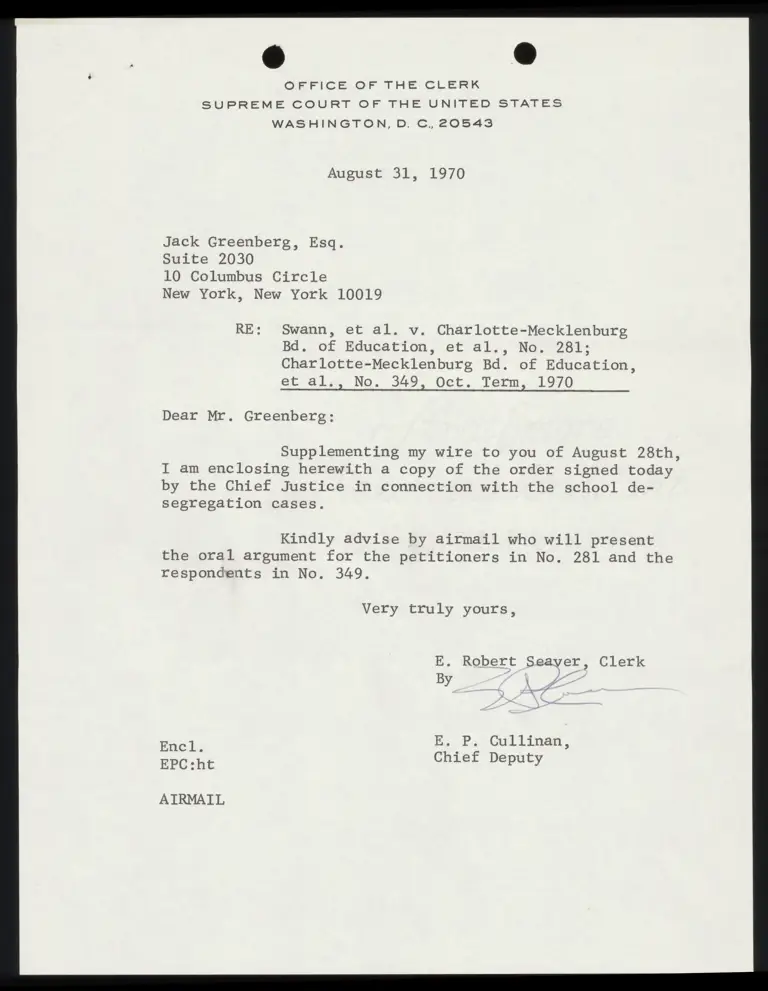
Correspondence from Clerk to Greenberg Re: Order to Set Oral Argument
Correspondence
August 31, 1970
3 pages
Cite this item
-
Case Files, Swann v. Charlotte-Mecklenburg Hardbacks. Correspondence from Clerk to Greenberg Re: Order to Set Oral Argument, 1970. d93e0541-2e34-f111-88b4-0022482cdbbc. LDF Archives, Thurgood Marshall Institute. https://ldfrecollection.org/archives/archives-search/archives-item/1cd0bf65-587c-44b2-98e3-013c9e40fc01/correspondence-from-clerk-to-greenberg-re-order-to-set-oral-argument. Accessed June 02, 2026.
Copied!
[||43448bb1-83c6-44f5-898a-9536bc51b748||] OFFICE OF THE CLERK
SUPREME COURT OF THE UNITED STATES
WASHINGTON, D. C, 20543
August 31, 1970
Jack Greenberg, Esq.
Suite 2030
10 Columbus Circle
New York, New York 10019
RE: Swann, et al. v. Charlotte-Mecklenburg
Bd. of Education, et al., No. 281;
Charlotte-Mecklenburg Bd. of Education,
et al,, No, 349, Oct. Term, 1970
Dear Mr. Greenberg:
Supplementing my wire to you of August 28th,
I am enclosing herewith a copy of the order signed today
by the Chief Justice in connection with the school de-
segregation cases.
Kindly advise by airmail who will present
the oral argument for the petitioners in No. 281 and the
respondents in No. 349.
Very truly yours,
E. Robert Seayer, Clerk
By |
E, P., Cullinan,
Chief Deputy
NOTICE TO COUNSEL
Cases are not assigned for a day certain nor aré* they
called until actually reached for argument. The Clerk
informs counsel as to the day they must be present and
the case upon which they are in attendance is usually
heard that day or the following day.
The Court convenes at 10 a. m. and, except on days
when there may be opinions to be announced, the argu-
ment of cases begins immediately after admission of
attornevs to practice.
The names of counsel who will argue and the order in
which they will appear, if more than one on a side,
should be given to the Clerk as soon as determined.
Those who will argue must register with one of the clerks
in Room 102 prior to entering the Court Room to aw;
the call of their case. Identification cards will be iss
authorizing occupancy of the tables directly behind Con
sels’ tables when argument in the preceding case begins.
Counsel should remain seated at these tables while the
preceding case is being argued.
In cases on the Summary Calendar but one counsel
may argue on each side and his time is limited to one-
half hour. In other cases the time is one hour for each
side and two counsel are permitted to speak although
divided arguments are not favored. (Rule 44.)
Signal lights on the lectern are emploved to inform
counsel when time has expired. A white light appears
when five minutes remain and a red light when time has
expired. The red light alone indicates the arrival of the
12 to 12:30 luncheon recess and the 2:30 adjournment.
When counsel desire to save time for rebuttal or when
time is to be prorated in the case of a divided argument
arrangement may be made with the Marshal, prior to
the time case is called, to have an appropriate signal
flashed at a specified time. Where counsel have agre
to a division of the time for argument, the use of )
time by one attorney does not extend the total time
allotted. Inquiry should not be made of the Chief
Justice as to amount of time remaining.
Counsel in cases being argued at or after the luncheon
recess may make luncheon arrangements with the
Marshal before 10:30 o’clock.
Admissions to the Bar are entertained each day the
Court is in session. If not previously admitted counsel
who plan to argue may be admitted on the d: ay their case
is he: provided the necessary application papers have
been filed and approved. JouN F. Davis, Clerk.
Add eo
ress Be -
Eee ————
Br ——————
Be... i
°
——— SOR ——
| i [||43448bb1-83c6-44f5-898a-9536bc51b748||]