First Mississippi School Desegregation Suits Filed
Press Release
March 8, 1963
-
Press Releases, Loose Pages. First Mississippi School Desegregation Suits Filed, 1963. 56adb748-bd92-ee11-be37-6045bddb811f. LDF Archives, Thurgood Marshall Institute. https://ldfrecollection.org/archives/archives-search/archives-item/1d109b07-bb9c-43e6-9a50-9dba7dab2933/first-mississippi-school-desegregation-suits-filed. Accessed October 09, 2026.
Copied!
    PRESS RELEASE®@ @

NAACP LEGAL DEFENSE AND EDUCATIONAL FUND
TOCOLUMBUS CIRCLE + NEW YORK19,N.Y. © JUdson 6-8397

DR. ALLAN KNIGHT CHALMERS JACK GREENBERG CONSTANCE BAKER MOTLEY
President Director-Counsel Associate Counsel

=> s

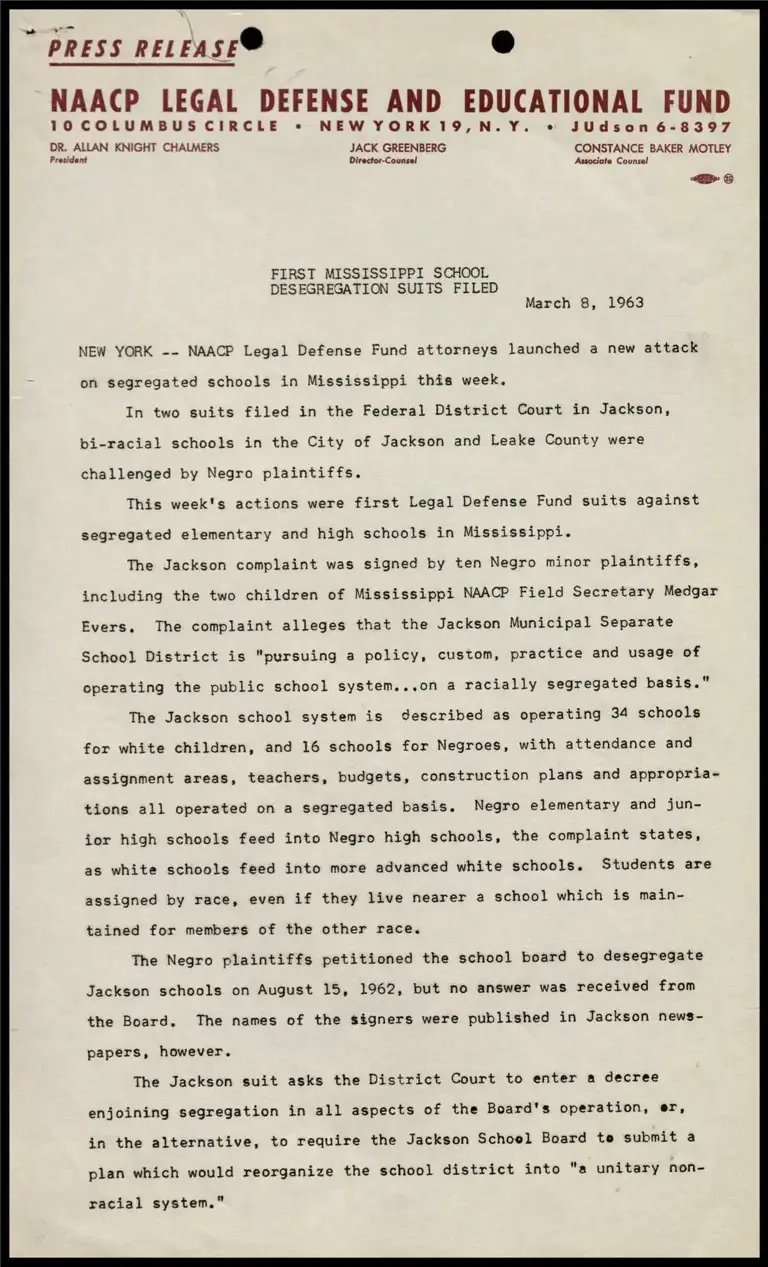
FIRST MISSISSIPPI SCHOOL
DESEGREGATION SUITS FILED

March 8, 1963

NEW YORK -- NAACP Legal Defense Fund attorneys launched a new attack

on segregated schools in Mississippi this week.

In two suits filed in the Federal District Court in Jackson,

bi-racial schools in the City of Jackson and Leake County were

challenged by Negro plaintiffs.

This week's actions were first Legal Defense Fund suits against

segregated elementary and high schools in Mississippi.

The Jackson complaint was signed by ten Negro minor plaintiffs,

including the two children of Mississippi NAACP Field Secretary Medgar

Evers. The complaint alleges that the Jackson Municipal Separate

School District is "pursuing a policy, custom, practice and usage of

operating the public school system...on a racially segregated basis."

The Jackson school system is described as operating 34 schools

for white children, and 16 schools for Negroes, with attendance and

assignment areas, teachers, budgets, construction plans and appropria~

tions all operated on a segregated basis. Negro elementary and jun-

ior high schools feed into Negro high schools, the complaint states,

as white schools feed into more advanced white schools. Students are

assigned by race, even if they live nearer a school which is main-

tained for members of the other race.

The Negro plaintiffs petitioned the school board to desegregate

Jackson schools on August 15, 1962, but no answer was received from

the Board. The names of the signers were published in Jackson news-

papers, however.

The Jackson suit asks the District Court to enter a decree

enjoining segregation in all aspects of the Board's operation, er,

in the alternative, to require the Jackson School Board to submit a

plan which would reorganize the school district into "a unitary non-

racial system."


Thirty Negro minor plaintiffs signed the Leake County Complaint.

Almost all of the plaintiffs are from the Negro community of Harmony

Miss., about 65 miles northeast of Jackson and ten miles from

Carthage, the largest city in the county. Slightly more than 50% of

the county residents are Negro.

The complaint points out that: 1) Negroes are assigned to Negro

schools located further from their homes than schools limited to

whitesj and 2) all curricula and extra-curricular activities are

provided on a racially segregated basis, in addition to bus transpor-

tation.

The Leake County plaintiffs first petitioned the County School

Board for desegregation on February 23, 1962. They received no reply

from the Board, but during March 1962, Mr. O. E. Jordens, Principal

of the Negro High School in Carthage, personally wrote each of the

petitioning parents telling of the advantages of segregated schools

and urging them not to take further action because the white community

would react adversely to such efforts.

In August 1962, the parents sent a second petition to the

Board, but have still received no answer. During the height of the

University of Mississippi controversy last fall, on the nights of

October 4th and 5th, the homes of two of the plaintiffs, Mr. James

Overstreet and Mrs. Ruthie McBeth, were shot into.

The Leake County complaint asks, as in the Jackson case, that

the District Court enjoin all segregation in the operation of the

County school system, or that the Board be required to submit a plan

which would establish a "unitary nonracial system."

Local NAACP Legal Defense Fund attorneys are Jack Young of

Jackson, for the Jackson plaintiffs, md R. ZJess Brown of Vicksburg,

Miss. for the Leake County plaintiffs.

Other Legal Defense Fund attorneys are Jack Greenberg, Constance

Baker Motley and Derrick A. Bell, Jr., of New York City.

HHH