Anderson v. City of Albany, GA Transcript of Record Volume VI
Public Court Documents
September 26, 1962 - February 14, 1963
-
Brief Collection, LDF Court Filings. Anderson v. City of Albany, GA Transcript of Record Volume VI, 1962. c4f2b451-ac9a-ee11-be37-00224827e97b. LDF Archives, Thurgood Marshall Institute. https://ldfrecollection.org/archives/archives-search/archives-item/1ddb67ed-327a-4979-ba56-fe026456fd67/anderson-v-city-of-albany-ga-transcript-of-record-volume-vi. Accessed October 28, 2026.
Copied!
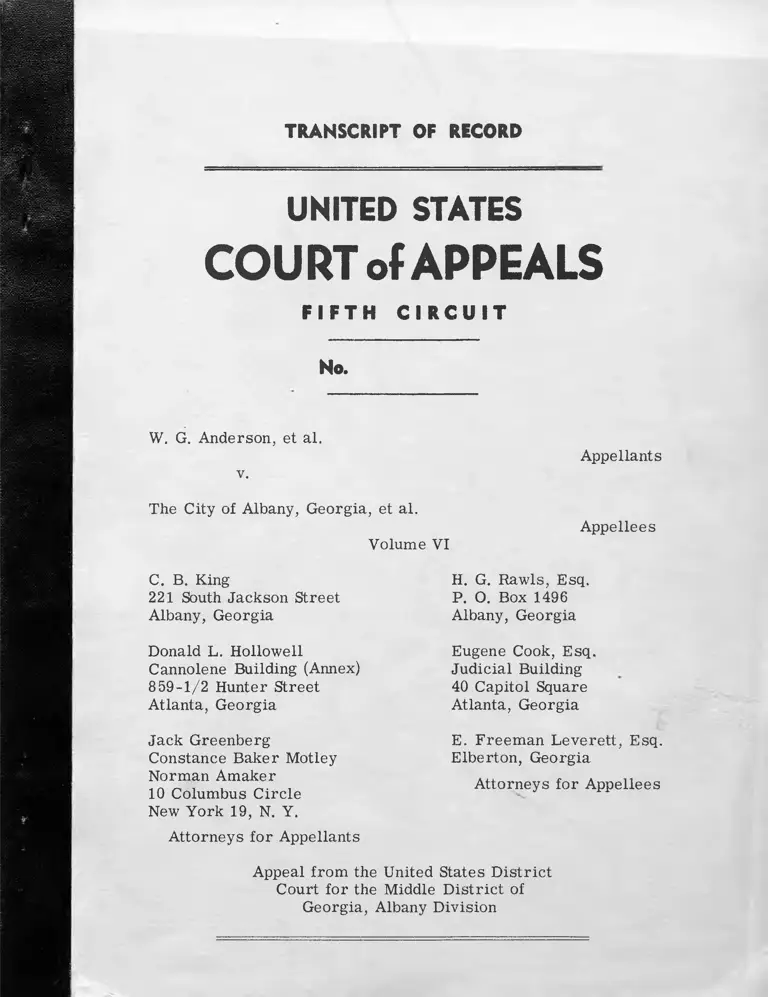
TRANSCRIPT OF RECORD
UNITED STATES
COURT of APPEALS
F I F T H C I R C U I T
No.
W. G. A nderson, et al.
v.
C. B. King
221 South Jackson S treet
Albany, G eorgia
Donald L. Hollowell
Cannolene Building (Annex)
859-1/2 H unter S treet
A tlanta, G eorgia
Jack G reenberg
Constance B aker Motley
Norm an A m aker
10 Columbus C ircle
New York 19, N. Y.
A ttorneys fo r A ppellants
A ppellants
A ppellees
H. G. Rawls, Esq,
P. O. Box 1496
Albany, G eorgia
Eugene Cook, Esq.
Jud ic ia l Building
40 Capitol Square
A tlanta, G eorgia
E. F reem an L ev ere tt, Esq.
E lbert on, G eorgia
A ttorneys fo r A ppellees
The City of Albany, G eorgia, et al.
Volume VI
Appeal from the United S tates D is tr ic t
Court fo r the Middle D is tr ic t of
G eorgia, Albany Division
I N D E X
(Volume VI)
Page
HEARING ON MOTION FOR PRELIMINARY
INJUNCTION, Nos. 730. 731 --------------------------- 199B
Testimony of Mr. Pat Phillips
Direct Examination ------------------------ 199B
Cross Examination------------------------- 205B
Testimony of Mr. James M. Robinson
Direct Examination ------------------------ 211B
Cross Examination------------------------- 218B
Redirect Examination ---------------------- 229B
Testimony of Mr. Rodney H. Blalock
Direct Examination ------------------------ 230B
Cross Examination------------------------- 237B
Redirect Examination ---------------------- 270B
Testimony of Mr. Leslie Summerford
Direct Examination ------------------------ 271B
Cross Examination------------------------- 278B
Redirect Examination ---------------------- 289B
Testimony of Laurie Pritchett, Chief of Police
Direct Examination------------------- 291B
Cross Examination--- --------------------- 295B
Redirect Examination --------------------- 301B
Defendants’ Exhibits-------------------- ------- 302B
Testimony of Mr. C. B. King, Attorney
Direct Examination------------------------ 304b
Cross Examination------------------------- 308b
Plaintiffs’ Exhibits --------------------------- 31^B
Testimony of Dr. W. G. Anderson, recalled
Recross Examination ---------------------- 315B
OPINION AND OR D E R ---------------------------------- 324B
NOTICE OF APPEAL------------------------------------ 329B
199B
Hearing on Motion For Preliminary Injunction, Nos. 730, 731
ALBANY, GEORGIA,
9:30 A. M.
SEPTEMBER 26, 1962:
THE COURT: All right, I believe the Plaintiffs
had rested, and you may proceed for the Defendants at
this time.
MR. BURT: Call Mr. Pat Phillips please to
the stand.
MR. PAT PHILLIPS
1 st witness called and sworn in
behalf of Defendants, testified
DIRECT EXAMINATION
BY MR. BURT:
Q For the record, will you give us your full name?
State your full name?
A Well, my full name is Ernest Vandousen Phillips
but Pat just for a nickname, Pat.
Q Will you speak up just a little bit louder, Mr.
Phillips? Where do you live?
A Here in Albany.
Q Whereabouts?
A 1308 Seventh Avenue.
Q And how long have you lived here?
A Oh about 17 years.
Q What business are you in or what is your occupation?
A Service station attendant now.
Q Mr. Phillips, I direct your attention back to
January 12, 1962 and ask you did you witness any Incident at the
intersection of Broad and Washington here in Albany, with
200B
Hearing on Motion For Preliminary Injunction, Nos. 730, 731
reference to a Cities Transit bus driver and a colored girl?
A Yes sir.
Q Where were you at this time, Mr. Phillips?
A I was on the bus.
Q, Where were you seated?
A Right behind the driver. There's two long seats
you know on each side before the short ones start.
Q. Do you know the name of this colored girl?
A Ola Mae Quarterman.
Q, Will you relate for us, please, what occurred in
your presence?
A Well, Ola Mae got on the bus on East Thomas Avenue
and come on to town and sit down right on the first seat, the
first short seat.
Q How far was this from where you vie re sitting?
A Oh, about like between me and that man (reporter)
right there.
Q, How far would you estimate that to be, about 4 or 5
feet?
A No, it wasn't 5. About 3 or 4 feet.
Q Did anything occur from the time she got on the bus
until they arrived up town?
A No sir.
Q Well, what, if anything, occurred at the time they
did arrive downtown?
A Well, when the bus driver got there and stopped
right at the corner of Broad and Washington, he got up out
of his seat and walked back there and asked, told Ola Mae,
20133
Hearing on Motion For Preliminary Injunction, Nos. 730, 731
said "Now, girl, the next time you get on the bus, get on
In the back".
Q, What did she say?
A Well, he turned around and come on back up to the
driver's seat there and she jumped up and run up there and
just went to shaking her finger in his face, and said "I paid
my money to ride this bus and I ride any Goddamn where I
want to and you can’t - ain't nobody can keep me from it."
Q What did the bus driver say?
A He never said a word to her. And something was
said about a badge, a little badge she had on.
Q, That Ola Mae was wearing?
A Yes sir, that she was wearing.
Q What was said about the badge?
A I never understood that; something was said about
little badge she was wearing. I don't know what kind of badge
it was or nothing, and I was setting right there and she was
right there In front of me.
Q How far away was she from you at that time?
A Oh, she wasn't - nearly about almost even.
Q, What did she say?
A She said "I'll wear this badge just as long as I
Goddamn please and ain't nothing you can do about it." And
the bus driver didn't say nothing. And she just kept cursing
and said, "You can tell them all just to kiss my Goddamn ass."
Q, She said "You can tell them all to kiss my Goddamn
ass"?
202B
Hearing on Motion For Preliminary Injunction, Nos. 730, 731
A Yes sir.
Q. And what did he do?
A He just walked - stepped out the door and called
the police right at the back of the bus there right at the
corner.
Q And what happened?
A Well, the police come and got her off of the bus
and taken her on.
Q Now, I want to ask you whether certain statements
made by Ola Mae Quarterman are true or not: Her testimony
was that after she got into the bus —
MR. HOLLOWELL: Now, if it please the Court, I
submit that counsel would not be in position to read
and identify what her statement was. If he is seeking
to prove, he can ask whether or not she made a particular
statement.
THE COURT: I agree. Suppose you —
MR. BURT; I'll ask It over.
THE COURT: If that's the purpose of your
question, suppose you follow that procedure; simply read
the statement and ask him if she made such a statement.
MR. BURT: All right, that's what I was
planning to do.
Q When she got on the bus, did the bus driver actually
pull off very fast, throwing her out of balance, forcing her
into the nearest seat?
A No sir.
203B
Hearing on Motion For Preliminary Injunction, Nos. 730, 731
Q, How far was she or how far did she sit from where
deposited her money in the bus?
A Oh, it wasn't as far as from me to you.
Q What do you say?
A The first seat, she sat down in the first seat.
Q The first seat?
A Yes sir.
Q What do you say as to whether or not she was seated
before or after the bus started?
A Oh, she was seated away before the bus started.
Another girl got on and went on in the back and sat down.
She come in first and the other girl come in and went on
to the back and set down, and she set down in the first seat.
Q When the bus pulled up at Washington and Broad
downtown, did the bus driver halt the bus very fast?
A No sir, he pulled up right behind another bus.
Q Did he jump up and come directly to her?
A He got up. He didn't jump up; he just got up and
walked - just turned around to her.
Q Did he jump up very rapidly?
A No sir.
Q Did he^t over her and shake his finger In front
of her face?
A No sir.
Q And tell her anything?
A No sir.
Q Did he ever raise his voice?
20 4B
Hearing on Motion For Preliminary Injunction, Nos. 730, 731
A Not no more than I'm raising mine right now. He
didn’t raise his voice a bit. He just said, "Girl, the
next time you get on the bus, get on to the back".
Q Did he stick his head out of the bus and scream
for a policeman?
A No, he stepped out of the bus. The policeman was
right there.
MR. HOLLOWELL: If It please the Court, I think I
still have to object to this line of testimony. In the
first place, it’s leading. This is his witness. He can
ask him what he did do, and I would submit that for him
to lead in this particular matter Is leading and would
be improper.
MR. BURT: Your Honor please, I asked him the
question, whether or not he screamed for a policeman.
I believe that would not be a leading question, but
simply asking him whether he did or did not.
THE COURT: It might be slightly leading, Mr.
Hollowell, but the purpose of his examination is to test
his recollection about particular details, he’s asking
for the witness’ recollection about a particular detail.
I think I will allow the question.
Q Mr. Burt: Did or did not the driver scream
for a policeman?
A No sir, he just stepped out and called a policeman.
He was right at the back of the bus and he just motioned
to him, said "Come here."
205B
Hearing on Motion For Preliminary Injunction, Nos, 730, 731
Q There was a policeman right there?
A Right there at the corner, right on the corner,
yes sir,
Q I believe that's all.
CROSS EXAMINATION
BY MR. HOLLOWELL:
Q Just a couple of questions, Mr. Phillips: Your
statement was to the effect that Ola Mae Quarterman sat
down and said nothing?
A No.
Q Until she got to Washington Street, at which time
she hao. still said nothing, until the driver came over to
where she was, and said to her, "Next time you get on this
bus, you get on, on the back," is that correct?
A That's correct, just asked her, said "next time
you get on the bus, get on in the back, back there."
Q Now, let me ask you this: Have you ever seen other
people get on, on the back?
A Yes sir.
Q What was the color of those people who get on
on the back?
A I've seen white people back there.
MR. BURT: Now, if Your Honor please, we
object to that, as to what ne may have seen on some
other occasion. We put this witness up for Impeachment
purposes for one particular Instance, and we submit
that he should be questioned about this incident.
20 6B
Hearing on Motion For Preliminary Injunction, Nos. 730, 731
THE COURT: Well, I think counsel is trying
to get at what the significance of the suggestion was
and I think it's proper line of questioning. He said
that he'd seen white people and colored people get on
in the back. Is that what you said?
A The Witness: Not on in the back, no sir; they
get on in the front and go to the back.
THE COURT: Get on in the front and go to the
back?
A The Witness: Yes sir.
THE COURT: All right, go ahead, Mr. Hollowell.
Q Mr. Hollowell: Have you ever seen white people
sitting back in the back with Negroes?
A No, I've seen him move white people up to give
them room to sit.
Q As a matter of fact, this is the pattern, is it
not, so that Negroes and whites are not sitting together
and if there are spaces in the front and no spaces In the
back, then they move white people up, so that the Negroes
can move into the back seats and vice-versa; that is, if
there are spaces in the back and it's congested in the front,
then you have seen them move Negroes back in order to let
the white people take those seats, is that correct?
A Yes sir.
MR. BURT: Here again, if Your Honor please,
I would like to interpose objection that he's asking
for what the policy Is and he hasn't qualified as any
2C7B
Hearing on Motion For Preliminary Injunction, Nos. 730, 731
expert on the regulations governing the seating of
passengers on busses; and we feel that if he is trying
to elicit an answer with respect to the driver asking
Ola Mae to sit in the rear, that’s all right, but now
he's going into the policy and custom and we object to
it, Your Honor please.
THE COURTS No, I think his intention was to
show what the significance was in the suggestion that
she go to the back and I think it's proper line of
questioning.
Q Mr. Hollowell: I believe your answer to that
question was "Yes" to that question?
A I've seen him move white folks and colored folks.
Q Move white folks forward in order for Negroes to
take the seats in the back, and move Negroes back where
there were empty seats in the rear, in order for white people
to take seats because all of the seats in the front part of
the bus were taken by other white people; that's what you've
seen, is that right?
A Yes sir.
Q You are a frequent user of the busses, are you not?
A Oh, I've rode them a good bit.
Q And at no time in your recollection have you ever
seen Negroes sitting in front of white people?
A No.
Q And how long have you been riding the busses?
A Oh, I've rode them off and on ever since they've
been here.
208B
Hearing on Motion For Preliminary Injunction* Nos. 730* 731
Q. As a matter of fact* there have been many occasions
or some occasions* have there not* when you haie seen the
driver ask other Negroes to move to the back* isn't that
correct?
A Yes* that's correct.
MR. HOLLOWELL: I believe the witness — I have no
further questions of the witness.
MR. BURT: That's all. May this witness be
excused?
BY THE COURT:
Q I have a question I want to ask him: On these
instances where the suggestion has been made that colored
people move to the rear of the bus and white people move to
the front* or vice versa* that suggestion has always been made
by the driver of the busj is that who has made the suggestion?
A Yes sir.
Q Hie bus driver?
A Yes sir.
Q Has there been a City policeman of the City of
Albany?
A No sir.
Q It hasn't been a City policeman but a bus driver?
A The bus driver, yes sir.
THE COURT: All right.
BY MR. HOLLOWELL:
Q Let me ask him one other question: Have you ever
seen a policeman stop the bus in order to make or to have
Negroes to shift to the rear?
209B
Hearing on Motion For Preliminary Injunction, Nos. 730, 731
A No sir.
Q You have not seen that?
A No.
Q That is, just by hollering back and telling them
or while at some stop telling them to move back?
A I haven’t seen no policeman tell one at all.
Q Did I say policeman, I didn’t mean policeman, I
meant the driver?
A You said policeman.
0, I mean the driver. Would you strike that, Mr. Join
er, and let me ask the question again, Mr. Phillips: Have you
ever seen the driver stop the bus for the purpose of shifting
the passengers, so as to make room for Negroes to sit In the
back and for white people in the front?
A No, I ’ve never seen him stop the bus for that
cause.
Q These occasions to which you make reference have
been occasions where maybe the bus driver would do this by
just turning his head and saying it or maybe doing it at a
stop somewhere?
A At a stop, that’s right.
Q Is that?
A That’s right, at a stop, when he stops to take on
more passengers.
Q. Did the driver who stopped the bus on the occasion
that you testified about involving Miss Quarterman, did he
get off of the bus?
210B
Hearing on Motion For Preliminary Injunction, Nos. 730, 731
A He got off when he went to call the police, just
stepped down at the door and called the police right there.
Q Now, did he move away from the bus?
A No.
Q How far was the policeman away?
A Right about the back of the bus. The back of the
bus was nearly about right at the corner. There was a bus
ahead of him and he was the last bus, and policeman standing
right on the corner nearly about right at the back of the bus.
Q Now, how far were they from the actual area where
the busses stop at the time that he brought the bus to a stop?
A How far was he from where the busses stop?
Q Yes?
A He stopped at the bus stop.
Q He stopped right at the bus stop?
A Yes sir.
Q And there was a bus In front of him?
A Yes sir.
Q And the policeman was standing right there?
A Yes.
Q And he immediately got off and summoned the police
man?
A After she went to cussing and all, he just got off
and called the police.
Q And this was all after he told her -
A Yes.
Q. - that the "next time you're to get on on the back
of the bus"?
211B
Hearing on Motion For Preliminary Injunction, Nos. 730, 731
A
the back.
Q
A
Q
That's right, not get on in the back but to go to
That she would go to the back?
Yes, just asked her to go to the back.
No further questions.
THE COURT: All right, you may go down.
MR. JAMES M» ROBINSON
2nd witness called and sworn in
behalf of Defendants, testified
DIRECT EXAMINATION
BY MR. BURT:
Q Will you state your name to the reporter, sir?
A James M. Robinson.
Q Mr. Robinson, what is your occupation?
A I'm a newspaper editor.
Q, And how long have you been in the newspaper busi
ness?
A 26 years,
Q, Where do you live?
A Albany, Georgia.
Q How long?
A About 30 years.
q Do you occupy any position with the Board of
Trustees of the Carnegie Library here in Albany?
A I'm a member.
Q And how long have you been a member?
212B
Hearing on Motion For Preliminary Injunction, Nos. 730, 731
A Since some time in the 40's; I think since ’40,
I ’m not exactly certain.
Q Now, what library facilities does your library
board provide here in Albany for the white and colored
citizens?
A The main Carnegie Library by custom is used by the
white population. It is located near the downtown area on
the space adjoining the Municipal Auditorium. There is a
branch library that has been established for Negroes on
Lee Street.
Q How recently has this Lee St. branch been estab
lished?
A This particular branch building was built part
of last fall and early this spring and dedicated some time,
I believe, in April of this year.
Q How long have you had a branch for the colored
citizens of Albany?
A Since 1948.
Q And where was that until recently?
A In Monroe High School.
Q Was it later changed from Monroe High School?
A Yes, the Board of Education requested the room space
we were using for the library facilities In the Monroe High
School and the branch library was moved to an adjacent build
ing, as I remember, that the City of Albany provided, and
was maintained there until this new library was built.
Q Mr. Robinson, what is the mechanics of a colored
213B
Hearing on Motion For Preliminary Injunction, Nos. 730, 731
citizen who wants a certain book which Is not available at
their branch, what is the mechanics of their being able to
use any book in the white library or the colored library?
A Well, they will simply request their book from
the librarian of the colored branch, Moses Faison, he
would telephone the main library and that book would be
provided for him immediately.
Q Do you have any data, Mr. Robinson, with respect
to the number of books in the colored branch?
A Yes.
Q As compared to the white?
A Yes, If I may refer to these notes -
Q Yes?
A - that the librarian prepared for me. The books
now in collection at the Lee Branch number 4,625. The
original number of books placed there when the branch was
established was 7*032.
Q, What's happened to the balance?
A Some of these books are mis sing; as you can see,
it's a fairly high attrition rate. I checked with the
librarian on this and at the time that the Negro branch
was located in Monroe High School, some of these books vie re
reference works and apparently were retained by the teachers
there. That wouldn't be all of them but some of them.
Q What other data do you have there?
A Well, the books now in the main library total
48,328. There are 30,570 members of the main library and 181
members of the Lee branch.
2l4B
Hearing on Motion For Preliminary Injunction, Nos. 730, 731
Q Say that again, how many at the main library?
A 30,570.
Q That would be white citizens?
A That's correct.
Q And how many colored citizens?
A l8l registered with the Lee branch. These were
as of —
Q That’s the number that have applied for membership
at the colored branch?
A That’s correct.
Q, 181 in the County of Dougherty?
A That’s correct. These figures are as of the
Library Board’s annual report to the City Commission as
of August 31 of this year.
Q I see. All right sir, go ahead?
A The circulation in the main library for the past
fiscal year ended with this period, August 31# 279#277.
Circulation in the branch library in the past fiscal year,
14,5^1 books. Fines collected at the main library, $2,690—
MR. HOLLOWELL: May It please the Court, I submit
that all of this statistical data might be important
In some aspects of some other case, but I certainly
can’t see where it has any relevance here. We’re not
determining what is the pattern insofar as the use that
is made and the administrative processes relating to
internal aspects. But the question is whether or not the
facilities are available.
215B
Hearing on Motion For Preliminary Injunction, Nos. 730, 731
MR. BURT: You Honor please,the Plaintiff
Anderson testified on more than one occasion that the
facilities for the colored citizenry were woefully
Inadequate, and we are trying to show what facilities
we do have, and what facilities the colored citizens
do have here. And I think that this gives us the back
ground. We have some pictures of the colored branch and
I think it will go, if for no other reason than that,
to Impeach the Plaintiff Anderson.
THE COURT: Yes, I do recall his testimony
about the Inadequacy and so on. I don't know really
whether that was particularly material but, since that's
in the record, this won’t do any harm, as I see it, to
let it go In. So, go ahead.
Q. Mr. Burt: Go ahead?
A There's only one other item of the fines collected
at uhe main library, $2,693.40j and fines collected at the
branch library, $8.1 2 .
(Photographs identified and tendered to Plaintiffs'
counsel)
Q I hand you DEFENDANTS' EXHIBIT No. 1 and ask you
what that shows?
A It shows a picture of the Carnegie Branch Library
established this year on Lee Street.
Q At what cost was that building?
A The building cost was $20,124. The equipment
$5^000. The lot, the tract of land was owned by the City
216B
Hearing on Motion For Preliminary Injunction* Nos. 730* 731
of Albany and I have no estimate as to its real value.
Q DEFEND MTS' No. 2?
This is a photo looking south in the Lee StreetA
library.
Q
A
Q
And DEFENDANTS’ EXHIBIT No. 3?
Elis scene looks north in the same installation.
With reference to the membership of the Lee St.
branch* is it overcrowded in any way* as far as the membership
is concerned?
A Apparently not with l8l members registering there
for books. The facility is entirely adequate as far as space*
physical space and number of books.
Q Now* how are these two libraries geographically
located? Take first the Lee Street branch* whereabouts is
that?
A It’s in the southern part of the City.
Q In any particular neighborhood?
A I believe In the Carver* generally the Carver Park
Area. I believe It’s in that general area.
Q Is that in the white or colored section?
A That’s generally a colored section.
Q As far as the adequacy of the two libraries* have
you studied this adequacy of the libraries with reference
to population here in Albany?
A With a population of 55*000 in the City and
roughly 75*000 metropolitan area* I would say that -
217B
Hearing on Motion For Preliminary Injunction, Nos. 730, 731
MR. H0LL0WELL: Nov/, may it please the Court,
I object to that. There has been no determination
here that this man is an expert on what constitutes
adequacy or non-adequacy as relates to library facili
ties. Nothing here is indicated that he has had any
background in this particular whatsoever. This would
be a mere speculative opinion. Even the figures that
he has read are figures that were compiled by someone
else. It would be mere opinion, mere opinion.
MR. BURT: Your Honor please, he's been on
the Board of Trustees for 22 years. I think his
experience would certainly equip him for his opinion.
THE COURT: Well, I don't know that simply
membership on the library board would qualify him to
give an opinion on whether a library was adequate or
not. It would be my view that he would have to have
some particular training and qualification to testify
to that.
I®. BURT: We were attempting to show by
yardstick what number of books would be for number
of population which he has knowledge of.
THE COURT: Well, he hasn't been qualified on
that extent. Maybe he has the qualifications which
you haven't brought out. But so far the only thing that
appears Is that he's a member of the Board and that
wouldn't qualify him as an expert to express an opinion
about it.
2l8B
Hearing on Motion For Preliminary Injunction, Nos. 730, 731
Q Mr. Burt: Mr. Robinson, have you undertaken
to, in your service on the Board for 22 years, to make any
studies or reviews of the adequacy of libraries in attempting
to bring your libraries up to standard?
A Not other than to study the reports issued by the
American Library Association, the Georgia Library Association
and Southeastern Library Association. I don't pose as an
expert on library matters,
Q All right, sir. What is the comparison between
the physical plant of the Lee Street Branch and the main
library here downtown?
A Tiie new Lee Street branch is Just by rough rule
of guess about half as large, maybe not quite half as large
as the downtown Carnegie Library; that Is, as far as physical
floor space is concerned.
Q What about the facilities and equipment therein?
A The equipment generally speaking In the Lee Street
branch Is better. For example, they have steel racks for
books, which are now generally used by libraries everywhere,
and downtown the old wooden types are used. Of course, the
downtown library was built in 1906 and most of its facili
ties are the same as they were, I suppose, when it was
opened.
MR. BURT: I believe that’s all.
CROSS EXAMINATION
BY MR. C. B. KING:
Q Mr. Robinson, I believe you indicated that you were
Hearing on Motion For Preliminary Injunction, Nos. 730, 731
a member of the Board of Trustees of Carnegie Library for
a period of 22 years, is that correct?
A I didn’t pin-point it exactly. I said I was appoint
ed some time in the '40's, I believe 1940, but I ’m not
certain of the date.
Q And I believe you further indicated over that
rather protracted period, the custom has been that the
Carnegie Library in use is relegated to white citizens
of this community?
A That is correct.
Q And, of course, the Negroes have had another
segregated facility, is that correct?
A That is correct, since 1948, when it was established
Q, When was - when what was established?
A The branch library for Negroes.
Q But even prior to that time Negroes were not
permitted to use the Carnegie library?
A Not to my knowledge.
0. And, as a matter of fact, based on your residence
in this community, prior to 1948 they had not, is that correct?
A That’s correct.
Q Now, you s aid a moment ago that this was the
customj certainly by that you mean that this was a custom
which was enforced by the City of Albany and the avowed
policy of the Board of Trustees of the Carnegie Library,
is that correct, sir?
A What I ’m saying in reference to custom is -
220B
Hearing on Motion For Preliminary Injunction, Nos. 730, 731
Q Excuse me, sir, would you answer the question?
A If you will state it specifically. I'm not sure
I know the sense of it.
Q I believe that your testimony is that this was the
custom, the segregated pattern?
A That is correct.
Q And I am now addressing your attention to whether
or not this custom that you make reference to, is that
dictated by the Board of Trustees of the Carnegie Library?
A Policy for the library is made by the Board of
Trustees, that is correct.
Q You still do not answer my question, sir?
A You're asking me specifically, if I can understand
you, did this particular policy of segregation or was it
dictated by the Board of Trustees?
Q This Is quite correct, sir?
A That would be hard for me to answer specifically.
When I was appointed to the Board, that custom was in force.
It has been In force since that time. That's all I can say.
Q And this custom has been enforced by the Board of
Trustees?
A That is correct.
Q Of the Carnegie Library?
A Yes.
Q And as a matter of fact, it presently is being
enforced, Is that correct?
A Yes, except the library is not open, as you know;
neither the downtown branch nor the Lee St. branch.
221B
Hearing on Motion For Preliminary Injunction, Nos. 730, 731
Q Then, up until such time as it was closed, it
was maintained?
A That is correct.
Q Now, as regards to this information that you bring,
Mr. Robinson, with reference to the status, the present
status of the library, whose decision was it that these
libraries would be closed?
A As a matter of personal knowledge, I can’t say.
They were closed on a week-end I happened to be out of the
City. I have subsequently learned that they were closed by
police action.
Q Now, you make mention of the facilities that have
been afforded In the community for Negroes, I believe,
as regards libraries?
A Yes.
Q And you made mention of the fact that there was
a library facility at Monroe Street High School?
A That’s correct.
Q As a matter of fact, Mr. Robinson, wasn’t that
library, as you designate, to accommodate the high school
students; is that correct?
A The library was to accommodate all Negroes, as I
understand It.
Q Then, it had a dual utility, Is that correct, sir?
A Whatever Interpretation you want to place upon
that statement. It was a branch library established for
Negroes, as I understand it.
222B
Hearing on Motion For Preliminary Injunction, Nos. 730, 731
Q For what, sir?
A It was a branch library established for Negroes.
It was not restricted to the use of the high school. It
was not a State Board of Education library. This was a
branch library -
Q But It was In the Dougherty County Board of Educa
tion facility, It was in the physical plant of the high
school, is that correct?
A Exactly.
Q Who was that Mr. Faison paid by during the time
of his tenure?
A Albany Carnegie Library.
Q Albany Carnegie Library?
A Yes.
Q, But it was inside of the physical structure?
A That is correct.
Q, Nov/, you make mention of the volumes that you have
in this library?
A. Yes.
Q I'm interested in knowing whether or not you can
give me the kinds of volumes that were situated therein?
A The type of books?
Q Yes?
A No, I have no information on that. I have only
the statistics furnished by the Librarian.
Q Then, it is inadequate in that regard, that Is
your statistical information, is that correct, sir?
A The statistical information is adequate. You
asked a question concerning the type of books. I have
Hearing on Motion For Preliminary Injunction, Nos, 730, 731
no information on that.
Q Then, to that extent your statistics are inadequate
A To that extent I have no information, that is
correct.
Q As a matter of fact, by the latter acknowledgement
you don't know, don't presume to know how many or at least
whether these books are archaic, tattered or anything like
that, is that correct?
A I have no knowledge.
Q You have no knowledge?
A No.
Q The only thing that you intended to convey by
the statistical designations in your report was the number
of volumes, is that right?
A Exactly.
Q But as to their character you know not?
A Nothing.
Q Now, you speak In terms of this facility at the
Monroe High School, I believe that you Indicated that sub
sequently it was moved?
A Yes,
Q, As a matter of fact, it was moved to Whitney
Avenue, which was across the street from the Monroe High
School, is that correct, sir?
A To the best of my recollection, as I remember,
the City owned a building or rented one there to house
this facility when the school system required the use
of the space we were occupying at Monroe High School.
224B
Hearing on Motion For Preliminary Injunction, Nos. 730, 731
Q As a matter of fact, that was a store building,
is that right, sir?
A Beg your pardon?
Q As a matter of fact, that was a store front,
isn't that right?
A I'm not familiar with it. I just know that a
facility was provided by the City. I don't know the
character. I never saw it.
Q Then, as a matter of policy, sir, that is being
a Board member of the Trustees of the Carnegie Library, it
is not the custom of the Board to inspect or otherwise
investigate a facility in which books of this library
will be put or placed?
A I think it is a custom. It so happens there
are seven members of the Board and I just happened to be
one of them who didn't inspect this particular facility.
Q I see. Then, I take it that maybe your work
requires you to not be able to attend many of the Board
meetings, sir?
A I think the minutes will show that I attend most
of them,
Q You attend most of them?
A Yes.
Q Well, in that regard, have you ever been confronted
by any Negro citizen of the Albany community with reference
to the desire to use this facility up here?
A I certainly have.
225B
Hearing on Motion For Preliminary Injunction, Nos. 730, 731
Q, And what was the attitude as expressed on the
occasions when Negroes did request the use of this before
the Board?
A There was only one such occasion before the
Board. In the spring of this year, April or May I don't
remember the exact date, there was a delegation headed -
of mostly young Negroes headed by Eddie Wilson, as I
remember, who petitioned the Board for an integration
of the library facilities. The Board referred -
MR. BURT: Your Honor please, we would like
to interpose objection here. This was not gone Into
on direct examination and we think that counsel should
limit his cross-examination to such testimony as we
brought out on direct. We went into simply a compari
son. They had brought up the point that the Lee branch
was woefully inadequate. And now he's going into all
of the incidents that may have occurred with reference
to the library and we did not go into this.
MR. KING: If Your Honor pleases, I believe
that one of the admitted purposes on the part of
opposing counsel In interrogating the witness was
to establish policy and I would respectfully submit
to the Court in that regard that this is a logical
extension of establishing what was the policy.
MR. BURT: We submit, Your Honor, that if
he wants to call this witness, that would be up to him.;
but I should that he should cross-examine him about
226b
Hearing on Motion For Preliminary Injunction, Nos. 730* 731
the very points that we brought up, which was impeach
ing and rebuttal testimony, of testimony that they had
brought out on their direct examination of the Plain
tiff, Anderson.
THE COURT: I think I will allow the question.
Go ahead.
A The Witness: I don't remember the question,
MR. KING: Would you read the question, Mr.
Joiner, please.
THE H3P0RTER: "Question: And what was the
attitude as expressed on the occasions when Negroes did
request the use of this before the Board?"
A The Witness: As I was saying, I remember now,
there was one occasion in the spring of this year when a
delegation appeared before the Board to make a request
that the library facilities, that is the Carnegie Library
downtown be opened to Negroes. The Chairman of the Board,
Mr. James M. Meadows, advised the delegation that the
library had been segregated for many years and that the
policy of the Board was to let the City of Albany, which
is the main contributory political body, that Is in terms
of finances to the Library, render a decision on this
request. Therefore, they were referred to the City Manager
of Albany.
Q Mr. King: There was one other bit of
information — do you have the pictures?
227B
Hearing on Motion For Preliminary Injunction, Nos. 730, 731
THE COURT: Here they are.
Q, Mr. King: Thank you, Your Honor. I submit
D-l; a photograph which has been priorly presented to you
Mr. Robinson, and ask you whether you've ever had an occas
ion to visit that library?
A Yes, I have.
Q Have you ever driven an automobile out to the
situs of that library?
A My automobile?
Q Yes?
A No.
Q Have you ever ridden in the automobile of another
out there?
A Yes.5 I have.
Q As a matter of fact, in that area, it's muddy when
it rains and generally unpaved,* is that correct?
A The street is unpaved. I was there on a dry day.
Q Is that correct?
A It was not muddy.
Q, But you would certainly recognize that should it
rain that the general viscosity of mud to confront one
driving an automobile In that area, would confront one,
Is that correct?
A I think that would be a logical conclusion, yes.
Q I see. And on the contrary, one attempting to drive
a vehicle, of course, to the downtown library would not
encounter mud on a rainy day?
228B
Hearing on Motion For Preliminary Injunction, Nos. 730, 731
A Not on paved streets, no.
Q Are there any parking areas provided for the library,
sir, that is, as pictured here in Defendants * Exhibit #1?
A The Lee St. library?
Q Yes?
A There are none marked because there's no pavement
in that area. There is an adjacent area, I think as the
picture vd.ll show, I believe, on the left-hand side of the
building where automobiles could be parked, yes.
Q I would submit again, sir, Defendants' Exhibit No. 1
and I notice in this picture that you have these flood lights
extending upward behind the library; as a matter of fact,
that's adjacent to the ball park, is it not, sir?
A That is correct. There is a ball park in the rear
of the branch library.
Q Well, I mean it's really, it's the adjoining
property, is that correct, sir?
A That's correct.
Q And are there any windows at all in this library?
A No windows in the library, no,
BY THE COURT:
Q There are no windows in the building, you say?
A No sir.
Q, The building is completely air-conditioned?
A Yes sir, it is air-conditioned and heated, yes sir.
BY MR. KING:
Q, You talked about these volumes, I believe, on direct
229B
Hearing on Motion For Preliminary Injunction, Nos. 730, 731
examination that are depicted here. You do not intend to
suggest by any prior testimony that you've given that you
know the character of the volumes which are there depicted?
A No, with one exception. There are a set of standard
reference works in the Lee Street branch.
Q I see. One final question, sir: Do you know, Mr,
Robinson, the amount of money that's expended by the Carnegie
Library Board for supplies for the operation of the Albany
library, where that is concerned?
A For supplies only?
Q Yes?
A No, I don't have that data here. It is very readily
available at the downtown library.
Q, I have no further questions.
REDIRECT EXAMINATION
BY MR. BURT:
Q Mr. Robinson, what do you say with reference to
comparison between the two libraries as to parking space
availability?
A There Is one marked space, I believe; I believe
one, in front of the downtown Carnegie Library, with a very
short meter time, 15 minutes or something like that. I don't
recall exactly. That is the provision for the downtown
library on the public street. As I said, there are no marked
spaces, the Lee Street library being a dirt street.
Q Are there any other buildings adjacent, which wouJh
necessitate parking adjacent to the Lee St. branch?
A No, it's open on either side of the entrance.
230B
Hearing on Motion For Preliminary Injunction, Nos. 730, 731
MR. BURT: That's all.
THE COURT: All right, you may go down.
MR. RODNEY H. BLALOCK
3rd witness called and sworn in
behalf of Defendants, testified
DIRECT EXAMINATION
BY MR. BURT:
Q Will you state your name to the Court, please?
A Rodney H. Blalock.
Q Where do you live, Mr. Blalock?
A 1510 Maryland Drive.
Q What is your occupation?
A Superintendent of Recreation, City of Albany.
Q How long have you been so engaged?
A Since December of 1948.
Q 1948?
A Yes.
Q How long have you been in recreational work?
A Well, recreation and athletics coaching for 18
years.
Q What positions with what organizations have you
held with reference to athletics and recreation? What was
the nature of them?
A Well, I've been head coach and athletic director
at Americus High School, Terrell County High School, President
of the Georgia Recreation Society, on national advisory
committee of the National Recreational Association, and
officer in the Southeastern Recreation, executive.
231B
Hearing on Motion For Preliminary Injunction, Nos. 730, 731
Q What does your job as Recreation Director here
in Albany consist of?
A Well, itfs professional administrator of a
community recreation program, which Involves both super
vision, organization, planning and administrating and
programing.
Q Now, what is the policy of your Department with
reference to picnic areas as to assignment with respect
to colored or white citizens of Albany?
A Well, in our areas where picnic facilities are
available and because of Heavy traffic and large participa
tion during the picnic months, the summer months, we have
consistently made a policy of reserving areas according to
the number in the party, whether children were involved,
how much parking might be needed, and the best possible
place to facilitate other programs in progress at that time;
in other words, to keep from hindering or Interrupting other
programs.
Q What areas do you or what parks do you have picnic
areas in here in Albany?
A Well, in general, most of our parks have got
some. Some are limited and our larger parks have quite a few
areas.
Q Where is the largest area located?
A Tift Park is our largest recreation area and we
have some 20 or 25 picnic areas in that.
Q Now, where is Tift Park located?
23 2B
Hearing on Motion For Preliminary Injunction, Nos. 730, 731
A Tift Park is located between 6th and 7th Streets,
and between Jefferson and Monroe.
Q Now, is there any distinction made as to reser
vations for picnicking at Tift Park between the colored and
white citizens of Albany?
A No distinction made, no.
Q Now, how many pools do you have under your
supervision here?
A We have three.
Q, Will you tell us where they're located?
A We have one in the Tift Park area, we have one
in Tallulah-Massey Park.
Q Now, Tift Park, is that located In predominantly
white or colored section? Will you tell us?
A Yes, it's in the northern section of the City.
I xrould say it's predominantly a white residential area.
Q And I think you said Tallulah?
A Tallulah Massey Park, which is out In the east
on the expressway near 5-Points, located to the right of
the expressway going east,- and it is predominantly a white
residential area, And then, the Carver Park area, we have
a pool there, which is predominantly a Negro section.
Q Now, with reference to the colored facilities
at Carver Park, what do you say as to their adequacy or
inadequacy?
A Well, we have felt that they were most adequate.
I say that not only from my own viewpoint but they've been
233B
Hearing on Motion For Preliminary Injunction, Nos. 730, 731
recognized by both the Georgia Recreation Society, the
Georgia Recreation Association, and the National Recreation
Association as very fine facilities. Our Center there Is
one of the finest in the South, the largest and best equipped,
and Is recognized as one of the finest.
Q, You say "your center", Is that a teen center?
A Yes, it's a community center in that area.
Q, For the colored people?
A In that area. The pool Is 75 x 50 pool, which
normally suffices for a large community. And the athletic
area at Carver Park covers one, almost entire block. It is
one of our largest facilities in town. So, I personally feel
and, as I say, it’s been recognized by some agencies as one
of the finest recreation facilities In the South.
Q I hand you DEFENDANTS' EXHIBIT #4 and ask you
what that shows?
A This is a picture of our pool in the Carver
recreation area at Carver Park.
Q Now, I hand you DEFENDANTS' EXHIBIT #5 and #6
and ask you what these pictures show?
A These are pictures of the pool at the Tift Park
recreation area.
Q And DEFENDANTS' EXHIBIT #8?
A This is another picture of the Carver Park pool
in the Carver recreation area.
Q All right sir, do you have any records with you
as to your attendance for the last three years with respect
to these pools?
234b
Hearing on Motion For Preliminary Injunction, Nos. 730, 731
A Yes.
Q With respect to the Tift Park Pool and the Carver
pool?
A Yes, we run annual reports on all of our partici
pation in our areas, and the Tift Park pool is 460 gallonage
pool; the Carver Park pool is 130-gallonage; approximately
3250 square feet; Tift Park pool is 1200 square feet. And
according to the recommended area by pool builders and the
National Recreation Association per square footage per
swimmer, and according to our participation reports, the
swimming facilities are most adequate for the participation
that is carried on.
Q Have you ever had to deny people, colored people,
the use of the pool because of too big a crowd or more demand
than you could accommodate?
A No, we've never turned any one away, to my
knowledge. I ’m not at that pool consistently during Its
operation but, to my knowledge, we've never had to refuse
any one.
Q. Have you finished all of your figures there?
A Unless you wanted —
Q Just break it down, go all the way down, will you?
A Well, in 1939-60 our reports showed we had 46,291
swimmers at the Tift Park pool and 13,489 at Carver; in
60-6l, 44,905 at Tift Park and 12,887 at Carver. This past
season 31,603 at Tift Park, 11,733 at Carver swimming pool.
Q Now, with reference to your pool facilities at
23 5B
Hearing on Motion For Preliminary Injunction, Nos. 730, 731
Tift Park, what is necessary in order to be admitted to the
pool, what are the mechanics about going out there and being
admitted to the pool?
A Well, we charge at all of our pools and the
purchase of a ticket, which Is then presented to a bath
house attendant, who then allows entrance to bath-house
facilities, where normally certain rules are to be followed
within that bathhousej and then admittance Into the pool in
the swimming area.
Q Now, where do you purchase a ticket with reference
to the ticket taker?
A At the concession stand.
Q. How far Is that away from the ticket-takers
and the entrance to the pool?
A I would say approximately 40 to 50 feet, maybe
a little further.
Q Is it on the same side as the opening to the pool
or is it on a different side or direction?
A No, It’s out towards the playground area of the
Park and, of course, the pool and the bath-house entrance
is over In an area where no playground facilities are.
The concession stand, you understand, serves all of the
parks and it's up near the playground area.
Q Can an individual go to the ticket-taker and
gst a ticket to go into the pool?
A Yes, that's perfectly proper.
Q I mean, can he purchase a ticket at the ticket-
taker or does he have to go to the concession stand first?
236b
Hearing on Motion For Preliminary Injunction, Nos. 730, 731
A No, he has to go to the concession stand. The
ticket-taker has no money or has no responsibility or cannot
sell tickets.
Q Now, to your knowledge, has any one ever been
refused, whether white or colored, admittance to the Tift
Park pool who had purchased a ticket?
A No, we have never had one.
Q Now, what is your policy or custom - let’s take
Tift Park, with reference to segregation between the races,
as to whether it Is enforced or not, or just how do you handle
it? Take first your recreation facilities there at Tift
Park?
Q Well, there's been no real thought of it. It's
purely a matter - recreation is a voluntary thing. I mean,
they come seeking - to the park and It’s just where they
come to. I mean there’s been no reference to it or no
enforcing of any people having to go here or go there.
I mean the zoo, they come right through it. We have people
in there. And there’s been really nothing as far as thinking
about it. It's purely a voluntary thing as far as them
coming to the park.
Q What about your other programs like your midget
football and baseball programs, has there been any attempt
to keep anyone out of these programs because of color, race
or color?
A No, we operate a community program and within
the areas that we operate we offer that program to the
23 7B
Hearing on Motion For Preliminary Injunction, Nos. 730, 731
citizens. If Is wasn’t a voluntary thing, It wouldn't be
a recreation thing. You can't force --
Q Explain that, If you will?
A Well, you can't legislate a person's recreation
activities, any more than you could legislate his emotions
such as laughter and crying. I mean he laughs because he's
amused and because he wants to , not because somebody told
him to. And a person in a recreation activity must be on
leisure time. If it's not a leisure time activity, it can't
be classified a recreation activity. And companionship,
fellowship, general acceptance is a part of that individual's
enjoying that recreation activity. So, we could not possibly
say you can't or you must or you've got to go here or you've
got to go there, and have a recreation program, because
recreation is purely what the individual desires to do.
That's the only reason he seeks it, because that's what he
wants to do at that time, and he seeks It because it's some
thing he can do because he wants to do it, not because somebody
told him he had to do It.
I happen to know you like tennis but I bet if
you were forced to play tennis, you wouldn't like it near
as much.
MR. BURT: I believe that's all.
CROSS EXAMINATION
BY MR. HOLLOWELL:
Q Mr. Blalock, as you say there are about 20 to 25
picnic areas in Tift Park’
238B
Hearing on Motion For Preliminary Injunction, Nos. 730, 731
A I said areas. I had reference to picnic tables.
We consider them areas.
Q, About how far are they spread out?
A Well, we have them all over the section of the
park that no playground equipment is operated. We do not
have picnic tables in the Immediate area where the youngsters
are taking part on swings, slides and things like that.
Q Now, let me get some idea as to your functions
As the Director, you spend how much of your time at the Park
itself?
A That would be hard to determine. I visit It
every day and I try to visit all of the facilities every
day. I would say I spend much more time - do you have
reference to one specific park?
Q Well, let's take Tift Park?
A I would say I spend more time at Tift and on an
average probably two hours a day at that particular park.
Q And that's probably the most that you would spend
there any day?
A Probably that's a good average. It may run more.
Now, we have a swimming meet and I'm there all day. If we
have a special event, I'm there all day. It just depends
on the activities for that day.
Q But as a matter of function, job function,
you visit, you go from park to park, you're on callj so,
really you do not handle any specific recreation facility
with any park at any time, do you, as such,- you have people
hired for that?
239B
Hearing on Motion For Preliminary Injunction, Nos. 730, 731
A I have people hired to program but I do handle
some things personally. I mean, I don't have that many
hired.
Q, Do they make the applications to you for use of
the park areas, say for picnics?
A Yes, we get them through the mail to the recrea
tion office; and that comes to my office. Those are always
passed through my office If it's a mail one.
Q If it's mailed?
A Yes.
Q Now, If someone wants to use certain of the
Park facilities, say for picnic purposes, they can come
directly out to the area?
A Right.
Q And who would be the person at your office,
since you are only there, since you're only there say a
couple of hours a day at Tift Park, who would be the person
that one would address themselves to?
A Well, if they came to the office?
Q To the office?
A And I was not there, it would be my secretary.
Of course, If it was by mail, she would just leave it on
my desk and she would try to refer them to where I was, or
have me call them when I came back.
Q But isn't it true that, as a matter of fact, if
a person comes out, he has a group with him now, you're
gone; you've been there your two hours and you're gone;
240B
Hearing on Motion For Preliminary Injunction, Nos. 730, 731
you were there from 8:00 to 10:00 and you won't be back today
in all probability because you have to make the other rounds,
and we want to use the park now that you see, the group of
persons, they can go in and talk to your secretary, and
say "we would like to have a reservation and we want to use
the park now, our group is here," and your secretary has
the authority to go ahead and assign them if there is space
available Is that not true?
A She would refer them to the manager of the
concession stand at the park, because she would not know
what areas were available or what programs. She is purely
a secretary as such, paper work, and she would not be familiar
enough with the program in the park at the time to assign
a reservation area.
Q, So, the manager then of the concession is the
person who has the authority to let the reservation?
A He has authority to make reservations, yes.
Q Is he a hired person or is he appointed?
A He's hired.
Q He's hired by whom?
A Well, actually, he leases the concession rights
from the City. He is paid by the City of Albany, is on my
staff as the seller of tickets and to handle the concession
stands and the pool area there at that particular park.
Q So, he has a dual capacity! he is both a lessee
or rather lessor and a - well, he's a lessee, he's a lessee
and also an employee of the City, is that correct?
241B
Hearing on Motion For Preliminary Injunction, Nos. 730, 731
A I would say —
Q He leases the concession from the City and yet
he is employed by the City, in order to perform certain
administrative functions as relates to the park - correct?
A Since we sell tickets out of his concessionaire,
his operating stand there, we pay him for handling these
tickets for us.
Q And you pay him also for handling the administra
tion of the park area, do you not?
A I would say no. Now, that’s never been brought
up. Let me clarify that: It’s never been brought up and
discussed. We pay him for handling tickets and he does the
other, because It’s to his benefit, the more people that are
in that park.
Q He does this with your approval?
A Yes.
Q So then, actually he’s sort of an ex-officio
assistant director insofar as the administration of that
park is concerned?
A He is the answer to your question about me not
being there or you not being able to get a reservation.
He Is there and he is there all the time.
Q, So, he’s de facto the assistant recreation
director?
MR. BURT: He’s what?
MR. HOLLOWELL: De facto.
MR. BURT: I think, Your Honor please, he
ought to explain that word to the witness.
242B
Hearing on Motion For Preliminary Injunction, Nos, 730, 731
MR. HOLLOWELL: The witness hasn't said that he
didn't understand the word.
A The Witness: He is not in any manner qualified
recreation profession, such as the other members of my
staff.
Q Mr. Hollowell: However, he does perform the
function which you have indicated?
A He performs no recreational programming or
recreational professional aspects of programming.
Q His Is purely administrative?
A That's right.
Q Now, these picnic areas, these 20 or 25, we're
still speaking of Tift Park as a matter of convenience for
the moment, how many toilet facilities do you have in that
total area?
A The entire Tift Park area?
Q, Yes, picnic area?
A Picnic area, three.
Q Are they marked as to color?
A No.
Q, Are you sure about that?
A Not to my knowledge, there are no signs on them.
Q To your knowledge?
A Yes.
Q You would't say that they are not any?
A Well, I suppose I shouldn't say they are not.
Q Now, have you ever known Negroes to be assigned
other than in the one general area there?
243B
Hearing on Motion For Preliminary Injunction, Nos. 730, 731
A What specific area do you have reference to?
Q To the general area which is on - let me get
my directions right - this Is generally on the western area,
the far western area; there on the far western area; this is
where Negroes are generally assigned, Is that correct?
A To my knowledge, they have been assigned to
areas east, I mean west and south of the road running in
front of the pool and through Tift Park; and to the west
and north of the road running through Tift Park and between
7th Street.
Q, So, that then Is generally In the western region
of the park?
A That's where our picnic areas, that’s where
our largest picnic areas are, on that side of the park.
Q, What's this on D-6 over here that’s to the right
that is just a prolongation of the bathhouse?
A Straight down this way?
Q, Yes, toward the top?
A This is the road that runs down through by the
zoo and goes up through the park, which divides our park
completely. We have another road that comes down, that is
Monroe comes right through the park, which you might say
gives us four sections of park. We have picnic areas In
three of those sections. And to my knowledge, we have
assigned Negro groups to the section to the northwest
quadrant of the park, to the north or to the southwest
quadrant of the park.
244b
Hearing on Motion For Preliminary Injunction, Nos. 730, 731
Q How many times have you known that to happen?
A I don't think I could give you an accurate count.
We have a tremendous amount of picknicking out there.
Q. I see.
A I just say that I've seen them in those areas,
so I knew they were assigned to those areas.
Q, All right, so this is the northwest and the
southwest; in other words, to one extreme or the other.
Now, that's just two of the quadrants; you’re saying that
you have never seen any In the northeast nor in the south
east quadrant?
A The southeast would contain your pool, your
playground area. I would say that the north or the southwest
quadrant Is our largest picnic area. Then, the northeast
quadrant, if you could call It that, but it's just across
the road from that one, Is the next largest; and the north
west quadrant is next largest.
Q Then, you assign -
A But only three of them have picnic areas.
Q. And you assign tables within those quadrants, is
that correct?
A Yes.
Q So that, it would be a fair statement to say
that generally the tables to which Negroes have been assigned
in the two quadrants that you have mentioned, have been on
the periphery of those two sections; that's correct, isn't It?
A No.
245B
Hearing on Motion For Preliminary Injunction,, Nos. 730, 731
Q, Beg pardon?
A No.
Q Have you seen, have you assigned any personally
to any other section?
A No.
Q And when they write in, it comes across your desk,
isn't that correct?
A Yes.
Q Now, let me ask you this; let's look at D-6 and
ask you have you ever seen any Negroes playing in and around
this beautiful pool?
A Yes, we have had them up and down around the pool.
Q I say, playing, using the amusement facilities
in the vicinity of the pool?
A Now, there's no — what amusement?
Q Any that might be there?
A There's no playground equipment Immediately around
this pool.
Q None at all?
A It's simply deck area.
Q, Have you ever seen any Negroes In that pool?
A No, I have not.
Q Is It your understanding that to your knowledge
there has never been one to apply for using that pool? You
wouldn't say that, would you?
A There has never been one asked to buy a ticket
to this pool at the place that we sell tickets.
246b
Hearing on Motion For Preliminary Injunction, Nos. 730, 731
Q How do you know that? You're only there two hours
a day?
A And I've investigated.
Q I mean, to your knowledge?
A To my knowledge.
Q, To your knowledge?
A Yes, to my knowledge.
Q Which is two hours a day. Mow, what other
facilities are there adjacent to the pool?
A Playground apparatus.
Q Have you ever seen any Negroes on any of that
playground apparatus?
A I'm only there two hours a day.
Q, Well, in the two hours a day that you're there,
have you ever seen any?
A No, I haven't.
Q You have not, have you?
A No.
Q As a matter of fact, you've never seen any Negroes
use any of the recreational facilities at Tift Park or
Tallulah - what is it - Tallulah Massey Park, or any other
so-called "white park" in the City of Albany, have you?
A Yes, I have.
Q Where?
A I've seen them use the facilities in Tift Park.
Q What facilities?
A The picnic areas.
247B
Hearing on Motion For Preliminary Injunction, Nos. 730, 731
Q The picnic tables?
A The zoo.
Q Do you call the zoo a facility?
A Yes, it’s one of our finest facilities.
Q I mean, insofar as the use of it; let's exclude
the zoo?
A Me think it!s the thing that attracts the most
people to Tift Park.
Q All right, Negroes have been able to go and
see the animals in the zoo; have they been able to ride the
train? Have you ever seen one on the train?
A They've never asked to ride the train.
Q You don't know that?
A Well, I !ve never seen one on it; so, I presume
they haven't.
Q This is mere assumption, isn't that right? This
is a mere assumption on your part?
MR. BURT: Your Honor please, I think he's
arguing with the witness. He can ask him what he's seen
and what he hasn't.
Q Mr. Hollowell: Have you ever seen one? I with
draw that. Have you ever seen one?
A No.
Q And you're only there a couple of hours a day
at the most? You don't know whether anybody has ever applied
of your own knowledge, do you?
A Of my own knowledge, no.
248b
Hearing on Motion For Preliminary Injunction, Nos. 730, 731
Q, Now, let me see, let's look at D-5 and we see
the swimming pool in the front and I ask you to tell me
that this item is just beyond the pool as you look straight
into the center of the photograph, that canopy over there?
A That is a picnic shelter.
Q, That's a picnic shelter?
A Yes.
Q Is that a barbecue pit there?
A No.
Q, That’s not a barbecue pit; what are these things
back over here to the right?
A Picnic tables.
Q Those are picnic tables?
A Yes.
Q Well, I thought you said that there were no
picnic tables or no picnic areas in the vicinity of the pool?
A Well, that is not in the vicinity of the pool.
You said around that pool, did I ever see anyone playing
around that pool.
Q No, I'm asking about the use of picnic facilities
in the general vicinity of the pool] and you say that these
in D-5 are picnic tables?
A That’s right.
Q And this is the pool we're talking about?
A And that's at least 70 to 80 feet from the
other side of that pool.
Q, Then, your construction is that the Item or
249B
Hearing on Motion For Preliminary Injunction, Nos. 730, 731
the facility is 70 or 80 feet; you consider that as being
adjacent or in the adjacent area to the pool, is that
correct?
A No, we have a concrete deck around the pool
that we consider that!s the end of the pool.
Q All right, and anything beyond that is not in
the vicinity of the pool?
A It's not a part of that pool operation.
Q Well, let me ask you this; I'm talking about
these tables that are in D~5.> which are adjacent or which
can be seen: have you ever seen any Negroes or had any assigned
to that area?
A I have seen them there but, to my knowledge, I
don't know that any were assigned to that area.
Q You've seen some there in passing?
A That's right.
Q Maybe going to the zoo?
A No, they were sitting.
Q Just sitting down?
A Yes.
Q Were they eating?
A No.
Q They weren't eating?
A No.
Q Have you seen them using this shelter?
A No.
Q. How many shelters are there out there?
A In the entire Picnic area?
250B
Hearing on Motion For Preliminary Injunction, Nos. 730, 731
Q Yes?
A Three.
Q This pool at Tift Park is the only pool of its
kind in the City and, by that I mean the only one that has
the dimensions that would qualify It for use for Olympic
meets, Is that true?
A It is an Olympic standard pool.
Q There's no other one In the City, is there?
A No.
Q When you indicate that there is no segregation
in the use of the park facilities, at the time you made that
statement, were you aware of the fact that the Mayor had
indicated to the contrary?
MR. BURT: Now, if Your Honor please, I object
to that question. I think he can just make a statement
as to what he knows. Regardless of what any one else
says, he gives his testimony.
THE COURT: Yes.
MR. HOLLOWELL: If it please the Court —
THE COURT: I don't see that that's a proper
question. He can testify about what he knows.
MR. HOLLOWELL: We asked him - excuse me, sir.
THE COURT: As a matter of fact, I don't
recall at the moment what the Mayor’s testimony was
myself; it’s been a good while ago. But whether he
knew that the Mayor had testified so and so, I don't
see that that would be pertinent. The Mayor's testimony
251B
Hearing on Motion For Preliminary Injunction,, Nos. 730* 731
will stand on its own basis and his testimony will
stand on his. I sustain the objection to that.
Q, Mr. Hollowell: How many policemen do they
normally have patrolling in that area?
A Do you refer to the Tift Park area?
Q Let’s take Tift Park?
A We normally, especially during our heavy summer
program, work very closely with the police Department because
of the number of youngsters —
Q, Excuse me, sir, I cannot hear you?
A I ’m trying to get - I ’m trying to guess at the
number and this would be a guess.
Q, Well, approximate it?
A Because we ask Chief Pritchett to give us constant
supervision in the area where all of these youngsters are
because of various things that might could happenj and I ’d
hesitate to say how many, any number. They would be in a
car and be patrolling that area. But we normally, there’s
a couple in the Park.
Q Normally, there would be only a couple in the
park except for those who would be cruising in the patrol
cars from time to time, is that correct?
A That would possibly be an average.
Q Normally, you don't see a half dozen = 8, 10 or
12, just sitting around or standing around in a group in the
Park, do you, not normally?
A Not normally, no.
252B
Hearing on Motion For Preliminary Injunction, Nos. 730, 731
Q Now, this midget football and baseball team that
you talk about; you say that the persons within the area where
we operate participate on those; isn't that your statement?
A I believe I said that in all of our programs
we offered in the areas where we have facilities for that
type of program and people seek what they want. So, It's
purely a voluntary thing.
Q Is there any such facility - strike that - Are
there any programs of that nature in the Carver Park facility?
In the Carver Park vicinity I mean?
A Yes.
Q There are? Who handles them?
A The Midget Athletic Association sponsors It
and the Recreation Department staff administrates it.
Q Who’s the manager of the team, the baseball team
and the football team?
A It would be hard to name them all.
Q In the Carver Park area?
A Now, do you refer to the managers of the Individual
teams or the administrator of the program.
area?
Q Who is the administrator of that program in that
>
A Our staff member.
Q Who Is that?
A Charles Driskell.
Q, What does the team call itself, the football team?
A I don't believe you understand about our program.
We have 12 or 15 of them. They're named Sparrows, Crows,
253B
Hearing on Motion For Preliminary Injunction, Nos. 730, 731
just whatever names the kids want to pick out,
Q, Who furnishes the equipment?
A The Midget Athletic Association.
Q Who is that?
A It's a group of citizens of that community who
have organized to promote recreation for the young people,
for the youngsters and wants to see them play and such.
Q Is it your testimony that there Is a midget
football team that is equipped and operates in the Carver
Park area; Is that your testimony?
A There are several.
Q There are several, which are equipped and operat
ed in the Carver Park, area?
A Yes.
Q Is that right?
A Yes.
Q Can you name the person who handles one of them?
A Robert Cross.
Q What does he operate?
A What does he coach, what team you mean?
Q. Yes?
A I can't remember right now, there are so many of
James Waterman coaches one.
Q Waterman? Are they transported by bus from
to place?
A No.
Q You do have such facilities though?
A No.
254b
Hearing on Motion For Preliminary Injunction, Nos. 730, 731
Q You donft have any bus facilities that are used
for the transporting of some of these teams from place to
place that are a part of your midget football and baseball
program?
A Midget football is operated strictly within the
area and the youngsters come from school or from their homes
to the area closest to them and play there.
Q Whatfs the name of the person who is the lessee
of your concessions at Tift Park?
A Mr. Clarence Hopkins.
Q What's the name of the person at Tallulah-Massey?
A Mr. Clarence Hopkins.
Q He operates both?
A Yes.
Q Who actually sells the tickets at those places?
A Either Mr. Hopkins at Tift Park or the two working
for him in the concession stand, Clarence Hopkins, Jr. at
Tallulah-Massey Park or the persons working at the concession
stands.
Q, They even have some juveniles to work for them,
don't they?
A Teenagers.
Q Teenagers?
A Yes.
Q Now, you have a teen center at how many of these
parks?
A Carver Park and Tift Park.
255B
Hearing on Motion For Preliminary Injunction, Nos. 730, 731
Q Carver Park and Tift Park?
A Yes.
Q Are Negroes permitted to utilize the teen center
at Tift Park? As a matter of fact, they aren't, any more
than whites are allowed to use the teen center at Carver,
isn't that correct?
A Neither has ever broached that question; neither
has there been, for I know —
Q Beg pardon?
A I know.
Q You know what?
A That we've never faced that.
Q That you've never faced the problem?
A No.
Q Even though you are only there two hours a day?
A That's right. I know I would have, in talking
with the directors, they've never mentioned it.
Q Oh, they've never mentioned it, that is not to
say it hasn't happened? Right? ... Sir?
A Through my Investigation of my staff, people who
work for me, that has not happened.
Q It's never been told to you, that's what you're
saying? You've never been told that It happened?
A I've been told that it hasn't happened.
Q You've been told that it hasn't happened; tell
we who told you that?
A The Director of the Tift Teen Center.
Hearing on Motion For Preliminary Injunction, Nos. 730, 731
Q What's his name?
A Mrs. Mary Roth.
Q R-o-t-h (spelling), when did she tell you that?
. . . Sir?
A The week-end, about the third week-end of August.
Q About the third week-end of August?
A Yes.
Q, Where does she live?
A She lives on Harding Street in the 2000 block.
Q Did you spend most of your time in that area,
that Is in the area of Tift Park, during the third week of
August?
A No.
Q No more than any other week, is that right?
A No, I didn't spend any in there during the third
week in August.
Q Why?
A I just wasn't over there.
THE COURT: Speak up, Mr. Witness.
A The Witness: I just wasn't up there. It's not
operative.
Q Mr. Ho Howell: Was it because it has been closed
A Well, we are not - our pools, of course, normally
close at that time and the zoo was open -
Q If you please sir, excuse me. Mr. Blalock, I
cannot hear you?
THE COURT: I can't hear him either.
257B
Hearing on Motion For Preliminary Injunction, Nos. 730, 731
A The Witness: The pools are closed normally at
the end of August and the 200 was open, of course, but we had
no program going in that area; so, I did not go Into the
park, to Tift Park.
Q Mr. Hollowell: I don't know whether I under
stand the answer. Are you saying that the pool had been
closed as of that time?
A No.
Q You just didn't have any program going?
A That's right.
Q Now, maybe you can distinguish it for me: The
pools still had water in them but no tickets were being sold,
is that what you're saying? I don't know as I understand
what you're saying?
A You asked me if I spent most of my time the
third week in August in Tift Park?
Q Yes?
A And I truthfully replied no.
Q I see, and you said the reason was what? What?
A There just wasn't much for me to do up there.
I just didn't go up to the Park.
Q Now, as a matter of fact, the Park was closed,
wasn't it?
A Certain areas of it.
Q The only thing that was open was the Zoo?
A Yes.
Q The concessions were closed? Right?
258b
Hearing on Motion For Preliminary Injunction, Nos. 730, 731
A No, the concessions were not closed.
Q Well, name those which were open?
A The zoo and the concessions.
Q, Which concessions? Was the Teen Center open?
A No.
Q Was the train operating?
A No.
Q Was the swimming pool open?
A No.
Q Was the tennis court open?
A No.
Q. What else have you got out there?
A The zoo and the concessions.
Q When you say the "concessions", you have reference
to a place where you can buy candy, chewing gum and pop, is
that what you1 re referring to?
A Yes.
Q But insofar as the facilities chat are available
for one recreating himself are concerned, they were all
closed?
A (No answer) . . .
Q Were you able to get reservations? Right, they
were all closed?
A Yes sir.
Q Did you say "yes"?
A Yes.
THE COURT: Mr. Blalock, It would help us
if you would speak up so we can get your answer.
259B
Hearing on Motion For Preliminary Injunction, Nos. 730, 731
Q Mr. Hollowell: Do you know whether or not
this was after there had been some visitations on the part
of Negroes to use certain of those facilities at Tift Park?
1 say, do you know whether or not?
A I know or I was informed that, because of trouble
and imminent trouble, and to avoid any trouble that we would
be better off to close the facilities.
Q Who told you that?
A Well, actually, Mr. Pritchett, our Chief, handled
the situation from the standpoint of closing the facilities
for the safety of the community.
Q And this safety grew out of an attempt of Negroes
to utilize those facilities, isn't that true? Yes or no?
A No.
MR. BURT: I didn't understand the question.
What was the question? Will you read the question, Mr.
Joiner?
THE REPORTER: "Question: And this safety grew
out of an attempt of Negroes to utilize those facilities,
Isn't that true? Yes or no?"
A The Witness: The closing of the facilities for
the safety of the community grew out of the fact that there
were tempers and disrupting of both races in the park, and
we had to clear the park to alleviate the matter of violence
occurring.
Q Mr. Hollowell: Have you seen any violence?
A No, they were very well mannered.
260B
Hearing on Motion For Preliminary Injunction, Nos. 730, 731
Q, You didn't see any, did you?
A No.
Q And you didn't hear of any, did you?
A No.
Q, And this to which you make reference only occurred
after there had been some Negroes there who attempted to
utilize the facilities, isn’t that correct? Yes or no?
A Would you repeat that?
MR. HOLLOWELL: Would you repeat it, sir?
THE COURT: Suppose you stand back a little,
Mr. Hollowell, and maybe we can get the witness to speak
up a little louder, if you stand back a little further.
THE REPORTER; The question was; "And this to
which you make reference only occurred after there had
been some Negroes there who attempted to utilize the
facilities, isn’t that correct? Yes or no"?
A The Witness: And what did I make reference to?
Q Mr. Hollowell; You made reference to the fact
that the parks were closed because of some contemplated
tempers involving both races, or words to this effect. This
is what the "this" refers to. Now, my question is, that it
was only after there had been Negroes attempting to use the
facilities of the park that the conclusion was come to that
the park needed to be closed, In order to prevent or In order
to protect the safety of the community? Yes or no?
A Not after their attempt to use the facilities?
When the —
261B
Hearing on Motion For Preliminary Injunction, Nos. 730, 731
Q What was it after?
A As soon as they appeared in the park and we had
whites and the general upheaval of the thing, it was then -
Q I see.
THE COURT: Let him answer the question.
A The Witness: It was imminent as soon as they
came into the park.
Q Mr. Kollowell: What was imminent?
THE COURT: Just a minute.'. Mr. Hollowell,
let the witness answer the question.
MR. HOLLOWELL: I'm trying, Your Honor.
THE COURT: I know you're trying, I understand
what you're trying to do, but try to see to it — it's
my function to see that the witness has a fair opportunity
to answer the question.
MR. HOLLOWELL: May I submit to the Court that
counsel at no time has a desire to keep the witness from
answering.
THE COURT: Well, demonstrate it by withhold
ing any further question until he has answered the one
you have propounded.
MR. HOLLOWELL: I'm trying to do that, Your Honor.
THE COURT: Just a minute] Now, Mr. Witness,
you go ahead and answer the question.
A The Witness: Your question began with "after
they had tried to use the facilities", and this is not so.
When they came in the park, there were groups of white people
26 233
Hearing on Motion For Preliminary Injunction, Nos. 730, 731
in the park who immediately started talking in uprisings,
not uprisings but there was imminent rumblings; and Chief
Pritchett felt at that time to keep anything from happening,
it would be better if we closed the parks.
MR. HOLLOWELL: Now, we object to anything he
says that Chief Pritchett felt.
THE COURT: Well, you asked him earlier what
was the source of his information?
MR. HOLLOWELL: I didn't ask him on this occasion.
THE COURT: And he's telling you that Chief
Pritchett told him. He's responding to your question.
MR. HOLLOWELL: He didn't say that Chief Pritchett
told him anything. He said that Chief Pritchett "felt",
and I am objecting to that which Chief Pritchett felt
because he's not in position to indicate that.
THE COURT: All right, I sustain the objection
to his statement about what Chief Pritchett felt. Now,
if Chief Pritchett told him something, he can testify
about that.
A The Witness: ffell, I perhaps used the wrong
word. He told me to close the parks, that it was evident
that we were going to have some trouble If we didn't disperse
these people and make the areas inaccessible.
Q Now, what day was that?
A On August 11.
Q Beg pardon?
A On August 11.
263B
Hearing on Motion For Preliminary Injunction, Nos. 730, 731
Q August 11?
A Yes.
Q How many Negroes did you see?
A You refer to Tift Park?
Q At that time; yes, at Tift Park?
A I would estimate 35 to 50, somewhat
neighborhood. They were pretty scattered; I mean coming in
from different areas of the Park.
Q So, in the whole park you saw 35 to 50 Negroes
and found it necessary to close the park under your testimony
because of some rumblings and some talking that you say that
some white people were engaged in?
MR. BURT: Now, if Your Honor pleases, he
has already testified to the reasons for closing the
parks and he paraphrases and leaves out something. I
think since he has already testified that would be
sufficient.
MR. H0LL0WELL: If it please tne Court, the
witness has already testified and if I don’t state it
correctly, the witness is in position to say that he
did or did not say that.
THE COURT: Well, why is It necessary for you
to keep stating it over. He has testified and then
you re-state It to him 2 or 3 times; why is that
necessary? He’s already testified now that the parks
were closed for the reasons which he has stated. Now,
why is it necessary to restate it and ask him if that's
what he testified?
264B
Hearing on Motion For Preliminary Injunction, Nos. 730, 731
MR. HOLLOWELL: No. 1, Your Honor, the witness
is on cross-examination. The witness had made, in
my opinion, some contradictory statements and the
Plaintiffs In this case, because counsel is on cross
examination, are entitled to make a sifting examination
of this witness.
THE COURT: Yes, but under that theory you
could stand there all day and just ask him the same
question over and over again, "Now, did you say so
and so", "did you say so and so". That is not what is
Intended by the right to a sifting cross examination.
You're not being denied any right to a thorough cross
examination, but I don't see any advantage to the Court
or to counsel in asking him time and again, "Now,
didn't you say so and so", and "do you say so and so."
He has testified and his testimony is rather clear.
So, let's proceed with it without just asking
him over and over again "wasn't this your testimony"
and "wasn't that your testimony." Whatever the testimony
is, is in the record. It's in there.
MR. HOLLOWELL; Would you read the last question
back, Dr. Joiner?
THE REPORTER: "Question: So, In the whold park
you saw 35 to 50 Negroes and found It necessary to close
the park under your testimony because of some rumblings
and some talking that you say that some white people
were engaged In"?
265b
Hearing on Motion For Preliminary Injunction, Nos. 730, 731
Q MR. H0LL0WELL: All it requires is simply a "yes"
or "no".
THE COURT: Well, It's not a fair question
because that is not what he testified. That's the reason
that we've got to stop somewhere and not just keep
asking him over and over again, "Didn't you say so and
so". He's testified as to why the park was closed,
that It was closed at the suggestion of Chief Pritchett
and I don't see any necessity of continuing to go over
it.
MR. HOLLOWELL: I submit, Your Honor, that the
reason for the closing may or may not be directed
to the things xtfhich were specifically indicated that
he said the Chief said,* and I think that we are entitled
to elicit all of the reasons,
THE COURT: All right, let's ask him the
simple question, were there any other reasons other
than the fact that Chief Pritchett suggested that they
be closed.
Now, I'm asking you that question, Mr. Witness:
Was there any other reason for closing the parks at
that time other than the fact that Chief Pritchett in
his judgment directed that he thought that the parks
should be closed? Was there any other reason for
closing them?
A The Witness: No sir.
Q Mr. Hollowell: Now, Tallulah was closed also,
was it not, sir? . . . Sir?
266b
Hearing on Motion For Preliminary Injunction, Nos. 730, 731
A When Chief Pritchett pointed out to both whites
and Negroes assembled at Tift -
Q Excuse me, sir, I would like to get an answer to
my question. You are entitled to explain but you answer the
question first, please sir, and then you can explain your
answer. Was Tallulah closed?
A Repeat your question?
Q The question is, was Tallulah-Massey Park closed
the same day?
A The same day, yes.
Q Were you there at the time it was closed?
A At Tallulah = Massey Park?
Q Yes?
A No.
Q Was Carver closed?
A Yes.
Q Were you there at the time it was closed?
A No.
Q Was it closed within the same general period of
time that Tift was closed, within an hour or two?
A Yes.
Q Did you give the directions that it be closed?
A Yes.
Q, Was this pursuant to directions from the Chief
of Police?
A Yes.
Q, To your knowledge, had there been any rumblings — *
267B
Hearing on Motion For Preliminary Injunction, Nos. 730, 731
MRe RAWLS: Now, if Your Honor pleases, I
would like to make this observation in the record.
I believe the rule is that a city may or- may not main
tain public recreation facilities. It's a matter
within the discretion of the city governing authori
ties; and whether they did close or open a specific
unit I think would be highly irrelevant and immaterial
in this matter. The City is not bound to operate these
facilities unless they want to.
THE COURT: Well, since we’ve gone so far with
it, let's go ahead and conclude it. I believe the testi
mony now shows that all three of them were closed on that
day.
Q Mr. Hollowell: As a matter of fact, all of the
park facilities were closed on that day, is that not correct,
except those things that you mentioned; namely, the zoo and
the little concession stand, where you could buy knick-knacks?
A All three of our largest supervised parks were
closed.
Q Now, as of the time that you got - that you made
your call to have Carver closed to have Tallulah-Massey
closed, was there or had there been any communication to you,
indicating that there was anything at all happening at either
of those parks which would give rise to closing them?
A Yes.
Q What? Let’s take Tallulah first?
A When we announced the closure of Tift Park, there
268b
Hearing on Motion For Preliminary Injunction, Nos. 730, 731
was immediate reaction to the rest of the parks and "we’ll
help you close them"; and It was just the situation, the
people, the people out there in front of Tift Park.
Q What people?
A Persons, citizens In the park who were causing us
to close Tift Park.
Q Name them?
A Name them?
Q Yes?
A I can't give you any names like that.
Q Those who you say were causing you to close Tift
Park, were these persons Negro or white, that were causing you
to close it, the ones to which you make reference?
A Both.
Q They were both?
A Yes.
Q Were they together, seemingly?
A Right there in front of Chief Pritchett, all
of them gathered up there; and, as I said, for the safety of
the community he closed Tift Park and the Immediate reaction
was not good In the face of the other parks.
Q What do you mean "was not good"?
A Well, there was a general, "What about the rest
of the parks" and "We'll go help you close them." This is the
bind of situation vie had; so, we felt closing all the parks
Immediately and dispersing the crowds from these areas was
going to save us possible trouble.
269B
Hearing on Motion For Preliminary Injunction* Nos. 730, 731
Q And so, you closed them?
A Yes.
Q Why have they remained closed?
MR,. RAWLS: Now, if Your Honor please, that
would be a conclusion of this witness, No. 1; and No. 2
MR. HOLLOWELL: We'll rephrase it.
MR. RAWLS: It's immaterial and irrflevant.
Q Mr. Hollowell: We will rephrase it. Do you know
why they have remained closed?
MR. RAWLS: Our same objection would apply to
that, Your Honor, as I pointed out a while ago, the City
don't have to maintain public recreation facilities.
We still object to it.
THE COURT: Yes, I think we've gone far enough
along this line, Mr. Hollowell. I didn't sustain the
objection earlier because we had gone so far with it.
But now that we've got in the record the circumstances
and so on of the parks having been closed on a certain
day, I don't see that it would have any value to go into
the subsequent time.
MR. HOLLOWELL: I thought I would propound the
question that we might determine whether or not the
parks were in the same status as they were as of that
time.
THE COURT: Well, that's all right to do that.
Are the parks closed at the present time, Mr. Witness?
A The Witness: Yes sir.
27OB
Hearing on Motion For Preliminary Injunction, Nos. 730, 731
MR. HOLLOWELL: One moment, Your Honor, and I
think maybe I might be able to conclude with this
witness. . . . I believe that's all for this witness.
REDIRECT EXAMINATION
BY MR. BURT:
Q Mr. Blalock, at the time you closed Tift Park
and you told us of this particular incident that you've
testified to, what was done with the white children or the
participants in the park or in the pool? What did you all do
about them?
A Every one In Tift Park was dispersed or asked to
leave the vicinity Immediately.
Q, Now, what was the date of construction of the
Tift Park pool in comparison to the Carver Park pool? Do you
know which was built first or the dates, comparative dates?
A Carver Pool actually went Into operation first.
Q Before Tift Park?
A But only - I mean they were under construction
at similar times and then perhaps started operating a week
before the Tift pool did.
Q This picture D-7* did I ask you to make that
picture?
A Yes.
Q What is that a picture of?
A That's a picture of the Carnegie Library, uptown.
Q Uptown?
A Yes.
27 IB
Hearing on Motion For Preliminary Injunction, Nos. 730/ 731
Q That's all.
THE COURT: All right, you may go down. We'll
take about a 10~minute recess at this time.
RECESS: 11:17 AM to 11:27 AM. September 26, 1962
MR. HOLLOWELL: May it please the Court, there is
one question I want to ask Mr. Blalock? Has Mr. Blalock
been excused?
MR. BURT: Yes.
MR. HOLLOWELL: I don't believe there was any
request for him to be excused.
MR. BURT: Well, we can have him called back.
MR. HOLLOWELL: Sometime during the course of the
trial.
THE COURT: Do you want him back?
MR. HOLLOWELL: Sometime during the course of the
trial.
MR. LESLIE SUMMBKFORD
4th witness called and sworn in
behalf of Defendants, testified
DIRECT EXAMINATION
BY MR. BURT:
Q Will you give your name to the reporter, please sir?
A Leslie summerford.
Q. What is your occupation, Mr. Summerford?
A I'm Assistant Chief of Police of the Albany -
of the Police Department, Albany, Georgia.
27 2B
Hearing on Motion For Preliminary Injunction, Nos. 730, 731
Q And how long have you been engaged in police work?
A Nearly 21 years.
Q What is your background in police work?
A Well, I !m a graduate from the FBI Academy in
Washington and several schools that they've had, that the
FBI has conducted in this area and several state schools.
Q I direct your attention, Mr. Summerford, to
March 10 of this year, with respect to the arrest of W. G.
Anderson for picketing in the 100 block of North Washington:
What part did you have to play in this arrest?
A I arrested Dr. Anderson on that occasion.
Q Do jrou have your report with you as to what
charges were placed against him?
A I recall we charged him with disorderly conduct
and failure to obey an officer.
Q And where did this occur, Mr. Summerford?
A In the 100 block of North Washington.
Q, What was the occasion for your being there?
A Well, I had a radio call from the station to go
to the 100 block of North Washington Street and investigate
a disturbance.
Q And as a result of what, what did you find that
existed in the 100 block of North Washington?
A I found that four people, which one of them was
Dr. Anderson, were carrying signs walking up and down the
street, two on the west side and two on the east side of the
street, in the 100 block of North Washington. And they had
273B
Hearing on Motion For Preliminary Injunction, Nos. 730, 731
quite a crowd gathering, had lots of people standing in the
doorways of the stores and out in the street and lots of
traffic, automobile traffic, where we even had to get
officers out to direct traffic to get them out of the block.
Q Did you speak with W. G. Anderson?
A I did.
Q, What was said?
A I told Dr. Anderson, I asked Dr. Anderson what he
was doing, and he said he was walking; and I asked - I told
him to move on out of this block because It xvas causing - It
looked like that we might have some trouble there.
Q Where was he at that particular time, on what
side of the street?
A He was on the west side of the street along about
the MY SHOP there.
Q The MY SHOP, on which side of the alley, of
Broad Alley would that be on, the north or south?
A That would be on the south side.
Q And what was his response?
A He said, "Let us confer".
Q Who did he confer with, if he did?
A He walked up to Slater King.
Q Where was Slater King?
A Slater King was right along there with him, right
by him.
Q Just the two of them conferred?
A That1s right.
274b
Hearing on Motion For Preliminary Injunction, Nos. 730, 731
Q, And then, what happened?
A I went to all four of the picketers or the people
carrying the signs and told them, asked them to move on;
and then I came back to Dr. Anderson.
Q And what happened then?
A He was still walking and I told him if he didn't
move on and leave the area that I would have to make a case
against him.
Q For what reason?
A He asked me what kind of case and I told him,
failing to obey an officer,
Q What was the situation there?
A The situation there, as far as I could determine,
they had some photographers there or people, I call them
photographers, people with cameras running around snapping
pictures, and a whole lot of people that normally wouldn't be
there out on the street, watching and glaring at one another.
Q What about your traffic?
A Traffic was real heavy. We had to put two men
on both ends of the block to move them out. People were
coming along in cars looking and stopping and blocking traffic
and so forth.
Q Over what period of time were you there while phis
was going on?
A I got there about 5:30 in the afternoon, about
5:30, and we were there until about 6 o'clock.
Q What about any cars parked there, was there
275B
Hearing on Motion For Preliminary Injunction, Nos. 730, 731
anything unusual about the cars parked in the area?
A They had quite a few cars, every parking place
was taken there, and there were quite a few cars loaded with
people. It wasn't only a lot of people standing on the street,
a lot of people in doorways to the stores and a lot of people
sitting in cars, just loaded down with people. Some of the
cars would have 6 or 7 people sitting in them.
Q Did you estimate the crowd In the 100 block of
Washington or would you for us?
A Yes, I estimated that crowd in Recorder's Court,
I think if I'm not mistaken, at 200 people.
Q What was their attitude? What was their appear
ance to you as a trained officer?
A Ask that question again?
Q, What was their appearance to you as a trained
officer, these 200 people in the 100 block of North Washington?
A Well, I stood around to observe and walked from
one end of the block once or twice there to see and, in my
opinion as an officer, I figured that I had to do or the
Police Department had to do something before some trouble
started. I was afraid we were going to have some trouble.
Q What gave you the idea that there might be some
trouble, what did you see?
A Well, the fact that they had people running around
taking pictures right In people's faces, and had so many
People there and the crowd gathering all the time, it was
getting bigger all the time; and the traffic getting blocked
2?6b
Hearing on Motion For Preliminary Injunction, Nos. 730, 731
and so forth, it just looked like we ha.d to do something
before —
Q Were the people standing around just peaceful
or did they have any attitude that you could tell from
observing?
A People were glaring at one another, different
ones, and there just was an air of uneasiness there.
Q After you observed these things, what did you
finally do?
A I went to Dr. Anderson and talked to him.
Q What did you discuss with him?
A I told him to move on there, to move on out of
the block, that we were having a big crowd and I was afraid
we were going to have trouble.
Q And what did he say?
A He said "Let me confer".
Q Then, did you talk to him again?
A I did.
Q What did you say to him the next time?
A I told him if he didn't leave, I would have to
make a case against him.
Q What did he say?
A He didn't say anything.
Q What did he do?
A He kept walking.
Q, What did you do?
A I told him that he was under arrest and carried
him to the police station.
277B
Hearing on Motion For Preliminary Injunction, Nos. 730, 731
Q, Did you tell him what charge you were making
against him?
A Yes sir, I did.
q, Did you make any statement, "Well, we’ll get a
charge against you" to him at that time?
A No sir.
Q What did you tell him as to the charge that you
were making?
A I told him the charge would be failing to obey
an officer; and when we got to the police station we were -
THE COURT: Can counsel hear the witness?
MR. HOLLOWELL: Not very well.
THE COURT: Speak up.
Q Mr. Burt: Speak ip please?
A I believe when we got to the station, the lawyer
came in, I believe it was lawyer King.
Q Lawyer C. B. King?
A That's right. He was around at the place
observing also.
Q He was there at the picketing?
A Yes sir.
Q What was he doing?
A I don’t know. He was walking up and down the
street back and forth. There was a whole lot of people there.
Q Was he there when you got there?
A Yes sir.
q. All right, go ahead with your testimony?
278b
Hearing on Motion For Preliminary Injunction, Nos. 730, 731
A And he asked me what the charge was and I told
him disorderly conduct and failing to obey an officer.
Q Is that what you charged him with?
A Yes sir,
Q, I believe that’s all.
CROSS EXAMINATION
BY MR. HOLLOWELL:
Q, Chief Lairsey, who were the four pickets that
you make reference to?
A I ’m Summerford now.
Q I ’m sorry, I'm sorry, Chief Summerford, who were
the four to whom you make reference?
A Slater King, Dr. Anderson, Elijah Harris and
Emanuel Jackson.
Q, Have you been on the stand before in connection
with these cases?
A In this court?
0 In this Court?
A Not in this Court.
Q Not in this Court?
A No.
Q Did you actually make the arrest of Dr. Anderson?
A I did.
Q Have you seen the photographs that the Chief had
depicting what the situation was as of the time of the general
arrest of these four persons?
A I saw some photographs that Lawyer King presented
279B
Hearing on Motion For Preliminary Injunction, Nos. 730, 731
in our Recorder's Court.
Q Do they accurately depict the situation?
A No sir.
Q Beg pardon?
A They did not.
Q They did not?
A They did not.
Q Was Dr. Anderson or any of tine other three who
were arrested doing anything other than walking?
A Doing anything? They were carrying a sign.
Q, Were carrying a sign; were they talking to anybody?
A Oh, they would speak to people when they would
meet them but not especially talking.
Q They didn't carry on any conversation, did they?
A Not that I paid - I didn't pay that much attention
to them stopping and talking to people.
Q They didn't stop at all, did they?
A I don't believe I remember bhem stopping except
when I talked to him. They stopped when I talked to them.
q, Do you remember what the sign said?
A I remember - we had the signs there as evidence
in Recorder's Court. I don't have them right now. They kept
them there, I suppose, as evidence. But I remember one of
the signs.
Q What did It say?
A It says "The dollar is green, not black and white",
I believe.
28033
Hearing on Motion For Preliminary Injunction, Nos. 730j 731
Q You didn't hear them then sa.y anything to anybody
during the whole time that you observed?
A I don't remember hearing them say anything. It
seems like I remember them speaking to people.
Q Possibly speaking to people?
A But no conversation.
Q, But no conversation as such?
A No.
Q Now, these people to whom you make reference, do
you know who they were, these other people you say in the area?
A You mean walking around the area?
Q, Walking around the area?
A I knew quite a few of them. I knew C. B, there,
Lawyer King.
Q You mean Attorney King?
A That1s right.
Q Yes. Were they most of these - excuse me - had
you finished?
A There were several there from the Non-Violent
groups.
Q Where weretthey?
A They were walking up and down the street.
Q Walking up and down the street? Were any persons
doing anything other than just walking up and down the street?
A Yes, they were standing, not all of them were
walking.
Q Let me show you DEFENDANTS' EXHIBIT 17 in #827 -
281B
Hearing on Motion For Preliminary Injunction, Nos. 730 , 731
MR. HOLLOWELL; Would you want me, Your Honor,
in # 727, yes, excuse me - would you want to put some
additional identification on that, Your Honor?
THE COURT: I believe the statement you made
in the record will be sufficient.
Q Mr. Hollowell: Will be sufficient. I’ll ask you
to look at that photograph and tell me whether or not that
is the sign that Dr. Anderson was carrying at the time that
you make reference?
A I'm not sure whether that's the sign that he was
carrying. He was carrying a sign similar to this one.
Q Can you from your observation and from your
knowledge of the particular area determine whether this is
the general area to which you made reference in your direct
testimony?
A It looks like a building there in the 100 block
of North Washington but I can't tell for sure. Now, the
pictures that they had in our Recorder’s Court, I couldn't
identify them because they were so bad I couldn’t identify.
This is a better picture.
Q This is a better picture?
A Or, It looks like to me it’s a better picture.
Q, Now, let me see if I understand, are you saying
that one of the buildings in there looks like a building
which you recognize to be located in the 100 block of Wash
ington, is that correct?
A Of North Washington Street?
282B
Hearing on Motion For Preliminary Injunction, Nos, 730> 731
Q Yes, of North Washington Street, and this is the
area in which Dr. Anderson and the three other persons to whom
you made reference were talking and picketing, is that correct?
A That’s right.
Q Now, how much of the street can you see in that
photograph?
A I'd say this is about a quarter of a block here.
Q I’m sorry, sir, I cannot hear you?
A I say this looks like about a quarter of a block,
about a quarter of a city block.
Q Do you see any crowds in that photograph?
A I don’t see any crowds in this.
Q Let me show you what was DEFENDANTS' EXHIBIT 19
in Case #727 and ask you if you know the officer who is
looking back over his left shoulder; who is that officer?
A That’s me.
Q That’s you, sir. Now, is that one of the
defendants to whom you made reference?
A I ’m not sure, I can tell you who it looks like.
Q Who does it look like?
A It looks like Slater King.
Q, Now, he was one of them —
A That’s not a very good picture of identification,
Q But that is you in the picture?
A That’s me.
Q Who is the other officer?
A That's Joe Gordon.
283B
Hearing on Motion For Preliminary Injunction, Nos. 730, 731
Q Officer Gordon, and a person whom you identify
to be Slater King?
A No, I dldn*t Identify him. I said it looks like
Slater King,
Q Is the sign which you see there a sign which looks
like the kind of sign that slater King was carrying on that
occasion?
A Well, this particular sign here, I can't even read
one letter on, and I couldn't tell you. It's got a piece of
cardboard, looks like, there or something white in front of
him and I can’t read one letter of that sign,
Q I wasn't - excuse me, were you finished - I wasn't
asking you what it said as such but I asked whether or not It
looked like a sign of the general portion and diagram of the
one that Slater was carrying on that date?
A It looks like it might be the same size piece of
cardboard but that's the best I could do on that.
Q Can you identify the area from the buildings that
you see, and tell me whether or not this is also the 100 block
on Washington Street?
A I couldn't say that that was the 100 block of
North Washington Street for sure. I see a building down
there that looks familiar to me but there's no particular
identification on the building.
Q, Well, out of the familiarity which you recognize,
do you feel that it Is - I mean is it your thinking that It Is°
A That looks like the Gordon Hotel down there.
284b
Hearing on Motion For Preliminary Injunction, Nos. 730, 731
Q I see; now, Is the Gordon Hotel in the vicinity of
North Washington Street?
A The side of it comes up to the 200 block of North
Washington.
Q A H right, the 200 block of North Washington Street
right at the end. Do you recollect being In the general
vicinity of where this particular photograph was photographed
on the particular* day of the arrest?
A I do.
Q You do?
A That I was there?
Q Yes?
A Sure I was there. I had to be there to make the
arrest,
Q You made the arrest at this time. Now, would you
look in that photograph, Captain or Chief, and tell me if you
see any crowds of people?
A Any what?
Q, Any crowds of people?
A This Is such a poor photograph you can't see down
the street there.
Q Well, I mean -
MR. BURT; Let him finish,
MR. HOLLOWELL: He had finished so far as I know.
THE COURT; That's right, that's a question
that he can answer yes or no, and then he can explain
it anyway he wants to. The question is, Chief, do you
285B
Hearing on Motion For Preliminary Injunction, Nos. 730* 731
see any crowds In the picture. Now, you can answer that
yes or no and then you can explain it anyway you want
to, if you want to explain it.
A The Witness: I see some people down the street.
Q Mr. Hollowell: How many people do you see?
A Well, that’s a poor picture.
THE COURT: Well, the question now, Chief,
is do you see any crowds? Did you see some crowds or
do you see any in the picture? If you don’t see any
crowds, say no.
A The Witness: Well, I see several people there.
I don't know? exactly what would constitute a crowd, is what
I was —
THE COURT: All right, that's his answer.
Q Mr. Hollowell: What to you constitutes a crowd?
A Well, I constitute a crowd, of course, I don't
know, I may be wrong about It but more people in a given
area than is there ordinarily,
Q If you usually saw one person in an area and
you saw four, would you consider that a crowd?
A No, I wouldn't consider that a crowd.
q isn't it really that when you say a crowd, you
mean a goodly number of persons in a given area?
A That's right.
Q Now, do you see a goodly number of persons
concentrated in a given area on that photograph, which we
have referred to as D-19, I believe it was, of $727?
286b
Hearing on Motion Bor Preliminary Injunction, Nos. 730, 731
A That’s right, D-19.
Q Yes?
A I don't see very many people on this photograph, no.
MR. RAWLS: Your Honor please, I wish to
invoke the old maxim which says that "two is company
and three is a crowd". And many as three might be
axiomatically a crowd.
MR. HOLLOWELL; I don't think that any objection
calls for any response.
THE COURT: I don't think so.
Q Mr. Hollowell: Let me show you DEFENDANTS1 EXHIBIT
#18 in case 727 and ask you if you recognize any of the persons
that are there?
A I can't recognize them in this photograph.
Q Do you know Defendant, Bnanuel Jackson?
A I do.
Q Do you see any person in the photograph that
in any way resembles him?
A That resembles Emanuel?
Q Yes?
A I see one here that's about the same size of
Emanuel.
Q, Do you recognize any of the placards or signs
in that photograph which were taken from the four persons
who were arrested on the particular occasion that we're
discussing?
I don't recognize these as being the ones that weA
287B
Healing on Motion For Preliminary Injunction, Nos. 730, 731
took away from them. I see a sign here with some lettering
on it.
Q Can you read the lettering?
A I can on one of them.
Q What does it say?
A !,We walk for" I suppose that's for -it's not
separated - "w-a-l-k-f-o-r" all written together, there's
no separate there, but that's what I take that to be.
Q Yes.
A "right, not black nor white".
Q All right, now let me call your attention to the
one down on the right here; can you read that one?
A 'Why spend where you are segregated". I suppose
it's supposed to be "segregated", it's separated on two —
0, It's hyphenated on two different lines?
A Yes.
Q Are these signs of the nature of those that were
being carried on that day that you arrested these four?
A That's right. I'm not testifying these are the
signs.
0. I understand. What automotive vehicle is that,
what vehicle is that? Is it familiar to you?
A No, the way this picture is, I couldn't identify
that, i can tell you what it looks like.
Q What does it look like?
A It looks like our paddy wagon.
Q Can you tell where the location of it is generally;
288B
Hearing on Motion For Preliminary Injunction, Nos. 730, 731
A No, I can't; I cannot.
Q If I said it was behind the police station, would
that in any way help you in making your determination?
A I can't tell where that Is.
Q You wear your glasses all the time, don't you,
Mr. Summerford?
A I sure do.
Q Do you know where the Diana Shop Is?
A The Diana shop?
Q Yes?
A I do.
Q Showing you again D-17* do you recognize that
as being the Diana Shop?
A I can see the word "shop”.
Q I mean look at the whole building, if you will,
and recollect how the inscription is on the Diana Shop and
the doors and the front; does it look like the Diana Shop to
you?
A I couldn't say that was the Diana Shop. I can
say it looks like it.
0, It looks like the Diana Shop?
A Yes.
0, Now, where is the Diana Shop located?
A It's in the 100 block of North Washington Street.
Q Do you recollect where it was that you saw Attorney
King in the area?
A I saw Attorney King over right in front of the
289B
Hearing on Motion For Preliminary Injunction, Nos. 730> 731
old C. & S. Bank Building at one time, and then I saw him
over on the west side of the street another time.
Q, Mas he at any time in the 100 block of Washington
Street?
A This is all in the 100 block of North Washington
Street.
Q, In the position where he was, was he in a position
generally to observe the conditions of that block, If he so
desired?
A Sure he was.
Q No further questions.
REDIRECT EXAMINATION
BY MR. BURT:
Q, Mr. Sumraerford, these pictures that Attorney
Hollowell has shown you, do you know when they were taken?
A No sir, I don't have any idea; In fact, they look
like they might have been taken almost at night there, the
way they're so dark and everything.
Q Do these pictures show the crowd that you have
testified to?
A The crowd there, no sir.
Q. That you testified to?
A No sir.
Q Were there as many people when you first got there
as there was when you arrested the Plaintiff Anderson?
A No, the crowd was a good bit bigger when they
were arrested than when I first got there.
29 OB
Hearing on Motion For Preliminary Injunction, Nos. 730, 731
Q, Were the photographers there when you first
arrived?
A How's that?
Q Were the photographers there —
A Well, people running around with cameras when
1 got there.
Q When you first got there?
A When I got there.
Q Would these pictures show any clerks or any
crowds standing in the recesses or the entrances to the
businesses?
A I don't see any at all.
MR. HOLLOWELL: If it please the Court, the
pictures will show what they show.
MR. BURT: I think this witness can look
at the pictures and tell us whether it would show any
people standing in the recesses of buildings.
THE COURT: I don't ran ember what his testimony
was.
MR. BURT: His testimony earlier, Your Honor,
was that there were people standing in the recesses of
the buildings.
THE COURT: Well, show him the picture and
ask him do you see those people in the picture?
MR. BURT: All right, sir.
Q With reference to D-17, do you see people standing
in the recesses and entrances to the doorways, that you testi
fied about on direct examination?
201B
Plearing on Motion For Prelirainary Injunction., Nos. 730, 731
A I do not.
THE COURT: All right, anything further from
this witness? . . . . All right, you may go down.
MR. LAURIE PRITCHETT
5th witness called and sworn in
behalf of Defendants, testified
DIRECT EXAMINATION
BY MR. BURT:
Q, State your name, please sir?
A Laurie Pritchett.
Q. Your occupation?
A Chief of Police, City of Albany.
Q Chief, you heard the testimony of Ossie Wilson at
the last hearing, on August 31 of this year, with reference
to your coming to the Albany Theater and stating to her that
she was under arrest and taking her to the police station:
do you recall going to the Albany Theater on this occasion?
A I recall going there, yes.
Q Would you relate to us the circumstances and
what occurred on this occasion?
A I was at my office, I received a call from the
Theater and was asked to come around there. I got up, it
was a rainy day, put on ray raincoat and walked around to the
Theater; and as I come up under sort of like a canopy there
after you pass the ticket box into the main entrance to the
Theater, there was a group of teenagers, Negro teenagers
there, both male and female. I walked on In past the
29 2B
Hearing on Motion For Preliminary Injunction, Nos. 730, 731
ticket gate there, the show was not open at the time, and
the young man there at the ticket gate was walking there in
the lobby, told me that they wanted me in the office. And
he taken me around the office, to Mr. Gortatowsky's
office.
At that time I walked in, I was asked to have a
seat, and I observed some teenage Negroes there, both male
and female. I taken a seat where I was directed and sat there
for a few minutes while the discussion was going on between
Mr. Gortatowski and one of the teenagers.
Q Was the Wilson girl there?
A She was there, along with Eddie Wilson and some
body else, I don't recall who, but there was 2 or 3. There
was more than 2, 3 or 4 in that office there. And I sat there
a few minutes and listened to this discussion or conversation
from this teenager to Mr. Gortatowsky and to George Eitel.
And I asked him, I said "What's this all about, Mr. Gorta
towsky"; and he said "These people are giving me an ultimatum
and demands on what they want in this theater." And I said,
"Well, I don’t know about you but I've got more things to
do than set here and listen to a bunch of teenagers tell you
how to run your business." And I said, "If you can show me
some evidence here that you have an excuse from your school" -
Q Who were you speaking to then?
A Speaking to the teenagers.
Q Including Miss Wilson?
A That's said. I said "Does the Principal know
where you're at."
293B
Hearing on Motion For Preliminary Injunction, Nos. 730, 731
Q What time of day was this?
A That was in the morning sometime before 12 o'clock.
Q During the week, school week?
A That's right. And I said, "unless you can show
me evidence", I said "I want you to go with me to the City
Hall and I !m calling your Principal and turning you over to
the Principal to put you back in school where you belong."
Q Did you at that time tell any of them that they
were under arrest?
A Not at any time. I brought them back to the City
Hall, asked them to stand in the lobby. I went in and called
the Principal Heard, the Principal down there, and asked him
if they had permission to be there, and he said they did not
and for me to hold them.
MR. KIMJ: If Your Honor please, we object
to whatever Mr. Heard might have told him in this phone
conversation.
MR. BURT: Well, if Your Honor pleases, it
would be admissible, not to the truth of that but to
show what he may have done as a result of this conversa
tion, which he did. I believe he's going to relate
what he did as a result of that conversation. This
is not to prove the truth of it, which I understand
would be hearsay but to show conduct, what he did as
a result of It.
THE COURT: I will allow it simply for that
purpose. Of course, the only way that we could get
294b
Hearing on Motion For Preliminary Injunction, Nos. 730 , 731
in any evidence of any probative value as to whether
they were or were not excused from school would be from
the Principal. I will allow him to say what the Princi
pal told him only as foundation for his explanation of
why he may have done what he did; not as proof of the
fact that they did not have permission.
Q Mr. Burt: Go ahead, Chief?
A I was informed by the Principal that he wanted
them held there until he could get transportation to bring
them back to school; and upon his arrival -
q What did you do as a result of that conversation?
A I informed the students, there was Eddie Wilson
in my office and his sister was in my office when I made the
contact. The Principal came to my office, talked to me
personally and taken charge of the students and taken them
back to the high school.
Q You turned them over to the Principal?
A That's correct. At no time were they booked or
placed under arrest or told that they were under arrest.
They were just there until they were turned over to the
proper authorities at the shool.
Q Chief, with reference to this incident with
Ola Mae Quarterman and the Cities Transit driver, have you
at my request investigated where the drivei’ is at the
present time?
A Yes, I did. We located him in Sarasota, Florida.
Q And his name Is what, do you recall?
295B
Hearing on Motion For Preliminary Injunction, Nos. 730, 731
A No, I would have to check the records. I don't —
Q He's not in the State of Georgia?
A He's not in the State of Georgia. He's in
Sarasota, Florida.
CROSS EXAMINATION
BY MR. HOLLOWELL:
Q, Chief, on this particular occasion, who called
you to the Theater, do you know?
A Attorney, I just don't recall who called. It
was somebody at the Theater, whether it was Mr. Gortatowsky1 s
secretary or it was somebody there at the Theater that
called me around, because when I got there, they were
expecting me.
Q What were there young people talking to Mr. Gorta
towsky about?
A They were telling him that they wanted to use
the white facilities, rest rooms, seating capacities, more
or less telling him what they had to do to satisfy them.
Q And they also indicated, did they not, that they
wanted not to have to go down into the alleyway to get to the
ticket box, which Is relegated to the use of Negroes?
A Attorney, I don’t recall anything like that,
because I didn't stay around there and listen to that too
Much, because it was no business of mine to hear what they
had to say and tell Mr. Gorta/towsky how to run his business;
and I didn't stay there long enough to hear anything about it.
Q, This sort of irked you as a matter for these
296b
Hearing on Motion For Preliminary Injunction, Nos. 730, 731
young people to be there trying to tell him how they wanted -
MR. BURT: Now, if Your Honor please -
MR. HOLLOWELL: Just a moment, sir; I hadn't
finished my question yet.
MR. BURT: Go ahead.
Q Mr. Hollowell: I say, as a matter of fact, it
kind-of irked you to see these young people, as you have
indicated, trying to tell Mr. Gortatowsky how they wanted
him to run his business, did it not?
MR, BURT: Now, if Your Honor please, we
object to that. I believe that's an improper question.
It's not a factual question. The only issue xve're
concerned with is what he did, rather than any attitude
that he may have had or his feelings in the matter.
It is facts that we're concerned with,
THE COURT: Well, I will allow the question
and the witness may answer it for this reason: His
feelings and his mental attitude at the time might
throw some light of his intention at the time he had
the girl to go to the police station with him. I allow
the question for that purpose only. Whether he was
irked or not might throw some light on it. All right,
go ahead and answer it.
A The Witness: No sir, Your Honor, I wasn't
irked, as the Attorney put it, or disturbed about what they
were doing. It was the fact that I had been called around
there as the Chief of Police to Mr. Gortatowsky' s office,
29 7B
Hearing on Motion For Preliminary Injunction, Nos. 730, 731
unknowing what was going on around there; and after I got
there and see what it was, that I had no business there, to
determine whether or not he opened his facilities to teenage
colored people or not. And I made myself plain that I was not
there to determine whether or not. The only thing that I
wanted to know was whether or not they had permission to
be there. If they didn’t, I was going to call the principal
and I found out that he didn't give them permission and they
were taken to his custody; not whether I was irked about it.
My feelings had no feelings in it whatsoever.
Q, Do you know, as a matter of fact,wwhether or not
the Principal in fact allowed them to go?
A Upon his own admission to me, he did not allow
them to go to the Theater.
Q, Did they indicate to you that they had an excuse
to be able to be away from the school at that time?
A They said they had permission, which they did
not have anything there to evidence their permission; and
upon contacting the Principal, he did — he said they did
not have permission to go to the Theater.
Q, Did he say what they did have permission to do?
A I think he stated that they had permission to go
to town for some type of business that they had, but he said
they definitely did not have any business to be at the Theater
and he told them so.
Q They had permission to be off the campus of the
school?
A That’s correct.
298b
Hearing on Motion For Preliminary Injunction, Nos. 730, 731
Q And you indicated that they were complaining to
Mr. Gortatowsky about the segregated facilities of the Theater?
A They were more or less -
Q Is that right?
A — telling him what they wanted, and, as soon as
I sensed what was going on, I told them, I said "I have -
this is no concern of mine." I said "I have more things to
do than to set here and listen to these juveniles tell you
how to run your private business", and I up and excused
myself from them.
Q When you excused yourself, you invited them to
come along with you, is that correct?
A After I had contacted the Principal, that's
correct.
Q When and where did you make this contact with
the Principal?
A There in the office, I'm pretty sure that I
called there about the excuse they had, or either I asked
them for their excuse and they did not have it and I asked
them to come to my office until I contacted him. I believe
that’s the way it was, until I contacted the Principal Heard.
Q, They were not free to leave, were they, in the
distance from going from the Theater to the City Hall; they
were not free to leave, were they?
A No, but it was just me there along with 15 or 20
of them and I didn’t compel them to come. I asked them to
come with, invited them to.
299B
Hearing on Motion For Preliminary Injunction, Nos, 730, 731
Q But they were not free to leave? This was the
question,
A Well, they had no objections to returning with me
upon my invitation to them to accompany me to the City Hall
until I could clear the thing up.
Q Did any of them say they wanted to go to the
City Hall with you?
A None of them said they didn't.
Q As a matter of fact, you told them to go with you?
A I Invited them to come with me.
Q, In your official capacity as the Chief of Police?
A That is correct,
Q, How many were Inside and how many were outside?
A Inside and outside of what.
Q. Of the conference room?
A The what?
Q The conference room, the room In which the conver
sation among Mr. Gortatowsky, the students and yourself was
taking place?
A As I stated, when I arrived at the Theater, It
was raining and there was a group, I would say 10 or 12, maybe
Wore or maybe less, waiting in a bunch outside of the office.
I didn't know where they were, I went inside the lobby and
they taken me to the office. Upon getting there at the office,
this young girl, Wilson, I think she was taking down notes;
and one or two others there were the spokesmen. There was
3 or 4 maybe.
300B
Hearing on Motion For Preliminary Injunction, Nos. 730,731
Q, Did you take any record yourself of what took
place? You didn't write down anything, did you?
A No, I didn't want to write down anything of
what was taking place there. It was none of my business.
Q Don't you know as a matter of fact that this
conference was set up with Mr. Gortatowsky, growing out of
a situation which had happened In the Theater relative to the
segregated practices of the Theater?
A No, I don't know that.
Q, You don't know that that is the case?
A No.
Q But you do know that these students had permission
to be away from the school?
A That's what the Principal said. He did not say
that they had permission to go there but he wanted them held
until he could get them and take them back. They told him
they wanted to go somewhere else, I don't recall to do what,
but it wasn't to go to the Theater.
Q When you took them around to the City Hall, to
what place did you take them?
A I brought them inside out of the rain and asked
them to seat themselves as well as they could In the lobby
there until the Principal come to take them back.
Q What seating facilities are there in the lobby?
A There's a few chairs and there's a lot of steps,
Q. No further questions.
301B
Hearing on Motion For Preliminary Injunction, Nos. 730* 731
REDIRECT EXAMINATION
BY MR. BURT:
Q Chief, were these students told why they were going
to the City Hall with you?
A Yes, they were. They were told, I asked them to
accompany me to the City Hall until I could contact the
Principal and they voluntarily went with me.
MR. BURT: That's all.
THE COURT: All right, you may go down.
MR. BURT: Plaintiff Anderson, we would
like to call him for a question or two on cross examina'
tion.
MR. HOLLOWELL: The Doctor is not here. We can
possibly locate him. I don't think he’s under subpoena.
We can try to locate him but he's not under subpoena,
Your Honor.
MR. BURT:
Honor please.
He’s a party-Plaintiff, if Your
MR. HOLLOWELL: He’s a party-Plaintiff but that
doesn't indicate that he has to be here, that is, if you
haven’t subpoenaed him. We would certainly seek to
accommodate them, Your Honor.
MR. BURT: Your Honor please, he was here
earlier and the question was asked me whether we would
need him and we said that we probably would; and just
five minutes ago I indicated to Attorney King that we
wanted him here, and as soon as he does show up, he will
be our last witness.
302B
Hearing on Motion For Preliminary Injunction, Nos. 730, 731
MR. H0LL0WELL: Excuse,me, Your Honor, it might
be, I don't know whether counsel would feel like
indulging in his confidence, if he indicated what it
was, I might be able to make a stipulation, if he would
feel disposed to propound to me. I don't know.
MR. BURT: No sir, it's something personal.
MR. HOLLOWELL: All right. All I can say is that
we will try to get him for you.
MR. KING: We will try to get him here.
Someone has been dispatched to try to get him by phone.
MR. BURT: Your Honor please, we could put in
our documentary evidence.
THE COURT; Suppose if you have documentary
evidence to put in, we can dispose of that at this time
and maybe he'll be here by that time.
MR. BURT: Your Honor please, we introduced
DEFENDANTS' EXHIBITS 1, 2, e, 4, 5, 6, J and 8, which
are pictures'of• certain facilities, library and recrea
tion facilities of the City of Albany.
THE COURT: Any objection?
MR, HOLLOWELL: We have no objection, Your Honor.
THE COURT: All right, they are admitted.
MR. BURT: We also would like to Introduce,
if Your Honor please, a certified copy of the Code
Section of the City Code of Albany, with reference to
the creation and the duties and functions of the Trustees
of Carnegie Library.
303B
Hearing on Motion For Preliminary Injunction, Nos. 730, 731
THE COURT: Any objection to that?
MR. BURT: It is out of the City Code and
has been certified by the Clerk.
THE CLERK: D-9.
MR, HOLLOWELL: We have no objection, counsel.
THE COURT: All right, that is admitted. (D-9)
MR. RAWLS: May It please the Court, I desire
to call the Court1s attention to the fact that veteran
City police officer Gore passed away Monday Morning and
his funeral is at 3:30 this afternoon or 3:00. Of
course, the City officials and members of the Police
Department would very much like to attend his funeral.
As a matter of fact, they expect to be at the church as
a group of honorary pall-bearers. I would just like to
call that to Your Honor*s attention.
THE COURT: Well, I had entertained some hope
that we might be through here prior to that time. Of
course, I don't know yet what else there is to offer.
MR. RAWLS: The cross-examination of Dr.
Anderson will be very brief and that will be the only
other evidence that we will have to offer. I don't
know what Plaintiffs have.
THE COURT: Do counsel for the Plaintiffs have
any rebuttal evidence to offer?
MR. HOLLOWELL: As of now, we will possibly put
on one rebuttal witness, Your Honor, for a period of
maybe three minutes.
304b
Hearing on Motion For Preliminary Injunction, Nos. 730# 731
THE COURT: Well, suppose we do this: As I
understand it, you want to put Dr. Anderson on and that
will be your last witness?
MR. RAWLS: That’s correct. Why don't the
Plaintiffs put on their witness now while we’re marking
time.
THE GOURD: Well, it depends on what they
prefer, I would not require them to because it would
be out of order.
MR, HOLLOWELL: We have no objection, Your Honor.
THE COURT: Well, if you would like to, suppose
you go ahead and we will allow Plaintiffs at this time to
put up a rebuttal witness out of order, and then we will
conclude with the final witness for the Defendants.
MR. HOLLOWELL: Attorney, C. B. King, will you
take the stand?
MR. C. B. KING
of counsel for Plaintiffs, and called
as witness In rebuttal by Plaintiffs,
being first duly sworn, testified on
DIRECT EXAMINATION
BY MR. HOLLOWELL:
Q Mr, King, give your name and your employment
for the record?
A Chovene Bowers King. I’m a practicing attorney.
Q Mr. King, you were here and heard the testimony
of Officer Summerford, did you not?
A That’s correct.
305B
Hearing on Motion For Preliminary Injunction, Nos. 730, 731
Q As it related to the picketing in March, at the
time that Dr. Anderson and three others were arrested?
A Yes sir.
Q And I believe there was indication that you were
in fact in the area and were in position where you might be
able to see what transpired on that occasion?
A Yes, as a matter of fact, my car was parked imme
diately opposite the prowl car of the City Police Department,
in which Assistant Chief Summerford drove up in.
Q Did you notice the character of the traffic
both on the sidewalk and in the street in the 100 block of
North Washington?
A Yes, I did.
Q Would you indicate what that was?
A The traffic, in my opinion, was not unusual for
the day of the week, nor the hour of that particular day of
the week. As to the character of pedestrian traffic, it was
rather light relatively speaking for - that Is in my opinion -
for the day of the week and the time of this particular day
of the week.
0 Did you see the photographs which are marked
D-17* 18 and 19 in case #727 when they were in the process
°f being taken?
A I cannot say that I did actually see those
Particular photographs^ that is, the reproduction of the
Photographs that were taken at that particular time.
Q. Did you see the four persons who were picketing
at that time?
306b
Hearing on Motion For Preliminary Injunction, Nos. 730, 731
A Yes, I did.
Q I show you D-17 and ask you do you recognize that
as being one of the individuals that you saw and whether or not
it is representative of the general pedestrian area as of the
time that you were observing?
A Yes, it is. This person I identify as Dr. ¥, G.
Anderson, and the sign that he is holding in this photograph
is the sign that he had on the occasion in question.
Q And does the pedestrian traffic as you see it
there reflect and correspond to what you recognized it to
be as of that time?
A Yes, sure.
Q Would the same be true of D-19 in #727?
A Yes, this is true. It is representative of what
I observed.
Q Did you see any crowds anywhere in that block
during the time that you were there?
A No, I did not.
Q Were you there as of the time that the police
arrived?
A Yes.
Q, Were you there as of the time that the arrests
were made?
A Yes,
Q, Were you there as of the time that the officers
took the arrestees away?
A Yes.
307B
Hearing on Motion For Preliminary Injunction, Nos. 73<3, 731
Q Did you at any time see any crowds of people
collected up and down that street, on the sidewalks or causing
congestion in the movement of automobiles in the street?
A No, as a matter of fact, the only congestion
that I observed in the area was occasioned by the number of
police who came to the area.
Q Let me show you D~l8 and ask you if you recognize
where that is?
A This is - that is, based on the photograph and
based on my personal observations of the arrests and identi
fication of the vehicle, the back of which is exhibited by
the photograph as being the paddy wagon of the City of Albany,
the location of this is in the alleyway between Broad Avenue
and Pine Avenue, which represents the —
Q Is this the rear entrance of the jail?
A No, this is the alleyway, as I observe It, which
if you went in this direction —
Q What Is "this direction"?
A - westerly, if you went westerly down toward the
end of the alleyway between Washington Street and Jackson
Street, you would ultimately come to the alleyway behind the
Police Department.
Q Do you recognize any of the Individuals In It?
A Yes.
Q, Who are they?
A One Is Mr0 Emanuel Jackson and the other one I
Recognize to be as Elijah Harris.
308b
Hearing on Motion For Preliminary Injunction, Nos. 730, 731
Q Were they both persons who were a part of this group
of four who had been picketing in this total block area?
A That is correct.
MR. HOLLOWELL: The witness is with you.
CROSS EXAMINATION
BY MR. RAWLS:
Q Now, C. B., when was it —
MR. HOLLOWELL: Now, if it please the Court, I
will have to object to counsel referring to an attorney
or any other witness, as a matter of fact, by his initials.
I think it is improper and necessarily lowers the
dignity of the court, and I would certainly have to
object.
MR. RAWLS: I call Mr. Burt "Hilliars" and
I call my other associate by his first name; and the
only first name I know is "C. B."
MR. HOLLOWELL: I submit it would be improper to
even address any witness by his first name in a court
of law and particularly in a court of this jurisdiction,
and particularly one that is known to have a title.
MR. RAWLS: Known to have a what?
MR. HOLLOWELL: A title by which he is addressed.
THE COURT: Well, let's don't get into any
controversy about things such as this. Now, Mr. King,
would you prefer to be addressed as "Mr. King"; would
you prefer that Me. Rawls address you as "Mr. King"
rather than as "CL B."?
309B
Hearing on Motion For Preliminary Injunction, Nos. 730, 731
The Witness: Well, I will say this: I certainly
would like to have the confidence by whatever reference
that Mr. Rawls would choose to address me, that It
would not, that is his preference would not be establish
ed on the basis of my ethnic Identity. As long as I have
the security of knowing that, then I would very graciously
encourage him to call me nC. B." This as a condition
precedent.
THE COURT: All right. I'm not sure that I
understand. My attitude, the Court's attitude is this,
If it is agreeable with the witness to be addressed by
Mr. Rawls as ”C. B." all right with the court. If
the witness prefers to be addressed as "Mr, King", then
I suggest that he be addressed that way. We will follow
whatever the witness' preferences are. What is your
preference?
A The Witness: I would reiterate, Your Honor,
that my preference is contingent upon whether or not
counsel presumes to address me by the terra "C. B." based
on ethnic identification; that is, this contingency of
addressing me In this fashion, if it is based on a matter
of ethnic identification, then I say that certainly I
would find it reprehensible and objectionable. But If
he does it as one who has a sense and a feeling of
well-being, a feeling of comradery, I say I welcome
this form of address as "C. B.”
MR. RAWLS: Your Honor, I make the explanation
310B
Hearing on Motion For Preliminary Injunction, Nos. 730, 731
that I refer to my associate Mr. Burt there as "Hilliard"
and ray other associate By his first name.
MR. HOLLOWELL: What I'm saying is that they have
not been witnesses on the stand and I sort of - I think
that as a matter of protocol, it’s inappropriate, I
don't care who it is; If It was a lady here, to refer
to her as "Mary", it would be improper in court. It
would be "Mass" whoever it is or "Mrs." whoever It is
or "Doctor", whoever it might be. I don't think that
the kind of comradely which Is involved in the explana
tion given by counsel Is Indicative of the situation
or makes it proper.
THE COURT: Well, it is always my attitude
that ivitnesses on the stand - and we do observe from
time to time in court procedures that counsel sometimes
addresses a witness by his first name or nickname of
formal name, depending upon the sort of feeling that
may exist between counsel and the witness. And, of
course, it's difficult for the Court to control that.
I suggest - that's the reason I was trying to find out
what the attitude of the witness was -
A The Witness: If Your Honor please, may I
say this, that if counsel chooses to use the term "c . B . " ,
I will indulge myself in Interpreting it as a manifesta
tion of his feeling of comraderyj so, ultimately, we
are left to depend upon counsel either choosing to give
an expression of comradery or to do It very formally.
311B
Hearing on Motion For Preliminary Injunction, Nos. 730, 731
Q Mr. Rawls: On the basis of that, C. B., have
I ever indicated to you any animosity on account of your race,
on account of your being of a different race?
A Well, of course, I would be presumed to analyze
intent and I'm not In position to do this. Only you would
be able to determine this, Mr. Rawls.
Q Well, anyway, we'll get on with the subject here:
Did you arrange this picketing that was carried on that
particular day? Did you participate in the arrangement of
that affair?
A Did I participate in the arrangement of It? What
do you mean?
Q Well, I mean somebody had to organise the pickets;
it just wasn't and wouldn't be so incidental that you and four
picketers would meet down at that particular place and you would
be there, without some prior arrangement, would it?
A Oh, I don't know. If you’re asking me whether
these are clients of mine, I would answer in the affirmative.
Q Did you suggest to them that they go down and do
a little picketing on this occasion?
A Well, of course, what I suggested or failed to
suggest to them, I submit, Is a privileged communication
between client and counsel and, of course, it Is privileged,
which I am not in a position to waive for ray clients,
Q Did the picketers get to the area before you did
or did you get there after they did?
A I think I drove up after they were there.
312B
Hearing on Motion For Preliminary Injunction, Nos. 730, 731
Q How long had they been there when you got there,
if you have any way of knowing?
A No, I wouldn’t by virtue of the sequence —
Q How long had you been there when the police
officers arrived?
A Oh, I imagine it was shortly afterwards that
they arrived.
Q You mean you didn’t arrive on the scene at all
until after the police officers arrived?
A Mo, no, I said, I was there shortly after they -
no - I understand what you’re saying and I said it Incorrectly
I was there before the police officers arrived.
Q How long? You don’t know how long you had been
there?
A No.
Q, When the police officers arrived?
A No.
Q You can’t estimate that?
A I imagine it was very few minutes or a few seconds
maybe„
Q The presence of these picketers on the sidewalks
was an unusual situation, it wasn’t usual and ordinary, was It'
A If you mean by that, Negroes heretofore had not
manifested their protestations regarding segregation in this
form before, I submit that this is true,
Q It is not a commonplace thing to see either white
folks or Negro folks walking up and down the street with
a sign proclaiming something, is it?
313B
Hearing on Motion For Preliminary Injunction, Nos. 730, 731
A I don’t know whether it’s very unusual or not.
Q Well, don’t you know —
A But I take the position that it’s legal.
Q, Don’t you know that picketing is calculated to
attract pedestrians and also people who are driving by
in motor vehicles, and it’s a method that certainly impairs
the traffic; isn't that true?
MR. HOLLOWELL: I object to that. In the first
place, it’s argumentative and, in the next place, It
calls for opinion evidence.
THE COURT: Yes, I think It is argumentative,
Mr. Rawls,,
Q Mr. Rawls: Did you have your camera with you?
A No. This necessarily presumes that I have one.
I don’t.
Q Did you have a camera with you on this occasion?
A No, I didn't.
Q Why did you go to the scene, why did you go down
there?
A Specifically to observe.
Q To observe?
A That’s correct,
Q You knew the picketing would be carried on at
that place?
A Well, it is kind-of apparent that there was
some sort of action.
Q Did you figure on making a witness out of your
self by going down there?
Hearing on Motion For Preliminary Injunction, Nos. 730, 731
A No, I didn’t. I find, however, that in the
Federal context it has become convenient in terms of rebuttal
testimony.
Q, And the gist of your testimony simply is that
you disagree with the officer about where there was any crowd
or not there, is that true?
A Yes, as a matter of fact, that’s true; and not only
I but the reports from the Albany Herald so sustain this as
an appropriate position.
THE COURT-. Anything further?
MR. H0LL0WELL: No, Your Honor.
THE COURT: All right, you may go down.
MR. HOLLOWELL: I think for the record we need
to indicate that these exhibits which viere used in #727
Your Honor, will be - at least 17, 18 and 19 — if
they’ve been given a number —
THE CLERK:
in this proceeding.
They will be P-7, P-8 and P-9
MR. HOLLOWELL: We would like to tender those
photographs which have been identified.
MR. BURT: The small pictures?
MR. HOLLOWELL: Yes, the small pictures.
MR. BURT: What are the numbers there?
THE CLERK: P-7 is the same as D-18;
P-8 would be the same as D-17; and P-9 is the same
as D-19.
THE COURT: All right, they are admitted.
3153
Hearing on Motion For Preliminary Injunction, Nos. 730, 731
MR. HOLLOWELL: We certainly want to try to
accommodate counsel on the other side and welcome the
opportunity to be able to finish the case also; but
there is one witness in our opinion which will take
about 15 minutes to get here. I feel certain that if
this were permitted, we could all be through with
anything else that we might have by 1:15; and since
the Doctor is here, I think probably by the time he is
finished, we will be able to get this witness; and that
will be all that we will put on.
THE COURT: All right, suppose we do that
then. Suppose we just remain in session and get the
witness here as promptly as possible, with the hope that
we can conclude it before the lunch recess.
MR. HOLLOWELL; All right, Dr. Anderson is in the
courtroom.
DR. W. G. ANDERSON (See p. 204
' ’ 296)
party Plaintiff and 3rd witness called
and sworn in behalf of Plaintiffs, being
recalled by Defendants, testified further
RECROSS EXAMINATION
BY MR. BURT:
Q, Do you recall testifying in this hearing back on
August 31, 1962, when we had the hearing on this case before?
A Yes sir.
Q And I believe you testified - I asked you the
question where you graduated from?
31 6b
Hearing on Motion For Preliminary Injunction, Nos. 730, 731
A Yes sir.
Q And you said the California College of Medicine?
A That*s correct.
Q And College of Osteopathic Medicine and Surgery?
A Yes sir.
Q Where is this California College of Medicine?
A Los Angeles, California.
Q And this other?
A Des Moines, Iowa.
Q Now, I believe that you testified that you were
a medical doctor, is that right?
A A medical doctor and a doctor of osteopathy.
Q And are you a doctor of medicine?
A Yes sir.
Q You are a doctor of medicine?
A Yes.
Q. Do you hold a license as a doctor of medicine?
A I hold a degree of Doctor of Medicine.
Q You do not have a license in the State of Georgia?
A Not from the State of Georgia, no.
MR. BURT: That’s all, Your Honor.
MR. HOLLOWELL: No questions.
THE COURT: All right, now that leaves us in
this situation as I understand it: You have one witness?
MR. HOLLOWELL: Yes sir, and I think we might do
it out of turn, we might, for the record I want to renew
my motion, that which will have some limited effect.
317B
Hearing on Motion For Preliminary Injunction, Nos. 730* 731
I just want to be able to know that it will get into the
record, that which relates to the park situation. If
you wanted to take it out of turn, we could.
THE COURT: Well, maybe we had better hold
any motions back until we get everything in.
MR. HOLLOWELL: I think It will be maybe a matter
of 10 to 15 minutes at the most and it would not take
over 5 minutes for our examination.
THE COURT: All right, and that's the only thing
we have left, is one more witness?
MR, HOLLOWELL: Yes.
MR. RAWLS: We have nothing further.
THE COURT: Well, since I'm sure everybody
is anxious to conclude the matter and since it is
indicated that it will be only a few minutes, suppose
we simply take a recess for a few moments and as soon
as the witness arrives, let the Court know and we will
resume,
RECESS: 11:43 AM to 1:00 PM., SEPTEMBER 26, 1962
MR. HOLLOWELL: May It please the Court, the
witness did arrive and after farther interrogating the
witness, we are of the opinion that probably the matter
that would have been covered has been sufficiently
covered and we felt that it was not necessary to place
her on the stand. And therefore, we rest,
THE COURT: Then I take It that Plaintiff and
Defendants have rested?
318b
Hearing on Motion For* Preliminary Injunction, Nos. 730, 731
MR. BURT: Yes sir.
MR. H0LL0WELL; Yes sir.
THE COURT: Now, I would like to inquire of
counsel whether it may he stipulated that the record
now being complete, whether it may be stipulated that
the record as it stands may be the basis for a decision
of the issue as to whether a permanent injunction
should be granted in these cases, as well as the basis
for determination of the issue of whether a temporary
injunction should be granted.
Of course, this hearing has been conducted with
the prayer for temporary injunction in mind; but
since the record s6ems to be complete, I would simply
like for counsel to stipulate, if they are inclined to
do so, that it will not be necessary to have further
hearings to receive further evidence with regard to
the question of permanent injunction.
What is counsel’s attitude about that?
MR. HOLLOWELL: I would submit, No. 1, Your
Honor, that perhaps In advance we would like to have
before we address ourselves to that, we would like to
have the record to show that we are In fact renewing at
this time our motion for a preliminary injunction In
case No. 730. And since for the purpose of this hearing
the case # 73Q. is also included, I believe, for the
purpose of preliminary injunction, we would like for
the record to show that we have renewed our motion in
319B
Hearing on Motion For Preliminary Injunction, Nos. 730, 731
both cases for a preliminary injunction; and for the
argument, we would advance the same argument which has
been stipulated earlier in the trial at the end of
the testimony.
THE COURT; All right, the record will so
indicate.
MR, HOLLOWELL: Thank you. Now, as to the matter
of whether we would want to have this matter to be
considered as sufficient for the issuance of both the
preliminary and the permanent injunction, I think I
would have to take the position that we could only
subscribe to the latter. If the Court Indicated that
there was a particular period of time in which perhaps
affidavits or some other testimony which might come into
our possession might be submitted, then we would stipu
late perhaps that there would be no necessity for taking
any further testimony prior to the granting of a perman
ent injunction.
MR. BURT; Your Honor please, the Defendants
are agreeable to the record being used both for
preliminary and permanent Injunction. However, we are
not agreeable to the Plaintiffs using affidavits. If
they do have additional witnesses, we could perhaps
take them by depositions but we would want to cross-
examine any witnesses that they might want to use for
additional testimony.
MR. HOLLOWELL; To which we would be agreeable.
320B
Hearing on Motion For Preliminary Injunction, Nos. 730, 731
That will be agreeable; however, I will say that perhaps
it might be well in that aspect to make some determination
as to what might be a reasonable period of time In
which to make that determination, since the case will
be held open for that purpose.
THE COURT: Well, I can see no particular
advantage; in other words, as I see it, It's simply a
question of whether the record as it now stands, whether
counsel would be agreeable to proceeding on it for both
features or whether they would not; and, if there is
any reservation at all about if, suppose we just not
attempt to so stipulate.
MR. HOLLOWELL: May I possibly suggest this, Your
Honor. I believe all of the record is not out except
that which has transpired today and, in my talking with
Mr. Joiner prior to our commencement, I got the impression
that probably we would have the record even In this by
Monday; and I might suggest that perhaps we have one
week In which to read the record In this case and look
at it again, the full record, say a week or 10 days,
and then make a communication to the Court, with copy
going to other counsel and let them do the same for us,
as to whether or not there Is any reason to anticipate
any further' hearing for the permanent injunction. It
appears to me that this might possibly give both sides
an ample opportunity to review the record and to come
to that decision.
321B
Hearing on Motion For Preliminary Injunction, Nos. 730., 731
THE COURT: All right, suppose we do that.
In other words, after counsel have had ample time to
review the record - of course, the record Is closed now
insofar as the application for a temporary Injunction -
and then after counsel have had time to review the
record and reach a conclusion as to whether they are
willing to stipulate that this record shall also be
the basis for the question of issuing a permanent injunc
tion, let them communicate between themselves and if it
can be so stipulated, if counsel for one side or the
other will simply prepare such a stipulation and forward
It to me, then we will know where we are. Of course,
if you can't agree on that, the record Is still closed
for the temporary Injunction,* and it would simply be In
the status of counsel not being able at this time to
decide whether they are agreeable.
MR. BURT: Your Honor, the Defendants in 730
would like to renew their motion and put it in skeleton
form in the record. We renew our motion to dismiss
and request a judgment in favor of Defendants in Civil
Action #730 on the main complaint; and in the alternative
we ask for a judgment on each individual count.
And also, in the alternative, we ask for a
judgment dismissing the action with respect to being
a class action. And since these cases are joined,
I’m not sure I know what the motions were that were
made in #727 and #731; but for the purpose of the record
322B
Hearing on Motion For Prelirainary Injunction, Nos. 730, 731
we ask for a judgment in favor of the Plaintiffs in
727 and for a judgment in favor of the Defendants on the
cross-action in 7 3 1.
THE COURT; All right, I have made notes of
all motions that have previously been made by both
sides and I‘m making a mental note now, as the record
will show, of the motions which have been renewed and
possibly supplemented here this morning by both sides.
I am taking all of those motions under advisement
and I will pass on all the motions, that Is all of them
that it will be appropriate to pass on, and will make
disposition of the matter as soon as the Court has had
an opportunity to review the record. I do want to have
an opportunity to review the record thoroughly before
I make any disposition whatever.
Now, with that In mind, I anticipate that counsel
for both sides or one side may wish to file some further
briefs or arguments with the Court,* and with that in
mind, I think it would be better if we specified a date
by which time such briefs will be received by the Court.
I believe the record will be available some time next
week.
THE REPORTER: I promised it by Monday (Oct.
1, 1962)
THE COURT; To give everybody ample time,
would twenty (20) days be adequate?
MR. HOLLOWELL: I think It would for the Plaintiffs,
Your Honor
323B
Hearing on Motion For Preliminary Injunction, Nos. 730, 731
THE COURT: Would 20 days be adequate for
Defendants?
MR. BURT: Yes sir.
THE COURT: All right, any further briefs or
arguments of any nature with regard to any phase of
these matters, let them be in the Court's hands by
20 days from this date, 20 days from this date.
MR. RAWLS: Your Honor, wouldn't you make
that 20 days from the date that the record is received?
THE COURT: All right, then we'll make it,
instead of 20 days from this date, make it 20 days
from next Monday, whatever that figures?
THE CLERK: That would be October 20.
THE COURT: All right, we'll make it an
arbitrary date, October 20.
All right, any further details that there's any
question about? . . . .If not, we stand ADJOURNED.
HEARING ADJOURNED: 1:08 PM SEPTEMBER 26,
/ 1962.
324b
OPINION AND ORDER
(filed February 14, 1963)
ELLIOTT, District Judge;
This is a class action brought under the provisions of Rule
23(a)(3) of the Federal Rules of Civil Procedure by the Plain
tiffs on behalf cf themselves and on behalf of "all other Negro
citizens of the City of Albany, Georgia similarly situated".
The jurisdiction of this Court is invoked under the provisions
of Title 28, United States Code, §1343(3)., and the relief sought
is claimed to be authorized by the provisions of Title 42,
United States Code, §§ 1981 and 1983, the action being brought
to redress a claimed deprivation under color of state law,
statute, ordinance, regulation, custom or usage of certain
rights, privileges and immunities claimed to be secured by the
Constitution and laws of the United States.
The complaint/ 2 alleges that each of the Plaintiffs is an
adult Negro citizen of the United States and the State of
Georgia, presently residing in the City of Albany, Georgia, and
each Defendant is alleged to be an official or agent of the City
of Albany, Georgia. It is further alleged in the complaint that
segregation of the races is enforced by police officers of the
_/2 This case was consolidated with Civil Action 727 and Civil
Action 731 for the purpose of trial only. The ruling made
herein applies to Civil Action 730 only. Civil Actions 727
and 731 remain under consideration.
OPINION AND ORDER 325B
City of Albany, Georgia in the public recreational, library and
auditorium facilities of the City and that by reason of ordin
ances of the City of Albany segregation of the races is enforced
in the privately owned transportation facilities, theatres and
other places of public amusement, and it is these practices
which Plaintiffs seek to enjoin by this proceeding. Specifical
ly, Plaintiffs pray that the Defendants be restrained and en
joined :
(1) Prom an alleged enforcement of racial segregation in
publicly owned and operated libraries, in the publicly owned and
operated auditorium, in publicly owned and operated parks and
playgrounds, and the recreational facilities thereof, in pri
vately owned and operated buses and depots, in privately owned
and operated taxicabs, in privately owned and operated theatres
and other places of public amusement; and
(2) From threatening to arrest, arresting and harrasslng
Plaintiffs and members of their class for utilizing or attempt
ing to utilize public parks, libraries, buses, bus depots, train
stations, taxicabs, theatres and other places of amusement
claimed by Plaintiffs to be presently limited to white persons
by reason of Defendants' segregation policies and ordinances.
The Court has jurisdiction of the subject matter and the
parties to this litigation.
Various motions were made by Plaintiffs and Defendants dur
ing the course of the hearing on this matter and rulings upon
some were deferred until all the evidence had been submitted.
OPINION AND ORDER 326B
Early In the proceedings the Defendants moved to dismiss the
complaint for reason that it is not a proper class action, and
after all evidence was in this motion was renewed. The ruling
now made with respect to that motion makes it unnecessary to
rule upon the remainder of the motions.
We will first consider the rule governing class actions and
the cases which have construed the rule. The rule simply pro
vides that where there are numerous aggrieved parties one or more
of them may sue on behalf of all to enforce a right which is com
mon to the Plaintiff and the group or class which he represents.
If the representative Plaintiff sues to enforce a right which he
alleges has been withheld from the class, then he is required to
show that that right has been withheld from him also. Otherwise,
he is merely a volunteer. He is not a member of the class and
has no standing in court to represent the class. It is best
stated by the United States Supreme Court:
"They /plaintiffs in a class action/7 cannot represent
a class of whom they are not a part."
Bailey v. Patterson, 369 U.S. 31, 7 L.Ed.2d 512 (1962) . / 6
The decision in the Bailey case, supra, follows an earlier
decision of the Supreme Court which held:
In this case plaintiffs sought injunctive relief to enjoin
state criminal prosecutions of some of the "freedom riders".
Plaintiffs themselves had not been prosecuted or threatened
with prosecution and were without "standing to enjoin cri
minal prosecutions ... since they do not allege that they
have been prosecuted or threatened with prosecution". The
same case was reported earlier at 368 U.S. 346, 7 L.Ed.2d
332 (19 6 1), with the same ruling.
OPINION AND ORDER 327B
"It is an elementary principle that in order to justify
the granting of this extraordinary relief, the com
plainant's need of it, and the absence of an adequate
remedy at law, must clearly appear. A complainant
cannot succeed because someone else may be hurt nor
does it make any difference that other persons who
may be injured are persons of the same race or occupa
tion. It is the fact, clearly established, of injuries
to the complainant - not to others - which justifies
judicial intervention. /Cases cited/7'"
McCabe v. Atchison T. & S. F. R. Co., 235 U.S. 151,59 L.Ed. 1 W .
The rule stated in the Bailey case, supra, and the McCabe
case, supra, is enunciated in a decision of the Fifth Circuit
Court of Appeals where it is said:
" . . . Plaintiff has wholly failed to plead or prove
any deprivation of his civil rights and it is elemen
tary that he has no standing to sue for the deprivation
of the civil rights of others."
Brown v. Board of Trustees of LaGrange Independent
School District, TB7 F.2d 207
We will next consider so much of the evidence as necessary
to determine whether this is a proper class action. For the
Plaintiffs to maintain this action under consideration it must
appear that one or more of them had been denied the rights or
suffered the injuries which they allege have been denied to and
suffered by the class which they purport to represent. Upon
examination of 1338 pages of testimony and 65 exhibits we find
that there is a complete lack of evidence sufficient to sustain
a contention that any one or more of the Plaintiffs have ever
been denied the use of any of the facilities referred to in the
complaint because of their race or for any other reason, nor
that when using such facilities that they have been compelled
OPINION AND ORDER 328B
to use them on a segregated basis. Nor is there any evidence
that any one or more of the Plaintiffs have ever been arrested,
threatened with arrest or harrassed for utilizing or attempting
to utilize the public parks, libraries, buses, bus depots, train
stations, taxicabs, theatres and other places of public amuse
ment in the City of Albany. There are four Plaintiffs. Two of
them never testified concerning any matter during the course of
the trial. The testimony of the two who did testify was de
ficient in the respect above indicated. The Court finds that
the Plaintiffs have not been denied the rights nor suffered the
injuries referred to in the complaint. This being so, the
Plaintiffs lack standing to seek injunctive relief for others
who may have been injured, because the Plaintiffs cannot repre
sent a class of whom they are not a part.
It also follows that since Plaintiffs have failed to prove
that any of their rights as individuals have been denied, they
have no right to injunctive relief in their individual capaci
ties. The desire to obtain a sweeping injunction cannot be ac
cepted as a substitute for compliance with the general rule that
the complainants must present facts sufficient to show that their
individual needs require injunctive relief. Bailey v. Patterson,
369 U.s. 31, 82 S.Ct. 5^9, 7 L.Ed,2d 512; McCabe v. Atchison
T. & S, F. Ry. Co., 235 U.S. 151, 35 S.Ct. 69, 59 L.Ed. 169;
Brown v. Board of Trustees, U.S.C.A. 5th, 187 F.2d 20; and
Kansas City, Mo. et al v. Williams et al., U.S.C.A. 8th, 205
F. 2d 47.
Defendants’ motion to dismiss is sustained.
SO ORDERED, this l4th day of February, 1963.
J. ROBERT ELLIOTT
uni 'ted States d i s tr i ct judge
329B
NOTICE OF APPEAL
Notice is hereby given that W. G. ANDERSON, ELIJAH HARRIS,
SLATER KING and EMANUEL JACKSON, plaintiffs in the above cap
tioned case, hereby appeal to the United States Court of Appeals
for the Fifth Circuit from the order of the United States Dis
trict Court for the Middle District of Georgia, Albany Division,
in which the latter court dismissed the complaint of the plain
tiffs aforesaid for the reason that it was not a proper class
action.
Said Order was entered by the Court aforesaid, in this
action of February 14, 1963.
NOTICE OF APPEAL
Notice is hereby given that W. G. ANDERSON, ELIJAH HARRIS,
SLATER KING and EMANUEL JACKSON, plaintiffs in the above cap
tioned case, hereby appeal to the United States Court of Appeals
for the Fifth Circuit from the order of the United States Dis
trict Court for the Middle District of Georgia, Albany Division,
in which the latter court dismissed the complaint of the plain
tiffs aforesaid for the reason that it was not a proper class
action.
Said order was entered by the court aforesaid in this
action of March 15* 1963*