Plaintiff's Motion for Partial Summary Judgment on the Question of Liability
Public Court Documents
1985
187 pages
-
Case Files, Garner Working Files. Plaintiff's Motion for Partial Summary Judgment on the Question of Liability, 1985. f32b6735-36a8-f011-bbd3-000d3a53d084. LDF Archives, Thurgood Marshall Institute. https://ldfrecollection.org/archives/archives-search/archives-item/1e126f3c-be53-45c3-9cd0-8642a71d0812/plaintiffs-motion-for-partial-summary-judgment-on-the-question-of-liability. Accessed September 26, 2026.
Copied!
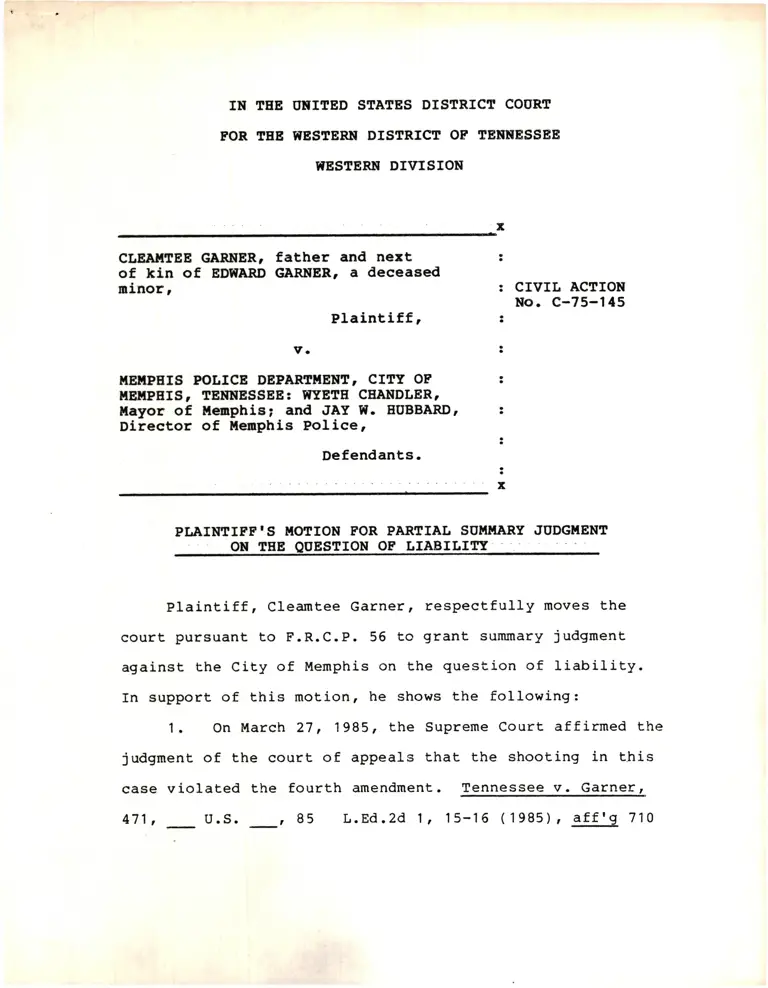
IN THE ONITED STATES DISTRICT COURT
FOR THE WESTERN DISTRICT OF TENNESSEE
WESTERN DIVISION
CLEAMTEE GARNER, father and next
of kin of EDWARD GARNER, a deceased
minor.
Plaintiff,
V .
MEMPHIS POLICE DEPARTMENT, CITY OP
MEMPHIS, TENNESSEE: WYETH CHANDLER,
Mayor of Memphis; and JAY W. HUBBARD,
Director of Memphis Police,
Defendants.
CIVIL ACTION
No. C-75-145
PLAINTIFF'S MOTION FOR PARTIAL SUMMARY JUDGMENT
ON THE QUESTION OF LIABILITY ______'
Plaintiff, Cleamtee Garner, respectfully moves the
court pursuant to F.R.C.P. 56 to grant summary judgment
against the City of Memphis on the question of liability.
In support of this motion, he shows the following:
1. On March 27, 1985, the Supreme Court affirmed the
judgment of the court of appeals that the shooting in this
case violated the fourth amendment. Tennessee v. Garner,
471, U.S. , 85 L.Ed.2d 1, 15-16 (1985), aff'g 710
F.2d 240, 246 (6th Cir. 1983). It remanded for further
proceedings to determine the city's liability under Monell
V . Department of Social Services, 436 U.S. 658 (1978). The
amount of damages is the only other issue that remains in
addition to the question of liability.
2. Under Monell v. New York Dept, of Social Services,
436 U.S. 658 (1978), municipalities are "persons" within the
meaning of § 1983 and subject to suit under that statute.
Under Monell, a city may be held liable in damages under
§ 1983 for constitutional deprivations that result from a
"policy or custom" followed by the city. Under that
standard, Mr. Garner is clearly entitled to relief.
3. "[I]t is when execution of a government's policy
or custom, whether made by its lawmakers or by those whose
edits or acts may fairly be said to represent official
policy, inflicts the injury that the government as an entity
is responsible under § 1983." Monell, 436 U.S. at 694. A
city is responsible for its own acts, "that is, acts which
the municipality has officially sanctioned or ordered."
Pembaur v. Cincinnati, 475 U.S. ___ , 89 L.Ed.2d 452, 463
(1986). "[T]o establish the constitutional violation [as]
in Monell no evidence [i]s needed other than a statement of
the policy by the municipal corporation, and its exercise."
Oklahoma City v. Tuttle, 471 U.S. ___ , 85 L.Ed.2d 791, 803
( 1985) .
- 2 -
4. Under these standards, plaintiff is entitled to
summary judgment on the issue of liability. All he need
show is the municipal policy and its exercise. There can be
no genuine issue of fact because it cannot be denied that
Memphis had an explicit, written policy sanctioning the
shooting in this case. It was this municipal policy of
Memphis that was "the moving force of the constitutional
violation." Monell, 436 U.S. at 694.
5. The record material attached to this motion
establishes beyond doubt that the Memphis deadly force
policy in effect on the night of Edward Eugene Garner's
death explicitly authorized the shooting of fleeing burglary
suspects. General Order No. 5-74, Attached as Exhibit 1, is
a policy statement signed by then Director of Police, J.W.
Hubbard (see Exhibit 4) — "a municipal policymaker."
Pembaur, 89 L.Ed.2d at 464-65; Tuttle, 85 L.Ed.2d at 804. It
was adopted with the explicit consideration and approval of
the Mayor, Wyeth Chandler. Indeed, although this policy is
more restrictive than state law, the inclusion of burglary
as an enumerated underlying felony justifying the use of
deadly force to prevent escape was a considered policy
choice "consciously chosen from among various alternatives
__ ," Tuttle, 85 L. Ed.2d at 804, by Mayor Chandler and
Director Hubbard. See Exhibit 2, 3, and 4. As the Mayor
testified in deposition; "One of the arguments was to
- 3 -
eliminate burglary and this type thing, some kinds of
burglary, which I did not do. I did not think it should be
done." Exhibit 2, Deposition of Mayor Wyeth Chandler at 22
(Dec. 19, 1979).
6. The district court previously found that;
Under ... regulations of the Memphis Police
Department ... lethal force may be used by police
officers to apprehend persons fleeing from the
commission of certain felonies.... Burglary of a
residence is one of the felonies covered ....
Lethal force may be resorted to in order to
apprehend a person fleeing from the commission of
a burglary such as that in which deceased Garner
was involved....
Memorandum Opinion of September 29, 1976, Slip. op. at 9-10.
On the first appeal, the court of appeals affirmed the
finding that the officer "shot because he believed that the
boy would elude capture," and that the officer "was taught
that it was proper to kill a fleeing felon rather than run
the risk of allowing him to escape." Garner v. Memphis
Police Department, 600 F.2d 52, 53 (6th Cir. 1979). There
can be no doubt that the officer was taught and acted
pursuant to the policies of the City of Memphis.
7. The Supreme Court held that, without probable
cause to believe that he is dangerous, the shooting of a
fleeing suspect solely because there is a probable cause to
believe that he committed a burglary violates the fourth
amendment. Garner, 85 L.Ed.2d at 16. The record leaves no
doubt that there can be no genuine issue of material fact:
- 4 -
(1) that this was the explicit policy of the City of
Memphis, adopted by its Mayor and Director of Police; (2)
that this policy was taught to Officer Hymon who fired the
fatal shot; and (3) that he shot because of the policy.
Accordingly, plaintiff is entitled to judgment on the
question of liability. He had made an incontrovertible
showing "sufficient to impose liability under Monell ...
[that] includes proof that [the unconstitutional shooting]
was caused by an existing, unconstitutional municipal
policy, which policy can be attributed to a municipal
policymaker." Tuttle, 85 L.Ed.2d at 804.
8. In Sartor v. Arkansas Natural Gas Corp., 321 U.S.
620 (1944), the Supreme Court held that "Rule 56 'authorizes
summary judgment only where the moving party is entitled to
judgment as a matter of law, where it is quite clear what
the truth is, that no genuine issue remains for trial.'" 6
Moore's Federal Practice K 56.15 [ 1-.00] (quoting Sartor,
321 U.S. act 627) (emphasis added). Given the Supreme
Court's holding in Garner, "it is quite clear what the truth
is" — a policy that authorized the use of deadly force
claimed the life of Edward Eugene Garner. The execution of
the city's policy, made by municipal decisionmakers,
inflicted the ultimate injury of death. The city is liable
under § 1983.
- 5 -
9. Even though the question of damages may be at
issue. Rule 56 clearly provides for partial summary judg
ment. According to Rule 56, a claimant may "move — for a
summary judgment in his favor upon all or any part" of a
claim. F.R.C.P. 56; see 6 Moore's Federal Practice
1156.20 [3.-0] at 56-1208 . Under subdivision (c) of F.R.C.P.
56, there is little doubt that summary judgment should be
granted in this case: "A summary judgment, interlocutory in
character, may be rendered on the issue of liability alone
although there is a genuine issue as to the amount of
damages." I£.. (emphasis added).
For the foregoing reasons, and as more fully set out in
the attached memorandum and exhibits, the motion for partial
summary judgment on the question of liability should be
granted.
Respectfully submitted.
JOLIDS LeVONNE CHAMBERS
STEVEN L. WINTER
16th Floor
99 Hudson Street
New York, New York 10013
WALTER L. BAILEY, JR.
Suite 901, Tenoke Building
161 Jefferson Avenue
Memphis, Tennessee 38103
COUNSEL FOR PLAINTIFF
- 6 -
IN THE UNITED STATES DISTRICT COURT
FOR THE WESTERN DISTRICT OF TENNESSEE
WESTERN DIVISION
CLEAMTEE GARNER, father and next
of kin of EDWARD GARNER, a deceased
minor,
Plaintiff,
V,
MEMPHIS POLICE DEPARTMENT, CITY OF
MEMPHIS, TENNESSEE: WYETH CHANDLER,
Mayor of Memphis; and JAY W. HUBBARD,
Director of Memphis Police,
Defendants.
CIVIL ACTION
No. C-75-145
EXHIBITS IN SUPPORT OP
MOTION FOR PARTIAL SUMMARY
JUDGMENT
EXHIBIT 1
I
sv-iscv^c=wcG p Q ! L 3 a n c c i T A P T T r ^ c r v r r
<C=3 ASAWK3 C5C«S:53
,/lTo-LiriL''
. y*
^ a i p - v
">u »J o>-:. ̂/
oATei 5 February 1974
rsjuMBEP! 5“74
USE OF FIREARMS AND DEADLY FORCE
I.
1. PURPOSE. •.*._...
~~ j U4/-W nrani Y FORCE and NON-^DEADLY
effect an arrest. •.• ■̂ •
2. r a c k g r o u n d .
a. npfinlt1ons.
j ncani Y FORCE means the discharge of
, F 1 ? l a % t ^ r % S r u s r r f ’-^o“4 f r L e n s c e U u U t e U so .
Inflict serious bodily Injury or death.
, ''° L fh ?“s I ld ro r L " L r ^ L r p L ‘’/ n r t^ r a lc L r te 5 ° « ; Intln^ed
lriLllftMrlS5s°Lrily injury or death.
b. Apol 1 cabil 1 ty_.
3.
The orocedures defined 1n this order apply to the use of
fIrelLs under the following circumstances.
(1 ) situations^ ^ - ? ’’^ ? 1 „ r L T u t : ^ n " o r v ^ f g t L ^ r ^ v e n -
H"rorErfr"r:Lnkr^ '
ACTION.
a. Non-deadly Force,.
An officer may use NON-DEADLY FORCE when It Is necessary to
̂/ /
• 2 •
(1) Effect an arrest;
2̂̂ Prevent the escape from'custody of a person who Is
reasonably suspect of having committed an offense; or to
— {zy Defend one's self or another In cases not Involving
serious bodily Injury or death.
b. Dpadlv Force.
DEADLY FORCE may be used In the following circumstances only
after all other reasonable means to apprehend or otherwise prevent
the offense have been exhausted: . _ ----■
(1) Self-Defense.
An officer may use DEADLY FORCE when It If In the
defense of himself or another from serious bodily injury or
death and the threat of serious bodily injury or death is
real and Immediate. •
(2) Felonies Involving the Use or Threatened Use of Physical
, Force.
An officer may use DEADLY FORCE when the offense involves
a felony and the suspect uses or attempts to use or threatens
the use of physical force against any person.
(3) Other Felonies Where Deadly Force Is Authorized.
c.
After all reasonable means of preventing or apprehending
a suspect have been exhausted. DEADLY' FORCE Is authorized in
the following crimes:
(a) Kidnapping
Murder In the 1st or 2nd degree
Manslaughter u u i
Arson (Including the use of firebombs;
AssLlt and battery'with Intent to carnally know
a child under 12 years of age
Assault and battery with Intent to commit rape
Burglary in the Ist, 2nd. or 3rd degree
Assault to commit murder In the 1st or 2nd degree
Assault to commit voluntary mansl aughter
Armed and_simpl^e^obbery
Use of Deadly Force Prohibited.
The use of DEADLY FORCE Is prohibited when:
(l) Arresting a person for any misdemeanor offense, or
- 3
(2) Effecting an arrest of any person for escape from
the commission of any misdemeanor offense.
d. Use of Firearms Prohibited.
(1) As warning shots; * '
(2) From any moving vehicle or to stop any fleeing vehicle.
Lcept In caLs of self-defense or cases Involving.
(a) Murder in the 1st or 2nd degree
Ic) A^ault and battery with Intent to carnally know
a child under 12 years of age
(d) Armed or simple robbery
In anv case where an officer does not have a clear field
nf fire and cannot be reasonably certain that only the sus
pect will be hit and that the potential for harm to Innocent
persons or their property is minimal.
e. N o t i f i c a t i o n Procedure,?,.
m Once the situation is under control. any member who dis-
u 4c f5roarm in ^he line of duty will immediately report the
to the Dispatcher who will have the cognizant watch or
sgfad comlSnde; S^tifled. The letter will
or bureau commander of the event,wi thout delay. ..^enor ...uq fired a weapon will submit a written
F h !r f ‘ irP °o f lc e ! w u r c e p t s r i ; lll ^^S1fr^iemh:^T^t"h^Frrea^ms
the Firing Range.
watch^or ^ua3^5mmanSrr'i?^his^3es1gJated
Firearms Review Board.. In addition, the Dispatcher w t m no-'*/
of the senior commander present.
’’
4. SELF-CANCELLATION.
This order shall remain In effect
incorporated into the department s Manua *
Rules and Regulations.
1 2 7 ^ r*t> ■J. W/“Tiubbard
Distribution: A
EXHIBIT 2
IN THE UNITED STATES DISTRICT COURT
FOR THE WESTERIT DISTRICT OF TENNESSEE
^*7ESTERN DIVISION
IRA LEE flADISON, ET AL,
)
)
PLAINTIFFS, )
)
VS,
MEI^HIS POLICE DEPARTI-1ENT,
ET AL,
DEPENDANTS.
NO. C/A C-73-21
The discovery deposition of WYETH CHANDLER,
taken this 19th day of December 1979, at Memphis,
Shelby County, Tennessee, pursuant to Notice and in
accordance with the Federal Rules of Civil Procedure.
All forms and formalities are waived.
Objections to competency, relevancy, and
materiality are reserved, to be disposed of at or before
the hearing of the cause.
Objections to the form of the questions, and
to leading questions are to be made at the time of the
taking of the deposition.
The signature ofthe witness is waived.
Court co/^zportzzi
2SV 700 <o:N. <dy\ain.
izCyismpfiLt, CJ£rvis±±s£.
526-7516
• , i ' 7
APPEAHANC2S
For the Plaintiff, .Ratner, Sugannon, Lucas j
Henderson, by
MR. G. PHILIP ARNOLD
Attomey-at-Law
MR. WILLIAM E. CALDI'/ELL
Attomey-at-Law
Suite 525
Coimnerca Title Building
Memphis, Tennessee 38103
For the Defendant. .Office of The City Attorney, by
MR. ARTHUR J. SHEA
Atto m e y - a t-Law
Room 314
125 North Main Street
Memphis, Tennessee 38103
IXjbmlxill Er ^sazoui
(Zxizt
2317 100 <d%un
yizmjlflLiL, 'Ẑ /2/Z£il££ 3^103
526-7516
I N D E X
EXMIINATION
WITNESS PAGE
WYETH CHANDLER
DIRECT EXAMINATION BY; I-ffi. ARNOLD .
CROSS EXAMINATION BY; I-IR. SHEA. 38
E X H I B I T S
N O . DESCRIPTION PAGE
1 - STATEMENT 41
S ’ ^saw ut
(Zouzb
2377 700
'̂ŷ £̂mj2̂ ±, ^£nnzi.*£S
526-7516
5 / (
1
2
3
4
5
6
7
3
9
10
11
12
13
14
15
16
17
18
19
20
21
22
23
24
^TOSTH CHANDLER,
The witness, being first duly sworn, deposed as
follows, to-wit:
DIRECT EXAiMINATION
BY MR. ARNOLD;
Q. State yoxir name and your position, please.
A. Wyeth Chandler, Mayor of the City of Memphis,
0- Mr. Chandler, you have talked with Mr. Shea about
the purpose of this deposition and you know the case that
this is about?
A. Briefly. I get confxosed. May I ask you this?
Ql Certainly.
A. Is this the one where the — is this the one where
the juvenile was in a car that had been stolen, and ran and
was shot?
a
A.
ft
A.
ft
A.
ft
Yes, that's correct.
Okay.
This happened on January 12, I believe, 1972.
Okay.
And the person's name is Eddie Madison.
Eddie Madison.
The child who was shot.
Now, you had been Mayor how long at that point?
Twelve days, I assume.
-4-
1
2
3
4
5
6
7
8
9
10
11
12
13
14
15
16
17
18
19
20
21
22
23
24
Ql Yo u took your oath as Mayor January 1, 19 72?
fl. 1972, that's right.
g. Just for the record, I know we've got it in the
other deposition, and everybody who is going to deal with thi^
is going to know it, but prior to that time, you were on the
City Council, is that right?
A. For four years.
QL And, then, prior to that, what did you do?
A. I practiced law.
g. How long had you practiced law up until the time
you became Mayor?
A. Since 1955.
gL You practiced law during the time you were on the
Council, is that correct?
A Yes.
Q, Now, Mr. Shea mentioned, and has handed you a copy
of a previous deposition we've taken of you in another case.
That case was Wiley versus the Police Department. We took
that deposition on January 16, 1975.
I want to start by calling yoxir attention to a few
things you said in that deposition, and, then, ask you some
questions about those.
I believe those statements related to perhaps the
facts of this case and that's why I want to call your attanti^on
o '-r c •)
-5-
1
2
3
4
5
6
7
8
9
10
11
12
13'
14
15
16
17
18
19
20
21
22
23
24
to them.
First of all, before we get to that, though, in
January of 1972, there were several shooting incidents that
occurred very quickly after you had become Mayor, is that
correct?
A. I ’m not sure how quickly, but there were, it seems
like three or four within a two month period, maybe three
within three weeks.
CL All right. And the incident that we are discussing
is one of those.
A Right.
CL And you remember it as being one of those that
occurred in this short period of time?
A I s\ire do.
CL Ifho was the Chief of Police at that point?
A I believe Bill Price was the Chief of Police. As
I recall. Chief Lux had retired before I took office, and I'm
not sure whether — I guess Bill Price was Chief of Police.
I'm not sure. We had no Director. We were waiting on the
appointment of a Director. My recollection is that Bill
Price had been appointed Chief of Police.
Cl This was yoxar appointment?
A It w a s .
CL And I re-read this deposition, and what you
3 s n _
-6-
2
3
4
5
6
7
a
9
10
11
12
13
14
15
16
17
18
19
20
21
22
23
24
1 remembered in there was, you think he took office the same
day you did, that is, he took on the duties as Chief the
first of January.
A. I think so. It seems like Henry Loeb put Jack
Wallace in charge in December or something like that, but
everybody knew that Bill Price was going to take over when
I went in office, and I assume he did.
0. All right, sir.
MR. SHEA: It might help clear up the record,
but in Chief Lux's deposition, which you've also
taken. Chief Lux went on sort of a terminal leave
sometime in November of 1971. Actually, went off
the payroll as of December'13st, and Chief Price
was the Chief of Police as of the first of January
19 72.
0. And how had you done that? I mean, you had made
a recommendation for him to be Chief prior to taking the
office of Mayor? Is that how that had happened?
A I ’m sure I had. I'm sure that everybody knew that
he would be the Chief of Police, and I appointed him Chief
of Police.
Qi But he was your appointment, as you've said?
A He was my appointment. It's a Civil Service
appointment, but he was serving in that capacity, whether
2
3
4
5
6
7
8
9
10
11
12
13
14
15
16
17
IS
19
20
21
22
23
24
1 he was undergoing his Civil Service examinations or anything.
I think maybe they had. At some point, they took tests of
him, Hutchison took them. Price and Crumby. And we appointed
Price. But whether that had been done or whether he was
serving as interim Chief, he was in fact the Chief of the
Police Department at that time.
0i And how long did he continue, then, as Chief?
A. That, I can't tall you. He left the Police Depart
ment to become the head of the MATCOG, and still is head of
the District ~ Delta District Law Enforcement Operations for
the State of Tennessee, and still serves in that capacity.
But he was Chief at least, I guess, a year aind a half or
something like that.
0. He had been on the Force for a long time?
A. Twenty-five years.
0. Prior to becoming Chief.
Mayor Chandler, if you will, I want to call your
attention to certain statements made in that deposition
perhaps as a way of focusing.
MR. ARNOLD: Mr. Shea, if you want to look at
these as I read them — -—
0. The first one is one page twenty, starting with
line six and going through line twelve. Again, we are
reading from the Wiley deposition taken in 1975.
S S 2
A
-3-
1
2
3
4
5
6
7
3
9
10
11
12
13
14
15
16
17
IS
19
20
21
22
22
24
fl. All right.
0. The sentence there says: "For example, we have a
situation that grew out of some deal where we had a stolen
car situation in which a child ran out of a stolen car, and I
think the child ended up mentally off or something. I don't
know what. Gotten in a car with some other people and they
bailed out and left him holding the bag, and he ran and so
forth." And the question was: "And the shot?" And you
answered: "And the shot."
And I believe that that is the situation that we
are talking about here in this case.
A The only thing, of course, I'm not sure whether he
was mentally off or what, but I remember, as the story was
told to me, that was — that was the way I understood it.
0. Yes, sir. We won't try to prove his mental conditioiji
through your testimony.
A No, that would be hard to do.
QL This was the sitviation, then. I'm trying to focus
on some of these prior statements.
Again, on page thirty-two, beginning with line
eighteen, you made a statement and this was part of a
previous statement, if you want to read the whole statement,
it's fine, but the part that I think is referring to this
incident says: "As I say, I think the one thing we did move
-9-
2
3
4
5
6
7
8
9
10
11
12
13
14
15
16
17
18
19
20
21
22
22
24
1 into this thing you will see is the car thief, that just the
car thief alone, not connected to anything else, but just the
car thief, you run him down, you get in the car, and he jumps
out of the car and runs, you can't connect him to burglaries
or robberies, h e ’s nothing but a car thief, which is a felon,
just never strikes me like a burglar or robber or murderer or
rapist or et cetera. You know, he doesn't fit into that
category with me. That's my personal opinion. I think I —
I think it is in that area that I found some reason to
relax it. That is because, you know, so many kids joy-ride,
I hate to see then put in the same category with the burglar
and robber and rapist and murderer, that type of guy. But
that is just my personal opinion."
Again, I believe, in this situation you were talking
about a change of policy which occurred after the incident
in which the juvenile was shot as he ran from the stolen car
Is that correct?
A. That's correct.
CL And, finally, on page thirty-eight, line seventeen,
you said; "I think if you have got a kid, you may have a joy
ride, certainly you don't want to kill the kid, you know, but
the time, January 8, 1972, and that is what I thought you
were going to ask me, did I have a policy to shoot all fleein
felons, I say, no, they followed the policy of the State Law.
-10- 8 8 4
1
2
3
4
5
6
7
a
3
10
11
12
13
14
15
16
17
18
19
20
21
22
23
24
And if I may stop reading although that's in the middle of
a sentence. Again, you were referring there to the general
policy, but some different feelings you had about the situation
of a kid joy riding in a stolen car, is that correct?
a. Yes. The State Law, in ray opinion, said they could
shoot fleeing felons, and we began to relax that in certain
areas, not only joy riders, but primarily embezzlers, fraud
people and so forth. It may be a felony, but I didn't look
on it as necessary to shoot them if they were about to escape
Ql No w , at the time of this incident, January 12, 19 72,
again, we're going back a long time in your history as Mayor,
if you would, I know you've just made mention to it, but
tell me in as complete terms as possible what you understood
the policy of the Police Department toward shooting — the
use of deadly force, what you understood that to be.
A. Well, I understood it to be, as far as I knew it, I ’i&
only been in office for twelve days, but I had been on the
Council and I had some knowledge, not total knowledge, of the
Police Department, my belief, it is now, that it was their
policy that you did everything within hximan power to capture
a fleeing felon without the use of deadly force. But if it
became apparent to you that a fleeing felon would escape, if
not apprehended by the use of firearms, there was a policy
of the Police Department to use firearms.
885
-11-
2
3
4
5
6
7
3
9
10
1 1
12
13
14
15
16
17
18
19
20
21
22
23
24
1 0. And, then, of course, in addition to that, the
police could use firearms in self defense or defending another
officer?
A. Self defense, the protecting of someone else and
so forth.
QL When this — or when these instances occurred shortly
after you became Mayor, you took it upon yourself to investi
gate the Depeurtment' 3 policies and shortly thereafter a new
statement was issued, is that right?
A. That's true.
0. How, again, I know I'm asking you to go back a long
way, but what did you do in that investigation? You must
have called Chief Price in and you must have talked to some
other people on the Force?
A. I can't remember who all I talked; to. I'm not even
— if it's a police matter, in all likelihood I read the filei
as much as I could and discussed the cases briefly.
Q, When you say "the files" are you talking about the
three or four incidents?
A. The,three or four incidents where they were shot at,
yes. The first time I remember conversing about this particular
incident, I believe it was an incident involving a situation
that I don't believe the police had any fatalt in, and that
was where they shot a man where the Pepsi Cola driver had
Q
-12-
2
3
4
5
6
7
8
9
10
11
12
13
14
15
IS
17
18
19
20
21
22
23
24
1 called and said that — I guess, had an armed robbery and he
had lied. And a youngster, I believe a young boy was shot.
I'm not sTire how young he was. But those two stick out in
my mind. And it was simply my feeling that in cases of joy
riding or in cases of felonies that don't involve physical
force, threat of life, rape, so forth, those — threat of
personal harm, or threat of — or certainly of stealing
anything or being in a house or place of business where
others might be, and, therefore, possible violence could
occur, that we ought not to use firearms at all. Now, that
was just my thoughts cibout it and I expressed them and felt
that way about it. I know that it was not tied into the
State Law, auid I knew that, you know. State Law overruled
anything, any policy I might have, but that was the policy
I felt would be best,
ft Now, did you understand that in the Police Department
in the past, that is, prior to this period of time in January
of '72, that police officers had utilized deadly force against
any situation where a felony might have been committed?
A Well, I didn't know whether they had or not. I
really didn't inake any study of whether, for example, they'd
ever shot an embezzler who was fleeing. The primary thing
I was — it was just something that was brought up in the
discussion about the Fleeing Felony Statute. It was just my
837
-13-
2
3
4
5
6
7
8
9
10
11
12
13
14
15
16
17
18
19
20
21
22
23
24
1 feeling that as you don't apply it to a embezzler, that it
should be in some way, therefore, limited. As far as I knew,
they had never shot an embezzler. To my knowledge, they had
not. I assume they had not. But if you had the right to
and didn't, as a policy, then we ought to extend that Scime
right to the juvenile in a joy riding situation. That was
basically the idea that I — so, we listed things that we
felt you could use it for and left off those things which
we, even though you may be able to under the State Law, that
I didn't feel that you should.
Qi In fact, wasn't it clear to you that they would
not have used force against say an embezzler?
fl- I would assume they would not. But inasmuch as
they wouldn't do it against an embezzler, I just simply put
the child, fleeing felon or joy rider in the Seune category.
Ql That's extend that principle to some other felonies?
A That idea, right.
Ql And I asstime in fact that there are a lot of other
felonies that you knew then that the police simply would not
use force to capture such persons, aind that would be in
non-violent situations?
A Well, not necessarily non-violent. I didn't not —
was requested and did not remove it, for example, I don't
think from burglaries, which are not necessarily violent, but
-14-
2
3
4
5
6
7
3
9
10
11
12
13
14
15
16
17
18
19
20
21
22
23
24
1 that I have considered always as the type of things that can
lead to violence.
& Well, now, I looked through the Code, the Tennessee
Code this morning, just looking at a lot of different
felonies, trying to figure out ones that I thought were
in effect in 1972, and I found a lot that it appears to me
the department has never used force when trying to apprehend
such a person. I found one like in TCA 39-1907, it's*a
felony to issue false stock certificates. We csm assime
they've never used force in a situation like that?
A. As far as I know, they have never -- I would assume
so.
0. And, in fact, when you were having this discussion,
wasn't that the general flavor of the'discussion, that it was
in certain situations, felony situations, it was used and
in others it just was not used?
A. That's why the end result, I believe, was a publica
tion of those felonies that I felt you should use it.
0. Now, prior to that publication that came out as
a restilt of this meeting or meetings — was there more than
one meeting?
A. ProbedJly s o .
0. Had there ever been a -delineation of which felonies
the department, in those situations where the department would
-15-
2
3
4
5
6
7
8
9
10
11
12
13
14
15
16
17
18
19
20
21
22
23
24
1 use force and against which they would not use force?
A. Not that I know of in written form. I'm sura that
in unwritten form it was obvious that they would not, you
know, in the Fraud and Document Squad for a guy that had
kited a check. I don't know that they ever used force or
didn't use force, but whatever, the policy was, it was an
unwritten policy, as far as I know.
Q. And it was the policy, say, in that situation or
similar situations, even though it might have been a felony,
they wouldn't use force to apprehend a person fleeing?
A. As far as I know, that was a general policy, unwrit
ten that it may have been. Now, had they used it, you know,
I don't know what the status of it would have been as far
as whether the policeman would have been 'fired or not. If
he was after a man that had written 5,000 checks all over the
country and they guy has wheeled off and about to get away,
whether they used it or not, I don't know. If they did use
it, I don't know whether the policy of the Police Force would
be to fire the guy or give him a decoration.
0. And the reason you don't know that is because it was
not a written policy, is that right?
A. As far as I know, it was never written.
Q, As far as I know, Mr. Mayor, you're going to be the
only person we ask about this meeting or these meetings.
-16-
2
3
4
5
6
7
3
9
10
1 1
12
13
14
15
16
17
18
19
20
21
22
22
24
1 whichever it was. We're not going to try to depose some of
the other folks, I think, but if you can, can you remember
anybody else besides Chief Price who was there?
A- I really can't. It might have been Bill Crumby. I
don't know. Bill Crumby, or Hutchison, or somebody like that
there. I probably wotild have discussed it with them at one
tdLme or another, here and there. I didn't have a meeting on
it. I just simply read the report, probably called him and
said — ■ or them and said "I just want to tell you that I
don't think it's a good idea to shoot yoTingsters who are
joy riders if there's nothing else involved." Now, as I
say, I don't know what your policy is on it, and I'm sure,
for example, car thieves, grand larcenist, thatis a man who
has been an habitual car — steels a car,' takes it to St.
Louis, sells it and so forth, is guilty of grand larceny,
that might be something that they have always had a policy
they woxild probably shoot him as a felon as qxxickly as they'd
shoot a burglar.
On the other hand, children, joy riding, not doing
it for a livelihood, and certainly are not trying to, you
know, not using it for robbery or whatever, I looked onthem
differently. I just told them that's my opinion of it, and
they ended up going and getting, I guess, Krelstein or
somebody to draft them up something and put that into writing
891 -17-
2
3
4
5
S
7
8
9
10
11
12
13
14
15
16
17
18
19
20
21
22
23
24
1 "These are the felonies that the Mayor thinks we ought to do
something about."
QL I have a copy of a document I want to show you. I t '4
a January 19, 19 72 document that went out over your name and
I believe it was a press release or a pt:blic relations
release.■
A. I didn’t know I made any of those during the whole
time I was in. I never have had anybody to release them
but m e .
& Well, I'll ask you what it is, then, and let you
categorize it.
A. Okay.
CL It was utilized in another case and that's what the
nxamber at the bottom refers to, but everything else purports
to be something that came from your office.
(Passed to witness for inspection.)
A. I don't know where this came from. I guess it was
a statement that I ’m supposed to have made to reporters?
CL Yes, sir. That's what we understand it to be.
MR. SHEA: IVhat case was that used in?
MR. ARNOLD: It was used in the Wiley case.
0. Now, I haven't marked the place in the previous
deposition in which you referred to that.
A I just have no recollection of it at all.
-IS-
2
3
4
5
6
7
3
9
10
1 1
12
13
14
15
16
17
18
19
20
21
22
23
24
1 n. On page six of the Wiley deposition you stated:
"During a short period of time, I think there were four
shootings." I ’m sorry. I started at line four. "Three
resulting in death and one just a wounding. And as a result
of that and because I was called out to the meeting with the
NAACP people and other leaders in the city, seems like we
formulated some kind of statement that made national head
lines . I know they came in here from Atlanta to tape it on
CBS."
Another place here in the deposition —
A (Interposing) Obviously, this was not that statement
0. All right. You don't remember releasing such a
statement then as that one that I ’ve showed you?
A This one here (indicating)? I probcibly said those
words. I didn't release any statement that I know of. This
appears to me to be something where they've come up to me
in the morning, after apparently one of these shootings the
night before, and said "Tell us what you think about the
shooting." At that point, all I knew was that we had a
situation involving a fleeing felon. I may not have known
cuiy more about it them that. And that Police Department
policy at that time was to shoot fleeing felons, that they
had shot him. That's basically all I know about that. That's
what it appears. I don't remember anything, really.
8 3 3
-19-
1
2
3
4
5
8
7
8
9
10
11
12
13
14
15
18
17
18
19
20
21
22
23
24
Q. All right. The last paragraph in that document which
I showed you says: "I plam to get with Chief Price and
members of our Legal Staff and draw up some interim guide
lines stifaject to comment and review as soon as possible."
you, in addition to having Chief Price and
perhaps other policemen .or members of the Police Department
present with you, was there somebody from the Legal Staff
there?
A, There mav well have been. Probably Krelstein. I
think he was working over there then. I'm not sure.
#
QL You don't remember specifically?
A. I don’t remember. (Pause) Probably. Was Krelstein
working then?
MR. CALDWELL: Yes.
a. r just figured he was. I'm sure Krelstein was in
on these meetings. He probably drafted the final statement.
Q, X would like you to look at this document, it s
labeled "To All Personnel Field and Staff Operations" from
Chief Bill Price, dated January 20, 1972.
(Passed to witness for inspection.)
A. All right. All right. I'm sure this is probably
the statement, the interim statement or whatever that grew
out of this earlier statement which grew out of our conversa
tions with Price andKrelstein.
89-1
- 20 -
2
3
4
5
s
7
8
9
10
11
12
13
14
15
16
17
18
19
20
21
22
23
24
1 a Now, did you — you've seen this one before, haven't
you?
fl. This statement here, y e s .
Ct The last one I just handed you.
fl. Right. I'm s\ire I have.
MR. ARNOLD: I'd like to make that Exhibit 1
to your deposition.
(^-Thereupon, said STATEMENT was marked e :<HI3IT
1.)
0. Now, this is dated January 20, and onpage three of
#
that it says: "Firearms — " This is paragraph Roman nvuneral
V: "Firearms shall not be discharged; A. As warning shots;
or B . Brom a moving vehicle or to stop a fleeing vehicle
except as provided for in Paragraph IV." And that last
statement I read, V-B, reflects the change in yo\ir r:- in
policy that resulted from these meetings, is that correct?
A No, I don't think so. That's one of the changes.
I'm not sura about warning shots. I think Krelstein had been
against warning shots and he brought that up.
The real change in the policy, as I recollect it to
be, first of all, in writing down those things under A and B,
and listing those things under II, by listing. In other words,
by saying, rather than "fleeing felons," you list the felonies
that, if you can't apprehend a guy, you list all these things
S 9 ^
-21-
1 that you can shoot, you can use fireams, you can use deadly
2 force to apprehend him. Also, I think for the first time
3 they had this report to be made and so forth.
4 Cl Y e s . I believe Chief Lux perhaps had prohibited in
5 1969 the use of warning shots.
S a. That may be. That was something that was discussed.
7 Ql In Section IV-a-2, the auto theft has been eliminated
8 from that list.
g a. Grand larceny has not been eliminated. I don't
1 0 know whether auto theft is listed under grand larceny under
1 1 the law or not. I can't tell you. I don't think, as I
12 remember, that auto theft per se was discussed as needing to
1 3 be eliminated. It was the joy riders that bothered me, not
1 4 the auto thieves. I tried to make that clear earlier. I
1 5 don't consider a professional auto thief as any less the type
16 of guy that I would want to apprehend personally than a guy
17 who would sneak into Joe's Barbecue and ransack his building,
18 steel his money. One of the arguments was to eliminate
1 9 burglary and this type thing, some kinds of burglary, which
20 I did not do. I did not think it should be done. But I
21 don't remember discussing auto theft as such. I do remember
22 discussing children joy riding.
23 Qt Now, you understand then that this document we've
24 labeled as Exhibit 1 excludes the situation where a person
-22-
2
3
4
5
6
7
8
9
10
11
12
13
14
15
16
17
18
19
20
21
22
22
24
1 is in a stolen car and is joy riding in it and is not threat
ening anybody —— anybody else, is that right?
A, That's what I thought the policy should be, and
still do.
ql In fact, that's what the policy became after
January 20, 1972, isn't it?
A. Well, as far as I was concerned that's what the
Dolicy became. You tell m e . I wanted that to be the
policy. Then they printed this up. I felt it incorporated
it in there. VThether the others do or not, I don't know.
But I didn't want joy riders shot, especially oassengers.
Ql Well, now, you've been Mayor continuously since
that time.
A. Right.
g. And there hasn't been another example since January
12, 1972 of a young child being shot joy riding?
A. Not as far as I know. I'm glad it's true.
QL And that's a direct result of yo\ir involvement at
this stage?
A I hope so .
Ql And that involvement came about as a result of the
shooting and killing of Eddie Madison, didn't it?
A That's right.
Q. Now, when you were discussing this, you met sometime
£.9-2-
-23-
2
3
4
5
6
7
3
9
10
11
12
13
14
15
IS
17
18
19
20
21
22
23
24
1 around the 19th or 20th or sonewhere before the 20th?
Pu Quite a long while, yes. Two or three hours,
g. You must have discussed law enforcement objectives,
what they were -- what you thought the Police Department ought
to be trying to do and they, in turn, told you what would be
problems if policies were changed. Is that how it went?
A. Well, in this particular instance there was no
great discussion about pros and cons. I don't really feel
that the — I ’m not sure how the hierarchy of the Police
Department felt. We had a very broad State Law under which
the Police Department operated. In my judgment the policemen
felt secTire in the ability to use firearms to apprehend a
fleeing felon, assuming they had exhausted all other ways of
apprehending him, in any felony case. I think that was just
the standard operating procedure, had been, was, and probcibly
is in many cities to date. All we did was try to say that
we don't do it in certain cases, no matter what the law is.
Now, let's extend that another notch and eliminate the joy
riding. That was basically the idea. I think that's the way
it was perceived by the Police Department.- They perceived
this announcement, the notoriety given to it, the fact that
this C2ime out and didn't list joy riding and all that type of
thing, as eliminating joy riders. And I think basically most
of them probably had never done it. I don't know that it was
8 9 S -24-
2
3
4
5
6
7
8
9
10
11
12
13
14
15
16
17
18
19
20
21
22
22
24
1 being done all the time, but I*m doubtful. I ’m sure many a
policeman saw a joy rider run off into the dark and said,
"Okay. We'll get around to getting him, that guy some other
tine." But I'm not sure that that was — that was just their
own personal policy. It was not — I don't know what they
were taught when they went to the Academy about that type
of thing or what anybody told them to do, what they were
instructed to do, but I'm sure that there were some policemen
that would shoot a fleeing felon more quickly than others and
feel.very justified and very happy about, under the law, very
well protected. I just felt that that ought to be eliminated
He shouldn't be given that option of making that decision so
that good officer or good guy officer so-and-so would let the
man escape, say he's just a joy rider and let him go, and the
other guy feeling he was protected, he was a felon, he was
a car thief, and, therefore, would shoot him. I just think
we ought to eliminate that judgment.
Q. Well, now, we've previously discussed that it was
your perception then that, say in the case of an embezzler,
it was kind of an unwritten policy that force was not used
against that person. Is it your perception that there was
a general unwritten policy that force was used against joy
riders or was not?
A Well, I think probably it was a general — general
8 9 H -25-
2
3
4
5
6
7
3
9
10
11
12
13
14
15
IS
17
18
19
20
21
22
23
24
1 unwritten policy, but that it was not a policy with the
strength would be for something like an embezzler. In other
words, each individual officer confronted with a joy riding
situation thinking to himself at*that particular time "This
man's going to get away." One officer may have no idea that
there was a policy in his mind. I think it became an
individual officer’s decision. He could shoot him and he
would be protected, he felt. Or he could let him go because
he was the kind of guy that didn't want to shoot the guy
for joy riding. And he wouldn't be — I don't think the
Police Department would have prosecuted him, you know. Of
course, maybe the Police Department would never know eibout
it. He'd say "The guy got away" and that would be the end
of it* But I felt that since someone who felt that the policy'
was not in existence, there was no policy, or if the policy
was in existence, it was only the State Law that set the
policy, had done it, then it was time to say to all the
officers "Our policy is against it. It's not one of the
things we think you ought to use force on." I didn't say
"car thieves" but I said "joy riding." Kids out riding arovmc,
the block, take a car and ride it around the block, not
j
creating any havoc, not stealing, not using it to murder
somebody or rob somebody. And that would be just one less
opportunity for this to occur again, which I, you know, I
r-on
-26-
1
2
3
4
5
6
7
8
9
10
11
12
13
14
15
IS
17
18
19
20
21
22
22
24
deplore.
Q. Well, actually, the policy was such that it allowed
one officer to use deadly force in that situation and another
officer to ~ and when I say "policy" we know we're not talk
ing about a written policy, but the way things operated in
the department at that time, it allowed one officer to use
force, deadly force, and another one not to.
A. Well, I'm not sure that that isn't the policy in
everything in the Police Department today. I'm not sure that
every officer would react, for example, to a fleeing burglar
or fleeing murderer the same as another. They perceive the
law, and, therefore, the policy to be, if I cannot shoot this
person, if I cannot apprehend him, I have the right to use
force, I. have the right to use a firearm to apprehend him.
That doesn't mean, in my opinion, that every policeman will
shoot an escaping person, felon, if they can't apprehend him.
There may be some people over there, I don't know who they
are or anything else, but I believe some would say "I'm just
not going to shoot that fellow. I believe we can catch him.
I believe that he's catchable." And I believe that's true
in this area. But in this area, I didn't want, if I couldi
avoid it, anyone to have the decision in their mind that I
can or can't. I wanted it eliminated as much as we could by
policy from their decision-making process. I can't make a
J K i l -
-27-
1
2
3
4
5
8
7
8
8
10
11
12
13
14
15
16
17
18
19
20
21
22
23
24
decision for a nan to shoot a nurderer,. Therefore, I assune
that they nay or itiay not shoot a murderer, even if he s going
to get away.
Q. But State Law allows the person, the officer to use
all, I mean, it requires that all other means of apprehension
be exhausted first.
A. That's right.
Q, Before employing deadly force.
A, Right.
ql And what you're saying is that some officers are
going to look harder for other means of apprehension before
the use of force.
A. Well, I'm — no, I'm not really saying that.
I'm saying that some officers, if they see a fleeing felon,
not matter what his offense may be, will hesitate before
they're willing to shoot a fellow man. Some will not. That's
a decision that they make at the moment, under tremendous
pressure. Some will just not do it. That's the decision the/
make with every fleeing felon. Have I used everything? You
know, can I do more? Is there something else I could do?
That guy, while he's thinking, the guy is gone.
Others will use it the moment they feel that the
man will be gone. That man, that person may be a chauvenistit
pig, but that person will escape, they will feel that that
? . Q Z
-28-
2
3
4
5
S
7
8
9
10
11
12
13
14
15
18
17
18
19
20
21
22
22
24
1 line has been crossed and they will use it quickly. It's a
judgmental thing.
Now, I'm not going out here to tell every policeman
to shoot everybody that, you know, as soon as they feel, you
know, just quick, make up your mind, no waiting. But I
don't want them to be cible to use it in matters involving
joy riding. I don't want them to have that decision-making
process, this is a joy rider. I want them to do everything
to apprehend them they can, but I don't want them to come
to a time to whip out their gun and say "Now, h e 's crossed
the line." I don't want them to make that decision in a
joy riding case.
Q. Did you discuss, again, we're talking about a meet
ing and it's difficult for you to recall who was there, but
when I ask this question you're going to have a hard time
remembering, I know, but do you remember whether or not you
discussed any other felonies, about the possibility of eliminat.'
ing any other felonies, third degree burglary, for instance?
I do remember that. They did discuss that.
0. Well, tell me about that discussion now.
ft. I remember, I think it was maybe the nighttime
business burglary. Is that what? Third degree burglary?
I can't remember. But night time, breaking into to some
guy's place at night, where they would not assume that anybod^i
9 0 3 -29-
2
3
4
5
6
7
8
9
10
11
12
13
14
15
16
17
18
19
20
21
22
23
24
1 was in there and, therefore, if they.went in there, they were
obviously in there just to steal some things and get out. No
life involved, no danger to anybody. There was that as
opposed to going into a hone, that as opposed to going into
a place in the day tine when people could or could not, may
or may not come in and out. It was my opinion then and still
is at this time that those should not be eliminated from
the fleeing felon policy.
Ql Including the person going into the business at
night?
fl. Including the place of business at night.
Qi Well, now, you say you remember this coining up. Was
this the opinion that other persons had? Do you remember
Chief Price or others?
A. I ’m not sure who had what. There was, as I say, I
believe we discussed this probably with, I think, Maxine
Smith and her group may have come down here, I ’m not sure.
And I think that was one of the things that they brought up.
I don't think the Police Department wanted that included or
added to this or eliminated from the policy. Krelstein may
have been for it, I'm not sure.
' Q. You think that your opinion was consistent with
that opinion generally held by the members of the Police
Department?
Kli.
nr -30-
2
3
4
5
6
7
8
9
IQ
11
12
13
14
15
18
17
18
19
20
21
22
23
24
1 5. I don't recall. Tt orobably was.
0. And what is the basis for your opinion in that area
of just a person burglarizing a business at night?
A Well, ny opinion of anyone who would break into a
building or enter a building for stealing, that if he's
confronted by a watchman, by someone who comes in at night,
by any person who may or nay not com.e about the place of
business, or a policeman that comes to investigate, the mere
fact that he is willing to go to the extreme of going into a
building where a person may com.e in and nay contront him. In
my opinion, ofttim.es he will and does use deadly force himseli
to escape, and that, therefore, he should not be treated as
some guy just sneaking and skulking in the dark. I don't —
I think anybody that will cross somebody else's threshhold
and therefore enter into a situation where someone could be
endangered, an alarm goes off, the owner comes down, he goes
in before the police get there, or he goes in, comes back at
night to check his goods or whatever, and the mean's in there,
many times he'll kill. I just don't think we ought to let
people go in and out at will, invade people's homes, business
es or anything else, and, then, get away by simply running
away, because even though there wasn't anybody in there today
or tonight, there could be people in there other times and
it could end up in a confrontation and somebody could be
-31-
2
3
4
5
6
7
3
9
10
11
12
13
14-
IS
IS
17
18
19
20
21
22
23
24
1 injured or killed.
0. So, I'm trying to understand from a law enforcement
point of view what policy you have in mind there.
A. Well, I'm not a law enforcement officer. , You asked
me my opinion. That's my idea of what the policy should be.
You will have to ask others about the law enforcement aspect.
Q. Well, it does appear, though, that you're saying
that that person is going to, even from a law enforcement
point of view, is going to, by the nature of the act commit
ted, be. likely to be committing other kinds of crimes which
nay be more harmful to other people.
A. Well, no, I'm not saying that. I'm saying that a
burglar or a person that comes into this building at night,
everybody's supposed to be gone, he's rifling my drawers, if
he's confronted by a nightwatchman, as we see constantly, as
occurs constantly, he may kill him in order to escape. There
fore, I don't look on him as just some misdemeanor or some
guy, well, he's just in there just stealing personal property
we won't worry about him, let him go. I look on him more as
a potential — potentially very dangerous person. I'm sure
that I don't have to tell you and I'm sure you don't have to
read the papers often to find out how many times a guy that's
in somebody's house, somebody's business, when confronted by
people,kills them. And they do it all the time. They are
9 0 R -32-
2
3
4
5
8
7
8
9
10
11
12
13
14
15
16
17
18
19
20
21
22
23
24
1 burglars, but they are rapists or nurderers as an adjunct of
that burglary. The fact that a man comes into a place of
business or into a building that's not his own shows he'll
do anything, in my opinion, ofttimes to get out of that
situation, if confronted. And I think he should be apprehend
ed, first, legally by being' caught, but, second, by putting
an end to it. I don't think he should be allowed to just
burgle at will as long as he can outrun the police. Sooner
or later, he'll get into deeper trouble.
ft Well, for whatever reason. Chief Price was in agree
ment with you on that, wasn't he?
A. Well, he included it in his policy.
ft I mean, you didn't prevent him from eliminating night^
burglaries of a bxisiness in this policy. He would have
included that in his,policy. The two of you were in agree
ment on that issue.
L I'm sure we were.
ft Was there a disagreement with you, as far as you
remember, from anybody about changing the policy on joy
riding?
A. I don't remember ainy. I think — I think generally
the people in the Police Depar-tment, the Legal Staff, all of
us felt that, I think basically we felt that most times that
had been the quote unwritten policy, and that in view of the
9 0 7 -33-
2
3
4
5
6
7
3
9
10
11
12
13
14
15
IS
17
18
19
20
21
22
23
24
1 fact that it had — this occurred, it should be eliminated
in any written policy. That was the prinar^' purpose of this
nemo.
CL And that that wasn't going to cause then any
problems, to eliminate that from —
A (Interposing) 17ot that I know of. As far as I know,
it hasn't caused them any problem. When I say it hasn't
caused then any problems, Phil, I mean I've never heard from
the Police Department since about it. If it was causing
trouble, I'm sure I'd hear from somebody,
n, I'm not trying to bring the election into the
deposition. Mayor, but you have made some statements recently
about uniting the comniinity, and various divisions that may
continue to exist. Back in '72, and I know in this other
deposition you've recognized some fairly serious divisions
that existed in the community, and in particular how it
appeared the black community viewed the Police Department.
We have that in this other deposition, but you are a lawyer,
you know we've got to get it into this case.
A Right.
Q. And I want to simply ask you about that. I think
it's a reiteration. And I think also that it's your feeling
that there's been siibstantial change in that perception of the
Police Department. But in 1972, it was communicated to you
_ a o 8 _ _
-34-
2
3
4
5
6
7
3
9
10
11
12
13
14
15
IS
17
18
19
20
21
22
23
24
1
A. It was corairiunicated to me by the black leaders, but
I was well aware of it. It had been communicated to me by
black people all my life. I've lived here all my life and
I've been talking tO' people all my life, so I knew how they
felt about the Police Department.
n. And as Mayor, you utilized that information to try
to do something about it, I assume?
A. I did.
Q. And what was that perception that you viewed as
being the perception of the black community in general toward
the Police Department?
A. T7ell, I think, generally speaking, whether justified
or not, the black community felt that the police were the
enemy. I think from the time they were young children, they
had been told by their parents, I was told that if I didn't
behave the boogyman would get me, they were told that they
would call the police, to put it in the vernacular. And the
police generally, though they may have risked life and limb
constantly in an effort to assist the black community, were
looked upon as representatives of quote the establishment or
quote the man or whatever, and as being very brutal, being
very racist, and as being just — running them down, doing
by black leaders what the perception of the black connimity
X7as toward the Police Department, isn't that correct?
-35-
1
2
3
4
5
6
7
8
9
10
11
12
13
14
15
16
17
18
19
20
21
22
23
24
'.whatever they fait they could do.
Q. But there was sone basis for that perception, too,
wasn't there?
A. 17ell, there nay have been. I've never lived in
the ghetto with than, but I'n sure that sone of them felt
there was justifiable cause. There may have been.
Q. Well, what about when you first cane into office,
during this period of tine, January of '72, what about just
the makeup of the department itself in terms of black and
white officers? There weren't many black officers as
compared to ntmbers of whites, isn't that correct?
MU. SHEA: I believe I would li.ke to raise an
objection. I know you're going to answer anyway,
but it's a cgntinuing objection into this line of.
■' questioning.
A. Yes, there weren't many.
(X Were not many black police officers. And the
hierarchy of the department?
A. Included no blacks whatever.
0. None whatsoever?
A. The highest ranking black was probably lieutenant.
I'm not sure.
(Off the record discussion.)
But you've worked on problems yourself and you know
o ̂ n
-36-
2
3
4
5
S
7
8
9
10
11
12
13
14
15
IS
17
18
19
20
21
22
23
24
1 that others whom you've appointed and with whon you've talked
have also worked on problens of how white police officers
treated blacks. And at this time in '72, there were
justifiable claims of mistreatment of dealing with blacks
in disrespectful manners, isn't that correct?
A. I'm not going to say that — you know, I don't know,
just as a broad statement. There were allegations constantly
made. Some perhaps had some justification. Many others did
not. Of both mistreatment and rudeness or whatever, yes.
You Icnow, I don't know what — I don't know what all -- what
case you're talking aibout or what —
GL (Interposing) I'm not talking about a particular ca.sk,
but I — you did have some ideas yourself, you said, that
you developed over a period of time, as an attorney, as a
councilman?
A. Sure.
Q. Of what the perceptions were in the black community,
and you made some —
A (Interposing) Well, first we can agree on the
perception. And there's no question that we can agree that
there were many complaints about the police over their
conduct, physical and vocal. I can't agree on how many were
justified or what percentage were or whatever. I know that
there were some awfully fine men on the police force.
e i l
-37-
1
2
3
4
5
6
7
8
9
10
11
12
13
14
15
16
17
18
19
20
21
22
23
24
i And I ’m not asking you to do that because I don't
have even anything I'd ask you to agree with on that in terms
of percentages. But I am talking about the perception then,
and if that perception existed.
A.' It did.
Q. And we agreed it did.
Do you feel that it was likely that a black would
run from the police because he feared the police as well as
because he was trying to not be apprehended?
A I feel there are — there have been many instances
where the blacks have run from police who weren't even guilty
of anything.
Qt And that would be because of this perception of the
depcortment or of police and the fear that —
A (Interposing) They could run because of perception
and they could run because they're trying to escape from the
police because they had committed a crime, both are possible.
MR. ARNOLD: Thank you, Mr. Mayor.
CROSS EXAMINATION
BY MR. SHEA:
Q. Mayor Chandler, you had been Mayor for only twelve
days when this unfortunate occurrence took place. You did
not know nor did you condone all the policies and customs
2
3
4
5
S
7
8
9
10
11
12
13
14
15
16
17
18
19
20
21
22
23
24
1
I did not.
MR. SEEA: Thank you.
AMD FURTHER DEPONENT SAITH MOT.
(SIGNATUP^ WAIVED)
ST.ATE OF TENNESSEE
of the Police Departnent at that tine?
COUNTY OF SHELBY
Sworn to before ne this 19th day of Decenber 1979.
Helen Kimball
MY COMMISSION ElfPIPJSS t
October 14, 19 31
(Seal)
o 1 ■' :•
-39-
C E R T I F I C A T E
3
4
5
8
7
8
9
IQ
11
12
13
.14
15
IS
17
18
19
20
21
22
22
24
2
STATE OP TEl-HIESSEE
COUNTY OF SEELEY
I, HeiGn Kinball, Court Reportsr and Notary
Public, do hereby certify that the foregoing proceedings
’vere recorded by me in shorthand, and taped, and subse
quently reduced to typewriting under ny supervision,
and contains all the proceedings propounded which
occurred this 19th day of December 1979.
— I further certify that I am neither related
to nor employed by counsel or any of the parties
concerned in this cause of action, and have no interest
in the outcome of same.
WITNESS HAND AITO SEAL, This December 19, 1979
NOTARY PUBLIC & COURT REPORTER
liY COMl-lISSION EXPIRES
October 14, 1981
(Seal)
EXHIBIT 3
IM THE UNITED fTATES DISTRICT COURT
ROR THE WESTERN DISTRICT OF TENNESSEE
^^STERN DIVISION
IRA LEE MADISON, ET AL,
PLAINTIFFS,
VS.
ME14PHIS POLICE DEPARTMENT,
ET AL,
CIVIL ACTION
NO. C-73-21
The deposition of E. WINSLOW CHAPMAN, was taken
on this the 27th day of December, 1979 at the Memphis
Police Department, Adams and Second, Memphis, Shelby
County, Tennessee, on behalf of the Plaintiffs, by consent
of counsel, pursuant to the Federal Rules of Civil Procedure.
All forms and formalities including the signature
of the witness are waived.
Objections as to the incompetency, irrelevancy and
immateriality of the testimony are reserved; objections as
to forra and to leading questions are to be made as they
occur, all of which are to be presented at or before the
hearing.
r - S' '^£uzou£
Cxxizt c/?ŝ tts.zi.
2317 JCO
Êrji£.i.i££. 3S103
526-7516
317
r \
% APPEARANCES
For the Plaintiff.
For the Defendant,
.Ratner, Sugarmon, Lucas and
Henderson, by
MR. G. PHILIP ARNOLD
Attorney-at-Law
MR. WILLIAM E. CALDWELL
Attorney-at-Law
525 Coininerce Title Building
Memphis,.Tennessee
.City Attorney's Office, by
MR. ARTHUR SHEA
Attorney-at-Law
MR. CHARLES V. HOLMES
Attorney-at-Law
314 City Hall
125 North Main Street
Memphis, Tennessee
I N D E X
EXAMINATION
WITNESS PAGE
E. WINSLOW CHAPMAN
DIRECT EXAMINATION BY: MR. CALDWELL. ,
CROSS EXAMINATION BY: MR. SHEA . . . ,
REDIRECT EXAMINATION BY: MR. CALDWELL,
4
86
38
n S'
douik
23/7 100 <d\ Sl/lain.
526-7516
918
6
E X H I B I T S
NO. DESCRIPTION PAGE,
1 -
2 -
3 -
4 -
5 -
POLICY.
POLICY.
POLICY.,
CHART .
DIAGRAM
91
92
93
94
95
n
9 1 9
D^imJjal[ S ’ ^satouh
Caait
2317 lOO SV . yy{aJU^
^£nn£±i££.
526-7516
3
4
5
S
7
8
9
10
11
12
13
14
15
16
17
18
19
20
21
22
23
24
E. WINSLOW CHAPI4AM,
The witness, being first duly sworn, deposed as
follows, to-wit:
DIRECT EXAMINATION
BY MR. CALDl'TELL:
Q. You are E. Winslow Chapman?
A- Yes, I ant.
Q. And you're the Director of Police Services, is that
the correct title?
A That's correct.
0. I'Jhich position you've held since September, 1976?
A Correct.
0. And prior to that time you were the Mayor's
Executive Assistant?
A. Correct.
Q, From 1 January, 1972 until September, 1976?
A Correct.
Ql And prior to being the Mayor's Executive Assistant
what business were you in?
A I was self-employed, farming and real estate,
g. Are you a native Memphian?
A Yes.
Ql You attended tiie public schools of Memphis?
A Yes.
-4-
op(]
r '
I
.
i
1
2
3
4
Q.
A .
Q-
A .
a
A .
in '61.
VJhat schools di' you attend?
Bartlett.
That was in the county system at the time?
Uh-huh. County system.
Still is. And then did you go to college?
I went to the Naval Academy and graduated from there!
15
16
17
13
19
20
21
22
23
24
l-That did you do after that?
A . Went into the Army, took a commission in the Army
and served in Europe for a little over four years,
a In what capacity did you serve in the Army? • ‘
S. About a year and a half as an ansored cavalry platoo
leader, and I guess a little longer than that as the Provost
Marshal of Ansbach, Germany, D.S. Army Military Police.
All right. That would have been '61 through 65?
Uh-huh.
And then what did you do after '65?
I came back in '65 and went to law school for a
year. I worked in construction work for maybe a year or two,
and then went into business for myself,
a You say you were in the farming and
A. (Interposing) Farming and real estate.
Q. And then when Mayor Chandler was elected, or when
he took office for his first term as Mayor in January of
-5-
h
n 1
2
3
4
5
6
7
8
9
10
11
12
13
14
15
16
17
18
19
20
21
22
22
24
1972 you were — he had already selected you at that point
as his Executive Assistant, is that essentially — had you
worked —
A. (Interposing) He made that selection in December
of *71.
Qi
A
Had you worked with him during his campaign?
Yes.
Q- Did you have any prior law enforcement experience?
Would you call any of yoxir experiences in the Armed Services
A (Interposing) Well, I'd say that my, I guess three
years, two and a half years as the Provost Marshal would be
law enforcement experience. I was in the Sheriff's Reserve
for some little over six years.
Q. This was during the '60's?
A Uh-huh.
/
Q. And what did you do in the Sheriff's Reserves?
A Active, you know, active enforcement, riding in a
sauad car.
Q.
A
0-
A
Q.
A
Is that right?
Uh-huli..
How often did you do that?
Probably twice a week.
And you'd make arrests?
Oh, yes. You were fully commissioned Sheriff's
-6-
0 9 ‘“’tj Cmj
m
n
f
2
3
4
5
6
7
8
3
10
11
12
13
14
15
IS
17
18
19
20
21
22
23
24
1
0. Did you ever have occasion to use deadly force?
A . N o .
0. T^iat were the deadly force practices of the Sheriff
Department? I'That was their policy?
Deputy.
a
A .
Q.
State law.
Is tliat still their policy?
I'n not sure.
Now, since January, '72 have you taken any courses
toward obtaining a degree of any kind?
A. Yes.
0. In lav/ enforcement or some related field?
A. I'ra presently working, and have been for the past
three years, on-a Doctorate — I mean a Ilaster's Degree in
Administration of Criminal Justice. I'll complete that this
spring. Southern Illinois University.
Q. Is this a correspondence course?
A. N o .
Q. H o w do you work this?
A. It is not a correspondence course. Southern Illinois
needed a department to study, and as — in an exchange for
allowing tiiem to come in here and work with us for the
practical application of their program they established an
in-house, that is in Memphis course through the University
-7-
0 9 3
c
n
n
2
3
4
5
s
7
3
9
10
11
12
13
14
15
16
17
18
19
20
21
22
23
24
1 involves coiursss givsn hera and then courses given up
there in the sximmertiina,
ft And you'll get a Master's in the Administration of
Criminal Justice?
A
ft.
A
Right.
This coming spring?
Well, probably summer.
ft Tell me what kind of courses you've taken?
A Oh, the history of law enforcement, some statistics,
law enforcement — I don't know the correct titles, I guess
is what my problem i s . I'd have to go back and look at the
catalog. Law enforcement administrative techniques,
corrections, juvenile jxistice, pretty well the whole smear.
MR. SHEA: Excuse me. This, of course, is a
discovery and I know you have wide latitude, but
since he did not become the Director of Police until
1976 I'm just going to enter a continuing objection
to cuiy of this line of questioning,
ft (By Mr. Caldwell) The courses you're taking with
Southern Illinois are primarily courses geared toward how to
manage a law enforcement agency as opposed to how to be a law
enforcement officer, is that correct?
A That's correct.
ft So you're not taking courses designed to train you
-8-
!•
h
. k
k
1
2
3
4
5
8
7
8
3
10 11 0*
how to be a police officer?
a. No. I f s administrative courses.
5, But in the course of that you're also subject to- -
or you're also provided with infonnatiou about how law enforci-
ment works on the street?
Oh, I make it my business to know as much about that
as possible.
g. But do any of the courses go to tnat?
Like arrest techniques?
No, not that basic.
Nothing like hostile situatxons?
u in the — I'm aware of some of thoseWe teach that xn tne
A.
Q.
A.
11
12
■ „,.oh that at the Academy and I've modified
1 4 II things because we teach that ar m
, 3 the courses that are given at the Academy to some degree, but
, L o , X have not taken such courses. I took such courses when
X went through the Academy with the Sheriff's Department, but
,8 I I'm not now presently taking them.
g BOW, when did you go through the Academy with the
20 I Sheriff's Department, do you remember?
J. I guess it would have been '65.
g BOW, the Sheriff's Department has a separate Aoademyi
21
22
23 from the Police Department?
24
„ T Hon't know that it was "Academy I say "Academy", I don t know
-9-
«../ kJ
n
1
2
3
4
5
S
7
3
9
10
1 1
12
13
14
15
IS
17
18
19
20
21
22
23
24
per se. It was a training session which included both
reserves and regular deputies. I think it was some two hund-*
red acid fifty hoxirs.
0̂ So you would have taken as a reserve candidate the
same courses that a Sheriff's Deputy recruit would have
taken?
fl. Would have then.
Q. Right. Have you taken courses in connection with
your Southern Illinois studies on police community.relations?
Has that been a subject? j ■
fl. No. Not per se. Maybe some, you know, aspects are
intermingled in other courses, but not per se. Once again,
we give a pretty expauided segment of that in our own training
academy.
g. How about deadly force?
A. I have not taken any such covirses, per se.
Ql Tell me what your duties were when you were Mayor
Chandler's Executive Assistant, beginning 1 January 1972?
A. Many and varied, j\ist whatever the Mayor didn't have
time to get to.
Q. You were sort of his trouble shooter, is that
essentially what it boiled down to?
A. His Executive Assistant, you know, I think that
pretty well covers it. Just whatever administrative items
92G ^
-10-
€
n
n
1
2
3
4
5
6
7
8
9
10
11
12
13
14
15
18
17
18
19
20
21
22
23
24
that he didn't have an opportvinity to tcdce care of himself.
Ql Yo u were at Mayor Chandler's deposition which we
took last week, and you heartL^him testify cdaout some meetings
he and others were involved in?
A. Correct.
Q: With the aim of revising the deadly force policies
shortly after he took office?
A. Yes.
Ql Do you recall being present at any of those meetings
or having anything to do with that?
A. Definitely not present at any of them amd had
nothing to do with it.
Ql How many police officers do you have on the Memphis
Police Department?
A. About twelve thirty now, twelve twenty-five or
twelve thirty commissioned.
Ql And is that up or down from what it's been over the
past years?
A It's fluctuated. It goes up every time we have a
new budget yeaar and a class, and then steadily downward
until we have a new budget year and a new class. We were
scheduled to have a class this spring, but we probably won't.
So I'd say it's down overall. It's down considerably from
what it was in '74, '75.
-11-
1
2
3
4
5
6
7
8
9
10
11
12
13
14
15
IS
17
18
19
20
21
22
23
24
0- Is that right? you had over thirteen hundred, four
teen hundred?
A. I think they went over fourteen hvmdred at one point,
didn't they,-Art? I'm not sure. It went up at least in the
range of fourteen hundre4 at one point.
0. You were appointed Director in September of 1976 at
about the time that the Civil Rights Commission was, maybe
during the course of its investigation of Police Community
Relations in Memphis?
A. Directly before they came in here, like days before
they came in.
0- And you presented testimony to the Civil Rights
Commission, is that correct?
A. Yes.
Qi One of the big issues with which the Civil Rights
Commission concerned itself and which you testified to, I
believe, had to deal with the relationship of the Memphis
Police Department with the black community?
A. It was a major part of the issue.
0. And you agreed at that time that it was a serious
problem?
A. I did.
Q. Had it been a serious problem as long as you had
been observing the community and the situation?
-12-
3 ^
#
1
2
3
4
5
6
7
8
9
10
11
12
13
14
15
I S
17
18
19
20
21
22
22
24
fl.’ My feeling was it had been a serious problem for
years, yes.
Ql N o w , from your perspective now what are the contours
of that problem? What 2u:e the dimensions of it, and what
causes it? How deep seated is it? How are you going to
remedy it, and I'm not trying to suggest that you haven't
been taking steps to remedy it.
A. Well, I think it has been alleviated in Icurge part
at this time. And I think that a major part of that is in,
first of eLll, the perspective of the black community as to
what the police department is going to do aUaout them, amd
secondly, the perspective of the police department itself as
to where they fit relative to the black community. You know,
it's a discussion that we could go on for several hcxirs if
we really got into it.
Ql I meam is it a fair definition of the problem that
historically the black community has not trusted the Memphis
Police Department, or Memphis police officers in general?
A. Oh, I think that's a fair and correct statement.
Q, And they also feel that they aire subject to abuse by
Memphis Police officers?
A Yes.
g. And there's a basis in fact and history for that,
is there not?
-13-
r
n
10
1 1
12
13
14
IS
16
17
18
19
20
21
22
23
ft. Yes. Yes.
g, in fact it hasn't been eliminated to this day?
ft. Not completely/ no.
g Last week you had a situation where you, well, I
^ a s you forced an officer to r e s i ^ f=r passing out racist
literature on company time, so to speak?
ft. He chose to resign. ^
, But am I correct in that he was passing out racist
literature to fellow officers?
^ I don't know how to describe that Uterature to you,
hut yes, it was - it did have - it was basically racial as
far as its overtone was concerned.
g. According to the descriptions in the press, 1 don t
taow whether it was a pamphlet or a series of papers
but it depicted blacks as still being m the ape age, or
ape stage of development?
ft. That basically was what it drd, yes.
(g All right. The commercial Appeal's article on this
incident also said that other white officers were observed
reviewing this material and laughing. Is that a fact or did
you find out?
g. That was as related to us by the black officers
who observed it.
g SO there's still a chance you have racist police
24
-14-
1
2
3
4
5
S
7
3
9
10
11
12
13
14
15
IS
17
18
19
20
21
22
23
24
officers?
A. Oh, yes, I think that that's a definite possibility.
Q. And a police officer who would find fun in this sort
of thing might also mistreat a black person, mightn't he?
A Well, I don't think that you could make that
definite assTimption, I really don't. I think that obviously
the treatment of all citizens, black cind white, by this
department is not exactly all the time in every instance what
I think it should be. On the other hand the improvement has
been just tremendous over what it was a few years ago, and I
think that this improvement is continuing,
g. Well, I agree with that. I mean I agree with you
that there has been improvement and it is in contrast to what
it was a few years ago.
A I don't relate the passing out of that literatxire as
necessarily being related to a tendency to abuse people. I
think it was just a very immature, childish, inexcusable,.-
but immature and childish thing.
ql Well, someone who finds humor in this sort of
bigotry at least has a potential not to treat people equally
because of the color of their skin, would he not? Well,
anyway, the fact that we agree there is a basis in fact for
this —
A (Interposing) There's a basis in fact for the
-15-
9 3 1
1
2
3
4
5
•
6
7
3
9
10
11
(jis-tJTust of the black coinrounity.
Q.
A.
Q.
A.
Q.
A.
a
c
12
13
14
15
16
17
18
1 19
1 20
21
li1
22
22
m
24
And that would have been true in 1972?
Absolutely.
And 1974?
Absolutely.
And 1976?
Yes.
A part of that historical tension between the
Memphis police officers and the black community is related
to incidents of the use of deadly force? That's also been a
part of the overall community relations problem, has it not?
J. AS far as the perception of some members of the
black community, yes.
g, would it be fair to say that in 1972 a black person
is likely to have feared contact with the Memphis police
officers?
ft. It's possible, yes.
g And I saw an article a while back, I keep all kinds
of clippings, but this is - you may recall this situation
where the guy was standing on the corner and the police
arrived and he started tunning and was shot at. It turned
out that he was totally innocent of anything. He was just
standing on the com e r , or were you satisfied that he was -
^ (Interposing) Well, no. I was not satisfied. I
-16-
9 3 1
r '
it IS
matter
ln^
10
11 del
,ot within the bounds
4. -fhat shooting was not.as satisfied that that ^
riQliCV, ^ ^of our shooting P involved. ^ »
. . nossibility that nea distinct poo 1,0 was
.. have two eyewitnesse of fact we have
.volved without question.
Oh, in that right?
He was involved.
can't prove hppeai?
, ,ou saw thin article m the
' ,os something that we neverfhat he deiinitelV - or he
offher one wav or the other that h
.finitely wasn't. shooting? «ts
.h» circumstances m u.„ What were the cir
^ „hat I don't remember?
i*st a hold-up or what,
I don't recall.
he was repriiaanded?
yes. ^ this suspect?
yes. . . aooeal ot this ̂ . lo the commercial hPP«n
NOW, according (Reading)
.79 page forty-one.
■S»nt of ? November, > y,eincident operations,
Chief John Molnar, •plating three"Deputy Chi ^i+.ed fot Violating
.Olioeoiiicer involved had been
1 ntder on m ethe General oraex ^^a-ain thatsections of tne virtually certain
. ^hree sections.then he Uath'^ three
-17-
12
13
14
15 0-
16
17
18
19
20
21
22
23
24
3 3
2
3
4
5
8
7
8
9
10
11
12
13
14
15
16
17
18
19
20
21
22
22
24
1
the person he shoots at is responsible for the crime. Use
all reasoncible means to capture a fleeing, dangerous felony
suspect before using his weapon. Have a clear line of fire
when he uses his weapon in order to prevent injury to
innocent persons."
And then it says, "The Trial Board cleared him on
the first two sections but found hint guilty on the third,"
apparently because a pellet struck a house and could have
injured an occupant. So he violated your deadly force policy
at that time by not having a clear field of fire?
A Right.
& Before he fired. All right. When you took over
the Police Department in September of 1976 what was your
first action with respect to modifications or changes in the
deadly force procedure? Let me show you a document which I
believe is the last General Order on Deadly Force before this
summer, and that's dated 5 February 1974?
(Passed to witness.)
A Uh-huh»
Q. That was the policy in effect when you became
Director in 1976?
A Right.
0. Now, you made some .changes over the time that you've
been Director in the deadly force policies and procedures,
1 and reporting procedures and so forth?
2 A. N o , I d o n ' t think s o . I think I ' ve made changes in
3 the reporting procedxires. I think I have clarified, I hope,
4 you know, sufficiently what the policy is, but as far as
5 I'm concerned I changed nothing as far as this basic well,
6 I have taUcen certain standing rules unwritten, such as firing
7 at juveniles, which I don't think you will find written
8 anywhere, but it was a policy, unwritten, but nevertheless
9 a policy of the department. My instructions when that B79
10 Ql (Interposing) Now, how did you know about this
11 policy? Let me interrupt you a moment. How do you know it
12 was a policy?
13 A. Through staff discussions. Through staff discussionis
14 Q. How long do you think that had been a policy?
15 A. I don't know. My instructions to Lieutenant Kenon
16 were to take all the extant procedures, policies, written
17 and unwritten, to come up with them, to discuss them with
18 myself and the command staff, and then from that we gave him
19 the instructions of how we wanted the new General Order
20 written, with a fiirther instruction that it was to be written
21 in such a way that if at all possible there could be no
22 question about what it meant, because I think that the pro-
22 blems that we had found in the policy was, you know, some
24 question as to what — at times as to what the policy w a s , so
r
2
3
4
5
6
7
8
3
10
11
12
13
14
15
16
17
18
19
20
21
22
22
24
1 we wanted to make it as clear as possible. But I don't feel
that I changed anything.
Q. The substance of the policy?
fl. No.
Q. All right. And in fact the — let me show you
another docximent which is dated 16 July 1979, and this is
the policy that resulted from your instructions to Lieutenant
Kenon?
A Right. Right.
Q. Now, how did ~ when you arrived at this policy tell
me who all was involved in formulating this policy in additioiji
to — Lieutenant Clyde Kenon is yoxir legal advisor, is that
right?
A Right.
0- And who else was involved?
A Oh, I would say for sura the entire Command Staff
which I refer to as being Chief Inspector and above, probably
some Inspectors and some Captains. What we do on a major —
0. (Interposing) Let me interrupt you one second.
How many people are involved in the Chief Inspector and above^
A Twelve.
Qi Twelve.
A But what we do on something of this sort, we'll tell
the staff person what we want; that is my Command Staff will
-20-
n
n
1 tall the staff person what we want; that is, my Command
2 Staff will tell the sta^f support person, which in this case
3 was Kenon, what we want. Then he might go taUc to an
4 Inspector, or he might talk to the Homicide Bureau Commander,
5 or he might ~ he would go through a very extensive procedure
6 of getting it ready in draft form. Then when it was ready
7 in draft form — this is true in any major Order like this —
8 it would come back around and it would come back up through
9 that Command Staff, cuad it would be initialed by each Chief
1 0 Inspector, each Deputy Chief, the Deputy Director, and
1 1 finally it would come to me, and on it it would not only
12 have their initials but it would have any changes and any
13 suggestions, any problems that they might have woxild be
14 written in longhand. Then I would take that, I would review
15 it myself, probably, and I think in this case I reviewed it
16 with the Deputy Director and the two Deputy Chiefs. We would
17 review the thing itself — and probcdjly Kenon was in there,
18 I don't remember but I believe he was. We would review the
19 remarks and then we would give it back to him with instructiohs
20 in regard to writing the final draft. Then the final draft
21 would do exactly the same thing and come back up through and
22 be initialed by all people, all persons, all Command. Staff,
23 and then after the final initial, my own initial, it would
24 go to be published, as this is now.
-21-
^ 3 7
n 1
2
3
4
5
6
7
3
9
10
11
12
13
14
15
IS
17
18
19
20
21
22
23
24
0. The 1974 policy listed — you wrote the new policy
we just talked about, the '79 policy?
A. Right.
0. And let nse read the list of crimes with respect
to which policy officers can use deadly force to effect
arrest. (A) Kidnapping. Is that on the '79 policy?
A Yes.
& And I'm reading from the '74 policy. (B) Mxirder
in the First or Second Degree. Is that on there?
A
&
A
Qi
A
&
A
Yes. #
(C) Manslaughter?
Yes.
(D) Arson including the use of fire bombs?
■ It just says Arson.
(E) Rape?
It says Criminal Sexual Assault, which I think goes
with the new Criminal Code description of it. It is rape,
but that's what they call it.
0. Assault emd Battery with Intent to Carnally Know a
Child Under Twelve Years of Age?
A I think that comes, once again, under the Criminal
Sexual Assaxilt. You're an attorney and you're more familiar
than I am with the new descriptive thing that was issued by
the Legislature.
. 9 3 8
n
4
1
2
3
4
5
6
7
3
3
10
11
12
13
14
15
16
17
18
19
20
21
22
23
24
Q. I don't do any criminal defense work, so I'm not as
familiar with all these crimes ——
A. (Interposing) I think it all comes \mder that.
0. Assaxilt and Battery with Intent to Commit Rape?
A» That once again, I think comes under the Sexual
Assault.
Q. Burglary • in First, Second or Third Degree?
A That's on here,
ft Assault to Commit Murder in the First or Second
Degree?
A Okay. Once again I'm not sure. Aggravated Assault
is on here, and I think Aggravated Assault, under the new
Code, includes with intent to commit murder.
ft And Assault to Commit Voluntary Manslaughter —
A (Interposing) And I think that is under that, also,
ft And then Armed and Simple Robbery?
A And I think that — it's here as Robbery, but I
think that that also is in line.with the new Criminal Code,
ft ■ All right. So the list is basically the seme?
A Yes, it is.
ft The list of crimes?
A Yes, sir.
ft Now, did anyone propose to add to the list any crimes
which aren't on there that you recall?
-23-
1
2
3
4
5
6
7
3
9
10
11
12
13
14
15
16
17
18
19
20
21
22
22
24
A. No.
0- They didn't propose to put Grand Larceny back in?
A. No.
CL
A.
CL
A.
0-
A.
Nobody proposed that?
No.
Or Auto Theft as a separate offense or anything?
No.
Or embezzlement or any of these others?
No.
Ql
A
The major cheuige —
(Interposing') I believe that the original roughv.
draft might have had reference to the fact that those are
felonies, but under practice of the Police Department, and
I ’m not sure that anything is spelled out other than Auto
Theft anywhere in writing, but once again, my instructions
to Kenon were to come up with both the written — everything
that was written in previous Orders and what the, I guess
you'd say unwritten policy, the standing procedure was. It
seems to me that either in — either verbally or it might
possibly have been written on the draft that it was discussed
that all those were felonies, that they were not felonies
for which this department would use deadly force. This was
a several week procedure to come up with this thing, and we
had many meetings on it, and I'm not sure what was said at
-24-
jT s
n
r
1
2
3
4
5
S
7
8
9
10
11
12
13
14
15
IS
17
18
19
20
21
22
23
24
each meeting.
Q. In your studies at Southern Illinois have you
formed an opinion adsout the validity of unwritten policies?
I mean is that an effective way to run a large Police Depart
ment?
A. I have an opinion but it wasn't necessarily formed
by S.I.U.
Ql Tell me what your opinion is?
A. Well, my opinion is that everything, if at all
possible, should be written down and as clear as possible.
Ql The records that we have show that over the years
deadly force has been used against juveniles, emd you know,
you'd have to look at each fact situation and decide whether
they should have known he was a juvenile or not, but most of
the officers that we've talked to eUDOut this case back in
1972 and those in cinother case that we had, the Wylie case,
were not aweire that there was any policy against it, and I
know that Chief Lux, you know, used to say that everybody had
that understanding, but everybody didn't seem to have that
understanding.
A. I think that you will find in this department there
were many areas that were far from clear, and this is one of
the reasons that I wanted this to include everything in
writing, clarified to the finest point, and that it be issued
-25-
n
r
n
1 to all men. This dociiment has been issued to everyone in
2 this depeurtment.
3 Q. Now, was that the case with the previoxis policies?
4 a. No. Previously they woxald have been read at roll
5 call and put on the bulletin board.
8 Ql Is that your general practice now with respect to
7 General Orders?
8 A. General Orders would once again be read at roll call
9 and put on the bulletin board unless it was something that
10 I considered to be very, very serious, and then I might also
11 instruct that we do extra copies and pass them out.
12 g. But this one — each police officer has been issued
13 a copy of this General Order, on the use of deadly force?
14 A. Supposedly, yes.
15 Q. And have you revised the cvirricailum at the Training
IB Academy in any way in light of this new policy you have?
17 A. Yes, we have.
18 Q: Do you instruct them about this policy when they go
19 through the training class now?
20 A. Well, we'll do much more than instruct them in this
21 policy. We have a plan to make o\ir own "Shoot - Don't Shoot
22 film wherein we will take from our shooting records those
23 cases which cause us the most problem, either because of
24 severity or because of being repeated, and we will play-act
- 26-
o 4 ‘)
n
n
1 them into a film. I guess you're familiar with a "Shoot -
2 Don't Shoot" firm.
3 Ql • Now, that’s a —
4 A. (Interposing) That's where am officer is shown a
5 set of circumstances on 4 screen and he has a gun with
S blanks, and he had to make up his mind whether to shoot or
7 not shoot.
3 Ql Did Sixty Minutes run a program on one of these?
9 A. Yes. Yes. But we'll make our own.
10 Qi Did you have any kind of film prior to this Order
11 that you —
12 A. (Interposing) We have the standard "Shoot - Don't
13 Shoot" film, but I don't like it because I don't think it
14 applies itself to what our problems are. It has some situa-
15 tions in there that are just totally removed from anything
16 that we would encounter, but we will reqtiire in the future,
17 probably during this next in-service class, that the officer
19 not only pass the P.P.C., which is the straight marksmanship
19 coxirse, he will also have to pass our "Shoot - Don't Shoot"
20 covirse, which once again will have those situations which we,
21 and that's the Command Staff and the Training Staff, perceive
22 to be our most serious problems. It coxild be because it's a
23 very, very serious shooting, or because it's one that
24 continues to pop up and cause us problems.
e 4 3
-27-
2
3
4
5
6
7
8
9
10
11
12
13
14
15
16
17
18
19
20
21
22
23
24
1
& Does the present "Shoot - Don't Shoot" film'' that
you use — who publishes that, by the way?
I think it's Riverside Police Department, but it's
very poor and I have objected to this on a national scale.
It's something that is just very, very poor from a lot of
different aspects.
ft Because it doesn't cover the kinds of situations
that a particular police department might confront, or becausa
it just —
A* (Interposing) Because it covers situations in such
a way that I think it's just a ~ I think it's a problem,
ft So you're going to revise that? You're going to
come up with your own film?
A- We're going to do our own, and we have a commitment
from the Justice Department that we build — and Doctor
Klyman is presently building a plan format around which any
department can do the same thing, and we've been asked by
to give technical assistance to other departmsnts to
help them develop a co^ination of P.P.C. and "Shoot - Don't
Shoot" courses. And it will be built basically aroiind this
General Order.
ft The Memphis Police Department has historically and
does use deadly force essentially in three situations;
self-defense of your officer, defense of other citizens by
-23-
o 1 IL -
n
n
r the officer, and to effect arrest?
2 A. Right. A fleeing felon.
3 Qi A fleeing felon situation. And as you know this
4 case concerns the third category?
5 A Right. Well, I've got to be honest with you. I'm
6 not familiar at all. I know nothing whatsoever about the
7 case we're discussing. I was, you know, I don't have any
3 historic knowledge of it, and I generally heard the Mayor
9 discuss it, and that's the extent of my knowledge of it.
10 0. Well, you know, it was an auto theft situation where
11 some teenagers had — -
12 A (Interposing) I've heard that discussed in his
13 office.
14 & So you know that much about it. I mean I'm not
15 going to get into the facts of this case with you. Now,
16 what is the purpose of using deadly force to arrest somebody?
17 Let's assume that it doesn't have any of the other two elements
18 in it. There's no element of self-defense involved. There's
19 no element of defending another citizen involved.
20 A You and I discussed that at length in this very
21 room sometime back, but I'll reiterate.
22 Q. All right.
23 A We feel a dangerous felon is a person who by virtue
24 of his actions and his temperament and his propensity is an
-29-
9 ^ —
r
2
3
4
5
8
7
3
9
10
11
12
13
14
15
16
17
18
19
20
21
22
23
24
1 individual who, if allowed to escape from whatever crime you
encounter him in, is subject to cause danger, is subject to
be in a situation which will be dangerous in the future.
0. To either the police officer or to who?
fl. Well, to both the police officer and the citizens,
primarily the citizens, but I think you'd have to say to both
that he is a potentially dangerous person, that by virtue of
commiting one of these acts he has proved himself to represent
a danger to the community, which the community I would hope
would include both police and the citizens. It should.
Therefore, if allowed to escape he represents a very clear
future danger. That's the rationale.
0. So the purpose, is to —
A. (Interposing) The purpose is to apprehend him.
Q. But when you use deadly force you're also risking
his life?
A. Yes.
Q. And i t ' s not for what he ' s doing right then, but
it's what he might do in the future, is that essentially what
you're saying?
A No. I think you've got to taike it in steps. We're
saying that we're using deadly force, and we may use a lot of
other methods with deadly force being the last resort to
apprehend this person. And we're saying that the reason we
-30-
04B
m
1 would go as far as deadly force is because if allowed to
2 escape this person would represent a danger to the community
3 . in the future, and therefore we wovild do all of the things
4 that we would do in some other circumstances; for instance,
5 if it's someone who's a DWI and driving in a reckless manner,
8 we would try to cut him off. We would try to call in help.
7 We would do everything we could to stop him. We would not
8 use deadly force.
9 In the case of a fleeing felon who we consider to be
10 a basically dangerous individual, a person who by virtue of
11 committing a felony has proved himself to be a basically dan-
12 gerous person, we would go one step further, assuming all
13 other means were exhausted and use deadly force to apprehend
14 him. Now, the use of deadly force relates to what he's done
15 only that by doing whatever he's done he has placed himself
16 in the category of being a dangerous felon, of having committed
17 a felony and therefore being a dangerous person who has to be
18 stopped with everything up to and including deadly force.
19 Q. All right. Now, some of the felonies on the list
20 are inherently dangerous felonies?
21 A Yes.
22 Q- Burglary in the First or Second Degree?
23 A Right.
24 Ql But others may not be inherently dcingerous felonies,
-31-
9 4 ?
f
1 do you agree with that?
2 A. We've discussed that, too, yes.
3 g And we've talked about Third Degree Burglary?
4 fl. Right.
5 Q, And how that frequently a crime is committed by
S juveniles, frequently unarmed, I'm not saying all the time
7 but it does have a high degree of frequency that these people
8 aren't armed. They're not breaking into somebody's house,
9 they're breaking into a business establishment.
IQ A Well, as I said to you previously, unfortvmately we
11 don't have specialized burglars, and we don't have burglars
12 who specialize in Third Degree burglaries only, nor can we
13 say with any accuracy whatsoever that the fact that an
14 individual is a juvenile does not — automatically makes him
15 not a dangerous person. I think statistics and facts would
16 definitely not bear that assumption out. So what we're
17 saying is that a burglar, a person who would break into a
18 building, we are not prepared to say that a person who rs
19 encountered escaping from a Third Degree Bxirglary is simply
20 a Third Degree Burglar. We're saying he is a burglar, and
21 that burglars are dangerous people. And this obviously could
22 I be debated, and you and I have debated it. But we're saying
2 3 I he's STibject to commit a First Degree Burglary maybe tomorrow
24 night, maybe not, but the chances are that at least — and I
-32-
114 8
€
n
2
3
4
5
6
7
3
9
10
11
12
13
14
15
16
17
18
19
20
21
22
22
24
1 think I could run you through a series of situations. For
example, the burglars who broke into Mrs. Dorris' home, M r s .
Jewel Dorris' home sexually assaulted her in unspeakaUale ways
left her tied spread-eagled to a bed for some forty-eight,
fifty hours. She escaped with her life by the hardest. They
were in fact giiilty of Third Degree Burlaries before that
event and were apprehended in the course of a Third Degree
Burglary after that event. So I don't think you can cate
gorize persons involved in Third Degree Burglaries as a non-
dangerous person. They may not be.
Q. I agree. Now, what did you do with these people
when you caught them? You didn't take them out and shoot
them, you took them to a jail and charged them with a crimina|L
offense —
A. (Interposing) Yeah. Right. Hopefully we don't
take anyone out and shoot them.
Q. Well, I agree that I'm not — I didn't mecui to over
state my point. You couldn't just go through yo\ir records,
your arrest records, or yovu: conviction records and pick out
an individual with a high degree of Third Degree burglaries
on his card and go out and arrest him because he might
commit another one tomorrow night, although the statistics
are very good that he might?
A. Right.
-33-
¥
2
3
4
• S
6
7
8
9
10
11
12
13
14
15
16
17
18
19
20
21
22
22
24
1
a You couldn't go arrest him? You couldn't get an
arrest warrant?
A. No, I could not.
a On the basis of that information?
A- No, I could not.
a But what you're-telling me is that you shoot him for
that purpose because if he gets away he might commit another
one tomorrow night? Now, isn't that what you're saying?
A. I'm saying we apprehend him and we authorize the
use of deadly force to apprehend him*
a Unless he's thought to be a juvenile, now?
A. Unless he's thought to be a juvenile. That is a
policy which brings about considerable conversation because,
once again, juveniles are increasingly svibject to be dan-
•i • * ' •
gerous people themselves.
a But if they're being dangerous in a way that the
officer believes presents a threat to his life or the life
of some other person —
A. (Interposing) Right.
a (Continuing) — he's authorized to use deadly force,
isn't he?
A. Absolutely.
a But it's only that he's not allowed to use deadly __
the officer is not allowed to use deadly force solely on the
-34-
S 3 0
«r 1
2
3
4
5
6
7
8
9
10
11
12
13
14
15
16
17
18
19
20
21
22
22
24
basis of the fact that he's commited a crime?
A. Solely on the basis that he's a fleeing felon.
QL In one of these felony categories that's listed?
a. Right.
Ql Do you think'-! you ought to shoot auto theft suspects
if there's no other way to apprehend them?
A. Do I think so? Probad3ly not but I have mixed
emotions on that.
Q. How cibout embezzlers?
A. No. Statistics would show you that embezzlers very
seldom harm cuiyone in the course of embezzlement, and the
reason I said I have mixed emotions on auto theft is because
of the fleeing in an automobile representing a clear and
inherent danger, and I — as I say, I'm saying "no", but I'm
telling you I have a reservation about it. By the same
respect I would tell you that I'm not sure in terms-of, and
I think we're talking cdDOUt danger, in terms of how dangerous
a DWI is, but I would say in the case of DWI or traffic or an
auto theft, and they all three basically fit in the same
category as far as danger is concerned, is that there is
almost always another way to stop them.
Q. But these are — you're talking adDOUt people who are
in automobiles who are fleeing?
A. Right.
-35-
n ̂
n
1 0- All right. What about after they get out of their
2 automobile? Last week I think —
3 A (Interposing) I told you we shouldn't ~ I don't
4 think we should. I just said I had, you know, some thoughts
5 about that, the same way I do about juveniles.
6 f t I understand, but I mean I'm just trying to explore,
7 you know, just what it is that makes the distinction. I
a mean the basic thing that motivates you to think that you
a shouldn't shoot them is that they're not engaged in a crime
10 which ordinarily results in a threat to human life?
11 A Right.
12 ft Except maybe the DWI's might come closer than any-
13 body in this category that we're talking about?
14 . A Right.
15 ft But at least auto theft suspects ordinarily are
IS either doing it for profit, or they're doing it for joy-riding,
17 or pranks or somel^ing, but they're not ordinarily using an
18 automobile in order to threaten somebody's life?
19 A That's correct.
20 ft And you recently reprimanded an officer. I think it
21 was more severe than that. My clipping file here shows that
22 this is a Commercial Appeal article of 20 December 1979, that
23 the Police Trial Board sustained two of three administrative
24 charges against Patrolman Steve Bandura in connection with an
-40-
3
4
5
6
7
1
incident in which he fired five shots at an auto theft
suspect three weeks ago. Are you familiar with that case?
No? Without having to read the whole article do you remembe
what —
j. (Interposing) Well, he didn't fire the shots becausk
the man was a fleeing auto theft suspect. That's not why he
was reprimanded. He fired the shots because according to him
the man was trying to run over him with the automobile.
Q: Why was he reprimanded?
a. He was reprimanded because of the fact that they
U I had allowed the vehicle to stop and the individual they en-
12 countered was not actually the individual they were looting
13 II for.
a But if he had used deadly force, just to give you
15 I a hypothetical, if an officer does use deadly force to try to
16 11 arrest an auto theft suspect he gats charged —
A. (Interposing) I don't thin)c ha was, as I recall,
18 I and I'd have to go back in case, this is one of the ones that
19 just recently happened, and I have a lot of other things. As
20 I a matter of fact it was being completed that afternoon I had
21 I the melee on the racial literature. I don't think he was
22 reprimanded for his use of deadly force. I think he was
23 reprimanded for the way they conducted tiiemselves in the
24 I apprhension of the individual, but he was not using deadly
-41-
r
r -
2
3
4
5
6
7
3
9
10
11
12
13
14
15
16
17
18
19
20
21
t
22
23
24
1 force because the man was an auto theft. He was using
deadly force because according to him the man was trying to
run over him. He was reprimanded, as I recall, for the way
they treated the man once they took him into custody, not for
using deadly force.
Q. I was jtast exploring a hypothetical, and I didn't
even mean to mention this officer's name because I wasn't
trying to get into the facts of his case, since- I don't
represent anybody involved in that.
I've lost my question.' now. All right. We were
talking about the purpose behind using deadly force, and
you're telling me that the basic purpose is to prevent him
from getting away cmd commiting another similar crime or a
worse crime?
A. Commiting a dangerous act in the futxire.
0. In the future. And this would be even though he
hasn't commited a crime inherently dangerous to people at the
time, at least so far as the police officer on the scene knowk
from all the facts that he observes? Even if this suspect -f
let's assume.he's breaking out of a warehouse or a school at
night, or something. That's a Third Degree burglary, he's
guilty of a felony and he's tried and convicted. But you
authorize the officer to use deadly force in those circum
stances because statistically you think that a lot of people
-42-
95'1
n
1 in this category commit more violent crimes if they don't
2 get apprehended?
3 it I thinJc that that is not an inherently non-dangerous
4 crime. Suppose he encountered a guard or an individual in
5 that? The fact that the warehouse happened to be empty euid
6 therefore he encoxintered no one, and therefore no hcuna was
7 done to anyone does not make him any less a dangerous person.
3 The propensity to commit an act. Suppose that we caught
9 someone burning down — arson is also on the thing, suppose
10 we caught someone burning down a building which had no one
11 in it, and it was a building away from everything else. He
12 would still be an arsonist, because the propensity to burn
13 down buildings, the fact that that' one building happened, to
14 be unoccupied, the propensity to do that makes him eui inheren)ily
15 dangerous individual, and I think that is the issue, is that
16 what is a dangeroxis felon? An embezzler is not a dangerous
17 felon. He is a felon but not a dangerous felon. A burglar,
18 and we don't — we don't specialize burglars in categories.
19 Burglaries may be specialized, but burglars we don't feel are
20 A burglar is a dangerous felon.
21 Ql Although there are non-dangerous burglars?
22 A No, I don't think so. I think a person who would
23 commit bxirglary, you know, is subject to — he is an inherently
24 dangerous person by virture of the fact that he commits
-43-
n
13
14
IS
burglaries.
j I used to live in Parkway Village. I ’ve never been
ripped Oft as ouch in oy w h o l e U i f e as I was during those
two or three years I lived out there, but it was mostly kids.
They broke into houses. They broke into - stole my tools.
MR. SHEA! This is off the record.
(Off the record comment.)
^ (By Mr. Caldwell) There was never a situation where
^ 1 . j T TTia.an i f we caught these kids
I deadly force was considered.
they went to, Juvenile Court. We gave them a lawyer. We gave
them all the due process in the world, and then they got put
in the custody of their parents where they were to begin wrthj
and t h a f s all that happened to them. We don't kill them.
^ a- n^^ficers are authorized to kill
But you're saying that police
• ^ now because they've juveniles,
if they're escaping -•
but if they're adults he's authorized to kill them?
^ wall, I think that you hit on a very important point
nrn-tr force " We rest our case in
there, "authorized to use deadly
sfsr- A Dolice officer is supposed
the judgment of police officers. P
to have judgment. And I think the issue here is not th
is required to use deadly force in the case of an escaping
burglar, but that he is authorized to do so. I think that
,,UU would find more cases of escaping burglars who in effect
successfully escaped and who did not have deadly force used
16
17
18
19
20
21
22
23
24
-44-
.23li-
I*
1
2
3
4
5
6
7
3
9
10
11
12
13
14
15
IS
17
18
19
20
21
22
23
24
against them. I think tiiat if you restrict the officer
from the use of that deadly force then you've got a problem.
Ql All right. Let's talk about that. Do you know
what percentages of eurrest are effectuated by the use of
deadly force?
A. Well, very few because you would find that deadly
force is the exception rather than the rule. And as I say,
statistics would easily bear you out that — just offhand,
just a jump at a number, I'd say maybe one percent or less
of all arrests involve the use of deadly force in any way.
MR, SHEA; Excuse me. Coxild you clarify what
you mean by "the use of deadly force"? Is that
xmholstering your revolver or is that actually —
Q. (By Mr. Caldwell) (Interposing) Discharging the
firearm is what I'm talking about. You know, we've got
statistics in the Wylie case covering about a four year
period, and I'd say that at least ninety percent of them the
suspect escaped. Now, he might have been arrested later
because of other information that he had.
A But what I'm saying to you — that's not the
statistic I'm referring to. What I'm referring to, of all
arrests made how many invollve the use of deadly force, I
would say it would be less than one percent, probably less
than a half percent. I don't have that statistic, but I know
-45-
9 5 7
r>-
r '
n
2
a
4
5
S
7
3
9
10
11
12
13
14
15
IS
17
18
19
20
21
22
23
24
1 how many arrests we make, and if you want to even boil it
down to arrests of felons I think you'd still find it less
than — well/ let's say you'd find it a minute percentage
point.
That's true. I think when we compile these statistijcs
something like, you know, I don't know exactly, it was
something like a hxindred instances of the xise of deadly force
against property crime suspects during the same period of
time fifteen thousand property crime arrests were made. ,
A. I would say .that.
QL So we're talking about a very small percentage of
arrest situations in which deadly force is even used. Now,
my question is., let's say there is a hundred in a given
period of time in which deadly force is actually used- Still
a small percent, less than half of those actually result in
the arrest of a suspect. In other words they miss more —
A. (Interposing) You're saying in other words do we
hit at what we shoot at? The chances are, you know, probably
more likely, under the circumstances where deadly force is
used, he will not hit. I agree with that.
Ql I mean if we just look through the incidences that
get coverage in the paper over the past six months, one or
two of those the suspects were hit, but in other instances
like this police officer who was involved in the auto theft
-46-
n rro
v-> O
2
3
4
5
S
7
8
9
10
11
12
13
14
15
16
17
18
19
20
21
22
23
24
1 investigation, he didn't hit anybody. I mean that just
happens more often than they hit somebody?
A. Right.
Q. All right. So we're down to where — maybe we're
down to a tenth of a percent now of arrests that are actually
made by the use of deadly force?
A Yes.
Ql And a high percentage of those are made because the
victim is killed or seriously wounded?
A Yes.
& Now, I'm jxist talking about the non-violent property
crime suspects, or at least the unarmed property crime
suspects.
MR. SHEA: Excuse me. When you say "unarmed",
does the officer know that he is unarmed at the
time the property crime is being —
Q: (Interposing) Well, these statistics are ones that
Captain Coletta compiled for us and were separated into
those in which he used it for self-defense aind defense of
others, and in those in which he just used it for currest
purposes. He wasn't using it because he thought the suspect
was armed, and all those instances were unarmed. So you know,
I'm not trying to get any general agreement on \inarmed or
non-violent or inherently not dangerous property crime suspecjts
-47-
9 5 i i
V
n
1 But given a small percentage of people actually
2 arrested through the use of deadly force, what I want to know
3 is what — ’ how does this serve effective law enforcement?
4 What objective is served by this kind of policy?
5 A. I think that you can medce the exact same arguments
6 in terms of the fact that — of mcurksmanship, that if, in
7 terms of whether or not you hit what you're aiming at, should
8 you say policemen shouldn't carry guns. I think that that's
9 the Scime type of aurgument, cuid I think once again what we're
10 saying, is the officers' prerogative to use deadly force, and
11 that prerogative covers a whole bunch of other possibilities
12 also> most of which are employed. I'm saying as a police
13 administrator I would be unwilling to remove that prerogative
14 from the officer, and I said, I think to you before, I've
15 certainly said it to many others, that if you were to run
16 a referendum in this city, in this community, overwhelmingly
17 black and white would not only approve what we now use deadly
18 force for, they would probably vote to expand it.
19 Qt In the abstract?
20 A. In other words I don't — I think that the, you
21 know, we started the conversation with the feeling of the
22 black community. I think you could run a referendxim in the
23 black community in regard to a police officer's use of deadly
24 force in regard to felons, and there's no question in my mind
-48-
2
3
4
5
6
7
8
9
10
11
12
13
14
15
16
17
18
19
20
21
22
23
24
1 it would overwhelmingly pass that deadly force should continue
to be used for all felons^ and I don't think they would
restrict it to the ones we have. That's just an opinion,
d Well, it would be a difficult referendum to conduct
and have any meaning to it. If you gave them a fact situatio;i
like kids breaking into Snowden School or some public school
and ask them if they thought the police officer ought to use
deadly force with those kids that ran from the police -- it
woxild be a different response than if you asked them if they
ought to shoot a fleeing murder suspect?
A. I'm not so sure that you correctly interpret the
feeling of the community, the black community and the white
community in regard to kids who do something like that. I'm
not sure we agree on that, but that's something we neither
one of us will know. I think, once again, I reiterate that
persons who commit burglairies have proved themselves to have
a propensity to be dangerous and therefore they are dangerous
felons, and therefore we allow the officers' prerogative to
̂use deadly force. We do not require him to use deadly force,
and he probably does not use it more often than he uses it,
but he nevertheless has that right.
Ql Before you got off onto the referendum answer, we
were talking about what a small percentage of arrests are
actually effected by using deadly force in the property crime
- G f -
1
2
3
4
5
6
7
8
9
10
11
12
13
14
15
IS
17
18
19
20
21
22
23
24
— unarmed property crime suspect category.
A. I would concede it as a very small percent.
Q. And I want to get back to this question because I
want, I really want to press you on just what legitimate law
enforcement objective is served by that policy. Now, it can'
be capturing criminals because you don't capture memy that
way.
A.
ft
A.
ft
Well, nevertheless that's what it i s .
That's it? Capturing criminals?
Right.
Chief Lux used to argue that it deterred other
people from fleeing, the use of —
A. (Interposing) I think in a degree it does deter
them. I think that the cibsence of it would be whatever the
negative of deter is, encoxirage, I suppose,
ft And is that still a purpose of the —
A. (Interposing) No. You just said it did. That's
not the purpose of the policy. I'm just saying that I agree
with that.
Ql I say Chief Lux argued that it did have a deterrent
effect.
A. And I would agree with you that it does, but I'm
saying that's not the purpose of the policy.
Ql Yo u would agree with Chief Lux?
-50-
06: )
n
n
1
2
3
4
5
6
7
8
9
10
1 1
12
13
14
15
16
17
18
19
20
21
22
23
24
A. Agree with — excuse me, agree with Chief Lux.
I thought I had you on my side there.
g. No. In fact I've never subscribed to that, that it
deters people from coiraaiting crimes by using deadly force
against fleeing suspects. I always thought that was a hard
way to — one time the department, I don't Icnow if you're
familiar with this, in 1969 Chief Lux issued the first Order
prohibiting warning shots, and you still your policy
still incorporates that prohibition?
A. Right.
g. And he did that after some study indicated, it just
wasn't having any effect?
A. Right.
g: I think one police department reported that they
thought it just made the suspects run faster.
A. Well, I could give you a personal experience of that
gL Give me that.
A. I was chasing a man through a field and somebody
in the back of the crowd said " H a l f and shot up in the air
and I was just about to catch him, and he ran off and left
me. I was running just as fast as I could go.
g. This was when you worked for the Sheriff's Depart
ment?
A, Yes. I was within two steps of catching hxm and he
-51-
0 G 3
n
r
1
2
3
4
5
S
7
8
9
10
11
12
13
14
15
16
17
18
19
20
21
22
22
24
just ran off and left me.
0. Now, suppose he'd shot at him eind missed?
i I suspect that would have probably made him run.
0- Had the scune results?
A. Yes.
0- Chief Lux testified for us in the Wylie case, and
of course, he's dead now, but he felt that there was — one
of the biggest problems he had in cxurtailing the use of
deadly force by police officers was what he called "peer
pressure." You know, it seemed to be a sort of a macho kind
of thing to use deadly force. Is that a problem in your
j udgment now?
A. No.
0- And that's because you have had more effective
pviblication of the rules and regulations?
A I think so.
0. Does this General Order — do the officers get
reminded of that periodically at roll call?
A No, not at roll call, but they'll get a pretty
extensive course on it each year during in-service training
to include, as I say, the "Shoot - Don't Shoot" film.
Q. Would you be satisfied just to have the State law
authorizing the shooting of fleeing felon suspects without
any written orders of any kind?
-52-
9 6 4
n
1 A* I'm satisfied with our written orders. I wouldn't
2 want to go back strictly to State law.
3 Q. Why?
4 A. Well, I think State's law is too vague. I think
5 that State law is not specifically spelled out and therefore
■S represents a problem or a danger to the police officer that
7 in a situation he might do something which caused him to be
8 liable or him to have a problem, and that's one of the reason
9 that we wanted it spelled out, I wanted it spelled out in
10 just as- fine a detail as possible. So, no, I think the State
11 let's face it, the State law is mainly, in regard to fleeing
12 felons, is not in fact a law. It's a series of case Opinions
13 and therefore it's very, very complicated, and you've almost
14 got to take it case by case to know what the State law i s .
15 Q. But there aren't that many decisions? I think it's
18 only four or five.
17 A. No, but they're very complicated decisions, you know
18 Q. Most of them arise in the criminal context, too,
19 when a police officer is being charged with manslaughter or
20 something?
21 A. No. I think that the responsibility of carrying a
22 weapon and xising that weapon is awesome. It's an awesome
22 responsibility, and therefore we should very closely regulate
24 it, very closely monitor it, and insure that every officer
-53-
r
r
r
who is empowered to do thus is very clear under what errcum
stances. I thinX t h a f s why I would be, you .now, I would
not wish to go away from the Seneral Order.
^ you familiar with the President's Commission on
Law Enforoement and the Administration of Justioe and the
reports that were issued back rn '*67?
A. Yes.
1 1 ^j Task Force Report-to Police.g. One of them was called Task roi^c
a. Right.
J And the other was tailed the challenge of Crime
►
in a Free Society?
I have a copy of both.
j Ahd both of those reoommended that polite department^
should have detailed guidelines on the use of deadly foroe?
^ Right.
5, And found that the lack of such guidelines in police
dep2u:tments —
ft. (Interposing) Caused problems.
g_ Was a problem?
ft. Right.
j All right, well, I understand the purpose now. Th
purpose of deadly force, as far as you're concerned in the
oategory that we're talking about, that's non-self-defense
,nfh^rs is to capture the person because he or defense of others, is uo f
-54-
n
4
2
3
4
5
6
7
8
9
10
11
12
13
14
15
16
17
18
19
20
21
22
22
24
1 might commit a more violent crime the next day or in the
future?
A- Well, because he is a dangerous person and repre
sents a clear danger in the futtire.
ft And it's not because you think it will prevent him
from committing a crime, and i t 's not even because you think
it will deter him from escaping if you have this kind of
policy?
A I ’n not sure I understand your question. Obviously
you're not going to. prevent him from something because he is
in fact fleeing at the point that you have employed that. As
far as deterring him, no. That's not the purpose of the
policy.
0- And it doesn't even —
A (Interposing) And it wouldn’t deter him at that
point. I think the deterrent that Chief Lux was referring
to was that it might deter others or it might deter him in
the future, the thought that force might be used against him,
but that once again — the purpose of the use of deadly force
is to apprehend a dangerous felon when all other means have
been exhausted.
Q. And you identify the dangerous felons by the list
of categories?
A Yes. Right.
-55- [)G7
r
n
2
3
4
5
S
7
8
9
10
11
12
13
14
15
16
17
18
19
20
21
22
23
24
1
A.
&
A.
0- And auto theft is not among those?
It is not.
And you don't think it should be?
No.
0- IVhat year was your year in law school? Did you go
to Memphis State?
^ For one year, and X guess I was there the year of
'66, but I'd have to go back and check that out. I lose trade
of time.
ft It was the year before I went there. The Civil
Rights Commission criticized the curriculum at the Police
Academy for not including programs on community relations and
race relations. Did you accept that as a legitimate criticism?
A. Absolutely legitimate.
ft Have you taken steps to include such courses?
A Oh, absolutely. I think that our training, both
as it is being administered and our plans for training —
well, I not only think it, I can tell you they are right at
the verge of being a national model on police training,
ft In terms of police —
A (Interposing) But that's my in every aspect. My
thesis for my Master's Degree will be in the training, be the
use of electives in in-service training. And there's no
question- that — I don't think that there is an area of
-56-
OI£K.
n
1
2
■ 3
4
5
6
T
3
9
10
11
12
13
14
15
18
17
18
19
20
21
22
22
24
training tlxat we don't stand out/ and I think we re far
ahead of every department, including those on the West Coast
in terms of our programs that will be implemented during
the next year or year thereafter.
Ql And these include programs on race relations?
A. Absolutely. Race relations, public relations,
stress training, bringing the public in and letting them
take part in group discussions. In other words, what we've
done is to get persons from the community, particularly from
the minority community in. They come in with the class of
policemen and actually watch a film on some sort of stressful
situation between the police and the community, between the
police auid the minority, and then they discuss from both
sides; the policemen saying, "Look, you know, if they had
just cooperated with us," and the community person saying,
"Well, if you hadn't been so arrogemt," whatever. And then a
lot of other things, too. Our training, I think some twenty
to forty hoTirs is now one way or the other related to that.
The Civil Rights Commission and the Justice Depart
ment have both reviewed our present curriculum and find them
not only acceptcdale in terms of whatever those criticisms
were, but as being, as I say, as being models for the natron
g. And these are things that you've moved to recently
that you haven't done in the past?
Q Q
-57-
n
1
2
3
4
5
6
7
3
9
IQ
11
12
13
14
15
IS
17
18
19
20
21
22
23
24
A. Yes. We hired a professional educator to head up
the training academy, a non-police person, a person well
versed in police training but not a Ccureer policemaui. I
specifically have instructed and encouraged that we expand
the scope of our training. We now bring people in from out
side of this coxmtry for the command training. Now, I think
command training is just as important as what you give the
patrolman because I think the patrolmen reflect what they
see and feel in the upper ranks, and we have a man here from
the National Police College in England last year, and we'll
have a man here from Israel this year.
As I say. I'll put my training program against euiy
police chief in this nation. I don't think any of them can
even come close to it. It will be even finer than that.
It will be a national model in every aspect, community
relations, shooting, "Shoot - Don't Shoot”, diversity.
Q: Do you get any L.E.A.A. money?
A We've got some L.E.A.A. money for our video equip
ment to do our "Shoot - Don't Shoot". I think we will get
some L.E.A.A. money indirectly through main Justice for
development of a format so that these can be employed by
other departments. We get the standard — n o , that's not
L.E.A.A. money. We get the stcindard State supplement.
I'm hopeful that we can get some L.E.A.A. money in
-58-
970
n
n
2
3
4
5
S
7
8
■ 9
10
11
12
13
14
15
16
17
18
19
20
21
22
23
24
1 some of these other areas that we're looking at becaiise I
think — and I told the Civil Rights Commission this, I
think training is the key to the elimination of the problems
that we're talking about, whether it beusome shooting that
there was a problem with,and very detailed training on the
General Order makes that purely a problem of policy, and I
hope that we're not — I hope that you're not necessarily
proceeding from a problem of policy but rather from a problem
in regard to a case. Policy is something that the City says,
"Here's the way we wemt to do it," and then hopefully we
train our policementso they follow it. But I do think that
training is the key to it.
Q: You've also set up a — since you became Director,
a Police Advisory Commission?
fl. Right.
Q. That's where you auid I discussed this subject
before?
A Right.
Ql And that's a broad based group of civilians who
meet with you periodically?
A Primarily people who are critical of the department,,
or who were.
Q. Have you pursuaded them?
A No. I think they've seen some changes. I think
-59-
n ? I
n
2
3-
4
5
6
7
3
9
10
ir
12
13
14
15
IS
17
13
13
20
21
22
23
24
1 that they've been a part of some changes. You see, many of
these changes that we're talking about have been, if not
directly, certainly indirectly by virtue of our discussions
and their encouragement and whatever, mcuiy of them.
0. Oh, I think you're doing an effective job. The
people who are critical traditionally of the police depart
ment give you high marks for progress.
MR. CALDWELL: Can we take a short recess?
RECESS
Q. (By Mr. Caldwell) Director Chapman, I just have ̂ a
couple more short questions which Mr. Arnold has called to
ray attention, some things I want to get kind of specific
about, and we're not just using this as an opportunity to
get to spend the day with you, even though we don't get to
spend much time with you.
We talked about the fact that there was a basis in
fact historically for the animosity, or whatever we want to
call it between the black community and Memphis police
officers?
A Right.
Q. We didn't talk about many examples of what, you
know, what forms that basis, and I'm sure it's a very complex
problem, but you were aware that in 1970 the N.A.A.C.P. had
an Ad Hoc Committee of black elected representatives which
held hearings on the police department?
O ’-TQ -60-
n
n
n
1 i No. I was not here.
2 0- That Committee's report, you know, made a number of
a reported findings, one;j of which was that the most common
4 form of address between a Memphis police officer-^and a black
5 person appeared to be "Nigger" or "Boy". In fact Mayor
6 Chcindler said in one of these depositions that we've taken
7 from him that he thought, you know, he hoped this — this
3 was, I guess the Wylie deposition back in '75, and he hoped-
9 in the future that the black community would come to the
10 point where it wouldn't view the police officer as jxist,
11 you know, "Hey, boy, come over here" kind of response, but,
12 you know, as a friend. And I suppose that's your goal.
13 But those kinds of things are the things we're
14 talking about which have given the relationship a basis in
15 fact, you know, the "Hey, boy, come over here" kind of
16 approach. . .
17 A Yes, although really I think that's an over-simplifi
18 cation. I think the relationship between this department
19 and the black community is a direct reflection of the
20 relationship between the white and black commvmity here in
21 Memphis. I think that the "Hey, boy" syndrome extended far
22 beyond the Memphis Police Department. It maybe lasted there
23 longer, but lasted there only because it was perceived by
24 the department as being accepted by the majority of this
-61-
r
r
2
3-
4
5
S
7
8
9
10
11
12
13
14
15
IS
17
18
19
20
21
22
23
24
1 comintmity. I would like to take credit for all the changes,
but I think that the changes are in fact reflective of what
we have at least convinced the police officers that this
conmunity expects of them and the fact that they belong to
the community. I mean that literally, both black 2uid white.
So I think that you could tcike those problems and
work them- into that context, but I think that that's an over
simplification of the real problem.
Q, The real problem is the community problem between
the white and black commvinities?
fl. Yes.
Ql And of course, during most of the time we're talking
adbout the police depaurtment was all white, or virtually all
white?
JL Certainly representative of the white majority.
Ql And it's still disproportionately white but you've
made some fairly significant employment and promotional gains
in the last few years, is that correct?
A. V7ell, yes. But of course, and I suppose some people
would argue this; I think that the real key is the perspectiv<i
on the part of the individual police officer as to what his
responsibilities are and his personal vices, prejudices,
feelings may not enter into the performance of his duties
professionally any more than the bias of an attorney, the
-62-
4
1 bias of an doctor can enter into his if they're going to be
2 the professionals that they claim to be. I think that the
3 individual police officer has at last come to the realization
4 that he is in fact the servant of this entire community
5 and that this depeurtment belongs to the entire community.
8 And I think that these are the real keys, not the racial
7 make-up of the department, although I think that the racial
8 make-up of the department in retrospect was reflected in the
3 original problems mentioned. I think that the racial make-up
10 of the department is important, but I think that in terms of
11 what you're talking about and those problems, I have had equal
12 problems with the black officers in terms of the black
13 officers trying to out red-neck the white officers,and that's
14 a very poor way to put it, but I mean that's literally what
15 we had. So what we need is a realization on the part of all
16 officers, black, white, male or female, of what their role
17 is, and of course, that's what we've tried to do.
18 Now, I'm not saying that we've completed that goal
19 one hundred percent, and I don't think that we will over a
20 period of years because I think attitude changes are slow in
21 coming, but I think we're on the road, and I think that they
22 do realize at this point. ^■Thether they do it. in practice or
23 not, by golly they realize what tiiey're supposed to do and
24 they know, just as they found out the other day, they know
i '.J
-6 3-
1
2
3
4
5
S
7
8
9
10
11
12
13
ll
15
IS
17
18
19
20
21
22
23
24
that when they are caught not doing that, action — > remedial
action will be taken. So I don't know — I've-talked around
the bush, but I dislike the thing of saying the racial make-u^
of the department solves the problems. ‘
0. I find your answer acceptable, that the racial make
up of the department —
A. (Interposing) It's a fact. It's a fact.
Q. (Continuing) — and what was going on in the
community, and in the community law enforcement wae used
primarily as something for white people and black people
were treated as second class citizens historically, is that
correct?
A. Yes, I think, we could say that.
Qi Your answer sort of prompts another question on a
sort of different level, but you talked about you thought
now one of the most important things you were doing in terms
of bringing officers into line with what you want them to be
and what the community wants them to be is their perception
of the Command Staff, aind what their policies are, and how
important that is, to communicate with the officer on the
beat?
A. Right.
Ql And this is also why policy should be written as
opposed to word of mouth and unwritten sorts of policies?
971) -64-
r
1 A. Right.
2 Q. So that it will be clear that the people in charge
3 of law enforcement have this as their policy and that you're
4 . supposed to be carrying out that policy, isn't that correct?
5 A. Right.
6 Q. And when you talk about this superiority of written
7 policies as opposed to word of mouth policies, it's.
3 essentially that kind of thing that we're talking about?
9 A Yes. The slipped con.
10 Ql The what?
11 A Slipped con.. Word of mouth.
12 Ql Yo u were talking aUaout this unwritten policy, I
13 don't know whether that was your word or mine, but yo\ir
14 feeling was when you developed this policy last summer, this
15 new General Order on deadly force, now as I understand you
16 didn't develop this policy, it's sort of a combination of'all
17 of the previous policies?
18 A It's evolutionary.
19 Q. Evoluntionary. But your understanding from the
20 people you talked to was that it had always been sort of an
21 unwritten policy that you shouldn't shoot at juveniles?
22 A. It's not my impression. That is a fact that that
23 was the general impression in this department. Once again,
24 when you talk about an unwritten policy you can not say for
97-7
-65-
%
r
r
2
3
4
5
6
7
3
9
10
11
12
13
14
15
16
17
18
19
20
. 21
22
22
1
24
an absolute fact that every person in the department sees
it or understands it that way, and I suspect that you could
find as mamy variations of that part of it as you could any
other, but there is no question — from a variety of sources
that that is what it was supposed to be. Whether-^it. was
understood that way by everybody I couldn't say.
Ql No w , the sources you're talking about —
A. (Interposing) We didn't come up with that as a
revolutionary new thing. In other words, my instructions to
Kenon were to take everything, written and unwritten, and to
present it to u s , and then for us to sort it out and say
"We'll have this cuid not have that." Basically we wound up
with the exact same thing except some portions were perhaps
-more minutely gone into than they had before, almost to the
point of change. In my opinion they weren't changed. In
someone else's opinion they might say they were changed,
because I suspect you could find someone on the subject of
juveniles that said, "Well, yeah, it wasn't the policy to
shoot juveniles in this, that and the other situations, but
other ones it was." But nevertheless, that's just a problem
which you mentioned in terms of unwritten policy.
Q. The people you got this general impression from were
your Command officers, people who had been around a long time;
A, Command Staff plus Kenon and I don't — as I say,
-66-
§
2
3
4.
5
6
7
3
9
10
1 1 -
12
13
14
15
IS
17
18
19
20
21
22
22
24
1 there were so many meetings on this specific item and the
formation of the shoot team and the training, euid- you know,
it all goes together, and I can't tell you who was in each
meeting, but it was the overall impression of the Command
Staff that that had been a general — well, maybe policy is
too strong— a general understanding maybe is better.
Ql For ten years, for the last ten years, fifteen years?
A. I don’t know that we necessarily discussed a time.
Kenon could probably — he was so intimately involved in
sorting these things out he could tell you.
Ql Well, you know, I've uncovered almost everything in
writing that the City Attorney's office will let me uncover
and I've never seen anything in writing about policy prior -
to this policy which you issued, this General Order you
issued last July.
A. That came from people saying —
g. (Interposing) That's always been the way ~ the
under standing?
A. I don't know that I knew about it or didn't know
about it, but it came forward in terms of Kenon's original
general up-draft of policies, written and unwritten.
Q_ Did you discuss when you were formulating this new
General Order any differences in the use of deadly force when
it involves using the shotgun as opposed to when it involves
0 7ii
-67-
m
2
3
>
S
S
7
3
9
10
11
12
13
14
15
16
17
18
19
20
21
22
22
24
1
A. No. But I think that the restrictions — restrictiojns
is the wrong word. The fact that we investigate each shoot
ing so closely has as a spin-off effect, just statistically
I can show you that the officers aure less inclined to use
the long gun now. I raecui we jxist have — well, I say that's
what it is. I'm not sure but I just notice that they seem
less inclined to use the long gun.
Ql The shotgun you're talking about?
A. Yes. There are less incidents where a long gun has
been used, and of course, there are less incidents of force
being used, deadly force being used. I think that this is a
direct result of the fact that everyone understands it would
be very closely investigated under a very clear set of guide
lines. There's no "who shot John" about it. It's very clear
Ql I don't recall whether this new policy — while
I'm talking about that let me make these two — maybe I can
make all three of them — this is the first written policy
here? That's dated —
the service revolver?
A .
Q.
A .
yes
&
(Interposing) '72. January 20, '72.
You recognize that as the first one?
I recognize it as one of the things that I've seen.
And then the 5 February '74 policy was the last
-63-
9 3 0
r '
•
1 General Policy on the use of force, the use of deadly force
2 prior to your policy of 16 July 1979?
3 A. Yes. Of course, I think the real key to the con-
4 trol of this thing —
- 5 MR. CALDWELL; (Interposing) Excuse me. I'd
6 like to make these three doctments exhibits to the
7 deposition.
8 (Whereupon, said POLICIES were marked EXHIBIT
3 1, EXHIBIT 2, and EXHIBIT 3 to the testimony of the
10 witness.)
11 A. A real key in addition to what's in there, how -
n
12 specifically it's spelled out is the formation of a shoot
13 team and the way that shoot team operates which is virtually
14 ® mystery homicide. I mean that's the way they investi—
IS gate every shooting even if it's as we had here a while back
16 where some guy stumbled and his gun tore out of his holster
17 and in the process of picking it up it discharged. We still
18 go through it. The only other place that I know of that they
' 19 have always done that on a regular basis is on the West Coast
20 where they virtually do a mock-up of it. It's just like a
21 mystery homicide. That's the way we look at it.
22 0- And that's a wholly separate unit of the police
n
22 department down there?
24 A. Yes.
•
-69-
9S1
2
3
4
5
s
7
8
9
10
11
12
13
14
15
18
17
18
19
20
21
22
23
24
1
&.
Ql
A.
a How long has that unit been in operation?
Oh, I can't tell you when, months.
Less tham a year?
Yes.
ft So it sort of goes along with the —
A. (Interposing) Well, we had it in part sort of. We
were kind of feeling our way on the thing as to how we wanted
to do it, and then in the coiarse of re-organizing our investi
gative bureau we decided that we would form a full-fledged
shoot team which would not only investigate the discharge of
firearms by an officer, but would also investigate whatever
crime went along with that. For instaince, if a suspect is
shot in the course of an armed robbery of a 7-11, they will
investigate the shooting of the siaspect, but they will also
investigate the robbery of the 7-11, so that it becomes all
one package with whatever charges or whatever about anyone
who's in that, whether it be the officer, suspect, or what
ever. So it comes under Kenon and Captain Jackson, the head
of Violent Crimes, and it's an integral part. They take
command of a scene when they go there, and the units, as
spelled out in here, are responsible for maintaining that
scene for them.
ft Traditionally shootings were investigated by — well
all the ones I know of were the ones that resulted in death.
2
3
4
5
6
7
8
9
10
11
12
13
14
15
IS
17
18
19
20
21
22
23
24
1 and they were inveetigatad by homicide. Were the non-death
shootings also investigated by homicide, or do you remember
how that was handled?
^ Well, since I've been Director they have been
investxgated by really a semi-shoot team, a forerunner of
what this is. Prior to that time I don't have any knowledge
of how they were investigated.
0- Are you gathering information now in some sort of
way that you can retrieve it easily and make statistical
analyses? Do you have a computer that you feed in this •
information to?
We haven't been but we intend, and I've asked them
to put this information on the Crime Analysis Computer, and
hopefully when we get computerated dispatch it will have a
program developed which will spit out the very things you're
talking about; how many times we've discharged, what type of
crimes, how often did we hit, how often did it result in an
apprehension, whatever. It ought to be able to give us that
whole story, which ought to also give us a very clear picture
of what we're doing right or wrong.
0- I got the impression from some cirticle I read on one
of your visits with the Justice Department that there was some
sort of computer information that they had looked at, or maybe
It was just hand compiled information that they looked at on
-71-
OQ'?O «-)
n
2
3
4
5
6
7
8
9
10
11
12
13
14
15
16
17
18
19
20
21
22
23
24
1
A. I d o n ' t think there' s any.
Ql Do you get any periodic reports from your Shoot
Tecim?
A. N o . I get reports from the Shoot Teeun but they' re
not computer reports.
Ql Then you don't get like a six month report that says
how many instances?
A. Yeah, I get that.
QL You get' those?
A. Yes. That comes from Kenon. Plus the fact
virtually every shooting that has any ~ what would be the
word I'm looking for, that is extraordinaxy any way. I mean
I don't look at them myself if it's some guy that tripped and
discharged his weapon, but if cinyone is hit, if an officer
I
is hit, if it has anything extraordinary at all the shoot
team is advised to notify me immediately. So I pretty much
know about everything except the routine deals.
Ql But do you have personnel records on computer now?
A. We're getting ready to have. We have a Federal
grant to put personnel records on the computer but we don't
have them on yet. I know of no computer records that are
capable of giving us anything to do with shootings. First of
all, because the records — and it's a real problem with the
-72-
0S4
the use of deadly force?
n
1
2
3
4
5
6
7
8
9
10
11
12
13
14
15
16
17
18
19
20
21
22
23
24
records that you've asked for. Kenon, I know, has advised
me that they're just simply — they're either non-existant
or they're very hit or miss. I mean we'll obviously get what
we have, but there are no — see, now each shooting -- each
time a weapon is discharged, each Shoot Team investigation
has its own file number, amd it is a file:.invitself jxist like
a homicide investigation. Okay. We will then enter those on
a computer, but that's from now forward, or at best — well,
I sxispect we cam give you pretty good records back to about
the latter part of *76 when I began to tighten down on the
keeping of the records. Prior to that time I think you're
going to find it very sketchy.
Or How did I get off on this — talking about shotgun
versus the pistol — I mean is the shotgtm viewed as a more
dangerous weapon?
A. No question.
It is?
Absolutely.
I think it's one of the old firearms —
(Interposing) Well, I think that no one would
argue that with you. A shotgun is probably one of the most
dangerous weapons there is.
Q, Does your new policy speak to the situation about
when the officer thinks that he has sufficient information to
-73-
r
1 apprehend the suspect by means other than the use of deadly
2 force —
3 A. (Interposing) Yes.
4 ft (Continuing) — even if it means the next day?
5 A. Plus the fact that we go into that pretty specifi-
S cally. It was gone into in the briefing on this policy, and
7 it will be gone into even further in terms of the training
8 they receive. For instance, just what you're addressing,
9 because you know who the guy i s , or you have someone who says
10 they know who he i s , or you have his partner cuid two others
11 escape, or whatever, yes.
12 ft Let me just give you a hypothetical. Let's say you
13 have a burglary and the officers arrive on the scene and
14 they catch one guy. They apprehend him coming out the front
15 door, let's |say, and they've got him in custody. Then they
16 find out his partner is going out the back door. What would
17 the policy tell them to do in that situation?
18 A. The policy would tell them, you know, that there is
19 another means to apprehend him.
20 ft And so they shouldn't use deadly force even if he
21 might get away in that instance, since they have another
22 means of identifying who he is?
23 A. Right. I was just looking to see if — well, just
24 at a glance I don't see that specific set of circumstances
-74-
9S(;
2
3
4
5
6
7
8
3
1 spelled out in here but it is spelled out in our training
and in o\ir explanation of what all of it means, encompasses,
g. We were talking edaout this collection of cases
which comprise the State law, and as I recall some of those
cases specifically talk about the fact that an officer should
not use deadly force if he can otherwise apprehend the suspect,
even if that means at a later time?
A. Right. I don't see it specifically spelled out.
Q. Is that your professional judgment, too, that an
10 I officer should, in those situations where you have other
11 means of identifying who the other suspect is, like where
12 you've got his partner or something —
A. (Interposing) Right
g. Then it shouldn't be used in those circumstances?
A. Right. It should be very clecir. We hope it is.
g. All right. Now, tell me about what ought to be done
17 II in terms of rtmning down — let's assvime you've got a suspect
18 II who has no partner in crime that you've apprehended, and
19 II he's a lone suspect and he's fleeing from you. I mean is
20 II the officer supposed to chase him first? How do you
21 II A (Interposing) To a degree, but the officer is not
22 required to beat him in a foot race. I would say certainly
23 an officer who makes no attempt whatsoever to pursue would,
13
14
15
16
24 you know, certainly he would not have exhausted all other
-75-
O o '
€
n
2
3
4
5
6
7
8
9
10
11
12
13
14
15
18
17
18
19
20
21
22
23
24
1
ft Even under State law?
fl. If he attempts to pursue and the individual is
obviously faster than he is, or could climb a wall that he
can't climb, or whatever. So he would have to-make an.
attempt to catch the person. If he saw him going ~ we had
a case where he was looking in the back window and saw him
going out the front and he did not meJce an attempt- to go
around to the front, he would be wrong,
ft He would be wrong in that case?
ft. Yes.
ft Let me give you this hypothetical. Let's assume
that auto theft is a crime under which deadly force is ~
for which deadly force is authorized to arrest the fleeing
suspect. The police officers stop the car and tell the
passengers of the car to get out with their hands up, and
one of the suspects flees.
fl. And he has the rest of them in ciistody?
ft He has the other one in custody. Let's say there
were two in the car. He has the other one in custody.
Should ah officer use deadly force in those circumstances?
A I've already said, you know, if he has one in
custody he would not.
ft All right. Now, let's suppose he's by himself, the
means.
-76-
O >
2
3
4
5
8
7
8
9
10
11
12
13
14
15
16
17
18
19
20
21
22
23
24
1 person who stole the automobile is by himself. He's driving
the cau: and the officer stops the car and says, "Get out -
with your hands up," and he jumps out and takes off running.
Now, what should the officer do in that circumstamce?
A. He nudces, you know, an attempt to catch him. If he
does not see another .reasonadale way to stop him, that is
another car, he knows another one is around the corner, he
knows he's going to run into a dead end alley, or whatever,
then he would be authorized to use deadly force.
Q. But after he exhavists these other alternatives?
A. He has to exhaust the other alternatives either by
act on his part or by reasonable elimination of them.
Q. Well, let's suppose in a hypothetical, the last
hypothetical I gave you, there is a single person in the car.
The police officer approaches the car from the passenger side
of the stolen vehicle and tells the driver to get out. The
driver jumps out and runs and the police officer then has a
number of options. I-rtiat are those options he has?
A. Well, I was going to say you'd have to give me more
than that. I'd have to know where the car was stopped, where
the guy was running to, who else was there, and who-else was
subject to be there. You know there are all — I'm just
saying that the officer in his explanation to the Shoot Team
at this point has to explain why he felt those reasonable
-77-
r
1 means had been exhausted. I don't think that I could
2 immediately come back and tell you he was right or wrong
3 without knowing every detail, you know, like I say, where
4 was he running to? Was he running into some bushes, was he
_5 running down the street, was he running into an apartment
6 building?
7 0* Well, let's try to narrow it. Let's say he was —
8 let me just use a drawing here. Allright. Let's say this
9 was a stop sign here. (Indicating) And I'll make this west
10 and this will be east, this will south and this will be north
11 MR. SHEA: Which one is Florida, and which one
12 is Gage?
13 MR. CALDWELL: No, this is a hypothetical.
14 ^ What really matters is what else is around there,
15 what time of the day or night.
16 (By Mr. Caldwell) There are buildings down this
17 street here, the street going to the south.
18 A* Just business buildings?
19 0- Bvisiness buildings, right. Now, right down here
20 there's an alley. (Indicating)
21 A. Okay.
22 0- It goes back. The suspect's car stops here at this
23 stop sign. At some point in there there was a car in front
24 which pulled off while the whole thing was going on. The
-78-
9 3 0
r
1
2
3
4
5
6
7
3
9
IQ
11
12
13
14
15
18
17
IS
19
20
21
22
22
24
police officers come up behind this car, and the officer —
A. (Interposing) Goes to the passenger side,
ft Comes to the passenger side.
A. Okay. He has another officer with him?
ft He has another officer with him who is using a radio
to communicate. He was getting out of hia car and was using
the radio to give the dispatcher's location and what's going
on report. The driver suspect leaps from his car and starts
running down this street. (Indicating)
A. Down the sidewalk?
ft Down the sidewalk.
A. And the other officer is still behind the wheel in
the squad car?
ft This officer is still on —
A. (Interposing) But the other officer is still behind
the wheel of the squad car?
ft Well, he's outside but he also fires one shot.
A. Well, it makes a difference.
ft All right. Let's assume this officer is out of his
car, the officer who's driving the squad car.
A* He's not behind the wheel of the squad car?
ft He's not behind the wheel. Let's assume he's out of
his car. This officer runs up to the side of the car, says
"Get out with your hands up." The driver of the car jumps out
-79-
g 9 i -
n
1
2
3
4
5
6
7
8
9
10
11
12
13
14
15
16
17
18
19
20
21
22
23
24
and starts running in the southerly direction that I've
indicated.
MR. SHEA: Well now, wait a minute. Let's
put this in the proper perspective. The corner of
the building is between this officer and where the
suspect is running, amd if he gets around that
corner h e 's gone.
A I'm judging this case is what you're telling me.
I-IR. SHEA: Now, this m2m —
MR. CALDl'/ELL; (Interposing) You know this
is my hypothetical. You're going to get yo\ir hypo
thetical .
MR. SHEA: All right. Well, I get the hypo
thetical' later.
A I think Shea is definitely guilty. All right. Did
either one try to chase him?
QL (By Mr. Caldwell) Neither one, in the circumstances! —
or not in the hypothetical I'm giving you. Neither one tried
to chase him. The officer on the passenger side of the stolen
car, by the time the suspect has reached this sidewalk here
fires a warning shot into the side of this building, and the
building s;irvived, but you know, it was no small miracle
apparently, and then shot twice at the fleeing suspect as he
continued to run without making any effort to chase him.
-80-
o q ‘>V./ vj
£
1
2
3
4
5
6
7
8
9
10
11
n 12
13
14
15
18
17
18
19
20
21
22
23
m
24
A. Neither one tried to go get in the car?
ft Neither one. And in the meantime the officer who
was driving the car who I have situated here standing out
beside the car fired one shot at the suspect before he roundel
the c o m e r here out of this officer's line of vision?
A- Well, I would say that under the General Order that
we issued, under the way that that case would be judged today
probably the officers would have been at fault, but I think
that there are undoubtedly any number of, you know, possibles
that - as I say, that's the purpose for having it investi
gated in such minute detail. I mean minute detail, that
c o m e r s and projections and on-coming traffic, and I mean any
number of things would all be exhausted. i would say in the
very simple hypothetical you've given me, neither one of them
attempted to m n after him, neither one of them attempted to
go jump in the car. No, you know, I'd say judged by our
deadly force policy today they would be wrong.
ft Would that also be in accordance with your professionil
judgment about what ought to be done in a situation like that?
^ Well, now, that's another thing. Professional judg-
jnent is gauged by the- rules extant at that time and would be
something else again.
I understand, but I'm talking about what you __
(Interposing) I would say that they were within the —
-81-
iC
10
11
12
13
14
15
IS
17
18
19
20
21
22
23
24
0- (Interposing) Given what you know about the use of
deadly force and all the study you've done on the subject is
that or is that not a proper use of deadly force, in your
judgment?
MR. HOLMES: Are we talking about today or
are we talking about 1972?
& (By Mr. Caldwell) Any time, talk about 1816.
^ Well, I would say that the two things that bother
me about it is neither one of them attempted to give chase,
nexther one of them tried to go jump in the car, which if
he's running down the street, that would be my first
inclination, but there may have been a reason they couldn't
do that. I don't know. I'm looking at it as you gave it to
m e .
0- All right. But as I gave it to you you think it was
an improper use of deadly force?
A. Well, I wouldn't go that far but I would say that
there are a couple of things that I would be very troubled
that they didn't do, and so I, you know, I'd have to say
didn't you do it?” and they might have the best reason
in the world why they didn't do that, and if they didn't —
you know, that's why I say I don't think that you — I think
that the use of deadly force is something that being judged
proper or improper is based on all the factors, and I think
O Q 1
V - - X
-82-
n
n
1
2
3
4
5
6
7
8
9
10
11
12
13
14
15
16
17
18
19
20
21
22
23
24
that what we do is come up with a seties of questions. Why
didn't you do this? Why didn't you do that? What did you
think?" For instance, I can give you a case, the Snowden
School case is a perfect example, where had you showed me
the Snowden School case, which they did on a piece of paper,
he was wrong, cold turkey wrong in the use of deadly force.
But when you heard the officer's explanation, and if you
believed the officer, which the Trial Board did, as to what
he believed, see — in other words, if I come up to you and
I have my hand in my pocket and tell you that I'm going to
*
kill you, if you really believe that I've got a gun in my
pocket and that I really am going to kill you, then that
puts it in a whole different perspective. So I'd say that,
you know —
(Interposing) Oh, I agree. But here nobody is
claiming in my hypothetical, or in fact, that they were in
fear'of “their lives.
A. Oh, I don't think that. I'm just saying that the
two immediate questions that I would ask, and I'm sure the
Shoot Team would ask, would be why didn't they give chase
and why didn't the other officer run back to the car? Now,
there may be a real good reason for that,
g. All right. Now, let me go a step further in my
hypothetical. Let's suppose this officer here who I've shown
-83-
<_/V/«J
n
1
2
3
4
5
6
7
3
9
10
11
12
13
14
15
IS
17
18
19
20
21
22
23
24
at the driver's side of the stolen — I mean the passenger
side of the stolen automobile, when you ask him the question
"Why didn't you chase after the suspect before you opened
up with yoxir shotgun?" He says "Because the car was between
me and the suspect. I would have had to run around the car."
Now, does that add --
A. (Interposing) Not really.
Q- That doesn' t add anything?
A. No. ■
& Suppose that's his sole explanation? Is it a proper
use of deadly force?
A. Not under today's policy I don't think. In all
honesty I don't think that's a good shooting, giving it to me
as you've given it to me, but there may be other things,
ft All right. Now, you're going to go and ask this
officer here, "Why didn't you chase after him?" i. mean the
one standing beside the —
A (Interposing) Well, I would say this, that in a two
man car it would not seem reasonable to me for both officers -
you know, in other words — and that makes a big difference,
it's a big difference between a one man car and a two man
car. It would seem to me that the proper procedure is this
one give chase, the other one get in the car and help him to
chase, and then if he rounds the corner in the alley and he
-84-
2
3
4
5
8
0
7
8
9
10
11
12
13
14
15
16
17
18
19
20
21
22
23
24
1 Still hasn't stopped and they don't think they're going to
catch him because the alley is blocked and the car won't go
through it or whatever, then that would be another matter.
No, I don't think it's a good shooting as you've explained
it.
ft You mean you don't think it's good policy to shoot
in those circumstances? . .
A- I don't think it would fit under the policy of our
present rules.
0- Now, if this officer here told you, the officer
driving the police car, as I told you in my hypothetical, he
fired one shot at the suspect just before he went out of
sight around the corner. Now, his explanation, assume for
the purposes of my question, is that "I might have run after
him but I was afraid I'd get shot by 'my partner who was
opening up with the shotgxon." Now, would that make you feel
A- (Interposing) Now, that's a damn good explanation.
However it still doesn't explain why he didn't go get in the
car.
0- Now, let me add one more fact to my hypothetical.
The driver of the stolen automobile is not alone but has a
passenger in the front seat with him, who does not get out
a n d run. That wouldn't fit today's policy at all to use
deadly force in those circimstances, would it?
-35-
097
1
2
3
4
5
6
7
A. No.
MR. CALDWELL: I want to maJce this chart that
I've been using here an exhibit.
(Whereupon, said CHART was marked EXHIBIT 4 to
the testimony of the witness.)
MR. CALDWELL: No further questions.
CROSS EXAMINATION
BY MR. SHEA:
r
10
11
12
13
14
15
16
17
18
19
20
21
22
22
24
Ql Let me explain my hypothetical to you, which is a
'
factual situation that's under discussion. The police office
there was an automobile, unknown automobile stopped at the
intersection of Gage and Florida. j
A. Right.
0> The automobile that had been stolen and occupied by
two individuals stopped behind it. The police officer in
their squad Ccir stopped behind it. When the officer got out
on the passenger side and went up to the passenger side
there was a passenger seated there, and the officer didn't
know whether he had a gun, was going to stab him in the belly
or what —
A. (Interposing) Right.
Q. (Continuing) — and he tapped on the glass with the
shotgun and said, "You're under arrest. Halt" or whatever
-86-
§
n
2
3
4
5
6
7
3
9
10
11
12
13
14
15
IS
17
18
19
20
21
22
23
24
1
A. (Interposing) Bolts.
0- (Continuing) — rvms in the direction of the
buildings. - . -
A. Right.
Q. This vehicle somehow or another at some decamps
The officer who is standing on this side doesn't know-whether
the car is there or not. He can't run front, he can't run
behind because he doesn't know, according to him.
The officer fires a warning shot into what he
thought was a blank wall but it turns out it was the upstairs
window that was boarded over. The second shot was when the -
A. (Interposing) When he was rounding the come r .
Q. - When he was rounding the corner, and the third shot
was after he had gotten around the corner. This officer was
working the radio in the car. He got out and was giving
their position and everything like that when this incident
was taking place. He then was afraid that if he pursued
that he would rxin into the line of fire of this officer.
This automobile after the driver exited, pulled away and
the officer was under the impression that the passenger had
gotten under the wheel and was driving away. . He then turned
and fired at this vehicle which was leaving. He did not have
this passenger in custody.
O Q f ]‘j ' >
it was. The driver gets out and —
-87-
n
1 A- That makes a big difference.
2 Q. Then after the — well, under that factual situation
3 based on the policy that was in effect in 1972, did the
4 officer operate — act in accord2uice with instructions?
5 A. Probedaly so, yes. :i.,.
S MR. SHEA: That's Exhibit 5.
7 (Whereupon, said DIAGRAM was marked EXHIBIT 5
3 to the testimony of the witness.)
9 MR. SHEA; That's all.
10
11 REDIRECT EXAMINATION ’ i:
BY MR. CALDWELL; _________________
12
13 0> There are several flaws in MTi Shea's hypothetical,
14 one of which is that this kid who was the passenger in the
15 stolen vehicle did not immediately take control of the cclt
16 and drive it away. I mean it doesn't seem very likely that
17 he could have been in the same place the passenger w a s , so
18 he did that while all hell was breaking loose outside. That'
19 when he tried to get away with the car, after this officer
20 was shooting. The question is should that officer have used
21 deadly force to try to stop this fleeing suspect when he had
22 the passenger in the stolen automobile right under his car?
23 I mean he was standing right next to the window with his .
24 shotgun where this other passenger was situated.
-88-
1
#
n
1
2
3
4
5
6
7
3
9
10
11
12
13
14
15
16
17
18
19
20
21
22
23
24
A. Well, I've got to tell you that — back to the
Snowden School thing and all the drawings notwithstanding,
a lot would depend on the officer's statement, and I think
the Shoot Team relies heavily on both officer's statements
as to what they saw, what they perceived was going on, and
as I say, you know, you give it to me one way, it's a bad
shooting, but the officer might explain to you that he really
didn't feel that he had that person in custody and that, you
know, they're going in different directions. I've got to say
that it would depend on the officers' statements and what
the actual situation was as they saw it, not what the actual
situation was, but the situation as they saw it-
I've'got to tell you under our rules today I think
there would be a lot of questions about that shooting. My
knowledge of the rxiles in '72 though’, I don't.
MR. CALDWELL: No more questions. Thank you.
AND FURTHER DEPONENT SAITH NOT.
(SIGNATURE WAIVED)
STATE OF TENNESSEE
COUNTY OF SHELBY
Sworn to before me this 27th day of December, 1979
Linda Thomas
MY COMMISSION EXPIRES:
May 24, 1980
-89-
l O n i
1
2
3
4
5
8
7
8
8
10
11
12
13
14
15
16
17
18
19
20
21
22
23
24
CERTIFICATE OF COURT REPORTER
STATE OF TENNESSEE -
COUNTY OF SHELBY ' ' -1
I , Linda Thomas, certify that the above and
foregoing deposition was taken by me in shorthamd, and
taped, and the questions auxd answers thereto were reduced
to typewriting under my supervision and that the foregoing
represents a true and correct transcript of the deposition
given by said witness.
I further certify that I am not related to nor
employed by counsel or any of the p2irties in this cause
of action and have no interest in the outcome of saime.
NOTARY PUBLIC & COURT REPORTER
MY COMMISSION EXPIRES:
May 24, 1980
-90-
1
2
3
4
5
10
11
12
13
14
LS
16
17
18
19
20
21
22
22
24 EXHIBIT 1 - POLICY - INTRODUCED AT PAGE 69
-91-
1 0 0 3
CITY O F ;V]E?,:?H!S
I N T E F - O F F i C E
r.̂ E M O R A i'J D U M
£^.
TO: ALL PERSONNEL
field ^ STAFF OPERATIONS
DATE:
FROM: CHIEF B H i PRICE SUaJSCT:
Order 0-72-6
Jauiuary 20, 1972
"USE OF FISEAK.IS"
I. PURPOSE - The purpose of this departmental order is to defiiie ____
the circumstances under which deadly force auid non-daadly force may be
used to prevent an offense from being committed and to effect an arrest.
As used in this order, DEADLf FORCE means force calculated to cause
serious physical injury or death. KOIT-DEADLf FORCE is any other physi
cal force including the use.of the night stick and chemical mace or
similar v/eapons,
II. PROCEDURE - The discharge of any firearm by police personnel
accidental or intentional will be reported by letter to the commanding
officer as soon as possible after such discharge, whether it be on duty
or off duty. A copy of this letter shall be sent to the Chief of Police,
Ciiief of Field and Staff Operations, Internal Affairs Bureau, and tb.e
Firing Range.
In the event of an injury or death, the officer involved will
notify his commanding officer immediately. It shall be the responsibility
of the commanding officer to notify immediately the Homicide Bureau and
the Internal Affairs Bureau, The commanding officer shall secure the
scene.
The officer Involved will report to the Police Range within
three days, unless health prevents it, for the ouroose of being inter-
1 0 0 4
??.S2 2 - "USE OF FraEA?:̂ 3"
viewed as to the circumstances of the discharge. This policy applies
only to the discharge of firearms covered by this order.
Ill- KON-DEADLf FORCE - An officer may use non-deadly force which is-- -■
reasonably necessary to effect an arrest or prevent or attempting to pre
vent the escape from custody of a person whom he reasonably believes to
have committed an offense; reasonable force may be used to the extent that
the officer reasonably believes s\;ich to be necessary to defend himself or
a third person from what he reasonably believes to be the use or imminent
use by the suspect of non-deadly physical force.
IV. DEADLY FORCE - Deadly -force may be used v̂ hen after an officer has
exhausted all other reasonable means to apprehend or other’wise prevent
the commission of an offense and;
A. 1) It is in defense of himself from death or serious bodily injury when attacked or,
2) It is in the defense of another person from death or serious bodily injury when attacked or,
3) There is a substantial risk tnat the person whose arrest
is sought will cause death or serious bodily h a m if his apprehension is delayed.
3. The offense committed or being committed by the susnect is:
1) A felony or aui attempt to commit a felony involving the
use or attempted uae or threatened imminent use of'^uhysi- cal force against any person or,
2) Kidnapping, murder in the first or second degree, voluntary
intent to commit rape, burglary in the first, second or
third degree, grand larceny, assault to commit murder in
the first or second degree, assault to commit voluntary
manslaughter, armed robbery, robbery, or any attenot to commit such crimes.
C. The offense committed or attempted by the susnect is a felon ■
and in the course of resisting* arrest or attempting to esca-->e
from custody the person is armed with a firearm or other deadly
weapon or the officer reasonably believes the suspect to be armed with a firearm or other deadly weapon.
Page 3 'USE OF FIRSAILMS'’
— f ijTsaxTns shall not bs d.iscna.r'’’6u.;
A.
B.
C.
As iiraming shots; or
Fr om a moving vehicle or to stop a fleeing vehicle exceot a- provxaed for in Paragraph 17; or
The officer d ^ s n o t have a clear field of fire and cannot be
reasonably certain that the suspect will be hit and the ooten-
tial for harm to innocent bystanders or their property is
71. Deadly force shall not be used in the follovnLng circiunstances:
n* arrest of any person I’or aiiy misdemeanor offense;B. To effect an arrest of any person for escape from the commissio of any misdemeanor offense. xo
BILL PRICE
CHIEF OF POLICE
1 0 0 b
2
3
4
5
S
7
3
9
10
11
12
13
14
15
16
17
18
19
20
21
22
23
24
1
EXHIBIT 2 - POLICY - INTRODUCED AT PAGE 69
-92-
i
M E M P H I S P C U C S O S P A R T M O N T
iMUMaepi 5-74 opcrai 5 February 1974
s u b j e c t : USE OF FIREARMS AND DEADLY FORCE
1. PURPOSE. ._.J__ I. ;
- -To-define circumstances under which DEADLY F0RCE and N0 DEA_QLX
FORCE may be used to prevent the commission df an offense an^^to
effect an arrest.
2. BACKGROUND.
a . D e f i n i t i o n s . __________
As used In this order, 0£J\DLY FORCE means the discharge of
a firearm; or the use of force by other means calculated to
Inflict serious bodily Injury or death.
NON-DEADLY FORCE means the use of force by methods, |'’clud-
Ing a night stick or similar weapon, not. calculated nor intended
to Inflict serious bodily Injury or death.
b. Ap d I 1cabi11ty. . ___________
The procedures defined In this order apply to the use of
firearms under the following circumstances-^
(1) Situations Involving the use of firearms by depart
mental personnel In the line of duty Involving the preven
tion of'an offense or apprehension of an offender whether
or not death or a wounding occurs as a result.
(2) In any case involving the accidental or negligent
discharge of firearms Involving departmental personnel in
the line of duty not covered under sub-paragraph (i) above.
3. ACTION
a. Non-deadlv Force.
Arr officer may use NON-DEADLY FORCE when l ^ s necessary t:
(1) Effect an arrest;
(2̂ Prevent the escape from custody of a person who is
reasonably suspect of having committed an offense; or to
(3) Defend one's self or another In cases not Involving
serious bodily Injury or death.
b. Deadly Force. __________
DEADLY FORCE may be used In the following circumstances only
after all other reasonable means to apprehend or otherwise prev
the offense have been exhausted;
(1) Self-Defense.
An officer may use DEADLY FORCE when It is in the
defense of himself or another from serious bodily injury or
death and the threat of serious bodily injury or death is
real and immediate.
(2) Felonies Involving the Use or Threatened Use of Physical
Force.
An officer may use DEADLY FORCE when the offense involves
a felony and the suspect uses or attempts to use or threatens
the use of physical force against any person.
(•3) Other Felonies Where Deadly Force is Authorized.
c.
After all reasonable means of preventing or apprehending
a suspect have been exhausted, DEADLY FORCE is authorized in
the following crimes:
(a) Kidnapping „ . ^
Murder in the 1st or 2nd degree
Manslaughter ̂ \ ■
Arson (Including the use of firebombs)
AsHult and battery with Intent to carnally know
a child under 12 years of age
(g) Assault and battery with Intent to commit rape
(h) Burglary in the 1st, 2nd, or 3rd degree
(1) Assault to commit murder in the 1st or 2nd degree
(j) Assault to commit voluntary manslaughter
(k) Armed and_i1nipJ^e^obbery
Use^of Deadly Force Prohibited.
The use of DEADLY FORCE is prohibited when:
(1) Arresting a person for any misdemeanor offense; or
l O O l )
(2) Effecting an arrest of any person for escape from
the commission of any misdemeanor offense.
d. Use of Firearms Prohibited. _______
- 3 -
(1) As warning shots;
(2) From any moving vehicle or to stop any fleeing vehicle,
except In cases of self-defense or cases Involving:
(a) Murder In the 1st or 2nd degree
(b) Rape
(c) Assault and battery with Intent to carnally know
a child under 12 years of age
(d) Armed or simple robbery
(3) In any case where an officer does not have a clear field
of fire and cannot be reasonably certain that only the sus
pect will be hit and that the potential for harm to innocent
persons or their property Is minimal.
e. Notification Procedures. ______________
(1) Once the situation Is under control, any member who dis
charges a firearm in the line of duty will Immediately report the
fact to the Dispatcher who will have the cognizant watch or
squad commander notified. The latter will Inform the precinct
or bureau commander of the event,without delay. As soon as
practicable, the officer who fired a weapon will submit a written
narrative of the circumstances, via the chain of command, to the
Chief of Police, with copies to the Senior Member of the Firearms
Review Board and to the Commanding Officer of the Firing Range.
In addition. Form F2100.149 shall be filled out and forv/arded to
the Firing Range.
(2) In any case resulting In death or wounding, the cognizant
watch or squad commander.or his designated representative, will
proceed to the scene and will relieve the officer(s) concerned
pending completion of the Inquiry that will be conducted by the
Firearms Review Board.. In addition, the Dispatcher will notify
the Homicide Squad and the Internal Affairs Bureau as rapidly
as possible. Preservation of the scene will be the respons i bi 1 ■i tv
of the senior commander present.
4. SELF-CANCELLATION.
This order shall remain in effect until Its provisions have bton
incorporated into the department's Manual of Policies, Procedure; ’nd
Rules and Regulations.
.'̂ Hubbard
Distribution: A
lain
1
2
3
/ 4
S
S
7
8
10
11
12
13
14
15
16
17
18
19
20
21
22
23
24
EXHIBIT 3 - POLICY - INTRODUCED AT PAGE 69,
-9 3-
1011-
rviSIVIPHIS PQLJCS OEPARTMEiMT
■ -ma AOAwie *v«iMua-,(y(«ivi*iwi*,TS»>jNBaaeB amoa.
. jvuMaaB;
aueuacT;
OATS: 16 July T979 J
DEADLY FORCE POLICY
1. PURPOSE.
To establisn onifonn oolicies regarting t.'̂e use at deadly force by members of Mis
decartment and to establish procedures for tre investigation and review of police
shooting incidents. This order rescinds General Orders 13-75, 12-75, 13-77, 4-74, and
72-5 and Conmand Bulletin 9-77.
ACTION.
a. USE OF DEADLY FORCE
Definitions;
(!) DAiNGEROUS FELONY - A dangerous *alony is any felony (̂herein the suspect has used, t.nreatened to use, or attemoted to use deadly force in the cooinisslon of a crime. Dangerous felonies include the following crimes:
(a) Kidnapping(b) iiurder in t.he 1st or 2nd degree(c) fianslaughter(d) Arson(e) Criminal Sexual Assault, 1st, End, or 3rd degree (Race and Attemot Race)(f) Aggravated Assault(g) Pobber7•;ni Burglary, 1st, 2nd, or 3rd degree , ’ Any attemot to cocroit tne aoove tr'ses.
'3' lEAjt.'' FORCE - “nat amount t̂ 'tree that 's suf*'t*ent to, intendedto. f may :e “easonao'y exoected to sar’ous tcd'ly ’njyr/ arc, fteatn. 7n-; -'cTjoes fe d’so'a’de ary at, nean, on in tnet-'ection o'̂ ary :n-i’v oual.
lor^
- -
(4; REASONABLE BELIEF - Such belief as would aoDear reasonable to the
ordinary and prudent police officer of similar experience in like
circumstances. Such belief is not reasonable if the officer is
^cxless or negligent in having such belief or in acouiring or
failing to, acquire any knowledge or belief of fact or of law wn’cn
is material to the justifiability of his use of force.
(5) pHAUSTION OF ALL OTHER REASONABLE ME.ANS - All other reasonable means
nave been exnausted when an officer has tried to control conflict ov
using all alternate methods other than deadly force; however, all
other reasonable means may be considered to have been exhausted when
an officer analyzes a set of circumstances and honestly and reasonablv
concludes that any other means will be ineffective, useless, or
hazardous to the officer or some innocent third party. In order to
Qualify as having exhausted all other reasonable means, the officer
must be abie to show that his use of deadly force was immediateW
necessary. The officer must also have ccnmunicated his identity and
purpose to the suspect, unless these facts are already known by the
suspect or cannot reasonably be made known to the suspect under the
circumstances. In deciding whether the use of deadly force is rea
sonably necessary, the officer'must consider whether later action on
his part could eliminate the immediate need for deadly force.
The law in the State of Tennessee which regulates whether or not an
OTficer has exhausted all other reasonable means is best illustrated
fay gfreau V. State, 70 Tenn. 720 (1879). In this case the-Tennessee
5upr_me Cô urt jammed a situation wherein a constable and a guard
were transoorting a prisoner to the Jefferson County Jail when the
prisoner broke_and ran inan attempt to escape. Neither of the
0.fleers ran after the prisoner. Instead, after cotnnanding the ori-
soner three (3) times to halt without being obeyed, the constable
fired two (2) shots at the prisoner. The constable .was convicted of
manslaughter and the Supreme Court upheld this conviction and laid
down this rule- for the State of Tennessee:
An officer having a orisoner in custody who attempts
escape will be excused for killing him if ne cannot be
otherwise retaken, but if he can be otherwise retaken
in any case without resort to such harsh measures, it
will be at least manslaughter to kill him. The officer
doubtless acted under the belief that erroneously prevails
as to the rights of a public officer, that is, that he
may lawfully kill a orisoner if he fails to obey his
command to halt. This is a very erroneous and very fatal
doctrine and must be corrected. Officers should under
stand that it is their duty to use such means to secure
oriseners as will enable them to nold them in cus
tody witneut ’"esortinc to ti® ise - - ciinod'-ns or darce.̂ CuS
'•eacons and t.nat t.̂ey w 1T no's oe excused "or tak’
’n any case, whe-e, t.h dil-gence and cauticnî 'tra':’
sorer could ct.ner̂ '̂se ce taker.
i n i ; ^
- J -
c.
This earlier Tennessee law has since been applied in rnany other
cases involving the use of deadly force by police officers and
is equally applicable to situations where an attemot is being
made to apprehend a fleeing felon. The Tennessee Supreme Court
in Scarbrough v. State > 76 S. W. 2d 106., (193.4) , specifically______
applied the above rule of law to cases involving fleeing fe'Tdhs.
The court said;
The law does not clothe an officer with authority
to arbitrarily judge the necessity of killing, and
such a course must be a last resort; and whether or
not there was a necessity for killing, and the
reasonableness of the grounds upon which the officer
acted are questions of fact for a jury. Killing in
flight is excusable only when it is shown that the
felon cannot be ultimately taken by less drastic means.
Deadly force may be used in the following circumstances after all other
reasonable means of apprehension or prevention have been exnausted:
(1) In self-defense where the officer has been attacked with
deadly force or is being threatened with the use of deadly
force.
(2) In defense of others where a third party has been attacked wich
deadly force or is being threatened with the use of deadly force
or is in danger of serous bodily injury or death during the
actual commission of a crime against his person.
(3) To prevent the comnission of a dangerous felony in progress. ■•i
(4) To apprehend a suspect fleeing from the commission of a dangerous
felony when an officer has witnessed the offense or nas sufficient
information to know as a virtual certainty that the suspect committed
the offense.
(5) To kill an animal which poses a direct threat to the safety of the
officer or other persons. However, the Ordnance Section should oe
called to nandle such a matter unless the danger is i[mediate.
'JSE OF DEADLY FORCE PROHIBITED
The use of deadly force is prohibited in the following circumstances:
(1) To apprenend or arrest a person for a misdemeanor offense.
I 2) To effect the arrest of any oe’̂ ca for escape “rcm tne commiss'or
of any misdemeanor offense.
3} -Is ■naming snots..
lOli
- <* -
"c aoor«»h“ni o’̂ arrest a ae'-son knowr to be or believed to be e
juvenile unless the use of deadly force is irmediately necessary
in the defense of the office*-'s life or of another oerson's li’e ̂
when all other reasonable means have been exhausted. The of icer s
knowledge or belief of a oerson’s age may be based uoon -ac-ors
such as the officer's previous knowledge of the oerson, ms ooser-
” vations of the oerson‘s aooearance, or uoon reliable information
given to him by other persons.
>'5) To apprehend or arrest a person fleeing from a felony which is not
a dangerous felony. This includes felonies such as auto
larceny, embezzlement, fraud, burglary of an auto, or any
felony which does not involve the use use of deadly force, attempted
use of deadly force, or threatened use of deadly force.
f6) From or at any moving vehicle except in a case where ®
felony has been consnitted in the officer's presence and the officer
has determined that there is a much greater threat to innocent lives
bv not using deadlv force. In making this determination, the officer
must consider the consequences of stray shots endangering innocan.
parties and must consider the consequences of uhe vehicle going ouu
of control at a high rate of speed. Officers should be ^
cautious in using deadly force in self-defense
used by the other person is an automobile, and the other person is
tryinĝ to get away. -The suspect's intentions are usually ambiguous,
and th-i officer can usually esc:oe harm ct least as
the vehicle as he can by standing his ground and ®t we on
coming vehicle. An officer almost never has a safe, effective shot
at a moving vehicle. This is particularly triie when an •
involved in a high speed chase and is shooting from a moving vehicle.
(71 In any other case where the officer does not have a clear field of
fire and cannot be virtually certain that only the susoert will be
hit and that the potential for harm to innocent persons is minimum.
d. NOTIFICATION PROCEDURES WHEN WEAPONS ARE FIRED
When any officer of the Memphis Police Department discharges any firearm,
whether on duty or off duty, the officer will immediately report the
incident to the dispatcher who will have the cognizant WawCh or Squad
Coirmander notified. This Conmander will proceed to the scene of ^®
shooting and will begin an inmediate investigation and notify the procincw
or bureau commander of the incident. The Commander will prepare a Suoer-
visor's Shooting Incident Reoort (Attachment 1), and will also have the
officer prepare a Firearms Use Report (Form-2100.149, Attachment 2). The
Coirmander will also request a Crime Scene Squad urnt to process -he scene
if necessary. The Commander on the scene may also request investigative
assistance from the Investigative Services Division if said Conmancer
êels that it is necessary.
In all shooting incidents where a suspect, other officer, or oTher citizen
3̂ wounded or killed, the Watch or Squad Coirmander will request v...at wC>.r
'-'me Sce-e arc tre I-vest’cative Serv’tes D'vis'on conduct̂ an on-tne-̂ cere
-'-.vestiqaticr. "re lommancer in sucn cases *s to nrmeĉ ataly re:'eve tre
i U L
- J -
the involved officer of duty oending the ccmcletion of the oreliminary
investigation. The Commander will notify the on duty or on call Staff
Commander, and a decision will be made as to the necessity for notifying
the Police Legal Advisor and the Shelby County Attorney General's Office
for additional investigation.
e. REVIEW PROCEDURES
ATT reports» including the Firearms Use Reoort, Supervisor's Shooting
Incident report. Crime Scene report, and General Investigation Squad
report, copies of arrest tickets, offense reports, and memos will be
itnnediately forwarded directly to the Deouty Director of Operations,
prior to the end of the reporting officer's tour of duty.
Upon reviewing alT initial reports, the Deputy Director of Operetions
will take the following action;
(1) Determine that no additional administrative investigation is required
and either notify the officer by letter that no action is to be taken
or issue.a statement of charges using established disciplinary pro«
cedures..
(2) Determine that additional administrative investigation is required
and assign this investigation to the Internal Affairs Bureau.
After the completion of the Internal Affairs inveTtigation, all file material
will be returned to the Deputy Director of Ooerations. The Deputy Director
of Operations shall' take one of the following actions:
(1) Notify the officer by letter that no action is to be taken; or
(2) Submit the investigative file to the Police Legal Advisor for review
by the Attorney General's Office and/or the Shelby County Grand Jury.
(3) Issue a statement of charges using the established disciplinary pro
cedures and/or schedule the case to be presented to the Trial 3oard
for a hearing.
This bulletin will remain in effect until revoked or superceded by competent
authori ty. >%
\ S ’-
Distribution - A J. 0. Holt
Deouty Director of Operations
1 0 1 6
p lg lS A --. * '. f.- - t * - - T PC l-lC c □EPAaTV.E.VT
I .. . Ar:»* • • J ^
II
I »?*■
Sf HV«CC
nuTv sTArui MŜLCT*̂ ̂«*Oi« AUCBU 4 NAMli (•!
,:nout># ;.j orrourv i ̂ oo*qs
*v4 —
ryp%, Of •%ci3C*-«r suCM AS Au«4iw*Ay f«ocac&&. f amî v Fio«r. crc. •’A'* ** 'Xfr̂
iii>.«l'»t Vt-‘.-.E."r.-rA»'.i- rv — Vk lN<>Ct.vCO- «<<» At -»».U/MitNr, it! »lk,.»-»I'i. I*0«VC wOAOmO or MC&SAC& TAANSMirrCA.
U G H T I N C C O .S O in O .N S ' w E a T M E R C a S S lT I O N S ' UGCATION o r tMClOCNr
a OAyUGHT ; ‘3 OJCAG 1a OUSK CLOUOT t
□ NtCHT RAIM v .V x i ’O N S O tS C R lJ m O N3 COSO AATtPtClAU r o a 3 SMITH A wesson3 POOR ARTIPiCtAC 1 ^ OTS«C]t 1 — SHOTGUN 3 aosK — i t . u a3 n .A S H C ia M T 1 - 1
1 “
o t m c r scaiAU* — •
tNClOCNT OCCURR£0 TYRC o r PRCMtSU1
a iM O a o i i s □ OUTDOORS 11
n u m s c r o r o r e o N C N T S 1 WHAT WCAPONS OlO THCY USC
«11
111
iSTAWCCfRCU SUSPtOT w mCN fl R3T SHOT WAS riRCO
o tS T A N C s r « o « T J s r e c T w h c n u a s t s h o t w a s » i « c a
H U M S A A o r S H O T S r t m c o a y yow >
O F F IC E R 'S P O S Z n O S :
^ MfA 3 STANOIHO _ S»T̂HO C; MOHC ^ KHceuHO 3 oTM€R ♦ ••?r»ry
OlO yoo HAvC tvCAaCN OK Av..*4 A*, i ►CR uSS StrOKt >Cu NS&^&O J T?
AflC you
Q rtOHT HAMCC9 n UCFT <«AMOCO
RlIKAAKSOR •CCCMVCNOAnCHS, VQR wCAACNS O* TaAiN;.NC
I OlO you WAVS TO 4Ĉ AO>
j 3 r e s Q - HO
' vcs. ->ow M̂Mirr wCRC you a«u£ to rcuoao*I
J ••O'.'V t .O H C O lO IT T A A * IC C S f t O i r
310 ■̂ JUH
3 V T S 3 H O N O T . 3** • ? * / € » « ? St “ C
O lO y o u C O U N T '^OU« Sm C ’ S a ;
C2 y«s 3 NO
3 0 Y O U H A V C n u £ TO S tC H T A N O a i M* □ y«s Q HQ •vWA^ACfl c r SH O TS f t A C O
3 S IN O U t A C T IO N 3 r?c*-9t.c A.:-»cH
i N j u R ic s i s u s r e c T w a s
3 N O T w o u N o e o
o r r i c c R IN V C U Y C 3 w a s
C N O T w o u N o e o
s u * « R y c iA ia * Y w o u N o c o 3 c r i t t c a i -u y w c u n c c o T
s : « £ « y t C lA U . T W O U N O C O 3 C R tT tC A ,U Y w O U N C C O *— 1
c e s o R t e s »• ̂ rzzr'.vc ., S R .-. > 3 - - S i O ' SUCH A S w iO t- r S.3u £l». 3 3 C a a A f S . u . S
wHy 2»c ♦cu .seycwH ̂Aapcn*
3 • ^ • C T t c r s c u r 3 • a : r ? 3 - c ^ -^ tz c w
3 SU^ »T3T • A H T C 3 ? 3 A -
3 »Aty€Hr rcuCNyOTW£A . _ 9MCVC.NY CS>̂A> .
Aw A'» - • - M.bS£3
4^iy-
. *'•» . •.•i_*:«a -“.r
s.v?
EXHIBIT 4
1
2
J..
" V
5
6
7
8
9
10
11
12
13
U
15
16
17
18
19
20
21
22
23
24
25
UHITED STATES DISTRICT COURT
HBSTERH DISTRICT OP TE2INESSES
WBSTERH DIVISION
MARTHA SILET, Mother and )
Next of Kin of FRED LEE )
BERRY, a Deceased Minor, )
)
Plaintiff, }
)
verses )
--
CIVIL ACTION HO.
) C-73-3.
MEMPHIS POLICE DEPARTMEIIT, )
ST A L . , )
)
D e f e ndants. } -
TRANSCRIPT OP THE •SVIDSNCS
APaXL 3, 1975
MEMPHIS, TEMHSSSES
VOLOME II
1
2
3
4
5
6
7
a
9
10
11
1 2
13
14
15
16
17
18
19
20
21
22
23
24
25
129
I-N-D-E-X
WITNESS
J. W. Hubbard
Henry E . Lux
John A. Coletta
Charles T. Kenny
Henry E . Lux
DIRECT
EXAMINATION
135, 180
184
245
266
321, 343
CROSS-
EXAMINATION
140
237
344
1484
2
3
4
5
6
7
8
9
10
11
12
13
14
13
16
17
18
19
20
21
22
23
24
25
1
130
(Wheraupori/ pursuant to tte overnight
recess. Court convened at 9:17 a.m., and the
following proceedings were had.)
THE COURT: Gentlemen, eu:a we ready to proceed?
MR. CALDWELL: We are ready. Your Honor.
THE COURT: All right, you may proceed with
your further proof.
MR. CALDWELL: When we adjourned for the day
yesterday. Your Honor, I was calling the Court's
attention to certain portions of Director Hubbard's
deposition, and there are two other items that I
would like to direct the Court's attention to in
that regard.
At pages twenty-eight and twenty-nine of the
deposition. Your Honor, the following question and
answer appear, and the answer is continued on page
twenty-nine.
(Reading):
"Do you think then that the more restricj
tive policies that are in effect in other
cities cause those cities to do a less capable
job than your police department does here in
that respect?
"Answer: There is no way for you to
quantify who is doing the best and who is
1 4 8 5 0 0 0 0 9 S
2
3
4
5
6
7
8
9
10
11
12
13
14
15
16
17
18
19
20
21
22
23
24
25
1
131
doing the worst, because if there is anything
tha-t is characteristic of police statistics
and criminal statistics is that the guy that
is doing well today maybe right on his ear
tomorrow, so to try and correlate those would
be, in my opinion, an exercise in futility."
And at pages thirty-one to thirty-two;
"Question: v7hy did you adopt a policy of
self-defense or defense of others of deadly
force on" —
"Why did you not adopt a policy of self-
defense or defense of others of deadly force
on the part of an officer?
"Answer:- Because you would thereby of'fer
the full option of escape, too, and I feel
that would give unwarranted advantage to serious
— to the commission'of serious crimes.
"Question: Serious being the ones that
you have elaborated?
"Answer; Serious --
"Question; (Continuing) — in the deadly
force policy?
".Answer; That's right, the ones primarily
where you have a victim.
"Question: Did the deadly force policy
1 4 8 B i.-.jOu'h'fc
2
3
4
3
6
7
3
9
10
11
12
13
14
15
16
17
18
19
20
21
22
23
24
25
1
132
include burglary/ could include burglary, I
believe it does include burglary of a business
That doesn't seam to fall in that category to
me?
"Answer: It certainly does.
"Question: Would you elaborate on that?
' "Answer: Sure, be glad to. You arrive
at a burglary scene, you know that a burglary
has occurred or it has been reported, or it
is suspected, whatever, and the police arrive
at the Scene, you see someone fleeing the
scene, you ask them to stop and they don't
c o m p l y .
"Sow, right here, if for that instance
we could freeze everyone, have that, just
stay right where we are, we are not going to
touch you, we are not going to do anything,
just freeze while we go in and inspect the
premises, and once we are sure there is no
victim, that your only crime has been against
property, then we will say, okay, continue
running and we will try to get you some other
way, but you can't get that freeze to take
place, you have no idea what is in that scsnej
Now, if we had a situation where you j
0 0 0 0 ^ 7 - '
2
3
4
5
6
7
8
9
10
11
12
13
14
15
16
17
18
19
20
21
22
23
24
25
1
133
apprehended them inside the premises, you had
them basically in custody, and you satisfied
yourself that it was only against property
and not against any person, and then in the
process of their trying to, they caught an
unguarded moment and took off, I would say
that the use of deadly force might be q ues
tionable there for a burglar, but you have
first ascertained to your own satisfaction
that this is all that it was, nothing m o r e . ”
I think that is all. Your Honor, that we
would like to emphasize at this time in that depo-
sition-v
THE COURT: All right, sir.
ME. CALDWELL: We would like to call as our
next witness, Your Honor — (interrupted)
MS. SHEA: Excuse me. Director Hubbard is
here. May I speak to him for just a second. Your
Honor?
THE COURT; Yes, sir.
MR. SHEA: Subject to the approval of the
Court, Mr. Caldwell said we could put Director
Hubbard on out of order since he has other commit
ments on for the day. j
I might speak to him at this time for one |
V# vi»r O
2
3
4
5
6
7
8
9
10
11
12
13
14
15
16
17
18
19
20
21
22
23
24
25
1
144
A I, you don't know what kind of threat, a burglary
involving human life, you don't know the results.
Of course, if you see someone in the process of
entering, I'd say that it would be open to a great deal
of, of question whether or not deadly force to prevent
them from entering would be justified, would just have
to depend upon the situation, and, of course, the
burglary, burglar departing, our view is that you have
no idea what exists within that burglary scene, whether
there are victims, human' victims, or whether just a
simple theft of property, or property taken.
Q O k a y . •
What is the Memphis police officer authorized to
do in that situation where he doesn't know w h a t happened
on the inside of a building?
A He is, and you are talking about a burglar leaving
a scene?
Q Yes.
A A burglar leaving the scene, unless the individual,
I mean, first of all, there has to be clear probable
cause to suspect that that individual has been in that,
in those premises, without permission; that is number
!
one. j
!
And there are various circumstances tell you w h e t h s ’-
I
or not that is likely, but assuming that you have
• 5 000>ja
2
3
4
3
6
7
8
9
10
11
12
13
14
15
16
17
18
19
20
21
22
23
24
25
1
145
probable cause to suspect that a burglary has been com
mitted by this individual whom you have in visual sight,
and they don't -- and they refuse to stop on your order
our officers are authorized to shoot, and the reason is
because we have no idea of what we'll find when we entex'
that house, and the presumption is sufficiently high
that there may be a personal victim that we simply have
\
perhaps the entry, the illegal entry, means by force,
for a criminal assault, which is a fairly frequent
occurence, so we don't know what kind of burglary or
illegal entry was made, and, and for what, what purpose
the officer has no way, if, you know, if we^ could just
say freeze, we'll go inspect the premises, and talk
about the property, and the person, and then perhaps
that would be an ideal burglary.
Whoever is fleeing, you know, will not conform to
that, that kind of a concept, so there, our officers |
I
have no choice but to shoot. !
I
Q Let me understand, they're authorized to shoot on
the assumption of what might have gone on, and what is
pure conjecture at that point, on your, just pure specu-'
lation, or no knowledge of, they have no knowledge of
what is, has gone on inside of the building, they are
authorized to taka a human life on that basis?
Well, I think law enforcement is confronted with |
1 A o n
n o o i o c
r
2
3
4
5
6
T
8
9
10
11
12
13
14
15
16
17
18
19
20
21
22
23
24
25
1
146
enough illegal entries on other people's premises, and
enough assaults on other people's persons, that in orde;:
to defend a community, there is every reason in the
world to suppose that something that, that something
improper has happened in conjunction with breaking and
entering into someone's home. So I don't think that is
such an unacceptable form of conjecture.
Q All right, sir.
It may not b e .
A Since I provide the guidance of the department. I'm
not being regiment, but I think it is a reasonable p r e
sumption.
Q All right, sir.
But it would, could just as likely not occur in
half the cases, it could just as likely be in half the
cases, if what you are tailing us, you h a v e n ’t conductec,
any statistical analysis to find out how many burglaries
are, are, actually involve more serious crimes agains
persons?
A Well, first of all, you cannot distinguish, as I
have already mentioned, whether the intent was to commit
an assault upon property or person. There is nothing,
really, that distinguishes that for you, and in some
cases it is the mixture of the two.
Q Well, but the crime, itself, excuse me, the crime.
I
C :
2
3
4
5
6
T
S
9
10
11
12
13
14
15
16
17
18
19
20
21
22
23
24
25
1
147
itself that you are talking about, that you have probable
cause to believe that was committed is an crime against
property?
A You don't know that.
Q N o .
A That is your problem.
Q No, I'm talking about what you have of probable
cause to believe?
A Um-hum.
Q You couldn't get a search warrant, for example, on
the basis of information as'Speculative, as conjectual
as you are talking about, you might could get a search
warrant based on the probcible cause that, that caused
that, that he did commit a burglary, but you couldn't
get a search warrant based on that kind of information?
A Well, police officers — pardon me — police offi
cers responding to calls for service, or something that
they have observed, and has, have reason to believe that
a crime is in process, obviously operate on-the process
•
on, operate on the probable causa, that distinction, ana
!
that is the only thing they have at the time to operate I
o n .
So, all right, sir.
That is what I'm driving at.
V7e do operate on that, we are operating on it, if
1492 OOiJl>32
I
1
2
3
4
5
6
T
8
9
10
11
12
13
14
15
16
17
18
19
20
21
22
23
24
25
155
MR. CALDWELL: Yes, sir.
Q Director Hubbard, during the course of your depo
sition you talked about the need for specific guide
lines?
A (Nods head in the a ffiraative.)
Q Am I correct that you agreed that specific datailet,
guidelines are imperative in a wide variety of law
enforcement activities, but also with regard to use of
deadly force?
A Yes, sir.
The situations that confront a police officer,
where he has only moments to decide what action to taka
are so complex that there is a continuing effort in all
departments, that I'm aware of, to simplify, not neces
sarily reduce the options to use deadly force, but to
simplify the gui-delines so that they are more easily
read and more easily recalled, and we have a continuing
effort to do that. We are looking at our policy now,
not from the standpoint of making it more restrictive
on the officer in the use of deadly force, but trying
to make it more easy for him to make up his mind.
Q Between, between the January, 1972 policy and the
present policy, you eliminated grand larceny, and what,
how was that, how did you pick o u t grand larceny as
opposed to, say, armed and simple robbery, and
1493
0 0 0 l e a
1
2
3
4
5
6
7
8
9
10
11
12
13
14
15
16
17
18
19
20
21
22
23
24
25
156
what-have-you?
A The policy revision was largely constructed by the
then police legal advisor/ Mr. Krelstein/ and first of
all/ I had a grand total of, when/ when we began this
review/ I had literally no experience in law enforcemen
and the things that were, the guidelines that police
officers needed/ the laws that they had to observe in
the way of limitations/ and things, and I was in the
process of trying to educate myself. Mr. Krelstein was
very helpful and we had inany / many discussions about
such things as this, and we both agreed/ and I believe
that the chief of police agreed that it might be time
to try to clean the order up a little bit more. The
question of removing grand larceny is one of those
felonies that might be eliminated as the type of thing
where you would use deadly force./ just seems to make a
great deal of sense. We were strictly dealing with
property/ and we, we do value the human life, and we do
prefer not to take it, if only property is involved,
but at the same time, we did not, we don't want to
remove, m 2ike it so, reduce the threat so much that it
literally invites more felonies than we have a l r e a d y .
We have more than we can handle. So those kinds of
guidelines are what we follow, and we paid a great deal
of attention to language-, and structure of the order.
C O C i O - 5
1
2
3
4
5
6
■'7
8
9
10
11
12
13
14
15
16
17
18
19
20
21
22
23
24
25
157
that sort of thing.
Grand Larceny was removed -- One thing I neglected
to mention earlier, we fornulized a process that was
already in existence, was where the officers, of course,
had to report to our firearms training canter and explain
in detail the professional technical part of his p e r
formance, quite aside from any question of l i a H l i t y ,
criminal liability, anything that, or like that, just
what happened, what was the situation, how was it
handled. We went further and formulized that into a
firearms review board, which is used something like that
is used in many departments where we have a board of
some pure judgment and technicians, and they go back
through the situation and critique it, operationally,
and we incorporated that into the provisions as another
effort to analyze our own performance in situations
where the police officer felt that he had.
Q Now, just so I make sure that I understand the
extent of your direct testimony, under Mr. Shea's exami
nation, you have not developed, since you have been,
well, first of all, your law enforcement experience has
primarily been in, acquired in determining of the law
enforcement problems since becoming director of Memphis
Police Department?
A Well, I have seen law enforcement in other countries
I j O O i O H i
isa
1 that are far more regimented than ours in foreign comba
2 situations and foreign peacetime situations.
3 Q As far as your experience with domestic law enforce
4 mentr that has been since you became director?
5 A Yes. That has been my source of information.
6 Q You have not developed any information, this was
7 true at your deposition, and that was not that long ago
8 I assume that it is still true, that demonstrates a
9 correlation between the use of deadly force and a reduc
10 tion, or deterent with regard to the crime rata?
A I expressed my view on that.
12 Q You did express your opinion that you thought it
13 was a deterent, but you did not, you were, at the, of
14 the opinion, at your deposition, that it was not possi-
15 ble or at least there was not data presently available
16 which could justify that specifically?
17 A There are no data available to support that view.
18 Q Is that correct?
19 A Yes, air.
20 Q And in Memphis?
21 A Now, there are, in the literature, you'll find
22 data that supports the notions that the threat of a
23 very high penalty for certain types of crime is a deter
24 rent, that has to do with the question of the death
^ I penalties, watching certain rates., certain specific
O O O i u G
2
3
4
5
6
7
8
9
10
11
12
13
14
15
16
17
18
19
20
21
22
23
24
25
1
159
types of crine before and after tbe death penalty was
set aside by the Supreme Court action, but the, you know
(interrupted)
Q You think that important?
A There are data from people who, to take the oppo
site view, that, that would suggest that maybe there
wasn't such a direct correlation. I hold to the view
there is, that is a direct relation. 'l said in that,
in my deposition.
Q As to the death penalty?
^ Yes, sir. I think it is a positive deterrent, and
I think the deadly force has to be considered to be a
deterrent, because opportunity is — most crimes, as we
see them today, are crimes of opportunity. In other
words, if you think you can get away with it, you don't
you give it a shot, and that is just a tremendous 2LmOunt,,
amount of that. What we want to do is try to make it
clear that you can't get away with it, and, therefore,
remove the temptation that is in every digested form,
the essence of our theory about deterrent that, as we
are reflecting it now, in the use of electric equipment,
and various crimes, we want the risk to be very high,
and we would like to see tougher court sentences, a
higher bonding.
!
Q And so you find support for your opinion in that j
1 4 9 7 ( 3 0 0 1 0 7 j
2
3
4
5
6
7
8
9
10
11
12
13
14
15
16
17
18
19
20
21
22
23
24
25
1
1 6 0
part of the research and opinion literature that indi
cates the death penalty# for example, does have a great
deal of effect?
A I find a great deal of support for it in this com
munity, whom we serve.
Q I'm sorry. I'm not talking about public support,
I'm trying to pin it down, talk about impirical support,
or impirical evidence.
A I know I'm not that a profound a student, I have
not gone through near the literature, for example, Mr.
Lux or people who are in the professional development,
law enforcement development field. My reading time is
limited, but I have researched and listened to my own
satisfaction that in these times, and in this place,
with the threat as it is, and the propensity for crime
that very tough, tough measures are i n d icated,and I
reserve a great, great deal of feeling of support for
that view from the community, whom I'm sworn to serve.
So I believe there is a correlation t h e r e .
THE COUHT; Gentlemen, we are going right back
to exactly what the Court ruled on about twenty
minutes ago.
MR. CALDWELL; Your Honor — (interrupted)
THE COURT; We'll have this argued right now,
fully, and whether it pertains to Inspector Hubbard
1498 CnOlTirt
170
2
3
4
5
6
7
8
9
10
11
12
13
14
15
16
17
IS
19
20
21
22
23
24
25
1
you ara shooting at them to stop.
THE COURT: All right.
.Vre thare any further statanents that either
counsel wish to make or any fur.ther qnastion that
either counsel wish to propound to the witness for
purposes of the record in light of the Courtis
indicated ruling with regard to further testimony
off this witness?
MR. CALDWELL: Your Honor# we would have no
further questions of the witness.
I would like to respond to one statement that
Mr. Shea made# and that is# his view of this law
suit.
It has haen clear from the data the complaint
was filed about the theory of this lawsuit# and we
don't think the discovery process which has bean
engaged in has surprised Mr. Sha«# and it has all
been# we think# tailored to try to support our
theories with facts which were available from the
defendants# from elsewhere, and I don't think we
have engaged in any sort of harassment# which I
think Mr. Shea's argument implies.
THE COURT; Inspector Hubbard# why cannot and
should not an officer shooting at a fleeing- felon,
shoot to disable# rather than to kill?
i4aii
1
2
3
4
5
6
7
3
9
10
11
12
13
14
15
16
17
18
19
20
21
22
23
24
25
171
THE WITNESS: Well, it is inpractical, mainly
Ha, the presumption is that you will have a moving
target, and/or our officers simply have to be
trained so that if the use of a firearm is justi
fied at all, then the full consequences have to be
accepted.
THE COURT: And that is the same whether it ii
in preventing the threat of injury to the officer
or to someone else, or to fire at the fleeing
felon, the policy, as far as you are concerned, is
the Scuae; "shoot to kill"?
THE WITNESS: Yea, sir.
THE COURT: And the reason being, otherwise
it would be impractical?
THE WITNESS: Yes, sir, and I would not say
that it is necessarily shoot to kill, but it is
shoot to atop, and, and the likelihood of killing
someone in that process is very high. You simply
have to, sort of in an indirect way, it takes a
shot to kill people, just a shot to wound policy i£!
impractical.
THE COURT: Is there any distinction in the
policy, as you understand it, between the burglary
in the entry of a home and burglarizing, and entry
of a commercial business?
1500 ' ' A i l 4 I
172
1
2
3
4
5
6
7
8
9
10
11
12
13
14
15
16
17
18
19
20
21
22
23
24
25
THE WITNESS: Yes, sir. I see a distinction,
I do.
THE COURT: Is there any differentiation in
the policy?
THE WITNESS: No, except that we are looking
for alternatives.
If I may give a recent example that might be,
might emphasize the point:
We use, for the, for small businesses, we are
being particularly faced with food and convenience
stores, and that sort of thing. ?7e are being
really h i t hard for holdups. They are targets of
opportunity for people who just run all over the
city all night. If they see one that locks like
a, like a setup, they will go in and case it and
pull it off, if they think they can. If they
can't, they go on, find another or forget it that
night.
We have had as much as a hundred on l a r c e n y ,
in some cases we have had a hundred on Friday
nights, for example, still watches, and first of
it is tiresome and most unhappy situation.
It presents waste ,of time. It is burdensome,
looking at the walla of the inside of a store or
place, moat unpleasant to ait in the back of the
2
3
4
3
6
7
8
9
10
11
12
13
14
15
16
17
18
19
20
21
22
23
24
25
1
173
stora waiting with a shotgun and waiting for that
store to be hit, and we have Looked for alterna
tives to take care of that, and we found, first of
all, the outcome is frequently where the holdup
occurs, where you do have a hit, the holdup occurs
the officer steps out with his shotgun to threaten
the subject and hopefully to force him to stop.
The usual result is that the subject takes off and
the officer pursues, and frequently has to fire.
This was — They have had to fire those — or they
■have fired in those circumstances, and despite the
tragedies that have occurred out of that kind of a
posture to defend these stores, you simply cannot,
under our guidelines, you have to conclude the
officer was justified.
MR. CALDWELL: If Your Honor please, I may
apologize for interrupting here, but i d o n ’t think
the witness has responded to Your Honor's question,
as I understood the Court's question.
THE COURT; Well, you may be correct, and I'm
I'll pass on to the next question. At this time,
I don't w a n t to cut off the witness, if he is in
the middle of what he wants to express, and in
response to what has been asked.
THE WITNESS; Well, I'm hoping to try to make
1 5 0 2 « 0 0 U > ;
2
3
4
5
S
7
8
9
10
11
12
13
14
15
16
17
la
19
20
21
22
23
24
25
1
174
it clear that we are looking for alternatives to
shooting. We now use some electronics equipment/
which allows the officers to catch the subjects as
they are coming out. We have not had to shoot one
use firearms at all. We have had over twenty appr4
h e n s i o n s , auad twenty hitS/ about thirty-four or
thirty-five felons apprehended/ without firing a
shot.
In two of these situations, two women who
were attendants at the store were also spared from
criminal assault, which was in progress when our
officers arrived, is a, you know, just a better
outcome any way you look at it, and we are looking
to these kind of ways to, prevent the use of deadly
force, but we, at the same time, we do distinguish
between commercial e stablishments, except that we
have the experience of the women who attend some
of these stores at night being assaulted, so —
THE COURT: Well, let me ask this. Is there
any requirement of belief that the fleeing felon
be armed?
THE WITNESS: Yes, sir, there should be a
presumption that the felon is armed, unless — I'm
no, I'm sorry, I don't feel that is, I don't feel
that is an absolute requirement. It depends upon
1503__
2
3
4
5
6
7
3
9
10
11
12
13
14
15
16
17
18
19
20
21
22
23
24
25
1
175
what you have probable cause to believe has happen<5d
THE COURT.: What kind, of warning/ if any is
required/ under the policy before the shooting or
firing?
THE WITNESS: The officer must identify him
self/ must give more thaji one warning and make
every effort to get the attention of the subject
and get them to stop.
THE COURT: All right/ sir.
Anything further/ any further questions,
gentlemen/ in light of what the Court has commente<k
before?
MR. CALDWELL: Can I ask one or, two questions
Your Honor?
THE COURT: Y e s / sir.
BY MR. CALDWELL:
Q With regard to the last answer that you gave the
Judge, it is clear in the policy, both in this policy
and the last policy, that the use of deadly force that
we are talking about in the context of this question,
case, is, is to effect an arrest, has nothing to do, to
do with whether or not the fleeing suspect is armed, if
lie is armed, and presents a threat to the officer s li-:s,
or another citizen's life, that presents a different
policy; right?
... ■ *
176
1
2
3
4
3
6
7
8
9
10
11
12
13
14
15
16
17
18
19
20
21
22
23
24
25
A That is correct.
Q Ihe use of deadly weapon apainst an unarmed felon,
wdioh those are high, the deadly foroe is to be used
against him# nm I correct?
A The question of being arned is only resolved once
you have the subject in custody,- but the presunptxon
arises from various conditions that the officer
take into consideration.
Q But your answer to my question was, ‘yes", that 1
am oorreot, that is oorreot, that you, that the offioer
does not have to presume that the fleeing suspeot is
armed, he is authorized to use deadly foroe to effect
the arrest solely because a person might get away, not,
he is not required to make any determination as to
whether or not the suspeot is armed?
A If you had had a vicious attack upon the — (inter-
rup-ted)
a well, excuse me. Sow, will you answer my question
I am willing to let you go t-hrough with the hypothetioa
answer, but, but will you answer my question and then
explain it anyway you like, I would appreciate it. We
are talking about tiie policy authorizes.
a The presumption is that the individual is armed,
is not an absolute requirement, no, but rt, you know,
I mean it is the judgment that precedes t.he o f f i c e r ’s
i
2
3
4
5
6
7
8
9
10
11
12
13
14
15
16
17
18
19
20
21
22
23
24
25
1
177
action, is of importance with respect to whether or not
ha is dealing with an armed or unarmed suspect.
Q Surely, but, but do you think he should, there
should be evidence to indicate that the suspect is armec,
A No, not necessarily; no, sir, I don't.
Q Before he uses his deadly force?
A No, not necessarily. As I began to mention a moment
ago, terrible crimes are being committed without being
armed, and if one is a threat to the community, to peo
ple, and the only way to bring them in, bring them down
and stop them is b y the use of deadly force, whether,
whether armed or not armed, I would say shoot. Certain
types of subjects, I don't feel that it is an absolutely
requirement, and it is a consideration, and very impor
tant one, depending upon what kind of crime you are
dealing with.
Q Well, in the fleeing felon, let's say the fleeing
felon, burglary situation, you don't believe there is
such precept or evidence to give rise to such presump
tion?
A I can only say from my limited experience that I
presume that anyone who enters someone else'a home
illegally, going in there with some kind of protection
for himself, some kind of weapon, and also in the b u s i
nesses, business establishments, and I think we find
1 5 5 B _____ ___ a o i3ii;v
2
3
4
5
6
7
S
9
10
11
12
13
14
15
16
17
18
19
20
21
22
23
24
25
1
178
that'dost of our burglars have, are armed with something.
Q What percentage of them?
A We would have to research, which we. I'll leave it
to, to the city council.
Q You haven't done that, have you?
A No, we know that, know we, I would, wouldn't try
to give a horseback guess on that, but we could certainly
research and provide it for the record if counsel feels
it is relevant.
MR. CALDWELL: Two other particular areas, and
I'll let Director H\ibbard go.
Q ■ There are other law enforcement age n c i e s , other
urban police departments who do direct their officers
to shoot to wound, is that not correct?
A I'm not aware of any "shoot to wound" policy in any
major city of the United States.
Q That doesn't mean there isn't any?
A That doesn't, but I'm not aware of it, of any, and
I have discussed it with a number of administrators
around the country.
Q All right, sir.
In, if. in the course of collecting information from
other departments about their particular firearms policy
if the Memphis Police Department had gathered policy
from other departments which did direct officers to
------------------------------- ^ -J. i . I
2
3
4
5
6
7
8
9
10
11
12
13
14
15
16
17
18
19
20
21
22
23
24
25
1
179
shoot to wound in the fleeing felon, fleeing felony
cases, categories, you are not aware of those, is that
correct?
A I am not personally aware of any. All of my dis
cussions on the subject with other administrators is
that it is just impractical, if there were such a policy
in other cities, I personally would not- adopt it.
Q Under the present policy, and I have one question,
under the present policy, and previous policy, you do
not direct officers to make any distinction between
adult fleeing suspect and juvenile fleeing suspect.
Thera are, to your knowledge, are there not, policies of
other police departments which do direct officers to
treat persona who they have reason to believe may be
juveniles different with respect to use of firearms than
they do adults; am 1 correct?
A Yes, air, that is right. I am aware of some dis
tinction .
Q But your department does not make that distinction?
A Not, not at the present time.
Q And it has not made it, to your knowledge?
A The distinction is pretty much a matter of what
the officer sees in way of size of the subject.
MR. CALDWELL: Your Honor, I would like to
have Exhibits 16 and 17 admitted into evidence, this
150S