Article from the American Rifleman
Unannotated Secondary Research
October, 1975
-
Case Files, Garner Working Files. Article from the American Rifleman, 1975. bfd16dbb-33a8-f011-bbd3-000d3a53d084. LDF Archives, Thurgood Marshall Institute. https://ldfrecollection.org/archives/archives-search/archives-item/1f04717d-ed70-4017-8216-ee0b2a4c2831/article-from-the-american-rifleman. Accessed September 28, 2026.
Copied!
» .
r \
By JA\^ES P. COWGILL
■J , I'w k-ii'ci" -o arc various haniipun car-
j. • ,i;o..-cs’ Ihis micsuon has always
0 -1.1. c>l imicl> discussion within the fire-
.u;,.s ir.iicniiiy and revealed widely di
sc. sC .'pic.s’iis. One reason for the great
'.ir.ee ol he'...-l' I'n the subject is the fact
e ;bi; ' .is been no universally accepted
.1, d.il.i on handgun projectile per-
iiMiiuiacc.
1: you crease .someone's fender with
oi.i" a.iloniobile. forms will be filled out
..s iCsinied by law which report in con-
• b!e detail .ill peitinen: aspects of the
...cu.cm, such as speeds, weather, visibility
d ir.illic conditions. Ihis information,
ccled both n.itionally and locally, is
, , ;o assemble an impressive body of
si.iiis; cs. No such reporting system exists,
noweser, to. gunshot wounds or gunfights.
1 h.s .u" cnee of qualilied data permits
opinions .in bullet performance to be
b. ise.l or. 'icry limited stimples—related by
he.u'.o ix-si .ind by f.intasy at worst,
ri.uh suocc; ,o exaggeration. Critical re-
̂ u .1 0 .1 ..cl design .md construction, pro-
' n. ch.irge. b.irrel length or aiming
C. .U.' .s not uniformly applied. The vul-
r,e'..b,::t> Ilf the i.irget. an evaluation of
i.i.m..r .in. lomy .md physiology, is
..Is, ne..;;csiej Opinions formed with in-
cor; .c and sometimes inaccurate infor-
m..; • • . .c.ui to failacious “part for whole”
ger.c. ......ations which may wrongly ap-
F.iL.or’s Sole: While most S’HA Meni-
her^ use firearms piimarily for sport, a
pi ret'iih.ee of them are law enforcement
oflieers and an even larpcr percentape be
lieve in firearms for family or personal
protivuin. The relative performances of
/!,. cartriJpes in incapacilatinp an
losa-.lant are. therefore, of legitimate in
terest. For that reason The American Rille-
■ .ishes here an in-ileplh research of
o. ',(■./ V. hich IS likely to he quoted for
\ . r f
. hr irtoniialioii given here was derived
■ ’ tUnernment tests and sources.
n represent any NRA recom-
,1 , ndi. or vieivpoint. Its sole short-
c. .mhre a, direct application to police
r, II, s the reliance placed on only
a . - . .d typical shot dispersion: at the
/, ,( loldiers shooting MI 9 I I service
arm .i ,i. in under stress. If other arms and
amn ,a.lion can he shot far more accu-
raiei i . stress situations, the relative rank
ing of i.ir.miinilion for incapacitating effect
is siihjei t to i hange.
Anvone r.ishirig further information may
write: I.esie. I) Shuhin, National Institute
of Imw F.nforeement and Criminal Justice,
Udi. Department of Justice, Washington,
D. C. 20531.
38
praise entire families of weapons and loads.
New research, just completed, now con
siders handgun shootcr-wcapon-cartridgc-
target aspects as an entire system. For the
first time, these phenomena have all been
considered at once.
The National Institute of Law Enforce
ment and Criminal Justice sponsored the
research to determine relative handgun
cartridge elTectiveness as definitively as
modern science and technology will allow.
The purpose is to help law enforcement
agencies make considered decisions in
their choice of duty sidearms and loads.
The data resulting, from this research, pub
lished with this article, provides some sur
prising revelations and dramatic changes
from past perspectives on handgun termi
nal ballistics.
The Law Enforcement Standards Lab
oratory of the National Bureau of Stand
ards was responsible for the research,
which was conducted at the U.S. Army
Ballistic Research Laboratories, Aberdeen
Proving Ground, Md, Th<! characteristics
of the cartridges studied included relative
incapacitation of human targets, ricochet
hazards to innocent bystanders and pene
tration characteristics in hard surfaces.
Relative dispersions of various cartridges
and arms in the field were not studied.
Commercially available handgun bullets
of all types of conventional construction
were tested. Under conditions of equal
caliber, mass, velocity and placement, they
ranked in incapacitation efiiciency from
highest to lowest as follows;
Lead Hollow Point
Jacketed Hollow Point
Semi-Wadclitter
Wadcutter
Jacketed Soft Point •
Lead Round Nose
Full Metal Jacketed
A bullet of uneonventional design called
the Glaser Safety Slug was also tested with
impressive results. This projectile, avail
able only to law enforcement agencies,
consists of a copper jacket filled with No.
12 shot and viscous liquid, capped with
a fiberglass-Tedon plug. Upon impact,
the bullet penetrates and the plug dis
integrates, releasing the shot to eonvey
their energy to the target in a controlled
dispersion. Since this bullet expends all its
energy in the target in most situations,
there is little danger of injury to bystand
ers from over-penetration in police gun-
fight situations. Ricochet hazard is vir
tually eliasi/iirtnl because, upon .striking a
hard surface the shot are immediately re
leased and dispersed to dissipate their en
ergy as many small, low-mass particles.
Despite widely varying and tightly held
opinions on handgun cartridge effective
ness, no valid method for evaluating bul
let performance based upon quantifiable
theory and provable by demonstrable ex
perimentation has existed. Now, the latest
and most accurate scientific apparatus and
instrumentation and innovative mathe
matical modeling and computer simulation
have been used together to expand the
scope of the research considerably, beyond
the limitations of practicable physical
experimentation.
Study of the ability of cartridges to in
capacitate human targets required the fol
lowing definition, operable in the law en
forcement context:
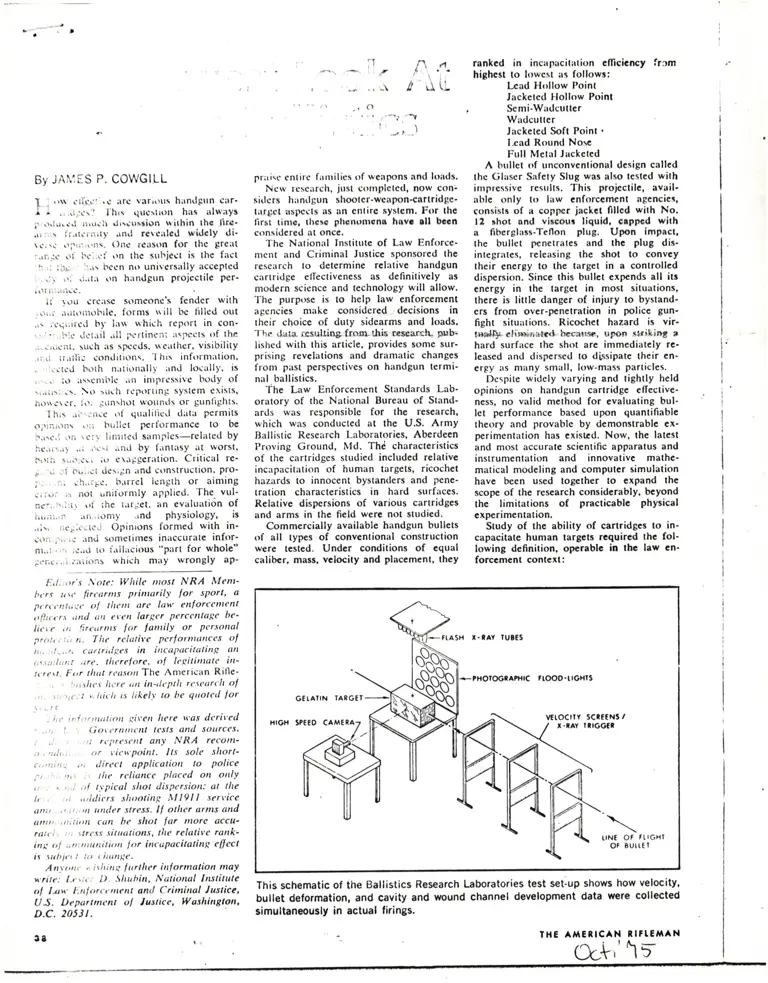
This schematic of the Ballistics Research Laboratories test set-up shows how velocity,
bu lle t deformation, and cavity and wound channel development data were collected
simultaneously in actual firings.
THE A ME R I C A N RI FLEMAN
Instant incapacitation is that which
will render the assailant incapa
ble of posing a continued threat
to the safety of the olliccr by
use of a hand-held weapon. Such
injUry may include clinical death,
unconsciousness, biomedical dys
function, etc., but pain may not
be considered a contributing fac-
areas to instant incapacitation, as defined.
An anatomical model of the human form
WHS divided into horizontal, inch-thick
sections. Each of these horizontal sections
was divided into rectangular solids by ver
tically imposing a 0.2-inch square grid on
each. A team of physicians from the Uni
versity of Maryland Shock-Trauma Center
assigned a numerical value to each rec-
tangular solid (over 150,000 total) which
represents its individual relative sensitivity
to instant incapacitation. This analysis of
human vulnerability to instant incapacita
tion by handgun bullets was entered into
automatic data processing equipment as
"Computer Man," the vulnerability model
for the study. , . . ,
Hit dispersion data was obtained from
Army Human Engineering Laboratory ex
perimentation which involved live firing
by soldiers using cal. .45 service pistols to
shoot at pop-up targets in a stress-type
scenario. The systems analysis technique
used can accept other dispersions which
may be developed for any shooter/ammu-
nition/handgun combination, such as the
hit distribution fired by policemen with
service ammunition and duty revolvers.
This has not yet been done, and the results
might greatly affect the published ratings.
These two models, the vulnerability rep
resentation and the hit distribution data,
were played against each other in a com
puter. Since the "Computer Man" repre
sented a dangerous assailant, its posture
alignment was always frontal, facing the
defending officer. Each round was
or weighted against its penetration of the
anatomical model with respect to incapaci
tation potential. Misses were zeroes.
There are three critical elements in en
counters between law enforcement officers
and their ass.ulants: target vulnerability,
hit distribution .ind bullet terminal bal
listics. D.iu representing these elements
were used as inputs to the study to pro
duce a Relative Incapacitation Index (RIl)
number for each cartridge tested. The
methodology used has made a significant
contribution to knowledge because, for the
first lime, all of the most significant identi
fiable variables in the encounter situation
have been considered to produce quantifi
able results. Previous efforts to quantify
performance usually considered only the
physical performance of the bullet, neglect-
ing critical factors of target vulnerability
and hit probability and distribution.
Target vulnerability was UetermincU by
analyzing a model of the human body to
determine the relative sensitivity of all
This is the dispersion
fired by relatively un
trained shooters with
the M 1911 cal. .45
s e r v i c e p i s t o l i n
stress-type scenarios.
Project funds were
not unlim ited , and d if
ferent dispersions—
using, for instance,
easier-to-shoot guns
__were not obtained.
4 .6 .6 1.0 1.2
DISTANCE IN METRES
,, ■) t ' ' - *
39
O C T O B E R 1975
Performance of Commercially Available Handgun Ammunition'
B A R R E L M E A S U R E D
C A L IG E R
W E IG H T
( g r a in s ) B U L L E T T Y P E M A N U F A C T U R E R
L E N G T H
( in )
V E L O C IT Y
( fp s ) ( m / s )
R l
IN D E X
2 0 0 J H P SPEER 4 .0 0 1 2 7 7 3 8 9 5 4 .9
. 3 b 7 t\*A u 9 6 S A F E T Y S L U G D E A D E Y E A S S O C 4 .0 0 1 7 2 5 5 2 5 5 0 .0
.3 5 7 M A u 9 6 S A F E T Y S L U G D E A D E Y E A S S O C 2 .7 5 1 6 1 5 4 9 2 4 6 .0
.3 S S P E C 9 6 S A F E T Y S L U G D E A D E Y E A S S O C 2 .0 0 1 4 9 6 4 5 5 3 7 .5
,3 S SPEC 1 2 5 J H P R E M IN G T O N 4 .0 0 1 1 0 8 3 3 7 2 5 .5
.4 5 A U T O 1 3 5 J H P R E M IN G T O N 5 .0 0 8 9 5 2 7 2 2 1 .1
.3 5 7 ,VAG 1 5 3 J S P (H I -V E L ) F E D E R A L 2 .7 5 1 1 9 5 3 6 4 1 8 .7
.3 5 7 M A G 1 5 8 J S P SPEER 2 .7 5 1 0 3 0 3 1 3 1 7 .5
.4 5 A U fO 1 8 5 W C (T A R G E T M A S T E R ) R E M IN G T O N 5 .0 0 8 2 1 2 5 0 1 4 .7
,3 S SPEC n o J H P (L O T -Q 4 0 7 0 ) W IN C H -W E S T E R N 2 .0 0 9 5 6 2 9 1 1 4 .0
.3S SPEC 1 4 3 W C R E M IN G T O N 4 .0 0 7 4 1 2 2 5 1 2 .4
.3 5 7 M A G 1 5 3 J H P S M IT H -W E S S O N 2 .7 5 9 8 2 2 9 9 1 1 .1
.3 3 S P E C n o J H P SPEER 4 .0 0 8 5 7 2 6 1 1 0 .5
9 M M 1 2 5 J S P S P E E R 4 .0 0 1 0 5 8 3 2 2 9 .9
.3 3 SPEC 1 2 5 J H P R E M IN G T O N 2 .0 0 9 1 1 2 7 7 7 .0
.4 5 A U T O 2 3 0 FJ W IN C H -W E S T E R N 5 .0 0 7 4 0 2 2 5 6 .5
.3 3 S P E C 1 5 8 LR N F E D E R A L 4 .0 0 7 9 5 2 4 2 5 .0
.3 3 S P E C 1 5 8 L R N R E M IN G T O N 2 .0 0 6 9 4 2 1 1 4 .4
.3 3 S P E C 2 0 0 L R N (L U B A L U V ) W E S T E R N b U P -X 2 .0 0 5 9 2 1 8 0 4 .1
.2 2 LR C A L 3 7 L H P W IN C H -W E S T E R N 2 .0 0 8 7 2 2 6 5 2 .3
.3 8 S P E C 6 4 S H O R T S T O P M B A 2 .0 0 6 7 1 2 0 4 0 .4
ar
a(
P<
si
1 he resiiU of this d.iia m.mipiilalion is
a curse which shows the \ ulnerabiliiy
inJev with respect to penetration, a com-
p.'sjte of all the shots lireil tind the entire
huni.in K'lly. I he cone shows that the
most Milnertible rcttion. essentially the
most sensitise pssrtions <if the vital organs,
occurs at ,i pcneti.ition of tipproxiniately
4.5 centimeters (about I ’a"). A logical
conclusion is th.it the more eflicient in
capacitating rounils ssill trtinsfer more
momentum (or energy) to the target in
the vulnerable regions than in the less
sensitise solumes.
The termin.il ballistics portion of the
experimentation examined bullet behavior
in detail by tiring into a tissue simulant,
blocks m.ide of 20Cc gelatin, on a highly-
instrumentCkl range. The correspondence
between the beh.isior of standardized gela
tin blocks wlien impacted by bullets and
that of bissly tissue has been established by
previous ,sf...> oi..geon General research.
When tissue .s struck by a penetrating pro
jectile. a iempssr.iry cavity is formed
around the p.ith of the bullet which may
be several times the diameter of the pro
jectile or of the permanent cavity or
wound ch.mnel. inis phenomenon is of
extremely short duration, from five tv’ sen
thousandths of a second, after which the
elastic and somewhat fluid tissue contracts
to the dimensions of the permanent cavity
or wound channel. I he volume of the
temporary ctivity is proportional to the
striking kinetic energy of the projectile.
I he shape of the temporary cavity is im
portant because Us radius at any penetra
tion depth can be used to determine how
much energy is delivered to the target at
that point. The more efTective projectiles
will transfer msire energy at the more vul
nerable peneration depths and thus will
generate temporary cavities of larger di
mensions at those critical depths.
Considerable effort was spent in the
measurement of the formation and subse
quent development of the temporary cav
ities produced by various cartridges. Bullet
impact velocity was measured, high-speed
motion picture photography recorded the
profile of the temporary cavity and flash
X-ray exposures were made of the bullets
as they traversed the gelatin. A dramatic
“ballooning” effect of the cavity was ob
served when the projectiles exceeded a
velocity of approximately 1100 feel per
second, which is, perhaps coincidentally,
the speed of sound in air.
The flash X-ray exposures provided five
images of each bullet as it traversed the
gelatin block. These shadowgram pictures
reveal the stability and deformation of the
bullet during penetration.
The payoff of the research is in the Rel
ative Incapacitation index (Rll), a man
ageable and quantifiable number that can
be used and understood by the law en
forcement official charged with the deci
sion of selecting arms and ammunition for
his department. Rll values were obtained
by the mathematical technique' of inte
grating the product of the averaged Vul
nerability Index and the cross-sectional
area of the temporary cavity with respect
to penetration depth. This mathematical
procedure is designed to score most highly
the bullets which transfer the most mo
mentum (or energy) to the target in the
most vulnerable regions.
The higher RII values do not always go
to the projectiles which have the most
kinetic energy or even to those which de
posit the highest total kinetic energy in
the target because of the significance of the
shape of the temporary cavity and its cor
respondence with the Vulnerability Index
curve. Remember, temporary cavity values
were obtained experimentally.
The Rll values published were obtained
by centering the hit distribution model
about the center of the "Computer Man"
torso mass, as is taught in standard fire
arms training courses. As an exercise in
computer simulation and analysis, the com
puter program was run with the center of
dispersion coincident with the center of
vulnerability, which is located at about the
armpit level. Even with the additional
misses created from raising the aiming
point, the overall Rll and probability of
incapacitation were increased significantly.
This finding may indicate that an officer
has a better chance of incapacitating his
assailant by aiming at the armpit level
rather than the center of the chest, infor
mation which may have a profound effect
on future firearms training and doctrine.
Previous efforts at quantifying pistol
cartridge performance have included Gen
eral Julian Hatcher’s Relative Stopping
Power (RSP) formula, first published in
1935, and Southwestern Institute of For
ensic Science’s energy deposit-tests in 1974.
Each approach has its limitations.
Hatcher’s formula multiplied a projec
tile’s area, half its momentum and a
“shape factor” determined from bullet con
struction to obtain an RSP value. A major
contribution of this formula was the recog
nition that bullet area and shape have a
significant impact on effectiveness, a con
cept thoroughly validated by subsequent
research. However, the numerical values
obtained for RSP do not correspond, even
relatively, to the results of the Aberdeen
tests. The RSP formula appears to give too
great a weight to the larger calibers. Also,
the "shape factor" values, rather grossly
S
J.
c l
fc
bl
d<
o
a'
t.i
Ilf
ti
o
a
n
e
n
40 THE A M E R I C A N RI FLEMAN
,ii I’iii ,ii il\ clu'^cn. I’l'ol'.iHy ilo not
. t v w . i i . i l i i . - « ulo spectrum of
pci to: i-.'..,iicc In i'ullcis of moilcrn con-
sliiiitn'ii, csi'ccullv vlumii; lict'oim:ition.
i t;c Soutliucstcui Insiaulc of 1-orciisic
Scic:iccs c\.ilu.ition, coiivluctcJ by N’iiiccnt
J M. O: M.iio, M D. and his associates,
chiono.cr.iplieJ scisicc h.imliriin bullets be
fore enierini; .uid after exiting gelatin
blocks ti' lietermine the toi:il kinetis energy
deposited in the i.iiget. NS'ithin the scope
ot these tests, reassuiitbly good quantifi-
,iblc, demonstrable indicators ncrc ob
tained for recommending amnumition for
l,in enforcement application. The evalua
tion did not. hosseser, examine the shape
of the temporary cavity and target vulner
ability as the l.itcs: lesearch has done. As
mentioned prexiously, maximum total en
ergy tr.insfer, does not always mean maxi-
mun'. inc.ipacit.ition clliciency.
Relative Incapacitation Index (RII)
xalues of rounds tested ranged from 54.9
for a jacketed hollow point (JHP) .44
Magnum to 0.4 for a .38 Spcci.il "bean
bag" round. Cartridges whose Kll values
fell between 10 and 25 have been postu
lated as adequate for service application,
with the caveat that the guidelines arc
offered as probabilistic rather than abso
lute indexes in kccp.ng with the statistical
nature of the biological data in the study.
How well did sonic of our more familiar
service rounds perform? Ihe most com
mon police side.irm ammunition in this
Cv'untry is the .38 Special 158-gr. lead
round nose tLRN) cartridge, and our pre
dominant milit.iry handgun load, is the .45
23()-gr, full metal jacketed (F,\U)
load. Of 142 pistol-cartridge combinations
tested, the most effective .38 Special LRN
was 99th on the list with an Rll of 9.0.
The first military-equivalent .45 ACP was
number 110 with an Rll of 6.7. Each of
these stand.ird cartridges was clearly out
classed by a great number of alternate
loads, including many 9 mm's.
The relative standings vif the various
cartridges are determined by the sizes and
shapes of the temporary cavities formed.
At comp.i.'.ibie non-deforming velocities, a
larger c.dibcr bullet will yield a higher
Rll; bevor.d deforming velocities, smaller
caliber bul.ets of ellicient design may out-
peiform .a.ger calibers.
The current research has contributed
greatly to bringing knowledge about rela
tive handgun cartridge effectiveness out of
the re.dm of mythology and folklore. The
concepts and principles developed should
be useful evermore to the scientific, law
enforcement and shooting communities. U
ACKNOWLEDGEMENTS
The author gratefully acLnowleUgev the as-
Mst.ince of the following research principals;
Lester D. Stiuhin. Program Manager for Stand
ards. National Institute of Law Enforcement
■ind Criminal Justice; Ron Dohbyn, Physicist,
Law Enforcement Standards Laboratory of the
.National Bureau of Standards; XVilliam J.
Bruchey. Jr.. Research Physical Scientist, Bal
listic Research Laboratories, Aberdeen Proving
Ground. The suggestions and encouragement of
Charles S. Petty, M.D., Director and Vincent
J. ,XI. Di .Xtaio. M.D.. Associate Medical Di
rector. Southwestern Institute of Forensic Sci
ences, were greatly appreciated.
O C T O BE R 1975
These representations of the evolution of maximum temporary cavities provide a
direct comparison of the difference velocity and bullet shape and construction
can make. On the left is the cavity produced by a typical 158-gr. lead round-nosed
bullet at 7 70 f.p.s. fired from a .38 Special handgun. At center, the load was a .38
Special 158-gr. semi-wadcutter at 8 6 0 f.p.s. On the right, and much more impressive,
is the result from a .357 S&W Magnum 158-gr. jacketed hollow-point bullet at
1100 f.p.s.
REFERENCES
Beyer, Major James C., MC. (ed.) H'oiind
Ballisilcs. Washington: U.S. Governmcnl Prim
ing Office, 1962.
Cowgill, Jim. "A Critical Look at KE and
RSP," Handlottdtr, (September-October 1975),
40-41.
Di Malo, Vincent J. M., M.D. et at. “A Com
parison of the Wounding Effects of Commer-
W-W, l« N , SI SSfC
VIIOCIIV ------- s e s m n . t l» J8 l / i « e l
146"'7i*c ( n 3 | f / i « c )
)|4mA«c
C A V IT Y P K O F iie (cm )
“ 5.1 0 5.1 10.2
30 5
dully Available Handgun Ammunition Suitable
for Police Use,” FBI Law Enforcement BuUetlnt
(December 1974), 3*8.
Di Malo, Vincent J. M., M.D. "The Effective
ness of Snub“Nosc Revolvers and Small Auto
matic Pistols," FBI Law Enforcement Bulletin,
(June 1975), 10-13.
Dobbyn, R. C., W. J. Bruchey, Jr., and L. D.
Shubin. An Evaltiation of Police Handgun Am-
munition: Summary Report. Washington: U.S.
Department of Justice, August 1975.
Hatcher, Major Julian S. Textbook of Pistolx
and Rexohers. Marines, N.C.: Small-Arms Tech
nical Publishing Company, 1935.
At left, temporary cavities from .38
Special lead round-nosed bullets at
three velocities are illustrated. The
correlation between velocity and rad
ius of the temporary cavity is direct.
S 4 w , J H 4 , 3 5 7 M A O
V I lO C iT Y ----------( 1 2 4 3 1 / m l
— - 5 2 4 « / m € (1727f/i«) ..........2*ImA»c |l5S f/»M )
“ 10,2
C A V IT Y 7 R O T II I (cm )
-5 .1 0 1.1 10 2
e
10.2 I
At right are cavities from four firings
of .357 S&W Magnum jacketed
hollow-points at varying velocities.
Again, there is direct correlation be
tween striking velocity and tem po
rary cavity generation. Note also the
difference in the results between
this representation and that shown
above.
41