Anderson v. Martin Brief for the United States as Amicus Curiae
Public Court Documents
September 1, 1963
-
Brief Collection, LDF Court Filings. Anderson v. Martin Brief for the United States as Amicus Curiae, 1963. 4cd3dcbc-b79a-ee11-be36-6045bdeb8873. LDF Archives, Thurgood Marshall Institute. https://ldfrecollection.org/archives/archives-search/archives-item/20944862-cc2f-46b6-a210-23baa6f6d27a/anderson-v-martin-brief-for-the-united-states-as-amicus-curiae. Accessed October 06, 2026.
Copied!
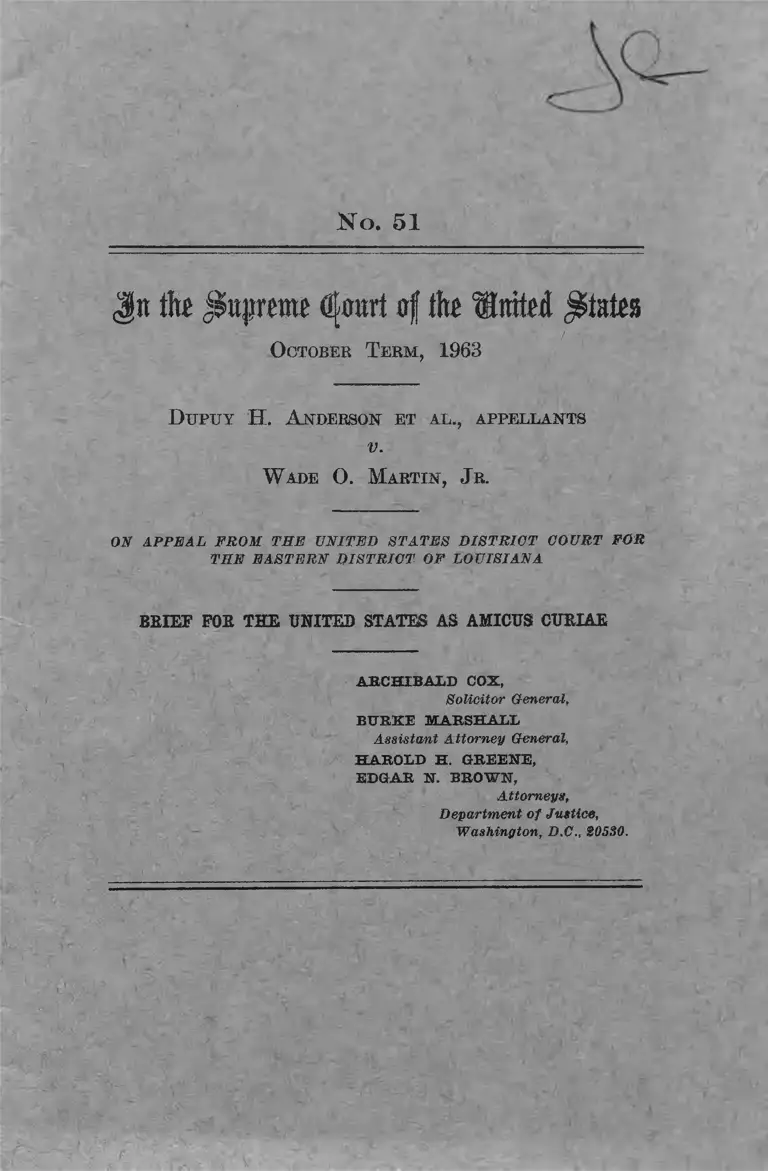
K o. 51
Jit th JSttjjrcp (§mrt of th UnM States
\ / ' .
October T erm, 1963
Dtjpuy H . A nderson et al., appellants
v.
W ade O. Martin, J r.
ON A PP E A L PROM T E E U NITED S T A T E S D IS T R IC T COURT FOR
TH E E A S T E R N D IS T R IC T OF LO U ISIAN A
BRIEF FOR THE UNITED STATES AS AMICUS CURIAE
A RCH IBA LD COX,
Solicitor General,
BURK E M A RSHA LL
A ssistan t A ttorney General,
HAROLD H . G R EEN E,
EDGAR N. BROW N,
Attorneys,
D epartm ent of Justice,
W ashington, D.C., &0580,
I N D E X
Pagro
Opinion below-------------------------------------------------------- 1
Jurisdiction----------------------------------------------------------- 1
Question presented-------------------------------------------------- 1
Statute involved---------------------------------------------------- 2
Statement------------------------------------- --------------------- -— ®
Interest of the United States-------------------------------------- 5
Summary of argument--------------------------------------------- 6
Argument:
Louisiana’s compulsory racial designation of candi
dates on an official state ballot violates the Equal
Protection Clause of the United States Constitution
because it encourages voters to discriminate on the
basis of race-------------------------------------------------- I
A. The statute promotes voting discrimination
against Negro candidates------------------------- I
B. The statute is not saved merely because its
terms apply equally to all candidates--------- 10
C. The statute is not a legitimate means of iden
tifying candidates or of informing voters— 12
Conclusion------------------------------------------------------------- 14
CITATIONS
Cases:
American Communications Ass’n. v. Douds, 339 U.S.
382_________________________________________ 10
Baldwin v. Morgan, 287 F. 2d 750-------------------------- 9
Bates v. Little Bock, 361 U.S. 516-------------------------10,12
Douglas v. California, 372 U.S. 353----------------------- • U
Goss v. Board of Education, 373 U.S. 683---------------- 11
Griffin v. Illinois, 351 U.S. 12------------------------------ 11
McDonald v. Key, 224 F. 2d 608, certiorari denied, 350
U.S. 895_______________________ 10
National Association for the Advancement of Colored
Peofle v. Alabama, 357 U.S. 449------------------------- 7,10
705-184— 63 (I)
II
Cases—Continued Page
Steele v. Louisville (& Nashville B. Co., 323 U.S. 192— 7
United States v. City of Jackson, 318 F. 2d 1______ 9
Constitution and statutes:
United States Constitution:
First Amendment__________ 2,3
Fourteenth Amendment________________ 2,3,4,7,11
Fifteenth Amendment____ ___________________ 2,3,4
28 U.S.C. 1331_________________________ 3
28 U.S.C. 1343(3)____________ 3
28 U.S.C. 2201_.___ 4
28 U.S.C. 2202_____________ 4
28 U.S.C. 2281_________ 4
28 U.S.C. 2284_______ 4
42 U.S.C. 1971____ 5
42 U.S.C. 1971(a)______________________________ 3
42 U.S.C. 1974b______________ 5
42 U.S.C. 1981_________________________________ 3
42 U.S.C. 1983_________________________________ 3
Gen. Stat. Kansas 1949 (1961 Supp.) § 25-602_________ 12
Louisiana Revised Statutes:
Section 18:316_________________________________ 8
Section 18:671____________________________ 8
Title 18, § 1174.1 (act No. 538,1960 Louisiana Legisla
ture) -------------------------------------------------------- 2,3,5,12
Rev. Stat. Maine 1954, C. 5, § 5______________________ 12
Ann. Code Maryland, 1957, Art. 33, § 94_______________ 12
Ann. Laws Massachusetts (1962 Supp.) C. 54, § 41_______ 12
New Hampshire Rev. Stat. Ann., 1955, §59:3__________ 13
Vermont Stat. Ann. 1958, Title 17, § 792(b)____________ 13
West Virginia Code, 1961, § 97_________ 13
Miscellaneous:
U.S. Commission on Civil Rights, The 50 States Report
(1961) 214-215_______ 9
October T erm, 1963
No. 51
D tipuy IT. A nderson et al.,; appellants
v.
W ade O. M artin, J r.
ON A PPEAL FROM TH E U NITED S T A T E S D IS T R IC T COURT FO R
TH E E A S T E R N D IS T R IC T OF LO U ISIAN A
BRIEF FOR THE UNITED STATES AS AMICUS CURIAE
O PIN IO N b e l o w
The opinion of the United States District Court for
the Eastern District of Louisiana (R. 26-36) is re
ported at 206 E. Supp. 700.
j u r i s d i c t i o n
The order denying the prayer for a permanent in
junction is dated September 28, 1962 (R. 44). Notice
of Appeal was filed October 25, 1962 (R. 48), and
probable jurisdiction noted on February 18, 1963
(R. 50). Jurisdiction of this Court to review this deci
sion on direct appeal rests on 28 U.S.C. 1253.
q u e s t i o n p r e s e n t e d
Whether Title 18, § 1174.1 of the Louisiana Revised
Statutes, which provides that the official ballots in any
2
primary, general and special election shall state the
race of each candidate, violates the Equal Protection
Clause of the Fourteenth Amendment to the United
States Constitution.1
STATUTE IN VO LVED
Section 1174.1 of Title 18 of the Louisiana Revised
Statutes of 1950 (Act ISTo. 538 of the 1960 Louisiana
Legislature) provides as follows:
A. Every application for or notification or
declaration of candidacy, and every certificate
of nomination and every nomination paper filed
in any state or local primary, general or special
election for any elective office in this state shall
show for each candidate named therein, whether
such candidate is of the Caucasian race, the
Negro race or other specified race.
B. Chairman of party committees, party ex
ecutive committees, presidents of boards of su
pervisors of election or any person or persons
required by law to certify to the Secretary of
State the names of candidates to be placed on
the ballots shall cause to be shown in such cer
tification whether each candidate named therein
is of the Caucasian race, Negro race or other
specified race, which information shall be ob
tained from the applications for or notifications
or declarations of candidacy or from the certifi
cates of nomination or nomination papers, as
the case may be.
1 The United States takes no position on either of the appel
lants’ other contentions: (1) that the statute violates the F if
teenth Amendment, and (2) that the statute violates the First
Amendment as it has been made applicable to the States by the
Fourteenth Amendment.
3
C. On the ballots to be used in any state or
local primary, general or special election the
Secretary of State shall cause to be printed
within parentheses ( ) beside the name of each
candidate, the race of the candidate, whether
Caucasian, Negro, or other specified race, which
information shall be obtained from the docu
ments described in Sub-section A or B of this
Section. The racial designation on the ballots
shall be in print of the same size as the print
in the names of the candidates on the ballots.
STA TEM EN T
Appellants Dupuy H. Anderson and Acie J. Belton
are citizens of the United States and of East Baton
Rouge Parish, Louisiana. They are Negroes. Each
sought election to the School Board of East Baton
Rouge Parish in the Democratic Primary Election
of July 28, 1962. On June 8, 1962, they filed a com
plaint in the United States District Court for the
Eastern District of Louisiana to enjoin enforcement
of Act No. 538 of the 1960 Louisiana Legislature,
§ 1174.1 of Title 18 of the Louisiana Revised Statutes,
which would require appellee, the Secretary of State
of Louisiana, to print their race in parentheses beside
their names on all ballots to be used in the election
(R. 1).
The complaint alleged that the statute violated the
First, Fourteenth and Fifteenth Amendments to the
United States Constitution, and appellants invoked
the court’s jurisdiction under sections 1981, 1983 and
1971(a) of Title 42, and sections 1331 and 1343(3) of
Title 28 of the United States Code. Appellants
4
sought an injunction against enforcement of the state
statute pursuant to 28 U.S.C. 2281 and also asked for
declaratory relief under 28 U.S.C. 2201, 2202, for
themselves and on behalf of all Negroes similarly sit
uated. They requested that a three-judge court be
convened, as provided in 28 U.S.C. 2284.
On June 11, 1962, a motion for a temporary re
straining order was denied by the District Judge with
whom the complaint had been filed (R. 15). On
June 14, 1962, a three-judge court was designated
(R. 17). Argument was heard and the case was sub
mitted to the three-judge court on June 26, 1962
(R. 20).
In its opinion of June 29, 1962, the court, by a two-
to-one vote (Circuit Judge Wisdom dissenting), up
held the constitutionality of the statute and denied a
temporary injunction. The court held that the Louisi
ana statute did not violate the Fifteenth Amendment
because that Amendment applied only to denial of the
right, to vote; and that the statute did not violate the
Equal Protection Clause of the Fourteenth Amend
ment because it applied to “all candidates alike” with
out discrimination.
The Democratic Primary Election took place as
scheduled on July 28, 1962. The Louisiana statute
was enforced, and the appellants’ race was printed
heside their names on the ballots. Appellant Ander
son was defeated in the July 28 election, and appellant
Belton was defeated in the runoff election held on
September 1, 1962.
On September T9, 1962, appellants filed a motion
for leave to file an amended or supplemental com
plaint (R. 36). On the same date the motion was
denied (R. 43). The amended complaint alleged that
the appellants’ unsuccessful candidacies were substan
tially influenced by the enforcement of Act No. 538
and that each of the appellants intended to become
candidates in the future (R. 37-42). On Septem
ber 28, 1962, the court, incorporating the opinion of
the three-judge court of June 29, 1962, denied appel
lants’ prayer for a permanent injunction (R. 44).
Judge Wisdom again dissented. Notice of appeal
was filed on October 25, 1962, and this Court noted
probable jurisdiction on February 18, 1963.
IN T E R E S T OE T H E U N IT E D STATES
The United States has a particular interest in the
protection of constitutional rights relating to the elec
tive process. In the 1957 and 1960 Civil Rights Acts
Congress authorized the Attorney General to institute
civil actions to protect voting rights of citizens from
discriminatory practices. 42 TT.S.C. 1971, as amended.
Pursuant to that grant of authority, the United States
has filed suit in more than forty counties in five States
to enjoin Unwarranted distinctions in the right to
vote and to prevent threats, intimidation or coercion
in connection with the exercise of this right. Legal
proceedings have also been instituted by the United
States to secure inspection of voting records under
42 U.S.C. 1974b. Finally, the United States has di
rectly attacked the constitutionality of state voter
qualification laws in the States of Louisiana and Mis
sissippi.
6
Nearly all of this activity has been directed at elim
inating various forms of state-imposed racial dis
crimination from the voting process. Such discrim
ination has generally taken the guise of restrictions
upon the rights of Negro citizens to register and to
cast a ballot. But other types of state regulation may
equally affect the integrity of the elective franchise
and may impermissibly inject racial distinctions into
the voting process. For the reasons developed in this
brief, we believe that this is the necessary consequence
of the legislation at issue here.
SUM M ARY OF ARG UM EN T
The district court held that the appellants were not
denied the equal protection of the laws by the Louisi
ana statute because (1) the races of all candidates are
designated on the official ballot, and (2) the statute
does not produce any “ actual discrimination” other
than by private individuals “ wholly beyond the con
trol of the state.” In our view, the statute, by con
centrating exclusively on the single factor of the can
didate’s race, has the necessary consequence of facili
tating, encouraging and promoting discrimination by
voters against candidates of the Negro race. The
equal treatment afforded by the statute is illusory
only, sinee none but a Negro candidate is likely to be
injured by the labeling requirement. The State has
a heavy burden when it seeks to justify the use of a
racial designation. Here, that burden cannot be met,
for it cannot be said that a statute which singles out
race alone as a fact to be stated on the ballot is genu
inely concerned with identifying the candidate or
7
informing the electorate. I t follows that the enforce
ment of Louisiana’s statute denies to candidates of
the minority race the equal protection of the State’s
laws.
A RG UM EN T
LOUISIANA’S COMPULSORY RACIAL DESIGNATION OF CANDI
DATES ON AN OFFICIAL STATE BALLOT VIOLATES THE
EQUAL PROTECTION CLAUSE OF THE UNITED STATES CON
STITUTION BECAUSE IT ENCOURAGES VOTERS TO DISCRIM
INATE ON THE BASIS OF RACE
A. THE STATUTE PROMOTES VOTING DISCRIMINATION AGAINST NEGRO
CANDIDATES
In the present case, as in National Association for
the Advancement of Colored People v. Alabama, 357
U.S. 449, 463, “ [t]he crucial factor is the interplay of
governmental and private action.” I t is clear that an
individual Louisiana citizen is free to cast his vote for
whomever he likes. His private choice is unfettered
by the Fourteenth Amendment, and it may be deter
mined entirely by racial prejudices. On the other
hand, it is equally obvious that the State of Louisiana
may not affirmatively bar Negro citizens from holding
public office merely on account of their race. Such
discrimination by the State, based upon a classifica
tion which this Court has declared to be “ obviously ir
relevant and invidious” (Steele v. Louisville & Nash
ville B. Co., 323 U.S. 192, 203), would violate the
Equal Protection Clause of the Fourteenth Amend
ment.
This case falls between the two extremes. The
State of Louisiana has not, by this statute, directly
s
imposed an y restraint upon a Negro’s candidacy, nor
has it, by the self-executing force of any statute or
regulation, reduced a Negro’s chances of election.
But the statute indirectly, but nonetheless inevitably,
discourages Negro citizens from becoming candidates
for public office and reduces the probabilities of a
Negro’s election by compelling all candidates to ad
vertise their race on the ballot.
The contents and form of the official ballot used in
general and primary elections in the State of Louisi
ana are prescribed by statute. La. Rev. Stat.
§§ 18: 316, 18: 671. Before 1960, when the statute here
in question was enacted, primary ballots contained no
information concerning any of the candidates other
than their names. General election ballots also
grouped the candidates according to the political
parties which they represented. The effect of the
1960 amendment was to add to the ballot a single item
of information—the. race of each of the candidates.
Consequently, Louisiana’s primary ballots now con
tain only the names of the candidates and each one’s
race. On general election ballots, candidates are
grouped according to party affiliation, and racial des
ignations follow their names.
By attaching only a racial label to the otherwise un
adorned name of each candidate on the official ballot,
the State of Louisiana implies to its voting citizenry
that the candidate’s race is or should be an important
element in the voter’s choice. By placing the racial
designation upon the very document on which the
voter expresses his choice, the State directs the voter’s
9
attention to this single consideration at the most crit
ical moment in the entire electoral process—the in
stant at which the vote is cast. The inevitable effect
of this practice is to encourage individual voter-
citizens to cast their ballots along racial lines. Since
Negroes constitute a distinct racial minority among
Louisiana’s voters,2 they are the ones who are injured
if the State’s emphasis on race succeeds in encouraging
voting on racial lines.
By requiring a racial label on the ballot, Louisiana
promotes private racial discrimination by voters
in the same manner as a State might promote racial
segregation by requiring or supplying signs to designate
separate Negro and white facilities in privately owned
places of public accommodation. In United States v.
City of Jackson, 318 F. 2d 1 (C.A. 5), it was argued that
such signs were merely “a helpful hint” and that they
“ just: assist members of both races in the voluntary
separation of the races.” Quoting from its opinion
in Baldwin v. Morgan, 287 F. 2d 750, the Court of
Appeals for the Fifth Circuit stated (318 F. 2d at 8):
I t is simply beyond the constitutional compe
tence of the state to command that any facility
either shall be labeled as or reserved for the ex
clusive or preferred use of one rather than the
other of the races. * * * [Emphasis added.]
2 The report of the Commission on Civil Eights states that
as of December 31, 1960, there were 992,684 registered white
voters in Louisiana and 158,765 Negro voters. In East Baton
Rouge Parish, where the appellants ran for office, the figures
were 66,041 white voters and 10,573 Negroes. IT.S. Comin’n on
Civil Rights, The 50 States Report (1961) 21T-215.
10
The State’s involvement is the same in the case of
the State’s ballot as it is in the case of the State’s
sign. Each is ineffective unless a private individual
supplements it with private discrimination. But in
each instance it is the State which has pointed the
way.
The “indirect” restraint which this labeling require
ment imposes upon a Negro’s candidacy is very much
like the consequences which this Court observed would
follow from “ [a] requirement that adherents of particu
lar religious faiths or political parties wear identify
ing arm-bands.” American Communications Ass’n v.
Douds, 339 U.S. 382, 402. Although an arm-band
requirement would not directly stifle speech and would,
in fact, impart truthful information concerning the
wearer’s affiliation, repressive consequences would re
sult from the combination of “state power” and “pri
vate action.” See National Association for the Ad
vancement of Colored People v. Alabama, 357 U.S.
449, 463; Bates v. Little Rock, 361 U.S. 516, 524.
Similarly, the labeling provision of the Louisiana
statute, when considered in light of “ private attitudes
and pressures,” ibid., has a clearly coercive effect on
the candidacy of Negro citizens for public office.
B. THE STATUTE IS NOT SAVED MERELY BECAUSE ITS TERMS APPLY
EQUALLY TO ALL CANDIDATES
The district court observed that pursuant to the
statute in question “all candidates must state their
race and have it printed on the ballot” (R. 32). On
this basis, it concluded that the Louisiana statute was
“nondiseriminatory,” and distinguished the decision of
the Tenth Circuit in McDonald v. Key, 224 F. 2d 608,
11
certiorari denied, 350 U.S. 895, which had declared
unconstitutional a similar labeling provision appli
cable only to Negro candidates.
The district court’s conclusion was erroneous. The
guarantee of the Equal Protection Clause of the Four
teenth Amendment is not limited to express statutory
classifications. As this Court noted in Griffin v. I l
linois, 351 U.S. 12, 17 n. 11, “a law nondiscriminatory
on its face may be grossly discriminatory in its
operation.” Griffin v. Illinois and many of this
Court’s decisions regarding the constitutional rights
of indigent defendants in the state courts, culminat
ing with Douglas v. California, 372 U.S. 353, decided
last Term, attest to the proposition that the constitu
tionality of state action under the Equal Protection
Clause must be measured by the necessary effect
of the State’s conduct, and not merely by the language
of its law.
In the present case, the equal treatment which the
Louisiana statute affords to Negro and Caucasian
candidates is illusory only. Obviously, the racial per
centages of Louisiana’s voting population being what
they now are,3 Caucasian candidates have little to
lose if their race is displayed on the official ballot.
Negro candidates, on the other hand, are likely to
encounter discrimination. Hence, as in Goss v. Board
of Education, 373 U.S. 683, 688, “ [t]he alleged equality
[is] * * * only superficial.” The full extent of the
statute’s “nondiscriminatory” nature is that Louisiana
law now equally compels both Negro and white candi
dates to suffer at the polls from racial prejudice.
3 See note 2, p. 9, supra.
12
O. THE STATUTE IS HOT A LEGITIMATE MEANS OE IDENTIFYING
CANDIDATES OR OF INFORMING VOTERS
We may assume, for purposes of argument, that if
Louisiana could demonstrate a legitimate interest in
displaying only the race of each of its candidates for
public office next to the candidate’s name on the of
ficial ballot, such a showing might save Act No. 538.
See, e.g., Bates v. Little Rock, supra, at 524. How
ever, the burden of justifying a racial designation is
a heavy one. And when, as here, the integrity of the
electoral process is involved, the burden should be
heavier still. We submit that there is no compelling
interest to warrant the racial designation required by
Louisiana.
There is no substance to the argument that the
State was concerned with further identifying the
names on the ballot so as to enable voters to relate
the names with actual living persons whom they have
seen or heard during an election campaign. Although
physical description may be one means of making
such an identification, the bare racial label is surely
inadequate for this purpose. At best, it is a group
identification which serves only to classify the person
so described as the “white” or “Negro” candidate—
precisely the “invidious” distinction which the State
may not promote. See p. 7, supra.
In some States identifying information other than
the names of the candidates appears on the ballot; 4
Louisiana is the only State which uses a racial label.
4 E.g., Gen. Stat. Kansas 1949 (1961 Supp.) §25-602 (resi
dence) ; Kev. Stat. Maine 1954, C. 5, § 5 (residence); Ann.
Code Maryland, 1957, Art. 33, § 94 (residence); Ann. Laws
13
Data concerning a candidate’s address, his occupa
tion, or the fact of his incumbency is far more helpful
in making a specific identification than is a racial
designation. Since most candidates are white, the
‘■‘Caucasian” label has almost no significance what
ever. If, as was true here, more than one Negro can
didate runs for office, the “ Negro” label merely nar
rows the (field. And if physical description is deemed
most appropriate, there are surely many more spe
cific physical characteristics which contribute to indi
vidual identification than the candidate’s race. At
best, Louisiana might use race as one of several identi
fying features. Its isolation on the official ballot is
susceptible of only one interpretation—a design to en
courage voting along racial lines—and eamiot be
j ustified by the minimal assistance it lends to the identi
fication of the candidates.
Equally without merit is any claim that the State is
interested in informing the electorate of the personal
traits of each candidate, so that the voters might have
these considerations in mind when they decide whom
to select. The bare racial label on the official ballot
cannot serve this purpose. I t imparts only the sort
of information which invites “invidious” discrimina
tion. See p. 7, supra. Standing alone, as it does
on the Louisiana ballot, it is of no other significant
informational value, as it perhaps might be in the
context of a detailed biography of the candidate.
Massachusetts (1962 Supp.) C. 54, § 41 (residence and in
cumbency) ; New Hampshire Rev. Stat. Ann., 1955, § 59 :-3 (resi
dence) ; Vermont Stat. Ann., 1959, Title 17, § 792(b) (residence);
West Virginia Code, 1961, §97 (residence).
14
Moreover, if Louisiana’s purpose were to convey bio
graphical information to its voters so as to enable them
to make an educated choice, it could accomplish this
objective far more effectively by distributing such a
biography well in advance of the actual vote. The
damaging effect of the racial label on the ballot is sub
stantially greater than its minimal contribution to the
public’s last-minute knowledge of the candidates.
CONCLUSION
Wherefore, it is respectfully submitted that the
judgment of the district court should be reversed.
A rchibald Cox,
Solicitor General.
B urke Marshall,
!Assistant Attorney General.
H arold H . Greene,
E dgar N. B rown,
Attorneys.
September 1963.
U S . GOVERNMENT PRINTING 0 F F IC E :!9 6 S