ACLU Press Release; Notice of Intent to Take Deposition
Public Court Documents
October 11, 1974 - April 1, 1976
-
Case Files, Garner Working Files. ACLU Press Release; Notice of Intent to Take Deposition, 1974. 4308b5a8-33a8-f011-bbd3-000d3a53d084. LDF Archives, Thurgood Marshall Institute. https://ldfrecollection.org/archives/archives-search/archives-item/212a6934-a840-48e3-aa8c-fbe601800d53/aclu-press-release-notice-of-intent-to-take-deposition. Accessed September 25, 2026.
Copied!
\Y
THE ATKRICAN CIVIL LIBERTIES UNION
In West Tennessee
3625 Midland Avenue
Mamphis, Tennessee 38111
323-8606
-1>
I • ck'tnê/J G-
FOR IMMEDI/.TE RKLFASF.
October 11, 1974
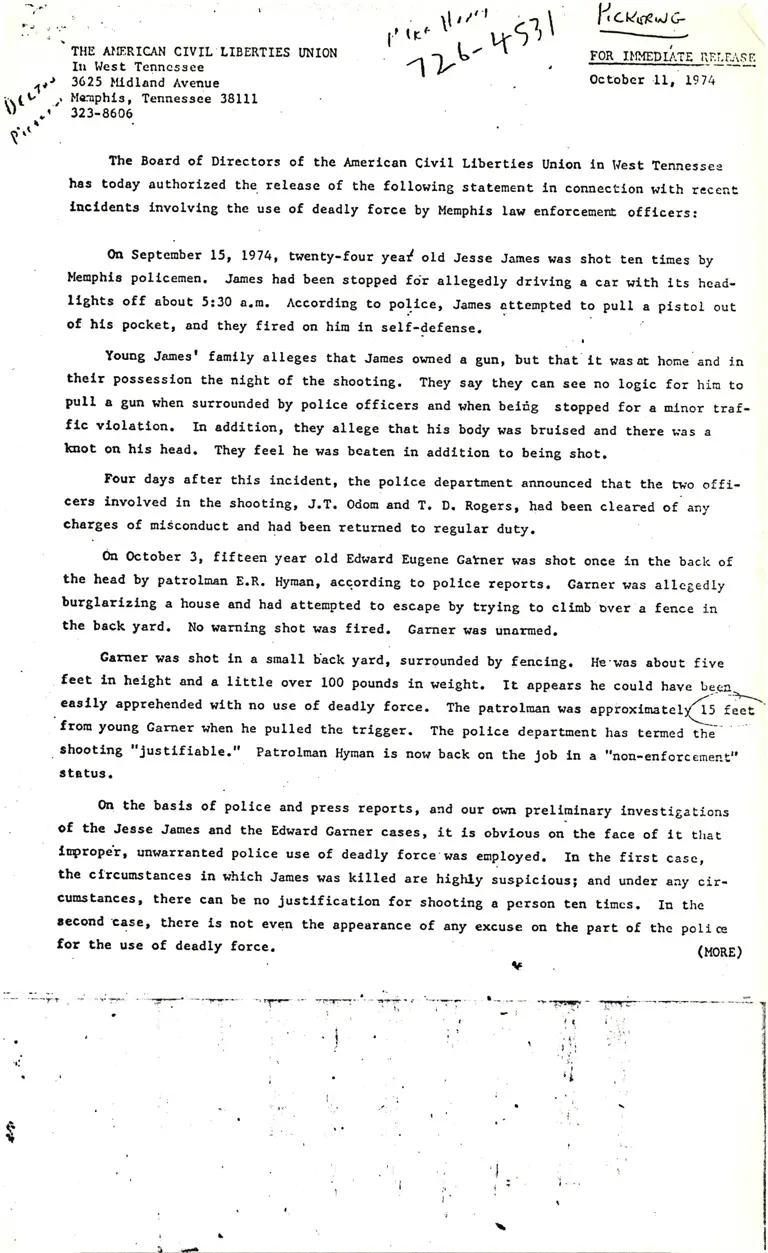
The Board of Directors of the American Civil Liberties Union in West Tennessee
has today authorized the release of the following statement in connection with recent
incidents involving the use of deadly force by Memphis law enforcement officers:
On September 15, 1974, twenty-four yea:^ old Jesse James was shot ten times by
Memphis policemen, James had been stopped for allegedly driving a car with its head
lights off about 5:30 a,ra. According to police, James attempted to pull a pistol out
of his pocket, and they fired on him in self-defense,
' I
Young James' family alleges that James owned a gun, but that it was at hone and in
their possession the night of the shooting. They say they can see no logic for him to
pull a gun when surrounded by police officers and when being stopped for a minor traf
fic violation. In addition, they allege that his body was bruised and there was a
knot on his head. They feel he was beaten in addition to being shot.
Four days after this incident, the police department announced that the two offi
cers involved in the shooting, J,T, Odom and T, D, Rogers, had been cleared of any
charges of misconduct and had been returned to regular duty.
On October 3, fifteen year old Edward Eugene Gatner was shot once in the back of
the head by patrolman E,R, Hyman, according to police reports. Garner was allegedly
burglarizing a house and had attempted to escape by trying to climb over a fence in
the back yard. No warning shot was fired. Garner was unarmed.
Gamer was shot in a small back yard, surrounded by fencing. He was about five
feet in height and a little over 100 pounds in weight. It appears he could have be.cn
easily apprehended with no use of deadly force. The patrolman was approxlmatelj^^^5 feet
from young Gamer when he pulled the trigger. The police department has t e r m e d ^ '
shooting "justifiable." Patrolman Hyman is now back on the Job in a "non-enforcement"
status.
On the basis of police and press reports, and our ovm preliminary investigations
of the Jesse James and the Edward Gamer cases, it is obvious on the face of it that
Improper, unwarranted police use of deadly force was employed. In the first case,
the circumstances in which James was killed are highly suspicious; and under any cir
cumstances, there can be no justification for shooting a person ten times. In the
second case, there is not even the appearance of any excuse on the part of the police
for the use of deadly force, (MORE)
- 2- ^
4
The Board of Directors of the American Civil Liberties Union in West Tcnncsee
views these cases as the most serious encroachment on civil libctties possible; both
instances constitute the unwarranted taking of human life. We have long stood against
police use of deadly force except in situations where such force is necessary to pre
vent loss of life or serious bodily injury to either an officer or another person, and
where no other means of apprehension and control are available. We have taken the po
sition that the action of any law enforcement officer who uses deadly force except to
protect human life cannot be justified. We have supported legislation which would
make such unjustified police use of deadly force a crime.
I
Therefore, we call upon Attorney General Hugh Stanton to launch a new invistiga*
tioh of these incidents and bring indictments against the officers involved if the*
facts warrant this action. ■ ■ ■
I
We further resolve that we will take whatever action possible to bring to light
the true facts in these cases and other similar cases involving unwarranted police use
of deadly force, and we will press for the prosecution of all guilty parties.
We’call upon Police Director Jay Hubbard to dismissftom'the police force officers
who make use of deadly force for purposes other than the protection of human life and
when other means of enforcing the Law are not possible.
We call upon the Mayor and the City Council to take immediate steps'to-make-^'
overall change in the application and formulation of‘guidelines on police use of deadly
force. We will take whatever steps we can to bring this about.
-30-
f i.< j/ * •
Vi
» *
i :
IN THE UNITED STATES DISTRICT COURT
FOR THE WESTERN DISTRICT OF TENNESSEE
CLEAMTEE GARNER,
vs.
MEMPHIS POLICE DEPARTMENT, et al.
CIVIL ACTION
No. C-75-145
NOTICE OF INTENT TO TAKE DEPOSITION
PLEASE TAKE NOTICE that plaintiff will take the
deposition upon oral examination pursuant to Rule 30 of the
Federal Rules of Civil Procedure of E. R. Hymon # 3441 and
L. B. Wright # 9273 of the Memphis Police Department, Memphis,
Tennessee at the offices of Bailey, Higgs & Bailey, Suite 901,
Tenoke Building, 151 Jefferson Avenue, Memphis, Tennessee, at
9:00 A.M. on Monday, April 26, 1975, before a Notary Public or
other qualified officer and deposition shall continue until
completed as taking thereof may be from time to time adjourned.
Drew S. Days, III
10 Columbus Circle
New York, New York 10019
CERTIFICATE OF SERVICE
I hereby certify that I mailed a copy of the foregoing
Notice of Intent to Take Deposition to Henry L. Klein, Esq.,
Staff Attorney, City of Memphis, Suite 3500, 100 North Main
Building, Memphis, Tennessee 38103, on this day of April,
1976 by United States mail, postage prepaid.
Drew S. Days, III
Attorney for Plaintiff