Memorandum of Points and Authorities of Plaintiff Cleamtee Garner
Public Court Documents
July 8, 1976
-
Case Files, Garner Hardbacks. Memorandum of Points and Authorities of Plaintiff Cleamtee Garner, 1976. 5550c7db-24a8-f011-bbd3-000d3a151b15. LDF Archives, Thurgood Marshall Institute. https://ldfrecollection.org/archives/archives-search/archives-item/2257cae8-ff7b-4ae0-80a4-cf3e30696da5/memorandum-of-points-and-authorities-of-plaintiff-cleamtee-garner. Accessed September 28, 2026.
Copied!
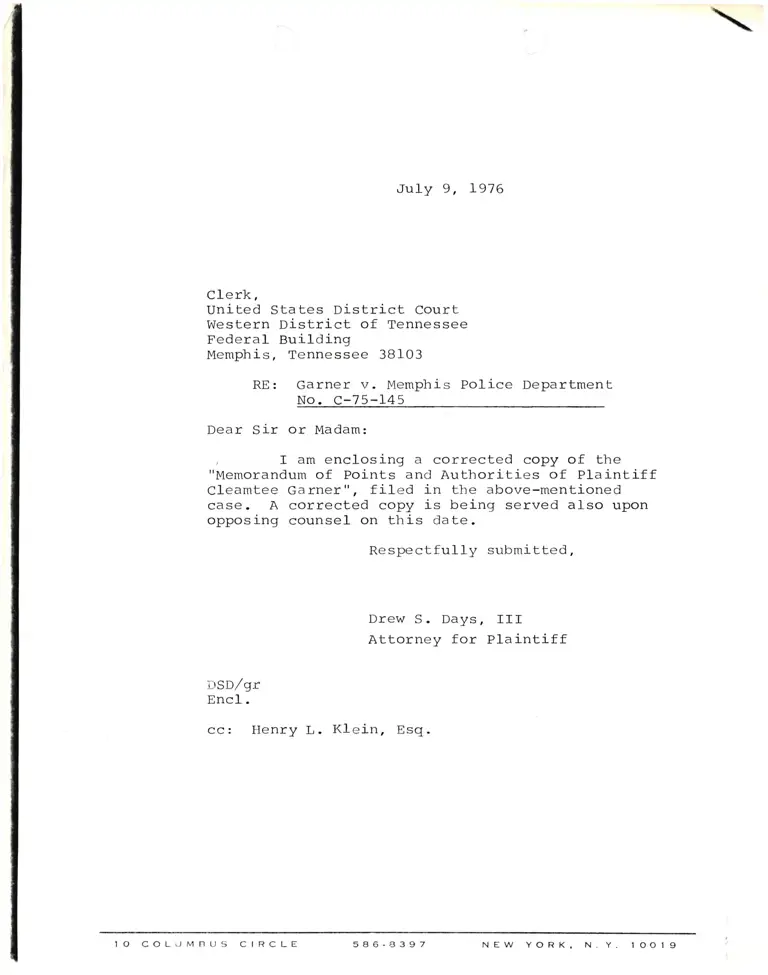
July 9, 1976
Clerk,
United States District Court
Western District of Tennessee
Federal Building
Memphis, Tennessee 38103
RE: Garner v. Memphis Police Department
No. C-75-145______________________
Dear Sir or Madam:
I am enclosing a corrected copy of the
"Memorandum of Points and Authorities of Plaintiff
Cleamtee Garner", filed in the above-mentioned
case. A corrected copy is being served also upon
opposing counsel on this date.
Respectfully submitted.
Drew S. Days, III
Attorney for Plaintiff
jjSD/gr
Enel.
cc: Henry L. Klein, Esq.
1 0 C O L U M R U S C I R C L E 5 8 6 - 8 3 9 7 NEW YORK 10 0 19
In The
UNITED STATES DISTRICT COURT
FOR THE WESTERN DISTRICT OF TENNESSEE
CLEAMTEE GARNER, father and next of kin
of Edward Eugene Garner,a deceased minor.
Plaintiff,
vs.
MEMPHIS POLICE DEPARTMENT, City of Memphis,
Tennessee; WYETH CHANDLER, Mayor of
Memphis; JAY W. HUBBARD, Director of
Police of Memphis; and E.R. HYMON, Police
Officer of the City of Memphis,
Defendants.
Civil Action
No. C-75-145
Memorandum of Points and Authorities
of Plaintiff Cleamtee Garner
Statement of Facts
On Thursday, October 3, 1974 at approximately 11:00 P.M.
the Memphis Police Department received a telephone call reporting
a burglary in progress in the vicinity of 737 Vollintine in the
City of Memphis, Tennessee. Officers Elton K. Hymon and Leslie
B. Wright of the Memphis Police Department were dispatched to the
scene to investigate. Upon their arrival at 737 Vollintine,
Officer Hymon was informed by the resident at 737 that the burglary
was in progress at 739 Vollintine. The residence at 739 runs
from front to back in a north-south direction. Officer Hymon
proceeded along the residence at 739 Vollintine on its west side
from north to south. Officer Wright proceeded on the eastern side
of the residence from north to south. Both officers had their
weapons drawn and flashlights illuminated as they moved toward the
rear of the residence.
Hymon reached the rear corner (southeast) of the residence.
and saw a figure run from the central area of the residence
midway between the east and west corners of the residence) toward
high
an approximately six-foot/chain-link fence which ran across the
entire rear portion of the residence. Officer Hymon directed
his flashlight beam on the figure revealing the decedent, Edward
Eugene Garner, who had reached the base of the chain-link fence.
Garner was at that time 15 years old, approximately 5 feet 4 inches
tall and of slight build. Officer Hymon yelled at Garner to halt,
identifying himself as a police officer. Garner then paused at
the fence and turned to Hymon, at which point Hymon could see that
the figure was an unarmed black male. When he observed Garner at
the fence. Officer Hymon was at the southwest corner of the resi
dence approximately 20-25 feet from where Garner stood at the
chain-link fence. A 2^-3 foot chicken-wire fence, running from
the rear of the residence at 739 Vollintine to the chain-link
fence in a north-south direction, was between Hymon and the
backyard area where Garner stood. Officer Hymon, who is 6 feet
4 inches tall and was in good physical condition at the time made
no attempt to move toward Garner in order to apprehend him as the
latter stood at the bottom of the chain-link fence. Instead,
Hymon turned away from Garner to alert his partner, Wright, of
Garner's whereabouts. While Hymon looked away. Garner began
climbing the fence. Hymon returned his attention to Garner and
fired his .38 calibre revolver once,wounding Garner in the head.
Upon being wounded. Garner's body fell upon the top of the chain-
link fence, his head and part of his torso on the south side of
the fence; the other portion of his torso and his legs fell to
the north side. A few seconds after Garner was shot. Officer
Wright arrived at the southeast corner of the residence where he
was able to see Garner's body draped on the fence and Officer
Hymon moving from the southwest corner toward the fence. Officer
- 2 -
— — ^ --------------------------— - - - - ̂ -_______________________________ *
Wright then went to his patrol car and summoned an ambulance.
Officer Hymon removed Garner's body from the fence.
An ambulance arrived and transported Garner to John Gaston
hospital where emergency surgery was performed in an attempt to
save his life. Garner died, however, during surgery.
Garner was shot by a Remington 125 grain semi-jacketed
hollow point bullet issued to Officer Hymon by the Memphis Police
Department. This bullet is recognized by authorities to possess
one of the greatest potentials of any for causing extensive
damage to the body upon impact. Its selection by the Memphis
Police Department was based primarily upon this characteristic.
Memphis Police Officers are trained to shoot at the torso area
of the body to prevent flight of a felon, are not given any
training in ways in which less vital parts of the body could be
shot to incapacitate a fleeing felon and are not schooled in the
alternatives to lethal force they might employ to prevent the
flight of a felon.
Issues Involved
1. Whether defendant E.R. Hymon acted unreasonably
in violation of Garner's federal right to due process
of law under the Fifth and Fourteenth Amendments and
to be free of violations of his Fourth and Eighth
Amendment rights by resorting to lethal force against
him when he could have been apprehended using means
short of lethal force.
2. Whether defendant E.R. Hymon acted unreasonably
in violation of Garner's state rights under the laws
and Constitution of Tennessee and specifically under
T.C.A. § 40-808 and by resorting to lethal force
against him when he could have been apprehended
using means short of lethal force.
3 -
6 .
Whether the defendant's Memphis Police Department,
City of Memphis, Hubbard and Chandler violated
Garner's federal right to Fifth and Fourteenth Amend
ment due process of law and to rights under the Fourth
and Eighth Amendments by authorizing issuance to Hymon
of ammunition that is known to have one of the greatest
potentials of any for damage to the body when a Memphis
Police officer's duty is to apprehend, not summarily
execute, a fleeing felon.
Whether the defendants Memphis Police Department,
City of Memphis, Hubbard and Chandler violated Garner's
state right under the laws and Constitution of Tenneessee and specifically under T.C.A. § 40-808
/’Ey authorizing issuance to Hymon of ammunition that is
known to have one of the greatest potentials of any for
damage to the body when a Memphis Police officer's duty
is to apprehend, not summarily execute, a fleeing felon.
Whether the defendants Memphis Police Department,
City of Memphis, Hubbard and Chandler violated Garner's
federal rights to Fifth and Fourteenth Amendment due
process of law and to rights under the Fourth and Eighth
Amendments by a) training Officer Hymon to shoot only
the torso area of the body to prevent flight of a felon
and not to shoot less vital parts of the body to in
capacitate a fleeing felon and b) not training Officer
Hymon in the alternatives to lethal force that might be
employed to prevent the flight of a felon.
Whether the defendants Memphis Police Department,
City of Memphis, Hubbard and Chandler violated Garner's
state rights under the laws and Constitution of Tennessee
and specifically under T.C.A. § 40-808 by a) training
Officer Hymon to shoot only the torso area of the body to
- 4 -
m m m
prevent flight of a felon and not to shoot less vital
parts of the body to incapacitate a fleeing felon and
b) not training Officer Hymon in the alternatives to
lethal force that might be employed to prevent the flight
of a felon.
Statement of Law
This suit does not represent an attack upon the constitu
tionality of Tennessee Statute Annotated 40-808 which permits
the use of lethal force by police officers to apprehend fleeing
felons, an issue presently pending before the United States Court
of Appeals for the Sixth Circuit in Wiley v. Memphis Police Dept.
#75-2321.' Rather, at issue is whether the resort to lethal
force by Officer Hymon under the circumstances was reasonable.
To the extent that it was not, his conduct violated Garner's
right to be free from summary punishment. Screws v. United States,
325 U.S. 91 (1945), from unreasonable seizure of his body,
Jenkins v. Averett. 424 F.2d 1338 (4th Cir. 1970); and from cruel
and unusual punishment, Weems v. United States, 217 U.S. 349
(1910). See generally^ Paust, "Constitutional Prohibitions of
Cruel, Inhumane or Unnecessary Death, Injury or Suffering During
Law Enforcement Process," 2 HASTINGS CONST. L.Q. 873. State
law which requires the exhaustion of non-lethal alternatives
before resorting to lethal force would also have been violated.
Scarborough v. State, 76 S.W. 2d 106 (1934).
Insofar as the other defendants are concerned, their liabi
lity derives from plaintiff's contention that both federal law
and state law, as presently interpreted, permit the resort to
lethal force to apprehend, not summarily execute, fleeing felons.
To the degree that these defendants provided officer Hymon with
ammunition that would greatly increase the likelihood that death
- 5 -
would in fact occur when he fired his gun, they violated the
principle that lethal force should be used to apprehend, not
kill. Similarly, in failing to train him in ways to use lethal
theyforce against non-vital areas of the body,/Enhanced the likelihood
that he would cause death as in this case. Furthermore, their
failure to train Hymon in non-lethal alternatives for apprehending
fleeing felons increased the likelihood that his first resort
would be his service revolver. In sum, they provided Hymon with
the ammunition and the inclination to execute, not apprehend.
Garner. Their malfeasance or non-feasance constituted the gross
est violation of Garner's federal constitutional and Tennessee
state rights.
I Respectfully submitted.
JACK GREENBERG ()
CHARLES STEPHEN RALSTON
DREW S. DAYS, III
10 Columbus Circle
New York, New York 10019
WALTER LEE BAILEY, JR.
D'ARMY BAILEY
Suite 901 Tenoke Building
161 Jefferson Avenue
Memphis, Tennessee 38103
Attorneys for Plaintiff
CERTIFICATE OF SERVICE
This is to certify that on this 8th day of July, 1976, I
served a copy of the foregoing "Points and Authorities" upon
Counsel for defendants, Henry L. Klein, Esq., City of Memphis,
Suite 3500, 100 North Main Bldg., Memphis, Tennessee 38103, by
United States mail, special delivery, postage prepaid.
1,
Attorney for Plainj:iffTnJT
- 6 -
In The
UNITED STATES DISTRICT COURT
FOR THE WESTERN DISTRICT OF TENNESSEE
CLEAMTEE GARNER, father and next of kin
of Edward Eugene Garner,a deceased minor.
Plaintiff,
vs.
MEMPHIS POLICE DEPARTMENT, City of Memphis,
Tennessee; WYETH CHANDLER, Mayor of
Memphis; JAY W. HUBBARD, Director of
Police of Memphis; and E.R. HYMON, Police
Officer of the City of Memphis,
Defendants.
Civil Action
No. C-75-145
Memorandum of Points and Authorities
of Plaintiff Cleamtee Garner
Statement of Facts
On Thursday, October 3, 1974 at approximately 11:00 P.M.
the Memphis Police Department received a telephone call reporting
a burglary in progress in the vicinity of 737 Vollintine in the
City of Memphis, Tennessee. Officers Elton K. Hymon and Leslie
B. Wright of the Memphis Police Department were dispatched to the
scene to investigate. Upon their arrival at 737 Vollintine,
Officer Hymon was informed by the resident at 737 that the burglary
was in progress at 739 Vollintine. The residence at 739 runs
from front to back in a north—south direction. Officer Hymon
proceeded along the residence at 739 Vollintine on its west side
from north to south. Officer Wright proceeded on the eastern side
of the residence from north to south. Both officers had their
weapons drawn and flashlights illuminated as they moved toward the
rear of the residence.
Hymon reached the rear corner (southeast) of the residence.
_____________ ' ‘ ] f - . l J* V •• f #
and saw a figure run from the central area of the residence
midway between the east and west corners of the residence) toward
high
an approximately six-foot/chain-link fence which ran across the
entire rear portion of the residence. Officer Hymon directed
his flashlight beam on the figure revealing the decedent, Edward
Eugene Garner, who had reached the base of the chain-link fence.
Garner was at that time 15 years old, approximately 5 feet 4 inches
tall and of slight build. Officer Hymon yelled at Garner to halt,
identifying himself as a police officer. Garner then paused at
the fence and turned to Hymon, at which point Hymon could see that
the figure was an unarmed black male. When he observed Garner at
the fence. Officer Hymon was at the southwest corner of the resi
dence approximately 20-25 feet from where Garner stood at the
chain-link fence. A foot chicken-wire fence, running from
the rear of the residence at 739 Vollintine to the chain-link
fence in a north-south direction, was between Hymon and the
backyard area where Garner stood. Officer Hymon, who is 5 feet
4 inches tall and was in good physical condition at the time made
no attempt to move toward Garner in order to apprehend him as the
latter stood at the bottom of the chain-link fence. Instead,
Hymon turned away from Garner to alert his partner, Wright, of
Garner's whereabouts. While Hymon looked away. Garner began
climbing the fence. Hymon returned his attention to Garner and
fired his .38 calibre revolver once,wounding Garner in the head.
Upon being wounded. Garner's body fell upon the top of the chain-
link fence, his head and part of his torso on the south side of
the fence; the other portion of his torso and his legs fell to
the north side. A few seconds after Garner was shot. Officer
Wright arrived at the southeast corner of the residence where he
was able to see Garner's body draped on the fence and Officer
Hymon moving from the southwest corner toward the fence. Officer
- 2 -
Wright then went to his patrol car and suminoned an ambulance.
Officer Hymon removed Garner's body from the fence.
An ambulance arrived and transported Garner to John Gaston
hospital where emergency surgery was performed in an attempt to
save his life. Garner died, however, during surgery.
Garner was shot by a Remington 125 grain semi-jacketed
hollow point bullet issued to Officer Hymon by the Memphis Police
Department. This bullet is recognized by authorities to possess
one of the greatest potentials of any for causing extensive
damage to the body upon impact. Its selection by the Memphis
Police Department was based primarily upon this characteristic.
Memphis Police Officers are trained to shoot at the torso area
of the body to prevent flight of a felon, are not given any
training in ways in which less vital parts of the body could be
shot to incapacitate a fleeing felon and are not schooled in the
alternatives to lethal force they might employ to prevent the
flight of a felon.
Issues Involved
1. Whether defendant E.R. Hymon acted unreasonably
in violation of Garner's federal right to due process
of law under the Fifth and Fourteenth Amendments and
to be free of violations of his Fourth and Eighth
Amendment rights by resorting to lethal force against
him when he could have been apprehended using means
short of lethal force.
2. Whether defendant E.R. Hymon acted unreasonably
in violation of Garner's state rights under the laws
and Constitution of Tennessee and specifically under
T.C.A. § 40-808 and by resorting to lethal force
against him when he could have been apprehended
using means short of lethal force.
3 -
Whether the defendant’s Memphis Police Department,
City of Memphis, Hubbard and Chandler violated
Garner's federal right to Fifth and Fourteenth Amend
ment due process of law and to rights under the Fourth
and Eighth Amendments by authorizing issuance to Hymon
of ammunition that is known to have one of the greatest
potentials of any for damage to the body when a Memphis
Police officer's duty is to apprehend, not summarily
execute, a fleeing felon.
Wliether the defendants Memphis Police Department,
City of Memphis, Hubbard and Chandler violated Garner's
state right under the laws and Constitution of Tenneessee _and specifically under T.C.A. § 40-808
/by authorizing issuance to Hymon of ammunition that is
known to have one of the greatest potentials of any for
damage to the body when a Memphis Police officer's duty
is to apprehend, not summarily execute, a fleeing felon.
Whether the defendants Memphis Police Department,
City of Memphis, Hubbard and Chandler violated Garner's
federal rights to Fifth and Fourteenth Amendment due
process of law and to rights under the Fourth and Eighth
Amendments by a) training Officer Hymon to shoot only
the torso area of the body to prevent flight of a felon
and not to shoot less vital parts of the body to in
capacitate a fleeing felon and b) not training Officer
Hymon in the alternatives to lethal force that might be
employed to prevent the flight of a felon.
Whether the defendants Memphis Police Department,
City of Memphis, Hubbard and Chandler violated Garner's
state rights under the laws and Constitution of Tennessee
and specifically under T.C.A. § 40-808 by a) training
Officer Hymon to shoot only the torso area of the body to
_ 4 _
flight of a felon and not to shoot less vital
parts of the body to incapacitate a fleeing felon and
b) not training Officer Ilymon in the alternatives to
lethal force that might be employed to prevent the flight
of a felon.
Statement of Law
suit does not represent an attack upon the constitu
tionality of Tennessee Statute Annotated 40-808 which permits
the use of lethal force by police officers to apprehend fleeing
felons, an issue presently pending before the United States Court
of Appeals for the Sixth Circuit in Wiley v. Memphis Police Dept.
#75-2321.' Rather, at issue is whether the resort to lethal
force by Officer Hymon under the circumstances was reasonable.
To the extent that it was not, his conduct violated Garner's
right to be free from summary punishment. Screws v. United States,
325 U.S. 91 (1945), from unreasonable seizure of his body,
Jenkins v. Averett, 424 F.2d 1338 (4th Cir. 1970); and from cruel
and unusual punishment, Weems v. United States, 217 U.S. 349
(1910). See generally, Paust, "Constitutional Prohibitions of
Cruel, Inhumane or Unnecessary Death, Injury or Suffering During
Law Enforcement Process," 2 HASTINGS CONST. L.Q. 873. State
law which requires the exhaustion of non-lethal alternatives
before resorting to lethal force would also have been violated.
Scarborough v. State, 76 S.W. 2d 106 (1934).
Insofar as the other defendants are concerned, their liabi
lity derives from plaintiff's contention that both federal law
and state law, as presently interpreted, permit the resort to
lethal force to apprehend, not summarily execute, fleeing felons.
To the degree that these defendants provided officer Hymon with
ammunition that would greatly increase the likelihood that death
- 5 -
I
i
would in fact occur when he fired his gun, they violated the
principle that lethal force should be used to apprehend, not
kill. Similarly, in failing to train him in ways to use lethal
they
force against non-vital areas of the body,/fenhanced the likelihood
that he would cause death as in this case. Furthermore, their
failure to train Hymon in non-lethal alternatives for apprehending
fleeing felons increased the likelihood that his first resort
would be his service revolver. In sum, they provided Hymon with
the ammunition and the inclination to execute, not apprehend.
Garner. Their malfeasance or non-feasance constituted the gross
est violation of Garner's federal constitutional and Tennessee
state rights.
' Respectfully submitted,
JACK GREENBERG 7)
CHARLES STEPHEN RALSTON
DREW S. DAYS, III
10 Columbus Circle
New York, New York 10019
WALTER LEE BAILEY, JR.
D'ARMY BAILEY
Suite 901 Tenoke Building
161 Jefferson Avenue
Memphis, Tennessee 38103
Attorneys for Plaintiff
CERTIFICATE OF SERVICE
This is to certify that on this 8th day of July, 1976, I
served a copy of the foregoing "Points and Authorities" upon
Counsel for defendants, Henry L. Klein, Esq., City of Memphis,
Suite 3500, 100 North Main Bldg., Memphis, Tennessee 38103, by
United States mail, special delivery, postage prepaid.
,vV(VtW A. K
Attorney for Plaiqf:iffiin J T
- 6 -