Defendant's Response to Plaintiffs' Memorandum of Law Pursuant to the Court's Order of April 29, 1980
Public Court Documents
July 30, 1980
6 pages
-
Case Files, Garner Hardbacks. Defendant's Response to Plaintiffs' Memorandum of Law Pursuant to the Court's Order of April 29, 1980, 1980. 7115cf0d-27a8-f011-bbd3-000d3a53d084. LDF Archives, Thurgood Marshall Institute. https://ldfrecollection.org/archives/archives-search/archives-item/2308693b-0269-4f5f-90e6-f0b55e473091/defendants-response-to-plaintiffs-memorandum-of-law-pursuant-to-the-courts-order-of-april-29-1980. Accessed September 27, 2026.
Copied!
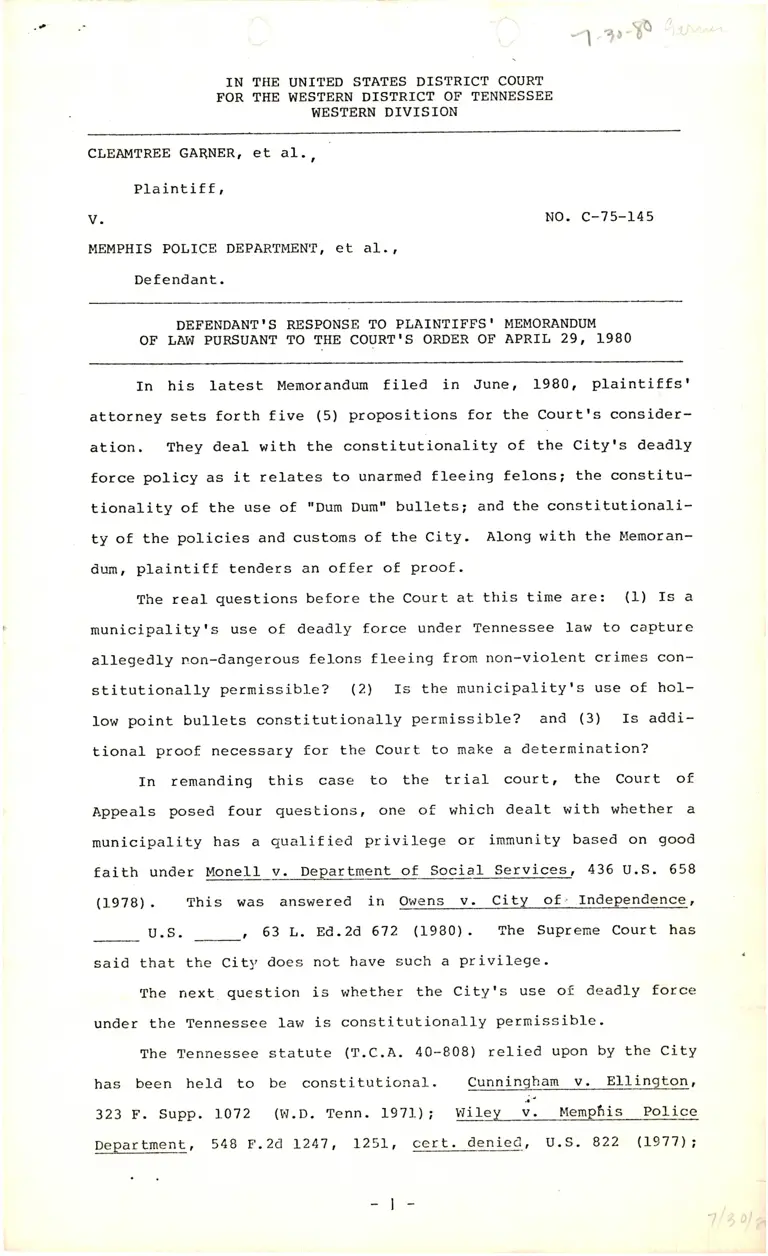
IN THE UNITED STATES DISTRICT COURT
FOR THE WESTERN DISTRICT OF TENNESSEE
WESTERN DIVISION
CLEAMTREE GARNER, et al.,
Plaintiff,
V.
MEMPHIS POLICE DEPARTMENT, et al..
Defendant.
NO. C-75-145
DEFENDANT'S RESPONSE TO PLAINTIFFS' MEMORANDUM
OF LAW PURSUANT TO THE COURT'S ORDER OF APRIL 29, 1980
In his latest Memorandum filed in June, 1980, plaintiffs'
attorney sets forth five (5) propositions for the Court's consider
ation. They deal with the constitutionality of the City's deadly
force policy as it relates to unarmed fleeing felons; the constitu
tionality of the use of "Dum Dum" bullets; and the constitutionali
ty of the policies and customs of the City. Along with the Memoran
dum, plaintiff tenders an offer of proof.
The real questions before the Court at this time are; (1) Is a
municipality's use of deadly force under Tennessee law to capture
allegedly non-dangerous felons fleeing from non-violent crimes con
stitutionally permissible? (2) Is the municipality's use of hol
low point bullets constitutionally permissible? and (3) Is addi
tional proof necessary for the Court to make a determination?
In remanding this case to the trial court, the Court of
Appeals posed four questions, one of which dealt with whether a
municipality has a qualified privilege or immunity based on good
faith under Monell v. Department of Social Services, 436 U.S. 658
(1978) . This was answered in Owens v. City of^ Independence,
_____ U.S. _____, 63 L. Ed.2d 672 (1980). The Supreme Court has
said that the City does not have such a privilege.
The next question is whether the City's use of deadly force
under the Tennessee lav; is constitutionally permissible.
The Tennessee statute (T.C.A. 40-808) relied upon by the City
has been held to be constitutional. Cunningham v. Ellington,
323 F. Supp. 1072 (W.D. Tenn. 1971); Wiley v. Memphis Police
Department, 548 F.2d 1247, 1251, cert, denied, U.S. 822 (1977);
Beech v. Melanon, 465 F.2d 425, cert, denied, 409 U.S. 1114
(1973). Testimony at the trial was that the guideline for the
City's deadly force policy was T.C.A. 40-808 and that the City's
policy was more restrictive than the statute.
VJith regard to the statute's constitutionality, relative to
unarmed fleeing felons, the Court in V?iley addresses itself to the
opinion of Eighth Circuit in Mathis v. Schnarr, 547 F.2d 1007
(CA. 8, 1976) which dealt with the constitutionality of a Missouri
statute similar to Tennessee's as it relates to the apprehension of
fleeing felons suspected of a non-violent felony whom the officer
does not reasonably believe will use force against the officer or
others. In Mathis the Court held the statute to be unconstitu
tional since there was no threat to the officer or others. No claim
was being made that the statute was unconstitutional where there is
a threat to the officer's life or others. The dissent which was
adopted by the Sixth Circuit in Wiley is strongly critical of the
majority stating that a proper balance must be made between the
state's interest and that of the fleeing felon, and that any con
flict in these interests should be resolved, by the legislature and
not the Courts. This is precisely what Judge Brown said in his
opinion in Cunningham v. Ellington, supra, at page 1075.
Indeed as far back as Rensaw v. State, 70 Tenn.
720 (1879) , the Tennessee Supreme Court sug
gested that in view of the increase of crimes
defined as felonies, the rule of law allowing
officers to shoot at escaping persons though to
be felons should be re-examined. This, how
ever, is a policy question for the Tennessee
legislature or perhaps the Tennessee courts
and not for the federal courts in the guise of
constitutional adjudication (Emphasis Ours).
Plaintiff contends that the use of deadly force to apprehend
0
one who is unarmed amounts to punishment. Again, in Cunningham v.
Ellington, supra, at page 1075, the Court in dealing with an
alleged Eighth Amendment violation said:
. . . and the short answer to plaintiff's con
tention is that we simply are not dealing with
punishment.
Much has been said in plaintiffs' Memorandum maintaining that
Garner was unarmed and not a threat to anyone. It must be remem
bered, however, that the Court concluded as the finder of facts
that the officer could not be certain whether Garner was armed at
- 2 -
the time and further that he had reason to believe under all the
circumstances that an accomplice may be involved, and that accom
plice may be armed. Considering all these factors, this was more
than simply an unarmed fleeing felon case at the time the officer
was called upon to act. If the officer has to wait each time to be
certain the fleeing party is unarmed or that nothing more than a
property crime has been committed before he can use deadly force
then there is a potential danger to the officer as well as the pub
lic .
Another issue raised by plaintiff is whether the City's deadly
force policy violates the equal protection clause because it is
racially discriminatory. In Wiley the same issue was raised and
pursued as to all defendants which included the City of Memphis and
the Court said at page 1254:
The District Court held with respect to plain
tiff's claim of racial discrimination that
"plaintiff has failed to persuade the court
that under the circumstances of this case
defendants have discriminated against her or
against her son because of their race."
Nor did the Court find a denial of equal pro
tection when it said:
No racial animus or basis is shown to motivate
the policy involved. Both white and black
fleeing felons have been shown by plaintiff's
own proof to have been fired upon or shot by
Memphis police as a matter of last resort where
otherv/ise arrest cannot be reasonably accom
plished and escape is inevitable, even in the
case of so-called property crimes.
In our opinion these findings of fact are sup
ported by substantial evidence and are not
clearly erroneous.
As to racial impact, the Supreme Court in
Washington v. Davis, 426 U.S. 229, 239,
96 S. Ct. 2040, 2047, 48 L. Ed. 2d 597 (1976)
stated:
. . . [0]ur cases have not embraced the propo
sition that a law or other official act, with
out regard to whether it reflects a racially
discriminatory purpose, is unconstitutional
solely because it has a racially dispropor
tionate impact.
In the case at bar, this issue was not pursued by counsel for
plaintiff.
It is difficult to ascertain the difference in the constitu-
0
tionality of a statute as it relates to individuals as opposed to a
municipality. If T.C.A. 40-808 is constitutional and the officers
3 -
and officials had a right to rely upon it then why would not the
City have the same right. As pointed out in our previous memoran
dum, the Court in Wiley referring to the City as well as others said
at page 1254:
We are of the opinion further that MPD, the
City, the Mayor, and the former Mayor, and the
Chief of Police had the same right to rely on
the law of Tennessee and the decisions of this
Court and the decision of the three-Judge Court
in formulating their policies. Also, they
would rely on the presumption that the Tennes
see statute was constitutional and on the fact
that no court at that time had ever held that
statute or a similar statute to be unconstitu
tional. (Emphasis Ours)
The proof in the case showed and the Court so found that the
use of Dum Bum bullets was not implemented for the purpose of in
flicting extensive punishment and did not violate standards of
civilized conduct so as to shock the conscience of the Court.
Rochin V. California, 343 U.S. 165 (1952). This was pointed out in
the Court's Order of February 29, 1980.
In interpreting the purpose of the questions posed by the
Court of Appeals in this cause for consideration in light of
Monell, if this Court finds no constitutional violation in connec
tion with the City's use of deadly force under Tennessee law and
its use of hollov; point bullets, then there is no need to go further
and consider the fourth question dealing v/ith "policy or custom .
In any event this Court retained jurisdiction over the City of
Memphis pursuant to 28 US.C. § 1331 and the Fourteenth Amendment
and at the conclusion of the trial ruled;
VIII. The policies of the Memphis Police
Department which authorizes the use of fire
arms to apprehend fleeing felons come within
the general ambit of the Tennessee statute
(T.C.A. 40-808) . The training program of the
Memphis Police Department which incorporates
some of the methods, practices and procedures
used by other police departments was at least
adequate in respect to apprehension of resist
ing or fleeing felons. The City of Memphis and
the Memphis Police Department are not liable to
plaintiff on this basis asserted.
Why should the case against the City be reopened on the ques
tion of policy or custom? In Wiley the Court found at page 1249:
The facts as found by the Distrct Judge, how
ever, were that these policies, practiced,
customs and usages were authorized by the
Legislature of Tennessee in its enactment more
than one hundred years ago, of the present Ian-
guage of T.C.A. § 40-808, hereinabove set
forth. This language appeared as Section 5040
of the Tennessee Code of 1858, the first offi
cial code of Tennessee, and embodied the common
law of that State. Love v. Bass,
l45 Tenn. 522, 529, 238 S.W.2d 94 (1921);
Reneau v. State, 70 Tenn. 720 (1879).
It is also interesting to note that the Court of Appeals in
this case refers to the appellate record in Wiley and certain sta
tistics on the question of "policy and custom". If the Court in
V̂ iley did not see fit to disturb the trial court's findings rela
tive to policies and customs based on City of Memphis statistics,
then certainly there would be no justification for disturbing the
findings in this case which likewise involves the City of Memphis.
There is no need to reopen the case to permit plaintiff to of
fer additional proof. He should not have that right in view of the
fact the case has already been considered against the City. Fur
thermore, no proof is needed on the purely legal question of the
constitutionality of use of deadly force under Tennessee law. The
Dum Dum bullet issue was dealt with in detail at the trial. Plain
tiff had every opportunity to present proof which involved the City
of Memphis. Much of plaintiff's offer of proof seems to go to cus
tom or policy, which at this point is of no concern to the Court
because we do not get to that question.
In conclusion, defendants respectfully submit that the Court's
Order of February 29, 1980, should be reinstated.
CLIFFORD PIERCE, City Attorney
City Hall, Room 314
125 N. Mid-America Mall
Memphis, Tennessee 38103
ENRY l 7 KLE“;HENRY L/ KLEIN, Staff Attorney
City of Memphis
2108 First Tennessee Bldg.
Memphis, Tennessee 38103
(90]) 523-2363
ATTORNEYS FOR DEFENDANTS
- 5 -
CERTIFICATE OF SERVICE
I, HENRY L. KLEIN, hereby certify that a copy of the foregoing
pleading has been mailed, postage prepaid, to Mr. Steven L. Winter,
Suite 2030, 10 Columbus Circle, New York, New York 10019, and Mr.
Walter Lee Bailey, Jr., Suite 901, 161 Jefferson Avenue, Memphis,
Tennessee 38103, this the day of , 1980.
HENRY
- 6 -