Response to Motion to Tax Costs
Public Court Documents
August 7, 1971
8 pages
-
Case Files, Swann v. Charlotte-Mecklenburg Hardbacks. Response to Motion to Tax Costs, 1971. a1e0654f-2e34-f111-88b4-7c1e526962fd. LDF Archives, Thurgood Marshall Institute. https://ldfrecollection.org/archives/archives-search/archives-item/25054dfe-b9da-4879-9dae-1bc508df29eb/response-to-motion-to-tax-costs. Accessed October 15, 2026.
Copied!
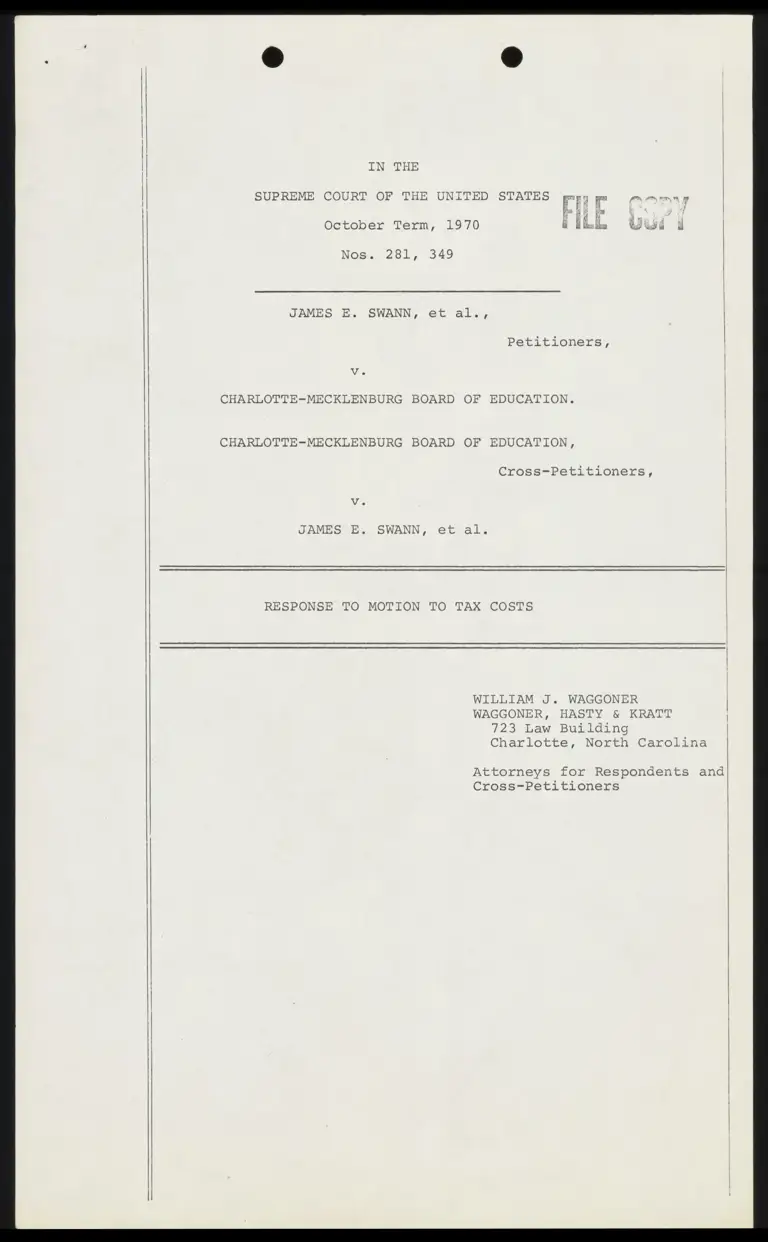
     [||f7bbbcb5-7f02-420f-a5fb-486fad5ee059||] IN THE

SUPREME COURT OF THE UNITED STATES pnpy pe on ~ |


October Term, 1970 WR sd fd
Nar Wi Wi ed

Nos. 281, 34°


JAMES E. SWANN, et al.,

Petitioners,

Ve

CHARLOTTE-MECKLENBURG BOARD OF EDUCATION.     CHARLOTTE-MECKLENBURG BOARD OF EDUCATION,

Cross=-Petitioners,

Vv.

JAMES E. SWANN, et al.


RESPONSE TO MOTION TO TAX COSTS


WILLIAM J. WAGGONER

WAGGONER, HASTY & KRATT
723 Law Building
Charlotte, North Carolina

Attorneys for Respondents and

Cross-Petitioners


IN THE

SUPREME COURT OF THE UNITED STATES

October Term, 1970

Nos. 281, 349


JAMES E. SWANN, et al.,

Petitioners,

Yo

CHARLOTTE~-MECKLENBURG BOARD OF EDUCATION.

CHARLOTTE-MECKLENBURG BOARD OF EDUCATION,

Cross=Petitioners,

Vv.

JAMES E. SWANN, et al.


RESPONSE TO MOTION TO TAX COSTS


Respondents and Cross-Petitioners, the Charlotte-Mecklenburg

Board of Education, et al., responding to Petitioners' Motion

for an order allowing Petitioners their costs in this Court in

No. 281 show the Court as follows:

I.

REASONS FOR DENYING PETITIONERS' MOTION FOR COSTS


l. Petitioners are not entitled to costs as a matter


Of course under Rule 57(2).


Petitioners in their Motion erroneously assert that they

are entitled to costs in No. 281 as a matter of course under

Rule 57(2). The rule provides:

"In cases of reversal or vacating of any judgment or
decree by this Court, costs shall be allowed to the
appellant or petitioner, unless otherwise ordered by
the Court".

The express holding of this Court in its decision of April 20

was as follows:

For the reasons herein set forth, the judgment of
the Court of Appeals is affirmed as to those parts
in which it affirmed the judgment of the District

Court. The order of the District Court dated August 7,
1970 is also affirmed.


It is quite apparent that the Court in its holding did not

reverse or vacate any judgment or decree of the lower courts.

Accordingly, Rule 57(2) by express terms denies petitioners costs

as a matter of course.

We acknowledge that the general rule with respect to costs

in the trial court where costs are normally awarded to the


prevailing party. Ex Parte Peterson, 253 U.S. 30. The awarding


of costs to the prevailing party in Mansfield C. & L. M. R. Co.


v. Swan, 111 U.S. 379 was the exercise of discretion by the

Supreme Court under the portion of the rule " . . . unless

otherwise ordered bv the Court".

Other authorities cited by petitioners are inapplicable.

Newton v. Consolidated Gas Company, 265 U.S. 78 involved the


question of the power of the District Court to award a bond

premium as costs. In Rogers v. Durant, 106 U.S. 644 the Court


exercised its discretionary power and split the costs between

the parties. The propriety of the trial court in taxing the

auditor's fees was the only issue respecting assessment of costs.

It would therefore appear that these cases are not helpful in

resolving the question.

The only case cited by petitioners entitling a party to

costs as a matter of course is St. Louis & SS. rr. BR. Co. Vv.


Spiller, 275 U.S. 156 where the judgment of the lower court was

affirmed in part and reversed in part.

The judgment of the lower court was not reversed or vacated

either in whole or in part in No. 281. Therefore, costs are not

awarded as a matter of course.

2. Equity requires the parties to bear their respective


costs.

This action was instituted in 1965 at which time the District

Court found the school system to be in compliance with the

Constitution. Swann vs. Charlotte-Mecklenburg Board of Education


243 F. Supp. 667 (1965). The holding of the District Court was


approved by the United States Court of Appeals for the Fourth

| Circuit in 1966 in Swann v. Charlotte-Mecklenburg Board of


Education, 369 ». 24, 29. In a concurring opinion, Circuit


Judges Sobeloff and Bell restated:

"This is far from suggesting that children
are to be uprooted arbitrarily and bused

against their will to distant places merely
to place them with children of the other
Xace . a a"

On September 6, 1968, Petitioners and Cross-Respondents

filed their motion for further relief which resulted in the

entry of the District Court's order of April 23, 1969. In that

order, the District Court expressly found that the Board had

operated in good faith pursuant to the "general understanding

of 1965 about the law regarding desegregation" and concluded:

3 They have achieved a degree and volume of
desegregation of schools apparently unsurpassed

in these parts, and have exceeded the performance
of any school board whose actions have been
reviewed in appellate court decisions. The
Charlotte-Mecklenburg schools in many respects
are models for others."

In the same April 23, 1969, order, the District Court

found there was no racial discrimination or inequality with

reference to the use of federal funds or special aid to the

disadvantaged, use of mobile classrooms, the quality of school

buildings and equipment, coaching of athletics, parent-teacher

~ association contributions and activities, school fees, school

lunches, library books, elective courses, individual evaluation

of students and gerrymandering.

As indicated above, the good faith administration of the

Charlotte-Mecklenburg schools was accomplished under express

authorization and approval of a District Court which held:

"As a general proposition, it is undoubtedly
true that one could deliberately sit down
with the purpose in mind to change lines in
order to increase mixing of the races and
accomplish the same with some degree of success.
I know of no such duty upon either the School
Board or the District Court. The question is
not whether zones can be gerrymandered for the
assumed good purpose of racial mixing, but
whether gerrymandering occurred for the
unconstitutional purpose of preventing the
mixing of the races." Swann v. Charlotte-
Mecklenburg Board of Education, 243 F. Supp.


667 (1965).


In affirming, the Court of Appeals for the Pourth Circuit held:

". « +. S80 long as the boundaries are not drawn
for the purpose of maintaining racial segregation,
the School Board is under no constitutional
requirement that it effectively and completely
counteract all the effects of segregated housing
patterns." Swann v. Charlotte-Mecklenburg Board
Of Education, 369 F. 28. 29 (1966).


As found by the District Court, this School Board operated

pursuant to the understanding of the law. It was not alone as

evidenced by the many conflicting and inconsistent opinions of

the various district courts, courts of appeal and the Supreme

Court.

Notwithstanding the express holdings of the District Court

and the Court of Appeals in 1965 and 1966, the School Board

offered a plan for desegregation for the school year 1969-70.

On August 15, 1969, the District Court found that the Board had

acknowledged its affirmative duty to desegregate pupils, teachers

principals, and staff members at the earliest possible date and

had dramatically exceeded its goal in desegregating former all


black faculties. The plan for the 1969-70 school year exceeded

the desegregation accomplished by any major urban area in this

nation.

On February 5, 1970, the School Board offered a drastic

restructuring of attendance lines which accomplished a remarkable

degree of desegregation, placing 68 percent of the black students

in predominantly white schools. This offered performance so

far exceeded the performance of any other major urban school

Scien that it was then inconceivable that the effects of the

former "dual system" would not be removed by such a Wh, of

The District Court engrafted upon this plan the feature of

satellite zones and resulting extensive long distance cross busin

thereby resulting in the most sweeping and extreme desegregation

order entered by any district court affecting a major urban area

Of this nation.


1/ Compare the percentage of blacks in predominately white school
in the fall of 1970: New York City - 16.3%; los Angeles -~ 5.9%;
Chicago - 3%; Detroit - 5.8%; Philadelphia - 7.4%; Baltimore =-
9.4%; Cleveland - 4.2%; Washington, D.C. - 1.2%; Milwaukee - 12.2
Boston - 18%; San Francisco - 14.2%... Source: New York Times,
June 17, 1971. Was there any reasonable basis to believe that

a performance of 68% would fail to meet constitutional requirement
Should Charlotte-Mecklenburg foresee it would be required to reac
100 percentile?

-d]

Js

Ul


The Court of Appeals for the Fourth Circuit, on appeal, by

opinion dated May 26, 1970, {431 P. 24. 138) partially vacated

the judgment of the District Court and remanded the case for

further proceedings, primarily with reference to the question of |

"reasonableness" as expressed in the opinion of the Court of

Appeals.

On August 3, 1970, the Distvict Court held that its order

of February 5 was reasonable and ordered implementation thereof.

The Supreme Court of the United States, in holding the

District Court's order in compliance with the Constitution,

stated:

"These cases present us with a problem of defining
in more precise terms than heretofore the scope
of the duty of school authorities and district
courts in implementing Brown I and the mandate to
eliminate dual systems and establish unitary
systems at once. Meanwhile, district courts
and courts of appeal have struggled in hundreds
of cases with the multitude and variety of
problems under this Court's general directive.
Understandably, in an area of evolving remedies,
those courts had to improvise and experiment
without detailed or specific guidelines. This
Court, in Brown I, appropriately dealt with the
large constitutional principle; other federal
courts had to grapple with the flinty, intractable
realities of day-to-day implementation of these
constitutional commands. Their efforts of necessity
embraced a process of 'trial and error' and our
effort to formulate guidelines must take into
account their experience." Swann v. Charlotte-
Mecklenburg Board of Education, Supreme Court of
the United States, Nos. 281 and 349, Apr. 20, 1971,

at v.24


In Northcross Vv, Board. of Réducaltion, 396 U.S. 19 (1969),


the Chief Justice of the United States Supreme Court recognized

that it was high time that the Supreme Court came to grips with

the many problems resulting from the unsettled state of the law

with reference to the creation of a unitary system. These

acknowledgments by the Supreme Court so clearly demonstrate the

confused state of the law with reference to desegregation,

district courts, courts of appeal and school boards did not and

could not know the obligations imposed by the Constitution.

Notwithstanding the Board of Education could not have known

what was required of it, it operated its system in good faith


pursuant to the directives of the federal courts and exceeded

the performance of any school board whose actions had been

reviewed in the appellate court decisions. To award costs

against this school system, which has borne its costs in No. 349,

would clearly be contrary to the principles of equity, particular

where it is believed that the plaintiffs have not advanced and |

are not expected to advance any of these costs.

These cases have been used by the Supreme Court of the

United States as a vehicle upon which to express the public

policy of this nation on a matter of substantial constitutional

importance. In implementing the sweeping desegregation order

of the District Court, this school system has experienced

enormous expense. To further burden the Charlotte-Mecklenburg

Board of Education with additional expenses on this national

question will further impinge the educational process.

WHEREFORE, the Charlotte-Mecklenburg Board of Education,

et al, respectfully move the Court to deny petitioners motion

to. tax costs in No. 281.

This the 6th day of August, 1971.

Taw

L

o


William J. Waggoner /
Waggoner, Hasty & Kratt
723 Law Building
Charlotte, North Carolina
Attorneys for Respondents and

Cross—-Petitioners


ly


CERTIFICATE OF SERVICE


This is to certify that I have served copies of the fore-

going Response to Motion to Tax Costs upon the following parties

by depositing same in the United States mail, postage prepaid,

first class, addressed to said parties as follows:

Julius L. Chambers
Chambers, Stein, Ferguson & Lanning
White House Inn

Charlotte, North Carolina

James M. Nabrit, III
10 Columbus Circle
New York, New York

This the 6th day of August, 1971.


William J. Waggoner [||f7bbbcb5-7f02-420f-a5fb-486fad5ee059||]