Proposed Settlement Article with Cover Sheet
Public Court Documents
March 28, 2000
8 pages
-
Case Files, Sheff v. O'Neill Hardbacks. Proposed Settlement Article with Cover Sheet, 2000. 0df7c3da-a146-f011-877a-0022482c18b0. LDF Archives, Thurgood Marshall Institute. https://ldfrecollection.org/archives/archives-search/archives-item/25329cb0-f495-41f4-af52-6f4a5b7064c7/proposed-settlement-article-with-cover-sheet. Accessed October 05, 2026.
Copied!
    HF

COV ER


S HEET
To:

Deborah Archer

Sandra Del Valle

Derek Douglas

Chris Hanson

Wesley Horton

Marianne Engelman Lado

Wilfred Rodriquez

Elizabeth Horton Sheff

Martha Stone

Philip Tegeler

Suite 1600

New York, NY 10013-2897
(212) 965-2200

Company:

NAACP Legal Defense Fund

Puerto Rican Legal Defense Fund

NAACP Legal Defense Fund

American Civil Liberties Union

Horton, Shields & Cormer, P.C

NY Lawyers for the Public Interest

Greater Hartford Legal Assistance

Community Renewal Team

Center for Children Advocacy

Connecticut Civil Liberties Union

NAACP LEGAL DEFENSE & EDUCATIONAL FUND, INC

99 Hudson Street

FAX
Fax #:

212/226-7592

212/431-4276

212/226-7592

212/549-2651

860/728-0401

212/244-4570

860/541-5050

860/527-3305

860/570-5256

860/728-0287

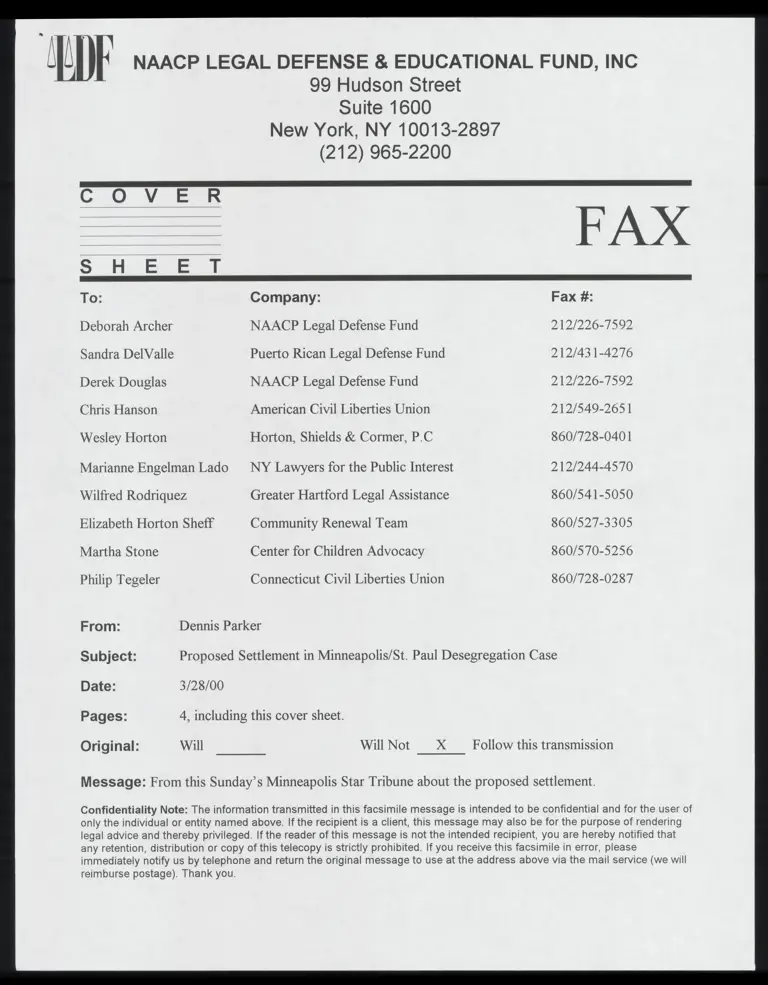
From: Dennis Parker

Subject: Proposed Settlement in Minneapolis/St. Paul Desegregation Case

Date: 3/28/00

Pages: 4, including this cover sheet.

Original: Will Will Not X Follow this transmission

Message: From this Sunday’s Minneapolis Star Tribune about the proposed settlement.

Confidentiality Note: The information transmitted in this facsimile message is intended to be confidential and for the user of
only the individual or entity named above. If the recipient is a client, this message may also be for the purpose of rendering

legal advice and thereby privileged. If the reader of this message is not the intended recipient, you are hereby notified that

any retention, distribution or copy of this telecopy is strictly prohibited. If you receive this facsimile in error, please

immediately notify us by telephone and return the original message to use at the address above via the mail service (we will

reimburse postage). Thank you.


EDK NAACP LEGAL DEFENSE & EDUCATIONAL FUND, INC

99 Hudson Street

Suite 1600

New York, NY 10013-2897

Tel: (212) 965-2200

Fax: (212) 219-2052


C. OVER

  FAX

To: Company: Telephone #: Fax #:

Leonard Stevens education-r-us.com 413-637-1243 413-637-4075


S H EET

From: Dennis Parker 1-212-965-2255

Subject: Minneapolis/St. Paul Proposed Settlement

Date: March 28, 2000 Time: 4.31 PM

Pages: 4, including this cover sheet.

Original: Will WillNot X Follow this transmission

Message: Attached is an article about the proposed settlement in Minneapolis/St. Paul. I'm not sure if

they've heard about our success in Sheff or whether Govenor Ventura has threatened them but the proposal

seems very disappointing - it calls for, in addition to the five hundred transfers, an institution of a system of

school report cards. Although there are some magnet schools, I don't think the settlement requires the

creation of any additional ones. ALI in all, it seems very much a one-way plan with very modest

expectaitions.

Confidentiality Note: The information transmitted in this facsimile message is intended to be confidential and for the use of

only the individual or entity named above. If the recipient is a client, this message may also be for the purpose of rendering

legal advice and thereby privileged. If the reader of this message is not the intended recipient, you are hereby notified that

any retention, distribution or copy of this telecopy is strictly prohibited. If you receive this facsimile in error, please

immediately notify us by telephone and return the original message to us at the address above via the mail service (we will

reimburse postage). Thank you.


"Other school deseg efforts much larger than Minnesota's


http://www startribune.com/cgi-bin/stOnLine/article?thisSlug=NAAC26


Worichs Largest Supergoiieny


shariribune, com

Sa Meine

elated item
At a glance: the


settlement

1 of 4


Published Sunday, March 26, 2000

Other school deseg efforts much larger than

Minnesota's

Norman Draper / Star Tribune

Thousands of poor minority students ride buses from the nation's cities
to suburban schools in the hopes of getting a better education. The
Minneapolis plan unveiled earlier this week is smaller than the majority

of them.

The 2,000 Minneapolis kids, at most, who would be affected come
nowhere near the 12,300 in St. Louis and the 4,900 in Milwaukee. But

a closer look at those cities indicates that their desegregation plans are

looking more like relics of the past than trends for the future.

Student busing plans are losing ground to a rising interest in
neighborhood schools, and to a growing sense that urban schools need
to be fixed to do the job for kids where they live.

The tentative settlement to the NAACP lawsuit in Minneapolis sounds

a lot like what some other big school districts have done in response

to lawsuits. Low-income Minneapolis students would be sent out to
the suburban districts, each of which would have to set aside a certain
number of places for them. Together, the eight suburban districts are

supposed to take in 500 Minneapolis students a year over the course
of four years.

Those districts are Robbinsdale, Columbia Heights, St. Anthony/New
Brighton, St. Louis Park, Richfield, Edina, Hopkins and Wayzata. The

transfers would be voluntary.

That settlement won preliminary approval Thursday from the West
Metro Education Program (WMEP), a consortium of nine suburban

districts and Minneapolis formed to promote the voluntary
desegregation of schools. The national NAACP still must approve the

deal.

One WMERP district -- Brooklyn Center -- will not have to participate
in the settlement because it already has high concentrations of poverty.

The Twin Cities approach to desegregation is multifaceted. Magnet

3/28/00 4:03 PM


"Other school deseg efforts much larger than Minnesota's http://www.startribune.com/cgi-bin/stOnLine/article?thisSlug=NAAC26

schools have been built in both the east and west metro area to attract
students from both urban and suburban districts. An example of this is
the Interdistrict Downtown School in Minneapolis, which is in its

second year.

At the same time, and seemingly at odds with the desegregation

efforts, is the increased emphasis in Minneapolis on having students

attend neighborhood schools.

Such urban school districts as St. Louis, Milwaukee and Boston have
been sending their minority kids out to suburban schools for years. As

with the Minnesota proposal, student participation is voluntary.

In St. Louis, the 12,300 students -- about one-quarter of the city's
black student population -- depart every school day for suburban St.

Louis County schools. Under the arrangement, 1,250 white suburban

St. Louis students attend magnet schools in St. Louis.

In Milwaukee, central city minority students have been heading out to
the suburbs under a voluntary desegregation plan since 1976.

Participation broadened in the early 1980s after Milwaukee schools

filed suit against nonparticipating suburban districts. Milwaukee
minority students who participate in the program now go to school in
23 suburban districts, and 500 suburban students go the other way to
attend Milwaukee schools, said Aquine Jackson, Milwaukee schools

director of the division of student services.

Does it work?

Experts remain divided over whether such methods actually work.

And both Milwaukee and St. Louis are scaling back their
desegregation efforts in favor of improving the schools within the

cities themselves. Still, proponents of such initiatives say students who
leave urban schools for the suburbs show better high school
graduation and college admission rates.

Students who transferred from St. Louis to suburban districts boasted
a 49 percent four-year graduation rate from high school, 22
percentage points higher than the kids who stayed behind, according
to Sharon Heisel, spokeswoman for the Voluntary Interdistrict Choice
Corporation, a consortium of school districts involved in the St. Louis
program. Plus, said Heisel, 77 percent of those minority students who
transferred to suburban schools and graduated from high school went
on to two-or four-year colleges. That compares to 47 percent for the

state of Missouri.

And even though there are concerns that not enough poor
Minneapolis students want to go to the suburbs to fill the 500-student
annual quota, interest has not been a problem in St. Louis. Heisel said

2 of 4 3/28/00 4:03 PM


30f4

Other schpol deseg efforts much larger than Minnesota's http://www startribune.com/cgi-bin/stOnLine/article ?thisSlug=NAAC26

about 6,000 St. Louis kids apply annually for 3,500 new suburban

school slots.

In Connecticut, a court order forced the expansion of a program that
allowed urban minority students in Hartford to transfer to suburban
districts. Now, New Haven and Bridgeport are participating, as well
as 60 suburban school districts. This year, 1,350 urban kids -- most of

them from Hartford -- are going out to suburban schools, said
Connecticut Department of Education spokesman Tom Murphy.

That's double last year's total. About 70 white suburban students are

coming in to the cities.

Fix for just a few

Others caution that pulling a few students out of failing urban schools
does nothing to improve the quality of those schools, where the
majority of students are staying put. They also warn of the culture

shock that can occur when a student shifts suddenly from a poor

school community to an affluent one.

"It's no panacea," said John F. Jennings, director of the Center on
Education Policy in Washington, D.C. "The fundamental solution has

to focus on improving the schools that aren't performing, not just
allowing some kids to escape those schools."

Jennings said there are other reasons why such efforts are misguided.

"Generally, the kids don't want to leave their neighborhoods, and it's

difficult for a kid from the inner city to go to a very affluent area," he
said. "The cultural norms are very different. Now, they're dealing with

kids who have computers in their homes and go to Disneyland for
Thanksgiving."

Jennings said such efforts as those in Milwaukee, St. Louis, and now

in Minneapolis, represent a continuing concern for the plight of
students at the same time that court-ordered desegregation is being
dismantled. Few places in the country remain with mandatory busing
for racial balance.

"We're in an area where courts are dissolving desegregation orders,"

he said. "But we're also in an era where people are concerned that kids
in the inner cities are not getting the best education."

Both St. Louis and Milwaukee are drawing back from their ambitious
voluntary desegregation plans in favor of doing things closer to home.

In Milwaukee, the school district has been granted $170 million in
bonding authority by the state to improve and expand the schools in
Milwaukee. And Milwaukee schools officials would like to see fewer
of their students heading out of the district.

3/28/00 4:03 PM


-Other school deseg efforts much larger than Minnesota's http://www startribune.com/cgi-bin/stOnLine/article?thisSlug=NAAC26

"We would like to see those numbers decrease because we would like
to say we have high-quality school programs in Milwaukee," Jackson
said.

In St. Louis, a 1999 wrinkle in the ongoing settlement of the

desegregation lawsuit allows suburban districts to drop out of the
program after four more years. It remains to be seen how many

districts will opt out, said Susan Uchitelle, who was appointed by the

court to implement the St. Louis-area desegregation effort between
1981 and 1999. Plus, the state has allotted $180 million over the next

11 years for St. Louis to fix its own schools, and the sentiment for

neighborhood schools is growing.

Uchitelle sees the beginning of a shift in priorities, especially as the
concept of neighborhood schools becomes more popular.

elated item "I would say diversity and desegregation are no longer the main
At a glance: the targets," she said. "Now, it's [school] quality. "
settlement


-- Staff writer Norman Draper can be contacted at

ndraper@startribune.com.
  tariribune, com

Cad ietio
© Copyright 2000 Star Tribune. All rights reserved.

3/28/00 4:03 PM


¥% JOB STATUS REPORT *x* AS OF MAR 28 2000 5:06 PM PAGE. 01

NAACP LEGAL DEFENSE

wack INCOMPLETE DESTINATION(S) HIGHLIGHTED BELOW s#%%

JOB #420

DATE TIME TO.” FROM MODE MIN/SEC PGS STATUS
3/28 4:35P 2267592 UR——3 56". 006 OK

4:38P 2125492651 EC——5 Ql. 006

4:51P 8607280401 EC--S “55. 006

4:53P NY LAWYERS PUB. INT HE-—-3 £ 40% 006

4:56P 860 541.5050 EC——5 206” 006
4.857P 860 3527 3305 {26 005

<4 4314276 = JC

5 860 728 0287
3 18605705256


NAACP LEGAL DEFENSE & EDUCATIONAL FUND, INC

99 Hudson Street

Suite 1600
New York, NY 10013-2897

(212) 965-2200


  FAX
Company: Fax #:


Deborah Archer NAACP Legal Defense Fund 212/226-7592

Sandra Del Valle Puerto Rican Legal Defense Fund 212/431-4276

Derek Douglas NAACP Legal Defense Fund 212/226-7592

Chris Hanson American Civil Liberties Union 212/549-2651

Wesley Horton Horton, Shields & Cormer, P.C 860/728-0401

Marianne Engelman Lado NY Lawyers for the Public Interest 212/244-4570

Wilfred Rodriquez Greater Hartford Legal Assistance 860/541-5050

Elizabeth Horton Sheff Community Renewal Team 860/527-3305

Martha Stone Center for Children Advocacy 860/570-5256

Philip Tegeler Connecticut Civil Liberties Union 860/728-0287

From: Dennis Parker

Subject: Proposed Settlement in Minneapolis/St. Paul Desegregation Case

Date: 3/28/00

Pages: 4, including this cover sheet.

Original: Will WillNot X Follow this transmission

Message: From this Sunday's Minneapolis Star Tribune about the proposed settlement.

Confidentiality Note: The information transmitted in this facsimile message is intended to be confidential and for the user of
only the individual or entity named above. If the recipient is a client, this message may also be for the purpose of rendering

legal advice and thereby privileged. If the reader of this message is not the intended recipient, you are hereby notified that
any retention, distribution or copy of this telecopy is strictly prohibited. if you receive this facsimile in error, please
immediately notify us by telephone and return the original message to use at the address above via the mail service (we will

reimburse postage). Thank you.


¥%x JOB STATUS REPORT xx AS OF MAR 29 2000 10:55 AM PAGE. 01

NAACP LEGAL DEFENSE


JOB #428

DATE TIME TO/FROM MODE MIN/SEC PGS STATUS
001 3729 10:52A 4314276 EC--5 00" 53”: 005 OK
002 10:53A 860 570 5256: EC——S 01:39” 005 OK


TIF NAACP LEGAL DEFENSE & EDUCATIONAL FUND, INC

: 99 Hudson Street

Suite 1600

New York, NY 10013-2897

(212) 965-2200


C OVER F AX

8S HEET

To: Company: Fax #:

Deborah Archer NAACP Legal Defense Fund 212/226-7592

Sandra DelValle Puerto Rican Legal Defense Fund 212/431-4276

Derek Douglas NAACP Legal Defense Fund 212/226-7592

Chris Hanson American Civil Liberties Union 212/549-2651

Wesley Horton Horton, Shields & Cormer, P.C 860/728-0401

Marianne Engelman Lado ~~ NY Lawyers for the Public Interest 212/244-4570

Wilfred Rodriquez Greater Hartford Legal Assistance 860/541-5050

Elizabeth Horton Sheff Community Renewal Team 860/527-3303

Martha Stone Center for Children Advocacy 860/570-5256

Philip Tegeler Connecticut Civil Liberties Union 860/728-0287

From: Dennis Parker

Subject: Proposed Settlement in Minneapolis/St. Paul Desegregation Case

Date: 3/28/00

Pages: 4, including this cover sheet.

Original: Will Will Not _ X Follow this transmission


Message: From this Sunday’s Minneapolis Star Tribune about the proposed settlement.

Confidentiality Note: The information transmitted in this facsimile message is intended to be confidential and for the user of

only the individual or entity named above. If the recipient is a client, this message may also be for the purpose of rendering

legal advice and thereby privileged, If the reader of this message is not the intended recipient, you are hereby notified that
any retention, distribution or copy of this telecopy is strictly prohibited. If you receive this facsimile in error, please

immediately notify us by telephone and return the original message to use at the address above via the mail service (we will

reimburse postage). Thank you.