Motion for Bifurcation of the Issues at Trial and For Extension of Trial Date; Affidavit of Beth J. Lief
Public Court Documents
November 28, 1977
14 pages
-
Case Files, Hatcher v. Methodist Hospital - Hardbacks. Motion for Bifurcation of the Issues at Trial and For Extension of Trial Date; Affidavit of Beth J. Lief, 1977. 288384fb-5384-f111-ab0f-7c1e527d528a. LDF Archives, Thurgood Marshall Institute. https://ldfrecollection.org/archives/archives-search/archives-item/26001cb6-a834-4db1-9539-a2493a0a8608/motion-for-bifurcation-of-the-issues-at-trial-and-for-extension-of-trial-date-affidavit-of-beth-j-lief. Accessed October 10, 2026.
Copied!
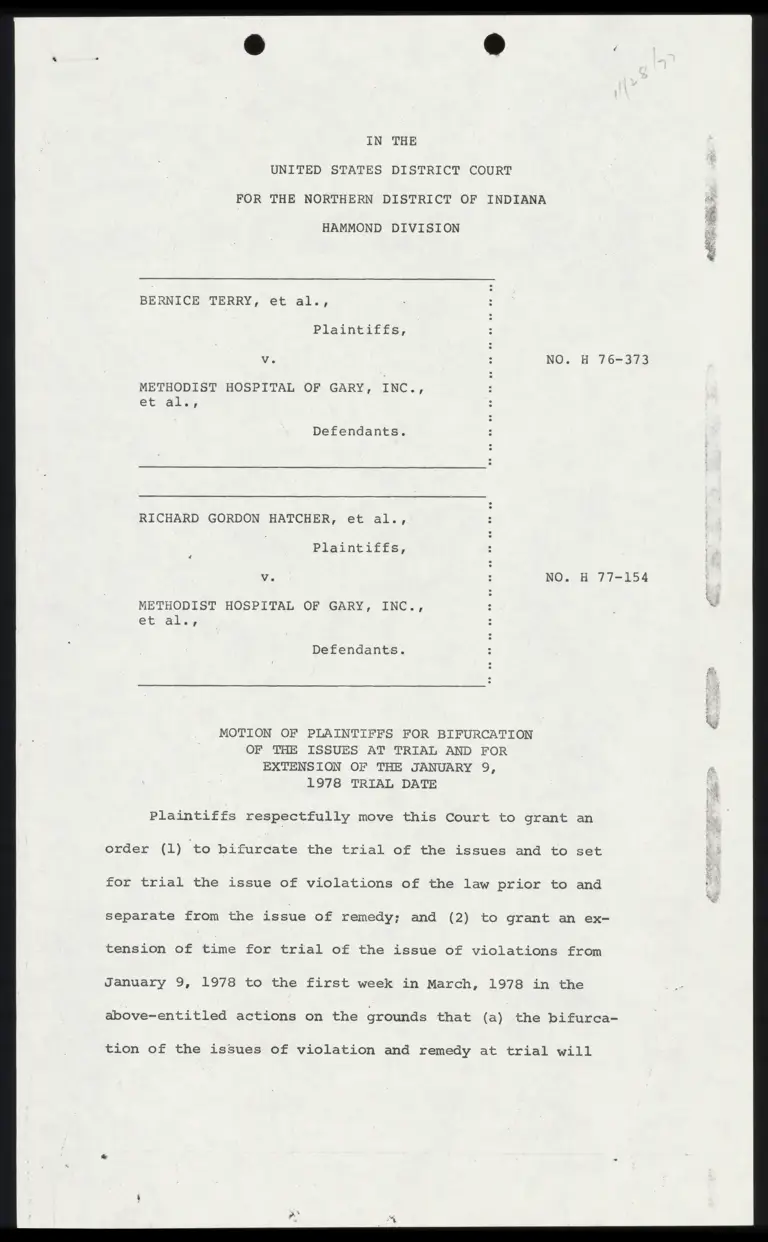
     [||47323117-24b5-4c5b-a40a-90287b635bd9||] IN THE

UNITED STATES DISTRICT COURT

FOR THE NORTHERN DISTRICT OF INDIANA

HAMMOND DIVISION

¥
E
e


BERNICE TERRY, et al.,

Plaintiffs,

Ve. : NO. H 76-373

METHODIST HOSPITAL OF GARY, INC.,

et al.,

Defendants.


RICHARD GORDON HATCHER, et al., 3

Plaintiffs,

Ve. : NO. H 77-154

METHODIST HOSPITAL OF GARY, INC.,

et al.,

Defendants.


MOTION OF PLAINTIFFS FOR BIFURCATION

OF THE ISSUES AT TRIAL AND FOR

EXTENSION OF THE JANUARY 9,

1978 TRIAL DATE

Plaintiffs respectfully move this Court to grant an

order (1) to bifurcate the trial of the issues and to set

for trial the issue of violations of the law prior to and

separate from the issue of remedy; and (2) to grant an ex~-

tension of time for trial of the issue of violations from

January 9, 1978 to the first week in March, 1978 in the

above~-entitled actions on the grounds that (a) the bifurca-

tion of the issues of violation and remedy at trial will


promote judicial efficiency and economy, will enable the

parties to present a joint plan for remedy, must await the

data currently being gathered by the United States Department

of Health, Education and Welfare, and will prejudice no parties

to this action; and (b) it is impossible to complete discovery

before the present deadline for the pre-trial order on

December 19, 1977 and the current trial schedule precludes the

possibility that the Court will hear all facts in these complex

actions necessary for a resolution of the issues. Further

grounds for this motion are set forth in the accompanying

affidavit of Beth J. Lief, counsel for plaintiffs.

Respectfully submitted,

A A
/ fy

! Dette. Lan br


JACK GREENBERG
BETH J. LIEF

BRENT E. SIMMONS

10 Columbus Circle

Suite 2030

New York, New York 10019

JULIAN B. ALLEN, JR.

2009 Broadway

Gary, Indiana 46407

Attorney for Plaintiffs


IN THE

UNITED STATES DISTRICT COURT

FOR THE NORTHERN DISTRICT OF INDIANA

HAMMOND DIVISION


BERNICE TERRY, et al.,

Plaintiffs,

‘Ve

NO. H 76-373

METHODIST HOSPITAL OF GARY, INC.,

et al.,

Defendants.


RICHARD GORDON HATCHER, et al.,


Plaintiffs, :

Ve :

: : NO. H 77-154

METHODIST HOSPITAL OF GARY, INC., :

et al., :

Defendants. :

AFFIDAVIT

STATE OF NEW YORK )

} 88.1

COUNTY OF NEW YORK)

Beth J. Lief, being duly sworn, deposes and says:

l. I am counsel for plaintiffs in the above-entitled

actions and submit this affidavit in support of Motion of

Plaintiffs For Bifurcation of the Issues At Trial and For


AT
ER


as
s

3
4 I

 N
R
I
s


Fr
at


SA
RA


&


é 4

Extention of the January 9, 1978 Trial Date.

2. Grounds For Birfurcation of the Trial.


op
ie


al


Plaintiffs contend and will establish that Methodist

Hospital of Gary, Inc., created and has perpetuated a dual

hospital system that segregates and discriminates against

R
a
i


S
U


e
e


L
g

T
r


E
A


A


FOE
v

3
:

CT
S
A


5
f
a


minority and handicapped residents of Gary, Indiana. As noted

in the Affidavit of Beth J. Lief, submitted in support of

plaintiffs' previous motion for a continuance of the trial date

(filed October 5, 1977), the issues of proof in these actions

Ey include a complex analysis of many variables. While the facts

outlined in that Affidavit will not be reiterated here, it is   important to note that, according to the United States Supreme

Court decision in Village of Arlington Heights v. Metropolitan


A
A
N
A

A
L
A
A


NI

NI

E
$
4
0
0
0

M
i
t
o


40
00
04
0)


A
d
i


A
a


Development Corporation, 425 U.S. 963 (1977), proof of

discriminatory intent under the Equal Protection Clause of the

A
M
D


YH
A
M
A
N
I
P
A
L


1
12


& Fourteenth Amendment necessitates analysis of historical

patterns and actions that created a system of segregation and

discrimination, as well as the present injury to the minority

and handicapped residents of Gary, Indiana. In addition, the

causes of action against the local, state and federal


governmental agencies require distinct evidence as to their

failure to enforce the civil rights of the plaintiff class and :

  to prevent the segregation and discrimination that has occurred
3
*

|

and continues to occur. Such proof will not only likely : |

:
require a lengthy trial, but also a detailed post-trial brief >

and proposed findings of fact in order to aid this Court in

resolving the issues presented. To present an analysis of the

complete remedies feasible and likely to redress the harm now

-


being suffered, even further evidence will be necessary.

Plaintiffs believe that the trial would proceed in a more

orderly fashion if the full-scale remedy were not completely

addressed in the first instance.

  Plaintiffs will establish not only that they are


suffering from a segregated and discriminatory health care

system, but that there are concrete measures that can be under-

taken to remedy these Wrongs. Many of those steps needed to

be taken will become evident through a presentation of the

violations that have occurred. However, certain remedies must :

await the presentation of evidence that will not be presented i
i

in the context of establishing a violation. Specifically,
*

u

plaintiffs will establish the need for a substantial renovation:

and remodeling program at Gary Methodist Hospital in order to


4

make that facility, which now serves an overwhelmingly black

49

I
N
V
A
 15


HY

BR
YA


1

5

population, equal to the facility that serves an almost totally

white population, Broadway Methodist Hospital. Other serious

deficiencies at Gary Methodist Hospital will also be established
and will require immediate attention. These types of remedies, 3 |

1

that is, those remedies that pertain directly to serious |
1

od
(|

|

|

deficiencies at Gary Methodist Hospital, will be fully present- {7}

ed to the Court. on :

However, as discussed in the oral ataument Betors the|

Court at the hearing on Methodist Hospital's Motion to Dismiss, | 5

other hospitals in Lake County affect, to a certain degree, the =|

patterns of saFreiaiion and discrimination in Gary. Moreover,

to a erthin extent, the duplication of services and draining of

scarce health resources caused by the expansion of St. Anthony's

in Crown Point and St. Mary's in Hobart, impact adversely on

“3m


the plaintiff class. Plaintiffs contend that the failure of

HEW and the state to prevent actions by those hospitals which

have a discriminatory impact on the minority citizens of Gary, FS

Indiana, violates those agencies' obligations under the civil |

rights laws, and that those agencies must be ordered to remedy


the past violations that have occurred. As the Court is aware,

the Office of Civil Rights, Department of Health, Education and

Welfare, is now conducting a regional civil rights review which

presumably will include an analysis of the effects of those f

hospitals on the discrimination that now exists in the Methodist

Hospital system. Until that review is completed, therefore,

regional remedies, which may need to include the elimination of,

certain duplicated services, and coordination among Lake Cnty)

hospitals cannot be formulated. This situation does not, of

course, mean, as stated above, that important remedies cannot

be achieved through a series of programs and actions undertaken ¥

by Methodist Hospital alone. Plaintiffs only request that those

remedies that can only be achieved through enforcement by the >

federal and state agencies be postponed until HEW completes its.
*

review.

There is another compelling reason why a full analysid™

of the remedies in this case should not end with an initial

trial on the issue of violations of the law. It is plaintiffs’

hope that many of the specifics of the remedies can be worked |

out among the parties as opposed to the necessity of having thisw

Court issue a detailed order. The expedition of this action

for trial Bas made it essential to concentrate on obtaining

discovery and preparing a case on the issue of violations, and

dle


has not allowed adequate time to explore the possibility of

settlement. After plaintiffs prove that their rights have peenf

violated, however, the parties will then be free to work out i

the specifics of the remedy. bi

Defendant Methodist Hospital cannot possibly be 5
i

prejudiced by structuring the case in this manner. When

plaintiffs establish that violations have occurred and that the

current building projects of Methodist Hospital that are being held

up as a result of this lawsuit will perpetuate the wrongs that i

have already occurred, Methodist Hospital will no longer have

even the presumed right to proceed with these projects. As

already stated to this Court, to Methodist Hospital and to HEW,

plaintiffs have no objections to Methodist Hospital's proceed- |

ing with the construction of the health facilities building at

Gary Methodist Hospital. Plaintiffs believe that the evidence

will demonstrate that certain of the proposed projects at 34

Broadway Methodist Hospital, specifically the removal of the

laundry from Gary to Broadway, is a direct violation of the

civil rights act and is not necessary if the hospital takes |

steps to renovate Gary Methodist Hospital. Moreover, plaintiffs

believe that upon a showing of serious deficiencies at Gary p

Methodist Hospital, renovation programs at that hospital must

precede any expansion at Broadway Methodist Hospital. If

plaintiffs prevail in these areas, then the building programs

now sought by Methodist Hospital will be, at the least, subject Ig

to substantial modification, and any delay caused by negotiations

as to remedy will, therefore, not prejudice the hospital. If

plaintiffs do not prevail, then Methodist Hospital presumably

may proceed.


$ » ’

3. The Necessity of a Continuance of the Trial Date.


At the hearing in September, this Court ordered the !

above-entitled actions to proceed to trial on December 5. 1977, ©

over the objections of plaintiffs. On October 5, 1977,


  plaintiffs filed a motion for a continuance of the trial date 8
it

for three months. In that motion plaintiffs explained that it E |

would be literally impossible to prepare for trial within the   time frame set by this Court and submitted affidavits of
i)

counsel for plaintiffs and several experts in support of said

motion. To date, plaintiffs have received no order from this

Court on either the motions to dismiss, the class action motion,

or the motion for a continuance of the trial date. However,

by telephone conversation on October 21, 1977, Mr. David Ranish,

Law Clerk to this Court, informed counsel that the continuance |

  of one month would be granted. On approximately November 10,

1977, counsel was informed that trial would be set for January Ou

1978 and that a pre-trial order would be due December 19, 1977.

Mm
It is absolutely impossible to conclude depositions by that date.

  As this Court is aware, interrogatories were propounded to

defendants in May, 1977. This Court granted ex-parte

FA applications for extension of time in which Methodist need

answer those interrogatories to September 30, 1977. Plaintiffs.

received from Methodist Hospital partial answers to the

interrogatories the first week in October, 1977. By letter


dated October 7, 1977 plaintiffs informed

Methodist Hospital that there were serious gaps in the answers -

to interrogatories. Methodist Hospital provided supplemental

answers to those interrogatories the following week, but to dase

have not fully answered the interrogatories. Plaintiffs

wily


. ® RL

  received certain documents requested from Methodist Hospital on


October 24, 1977. On September 20, 1977 plaintiffs propounded | |

a second set of interrogatories to Methodist Hospital which

R
A
I
A


A
R
E


Tr

E
E
R


S
A
N

I
E

R
A
Y


ha


S
e


sought to obtain information as to what data was contained on

computers, in order that plaintiffs might obtain such records

to conduct an analysis of staffing and patient patterns. E

Although plaintiffs requested that the answers to those

interrogatories be received within ten (10) days, plaintiffs, in
MN £+]   fact, received answers on October 21, 1977, October 29, 1977 and :

November 1, 1977. Only as of November 1, 1977 could plaintiffs

then make requests for the computer files that they needed. To

date, plaintiffs have received no computer files. In addition, |

plaintiffs have not received certain documents requested from

the hospital, such as accumulative financial statements for 1976,
and 1977 and projections, if any, for 1978.

Te

The complete set of answers to interrogatories from =


the Northern Indiana Health Systems Agency was only received

”
on November 17, 1977. Answers to interrogatories from the a:

state defendants were only received on November 3, 1977. Food
x |

ow | Although plaintiffs inspected documents at the offices of the


federal defendants in Chicago on September 30, 1977, the

documents requested were only fully received on November 14, 1977.

As can be seen by the above documentation, although

plaintiffs served their discovery instruments last May, and

have been diligently attempting to expedite to the extent "

feasible discovery in this action, documents which plaintiffs £

need to have prior to taking depositions were not received until

after the initial pre-trial order was due and one month Pein id

the time plaintiffs were informéd by telephone that the pre-trial

=]


pr

)

order would now be due.


Depositions have been proceeding virtually back-to- Pe

back since November 8, 1977, although at that time plaintiffs

did not have the documents they had requested. On October 8,

DUN
 O
ME
A
I
A
B
L
I
E


BA
S

MO
NR

NA
Y

& p
te

 \
g1


1977, the deposition of Mr. Everett Johnson, past Administrator ©

@
eA

of Methodist Hospital, was taken. It did not conclude, and was 9

continued on November 17, 1977. On November 21, 1977, the
deposition of plaintiff Metro Corps was taken and did not py

conclude. It is scheduled to conclude on December 12, 1977. On

November 22, 1977, the deposition of plaintiff Willie Lee Page |

was taken. Because of the Thanksgiving holidays, the next

deposition scheduled is on Monday, November 28, 1977 when |

Mayor Hatcher will be deposed, and it is understood that that | |

deposition will take two (2) days. On Wednesday, November 30, | |
: |

1977, the deposition of plaintiff Bernice Terry will be conclud- |

ed in the afternoon. On December 6, the deposition of Roald wg

Glesne, current Administrator of Methodist Hospital will be a

  taken and it is understood that the deposition will take two (2)

days. On December 8, 1977, the deposition of Kipton Kaplan,

Executive Director of Northern Indiana Health Systems Agency =

will be taken and on Friday, December 9, 1977, the deposition :

of Peter Teitleman, an employee of the Northern Indiana Health

Systems Agency, Inc., who worked on Methodist Hospital

proposals, will be taken. On December 12, 1977, the deposition, |

of plaintiff Metro Corps will be concluded. On December 13, oH

the deposition of Alfred Sanchez, employee of defendant HEW who %

conducted the civil rights review of Methodist Hospital will be

takan. On December 14, 1977, deposition of Mr. Edward Koven

—-


® » ¢ $

has been noticed. Plaintiffs have been informed by telephone »

conversation, today, November 23, 1977, that HEW will file a gus |

motion for a protective order to prevent that deposition.

Plaintiffs are in the process of scheduling other depositions


”
C
O
M
I
N


E
I
R


R
A
T
I
O

S
a
t
n
a
 42

2
a
y


for December 14, 1977 until the dispute as to the deposition

of Mr. Koven is resolved. E

As can be seen by the above schedule, depositions are

occurring every week and virtually everyday despite the fact -~   that transcripts from previous depositions are not available.

The pre-trial order is currently due on December 19, 1977, yet

plaintiffs have an minimum of fourteen more depositions that are |

absolutely crucial to this case. Plaintiffs need to depose the

three individuals from the state who are responsible for process

ing Methodist Hospital's construction applications and who

plaintiffs contend are responsible for enforcing civil rights.

In addition, plaintiffs must take the deposition of 4

Denis Ribordy, President of the Board of Directors of Gary

Methodist Hospital. Plaintiffs must also take the deposition

  of the HEW officials in Washington who are responsible for

enforcing civil rights. These include two officials from prior . |

Ho
w

administrations; David Tatel, current Director of the Office oth

Civil Rights; the three assistant directors under Mr. Tatel

who have responsibility for overseeing national civil rights

compliance; the current Director of the Hill Burton section:

Norman Chachkin, Assistant Director of the Office of Civil

S
R


Ea

Rights at the time the complaints in these actions were filed; i

and Mr. Michael Middleton, the individual who is currently

assuming Mr. Chachkin's responsibilities. Plaintiffs attempted

to schedule the deposition of certain of the HEW officials who g

or


= >
2
x Ft

wid
Rage
3
=

|

are located in Washington during the week of December 19, 1977, m

despite the fact that the pre-trial order would be due at that | .

time. Plaintiffs were informed by HEW today, November 23, 1977.4
that they would object to depositions being noticed during that!

week because Ms. Rebecca Ross, Counsel for HEW, will be nao

in another matter. Plaintiffs will, nevertheless, notice some LE |

depositions, but believe a protective order will result. Even

if those depositions could be held that week, it would be £2

impossible to finish those depositions as well as the other

depositions in the remaining time before trial, especially in

view of the unavailability of deponents during the Christmas   week. Moreover, the transcripts of those depositions could not

feasibly be ready for trial on January 9, 1978 although they |

would be essential. pect |

: Only after these depositions are completed can

plaintiffs review the evidence and determine what to present tol

the Court. In view of the enormous amount of documents in this gq

case and the numerous depositions, plaintiffs must have at   least three weeks after the completion of the depositions to

formulate a pre-trial order, during approximately the third weeltit
5

of February.

Plaintiffs in prior motions have attempted to explain

the complexity of this case to this Court. The case involves

the analysis of the actions over a decade of the hospital, and |

the operations of three distinct governmental agencies. It is

virtually impossible to accumulate the discovery necessary to


obtain the facts pertaining to these issues by December 19, 1977

when the pre-trial order is due or even by January 9, 1978 when

the trial is scheduled. In a case of such crucial importance £

that effects so many lives and that involves issues never

1


  |

| bod

NS He
pe

-

presented to a court before, a trial should not be an impromptu

presentation of whatever data plaintiffs can manage to £ | HS

ef   accumulate, but rather should be an orderly and complete

presentation of all relevant facts. The current trial date not |

only makes this impossible, but, indeed, even prevents the %

o
l


te,
ad

completion of discovery to which plaintiffs are entitled. ER

It is on the basis of the above facts that plaintiffs 4 |

make their motion for the continuance of the January 9, 1978 &   trial date. Plaintiffs continue to believe that a trial date in

March would enable discovery to be completed. As the court is =

aware, plaintiffs have entered into a stipulation with the other |

parties to this action to waive the requirements of Methodist

Hospital to obtain added government approval for their projects |

as a result of the delay occasioned by this lawsuit. The court

informed the parties that that stipulation was a precondition to

another continuance. Any delay in discovery that has resulted |

in this case has not been the fault of plaintiffs and they should |

not be prejudiced because of the complexity of the issues they : |

present. wl

RE 2 F¥ ‘4

|
|

Respectfully submitted, ~ |
!

2 |

JACK GREENBERG
BETH J. LIEF ig |
BRENT E. SIMMONS Bg

10 Columbus Circle

Suite 2030

New York, New York 10019


JULIAN B. ALLEN, JR.

2009 Broadway

Gary, Indiana 46407

Sworn to and subscribed before me

this ZA day of November, 1977 NW

mle Ow (Lie
    NOTARY PUBLIC ;

ny Cons mii s=sroed FKEPro2&s’ |

2/9/50

p
t
e


«ll


Certificate of Service


I hereby certify that a copy of the foregoing

MOTION OF PLAINTIFFS FOR BIFURCATION OF THE ISSUES


AT TRIAL AND FOR EXTENSION OF THE JANUARY 9, 1978


TRIAL DATE and ACCOMPANYING AFFIDAVIT == meee ——

was served by United States mail, postage prepaid, on

he
the °8 day of November + 1977, on counsel for


defendants as follows:

Rebecca L. Ross, Esq.

Department of Justice
10th and Pennsylvania Avenue
Washington D.C.

Marvin G. Garvin, Esq. and Edward L. Koven, Esq.
Regional Attorney and General Attorney
Department of Health, Education and Welfare

y 300 South Wacker Drive, 18th Floor
Chicago, Illinois

Fred W. Grady, Esq.
Assistant United States Attorney
Northern District of Indiana
Federal Building, 502 State Street
Hammond, Indiana 46325

Attorneys for Defendant Secretary of Health,
Education and Welfare

Hodges, Davis, Gruenberg, Compton & Sayers
Bruce E. Sayers, Esq.
5525 Broadway
Gary, Indiana 46401

Attorneys for Defendant Methodist Hospital
of Gary, Inc.

Theodore L. Sendak, Esq.
Assistant Attorney General of Indiana
219 State House
Indianapolis, Indiana

Attorneys for State Defendants

pss. Kf
Coon for lam HHS [||47323117-24b5-4c5b-a40a-90287b635bd9||]