Hayes v. Memphis Police Department Court Opinion
Unannotated Secondary Research
March 13, 1978
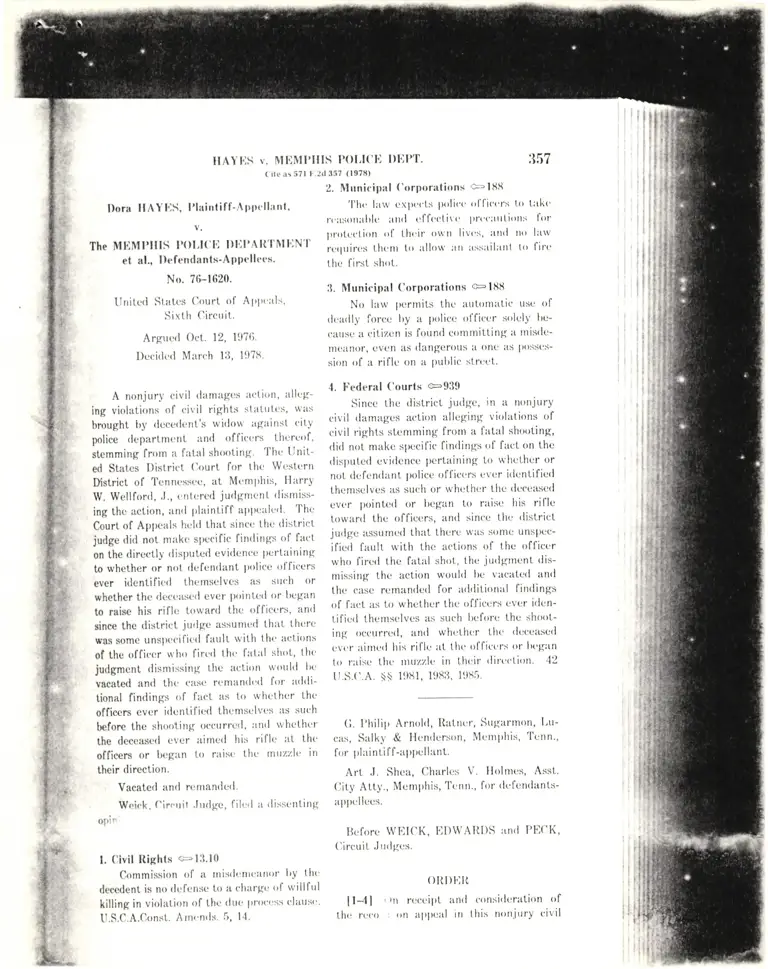
3 pages
-
Case Files, Garner Working Files. Hayes v. Memphis Police Department Court Opinion, 1978. 24d58ef9-34a8-f011-bbd3-000d3a53d084. LDF Archives, Thurgood Marshall Institute. https://ldfrecollection.org/archives/archives-search/archives-item/2713a736-5fb9-4c7e-a071-3d605c30840e/hayes-v-memphis-police-department-court-opinion. Accessed September 28, 2026.
Copied!
4
Dora IIAYi:S, I’laiiiriff-Apiullant,
V.
The MKMI’IIIS 1*()U( K DI'-l’AlM MION 1
et al., Defeiidants-Appellees.
HAYKS V. MKMIMIIS l*OU{ K DKPT. .{f)?
( Me as 571 I ,7 il 357 ( 1978)
2. Municipal Corporations
The law expects police oriicers lo take
reasonalile ami effecliu' precaulions for
protection ol' their own lives, ami no law
reipiires them to allow an assailant to fire
the first shot.
No. 7(V-l(i20.
United Stales Court of Appeals,
Sixth Circuit.
Arf^ned Oct. 12, 197<).
Decided March 12, 197S.
A nonjury civil daina{res action, alleg
ing violations of civil rights statutes, w:is
brought hj’ decedent’s widow :igainst city
police department and officers thereof,
stemming from a fatal shooting. The Unit
ed Stales District Court for the Wi'stern
District of Tennessee, at Memphis, Harry
W. Wellford, .1., entered judgment dismiss
ing the action, and |)laintiff appealeil. 'I’hr'
Court of Ajipeals held that since the district
judge did not make specific findings of fact
on the directly disputed evidence pertaining
to whether or not defendant jiolice officers
ever identified themselves as such or
whether the deceased ever |)ointed or began
to raise his rifle toward tlu! officers, and
since the district judge assumed that there
was some unspecified fault with the actions
of the officer who fireil the latal shot, the
judgment dismissing the action would be
vacated and the ca.se remanded for addi
tional findings of fad as lo whether the
officers ever identified tln.’mselves as such
l)cfore the shooting occurred, and whether
the deceased ever aimed his rifle at the
officers or began to raist' the mu/.'/.le in
their direction.
Vacated and remanded.
Wcii'k. Uirciiil .ludge, filed a dissimting
opir
1. Civil Rights c=3i;[.l0
Commission of a misdemeanor by the
decedent is no defense lo a chargr; of willful
killing in violation of the due process clause.
U.S.C.A.Const. Amends. r>, 14.
2. Municipal Corporations <cs=lHS
No law permits the automatic use of
deadly force by a police officer solely be
cause a citizen is found committing a misde
meanor, even as dangerous a one as posses
sion of a rifle on a |)ublic street.
4. Federal Courts c=392!t
Since the district judge, in a nonjury
civil damages action idleging violations of
civil rights stemming from a fatal shooting,
did not make specific findings of fact on the
disputed evidence ])erlaining to whether or
not defendant police officers ever identified
themselves as such or whether the deceiused
ever pointed or began lo raise his rifle
toward the officers, ami since the district
judge assumeil that there was some unspec
ified fault with the actions of the officer
wdio fired the fatal shot, the judgment dis
missing the action would be vacated and
the case remanded for additiomd findings
of fact as to whether the officers ever iden
tified themselves as such before the shoot
ing occurred, and whether the deceased
ever aimed his rifle at the ollicers or began
to raise the muz/.h' in their dirirtion. 42
U.S.U.A. 19S1, 19S2, 19S.9.
C. Philip Arnold, Ratiu'r, Sugarmon, Lu
cas, S;dky & Henderson, .Memphis, Tenn.,
for |)laintiff-ap|)ellant.
Art .1. Shea, Charles V. Holmes, Asst.
City Ally., Memphis, Tet)ii., for defendants-
appellees.
Before WUK'K, UDWARDS and PUCK,
Circuit Judges.
ORDKR
11-11 ■ Ml ns'eipl and consideration of
the reco on iipiieal in this nonjury civil
* 1' »
I
I
■if
^ m , I.
■ !
.-{58 571 Fi:i)i;iM- KFFOIMKK. 2(1 SKKIFS
i i i i
%-5 M
t e - i '
K » .
(Iiimaflfc.s action allcjj;ing violation oi civil
ri^lits under -12 U.S.C. <jt} 1981, 198:i, 198.5,
etc. (1970), with jurisdiction founded upon
28 U.S.C. §§ 1381. 1343, etc. (1970), which
was tried before a District .ludffc in the
Western District of Tennes.see; and
Noting? that the District .ludf^e has held
that |)laintiff-appellant’s deceasesi husband
was guilty of a tni.sdemeanor under Tennes
see law by having a .22 rifle in his hands
while being drunk on a public street at 2:30
a.ni. on the day in (piestion; and that the
|)olice officer, K. S. Rooker, who shot him to
deatli was justified in doing so as a matter
of S t ' If-defense; and
Further noting that when the two police
officers approached deceased and drew
their service revolvers, it is undisputed that
deceased was standing in tlu; street witli his
i)ack to the officers and the rifle poinUal
toward his feet, and that when the officers
called on him to dro|) the rifle, that without
doing so he began to turn toward them;
and
Further noting that what is charged here
is willful killing, in violation of the due
|)rocess clause of the United States (koisti-
tution, to which charge the commission of a
misdemeanor is, of course, no defense; and
that the deceased husband was black and
that both the olficer wdio killed him and his
partner were white and that api)ellant also
claims the killing was racially motivated, in
violation of the eipial protection clause;
and
Further recognizing that the law e.xpects
police officers to take reasonable and effec
tive precautions for protection of their own
lives and that no law re(piires them to allow
an assailant to fire the first shot, but that
in addition, no law permits the automatic
u.se of deadly force solely because a citizen,
white or black, is found committing ;i mis
demeanor even as dangerous a one as pos-
se.ssion of a rifle on a public street; and
Further noting that the District .Judge
did not make specific findings of fact on the
directly disputed evidence in this record
pertaining to whether or not the police offi
cers ever identified themselves as such or
whether the deceased ever jiointed or began
to raise the .22 rifle tow.ard the two police
officers and that the District .fudge a.s-
sumed that there was some unsiKicified
fault with Rooker's actions in this case; anil
Further noting that undisputed evidence
shows that this is the third jierson in six
years (2 black and 1 white) wtiom defend
ant K. S. Rooker has killed in police action,
and the fifth person in si.\ years at whom
he has fired (4 bl.ick and 1 white).
Now, therefore, tin- judgment of the Dis
trict Court dismissing this action is vacated
and the case is remanded to the District
Court for additional findings of fact (based
solely upon the pre.sent record) as to wheth
er the police officers ever identified them
selves as such before Officer Rooker fired,
and whether deceased ever aimeil the .22
rifle at the police officers or began to raise
the muzzle in their direction.
VVKICK, Circuit .fudge, di.ssenting.
In my opinion there is no need to remand
this case to the District Court limited to
additional findings on .self-defense. The
Memorandum t)|)inion of the District
.Judge, consisting of nine jiages, finds that
the deci;dent, Albert Hayes, had been drink
ing to excess witli friends in a neighborhood
tavern located in a high crime area, from
10:110 p. m. on a Saturday evening until 2:00
a. rn. on Sunday morning, when the tavern
was about to close, and that Hayes was
intoxicated. He and his friends left the
tavern and proceeded to cross a street when
Hayes was nearly struck by an automobile.
Hayes engaged in a loud altercation with
the driver of the automobile, who had
stojiped his car. Hayes, who became angry,
proceeded sudderdy to his nearby car in the
jiarking lot of the tavern. He ])rocured
from the trunk of his car a loaded automat
ic .22 caliber rifle, and returned to the jilace
where he had the altercation with the driv
er of the car, but the car had pulled away
as he arrived at the scene.
Obviously Hayes’ pursuit of the driver of
the car, with a loaded automatic rifle, was
for no lawful |uirpose.
Hayes
with gui
halt and
drop his
with tin
One of
whicli p:
at the fi
area, res
The ('
the offii
in his aci
that of
turned ti
jHist ure
death or
ate rail)
findings
The n
decision
O/i/o, 3
L.E(1.2d
phis
1977); ;
Cir. 197
S.Ct. 92
iia/n V.
Tenn.Ri
In h
that ll
back bi
true as
medical
Alth.
was on
in the I
his fail
officer
have Ir
The
even b
presen
to prev
in th(
protect
As I
offerei
raciall
Wit
der of
r
1
Mayes eiit'oimliTeil Iwo |iolic(men wlm,
vviUi mills ilrawii, sliouted al liiiii twice to
hall and to ili'o|) his >̂ nn, Hayes did not
drop his t îm lull turned toward the ollicers
with tile aiiloinalic rifle still in his hands.
One of Ihe officers fired the fatal shot
which passed Ihroiif^h Hayes’ hd’t shoulder
al Ihe fronl and into his chest and s|)ine
area, resulling in his death almost instantly.
The Court in its finding coiK'luded that
the officer who fired the shot was justified
in his actions “in defense of his own life and
that of his fellow officer when Hayes
turned toward them with a loaded rifle in a
[wsture which in a split second could mean
death or serious injury to others in immedi
ate ranf^e." (App. 25.) What additional
finding should he reipiired?
The rulinp; of the Court conformed to the
decision of the Supreme Court in Terry c.
Ohio, :592 U.S. 1, 2lt, 88 S.Cl. IStK, 20
L.h:d.2d 889 (10()8). See a/.so VTi7e.\ v. Mem
phis I'olicv Dei>l., 548 F.2d 1247 (tSth ( ir.
1977); Beech v. Melnncon, 405 I*'.2d 425 (tith
Cir. 1972), cert, i/eii/ei/, 409 U.S. 1114, '.12
S.Cl. 927, 24 I,.K(1.2d 090 (1972); (hwnin/r-
hiitn V. Hlliiifylon. 222 F'.Su|ip. 1072 (WM).
Tenn.1971).
In her complaint plaintiff had allef^ed
that the officer shot her hushand in the
back but this allemdion was false and un
true as was shown by the testimony of tiu'
medical examiner.
Althoutjh the possession alone ol the rille
was only a misdemeanor, its usi' by Hayes
in the pursuit of the driver of the car, aiul
his failuri' to obey the lawlul orders id the
officers to halt and drop the pun, ajipear to
have been more than a mi.sdemeanor.
The two officers had the ripht to arrest
even for a ini.sdemeiuior committed in their
presence, and certainly they had the right
to prevent ii felony from being committed
in their pre.sence, and indeed the right to
protect their own lives.
As Ihe Court found, there was no proof
offered that the actions of tlu' officers were
racially motivated.
With respect to the statement in the Or
der of the majority that one of the officers
I’Oin UK COUNTY ( HAPTKR OF the IZ-
AAK WAI/roN UKAtiUU OF AMKRI-
CA, INC., Save the Dunes Council, Inc.,
.Ann Sims and Herbert I‘. Read, I’eli-
lioners.
Douglas COSTI.K, .Administrator, United
States environmental I’rotection
Agency, Respondent,
Northern Indiana Public Service
Company, Intervenor.
Nos. 7(l-2()98 and 77-12f.2.
Uniteil Stales Court of Appeals,
.Seventh Circuit.
.Argued Oct. 27, 1977.
Decided .Ian. 21), 1978.
Rehearing Denied .March 21), 1978.
Appeal seeking review of decision of
Ihe Administrator of the Fnvironmental
Protection .Agency that provision of River
anil Harbor Act that slate of Indiana, [irior
to construction of harbor project, shall fur
nish assurance satisfactory to Secretary of
.Army that water and air pollution .sources
will be controlled to maximum extent feasi
ble to minimize adverse effects on public
recreational areas in general vicinity of
Rums llarboi- was not applicable as to pol
lutant discharge elimination system permit
for genera' ig station adjacent to Hums
Harbor w; cousolidaled with an ap|ieal