Order of Reference to Magistrate; Reports on Reference Concerning Discovery
Public Court Documents
November 18, 1975
21 pages
-
Case Files, Garner Working Files. Order of Reference to Magistrate; Reports on Reference Concerning Discovery, 1975. 76405bf4-33a8-f011-bbd3-000d3a53d084. LDF Archives, Thurgood Marshall Institute. https://ldfrecollection.org/archives/archives-search/archives-item/28664ae4-5442-4c72-87fc-728e2ead2336/order-of-reference-to-magistrate-reports-on-reference-concerning-discovery. Accessed September 26, 2026.
Copied!
n 'irhs
IN THE UNITED STATES DISTRICT COURT
FOR THE V7ESTERN DISTRICT OF TENNESSEE
WESTERN DIVISION
CLEAMTEE GARNER, father and
next cf kin of EDWARD EUGENE
GARNER, a deceased rr.rnor.
Plaintiff,
V.
MEMPHIS POLICE DEPARTMENT,
et al,
NO. C-75-145
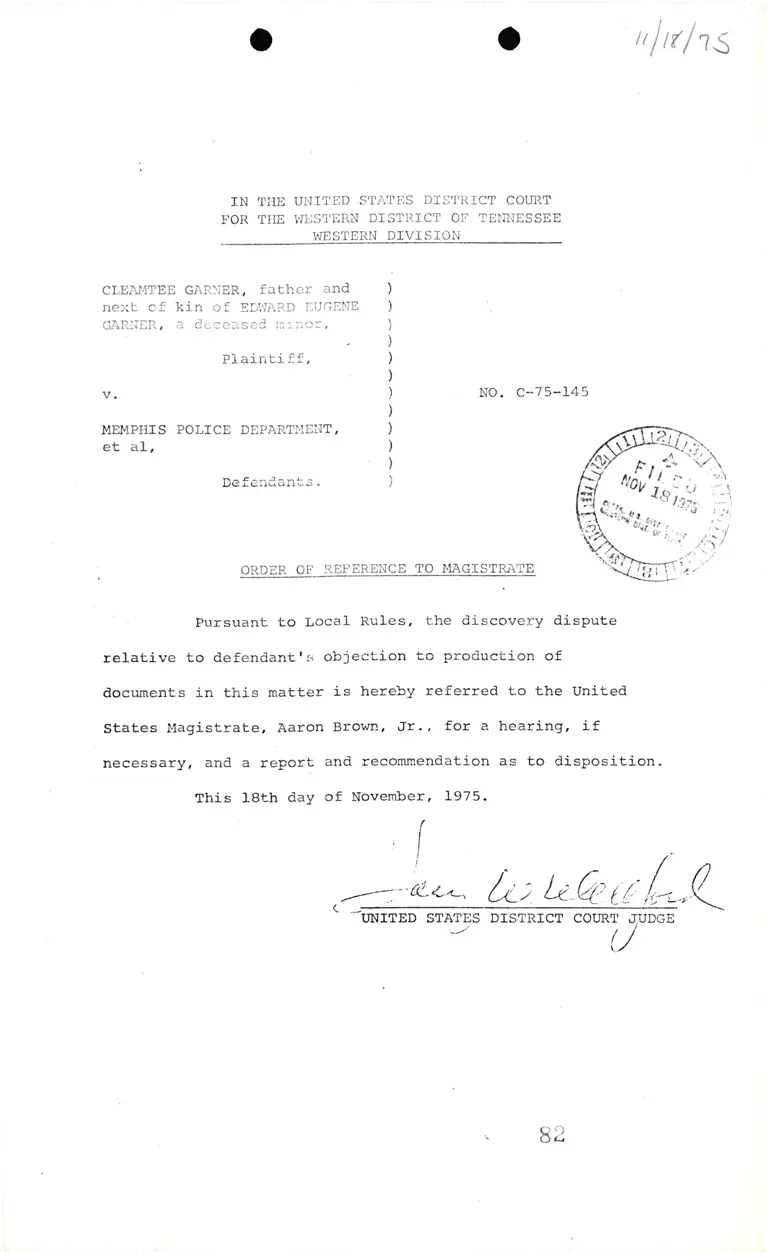
ORDER OF REFERENCE TO MAGISTRATE
Pursuant to Local Rules, the discovery dispute
relative to defendant's objection to production of
documents in this matter is hereby referred to the United
States Magistrate, Aaron Brown, Jr., for a hearing, if
necessary, and a report and recommendation as to disposition,
This 18th day of November, 1975.
UNITED STATES DISTRICT COURT JUDGE
u
52
• . ̂
t
IN THE UNITED STATES DISTRICT COURT
FOR THE WESTERN DISTRICT OF TENNESSEE
WESTERN DIVISION
CLEAMTEE GARNER,
Plaintiff,
This lawsuit grew out of a Memphis officer shooting
a fifteen-year-old black youth with a .38 caliber revolver
using a "Dum-Dum" bullet. The suit is against the Memphis
Police Department, the City of Memphis, the Mayor of Memphis,
the Director of Police of Memphis, and the police officer who
fired the shot that killed Edward Eugene Garner. The com
plaint asserts numerous grounds of relief, including
irresponsibility on the part of the city defendants in select
ing and training the defendant, Hymon; unreasonable police
policies concerning use of lethal force to apprehend fleeing
suspects; and unreasonable choice of weapons and ammunition
for use by the Memphis Police Department in apprehending
suspects. The complaint has survived a motion to dismiss
as to all defendants.
In addition to interrogatories, the plaintiff filed
seventeen requests for production of documents, to all of
which the defendants have objected. The plaintiff has now
83
filed a motion to compel production of those documents, to
gether with an appropriate certificate of consultation.
The defendants assert that the documents requested
in requests numbered 1, 2, 3, 4, 5, 6, 9, 10, 11, 12, 13, 14,
16, and 17 are "privileged." I have had occasion to deal
with the issue of alleged privilege with regard to police
matters in three prior cases, Wiley v. Memphis Police
Department, C-73-8; Ghoston v. Starns, C-73-243; and McGowan
V. City of Memphis, et al., C-72-326. I am attaching to
this report copies of those portions of the reports in those
cases dealing with the issue of privilege of police matters.
In addition, I would call the court's attention to the case
of Boyd V. Gullett, et al., 64 F.R.D. 169 (D.Md.), holding
that there is no general privilege against discovery of
police f i l e s . I therefore conclude that the defendants'
claim of privilege in the instant case should be rejected.
The defendants also claim that the information re
quested in the following requests for production of documents
is irrelevant to this case: 2, 3, 4, 5, 8, 9, 10, 11, 12,
13, 14, 15, 16, and 17. In view of the broad allegations of
the complaint which has, as I mentioned, survived a motion
to dismiss, I believe that all of these challenged requests
are relevant to this litigation or might lead to the dis
covery of relevant evidence-
The defendants assert that request number 5 is too
broad and vague. The request asks for "all documents relating
A/The Boyd case deals with and distinguishes Brown
V. Thompson, 430 F.2d 1214 (5th Cir. 1970), cited by the de
fendants in this case. The plaintiff also cites Tighe v.
City and Co. of Honolulu, 520 P. (2d) 1345, holding that there
is no common law privilege for police records.
84
-2 -
to Wyeth Chandler's or J. Hubbard's expressions with respect
to the use of lethal force in the apprehension of criminal
suspects or the prevention of crime." I agree that the re
quest is both vague and too broad, and therefore recommend
that the court deny the plaintiff's motion as regard to
request number 5.
In addition to privilege, the defendants assert
that request number 6 is also too broad. That request asks
for all documents relating to the selection of the type of
service revolver and ammunition issued by the Memphis Police
Department for its officers as of October 3, 1974. i do not
believe that this request is unreasonably broad.
Request number 7, which asks for all documents re
lating to the promulgation of regulations on the use of
lethal force by the City of Memphis Police Department, is
objected to only as being too broad, I likewise feel that
this request is reasonable and should be complied with.
Request number 8 asks for all documents "relating
to any studies conducted by or at the request of the City of
Memphis Police Department on the effects of various ammuni
tion used by its officers as of October 3, 1974 on the human
body." In addition to relevancy, this request is objected
to as being too broad. I think it reasonable and recommend
that the court grant plaintiff's-motion in regard to this
request.
Request number 12 asks for all documents "setting
out the official policies regarding promotion of police
officers of the Memphis Police Department." It is also
85
objected to as being too broad. I recommend that the court
grant the plaintiff's motion concerning this request.
Request 13 asks for all documents "relating to the
training of Memphis Police officers, generally and to the
training of the officers in the use of lethal and non-lethal
weapons, specifically." I agree with the defendants that
this request is unreasonably broad and recommend that the
court deny plaintiff's motion with regard to it.
Request number 14 asks for all documents relating
to instances in which lethal force was resorted to by offi
cers of the Memphis Police Department from January, 1973 to
October 3, 1974 and asks for official investigation reports,
citizen complaints, and disciplinary proceedings instituted
against officers resorting to lethal force. In addition to
privilege and irrelevancy, this request is likewise attacked
as being too broad. In the context of this case the docu
ments requested are highly relevant. I do not believe the
request is too broad and therefore recommend that the court
grant the plaintiff's motion with regard to it. The defendants
did not challenge this request as being burdensome, and in
any event, may respond under Rule 33(c) of the Federal Rules
of Civil Procedures.
Request 16 asks for "all rules and regulations
*governing the conduct of police officers of the Memphis Police
Department as of October 3, 1974." It is challenged as "too
broad." I recommend that the court grant the plaintiff's
motion with regard to this request.
In summary, I recommend that the court grant the
plaintiff's motion and require the defendants to produce the
8 u
- 4 -
documents requested in all of the plaintiff's requests for
production of documents, except requests 5 and 13, as to
which I recommend that plaintiff's motion be denied.
In these cases against the Police Department and
police officials, the court has in the past made extensive
use of protective orders. I feel that a protective order
would be appropriate in this case and recommend that the
court require counsel to undertake to agree on an appropri
ate protective order and submit an agreed draft to the court.
If an order cannot be agreed upon, counsel for the respective
parties should be required to submit proposed drafts.
■fhe plaintiff has also moved for an order requiring
the defendants to answer certain interrogatories. Interroga
tory 3(b) to defendant Chandler asks for his particular
responsibilities and authority with respect to the City of
Memphis Police Department. He responded that he had the re
sponsibility to "appoint the director, the interim director
and general authority over the City of Memphis Police Depart
ment." The plaintiff claims that he should be required to
clarify what he means by "general authority." I recommend
that the defendant Chandler be required to more specifically
answer this interrogatory as to his "general authority" over
the City of Memphis Police Department.
Interrogatory 16 to the defendant Hymon asks whether
he has been involved in other suits charging abuse of his
authority as a policeman. Interrogatory 17 asks for specifics
in the event the answer to interrogatory 15 is in the affirm
ative. It was, but the answer to 17 was not detailed. The
87
- 5 -
defendant Hymon should be required to give a more specific
answer, and supply such information concerning this matter
as is not only in his possession but in the possession of
his attorneys as well.
Interrogatories 25 and 25 to Mr - Hymon inquire
about insurance. Mr. Hymon responded that he did not know
whether he was insured. I recommend that the defendant
Hymon be required to more specifically answer these inter
rogatories. His amended answer should give not only
information in his possession but that in the possession of
his attorneys as well.
In interrogatories 17 and 18 to the defendant
Hubbard he is asked about his familiarity with certain re
volvers and ammunition issued to Memphis Police officers
as of October 3, 1975. He gave an answer concerning the
gun, but not the ammunition. I recommend that defendant
Hubbard be required to more fully answer interrogatory 18.
Submitted this, the 4th day of March, 1975.
Aaron Brown, Jr.,
United States Magistrate
8S
- 5 -
V .. •
IN THE UNITED STATES DISTRICT COURT
FOR THE WESTERN DISTRICT OF TENNESSEE
WESTERN DIVISION
CLINTON GHOSTON,
Plaintiff
vs. C-73-243
ALVIN M. STAMS,
Defendant
REPORT ON REFERENCE CONCERNING DISCOVERY
On September 19, 1973 the plaintiff in this civil
rights action submitted fifteen interrogatories under Rule 33
of the Federal Rules of Civil Procedure for the defendant to
answer. Plaintiff's attorney orally gave defendant's attorney
an extension of time to answer the interrogatories, but no
specific conversation was had about filing objections. On
November 16, 1973 the defendant filed answers to all the
interrogatories except 14e and 14f. The entire question 14
is as follows;
14. State whether there has been any investigation by any
individual, agency, or internal unit of the Police Depart
ment, the City of Memphis, or other governmental entity.
a. State the name of the organization, department, or
entity which has conducted this investigation.
b. State the name of the individual v/ho interviewed
you concerning the alleged incident. Give his name,
his rank, his badge number or any other identification,
including his address and telephone number.
c. State whether a report has been issued as a result
of investigation of this incident.
d. State in whose possession this report is at this time.
e. Attach a copy of any such report.
f. State the nature of the findings of these reports,
point by point.
83
any objection a party might have except as to such things as
privileged matter and attorneys' work product.
The defendant's refusal to supply the report on the
ground that the defendant does not personally have custody
or control of it must fail because the defendant's attorney
admittedly has custody of it. Although interrogatories must
be directed to a party rather than his representative, the
party must disclose all facts in his attorney's possession.
See Wright and Miller, Federal Practice and Procedure, volume
8, section 2177 eind cases cited.
There is not much authority on the question of a privilege
attaching to internal police investigations. In United States
V. Mackey, 36 F.R.D. 431 (1965) the district court for the
District of Columbia did recognize such a privilege for the
District of Columbia Metropolitan Police Department. But
that department is an agency of the executive branch of the
United States Government. The district judge did however
make the blanket statement that records of law enforcement
agencies are regarded as confidential and not subject to
public inspection in the interest of law enforcement and
for the protection of the public and individuals who might
be under investigation or might submit information. He does
not cite authority for this proposition. In Knott v. Perini.
283 F.Supp. 1, District Judge Don J. Young of the Northern
District of Ohio denied discovery of internal records of
the Canton, Ohio Police Department on the authority of the
Mackey case. Judge Young acknowledged that one of the bases
- 3 -
y u
of the holding in Mackey was the separation of powers in the
federal government, but he did not read the dase as upholding
the police internal records privilege solely on that ground.
He noted that the court in Mackey gave other reasons for the
privilege, presumably the public policy considerations noted
above. Judge Young did not note any distinction between his
case and Mackey on the basis that his was civil and Mackey
was criminal.
In Alexander v. Rizzo, 50 F.R.D. 374, Chief Judge John
W. Lord, Jr. granted discovery of material relating to internal
matters and procedures of the Philadelphia Police Department
in a civil rights case. Judge Lord pointed out that the case
was civil in nature emd was thus governed by the Federal Rules
of Civil Procedxare. He allowed discovery without prejudice
to the right of defendants to apply for a proper protective
order.
The defendant also relies on a recent case in this court,
Wiley v. Memphis Police Department, number C-73-8, where Judge
Wellford allowed the plaintiff to discover only the nature and
extent of a police internal security investigation. In a
clarifying order Judge Wellford said this:
For purpose of clarifying the Order filed on August
16, 1973, with respect to Interrogatories No. 12 and 13 and [sic] '
discovery, the subject matter to be discovered is limited
specifically to the nature and extent of an internal security
investigation, if there has been any. This Court does not include
in its Order divulging of the content of the actual statements
of witnesses nor the reports, recommendations nor conclusions
of the investigating officers, if any.[emphasis in original]
The Wiley ease is not in point with the present one because in
>-4_
Wiley the plaintiff only asked for the nature and extent of
the investigation and did not ask for a copy of the report.^
There are, to be sure, persuasive public policy arguments
for not divulging police Internal Affairs reports, but there
are equally forceful p\iblic policy arguments for divulging
these reports when they would assist in the full and fair
disposition of civil rights litigation. I see no reason why
these two conflicting views cannot be adequately accommodated '
by the use of protective orders.
Two other matters should be mentioned. First, the
plaintiff has sought a copy of the Internal Affairs report
by an interrogatory under Rule 33 rather than by a request
for production under Rule 34. But the fact that the plaintiff
has called his request an interrogatory under Rule 33 rather
than a request for production under Rule 34 should not be fatal
to him. See Federal Practice and Procedure, section 2165, page
495. Second, there has been no serious contention in this case;
that the report was prepared in anticipation of litigation or
that it is in any way the work product of the attorney. In fact
there has been no tender of proof at all as to why the report
was made. Statements of counsel at the hearing indicate that
these reports are routinely made by the police Internal Affairs
Bureau for internal disiplinary purposes.
1. I notice in the Wiley file that the plaintiff has nov/ asked
for the report, but no motion has yet been filed.
-5 -
92
/ /
vs NO. C-73-8
MEMPHIS POLICE DEPARTMENT,
et al.
Defendants.
/
1
REPORT OH REFERENCE CONCERNING DISCOVERY
Martha Wiley, as mother and next of kin of Fred Lee Berry,
deceased, has filed a complaint for the death of Fred Lee Berry who
was, as the complaint alleges, shot to death by defendants Callahan,
Roleson, Cox and Richards on January 8, 1972. Mrs. Wiley sued these
four defendants and the Memphis Police Department; City of Memphis;
Bill Price, Chief of Police of Memphis; Henry Lux, former Chief of
Police; ^\^eth Chandler, Mayor of Memphis; Henry Loeb, former Mayor or
Memphis; W. W. Wannamaker and Jule Ray as well as John Doe and others
similarly situated claiming that these defendants formulated,
effectuated and maintained an unreasonable firearms policy for the
police department which proximately resulted in Fred Lee Beriry's death.
A motion to dismiss was filed on behalf of all defendants. Chief Judge
Bailey Brown, to whom this case was originally assigned, granted the
motion to dismiss as to the defendants Memphis Police Department and
the City of Memphis but overruled the motion as to the other defendants.
/
93
interroqatories numbers 11, 12 and 13. In interrogatory
number 11 the plaintiff asks if the Internal Security Bureau of the
Memphis Police Department made an investigation into the circumstances
surrounding the death of Fred Lee Berry. Interrogatory number 12 asks
the defendants to describe the extent of the investigation and give the
name and other details of each person interviewed in connection with
the investigation. Interrogatory number 13 asks the defendants to
identify all written statements, memoranda, transcripts or other notes
of each interview. These questions are objected to for a number of
reasons which I shall discuss.
Although it was not specifically made a ground of defendants'
objections, the first problem with these interrogatories which comes
to mind is whether or not there remains anyone in the case after the
dismissal of the police department and the city with authority to r
respond. Although the information requested would be in the possession
of the City of Memphis and its police department, I believe the
defendants Bill Price and Wyeth Chandler, as Chief of Police and
Mayor, respectively, would clearly have these records sufficiently
under their control to make the information requested available if
it is appropriate to do so. The affidavit of Inspector E. C. Swann,
which I shall discuss below says that the.Xhief of Police has access
to the files of the Internal Affairs Bureau.
The defendants allege that police officers, by regulation,
are required to make statements to the Internal Affairs Bureau and,
if they refuse, they may be discharged for failure to cooperate. The
*
officers are not warned of their constitutional rights and are advised
that the statements they make are confidential and for interdepart-
mental disciplinary purposes only. Likewise, any witness who makes
- 6 -
94
a statement is advised that the statement will be kept confidential
and used only for purposes of discipline. The defendants maintain
that, since officers who are interviev/ed are not given customary
constitutional protections, their statements should not be discover
able, or admissible, or both. They cite authority to the effect that
such an investigative procedure is legal and that statements obtained
in such investigations cannot be used in subsequent criminal proceed
ings. The obvious problem with this argument is that the present case
is a civil one and does not involve the constitutional protections
which surround a defendant in a criminal prosecution.
The defendants maintain that public policy compels a privilege
with regard to Internal Affairs investigations because, if confidentiali'
ty is breached, the effectiveness of the investigations would be
hampered. An affidavit of E. C. Swann was submitted setting out the
procedures in making Internal Affairs investigations. The affidavit
says that the Internal Affairs files often contain hearsay, gossip and
other information from which the department hopes to develop leads in
its investigations and that public disclosure of this trivia would do
grave injury to those involved. Inspector Swann maintains in his
affidavit that disclosure of the Internal Affairs files would serious
ly undermine and impair internal investigations in the police depart
ment and v/ould deter persons from filing complaints. in addition,
covinsel for defendants made a reference at oral arguments to an '
"executive privilege" but did not elaborate on this with citations to
authorities or otherv/ise.
The case of United States vs. Mackey, 35 F.R.D. 431 (1955)
does recognize such a privilege, but that case is from the District of
Columbia where the Metropolitan Police Department is an agency ot tne
- 7 -
95
executive branch of the United States Government. The district judge
in the Mackey case does go on to state generally that records of law
enforcement agencies such as the Washington Metropolitan Police
Department are regarded as confidential and not subject to public
inspection. He says that this is in the interest of law enforcement
for the protection of the public and individuals who might be under
investigation or might submit information, but does not cite authority
for this proposition. In Knott vs. Berini, 283 F.Supp.l (N.D. Ohio,
1968) District Judge Don J. Young denied discovery of internal records
of the Canton, Ohio Police Department on the authority of the Mackey
case. Judge Young acknowledged that one of the bases of the opinion
in the Mackey case was the separation of powers in the federal
government, but he did not read Mackey as upholding the police
internal records privilege solely on that ground. He pointed out that
Mackey gave other reasons for upholding the privilege, presumably
the general pulDlic policy reasons noted above. Judge Young did not
see any distinction between his case and the Mackey case on the basis
that his was a civil trial and Mackey was a criminal trial. '
In Alexander vs. Rizzo, 50 F.R.D. 374 (E.D.Penn.,1970) Chief
Judge John W. Lord, Jr. granted discovery of material related to
internal matters and procedures of the Philadelphia Police Department
in a civil rights case. Judge Lord pointed out that the case was
civil in nature and thus governed by The Federal Rules of Civil
Procedure. He however granted the discovery without prejudice to the
rights of the defendants to apply for proper protective order.
While it is true that there is a strong public policy which
favors maintaining the complete confidentiality of internal records
of the police department, it is also true that there is a strong
- 8 -
9G
- 9 -
public policy which favors a full and fair trial of civil rights
litigation. I see no reason why these two policies cannot be adequate
ly ciccomodated by the use of protective orders as provided by The
Federal Rules of Civil Procedure. In this connection, counsel for ’
the plaintiff stated at oral arguments that he has no objection to a
proper protective order. I do not therefore believe the defendants
should be allowed to claim a blanket privilege for all Internal
Affairs investigations on the basis of piiblic policy or "executive
privilege."
\
\
97
IN THE UNITED STATES DISTRICT COURT
FOR THE WESTERN DISTRICT OF TENNESSEE
__________ WESTERN DIVISION_____
GUSSIE McGOWAN, Administratrix and
next of kin of Elton Hayes, a
deceased minor,____________________
Plaintiff
-vs- CIVIL C-72-326
THE CITY OF MEMPHIS, TENNESSEE,
THE COUNTY OF SHELBY,-^TENNESSEE,
et al,_____________________________
Defendants.
REPORT ON REFERENCE CONCERNING DISCOVERY
The plaintiff in this case served subpoenas ducus tecum
on Memphis Police Director Jay Hubbard and Assistant Police Chief
G. W. Hutchinson to take their depositions and to require them to
produce essentially all the material in the possession of the
Memphis Police Department concerning the investigation of the
death of Elton Hayes for whose wrongful killing this suit is brought.
The plaintiff’s notice encompassed the investigation made by the
Internal Affairs Bureau of the Memphis Police Department and
specifically asked for statements taken by the Internal Affairs
Bureau of the named defendants and certain other witnesses.
The defendants have filed a motion to quash the subpoenas
for Hubbard and Hutchinson to the extent that they seek information
and statements from the Internal Affairs Bureau of the Memphis
Police Department. The defendants rely on the cases of United
States V. Mackey, 36 F.R.D. 431 (D.C.,1955) and Knott v. Perini,
283 F. Supp. 1 (N.D.Ohio, 1958), as well as tv;o cases on the
subject decided in this district, Wiley v. Memphis Police Department
and others. No. C-73-8, decided by Judge V.’ellford, and Ghoston v.
Stams, C-73-243, decided by Judge Brown on December 4, 1973.
98
/
in the W i ] ^ case the plaintiffs initially asked for
information concerning the nature and extent of an internal
security investigation of the Memphis Police Department. i
recommended that the defendants be required to respond, and Judge
Wellford required a response but limited his order to "the nature
and extent of an internal security investigation," excluding the
contents of statements of witnesses or reports. Later in that
case Judge Wellford ordered the production of certain statements,
but it is not clear whether these statements were taken by the
Internal Affairs Bureau or by others.
In the Ghoston case the plaintiffs sought discovery of
the actual investigative reports of the Internal Affairs Bureau
of the Memphis Police Department. In my report I reviewed the
scant authorities on the question and recommended that the
defendant be required to produce the information requested. The
court, however, required only that the defendant produce the names
and addresses of the persons who conducted the investigation and
names and addresses of persons interviewed together with informa
tion as to whether or not such persons gave statements. The court
held that the defendant "need not, however, produce to the plaintiff
or otherwise reveal the contents of any statements made by witnesses '
nor the recommendations or conclusions of the investigating officers.
The court based its conclusion on the _Wiley case, the Mackey case
and the Knott case.
- 2 -
J
&
99
0 6
/
I have previously reviewed the authorities on this
question in both the Wiley and the Ghoston cases and see no
reason to reiterate them herel-^lhe defendants do maintain, in
addition to their public policy arguments, that it is inappropriate
for the plaintiff to discover information solely for impeachment
purposes. However, material for impeachment is usually discover
able. At Section 2015 of Wright and Miller, Federal Practice and
Procedure, it is observed that "[djiscovery is commonly allowed
in which the discovering party seeks information with which to
impeach v/itnesses for the opposition."
There are some distinguishing factors between the
present case and the Wiley and Ghoston cases. Here, the defendant
has given the entire Internal Affairs investigative report to the
District Attorney's office, which vitiates any argument that the
Internal Affairs investigation should not be divulged to protect
the constitutional rights of the persons investigated. Here also,
we have an affirmative allegation that there appears to be
substantial conflict between statements given to the Internal
Affairs Bureau immediately after the incident and subsequent
—^See also Re Story, 159 Ohio St.144, 36 A.L.R.2d 1312; and the
annotations at 95 L.Ed.425 and 97 L.Ed.736. Tne Story case deals
with police records, and the L.Ed. articles deal generally with
the government's privilege not to disclose information.
lot)
statements given by the defendants. In addition, the criminal
prosecutions of the defendants have terminated with not guilty
verdicts.
Essentially, the question comes down to whether the
need for the evidence requested in a particular case outweighs
the public policy for the confidentiality of police internal
affairs investigations. In my report in the Ghoston case, I
made the following comment on that point:
"There are, to be sure, persuasive public
policy arguments for not divulging police
internal affairs reports, but there are
equally forceful public policy arguments
for divulging these reports when they would
assist in the full and fair disposition of
civil rights litigation. I see no reason
why these two conflicting views cannot be
adequately accomodated by the use of protective
orders."
Discoursing on the duty of citizens to give testimony. Professor
Wigmore makes these observations:
For more than three centuries it has now been
recognized as a fundamental maxim that the
pxiblic (in the word sanctioned by Lord Hard-
wicke) has a right to eveiy man's evidence.
V?hen we come to examine the various claims
of exemption, we start with the primary
assumption that there is a general duty to
give what testimony one is capable of
giving and that any exemptions v/hich may
exist are distinctly exceptional, being so
many derrogations from a positive general
rule: ****
It follows, on the one hand, that all privileges
of exemption from this duty are exceptional, and
are therefore to be discountenanced. There must
be good reason, plainly sho\'m, for their
existence. In the interest of developing
scientifically the details of the various
recognized privileges, judges and lawyers
are apt to forget this exceptional nature.
The presumption against their extension is
- 5 -
lOi
- 6 -
not observed in spirit. The trend of the
day is to expand them as if they were large
and fundamental principles, worthy of pursuit
into the remotest analogies. This attitude
is an unwholesome one. The investigation of
truth and the enforcement of testimonial duty
demand the restriction, not the expansion,
of these privileges. They should be recognized
only within the narrowest limits required by
principle. Evei^ step beyond these limits
helps to provide, without any real necessity,
an obstacle to the administration of justice.
[Section 2192, Wigmore, Evidence].
It is my view that the plaintiff has a legitimate need
for statements taken by the Internal Affairs Bureau of the
Memphis Police Department concerning the incident which is the
subject of this lawsuit, and that her need for these statements
conspicuously outweighs any public policy for withholding the
statements. I therefore recommend that the defendants be
required to produce them. I do not, however, %ee any reason
for the plaintiff to have the entire investigative file, which
includes opinions and comments of the various investigators.
To the extent that the plaintiff seeks these documents, I
recommend that her motion be disallowed.
Submitted this the 4th day of April, 1975.
Aaron Brown, Jr.,
United States Magistrate
10^