Wheeler v. Durham City Board of Education Brief of Appellee
Public Court Documents
January 1, 1964
-
Brief Collection, LDF Court Filings. Wheeler v. Durham City Board of Education Brief of Appellee, 1964. 1bb18bf2-c89a-ee11-be36-6045bdeb8873. LDF Archives, Thurgood Marshall Institute. https://ldfrecollection.org/archives/archives-search/archives-item/28b370c7-ac51-42e6-b33d-ef76a7721103/wheeler-v-durham-city-board-of-education-brief-of-appellee. Accessed October 06, 2026.
Copied!
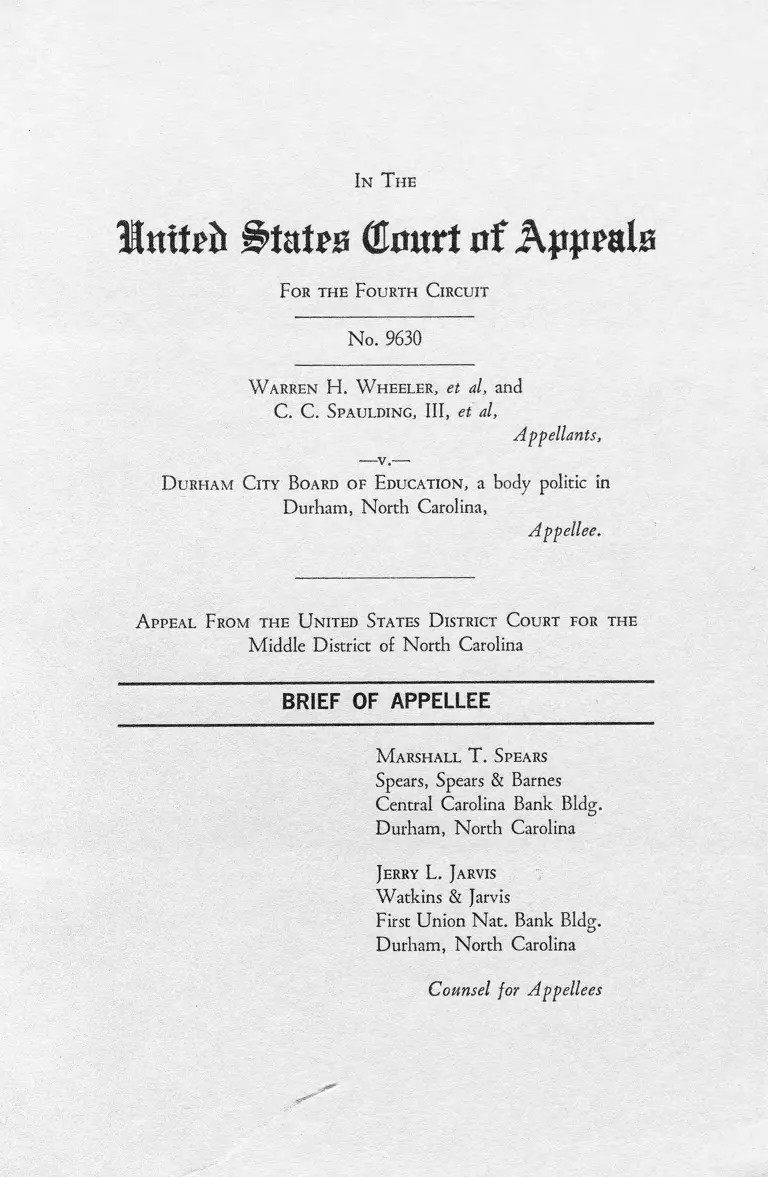
In The
Initph i ’tatw QInurt of Appeals
For the Fourth C ircuit
No. 9630
W arren H. W heeler, e t al, and
C. C. Spaulding, III, et al,
Appellants,
—v.—-
D urham C ity Board of Education, a body politic in
Durham, North Carolina,
A ppel le e .
A ppeal From the U nited States D istrict C ourt for the
M iddle District of North Carolina
BRIEF OF APPELLEE
M arshall T . Spears
Spears, Spears & Barnes
Central Carolina Bank Bldg.
Durham, North Carolina
Jerry L. Jarvis
W atkins & Jarvis
First Union Nat. Bank Bldg.
Durham, North Carolina
C oun se l f o r A pp e l le e s
INDEX
PAGE
Statement o£ the Case on Appeal _________________________ 1
Questions Presented _________ __________________ _________ 3
Statement of Facts _________________ _____ _______________ 3
Argument:
1. Whether the injunctive order of the District Court, which
disapproved the Board’s proposed desegregation plan, pro
vided the Plaintiffs with appropriate relief by ordering the
assignment of pupils on the basis of the absolute free choice
of the parents and pupils, until such time as the Board pre
sents and, with the approval of the Court, adopts some other
plan for the elimination of racial discrimination in the opera
tion of the schools of the C ity of Durham? _____________ 8
2. Whether the District Court abused its discretion by con
tinuing in effect its general injunctive order while deferring
consideration of a request for specific injunctive relief with
respect to the hiring and placement of teachers until after
the close of the 1964-65 school term and requiring the Board,
in the meantime, to make a detailed study of the adminis
trative and other problems involved? ___________________ 17
3. Whether the District Court abused its discretion by con
tinuing in effect its general injunctive order while denying
specific injunctive relief with respect to the size and location
of new school facilities, for the reason that these are con
siderations initially for the School Board, when the Court
had the assurance of the Board that its school construction
program will not be designed to perpetuate, maintain, or
support segregation? ________________________________ 20
Conclusion__ _____ _________________________ _______ ___ 24
i
TABLE OF CITATIONS
PAGE
Board of Public Instruction of Duval County v. Braxton,
326 F. 2d 616 (5th Cir. 1964), cert, denied, 377 U.S.
924 (1964) _________________________________________ 21
Brown v. Board of Education, 349 U.S. 294 (1955) __________ 20
Buckner v. County School Board of Greene County, Va.,
332 F. 2d 452 (4th Cir. 1964) _________________________ 9
Calhoun v. Latimer, 321 F. 2d 302 (5th Cir. 1962) __________ 19
Downs v. Board of Education of Kansas C ity, 336 F. 2d
988, 997 (10th Cir. 1964) ____________________________ 18
Jeffers v. W hitley, 309 F. 2d 621 (4th Cir. 1962) _______ 9, 11, 17
Mapp v. Board of Education of Chattanooga, 319 F. 2d 571
(6th Cir. 1963) ________________________________ 18,19
Northcross v. Board of Education of C ity of Memphis, 302
F. 2d 818 (6th Cir. 1962) _____________________________ 19
Wheeler v. Durham City Board of Education, 210 F. Supp.
839 (M .D .N .C . 1962) _________ 3
Wheeler v. Durham C ity Board of Education, 309 F. 2d
630 (4th Cir. 1962) __________________________4 ,9 ,1 1 ,1 7
Wheeler v. Durham C ity Board of Education, 326 F. 2d
759 (4th Cir. 1964) ________________________________ 5
u
IN THE UNITED STATES DISTRICT COURT
FOR THE MIDDLE DISTRICT OF NORTH CAROLINA
DURHAM DIVISION
W arren H. W heeler, a Minor, by J, H. )
W heeler, his father and next friend, e t al., )
v- )
D urham C ity Board of Education, a )
body politic in Durham County, North )
Carolina, )
Defendant. )
* * * ^
C. C. Spaulding, III, a Minor, by C. C. )
Spaulding, Jr., his father and next friend, )
e t al., )
Plaintiffs, )
v - )
D urham C ity Board of Education, a )
body politic in Durham County, North )
Carolina, )
Defendant. )
A ppeal From the U nited States D istrict C ourt for the
M iddle D istrict of N orth C arolina, D urham D ivision
APPELLEE’S BRIEF
Statement of the Case On Appeal
This is an appeal by the Plaintiffs, Negro school children and
parents, from an interlocutory Order (Appellant’s Appendix pp.
113a-l 19a) entered on August 3, 1964, which (1) disapproved the
School Board’s proposed Desegregation Plan and granted all pupils
assigned to any school in the Durham City School System the abso
2
lute right to attend the school of their choice during the 1964-65
school year. The Order is to remain in effect until the School Board
presents and, with the approval of the Court, adopts some other plan
for the elimination of racial discrimination in the operation of the
schools of the C ity of Durham.
If applications for reassignment should result in a particular school
having a pupil capacity beyond its ability to afford an effective pro
gram of education, the Order provides that the School Board may
apply to the Court, upon five days notice to Counsel for the Plaintiffs,
for an order permitting the transfer of certain applicants to another
school on a non-discriminatory basis, with enrollment in a particular
school to be determined on a first come - first served basis, regardless
of race.
Consideration of Plaintiffs’ request for injunctive relief with re
spect to the hiring and placement of teachers and other professional
personnel in the Durham C ity School System was deferred until after
the close of the 1964-65 school term, during which time the Order
requires the Board to make a detailed study of administrative and
other problems involved. The Order further provided that the in
junctive relief requested with respect to the size and location of new
school facilities was denied for the reason that these are considerations
which are initially for the defendant Board.
In an addendum to the Order (Appellant’s Appendix p. 119a),
Counsel were reminded that the provisions of Paragraph 3 of the
District Court’s Order of January 2, 1963, remained in effect. Para
graph 3 of the Order on Mandate dated January 2, 1963, restrains
and enjoins the School Board from any and all acts that regulate or
affect the assignment of pupils to any public school under their super
vision, management, or control on the basis of race or color. (Appel
lee’s Appendix p. 2)
To the entry of the aforementioned order, the Plaintiffs filed No
tice of Appeal on August 27, 1964.
3
Questions Presented
1. Whether the injunctive order of the District Court, which dis
approved the Board’s proposed desegregation plan, provided the Plain
tiffs with appropriate relief by ordering the assignment of pupils on
the basis of the absolute free choice of the parents and pupils, until
such time as the Board presents and, with the approval of the Court,
adopts some other plan for the elimination of racial discrimination
in the operation of the schools of the City of Durham?
2. Whether the District Court abused its discretion by continuing
in effect its general injunctive order while deferring consideration of
a request for specific injunctive relief with respect to the hiring and
placement of teachers until after the close of the 1964-65 school term
and requiring the Board, in the meantime, to make a detailed study
of the administrative and other problems involved?
3. Whether the District Court abused its discretion by continuing
in effect its general injunctive order while denying specific injunctive
relief with respect to the size and location of new school facilities,
for the reason that these are considerations initially for the School
Board, when the Court had the assurance of the Board that its school
construction program will not be designed to perpetuate, maintain,
or support segregation?
Statement of Facts
The Plaintiffs in these consolidated actions originally invoked the
jurisdiction of the United States District Court for the M iddle Dis
trict of North Carolina under the Civil Rights Act (28 U .S.C , 1343
( 3 ) ) , in 1960. On July 20, 1961, the District Court directed the
School Board to reconsider applications for reassignment of pupils
who had exhausted their administrative remedies. Subsequently, on
April 11, 1962, the District Court entered final judgment denying
the Plaintiffs the relief prayed for and dismissing the complaints. The
opinion of the District Court is reported at 210 F. Supp. 839
(M .D .N .C . 1962). The Plaintiffs appealed to the United States
4
Court of Appeals for the Fourth Circuit. The opinion of the Court
of Appeals, filed October 12, 1962, and recorded at 309 F 2d 630
(4th Cir. 1962), reversed the judgment of the District Court. By
mandate issued on October 12, 1962, the cause was remanded to the
District Court for further proceedings consistent with the opinion
of the Court of Appeals.
Thereafter, on January 2, 1963, Edwin M . Stanley, Chief District
Judge, issued an Order on Mandate (Appellee’s Appendix pp. 1-4)
which:
(a) Vacated the judgment entered on April 11, 1962;
(b) Directed the Board to reassign each minor plaintiff to the
particular school requested;
(c) Restrained and enjoined the Board and its agents, servants,
and employees from any and all acts that regulate or affect the assign
ment of pupils to any public schools under their supervision, man
agement, or control on the basis of race or color;
(d) Ordered that the restraining order and injunction should re
main in effect until such time as the Board had adopted, with the ap
proval of the District Court, a plan for the complete elimination of
racial discrimination in the operation of the schools under its super
vision; and
(e) Ordered that unless the Board submitted a suitable plan for ter
minating racial discrimination in the Durham C ity School System
not later than M ay 1, 1963, and unless the plan was approved by the
Court not later than July 1, 1963, every child enrolled for the school
year 1963-64 would have complete freedom to enroll or transfer to a
school attended solely or largely by pupils of another race.
On April 19, 1963, the Board submitted a Plan for Further De
segregation of the Durham City Schools, but the plan was disap
proved by the District Court, and on July 24, 1963, Judge Stanley
5
entered an order governing assignments and transfers within the
school system for the 1963-64 school year. Under the Court’s Order,
parents of all children enrolled in the elementary and junior high
schools were notified that they had the absolute right to attend any
school of their choice teaching the grade to which their child had
been assigned. However, all high school pupils were required, for the
school year 1963-64, to attend the high school to which they have
previously been assigned by the Board. Not later than M ay 1, 1964,
the Board was required to submit to the Court a plan for the total
and complete desegregation of the Durham C ity School System for
the 1964-65 and subsequent school year.
To the entry of the aforementioned Order, covering assignments
for the 1963-64 school year, the School Board appealed, and on Jan
uary 27, 1964, this Court affirmed the District Court’s order as “an
appropriate interim decree”. ( W hee l e r v. Durham C ity Board o f Edu
cation, 326 F. 2d 759, 760).
Pursuant to Judge Stanley’s Order, on April 28, 1964, the School
Board filed its Plan for the Desegregation of the Durham C ity Schools
for the 1964-65 and subsequent school years. (Appellant’s Appendix
pp. la-8a). Under the Board’s Plan, the assignment of pupils was
to be made on the following basis:
(a) Pupils entering the school system for the first time would be
initially assigned to the school located in the attendance area in which
the pupil was residing.
(b) Elementary and junior high school pupils who had been en
rolled in a particular school, under the “freedom of choice” plan of
assignments, during the 1963-64 school year were initially reassigned
to the same school for the 1964-65 school year.
(c) Pupils who had satisfactorily completed the course of instruc
tion at the elementary school where they were in attendance during
the 1963-64 school year were to be initially assigned to the junior
6
high school serving the geographic attendance area in which they
were residing.
(d) Pupils who had satisfactorily completed the course of instruc
tion at the junior high school where they were in attendance during
the 1963-64 school year were to be initially assigned to the high
school serving the graduates of such junior high school.
(e) Pupils who had attended high school during the 1963-64 school
year and who had not completed the course of instruction at said
school were to be initially reassigned to the same school for the 1964-
65 school year.
(f) Each pupil in the school system who was thus assigned had
the right to transfer to the school of his choice, as a matter of course,
by making timely application, until the maximum capacity per class
room had been attained, with priority being determined by the order
of receipt of such requests for reassignment.
The Plaintiffs objected to the Board’s Plan of April 28, 1964, and
a full evidentiary hearing was held on July 9, 1964, in the District
Court. Subsequently, the parties filed suggested Findings of Fact and
Conclusions of Law, and on July 31, 1964, the District Court heard
oral arguments. A t that time the Court expressed its disapproval of
the Board’s Plan as an adequate plan for the total and complete de
segregation of the Durham City School System; discussed with coun
sel the relief which might be appropriate; and invited discussion and
criticism from counsel as to each provision of a tentative order. (Ap
pellee’s Appendix pp. 47-60).
On August 3, 1964, the Court entered an Order substantially iden
tical to the tentative order proposed by the Court on July 31, 1964.
It disapproved the Board’s plan for the stated reason that the Court
was of the opinion that the school zone boundaries “in some instances”
had been drawn along racial residential lines. (Appellant’s Appendix
pp. 113 a, 114 a ) . A t the same time, the Order recognized that the
Board of Education had made substantial progress toward desegregat
7
ing the Durham C ity School System, and that the plan submitted by
the Board for the 1964-65 school year provided for further desegrega
tion of the System by the rearrangement of school attendance zones.
(Appellant’s Appendix p. 114 a)
The Court then decreed that assignments for the 1964-65 school
year be made on the following basis:
(a) A ll pupils in the Durham City School System would be in
itially assigned in accordance with the plan submitted by the de
fendant Board on April 28, 1964.
(b) Not later than August 10, 1964, the Board was required to
give appropriate notice to the parents or guardians of all pupils in
the system that they had the absolute right, subject only to exceptions
to be made by the Court in the event of overcrowding, to attend the
school of their choice during the 1964-65 school year by filing an
application for reassignment with the Board within a specified time.
(c) Assignments and reassignments will continue to be made on
this free choice basis until such time as the Board presents and, with
the approval of the Court, adopts some other plan for the elimination
of racial discrimination in the operation of schools in the C ity of
Durham.
The result of the incorporation of certain provisions of the Board’s
proposed plan into the Court’s Order is to effect initial assignments
in the following manner:
(1) A ll pupils enrolling in the Durham City School System for
the first time are initially assigned to the school located in the geo
graphical attendance area where the pupil resides;
(2) A ll pupils who have completed the course of instruction at
an elementary or junior high school are initially assigned to the junior
high school or high school in the geographical attendance area where
the pupil resides;
8
(3) A ll other pupils are initially assigned to the school which
they chose to attend during the preceding school year under the
“free choice” method of assignments then in effect; and
(4) A t the time pupils are initially assigned pursuant to the fore
going provisions of the order, they are notified of their right, if dis
satisfied with their initial assignment, to attend another school of
their free choice, by filing application for reassignment with the
School Board within thirty days.
Argument
I.
WHETHER THE INJUNCTIVE ORDER OF THE DIS
TRICT COURT, W H ICH DISAPPROVED THE BOARD’S
PROPOSED DESEGREGATION PLAN, PROVIDED THE
PLAINTIFFS W ITH APPROPRIATE RELIEF BY ORDERING
THE ASSIGNM ENT OF PUPILS ON THE BASIS OF THE
ABSOLUTE FREE CHOICE OF THE PARENTS AND PU
PILS, UNTIL SUCH TIME AS THE BOARD PRESENTS
AND, W ITH THE APPROVAL OF THE COURT, ADOPTS
SOME OTHER PLAN FOR THE ELIMINATION OF RA
CIAL DISCRIMINATION IN THE OPERATION OF THE
SCHOOLS OF THE CITY OF D URHAM ?
Although the District Court found that the Durham C ity Board
of Education had made substantial progress towards desegrating the
Durham C ity School System, and that the Board’s Plan for the 1964-
65 school year provided for further desegregation of the school sys
tem, the Court was of the opinion that the school zone boundaries
“in some instances” had been drawn along racial residential lines and,
therefore, disapproved the Board’s Plan as submitted. No appeal has
been taken from that part of the decree which disapproved of the
plan, and the only question presented by the Plaintiffs’ appeal is
whether or not the judicial relief granted to the Plaintiffs is appro
priate.
9
Where the District Court finds that racial considerations have
played any part in determining the assignments or reassignments of
pupils, the right of the Plaintiffs to obtain injunctive relief for them
selves and for the class they represent is clear beyond any doubt.
Buckner v. C oun ty S ch oo l Board o f G reen e C o u n t y , Va., 332 F. 2d
452 (4th Cir. 1964). As stated by this Court in the case of J e f f e r s v.
W hit ley , 309 F. 2d 621, 629 (4th Cir. 1962):
“In these circumstances, the duty of the Court as a court of
equity, is traditionally discharged through injunctive orders.
“W e conclude, therefore, that the appellants . . . are entitled
to individual relief . . . .
■M, M , M , Jfc
TT •7t* ■7T •W
“On behalf of others, similarly situated, the appellants are not
entitled to an order requiring the School Board to effect a gen
eral intermixture of the races in the schools. They are entitled
to an order enjoining the School Board from refusing admission
to any school of any pupil because of the pupil’s race.”
When these present actions were before this Court on the first ap
peal, W hee le r v. Durham C ity Board o f Education, 309 F. 2d 630
(4th Cir. 1962), the Court said:
“ (T)hese plaintiffs are entitled to an order for their admission
for the 1962-63 school year to the schools for which they have
applied, to a declaratory judgment that the defendants are ad
ministering the North Carolina Pupil Enrollment Act in an un
constitutional manner, and to an injunction against the con
tinuance of the Board’s discriminatory practices. The injunction
shall control all future assignment of pupils to schools unless and
until the defendants submit to the District Court a suitable plan
for ending the existing discrimination.”
Pursant to this Mandate, on January 2, 1963, the District Court
10
entered its Order on Mandate incorporating the prescribed injunctive
provisions. Paragraph 3 of that order reads as follows:
“It is further Ordered that the defendants, their agents, ser
vants and employees are restrained and enjoined from any and
all acts that regulate or affect the assignment of pupils to any
public schools under their supervision, management or control
on the basis of race or color. The defendants are specifically re
strained and enjoined from (a) using any method of determining
the placement of pupils in school on the basis of racial consid
erations when pupils first enter the school system, when pupils
are promoted from elementary school to junior high school, or
from junior high school to high school, or when pupils change
their residences from one part of the area served by the school
system to another part of the school system’s area; (b) using any
separate racial attendance area maps or zones or their equivalent
in determining the placement of pupils in schools; (c) from re
quiring any applicants for transfers to submit to any futile, bur
densome, or discriminatory administrative procedures in order to
obtain such transfers, including (but not limited to) the use of
any criteria or standards for determining such requests which are
not generally and uniformly used in assigning all pupils, and
the requirement of administrative hearings or other procedures
not uniformly applied in assigning pupils; and (d ) using any
standards relating to residence, academic achievement, overcrowd
ing or otherwise in determining such transfer requests which are
not used in determining initial assignments of all pupils.”
(Appellee’s Appendix pp. 2, 3 ).
The District Court’s Order, from which the Plaintiffs are presently
appealing, specifically incorporates and continues in effect those in
junctive provisions. (Appellant’s Appendix p. 119 a ) .
In addition to the injunction, this Court has repeatedly stated the
further judicial relief that must be granted to school children pending
the submission by a School Board of a suitable plan for nondiscrim
11
inatory administration of the school system. When these cases were
first before this Court in W hee le r v. Durham City Board o f Educa
tion, 309 F. 2d 630 (4th Cir. 1962) , the Court stated:
“W e find it unnecessary to burden the opinion with these
details, for in J e f f e r s v . W hit l ey , No. 8593, Fourth Circuit, June
1962, decided today, we have declared the judicial relief that must
be granted to school children who have been initially assigned on
a racial basis.”
The declarations of this Court in J e f f e r s v. W hit ley , 309 F. 2d 621
(4th Cir. 1962) referred to in the W hee le r case are clear and un
ambiguous. It is there stated:
“So long as the School Board follows its practice of racial as
signments, the injunctive order should require that it freely and
readily grant all requests for transfer or initial assignment to a
school attended solely or largely by pupils of the other race. T he
order sh ou ld prohibit th e S choo l Board c ond i t ion in g its g ran t o f
any su ch r equ e s t ed transfer up on th e app licant’s subm iss ion to
fu t i le , bu rd en som e , or d iscr im inatory administra tive p ro cedu res .
T h e order sh ou ld fu r th er p rov id e that i f t h e S ch oo l Board d o es
not adop t s om e other non -discr im inatory plan, it shall in form
pupils and their parents that th e re is a r igh t o f f r e e c h o i c e at th e
t im e o f initial a s s ignm en t and at su ch reasonable intervals th e re
after as may be d e t e rm in ed by th e Board, w i th th e approval o f
th e District Court. How and when such information shall be dis
seminated may be determined by the District Court after re
ceiving the suggestions of the parties.
“The injunctive order may provide for its modification upon
application of the School Board to the extent that modification
may be required to enable the Board to solve and eliminate any
administrative difficulty that may arise. It may contain other
provisions not inconsistent with this opinion.
"T h e in jun c t iv e order sh ou ld r emain in e f f e c t until th e S ch oo l
12
Board, i f it e l e c t s to do so, p r e s en t s and, w i th th e approval o f th e
District Court, adop ts s om e o th er plan fo r th e e l im ination o f
racial d iscr im ination in th e operation o f th e s ch o o l s . . . (Em
phasis added.)
Judge Stanley’s comments at the hearing on July 9, 1964, indicate
that this particular form of relief was granted pursuant to the direc
tions of this Court in the prior appeals and in f e f f e r s v. W hit ley . In
his discussion with counsel he asked:
“W hat can the Court do except approve a plan or, if no plan
is submitted that can be approved, order that the Board with
out regard to the initial summons—whether it’s the school they
attended previously or in zones or however it is—that all children
have the freedom to go to any school they want to? I do not
understand that the Court can come up and take a map and
draw lines and prepare its own plan and take over the administra
tion of the school system.” (Appellee’s Appendix, p, 5) .
# # # *
“W ell, what’s the suggestion of counsel now for both sides
as to the future handling of this matter? I would like to make
some reasonably early disposition of it. I want to give you an op
portunity to file your requests for findings and conclusions and
any type of relief that should be entered.
“I would like to just make this one observation as to the type
of relief. I mentioned I believe in my comments here before, and
I made some casual reference to it here this morning, that I
thought—well, when it was before the Court of Appeals, they
said, W e find it unnecessary to burden this opinion with details’,
that is, as to the relief to be granted, ‘for in J e f f e r s v er su s W hit
l e y , decided today, we have declared the judicial relief that must
be granted to school children who had been initially assigned on
a racial basis.’
13
“Now when this matter was decided by the Court of Appeals
in January of this year, they again refer to J e f f e r s v er su s W hit l ey
as to how the matter would be handled; and the Court in J e f f e r s
v er su s W hit l e y said, ‘so long as the School Board follows its prac
tice of racial assignments, the injunctive order should require
that it freely and readily grant all requests for transfer or initial
assignment. The order should prohibit the School Board condi
tioning its grant of any request for transfer upon the applicant’s
submission to futile and burdensome administrative procedures.
The order should further provide that if the Board does not adopt
some other nondiscriminatory plan, it shall inform pupils and
their parents that there is a right of free choice at the time of
initial assignment and at such reasonable intervals thereafter as
may be determined by the Board with the approval of the Dis
trict Court. How and when such information shall be dissemi
nated may be determined by the District Court after receiving
the suggestions of the parties.
“ ‘The injunctive order may provide for its modification upon
application of the School Board to the extent that modification
may be required to enable the Board to solve and eliminate any
administrative difficulty that may arise. It may contain other
provisions not inconsistent with this opinion.’
“Now I simply bring that up, without deciding it now at all,
because I want counsel to assist me some in that area. I think I
am generally familiar with the pronouncement of the Courts in
this area. I have tried to read certainly out of our Court of Ap
peals and out of the Supreme Court of the United States, and I
am just simply not mindful of any decision of any Court any
where that has said that the Court must take over the administra
tion of the school system and must sit down and draw lines and
say that every child living in this area will have to go to this
school and everyone here has to go to this school for elementary,
and then draw up the other lines and so forth.
14
“Now its seems to me, without deciding the matter, that the
School Board has either one or two choices; it has to propose a
plan that is nondiscriminatory in nature, and generally that plan
has to be a plan that would be reasonable if every child living in
the area were of the same race and they were attempting to ad
minister a school program without regard to race being used as
a factor in any way, directly or indirectly. But if the Board for
any reason doesn’t come up with such a plan that the Court can
say is completely nondiscriminatory, then the alternative is that
every child is entitled to go to the school of his choice and en
titled to be notified of that until such time as such plan is con
ceived.
“Now, that’s what the Court said should be done in J e f f e r s
ver su s W hit l ey . It’s what the Court said in this very case, that
must be done in this case, and it’s what the Court of Appeals re
stated in its opinion in January of this year by referring to J e f f e r s
ver su s W hit ley . Now if there is some other line of decisions to
be followed, I would like to know why this is not the law in this
case, but that there is some other law.
“I understood you to say that you weren’t confined to those
two choices here before. The matter was not pursued and, as I
say, I’m not inviting a discussion of it now. I only made these
remarks as an aid and guidance to counsel when they are pre
paring their briefs.” (Appellee’s Appendix pp. 44-46).
When the matter again came on for hearing on July 31, 1964,
Judge Stanley, in the interest of time, had prepared a tentative order
which he discussed with counsel for all parties, and which, with in
significant changes, became the Order presently appealed from. The.
paragraph by paragraph comments of Judge Stanley with reference
to this order are printed at length in Appellee’s Appendix, and are
indexed as to subject matter. (Appellee’s Appendix pp. 47-60).
W ith reference to the recognition that substantial progress had
been made, the Court stated:
15
“I think there has been substantial progress made as referred
to in the second paragraph, and third, that this thing not be
thrown completely open and go back to the old standards but
that we build on the progress that has been made, and that these
students be initially assigned to all schools this year in accordance
with the plan proposed by the defendant. That means that stu
dents attending all these schools last year will be assigned to
those schools, and the balance of them will be assigned. Now if
that needs to have some amplification, of course, it’s quite all
right; but I assume that all children have been assigned. But
it is to carry forward the progress that has been made and we
use that as a floor.” (Appellee’s Appendix p. 49).
W ith reference to the continuing application of the Order (Para
graph 7 of the final order), the Court stated:
“I don’t see what purpose it will serve going through this
every summer. W e are going to take the progress we have built
and then couple that with an absolute freedom of choice for
every child in the Durham City School System, and then put the
burden on the Defendant School Board, and if they can’t ad
minister that system, they are going to have to come in with a
plan; and then that will stand in effect until they do come in
with a plan that does take care of it. There has to be some re
wording of this number six (paragraph 7 of final order) I think
that second sentence in number six should be, ‘unless and until
such a plan has been submitted and approved’ by the Board,
that then the Board shall at the end of each school term hereafter
do so and so, so as to make it perpetual.” (Appellee’s Appendix
P-50) .
A t that point M r. Nabrit, of counsel for the Plaintiffs, asked
Judge Stanley if he intended not to order the School Board to come in
with new zones, to which question the Court replied:
“W ell, it is intended to do two things: It is to build on the
plan that has been submitted, and that has to be incorporated
16
into this by reference; secondly, if you keep that plan in effect
together with complete freedom of choice and free and easy ad
ministrative techniques to get applications and to be transferred
simply on the asking, and that sort of thing, unless and until
the Board does come in—Now as I read J e f f e r s v er su s W hit l e y ,
and as I read in this case here from the Court of Appeals, every
thing that they have said on it, they say that you should—until
they do come in and submit a plan, that you should give them
that free choice. I think we actually go one step further here. I
think that we build on what I think is a very substantial improve
ment and we use that as a floor, rather than those strictly neigh
borhood schools, in a complete desegregated school system. A ll
of those who have heretofore exercised their choice, they are auto
matically put in that school, and I think for the time being—of
course, all of these orders are interlocutory, and if you want to
come back a year or two years from now and say, ‘Now we
think that this defendant should be required to come in with a
plan, and this thing is not working as it should,’ of course, you
can always have that chance to come back.
“But this is intended, and I think is in complete, one-hundred-
percent compliance, plus some, with what the Court of Appeals
has said in this case and what they said in this case by reference
to J e f f e r s v er su s W h i t l e y .” (Appellee’s Appendix p. 51).
As the members of this Court will recall, Judge Stanley employed
the free choice basis for assignments as to elementary and junior high
schools in the Durham City School System for the 1963-64 school
year, but ordered that assignments to the senior high schools be made
on the same basis as previous years. The Board of Education appealed
from that order, and this Court affirmed his decision as “an appro
priate interim decree” in its per curiam opinion reported at 326 F. 2d
759 (4th Cir. 1964).
Ironically, on that appeal, the Plaintiffs took the position, not only
that such relief was appropriate, but that it was, in fact, what this
17
Court had suggested. At page 20 of Appellee’s brief in Appeal No.
9184, it is stated:
“The trial court apparently selected the ‘free choice’ or ‘free
transfer’ formula as a temporary expedient to enable those Negro
pupils who desired to attend desegregated schools to do so, with
out undertaking a complete realignment of the initial assign
ment system. This expedient had been adopted by District
Judges W right and Ellis on a temporary basis pending realign
ment of dual zones in the New Orleans case. Bush v. Orleans
Parish S ch oo l Board, 308 h. 2d 491 (5th Cir. 1962). More im
portantly this course had been suggested by this Court in J e f f e r s
v. W hit ley , 209 F. 2d 621, 629 (4th Cir. 1962), where the court
directed that ‘So long as the School Board follows its practice of
racial assignments, the injunctive order should require that it
freely and readily grant all requests for transfer or initial assign
ment to a school attended solely or largely by pupils of the other
race.’ In the prior appeal in the present case, this Court referred
to the contemporaneous J e f f e r s opinion as setting out ‘the judicial
relief that must be granted to school children who have initially
assigned on a racial basis.’ W hee le r v. Durham C ity Board o f
Education, 309 F. 2d 630, 633 (4th Cir. 1962).”
It is difficult to imagine how the present order of the District Court,
from which the Plaintiffs have appealed, could more precisely com
ply with the mandates from this Court in W hee le r v. Durham City
Board o f Education, 309 F. 2d 630 (4th Cir. 1962) and J e f f e r s v.
W hit ley , 309 F. 2d 621 (4th Cir. 1962). Furthermore, in approving
the freedom of choice order governing assignments in this school
system for the 1963-64 school year, this Court again indicated the
appropriateness of this relief by referring to these decisions.
II.
WHETHER THE DISTRICT COURT ABUSED ITS DIS
CRETION BY CONTINUING IN EFFECT ITS GENERAL
INJUNCTIVE ORDER WHILE DEFERRING CONSIDERA-
18
TION OF A REQUEST FOR SPECIFIC INJUNCTIVE RE
LIEF W ITH RESPECT TO THE HIRING AND PLACEM ENT
OF TEACHERS UNTIL AFTER THE 1964-65 SCHOOL
TERM , AND REQUIRING THE BOARD, IN THE M EAN
TIM E, TO MAKE A DETAILED STUDY OF THE A D M IN
ISTRATIVE AND OTHER PROBLEMS INVOLVED?
Since the District Court continued its injunction against the Board
with regard to all acts that regulate or affect the assignment of pupils,
and required the school authorities to make a detailed study of the ad
ministrative and other problems involved with respect to the hiring
and placement of teachers and other professional personnel in the
system, and to be prepared to express themselves fully with reference
to all administrative and legal problems involved at the end of the
1964-65 school year, the Plaintiffs’ objection to this portion of the
Order appears to be that the Court did not take further action in this
regard within the few days between the date of his order and the
commencement of the 1964-65 school term.
W hile the Court did suggest that all parties be prepared to discuss
the standing of the minor plaintiffs to question the policy employed
by the Board in this matter, he referred counsel to decisions in the
Fifth Circuit Court of Appeals and acknowledged that this Court
had indicated that a complaint seeking relief from a discriminatory
school system was broad enough to cover relief in this area. (A p
pellee’s Appendix p. 46, 47). However, the Court also noted that
there had been no evidence introduced on the question of how pupils
were affected by the present policy of the Board in the hiring and
placing of teachers and other school personnel. Cf., D ow n s v. Board
o f Education o f Kansas C ity , 336 F. 2d 988, 997 (10th Cir. 1964);
and, M app v. Board o f Education o f Kansas C ity , 319 F. 2d 571 (6th
Cir. 1963). He required the parties to be fully prepared to discuss all
phases of this issue after the close of the 1964-65 school year. (A p
pellants’ Appendix p. 117 a ) .
The question now before the Court is not whether or not the plain
tiffs have standing to raise the issue of personnel, as suggested by the
19
Plaintiffs, for the District Court has not ruled that they lacked stand
ing. Indeed, the trial judge acknowledged that this Court had inti
mated its accord in this area with the Fifth and Sixth Circuits. The
question which is before the Court is whether or not the District
Court abused its discretion in deferring consideration of this question
until after the close of the current school year.
When this issue was first presented to the Court of Appeals for the
Sixth Circuit in M app v. Board o f Education o f Chattanooga , 319
F. 2d 571 (6th Cir. 1963), that Court concluded that the issues of
assignment of teachers and a unitary employment policy were proper
ones to be determined in that action, but stated:
“ (W )e think it appropriate that the stricken allegations of
the complaint, insofar as they relate to the assignment of teachers
and principals, be restored to the pleading and that decision of
the legal question presented await developments in the progress
of the plan approved. Nothing we have said need call for any
present taking of testimony on the subject of teacher and prin
cipal assignment. W ithin his discretion, the District Judge may
determine when, if at all, it becomes necessary to give considera
tion to the question under discussion.”
The postponement of consideration of such an issue by the trial
court was approved by the Sixth Circuit again in N orth cro ss v. Board
o f Education o f M em ph i s , 333 F. 2d 661 (6th Cir. 1964). Also, in
the case of Calhoun v. Latimer, 321 F. 2d 302 (5th Cir. 1963), the
Fifth Circuit affirmed an order of the District Court which postponed
consideration of teacher assignments.
In November 1964 the Chairman of the Durham C ity Board of
Education appointed a committee to explore all administrative aspects
of integration of teaching and professional staffs in the system, and
this committee has reported to the Board that it has already under
taken its assignment and expects to make its report in the near future.
The North Carolina State Department of Public Instruction alio-
20
cates between Negro and White teachers the number of positions in
each school system for which it will reimburse the system the teachers’
salaries. (Appellants Appendix pp. 62a, 63a) . This assures that each
school system will employ Negro and white teachers on a fair pro
portionate basis with the funds provided by the State of North Caro
lina. The local boards of education hire all teachers and make the as
signments to the respective schools. (Appellants’ Appendix p. 64a).
Since the number of available qualified teachers is always limited, the
individual preference of the teachers must necessarily be taken into
consideration in making these assignments. As recently as this past
summer, one of the Negro librarians employed by the Durham City
Board of Education was offered the position of assistant supervisor
of librarians over all schools in the system, and although she initially
stated that she would accept the position she ultimately declined to do
so. (Appellee’s Appendix p. 26).
A t the close of the 1963-64 school year the Durham City School
System employed 640 teachers, of which number 292 were Negro
and 348 were white. The large turnover in teacher personnel is indi
cated by the fact that 455 new teachers were employed between 1959
and 1963, of which number only 108 filled new teaching positions,
and of this number 66 were Negro and 42 were white. (Appellants’
Appendix pp. 29a, 30a).
These are but a few of the many administrative problems which
must be considered in connection with the integration of teaching
staffs and which justify the postponement of this issue under the
principles of Brown v. Board o f Education , 349 U. S. 294 (1955).
The Court of Appeals for the Fourth Circuit has recognized the
complexities which are involved during this period of transition, as
have the Fifth and Sixth Circuits, and it is respectfully urged that
the District Court was entirely justified in postponing consideration
of this issue until after the close of the 1964-65 school year.
III.
WHETHER THE DISTRICT COURT ABUSED ITS DIS-
21
CRETION BY CONTINUING IN EFFECT ITS GENERAL
INJUNCTIVE ORDER WHILE DENYING SPECIFIC IN
JUNCTIVE RELIEF W ITH RESPECT TO THE SIZE AND
LOCATION OF NEW SCHOOL FACILITIES, FOR THE
REASON T H A T THESE ARE CONSIDERATIONS INITIAL
LY FOR THE SCHOOL BOARD, W H EN THE COURT HAD
THE ASSURANCE OF THE BOARD T H A T ITS SCHOOL
CONSTRUCTION PROGRAM WILL NOT BE DESIGNED
TO PERPETUATE, M AIN TA IN , OR SUPPORT SEGREGA
TION?
The basic school facilities available in the Durham C ity School
System have existed for a great many years and were constructed
on the neighborhood school plan to accommodate pupils residing in
the neighborhood. (The dates of construction of each school are set
forth in Appellee’s Appendix pp. 12-19). To keep these facilities in
good condition the Board is required to maintain a program of per
petual repair, renovation and expansion. The standards required under
a modern educational program are constantly changing and additional
and expanded facilities at the existing sites are required from time to
time to maintain accreditation. (Appellee’s Appendix p. 24, 25).
These facilities which have been constructed at a cost to the com
munity of millions of dollars cannot be abandoned and new plants
erected. The increase in pupil enrollment alone results in a tremen
dous financial burden each year to the community for additional faci
lities. For a number of years the Durham C ity School System has
had an increase in school population of about 500 pupils a year. This
necessitates the annual construction of one new school or from 14 to
18 additional classrooms. (Appellee’s Appendix p. 24).
Certainly, school construction is an appropriate matter for con
sideration by the courts, for construction programs may not be de
signed to perpetuate, maintain or support segregation. Board o f P ub
l i c Instruct ion o f D uval C oun ty v. Braxton, 326 F. 2d 616 (5th Cir.
1964). However, as pointed out by the District Judge in his consid
eration of the Plaintiffs’ request for a specific injunction in this regard,
22
there are many, many factors involved in determining how, where
and when new facilities are to be constructed, such as: the availability
of land, cost of land, concentration of population, and present over
crowded conditions. (Appellee’s Appendix p. 56).
The District Court was not unmindful of the responsibility of the
Board in this area. During the discussion with reference to the ap
propriate relief to be granted and the drafting of the present Order,
the Court stated:
“Now that leaves one item for consideration and that is this
question of construction, which yesterday when I was jotting
down these thoughts I didn’t even think about, and frankly I
just simply do not know how to handle that problem. Certainly
I can’t tell the School Board where to build a school. I do think
that it goes to their good faith. If they build a very small school
simply to accommodate a small population group in a certain
area, when any judgment at all would dictate that there be a
larger school for a larger area if all the individuals in that area
were of the same race. However, they have many, many factors
that are involved in it: the availability of land, the cost of the
land, the concentration of population, the overcrowded conditions
now; and as I mentioned a little while ago, I think it would be
just as bad for the School Board to sit down and say, ‘W ell, this
is not good business here from a business standpoint. W e
wouldn’t put it here if all the children were white or all the
children were Negro but in order to encourage and to get more
intermixture of the races, why we’ll put it here.’ I think that’s a
bad criterion to go about it. But if they say they are going to lo
cate it there because it will tend to perpetuate segregation, it
will tend to segregate a community where all the people who live
there are one race, I think that’s bad and it should not be done.
“I rather think this construction problem is a part of the good
faith of the School Board in trying to fully and completely com
ply with the pronouncements of the Courts in this area. I would
hope that there would be some consultation between the parties
23
interested in the location of the school, but I simply do not know
what sort of injunctive relief—and who’s going to tell them
where you can put a school with all this multitude of factors in
volved? 1 agree with counsel for the plaintiffs as to the general
objective, and I will simply say to the defendant that you should
not use race as any factor in deciding on a location; but there
are dozens of other factors that are perfectly legitimate and when
those factors are given their full weight and you apply good
business principles and practices, that might go counter to the
wishes of some population group. It might be a white popula
tion group; it might be a Negro population group. But it’s
an area that requires the utmost good faith coupled with good
business practices. I can simply say to all parties that as new con
struction comes along that I would think the burden would be
on the School Board to reasonably justify its actions in the loca
tion, to demonstrate its good faith.”
These remarks by the District Judge are certainly not in accord
with the statement in Appellants’ brief which imputes a finding by
the Court that this matter of construction was not relevant to the
litigation. (Appellants’ Brief p. 26). Indeed, the Order of the Court
states that the Court has the assurance of the defendant that its school
construction program will not be designed to perpetuate, maintain or
support segregation. (Appellants’ Appendix p. 118a).
Not only has the School Board assured the Court that it is approach
ing this matter with the utmost good faith, but as further evidence
of this fact, on November 23, 1964, the Board held a special meeting
for the purpose of discussing capital needs and the 1964 bond funds
which it will receive, and to consider its immediate and long-range
programs for school construction and renovations. The attorneys for
the plaintiffs were urged to attend this meeting for the purpose of
assisting the Board in its decisions with their suggestions and critic
isms. Counsel for all parties met with the Board on that occasion.
At the close of the meeting the Board was assured that counsel for
the plaintiffs would formulate their suggestions in the near future
24
and present them to the Board before further action becomes necessary
on these matters.
It is respectfully submitted that this is the only reasonable approach
to this difficult problem of new construction, and that the parties are
proceeding in this manner demonstrates that no injunctive relief is
necessary.
Conclusion
Wherefore, for the foregoing reasons, it is respectfully submitted
that the judgment of the District Court should be affirmed.
Respectfully submitted,
M arshall T. Spears
Spears, Spears & Barnes
Central Carolina Bank Bldg.
Durham, North Carolina
Jerry L. Jarvis
Watkins & Jarvis
First Union Natl. Bank Bldg.
Durham, North Carolina
A tto rn ey s f o r A ppelle e .