Nixon v. Condon Court Opinion
Public Court Documents
May 2, 1932
-
Brief Collection, LDF Court Filings. Nixon v. Condon Court Opinion, 1932. 08d6b2a1-bf9a-ee11-be36-6045bdeb8873. LDF Archives, Thurgood Marshall Institute. https://ldfrecollection.org/archives/archives-search/archives-item/2a055b28-fe5d-478b-b853-90e16c1b45a2/nixon-v-condon-court-opinion. Accessed October 06, 2026.
Copied!
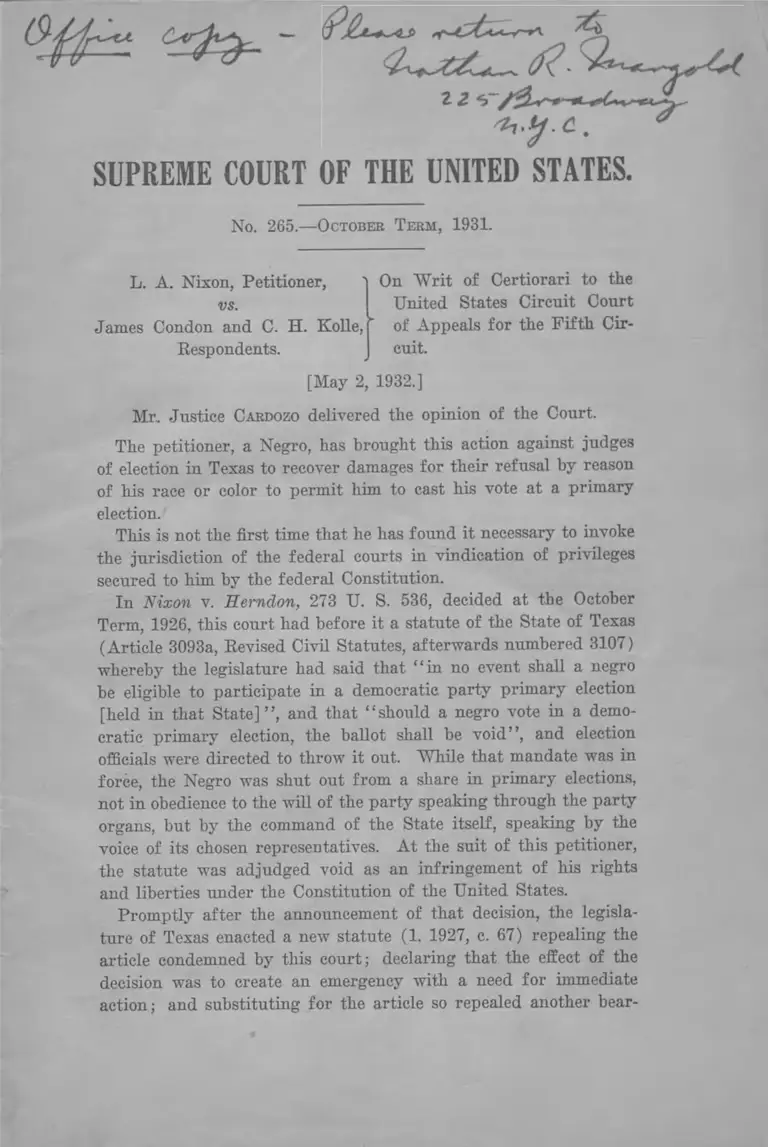
SUPREME COURT OF THE UNITED STATES.
No. 265.— October Term, 1931.
L. A. Nixon, Petitioner,
vs.
James Condon and C. H. Kolle, "
Respondents.
On "Writ of Certiorari to the
United States Circuit Court
of Appeals for the Fifth Cir
cuit.
[May 2, 1932.]
Mr, Justice Cardozo delivered the opinion of the Court.
The petitioner, a Negro, has brought this action against judges
of election in Texas to recover damages for their refusal by reason
of his race or color to permit him to cast his vote at a primary
election.
This is not the first time that he has found it necessary to invoke
the jurisdiction of the federal courts in vindication of privileges
secured to him by the federal Constitution.
In Nixon v. Herndon, 273 U. S. 536, decided at the October
Term, 1926, this court had before it a statute of the State of Texas
(Article 3093a, Revised Civil Statutes, afterwards numbered 3107)
whereby the legislature had said that “ in no event shall a negro
be eligible to participate in a democratic party primary election
[held in that State]” , and that “ should a negro vote in a demo
cratic primary election, the ballot shall be void” , and election
officials were directed to throw it out. While that mandate was in
force, the Negro was shut out from a share in primary elections,
not in obedience to the will of the party speaking through the party
organs, but by the command of the State itself, speaking by the
voice of its chosen representatives. At the suit of this petitioner,
the statute was adjudged void as an infringement of his rights
and liberties under the Constitution of the United States.
Promptly after the announcement of that decision, the legisla
ture of Texas enacted a new statute (1. 1927, c. 67) repealing the
article condemned by this court; declaring that the effect of the
decision was to create an emergency with a need for immediate
action; and substituting for the article so repealed another bear
2 Nixon ys. Condon et al.
ing the same number. By the article thus substituted, “ every
political party in this State through its State Executive Com
mittee shall have the power to prescribe the qualifications of its
own members and shall in its own way determine who shall he
qualified to vote or otherwise participate in such political party;
provided that no person shall ever he denied the right to parti
cipate in a primary in this State because of former political views
or affiliations or because of membership or non-membership in or
ganizations other than the political party.”
Acting under the new statute, the State Executive Committee
of the Democratic party adopted a resolution “ that all white
democrats who are qualified under the constitution and laws of
Texas and who subscribe to the statutory pledge provided in Ar
ticle 3110, Revised Civil Statutes of Texas, and none other, be
allowed to participate in the primary elections to be held July 28,
1928, and August 25, 1928” , and the chairman and secretary were
directed to forward copies of the resolution to the committees in
the several counties.
On July 28, 1928, the petitioner, a citizen of the United States,
and qualified to vote unless disqualified by the foregoing resolu
tion, presented himself at the polls and requested that he be
furnished with a ballot. The respondents, the judges of election,
declined to furnish the ballot or to permit the vote on the ground
that the petitioner was a Negro and that by force of the resolu
tion of the Executive Committee only white Democrats were al
lowed to be voters at the Democratic primary. The refusal was
followed by this action for damages. In the District Court there
was a judgment of dismissal (34 P. (2d) 464), which was af
firmed by the Circuit Court of Appeals for the Fifth Circuit, 49
P. (2d) 1012. A writ of certiorari brings the cause here.
Barred from voting at a primary the petitioner has been, and
this for the soIq reason that his color is not white. The result
for him is no different from what it was when his cause was here
before. The argument for the respondents is, however, that iden
tity of result has been attained through essential diversity of
method. We are reminded that the Fourteenth Amendment is a
restraint upon the States and not upon private persons uncon
nected with a State. United States v. CruikshanTc, 92 U. S. 542;
Strauder v. West Virginia, 100 U. S. 303; Ex parte Virginia,
Nixon vs. Condon et al. 3
100 U. S. 339, 346; James v. Bowman, 190 U. S. 127, 136. This
line of demarcation drawn, we are told that a political party is
merely a voluntary association; that it has inherent power like
voluntary associations generally to determine its own membership;
that the new article of the statute, adopted in place of the man
datory article of exclusion condemned by this court, has no other
effect than to restore to the members of the party the power
that would have been theirs if the lawmakers had been silent; and
that qualifications thus established are as far aloof from the im
pact of constitutional restraint as those for membership in a golf
club or for admission to a Masonic lodge.
Whether a political party in Texas has inherent power today
without restraint by any law to determine its own membership,
we are not required at this time either to affirm or to deny. The
argument for the petitioner is that quite apart from the article
in controversy, there are other provisions of the Election Law
whereby the privilege of unfettered choice has been withdrawn or
abridged (citing, e. g., Articles 2955, 2975, 3100, 3104, 3105, 3110,
3121, Revised Civil Laws); that nomination at a primary is in
many circumstances required by the statute if nomination is to be
made at all (Article 3101); that parties and their representatives
have become the custodians of official power (Article 3105); and
that if heed is to be given to the realities of political life, they are
now agencies of the State, the instruments by which government
becomes a living thing. In that view, so runs the argument, a
party is still free to define for itself the political tenets of its
members, but to those who profess its tenets there may be no
denial of its privileges.
A narrower base will serve for our judgment in the cause at
hand. Whether the effect of Texas legislation has been to work so
complete a transformation of the concept of a political party as a
voluntary association, we do not now decide. Nothing in this
opinion is to be taken as carrying with it an intimation that the
court is ready or unready to follow the petitioner so far. As to
that, decision must be postponed until decision becomes necessary.
Whatever our conclusion might be if the statute had remitted to
the party the untrammeled power to prescribe the qualifications of
its members, nothing of the kind was done. Instead, the statute
lodged the power in a committee, which excluded the petitioner
4 Nixon vs. Condon et al.
and others of his race, not by virtue of any authority delegated
by the party, hut by virtue of an authority originating or sup
posed to originate in the mandate of the law.
We recall at this point the wording of the statute invoked by
the respondents. “ Every political party in this State through
its State Executive Committee shall have the power to prescribe
the qualifications of its own members and shall in its own way
determine who shall be qualified to vote or otherwise participate
in such political party.” Whatever inherent power a State polit
ical party has to determine the content of its membership resides
in the State convention. Bryce, Modern Democracies, Vol. 2, p. 40.
There platforms of principles are announced and the tests of party
allegiance made known to the world. What is true in that regard
of parties generally, is true more particularly in Texas, where the
statute is explicit in committing to the State convention the for
mulation of the party faith (Article 3139). The State Executive
Committee, if it is the sovereign organ of the party, is not such
by virtue of any powers inherent in its being. It is, as its name
imports, a committee and nothing more, a committee to be chosen
by the convention and to consist of a chairman and thirty-one
members, one from each senatorial district of the State (Article
3139). To this committee the statute here in controversy has at
tempted to confide authority to determine of its own motion the
requisites of party membership and in so doing to speak for the
party as a whole. Never has the State convention made declara
tion of a will to bar Negroes of the State from admission to the
party ranks. Counsel for the respondents so conceded upon the
hearing in this court. Whatever power of exclusion has been
exercised by the members of the committee has come to them,
therefore, not as the delegates of the party, but as the delegates
of the State. Indeed, adherence to the statute leads to the con
clusion that a resolution once adopted by the committee must con
tinue to be binding upon the judges of election though the party
in convention may have sought to override it, unless the com
mittee, yielding to the moral force of numbers, shall revoke its
earlier action and obey the party will. Power so intrenched is
statutory, not inherent. If the State had not conferred it, there
would be hardly color of right to give a basis for its exercise.
Our conclusion in that regard is not affected by what was ruled
by the Supreme Court of Texas in Love v. Wilcox, 28 S. W. (2d)
Nixon vs. Condon et al. 5
515, or by the Court of Civil Appeals in White v. Lubbock, 30 S. W.
(2d) 722. The ruling in the first case was directed to the validity
of the provision whereby neither the party nor the committee is to
be permitted to make former political affiliations the test of party
regularity. There were general observations in the opinion as to
the functions of parties and committees. They do not constitute
the decision. The decision was merely this, that “ the committee
whether viewed as an agency of the State or as a mere agency of
the party is not authorized to take any action which is forbidden
by an express and valid statute.” The ruling in the second case,
which does not come from the highest court of the State, upholds
the constitutionality of section 3107 as amended in 1927, and
speaks of the exercise of the inherent powers of the party by the
act of its proper officers. There is nothing to show, however, that
the mind of the court was directed to the point that the members
of a committee would not have been the proper officers to exercise
the inherent powers of the party if the statute had not attempted to
clothe them with that quality. The management of the affairs of
a group already associated together as members of a party is ob
viously a very different function from that of determining who
the members of the group shall be. If another view were to be
accepted, a committee might rule out of the party a faction dis
tasteful to itself, and exclude the very men who had helped to
bring it into existence. In any event, the Supreme Court of Texas
has not yet spoken on the subject with clearness or finality, and
nothing in its pronouncements brings us to the belief that in the
absence of a statute or other express grant it would recognize a
mere committee as invested with all the powers of the party as
sembled in convention. Indeed its latest decision dealing with any
aspect of the statute here in controversy, a decision handed down
on April 21, 1932 (Love v. Buckner, Supreme Court of Texas), de
scribes the statute as constituting “ a grant of power” to the State
Executive Committee to determine who shall participate in the
primary elections.* What was questioned in that case was the
validity of a pledge exacted from the voters that it was their bona
*“ We are bound to give effect to a grant of power to the State Executive
Committee of a party to determine who shall participate in the acts o f the
party otherwise than by voting in a primary, when the Legislature grants
the power in language too plain to admit of controversy, and when the deter-
6 Nixon vs. Condon et al.
fide purpose to support the party nominees. The court in up
holding the exaction found a basis for its ruling in another article
of the Civil Statutes (Art. 3167), in an article of the Penal Code
(Art. 340), and in the inherent power of the committee to adopt
regulations reasonably designed to give effect to the obligation
assumed by an elector in the very act of voting. To clinch the
argument the court then added that if all these sources of author
ity were inadequate, the legislature had made in Article 3107 an
express “ grant of power” to determine qualifications generally.
There is no suggestion in the opinion that the inherent power of
the committee was broad enough (apart from legislation) to per
mit it to prescribe the extent of party membership, to say to a
group of voters, ready as was the petitioner to take the statutory
pledge, that one class should be eligible and another not. On the
contrary, the whole opinion is instinct with the concession that
pretensions so extraordinary must find their warrant in a statute.
The most that can be said for the respondents is that the inherent
powers of the Committee are still unsettled in the local courts.
Nothing in the state of the decisions requires us to hold that they
have been settled in a manner that would be subversive of the
fundamental postulates of party organization. The suggestion is
offered that in default of inherent power or of statutory grant the
committee may have been armed with the requisite authority by
vote of the convention. Neither at our bar nor on the trial was
the case presented on that theory. At every stage of the case the
assumption has been made that authority, if there was any, was
either the product of the statute or was inherent in the committee
under the law of its creation.
We discover no significance, and surely no significance favor
able to the respondents, in earlier acts of legislation whereby the
power to prescribe additional qualifications was conferred on local
committees in the several counties of the State. L. 1903, c. 103,
sec. 94. The very fact that such legislation was thought necessary
is a token that the committees were without inherent power. We
do not impugn the competence of the legislature to designate the
mination o f the Committee conflicts wi+h no other statutory requirement or
prohibition, especially when the Committee’s determination makes effectual
the public policy o f the State as revealed in its statutes. ’ ’ Love v. Buckner,
supra.
Nixon vs. Condon et al. I
agencies whereby the party faith shall be declared and the party
discipline enforced. The pith of the matter is simply this, that
when those agencies are invested with an authority independent
of the will of the association in whose name they undertake to
speak, they become to that extent the organs of the State itself,
the repositories of official power. They are then the governmental
instruments whereby parties are organized and regulated to the
end that government itself may be established or continued. What
they do in that relation, they must do in submission to the man
dates of equality and liberty that bind officials everywhere. They
are not acting in matters of merely private concern like the di
rectors or agents of business corporations. They are acting in
matters of high public interest, matters intimately connected with
the capacity of government to exercise its functions unbrokenly
and smoothly. Whether in given circumstances parties or their
committees are agencies of government within the Fourteenth or
the Fifteenth Amendment is a question which this court will de
termine for itself. It is not concluded upon such an inquiry by
decisions rendered elsewhere. The test is not whether the members
of the Executive Committee are the representatives of the State in
the strict sense in which an agent is the representative of his prin
cipal. The test is whether they are to be classified as representa
tives of the State to such an extent and in such a sense that the
great restraints of the Constitution set limits to their action.
With the problem thus laid bare and its essentials exposed to
view, the case is seen to be ruled by Nixon v. Herndon, supra.
Delegates of the State’s power have discharged their official func
tions in such a way as to discriminate invidiously between white
citizens and black. Ex parte Virginia, supra; Buchanan v. Warley,
245 IT. S. 60, 77. The Fourteenth Amendment, adopted as it was
with special solicitude for the equal protection of members of
the Negro race, lays a duty upon the court to level by its judg
ment these barriers of color.
The judgment below is reversed and the cause remanded for
further proceedings in conformity with this opinion.
A true copy.
Test:
Clerk, Supreme Court, TJ. S.
SUPREME COURT OF THE UNITED STATES
No. 265.— October Term, 1931.
L. A. Nixon, Petitioner, 1 On Writ of Certiorari to
the United States Cir-
vs' ' cuit Court of Appeals
Janies Condon and C. H. Kolle. for the Fifth Circuit.
[May 2, 1932.]
Separate opinion of Mr. Justice McReynolds.
March 15, 1929, petitioner here brought suit for damages in the
United States District Court, Western Division of Texas, against
Condon and Kolle, theretofore judges in a Democratic primary
election. He claims they wrongfully deprived him of rights guar
anteed hy the Fourteenth and Fifteenth Amendments, Federal
Constitution, by denying him the privilege of voting therein. Upon
motion the trial court dismissed the petition, holding that it failed
to state a cause of action; the Circuit Court of Appeals sustained
this ruling. The matter is here by certiorari.
The original petition, or declaration, alleges—
L. A. Nixon, a negro citizen of the United States and of Texas
duly registered and qualified to vote in Precinct No. 9, El Paso
County at the general election and a member of the Democratic
party, was entitled to participate in the primary election held
by that party July 28, 1928, for nominating candidates for State
and other offices. He duly presented himself and sought to cast
his ballot. Defendants, the judges, refused his request by reason
of the following resolution theretofore adopted by the State Demo
cratic Executive Committee—
‘ ‘ Resolved: That all white Democrats who are qualified
and under the Constitution and laws of Texas and who sub
scribe to the statutory pledge provided in Article 3110, Re
vised Civil Statutes of Texas, and none other, be allowed to
participate in the primary elections to be held July 28, 1928,
2 Nixon vs. Condon et al.
and August 25, 1928, and further, that the Chairman and
secretary of the State Democratic Executive Committee be
directed to forward to each Democratic County Chairman in
Texas a copy of this resolution for observance.”
That, the quoted resolution “ was adopted by the State Demo
cratic Executive Committee of Texas under authority of the Act
of the Legislature” — Chap. 67, approved June 7, 1927. Chapter
67 undertook to repeal former Article 3107,* * Chap. 13, Rev. Civil
Stat. 1925, which had been adopted in 1923, Ch. 32, Sec. 1 (Article
3093a) and in lieu thereof to enact the following:
“ Article 3107 (Ch. 67 Acts 1927). Every political party in
this State through its State Executive Committee shall have
the power to prescribe the qualifications of its own members
and shall in its own way determine who shall be qualified to
vote or otherwise participate in such political party; pro
vided that no person shall ever be denied the right to par
ticipate in a primary in this State because of former political
views or affiliations or because of membership or non-mem
bership in organizations other than the political party.”
That, in 1923, prior to enactment of Chap. 67, the Legislature
adopted Article 3093a,t Revised Civil Statutes, declaring that no
negro should be eligible to participate in a Democratic party pri
mary election. This was held invalid state action by Nixon v.
Herndon, 273 U. S. 536.
That, when Chap. 67 was adopted only the Democratic party
held primary elections in Texas and the legislative purpose was
tArticle 3093a from Acts 1923. “ All qualified voters under the laws and
constitution o f the State of Texas who are bona fide members of the Demo
cratic party, shall be eligible to participate in any Democratic party primary
election, provided such voter complies with all laws and rules governing
party primary elections; however, in no event shall a negro be eligible to
participate in a Democratic party primary election held in the State of Texas,
and should a negro vote in a Democratic primary election, such ballot shall
be void and election officials are herein directed to throw out such ballot and
not count the same.’ ’
*Original Art. 3107— Rev. Civ. Stats. 1925: “ In no event shall a negro be
eligible to participate in a Democratic party primary election held in the
State o f Texas, and should a negro vote in a Democratic primary election,
such ballot shall be void and election officials are herein directed to throw out
such ballot and not count the same. ’ ’
thereby to prevent Nixon and other negroes from participating in
such primaries.
That, Chap. 67 and the above quoted resolution of the Execu
tive Committee are inoperative, null and void in so far as they
exclude negroes from primaries. They conflict with the Four
teenth and Fifteenth Amendments to the Federal Constitution
and laws of the United States.
That, there are many thousand negro Democratic voters in
Texas. The State is normally overwhelmingly Democratic and
nomination by the primaries of that party is equivalent to an
election. Practically there is no contest for State offices except
amongst candidates for such nominations.
That, the defendants’ action in denying petitioner the right
to vote was unlawful, deprived him of valuable political rights,
and damaged him five thousand dollars. And for this sum he
asks judgment.
The trial court declared—
“ The Court here holds that the State Democratic Executive
Committee of the State of Texas, at time of the passage of the
resolution here complained of, was not a body corporate to which
the Legislature of the State of Texas could delegate authority to
legislate, and that the members of said Committee were not of
ficials of the State of Texas, holding position as officers of the
State of Texas, under oath, or drawing compensation from the
State, and not acting as a State governmental agency, within the
meaning of the law, but only as private individuals holding such
position as members of said State Executive Committee by virtue
of action taken upon the part of members of their respective po
litical party; and this is also true as to defendants, they acting
only, as representatives of such political party, v iz: the Democratic
party, in connection with the holding of a Democratic primary
election for the nomination of candidates on the ticket of the Demo
cratic party to be voted on at the general election, and in refusing
to permit plaintiff to vote at such Democratic primary election
defendants were not acting for the State of Texas, or as a gov
ernmental agency of said State.”
Also, “ that the members of a voluntary association, such as a
political organization, members of the Democratic party in Texas,
possess inherent power to prescribe qualifications regulating mem
Nixon vs. Condon et al. 3
4 Nixon vs. Condon et al.
bership of such organizations, or political party. That this is, and
was, true without reference to the passage by the Legislature of
the State of Texas of said Art. 3107, and is not affected by the
passage of said act, and such inherent power remains and exists
just as if said act had never been passed.”
The Circuit Court of Appeals said—
“ The distinction between appellant’s cases, the one under the
1923 statute and the other under the 1927 statute, is that he was
denied permission to vote in the former by State statute, and in the
latter by resolution of the State Democratic Executive Committee.
It is argued on behalf of appellant that this is a distinction without
a difference, and that the State through its legislature attempted
by the 1927 act to do indirectly what the Supreme Court had held
it was powerless to accomplish directly by the 1923 act.
“ We are of opinion, however, that there is a vast difference be
tween the two statutes. The Fourteenth Amendment is expressly
directed against prohibitions and restraints imposed by the States,
and the Fifteenth protects the right to vote against denial or
abridgment by aUy State or by the United States; neither operates
against private individuals or voluntary associations. United
States v. Cruikshank, 92 U. S. 542; Virginia v. Bives, 100 U. S.
313; James v. Bowman, 190 U. S. 127.
“ A political party is a voluntary association, and as such has
the inherent power to prescribe the qualifications of its members.
The act of 1927 was not needed to confer such power; it merely
recognized a power that already existed. Waples v. Marrast, 108
Tex. 5; White v. Lubbock, 30 (Tex.) S. W. 722; Grigsby v. Harris,
27 F. (2d) 942. It did not attempt as did the 1923 act to exclude
any voter from membership in any political party. Precinct
judges of election are appointed by party executive committees
and are paid for their services out of funds that are raised by
assessments upon candidates. Revised Civil Statutes of Texas,
Secs. 3104, 3108.”
I think the judgment below is right and should be affirmed.
The argument for reversal is this—
The statute— Chap. 67, present Article 3107—declares that every
political party through its State Executive Committee “ shall have
the power to prescribe the qualifications of its own members and
Nixon vs. Condon et al. 5
shall in its own way determine who shall he qualified to vote or
otherwise participate in such political party.” The result, it is
said, is to constitute the Executive Committee an instrumentality of
the State with power to take action, legislative in nature, concern
ing membership in the party. Accordingly, the attempt of the
Democratic Committee to restrict voting in primaries to white
people amounted to State action to that effect within the intend
ment of the Federal Constitution and was void under Nixon v.
Herndon, supra.
This reasoning rests upon an erroneous view of the meaning
and effect of the statute.
In Nixon v. Herndon the Legislature in terms forbade all negroes
from participating in Democratic primaries. The exclusion was
the direct result of the statute and this was declared invalid be
cause in conflict with the Fourteenth Amendment.
The act now challenged withholds nothing from any negro; it
makes no discrimination. It recognizes power in every political
party, acting through its Executive Committee, to prescribe quali
fications for membership, provided only that none shall be ex
cluded on account of former political views or affiliations, or mem
bership or non-membership in any non-political organization. The
difference between the two pronouncements is not difficult to dis
cover.
Nixon’s present complaint rests upon the asserted invalidity of
the resolution of the Executive Committee and, in order to prevail,
he must demonstrate that it amounted to direct action by the State.
The plaintiff’s petition does not attempt to show what powers the
Democratic party had entrusted to its State Executive Committee.
It says nothing of the duties of the Committee as a party organ;
no allegation denies that under approved rules and resolutions,
it may determine and announce qualifications for party member
ship. We cannot lightly suppose that it undertook to act without
authority from the party. Ordinarily, between conventions party
executive committees have general authority to speak and act in
respect of party matters. There is no allegation that the ques
tioned resolution failed to express the party will. For present
purposes the Committee’s resolution must be accepted as the voice
of the party.
6 Nixon vs. Condon et al.
Petitioner insists that the Committee’s resolution was author
ized by the State; the statute only recognizes party action and he
may not now deny that the party had spoken. The exclusion re
sulted from party action and on that footing the cause must he
dealt with. Petitioner has planted himself there. Whether the
cause would be more substantial if differently stated, we need not
inquire.
As early as 1895-—Ch. 35, Acts 1895—the Texas Legislature
undertook through penal statutes to prevent illegal voting in
political primaries, also false returns, bribery, etc. And later,
many, if not all, of the general safeguards designed to secure
orderly conduct of regular elections were extended to party pri
maries.
By Acts of 1903 and 1905, and subsequent amendments, the
Legislature directed that only official ballots should he used in
all general elections. These are prepared, printed and distributed
by public officials at public expense.
With adoption of the official ballot it became necessary to pre
scribe the methods for designating the candidates whose names
might appear on such ballot. Three, or more, have been author
ized. A party whose last candidate for governor received 100,000
votes must select its candidate through a primary election. Where
a party candidate has received less than 100,000, and more than
10,000, votes it may designate candidates through convention or
primary, as its Executive Committee may determine. A written
petition by a specified number of voters may be used in behalf
of an independent or nonpartisan candidate.
Some of the States have undertaken to convert the direct primary
into a legally regulated election. In others, Texas included, the
primary is conducted largely under party rules. Expenses are
borne by the party; they are met chiefly from funds obtained by
assessments upon candidates. A number of States (eleven per
haps) leave the determination of one’s right to participate in a
primary to the party, with or without certain minimum require
ments stated by statute. In “ Texas the party is free to impose
and enforce the qualifications it sees fit,” subject to some definite
restrictions. See Primary Elections, Merriam and Overaeker, pp.
66, 72, 73.
Nixon vs. Condon et al. 7
A “ primary election” within the meaning of the chapter of
the Texas Rev. Civil Stat. relating to nominations “ means an
election held by the members of an organized political party for
the purpose of nominating the candidates of such party to be
voted for at a general or special election, or to nominate the county
executive officers of a party.” Article 3100; General Laws 1905,
(1st C. S.) Ch. 11, Sec. 102. The statutes of the State do not
and never have undertaken to define membership—who shall be
regarded as a member—in a political party. They have said that
membership shall not be denied to certain specified persons; other
wise, the matter has been left with the party organization.
Since 1903 (Acts 1903, Ch. Cl., Sec. 94,* p. 150, 28th Leg.;
Acts 1905, Ch. 11, Sec. 103, p. 543, 29th Leg.) the statutes of
Texas have recognized the power of party executive committees to
define the qualifications for membership. The Act of 1923, Ch.
32, Sec. 1, (Art. 3093a) and the Act of 1927, Ch. 67, Sec. 1, (Art.
3107) recognize the authority of the party through the Executive
Committee, or otherwise, to specify such qualifications throughout
the State. See Love v. Wilcox, 28 S. W. Rep. (2d) 515, 523.
These Acts, and amendments, also recognize the right of State
and County Executive Committees generally to speak and act for
the party concerning primaries. These committees appoint the
necessary officials, provide supplies, canvass the votes, collect as
sessments, certify the successful candidates, pay expenses and
do whatever is required for the orderly conduct of the primaries.
Their members are not State officials; they are chosen by those
who compose the party; they receive nothing from the State.
By the amendment of 1923 the Legislature undertook to declare
that “ all qualified voters under the laws and constitution of the
State of Texas who are bona fide members of the Democratic party,
shall he eligible to participate in any Democratic party primary
election, provided such voter complies with all laws and rules
governing party primary elections; however, in no event shall a
negro he eligible to participate in a Democratic party primary elec
tion held in the State of Texas.” Love v. Wilcox, supra, p. 523.
*Aets 1903, Ch. Cl. “ Sec. 94. . . . provided, that the county execu
tive committee of the party holding any primary election may prescribe ad
ditional qualifications necessary to participate therein.”
8 Nixon vs. Condon et al.
This enactment, held inoperative by Nixon v. Herndon, supra,
(1927) was promptly repealed.
The courts of Texas have spoken concerning the nature of po
litical primary elections and their relationship to the State. And
as our present concern is with parties and legislation of that State,
we turn to them for enlightenment rather than to general obser
vations by popular writers on public affairs.
In Waples v. Marrast, 108 Texas 5, 11, 12, decided in 1916, the
Supreme Court declared—
“ A political party is nothing more or less than a body of men
associated for the purpose of furnishing and maintaining the
prevalence of certain political principles or beliefs in the public
policies of the government. As rivals for popular favor they
strive at the general elections for the control of the agencies of
the government as the means of providing a course for the gov
ernment in accord with their political principles and the adminis
tration of those agencies by their own adherents. According to
the soundness of their principles and the wisdom of their policies
they serve a great purpose in the life of a government. But the
fact remains that the objects of political organizations are inti
mate to those who compose them. They do not concern the gen
eral public. They directly interest, both in their conduct and in
their success, only so much of the public as are comprised in their
membership, and then only as members of the particular organi
zation. They perform no governmental function. They consti
tute no governmental agency. The purpose of their primary elec
tions is merely to enable them to furnish their nominees as can
didates for the popular suffrage. In the interest of fair methods
and a fair expression by their members of their preference in the
selection of their nominees, the State may regulate such elections
by proper laws, as it has done in our general primary law, and as
it was competent for the Legislature to do by a proper act of the
character of the one here under review. But the payment of the
expenses of purely party elections is a different matter. On prin
ciple, such expenses can not be differentiated from any other
character of expense incurred in carrying out a party object, since
the attainment of a party purpose— the election of its nominees
at the general elections through the unified vote of the party mem
bership, is necessarily the prime object of a party primary.
Nixon vs. Condon et al. 9
“ To provide nominees of political parties for the people to vote
upon in the general elections, is not the business of the State. It
is not the business of the State because in the conduct of the gov
ernment the State knows no parties and can know none. If it is
not the business of the State to see that such nominations are
made, as it clearly is not, the public revenues can not be em
ployed in that connection. To furnish their nominees as claimants
for the popular favor in the general elections is a matter which
concerns alone those parties that desire to make such nominations.
It is alone their concern because they alone are interested in the
success of their nominees. The State, as a government, can not
afford to concern itself in the success of the nominees of any po
litical party, or in the elective offices of the people being filled only
by those who are the nominees of some political party. Political
parties are political instrumentalities. They are in no sense gov
ernmental instrumentalities. The responsible duties of the State
to all the people are to be performed and its high objects effected
without reference to parties, and they have no part or place in the
exercise by the State of its great province in governing the people. ’ ’
Koy v. Schneider, 110 Texas, 369, 376 (April 21, 1920)—“ The
Act of the Legislature deals only with suffrage within the party
primary or convention, which is but an instrumentality of a group
of individuals for the accomplishment of party ends.” And see
id. pp. 394 et seq.
Cunningham v. McDermett, 277 S. W. Rep. 218, (Court of Civil
Appeals, Oct. 22, 1925)—“ Appellant contends that the Legis
lature by prescribing how party primaries must be conducted,
turned the party into a governmental agency, and that a candi
date of a primary, being the candidate of the governmental agency,
should be protected from the machinations of evilly disposed
persons.
“ With this proposition we cannot agree, but consider them as
they were held to be by our Supreme Court in the case of Waples
v. Marrast, 108 Tex. 5, 184 S. W. 180, L. R. A. 1917A, 253, in which
Chief Justice Phillips said: ‘ Political parties are political instru
mentalities. They are in no sense governmental instrumen
talities.’ ”
Briscoe v. Boyle, 286 S. W. 275, 276 (Court Civil Appeals, July
2, 1926)— This case was decided by an inferior court while the
10 Nixon vs. Condon et al.
Act of 1923, Ch. 32, See. 1, amending Art. 3093, was thought to be
in force—before Nixon v. Herndon, supra, ruled otherwise. It
must be read with that fact in mind. Among other things, the
Court said—“ In fine, the Legislature has in minute detail laid
out the process by which political parties shall operate the statute-
made machinery for making party nominations, and has so hedged
this machinery with statutory regulations and restrictions as to
deprive the parties and their managers of all discretion in the
manipulation of that machinery.”
Love v. Wilcox, supra, 522 (Sup. Ct., May 17, 1930)—“ We are
not called upon to determine whether a political party has power,
beyond statutory control, to prescribe what persons shall partici
pate as voters or candidates in its conventions or primaries. We
have no such state of facts before us. The respondents claim that
the State Committee has this power by virtue of its general au
thority to manage the affairs of the party. The statute, article
3107, Complete Tex. St. 1928 (Vernon’s Ann. Civ. St. art. 3107),
recognizes this general authority of the State Committee, but places
a limitation on the discretionary power which may be conferred
on that committee by the party by declaring that, though the party
through its State Executive Committee, shall have the power to
prescribe the qualifications of its own members, and to determine
who shall be qualified to vote and otherwise participate, yet the
committee shall not exclude anyone from participation in the
party primaries because of former political views or affiliations, or
because of membership or non-membership in organizations other
than the political party. The committee’s discretionary power is
further restricted by the statute directing that a single, uniform
pledge be required of the primary participants. The effect of
the statutes is to decline to give recognition to the lodgment of
power in a State Executive Committee, to be exercised at its dis
cretion. The statutes have recognized the right of the party to
create an Executive Committee as an agency of the party, and
have recognized the right of the party to confer upon that com
mittee certain discretionary powers, but have declined to recog
nize the right to confer upon the committee the discretionary
power to exclude from participation in the party’s affairs any
one because of former political views or affiliations, or because of
refusal to take any other than the statutory pledge. It is obvious,
Nixon vs. Condon et al. 11
we think, that the party itself never intended to confer upon its
Executive Committee any such discretionary power. The party
when it selected its State Committee did so with full knowledge of
the statutory limitations on that committee’s authority, and must
be held to have selected the committee with the intent that it would
act within the powers conferred, and within the limitations de
clared by the statute. Hence, the committee, whether viewed as
an agency of the state or as a mere agency of the party, is not
authorized to take any action which is forbidden by an express
and valid statute.”
Thomas B. Love, Appellant v. Buchner and Wakefield, Appellees,
Texas Supreme Court, April 21, 1932.
The Court of Civil Appeals certified to the Supreme Court for
determination the question—“ Whether the Democratic State Ex
ecutive Committee had lawful authority to require otherwise law
fully qualified and eligible Democratic voters to take the pledge
specified in the resolution adopted by the Committee at its meet
ing in March,” 1932.
The resolution directed that no person should be permitted to
participate in any precinct or county Democratic convention held
for the purpose of selecting delegates to the State convention at
which delegates to the National Democratic Convention are selected
unless such person shall take a written pledge to support the
nominees for President and Vice-President.
“ The Court answers that the Executive Committee was author
ized to require the voters to take the specified pledge.”
It said—
“ The Committee’s power to require a pledge is contested on the
ground that the Committee possesses no authority over the conven
tions of its party not granted by statute, and that the statutes of
Texas do not grant, but negative, the Committee’s power to exact
such a pledge.
“ We do not think it consistent with the history and usages of
parties in this State nor with the course of our legislation to re
gard the respective parties or the state executive committees as
denied all power over the party membership, conventions, and pri
maries save where such power may be found to have been expressly
delegated by statute. On the contrary, the statutes recognize party
12 Nixon vs. Condon et ad.
organizations including the state committees, as the repositories of
party power, which the Legislature has sought to control or regu
late only so far as was deemed necessary for important govern
mental ends, such as purity of the ballot and integrity in the as
certainment and fulfillment of the party will as declared by its
membership.
“ Without either statutory sanction or prohibition, the party
must have the right to adopt reasonable regulations for the en
forcement of such obligations to the party from its members as
necessarily arise from the nature and purpose of party govern
ment. . . .
“ We are forced to conclude that it would not be beyond the
power of the party through a customary agency such as its state
executive committee to adopt regulations designed merely to en
force an obligation arising from the very act of a voter in par
ticipating in party control and party action, though the statutes
were silent on the subject. . . .
“ The decision in Love v. Wilcox, 119 Tex. 256, gave effect to
the legislative intent by vacating action of the State Committee
violative of express and valid statutes. Our answer to the cer
tified question likewise gives effect to the legislative intent in up
holding action of the State Committee in entire accord with the
governing statutes as well as with party custom.”
The reasoning advanced by the court to support its conclusion
indicates some inadvertence or possibly confusion. The difference
between statutes which recognize and those which confer power is
not always remarked, e. g., “ With regard to the state com
mittee’s power to exact this pledge the statutes are by no means
silent. The statutes do not deny the power but plainly recognize
and confer same.” But the decision itself is a clear affirmation
of the general powers of the State Executive Committee under
party custom to speak for the party and especially to prescribe
the prerequisites for membership and for “ voters of said political
party” in the absence of statutory inhibition. The point actually
ruled is inconsistent with the notion that the Executive Committee
does not speak for the organization; also inconsistent with the
view that the Committee’s powers derive from State statutes.
Nixon vs. Condon et al. 13
If statutory recognition of the authority of a political party
through its Executive Committee to determine who shall par
ticipate therein gives to the resolves of such party or committee
the character and effect of action by the State, of course the same
rule must apply when party conventions are so treated; and it
would he difficult logically to deny like effect to the rules and by
laws of social or business clubs, corporations, and religious asso
ciations, etc., organized under charters or general enactments.
The State acts through duly qualified officers and not through the
representatives of mere voluntary associations.
Such authority as the State of Texas has to legislate concern
ing party primaries is derived in part from her duty to secure
order, prevent fraud, etc., and in part from obligation to pre
scribe appropriate methods for selecting candidates whose names
shall appear upon the official ballots used at regular elections.
Political parties are fruits of voluntary action. Where there
is no unlawful purpose, citizens may create them at will and limit
their membership as seems wise. The State may not interfere.
White men may organize; blacks may do likewise. A woman’s
party may exclude males. This much is essential to free govern
ment.
I f any political party as such desires to avail itself of the privi
lege of designating candidates whose names shall be placed on
official ballots by the State it must yield to reasonable conditions
precedent laid down by the statutes. But its general powers are
not derived from the State and proper restrictions or recognition
of powers cannot become grants.
It must be inferred from the provisions in her statutes and
from the opinions of her courts that the State of Texas has in
tended to leave political parties free to determine who shall be
admitted to membership and privileges, provided that none shall
be excluded for reasons which are definitely stated and that the
prescribed rules in respect of primaries shall be observed in order
to secure official recognition of nominees therein for entry upon
the ballots intended for use at general elections.
By the enactment now questioned the Legislature refrained from
interference with the essential liberty of party associations and
recognized their general power to define membership therein.
The words of the statute disclose such purpose and the circum-
14 Nixon vs. Condon et al.
stances attending its passage add emphasis. The act of 1923 had
forbidden negroes to participate in Democratic primaries. Nixon
v. Herndon (March, 1927) supra, held the inhibition invalid.
Shortly thereafter (June, 1927) the Legislature repealed it and
adopted the Article now numbered 3107 (Rev. Stats. 1928) and
here under consideration. The fair conclusion is, that accepting
our ruling as conclusive the lawmakers intended expressly to re
scind action adjudged beyond their powers and then clearly to
announce recognition of the general right of political parties to
prescribe qualifications for membership. The contrary view dis
regards the words, that “ every political party . . . shall in
its own way determine who shall be qualified to vote or otherwise
participate in such political party” ; and really imputes to the
Legislature an attempt indirectly to circumvent the judgment of
this Court. We should repel this gratuitous imputation; it is
vindicated by no significant fact.
The notion that the statute converts the Executive Committee
into an agency of the State also lacks support. The language
employed clearly imports that the political party, not the State,
may act through the Committee. As shown above since the Act
of 1903 the Texas laws have recognized the authority of Execu
tive Committees to announce the party will touching membership.
And if to the considerations already stated there be added the
rule announced over and over again that when possible statutes
must he so construed as to avoid unconstitutionality, there can re
main no substantial reason for upsetting the Legislature’s laudable
effort to retreat from an untenable position by repealing the earlier
act, and then declare the existence of party control over member
ship therein to the end that there might he orderly conduct of
party affairs including primary elections.
The resolution of the Executive Committee was the voice of the
party and took from appellant no right guaranteed by the Federal
Constitution or laws. It was incumbent upon the judges of the
primary to obey valid orders from the Executive Committee. They
inflicted no wrong upon Nixon.
A judgment of affirmance should he entered.
I am authorized to say that Mr. Justice V an Devanter, Mr.
Justice Sutherland and Mr. Justice Butler concur in this opinion.