Order to Desegregate
Public Court Documents
May 23, 1962
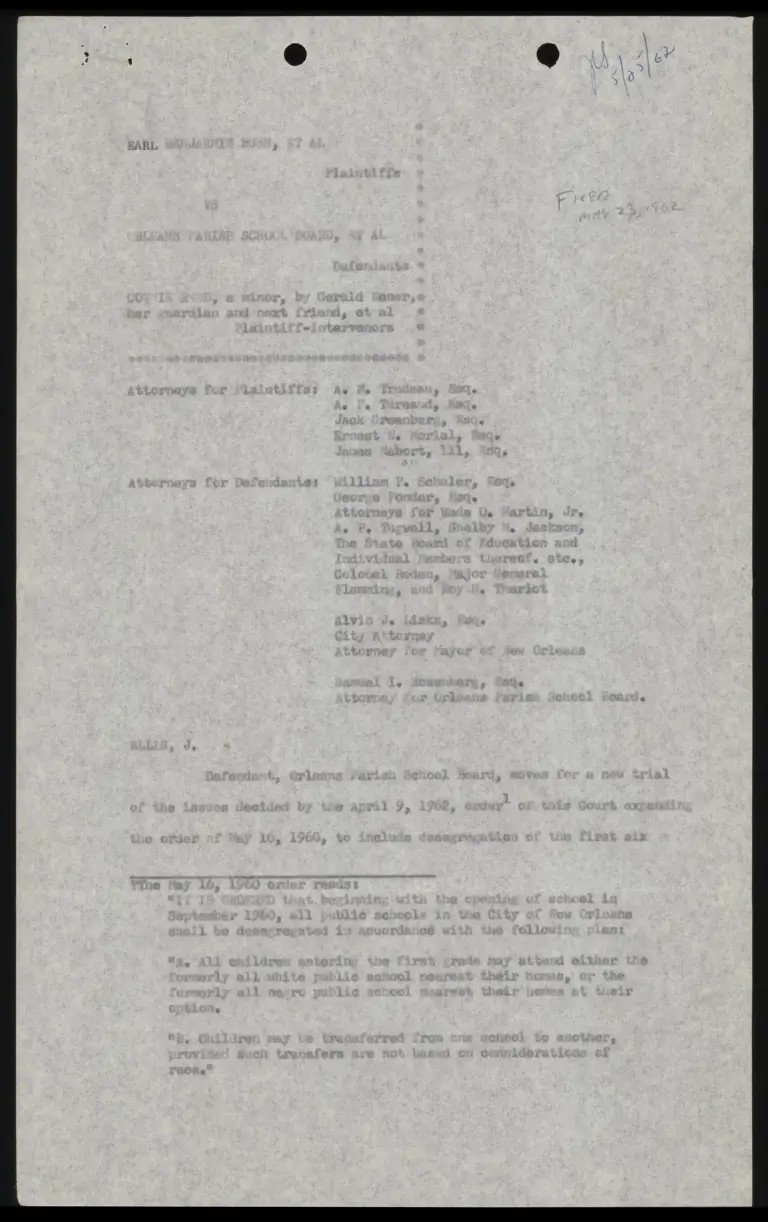
13 pages
-
Case Files, Bush v. Orleans Parish School Board. Order to Desegregate, 1962. c25e9b70-d2fd-f011-8406-0022482cdbbc. LDF Archives, Thurgood Marshall Institute. https://ldfrecollection.org/archives/archives-search/archives-item/2a1b8d6d-b2d7-4ca4-b08a-b7318f92a15d/order-to-desegregate. Accessed October 08, 2026.
Copied!
    a


9


i
3

1


ya »

adequacy of any plans the defendant prooiems

and to effectuate a transition te

nbd : BRE By y
system, Subsequently in Cooper v. Aaron, 358 U, 8, 1, 1,7, the

school

Court ordered that "... [A] District Court, after analysis of the

relevant factors (which of course excludes hostility to racial desegre~

gation) might conclude that justification existed for not requiring present

nonsegregated admission of all qualified negro/children, In such circum-

stances, however, the courts should scrutinize the program of the school

authorities to make sure that they had developed arrangements pointed

towards the earliest practicable completion of desegregation, and had taken

appropriate steps to put their program into effective operation, And

finally, ''State authorities were thus duty bound to devote every effort

toward initiating desegregation and binging about the elimination of

racial discrimination in the public schools,”'4 There can be little doubt

that the original conception of the Supreme Court was that desegregation

would be implemented by the school boards through plans devised &
t


f
g


&


a % » ge B \'® _ ] a = go ye - 5. & de »
boards and supervised by the District Courts.?® The history &

tion in New Orleans proves that this was not te be the case here, or


i


id 5 The implementing decision in Brown was handed down on May 31,

19565, On February 15, 1956, the Orleans Parish School Board was ordered

to desegregate with all deliberate speed,” When no independent action

&


o


0


ob


NN


®


or


,..
.

oF


by


oO
 Board, this Court, on July 15, 1959, ordered the Board to

file a plan of desegregation by May 16, 1960, When the Board failed to do

that, this Court ordered the desegregation under its own plan on May 16,

1960. On August 27, 1960, a three-judge court ordered that the May 16,

1960, order be implemented, 37

See procedure suggested in Gibson v. Board of Public Instruction,

Dade County, Fla, (5 Cir.) 272 F.2d 763, and adopted in Dove Vv.

181 ¥, Supp. 504, 183 F., Supp. 389, modified 8 Cir, Parham, E.D. Ark
ne?

¢ a . » or TR oer a col.

(E.D., La,) 138 F. Supp. 337, aff'd. » 16 gush v. Orleans Parish School Board
[5
3 5 ¥ iy) Yr ® 242 F. 2d 16 Je

17 3 © v -s - ry a y 3 r oe 4

Ibid, 187 F. Supp. 42, aff'd, 365 U, 8S. 569


«

4 or


%*


Ww

»


mica


oy

“ i yc

¥ §
&

:

k ; i
Xs 311 A 4

;
A

8
X

“eg

|

i

,

:
Lan

i

OR

3
a

’

B

|

|

:
. ]

i R

3

2

i 7

¥

wy

:

|
|

verl


.
’ [J ae

¢
~N

Schools, To believe that desegregation can be eifected here with all

deliberate speed through application of the Pupil Placement Law is indeed

no more than "a speculs tive possibility wrapped in disuasive qualifica-

tions, "98 However, ii dual school systems are elimated and the Pupil

Placement Law is administered even-handedly without overtones of race,

the constitutional inhibition is alleviated, Once a child is given the

opportunity to choose a school on a non-racial basis, he may be segrega=

ted according to academic ability. The mechanics of the plan to be

constitutionally applied by the Board would also necessitate a dissolution

of the dual schools system,

It remains to consider the expanded plan of April 9, 1962, As

noted before, the discretion to formulate plans for desegregation has been

vested in local officials even if such officials come to be the United

: 38 : :
States District Court, All such officials are answerable to the Consti-

tution, the public needs, and physical possibility. A new Court in a

case such as this must respond to these demands as it deems wise and

proper, whatever may have gone before, It is in the exercise of that

considered judgment that this Court views the present state of the record.

This Court is impressed with the magnitude of the administrative

problem of suddenly turning tens of thousands of children free to choose

y their own schools, leaving the School Board to shepard them into some

workable order, However, the Board now finds itself able to accommodate

the administration of thie schools with the order of May 16, 1960, With

this resolution the Orleans Parish School Bard starts active compliance

with the order of May 16, 1960, While it does not divest this Court of

the duty to formulate plans of desegregation, it is a drasticedeparture

from programs of the past, By this the Board supplements good faith with

affirmative performance. The Board's formal decision to comply with the

prders of this Court coupled with the order handed down this day repre-

sents, to the Court's satisfaction, an active plan of desegregation under

Brown that will adequately protect plaintiffs’ rights as well as the aspir-

ations for order sought by all reasonable men,

a  ., tl A OU. , ll... —._. ss  ii..—.—.

Sh oN Ra
““Doveé v., Parham, 8 Cir, 282 F, 2d, 256, 261

39 ;
See footnote 21 supra


k

x

j
o


b