Plaintiff's Proposed Findings of Fact and Conclusions of Law
Public Court Documents
1976
28 pages
-
Case Files, Garner Working Files. Plaintiff's Proposed Findings of Fact and Conclusions of Law, 1976. 4eb872fa-33a8-f011-bbd3-000d3a53d084. LDF Archives, Thurgood Marshall Institute. https://ldfrecollection.org/archives/archives-search/archives-item/2a8f8a3a-e917-48ae-9f2b-a02b5bc81bdd/plaintiffs-proposed-findings-of-fact-and-conclusions-of-law. Accessed September 26, 2026.
Copied!
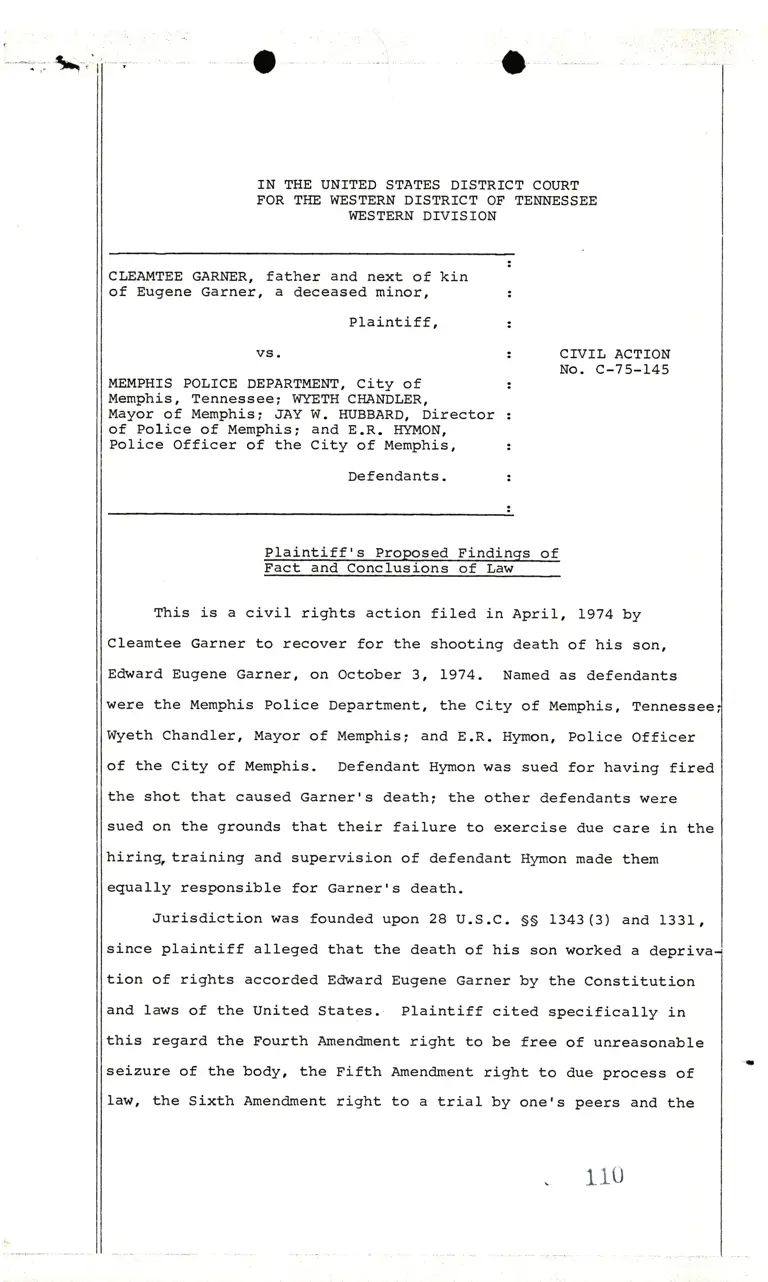
IN THE UNITED STATES DISTRICT COURT
FOR THE WESTERN DISTRICT OF TENNESSEE
WESTERN DIVISION
CLEAMTEE GARNER, father and next of kin
of Eugene Garner, a deceased minor.
Plaintiff,
vs.
MEMPHIS POLICE DEPARTMENT, City of
Memphis, Tennessee; WYETH CHANDLER,
Mayor of Memphis; JAY W. HUBBARD, Director
of Police of Memphis; and E.R. HYMON,
Police Officer of the City of Memphis,
Defendants.
CIVIL ACTION
No. C-75-145
Plaintiff's Proposed Findings of
Fact and Conclusions of Law
This is a civil rights action filed in April, 1974 by
Cleamtee Garner to recover for the shooting death of his son,
Edward Eugene Garner, on October 3, 1974. Named as defendants
were the Memphis Police Department, the City of Memphis, Tennessee;
Wyeth Chandler, Mayor of Memphis; and E.R. Hymon, Police Officer
of the City of Memphis. Defendant Hymon was sued for having fired
the shot that caused Garner's death; the other defendants were
sued on the grounds that their failure to exercise due care in the
hiring, training and supervision of defendant Hymon made them
equally responsible for Garner's death.
Jurisdiction was founded upon 28 U.S.C. §§ 1343(3) and 1331,
since plaintiff alleged that the death of his son worked a depriva
tion of rights accorded Edward Eugene Garner by the Constitution
and laws of the United States. Plaintiff cited specifically in
this regard the Fourth Amendment right to be free of unreasonable
seizure of the body, the Fifth Amendment right to due process of
law, the Sixth Amendment right to a trial by one's peers and the
iiu
Eighth Amendment right to be spared cruel and unusual punishment,
all rights incorporated into the due process clause of the
Fourteenth Amendment and made applicable to the States. Statutory
rights granted by 42 U.S.C. §§ 1981, 1983, 1985, 1986 and 1988
were also alleged to have been violated. A pendent claim against
the same defendants under the Constitution and laws of the State
of Tennessee was also alleged. Violation of rights and duties
created by Tenn. Code Ann. § 40-808 with respect to the proper
circumstances for resort to lethal force by police officers was
specifically asserted.
By order of August 18, 1975, this Court ruled that no cause
of action could lie against the Memphis Police Department, or the
City of Memphis under 42 U.S.C. § 1983 and 28 U.S.C. § 1343(3)
since they were not "persons" within the meaning of that statute.
City of Kenosha v. Bruno, 412 U.S. 507 (1973) and Monroe v. Pape,
365 U.S. 167 (1961). Jurisdiction of the Court over these defend
ants was found to have been properly invoked, however, under 28
U.S.C. § 1331. Bivens v. Six Unknown Named Agents, 403 U.S. 388
1971. In all other respects, jurisdiction was upheld.
The Trial
After the parties had completed all discovery a bench trial
was held before this Court from August 2-5, 1976, Testifying for
the plaintiff were Cleamtee Garner, the plaintiff; Douglas Enoch,
an architect; David Michael Cordera, a paramedic; Ms. _____ Stepp,
custodian of medical records at John Gaston Hospital; Mr. Liddell
Anderson, owner of the premises at 739 Vollentine Avenue in
Memphis, Tennessee; Dan Jones of the Shelby County Sheriff's
Department; Eugene Barksdale, an inspector on leave of absence
from the Memphis Police Department; and Dr. Jerry T. Francisco,
County Medical Examiner of Shelby County, Tennessee. Portions
of the deposition of defendant E.R. Hymon were read into the record
- 2 - 111
as part of plaintiff's case pursuant to provisions of Rule 32 of
the Federal Rules of Civil Procedure. And Capt. John A. Coletta,
Commander of the Training Division of the Memphis Police Deaprt-
ment, was called by plaintiff for purposes of cross-examination
pursuant to Rule 611(c) of the Federal Rules of Evidence. Testify
ing for defendants were defendant J.W. Hubbard, former Director
of Police of Memphis; defendant E.R. Hymon; Leslie B. Wright, a
Memphis police officer who was defendant Hymon's partner on the
night Garner was shot; Velton J. Rogers, a probation officer
attached to Juvenile Court; F.J. Wheeler,a Memphis police officer, and
C.A. Russell, a Memphis police officer attached to the Crime
Scene Squad.
The Testimony
Cleamtee Garner, the plaintiff, testified first. He indica
ted that he was the father of the deceased, Edward Eugene Garner.
At the time of his death, Edward Garner was 15 years old, about
5'3" tall and weighed under 100 lbs., according to his father.
Mr. Garner testified that he has lived in Memphis since 1945 after
to leaving the Army, has owned his own home at 928 Tully in Memphis
for the past eleven years and has worked at the Defense Depot in
Memphis for 24 years as a material packer. In addition to Eugene,
Mr. Garner is the father of three boys ages 22, 20, 19 and two
girls, 16 and 14. Two of the boys are high school graduates, all
have jobs and the two girls are doing well in high school and
expect to graduate. The mother of Eugene and the other children,
Bertha Lee Garner, is also alive and living with the family.
Mr. Garner testified that he had not experienced any real
trouble insofar as his children other than Eugene were concerned.
They had, to his knowledge, no criminal records nor had they been
disciplinary problems at school. He admitted, however, that
Eugene was somewhat of a problem. Prior to his death Eugene had
- 3 - 112
been placed on probation for allegedly participating in a Third
Degree Burglary, he had been charged with violating a curfew
imposed in Memphis and had been placed on probation for taking a
quantity of pennies from a neighbor's home. In the first instance,
Mr. Garner explained that Eugene had been in the company of other
boys who were regarded by the authorities as having initiated a
plan to climb into a private home. The curfew violation was,
according to Mr. Garner, simply a mistake: Eugene had been working
in a sundry store at night and went out to observe an incident
where police were present; because the police thought Eugene was
simply wandering the streets, he was cited for violating the
curfew. The third incident involving pennies belonging to a
neighbor came to the attention of juvenile authorities through a
complaint filed by Mr. Garner himself. Mr. Garner had been in
formed by one of his other children that Eugene had pennies that
did not belong to him. Mr. Garner, first, forced Eugene to return
the pennies, apologize and, then, took him to the juvenile officer
to report the incident. On this occasion and in several others
relating to problems Eugene encountered at school, Mr. Garner
took it upon himself to determine what was wrong and to take steps
to see that Eugene improved his conduct. Mr. Garner described
his son as a likeable, intelligent boy who would have turned out
all right with proper supervision and guidance. Since Mr. Garner
admitted that his working hours 4:00 P.M. to 12 midnight,made it
hard for him to provide such direction for Eugene, he had decided
to retire from his job just before his son’s death.
Douglas Enoch, an architect, testified that he had been asked
by plaintiff's counsel to visit the scene at 739 Vollentine and
to prepare a scale model setting out accurately that scene, with
pertinent heights and distances suitably marked. He identified
Exhibits 1, 2, 3,4, and 5 as photographs accurately depicting
the back of the residence at 739 Vollentine, Exhibits 7 and 8
- 4 -
113
as photographs accurately depicting the area behind the shed or
"outer house" behind 739 Vollentine; and Exhibit 9 as a photo
graph accurately depicting the area behind the chain link fence
running east-west behind the backyard of 739 Vollentine. The
model he prepared on a scale of 1/4 inch = 1 foot was
marked as Exhibit 5. Exhibits 1—9 were duly admitted into evi
dence by the Court.
David Michael Cordera, a paramedic with the Memphis Fire
Department, testified that he was called to 739 Vollentine on
October 3, 1974 to rush a person who had been shot by a police
officer at that location. When he arrived on the scene, Cordera
stated that he saw a black male writhing on the ground, uttering
moans and crying and being held down by a black police officer.
He recalled the officer's expressing surprise at how young the
wounded person was. Mr. Cordera marked and initialed on Exhibit
6 the spot where Garner's body was lying when he arrived at 739
Vollentine.
Ms. _____ Stepp, custodian of medical records at John Gaston
Hospital, read from official hospital records relating to treat
ment of Edward Eugene Garner on October 3, 1974. They indicated
that Garner had been brought to the hospital with a bullet wound
to the right rear portion of the skull, that he was moaning and
groaning on arrival and that he died during emergency surgery.
The records were admitted into evidence as Exhibit 10.
Liddell Anderson, owner of the residence at 739 Vollentine,
testified on direct with respect to a three foot high chicken-wire
fence that ran from the back of his house in a north-south direc
tion, separating his yard from that of 737 Vollentine. On cross-
examination, Mr. Anderson verified the accuracy of certain photo
graphs depicting the condition of his home on October 3, 1974.
Exhibit 11 showed the inside of the house, 12 showed the window
to his wife's room, 13a and 13b depicted the interior of his wife's
- 5 - 114
room, 14 showed the interior of the kitchen and 15 showed the
exterior of the kitchen. Exhibits 11, 12, 13a, 13b, 14 and 15
were duly admitted into evidence. Mr. Anderson marked and ini
tialed Exhibit 6 to indicate where the fence in question was
located.
The following pages of the deposition of defendant E.R. Hymon
taken on April 26, 1976 were read into the record during the pre
sentation of plaintiff's case:
Page Lines
4 6-9,
5 1-3,
6 1-13
23 1-24
24 1-24
30 22-24
31 1-17
33 19-24
34 1-24
35 1-24
36 1-21
47-100 1-24
101 1-16
107-112 1-24
113 1-21
114 15-24
115 1-8
In these portions of his deposition, defendant Hymon testified
that he was a native Memphian, attended public schools in Memphis
and received a B.S. degree in English from Tennessee State College
He played basketball and softball in both high school and college,
receiving a high school varsity letter in basketball. He is
6'4" tall. He indicated that, prior to joining the Memphis
Police Department in 1973, he was given training in physical
combat — use of the nightstick and judo — and required to do
an "excessive amount of running." When asked about the extent
to which he received training in when resort to lethal force was
appropriate in apprehending a fleeing felon, Hymon testified
that he was told to use his discretion by instructors from the
Memphis Police Department. Hymon was also asked about tests given
him by the Memphis Police Department to determine his physical
- 6 - 115
abilities. In such a test that measured his performance in ten
different physical exercises, Hymon scored 75 out of a possible
100 points. This score was above the minimum required of appli
cants for employment as Memphis police officers.
Under further questioning, defendant Hymon then proceeded
to describe the circumstances surrounding the shooting death
of Edward Eugene Garner on October 3, 1974. On that night,
Hymon was working a 4:00 PJl . to midnight shift in Ward 128 with
his partner, Leslie B. Wright. While sitting in the patrol car
at a firehouse located at Stonewall and Chelsea, Officer Wright
received a radio call to investigate a report that a prowler was
inside at 737 Vollentine in Ward 129. After Officer Wright in
formed Hymon of this dispatch, both officers proceeded to 737
Vollentine. When they arrived at 737 Vollentine, a woman stand
ing on the porch at that location told defendant Hymon, "They
are breaking in" and pointed toward 739 Vollentine. Hymon went
back to his partner, told him what the woman had said and directed
him to proceed around the side of the residence at 739 Vollentine
opposite from the side he was taking. The house at 739 Vollentine
faces north, the back faces south and 737 is located on its west
side. Hymon saw lights on in the front and on the southeast side
of the house. Hymon moved from front of 739 to rear of the house
along its west side with a flashlight containing five D-cell
batteries in his right hand to illuminate the area and his revolvejf’
in his left. At that time, Hymon had no indication that the sus
pect was armed. When he got to the southwest corner of the house
he heard a door slam, saw someone move across a streak of light
(created by a porchlight turned on in back of 737 Vollentine) and
heard noise on a chain-link fence running across the
length of the back yard in an east-west direction. Weeds or
"Johnson Grass" about half the height of the fence appeared to be
on the south side. He then shined his flashlight on the fence and
- 7 - IIG
and saw a "male black". An outer building was observed at the
southeast corner of the back yard abutting the chain-link fence.
From where he was standing at the southwest corner of the house,
Hymon said he could see a broken window, a garbage can under
that window and the area around the back door. After he located
the person at the fence, he yelled, "Halt. Police". The person
at the fence looked in his direction. He appeared to Hymon to be
about 17-18 years old, between 5'5"-5'7" tall and roughly 130 lbs.
Hymon could see Garner's hands but could not see his feet because
he was in a "stooped position". Garner halted briefly as Hymon
ordered. Hymon then called to his partner, Wright, who had come
into his view at the southeast corner of the house. Hymon told
Wright that Garner was on the fence and that he should come
around and get him. Wright, however, asked Hymon to repeat his
instructions and started "perhaps a little hesitantly" around to
where Hymon had directed him. Hymon was "reasonably sure" that
Garner was unarmed, since he could see his hands at all times.
When Hymon told Wright once again where Garner was, the latter
"sprang over the fence". When Garner was well up on the fence,
Hymon fired his .38 caliber. Model 10, Smith & Wesson revolver,
hitting him once in the head though he aimed, as he was taught,
at the largest target, the back. Hymon testified that he fired
because a chicken-wire fence separated him from the backyard
area of 739 and he did not feel that he could have climbed it and
caught Garner who was between 30-40 feet away; "I'm not that
fast," he remarked. Yet Hymon admitted that he did not have to
jump over the fence, he could have stepped over it. After being
shot. Garner's body fell across the top of the chain-link fence,
his head, arms and torso on the south side, his legs on the north
side. Hymon and Wright removed Garner's body from the fence;
Wright then called for an ambulance and for police officials to
come to the scene.
- 8 - 11'
Dan Jones, Chief of Detectives for the Shelby County Sheriff's
Department, was accepted by the Court as an expert on proper police
procedures in the Memphis area. When presented with hypotheticals
which contained critical facts about the shooting of Garner, and
asked whether the procedure used by defendant Hymon, Chief Jones
answered negatively. He stressed that under circumstances like
those at the time Garner was found by Hymon behind 739 Vollentine
the officer had a duty to run after the fleeing felon prior to
resorting to lethal force and that, had he been in Hymon's place he
would definitely have run after Garner. Eugene Barksdale, Inspector
of the Memphis Police Department on leave, was likewise qualified
as an expert on proper police procedure. He concurred with
Chief Jones that Hymon should have run after Garner and resorted
to lethal force only when that alternative failed.
Capt. John A. Coletta, Commander of the Training Division of
the Memphis Police Department was called as a witness in the
presentation of plaintiff's case. He testified that prior to
assuming his present position, he served as Range Officer in
charge of the Memphis Police Department Firing Range and instructor
at the Police Academy in firearms training. He indicated that he
was responsible for training the class of police recruits in July
and August, 1973 that contained defendant Hymon. He was asked
what if any instruction was given to recruits in the use of lethal
force. He mentioned that one film, "Shoot - Don't Shoot", was
shown during Hymon's training. This film was marked, introduced
into evidence as Exhibit 16 and projected during Capt. Coletta's
testimony. The film discussed the circumstances under which a
police officer would be warranted in using lethal force to protect
his own life or the lives of third parties. It cautioned that a
police officer should use lethal force in self-defense only when
a suspect has the "abilty and opportunity" to injure the officer
and his life or limb is clearly in "jeopardy". "If there is the
- 9 - 118
slightest doubt" that these three elements are all present "don't
shoot", stresses the film. While the film does allude to the
fact that officers in some jurisdictions are permitted to shoot
fleeing felons, the only examples of this rule in the film are
ones in which the fleeing felon is armed. Capt. Coletta conceded
that no film was shown that dealt directly with the use of lethal
force to apprehend unarmed fleeing felons. He pointed out that
lectures on Tennessee law and police regulations regarding lethal
force were handled by the Police Department's Legal Advisor during
the training course. No training was given to recruits, he
admitted, with respect to alternative techniques for apprehending
unarmed fleeing felons that should be exhausted before resorting
to lethal force, even though Tennessee law dictates that lethal
force be used under such circumstances only as a last resort when
other means of apprehension have failed. The Police Department's
Firearms Manual prepared by Capt. Coletta and others deals in
some detail with techniques for using firearms but contains no
such information on the apprehension of unarmed fleeing felons.
In Slim, police recruits receive no training, or guidance as such
— not from the Range Officer, not from the Legal Advisor, not
from the Firearms Manual — in this regard. They are simply
told, according to Coletta, that they should be able to live
with themselves if they have to shoot and kill a person while on
duty. The use of lethal force under such circumstances is left
to each officer's discretion.
The examination of Capt. Coletta then turned to a discussion
of weapons and ammunition used by Memphis Police Department
officers in their official capacity. Capt. Coletta acknowledged
that there were essentially three subcategories of expertise
within the general field of ballistics: internal ballistics,
which concerns itself with characteristics of a projectile within
the gun; external ballistics, which addresses questions related
- l o ne
to behavior of projectiles from the time they exit from a gun
to the point of striking a target; and terminal or wound ballis
tics , which studies the behavior of projectiles after they strike
a target or live tissue, Capt. Coletta indicated that his exper
tise was in the first two subcategories of ballistics, in view
of his training on ballistics testing he had conducted person
ally for the Police Department. Under examination, Capt. Coletta
testified that Memphis police officers were issued a .38 caliber
Smith and Wesson revolver. Prior to 1970, a .38 caliber 158 grain
lead roundnose Winchester cartridge was the ammunition issued
for use in service revolvers. Between 1970 and 1972, the Depart
ment issued a .38 caliber 110 grain, semi-jacketed hollow-point
1/Smith & Wesson cartridge. In 1972, Capt. Coletta was asked
by Department officials to conduct a study to determine whether
the weapon and ammunition presently issued to line officers were
adequate. According to Capt. Coletta, the police officers'
union had contended that more powerful weapons and ammunition
were necessary to insure that the officer would be able to in
capacitate an armed suspect immediately. The internal memoran
dum setting out the objectives of the study was admitted as
Exhibit 17. As a result of tests conducted by Capt. Coletta,
the Department adopted for general use the .38 caliber 125 grain,
semi-jacketed hollow-point Remington cartridge. The bullet that
caused the death of Edward Garner was of this type.
The tests conducted by Capt. Coletta to determine the most
effective bullet for Department use were designed to measure
essentially three characteristics of various types of ammunition:
1/ "cartridge" refers to the entire ammunition; the 'base" which
does not leave the weapon upon firing, the "bullet" or "slug"
which does leave the weapon, and the "load", or the amount of
gun powder included.
- 11 - 120
accuracy, penetration and cavitational effect. Accuracy was
measured by firing several rounds of each bullet from a fixed
weapon at a target; the farthest distance between any two bullet
holes on the target was then recorded. Penetration was measured
by firing bullets into a row of pine boards and seeing how many
boards were pierced or dented by the projectile. Cavitational
effect was measured by firing bullets into clay blocks and seeing
how large a cavity was created in a block upon impact from the
bullet. The velocity of each bullet as it left the fixed weapon
was also measured with an electrical device. Since the tests
were also designed to determine which bullet would have the
greatest "stopping power" or ability to incapacitate, velocity
was a significant consideration. For kinetic energy of a pro
jectile, that is the amount of energy it expends in a target upon
impact (and, to a large extent its wounding capacity), depends
heavily upon the projectile's velocity. Mathematically, this
V2
phenomenon is expressed in the formula K = Mx 2 where K = kinetic
yenergy, M = mass (the weight plus gravitational force of the
bullet) and V = velocity. Capt. Coletta's tests of the three
bullets used prior to 1970, between 1970 and 1972 and after 1972
revealed the following with respect to their relative velocities;
Bullet In Use
158 grain, Lubaloy
roundnose Winchester
Prior to 1970
110 grain, semi-jacketed
hollcw-point Smith & Between 1970-1972
Wesson
125 grain,semi-jacketed After 1972
hollow
Velocity
(in feet per sec.)
872 - 25
1050 - 97
1425 - 62
In other words, the velocity of the bullet used after 1972 was
almost twice that of the bullet used up to 1970.
Weight of bullets is expressed in the grains; 7,000 grams
equal one pound.
- 12 - 12i
Photographic slides which depicted the results of the accu
racy, penetration and cavitational tests of the three bullets
mentioned above were marked, admitted into evidence and projected
during Capt. Coletta's testimony. The results were as follows:
Exhibit #Cartridge Accuracy of Slide Showing
Performance
158 grain, roundnose
Lubaloy Winchester 1 1/2" 18(a)
110 grain, hollow-point
semi-jacketed Smith &
Wesson 1" 18 (d)
125 grain, semi-jacketed,
hollow-point Remington 5/8" 18(g)
Cartridge Penetration Exhibit # of Slide
Showing Performance
158 grain Penetrated 6
boards and
dented 7th
18(b)
110 grain Penetrated 5
boards and dented
6 3/4 boards
18(c)
125 grain Penetrated 7
boards and
dented 8th 18(h)
Cartridge 1/Cavitational Effect Exhibit # of Slide
Showing Performance
158 grain 3" upon impact 18(c)
110 grain 4" 18(f)
125 grain 4 1/2" 18 (i)
Though Capt. Coletta stated that he could not reach any definitive
conclusions with respect to wounding capacity of the bullets
tested based upon their cavitational effect in clay since human
tissue might respond differently, he admitted that certain assump
tions were made in this regard, i.e., that greater cavitational
^ Penetration was also measured by the distance each bullet trav
elled into the clay block: 158 grain - 18"
110 grain - 9"
125 grain - 13" 1 ^ 2
- 13 -
effect in clay would mean greater "stopping power". And he ex
pressed awareness of professional studies that supported the view
that the 110 grain would be more effective than the 158 grain
1/and that the 125 grain would be most effective. Capt. Coletta
defended the adoption of the 125 grain based upon its overall
performance in the tests discussed above and upon the fact that
it would be less likely to ricochet than other bullets. He did
admit, however, that the LEAA study had concluded that all com
mercially available ammunition posed significant risks associated
with their tendency to ricochet. A document reflecting the
results of Capt. Coletta's study was admitted into evidence as
Exhibit 19. Capt. Coletta was asked why Memphis Police Depart-
ment officers were trained to shoot at the "center mass", i.e.,
the torso area where viscera would likely be hit, rather at other
less vital parts of the body. This inquiry was pressed parti
cularly with respect to the shooting of unarmed fleeing felons.
Capt. Coletta responded that he seriously doubted whether such
accuracy could be taught given the capabilities of recruits to
the Memphis Police Department, the time allotted for training
and budgeting constraints.
Capt. Coletta was asked whether he had any awareness, in
view of his expertise in ballistics, of the extent to which
the--us«̂ =c>f certain types of bullets were banned for use in inter-
£/ He acknowledged, for example, that Dr. Vincent DiMaio, a
renowned forensic pathologist had found that the 125 grain bullet
expended three times as much kinetic energy as the 158 grain and
a fourth more than the 110 grain. He also was familiar with a
study conducted by the Law Enforcement Assistance Administration
(LEAA) that found that the 125 grain had three times the Relative
Incapacitation Index (RII) as the 158 grain and twice that of the
110 grain. Relative Incapacitation Index was defined as the
ability of a bullet to render an armed suspect confronting a
police officer instantaneously non-functional and incapable of
posing a continued threat to the officer's safety.
123
- 14 -
national warfare by the Hague Convention of 1899. He stated
that he understood that the convention banned the use of "Bum
Bum" bullets (bullets intentionally disfigured to produce more
grievous wounds than ordinary bullets) and that the United
States was not a signatory of the Convention. When he was read
language from the "Beclaration (IV,3) Concerning Expanding
Bullets" (Hague, 1899) which indicated that the signatories
would abstain from the "use of bullets which expand or flatten
easily in the human body, such as bullets with a hard envelope
which does not entirely cover the core or is pierced with
incision," he conceded that hollow-point, semi-jacketed bullets
might arguably fall within the category of those banned by the
Beclaration. Hollow-point bullets have a hole in the lead slug
which, upon impact, causes the bullet to flatten, creating a
diameter greater than that of a roundnose bullet;
the greater the presenting diameter, the greater the wound is
likely to be. In semi-jacketed bullets, the lead slug is not
entirely encased which causes the uncovered area of lead to peel
back over the encased portion producing a greater presenting
diameter at impact. It was Capt. Coletta's understanding that
the United States Government did not permit the use of hollow-
point, semi-jacketed bullets by its armed forces in part to avoid
any international disputes over violations of the Hague Beclara-
tions of 1899 despite the fact that it did not sign the document.
A document reflecting the course of instruction provided to
recruits at the 35th Session (July 30 - September 21, 1973) of
the Memphis Police Bepartment Training Academy was admitted
into evidence as Exhibit 20 during Capt. Coletta's testimony.
Buring examination by counsel for defendants, Capt. Coletta
described the establishment and operation of the Firearms Review
Board. He stated in response to a question from counsel for
plaintiff that he could not recall an instance when an officer
- 15 - 124
was found by the Board to have fired his weapon improperly.
Exhibit 21, purporting to be the conclusion reached by the Fire
arms Review Board with respect to the shooting of Edward Garner
was marked for identification but not admitted.
Dr. Jerry T. Francisco, Medical Examiner for Shelby County
since 1961 and Chief Medical Examiner of the State of Tennessee
since 1970 was subpoenaed to testify in plaintiff's case. He
was accepted by the Court as an expert witness in the areas of
forensic pathology and terminal (wound) ballistics. Dr. Fran
cisco testified that he performed an autopsy upon the body of
Edward Eugene Garner to determine cause of death. His exami
nation of the body revealed that Garner was 5'4" tall, between
85 and 100 lbs. in weight and generally thin. The bullet entered
Garner's head slightly behind and above the right ear and exited
in the left rear part of the skull. Dr. Francisco admitted
the possibility that Garner was able to see Officer Hymon at the
time he was shot. The autopsy identified no marks on the hands
or torso that might have been caused by the sharp, pointed wire
at the top of the chain-link fence where his body fell. Garner
was found to have a blood alcohol level of .09 (about the level
one would get from drinking four cans of beer); Dr. Francisco
testified that such an alcohol content would probably have
slowed Garner's reaction time.
With respect to the theoretical ability of various bullets
to wound. Dr. Francisco testified that two formulas were generally
used to reach such determinations. The first, K = M x Y2l , was2
discussed by Capt. Coletta. Once kinetic energy (K) is deter
mined (measured in foot-pounds), a second calculation is neces
sary, according to Dr. Francisco, to measure potential wounding
effect. This second formula is expressed a s W - E x i x l . x KT A
in which W = wounding effect, E = Kinetic energy, T = time during
which bullet is in contact with the body, A = presenting area of
bullet upon impact and K - a number of variables that cannot easily
■ ̂ 125
be quantified.
Based upon his knowledge of these formulas and his presence
during Capt. Coletta's testimony with respect to the findings
of his study of the 158 grain, 110 grain and 125 grain bullets.
Dr. Francisco was able to reach the following conclusions:
1) The 125 grain bullet has the greatest
potential wounding capacity of the three,
the 158 grain has the least;
2) Hollow-point bullets have a greater
potential wounding capacity than roundnose
bullets because of their larger presenting
area (A) on impact;
3) Semi-jacketed bullets also have larger pre
senting areas and, consequently, greater
potential wounding capacity than fully-
jacketed bullets;
4) The results of Capt. Coletta's cavitational
effect tests are consistent with what one
would expect based upon theoretical analysis»
bullets with greater wounding capacity have
greater cavitational effect.
Dr. Francisco testified that, based upon the purported ability
of semi-jacketed, hollow-points to expand or flatten easily in
the human body, he would conclude that such bullets fall within
the category of those banned for use in international warfare
by the Hague Declaration of 1899. He pointed out that the pheno
menon of "yaw" or the tendency of a bullet to rotate off center
during flight might, in any given case, cause a bullet to hit the
target at an angle rather than head-on. As a general rule,
however, hollow-point, semi-jacketed bullets would tend to flatten
more easily than roundnose, jacketed bullets. Dr. Francisco
demonstrated the wounding formulas and the effect of yaw in
writing for the Court's benefit during his testimony; the docu
ment containing these writings was marked and admitted into
evidence as Exhibit 22. A bulletin sent to police officials
which defense counsel sought to use for purposes of cross-examin
ing Dr. Francisco was marked as Exhibit 23 but not admitted.
When asked by the Court whether Garner's wound was consistent
with what one might expect based upon the theories he discussed.
- 17 - 12G
Dr. Francisco indicated that he could not reach any such con
clusion based upon one case study.
At the end of Dr. Francisco's testimony which concluded
plaintiff's case, plaintiff asked the Court to take judicial
notice that, under Tennessee law, Edward Eugene Garner had a life
expectancy of 54.95 years at time of death. Tenn. Code Ann. (Vol.
1, 1975 Cumulative Supplement at 515). Upon the conclusion
of plaintiff's case, defendants moved to dismiss the entire action
With plaintiff's consent, the Court dismissed the Third and Fifth
Claims for Relief against defendants J.W. Hubbard and Wyeth
Chandler, respectively. Claims against defendants City of
Memphis and the Memphis Police Department for their alleged
failure to exercise due care in hiring defendant Hymon, set out
in Paragraphs 24 and 37, were also dismissed. In all other
respects, the Court reserved its ruling on the motion to dismiss.
The first witness for defendants was Jay W. Hubbard, former
Director of Police in Memphis. He testified to his efforts, in
general, to bring more efficiency and professionalism to the
Department during his tenure as Director. Specifically, he
described his promulgation in 1374 of a revised general order
with respect to the use of lethal force by Memphis officers
which was more restrictive than Tennessee law on the subject
(Exhibit 24) and of a general order creating a Firearms Review
Board during the same year (Exhibit 25). He explained the
organization and operation of the Firearms Review Board. And he
related the history of the Department's decision to issue 125
grain, hollow-point, semi-jacketed Remington ammunition to its
officers. According to Hubbard, the shooting death of an officer
by an assailant who fired despite having been shot several times
by the officer made the move to more powerful "loads" imperative.
Hubbard decided on the 125 grain bullet in view of the results of
Capt. Coletta's study and his own knowledge of the capabilities
- 18 -
12'
of various types of ammunition. He indicated that he was
familiar with the Garner incident and that Hymon was not dis
ciplined by the Department for his conduct nor was Hymon
indicted by a grand jury that investigated the shooting.
Elton Richard Hymon testified with respect to his educational
background, his employment at Fort Pillow Correctional Institution
prior to joining the Memphis Police Department. He indicated
his great interest in becoming a police officer, even though he
had to take a reduction in salary at the start in comparison to
what he was earning at Fort Pillow. He stated that he was a
member of the recruit class at the 36th Session at the Police
Training Academy in 1973. At that session Capt. Coletta was in
charge of firearms instruction but offered no guidance with
regard to when the use of lethal force would be appropriate.
The Legal Advisor did lecture his class on the laws and regu
lations governing the use of lethal force. Hymon's testimony as
to the circumstances surrounding the shooting death of Edward
Eugene Garner did not differ in any major regard from that given
in those portions of his deposition previously read into the
trial record. He did mark and initial on Exhibit 6 where he was
standing when he fired the fatal shot. He described his investi
gation of the scene after the shooting which confirmed his
earlier judgment that a burglary had been committed by Garner at
739 Vollentine. After the shooting, he was interrogated by the
Crime Scene and Homicide Squad of the Department, relieved of
duty with pay for a few days and then returned to duty. He
corroborated Hubbard's recollection that the Firearms Review
Board found his use of lethal force justified and that a "no bill"
was issued by a Shelby County grand jury convened to consider
whether criminal prosecuting was warranted by the circumstances
surrounding Garner's death. Exhibit 26, a photograph showing a
clothesline running across the backyard of 739 Vollentine was
- 19 - 125
admitted into evidence.
Leslie B. Wright gave testimony similar to Hymon's as
to the circunstances surrounding their being dispatched to 739
Vollentine and proceeding to investigate whether a burglary was
in progress at that location. Wright's recollection with respect
to what occurred after he arrived at the scene differs markedly,
however, from Hymon's in several major respects. Wright stated
that he had just reached the northeast corner of the residence
at 739 Vollentine when he heard Hymon fire at Garner; Hymon
recalled that Wright was at the southeast corner and visible to
him when he fired. Wright recalls that Hymon indicated that
Garner was on the fence after the shot was fired, not before as
Hymon testified. It was Hymon who removed Garner's body from
the fence, though Hymon recalled that Wright assisted him in this
effort. He stated that it took Hymon about 3 - 4 seconds to
move from his position at the southwest corner of the house where
he was standing when he fired to Garner's body on the fence. And
he confirmed that the backyard at 739 Vollentine was dark and
contained various objects on the ground. He testified to having
called for an ambulance and for police officials after the shoot
ing, and seeing to it that the woman who reported the burglary
remained on the scene for questioning.
Velton J. Rogers, a probation officer from the Juvenile
Court, testified as to his familiarity with Edward Eugene Garner's
difficulties with the police. He merely corroborated Cleamtee
Garner's testimony in this connection. Contrary to Mr. Garner's
recollection that his other children had had no history of cri
minality, Mr. Rogers revealed that Larry Garner had in fact been
brought before juvenile authorities for fighting and truancy. Mr.
Rogers recalled that after the incident involving Edward Garner's
taking of pennies that belonged to a neighbor, Mr. Garner expresse
a desire to see his son placed in an institution for a brief
- 20 - 120
period in hopes that such an experience might encourage him to
improve his conduct. Mr. Rogers testified that he rejected Mr.
Garner's request because he felt that Edward could be helped
effectively through further counselling and guidance.
F.J. Wheeler, a member of the Memphis Police Department,
testified briefly with respect to Mr. Garner's emotional reaction
upon learning that a boy identified as his son had been killed.
C.A. Russell, a member of the Department's Crime Scene Squad
identified photographs taken by him of the exterior and interior
of 739 Vollentine of October 3, 1974. These photographs were
marked as Exhibits 27 a,b-v and admitted into evidence. They
depicted, among other things, the ransacked condition of the
interior, a purse found on the ground in the backyard, a damaged
window and door, blood near the chain-link fence. One photograph
26(b), showed blood on defendant Hymon's sleeve. It was taken,
according to Mr. Russell in case Garner lived and alleged police
brutality.
At the end of its case, defendants introduced the Tennessee
burglary statute, marked and admitted into evidence as Exhibit 28.
A funeral home bill for $913.00 was marked for identification as
Exhibit 29(a) and a cemetary bill of $165.00 was marked for
identification as Exhibit 29(b) to reflect costs related to the
burial of Edward Eugene Garner. The Court also dismissed without
objection by plaintiff, paragraph 22 of the complaint alleging
racial discrimination by defendants in the death of Garner.
- 21 - 130
1. Edward Eugene Garner was 15 years old, about 5'4" tall,
between 85 and 100 lbs. in weight and of thin overall body
structure on October 3, 1974.
2. Defendant Elton Richard Hymon is 6'4" tall and was in good
physical condition on October 3, 1974.
3. Edward Eugene Garner was fleeing from the commission of a
first degree burglary when he was fatally wounded on October
3, 1974.
4. The backyard of 739 Vollentine was completely encircled by
fencing.
5. Defendant Hymon was so positioned that Garner could not have
escaped capture by fleeing to the southwest from the back
of 739 Vollentine.
6. Officer Leslie B. Wright was so positioned that Garner
could not have escaped capture by fleeing to the southeast
from the back of 739 Vollentine.
7. Garner's only possible avenue of escape was over a 6 foot
chain-link fence running east-west directly to the south of
the back of 739 Vollentine.
8. Garner was unarmed at the time he was shot.
9. Defendant Hymon was between 30-40 feet from the chain-link
fence when he observed Garner at the base of the fence.
10. The backyard area was illuminated by Hymon's flashlight beam,
from lights on in the residence at 739 Vollentine and from
a porchlight at 737 Vollentine.
11. Defendant Hymon yelled "Halt, Police" which caused Garner to
pause momentarily.
12. Garner began climbing the chain-link fence when defendant
Hymon was attempting to provide his partner, Wright, with
Garner's location.
Findings of Fact
- 22 - 13i
13. Defendant Hymon was separated from the main backyard area
of 739 Vollentine by a three-foot chichen-wire fence which
Hymon could have stepped over with ease.
14. When Garner began climbing the fence, defendant Hymon made
no attempt to run toward the fence to apprehend him, even
though he could have done so in 3-4 seconds, as he did after
the shooting. Instead, he fired his service revolver,
wounding Garner fatally in the head.
15. Defendant Hymon fatally wounded Garner with a 125 grain,
semi-jacketed hollow-point Remington bullet fired from a
Smith & Wesson .38 caliber revolver.
16. The Memphis Police Department did not provide defendant
Hymon with any instruction in non-lethal alternatives to
the use of lethal force in apprehending unarmed fleeing
felons.
17. Defendant Hymon was taught by the Memphis Police Department
to fire at the "center mass" of the body in using lethal
force to apprehend a fleeing felon, whether armed or unarmed.
18. The Memphis Police Department makes no effort, for budgetary
and time reasons among others, to train police officers to
shoot non-vita1 areas of the body when using lethal force
to apprehend unarmed fleeing felons.
19. Prior to 1970, the Memphis Police Department issued as
standard ammunition a 158 grain, roundnose Lubaloy (fully
jacketed) Winchester; between 1970 and 1972, the Department
issued a 110 grain, semi-jacketed, hollow-point Smith and
Wesson cartridge; and in 1972 the Department made another
change in ammunition to a 125 grain, semi-jacketed, hollow-
point Remington cartridge.
20. The Department's change from the 158 grain ultimately to
the 125 grain was prompted by its desire to find ammunition
that would deliver a blow of sufficient severity to cause
- 23 - 132
... -.-.wajtoi.-
immediate incapacitation of an armed person in order to
protect the lives of officers and of third persons directly
threatened by such a person.
21. Because of its high velocity, which insures that it will
expend significant kinetic energy in the body upon impact,
its hollow point, which causes it to flatten easily upon
impact and its semi-jacketed construction, which causes it
to peel back upon impact, the 125 grain appeared to have the
wounding and "stopping power" qualities the Department was
5/seeking.
22. The 125 grain ammunition, though adopted with the thought
that it was needed by police officers to incapacitate armed
persons threatening their lives or the' lives of third parties,
was issued by the Department to line officers for use even
in the apprehension of unarmed fleeing felons.
5/ The following articles on wound ballistics, with some indica
tion of their pertinent conclusions, are listed for the Court's benefit:
Di Maio and Spitz, "Variations in Wounding Due to Unusual
firearms and Recently Available Ammunition" 17 J. For. Sci.377 (1972)
The entrance wounds in the skin were identical to
those produced by the standard .38 Special round.
On reflecting the skin [of unautopsied bodies], the
Super Vel [hollow-point] entrance wounds in the tho
racic wall were seen to be at least 2 to 3 times the
diameter of those produced by the standard 158-grain
round nose bullet. ■ This finding was unrelated! as to
whether the bullet struck a rib. . . . The entrance
wounds from the hollow point bullets were larger and
more irregular than those caused by the soft point
bullets. The greater wounding ability of the hollow
point is apparently due to their tendency to mush
room on penetrating tissue. The jacket peels back
allowing the lead core to expand, at 385
Di Maio, Jones and Petty, "Ammunition for Police; A Comparison
of the Wounding Effects of Commercially Available Cartridges," 1 J.P.S. & Admin. 269 (1973).
The hollow-point bullets lost more kinetic energy
and were generally superior to the solid nose
bullets, at 271
(continued)
- 24 - 133
1. Jurisdiction of this Court over defendant Elton Richard
Hymon is established by 28 U.S.C. § 1343(3) and by 42 U.S.C.
§§ 1983 and 1988. Monroe v. Pape. 365 U.S. 167 (1961).
2. Jurisdiction of this Court over defendants Memphis Police
Department and the City of Memphis is established by 28
U.S.C. § 1331 and the Fourteenth Amendment. Gray v. Union
County Intermediate Education District, 520 F.2d 803 (9th
Cir. 1975); City of Highland Park v. Train, 519 F.2d 681
(7th Cir. 1975); Hanna v. Drobnick, 514 F.2d 393 (6th Cir.
1975) and Roane v. Callisburq Independent School District.
511 F.2d 633 (5th Cir. 1975).
3. Under Tennessee Code Annotated 40-808 and under regulations
of the Memphis Police Department (General Order 5-74, Febru
ary 5, 1974), lethal force may be used by police officers to
apprehend persons fleeing from the commission of certain
felonies. Reneau v. State, 70 Tenn. 720, 31 Am. Rep. 626
(1879); Love v. Bass, 145 Tenn. 522, 238 S.W. 94 (1921);
Cunningham v. Ellington, 323 F.Supp. 1072 (W.D. Tenn. 1971);
Beech v. Melancon, 465 F.2d 425 (6th Cir. 1972).
4. Under Tennessee law, Tenn. Code Ann. 39-901, and under regu
lations of the Memphis Police Department, a police officer
Conclusions of Law
_5/ (continued)
Di Maio, Jones, Caruth, Anderson, Petty, "A Comparison of the
Wounding Effects of Commercially Available Handyman Ammuni
tion Suitable for Police Use" FBI Law Enforcement Bulletin
(December, 1974) 3-8
Research in the field of wound ballistics during and
after World War II revealed that the severity of a
wound is directly related to the amount of kinetic
energy lost by the bullet in the body. This means
that the greater the loss of kinetic energy, the
greater the damage to the tissues, therefore, the
more severe the wound. at 3
Cowgill, "The Newest Look at Handgun Ballistics," The American
Rifleman, (Oct. 1975) 38-41 (discussion of Law Enforcement
Assistance Act [LEAA] study of Relative Incapacitation Indices
of Ammunition).
- - . 134
7.
8 ,
may use lethal force to apprehend a person fleeing from the
commission of burglary in the first degree.
Under Tennessee law and under regulations of the Memphis Police
Uspartment, lethal force may be resorted to in order to appre
hend a person fleeing from the commission of a bruglary in
the first degree "only after all other reasonable means to
apprehend . . . have been exhausted." Reneau, supra 7
Scarborough v. State, 76 S.W. 2d 106 (1934); Cunningham, supra],
and Beech, supra.
Resort to lethal force by a police officer to apprehend a
person fleeing from the commission of a felony without ex
hausting available non-lethal means of apprehension violates
strictures against the use of excessive force under the
Constitution and laws of the United States. Screws v. United
States, 325 U.S. 91 (1941); Monroe v. Pape, supra; Jenkins v.
Averett, 424 F.2d 1228 (4th Cir. 1970); Jackson v. Martin,
261 F.Supp . 902 (N.D. Miss. 1966). Such conduct must "shock
the conscience of the court," Rochin v. California, 342 U.S.
165 (1952); Rosenberg v. Martin, 478 F.2d 520 (2d Cir.)
cert.denied, 414 U.S. 872 (1973); Johnson v. Click. 481 F.2d
1028 (2d Cir.) cert.denied. 414 U.S. 1033 (1973).
Defendant Hymon violated the law of Tennessee and regulations
of the Memphis Police Department in resorting to lethal force
to apprehend unarmed Edward Eugene Garner without attempting
to exhaust a non-lethal alternative reasonably available to
him such as running after him.
Defendant Hymon violated the Constitution and laws of the
United States in resorting to lethal force to apprehend un
armed Edward Eugene Garner without attempting to exhaust a
non-lethal alternative reasonably available to him such as
running after him.
- 26 -
135
9. The City of Memphis is required under Tennessee law to indemni--
fy defendant Hymon for any liability he incurs by award of
•this Court for his negligent conduct in the shooting death
of Edward Eugene Garner. TCA 6-640. Liability of the City
of Memphis is also warranted under respondeat superior doctrine:
Williams v. Brown. 398 F.Supp. 155, 160-61 (N.D. 111. 1975).
LO. In failing to train defendant Hymon in non-lethal techniques
for apprehending unarmed fleeing felons, the defendants City
of Memphis and the Memphis Police Department made inevitable
Hymon's resort to excessive force to apprehend Edward Eugene
Garner. Their failure in this regard constituted violations
of both Tennessee State and Federal Constitutions and laws.
City of Kenosha v. Bruno. 412 U.S. 507 (1973); Foster v. City
of Detroit, 405 F.2d 138 (6th Cir. 1968).
LI. In issuing to defendant Hynon the 125 grain, semi-jacketed,
hollow-point Remington, the City of Memphis and the Memphis
Police Department insured that defendant Hymon would use
ammunition which, by definition, constituted excessive force
in the context of apprehending an unarmed fleeing felon: the
bullet was adopted because of its ability to incapacitate
immediately armed persons posing a direct threat to the lives
of police officers or of third persons. The conduct of the
City of Memphis and of the Memphis Police Department in this
regard condoned and urged violation of federal constitutional
strictures against excessive force sufficient to "shock the
conscience of the court." Rochin, supra; Rosenberg, supra;
Johnson v. Glick, supra; Paust, "Constitutional Prohibition
of Cruel, Inhumane or Unnecessary Death, Injury or Suffering
During Law Enforcement Process," 2 Hastings Const. L.G. 873
(1975).
12, Semi-jacketed, hollow-point bullets are of a type banned from
- 27 - 13b
use in international warfare by the Hague Declaration of
1899 [(Schindler, The Laws of Armed Conflict, 103 (1973)]
because of their tendency to inflict unnecessarily cruel
wounds. This Declaration provides a standard for determining
what constitutes civilized conduct in domestic matters as
well as in international relations. Paust, "Human Rights
and the Ninth Amendment: A New Form of Guarantee," 60 Cornell
Rev. 231 (1975).
Respectfully submitted.
InQauj yJACK GREENBERG
CHARLES STEPHEN RALSTON
DREW S. DAYS, III
10 Columbus Circle
Suite 2030
New York, New York 10019
WALTER L. BAILEY, JR.
D'ARMY BAILEY
Suite 901, Tenoke Building
161 Jefferson Avenue
Memphis, Tennessee 38103
Attorneys for Plaintiff
- 28 - 13