Civil Rights Attorneys' Fees Awards Act
Public Court Documents
June 18, 1976
8 pages
-
Case Files, Norwood v. Harrison - Hardbacks. Civil Rights Attorneys' Fees Awards Act, 1976. 973289ac-722e-f111-88b4-000d3a199651. LDF Archives, Thurgood Marshall Institute. https://ldfrecollection.org/archives/archives-search/archives-item/2b5062d3-1461-4241-ad34-db98292bb68b/civil-rights-attorneys-fees-awards-act. Accessed October 16, 2026.
Copied!
     [||a731a105-614f-4dfa-82ce-51c09f2f4e52||] Ko. 955
O4rir CoNGriss SIENA | Revont

2d Session No. 94-1011


Ur, ¥ .
3

Ie?
x


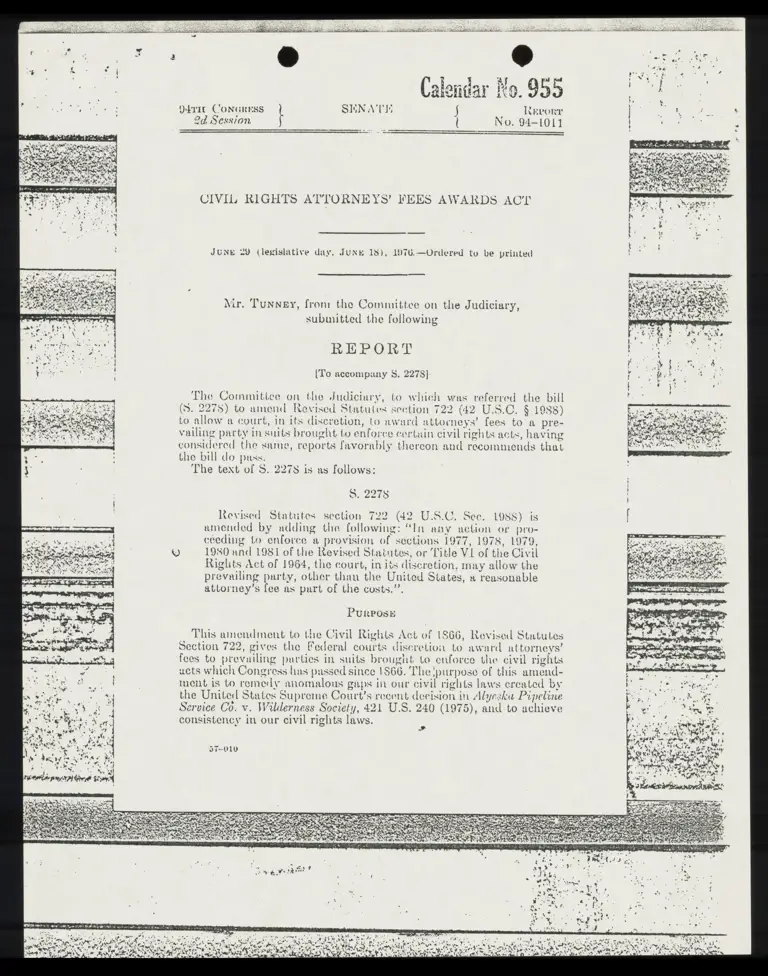
CIVIL RIGHTS ATTORNEYS’ FEES AWARDS ACT


JUNE 29 (legislative day, Junk 18), 1070.—Ordered to Le printed


7 BINT IF Wc

ork RES HR
y\ pe ys tp

A ETA DRA
ay TONES 9 D SA A

ty SA WANN
Nir. Tunney, from the Committee on the Judiciary, Ha GL

: . RRS RAT Sha submitted the following
~

REPORT

[To accompany S. 2278]


hi
de


Ed


v
r


The Committee on the Judiciary, to which was referred the bill
(3. 2278) to amend Revised Statutes section 722 (42 U.S.C. § 1088)
to allow a court, in its discretion, to award attorneys’ fees to a pre-
vailing party in suits brought to enforce certain civil rights acts, having
considered the same, reports [avorably thercon and recommends that
the bill do puss.

The text of S. 2278 is as follows:


T
r
e
y


r
e


8, 2278

leviced Statutes section 722 (42 U.S.C. See. 1988) is
amended by adding the following: “In anv action or pro-
ceeding to enforce a provision of sections 1977, 1978, 1979,
1980 and 1981 of the Revised Statutes, or Title VI of the Civil
Riglits Act of 1964, the court, in its discretion, may allow the
prevailing party, other than the United States, a reasonable
attorney’s fee as part of the costs.”.


Punrrose

This amendment to the Civil Rights Act of 1866, Revised Statutes
Section 722, gives the Federal courts discretion to award attorneys’
fees to prevailing parties in suits brought to enforce the civil rights
acts which Congress has passed since 1866. The purpose of this amend-
ment is to remedy anomalous gaps in our civil rights laws created by
the United States Supreme Courts recent decision in Alyeska Pipeline
Service Co. v. Wilderness Society, 421 U.S. 240 (1975), and to achieve
consistency in our civil rights laws.

mie


-

>

- iy - ; Lg 37-010 ON SE
) DN Cad

y+} ' rien . .
) nr A ol

ame pe rd $e


A by cs on - .

. MELA rat, ; Ne : v . SE a EY No ta ei i . ANG Cle ane Voy Bed gaa Natl oe TN ani ) yh Y ph, hit , vad
Nr wt." b/ wn hd C8 4 re ? Yoladh ho IPS RANA da UR Al SLY NE 2 ra. A Np
\AY oo AISY, TEA AX 2 TH Mal Aro IE AEA ZN Avas 2 A BC eh They, “a 7 § .

2 ty X) ne TAN SN eH i a SC ’ 4 amie - V A ’ -


History or THE LEGISLATION

The bill grows out of six dnys of hearings on legal fees held before
the Subcommittee on the Representation of Citizen Interests of this
Committee in 1973. There were more than thirty witnesses, including mn
Federal and State public officials, scholars, practicing attorneys from En
many areas of expertise, and private citizens. Those who did not HE
appear were given the opportunity to submit material for the record,
and many did so, including the representatives of the American Bar
Association and the Bar Associations of 22 States and the District
of Columbia. The hearings, when published, included not only the
testimony and exhibits, but numerous statutory provisions, proposed
legislation, case reports and scholarly articles.

In 1975, the provisions of S. 2278 were incorporated in a proposed
amendment to S. 1279, extending the Voting Rights Act of 1965.

The Subcommittee on Constitutional Rights specifically approved
the amendment on June 11, 1975, by a vote of 8-2, and the full
Committee favorably reported it on July 18, 1975, as part of S. 1279.
Because of time pressure to pass the Voting Rights Amendments, the
Senate took action on the Iouse-passed version of the legislation.
S. 1279 was not taken up on the Senate floor; hence, the attorneys’
fees amendment was never considered.

On July 31, 1975, Senator Tunney introduced S. 2278, which is
identical to the amendinent to S. 1279 which was reported favorably
by this Committee last summer.

Shortly thereafter, similar legislation was introduced in the IIouse
of Representatives, including IL.R. 0: 552, which is identical to S. 2278
except for one minor technical difference. The Subcommittee on
Courts, Civil Liberties and the Administration of Justice of the
House Judiciary Committee has conducted three days of hearings at
which the witnosses have generally confirmed the record presented to
this Committee in 1973. H.R. 9552, the counterpart of S. 2278, has
received widespread support by the witnesses appearing before the
House Subcommittee.


STATEMENT


The purpose and effect of S. 2278 are simple—it is designed to allow
courts to provide the familiar remedy of reasonable counsel fees to :
prevailing parties in suits to enforce the civil rights acts which Congress : TR ie Sa
has passed since 1866. S. 2278 follows the language of Titles II and VII on REI Cy
of the Civil Rights Act of 1964, 42 U.S.C. $3 2000a-3 (b) and 2000c- ATR,
5(k), and section 402 of the Voting Rights Act Amendments of 1975,
42 U.S.C. § 1973L(c). All of these civil rights laws depend heavily upon
private CR oreaaiont, and fee awards have proved an essential remedy
if private citizens are to have a meaningful opportunity to vindicate
the important Congressional policies which these laws contain.

In many cases arising under our civil rights laws, the citizen who
must sue to enforce the law has little or no money with which to hire a
lawyer. If private citizens are to be able to assert their civil rights, and
if those who violate the Nations fundamental laws are not to proceed
with impunity, then citizens must have the opportunity to recover
what it costs them to vindicate these rights in court.

>


aes re ee pt
LA

S.R. 1011


Y Fe Shae


Ga se 3

AN Z RE DR
bo 3


or he - oa AY ’ TL oe al a, L

Lie ANN ' RE Aste “ry, Sat Ch ns

rE Ne Eady DIT Na fan ih 3 on SERN


-
>»


Aw rd 0d


EAD Mate SSNS

ON Jas x
NRA ve Nia WERT


Congress recognized this need when it made jhe provision [or

such fee shifting in Titles II and VII of the Civil Rights Act of 1964:

When a plaintifl brings an action under [Title 11] he cannot

recover damages. 1f he obtains an injunction, he does so not

for himself alone but also as a “private attorney general,”

vindicating a policy that Congress considered of the highest

priority. If successful plaintifls were routinely forced to bear

their own attorneys’ fees, few aggrieved parties would be in a

osition to advance the public interest by invoking the

injunctive powers of the Federal courts. Congress therefore

enacted the provision [or counsel fees—* * * Lo encourage

individuals injured by racial discrimination to seek judicial

relief under Title II.” Newman v. Pigg Park Enterprises,

Inc., 390 U.S. 400, 402 (1968).

The idea of the “private attorney general” is not a new one, nor

are attorneys’ fees a new remedy. Congress has commonly authorized

attorneys’ fees in laws under which “private attorneys general” play a

significant role in enforcing our policies. We have, since 1870, author-

ized fee shifting under more than 50 laws, including, among others, the

Securities 18xchange Act of 1034, 15 U.S.C. §§ 781(c) and 78r(a), the

Servicemen’s Readjustment Act of 195%, 38 U.S.C. § 1822(h), the

Communications Act of 1934, 42 U.S.C. § 206, and the Organized

Crime Control Act of 1970, 13 U.S.C. § 1964(c). In cases under these

Jaws, fees are an integral part of the remedy necessary to achieve

compliance with our statutory policies. As former Justice Tom Clark

found, in a union democracy suit under the Labor-Management

Reporting and Disclosure Act (Landrum-Griflin),

Not to award counsel fees in cases such as this would be

tantamount to repealing the Act itself by frustrating its basic

purpose. * * * Without counsel fees the grant of Federal

jurisdiction is but an empty gesture * * * [Hall v. Cole, 412

U.S. 1 (1973), quoting 462 I. 2d 777, 780-81 (2d Cir. 1972).

The remedy of attorneys’ fecs has always been recognized as par-

ticularly appropriate in the civil rights area, and civil richts and

attorneys’ fees have always been closely interwoven. In the civil rights

aren, Congress has instructed tho courts to use the broadest and most

effective remedies available to achieve the goals of our civil rights

taws.! The very first attorneys’ foe statute was a civil rights law, the

Enforcement Act of 1870, 16 Stat. 140, which provided for ¢ ‘torneys’

feos in three separate provisions protecting voting rights.?

Modern civil rights legislation reflects a heavy reliance on attorneys’

fees as well. In 1964, seeking to assure full compliance with the Civil

Rights Act of that year, we authorized fee shifting for private suits

establishing violations of the public accommodations and equal

employment provisions. 42 U.S.C. §§ 2000a-3(b) and 2000e-5(k).

Since 1064, every major civil rights law passed by the Congress has

included, or has been amended to include, one or more fee provisions.

1 For example, the Civil Rights Act of 1866 directed Foderal courtsito “use that combination of Federal law,

common: law and State law as will be hest adapted to the object ol the civil rights laws.” Brown v. City of

Meridian, Mississippi, 356 F. od 602. 605 (5th Cir. 1066). See 42 U.S.C. § 1088; Lefton v. City of Hattiesburg,

Mississippi, 333 F. 2d 280 (5th Cir. 1964).

2 The causes of action established by these provisions wero eliminated in 1804. 28 Stat. 36.


S.2. 1011


2


H
L

R
E
C
A


A
he


a


:
TT

ES
EA
R

ED
-

«
1


p
m


N
H


he
ay
e


ea A, ‘ r———————————eCy——
PE ON MT

0


      5

ofr AF pLY
SEN N-om

ig pe Lod bi
“4 a ha

X SIN SO OE LR SY ww > SOLON AS SRA

ATLAS Deas SHEE ov he Hn 34 Fakes ab Fog nN aR

; : ; pl + ah {OVE FYRAS
x AA eA NASA


g

Tet Na Hl ; E.g., Title VIIT of the Civil Rights Act of 1868, 42 U.S.C. § 3612(c); f pit, FR.
the Emergency School Aid Act of 1972, 20 U.S.C. § 1617; the Equal : hi ART in A .
Employment Amendments of 1972, 42 U.S.C. § 2000e-16(b); and the :
Voling Rights Act Extension of 1975, 42 U.S.C. § 19731(c).

These fee shifting provisions have heen successful in enabling
vigorous enforcement of modern civil rights legislation, while at the
same time limiting the growth of the enforcement bureaucracy. Before
May 12, 1975, when the Supreme Court handed down its decision in
Alyeska Pipeline Service Co. v. Wiiderness Society, 421 U.S. 240 (1975),

andy many lower Federal courts throughout the Nation had drawn the obvi-
Ria St ous analogy between the Reconstruction Civil Rights Acts and these

5 modern civil rights acts, and, lollowing Congressional recognition in
the newer statutes of the “private attorney general” concept, were
exercising their traditional equity powers to award attorneys’ fees
under early civil rights laws as well 3

These pre-Alyeska decisions remedied a gap in the specific statutory
provisions and restored an important historic remedy for civil rights
violations. However, in dlyesia, the United States Supreme Court,
while referring to the desirability of fees in a variety of etrecumstances,


  Lk
1 ;

me tg &. ruled that only Congress, and not the courts, could specify which laws cg. fr Sine . v vo ag > . ra NE were 1mportant enough to merit fee shifting under the “private
A rad lt attorney general” theory. The Court expressed the view, in dictum,


that the Reconstruction Acts did not contain the necessary congres-
sional authorization. This decision and dictum created anomalous gaps
in our civil rights Jnws whereby awards of fees are, according to Alyeska,


LED £3 . . . ini . ~ Sena id suddenly unavailable in the most fundamental civil rights ences. For A py Ie . 3 . . . . . .
LIAR a Jnstance, fees are now authorized in an employment diserimination ty 1H . . . i : . NE) suit under Title VIL of the 1964 Civil Rights Act, but not in the same
  suit brought under 42 U.S.C. § 1981, whieh protects similar rights but

involves fewer technical prerequisites to the filing of an action. Fees are
allowed in a housing discrimination suit brought under Title VII of the
Civil Rights Act of 1963, but not in the same sui brought under 42
U.S.C. § 1982, a Reconstruction Act protecting the same riohts. Like-
wise, fees are allowed in a suit under Title 11 of the 1964 Civil Rights
Act challenging discrimination in a private restaurant, but not in suits
under 42 U.S.C. § 1983 redressing violations of the Federal Constitu-
tion or laws by oflicials sworn to uphold the laws.

This Dil, 8.2278, 1s an appropriate response to the J /yeska decision.
It 1s limited to cases arising under our eivil rights laws, a category
of cases In which attorneys fees have heen traditionally regarded as
appropriate. It remedies gaps in the language of these civil rights
laws by providing the specific anthorization required by the Court in 5 SA *, . lyeska, and makes our civil rights laws consistent.

It is intended that the standards for awarding fees be cenerally the
same as under the fee provisions of the 1964 Civil Rights Act. A party
seeking to enforce the rights protected by the statutes covered by
S. 2278, il successful, “should ordinarily recover au attorney's fee
unless special circumstances would render such an -award un) nst.”’
Newman xv. Piggie Parke Enterprises, Inc., 390 U.S. 400, 402 (19068).

3 These civil rights eases are too numerous to cite here. See, ep, Sims vo ctmos 30 F.Supp. 601 (M.D.
Ala, 1072), alld, 400 U.S, 042 (1972); Sten ford Daily v. Zuwcher, 366 F. Supp. 18 (N.D. Cal. 1973); and cases cited in Atyeska Pipeline, supre, abn. 46. Many of the relevant eases are collected in “Hearings on the 1 (deet of Legal Fess on the Adequacy of Representation Before the Stbeon. on Representation of Citizen Interests of the Senate Comm. on the Judiciary,” 93d Cong. 1st sees. pt. HH, of PI. SSS-1021, and 1060 (2,
Cn the laree umjority of eases the party or parties seeking to enforce such richits wiil be the plintitls and/or plaintifl-intervenors, However, ln the procedural posture of some eases. the parties seeking to enforee FEE Suclt Hots may be the defendants and/or defendant-intervonors. See, e.g., Shelley v. Nracmer, 334 U.S. hd. SES
048 .

wee
RELL


R
e


©


Fred o he Fog ng
ARN AI “YY CET di

| Bi Se RRA MES S05. 3


He
d

Ye


0 *

Ninizs omit

WP


Au
d


LL TRA AN Vl Sa a ls TE aici A a i RR Bo
« - Sp [S >t we 4 SFG Ae POA abl LP. To WANS a ~

Kl le

4 2 . i
¢ »

: yy? and." y+ yee 03
ag 3 : ; A gis

RB Sl LTT hg «
*

Lleet bn J .

si ely RE WE
5. og i.

PEE Whi " Ie Ne ny
¥. Jo “4 v Jad t Vos
hoy yo ful at NEC of

re pi ' »* f .
' iE, ER adi A rel hy,

pa gh i a SIE i 0 A “ . vt : n - HIRT A A, mht AM nA ES Saber Rg 2
RG Sal SS a A Cp Ma . : ART ol : - FARR
“land ".. Fi SOR rs . 2 Ls RE - x apn tf N Ny op k a PT WORT koran CEE b) RE PA EL TO ne Nw SMT Iie a oa TH Aire Seale [) 3 - wd NAT x. syn Wp

ELA ER TALKER LMR Sela hy ALE ENA Ke ats Lo PAREN giant ALS $ Avian Bir ar YUINOS, VA. hs PERS a A We 0 TAY J A NTN a ED CN Cl et (ArT


nN

Stich “private 9 general” should not be deterred from bringing
oood faith actions to vindicate the fundamental rierhis here involved
by the prospect of having to pay their opponent’s counsel foes should
they lose. Richardson v. Hotel (‘orporation of America, 332 VV. Supp.
HO (ID. La, 1971). ail’d, 468 Ie. 200 951 (5th Cie 1972). (A fee award
to a defendant's employer, was held unjustified where a claim of racial ly kaa:
diserimination, thongh meritless, was made in good (aith.) Such a RE EA
party. if unsuccessful, could be assessed his opponent’s fee only where :
it is shown that his suit was clearly frivolous, vexatious. or brought. for
harassment purposes. United Slates Steel Corp. v. United States, 385
F. Supp. 346 (W.D. Pa. 1974), a(’d. 9 .P.D. 9 10,225 (3d Cir. 1075).
This bill thus deters frivolous suits bv authorizing an award of
attorneys’ fees against a party shown to have litigated in “bad faith”
under the guise of attempting to enforce the Federal rights created
by the statutes listed in 8. 2278. Similar standards have been followed
not only in the Civil Rights Act of 1964, hut in other statutes providing
for attorneys’ fees. E.g., the Water Pollution Control Act, 1972 U.S.
Code Cong. & Adm. News 3747; the Marine Protection Act, Td. at
4249-50; and the Clean Air Act, Senate Report No. 91-1196, 91st
Cong., 2d Sess, p. 483 (1970). See also fTutchinson v. William Barry,
Inc., 50 F. Supp. 292, 2908 (D. Mass. 1943) (Fair Labor Standards
Act).

In appropriate circumstances, counsel fees under S. 2278 may be
awarded penderite lite. See Bradley v. School Board of the City of
tichmond, 416 U.S. 686 (1974). Such awards are especially appropriate

where a party has prevailed on an important matter in the course of
litigation, even when he ultimately does not prevail on all issues.
See Bradley, supra: Mills v. Eleciric Auto-Lite Co., 306 US. 375
(1970). Morcover, for purposes of the award of counsel fees, parties
may be considered to have prevailed when they vindicate rights
through a consent judgment or without formally dbtaining relief.
Kopet v. Esquire Realty Co., 523 T. 2d 1005 (2d Cir. 1975), and cases
cited therein; Parham v. Southwestern Bell Telephone Co., 433 TF. 2d
421 (Sth Cir. 1970); Richards v. Griffith Rubber Mills, 300 F. Supp.
338 (D. Ove. 1969); Thomas v. IHoneybrook Mines, Inc., 428 T. 2d
981 (3d Cir. 1970); Aspire of New York, Inc. v. Board of Iiducation
of the City of New York, 65 F.R.D. 541 (S.D.N.Y. 1675).

In several hearings held over a period of vears, the Committee has
found that fee awards are essential if the Federal statutes to which

: 5 8. 2278 applies are to be fully enforced.® We find that the eficcts of 3 Spa
Na LE Ey such fee awards are ancillary and incident to securing compliance ENF

with these laws, and that fee awards are an integral part of the a :
remedies necessary to obtain such compliance. lee awards are there-

fore provided in cases covered by 8. 2278 in accordance with Congress’
powers under, inter alia, the Fourteenth Amendment, Section 5. As
with cases brought under 20 U.S.C. § 1617, the Emergency School
Ald Act of 1972, defendants in these cases are often State or local
bodies or Siate or Joeal ofiicinls. Tn such cases His intended that
the attorneys’ fees, like other items of costs,’ will he collected cither
directly from the official, in his official capacity,” from funds of his
agency or under his control, or from the State or local government
(whethep or not the agency or government is a named party).


id


B
N


$5


r
f

A
b
a
d


ar

h
a
l
a


7


*.


A
E


S
E
N
T


w
o
n


7

5 See, e.g. “Hearings on the Bilecet of Lean! Tees,” supra.
8 Fairmont Creamery Co. v. Minnesota, 275 U.S, 163 (1927). > ;
T Proof that an otlicial had acted in bad ith could also render him linble for fees in hisindividunl enpacity,

under the traditional bad faith standard recognized by the Supreme Court fn olly-aka. Sen Clava v. Norton,
S05 IF, 2d 123 (2d Civ, 1974); Doe v. Poclker, 515 1. 2d 541 (Sth Cir. 1975).

SR... 101)


SRT sa Sie Ap wry NAS et ; : rs AA X SE ta SIN Td 2 PR ae A Su RR EAU SRN LE Cr RE ASOT same o RS AR A Rs Na EH ease, FERRE
. i fh

ci ok YS Er

R ER ENA
3 RoR RR TER Nd oy ATRL


‘.

Lon PW Fue wei


  LL ET REGRTA _ San ad! gee
NR Ts ur Simin NENG: wey eA Co 5 SMART AOS, FAR RR ART
oer LAREDO (pe aN a I EAN eS

a TIRE DRM MP I LR Th eT TLE 7 RET .
Ey EL IRE SE Ca WY) we Bd ay NE bead ul Ae BE fal) A CALS bh /, Mo SrA VC aaa aS, v LANE IS) add 8 Ross oy Vg. . fay A SAR .

y=

HL
<! 4s

4 5 3 BARA - Be FL) 3 A ow y aT Se IARI FG SR TR SRP FW a A a admit Sg Teil Jean, et SE > RATS - mR a AN) TNR 24 ie

Mo

LOVES

nie Ly Lv ;
A 3 Viol ! J! # FAL x» p Nay aR wk ; SRA SAS A ARN " A a 4 PAS + 2% reo RL SA AA HAND a NAS AVG Ay

2; A A Sr HR ee TR AIRES
TR
Roh Ww


It is - that the amount of fees awarded under S. 2278 he governed by the same standards which prevail in other types of equally :
complex Ifederal litigation, such ns antitrust cases and not be reduced i a :
because the rights involved may be nonpecuniary in nature. The “
appropriate standards, see Johnson v. Georgia Highway Express, Wes A oe
488 F. 2d 714 (5th Cir. 1974), are correctly applied in such Cases as RT A
Stanford Daily v. Zurcher, 64 T.R.D. 680 (N.D. Cal. 1974); Dawis v. py poe Bi G1 By
County of Los Angeles, SE P.D. « 9444 (C.D. Cul. 1974); and Swann v. A.
Charlotte-Mecklenburg Board of Lducation, 66 I.R.D. 483 (W.D.N.C. 1975). These cases have resulted in fees which are adequate to attract competent. counsel, but which do not produce windfalls to attorneys, In computing the fee, counsel for prevailing parties should he paid, as is traditional wit] attorneys compensated by a [ee-paying client, “for

8, supra; Stanford


all timo reasonably expended on g matter.” Daw; Daily, Supra, at (84.
This bill creates no startling new reniedy—it. only moots tho ites

technical requirements that the Supreme Court has laid down if the : ESCA
Federal courts ara to continue the practice of awarding attorneys’ a
fees which had been going on for years prior to the Court's May ecision. It does not change the statutory provisions regarding the
protection of civil rights excopt as it provides the fee awards which are necessary if citizens are to be able to effectively secure compli- ance with these existing statutes. Thero are very few provisions in our Federal laws which arc self-exceuting. Enforcement of the laws depends
on governmental action and, in some eases, on private action through the courts. If he cost of private enforcement actions becomes too great, there will be no privato enforcement. If our civil rights laws’
aro not to become mero hollow pronouncements which the average citizen cannot enforce, we must maintain the traditionally cffective remedy of fee shifting in these cases,


eh


Sa

Fil

.


CHANGES IN Existing Law MADE BY THE Birr Arg ITALICIZED
REVISED STATUTES $722, 42 v.s.c. § 1983

“The jurisdiction ip civil and criminal matters conferred on the district courts by the provisions of this chapter and Title 1S, for the protection of all persons in the United States in their civil rights, and xin BAY :
for their vindication, shall be exercised and enforced in conformity y RTE a So es
with the laws of the United States, so far as such Inws are suitable TREE
to carry the samo into effect; but in all eases where they are not, s
adapted to (he object, or are deficiont in the provisions necessary to furnish suitable remedies and punish offenses against law, the common law, as modified an changed by the constitution and statutes of the State wherein the court having jurisdiction of such civil or criminal cause is held, so far as the same is not inconsistent. with the Consti- RK Amos :
tution and laws of the United States, shall be extended to and govern LESTE sr
the said courts in the trial and disposition of the cause, and, if jt is

a
of a criminal nature, in the infliction of punishment on the party found guilty.” In any action or proceeding to enforce q provision. of sections 1977, 1978, 1979, 1950 and 1981 of the Revised Statutes, or Title VI of the Civil Rights Aet of 1964, the court, in its discretion, may allow the pre- varling party, other than the United States, a reasonable atlorney’s fee as part of the costs.


-

S.R. 1011

a

ANT
->


  a


by ee es

ba ay
7 3 : on

a Ste hi a 2 tng S—_—

2 A LAA Wis Po Lh

2
TR pA A hod Pe 4 a Yogi rg Irie s. VNTR}

te

APRS
)

NG

v

1
ON i
av y
Wha

-

Le aed

-

THAR LR etl,

AG

oN Tl Ay, XIONES
JA

ARLENE 2 Ra SANA EH SD Vag dal adie INCL 3 Al :
ree Vt la .


= + ~

iis : .

- 2 "J [

7
2

: v
Cost OF LEGISLATION

The Congressional Budget Office, in » le ter dated March 1, 1976, has advised the Judiciary C 'ommittee that: “Pursuant to Section 403 of the Congressional Budget Act of 1974, the Congressional Budget, Oflice has reviewed S. 2978, a bill to award attor neys’ "fees to prevailing parties in eivil rights suits.
“Based on this review, it appears that no additional costs to the government would be jncurred as a result of the enactment of this Bill. »

I

|
}
I

as CSET :
ah pad mA At A O

ol ne r
AES ERAS Se

on - i: . Ey

nN hi 1 : i! oA 7 :

PA AAS
iy Ph .

: . qo WL ord pS Sel
Al iy aw we - any aye”

»
ER at rz ve? ¥ oe OE a

S$. 1011

BE EN RC rr CR Pr PR eT

AMPRITIE Th

hdr RI le Cie antl Em Ot TE ARC , RN oN HN vrs Sn Le Sy a dy iar POT FReRT = SRN RSH ae pity DRAG So a Lr RRL 3% Sal rant Fi Ge ~~ it wy He xy


ere JRE

Flot wsato
a “ay

ams = +)

Sp  r
Sa BR

r ’ ae a,

"nn


Orin CONGRIESS Fig EI:
ID SESSION KK i 5460

: ] H


IN TILE HOUSE OIF REPRESENTATIVES

SErreMBeRr 8,1976

Mr. Parison of New York, Me. Ryissack, and Mr. Wicains) introduced


A BILL
To allow the awarding of attorney's fees in certain civil

rights cases.

1 Be it enacted by the Senale and House of Lepresentu-

No


lees of the United Stales of dbmerica in Congress assembled,

3 “That this Act may be cited as “The Civil Rights Attorney's

4 Fees Awards Act of 19767,

5 Sic. 2.0 That the Revised Statutes section 722 (42

6 U.S.C. 1988) is amended by adding the following: “Iu

T any action or proceeding to enforce a provision of sections

8 (977, 1978, 1979), 1980, and 131 of the Revised Statutes,

9 title IN of Public Law 92-313, or title V1 of the (vi) Riehits

10 Net of 1964, the court, in its discretion, may allow (he

11 prevailing party, other than the United States, a reasonable

12 altorney’s fee as part of the costs.”.

I

Mr. DiraNan (for himself, Mr. Kasrexseer, Mr. Danimnson, Mr. Babiuno,

the following bill; which was referred to the Committee on the Judiciary

a
Yo
r

—


e
w


ay


-

BL

2
i
Xo
Wil


T
T
R


p
s
d


Mh
ac
as
at


BL
c
c


i
Hi
ri

c
t


SIE
L
h
 A


i

df
PG


i
f


id


7


- [||a731a105-614f-4dfa-82ce-51c09f2f4e52||]