Davis v. Tri-State Mack Distributions, Inc. Brief as Amicus Curiae
Public Court Documents
April 15, 1992
-
Brief Collection, LDF Court Filings. Davis v. Tri-State Mack Distributions, Inc. Brief as Amicus Curiae, 1992. e7cbd858-af9a-ee11-be37-00224827e97b. LDF Archives, Thurgood Marshall Institute. https://ldfrecollection.org/archives/archives-search/archives-item/2bcc68d2-3ade-41a8-93f3-998afdc489f2/davis-v-tri-state-mack-distributions-inc-brief-as-amicus-curiae. Accessed October 08, 2026.
Copied!
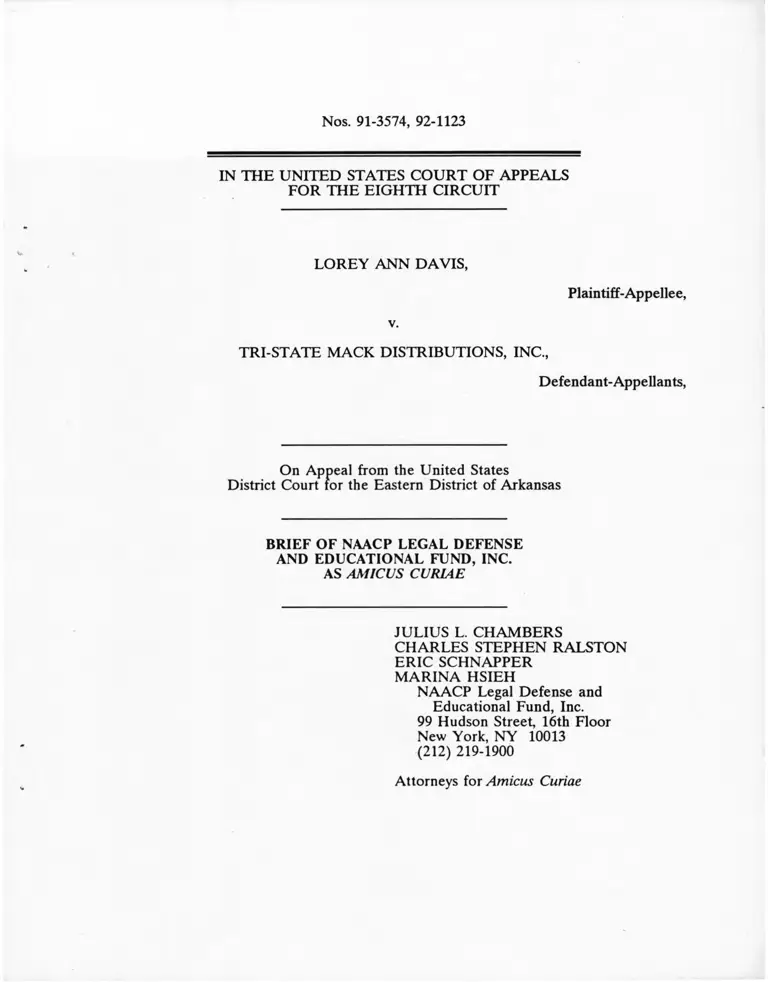
    Nos. 91-3574, 92-1123

IN THE UNITED STATES COURT OF APPEALS
FOR THE EIGHTH CIRCUIT

LOREY ANN DAVIS,

Plaintiff-Appellee,

v.

TRI-STATE MACK DISTRIBUTIONS, INC.,

Defendant-Appellants,

On Appeal from the United States
District Court for the Eastern District of Arkansas

BRIEF OF NAACP LEGAL DEFENSE
AND EDUCATIONAL FUND, INC.

AS AMICUS CURIAE

JULIUS L. CHAMBERS
CHARLES STEPHEN RALSTON
ERIC SCHNAPPER
MARINA HSIEH

NAACP Legal Defense and
Educational Fund, Inc.

99 Hudson Street, 16th Floor
New York, NY 10013
(212) 219-1900

Attorneys for Amicus Curiae


TABLE OF CONTENTS

INTEREST OF A M IC U S.....................................................................................................  1

SUMMARY OF A RG U M EN T............................................................................................ 2

ARGUMENT ......................................................................................................................... 3

I. THE PLAIN LANGUAGE OF THE CIVIL RIGHTS ACT OF 1991
EVIDENCES CONGRESSIONAL INTENT TO APPLY THE
TERMS OF THE FEE AMENDMENT TO PENDING CASES...........  3

II. THE BRADLEY PRESUMPTION THAT NEW LAWS ARE
APPLICABLE TO PENDING CASES REMAINS A CRUCIAL
RULE OF ADJUDICATION......................................................................... 4

A. T H E  E N D O R S E M E N T  O F T H E  B R A D L E Y
PRESUMPTION BY AMICUS UNITED STATES IN
NUMEROUS OTHER CASES ILLUSTRATES THE
IMPORTANCE OF THE RULE......................................................  5

B. THE SUPREME COURT FOLLOWS THE BRADLEY
PRESUMPTION OF APPLYING NEW STATUTES TO
PENDING CASES...............................................................................  8

C. THIS C IR C U IT  HAS NOT R E JE C T E D  TH E
PRESUMPTION OF RETROACTIVITY OF NEW
STATUTES............................................................................................  9

III. THE RECORD IS DEVOID OF ANY EVIDENCE THAT
APPLICATION OF THE EXPERT FEE PROVISION OF § 113 TO
DEFENDANT-APPELLANT WILL RESULT IN MANIFEST
INJUSTICE...................................................................................................... 10

CONCLUSION ....................................................................................................................  13

l


TABLE OF AUTHORITIES

Albemarle Paper Co. v. Moody,
422 U.S. 405 (1975).....................................................................................................  11

Bennett v. New Jersey, 470 U.S. 632 (1985) ...........................................................................8

Bess v. Bess, 929 F.2d 1332 (8th Cir. 1991)........................................................................... 9

Bowen v. Georgetown University Hospital,
488 U.S. 204 (1988)................................................................................................Passim

Bradley v. Richmond School Board,
416 U.S. 696 (1974)................................................................................................Passim

Brown v. General Services Administration,
425 U.S. 820 (1976)..........................................................................................................2

Crawford Fittings v. J.T. Gibbons Co.,
482 U.S. 437 (1987).....................................................................................................  12

Davis v. Tri-State Mack Distributions, Inc.,
No. LR-C-89-912 (E.D. Ark. Dec. 16, 1991)..........................................................13

Federal Deposit Insurance Corp. v. Kasai,
913 F.2d 487 (8th Cir. 1990) .......................................................................................9

/

Fray v. Omaha World Herald Co.,
slip, op., Nos. 91-2439, 91-2443, 91-2713
(8th Cir. Apr. 3, 1992)..................................................................................  2, 9, 10, 14

Friedrich v. Chicago, 888 F.2d 511 (7th Cir. 1989) ..........................................................  12

Gersman v. Group Health Ass’n,
112 S.Ct. 960 (Jan. 27, 1 9 9 2 ).......................................................................................9

Gulf Offshore Oil Co. v. Mobil Oil Corp., 453 U.S. 473 (1981) .......................................8

Hicks v. Brown Group,
60 U.S.L.W. 3522, 58 FEP Cases 144,
No. 91-1116 (Mar. 2, 1992) ...........................................................................  9, 10, 14

Holland v. First Virginia Banks,
60 U.S.L.W. 3577, 58 FEP Cases 144,
No. 91-974 (Feb. 24, 1992) ......................................................................................... 9

In re Resolution Trust Corp.,
888 F.2d 57 (8th Cir. 1989) ......................................................................................... 9

Kaiser Aluminum & Chemical Corp. v. Bonjorno,
494 U.S. 872 (1990)..............................................................................................Passim

Cases: Pages:

ii


Pages:

King v. Shelby Medical Center,
779 F.Supp. 157 (N.D. Ala. 1991) ............................................................................. 8

Missouri v. Jenkins, 491 U.S. 274 (1989).............................................................................  12

Patterson v. McLean Credit Union,
491 U.S. 164 (1989)........................................................................................................9

Place v. Weinberger, 426 U.S. 932 (1976)............................................................................. 2

Simmons v. Lockhart, 931 F.2d 1226 (8th Cir. 1 9 9 1 )...................................................9, 10

Temple University v. United States,
769 F.2d 126 (3d Cir. 1985)......................................................................................... 6

United States v. Presidio Investments, Ltd.,
CIV-90-0063-TTUC-AM (D. Ariz.) ....................................................................7, 11

West Virginia University Hospitals, Inc. v. Casey,
111 S.Ct. 1138 (Mar. 19, 1991).................................................................................. 12

Statutes: Pages:

12 U.S.C. 1715z-4a(c) (1 9 8 8 ).................................................................................................... 7

12 U.S.C. § 1823(e)....................................................................................................................... 6

28 U.S.C. § 1821(b) ...................................................................................................................12

31 U.S.C. § 3729-3733 ..................................................................................................................5

42 U.S.C. § 2000e et seq. (Title V II ) ...................................................................... 2-4, 11, 12

42 U.S.C. § 2000e-5(k) ...............................................................................................................3

Civil Rights Act of 1991 ............................................................................................................ 3

Other Authorities: Pages:

Brief for Appellee United States of America,
Plaintiff-Appellee, United States v. Fischbach
and Moore, Inc., Nos. 90-5648, 90-5649
(6th Cir. Aug. 18, 1990) ................................................................................................ 6

in


Pages:

Brief for Respondent’s Opposition to a Stay
of Deportation, Ayala-Chavez v. I.N.S.,
No. 91-70262 (9th Cir. May 7, 1991) ........................................................................ 7

Brief of Appellee, United States v. Peppertree Apartments,
No. 89-7850 (11th Cir. July 3, 1990)............................................................... 7, 8, 11

Brief of Plaintiff-Appellant Federal Deposit
Insurance Corporation, Federal Deposit
Insurance Corp. v. Wright, No. 90-2217
(7th Cir. Sept. 20, 1990) .............................................................................................. 6

Reply Brief of the United States to Opposition
Briefs of Defendants, United States v. Allied Corp.,
Civil No. C-83-5898 FMS (N.D. Cal. Oct. 27, 1989) ..............................................6

Response of the United States to Defendants’
Motion to Strike Claims for Damages and
Penalties, United States v. Rent America, Inc.,
No. 89-6188 PAINE (S.D. F la . ) .................................................................................. 8

United States’ Reply to Defendants’ Oral
Motion to Dismiss, United States v. Cannon,
Civil Action No. 6:91-951-3K (D.S.C.) ...............................................................7, 11

IV


Nos. 91-3574, 92-1123

IN THE UNITED STATES COURT OF APPEALS
FOR THE EIGHTH CIRCUIT

LOREY ANN DAVIS,

Plaintiff-Appellee,

v.

TRI-STATE MACK DISTRIBUTIONS, INC.,

Defendant-Appellant,

On Appeal from the United States
District Court for the Eastern District of Arkansas

BRIEF OF NAACP LEGAL DEFENSE
AND EDUCATIONAL FUND, INC.

AS AMICUS CURIAE

INTEREST OF AMICUS

The NAACP Legal Defense and Educational Fund, Inc. ("LDF") as amicus curiae

files this brief in support of the Plaintiff-Appellee on the question of the applicability of

§ 113 of the Civil Rights Act of 1991 to her award of expert witness fees. All party counsel

have consented to this participation pursuant to F.R.A.P. 29; copies of letters of consent

have been filed with the Clerk. This brief is submitted within the time granted to Plaintiff-

Appellee by this Court’s order of March 25, 1992.

LDF is a non-profit corporation established to assist African Americans in securing

their constitutional and civil rights. The issue raised on this appeal, regarding the

applicability of the Civil Rights Act of 1991 to pending cases, is of singular importance to

LDF and its clients, who do and will have significant claims under its various provisions.

1


Further, LDF has a particular interest in the consistent and proper interpretation

of civil rights laws because of the importance of such legislation, and the number of clients

it serves. For example, when Title VII, 42 U.S.C. § 2000e et seq., was amended in 1972 to

authorize civil actions against federal agencies, the United States argued to its advantage

in some cases that that legislation did apply to pre-amendment claims, and simultaneously

in other cases, insisted that the legislation did not apply to pre-amendment claims. Acting

on petitions filed by LDF, the Supreme Court resolved the confusion that was inevitably

created by that tactic, holding that the 1972 amendments did apply to pre-Act claims. See

Brown v. General Services Administration, 425 U.S. 820, 824 n.4 (1976); Place v. Weinberger,

426 U.S. 932 (1976).

SUMMARY OF ARGUMENT

If the Court concludes that congressional intent on this issue is unclear, it will have

to decide whether to continue to adhere to the rule in Bradley v. Richmond School Board,

416 U.S. 696 (1974), that new legislation is presumed to apply to pre-Act claims unless

manifestly unjust.

Whether or not Bradley remains the rule of construction is a question of enormous

practical importance. This and other circuits have relied on Bradley in interpreting a wide

variety of statutes, most of which have nothing to do with civil rights. The Department

of Justice and other federal agencies have repeatedly relied on Bradley in urging the courts

to apply new laws retroactively. We include the arguments from several of these briefs,

which are flatly inconsistent with the brief filed by Amicus United States in this case.

Bradley remains good law. In Kaiser Aluminum & Chemical Corp. v. Bonjomo, 494

U.S. 872, 108 L.Ed.2d 842 (1990), eight justices rejected Justice Scalia’s call to overturn

Bradley. This court has repeatedly applied Bradley during the last three years. The Fray

v. Omaha World Herald Co., slip, op., Nos. 91-2439, 91-2443, 91-2713 (8th Cir. Apr. 3, 1992)

majority stops short of repudiating Bradley. We urge that Bradley and Bowen can in fact

be reconciled in the manner suggested by Judge Heaney in Fray. Id. at 17.

2


Application of § 113 of the Civil Rights Act to this case would cause no injustice.

Under Bradley retroactive application may be manifestly unjust if a party relied to its

detriment on legal principles overturned by a new statute. But whether such detrimental

reliance occurred is a question of fact in each case; it must be alleged, proved and found

like any other fact. In the instant case the Defendant-Appellant never even asserted that

it relied on the absence of expert fee provisions, and there is no evidence of such reliance.

ARGUMENT

I. THE PLAIN LANGUAGE OF THE CIVIL RIGHTS ACT OF 1991 EVIDENCES
CONGRESSIONAL INTENT TO APPLY THE TERMS OF THE FEE
AMENDMENT TO PENDING CASES.

It is unquestionably within the power of Congress to decide, within the boundaries

of the Constitution, when the terms of new laws are to apply to prior conduct. Amicus

LDF maintains that ordinary rules of statutory construction dictate the conclusion that

Congress intended that the provisions of the Civil Rights Act of 1991, Pub. L. 102-166

(Nov. 21, 1991) ("Act") apply to cases then pending in the courts. The section of the Act

at issue amends 42 U.S.C. § 2000e-5(k) "by inserting ‘(including expert fees)’ after

‘attorney’s fee’." Act § 113. This Congressional clarification of Title VII’s fees took effect

on November 21, 1991, pursuant to § 402(a), which specifies: "[Ejxcept as otherwise

specifically provided, this Act and the amendments made by this Act shall take effect upon

enactment." "Exceptions" are spelled out in § 402(b) (excepting certain pending disparate

impact cases) and § 109(c) (excepting pre-Act conduct arising from extraterritorial

employment). Section 113, however, contains no such "exception" precluding application

to pre-Act claims.

Without repeating the statutory analysis presented by the parties and other amici to

this action, LDF emphasizes that the language of the Act, absent proof of contrary

Congressional intention, is sufficient to resolve the narrow question in this case. Amicus

United States’ suggestion that a presumption (either way) must be selected and then

rebutted by the language and history of particular statute turns statutory analysis on its

3


head. Like the Supreme Court in Bonjomo, there is no need for this Court to analyze or

adopt any general presumption regarding the retroactivity of new laws where, as here,

Congressional intent can be determined from the face of the statute.

However, if this Court holds that Congress was unclear about the Title VII fee

provisions, Amicus LDF submits this brief to respond to the argument that the Court

should no longer use a presumption that new laws apply to pending cases.

II. THE BRADLEY PRESUMPTION THAT NEW LAWS ARE APPLICABLE TO
PENDING CASES REMAINS A CRUCIAL RULE OF ADJUDICATION.

The so-called Bradley and Bowen presumptions draw their titles from the holdings

in Bradley v. Richmond School Bd., 416 U.S. 696 (1974) (applying an attorney’s fee statute

enacted during the pendency of the appeal), and Bowen v. Georgetown University Hospital,

488 U.S. 204 (1988) (holding that Congress did not give the Department of Health and

Human Services the power to issue administrative rules that imposed retroactive limits on

costs already reimbursed). The Supreme Court has recently noted in dictum that the

Bradley line of precedent suggests that an "intervening statute applies retroactively unless

a contrary intention appears," while the Bowen line suggests that a "statute does not apply

retroactively unless its language requires it." Bonjomo, 494 U.S. a t___, 108 L.Ed.2d at 854.

Amicus LDF agrees with Justice White, who, writing for four Justices in Bonjomo,

insisted that any conflict between these cases was

more apparent than real, for the rule against retroactivity has little to do with
this case. This case does not involve true retroaction, in the sense of the
application of a change in law to overturn a judicial adjudication of rights
that has already become final.

Id., 108 L.Ed.2d at 857. (White, J., dissenting). Indeed, the majority agreed that any

tension was only "apparent," and declined to identify any true conflict, much less overrule

either line of cases. Id., 108 L.Ed.2d at 871.' The Defendant-Appellant and Amicus 1

1 Bradley and Bowen are easily distinguishable; one was pending, while the other was
closed and final. The "rule" of Bowen is also dictum insofar as the question in that case
concerned only an agency’s retroactive rulemaking power, not the interpretation of all
Congressional enactments. See Bowen, 488 U.S. at 208.

4


United States argue that Bowen necessarily controls this case. In so contending, they would

have this Court overrule the entire Bradley line of cases, and to adopt a sweeping

presumption against retroactivity of statutes.2

A. THE ENDORSEMENT OF THE BRADLEY PRESUMPTION BY AMICUS
UNITED STATES IN NUMEROUS OTHER CASES ILLUSTRATES THE
IMPORTANCE OF THE RULE.

Amicus United States has entered this case vigorously to urge this Court to refuse

to follow the presumption in Bradley, and to dismiss that decision as bad law. Am. U.S.

Br. at 7-13. The ramifications of reversing the Bradley presumption would, however, reach

far beyond employment discrimination laws. In fact, notwithstanding its assertion of the

"deep roots" of the "heavy presumption" against retroactive application in this case, the

United States itself is one of the most frequent advocates for retroactive application of new

statutes under the Bradley presumption. Am. U.S. Br. at 8. Appendix A to this brief lists

some of the many cases in which the United States has sought to apply a new statute to a

pre-existing claim.

In direct contradiction to its present posture, the United States has urged a liberal

presumption of retroactivity in applying 1986 amendments to the False Claims Act, 31

U.S.C. § 3729-3733. In almost a mirror image of its present argument, the United States

argued in a brief filed only eight months ago in the Sixth Circuit case United States v.

Fischbach and Moore:

It is beyond dispute that Congress did not provide that the 1986
amendments should be applied prospectively only. A presumption therefore

2 Defendant-Appellant urges this Court to reverse the District Court for "departing
from accepted rules of statutory interpretation which would give the Act prospective
application only," asking this Court, "faced with choosing between the earlier lenient views
of retroactivity expressed in Bradley or the recent holding of Bowen," to adopt the latter.
Def.-App. Br. at 37, 40; Am. U.S. Br. at 7.

5


operates to apply the amendments to all cases pending on the date of
enactment.3

In Fischbach, the United States also contrasted the existence of provisions expressly

prohibiting application to pre-enactment conduct in other civil fraud statutes with the

"absence of any similar language in the false Claims Amendments Act of 1986," concluding

that the absence "shows that Congress intended the amendments to apply to all pending

litigation."4

And in cases involving far more dollars than a civil rights case, the Federal Deposit

Insurance Corporation has relied on Bradley in seeking retroactive application of 1989

legislation extending the sweep of certain provisions of FIRREA, 12 U.S.C. § 1823(e).

FDIC argued:

Bradley and its progeny hold that, in the absence of clear legislative intent to
the contrary, courts should apply the law in effect at the time of the
decision.... Even if the legislative history were construed to be ambiguous, the
Bradley presumption should control.5

Similarly, the government has often sought retroactive application of changing and complex

environmental legislation, such as regulatory amendments under CERCLA.6 The United

States has even sought to use Bradley to retroactively deprive criminal defendants of their

right to a stay of deportation proceedings under newly passed IMMACT laws.7

3 Brief for Appellee United States of America, Plaintiff-Appellee, United States v.
Fischbach and Moore, Inc., Nos. 90-5648, 90-5649 (6th Cir. Aug. 18, 1990), at 45-46. The
United States also argued that "determining legislative intent from silence is not unusual.
See Temple University v. United Slates 769 F.2d 126 (3d Cir. 1985), cert, denied, 476 U.S.
1182 (1986)." Id. at 46 n.28.

4 Id. at 46 & n.30 (emphasis in original).

5 Brief of Plaintiff-Appellant Federal Deposit Insurance Corporation, Federal Deposit
Insurance Corp. v. Wright, No. 90-2217 (7th Cir. Sept. 20, 1990), at 26-27 (emphasis added).

6 E.g., Reply Brief of the United States to Opposition Briefs of Defendants, United
States v. Allied Corp., Civil No. C-83-5898 FMS (N.D. Cal. Oct. 27, 1989), at 18.

7 Brief for Respondent’s Opposition to a Stay of Deportation, Ayala-Chavez v. I.N.S.,
No. 91-70262 (9th Cir. May 7, 1991), at 19. ("A fundamental principle of our jurisprudence
is that a court will apply the law as it exists when rendering its decision.")

6


Less than one month before filing the amicus brief in this case, the United States

found yet another need for Bradley. Urging a retroactive extension of a new statute of

limitations for Fair Housing Act suits, the Civil Rights Division asked the South Carolina

District Court "to apply the time-honored principle that ‘a court is to apply the law in effect

at the time it renders its decision, unless doing so would result in manifest injustice or there

is a statutory direction or legislative history to the contrary.’ Bradley v. Richmond School

Board, 416 U.S. 696, 711 (1974)." United States’ Reply to Defendants’ Oral Motion to

Dismiss, United States v. Cannon, Civil Action No. 6:91-951-3K (D.S.C.), at 4. See also

Memorandum of the United States In Opposition to Defendant’s Motion to Dismiss, United

States v. Presidio Investments, Ltd., CIV-90-0063-TUC-ACM (D. Ariz. July 24, 1991), at 14

(urging in a Fair Housing case that, "[a]s .... Bradley makefs] clear, a statute will be assumed

to apply to cases pending at the time of its passage unless there is a ‘clear indication’ that

it is not to apply.")

In United States v. Peppertree Apts., 942 F.2d 1555 (11th Cir. 1991), the United States

successfully obtained double damages, fees, and costs under a HUD fraud amendment

enacted after the forbidden conduct occurred. 12 U.S.C. 1715z-4a(c) (1988). The United

States argued to the Court of Appeals that: "Bradley creates a presumption that statutes

will apply retroactively ...,"8 The argument in the Department of Justice’s Eleventh Circuit

brief, filed several months after Bonjomo, is applicable to this case:

[Tlhe double damages remedy does not alter or diminish defendants’
substantial rights. [The law] does not prohibit conduct that was previously
permitted ... nor does it impose any additional duties...; it merely increases
the measure of damages that result from violation of defendants’
obligations.9

8 Brief of Appellee, United States v. Peppertree Apartments, No. 89-7850 (11th Cir.
July 3, 1990), at 23.

'Id. at 33. See also Response of the United States to Defendants’ Motion to Strike
Claims for Damages and Penalties, United States v. Rent America, Inc., No. 89-6188 PAINE

(S.D. Fla.), at 24. ("A statute will be presumed to apply to cases pending at the time of its
passage unless there is a ‘clear indication’ that it is not to apply. Bradley ....").

7


The en banc decision in Peppertree is presently pending before the Supreme Court, sub nom.

Bailes v. United States, petition for cert, filed, Dec. 26, 1991, No. 91-1075. Bailes presents

one simple question:

"Whether a congressional statute that is silent as to congressional intent for
its retroactive application should be presumed to have retroactive effect."

Confronted with its contradictory position on Bradley in Civil Rights Act cases, the United

States has dropped its claim for double damages under the new HUD law in the Supreme

Court. An award of costs and fees from the retroactive application of the HUD law is still

at issue in the petition.

B. THE SUPREME COURT FOLLOWS THE BRADLEY PRESUMPTION OF
APPLYING NEW STATUTES TO PENDING CASES.

The rule of construction urged by Defendant-Appellant and the government is

simply not the law.10 Faced with repeated appeals, the Court continues to apply the

Bradley analysis. See, e.g., Gulf Offshore Oil Co. v. Mobil Oil Corp., 453 U.S. 473 (1981);

Bennett v. New Jersey, 470 U.S. 632 (1985). As was clear from Bonjomo, all but one

member of the Court accepts the co-existence of Bradley and its exceptions. Bonjomo, 494

U.S. at ___, 108 L.Ed.2d. at 856 (Scalia, J., concurring separately and joining majority

opinion).

The Supreme Court has not suggested that it would reject the presumption of

retroactivity of the Civil Rights Act of 1991; on the contrary, the Court has repeatedly

granted certiorari, vacated, and remanded cases involving pre-Act conduct for further

consideration in light of the Act. See, e.g., Gersman v. Group Health Ass’n, 112 S.Ct. 960

10 The inconsistency of the United States’ position on Bradley in Peppertree and a Civil
Rights Act case was noted with disapproval by Judge William Acker in King v. Shelby
Medical Center, 779 F.Supp. 157, 158 (N.D. Ala. 1991):

It may be possible by some brilliant piece of judicial legerdemain to
distinguish Peppertree in a way which would allow this court to be bound by
Peppertree, as it most certainly is, and still deny retroactivity to the so-called
‘remedial provisions’ of the Civil Rights Act of 1991, but this court is not that
brilliant, much less that intellectually dishonest.

8


(Jan. 27, 1992); Holland v. First Virginia Banks, 60 U.S.L.W. 3577, 58 FEP Cases 144, No.

91-974 (Feb. 24, 1992). Indeed, one case has been remanded to this Circuit after briefing

on retroactivity and the Act. See Hicks v. Brown Group, 60 U.S.L.W. 3522, 58 FEP Cases

144, No. 91-1116 (Mar. 2, 1992). Bradley’s presumption of retroactivity serves the courts

------and Amicus United S ta tes------- fairly and ably. The Government’s contradictory

position on Bradley's application to the Civil Rights Act must be rejected.

C. THIS CIRCUIT HAS NOT REJECTED THE PRESUMPTION OF
RETROACTIVITY OF NEW STATUTES.

This Circuit has followed Bradley in a series of precedents utilizing an initial

presumption of applicability of new laws to pending cases. See, e.g., Bess v. Bess, 929 F.2d

1332, 1334-35 (8th Cir. 1991) (applying Bradley but refusing to apply Title III of Omnibus

Crime Control and Safe Streets Act due to manifest injustice); Federal Deposit Insurance

Corp. v. Kasai, 913 F.2d 487, 493 (8th Cir. 1990), cert, denied, 112 L.Ed.2d 1178 (1991)

(applying Federal Deposit Insurance Act retroactively under Bradley)’, In re. Resolution Trust

Corp., 888 F.2d 57, 58 (8th Cir. 1989) (cases are to be decided in accord with law at time

of decision); but see Simmons v. Lockhart, 931 F.2d 1226, 1229 (8th Cir. 1991) (single-Judge

order following Bowen).

This Court’s only decision on the retroactivity of the Civil Rights Act of 1991 itself

indicates that the proper approach to retroactivity requires a case-by-case scrutiny. In Fray,

a divided panel of this circuit concluded that § 101 of the Act, overturning Patterson v.

McLean Credit Union, 491 U.S. 164 (1989), would not apply retroactively to the case at bar.

Although the Fray majority agreed with Simmons’ endorsement of Bowen, slip. op. at 9 n.6,

it went on to justify its holding under both Bradley and Bowen. Id. at 16.11 Judge Heaney,

in dissent, also refrained from rejecting either line of cases, instead choosing to "reconcile

them as much as possible." Id. at 21. Amicus LDF is in full agreement with Judge Heaney

11 The majority found that the Bradley presumption was overcome by a legislative
history of provisions that would have reopened closed § 1981 cases. Slip. op. at 16.

9


that these lines of cases share "an overriding concern for fairness," and, when read together,

define specific exceptions for cases in which retroactive application of new law would result

in manifest injustice. Id. at 22, 21. (Heaney, J., dissenting.)

Both the majority and dissenting opinions in Fray leave the Bradley and Bowen

precedents intact. Furthermore, because Fray focused on a fragment of legislative history

regarding closed claims under § 101, the Fray decision should not apply to other sections

of the Act.12 Section 113, amending fee provisions, must be analyzed on its own

provisions and history.13

III. THE RECORD IS DEVOID OF ANY EVIDENCE THAT APPLICATION OF THE
EXPERT FEE PROVISION OF § 113 TO DEFEND ANT-APPELLANT WILL
RESULT IN MANIFEST INJUSTICE.

Assuming that this Court finds Congressional intent unclear about the restoration

of the expert fee provision, it must proceed under the Bradley presumption. The Court

must thus consider whether, under Bradley, application of the amendment to this pending

case would result in manifest injustice. Bradley sets out a three-part analysis to be applied

on a case-by-case basis: "(a) the nature and identity of the parties, (b) the nature of their

rights, and (c) the nature of the impact of the change in law upon these rights." Bradley,

416 U.S. at 717. The District Court’s findings regarding each of these factors is reviewable

for clear error.

(a) Plaintiff-Appellant is a private party who, by acting as a private attorney general,

is advancing the "strong public interest" in eradicating discriminatory employment practices.

Albemarle Paper Co. v. Moody, 422 U.S. 405, 414 (1975). Recognition of this public

12 Amicus LDF maintains that each Patterson claim should be evaluated under the
three-part Bradley analysis for manifest injustice.

13 LDF strongly rejects a blanket application of Fray or Bowen to all sections of the
Civil Rights Act of 1991. If this Court is indeed contemplating such an approach, LDF
respectfully suggests that the issue of the applicability of the Act in this case, in Hicks, and
in Fray, be consolidated and heard on a motion for rehearing en banc.

10


function is underscored by 42 U.S.C. § 2000e(k), which provides for an award of attorney’s

fees------now explicitly including expert fees-------under Title VII.

(b) The second Bradley factor, the nature of the rights at issue, also weighs in favor

of retroactive application of the statute. Defendant’s underlying conduct was unlawful at

all times before and after the new law; the change only affected the remedy against him.

Again, the United States has advocated the opposite, correct, position in other actions

seeking retroactive application of double damages, costs, and fees under the HUD fraud

statutes:

[T]he general rule [is] that "changes relating only to procedure or remedy are
usually held immediately applicable to pending cases." .... This is because
there is no matured right to any particular remedy.14

See also Bradley, 416 U.S. at 711 (fees awarded under a statute that was not enacted until

after the expenses were incurred, but case was still pending). •

Finally, Defendant-Appellant has not and cannot claim any "right" to a lower expert

witness fee, or that the new law imposed "new and unanticipated obligations" upon it

without notice or chance to be heard. Bradley, 416 U.S. at 720. As the District Court

recognized, the provision at issue in this case is restorative in nature. Def. Br. A.5.

Defendant-Appellant became liable for its unlawful conduct and for the costs of litigation

(including testimonial witnesses) at the time it acted. This liability did not change during

14 Brief of Appellee, United States v. Peppertree Apartments, No. 89-7850 (11th Cir.), at
31 (emphasis in original) (citations omitted); see also Memorandum of the United States
in Opposition to Motion to Dismiss, United States v. Presidio Investments, Ltd., CIV-90-
0063-TTUC-AM (D. Ariz.), at 14:

The 1988 Amendments ... do not create new legal duties or responsibilities.
Rather they merely provide a new process by which aggrieved persons may
enforce existing rights.... Because the new remedies and enforcement
procedures do not affect vested rights, retroactive application is entirely
appropriate.

See also United States’ Reply to Defendants’ Oral Motion to Dismiss, United States v.
Cannon, Civil Action No. 6: 91-951-3K, at 8 ("defendants have no ‘right’ to avoid new
penalties or administrative procedures for conduct that was unlawful at the time it
occurred.")

11


the February 1991 trial.15 When the Act passed in November, the District Court had

ruled on only motions to amend the judgment; fees were not addressed until the order of

December 16, 1991. Def. App. Br. A17. There is not the slightest suggestion on the

record that Defendant would have behaved differently, attempted settlement, or otherwise

changed its course had it known that slightly higher witness fees could be recovered under

the new law.

Amicus United States’ assertion that "When the plaintiff incurred the fee of her

expert, the defendant legitimately expected that it would not be made to pay that fee" is

unsupported and unpersuasive. Am. U.S. Br. at 12. In fact, the United States concedes

that the $1600 expert fee in this case "is not large, and so it presumably was not a very

heavy factor in the defendant’s decision." Id. at 12 n.5. But it is precisely what this

particular defendant relied upon that matters in a Bradley inquiry. "The general case, in

which potential exposure to liability for an expert fee can be an important factor," is an

irrelevant hypothetical. Id. (emphasis added). Whether other defendants may meet the

Bradley test is not for this Court to decide.

The Court below ordered the defendant to pay $1600.00 in fees for plaintiff s expert

medical witnesses’ fees after finding:

After careful review, and upon consideration of the remedial purposes of the
legislation and the absences of any language therein against retroactive
application, the Court finds that the Act applies to this case. Due to the
reasonableness of plaintiffs request and the relatively modest amount
involved, the Court finds that plaintiff should recover her expert witness fees
herein. Accordingly, plaintiffs motion should be, and it is hereby, granted.

15 Witness fees in Title VII actions and under 42 U.S.C. § 1988 were routinely awarded
as part of attorney’s fees. Crawford Fittings v. J.T. Gibbons Co., 482 U.S. 437 (1987), raised
some questions of per diem limits under 28 U.S.C. § 1821(b), but non-attorney fees
continued to be sought as fees or costs in civil rights actions. See Missouri v. Jenkins, 491
U.S. 274 (1989) ("costs" include paralegal and law clerk fees); Friedrich v. Chicago, 888 F.2d
511, 514 (7th Cir. 19891, (including expert time in fees), vacated 111 S.Ct. 1383 (Mar. 25,
1991) after West Virginia university Hospitals, Inc. v. Casey, 111 S.Ct. 1138, 1140 (Mar. 19,
1991).

Plaintiff-Appellee also had, at all times, a potential claim to at least per diem fees
for expert witnesses’ testimony. 28 U.S.C. § 1821(d).

12


Davis v. Tri-State Mack Distributions, Inc., No. LR-C-89-912 (E.D. Ark. Dec. 16, 1991)

(order at Def.-App. Br. at A5). Defendant-Appellant has established no record to support

a claim of unfairness. The District Court’s holding must be affirmed.

The Supreme Court, this Court, and even Amicus United States clearly rely on the

Bradley presumption in implementing a wide variety of new congressional enactments.

Nonetheless they seem willing to abandon the presumption in order to alter the result in

a handful of cases. Such a course is rarely advisable; in this case, such manipulation would

produce a flatly incorrect result and would upset the carefully checked presumption of

Bradley. Instead, a sweeping presumption of non-retroactivity would have enormous

and unforeseeable consequences for the interpretation of countless statutes entirely

unrelated to civil rights laws.

Amicus LDF prays that this Court affirm the holding of the District Court for $1600

in expert witness fees to Plaintiff-Appellee. In the alternative, amicus LDF urges the Court

to hold this question and to consolidate review of the applicability of the Civil Rights Act

of 1991 in this case with Hicks and Fray and review this question en banc.

CONCLUSION

Respectfully submitted,

JULIUS L. CHAMBERS
CHARLES STEPHEN RALSTON
ERIC SCHNAPPER
MARINA HSIEH

NAACP Legal Defense and

99 Hudson Street, 16th floor
New York, NY 10013
/->n\ n o  moo

Educational Fund, Inc.

Dated: April 15, 1992

13


CERTIFICATE OF SERVICE

I certify that I have this 15th day of April, 1992, served two copies of the foregoing

BRIEF OF NAACP LEGAL DEFENSE AND EDUCATIONAL FUND, INC. AS

AMICUS CURIAE by United States Mail, postage prepaid, on each of the following

attorneys of record:

Stephen H. Biller
Heiskell, Donelson, Bearman,

Adams, Williams & Kirsch
2000 First Tennessee Building
165 Madison Avenue
Memphis, Tennessee 38103

Richard Quiggle
P.O. Box 2651
Little Rock, Arkansas 72203-2651

Jonathan R. Siegel
Attorney, Appellate Staff
Civil Division, Room 3127
Department of Justice
Washington, D.C. 20530-0001

Michael Selmi
Lawyers’ Committee for Civil Rights

Under Law
1400 "Eye" Street, N.W., Suite 400
Washington, D.C. 20005

By:
Attorney for Amicus Curiae


Appellate Cases in Which the United States
Has Sought to Apply a New Statute to a

Pre-Existing Claim
Department of Justice - Criminal Cases
Turner v. United States, 410 F.2d 837, 842-43 (5th Cir. 1969) (1967
amendment to Universal Military Training and Service Act).
United States v. Haughton, 413 F.2d 736, 738 (9th Cir. 1969) (1967
amendment to Universal Military Training and Service Act).
United States v. Vanella, 619 F.2d 384, 385-86 (5th Cir. 1980)
(amendment to Speedy Trial Act).
United States v. Fernandez-Toledo, 749 F.2d 703 (11th Cir. 1985)
(amendment to Bail Act) (application denied).
Nilson Van & Storage Co. v. Marsh, 755 F.2d 362, 364-66 (4th Cir.
1985) (Comprehensive Crime Control Act of 1984).
United States v. Angiulo, 755 F.2d 969, 970-74 (1st Cir. 1985)
(Bail Reform Act of 1984).
United States v. Zannino, 761 F.2d 52 (1st Cir. 1985) (Bail Reform
Act of 1984).
United States v. Miller, 830 F.2d 1073, 1075-76 (9th Cir. 1987)
(Comprehensive Crime Control Act of 1984).
United States v. Wright, 873 F.2d 437, 443-44 (1st Cir. 1989)
(amendment to statute regarding sentencing guidelines).

Department of Justice - General Civil Litigation
Beatty v. United States, 191 F.2d 317, 320 (8th Cir. 1951) (1949
amendment to Housing and Rent Act).
United States v. Alabama, 362 U.S. 602 (1960) (1960 Civil Rights
Act) .
United States v. Village Corp. , 298 F.2d 816 (4th Cir. 1962)
(Virginia law extending statute of limitations).
United States v. Hinds County School Bd., 560 F.2d 619, 622-23 (5th
Cir. 1977) (1972 Equal Educational Opportunity Act).
United States v. State of North Carolina, 587 F.2d 625, 626 (4th
Cir. 1978) (executive branch reorganization approved by Congress).
United States v. Fresno Unified School Dist., 592 F.2d 1088, 1093-

1


94 (9th Cir. 1979) (executive branch reorganization approved by
Congress).
United States v. Commonwealth of Virginia, 620 F.2d 1018, 1022 (4th
Cir. 1980) (executive branch reorganization approved by Congress).
United States v. Elrod, 627 F.2d 813, 819 (7th Cir. 1980) (Civil
Rights of Institutionalized Persons Act).
Ruiz V. Estelle, 679 F.2d 1115, 1134-36 (5th Cir. 1982) (Civil
Rights of Institutionalized Persons Act) .
United States v. Marengo County Comin'n, 731 F.2d 1546, 1552-55
(11th Cir. 1984) (1982 amendments to Voting Rights Act).
United States v. Dallas County Comm'n, 739 F.2d 1529, 1534 (11th
Cir. 1984) (1982 amendment to Voting Rights Act).
United States v. 6.93 Acres of Land, 852 F.2d 633 (1st Cir. 1988)
(amendment to Equal Access Justice Act).
Ayers v. Allain, 893 F.2d 732, 754-56 (5th Cir. 1990) (Civil Rights
Restoration Act)
United States v. Peppertree Apartments, 942 F.2d 1555, 1560-61
(11th Cir. 1991) (amendments to National Housing Act).

Department of Justice - Immigration and Naturalization Service
United States v. Kairys, 782 F.2d 1374 (7th Cir. 1986) (1961
amendment to immigration law).
Ayala-Chavez v. United States I.N.S., 945 F.2d 288, 294-95 (9th
Cir. 1991) (1990 amendment to Anti-Drug Abuse Act) (application
denied).

Department of Labor
Bethlehem Shipbuilding Corp. v. Cardillo, 102 F.2d 299, 303 (1st
Cir. 1939) (1934 amendment to Longshoremen's and Harbor Workers'
Compensation Act). ).
Luckenbach S.S. Co., Inc. v. Norton, 106 F.2d 137, 138 (3d Cir.
1939) (1934 amendment to Longshoremen's and Harbor Workers'
Compensation Act).
New Amsterdam Casualty Co. v. Cardillo, 108 F.2d 492, 493 (D.C.
Cir. 1939) (1934 amendment to Longshoremen's and Harbor Workers'
Compensation Act) .

2


Overseas African Construction Corp. v. McMullen, 500 F.2d 1291 (2d
Cir. 1974) (amendment to 33 U.S.C. §928 [check this].
Cooper Stevedoring of Louisiana, Inc. v. Washington, 556 F.2d 268,
271-72 (5th Cir. 1977) (1972 amendment to Longshoremen's and Harbor
Workers' Compensation Act).
Marshall v. Sink, 614 F.2d 37, 38 n.l (4th Cir. 1980) (Federal Mine
Safety and Health Amendment Act of 1977).
Reeves v. International Telephone and Telegraph Corp., 616 F.2d
1342, 1350 (5th Cir. 1980) (1978 amendment to Fair Labor Standards
Act) .
Sikora v. American Can Co., 622 F.2d 1116, 1119 (3d Cir. 1980)
(amendment to ADEA) (application denied).
Rivera v. Becerra, 714 F.2d 887, 896 (9th Cir. 1983) (1980
amendment to Federal Unemployment Tax Act).

Environmental Protection Administration
Republic Steel Corp. v. Costle, 581 F.2d 1228, 1233-34 (6th Cir.
1978) (Clean Water Act of 1977).
United States v. Monsanto Co., 858 F.2d 160, 175-76 (4th Cir. 1988)
(amendment to Comprehensive Environmental Response, Compensation
and Liability Act).
United States v. R.W. Meyer, 889 F.2d 1497, 1505-06 (6th Cir. 1989_
(Superfund Amendments and Reauthorization Act) .
Schalk v. Reilly, 900 F.2d 1091, 1096-97 (7th Cir. 1990) (1988
Superfund Amendments and Reauthorization Act).

Federal Deposit Insurance Corporation
Demars v. First Service Bank for Savings, 907 F.2d 1237, 1239-40
(1st Cir. 1990) (Financial Institutions Reform, Recovery and
Enforcement Act).
Federal Deposit Ins. Corp. v. 232, Inc., 920 F.2d 815, 818-19 (11th
Cir. 1991) (Financial Institutions Reform, Recovery and Enforcement Act) .
Federal Deposit Ins. Corp. v. Kasai, 913 F.2d 487, 493 (8th Cir.
1990) (Financial Istitutions Reform, Recovery and Enforcement Act) .
Federal Deposit Ins. Corp. v. Wright, 942 F.2d 1089, 1095 (7th Cir.
1991) (Financial Institutions Reform, Recovery and Enforcement

3


A c t)  .

Resolution Trust Corporation
In re Resolution Trust Corp. , 888 F.2d 57, 58 (8th Cir. 1989)
(Financial Institutions Reform, Recovery and Enforcement Act).
Resolution Trust Corp. v. Lightfoot, 938 F.2d 65, 67 (7th Cir.
1991) (Financial Institutions Reform, Recovery and Enforcement
Act) .

Department of Health and Human Services
Harper-Grace Hospitals v. Schweiker, 691 F.2d 808, 811 (6th Cir.
1982) (law regarding Medicaid reimbursement).
Memorial Hosp. v. Heckler, 706 F.2d 1130, 1136 (11th Cir. 1983)
(amendment to Medicaid law).
Hyatt v. Heckler, 757 F.2d 1455, 1458-59 (4th Cir. 1985) (Social
Security Disability Benefits Reform Act of 1984).

Other
Hallowell v. Commons, 239 U.S. 506 (1916) (36 Stat. 855)
(Department of the Interior).
Federal Reserve Bank of Richmond v. Kalin, 77 F.2d 50 (4th Cir.
1935) (48 Stat. 184) (Federal Reserve Board).
Ziffrin v. United States, 318 U.S. 73, 78 (1943) (amendment to
Interstate Commerce Act) (Interstate Commerce Commission).
Bowles v. Strickland, 151 F.2d 419 (5th Cir. 1945) (1944 amendment
to Emergency Price Control Act) (Office of Price Administration).
Hospital Ass'n of New York State, Inc. v. Toia, 577 F.2d 790, 796
(2d Cir. 1978) (amendment to Medicaid Act) (Department of Health,
Education and Welfare).
Natural Resources Defense Council v. United States Nuclear
Regulatory Commission, 580 F.2d 698, 699-700 (D.C. Cir. 1978)
(Nuclear Non-Proliferation Act of 1978).
Chamberlain v. Kurtz, 589 F.2d 827, 835 (5th Cir. 1979) (amendment
to Internal Revenue Code) (I.R.S.).
United States v. City of Miami, Fla., 614 F.2d 1322, 1328 (5th Cir.
1980) (executive branch reorganization approved by Congress).

4


Coca-Cola Co. v. Federal Trade Commission, 642 F.2d 1387, 1390
(D.C. Cir. 1981) (Soft Drink Interbrand Competition Act).
United States v. Holcomb, 651 F.2d 231, 234 (4th Cir. 1981) (Horse
Protection Act Amendments of 1976) (Department of Agriculture).
Equal Employment Opportunity Comm'n. v. County of Santa Barbara,
666 F. 2d 373, 375 n. 6a (9th Cir. 1982) (amendment to ADEA)
(application denied) (E.E.O.C.).
Central Freight Lines, Inc. v. United States, 669 F.2d 1063, 1069-
70 (5th Cir. 1982) (Motor Carrier Act of 1980) (Interstate Commerce
Commission).
United States v. Tex-La Elec. Co-op., Inc., 693 F.2d 392, 404 (5th
Cir. 1982) (1977 Department of Energy Act) (Department of Energy).
People of State of Illinois v. I.C.C., 698 F.2d 868, 872 (7th Cir.
1983) (Staggers Act) (application denied) (Interstate Commerce
Commission).
Petrou Fisheries, Inc. v. I.C.C., 727 F.2d 542, 545-48 (5th Cir.
1984) (Railroad Revitalization and Regulatory Reform Act)
(application denied).
Long v. United States I.R.S., 742 F.2d 1173, 1183 (9th Cir. 1984)
(Economic Recovery Tax Act).
Black Hills Power and Light Co. v. Weinberger, 808 F.2d 665, 672
and n.5 (8th Cir. 1987) (Competitiveness in Contracting Act)
(Department of Defense).
Danbury, Inc. v. Olive, 820 F.2d 618, 625 (3d Cir. 1987) (Tax
Reform Act) (Government of the Virgin Islands).
Lunsford v. Price, 885 F.2d 236, 240 (5th Cir. 1989) (Federal
Employees Liability Reform and Tort Compensation Act of 1988)
(Tennessee Valley Authority).

5