Motion and Order for Temporary Injunction; Motion for New Trial
Public Court Documents
April 9, 1962
23 pages
-
Case Files, Bush v. Orleans Parish School Board. Motion and Order for Temporary Injunction; Motion for New Trial, 1962. d4451474-d2fd-f011-8406-7c1e526962fd. LDF Archives, Thurgood Marshall Institute. https://ldfrecollection.org/archives/archives-search/archives-item/2c41acf9-2210-4aa0-a85a-62a9f806aa7f/motion-and-order-for-temporary-injunction-motion-for-new-trial. Accessed October 06, 2026.
Copied!
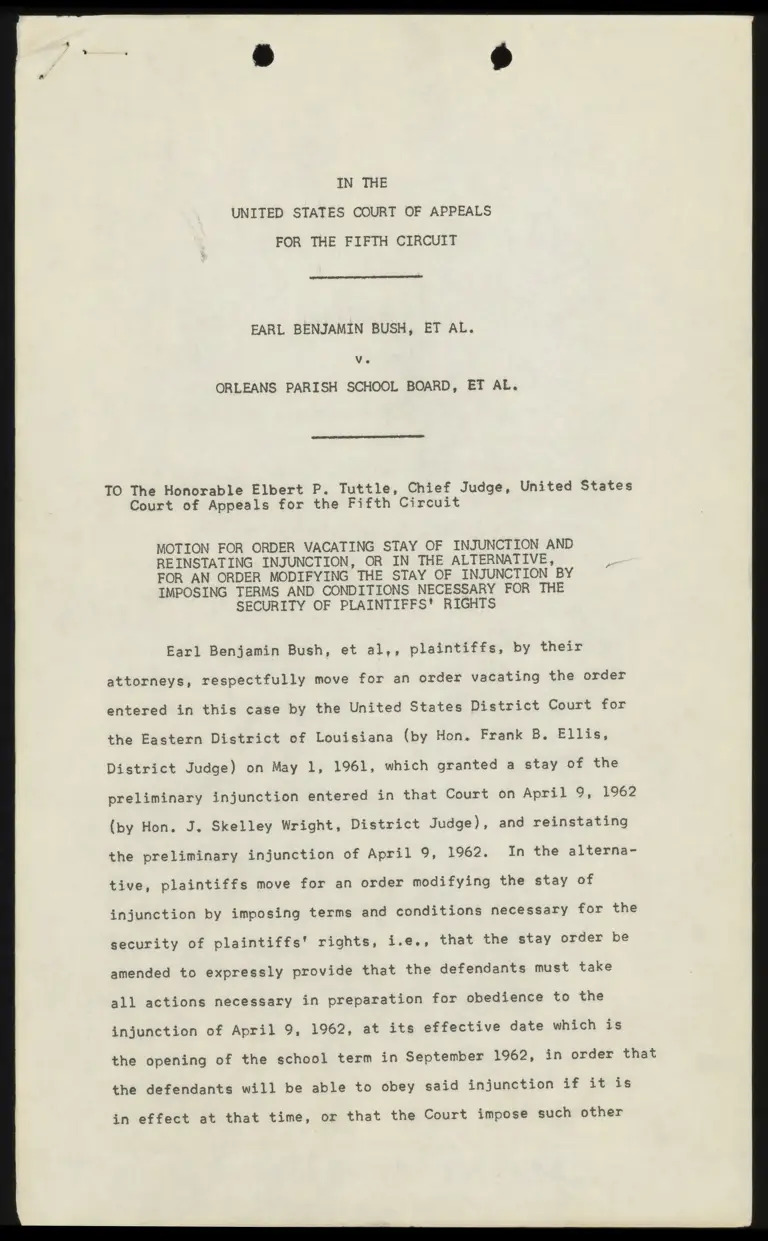
    IN THE

UNITED STATES COURT OF APPEALS

FOR THE FIFTH CIRCUIT

EARL BENJAMIN BUSH, ET AL.

Ve

ORLEANS PARISH SCHOOL BOARD, ET AL.

TO The Honorable Elbert P. Tuttle, Chief Judge, United States

Court of Appeals for the Fifth Circuit

MOTION FOR ORDER VACATING STAY OF INJUNCTION AND

REINSTATING INJUNCTION, OR IN THE ALTERNATIVE,

FOR AN ORDER MODIFYING THE STAY OF INJUNCTION BY

IMPOSING TERMS AND CONDITIONS NECESSARY FOR THE

SECURITY OF PLAINTIFFS' RIGHTS

Earl Benjamin Bush, et al,, plaintiffs, by their

attorneys, respectfully move for an order vacating the
order

entered in this case by the United States District Court for

the Eastern District of Louisiana (by Hon. Frank B. Ellis,

District Judge) on May 1, 1961, which granted a stay of the

preliminary injunction entered in that Court on April 9,
1962

(by Hon. J, Skelley Wright, District Judge), and reinstating

the preliminary injunction of April 9, 1962. In the alterna-

tive, plaintiffs move for an order modifying the stay of

injunction by imposing terms and conditions necessary
for the

security of plaintiffs' rights, i.e., that the stay order be

amended to expressly provide that the defendants must
 take

all actions necessary in preparation for obedience to the

injunction of April 9, 1962, at its effective date which is

the opening of the school term in September 1962, in order that

the defendants will be able to obey said injunction
if it is

in effect at that time, or that the Court impose such other


terms and conditions as it may deem proper. As grounds for

said motion, plaintiffs submit the following:

1. This school segregation case has been before the

courts through prolonged and complicated litigation. Earlier

opinions in this case are reported as indicated in footnote

one of the opinion below dated April 3, 1962 (Exhibit No. 1,

attached). The present proceedings result from motions filed

by the plaintiffs and intervenors, Negro school children in

New Orleans, seeking injunctive relief upon assertions that the

defendant Orleans Parish School Board has failed to comply with

prior orders of the trial court with respect to desegregation

of the public schools. On March 5, 1962, the District Court

held a hearing at which it received oral testimony and docu-

mentary evidence submitted by all parties. After considering

the evidence and briefs filed by the parties, the District

Court on April 3, 1962, filed an opinion containing detailed

discussion of the facts and law governing the case. A copy of

this opinion is appended hereto as Exhibit No. 1, Thereafter,

on April 9, 1962, this Court entered a preliminary injunction

in accordance with the opinion of April 3, 1962. This injunc-

tion modified an earlier injunction entered May 16, 1960. A

copy of the order of April 9, 1962, is attached hereto as

Exhibit No. 2.

2. In summary, the District Court's opinion of April 3,

1962, found that the defendant school board had failed to file

a plan of desegregation for the Orleans Parish schoolsas ordered

by the District Court on July 15, 1959, and did not contemplate

submitting a desegregation plan: that the school board continues

to maintain a dual system of segregated schools based on race,

this being accomplished by dividing the City into separate Negro

and white school attendance districts; that since September

1960, the defendant has not complied with the Court's desegrega-

tion order of May 16, 1960, which provided that all first grade

A


children might "at their option" attend either the "formerly

all white public schools nearest their homes
or the formerly

all negro schools nearest their homes": that instead of comply-

ing with the court's order, the board had pursued a special

testing and screening program for first grade Negro
pupils

seeking to attend schools other than the ones
 to which they

were assigned under the segregated system; and that under this

pupil assignment program only four Negro first
 grade children

out of 134 applicants were allowed to transfer t
o white schools

nearest their homes during the 1960-61 term,
and eight Negro

children of 66 applicants were allowed to transf
er during the

1961-62 term. The Court concluded that the procedures followe
d

by the defendant in assigning pupils for the 1960-6) and 1961-

62 school terms was not in compliance wit
h the order of the

Court and further said that:

To assign children to a segregated school system and

then require them to pass muster under a pupil place-

ment law is discrimination in its rawest form.

The court also found that there was substantial

inequality in the school facilities maintai
ned for white and

Negro children by the defendants, particularly
 with regard to

severe overcrowding in the Negro schools, "slatooning" (less

than full-time sessions) of Negro children, and the use of

school building areas not planned for clas
sroom use in the Negro

schools. The Court said that:

Even under the separate but equal test, these


inequalities may not be maintained. It would

be unconscionable to compel Negroes, 67 years

after Plegsy v. Ferguson, supra, to continue to

submit to these conditions.

3, On or about April 17, 1962, defendant Orleans Parish

School Board filed a Motion For New Trial asking that the Court


set aside the order of April 9, 1962. This motion was originally

noticed for hearing on May 2, 1962; hearing is now scheduled to

be held May 8, 1962. A copy of the motion for new trial is

attached hereto as Exhibit No. 3. After filing the Motion For

“2%


New Trial, counsel for the defendant notified plaintiffs’

counsel on April 23, 1962, of the Board's intention to appear

before the Hon, Frank B, Ellis, District Judge, on the after-

noon of April 24, 1962, to present a Motion For a Stay of the

order of April 9, 1962°" pending disposition of the Motion For

New Trial. On April 24, the Motion For a Stay was filed and

counsel for all parties appeared before the court in chambers.

A copy of the Motion For a Stay is attached hereto as Exhibit

No. 4. |The Court took the motion under advisement pending sub-

mission of memoranda and, on May 1, 1962, entered an order

granting the stay as requested by the defendant board. The

stay order provided:

This cause came on for hearing "in camera" with

counsel for both parties present on a former day on

defendants' motion to stay the temporary injunction

of April 9, 1962, pending disposition of their

motion for a new trial.

The court, having considered the briefs and

argument of counsel is ready to rule.

It is ordered that the defendants' motion to

stay the temporary injunction of April 9, 1962,

pending disposition of a motion for a new trial

be, and the same is hereby granted, on the condi-

tion that this stay shall of no way affect the

order of May 16, 1960.

Pending the hearing and study of a motion for

3 new trial on matters which this court as consti-

tuted is considering for the first time, a stay of

the temporary injunction is deemed appropriate.

F.R.C.P. 62(b). This stay in no way reflects the

ultimate disposition of the motion for a new

trial.

4. The grounds upon which the defendant sought and

obtained a stay of the preliminary injunction were that duri
ng

the pendency of the motion for a new trial and the antici-

pated time which might elapse before the motion for
new trial

is determined, and the additional time which might elapse if

the motion is granted before the final decision on the mer
its

of the action, the defendant would be irreparably
harmed since

during this period the defendant must prepare for the reg
is-

tration, assignment and transfer of students for the Septem
ber

-d-


1962 school term. Defendants asserted that they would not

have sufficient time to properly prepare for the opening of

school in September 1962, using their prior pupil assignment

procedures, unless the stay is granted. The defendants' asser-

tions in this regard are made in their memorandum in support

of the motion for a stay, relevant portions of which are

quoted in the margin below.

The defendants! own asserted justification for the stay

(which is that unless they take action now, they will be unable

to properly prepare for the assignment of students for September

19062) demonstrates that the present stay order is actually a

determination that the preliminary injunction will not be effec~

tive as of September 1962 in accordance with its terms. Thus

the stay order amounts to a modification of the injunction by

relieving defendants of their obligation to take present action

which they insist is necessary to prepare to obey the injunc-

tion. The stay order postpones defendants' obligation to take

preparatory steps necessary to carry out the injunction b
eyond

the time within which such preparation must be completed if

they are to be meaningful, Defendants have argued to the trial

court that after the current school term ends and the summer

vacation period begins they will not have adequate personnel
to

carry out the assignment program they desire to undertake.

Defendants Memorandum stated: : y
1/ "In the instant case, defendant has filed a motion for a new

trial, and the hearing of said motion has been set for May

8, 1962. It is reasonable to assume that the Court might

take the motion under advisement after the hearing.
It is

also reasonable to assume that if a new trial is granted

herein, there will be an additional lapse of t
ime before the

new trial is held, and a further lapse of time before a judg~

ment is rendered after the new trial.

“In the interim, defendants must prepare for a new

school term, which begins in September of 1962.
 The cur-

rent school term is drawing to a close, and it is imperative

that defendants make and carry out, without
further delay,

plans for the registration, assignment, and transfer of

students for the September term,

"It is a matter of common knowledge that the parochial

school system in the City of New Orleans has
already conducted

it s registration for the coming school term,

- lw


Accepting this assertion, arauendo, it is apparent that the

defendants own argument indicates that the stay should be vacated.

If defendants have any reason to believe that the injunction

will ultimately be set aside, they may make preparations to

assign pupils on that assumption, but at the same time should

also be making preparations to obey the Court's order in the

event that they are wrong. Defendants should not be permitted

to sit on their hands and to do nothing so that they can later

claim unreadiness to obey the injunction if it is ultimately

upheld. In this connection, it is relevant to note that defend-

ants have already publicly announced that they would go ahead

with preparations for following their prior pupil assignment

practices even before the stay order was granted,

5. The school board has made no showing of any kind to

demonstrate irreparable harm to it from being required merely

to make preparations to obey the court's order pending deci-

sion of the motion for new trial. Even if the injunction is

set aside, defendants can have suffered no harm by making such

preparations, particularly since they have already begun pre-

paring to follow their prior procedures without reference to

the stay order. The harm which plaintiffs would suffer if the

injunction is eventually sustained but its enforcement is

frustrated because defendants have been permitted to utilize

the time obtained through the stay to render obedience more

difficult, is plain and substantial. By this means, plaintiff

would be deprived of enjoyment of their adjudicated rights even

if they prevail on the merits.

(Continued)

"The record in the case at bar shows that the defendants

adopted its procedure for the assignment, transfer and con-

tinuance of all pupils for the school year 1961-1962 on

April 24, 1961 (See Exhibit P-5). Since April 24, 1962 is
now upon us, if the judgment previously entered herein is

not stayed, defendants will not have sufficient time to

properly prepare for the opening of school in September of

this year."

of


6. A cursory examination of defendants' motion for a

new trial reveals that on its face it fails to state a basis for

the relief requested since it is a patent attempt to relitigate

old matter previously presented to and considered by the trial

court. There is no claim of newly discovered evidence and the

assertions that the judgment is contrary to the law and con-

trary to the facts are arguments which might be urged on appeal

but are inappropriate basis for seeking new trial. There is

clearly no basis for a claim that the trial court's opinion of

April 3, 1962, contained manifest or obvious errors of law or

fact which justify relitigation of the same issues of fact and

law before the same court. The Court may weigh the likelihood

that the motion for a new trial affords a sound basis for the

relief prayed in determining whether a stay should be granted

pending that motion. Where, as here, the motion for new trial

is obviously insufficient, no stay should be granted.

7. This Court has power to vacate the stay and restore

the injunction pending disposition of the motion for new trial

pursuant to Title 28, U.S.C., §1651. Since the stay order

sought to be vacated is by legal operation and effect a modi

fication of the injunction previously entered, this is an

appropriate occasion for the exercise of the power to restore

the injunction under the All-Writs Act (28 U.S.C. §1651). The

Court's powers under the All-Writs Act may clearly be exercised

on a basis consistent with Rule 62(c), Federal Rules of Civil

Procedure to restore an injunction or to impose conditions upon

the grant of a stay pending appeal. This is all the more appro-

priate where the stay order determines the outcome of the litiga-

tion as certainly as a ruling on the merits, but may be otherwise

unreviewable.

Respectfully submitted,

James M. Nabrit, III
Jack Greenberg
Constance Baker Motley
10 Columbus Circle
New York 19, New York

ME ir


A. P, Tureau
Ernest Morial
A. M, Trudeau
1821 Orleans Avenue
New Orleans, Louisiana

Attorneys for Movants

CERTIFICATE OF SERVICE

I hereby certify that on this the lst day of May, 1962,

I served a copy of the foregoing Motion for Order Vacating Stay

of Injunction and Reinstating Injunction, or in the Alternative,

for an Order Modifying the Stay of Injunction, Etc., and the

attached Exhibits, on Samuel I. Rosenberg, Esqg., attorney for

defendant Orleans Parish School Board, by mailing a copy of same

addressed to him at 747 National Bank of Commerce Building,

New Orleans 12, Louisiana, via United States mail, air mail

special delivery, postage prepaid.

James M, Nabrit, III
Attorney for Movants


Exhibit No, 1

UNITED STATES DISTRICT COURT
EASTERN DISTRICT OF LOUISIANA
NEW ORLEANS DIVISION

EE EN Raa aa a Sa eh

EARL BENJAMIN BUSH, et al.

Plaintiffs

versus

ORLEANS PARISH SCHOOL BOARD, et al.
CIVIL ACTION

Defendants

CONNIE REED, a minor, by Gerald Rener,
her guardian and next friend, et al.

%

%k
 %

k
%k
 %

k
%

%k
 %

k
k

k

%k

k

%k


kk

k

¥


Plaintiff-Intervenors

BA aa a aaa a Aaa nas rs a ALLL LL LL EE x


Jack Greenberg
A, P. Tureaud
Ernest N, Morial
James M, Nabrit, III

Attorneys for Plaintiffs and Plaintiff-
Intervenors

Samuel I. Rosenberg

Attorney for Orleans Parish School Board

WRIGHT, District Judge:

Plaintiffs, now supported by 101 additional intervenors,

petition this court for further relief in this long pending 1liti-

gations The further relief requested is based on plaintiffs’

allegations that the defendant, Orleans Parish School Board, has

not complied with this court's order of May 16, 1960, with respect

to desegregation of the public schools of New Orleans, In addition,

they maintain that the segregated schools operated for negroes by

the Board cannot pass the separate but equal test of Plessy Vv.

Ferguson, 163 U.S. 537.

l1For the prior history of this litigation, see Bush v,
Orleans Parish School Board, E.D. La,, 138 F., Supp.
337, affirmed, 5 Cir,, 242 F.2d 156; id., 163 F. Supp.
701, affirmed, 5 Cir., 268 F.2d 78; id., 187 F. Supp.
42, affirmed, 365 U.S. 569; id., 188 F, Supp, 916,

affirmed, 365 U.S. 569; id., 190 F, Supp, 861, affirmed,

365 U,S. 569; id., 191 F, Supp. 871, affirmed, 367 U.S.

908; id., 194 F. Supp. 182, affirmed, 368 U.S, ll.


On May 16, 1960, when the defendant failed to file a

plan of desegregation? of the Orleans Parish schools as ordered

by this court, this court filed one. The court's plan simply

provides that beginning September, 1960, all children entering

the first grade may attend either the formerly all white public

schools nearest their homes or the formerly all negro schools

nearest their homes, at their option, There is a further provision

for transfers not based on consideration of race.>

The Orleans Parish School Board maintains a dual system

of segregated schools based on race? This segregation is accom-

plished by dividing the city geographically into negro school

districts and white school districts based upon the residence and

race of the children attending such schools, On the opening of

school in September, 1960, instead of complying with the court's

5
desegregation order, the Board announced a testing program for

any first grade child electing a school other than the one to

which he would be automatically assigned under the Board's segre-

6
gated system, This program involved four steps consisting of

20n February 15, 1956, this court ordered the School Board

to desegregate the Orleans Parish public schools "with

all deliberate speed." On July 15, 1959, after no action

in compliance had been taken, the Board was ordered to

file a desegregation plan. To date no Board plan has
been filed and it was admitted at the hearing that sub-

mission of a plan is not in contemplation. This court

will, therefore, continue to order desegregation on an

ad hoc basis until an acceptable plan for integration of
the Orleans Parish schools is forthcoming.

3The order reads:

"IT IS ORDERED that beginning with the opening of school
in September, 1960, all public schools in the City of
New Orleans shall be desegregated in accordance with

the following plan:

“A. All children entering the first grade may attend

either the formerly all white public school nearest
their homes, or the formerly all negro public school
nearest their homes, at their option.

"B, Children may be transferred from one school to

another, provided such transfers are not based on
consideration of race."

4Enrollment in the Orleans Parish schools as of October 18,
1961, is as follows: White 37,845; Negro 55,820,

SThis testing program was promulgated pursuant to the
Louisiana Pupil Placement Act. La.R.S5. 17:10] et seq.
The constitutionality of the Act is not attacked in
these proceedings.

©The testing program applied only to the first grade and
there only to children requesting "transfer,"

-ide


(1) a review of the "transfer" application form and verification

of the information contained therein, (2) testing of the petition-

ing pupils to determine "scholastic aptitude," “intelligence or

ability" and "adequacy of oupills academic preparation or readi-

ness for admission to school or curricula," (3) "test interpreta-

tion and personal evaluation to consider" ten listed eriteria

relating generally to education, psychology, home environment and

health, and (4) a "general administrative review and preparation

of recommendation to Orleans Parish School Board to consider" all

of the information collected, the "choice and interests" of pupil,

as well as the possibility or threat of friction or disorder among

pupils or others, and the possibility of breach of peace or ill

will or economic retaliation within the community.” The bulletin

announcing the program further provides that pupils permitted to

transfer under these procedures and criteria "may be reassigned

to the school to which they are assigned by virtue of their place

of residence by order of the Orleans Parish School Board if they

do not make satisfactory adjustment to the newly assigned situa-~

tion,"8 The announcement further requires the separation of

pupils by sex in each class desegregated under this program,

An analysis of the test program demonstrates that the

Board, instead of allcwing children entering the first grade to

make an election as to the schools they would attend, assigned

all children to the racially segregated schools in their residen-

tial areas. Then, after being so assigned, each child wishing to

"while these broad criteria were upheld as valid elements

of a pupil placement law, Shuttlesworth v. Birmingham
Edi ion, N.D. Ala.,, 162 F, Supp. 372, affirmed,

358 U.S, 101, the application of such criteria to deny

admittance or transfer on the ground of potential racial

disturbance would be improper, Cooper v, Aaron, 358 U.S,

1, 16. See Buchanan v, Warlev, 245 U,S. 60, 81,

8This portion of the program in effect "repeals" the statu-
tory criteria since it leaves ultimate pupil assignment

in the unfettered discretion of the Board, This absence

of permissible standards for placement sealed the fate

of Louisiana's first pupil placement law. Bush v, Orleaps
Parish School Board, E,D. La,, 138 F. Supp. 337, 341,

affirmed, 5 Cir., 242 F, 2d 156, See Ihompson V. County

School Board of Arlinaton County, E, D., Va., 159 F, Supp.

567, affirmed, 4 Cir., 252 F.2d 929.

- 3a


exercise his right to elect pursuant to the court's plan of desegre-

gation was subjected to the testing program. No children other

than first grade were required to take the tests, Pursuant to

this testing program, four negro first grade children out of 134

applicants were allowed to "transfer" to the white schools nearest

their homes during the school year 1960-61, and eight negro

children of 66 applying successfully overcame the hurdles of the

1961-62 testing program. Consequently, 12 of the 13,000-odd negro

children entering the first grade in the years 1960-61 and 1961-62

were admitted to and are attending "white" schools,

The Board maintains that it was justified in applying

the pupil placement law to the desegregation order of this court

in an effort to make certain that the children applying to "trans-

fer" were intellectually and psychologically acceptable in the

schools they sought to attend. The Board makes no explanation

for its failure to test all children seeking to enter the first

grade, or any other grade, in an effort to determine whether or

not they were intellectually and psychologically acceptable in

the segregated schools to which they were automatically assigned.

This failure to test all pupils is the constitutional vice in

the Board's testing program, However valid a pupil placement act

may be on its face, it may not be selectively spolieds’ Moreover,

where a school system is seorsgated, there is no constitutional

basis whatever for using a pupil placement law, 11 A pupil place-

ment law may only be validly applied in an integrated school

The admission of thirteen Negro pupils, after a scholastic
test, which the white children did not have to take, out of
thirty-eight who made application for transfer, is not
desegregation, nor is it the institution of a plan for non-
racial organization of the Memphis school system,”
Northcross t a v, B of E et «sy: 5 Civ,.,
F.2d 2/23/62), p. 10, slip opinion, See also
Mannings Vv. Board of Public Instruction, 5 Cir., 277 F.2d

370, 374; Jopes v, School Board of City of Alexandria,
Virginia, 4 Cir., 278F.,2d 72, 77; Dove v, Parham, 8 Cir,,
282 F.2d 256, 258. ¢

10uopviously the maintenance of a dual system of attendance
areas based on race offends the constitutional rights of
the plaintiffs and others similarly situated and cannot
be tolerated, * %* ¥* ¥ In order that there may be no doubt
about the matter, the enforced maintenance of such a dual
system is here specifically condemned." Jones Vv lo

A dria, Virginia, supra, 76.

11Compare Gibson v,. Board of Public Instruction of Dade
County, 5 Cir,, 246 F,2d 913, 914; id., 272 F.2d 763, 767,

ow


system, and then only where no consideration is based on race.

To assign children to a segregated school system and then require

them to pass muster under a pupil placement law is discrimination

in its rawest form.

The plaintiffs, together with intervenors, also complain

of the crowded conditions in the defendant's negro schools, as

compared to the white, The evidence shows that 5,540 negro elemen=-

tary school children are on platoon, but no white, [| The evidence

shows further that the average class size in the negro
elementary

schools is 38.3 pupils compared to 28.7 in the white,}3 that
the

pupil-teacher ration in the elementary schools is 36,0 to 1 for

negro, 26.1 to 1 for white, and that negro classes are conducted

in classrooms converted from stages, custodians® quarters, librarie:

and teachers! lounge rooms, while similar classroom conditions do

not exist in the white schools, Even under the separate but equal

test, these inequalities may not be maintained, It would be

unconscionable to compel negroes, 67 years after Plessy v, Ferguson.

14
supra, to continue to submit to these conditions.

/ The Board states that in the next two or three years,

when its present building program is completed, most of the pl
a-

tooning and the crowded conditions in the negro schools
will be

eliminated. But the Board’s projection gives no facts or figures,

12vThe Pupil Assignment Law might serve some purpose in the

administration of a school system but it will not serve

as a plan to convert a biracial system into a non-racial

one." Northeross, et al, v., Bd, of Educ... et al., supra,

p. 6, slip opinion, See also id., p. B: "Since that

decision [Brown v. Board of Education, 347 U.S, 483],
there cannot be Negro! schools and 'white' schools,

There can now be only schools, requirements for admission

to which must be on an equal basis without regard to race.”

13The maximum class size for elementary schools prescribed
by

the Louisiana State Board of Education ig 35 pupils. As of

October 18, 1961, in the white elementary schools 7.4 per

cent of the regular classes had over 36 pupils, while in

the negro elementary schools 75.6 per cent of the classes

had over 36 pupils.

" 145ee Sweatt v, Painter, 339 U.S, 629; Wilson v, Board of
Sunczviecrs, E.D. La,, 92 F. Supp, 986, affirmed, 340 U.S.
909.


nor does it make allowance for the increase in the school popula-

tion to be anticipated, based on the current birth rate, The

Board also suggests that in two successive elections property

owners of New Orleans have voted down proposals for tax increases

to defray the increased cost of operating the public schools in

New Orleans, and that this failure has caused the crowded condi-

tions in the negro schools, Whether New Orleans will have adequate

public schools is, of course, the responsibility of her taxpayers.

But whatever is provided, inadequate as it is, must at least be

made available on an equal basis to all school children,

Generations of negroes have already been denied their

rights under the separate but equal doctrine of Plessy Vv. Ferquson,

supra, and, at the present pace in New Orieans, generations of

negroes yet unborn will suffer a similar fate with respect to their

rights under Brown unless desegregation and equal protection are

secured for them by this court,

The School Board here occupies an unenviable position,

Its members, elected to serve without pay, have sought conscien-

tiously, albeit reluctantly, to comply with the law on order of

this court, Their reward for this service has been economic

reprisal and personal recrimination from many of their constituents

who have allowed hate to overcome their better judgment. But the

plight of the Board cannot affect the rights of school children

whose skin color is no choice of their own, These children have

a right to accept the constitutional promise of equality before

the law, an equality we profess to all the world.

IT IS ORDERED that the order of this court dated May 16,

1960, be, and the same is hereby, amended to read as follows:

(A) Beginning with the opening of school in September,

1962, all children entering, or presently enrolled in,

the public elementary schools of New Orleans, grades 1

through 6, may attend either the formerly all white

public schools nearest their homes or the formerly all

negro public schools nearest their homes, at their

option,


(B) Children may be transferred from one school to

another, provided such transfers are not based on con
-

siderations of race,

(C) As long as the defendant, Orleans warish School

Board, operates a dual school system based on racial

segregation, the Louisiana Pupil Placement Act shall

not be applied to any pupil,

Injunction to be drafted by the court,

s/ J. Skelley Wright

UNITED STA.ES DISTRICT JUDGE

New Orleans, Louisiana

April 3, 1962


@ canivit No. 2 $

UNITED STATES DISTRICT COURT
EASTERN DISTRICT OF LOUISIANA
NEW ORLEANS DIVISION

363 Heb J Pe HIE HI FT FI 3626 36 I 2H 62636 IH 36 HIE 36363 36 I He HH 36 3H He He He

CONNIE REED, a minor, by Gerald Rener,
her guardian and next friend, et al.,

Plaintiff-Intervenors

*

EARL BENJAMIN BUSH, et al., *
*

Plaintiffs *
*

versus 2
%*

ORLEANS PARISH SCHOOL BOARD, et al., *
¥ No. 3630-B

Defendants *
* CIVIL ACTION
*
*
*
*

ve Te Ie FT FHI He A He Ie He He II 363 HI IH J FoI FHI Fe I Ie FoI HH HF HHH HHH Xe

TEMPORARY INJUNCTION

This case came on for hearing on plaintiffs' and intervenors'

motion for further relief and temporary injunction.

It being the opinion of the court that plaintiffs and intervenors

are entitled to further relief;

It is ORDERED that the motion to intervene be, and the same is

hereby, GRANTED,

It is further Ordered that the Orleans Parish School Board, its

agents, representatives, attorneys, and all other persons who are

acting or may act in concert with them, be, and they are hereby,

restrained, enjoined and prohibited from assigning pupils in any

manner inconsistent with the following plan:

S (A) Beginning with the opening of school in September, 1962, all

children entering, or presently enrolled in, the public elementary

schools of New Orleans, grades 1 through 6, may attend either the

formerly all-white public schools nearest their homes, or ths fomerly

all negro public schools nearest their homes at their option.

1/ This means that each child entering or attending grades 1

through 6 may elect to go to either the white school in his

or her residence district or the negro school in his or her

residence district as shown on the defendant's maps of the

City of New Orleans outlining the school district for each


(B) Children may be transferred from one school to another

provided such Coansters are not based on considerations of race.

(C) As long as the defendant, Orleans Parish School Board,

operates a dual system based on racial segregation, the Loulsiana

Pupil Placement Act shall not be applied to any pupil.

s/ J, Skelley Wright
UNITED STATES DISTRICT JUDGE

New Orleans, La,
April 9, 1962


® Exhibit No. 3 »

NIT S_DISTR UR

FOR TH TERN DISTRI E ISIA

NEW_ORLEANS_ DIVISION

EARL BENJAMIN BUSH, ET AL.,
PLAINT IFFS, :

ORLEANS PARISH SCHOOL BOARD, : CIVIL ACTION

2 Bey DEFENDANTS, . NO. 3630-B

CONNIE REED, ET AL., :
PLAINTIFF -INTERVENORS :

yi iss testes ieteelea iti, tetera Shrek ates reste sess rab Tieinvens

MOTION FOR NEW TRIAL

O° © © 9 60 8 50 00 9% 80 2238254034322 ® 0 99% oa PE TT FFE EEE EE EE EEN NE EE EE EEE

ee & » 6 9 0 0 EERE EER ER! oe 8 & 69 8 00 eo 9 0 8 00 © 5 690509 6000 95 C665 60 PF SOS S Ree

L
1

J

[ 1
]


L
1

J

Defendant, Orleans Parish School Board, moves the Court to set

aside the temporary injunction entered herein on the 9th day of April,

1962, and to grant defendant a new trial, on the grounds that:

The judgment is contrary to law, in that:

(a) The Orleans Parish School Board has made a

prompt and reasonable start toward full com-

pliance with the May 17, 1954 ruling of the

United States Supreme Court, and this Court

may, and should, find that additional time is

necessary to carry out the ruling in an ef-

fective manner.

(b) It is not true that during the period of

transition to a racially non-discriminatory

school system, the Louisiana Pupil Placement

Law (R.S. 17:101) may "only be validly applied

in an integrated school system." (Opinion, p. 4)

(¢) No plaintiff, or plaintiff-intervenor, has

exhausted the administrative remedies provided

for in Louisiana Act 492 of 1960, (R.S. 17:101,

et seq.), nor have any of them exercised the |

option given to them ir earlier orders of this

Court to attend "...either the formerly all

white public school nearest their home, or the


- Page 2 ~-

formerly all negro public school nearest their

home..."; and the pleadings do not allege that

they have so done,

(d) No pupil, whose application for transfer was

denied, has filed, in writing, with the Orleans

Parish School Board objections to the assignment

of the pupil to a particular school, or has re-

quested by petition, in writing, assignment or

transfer to a designated school, or to another

school to be designated by the Board, all as is

provided for in R.S. 17:106; and no such pupil

appears as either plaintiff, or plaintiff-intervenor.

(e) The constitutionality of Louisiana Act 492 of 1960


is not here attacked (See fn. 5 of opinion). Its

provisions are therefore binding upon defendants,

plaintiffs, plaintiff-intervenors, and the Court;

and injunctive relief can be granted only to those

‘who allege, and prove, that they have exhausted the

administrative remedies set forth in the statute,

and the rights which they claim must be asserted

as individuals, and not as a class or group.

(£) It is not a proper function of this Court to secure

desegregation for "generations of negroes yet un
-

born" (Opinion, p. 6). NOthing in the United States

Constitution or in Brown v. Topeka gives to a child

the right to attend a school of his choice solely

because of his race. The simple requirement is that

no child shall be denied admission to a school of his

choice on the basis of race or color. The constitu-

tion does not require desegregation, it merely forbids

discrimination.


- Page 3 ~

2. The judgment is contrary to fact, in that, it is based

largely upon a finding that school facilities for negroes are unequal

to those for whites. The findings are erroneous in the following

respects:

(a)

(b)

(c)

(d)

While some few "negro classes are conducted in

classrooms converted from stages, custodians’

quarters, libraries and teachers' lounge rooms,”

similar classroom conditions exist in the white

schools, (Opinion, p. 5)

When the present building program of the Orleans

Parish School Board is completed, all platooning

in negro schools will be eliminated, even after

making allowance for the increase in the school

population to be anticipated, based on the current

birth race. (Opinion, p, 5)

A vast preponderance of building funds spent in

the last ten (10) years have been for negro schools

(Exhibit OPSB__ 3 ).

Ten Million ($10,000,000,00) Dollars of Orleans

Parish School Bonds were delivered on April 4, 1962;

and this enabled Defendant to begin its current

construction program. On April 9, 1962 Defendant

awarded a construction contract for the construction

of twenty (20) additional classrooms at the Woton

School and twenty (20) additional classrooms at

the Dunn School; and in addition, Defendant authorized

the construction of sixty-four (64) portable classrooms.

The bulk of the funds available for the current

construction program of the defendant is already

earmarked for construction which will eliminate the

inequalities complained of.


~- Page 4 ~-

3. The Court erred in enjoining the Orleans Parish School

Board, et als., from assigning pupils in any manner inconsiste
nt

with the plan set forth by the Court, in that:

(a) School authorities have the primary responsib
ility

for elucidating, assessing, and solving, varied

local school problems.. In assuming this responsi-

bility, the Court has stripped Defendant of its

administrative powers, and allows each child in

the system to decide which school he will attend.

(b) The plan requires the present non-segregated admissio
n

of all negro children, whether qualified or not,
on

the theory that this is a guaranteed constitutional

right, but the United States Supreme Court has held

that a District Court might conclude that justifica-

tion exists for not requiring the present non-

segregated admission of even qualified negro children.

(c) Its order seeks to require the desegregation of

all six elementary grades in one fell swoop, and


prohibits the use of the Louisiana Pupil Placement

Law during the transitional period. No other School

Board in the deep South has been ordered to take

such drastic, sweeping, sudden action, and the Court

of Appeals for the Fifth Circuit reversed a similar

order issued to the Dallas School Board and ordered

the District Court to accord school authorities a

reasonable further opportunity to promptly meet

their primary responsibility in the premises,

(d) The plan handed down by the Court is impractical,

and is virtually impossible to comply with. If

school children are permitted to go to schools
of


- Page 5 -

their choice, without regard to attendance areas,

distances, school bus routings and other pertinent

factors, some of the schools would be crowded be-

yond their capacity and others would be practically

vacant.

WHEREFORE, Defendant prays that the above Motion be granted.

Samuel I, Rosenberg
Attorney for the Orleans Parish School
Board
747 National Bank of Commerce Building
New Orleans 12, Louisiana
JAckson 2-3128.


> : 4 ®

Exhibit No. 4

UNITED _STATES DISTRICT COURT

FOR_THE EASTERN DISTRICT OF LOUISIANA

NEW _ORLEANS_DIVISION

EARL BENJAMIN BUSH, ET AL.,
PLAINTIFFS,

VS,

ORLEANS PARISH SCHOOL BOARD,
ET AL.,

CIVIL ACTION

DEFENDANTS,

CONNIE REED, A MINOR BY
GERALD RENER, HER GUARDIAN
AND NEXT FRIEND, ET ALS.,

PLAINTIFF~INTERVENORS. ®
Ld

® 0 8 5 8 0 0 4% OW OB 6 0 96 OE" SHEE OHO LEN Ho
SS 0 8 @ °° O° > OH OO PEO PEW EDP OE SPE SS C9 ee

NO. 3630-B
9

@
&

9
%

8
9


#
0


9
9

S
E

g
e

e
f

8

p
a

d
e


¢ 8 0 ¢ 5 ® 5 0" 8&8 0 0 5 6 6 60 0
383323: $33%3%% 2192333332232:

MOTION FOR STAY OF EXECUTION PENDING DISPOSITION OF MOTION FOR
AL p

4
7
}


Defendant, Orleans Parish School Board, moves the Court

for an order staying execution of, or any proceedings to enforce,

the judgment entered in favor of plaintiffs and plaintiff-intervenors

herein, on April 9, 1962, pending disposition of defendants' motion

for a new trial, on the ground that irreparable injury might other-

wise result to defendant.

Samuel! I. Rosenlkerg
Attorney for Orleans Parish School
Board,
747 National Bank of Commerce Building
New Orleans 12, Louisiana
JAckson 2-5128.

[Defendants' Proposed Order Cmitted]