Motion of William C. Cramer to Participate in Oral Argument as an Amicus Curiae
Public Court Documents
September 15, 1970
3 pages
-
Case Files, Swann v. Charlotte-Mecklenburg Hardbacks. Motion of William C. Cramer to Participate in Oral Argument as an Amicus Curiae, 1970. 6f11e5a9-2e34-f111-88b4-7c1e526962fd. LDF Archives, Thurgood Marshall Institute. https://ldfrecollection.org/archives/archives-search/archives-item/2d8fc0ec-7a61-4937-83ee-4ab2a0edfba3/motion-of-william-c-cramer-to-participate-in-oral-argument-as-an-amicus-curiae. Accessed October 15, 2026.
Copied!
     [||7dc08060-4494-4b2c-9a8b-25fa75d73fa8||] S
O
N


KL


SS


IN'THE SUPREME COURT OF THE UNITED STATES

OCTOBER TERM, 1970

ar e
| NO. 281

JAMES E. SWANN, ET AL, )

Petitioners, )

Vv. )

CHARLOTTE-MECKLENBURG BOARD )
OF EDUCATION, ET AL.,

Respondents. )
) |


I MOTION OF WILLIAM C. CRAMER | i TO PARTICIPATE IN ORAL ARGUMENT
AS AN AMICUS CURIAE |

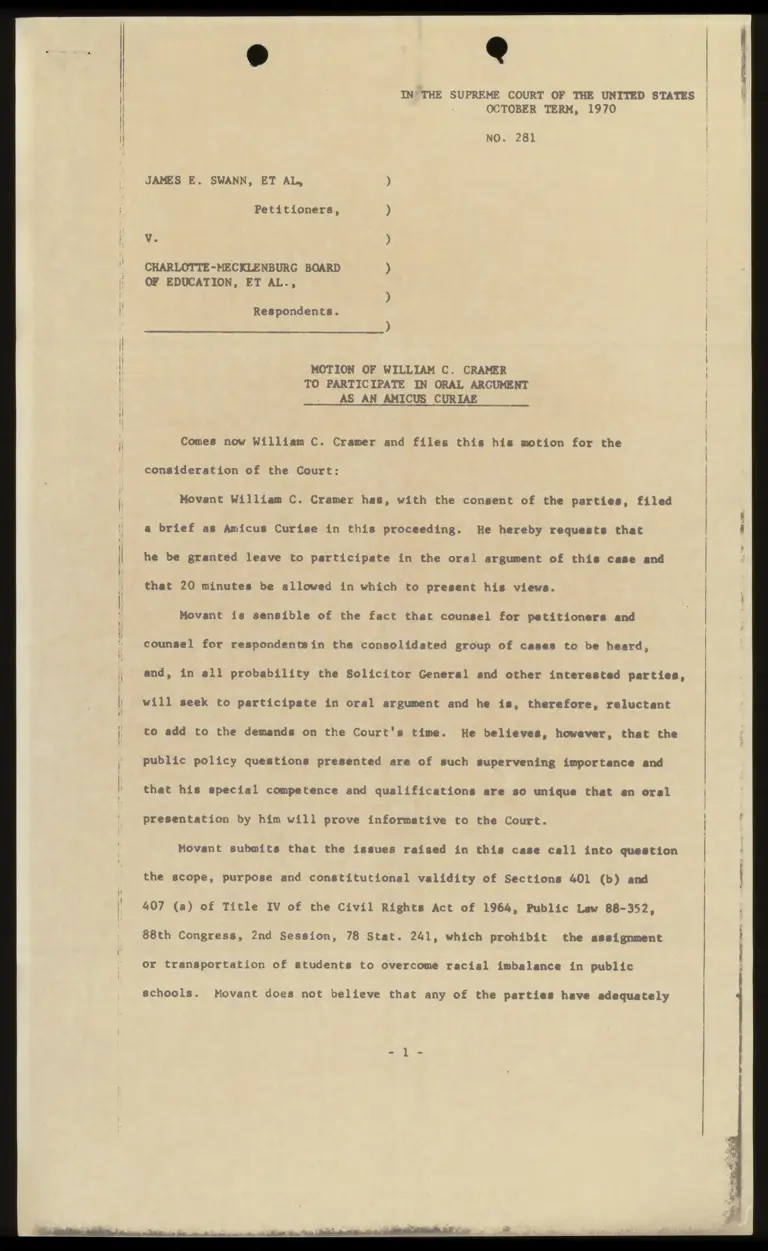
Comes now William C. Cramer and files this his motion for the

consideration of the Court:

Movant William C. Cramer has, with the consent of the parties, filed

a brief as Amicus Curiae in this proceeding. He hereby requests that | '

ii he be granted leave to participate in the oral argument of this case and

that 20 minutes be allowed in which to present his views.

Movant is sensible of the fact that counsel for petitioners and

counsel for respondents in the consolidated group of cases to be heard,

and, in all probability the Solicitor General and other interested parties,

{{ will seek to participate in oral argument and he is, therefore, reluctant

to add to the demands on the Court's time. He believes, however, that the

public policy questions presented are of such supervening importance and
that his special competence and qualifications are so unique that an oral

presentation by him will prove informative to the Court.

Movant submits that the issues raised in this case call into question

the scope, purpose and constitutional validity of Sections 401 (b) and

407 (a) of Title IV of the Civil Rights Act of 1964, Public Law 88-352,

88th Congress, 2nd Session, 78 Stat. 241, which prohibit the assignment

or transportation of students to overcome racial imbalance in public

schools. Movant does not believe that any of the parties have adequately


EE ov ee


RN ae


| *® ®


canvassed the legislative history of these provisions which were enacted

under the authority of Section 5 of the Fourteenth Amendment to the United

States Constitution.

Movant is a member of the U. S. Congress from the 8th Congressional

District of Florida. At the time the Civil Rights Act of 1964 was under

consideration by the Congress, he was a member of the Committee on the

Judiciary of the House of Representatives, and of its Civil Rights Sub-

committee. In that capacity, he participated extensively in the delibera-

tions and debate which led to passage of the Act and, in addition, he

was the author of Section 401 (b), one of the provisions to be considered

by this Court in this proceeding.

In view of the importance of the questions presented and the public

policy issues to be decided, Movant believes that his special competence

and qualifications merit his participation in oral argument and will

materially benefit this Court in reaching its decision.

For the foregoing reasons, Movant requests that he be granted 20

minutes for oral presentation of the legislative history of the Civil

Rights Act of 1964,


submitted,


’ RA C LJ

Rayburn House Office Building
House of Representatives
Washington, D.C. 20515


RICHARD C. PEET

4442 Hawthorne Street, N.W.
Washington, D.C. 20016


#
CERTIFICATE OF SERVICE


I HEREBY CERTIFY that a true and correct copy of the foregoing

has been mailed, postage prepaid, this 15th day of September, A.D.,

1970, to:

William J. Waggoner, Esa.
Weinstein, Waggoner, Sturges, Odom & Bigger
1100 Barringer Office Tower

426 No. Tryon Street

Charlotte, North Carolina 28202

C. O. Pearson, Esq.
At rAavrmoyw and Cvmiincel 1a + YT ae
ALLULILITY aiid LVOUlISe ll 101 a fs W J

P. 0. Box 1426

Durham, North Carolina 27702

J. LeVonne Chambers, Esq.

Chambers, Stein, Ferguson & Lanning

216 West Tenth Street
Charlotte, North Carolina 28202

Jack Greenberg, Esq.

Attorney at Law

10 Columbus Circle

New York, N. Y. 10019

Stephen J. Pollak, Esq.

Shea & Gardner

734-15th St., N.W.
Washington, D.C. 20005

Hon. Claude Kirk, Governor

Tallahassee, Florida

Raymond B. Witt, Jr., Esq.

Gaither, Abernathy & Wilson

1100 American National Bank Bldg.

Chattanooga, Tennessee 37402

David Norman

Department of Justice

Washington, D.C.

4
{

  qd __ lh. Ag a He ————————————— —

-v® . RM NT C .

iting [||7dc08060-4494-4b2c-9a8b-25fa75d73fa8||]