Eaton v. James Walker Memorial Hospital Board of Managers Deposition of Dr. Hubert A. Eaton
Public Court Documents
October 21, 1965
-
Brief Collection, LDF Court Filings. Eaton v. James Walker Memorial Hospital Board of Managers Deposition of Dr. Hubert A. Eaton, 1965. 29f51574-b09a-ee11-be36-6045bdeb8873. LDF Archives, Thurgood Marshall Institute. https://ldfrecollection.org/archives/archives-search/archives-item/2ddc87c0-7df3-45db-8956-41ac90da65b0/eaton-v-james-walker-memorial-hospital-board-of-managers-deposition-of-dr-hubert-a-eaton. Accessed October 08, 2026.
Copied!
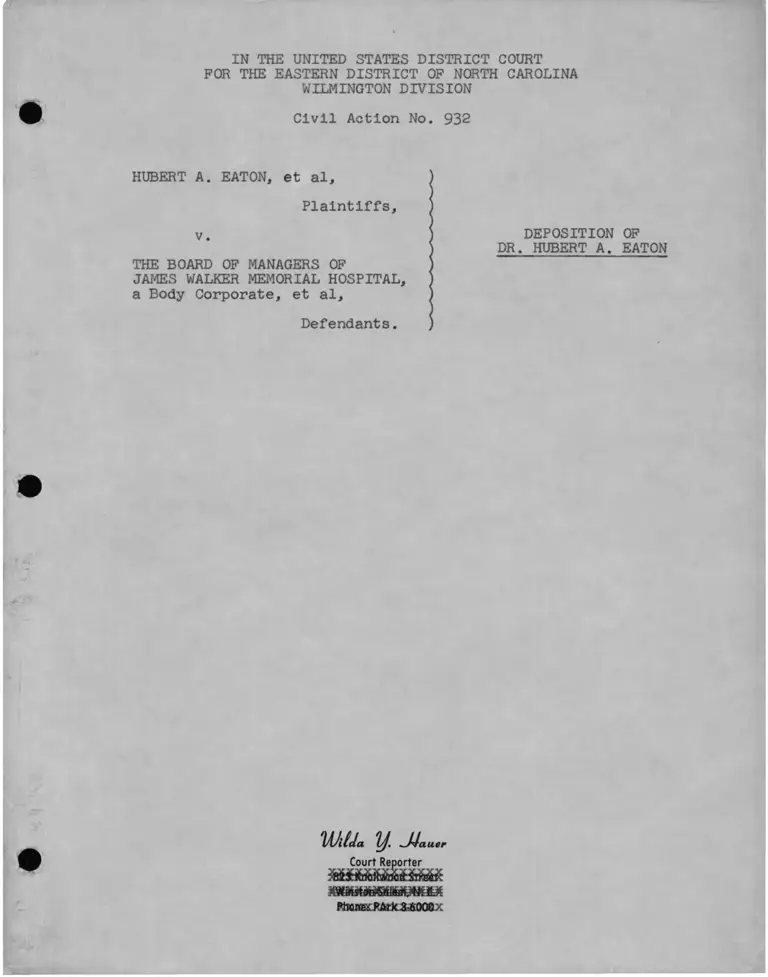
IN THE UNITED STATES DISTRICT COURT
FOR THE EASTERN DISTRICT OF NORTH CAROLINA
WILMINGTON DIVISION
Civil Action No. 932
HUBERT A. EATON, et al, )
Plaintiffs, j
v. ) DEPOSITION OF
) DR. HUBERT A. EATON
THE BOARD OF MANAGERS OF )
JAMES WALKER MEMORIAL HOSPITAL, )
a Body Corporate, et al, )
Defendants. )
UMJ* y.
Court Reporter
j L i i - i i i j u y i i t u u m u y u t i u t
Phone: PArk 3-6000
1
2
3
4
5
6
7
8
9
10
n
12
13
14
15
16
17
18
19
20
21
IN HIE UNITED STATES DISTRICT COURT
FOR THE EASTERN DISTRICT OF NORTH CAROLINA
WILMINGTON DIVISION
Civil Action No. 932
HUBERT A. EATON, et. al., )
Plaintiffs,
v ) DEPOSITION OF
j DR. HUBERT A, EATON
THE BOARD OF MANAGERS OF )
JAMES WALKER MEMORIAL HOSPITAL, )
a Body Corporate, et. al.,
Defendants. )
Deposition of Dr. Hubert A. Eaton, a plaintiff
herein, was taken by Mr. Michael Meltsner, of counsel for
plaintiffs, before the undersigned Wilda Y. Hauer, Official
Court Reporter and Notary Public, beginning on Tuesday,
July 20, 1965, direct-examination completed on Wednesday,
July 21, 1965, in the courtroom of the United States
Customhouse, Wilmington, North Carolina.
Cross-examination by Mr. Cyrus D. Hogue Jr,,
counsel for defendants, was conducted at the same place on
September 7, 1965, at which time, because of the absence
of Mr. Meltsner, defendants waived any objection to re
direct -examination of the witness by Mr. Julius LeVonne
Chambers, counsel for plaintiffs.
1
2
3
4
5
6
7
8
9
10
11
12
13
14
13
16
17
18
I N D E X
Witness Direct Cross Redirect Recross
Dr. Hubert A. Eaton 3 24 49
E X H I B I T S
Number - Description
P-1
P-2
D-2
Certified copy of minutes of -age
Clerk of Superior Court showing
disposition of case against
Dr. Eaton. 31
Copy of statement of Dr. Lumb
with regard to complaints made
by Dr. Wheeler to Sheriff’s
Department. 50
Copy of Death Certificate of
Alma Fredrick 47
1
2
3
4
5
6
7
8
9
10
11
12
13
14
15
16
17
18
19
20
21
July 20, 1965
MR. MELTSNER: Let the record clearly
Indicate that we are beginning with Dr. Eaton now,
and that the parties stipulate that it in no sense
prejudices the right of any party to recall Dr. Eaton
for any purpose they see fit.
p r . H U B E R T A. E A T O N , having been duly sworn,
testified as follows:
DIRECT-EXAMINATION
BY MR. MELTSNER:
Q Dr. Eaton, state your full name and medical
specialty.
A Hubert Arthur Eaton. I am a general practitioner
and general 3urgeon.
Q Dr. Eaton, how long have you been a licensed
physician?
A Since June of 19^2.
q, Where were you educated?
A I received my B.S. Degree from Johnson C. Smith
University in Charlotte, North Carolina. I received a
Master of Science Degree in Zoology from the University
of Michigan. I received an M.D. Degree from the University
1
2
3
4
5
6
7
8
9
10
11
12
13
14
15
16
17
18
19
20
21
22
23
24
25
of Michigan.
Q How long have you practiced in Wilmington?
A I started practicing in Wilmington on July 1,
1943.
q With what hospitals in Wilmington are you
associated ?
A I am a member of the staff of Community Hospital.
Q Do you perform surgery at that hospital?
A I have been on the surgical staff since 1945*
and for the past four or five years I have been chief of
the surgical service at this hospital.
Q During this period have any complaints been
made against you arising out of your performance at the
hospital?
A None that I know of.
Q Would you tell us as you remember it the history
of your attempts to become a member of the courtesay staff
of the James Walker Memorial Hospital?
A The exact date of my first application is quite
vague, but it must have been close to nine years ago that
I made application to the James Walker Memorial Hospital
for courtesy staff privileges. My application was denied.
And shortly after this time two of my colleagues applied,
Dr. Roane and Dr. Gray, and their applications were
denied. And it was shortly after this time that we employed
1
2
3
4
5
6
7
8
9
10
11
12
13
14
15
16
17
18
counsel. But first, I believe, we appealed to the County
Commissioners, because we felt that this was a county
hospital receiving public funds. The County Commissioners
indicated to us that they had nothing to do with the
control of this hospital and, therefore, could give us no
relief.
It was about this time that we employed
legal counsel and instituted suit in the federal court,
under the Fourteenth Amendment, asking that the courts
direct that this hospital extend to us courtesy staff
privileges. The first suit lasted for several years and
finally ended in a decision against us. It went up to
the appellate court in Richmond, and I don't recall the
exact terms of the decision, but It was against us.
Nothing happened for perhaps another year or so.
Feeling that the climate in the South was
changing, feeling that perhaps our application for staff
membership might receive a more favorable consideration,
some four or five years after our original application
we reapplied for courtesy staff privileges. At this
time there were four of us, the three original doctors
and a Dr. V/. J. Wheeler. It was not very long, however,
after Dr. Wheeler made his application that he decided,
for reasons known to himself only, to withdraw his
application; and he went to the hospital, as I understand
1
2
3
4
3
6
7
8
9
10
11
12
13
14
15
16
17
18
19
20
21
22
23
24
25
It, and asked that he be given a copy of his application,
that he would like to withdraw it.
Our applications were turned down on the
second occasion by the hospital, and we re-employed
counsel; and we have been in litigation up until
approximately a year ago when this time the appellate
court ruled that the James Walker Hospital was, I believe,
a public hospital and subject to the Fourteenth
Amendment. This decision I believe came down last June
or July, I don't recall exactly.
Q Did you reapply at the time of this decision?
A Yes. After this decision was handed down
to us, it was in August of last year that I gathered
together the applications. First, we had written for
new applications, and I got them together and saw to it
that Dr. Gray and Dr. Roane filled out their applications;
I got mine together, and we submitted these applications
to the James Walker Memorial Hospital.
These applications were taken to the hospital
on a Monday morning, and on a Tuesday morning I learned
that an indictment had been issued for me for allegedly
performing an abortion in my office some four or five
months earlier.
Q What crime was alleged in the indictment?
A The crime, I believe, was merely the patient
1
2
3
4
5
6
7
8
9 1
10
n
12
13
14
15
16
17
18
19
20
21
22
23
24
25
died in my office, and some four or five months later the
body was exhumed, and it was alleged that an illegal
operation had been performed on this individual. And
when this indictment was Issued the following morning,
I felt that I would not like to have my application
considered by the hospital under this cloud of suspicion,
so I instructed Lawyer Bond, a local attorney here, to
inform the hospital through Mr. Hogue, the attorney here,
that my application be withheld pending the outcome of
this particular matter.
Q Was it so withheld?
A It was, as far as I know, withheld, yes. In
the meantime, the applications of Doctors Gray and Roane
were processed; and after the directed verdict of not
guilty was given by the Judge in this indictment in
November, it was shortly after then that through counsel
I requested that my application be considered, and I
think this was the latter part of November or the first
part of December of last year.
Q, Now, you mentioned a verdict in this criminal
case. Would you briefly describe what occurred at the
trial?
A At the trial the prosecutor, a Mr. Bowman,
from Southport, placed Dr. George Lumb on the witness
stand, and Dr. Lumb gave an opinion as to what he thought
1
2
3
4
5
6
7
8
9
10
11
12
13
14
15
16
17
18
19
20
21
happened some four or five months before the autopsy was
performed.
Q Was this opinion based on something Dr. Lumb
observed?
A This opinion was based on slides and stains,
and so forth, coming from the organs of the deceased
body, and he sent his slides and materials to the Chief
Medical Examiner for the City of New York who came down
and testified that he concurred with an opinion expressed
by Dr. Lumb, but admitted that he was basing his opinion
on the findings of Dr. Lumb. And then three days before
the trial, Dr. Lumb sent all of his slides and material
down to a Dr. Thiebault at the University of Georgia, and
this doctor came up and attempted to testify in line
with Dr. Lumb * s opinion. It was brought out in court,
however, that these two men had been friends at the
University of Tennessee prior to Dr. Lumb coming to
Wilmington.
After these three men testified, the two
attorneys which I had employed, Mr. George Rountree and
Mr. John Burney, made an appeal to the Judge that there
had been no evidence presented which involved me in any
type of illegal operation on this patient; and the Judge
agreed, and issued the directed verdict of not guilty.
Q Did you have witnesses present who were going
1
2
3
4
5
6
7
8
9
10
n
12
13
14
13
16
17
18
19
20
21
to testify In your behalf?
A Yes, I did. I had a Dr. Johnson who Is the
chief of the basic science division of the United States
Armed Services Institute of Pathology. Dr. Johnson was
here in the city in a room at the Heart of Wilmington
Motel. He was prepared to demonstrate by slides, stains,
in three different ways that the substance which Dr.
Lumb had felt was a foreign body was, indeed, nothing
but broken down red blood corpuscles.
Also present in the city and at the motel was
Dr. Godfrey Mann who is, and has been for about fifteen
years, the Chief Medical Examiner for the State of
Virginia. Dr. Mann was here to testify that the cause
of this patient's death was exactly what I had put on
the death certificate, a reaction from penicillin. He
was here to testify that the pathologist who made the
stains, Dr. Lumb, had failed to recognize that this
patient had asthma, and it is well recognized in medical
circles that patients who have asthma are prone to
penicillin reactions. He was also prepared to testify
that even had this substance been a foreign material,
as Dr. Lumb had said, there had been an insufficient
amount to produce death. He was also prepared to
demonstrate very conclusively that Dr. Lumb had made
errors in his staining process and, on the Saturday before
1
2
3
4
5
6
7
8
9
10
11
12
13
14
15
16
17
18
19
20
21
22
23
24
25
the trial started this Tuesday, had called Dr. Lumb as
one pathologist to another and had told him that he had
made these mistakes, and had indicated to him that there
was really no necessity for trial and offered to have a
conference with Dr. Lumb and the lawyers to prevent the
further embarrassment of having to go through a trial.
Q Did this have any connection with the use of
the man from the University of Georgia?
A Well, after Dr. Lumb was notified by Dr. Mann
that he had made these mistakes in his slides, Dr. Lumb
admitted on the stand - and so did Dr. Thiebault and
the doctor from New York - that he then called New York,
told him what had happened, and then they arranged for
Dr. Lumb to send all of his materials or specimens from
the organs of this girl down to Georgia - this is less
than seventy-two hours from trial time - to try - as I
say, to get him off the hook - to try to get Dr. Thiebault
to come up and to testify that indeed this material was
a fat-staining material as Dr. Lumb had found earlier.
These three men testified and, of course, the
Judge was not impressed at all, and we had no opportunity
to present the conclusive evidence that we had in my
behalf that I was not involved at all in any type of
illegal procedure where this patient was concerned. There
was no evidence whatsoever presented, other than an opinion
1
2
3
4
5
6
7
8
9
10
n
12
13
14
15
16
17
18
expressed by Dr. Lumb concerning what he thought the cause
of the death was and not only this, but how soon the
patient had died after she got into the City of Wilming
ton.
Q Do you know what Dr. Lumb's position was at
the time he testified?
A He was the chief pathologist at the James
Walker Hospital.
Q Do you know the names of any other pathologists
at the James Walker Memorial Hospital?
A Yes. Dr. Singletary was his associate at
that time. Dr. Singletary has now moved up into his
spot, as I understand it. Dr. Singletary is now the
chief pathologist, but at that time he was Dr. Lumb's
assistant.
Q I want to call your attention to a bond issue
or bond issues with respect to a new hospital here in
Wilmington. Would you tell us the nature of such bond
issues and your position with respect to them and the
reason you took the position you took?
A Yes. There were two bond issues for the pro
posed hospital. I will be inaccurate in my dates, because
I'm not sure of the time. But approximately six years
ago a bond issue was held for a new hospital. The Negro
doctors met with a committee from the James Walker Hospital
1
2
3
4
5
6
7
8
9
10
11
12
13
14
13
16
17
18
19
20
21
22
23
24
25
to try to persuade us that we should support the bond
Issue. Many prominent citizens of this community, white
individuals, attempted to persuade me, personally, and
other Negro physicians that we should support the bond
issue for a new hospital. But we were unimpressed, be
cause we had no way of Judging the future other than by
the past; and we felt that not only would Negro
physicians be subjected to discrimination in the new
hospital but so would Negro patients, because this had
(old?)been the pattern in the new hospital. And we stead
fastly refused to give our support to the new hospital.
We proceeded to organize, and it fell my lot
to represent the thinking of the Negro community on the
bond issue, as well as the Negro doctors. I appeared
on television programs on several occasions; I appeared
on radio programs; I spoke anywhere I was invited; I
worked along with the other Negro doctors to issue
pamphlets giving the reasons why we were against the bond
issue, and I opposed it in every honorable way that I
knew how.
Q Who was in favor of it?
A The white physicians were in favor of it, most
of them; not all, but most of them were in favor of it.
And there were some people in the white community — it
was sort of a paradoxical situation — there were some
1
2
3
4
5
6
7
8
9
10
11
12
13
14
15
16
17
18
19
20
21
22
23
24
25
white Individuals in the community opposing the bond
issue for the reason that they thought it might be an
integrated institution; and there were some opposing it
for other reasons. But the white physicians I would say,
the big majority of them, were for the bond issue.
YJe had had, of course, experience with the
James Walker Hospital, with their policies of discrimina
tion; we had had contacts through our state medical
society with the Department of HE&W; we had been to
Washington and talked to Mr. Allen Wilcox, general counsel
of HE&W, and a Dr. Beaufelant Jones who at that time was
assistant secretary.Q What was the result?
A Well, we knew what their policy was at that
time. We knew that their interpretation of the Hill-Burton
Act, the Hospital Survey & Construction Act, was one
which would permit discrimination and even segregation.
Q Did this play a part in your opposition to the
bond issue?
A This played a part in our decision to oppose
the bond issue.
Q Now, what happened in the first vote?
A On the first vote the bond issue was decisively
defeated.
Q
A
Was the bond issue renewed?
Yes. There was a period of approximately a year
1
2
3
4
5
6
7
8
9
10
n
12
13
14
15
16
17
18
19
20
21
and a half, maybe a year or two years, I don't remember
exactly, and then the bond Issue was brought up again.
And again, efforts were made to secure the support of
the Negro community, but again we were unwilling to
support a bond issue for a new hospital when we knew
what the law was, when we knew that we would not be pro
tected by law, and this was our reason and our only
reason for opposition to the bond issue.
Q What happened to the vote?
A The second bond issue passed, I think by about
250 votes for the bond issue itself, but the levy to
support the hospital was defeated. And it was primarily
the opposition from the Negro community that defeated
the levy and caused the vote to be as narrow as it
was in favor of it.
q if a vote on this hospital were taken today,
would you oppose it?
A Nc, sir, I would not oppose it because the
laws have changed now. The Interpretation of the Hospital
Survey Construction Act has changed. We had Community
Hospital and, inadequate as it might have been, we
preferred to keep what we had rather than to go into a
basement or a wing of a new hospital. But today I
would give my full support to a bond issue for a new
hospital.
1
2
3
4
5
6
7
8
9
10
11
12
13
14
15
l6
17
18
19
20
21
The civil rights law has caused a complete
reversal of the policy in HE&W.
Q Is Community Hospital a facility solely for
Negroes?
A By and large it is. Over the years there
have been one or two white patients, but by and large
it is for Negro patients only. The staff is bi-racial,
however; and the board is bi-racial.
Q Do you have any reason to think that you
stirred animosity on the part of the white physicians
in this community by reason of your opposition to the
bond issue?
A Oh, there's no question in my mind about
this.
Q Why do you reach that conclusion?
A Well, I have been told this by some of my
friends from the community of white physicians. I have
been told this by friends of mine in the community.
Q Are you a member of a medical society?
A Yes. I sun a member of the Old North State
Medical Society.
Q What race are the members of the Old North
State Medical Society?
A The Old North State Medical Society is composed
of Negro physicians only
1
2
3
4
5
6
7
8
9
10
11
12
13
14
15
16
17
18
19
20
21
Q Is there another medical society in this
state?
A Yes. There Is a Medical Society of the State
of North Carolina.
Q Is there a local affiliate?
A There is a local affiliate called Ihe New
Hanover County Medical Society.
Q And of what race are the members?
A The members are all white as far as I know.
Q Have you over the years sought to gain
admittance for yourself and other Negro physicians to the
New Hanover County Society?
A Yes. Some eight or nine years ago I applied
for membership in the county medical society and It was
turned down.
Q Did it have an all-white by-law at that time?
A Yes. There was a regulation which said the
membership was limited to white physicians only.
Q Are there any Negroes presently In the New
Hanover County Society?
A None that I know of. I might add that in May
of this year the state medical society voted to admit
Negro physicians to full membership. And I have a
letter in my files from Mr. Barnes who is executive
secretary of the medical society of the State of North
1
2
3
4
5
6
7
8
9
10
n
12
13
14
13
16
17
18
19
20
21
22
23
24
25
Carolina indicating that this effectively abolishes dis
crimination on the local as well as the state level.
Q This is nine years after your application?
A Some nine years after my application.
Q What other activities have you been involved
with relating to desegregation?
A Everything. You name it, I've been in it.
My first effort to improve conditions for Negroes was
back in I think about 1949 when a group of us entered a
suit under the Fourteenth Amendment, under the old
"separate but equal," against the school board. We felt
that our educational facilities here were woefully lack
ing, separate but nowhere near equal, and it was at this
time that I spearheaded a movement against the Board of
Education on a separate but equal basiB to get better
schools for Negro students.
Then, again, some year and a half ago I spear
headed a suit — maybe two years ago now or two and a half
years ago, I spearheaded a suit allowing my daughter to
serve a3 the leading plaintiff asking that the federal
courts order the New Hanover County School Board to pro
ceed with desegregation of the school system. 3he decision
came down in 1954, and some eight years later no effort
had been made in this direction.
Q. Any other activity which you can describe?
1
2
3
4
5
6
7
8
9
10
n
12
13
14
15
16
17
A Yes. It was through my Initiative that the
golf course here wa3 desegregated. I headed a committee
which had conference with the city manager who was Mr.
Benton at that time, and as a result the golf course
was desegregated.
•Through a conference with Mayor Allsbrook
and Attorney Yow, the city library was desegregated.
I was very active two years ago in assiting
in helping the demonstrators here who were demonstrating
for civil rights, the permission to use public
accommodations, and who were demonstrating for their civil
rights in general.
Q What was the response of the community here
in Wilmington to these activities?
A Well, of course, the response In the Negro
community was excellent. I have gotten full support
and praise from 95 per cent of the Negro community.
The response In the white community has been
antagonistic. What percentage I don’t know, but I have
had my window lights broken out on my front porch; I have
had rotten eggs thrown against my door; I have received
so many insulting calls over the telephone that I consider
it an everyday occurrence almost; I have gotten at least
one threatening letter through the mail. However, I can
say that with very few exceptions I have done all of these
1
2
3
4
5
6
7
8
9
10
11
12
13
14
15
16
17
18
things on a very high plane, and I believe that I have
maintained the respect of the greater majority of the
higher class white citizens. I have many friends, I
believe, among the better class of white citizens.
Q Dr. Eaton, I wonder if you would describe
for me in a general way the kind of practice you have
had over the years?
A Over the years I have had a general practice.
I handle most cases which come to my office; I handle
all of my obstetrics; I handle a great majority of the
general surgery which comes in. At one time, up until
perhaps about five years ago, I handled all of my
pediatrics; but recently I have been referring most of
the pediatrics to pediatricians, because I have tried to
make an attempt to limit my work somewhat. I still do
pediatrics, but I am trying to concentrate more in general
surgery and general medicine. At one time I did the
majority of my orthopedics. Now I handle just the simple
orthopedic cases and refer most of the other orthopedic
cases which I get to the orthopedic specialists.
But this is the type of practice which I
have: a general practice with emphasis on general surgery,
but I also do obstetrics.
Q What is the race of most of your patients?
A With about two or three exceptions, a hundred
1
2
3
4
5
6
7
8
9
10
11
12
13
14
13
16
17
18
19
20
21
22
23
24
25
per cent Negro. I don't treat any white patients.
Q I3 that because they don't come to you or
because you won't accept them?
A I think perhaps both. There are seventy-five
white physicians in the city and four Negro physicians.
I have all that I can do trying to relieve the sick among
my race. Most of the whites who come to me come because
they have various conditions which they don't want the
white physicians to know about - venereal disease as a
general rule. I will see an occasional one every now
and then, but 99.9 per cent of my patients are Negro.
I occasionally turn down white patients who come in and
who call over the phone asking for appointments. I refer
them to one of the white physicians and indicate to them
that I Just have all that I can do treating Negro patients.
I am not adverse and I would have no objection to treating
them. Perhaps it goes back also to 1943 when I started
practicing and I worked for three years with my
father-in-law, who had been a physician in this community
for twenty-eight years, and he had adopted the policy
then that he thought it would be better, because of not
too good feeling between the races, more or less to limit
his practice to Negroes.
Q Is there a shortage of Negro physicians here?
A Oh, yes. There is a shortage of Negro
1
2
3
4
5
6
7
8
9
10
n
12
13
14
15
16
17
18
19
20
21
physicians everywhere. TSiere are less than 5>000 Negro
physicians in the whole country.
Many of ray patients come from outside of the
county, from the surrounding four or five counties.
Q Have you over the years been referred
patients by other physicians in the community?
A Other physicians in the community and the
surrounding area, yes.
Q What was the race of these physicians?
A White as well as colored. Over the years I
have had perhaps eight or ten different white physicians
refer surgical cases to me, and I have had perhaps as
many as half a dozen Negro physicians refer surgical
patients to me and sometimes other cases.
Q Can you recall any of the names of the white
physicians who have referred cases to you?
A Yes. Dr. Crouch, both of the Crouches, Dr,
Warshauer, Dr. Black. There was a Dr. Hargett who is
now retired, Dr. Hodman who is now deceased, Dr. Huntley
from Wallace, Dr. Beard, and several other doctors
whose names I cannot recall right now.
q Were any of these physicians on the staff at
James Walker?
A Oh, yes. Dr. Warshauer is on the staff at
James Walker, and Dr. Reynolds has occasionally referred a
1
2
3
4
5
6
7
8
9
10
n
12
13
14
13
16
17
18
19
20
21
22
23
24
25
case to me
Q Were the number of referrals affected by your
instituting action against James Walker in court?
A Well, I cannot make that as a positive
statement; however, I can say that from 1945 through 1950
I noticed a gradual falling-off of the referrals; and after
my first civil rights activities here, I found that I got
practically no referrals from the white physicians, Just
the Negro physicians. For example, in 1951 I can only
recall getting one referral from a white physicians. In
1950 I received five referrals. In 19 5̂ for example,
five years earlier, I had thirty referrals.
Q Did this coincide with that lawsuit you
mentioned earlier?
A Hie first lawsuit was, I think, in 19^9 or
1950. Now, I can't say this is the cause and effect,
but it certainly may be more than a coincidence.
Q Have any complaints, to your knowledge, been
made about your competence and 3kill at the Community
Hospital?
A None whatsoever.
Q Have any malpractice complaints ever been
filed against you?
A None at all.
Q Have you ever been charged with any criminal
1
2
3
4
5
6
7
8
9
10
11
12
13
14
15
16
17
18
19
20
21
activity other than the charge we have talked about before?
A None at all.
Q Will you state again the reason you opposed
the new hospital in Wilmington?
A I opposed the new hospital in Wilmington
because I felt it would be a continuation of the dis
criminatory practices at the James Walker Hospital. At
this hospital the Negro patients have, for the most part
over the years, been housed in a building separate from
the main building and have been subjected to discriminatory
practices which are almost unheard of in many communities.
And we have a hospital here where Negro patients can
at least go with dignity and be treated. And I along with
ray other colleagues, with the exception of one, felt that
we had rather keep what we had than to vote and move into
a new hospital and be placed in a basement or in a wing
and be subjected to embarrassment and humiliation and
discrimination.
Q What has been the level of Negro participation
in the new hospital?
A There is one Negro on the board of trustees
of the new hospital.
Q What is his name?
A Dr. Upperman. And Dr. Upperman was in full
accord with the opposition which we put up to the new
1
2
3
4
5
6
7
8
9
10
li
12
13
14
15
16
17
18
19
20
21
22
23
24
25
hospital on both bond Issues, but he was In the background;
I was In the forefront.
Q How many members are there on this board of
trustees?
A I think there are nine.
MELTSNER: That's all I have at this
time.
(Deposition of Dr. Eaton continued as
follows on September 7, 1965);
CROSS-EXAMINATION
BY MR. HOGUE:
Q Doctor, you testified, I believe, that you
reapplied for the staff of the hospital in August of
1964. Do you recall the date of your application?
A No, I don't.
Q Let me hand you this (later marked P-3). I
don't have the original, but I have a photostat of it.
me ask you if this is a true and correct copy of your
Application for Membership to the staff of James Walker
Memorial Hospital?
A Ye3. This seems to be a true and accurate
copy.
Let
Q Now, Doctor, you say you filed that in August,
1
2
3
4
5
6
7
8
9
10
11
12
13
14
15
16
17
18
19
20
21
22
23
24
25
I believe, of 1964?
A As far as I can recall. I notice the date of
this is July the 6th.
Q But it could have been dated earlier and Just
not filed?
A Yes. What happened was that after I filled
the application out, I had to sort of keep in behind Dr.
Gray and Dr. Roane and finally I sent to their office
for their applications and delivered all three of them
to Lawyer Bond, and he in turn took them over and handed
them to Mr. Martin.
Q Now, Doctor, I believe you testified on
direct-examination - and I don't have the transcript,
so I'm reading from my notes - that you reapplied in
August of 1964, and "applications were taken to the
hospital on Monday morning, and on Tuesday I learned
that an indictment for murder had been returned against
me"j is that correct?
A Yes, that's correct.
Q Now, Doctor, you don't contend that any member
of the Board of James Walker Hospital had anything to do
with your being indicted by the grand Jury, do you? You
don't mean to imply that from your testimony, do you?
A That any member of the Board of Managers--
q -- Board of Managers of James Walker Hospital
1
2
3
4
5
6
7
8
9
10
11
12
13
14
15
16
17
18
19
20
21
22
23
24
25
had anything to do with that?
A Not to my knowledge, no.
Q Now, on your application I believe, if you
will look on page 2 there, you applied for general
practice with a specialty in surgery; isn't that correct,
sir?
A No, sir, that's not correct.
Q What does the application say?
A Well, the application says many things. To
what do you refer now? The application does not de
lineate the privileges which you are requesting; I remember
this very well.
Q, The application states: "Is your work
strictly limited to any specialty in medicine?" And you
answered that "No"?
A That's correct.
Q "Are you particularly interested in any
special branch of medicine?" And the answer is "Yes"?
A Yes.
q And it states that you are particularly
interested in general surgery?
A Correct.
Q So on this application you expected to receive
surgical privileges upon admission, did you not, sir?
A I expected to receive privileges commensurate
1
2
3
4
5
6
7
8
9
10
11
12
13
14
15
16
17
18
19
20
21
with my experience and competence. The bulk of ray practice
is general practice, but I am particularly interested in
general surgery as this application indicates.
q Now, Doctor, would you say that it's a fair
statement to say that both the facilities of James Walker
Hospital and Community Hospital are pretty antiquated?
A Yes.
Q And would you say that it's fair to say that
the new hospital will be a step forward in medical
progress in this county?
A Today I would say that this is true, that the
new hospital will be a step forward in the medical
services available to people of both races. But when we
opposed the bond issue, I would have said that this would
have been true for white patients and not at all,
necessarily, for Negro patients.
Q What Information did you have at that time
that Negro patients would not be treated in that hospital,
if any?
A We at that time knew of no way of Judging
the future except by the past. We knew of the inhumane
treatment which Negro patients at James Walker had
received over the years. I say "inhumane" in that these
Negro patients were placed in a ward completely separated
from the main building; that in all sorts of weather they
1
2
3
4
5
6
7
8
9
10
11
12
13
14
15
16
17
18
19
20
21
had to he rolled from the main building; if operated on
or if they delivered babies or went to the main hospital
for other services, they had to be rolled back and
forth outdoors. This was almost an unbelievable practice.
We felt that in the general atmosphere here in Wilmington
there had been very little progress made along racial
lines, and we felt that we would prefer to keep the
hospital which we had and Improve this rather than run
the risk of having to abandon what we had and move into
a basement or some wing or floor of a new hospital.
There are many areas which take this opinion.
In Winston-Salem, for example, a new hospital in a Negro
neighborhood is being considered. At the present time
in Greensboro the old L. Richardson Memorial Hospital -
a new one is being built. In Durham this question has
come up. If you remember, with the first bond issue
Mr. Jack Norman from South Carolina outlined as an alterna
tive the spending of a million dollars in Community
Hospital to improve and update the facilities there, and
at the same time spend several million dollars Improving
the old facilities at the James Walker Hospital.
There are many, many reasons why we opposed
the bond issue at that time. And I might add, Mr. Hogue,
that today we would not oppose the bond issue. The
interpretation of the Hill-Burton Act has been completely
1
2
3
4
5
6
7
8
9
10
ll
12
13
14
15
16
17
18
altered. Today we have a Civil Rights Bill. But back
in those days we were uncertain, and we knew no way of
judging what would happen to us in the future by what
had already happened in the past.
Q When you drive down 17th Street and look
at it, it's kind of hard to think about being opposed
to it, isn't it?
A No, no; not at all, not at all. I think by
having opposed it -- and I might say this to you, that
when we filed the first suit against the James Walker
Hospital, we started an entirely new approach to the
problem of discrimination in hospitals, and here in
Wilmington we are generally given credit, more than
any other area, for the major changes which have taken
place in the Interpretation of the Hospital Survey and
Construction Act better known as Hill-Burton. We had
been to Washington through our local society and
through our state society; we had talked to Mr. Kat-
zenbach; we had talked to Mr. Allen Wilcox who at that
time was general counsel to the Department of HE&W and
to Dr. B. Jones who at that time was Assistant
Secretary of the Department of HE&W, So we knew what
the Interpretation of the Hill-Burton Act was. We
knew that this hospital could be built and Negroes
could have been put in a basement so long as Negroes were
1
2
3
4
5
6
7
8
9
10
11
12
13
14
15
l6
17
18
19
20
21
22
23
24
25
given service. This Is all the Act required according
to the interpretation which HE&W had placed on it.
So it was a combination of things which caused us to
feel as we did at that time.
I have been in Wilmington since 19^3# I
own a good deal of property here, I'm here to die I
suppose; and I'm interested in the progress of
Wilmington. But 1 have been unalterably opposed to
discrimination and segregation, as you well know.
Q Well, at the time you opposed the bond
issue, you were opposed to closing Community Hospital,
weren't you?
A Particularly the first bond issue. You will
recall that the first bond issue was defeated over
whelmingly, and we took the position at the first bond
issue that we felt that we would prefer to keep what we
had rather than to give it up not knowing what the
position of the Negro physicians would be and what the
position of the Negro patients would be in a new
hospital; and I think we took a similar attitude in
the second bond issue which, as you recall, passed by
less than 250 votes.
Q Now, Doctor, in your direct-examination
you testified that shortly after you applied for
application to the staff of James Walker Hospital that
1
2
3
4
5
6
7
8
9
10
11
12
13
14
15
16
17
18
19
20
21
22
23
24
25
you had had an indictment against you, and you testified
at length about this and testified that there was a
directed verdict of not guilty. Now, Dr. Singletary
testified at the last hearing that a permit had been
shown to him signed by this Miss Fredrick stating
that she knew she was in a state of abortion, "and it
was in the possession of Mr. Burney, Dr. Eaton's
lawyer, and he showed this to Dr. Lumb and to me."
Now, did such a permit exist at the time of that un
fortunate occurrence?
A Yes, sir. And in comment to your first
statement I would like to incorporate in the record
here a certified copy, drawn from the minutes of the
conclusion of this trial, exactly what the Judge did
say.
MR. HOGUE: All right. I have no
objection to that going in.
(Document referred to above marked
Plaintiffs' Exhibit No. 1.)
BY MR. HOGUE:
Q Doctor, how long had you treated this Miss
Fredrick?
A She made three visits to me. According to
your instructions, I brought my records. On July 9,
1963, she made her first visit, and I do have a blood
1
2
3
4
5
6
7
8
9
10
11
12
13
14
15
16
17
18
19
20
21
22
23
24
25
test slip, which was a part of my records, showing that
she came in on the 9th. She made her second visit to
me on the 19th, which was ten days later; and she made
another visit to me on the 30th, which was eleven days
later, and this is the day she died.
Q Now, when did she sign the statement saying
that she knew she was in a state of abortion?
A Well, she did not sign a statement which
said this. I would like to read the statement signed
on July 30, 1963. It is headlined "Release from
Responsibility for Abortion:
"I, the undersigned, a patient in attendance
at Dr. Eaton's clinic, Wilmington, North Carolina,
believe that I am in a condition of abortion.
"I hereby declare that neither Dr. Eaton
nor any person employed by or connected with said clinic
has knowingly or to my knowledge performed any act which
may have contributed to the induction of the abortion.
I further declare that I am returning home today against
my doctor's advice which is to enter the hospital at
once for treatment."
And she signed this on 7-30-63, and it was
witnessed by my nurse.
Now I would like to further elaborate on
this release. The first paragraph is more or less a
1
2
3
4
5
6
7
8
9
10
n
12
13
14
15
16
17
18
19
20
21
22
23
24
25
standard release which appears on the back of our
admission records at the hospital. I had over the
last several years developed a very high index of
suspicion regarding these abortions because of charges
on the part of one of my colleagues that all the Negro
doctors were doing abortions, and this release from
responsibility for abortion was done in an effort to
protect myself; and because the patient refused to
enter the hospital, I had my nurse add this second
paragraph to this statement prior to typing it up and
presenting it to her for signature.
q When you first treated this Miss Fredrick,
was your first treatment because of her pregnancy?
A Well, I would like to elaborate on that.
This patient lived about fifty some miles from Wilming
ton in a town called Kenansville, and she belonged to
a Holiness Church, and the so-called church mother
lived directly across from some very old patients of
mine; and this patient, Miss Fredrick had gone to at
least two doctors in her neighborhood on the complaint
of being run-down and weak, and she wasn't getting any
better; and it was her church mother who referred her
to me for diagnosis and treatment. At the time of her
first visit to me I found that she was very anemic;
her hemoglobin was nine and a half grams, and it should
1
2
3
4
3
6
7
8
9
10
11
12
13
14
15
16
17
18
19
20
21
22
23
24
25
be twelve and a half or thirteen; and I made a positive
diagnosis of fibroid uteri, and my diagnosis was later
substantiated at the autopsy. However, this patient
had not menstruated for -- well, since 6-I-63. In
other words, her period was eight days late, and I
indicated to her at that time that she should be ad
mitted to the hospital for transfusions and subsequent
surgery, after ruling out pregnancy; and on that first
visit I gave her a prescription for a drug called
Produosterone, which is a chemical test for pregnancy,
and I also gave her a prescription for some capsules
for pain.
Q Well, now, when she came to see you on the
30th, you administei’ed penicillin to her; is that
correct?
A Well, she came back in ten days as she was
instructed, and on this visit I gave her a prescription
for her anemia. Not knowing exactly when we would
be able to get into the hospital for an operation, I
examined her again, she still had not menstruated, and
I told her to see me again in two weeks; and I have a
letter in my files which she wrote to me asking if she
could come in a few days ahead of time, and she came in
on the 30th. She was due in, I think, on August the
1st or 2nd.
1
2
3
4
5
6
7
8
9
10
11
12
13
14
15
16
17
18
19
20
21
22
23
24
25
Q And when she came in on the 30th, she was
given penicillin?
A Ihis was the day she wa3 given penicillin,
that*3 right.
Q Was she running a fever at that time ?
A Yes, 3ir.
Q And there was a state of infection present
of some sort?
A Well, she was running a fever; and usually
when you have a fever, there is some sort of Infection
present some place.
Q Well, at that time did you know the cause
of the infection?
A No, I not only did not know the cause of it,
I didn't know the exact location of it. She was having
lower abdominal pains. She could have had an infection
in a tooth; she could have had an infection in her
uterus; she could have had a fever of undetermined
origin; she could have had a toothache, although she
did not complain at that time of a toothache. I did
not know exactly the cause of the fever which she
had.
Q Well, now, she had been told that she was
pregnant when she was in there the second time to see
you, is that correct?
1
2
3
4
5
6
7
8
9
10
11
12
13
14
15
16
17
18
19
20
21
22
23
24
25
A No, sir. It was impossible to delineate
a pregnancy in view of the tumor, and I told her that
we would have to wait until we ruled out pregnancy.
Q Now, when did she find that she was in a
state of abortion?
A She didn't realize that she was in a state
of abortion as far as she told me. I was the one who
told her that I felt that she might well be in a state
of abortion.
This was an unmarried girl, and as it later
turned out she was engaged to a young man who had never
had an intercourse with her. She did not admit to me
at all that she had tampered with herself or that any
body else had tampered with her; but over a period of
twenty years, a doctor learns much about a patient. You
listen and you Ignore part of what you hear; you go
by what you feel and what you suspect.
Q But she signed this statement after you
told her she was in a state of abortion, then?
A I told her that I felt that she hadn't been
telling me the truth, that she was withholding some
thing from me, and that I thought she might well be
in a state of abortion; and I told her that if she
refused to go to the hospital, I would do nothing for
her at all unless she signed a statement to relieve me
1
2
3
4
5
6
7
8
9
10
11
12
13
14
15
16
17
18
19
20
21
of any responsibility in case anything happened to
her.
Q Had you taken a full medical history on this
woman?
A As much as we do in the office. In doing
general practice when sometimes we see thirty-five and
forty patients a day in the office, we naturally don't
have the time to write up as elaborate a medical
history as we do in the hospital.
Q Before the penicillin was given her, was she
examined to see whether or not she might be allergic
to it?
A We always do this on new patients. This is
routine. I never give a new patient penicillin without
asking about it.
Q Had she had penicillin before?
A I recall that she said she could take it
all right. I asked her if she could take penicillin,
if she had had it before, and as I recall she said
yes. Else I wouldn't have given it to her.
Q Now, on the death certificate, doctor, you
put the immediate cause of death as anaphylactic shock
from penicillin; is that correct?
A That's correct.
Q Now, on the death certificate there are lines
1
2
3
4
5
6
7
8
9
10
11
12
13
14
15
16
17
18
19
20
21
22
23
24
25
to show other significant conditions contributing to
death but not related to terminal disease. Did you feel
that there were no other contributing factors that should
have been put on the death certificate?
A None relating to her death, no.
Q You didn't think that the fact that you
were suspicious of an abortion which could have caused
this infection should have been put on the death cer
tificate?
A My goodness, no. We don't put suspicions
on a death certificate. We would get into all kinds
of trouble if we did that sort of thing. I didn't know
that this patient had had an abortion. As I said
earlier, I--
Q Why would you have had her sign a statement
such as that if you didn't know that 3he had had an
abortion?
A Simply to protect myself. This is routine in
the hospital. Many patients, as I said, who enter
hospitals who are even bleeding excessively will have
to sign this type of statement to relieve the hospital
of any possible complications that might develop. This
was an effort on my part simply to protect myself be
cause, as I stated earlier, one of my colleagues had
over the last couple of years prior to this time been
1
2
3
4
5
6
7
8
9
10
li
12
13
14
15
16
17
18
19
20
21
attempting to Involve all the other Negro doctors in
abortions.
Q But you had this statement, and you had
administered penicillin before or after she signed that
statement?
A Oh, I hadn't given her any treatment at all
until she signed the statement. I told her I would
absolutely refuse to give her anything at all. And she
had promised to come back to the hospital.
Q And yet you didn't feel that it was
significant to put on the death certificate the reason
for your administering the penicillin?
A Oh, no. There is no place on a death
certificate for giving a reason for administering
penicillin.
Q Did you know of any antecedent cause which
gave rise to the anaphylactic shock from the penicillin?
A No, I didn't. I later learned that this
patient had signs of asthma; not clinical signs, but
pathological signs of asthma.
Q You didn't pick this up in your history?
A No. And patients who are asthmatics are
more or less prone to penicillin reactions. Whether
she actually had clinical asthma or not, I don't know.
It was brought out by a pathologist that 3he had what
1
2
3
4
3
6
7
8
9
10
11
12
13
14
15
16
17
18
they call thickening of the basal membranes of the
lungs, which is a pathoneumonlc sign of asthma,
according to the pathologist. But whether she
actually experienced asthma and knew that she had
asthma, I don't know. I doubt it.
Q Now, when this girl died in your office,
did you call the coroner?
A No, sir. I called in Dr. Roane when she
got into difficulty and asked him to come around and
help me with her, as I had done on occasions before
and as he has done for me. Our offices are right
around the corner from each other. On the last occasion
he had had a very severe penicillin reaction with a
male patient some few years ago, and I dropped what I
was doing and went around to help him. So he came
around and helped me with the patient.
Q Did he know that she was in a state of
abortion?
A He didn't know it, and neither did I. I
suspected it,
Q Well, the statement that she signed stated
that she knew that she was in a state of abortion?
A No, sir. The statement says: "I, the
undersigned patient, in attendance at Dr. Eaton's
clinic at Y’ilmlngton, North Carolina, believe that I am
1
2
3
4
3
6
7
8
9
10
11
12
13
14
15
16
17
Q She believed that she was in a condition of
abortion?
A Yes.
Q And she believed it based on what you had
told her?
in a condition of abortion.
A Maybe she believed it on the basis of what
she may have done before she came to my office, done
either to herself or had done. I don't know why she
believed it, but I read the statement to her and told
her she didn't have to sign it, but I wouldn't treat
her, wouldn't do anything for her at all.
Q But you believed that she was in a state
of abortion?
A I was suspicious that she had tampered with
herself.
Q And you gave her the penicillin to cure the
infection which came about by reason of this abortion?
A I gave her penicillin to give her some
relief. She was febrile. This we do very often.
Penicillin is a wonderful drug, it's a dangerous drug;
but many times we give it without having made a
definite diagnosis as to why we are giving it.
Q But the basic reason for giving it was be
cause you believed she had an infection from being in a
1
2
3
4
5
6
7
8
9
10
11
12
13
14
15
16
17
18
19
20
21
22
23
24
25
A The ba3ic reason for giving it was that she
was running a temperature and complaining of low
abdominal pain.
Q Which you believed resulted from being in a
state of abortion?
A Which I had a high index of suspicion.
Q And yet you did not put that on the death
certificate?
A No.
Q And you did not call the coroner?
A No. A coroner is called — over the years
I have called the coroner on very few deaths. You call
the coroner only in instances of an unexplained death.
For example, two years ago I walked into a home and
there was a school teacher lying on the bed dead. This
was in June. I had done the physical examination on
this young man in September, and his sister is a
nurse, and she called me to see him. When I got there,
he was dead; so I immediately called the coroner,
because I had no knowledge of what had happened to
this young man. This is the type of case that physicians
call the coroner for.
Q And you did not request an autopsy of the
family?
state of abortion; isn't that correct?
1
2
3
4
5
6
7
8
9
10
11
12
13
14
15
16
17
18
19
20
21
A No, sir. It has been my experience - and I
Imagine Mr. Martin can bear this out - at least in our
hospital our autopsy rate is very low. The brother was
the only family that I saw and he, of course, was upset
at the time, and I did not request an autopsy.
Q Now, Doctor, Mr. Chambers asked Dr. Roane
about your character and professional ability and
standing in the community, and he said it was excellent.
Do you know of anything wrong with the character or
standing in the community of any member of the Board of
Managers of James Walker Hospital?
A I know nothing about the character of any
one. When you say "standing in the community," you must
realize that we have two communities within one in
Wilmington; we have a white community, and we have a
Negro community. And as far as the standing of some of
the men on the James Walker Board in the Negro
community, it certainly Is not good. They have
reputations of being extremely prejudiced.
Q V/hich ones of these have reputations of
being extremely prejudiced?
A Well, because of the way Negroes have been
treated over the years, in the Negro community when you
refer to the Board of Managers of James Walker Hospital,
it's generally assumed that they all are prejudiced. I
1
2
3
4
5
6
7
8
9
10
11
12
13
14
15
16
17
18
do not adhere to this general belief in the community,
because I do know one or two of them. The mayor I
think is a very fine gentleman. The others, I do not
know personally.
Q Now, Doctor, I believe you have heard all
of the other doctors* testimony in these depositions,
is that true?
A Yes.
Q And when Dr. Warshauer testified that the
staff was instructed by the Board of Managers "not to
consider race in the decision on Dr. Eaton’s applica
tion," do you believe that that was a true statement?
A You are asking me if I believe that Dr.
Warshauer transmitted this message from the Board of
Managers to the staff?
Q That’s correct.
A I have no evidence that he did.
q , Well, you had no evidence that he did not?
A And I had no evidence that he did not. It
would appear to me that this transmission of a state
ment of this sort could well have been in the form of a
letter, a written directive.
q Well, you saw the exhibit which was intro
duced this morning as having been adopted by the Board
of Managers in June of 1964, didn’t you?
1
2
3
4
5
6
7
8
9
10
11
12
13
14
15
16
17
18
19
20
21
22
23
24
25
A Yes, I glanced at that.
Q Well, this was a directive, wasn’t It?
A I did not interpret it as a directive,
no.
Q But it could be interpreted as a directive,
couldn’t it, Doctor?
A Perhaps if someone wanted to.
Q Did you ever practice or consult with Dr.
Walden in your practice?
A Dr. who?
Q, Walden, W-a-l-d-e-n.
A I was in Wilmington a portion of the time
that he was here, but I never met Dr. Walden, and I
don't remember ever having spoken to him on the phone.
I am sure I must have treated some Coast Line patient
who had been to him, but as far as actually working
with him or having consulted with him or he having
consulted with me, the answer to that question is no.
Q So you really weren't familiar with his
reputation as a physician, is that correct?
A Oh, yes, I was familiar with his reputation
as a physician. He was a member of the American
College of Surgeons.
Q How did you know the reason that he was
turned down? You stated that ACL wanted to use the
1
2
3
4
3
6
7
8
9
10
n
12
13
14
15
16
17
18
19
20
21
22
23
24
25
hospital for treating employees and this was the reason
Dr. Walden v;as turned down. Now, how did you know
that?
A The president of the Coast Line told me.
Q Who told you - Mr. Davis?
A Told me in confidence that — well, I spoke
with him not too long ago, and I got a good deal of
information about it at that time. And then when this
happened some years ago, there was much in the newspaper
about it, and I discussed this with several white
physicians at this time, and this was the information
that was given to me some years ago when this happened.
Q Well, you don't know that that was the
reason, do you?
A I was not a member of the Board of Managers.
And the same situation existed then that exists now;
the medical staff voted against him and had to give
no reason, so I don't know what the reason was.
Q So you don't know what the reason was?
A No, I don't know what the reason was. Of
my own knowledge I don't know that he was a member of
the American College of Surgeons, but this is the in
formation from reliable doctors that I have received.
But I have never seen hl3 papers, his credentials.
Q Doctor, I hand you this (later marked D-2),
1
2
3
4
5
6
7
8
9
10
11
12
13
14
15
16
17
18
and I ask you to state whether or not that Is a correct
copy of the death certificate of this Miss Fredrick
we were talking about some time ago?
A Well, I would have no way of knowing that
everything on here is a correct copy. The diagnosis,
as I recall, is correct. 'The date of her first visit
to me and her final visit is correct. The fact that
no autopsy was performed, that's correct. But all of
this information above this dark line, I know nothing
about it.
Q How about the cause of death?
A The cause of death is correct, anaphylactic
shock from penicillin.
Q And that is the only cause that you entered
on the death certificate when you filled it out?
A That was the cause of her death in my
opinion; it wa3 then, and it is now.
MR. HOGUE: I would like to identify
this and offer it or so much thereof as he
has stated is correct as to his own know
ledge.
(Discussion off the record.)
MR. CHAMBERS: The parties stipulate
that Dr. Eaton prepared a death certificate
of Alma Fredrick s h o w in g Item 18 through
1
2
3
4
5
6
7
8
9
10
11
12
13
14
15
16
17
18
19
20
21
Item 22c
BY MR. HOGUE:
Q Now, Doctor, do you have the original of
the statement which she signed with you here?
A Yes, sir.
Q. Would you object to a copy of that going
in the record in addition to your reading from it?
A Well, the only misgivings I have about
this, Mr. Hogue, is that I'm not sure I'll be glad
to pass it to you now — I'm not sure what responsibility
I may have from a doctor-patient relationship with the
estate of this girl.
Q Well, you have read the entire thing into
the record, haven't you?
A I have read it, and I would like to have
you see it. I have no objection to copies being made
except from that point of view.
Q Well, you have read It In. Is Helen
Fredlaw your nurse?
A Yea.
Q And the person who signed this statement is
the same person whose death certificate we were just
looking at?
A This is correct.
MR. HOGUE: I have no further questions.
1
2
3
4
5
6
7
8
9
10
n
12
13
14
15
16
17
18
19
20
21
22
23
24
25
REDIRECT-EXAMINATION
BY MR. CHAMBERS:
Q Dr. Eaton, you made some statement In
reference to some question asked by Mr. Hogue that
some charges had been made against all Negro doctors at
the Community Hospital that they were performing
abortions. Do you have any evidence to this effect?
A Yes, I do, a copy of which I have here
signed by Dr. Lumb, by the chief deputy sheriff, by
Dr. Singletary, and by Mr. Millls as sheriff; and I will
be glad to release this copy to you for whatever purpose
you see fit.
In addition to this statement, some months
ago this sane Dr. Wheeler publicly accused another
colleague,Dr. Upperman, of performing a abortion on a
nurse - I do not recall her name - and this did not get
to the level of the staff because it was a verbal
accusation. However, Dr. Upperman did tell me that
he consulted his attorney, Mr. Yow, who in turn talked
with Dr. Yfaeeler and assured him that he would find
himself In difficulty If he continued to make public
statements of this sort, and no more was heard of this
particular charge. However, as a result of the
charges concerning Dr. Roane and myself, Dr. Wheeler was
1
2
3
4
5
6
7
8
9
10
ll
12
13
14
15
16
17
18
19
20
21
suspended from the staff for a period of time, and the
staff issued an apology to me and to Dr. Roane in a
staff meeting, I think either on this same date or a
day or two before then.
Q Did you receive this letter in the mail
from Dr. Lumb?
A I wrote to Dr. Lumb and asked him for a
copy of this, and he referred me to the hospital
administrator, and I obtained copies of this statement
from the hospital administrator.
Q 13 that the hospital administrator of
Community Hospital?
A Of Community Hospital, yes.
MR. CHAMBERS: Do you have any objection
to that going in?
MR. HOGUE: None at all.
MR. CHAMBERS: That will be Plaintiffs'
Exhibit 2.
A (Continuing) I would also like to add as an
addendum to answering this question that this same Dr.
Wheeler, according to Information furnished me by
Attorney John J. Burney, was the man who was a party
to the charges filed against me concerning the death
of this patient some three months after it occurred.
My attorney indicated to me that he was told by members
1
2
3
4
5
6
7
8
9
10
n
12
13
14
15
16
17
18
19
20
21
22
23
24
25
of the Sheriff’s Department that Dr. Wheeler had brought
the brother of the deceased into the sheriff's office
for the purpose of requesting an investigation.
Q Dr. Eaton, this problem of the question of
the death of Miss Fredrick and the subsequent indictment,
you say, caused you to withdraw your application for
staff privileges from consideration by the Board of
Managers of the hospital?
A Ye3, this is true. I gathered together
the applications, as I stated earlier, from Dr. Roane
and Dr, Gray and passed them to Attorney Bond, and
he took them over to Mr. Martin on a Monday morning;
and while I was eating breakfast on Tuesday morning,
the deputy sheriff, Mr. Jarrell, came to my home and
said that he had a subpoena for me. I think I am using
the wrong word; it wasn't subpoena; it was a paper for
my arrest.
Q A warrant for your arrest?
A An order for my arrest in connection with
the death of this girl. And this i3 the first knowledge
that I had that there was any grand jury hearing or
any other investigation -- not investigation, strike
that. I knew that the matter was under investigation
back in December of 1963* but since December I heard
nothing more of it until this morning in August sane
1
2
3
4
5
6
7
8
9
10
n
12
13
14
15
16
17
18
19
20
21
22
23
24
25
eight months later.
Q And you withdrew your application pending
disposition of the criminal trial?
A Yes. When this matter came up, I immediately,
among other things that same day, instructed Attorney
Bond to contact Hr. Hogue - and I believe that this
was the procedure - and ask Mr. Hogue to request
the hospital to withdraw consideration of my application
until this matter was cleared up. I think this was the
only logical step to take.
q Following dismissal of the criminal procedure,
you again renewed your application for staff privileges
at the hospital?
A Not Immediately. A few weeks elapsed.
I, of course, had gotten a little behind in my work.
But some several weeks, maybe six weeks, maybe four,
maybe seven - I don’t recall exactly - I asked Attorney
Bond to contact Attorney Hogue and ask him to request
that the hospital take action on my application for
courtesy staff privileges.
Q To your knowledge, Dr. Eaton, did the board
or any of the staff members of James Walker Memorial
Hospital contact you or attempt in any way to determine
the true facts about the charges of abortion?
A No, sir.
1
2
3
4
5
6
7
8
9
10
11
12
13
14
Q Or this criminal proceeding?
A No, sir. No one made any effort. I would
have been happy to reveal all of these papers and in
formation to them at that time. No one asked any
questions of me concerning the facts as I knew them to
be with regard to the death of this patient.
Q Dr. Eaton, perhaps you were asked this on
the last occasion, but to make sure: how long have you
been practicing surgery at Community?
A Since 19^5.
Q Do you know of any reason why you should be
denied staff privileges at James Walker Memorial Hos
pital?
A I most certainly don't.
Q And you were not contacted in any way by
either the staff or the Board of Managers in reference
to your application for staff privileges?
A No. Neither the Board of Managers of James
Walker Hospital nor the staff made any effort to contact
me, nor did they make any effort to ascertain information
from my attorneys as to the true facts involved in this
particular case.
MR. CHAMBERS: I have no further
questions.
MR. HOGUE: No further questions.
Signature of Witness
1
2
3
4
5
6
7
8
9
10
11
12
13
14
15
16
17
18
19
20
21
STATE OP NORTH CAROLINA
COUNTY OF WAKE SS
I, Wilda Y. Hauer, a Notary Public in and
for the State of North Carolina at Large, hereby certify
that Dr. Hubert A. Eaton was duly sworn by me prior to
giving testimony in the foregoing cause;
That the testimony of said witness was taken
by me in stenotype and also by means of electronic
recording and thereafter transcribed and reduced to
typewriting under my supervision and direction;
That the foregoing 53 pages contain a full,
true and correct record and transcription of all
interrogatories propounded to the witness and of the
answers given by him;
I further certify that I am an Official Court
Reporter for the United States District Court, Eastern
District of North Carolina, am not related by blood or
marriage to any of the parties, am not an employee or
agent of any of the parties, nor am I interested directly
or indirectly in the event of said action.
Witness my hand and seal this 21st day of
October, 1965.
Notary Public
My commission expires
May 28, 1966.
L A W Y E R ’S NOTES
Page Line