Byrd v McCready Petition for Writ of Certiorari and Brief and Appendix in Support of Brief
Public Court Documents
October 31, 1950
43 pages
-
Brief Collection, LDF Court Filings. Byrd v McCready Petition for Writ of Certiorari and Brief and Appendix in Support of Brief, 1950. 38c51343-b79a-ee11-be36-6045bdeb8873. LDF Archives, Thurgood Marshall Institute. https://ldfrecollection.org/archives/archives-search/archives-item/2de94b7d-cd0a-4f4c-8647-99d12397351a/byrd-v-mccready-petition-for-writ-of-certiorari-and-brief-and-appendix-in-support-of-brief. Accessed October 06, 2026.
Copied!
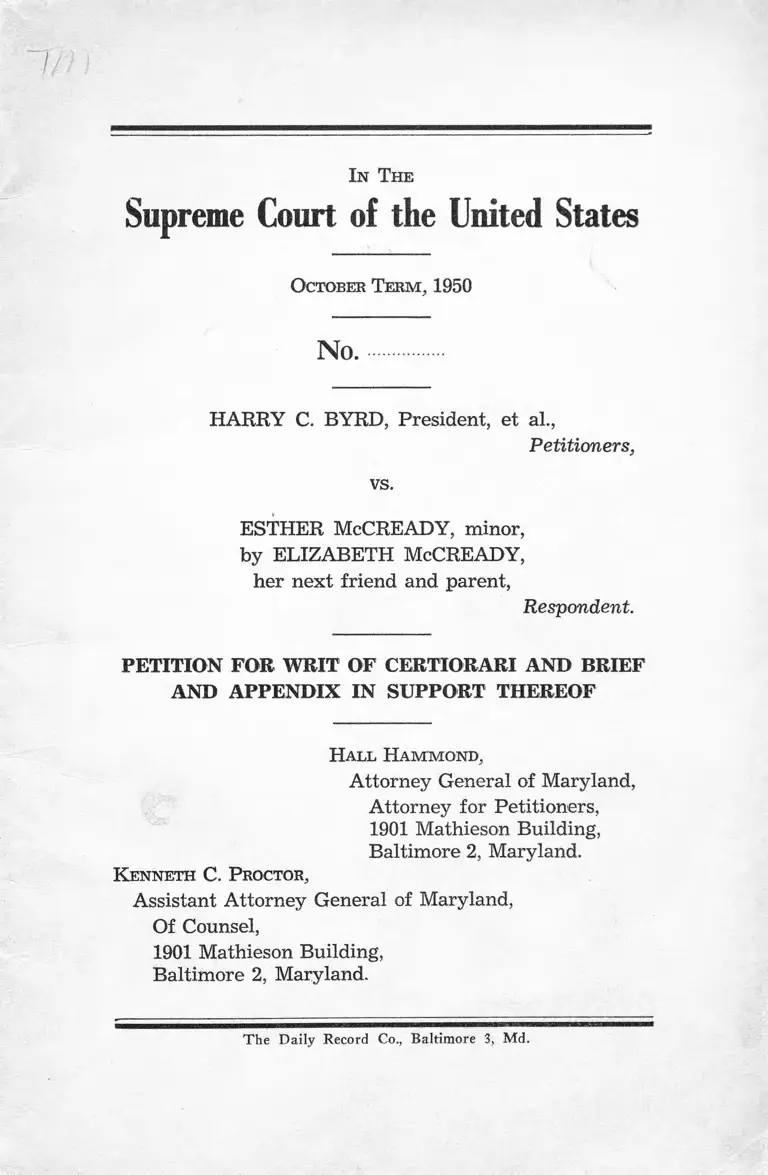
I n T h e
Supreme Court of the United States
O ctober T e r m , 1950
No.
HARRY C. BYRD, President, et al.,
Petitioners,
vs.
ESTHER McCREADY, minor,
by ELIZABETH McCREADY,
her next friend and parent,
Respondent.
PETITION FOR WRIT OF CERTIORARI AND BRIEF
AND APPENDIX IN SUPPORT THEREOF
Hall Ham m ond ,
Attorney General of Maryland,
Attorney for Petitioners,
1901 Mathieson Building,
Baltimore 2, Maryland.
K e n n e t h C. P ro cto r ,
Assistant Attorney General of Maryland,
Of Counsel,
1901 Mathieson Building,
Baltimore 2, Maryland.
The Daily Record Co., Baltimore 3, Md.
I N D E X
(Petition for Writ of Certiorari)
Table of Contents
PAGE
I. Su m m a ry Statement of the Matter Involved 2
II. Jurisdictional Statement ................................. 4
III. Question Presented ...................................... 6
IV. Reasons for Granting the W rit........... 6
V. Transcript of Record and Supporting Brief 7
Table of Citations
Cases
Hinderlider v. LaPlata River & Cherry Creek Ditch
Co., 304 U. S. 92, 106, 82 L. Ed. 1202, 1210.......... 5, 6
Missouri ex rel. Gaines v. Canada, 305 U. S. 337, 83 L.
Ed. 208 ................................................................... 5,7
Poole v. Fleeger, 11 Pet. 185, 9 L. Ed. 680, 690 5
Sipuel v. Board of Regents of the University of Okla
homa, 332 U. S. 631, 92 L. Ed. 247......................... 5
University of Maryland v. Murray, 169 Md. 478 5
Virginia v. Tennessee, 148 U. S. 502, 517-519, 37 L. Ed.
537, 542-543 ........................................................ 5, 6
Wharton v. Wise, 153 U. S. 155, 171-173, 38 L. Ed.
669, 676 6
Statutes
Constitution of the United States, Fourteenth Amend
ment ...................................................................... 5,6
Laws of 1949, (Maryland) Chapter 282 2, 7
United States Code, Revised Title 28, Section 1257 (3) 4
11
I N D E X
(Brief)
Table of Contents
pa g e
Opinion in the Court Below ............................................ 9
Jurisdiction ............................................................................ 10
Jurisdictional Statement .............................................. 10
Statement of Facts ........................................................... 11
Errors Below Relied on He r e .......................................... 17
A rgument :
Did the Offer to Provide Nursing Education for
Miss McCready at Meharry Medical College,
Nashville, Tennessee, Under the Regional Com
pact, Afford to Her the Equal Protection of the
Laws Guaranteed by the Fourteenth Amend
ment to the Constitution of the United States? 17
Conclusion .............................................................................. 28
Table of Citations
Cases
Hinderlider v. LaPlata River & Cherry Creek Ditch
Co., 304 U. S. 92, 106, 82 L. Ed. 1202, 1210 11, 24-25
Maryland v. Murray, 169 Md. 478................................ 11, 29
McCready, minor, by Elizabeth McCready, etc. v.
Harry C. Byrd, President, et al, Court of Ap
peals of Maryland, October Term 1949, No. 139,
73 A. (2) 8 ............................................................. 9
McLaurin v. Oklahoma State Regents, No. 34, Octo
ber Term, 1949 ...................................................... 18
Ill
PAGE
Missouri, ex rel. Gaines v. Canada, 305 U. S. 337, 83
L. Ed. 208 ........................................... 10, 11, 18, 26, 28, 29
Plessy v. Ferguson, 163 U. S. 537, 41 L. Ed. 256 18
Poole v. Fleeger, 11 Pet. 185, 9 L. Ed. 680, 690 11, 24
Sipuel v. Board of Regents of the University of Okla
homa, 332 U. S. 631, 92 L. Ed. 247..............10-11, 26, 29
Sweatt v. Painter, et al, No. 44, October Term, 1949 18
Virginia v. Tennessee, 148 U. S. 502, 517-519, 37 L. Ed.
537, 542-543 .................................................. 11,21-23,24
Wharton v. Wise, 153 U. S. 155, 171-173, 38 L. Ed.
669, 676 ................................................................. 11,23
Statutes
Constitution of the United States:
Article I, Section 10, Clause 3............................ 19
Fourteenth Amendment ..................................... 10,17
Laws of 1949, (Maryland) Chapter 282 .................... 13, 18
United States Code, Revised Title 28, Section 1257 (3) 10
Miscellaneous
Congressional Record, Volume 95, No. 77, page 5588,
Tuesday, May 3, 1949 ........................................... 20
Conference Proceedings, 1949, page 69, National Asso
ciation of Attorneys General................................ 19
Report of Interstate Compact Committee—Penna.
Bar Assn., June, 1950........................................... 24
In The
Supreme Court of the United States
October Term, 1950
No.
HARRY C. BYRD, President, et al.,
Petitioners,
vs.
ESTHER MeCREADY, minor,
by ELIZABETH MeCREADY,
her next friend and parent,
Respondent.
PETITION FOR WRIT OF CERTIORARI TO THE COURT
OF APPEALS OF MARYLAND
To the Honorable, the Justices of the Supreme Court
of the United States:
The Petitioners, Harry C. Byrd, President of the Uni
versity of Maryland, Edgar F. Long, Director of Admissions,
Florence Meda Gipe, Director of the School of Nursing, and
William P. Cole, Jr., et al, constituting the Board of Regents
of the University of Maryland, respectfully pray that a writ
of certiorari may issue to review the final decision of the
Court of Appeals of Maryland in this matter:
2
I .
SUMMARY STATEMENT OF THE MATTER INVOLVED
On February 8, 1948, the Governor of the State of
Maryland entered into a Compact, known as “The Regional
Compact” with the Governors of the States of Florida,
Georgia, Louisiana, Alabama, Mississippi, Tennessee, Ark
ansas, North Carolina, South Carolina, Texas, Oklahoma,
West Virginia and the Commonwealth of Virginia. The
General Assembly of Maryland, by Chapter 282 of the Laws
of 1949 (Appendix to Brief, pp. 31-38), approved, con
firmed and ratified the Compact. As of October 10, 1949,
the date on which this case was tried below, the Compact
had been ratified and approved by the Legislatures of all
the signatory States with the exception of Texas, Virginia
and West Virginia and was in full force and effect (R. 18*).
The Regional Compact provides for education in the
professional, technological, scientific, literary and other
fields for all citizens of the several signatory States, re
gardless of race or creed, at regional educational institutions
in the Southern States. Under the Compact, the Board of
Control for Southern Regional Education and the Univer
sity of Maryland (hereinafter referred to as Maryland) en
tered into a contract for Training in Nursing Education,
dated July 19, 1949 (R. 14-17).
On February 2, 1949, the application of Esther McCready
for admission as a first year student in the School of
Nursing was received by the University of Maryland.
Miss McCready is a Negress, a citizen and resident of the
* The term “ Record” and the symbol “ R ” will be used to refer to
the printed portions of the record filed by the Petitioners with this
Court.
3
State of Maryland and of the United States of America.
At the time of filing said application, she was eighteen
years of age. Miss McCready’s educational and moral
qualifications were conceded to be at least equal to the
educational and moral qualifications of at least some of the
white students who were admitted to the Nursing School
class to which she had applied for admission. She was
concededly ready, able and willing to pay all fees and
expenses for her first year course of study and to conform
to all lawful rules and regulations governing first year
students at said School (R. 17). Not having been advised by
Maryland of any action on her application, on July 27,
1949, Miss McCready filed the Petition for Mandamus in
this case.
On August 13, 1949, Dr. Long, Director of Admissions
at Maryland, wrote Miss McCready concerning her appli
cation. She was advised of the existence and effect of The
Regional Compact. She was further advised that arrange
ments would be made so that she could attend the School
of Nursing at Meharry Medical College, Nashville, Tennes
see (hereinafter referred to as Meharry), the school at
which nursing education was to be provided under the
contract dated July 19, 1949, referred to above; that her
total expenses incident to attending Meharry, including
necessary travel and room and board, would not exceed
what it would cost her to attend Maryland; that she would
receive the same quality and kind of work at Meharry as
she would receive at Maryland. Miss McCready was further
advised that she should contact Dr. Long, who would in
form her of the procedure to be followed in applying for
admission to Meharry (R. 10-11).
It was stipulated at the trial of the case that the total
overall cost to Miss McCready, including living and travel- *
*
4
ing expenses incident to her attendance at Meharry, would
not exceed what it would cost her to attend Maryland
(R. 18). Evidence offered by Petitioners at the trial below
showed clearly that the educational facilities for nursing
education afforded at Meharry were at least equal to, if not
in fact superior to, the facilities offered at Maryland (R.
39-46; 53-55; 57-59). This evidence was not disputed or
contradicted in any way whatsoever by Miss McCready.
Miss McCready’s application for admission to Maryland
was not accepted solely because of the fact that she is a
member of the Negro race (R. 17).
II.
JURISDICTIONAL STATEMENT
Petitioners bring this Petition pursuant to Section
1257(3) of Revised Title 28 of the United States Code.
A writ of certiorari is sought to review the final decision
entered on April 14, 1950, by the Court of Appeals of
Maryland, which is the highest Court of the State of Mary
land, in the case in the October Term, 1949, entitled No.
139, Esther McCready, minor, by Elizabeth McCready, her
next friend and parent v. Harry C. Byrd, President, et al
(R. 67-72).
The facts of the case and the rulings below which bring
the case within the jurisdictional requirement of Section
1257(3) are these:
The Petitioners, relying upon The Regional Compact
and the evidence adduced in the trial below, contended
that provision for Miss McCready’s nursing education at
Meharry would afford separate but equal facilities for
such education; that such provision did not in any way
deprive Miss McCready of the equal protection of the laws
and, therefore, did not violate the Fourteenth Amendment
<
of the Constitution of the United States. Miss McCready
contended that sending her to Meharry would deprive her
of the equal protection of the laws and, therefore, abridged
her constitutional rights.
The Court of Appeals of Maryland sustained the position
of Miss McCready by its decision filed on April 14, 1950.
Its decision was based solely upon the construction it placed
upon the decisions of this Court in the cases of Missouri,
ex rel. Gaines v. Canada, 305 U. S. 337, 83 L. Ed. 208, and
Sipuel v. Board of Regents of the University of Oklahoma,
332 U. S. 631, 92 L. Ed. 247. As a matter of fact, the decision
of the Court of Appeals of Maryland, except for a recital of
the facts and for a passing reference to the case of Univer-
sity of Maryland v. Murray, 169 Md. 478, consists entirely of
quotations from the decision of this Court in Missouri, ex
rel. Gaines v. Canada, supra.
The decision of the Court of Appeals of Maryland was
based upon dictum in Missouri, ex rel. Gaines v. Canada,
supra, indicating that separate but equal facilities must be
afforded within the jurisdiction of which the person seeking
such facilities is a citizen. The Court of Appeals of Mary
land incorrectly assumed that such dictum is an absolute
rule of law applicable in every case; that The Regional
Compact cannot, within the limits of the Constitution of
the United States, afford a means of providing “separate
but equal” educational facilities for members of the Negro
race. This decision was made in the face of declarations of
this Court to the effect that Compacts between the States
are binding upon all the citizens of such States. Virginia
v. Tennessee, 148 U. S. 502, 517-519, 37 L. Ed. 537, 542-543;
Poole v. Fleeger, 11 Pet. 185, 9 L. Ed. 680, 690; Hinderlider
v. La Plata River & Cherry Creek Ditch Company, 304
U. S. 92, 106, 82 L. Ed. 1202, 1210. This is the type of
5
6
Compact between the States which does not require the con
sent of Congress before it can be effective and binding.
Virginia v. Tennessee, supra, Wharton v. Wise, 153 U. S.
155, 171-173, 38 L. Ed. 669, 676.
III.
QUESTION PRESENTED
The question for review upon certiorari is:
Did the Offer to Provide Nursing Education for Miss
McCready at Meharry Medical College, Nashville, Tennes
see, Under The Regional Compact, Afford to Her the Equal
Protection of the Laws Guaranteed by the Fourteenth
Amendment to the Constitution of the United States?
The Court of Appeals of Maryland, in reversing the
judgment of the Baltimore City Court answered this ques
tion in the negative. In this finding and conclusion, it is
submitted, there is error.
IV.
REASON FOR GRANTING THE WRIT
The reason relied on for the allowance of a writ of
certiorari in this case is summarized as follows:
The Court of Appeals of Maryland decided a Federal
question of substance not theretofore determined by this
Court. It was that in offering to provide nursing education
for Miss McCready at Meharry under The Regional Com
pact the University of Maryland was denying her the equal
protection of the laws; that a group of States cannot com
bine in a Compact for the purpose of providing regional
education and under such Compact effect segregation of
the races; that the latter statement is true even though
admittedly, as in this case, the facilities afforded at the
7
out-of-State institution are at least equal to the facilities
provided in the home State. It is true that this Court has
indicated by dictum in Missouri ex rel. Gaines v. Canada,
supra, that to effectuate segregation of the races for
the purpose of education the equal facilities should be
provided in the jurisdiction of which the person seeking
an education is a citizen. However, it is equally true that
this Court has, on a number of occasions, held that such
segregation may be effected if equal facilities are pro
vided for the education of both races. Likewise, this Court
has held on a number of occasions that Compacts between
the States, if valid, are binding upon all of the citizens
of the several signatory States. This was held even though
such Compact was in derogation of the private rights of
such citizens. There is a pressing need for an adjudication
by this Court of the conflicting claims of the State of Mary
land and the Respondent as to the effect of The Regional
Compact and the offer of the University of Maryland to
afford nursing education for the Respondent at Meharry.
V.
TRANSCRIPT OF RECORD AND SUPPORTING BRIEF
Petitioners have already submitted to this Court a certi
fied copy of those portions of the record which were printed
for the use of the Court of Appeals of Maryland and of
the record of proceedings of said Court. Petitioners submit
herewith a brief in support of this Petition, and as an
appendix to said brief, for the convenience of this Court,
Chapter 282 of the Laws of 1949 of the State of Maryland.
W herefore, your Petitioners respectfully pray that a
writ of certiorari be issued out of and under the seal of
this Honorable Court, directed to the Court of Appeals of
Maryland, commanding that Court to certify and to send
to this Court for its review and determination, on a day
8
certain to be therein named, a full and complete transcript
of the record and all proceedings in the case numbered
and entitled on its docket as No. 139, October Term, 1949,
Esther McCready, minor, by Elizabeth McCready, her next
friend and parent v. Harry C. Byrd, President, et al; and
that the said judgment of the Court of Appeals of Mary
land may be reversed by this Honorable Court and that
your Petitioners may have such other and further relief
in the premises as to this Honorable Court may seem meet
and just.
And your Petitioners will ever pray.
Hall Ham mond ,
Attorney General of Maryland,
Attorney for Petitioners,
1901 Mathieson Building,
Baltimore 2, Maryland.
K enneth C. Proctor,
Assistant Attorney General of Maryland,
Of Counsel,
1901 Mathieson Building,
Baltimore 2, Maryland.
9
In The
Supreme Court of the United States
October Term, 1950
No.
HARRY C. BYRD, President, et al.,
Petitioners,
vs.
ESTHER McCREADY, minor,
by ELIZABETH McCREADY,
her next friend and parent,
Respondent.
BRIEF IN SUPPORT OF PETITION FOR WRIT
OF CERTIORARI
OPINION IN THE COURT BELOW
The Opinion of the Court of Appeals of Maryland has not
as yet been reported officially. It appears at 73 A (2d) 8
and at pages 67-72 of the Record.* The Opinion of the
Baltimore City Court was an oral one and appears at pages
27-34 of the Record.
* The term “ Record” and the symbol “ R ” will be used to refer to
the printed portions of the record filed by the Petitioners with this
Court.
10
JURISDICTION
The statutory provision is Section 1257(3), Revised Title
28, United States Code.
The final decision of the Court of Appeals of Maryland
reversing the judgment of the Baltimore City Court was
entered on April 14, 1950. The Court of Appeals of Mary
land is the Court of last resort for the State of Maryland
and, as such, meets the test of Section 1257(3), Revised
Title 28, United States Code and Rule 38 of this Court.
JURISDICTIONAL STATEMENT
The nature of the case and the rulings below which bring
the case within the jurisdictional requirement of Section
1257(3) appear from the following:
The Petitioners, relying upon The Regional Compact
and the evidence adduced in the trial below, contended that
provision for Miss McCready’s nursing education at Me-
harry would afford separate but equal facilities for such
education; that such provision did not in any way deprive
Miss McCready of the equal protection of the laws and,
therefore, was not in violation of the Fourteenth Amend
ment of the Constitution of the United States. Miss Mc
Cready contended that such provision would deprive her
of the equal protection of the laws and would, therefore,
abridge her rights under that Amendment.
The Court of Appeals of Maryland sustained the position
of Miss McCready by its decision filed on April 14, 1950.
Its decision was based solely upon the construction placed
by it upon the decisions of this Court in the cases of
Missouri, ex rel. Gaines v. Canada, 305 U, S. 337, 83 L. Ed.
208, and Sipuel v. Board of Regents of the University of
11
Oklahoma, 332 U. S. 631, 92 L. Ed. 247. As a matter of fact,
the decision of the Court of Appeals of Maryland, except
for the recital of the facts involved and for a passing refer
ence to the case of University of Maryland v. Murray, 169
Md. 478, consists entirely of quotations from the decision
of this Court in Missouri, ex rel. Gaines v. Canada, supra.
The decision of the Court of Appeals of Maryland was
based upon dictum in Missouri, ex rel. Gaines v. Canada,
supra, indicating that separate but equal facilities must
be afforded within the jurisdiction where the person seek
ing such facilities is a citizen. The Court of Appeals of
Maryland incorrectly assumed that such dictum is an abso
lute rule of law applicable in every case; that The Regional
Compact cannot, within the limits of the Constitution of
the United States, afford a means of providing “separate
but equal” educational facilities for members of the Negro
race. This decision was made in the face of declarations
of this Court to the effect that Compacts between the
States are binding upon all the citizens of such States.
Virginia v. Tennessee, 148 U. S. 502, 517-519, 37 L. Ed. 537,
542-543; Poole v. Fleeger, 11 Pet. 185, 9 L. Ed. 680, 690;
Hinderlider v. La Plata River & Cherry Creek Ditch Com
pany, 304 U. S. 92, 106, 82 L. Ed. 1202, 1210. This is
the type of Compact between the States which does not re
quire the consent of Congress before it can be effective and
binding. Virginia v. Tennessee, supra; Wharton v. Wise,
153 U. S. 155, 171-173; 38 L. Ed. 669, 676.
STATEMENT OF FACTS
The facts in this case are either admitted or uncontra
dicted. They may be summarized as follows:
Esther McCready (herein referred to as “Respondent” ),
a Negress, eighteen years of age, a citizen and resident of
the State of Maryland and of the United States of America,
12
duly filed her application, dated February 1, 1949, for ad
mission as a first year student in the School of Nursing of
the University of Maryland (herein referred to as “Mary
land” ) for the academic year beginning August 8, 1949.
That application was received by the proper authorities of
the University of Maryland on February 2, 1949. This
School is the only public institution offering a nursing edu
cation in the State of Maryland (R. 17-18). Two courses of
study are open to students admitted to the School. One is a
three year course leading to a certificate. The other re
quires the prior successful completion of two years of
college and leads to a B. S. degree. Three years study is re
quired in each course (R. 8).
The educational and moral qualifications of Respondent
are equal to, if not superior to, the educational and moral
qualifications of at least some of the white students who
were admitted to the first year class at Maryland for the
academic year beginning August 8, 1949, and whose appli
cations were received by the proper authorities of the
University of Maryland after the receipt of Respondent’s
application. Respondent was ready, able and willing to
pay all fees and expenses for her first year course of study
and to conform to all lawful rules and regulations gov
erning first year students at Maryland (R. 17-18). Respon
dent filed the Petition for Mandamus in this case on July
27, 1949.
On August 13, 1949, Dr. Edgar F. Long, Director of Ad
missions of the University of Maryland (one of the Peti
tioners), wrote to Respondent concerning her application
(R. 10-11). In this letter, Respondent was advised of the
policy of the State of Maryland that members of the white
and Negro races should be segregated in public educa
tional institutions. She also was advised that, in further
13
ance of said policy, the Governor of the State of Mary
land had entered into a Compact dated February 8, 1948,
known as “The Regional Compact”, with the Governors of
the States of Florida, Georgia, Louisiana, Alabama, Missis
sippi, Tennessee, Arkansas, North Carolina, South Caro
lina, Texas, Oklahoma, West Virginia and the Common
wealth of Virginia; that the General Assembly of Mary
land, by Chapter 282 of the Laws of 1949, approved, con
firmed and ratified said Compact, the Act of approval be
ing effective June 1, 1949; that said Compact had been ap
proved by proper legislative action by more than six of the
aforesaid States and was in full force and effect; that The
Regional Compact makes provision for education in the
professional, technological, scientific, literary and other
fields of all citizens of the several signatory States, regard
less of race or creed, at regional educational institutions in
the Southern States; that arrangements had been made
whereby the Meharry Medical College, Nashville, Tennes
see, had become a Compact Institution to which the signa
tory States will send students for medical, dental and
nursing education. Respondent was further advised that
arrangements would be made so that she could attend the
School of Nursing at Meharry Medical College (herein re
ferred to as “Meharry” ) ; that her total expenses incident to
attending Meharry, including necessary travel and room
and board, would not exceed what it would cost her to at
tend Maryland; that she would receive the same kind and
quality of work at Meharry as she would receive at Mary
land. Respondent was advised to contact Dr. Long either
at College Park or at Baltimore so that he could advise her
the procedure to be employed for her admission to Meharry;
that it was necessary that her application be certified to
Meharry by the Director of Admissions of the University
of Maryland.
14
It was stipulated by Respondent’s counsel that the total
overall cost to her, including living and traveling expenses,
incident to her attendance at Meharry would not exceed
what it would cost her to attend Maryland (R. 18). It was
further stipulated that as of October 10, 1949, the date on
which this case was tried below, The Regional Compact
had been ratified and approved by the Legislatures of all
the signatory States with the exception of Texas, Virginia
and West Virginia and that the Compact was in full force
and effect; also that each of the signatory States has segre
gated schools (R. 18).
It was stipulated that Respondent’s application for ad
mission to Maryland was not accepted solely because of
the fact that she is a member of the Negro race (R. 17).
There was offered in evidence the Contract for Training
in Nursing Education, dated July 19, 1949, between the
Board of Control for Southern Regional Education and the
University of Maryland (R. 14-17). Under this contract,
the Board covenants and agrees, among other things, to pro
vide the State of Maryland with a quota of three places
in Meharry Medical College, School of Nursing, Nashville,
Tennessee, for first year students to be selected from ap
plicants certified by the State of Maryland, that said quota
should continue through each succeeding college class until
it applies to all years of instruction desired by the State of
Maryland (R. 15). The State of Maryland, among other
things, agrees to make certain payments to the Board for
each student accepted under the Contract (R. 16). The
term of the contract is for two calendar years from July 1,
1949, automatically renewable for an additional term of
two years and so on unless either party gives the other
party notice, in writing, of its intention to terminate the
Contract at least two calendar years prior to the date of
termination (R. 16).
15
At the trial of this case, Petitioners offered evidence,
which was not disputed or contradicted in any way what
soever by Respondent, showing clearly that the educational
facilities for nursing education afforded at Meharry were
at least substantially equal to, if not in fact somewhat
superior to, the facilities offered at Maryland. Dr. Maurice
C. Pincoffs, who for a period of sixteen months prior to the
trial of this case had been in policy charge of the School
of Nursing of the University of Maryland, testified in detail
regarding the comparison of the facilities of the two Schools
(R. 39-46). His conclusion, based upon a comparison of
available funds, character of the student body, character
of the faculty, physical facilities (class rooms, laboratories,
equipment), curriculum and living conditions, was that
“if the objective of the candidate is education in nursing,
Meharry Medical College offers at least equivalent, and in
my opinion, somewhat better organized instruction in nurs
ing” (R. 46).
Petitioners also produced the testimony of Mrs. Verne
Allen Nesbitt, a graduate of Vanderbilt University and
the University of Nashville, Tennessee, and a registered
nurse. She is a white woman, well educated, whose hus
band is a medical doctor presently associated writh the
Johns Hopkins Hospital. At the time of the trial, Mrs.
Nesbitt was instructor in obstetrics in the School of Nurs
ing at Sinai Hospital, Baltimore, Maryland. Mrs. Nesbitt
taught at Meharry, for one term in the year 1947 (R. 52-53).
She testified that “Meharry students are a higher caliber
student than you would see in a hospital school of nursing
for the reason that they are better prepared, and are young
people who are seeking a higher course in nursing than the
three year course” (R. 53-54); that the physical facilities
offered at Meharry (the nurses’ home and the hospital
16
facilities) compared favorably with the facilities at Vander
bilt or Sinai (R. 54-55). She further testified that she was
much impressed with the library of the School, which was
shared with medical and dental students; also with the op
portunity for social life afforded the students (R. 55).
Petitioners further produced testimony showing that
Meharry was accredited by the National League of Nurs
ing Education, which, in itself, shows that it is a first class
nursing institution (R. 58). Although accreditation by the
League is conditioned upon application by the School of
Nursing seeking a rating, Maryland had not, up to the time
of trial, sought such accreditation for the reason that its
officials did not believe that it could meet the rigid standards
of the League (R. 58, 61).
In taking Tennessee State Board of Nursing examina
tions, graduates of Meharry compared most favorably with
graduates of other schools. Out of seven or eight subjects,
Meharry graduates’ average examination grades were
higher than the average examination grades of graduates
of approximately fourteen other schools of nursing in
Tennessee (R. 45). On the other hand, the record of
graduates of Maryland on examinations conducted by the
Maryland State Board of Examiners of Nurses’ does not
compare too favorably with the record of the graduates of
other schools of nursing (R. 64-66).
Up to the time of trial, only one graduate of Meharry had
applied for registration in the State of Maryland. She is
Mrs. Miriam Austin Wilkens, at present Assistant Director
of the School of Nursing at Provident Hospital, Baltimore,
Maryland. She was registered by the Maryland Board on
the basis of her Tennessee registration (R. 57-58).
17
ERRORS BELOW RELIED ON HERE
Petitioners rely on the following point:
The Fourteenth Amendment to the Constitution of the
United States does not prevent the State of Maryland from
effecting segregation of the white and Negro races for the
purpose of education, provided the facilities offered are
substantially equal; that the offer by the University of
Maryland under The Regional Compact to provide nursing
education for Respondent at Meharry Medical College,
School of Nursing, Nashville, Tennessee, would afford equal
facilities for the education of Respondent; that, therefore,
there has been no abridgement of the Respondent’s consti
tutional guarantee of equal protection of the laws. This
point was decided by the Baltimore City Court in favor of
the Petitioners and was decided by the Court of Appeals
of Maryland erroneously in favor of the Respondent.
ARGUMENT
DID THE OFFER TO PROVIDE NURSING EDUCATION FOR MISS
McCREADY AT MEHARRY MEDICAL COLLEGE, NASHVILLE,
TENNESSEE, UNDER THE REGIONAL COMPACT, AFFORD TO HER
THE EQUAL PROTECTION OF THE LAWS GUARANTEED BY THE
FOURTEENTH AMENDMENT TO THE CONSTITUTION OF THE
UNITED STATES?
Under the particular facts presented by this case, the
only question presented is as follows: Did the State of Mary
land, by virtue of the fact that it is a party to The Regional
Compact, discharge its duties and obligations to Respondent
under the Constitution of the United States when it ar
ranged for her nursing education at Meharry Medical Col
lege, School of Nursing, Nashville, Tennessee? This issue
is partly a question of fact and partly a question of law;
viz: (a) Are the facilities for nursing education offered by
Meharry substantially equal to the facilities offered at
18
Maryland? (b) Is provision for the education of a Maryland
citizen at a Compact institution legal segregation of the
races for educational purposes within the purview of the
Constitution of the United States and the decisions of this
Court?
1.
The policy of segregation of the two races for educational
purposes is generally accepted throughout the States which
are parties to The Regional Compact and has been ap
proved by this Court in the case of Plessy v. Ferguson, 163
U. S. 537, 41 L. Ed. 256. This approval of segregation was
again recognized in the case of Missouri, ex rel. Gaines v.
Canada, 305 U. S. 337, 344, 83 L. Ed. 208, 211. Finally, by
the very recent decisions of this Court in the cases of
Sweatt v. Painter, et al., No. 44, October Term, 1949, and
McLaurin v. Oklahoma State Regents, No. 34, October
Term, 1949, this Court refused to reexamine the “separate
but equal” doctrine enunciated in Plessy v. Ferguson, supra,
although requested to do so by the Solicitor General of
the United States.
2.
The Regional Compact (Laws of 1949, Ch. 282), which
was approved by the State of Maryland, effective June 1,
1949, was executed by the signatory States for the purpose
of the development and maintenance of education of the
citizens of such States on a regional basis. It is intended
to afford greater educational opportunities for such citizens
than could be provided by the several States separately.
It applies to all citizens of the States by its express pro
visions. The operations under the Compact, up to this
point, have, in fact, benefited all citizens regardless of
race or creed. For example, the State of Maryland, under
19
The Regional Compact, has sent several white students of
veterinary medicine to the University of Georgia and two
Negro students of medicine to Meharry.
In his remarks before the 1949 Conference of the National
Association of Attorneys General, (Conference Proceedings,
1949, p. 69) Solicitor General William F, Barry, of Tennes
see, made the following remarks on this point:
“Under these arrangements 207 white students and
180 Negro students will receive training in 1949-50.
These services are being paid for by a budget of approx
imately one and one-half million dollars. The Central
Control Office operations (located in Atlanta) carry
an annual budget of approximately $85,000.
“The program officially began in September, 1948.
In less than a year, therefore, regional planning in
graduate and professional education grew from a pro
posal to a program. The Board of Control has begun
to serve as an agency through which the states and in
stitutions of the compact area can broaden the base
of planning and support so that the opportunities for
training leadership in the South can match or exceed
opportunities anywhere in the nation.”
The Regional Compact is not, either expressly or by
necessary implication, aimed at segregation of the races.
However, it is available as a means of effecting such segre
gation when such means are not available within the con
fines of the several States. The Compact, as of the present
time, has been ratified by appropriate legislative action
of the signatory States, with the exception of Texas, Vir
ginia and West Virginia.
3.
The Regional Compact is the type of agreement which,
under Article I, Section 10, Clause 3 of the Constitution of
the United States, does not require approval by Congress
before it can become effective. When the Federal Aid to
20
Education Bill was being debated in the Senate, Senator
Morse of Oregon, in his remarks concerning a proposed
amendment to said Bill, discussed the fact that he had
opposed ratification of The Regional Compact by the
Senate. His remarks set forth in the Congressional Record,
Vol. 95, No. 77, page 5588, Tuesday, May 3, 1949, show the
following reasons for his opposition:
“First, is this the type of compact which the Con
stitution requires the Congress to ratify? I shall not
repeat my argument of last year at any length, other
than to point out that I am satisfied now, as I was then,
that the interstate compact offered by the 16 Southern
States was not the type of interstate compact that the
Congress of the United States, under the Constitution,
is required—and I underline the word ‘required’—to
ratify.
“So when the interstate compact was before us we
had to decide this question, ‘Is this the type of compact
which requires ratification by the Congress of the
United States?’ Of course the answer to that question
was clearly no; and the answer was ‘no’ because of
the second question which we must consider in such
a situation. The second question is: What Federal
jurisdiction is in any way encroached upon by the
proposed contract? It will be recalled that during the
course of the debate not a single southern Senator
could point out a single Federal power which was
encroached upon by the proposed compact. Until they
could show wherein that southern compact in some
way transgressed a delegated Federal power under
the Constitution of the United States, they were clearly
out of court, so to speak, so far as the Congress was
concerned. They failed to advance any sound argu
ment showing that as a matter of constitutional duty
under the interstate compact clause we would have to
approve the compact before it could be put into effect
by the States.”
21
That this Compact is not the type which requires Con
gressional approval is further supported by the case of
Virginia v. Tennessee, 148 U. S. 502, 517-519, 37 L. Ed.
537, 542-543. The applicable rule is stated by the Supreme
Court to be as follows:
“The Constitution provides that ‘no state shall, with
out the consent of Congress, lay any duty of tonnage,
keep troops or ships of war in time of peace, enter into
any agreement or compact with another state, or with
a foreign power, or engage in war, unless actually
invaded, or in such immediate danger as will not ad
mit of delay’.
“Is the agreement made without the consent of Con
gress, between Virginia and Tennessee, to appoint
commissioners to run and mark the boundary line
between them, within the prohibition of this clause?
The terms ‘agreement’ or ‘compact’ taken by them
selves are sufficiently comprehensive to embrace all
forms of stipulation, written or verbal, and relating
to all kinds of subjects; to those to which the United
States can have no possible objection or have any
interest in interfering with, as well as to those which
may tend to increase and build up the political influ
ence of the contracting states, so as to encroach upon
or impair the supremacy of the United States or inter
fere with their rightful management of particular
subjects placed under their entire control.
“There are many matters upon which different states
may agree that can in no respect concern the United
States. If, for instance, Virginia should come into
possession and ownership of a small parcel of land in
New York ivhich the latter state might desire to ac
quire as a site for a public building, it would hardly
be deemed essential for the latter state to obtain the
consent of Congress before it could make a valid agree
ment with Virginia for the purchase of the land. If
Massachusetts, in forwarding its exhibits to the World’s
Fair at Chicago, should desire to transport them a
part of the distance over the Erie Canal, it would
22
hardly be deemed essential for that state to obtain
the consent of Congress before it could contract with
New York for the transportation of the exhibit through
that State in that way. If the bordering line of two
states should cross some malarious and disease pro
ducing district, there could be no possible reason, on
any conceivable public grounds, to obtain the consent
of Congress for the bordering states to agree to unite
in draining the district, and thus remove the cause of
disease. So in the case of threatened invasion of
cholera, plague, or other causes of sickness and death,
it would be the height of absurdity to hold that the
threatened states could not unite in providing means
to prevent and repel the invasion of the pestilence
without obtaining the consent of Congress, which might
not be at the time in session. If, then, the terms ‘com
pact’ or ‘agreement’ in the Constitution do not apply
to every possible compact or agreement between one
state and another, for the validity of which the con
sent of Congress must be obtained, to what compacts
or agreements does the Constitution apply?
“Looking at the clause in which the terms ‘compact’
or ‘agreement’ appear, it is evident that the prohibition
is directed to the formation of any combination tend
ing to the increase of political power in the states,
which may encroach upon or interfere with the just
supremacy of the United States. Story, in his Com
mentaries (§1403) referring to a previous part of the
same section of the Constitution in which the clause in
question appears, observes that its language ‘may be
more plausibly interpreted from the terms used,
“ treaty, alliance, or confederation,” and upon the
ground that the sense of each is best known by its
association (noscitur a sociis) to apply to treaties of
a political character; such as treaties of alliance for
purposes of peace and war; and treaties of confedera
tion, in which the parties are leagued for mutual
government, political co-operation, and the exercise
of political sovereignty, and treaties of cession of
23
sovereignty, or conferring internal political jurisdic
tion, or external political dependence, or general com
mercial privileges’ ; and that ‘the latter clause, “com
pacts and agreements,” might then very properly ap
ply to such as regarded what might be deemed mere
private rights of sovereignty; such as questions of
boundary; interests in land situate in the territory
of each other; and other internal regulations for the
mutual comfort and convenience of states bordering
on each other.’ And he adds: ‘In such cases the con
sent of Congress may be properly required, in order
to check any infringement of the rights of the national
government; and, at the same time, a total prohibition
to enter into any compact or agreement might be at
tended with permanent inconvenience or public mis
chief.’ ” (Italics supplied).
See also:
Wharton v. Wise, 153 U. S. 155, 171-173; 38 L. Ed.
669, 676.
It is obvious that The Regional Compact in no way tends
“to increase and build up the political influence of the con
tracting State, so as to encroach upon or impair the su
premacy of the United States or interfere with their
rightful management of particular subjects placed under
their entire control” .
Certainly, interstate problems concerned with health
(e.g., infectious or contagious diseases, whether of humans
or of animals), institutional care (e.g., women’s prisons,
mental hospitals, homes for aged) conservation of natural
resources (e.g., oyster and fish conservation problems of
Maryland and Virginia) and motor vehicles (e.g,. recogni
tion of license tags of a foreign State) can be and have
been handled by Compacts between the States without the
requirement that they receive the approval of the Con
gress of the United States.
24
The Report of the Interstate Compact Committee of the
Pennsylvania Bar Association in June, 1950, states as
follows:
“There is now under consideration in eleven western
States a proposal to establish a regional institution
for care of mentally deficient juvenile delinquents.
There has been recommended also creation of regional
schools for the deaf and blind on a four-state basis
(Utah, Idaho, Wyoming and Nevada). It is not known
at the present time whether the States sponsoring
these institutional facilities intend to request the con
sent of the Congress to such plans.
“On the basis of precedents indicating that it is con
sidered unnecessary to secure approval of the Congress
with respect to agreements between States when those
agreements do not tend to increase political power of
the States or encroach on Federal supremacy under
the United States Constitution, States are beginning to
utilize the compact method for providing services as
to which the Federal government has not heretofore
asserted authority. Until recently the best known in
stances have been the arrangements between Virginia
and West Virginia for the use of an educational insti
tution in Richmond and between Vermont and New
Hampshire for a joint state penitentiary to serve both
States.”
It is submitted that this is equally true of interstate com
pacts which are concerned with higher education for citi
zens of the several States.
4.
The Regional Compact is binding upon each of the signa
tory States and upon all of the citizens of such States.
Virginia v. Tennessee, (L. Ed. p. 545), supra; Poole v.
Fleeger, 11 Pet. 185, 9 Ed. 680, 690; Hinderlider v. La Plata
River & Cherry Creek Ditch Company, 304 U. S. 92, 106,
25
82 L. Ed. 1202, 1210. In the last case cited, the Supreme
Court of the United States, in discussing the effect of inter
state compacts upon the citizens of the signatory States,
said as follows:
“Whether the apportionment of the water of an in
terstate stream be made by compact between the upper
and lower States with the consent of Congress or by
a decree of this Court, the apportionment is binding
upon the citizens of each State and all water claimants,
even where the State had granted the water rights
before it entered into the compact. That the private
rights of grantees of a State are determined by the
adjustment by compact of a disputed boundary was
settled a century ago in Poole v. Fleeger, 11 Pet. 185,
209, 9 L. ed. 680, 690, where the Court said:
‘It cannot be doubted, that it is a part of the general
right of sovereignty, belonging to independent nations,
to establish and fix the disputed boundaries between
their respective territories; and the boundaries so
established and fixed by compact between nations,
become conclusive upon all the subjects and citizens
thereof, and bind their rights; and are to be treated,
to all intents and purposes, as the true and real bound
aries. This is a doctrine universally recognized in the
law and practice of nations. It is a right equally be
longing to the states of this Union; unless it has been
surrendered under the Constitution of the United
States. So far from there being any pretense of such a
general surrender of the right, that it is expressly
recognized by the Constitution and guarded in its ex
ercise by a single limitation or restriction, requiring
the consent of Congress.’ ”
5.
The Regional Compact does not deprive the Respondent
of any rights guaranteed to her by the Constitution of the
United States.
26
Considering this point, it must be borne in mind that
up to this time none of the decisions of this Court have
dealt with the exact problem here under consideration.
In the case of Missouri, ex rel. Gaines v. Canada, supra,
the Petitioner was an applicant for admission to the Law
School. This was likewise true in the case of Sipuel v.
Oklahoma, 332 U. S. 631, 92 L. Ed. 247 (333 U. S. 147, 92 L.
Ed. 605). In the Gaines case supra, (L. ed. p. 213) in con
tending that the Writ should be issued, the Petitioners
relied particularly upon the special advantages incident
to attending a Law School in the State of which one is a
citizen and in which one intends to practice. The opinion
in the Sipuel case was per curiam and makes no reference
whatsoever to Petitioner’s contentions therein, the decision
being based upon the rule laid down in the Gaines case.
Petitioners admit that there are certain advantages incident
to attending a local Law School over attendance at one
outside of the State where one proposes to practice. In
a local school, the emphasis is upon local rules of practice
and procedure and substantive law peculiar to that State.
There is also the opportunity of observing the local courts
in action. However, no such advantages accrue to a student
of nursing. There are no rules regarding nursing which are
peculiar to any given State nor is there any practice in the
nursing profession peculiar to any given State.
An additional factor in the present case is that the
operations under The Regional Compact are such that the
cost to Respondent at Meharry will be no greater than
her expenses would be if she attended Maryland. That this
is true is conceded by Respondent (R. 18).
Under The Regional Compact, contracts have been en
tered into between various States, which wish to send
students out of their own boundaries for educational pur-
27
poses, with the Regional Board and by the Board with
Colleges and Universities in the various States, It is sub
mitted that, so far as citizens of Maryland are concerned,
the effect of these contracts executed under The Regional
Compact is identically the same as if the educational facil
ities were furnished within the State of Maryland. For
example, if the Maryland State College, at Princess Anne,
(a division of the University of Maryland) afforded facil
ities for nursing education substantially equal to such
facilities provided by the University of Maryland, in Balti
more, Appellees could provide such education for Respond
ent at the former institution. No question could be raised ' N o
under such circumstances that Respondent’s constitutional
rights had been violated. If, in lieu of having facilities for
nursing education of Negroes at Princess Anne, Somerset
County, the University of Maryland owned a tract of land
over the State line in Accomac County, Virginia, and there
established facilities for nursing education of Negroes sub
stantially equal to such facilities at the University of Mary
land, the same rule would unquestionably apply. Under
such circumstances, equal educational opportunities would
be afforded to Negro students by the University of Mary
land at a division of the University of Maryland. It is in
conceivable that the mere fact that the physical facilities
were located just outside the boundaries of the State of
Maryland would affect the rule. Instead of adopting what
would prove to be a most expensive and burdensome pro
cedure, viz. outright purchase of educational facilities so
that they would be an integral part of the University of
Maryland, the State has adopted the alternative procedure
of contracting for education of Maryland citizens in institu
tions located outside of the State. Maryland citizens are
protected by the provisions of The Regional Compact and
of the various contracts executed thereunder. There cer-
28
tainly is no substantial difference between such a con
tractual arrangement for, and actual ownership of, the
educational facilities. By this method, the State of Mary
land can maintain its policy of segregation, and, at the
same time, provide educational opportunities for Negroes
which are equal to those afforded to members of the white
race at no additional cost whatsoever to the members of
the Negro race.
That the facilities for nursing education offered at Me-
harry are substantially equal to those offered at Maryland
is obvious, and in fact uncontradicted, in the present
case so that in that respect this case meets the require
ments of all the decisions on this subject. It is clear from
a consideration of the careful analysis by Dr. Pincoffs
of the two Schools, the testimony of Mrs. Nesbitt and
the other evidence offered by Petitioners that a student
at Meharry receives an education in nursing certainly equal
to that afforded at Maryland. In fact, the conclusion that
Meharry, considering all factors, offers better educational
facilities can reasonably be drawn from the evidence.
6.
The Regional Compact has introduced a new decisive
factor into the law. The new factor is that the States
which have ratified the Compact have, for educational
purposes, eliminated State lines. It is an attempt through
voluntary agreement and cooperation to provide citizens
of all the signatory States with unlimited educational
opportunities. The opportunities proposed by The Regional
Compact have been assured by the execution of contracts
thereunder. The operations under The Regional Compact
are distinctly different from those under the out-of-State
scholarship plans in vogue in a number of States prior
to the decision in the Gaines case, supra. The scholarship
29
plans provided only for tuition. The fact that the student
would incur additional expense, such as travel, was not
taken into consideration. This, of course, resulted in
inequality. This is no longer true under The Regional
Compact plan.
7.
The Court’s attention is directed to the fact that a few
of the Western-Rocky Mountain States are presently oper
ating under informal agreements which involve incarcera
tion of female prisoners and treatment of mental patients
and the aged and indigent. In addition to this, those States
are presently drafting a Regional Compact covering medi
cal and dental education similar to that involved in this
case. From the foregoing, it will appear that there is a
trend toward interstate cooperation in problems of this
kind. This, of course, is dictated by a desire to provide
adequate and proper care, treatment and education for the s’ Q
citizens of the several States in a single location. Such a
solution is socially and economically sound. Most as
suredly, it does not in any way deprive the citizens of
the several States of the equal protection of the laws.
CONCLUSION
It is respectfully submitted that the Gaines, Sipuel and
Murray cases, supra, are not in point and are not con
trolling in this case; that The Regional Compact is valid
and binding upon the signatory States and the citizens of
such States; that the administration under the Compact,
so far as Respondent is concerned, does not in any way
abridge any of her constitutional rights; that Respondent
is afforded facilities for nursing education which are cer
tainly equal to and possibly better than she could obtain
at the University of Maryland; that, therefore, the judg-
30
ment of the Court of Appeals of Maryland should be re
versed.
Respectfully submitted,
Hall Ham m ond ,
Attorney General of Maryland,
Attorney for Petitioners,
1901 Mathieson Building,
Baltimore 2, Maryland.
K enneth C. Proctor,
Assistant Attorney General of Maryland,
Of Counsel,
1901 Mathieson Building,
Baltimore 2, Maryland.
31
APPENDIX TO BRIEF
LAWS OF 1949
CHAPTER 282
(Senate Bill 432)
A n A ct to approve, confirm and ratify a certain Compact
entered into by the State of Maryland and other Southern
States by and through their respective Governors on Feb
ruary 8, 1948, as amended, relating to the development and
maintenance of regional educational services and schools in
the Southern States in the professional, technological,
scientific, literary and other fields, so as to provide greater
educational advantages and facilities for the citizens in the
several States here recited in such region, and to declare
that the State of Maryland is a party to said Compact, as
amended, and that the agreements, covenants and obliga
tions therein are binding upon said State.
W hereas, on the 8th day of February, in the Year of Our
Lord One Thousand Nine Hundred and Forty-eight, the
State of Maryland, and the States of Florida, Georgia,
Louisiana, Alabama, Mississippi, Tennessee, Arkansas, Vir
ginia, North Carolina, South Carolina, Texas, Oklahoma
and West Virginia through and by their respective Gov
ernors, entered into a written Compact relative to the
development and maintenance of regional educational
services and schools in the Southern States in the profes
sional, technological, scientific, literary, and other fields, so
as to provide greater educational advantages and facilities
for the citizens of the several States who reside within
such region; and
W hereas, the said Compact has been amended in certain
respects, a copy of which Compact as amended is as follows:
THE REGIONAL COMPACT
(As Amended)
W hereas, The States who are parties hereto have during
the past several years conducted careful investigation look-
32
ing toward the establishment and maintenance of jointly
owned and operated regional educational institutions in
the Southern States in the professional, technological,
scientific, literary and other fields, so as to provide greater
educational advantages and facilities for the citizens of
the several States who reside within such region; and
W hereas, Meharry Medical College of Nashville, Ten
nessee, has proposed that its lands, buildings, equipment,
and the net income from its endowment be turned over to
the Southern States, or to an agency acting in their behalf,
to be operated as a regional institution for medical, dental
and nursing education upon terms and conditions to be
hereafter agreed upon between the Southern States and
Meharry Medical College, which proposal, because of the
present financial condition of the institution, has been ap
proved by the said States who are parties hereto; and
W hereas, The said States desire to enter into a compact
with each other providing for the planning and establish
ment of regional educational facilities;
Now, Therefore, in consideration of the mutual agree
ments, covenants and obligations assumed by the respective
States who are parties hereto (hereinafter referred to as
“States” ), the said several States do hereby form a geo
graphical district or region consisting of the areas lying
within the boundaries of the contracting States which, for
the purposes of this compact, shall constitute an area for
regional education supported by public funds derived from
taxation by the constituent States and derived from other
sources for the establishment, acquisition, operation and
maintenance of regional educational schools and institu
tions for the benefit of citizens of the respective States re
siding within the region so established as may be deter
mined from time to time in accordance with the terms and
provisions of this compact.
The States do further hereby establish and create a joint
agency which shall be known as the Board of Control for
Southern Regional Education (hereinafter referred to as
the “Board” ), the members of which Board shall consist
33
of the Governor of each State, ex officio, and three addi
tional citizens of each State to be appointed by the Gov
ernor thereof, at least one of whom shall be selected from
the field of education. The Governor shall continue as a
member of the Board during his tenure of office as Gov
ernor of the State, but the members of the Board appointed
by the Governor shall hold office for a period of four years
except that in the original appointments one Board member
so appointed by the Governor shall be designated at the
time of his appointment to serve an initial term of two
years, one Board member to serve an initial term of three
years, and the remaining Board member to serve the full
term of four years, but thereafter the successor of each
appointed Board member shall serve the full term of four
years. Vacancies on the Board caused by death, resigna
tion, refusal or inability to serve, shall be filled by appoint
ment by the Governor for the unexpired portion of the
term. The officers of the Board shall be a Chairman, a
Vice-Chairman, a Secretary, a Treasurer, and such addi
tional officers as may be created by the Board from time
to time. The Board shall meet annually and officers shall
be elected to hold office until the next annual meeting.
The Board shall have the right to formulate and establish
by-laws not inconsistent with the provisions of this com
pact to govern its own actions in the performance of the
duties delegated to it including the right to create and ap
point an Executive Committee and a Finance Committee
with such powers and authority as the Board may delegate
to them from time to time. The Board may, within its
discretion, elect as its Chairman a person who is not a
member of the Board, provided such person resides within
a signatory State, and upon such election such person shall
become a member of the Board with all the rights and
privileges of such membership.
It shall be the duty of the Board to submit plans and
recommendations to the States from time to time for
their approval and adoption by appropriate legislative ac
tion for the development, establishment, acquisition, opera
tion and maintenance of educational schools and institu-
34
tions within the geographical limits of the regional area
of the States, of such character and type and for such
educational purposes, professional, technological, scientific,
literary, or otherwise, as they may deem and determine to
be proper, necessary or advisable. Title to all such educa
tional institutions when so established by appropriate legis
lative actions of the States and to all properties and facili
ties used in connection therewith shall be vested in said
Board as the agency of and for the use and benefit of the
said States and the citizens thereof, and all such educa
tional institutions shall be operated, maintained and
financed in the manner herein set out, subject to any pro
visions or limitations which may be contained in the legis
lative acts of the States authorizing the creation, establish
ment and operation of such educational institutions.
In addition to the power and authority heretofore grant
ed, the Board shall have the power to enter into such
agreements or arrangements with any of the States and
with educational institutions or agencies, as may be re
quired in the judgment of the Board, to provide adequate
services and facilities for the graduate, professional, and
technical education for the benefit of the citizens of the
respective States residing within the region, and such
additional and general power and authority as may be
vested in the Board from time to time by legislative enact
ment of the said States.
Any two or more States who are parties of this compact
shall have the right to enter into supplemental agreements
providing for the establishment, financing and operation
of regional educational institutions for the benefit of citi
zens residing within an area which constitutes a portion of
the general region herein created, such institutions to be
financed exclusively by such States and to be controlled
exclusively by the members of the Board representing such
States provided such agreement is submitted to and ap
proved by the Board prior to the establishment of such
institutions.
35
Each State agrees that, when authorized by the Legis
lature, it will from time to time make available and pay
over to said Board such funds as may be required for the
establishment, acquisition, operation and maintenance of
such regional educational institutions as may be authorized
by the States under the terms of this compact, the contri
bution of each State at all times to be in the proportion that
its population bears to the total combined population of the
States who are parties hereto as shown from time to time
by the most recent official published report of the Bureau
of the Census of the United States of America; or upon
such other basis as may be agreed upon.
This compact shall not take effect or be binding upon
any State unless and until it shall be approved by proper
legislative action of as many as six or more of the States
whose Governors have subscribed hereto within a period
of eighteen months from the date hereof. When and if six
or more States shall have given legislative approval to
this compact within said eighteen months period, it shall
be and become binding upon such six or more States 60
days after the date of legislative approval by the Sixth
State and the Governors of such six or more States shall
forthwith name the members of the Board from their
States as hereinabove set out, and the Board shall then
meet on call of the Governor of any State approving this
compact, at which time the Board shall elect officers, adopt
by-laws, appoint committees and otherwise fully organize.
Other States whose names are subscribed hereto shall
thereafter become parties hereto upon approval of this
compact by legislative action within two years from the
date hereof, upon such conditions as may be agreed upon
at the time. Provided, however, that with respect to any
State whose constitution may require amendment in order
to permit legislative approval of the Compact, such State
or States shall become parties hereto upon approval of this
Compact by legislative action within seven years from the
date hereof, upon such conditions as may be agreed upon
at the time.
36
After becoming effective this compact shall thereafter
continue without limitation of time; provided, however,
that it may be terminated at any time by unanimous action
of the States and provided further that any State may
withdraw from this compact if such withdrawal is ap
proved by its Legislature, such withdrawal to become ef
fective two years after written notice thereof to the Board
accompanied by a certified copy of the requisite legislative
action, but such withdrawal shall not relieve the withdraw
ing State from its obligations hereunder accruing up to
the effective date of such withdrawal. Any State so with
drawing shall ipso facto cease to have any claim to or
ownership of any of the property held or vested in the
Board or to any of the funds of the Board held under the
terms of this compact.
If any State shall at any time become in default in the
performance of any of its obligations assumed herein or
with respect to any obligation imposed upon said State
as authorized by and in compliance with the terms and pro
visions of this compact, all rights, privileges and benefits
of such defaulting State, its members on the Board and its
citizens shall ipso facto be and become suspended from
and after the date of such default. Unless such default
shall be remedied and made good within a period of one
year immediately following the date of such default this
compact may be terminated with respect to such default
ing State by an affirmative vote of three-fourths of the
members of the Board (exclusive of the members repre
senting the State in default), from and after which time
such State shall cease to be a party to this compact and
shall have no further claim to or ownership of any of the
property held by or vested in the Board or to any of the
funds of the Board held under the terms of this compact, but
such termination sha.ll in no manner release such default
ing State from any accrued obligation or otherwise affect
this compact or the rights, duties, privileges or obligations
of the remaining States thereunder.
In W itness W hereof this Compact has been approved
and signed by Governors of the several States, subject to
37
the approval of their respective Legislatures in the manner
hereinabove set out, as of the 8th day of February, 1948.
STATE OF FLORIDA
By M illard F. Caldwell
Governor
STATE OF MARYLAND
By W m . Preston Lane, Jr.
Governor
STATE OF GEORGIA
By M. E. Thompson
Governor
STATE OF LOUISIANA
By J. H. Davis
Governor
STATE OF ALABAMA
By James E. Folsom
Governor
STATE OF MISSISSIPPI
By F. L. W right
Governor
STATE OF TENNESSEE
By Jim M cCord
Governor
STATE OF ARKANSAS
By Ben L aney
Governor
COMMONWEALTH OF VIRGINIA
By W m . M. Tuck
Governor
STATE OF NORTH CAROLINA
By R. Gregg Cherry
Governor
STATE OF SOUTH CAROLINA
By J. Strom Thurmond
Governor
38
STATE OF TEXAS
By Beauford H. Jester
Governor
STATE OF OKLAHOMA
By Roy J. Turner
Governor
STATE OF WEST VIRGINIA
By Clarence W. M eadows
Governor
now, therefore,
Section 1. Be it enacted by the General Assembly of
Maryland, That the said Compact is hereby approved, con
firmed and ratified, and that as soon as the said Compact
shall be approved, confirmed and ratified by the Legisla
tures of at least six of the States signatory hereto in ac
cordance with the provisions of the Compact, thereupon
and immediately thereafter, every paragraph, clause, pro
vision, matter and thing in the said Compact contained
shall be obligatory on this State and the citizens thereof,
and shall be forever faithfully and inviolably observed and
kept by the government of this State and all of its citizens
according t9 the true intent and meaning and provisions
of the said Compact.
Sec. 2. And be it further enacted, That, upon the ap
proval of this Compact by the minimum requisite number
of States, as provided in said Compact, the Governor is
hereby authorized and directed to sign an engrossed copy
of the Compact and sufficient copies thereof, so as to pro
vide that each and every State approving the Compact
shall have an engrossed copy thereof.
Sec. 3. And be it further enacted, That this Act shall
take effect on June 1, 1949.
Approved April 22, 1949.