Oklahoma City v. Tuttle Motion for Leave to File and Supplemental Brief for Respondent
Public Court Documents
1984
22 pages
-
Case Files, Garner Working Files. Oklahoma City v. Tuttle Motion for Leave to File and Supplemental Brief for Respondent, 1984. e6ab6351-35a8-f011-bbd3-000d3a53d084. LDF Archives, Thurgood Marshall Institute. https://ldfrecollection.org/archives/archives-search/archives-item/30a2d481-b747-4f5b-9515-073a7dbb61e3/oklahoma-city-v-tuttle-motion-for-leave-to-file-and-supplemental-brief-for-respondent. Accessed September 26, 2026.
Copied!
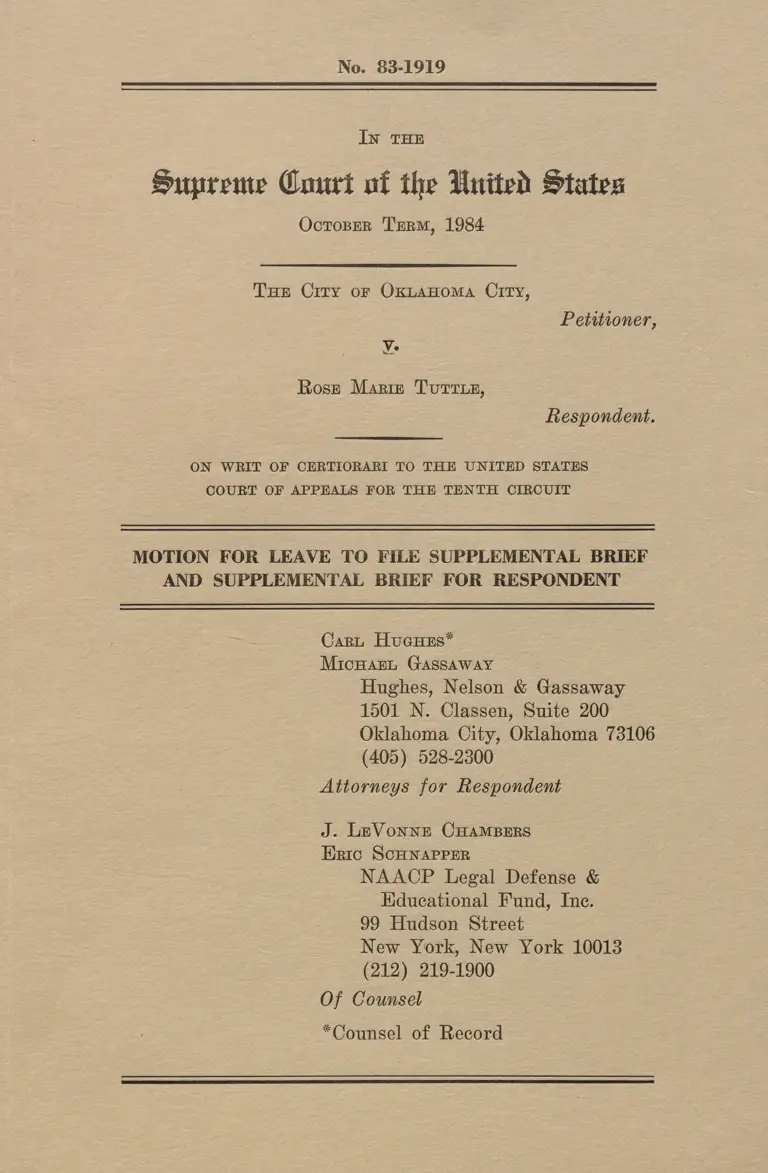
No. 83-1919
Im THE
Olourt of % Inttieii ^ a t e a
October Teem, 1984
The City of Oklahoma City,
y.
E ose Marie T uttle,
Petitioner,
Respondent.
OK WRIT OF CERTIORARI TO THE UKITED STATES
COURT OF APPEALS FOR THE TENTH CIRCUIT
MOTION FOR LEAVE TO FILE SUPPLEMENTAL BRIEF
AND SUPPLEMENTAL BRIEF FOR RESPONDENT
Carl H ughes*
Michael Gassaway
Hughes, Nelson & Gassaway
1501 N. Classen, Suite 200
Oklahoma City, Oklahoma 73106
(405) 528-2300
Attorneys for Respondent
J. L eV okke Chambers
E ric S chkapper
NAACP Legal Defense &
Educational Fund, Inc.
99 Hudson Street
New York, New York 10013
(212) 219-1900
Of Counsel
* Counsel of Record
■
■ ■ . . ■■
"" ;■ ■
,
.■■■•■■■ ■■:
. ■■■■■•■ : ■■...■ ■ , ■
-
■ ■ . ■; ■
. ■. ■■......
■ ■ ■ , ■ . ... ■■.. ..
■■■ . ■ .
'-- .--I . -
■■■.■••.:...■ •. ■ ■ ■'. . ••■,■.. .- •■■ ■•■ .-■• •
Wl̂'C
' ' J Z •»--
. V
' ’ ■ '. -r '
■:■'■ ■■■■■■.■■■■•■■ ■ . •■■ .. ■■
;. ■ ■ ■
• ■ ■ • •...■ ■ ■ • (
■■ ■: . ■.. ■. .. ■ ■•.'■ ■
. ■■ ■ ■
■; . . ■: .
V.' ■■ ■ ■. ■ . . ;■ . ■; ■■ .-.' .■■■ ..•■ .- ■ . ■ .■ . ■■■ .,.■
■v.-x.'- ' - ,;
■''‘'V ife a :- '" '
4SM
>/'m3
m -
i mVi
̂L' .> ■.
' -■-,
ig»i&i£5SS5iJSJ'. •• vv5
. . ̂ -* * *
i l i
, v: ^
-X-« " ~ ’ T
. v ' **’• . - ’■'jS-̂ - -
. - ̂C'X' - ‘ - C. '■
ilSS$%Sc:i
iiiiisis i\ . . 'v- r-v■. 2S*’’ - .. . *'v
No. 83-1919
IN THE
SUPREME COURT OF THE UNITED STATES
October Term, 1984
THE CITY OF OKLAHOMA CITY,
Petitioner,
V .
ROSE MARIE TUTTLE,
Respondent
On Writ of Certiorari
to the United States Court of Appeals
for the Tenth Circuit
- - ..... ....... ........ ^ ....... --------- ------- ■ ............ ............ .
MOTION FOR LEAVE
TO FILE SUPPLEMENTAL BRIEF
Respondent hereby moves this Court,
pursuant to Rule 35.6, for leave to submit
the annexed brief, and in support thereof
states as follows:
“ 11 “
At the oral argument in this action a
dispute arose as to whether the petitioner
had objected to the jury instructions in
the manner reauired by Rule 51. In
response to questions from the Court,
counsel for petitiner did not assert that
the statements of counsel contained in the
trial transcript met the requirements of
Rule 51. Rather, he asserted that a
specific and sufficient objection had
earlier been made off the record at an
instruction conference with the trial
judge.
This representation had never
heretofore been made by counsel for
petitioner in either this Court or the
lower courts. The accuracy of that
representation is critical to, if not
dispositive of, this appeal, since without
a sufficient objection this Court would
lack authority to consider the correctness
of the instruction at issue.
- Ill
Respondent has lodged with the Court
an affidavit of respondent's trial counsel
regarding the off the record conference
referred to by counsel for petitioner, and
seeks leave to submit this brief setting
forth her views on this new procedural
problem.
Respectfully submitted.
CARL HUGHES *
MICHAEL GASSAWAY
Hughes, Nelson & Gassaway
1501 N. Classen, Suite 200
Oklahoma City, Oklahoma 73106
(405) 528-2300
Attorneys for Respondent
J. LeVONNE CHAMBERS
ERIC SCHNAPPER
NAACP Legal Defense &
Educational Fund, Inc.
99 Hudson Street
New York, New York 10013
(212) 219-1900
Of Counsel
* Counsel of Record
TABLE OF AUTHORITIES
Case Page
Albemarle Paper Co. v. Moody,
422 U.S. 405 ( 1975) ........... 9
American Motors Sales Cor-
portation v. Semke, 384
F.2d 192 ( 10th Cir. 1967) ..... 5
City of Los Angeles v. Lyons,
461 U.S. 95 ( 1 983) 9
Great-West Life Assurance
Co. V . Levy, 382 F.2d 357
(10th Cir.* 1967) ............... 4
Monel1 V. New York City Dept,
of Social Services, 436
U.S. 658 ( 1978) ................ 7,8,9
Owen V . City of Independence,
445 U.S.' 622 ( 1980) ........... 8,9
Rizzo V . Goode, 423 U.S. 362
( 1976) ........................ 6,8,9,10
Schever v. Rhodes, 416 U.S.
232 ( 1974) ..................... 9
Rules
Rule 51, Federal Rules of
Civil Procedure ............... ii,2,4,5
Supreme Court Rule 35.6 .......... i
No. 83-1919
IN THE
SUPREME COURT OF THE UNITED STATES
October Term, 1984
THE CITY OF OKLAHOMA CITY,
Petitioner,
V .
ROSE MARIE TUTTLE,
Respondent.
On Writ of Certiorari
to the United States Court of Appeals
for the Tenth Circuit
SUPPLEMENTAL BRIEF FOR RESPONDENT
In our principal brief we noted that
counsel for petitioner had failed to make,
with regard to the instruction regarding
the evidentiary significance of a single
constitutional violation, an objection
- 2 -
which satisfied the requirements of
clarity and specificity established by
Rule 51. (R. Br. 44-45, 45 n.62).
Petitioner did not file a reply brief.
When this matter arose at oral argument,
counsel for petitioner did not contend
that what was said on the record at trial
was sufficient under Rule 51. (See Tr.
693). Rather, counsel for petitioner
asserted that a legally sufficient
objection had been made off the record at
an earlier instruction conference with the
trial judge. Petitioner urged that this
claimed off the record objection satisfied
the reauirement of Rule 51, or made
petitioner's position sufficiently clear
as to give meaning to the otherwise
unintelligible on the record statement.
Counsel for respondent have lodged
with the Court an affidavit of respon
dent's trial counsel describing the
instruction conference with Judge West.
- 3 -
According to that affidavit no objection
was ever made at that conference to the
t
"single violation" instruction or to any
other instruction subsequently presented
to the jury. The affidavit states that,
on the contrary, petitioner's lead
counsel, Richard Mahoney, expressly agreed
to the court's proposed instructions at
that conference.
The representation made in this Court
on behalf of petitioner was offered by
Burck Bailey. Mr. Bailey, however, was
not at the instruction conference, and he
did not indicate on whom he had relied in
reporting to the Court that an off the
record objection had been made. Mr.
Bailey's apparent error, and the exceed
ingly obscure nature of the statement that
appears on page 693 of the transcript, may
both have occurred because a third
attorney for respondent, Dan Brummitt, the
- 4 -
attorney who made that statement, may not
have been present at the instruction
conference itself.
This Court should decline peti
tioner's invitation to engage in specula
tion regarding how the trial judge might
have understood Mr. Brummitt's admittedly
confusing if not incomprehensible state
ment. Rule 51 requires a party to state
"distinctly the matter to which he objects
and the grounds of his objection" in order
to avoid the need for such appellate
exegesis or cryptography. (Emphasis
added). The tenth circuit court of
appeals has expressly admonished attorneys
in that circuit that they cannot rely
either on remarks in chambers conferences^
or on arguments made at some prior stage
1 Great-West Life Assurance Co. v. Levy, 382
F.2d 357, 359 ( 10th Cir. 1967)'.
- 5 -
of the proceedings, but must comply with
Rule 51 by making a specific and clear
objection on the record to any disputed
instructions.
The importance of such specificity
and clarity is demonstrated by the
ambiguity which still characterizes
petitioner's position. It is unclear
whether petitioner is contending in this
Court (1) that a plaintiff must prove both
the existence of a policy and the exis
tence of a series of violations, (2) that
proof of a series of violations is the
only way to establish the existence of a
policy, (3) that the particular violation
proven here would, without other proof, be
insufficient to establish the existence of
a relevant muncipal policy, (4) that the
plaintiffs here failed to offer any
credible evidence of a policy, except for
2 American Motors Sales Corporation v.
Semke, T84 F.2d 1 92 , 1 98 ( 1 0th Cir.
1967) .
6 -
the proof of a single violation, or (5)
that no single constitutional violation,
regardless of the circumstances or the
position of the perpetrator, could ever
support an inference of the existence of a
city policy. Only if the statement on
page 693 had the latter meaning might it
be sufficient to preserve an objection to
the single incident instruction. But
there is simply no way of knowing on the
present record whether that is the
argument intended by Brummitt or whether
that is what the trial court understood
Brummitt to mean.
The Court also inquired at oral
argument whether a finding of muncipal
liability based on adecruate training and
supervision was precluded by Rizzo v .
Goode 423 U.S. 3 62 (1976). Whatever the..... ̂ ‘ '
merits of this issue, it is not one
preserved or even raised by petitioner's
below. The trial iudge expressly
- 7
instructed the jury that liability could
be based on a policy of failing to provide
3adequate training or supervision,' and
petitioner did not voice even an unintel
ligible objection to that instruction. On
the contrary, petitioner expressly
acknowledged in its pre-trial brief that
the municipal liability could be grounded
on a city's training and supervision
4policies. Neither in the court of
appeals nor in this Court has petitioner
disavowed that position.
The unobjected to instruction was
clearly correct. Monell imposes liability
On a city for a constitutional violation
^ J.A. 43-44.
̂ Trial Brief of Defendant, p. 3:
" [A] showing of reckless or
non-existent training must be
affirmativelyshown. The affirma
tive showing of grossly negligent
or reckless training must then be
shown to be the causal link of
plaintiff's damaqes."
- 8 -
caused^ by "a government's policy", 436
n.s. at 694, not "a government's policy
5other than a training policy." The
issues raised by Rizzo are significantly
different than those which arise under
Monel1. In Rizzo the plaintiff sued only
individual muncipal officials, not the
city of Philadelphia itself; the standard
for municipal and individual liability
under section 1983 are clearly different.
Compare Owen v. City of Independence,
5 Monell read Rizzo to have held "that the
mere right to control without any control
or direction having been exercised and
without any failure to supervise is not
enough to support §1983 liability." 436
U.S. at 694 n.58. That holding is clearly
inapplicable to a case such as this in
which the plaintiff claimed both that
there was "a failure to supervise" and
that the citv did indeed exercise "control
or direction" over the training program.
In Owen v. City of Independence this Court
noted with approval that one of the
effects of potential municipal liability
under Monell would be "to increase the
attentiveness with which officials at the
higher levels of government supervise the
conduct of their subordinates." 445 U.S.
622, 652 n.36 (1980) (Emphasis added).
- 9 -
supra with Scheuer v. Rhodes, 416 U.S. 232
( 1 974 ). The plaintiffs in Rizzo sought
sweepina injunctive relief which would
have required the federal courts to
"supervise the functioning of the police
department," 423 U.S, at 380, a proposed
remedv which this Court concluded dis
regarded important principles of federa
lism. Id. at 378-80. Rizzo itself
emphasized that the standards which a
plaintiff must meet to obtain injunctive
relief under section 1 983 were different
and more stringent than those applicable
to an action for damages. at 378; see
also City of Los Angeles v. Lyons, 461
U. S. 9 5 ( 1 983). The prospect of substan
tial damage awards may well provide the
spur or catalvst which leads a city to
reevaluate policies that cause constitu
tional violations, cf. Albemarle Paper Co.
V . Moody, 422 U.S. 405, 417-18 (1975), but
such awards, unlike the injunction sought
in Rizzo, do not directly restrict the
city's "latitude in the dispatch of its
own internal affairs." Rizzo v. Goode,
423 U.S. at 379.
- 10 -
CONCLUSION
For the above reasons the decision of
the tenth circuit should be affirmed. In
liqht of the question which has now arisen
as to v/hether the disputed instruction was
objected to at the off the record con
ference, it may be appropriate to remand
this case for a resolution of that factual
issue.
Respectfully submitted.
CARL HUGHES *
MICHAEL GASSAWAY
Hughes, Nelson & Gassaway
1501 N, Classen, Suite 200
Oklahoma City, Oklahoma 73106
(405) 528-2300
Attorneys for Respondent
- 11 -
J. LeVONNE CHAMBERS
ERIC SCHNAPPER
NAACP Legal Defense &
Educational Fund, Inc,
99 Hudson Street
New York, New York 10013
(212) 219-1900
Of Counsel *
* Counsel of Record
i'".
,* -A. —= V -•^ ^ ĝT-E-;
-;4
S ^
"‘r *
'̂ • ' ** ^ - - •^ v -r- - ~ ^ ■*> 'i . ' 1*S- -v V t - ^ » .■%
- '
*■- r ''_ ' ,
*' ^ -" ' ■ -" ■>;r̂ :" ^̂ vi'"̂ ■̂ ~■’ * » ,,M .'-■ u>^i.-‘•^
ia~ r *Cô'' 5.*
Hamilton Graphics, Inc.— 200 Hudson Street, New York, N.Y.— (212) 966-4177