Hearing on Medical College Site
Policy Advocacy
February 13, 1968
174 pages
-
Subject Files, Newark Agreements Records from Michael Davidson. Hearing on Medical College Site, 1968. aed8b4a6-a9d7-f011-8544-000d3a9a3af4. LDF Archives, Thurgood Marshall Institute. https://ldfrecollection.org/archives/archives-search/archives-item/30bcee2c-8376-4c76-9115-32e1a6144573/hearing-on-medical-college-site. Accessed October 06, 2026.
Copied!
2
3
7
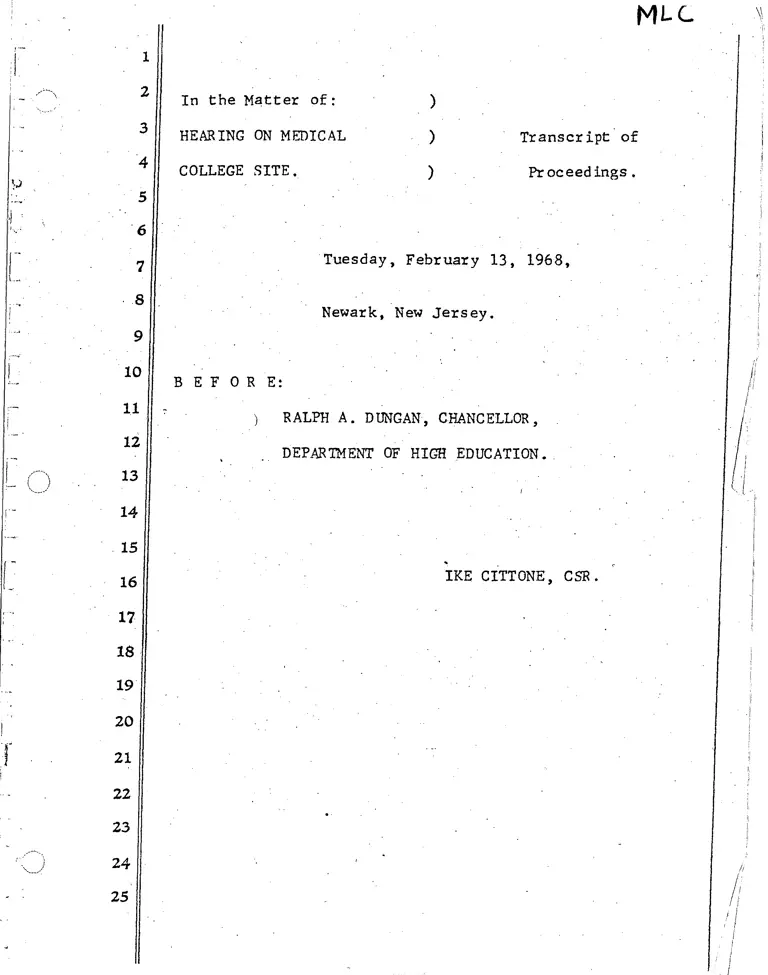
In the Matter of:
HEARING ON MEDICAL
COLLEGE SITE.
Tuesday, February 13, 1968,
Newark, New Jersey.
10
B E F 0 R E:
RALPH A. D UNGAN, CHANCELLOR,
DEPARTMENT OF HIGH EDUCATION..
13
14
. 15
16
IKE CITTONE, CSR.
17
1$
19
20
21
22
23
24
1.1
12
Transcript of
Proceedings.
)
25
1
3
4
9
10
11
12
13
18
19
20
21
22
23
24
25
2
CHANCELLOR DUNGAN: Ladies and
gentlemen, I appreciate very much your
being here. I would like to express my
appreciation to. you all on behalf of
the Governor, as well as all of our
colleagues in the State and local
Government, community, and medical school.
The purpose of this meeting, at
least as I see it, is to encourage views
among all who are concerned with the
location of the medical school here in
Newark, to explore whether in. terms of
the'conditions set up by the Federal
Government, the desires and the necessities
of the medical school as they see it and
the needs of the community can be compromised,
not in any essential way, but in a way that
will permit the fullest participation of
the community in this enterprise, so that
it will be beneficial to the community
and also so that we can run a first class
medical school.
We do begin, I must say, with
certain basics, which for good or evil,
are before us.
4
5
7
8
10
11
12
13
14
15
16
17
18
19
20
21
22
23
24
25
MR. WILLIAMS: I just want to interrupt
before you got started. There are not too
many people from the community present.
I think it would be very good if you would
wait.
CHANCELLOR DUNGAN : Would you like
to hold it?
MR. WILLIAMS : A lot of people are
here from the Federal. and State, but there
is not a hell of a lot of us from the local
community. I think it would be a good idea
if you did wait. There are some more coming.
I'm saying this, because I know this
to be true.
CHANCELLOR DUNGAN: Mr. Sagner,
from Beth Israel, had in mind to make a
statement. I think he has to make another
appointment. Do you think there would be
any problem in him making a statement?
MR. WILLIAMS : I see no problem
with that, as long as. it is not relevant
to the major part of the presentation.
CHANCELLOR DUNGAN: I am sure it
would be relevant, or he wouldn ' t be here.
Mr. Sagner.
4
3
1
8
. 16
17
18
19
20
21
22
23
24
25
14
13
15
11
10
12
MR. SAGNER: I like to read my
statement, if I May, which, I trust, is
somewhat relevant to this hearing.
In September, 1966, the top medical
and administrative officials of the five
voluntary hospitals in Newark, the. Newark
Beth Israel, United Hospital, Columbus
Hospital, St Michael's Hospital and St.
James Hospital met with representatives of
the New Jersey College of Medicine &
Dentistry in. the first of a series of
meetings to present reasons for the
medical school to locate in Newark, rather
than on a suburban site.
The Site Committee of the College,
in August, had advised the trustees that it
favored the DodgeEstate in Madison, a 185-acre
tract, that would have permitted the college
to immediately plan and construct its facilities
However, the trustees responded to
the presentation of the five hospitals in
concert with others, undertook to reconsider
Newark, and began a long trip, with some
painful aspects, that have brought us to
this hearing.
As President of a voluntary,
non-profit, nonsectarian hospital located
in Newark, I believe that ourhospital, its
Board, professional staff and employees are.
a part of the community and hence have a
right and responsibility to be heard at
this meeting.
Our hospital is pledged to provide
the best of medical care to those who come
to us from all parts of, the country,, state
and nation for the specialized programs
that we have in surgery and medicine in
our Newark ,,Beth Israel Hospital Intitution,
but equally important, we are devoted to
providing the community health facilities
needed by the residents in Newark, in close
proximity to our hospital.
I would like to give a few illustrations
of how we are serving our contnunity.
In 1967 we had 2,527 ward cases
In
none of these cases did we receive our cost
of the services. rendered.
In our out-patient department, we
had 26,157 visits in medicine, surgery and
dentistry, which, unfortunately, serves as
4
8
10
11
12.
13
14
15
16
17
18
19.
20
21
22
23
24
25
a 24-hour day, seven day a week, medical
3
2
office.
4
6
5
We had close to 25,000 visits, up
5,300 from 1966. Approximately 50 percent
of the nominal.charges in this department
were not collected.
..8
7 ,
And, more important, I would like to
. 9
.10
11
12
13
14
15
16
17
18-
.1.9
20
21
. 22
23
24
announce here tonight, for the first time,
that at present our medical staff is putting
the finishing touches on a dramatic plan to
provide a community health center at our
hospital, fully staffed to provide a 12-hour
a day, seven days a week care for our
cormunity.
In addition to providing medical
services to our community, the position of
the Newark Beth Israel Hospital has been
that the hospital, as the largest institution
in its neighborhood, has a responsibility
to maintain and strengthen the character
of the neighborhood.
Our Community Services Committee has
been working for over two years to assist
local groups in maintaining the integrity
.25
of the neighborhood, by assisting in such
4
2
10
11
12
13
.14
15
16
17
18
19
20
21
22
23
24
25
matters as opposing excessive liquor or.
tavern licenses, enforcing zoning, and so
forth, through legal, financial and other
assistance.
We are, in corporation with the
other hospitals in the Greater Newark Hospital
Development Fund, almost at the conclusion
of a 15 million dollar drive to renew and
refurbish our facilities at Newark.
Our share of this goal is three and
a half million dollars, only one-third the
amount needed for our Beth Israel program.
Our Board, Women ' s Auxiliary, medical
staff, employees and friends of the hospital
have pledged a million two hundred sixty-four
thousand dollars. The remainder we would
borrow to provide the physical facilities
to serve the people who come to our hospital.
I relate this brief background to
underscore our commitment to the community
and lend weight to our plea that approval
be given to the transfer of the land to the
college, as its location is vital to the
community hospitals in their' continued
programs in giving better medical care to
8
3
4
5
6
8
10
11
12,
13
14
15
16
17
.18
19
. 20
21
22
23
24
25
. the community.
At our meetings with Dr. Cadmus in
1966, we presented pledges on behalf of our
medical staff, agreeing to fully cooperate
with the medical school in any affiliation
that would assist in upgrading our present
grade of education. This symbolic relation-
ship with the medical school will have a .
salutary effect on the staff, intern and
resident recruit plans of the hospital.
Dr. Cadmus said in an article,,
"The Teaching Hospital Responsibilities
to Community Hospitals, " in the Journal of
American Medical Education, August, 1966,
."If medical schools are really concerned
with quality of patient care, they must
also be concerned with community hospitals. rr
A medical school in Newark, under
the direction of a president who espouses .
this view must result in the upgrading
all medical care in the community.
I would also like to comment on
the indication that we have of the community
dedication and depth of character of the
trustees in the New Jersey College of Medicine
2
3
4
5
6
L..
7
8
9
10
12
14
15
16
17
18
19
20
21
22-
23
24
25
13
9
& Dentistry.
FOllowing the advice of an impartial
professional Advisory Site Committee of three
leading professionals, Dr. Lippard, Dean of
Yale School of Medicine, Dr. Faulkner, President
National Foundation for Medical Education,
and Dr. Anderson, President of the University
of Rochester, they projected the requirement
of 150 acre campus.
Supported by this professional study,
they stuck to this as their requirement in
the face of strong opposition from many
sides. They have now reconsidered and have
agreed to accept one-third of that area and
tailor their plans accordingly.
All of us here have been faced with
the dilemma of taking a position and then
having to choose between clinging to a
questionable posture or making concessions.
The grace and intelligence of the trustees
indicates manliness and character that
reassures us of a school of the highest
quality.
In conclusion, we would like to urge
immediate approval and state that we have
10
3
2
4
7
8
9
10
.11
12
13
only one reservation to the plans as they
are known to the public now. We would like
an opportunity, in concert with the other
voluntary hospitals in Newark and neighboring
communities, the Medical School Administration,
the City of Newark and the representatives
of the residents of Newark, to reconsider.
the widom of using the Newark City Hospital
as the hospital for treatment of all indigent
patients in the city.
In cooperation with the medical school,
a better plan might be devised that would no+
concentrate all of the poor in one facility,
14
15
16
1'7
18
19
20
21
a concept that is contrary to modern
sociological principles.
A unilateral plan would also be
contrary to the concept of area planning
as represented by the Health & Hospital
Council of New Jersey.
This reservation was endorsed at
a meeting this morning by representatives
22
23
24
25
of the following hospitals: Columbus
Hospital, 1st. Michael's, St. James, United,
Hospital Center at Orange, East Orange
General, and Kessler Institute.
11
3
2
1
5
6
7
13
14
.23
22
25
24
21
16
15
Thank you, Mr. Chairman.
CHANCELLOR DUNGAN : Thank you, sir.
It has been suggested that we delay
the meeting for a little hit, until some
additional representatives, whom we know
are coming from the community, have an
opportunity to get here.
I. would like to say or extend my
own remarks just a little bit, in trying
to outline the purpose of the meetings.
. As I understand it, it's really
to get out on the table all of the concerns
that we have about any aspects of the.
location of the school here in Newark
and to treat them in as charitable and
rational a manner as we possibly can.
I think it can be said that no
one who has been involved in this, whether
from the community, the school, or the
state, the Federal Government, or otherwise,
has anything but the interest of the greatest
number of people in this community and
throughout the State and total extent
that the school will be providing medical
manpower to the community, through the cownunity
12
2
4
5
I think we are all. faced with a
very real task of whether men and women
sitting together can thrash out areas
of differences, areas of differences,
and at the same time come out with a
6
7
result which is. positive and. beneficial.
for all concerned.
8
I am personally committed to a
. 9
matter of principle to the feeling that
10
we can.
11
12
Now, maybe it' s possible, of course,
that we couldn ' t, and in such . circumstances
13
14
15
16
17
18
19
20
21
22
23
24
25
I take it that it would not be beyond the
realm of possibility that the school would
not be located in Newark and would go elsewhere
or just would collapse, something that I
think would be calamity for many people,
most especially for the community.
But I want to underscore that I
and my colleagues here, and I am sure
everyone in this room, approach this
night's work and subsequent evenings,.
if that turns out to be a necessity,
which I suspect it might, approach this
task with an openness, to listen to
13
1
6
.7
8
. 9
10
11
12
. ., 13
14
15
16
. 17
19
20
21
22
23
24
25
everybody and to get the points out on
the table, either to be resolved here or
at some subsequent time, but I would say
with a'considerable amount of speed.
Now, it does seem to me in reviewing
the situation as I know it, that there
are a number of areas, the first of which,
in terms of concetn and stickiness, if you
will, is the question of acreage and housing
.for people who would be dislocated by the
location of the school in Newark.
That, it seems to -me, is of paramount
and crucial importance.
There area number of other issues
having to do with employment opportunities
in the construction stage of the school
and further employment opportunities in
the medical complex itself..
There is also the problem of what
does all of this development mean for
the extended and high quality medical
care for the community.
. These, I hope, we will have an
opportunity to discuss, but I would suggest,
unless someone has an idea of different
14
1
priority, that we begin our discussion
2
4
7
8
10.
11
12
13
14
15
16
.17
18.
19
20
21
22
23
24.
25
this evening, concentrating, if we can,
on the matter of acreage and housing.
In order to focus that discussion
and only to focus It, I have taken the
liberty of preparing a very brief document,
which sums. up the factual situation as I
understand it,. that is, the understanding
of the Medical School Trustees and with
respect to the acreage and specifically
what are the availabilities as regards
housing.
I will ask my colleague, Mr. Leone,
to distribute this little summary sheet..
I want to emphasize, this is my
understanding, the collection of data
that I have made from various people who
are involved in this particular field,
Mr. Danziz and others in the city, who
are primarily concerned with housing,
as well as Mr. Sterns and Paul Ylvisaker,
Community Adminstration --
MR. WHEELER: Chancellor Dungan,
before you go any further; it was my
understanding that present here would be
15
1
3
4
2
C
9
10
11
12
I
14
.15
17
18
19
.21
22
23
24
25
L...
13
representatives of Model Cities from .
the Philadelphia Regional Office and Mr.
Charles Mennan, from the Philadelphia
Relocation Office, who would be part
of this meeting. Is there any reason
they are not present?
CHANCELLOR DUNGAN: There is no
reason. I talked to Mr. Faller in the
Regional Office this afternoon about who
he was planning to have here this evening,
and he said, "We are not planning to have
S
anybody."
He said, "This is not because
we're not intensely interested in the
work that you're trying to undertake up
there " -- but, in fact, what he said,
and I said, I would say this to all of
you, was that the problems of relocation
and housing, as well as Model Cities
plans are in the first instance of the
problem of the people. of the State of
New Jersey, in which we're intensely
interested.
He specifically asked-for a
transcript of the meeting.
16
1
2
3
8
9
10
11
16
. 17
18
19
20
21
22
23
24
25
4
5
'MR- WHEELER : The only reason I asked
the question, tied to all of the Model
Cities guidance is paramount as relates
to the seven conditions, and, it seems to
me, to be the best interest of everyone
concerned if we had the benefit of the
person wh is responsible for Mode]. Cities
as it relates to the city office.
MR. STERNS: . I would like to respond,
there was an unfortunate problem, that they
have to service a 'thousand communities in
the program, and the particular problem,
Mr. Chisson had to be in Baltimore today.
There are two factors I want to
bring out. First of all, as you know,
everything being said here, a transcript
is being taken of the discussion, which
they do want, and all the Federal agencies
will have the benefit of everything that
is said.
Secondly, we do not anticipate that
this is going to be the only meeting. As
a matter of fact, we anticipate that what
would come out tonight would be a number
of points that must be discussed and answered
17
2
3
10
11
12
13
14
15
16
17
18
19
20
21
22
23
25
with the appropriate people, Model Cities,
Federal, medical, et cetera.
You can be assured, at a critical
point, when something has got to be met
by a Federal official,/by a city official,
whatever, why that person will be at the
discussion at the critical point. This
is an unfortunate thing, but they are
overtaxed.
But if the question is, are they
going to be in a position to judge the
adequacy or the sufficiency cf what went
on today, they will have the transcript.
MR. WHEELER : I wasn ' t making
reference to the Federal Government. I
was making reference to the participation.
We were led to believe there would be a
representative from H.E.W. and H.U.D.,
that they would be here, since these:
two Federal agencies represent part of
the key to opening the door, as we see
it, to bring the medical school to the
City of Newark.'
It seems rather strange to me,
the irit is l meeting of what is the paramount
18
1
2
7
3
4
5
(
.10
11
12
13
14
15
16
17
18
. 19
20
21
22
23
24.
25
6
7
8
9
thrust of all of this, substantially
agreement on the seven conditions, that
the two most important agencies at this
juncture would not be represented, although
we are going to have it on tape, or however.
CHANCELLOR DUNGAN: Mr. Wheeler, I
can only say I agree with you completely.
I repeat, they are not here either. They
were invited. They ' re absent. I think
it connotes nothing more than what Mr.
Sterns already stated. They are up to
their ears in their own work. I don ' t
think there is anything devious --
MR WHEELER: I am not suggesting
that at all. I find it very strange, in
light of the history of this problem, as
we all know it, and it would seem to me
at this juncture, it anybody should be
here, it should be both H.U.D. and H.E.W.
It is my understanding that H.E.W. will
put thirty million dollars into this.
It is my further understanding that the
land, all of this to be. erected, is
controlled . by H.U.D., although the first
eight million dollars will, be expended
19
2
1
3
4
6
7
9
10
11
12
17
18
19
20
21
22
23
24
25
13
by the State.
So it seems it takes on a sort of
strange development, and the history of
strangeness has led us to he suspect, and
the evidence has been able to bear out
that suspect.
CHANCELLOR DUNGAN: I agree. I said
those very things to Mr. Faller this afternoon.
MR. DANZIG: May I, not to contradict
anything Mr. Wheeler has said, but we had
a public hearing .on January 11th, and I
submitted into that record a series of
four letters laying down some of the
guide lines that Mr.Wheeler mentioned,
and I would like to offer these for the
record.
MR. WHEELER: In relation to that,
if it is the same thing that we have
gotten, if it talks about a subsequent
letter of Terry Chisson, we would have
copies of that.
MR. WILLIAMS: Could I say something
about the whole structure here?
CHANCELLOR DUNGAN: Sure.
MR, WILLIAMS: I get the impression
20
3
1
4
5
.8
9
10
11
12
L) 13
14
15
16
17
18
19
20
21
22
23
24
25
that some kind of decision is going to
be made here tonight?
CHANCELLOR DUNGAN: No, no decision
will be made.
MR. WILLIAMS : Let me explain how
we interpret this. entire bargaining. We
thought this would be an introductory
session of some kind. Am I right on that?
MR, STERNS: .I would think so.
I think there are going to be unresolved
questions.
MR. WILLIAMS : We_ would like to
have your agreement on this point, because
we have agreement on our side, that this
should be done as if we were union, in
a union negotiating situation.
Now, you might say us and them,
this type of thing.
Pursuant to that type of agreement,
this type of arrangement, we have a bargaining
team from the community, and we are willing
to sit down with representatives from the
State and Federal Government, hopefully,
so we can fully hash out these questions.
As I see it, . a lot of people in this
21
1
3
4
7
8
'10
11
12
13
14
15
16
21
22
23
24
25
room, some of these people I have never
seen before in my life. I daresay, not
too many are from the community.
I don't know what role they want
to play. If they just want to observe,
I have no trouble with that, because I
thought this was going to be an open meeting,
but we do have a negotiating team and
negotiations, in my mind, presupposes
that both sides are adequately prepared
to go ahead with the negotiations.
I would like to. know if that
particular arrangement is agreeable with
you? Because we have agreement on our
side, the community.
CHANCELLOR DUNGAN: I'11 tell you,
Mr. Williams, I had not envisioned a
collective bargaining type arrangement this
evening.
I. have no problem going into that
kind of situation, forgetting personalities,
except that, as you well know, all of the
cardsare not in my hands, any more than
I suspect all of the cards are in your
hands, representing the . community.
22
(' )
13
19
24
25
23
22
21
20
18
11
10
7
2
3
4
The only thing, I'm not suggesting,
you know, that you got the cards or I got
the cards. I don't think that's the issue.
I think the issues are to get the questions
on people's minds on the table.
If we can resolve them, I'm willing
to resolve them within my competency. There
are probably some questions raised --
MR. WILLIAMS: On that same point,
this is true, but you see, on your side,
we feel it is encumbent upon us to make
sure that the process becomes and . stays
Democratic. We want to make sure there
is adequate discussion from the standpoint
of those of us who have been involved and
those of us who got in touch with others
who have been involved. We felt this was
the best mechanism, whereby all the cards
could be put on the table and we could, in
turn, report back and make our decisions
and come back to you.
That is up to you. If you want all
the people to speak, that is fine.
From our point of view, it is different.
MR. WHEELER : I would like to say,
2
1
3'
4
5
.10
11
12
13
14
15
23
Chancellor, in light of the urgency attached
to this matter by the Governor, Paul Ylviaker,
Joel Sterns, Bob Cadmus,' and all others,
we were under the impression, under a.
direction from the Government, that once
there. had been public agreement on the
acreage, 57 and nine-tenths, maximum and
final, to use the language that we project,
that immediately thereafter it was our. under-
standing that we would address ourselves
to the severconditions contained in the
Wood-Cohen letter.
CHANCELLOR DU GAN:. That's correct.
MR. WHEELER : To do this, it would
start long prior to the, meeting, that there
16
17
would be a need for developing a negotiating
team to work with those who represented the
18
19
20
21
22
state and the hospital in an effort to resolve,
to the extent of the terms substantial agreem d',
of the seven conditions.
We came, we meaning the negotiating
team of the community, came tonight prepared
23
24
25
to get involved in that kind of dialogue.
All I want to know is, is that what
the meeting is for or is it a meeting to get
24
public expression?.
CHANCELLOR DUNGAN: Oh, no. I would
say from my point of view, and I think I speak
also for the Governor's point of view, that
it has a little bit of both involved in it .
We want to discuss the issues on the
mind of the community.
We have no objection
to listening, and I hope none of you, to
have viewpoints of others in the community,
who may have been represented, for instance;
by the Warren
group, although, I would
assume, pursuant to your assertion that you
do.
MR. WHEELER: I think in terms of
the record, Mr. Williams,'that the first
thing that ought to be announced, in keeping
with prior meetings, that a bargaining
negotiating team was . established by the
community in this instance, and meetings
were held with those who had been involved
in this problem from its inception up to
now, with the understanding that the
historical document, the Wood-Cohen letter,
would be the matter to be discussed tonight,
and that our mechanism is that it will be
1
2
3
4
5
6
7
8
9
10
12
13
14
15
16
17
18
19
20
.21
22
23
24
25
1
discussed and it will be reported back
3
4
5
6
.10
14
15
16
17
18
19
20
21
22
23
24
25
to a larger body of that aspect of the
community that is directly involved in
the problem.
CHANCELLOR DUNGAN : Right. Which
are people represented by an organization --
MR. WHEELER : By a negotiating team.
CHANCELLOR DUNGAN : Right.
MR. WHEELER : ' I would hope this is
the kind of thing to pursue.
CHANCELLOR DUNGAN: Perfectly okay,
unless anyone else in the group --
REV. PERRY: I would like to ask a
question. If I understand it right, what
they ' re saying, is just this group alone
can speak for -- in other words, this group
is speaking for everybody in that community?
CHANCELLOR DUNGAN: Well, I don't
believe Mr. Wheeler is really suggesting --
MR. WHEELER: I can answer that..
We represent the community affected by
the Med School, and we have developed into
a negotiating team as a result of that.
We don ' t propose to represent the
community as it represents Newark as such.
26
4
7
10
11
12
13
14
REV. PERRY: What I mean is this.
How did you go about representing this
community, that is what I want to know.
MR. WHEELER: Rev. Perry, if you
had been a person participating from the
beginning, you would not have to ask that
question.
REV. PERRY: I'm in the area. I don ' t
know anything about it. That is what I am
trying to find out..
MR. WHEELER: First of all, I can
refer you, early in the history you were
contacted on this problem. Asa matter
of. fact, two or. three times you . were part
15
16
17
18
19
20
21
22 .
23
24
25
7
of a committee against Negro and Puerto
Rican removal, in terms of what we are
trying to do, and then like many other
people., they would, disappear, we didn't
hear from you and didn ' t see you,, which
is perfectly all right, that is your right.
The point of the matter is, the
people who are negotiating team represent
that part of the . community that ' s been
involved daily in the problem.
REV. PERRY: So the rest of us in
27
5
4
6
10
11
12
17
16
18
19
20
21
22
23
24-
25
the community will speak for themselves?
MR. WHEELER : I don ' t know about that.
REV. PERRY : That is what I am trying
to ask.
MR. WILLIAMS: . Let me say this.
I. think, Brother, what Harry has said is
. very true. I don ' t know you, sir. I'm
very happy to meet you.
I think what we're saying is, in
terms of efficiency, in terms of getting
the point across, that it is better to have
a group of people who are well versed in
the matter and who have been with the
situation for quite some time.
REV. PF tRY : I would just --
MR. WILLIAMS: Can I finish?
In terms with our ideas, your
opinions, I think they should be . heard .
We are perfectly willing to listen
and take them into consideration.
This is not the time to do it here,
when we are with people who are not part
of the community.
We will take it. back to the community
28
and discuss. it fully.
CHANCELL( . DUNGAN: As far as
ground rules and proceedings, Mr. Wheeler
and Mr. Williams, I take it that you would
have no problem with Rev. Perry or anyone
else at this hearing making a point 'ot view
heard on any particular issue that comes.
up for discussion during the course of
the evening?
.
MR. WHEELER : There is only one thing,
that it is very difficult for me to come to
the kind of status that would make me feel
that a comment would be valid at this juncture,
if the person had not been to the step by
step developments of the problem.
Now, if he is stating something that
is purely his, without knowledge of what the
step by step,development of the. problem is,
that is something else. I certainly wouldn Tt
want comments on the table tonight that are
lacking in all of the knowledge that goes
into this problem and why we are at this
point and this juncture, because it can
very well happen.
lam certain Rev. Perry doesn't want
2
3
4
5
7
10
11
12
13
14
15
16
17
18
19
20
21
22
23
24
25
29
to do anything to harm to bring the Med
• School to Newark, but because he doesn't
have all of the facts, because he doesn't
4
8
.9
10
11
12
13
. '14
15
16
17
I8
19
20
21
22
23
24
25
have the total exposure, he might say some-
thing that would be inadvertent.
CHANCELLOR DU GAN : Yes, sir.
MR. HALLAWAY : I have one question
I would like to ask. I would like to know
with the shortage of the police in the City
of Newark, how is this Med School, proposed,
other development of housing, are going to
be policed and where these people is going
to come from. That is the only question
I have to ask.
MR. WHEELER : You now have an example
of the kind of non-germane aspect of what
we are here for. Unfortunately, I must be
quite candid about it. Mr. Hallway is a
friend of mine. As a matter of fact, I made
some contributions toward the proper law
enforcement for housing projects, and I'm
sure he is addressing , himself to the problems
associated with the low income housing in
that particular. problem, but the purpose
of this meeting, as I understand it, is to
30
2
3
4
5
10
11
12
13
14
15
16
17
18
19
20
21
22
23
24
25
address ourselves to the seven conditions,
and law. entorcement at this juncture is not
part of the seven conditions.
CHANCELLOR DUNGAN: On the other
hand, I think you will also agree, Mr. Wheeler,
that there may be issues that anybody in the
State or local level --
MR. WHEELER: At least allied issues,
after we have addressed ourselves to the
seven conditions.
CHANCELLOR DUNGAN: That is precisely
why I took the liberty of preparing this
document, which seems to go to the heart
of one of the seven conditions, the .problem
of adequate relocation of the families that
would be dislocated by the . location of the
school.
MR. WILLIAMS: You see, we can't
really get into that discussion until we
clear up this matter of procedure. I take
issue with you on that very statement, because
I am not going to argue that point right now.
I would like to get it straight
where we are going and how we are going
to get there.
31
CHANCELLOR DUNGAN: Yes, sir.
REV. BROWN: I'm the Rev. Brown.
3
I'm in the area. I'm in accord with the
4
statement that Rev. Perry made.
5
. It's not the idea that it is going
to raise an issue that would apprehend the
procedural questions, but I think the question
he asked was a very good question. He asked
was this the group representing. the entire
10
community.
I think it's well to know our leaders
and to keep abreast with the meetings, keep
informed of the meetings.
Now, I am in the theory -- I'm in
15
the community, and if these is our representa-
16
tives, it there is. any more meetings in the
17
past that we did not attend, I think our leaders
18
should inform us.
19
Now, I'm here tonight to find out
20
just how we do stand, and I say that I
21
certainly coincide with what Rev. Perry
22
said. It is only a good question. Is
23
this the group 'that represents the entire
24
community.
25
CHANCELLOR DUNGAN : Thank you, Reverend.
32
r
1
MRS. EPPERSON: Mr. Chairman, to
2
the two good Reverends and anyone else here,
3
I .would like to say, I am Louise Epperson.
4
I am the Chairman of the Committee against
Negro and Puerto Rican Removal. I am the
person who started the crying and belly-
7
whining about the medical school coming to
8
Newark. I make no bones about it, because
you can imagine what a shock it was to pick
10
up the papers about 14' months ago and read
11
that my home and many of my neighbors' homes
12
were being taken away, with no schools for our
13
children to go to school, no homes for us to
14
g into.
15
I . myself rang many doorbells, stood
16
17
1.8
19
20
21
22
23
24
25
in front of many ministers' churches, gave -
out literature, run up and down steps to get
my neighbors organized for this very same
thing here. There are these gentlemen who
came out all last winter, this winter, this
summer, before the fact of the rebellion,
where you ministers wouldn't come and do
anything.
We stood shoulder to shoulder and
fought this. We have been in constant contact
33
2
3
4
9
10
11
12
13
14
15
16
17
18
19
20
21
22
23
24
25
5
with these people, in touch with the
city, the state, and the Federal Government,
concerning this school, housing and schools
for our children to go to school in.
I think you should have taken part
in it and you didn ' t take part in it, and
you can't speak now because you don't know
what you're talking about. We been fighting
for houses and schools, all of us, a long
time and not one of you came out and said
one word for it. Why come tonight and say
something?
You sit and listen and . take back to
your community and then stand shoulder to
shoulder and fight for it.
This is what we need, homes and
schools.
We need the medical school.
They don't need as much land as they wanted.
They want, us to relocate. As long as they
don ' t take all of the land, we agree, as
long as housing and schools are provided.
CHANCELLOR DUNGAN: . Rev. Perry.
REV. PERRY : I am not certain any
of them understand me. What I am saying,
if I'm here and as long as this group that
34
2
5
4
3
6
. 7
.8
.,
9
10
11
12
is representing the community is going
along and I can agree with them, I have
nothing to say. But if it gets to a
point that they are going oneuey and I don't
agree with it, I think I should be able to
speak up.
MR . WHEELER: It ' s America and this
is a Democracy.
REV. PERRY: That is all I have.
CHANCELLOR DUNGAN: I. think we are
in substantial agreement on that, if that
is acceptable to the negotiating group.
13
14
21
22
23
24
25
MR. WILLIAMS: As far as I'm concerned,
it is, but then that to me defines the kind
of meeting we are going to have, because --
CHANCELLOR DUNGAN: That is' a non-
negotiating session.
MR.' WILLIAMS: That's right.
MR- WHEELER: . ThiS is obviously a
non-negotiating session. I bring myself to
this whole state of urgency, that certainly
all of the available agencies forced upon
our shoulders in terms of coming to agreement
on acreage and in terms of addressing ourselves
to the seven conditions.
35 . ..
1
'2
3
4
5
6
14
15-
20
21
22
23
25
13
Are we now apparently coming to
some agreement on the acreage, and I was
hoPing and I am sure Bob Cadmus was hoping,
at' this juncture, 'we would address ourselves
to the seven conditions.
CHANCELLOR DUNGAN: Can we agree
on this session this way, as a negotiating
session in which we will have many of our
friends and neighbors sitting and in the
sense participating in the decision to the
extent that they wish to? As far as I'm
concerned, there will be issues that you
will want to take back to the group, with
whom the negotiating committee represents,
just as I am certain that there will be
issues that I will have to refer to other
people who are in a . position to control.
MR. WHEELER: Chancellor, just for
the edification of those who are here for
the first time, I would like them to know
that the Legal Defense Fund has already
filed a complaint with the two major agencies,
that is H.U.D. and H.E.W., and flowing from
that is the development of the negotiating
team.
IT
1
4
6
7
10
11
12
13
14
15
16
17
18
19
. 20
21
22
23
a
24
25
36
I want you to get some idea of
what the total picture is in this problem.
prior to coming to the agreement
of 57 and nine-tenths acres, there was
operative the possibility of a legal thrust.
As. you know,. the Courts require that
you exhaust your administrative relief first
and then go into Court.
The reason for the complaint being
filed was Mr. Weaver's office, and certainly
prior to Mr. Gardner ' s leaving, Mr. Gardner's
office, was to be sure that we exhausted our
administrative relief before going into Court.
This is the kind of thing, I think,
that those here for the first time should
know, that this struggle has been underway,
has been fought on various levels, and one
of them is a very serious legal level.
I hope we would not have to exhaust '
that thought, but I think you ought to know.
CHANCELLOR DUNGAN : Yes, sir.
MR. DANZIG: My name is Louis Danzig,
s peaking in two capacities, one as a citizen
and resident, the other capacity as Director
of Housing and Urban Renewal in Newark.
37
2
3
4
5
6
7
19
20
21
22
23
24
25
8
9
10
11
12
.
'13
. 14
I think already too much has
been said, Chancellor, about the various
issues.
I am very delighted that the
community can rest assured now that the
acreage is established and satisfactory,
and I now want to speak as the executive
director. I'm bound by the letter signed
by Undersecretary Wood and Undersecretary
Cohen, a copy of which you have, among those
four letters that we very carefully put into
the record on January 11th.
As an agency working under H.U.D.,
I'm bound by the contents of that letter.
If it's all right with the group,
and this is the manner of point of interest
and the discussion leads to resolve itself
around the .seven points in that letter,
I think that, as a ground rule, I think
that's very fine.
CHANCELLOR DUNGAN: So do I.
MR. DANZIG: We're bound by it anyhow,
you, sir, and I, you for the state and me
for the local community.
CHANCELLOR DUNGAN: Yes, sir.
38
1
10
11
12
13
14
15
16
17
18
19
20
MR. BROWN:t Joseph Browne. Since
this isn't going to be the type of negotiating
sessions that we had spoke of with the
Governor and Mr. Ylvisaker, this is only
an introductory session, will such sessions
go. around the clock, negotiating sessions,
that Gov. Hughes established and Mr. Ylvisaker
also?
CHANCELLOR DUNGAN : Mr. Browne, I would
certainly answer that. The sessions can be
whatever this group wants to make them. I am
perfectly willing to work around the clock,
if that is what we want to do.
I am sure thatit is not always the
most productive way to operate, but if that
is the way we want to do it, fine.
I would just suggest that I think
the Governor ' s conversation with you perhaps
might have indicated a much narrower, tighter
4
6
7
21
22
negotiating group than I think he had in
mind. I hope were doing what he had in
mind.
23
24
25
MR. WILLIAMS : You see, it is not
the' Governor's wish at this particular point.
We are interested -- we are interested in the
2
3.
4
5
6
* 8
9
10
11
12
13
14
15
21
22
23
24
25
39
point of the Wood-Cohen letter.
That letter indicates a different
kind of participation; not the kind of
participation you can get with a hearing
where you sit here as a chairman and listening
7
to what you have on the paper.
I have to get more fully prepared
to come in and talk about your paper.
I think that takes a little more time and
preparation.
I think the two Reverends would agree,
it would be better in terms of those self-
interest, if they were represented by people
fully informed, prepared, fully abreast of
what is going on..
I think the Wood-Cohen letter almost
demands the kind of negotiations we are
talking abOut.
CHANCELLOR DUNCAN: Mr. Williams,
believe me, I am not interested in being
up here as a chairman, in the sense I am
talking to you. I tried to make very clear
to you that I assume the things on that
piece of paper as a point of departure for
the discussions or negotiations, for no other
1
4
7
40
10
11
12
13
14
15
16
17
18
.19
20
21
22
23
24
25
reason.
If there is any disagreement by
anybody who is associated with those facts,
as I understand them to be facts, we will'
knock them out and start talking about
something else.
MR. WHEELER: . Just for the record,
because this involves the history of this
problem, it was our understanding that once
we came to some sort of an agreement, and
I am quoting verbatim, "That the community
would be prepared to negotiate around the
clock to arrive at a substantial agreement
on the seven points. "
I wish to reaffirm that position
for the record. Now, all the others that
you may have are fine, that is your choosing.
I am merely representing part of the
negotiating team in keeping with the history
of this problem and keeping with suggestions
that were made by the Governor and by his
Commissioner For Community Affairs, and I
would want the record to show that we now
have the negotiating team and its made up
of three members from the community, three
41
15
24
17
11
12'
9
25
23
18
14.
16
13
10
8
7
6
members from NAACP, a representative
of United Legals, United Freedom Party,
and United Services.
This is in keeping with 'the early
discussions and decisions arrived at by
the means of moving with the most dispatch,
so Bob Cadmus can meet the September deadline.
CHANCELLOR DUNGAN: Mr. Browne.
MR. BROW NE: There is one thing about
this meeting . here, in reference to substantial
agreement in the Wood-Cohen letter, that is
at a hearing such as this, you take it down,
you have your stenographer here, and take
all this information and go back. and come
up with a decision..
The way we had envisioned it, from
speaking with the Governor and Mr. Ylvisaker,
the community would be just as much a part
of this decision-making process as well as
the State, city and the hospital, and this
type of arrangement, you take information
back and you look at it --
CHANCELLOR DUNGAN: Look, if no one
has any objection, I like to take on some
. prerogatives here and invite the negotiating
1
2
3
4
5
6
8
9
10
11
12
13
14 .
15
16
17
18
19
20
21
22
23
24
25
42
committee to sit at this table in a
negotiating team set-up, with the other
people who have come out this evening
sitting in the audience and free to
participate if they wish.
MR. BROWNE: What we're saying,
the final decision, we have to be just as
much part of this decision-making process,
the decision when it is made, we have to
be a part of this, This is what we
refer to.
CHANCELLOR DUNGAN: If you want to
push the negotiating characterization,
oftentimes decisions are not made around
the negotiating table, but parties to the
negotiations withdraw and confer among those
and other'people.
MR. WHEELER: Chancellor, I would
take it this is a quasi-hearing. I don't.
know if we can talk about it as a public
hearing, and what we are planning to do
within this format, to confine 'ourselves
to the seven conditions, is that what you
are saying?
CHANCELLOR DUNGAN: That ' s correct.
43
MR. STERNS: I would say, it's not
right to characterize it as a hearing.
It's right to characterize it as a meeting.
The principal thing to come out tonight,
to present the seven issues. Some ot them
may be resolved, some of them may not be
put forward, others would have to require
further consideration.
I think the most important thing to
come out tonight, at a minimum, we should
come out tonight, have a full statement of
the points that have to be. considered and
resolved in your. minds, that are in our
minds.
CHANCELLOR DUNGAN : And flowing from .
the seven points.
MR. STERNS: There are things, for
example, that you may take; you may look
at the fact sheet and question some ot the
facts or not, and we can meet Thursday,
Friday, or whatever date- you want.
22
Sagner came in and made a point that
1
3
4
13
14
15
16
17
18
19
20
21
23
24
25
wasn ' t in any of our minds. . That point
will have to be discussed and some statement
will have to be made on it.
2
4
6
10
11
12
13
.14
15
16
17
18
19
20
21
22
23
24
25
. 44
MR. BROWNE: One thing. ' When we
were down in Trenton a few weeks ago in
Mr. Ylvisaker's office, it was decided
that the community would be allowed --
this is something that shouldn't be --
but we would be allowed to say who we
want to have on the negotiating team
for us and how these negotiations progress,
and we would delegate those who we felt
qualified or felt we could trust to.
represent us at these hearings, and
not have the State to decide who the
community would be or who the community
representatives would be.
MR. STERNS : I think it is precisely
that reason we have this kind of format.
We don ' t want to decide who the community
would be. . It. is obvious that different
people have different interests and different
people are in a position to have more facts,
information and perhaps be more representative.
If we were to shut off or shut out
people and say this was a closed meeting,
we, as public representatives, we would
have some kind of difficulty' .
L.:
10
12.
15
16
17
.18
19
20
21
22
23
2
5
13
14
24
25
.45
CHANCELLOR DUNGAN : Yes, sir.
MR.. BROWN: . My name is Alfred F.
Brown. I'm with the Newark Housing Authority,.
assistant to Mr. Danzig. I think a rather
serious procedural question has been posed
here, and I throw this out for consideration
of everyone within the sound of my voice.
Number one, there was a newspaper release
indicating that this would he a public
meeting, generally designed to hash out
points of concern in regard to the medical
school generally.
Number two, this meeting is convened
and we are here, and from the discussions
that have preceded, it appears that on the
one hand there's a negotiating team for at
least some segment of the Negro community
or the Negro community generally.
On the other hand, it appears that
there are individuals here from the Negro
community who would like to have a kind of
open choice, to speak for themselves, if and
when they find themselves in disagreement
with the negotiating team.
CHANCELLOR DUNGAN : Correct.
46
1
2
3
MR. BROWN: Now, you get the
kind of situation where if there ' is to
he a negotiating team, and for this
particular moment I'm speaking as a black
man, I know full well the involvement of
Mr. Williams and Mr. Wheeler, in this
entire community problem from the outset,
and I might say they have given some
considerable time and some considerable
efforts and no small degree of dedication
to, the problems involved.
Now, one of the questions posed
at the outset, is what character does this
meetingtake on and how and to what degree
do we proceed or do you proceed, if the
eventuality occurs, where the negotiating
17
team- feels that proposition is. preferable
18
and someone in the particular specific
4
5
6
7
8
9
10
15
16
community affected by the medical school,
.19
20
or some particular person from the nei ghbor-
21
22
23
24
25
hood in the community generally disagrees
with the proposition, which is the preferable
proposition.
Superimposed over all of this, you
get the kind of situation and atmosphere,
number one, the public he apprised of a
"public meeting. "
On the other hand, you get the kind
of situation where there is a group that
is speaking for the Negro community.
Now, it appears to me that they are
going to have some very serious decisions
made as to what kind of procedural posture
the meeting is to be cast in, if anything
meaningful is to come out of it.
Now, when I make the statements, I
mate these statements for the consideration
of this group here generally. I do not
speak in this matter as a representative,
as set forth by Mr. Williams and Mr.. Wheeler,
nor do I speak to the representatives set
forth by Rev. Perry or Rev. Brown, or any
other Negroes or any other group of Negroes.
What I am trying to pose here, what
appears to be a serious problem of the
procedural format of these meetings, and
it appears until this is resolved, you are
kind of proceeding from one stumbling block
to another.
MR WILLIAMS: Can I answer?
3
4
6
10
11
12
13
14
15
16
17
18
19
20
21
22
23
24
25
n
14
10
20
18
19
17
16
13
15
12
8
7
4
25
48
CHANCELLOR DUNGAN: Yes.
MR. WILLIAMS: Brother Brown, I think
that what we're saying is that we do represent
some number, some substantial number ot people,.
and we do represent the kind of ideas that
.are or have been adopted by several people.
Now, in terms of our own individual
trust, what we're saying is that we have
certain positions that we want to get put
forward into this meeting, into this hearing.
We are saying that, saying to the two Reverends
here, that as part of the .community that it
has been, to our knowledge, involved in this
affair, we are offering the opportunity to
let ' s go back and study it, so there will be
no two, three, four, five, six, seven kinds
of proposals coming forth, because I know you
understand the value of unity.
MR. BROWN: We ' re not in disagreement.
MR. WILLIAMS : Fine. I think it is
encumbent upon the.gentlemen here, who have
voiced some, kind ot position, from the
decision that they would like to be heard,
I think it is encumbent upon them to join
in with us, and sit down with us, we will
49
4
5
8
9
10
11
.12
17
18
19
20
21
22
23
24
25
all listen together. I will say we don't
have a formulated positi rn we are going to
put on the table tonight.
We have not gone back to formulate
his position. - That is what we want time
to do. We want to be able to make the kind
of presentation that will be meaningful.
CHANCELLOR DUNGAN.: Rev. Terry.
REV. PERRY: I would like to clarify
myself again, if I may. Iam not fighting
against the leaders for the community, but,
according to the newspapers, as this gentleman,
Mr. Brown has said, the public was invited.
Now, what I wanted to know was,
that if I did disagree, was I in order to
speak or was I not. That is all I want
to know. If I'm not in order to speak, I
would say nothing and go on, but if I am,
then I can express my opinion,.
CHANCELLOR DUNGAN: My answer is that
you are totally in order to speak and anyone
else is in order to speak.
MR. WILLIAMS: Second the motion.
REV._ PERRY : That is all I want to know.
REV. SHARPER : I am Rev. Sharper, Pastor
50
2
4
5
10
11
12
13
14
15
1b
17
18
19
20
21
22
23
24
25
of the Abyssinian Baptist Church, represent-
ing the United Freedom Party and two or
three other organizations.
I. think it is rather late now for
someone to come in and to even give any
semblance of being an entrepreneur.
We welcome them and I am sure we
would hate to say they couldn't speak, but
to see certain people in the community belabor
something with you for some time now, and
several meetings have been held, it's been
in the paper, there has been no secrecy
about it,. I'm hoping that these gentlemen
will not want to belabor the issue or
strain the patience of Governor Hughes or
anybody else involved in this, because
somebody tomorrow evening could come up
and say something else, and we can be here
two hundred nights. Time is of the
importance. We have been here . long
enough now.
MR. STERNS: Let me address myself
this, as a person who has been a party
to this over a period of months and try to
explain what I' think the problem is and what
1
4
7
22
23
24
25
13
19
21
11
,14
20
18
17
16
15
12
10
51
the concern is here.
for one, as you know, have been
involved for many days and months with the
negotiating. team and have been involved,
and I,for one, am prepared to say that
this negotiating team is indeed representative
of.a large portion of the municipality.
There is no United Corporation,
Legal Services, Community Against Negro
and Puerto Rican Removal, because they are
the people that carried the burden here.
I think you will understand that we,
as representatives of public agencies of
State and Federal Government, have a problem,
because this departs from the normal union
negotiation situation, where you can say
here are all the members of the plant. that
signed and we are their bargaining agent.
We don't have that. We don't come
here with the power to submit it or weaken
the negotiating team.
We come here., to be sure, that
nobody in the community is unable or does
not know of the fact that there is a
negotiating team, that there is some way
52
4
5
8
-r
10
11
L
.12
13
14
15
16
17
18
19
20
21
22
24
23
25
in which they can begin to participate,
that we, as public servants, are not
closing off the channels.
I want to say very plainly, I don't
want to say there is any question in my
mind, that I feel they are representative
of the community, because they have been
parties to long days and weeks of discussion,
representing a certain state, want to give
them the place that they earned by their
diligence.
I think you have to recognize if we
were to say that nobody but these people
are representatives, that they might appear
tonight, and you should not come before
this meeting. What we want to say is that
those people who have the most to say, do
carry the burden of the negotiations., but
nobody in this. community can come forward.
and say we shut them out from the negotiations.
We have another point of view that
wasn ' t raised. We can accommodate those
facts. 'I think what we are and you are
concerned about, there may be a vote of
people in a certain view.
53
L.
25
22
21
11
.2
15
16
4
10
23
24
12
13
14
MR. WHEELER: Decisiveness..
MR. STERNS: Yes. But I don't
know how, for example, you would suggest
us as public officials to carry the burden.
MR'. LOFTON: I would like to respond
to what Joel said. First of all, Ithink
there has been somewhat of a breakdown in
communications, at least as it relates to
the persons who have been in discussion,
in dialogue with state officials, including
the Governor, Paul Ylvisaker, and some of
the other persons involved.
The persons involved in that discussion'
have been a group of individuals that have
gathered themselves together or represents -
tives of a group or a larger group, one
being ,the Negro, the 'Negro against Negro
and Puerto Rican Removal and the Newark
Planning Association.
My interest, in terms of being
participant in those negotiations up to
this time, is I am the Director of Legal
Service Program, and have a peculiar kind
of position with the people involved or
the population most severely affected by
. 54
4
5
r
the coming of the medical school and I
think that there has been some accord
reached as it relates to the overall
acreage involved.
At the same time, the problem
6
10
11
12
13
14
20
19
is asked that in terms of communications,
in terms of whether or not this particular
meeting, as it relates to the discussions
with the State, would be with that group
of individuals that have been involved
in this participation from its inception
or. whether or not it would be a kind of
situation where there would be a wider
segment of a community involved in an
open forum kind of discussion.
Now, as . I understand it, there
will, in fact, presumably and hopefully,
be a juncture at which there will be
'public hearings, as it relates to these
parcels of land,
21
22
23
L.,
24
25
Apparently what we are involved
in here, is an overlaying kind of situation,
we are overlaying that public situation,
another. kind of public hearing situation,
which this partakes of, in my judgment.
55
IJ 5
4
2
10
11
12
13
14
15
16
-17
18
19
20
21
22
23
24
25
Now, the second thing is this.
It seems to me that the only reason for
and the only reason why we are having
this overlay kind of situation, which is
not, required bylaw, but which the former is,
is because of the participation of the two
groups, the. Newark Area Plann,ing Association
and the Committee Against Negro and Puerto
Rican Removal. Consequently, I cannot but
see that the brunt of the voice of these
two groups, the Newark Area Planning.
Association and the Committee Against Negro
and Puerto Rican Removal, obviously, if you
put these voices into another kind of
hearing situation, the incisiveness, the
kind of points ' reached and raised by.them,
will, in fact, result in the form of public
discussion not required by law.
If someone can make me understand
the necessity or the reason for it, this
kind of public hearing, superimposed over
and above the public hearing, then I will
have a fair understanding of what we are
speaking about in the proceedings.
REV'. ALLEN: I was listening to
56
1
3
2
rn 4
6
10
11
12
13
14
15
16
17
18
19
20
21
Rev. Perry and the others. Speaking in
terms of this situation, that Rev. Perry's
church is right in the midst of what has
been told that this medical site was coming,
also my church' is right in the midst of it,
now, maybe there might be some reason why
that you haven't seen our faces, hut by our
churches being in that community, our people
come to us from time to time; saying "Pastor,
what is going to happen? We don't have no
desire to paint. We don't have no desire to
do anything. All we know is what they say,
it's coming."
So finally, they get up and they
move out. Nothing is being said, nothing is
being done. But earlier we got the news that
everybody in this site would be given a
certain amount of money to relocate.
These people have relocated themselves
and they're coming to us right now saying,
"We located ourselves. Nobody has given us
22
23
nothing, but they still say the medical
school site is coming. "
24
25
I think tonight, as somebody has
said, it ' s time for somebody to know something,
3
4
5
6
10
L, 11
12
Li
13
14
15
r .
16
21
22
23
24
25
r
57
because we're busted with this every day
or two, they're coming, and our people don ' t
know what to say.
MR. WHEELER: Chancellor,. may we
address ourselves to the seven conditions?
CHANCELLOR DUNGAN:• If I may suggest,
I would suggest that the negotiating team
move itself up to the table in a more intimate
way ..
MR. DANZIG: Point of information.
I'm here only because you invited me by
telegram. As long as negotiations are
going to take place, I have no objection.
May I ask a simple question, am I part of
these negotiations?
CHANCELLOR DUNGAN : Absolutely.
All right.. And I would say Dr. Cadmus.
MR. WILLIAMS : Let me make a
suggestion. I would like to ,say that,
and this is in answer to Joel's inquiry,
how do people get heard.
I think that we should say at this
meeting that everyone will have a chance
to talk, but as I said, our concern is
about the positive proposals that come
1
2
4
r-'
1., 5
10
11
12
13
14
15
16
17
18
(_ ,
19
20
21
22
23
24
25
58
forward from the community..
I would like to suggest and invite
the ministers who have spoken out to join
with us, because, you see, that way you
will insure yourselves that your vote
will not be deleted, because, otherwise,
you just have a statement, go like water
off a duck's back. Sticking together, we
. can come forward, taking your considerations
along with our considerations, and we can
have that kind of strong unity approach.
I like to ask, is there any member
here in the community that would oppose
that kind of situation?
(No response.)
MR. WILLIAMS: Thank you... I think
that settles it. Let's proceed.
CHANCELLOR DUNGAN : Ladies and
'gentlemen, I think we can get underway now.
First of all,., let me be very clear about
the nature of these negotiations which we
are discussing.
This meeting was called at the
Governor ' s request to talk with representatives
of the community about the variety of matters,
59
housing, employment, community health
services that surround the possible
movement of the medical school to Newark.
The difficulties which Mr. Sterns '
pointed out a little bit earlier is not
peculiar to Newark, but trying to identify
who represents the community is of a great
difficulty. The gentlemen sitting around
this table represent a number of community
-g-r-o-u-ps , a-s Mr-. - -St er-ns-p-o rn t-ed--out ,--and- -d-o
have a claim to represent the community,
by reasonof their work over a period of months,
and also, I would suppose, bytheir direct
communication with certain members of the
community.
By the same token, there are other
people in the community who .also have an
interest, remote or immediate, in the
questions under discussion. Therefore,
what we will propose to do here this evening,
is begin the discussionof the seven point
letter, which came from H.U.D. and 1I.E.W.,
out-i-ning -the - Fed era-l-Gove-r-r^ment 's-mot inn
of the conditions, if you will, under which
it felt it could support a medical school
1
3
5
6
7
8
11
10
12
13
14
15
16
17
18
19
20
21
22
23
24
25
7
9
10
11
12
16
21
.22
23
24
25
60
in Newark. So we will begin.
MR. MOORE: Before we do that,
Rev. Perry has indicated he would like to
make a clarifying statement.
REV. PERRY: Yes. For the sake of
the record, I would like to make this
statement, that the questions that I
asked in the beginning -or the outset of
this meeting,were . simply questions of
information,. and I wanted to be clearly
understood that I'm not opposing the
representatives of the community, but I
do know now that if there be any questions
that I have in my mind I want to ask, I do
know the source whereto go and ask the
questions in the meetings , and there is
no division here tonight.
CHANCELLOR D UNGAN I never to 1t
there was any, Rev. Perry.
REV. PERRY: Thank you. I just'
wanted to make it.clear.
CHANCELLOR DUNGAN: 'All right.
Should we take the letter then?
Point one of the letter reads as follows:
"The decision on the ultimate site must
r
61
2
4
5
7
10
11
12
C.' 0
13
14
16
17
18
19
.20"
. 24
25
satisfy the intent of the Model Cities
Act that it be compatible with the plans
developed for the neighborhood as a whole.
The size of the site will have to be resolved
in terms of both the essential needs of a
high quality school and the social impact
of the amount of acres removed. from residential
use. "
MR. WHEELER : Chancellor, in keeping
with' that, the first thing. that. we would like
to have resolved is the following: that the
57 and nine-tenths acres of land represents
the total package, the maximum and final
acreage of land as it relates to the New
Jersey College of Medicine and Dentistry.
We would like to be sure that it be classified.
CHANCELLOR DUNGAN : First part of
the fact sheet.
MR. WILLIAMS: Can I make a statement'
on that? I brought along this map to show
it to everybody. .
Now, we have been told that that 57
point nine acres is a final amount of
acreage. However, in our last meeting
with Dr. Cadmus, we were also reminded
62
2
4
6
8
9
10
i11
12
13
14
15
16
17
18
19
20
21
22
23
L. 24
25
that. there is a total of seven acres
around City , Hospital, there is a total
of 10.3 acres here, that is going to come
under the auspices of the State Division
of Institutions and Agencies, that the
medical school is also interested in these
and in some discussion with Mr. Danzig
last summer and also in discussion with
the architectural firm of Agger & Higgins,
we also understand that there is some acres
totaling about 9.9 acres called a buffer
zone that is also to be included in the .
total acreage for the college., for medical
facilities in the Central Ward.
If you add all this up, it comes
out to be approximately 85 acres, if you
total all of those up.
We went along with 57. acres, that
and no more.
If the State Department of Institu -
tions and Agencies and all these other aspects
want to come in, then 57.9 acres is totally
sufficient for that kind of deal.
This down here was not included in
the contract, but we were told this was
63
1 _.i
r-.
1
2
3
4
5
10
supposed to be for the students, some
greenery, tennis courts, between the
college and the proposed highway.
I don ' t have to say any more
about that. I would like to have some
clarification. on that acreage, because
that is not all in the deal.
CHANCELLOR DUNGAN: Mr . Danzig.
MR. DANZIG: I would like to
clarify that map. It is bur map. May
I use it?
The 46 acres bounded as it is,
is what I understand it to be, plus 11.5,
take a fraction, leave a fraction, plus
approximately five acres of a piece in here'
for the Mental Health, period.
MR. WILLIAMS : That 's more than
MR. DANZIG: The Mental Health will
be run by the Institution & Agencies, and a
long time ago,. I understand, that' the
community wanted such a facility and there
is a need for -such a facility, and that
will be run by. the medical school.
MR. WHITLEY: May I ask a question?
15
16
17
18
19
20
21.
22
23
24
25
57.
3
2
8
7
10
11
12
14
13
15
16
17
L.
18
19
20
21
22
23
24
25
64
CHANCELLOR DUNGAN: Yes.
MR. WHITLEY: Is this indicated
in the Model Cities?
MR. DANZIG: The whole Model Cities
embraces all of this.
MR. WHITLEY': This is the thing we
really should straighten out.
CHANCELLOR DUNGAN : The basic acreage
for the medical school complex as, such is
57.9 acres. This is without respect to
any I. & A. question, which, as I understand
Mr. Danzig, is not a settled question at
this point.
MR. DANZIG: I understand It to be,
Chancellor, because originally that institu-
tion was supposed to occupy ten acres, and
after a study was made by the medical school
people, they thought they could absorb half
of that operation within the 46 acres. That
reduces the ten acres , to five acres, roughly.
So within the complex of 46 acres, will be
half of that medical health program.
MR. STERNS Are we coming out clear,
that we're talking about 57.9 for . the medical
school, five acres for the I.&A.?
65
1
2
3
4
t-
1'
5
7
8
9
10
11
12
14
13.
15
16
17
18
19
20
21
22
23
r
t
24
'25
MR. DANZIG: Period.
MR. STERNS: This should not be
. considered part of the medical.
CHANCELLOR DUNGAN : It is not the
medical school.
MR. WHEELER: May I' interject myself
at this juncture? When we took the original
proposal back to the community, involved in
the statement was reference to seven and a
half acres for the City Hospital, ten and
three-tenths acres for a center for the
mentally retarded to be. sponsored by the
State Department of Institutions and' Agencies.
When we discussed this matter, present
was Robert Cadmus, president of the college,
and Paul Ylvisaker, Commissioner of the
Community Affairs, and we made it quite clear
that we felt that the community would. only
be party to 57 and nine-tenths acres of land. '
We even discussed with Mr. Ylvisaker
and Mr. Cadmus ways and means how they could
go about the matter of removing as an issue
the 7.5 and the 10.3.
Now, when you made reference to the
State Department of Institutions & Agencies,
66
1
4
6
L.:
8
L;' {
-Th
13
25
23
24
22
21
20
15
16
17
18
19
14
11
12
10
being a separate factor, in reality,
is not, Chancellor, because the med school
and the Institutions & Agencies are both
state function matters. So it is state
being operative. I would like to clear
that up.
CHANCELLOR DUNGAN: Yes.
MR. WHEELER: The other matter is,
that we come with total agreement that on
5.7 and nine-tenths acres of land for the
med school, with the community not willing
to give up any more land at this point in
the history of Newark for any other facilities.
One of the suggestions that was made,
was the fact that if the center for the
mentally retarded was an imminent project,
that something be worked out within the
57 and nine-tenths acres, and we were quite
clear, quite candid, and when we put the
release in the paper yesterday, we were
speaking for the major agencies involved
in this problem, and that is, the total
acreage for health facilities for Newark
shall be 57 and nine-tenths acres of land.
Now, we would have to have some
13
22
14
23
24
11
20
21
25
10
19
12
4.
5
1
2
57
assurances, based on the mandates flowing
from"the groups that we represent, that
this is, in fact, what is meant by the
first statement contained in your summary
fact sheet.
CHA CELLOR' . DUNGAN: I . don ' t think, Mr.
Wheeler, that I am in a position to say
that the total amount of state. land for
all kind of health service facilities to
the community is included in the 57.5 as
mentioned in that fact sheet.
What that 57.5 in that fact sheet
refers to, is the amount of land which is
allocated for the medical school, for the
medical school complex per se.
So I think. what we're saying is,
that the community does not want an I.&A.
facility for mentally retarded youngsters.
MR. MOORE: No, we are not-saying that.'
We are saying at various times we did discuss
the 11.5 acres, and, as we were led to believe,
that this would contain temporary buildings
and at some portion in the life of the medical
dental college, these temporary buildings are
going to come down. So if you need five acres,
4
5
7
10
6-8.
you have 6.5 acres left off, so we are
• saying, how you arrange your complex is not
our concern, but arrange it in the 57.9.
MR. WHEELER : The position for keeping
.it all within ' the. 57 , is supported by the
fact that the 11 and a half acres will be.
utilized for temporarystructures.
Now, on that basis and since no one
has been able to point out that the erection
of the center for the mentally retarded is
11
12
13
14
15
17
18.
22
23
16
imminent, we are suggesting that possibly
the place for you to meet with the demands
that we're making can be contained specifically
within the 11 and a half acres, particularly
when you consider the facts that the structures
that are to g,o up for September are, and I
quote from Dr. Cadmus, ' "temporary structures. '
CHANCELLOR DUNGAN: ' I will go back
my original point, that the 57.9, that
we ' re referring to in the fact sheet and.
which we understood as the position, would
be the medical school complex as' designed
or as in the process of design and does not
24
envision this alternate or possible reuse
25
of 11 and a half acres.
69
1
4
6
7
10
11
12
13
14
MR. MOORE: Most certainly another
point would be that any accompanying land,
that is not a part of the 57.9, the
community's position is that houses have
to be built there. . This is an integral
part of what we are about here.
We're not talking about leaving five,
ten, or one acre fully placed for anybody
for anything that can be used, that could be
used for housing immediately..
NE. WHEELER: This" is our basic
position.
CHANCELLOR DUNGAN: Yes, I understand
that.
15
16
17
18
19
20
MR. WHEELER: . And to add to that,
in terms of urban renewal process, I think
everyone has to realize that the Fairmount.
Tract had two land use. designations,. commercial
and housing.
G-^
I. might point out . to two commercial
21
22
23
structures have been erected, the N.C.A. and
an addition to the Wiss & Co. However, not
one single unit of hous ing . has been erected
24
in the Fairmount Tract. So this further
25
supports the position of the community, as
70
1
2
3
.4
6
7
8
it relates to all of the facilities
mentioned being contained in the 57 and
nine-tenths acres, because then you would
be compounding the problem that I just
elicited, that if, you have commercial
structures and no housing in the very tract
where we can start erecting housing tomorrow.
CHANCELLOR DUNGAN: I think we have
the issue isolated. I think this is a
10
11
12
13
14
15
16
17
18
19
20
21
22
difference of opinion on this side of the
table from yours. I think it is one that
will have to be further discussed.
MR. MOORE: Let us say this, there
may be a difference of opinion, but the
position here is crystal clear, fixed,
absolutely fixed.
MR. WHEELER: The proper. acreage
is maximum and final.
ME_ DANZIG: I think in the beginning
of this meeting it has been defined by this
group as the negotiating group.
They ' re not there to negotiate. They
23
24
have a fixed position. So I suggest we get
their fixed positions, adjourn and reflect
25
on them.
71
.25
24
23
22
21
20
18
19
17
14
16
13
15
11
.4
12
10
9
8
6
3
1
I was taught . that part of the art
of negotiating was to lay all the facts
on the table. We had a hearing on the
plan . of the Fairmount Project January 11,
to which these folks did not choose to appear.
This is the plan and the . various uses that
we want to submit to. you, so that there
will be no surprises , on anybody at some
future time.
I would like this to go into the
record, which shows, to the best of our
dimensions, at this point, 11.5974 acres
for the New Jersey College of Medicine &
Dentistry. It shows 4.70 acres ' for a
State Mental Health. It shows an addition
to the City Hospital for nurses ' quarters,
which I don ' t think anybody would deny
giving nurses quarters. Indeed, we have
to have nurses. So there is no point in
making short drift of fixed positions,
and I would like to introduce all the rest,
as been marked for residential and related
uses, and I would like this to be in the
record as the present reuse plan, according
to the January 11th meeting -- January 31st,
72
I'm sorry.
CHANCELLOR DUNGAN: Mr. Lofton.
MR. LOFTON: I would like to take
exception to their stand as saying the
negotiating team came with a fixed position,
to characterize the negotiating team as
having a fixed position.
Quite obviously, when you come to.
a negotiating bargaining unit, you have
a position. It is quite obvious. that the
New Jersey College of Medicine & Dentistry
has a position, that is as of the present
time and from the ' public, this is a fixed
position. This is as far as they . will
go,. 57.9 acres.
CHANCELLOR DUNGAN: For the medical
school.
. MR. LOFTON: That is a fixed position.
CHANCELLOR DUNGAN: Correct.
MR. LOFTON: I see nothing wrong with
the negotiating team having a fixed position,
that anything to be contained for medical
services can be contained in 57.9 acres.
That is in response to Mr. Danzig's corent.
SecOndly, I also want to say, it seems
1
2
3
4
.5
6
7
16
21
22
23
24
25
1
3
4
6
7
10
11
12
13.
14
15
20
21
22.
23 -
24
25
/3
to me with respect to the whole thrust
of what the negotiating team is about,
is to restrict acreage as it relates to
the medical school and also restrict
acreage that are health-related facilities,
because the more you put into the situation,
the lesser is available for the construction
of housing, and there is a critical need of
housing.
What I want to say, Chancellor, in
terms of the fact to create doubt and say
57.9 acres is for the ' medical school, and
as far as the I.&A., Institutions and Agencies
that is .a different ball game. altogether. It
occurred to me, the expression, a rose is a
rose, is a rose, is a rose.
The fact is, the more acreage you
take in the types of construction, means
the less housing in this critical situation.
MR WHEELER : If I may make an addendum
on the whole matter of Mr. Danzig's statement,
unfortunately he was not present at a previous
meeting where there was negotiations on this
matter, first of all, with Mr. Ylvisaker and
Dr. Cadmus and members of the negotiting team,
/4
1
2
i :-ti'..,
;
4
5
6
7
8
10
11
12
13
14
15
16
17
18
19'
20
21
22
23
24
25
and, as a matter of fact, specific
suggestions were made in terms of the
very things we are talking about now,
and it was only after that negotiating
session and the negotiating team returned
to the larger body and placing this before
the larger body, did we come back with a
mandate,' that is a fixed position.
CHANCELLOR DUNGAN: 57 acres for
an all total medical facility?
MR. WHEELER : That'sr ight . So Mr.
Danzig is aware of the fact.
MR. DANZIG: I am not aware of the
details of that association, and I would
like the record to show that I consistently
objected to unilateral meetings where we
were not privied to communications, we were
not privied, and we have a perfect right to
sit on, by the State, by the Government, and
with our people. We had no communication,
for one reason or another.
However, I would like to point out,
that this nurses' quarters, if indeed the
State of New Jersey can put the 4.7 Mental
Health within the 57 acres, I am not going
75
4
5
6
7
8
9
10
11
.12,
to argue against them or these good people.
However, on the nurses' quarters, I think
it is important to understand. I don't
think you can have hospital facilities
without nurses' quarters, and I would like
you reconsider the proposition of the need
for the extension of. the nurses' quarters,
because they're hard enough to. get now.
MR. STERNS: I just. want to say, so
we don't get fixed on something, remember
what we're going on is the seven points, which
is not sufficient to say that the parties
13
.
14
19
20
21
22
23
24
25
are the medical schools and the community,
because you're going to have involved in here,
if we're talking about I.&A., the medical
school is not in a position to control I.&A.
So you have other factors of the State
Government that have to be. involved, when
you get the construction, you have the State
Treasurer, you have the City Government.
Let's not pinpoint it as two things.
MR. WHEELER: Only because we were
addressing the body here.
REV. SHARPER: I'just want to interject,
in rebuttal to Mr. Danzig, it looks like he
76
12
18
17
16
15
11
10
3
4
5
is driving a hard bargain. The tragedy
of the situation is,. of what is being said
now, should have been said long ago with
the community and the proper agencies in
total communication with one another, and
this was absent, and too much land is
involved, and Mr. Danzig told us many times
himself, we have been to him asking for
land, he told us, "There wasn't any land."
So Newark is land-hungry and we get
the impression somebody is very liberal with
the land for all kinds of agencies, and
perhaps we need them tor grass and that
things, but there isn't a whole lot of land,
and people need housing.
MR. DANZ IG : You got a piece for
expansion for your church.
REV. SHARPER: That piece of land,
I could put in. your vest pocket. I don't
want you to tell me. about that piece o t land.
I. know you offered other churches six times
the amount of land you gave me. So I don't
want to hear about what you gave me.
MR. WILLIAMS: Could I say more on
that?
1
2
4
5
6
9
10
11
12
13
14
15
16
17
18
19
20
21
22
23
24
25
77.
CHANCELLOR DUNGAN: Please.
MR. WILLIAMS: Mr. Danzig didn't
address himself to that 9.9. Here we are
face to face. If I said you didn't tell me
about that. 9.9 acres last summer.. what about
the tennis court for the kids to play on?
MR. DANZIG: This was a request of
Mr. Ferrora, who had many requests. I think
my position has been made clear on that.
MR WILLIAMS : What is your position?
Could we have that stated for the record?
MR. DANZIG! I would be very happy
to have it set straight, now that the
community is agreed on 58.9 or whatever it
comes to, more or less, that's tine with
me. But I got to now tell you about other
requests and other demands. That's all.
I'm not taking a position.
CHANCELLOR DUNGAN: I think we have
an issue here very clear that the negotiating
team, representing the community, states that
its position is clearly 57.9 for the total '
of health-related facilities, including, I
think, nursing quarters.
MR. MOOR E : Anything related .
78
2
3
4
8
10
11
12
13
14
15
16
17
l_.U
18
19
20
21
'22
25
23
24
CHANCELLOR DUNGAN: Whereas the
position as stated here is 57.9 acres for
the medical school complex per se.. All
right. Difference on the table.
Can we move on to the next point then?
MR. WHEELER : We're still at it,
because in it is involved the whole thrust
of the Model Cities, and it's a guide line.
MR. STERNS : How. would you propose
to move on it? Obviously, the first thing
you would want to do is meet with the Model
Cities . people. Are there questions you want
to frame right now to negotiate?
MR. WHEELER : Joel, one of the early
things I presented, in the presence with
Perry and Charlie Bickett, it was because
I was requesting it myself. I don't think
we would get involved in posing questions or
anything else, unless we have the two people
sitting across from the table like. this.
MR. JOEL: So, in other words, to put
it, so we know what we're talking about, you
would request that the City and Federal and
State Model Cities people be at the meeting?
MR. WHEELER: No. Our request is that
79
4
9
10
11.
12
13
14
15
16.
17
18
Li.
19'
r-.
20
21
22
23
24
25
the representative of Model Cities from
the Philadelphia office of 'H.U.D. be present
at the next meeting. Then if in his judgment
he feels that he ought to have the allied
representatives of the allied representatives
dealirrwith Model Cities, fine, but where we
sit, the person we want to talk to and pose
, questions to and with, is Mr. . Chisson ct the
,Philadelphia Regional office of H.U.D., who
Is . the representative from Model Cities.
MR. D ANZ IG : Can we say that will
dispose of page three of the Cohen letter?
Because. that is exactly it. If you include
H.U.D. in there, you got it.
MR. WHEELER: Yes. You ' ll have Chisson
on both.
MR. MOORE : Mind you, this is not to
indicate that if in their judgment they should
bring people with them,. that they're approving
this.
MR. WHEELER : No. What we want to do
is deal with that person responsible for making
the decision.
MR. STERNS : For the interest of the
meeting, if there are any points you definitely
80
5
4
3
2
8
r--
10
. 11
12
:a 13
14
15
16
17
18
19
20
21
22
23
i )
24
.25
want to raise, that requires some prepara-
tion, that you can state. it now, that we
. could have that preparation at the next
meeting. Obviously you would want the
full Newark Model Cities plan. Anything
else.?
MR. WILLIAMS : . Yes. I was going to
save it to the summary fact sheet. I don't
want, this in the alphabet the way you place it.
MR . STERNS : I guess it is different,
but it can be raised.
MR. WILLIAMS: What is the pressure
of everything? Take this in order and raise
it at the proper time.
CHANCELLOR DUNGAN: Yes, let's do that.
MR. WHEELER : Then we can go on to B.
Before we go there, we talked about.
Model Cities, which is A and C. Now, is it
any way for you to say at this juncture that
we will be able to convene another meeting
to deal with A and C and what particular day?
CHANCELLOR DUNGAN: I think Thursday
should be convenient. We'll do it tentatively
or Thursday, on the assumption that they
will be able to make it.
2
3
4
8
rr
(--'
I_
13
14
15
16
17
18
19
20
21
22
23
24
25
-R1
MR. WHEELER : Saturday would be a
better date, Chancellor.
CHANCELLOR DUNGAN: All right with me.
I'll tell you, I think it would be better if
we could move along,.
MR. WHEELER: The' thing about it, this
is what we're talking about, so we don't have
my - hang-up, in terms of having representation,
and we can address ourselves to the other
problems. Saturday?
CHANCELLOR DUNGAN: All right.
MR. WILLIAMS: What time?
CHANCELLOR DUNGAN: 9:30.
MR. WHEELER : . That's all right.
MR. DANZIG: A point of information?
If you take the Model Cities business out of
have we reached an agreement or haven't we?
MR. WILLIAMS: There is no agreement.
CHANCELLOR DUNGAN We agreed -there
.is a disagreement here on the 57..9 acres.
On the one hand, this side of the table,
is the medical school complex, and this
side of the table holding everything else
related.
MR. WILLIAMS: We can ' t agree to
82
2
3
r--
10
11
12
13
14
15
16
17
18
1'9
20
21
22
23
24
25
everything until it is brought back t
the community. We're narrowing the position.
CHANCELLOR DUNGAN: Item B in the
letter, for the information of all --
MR. LOFTON: Before we go on, can I
clearly understand this. Do I understand that
the position as is represented by the Chair
is that the medical school complex feels as
though it has a position of absolute necessity
as it relates to 57.9 acres, as it relates
to the medical school?
CHANCELLOR DUNGAN: Correct.
MR . LOFTON : And anything else is
something with other agencies and not involved;
is that the position?
CHANCELLOR DUNGAN : Right.
MRWHEELER : \But the only weakness,
Oliver, it ' s all State funds.
MR. LOFTON: Yes.
CHANCELLOR DUNGAN: Mr. Lofton, as I
think we stated- before, it's taking land
from residential use.
MR.DANZIG: Let the record show that .
nurses are not State.
MR. WHEELER : You can further add that
83
5
6
7
9
10
.11
12
13
14
15
16
17
18
19
20
21
22
23
24
25
it is our understanding that it will be
part of the negotiations for the contractual
relations between the college and City for
the taking over of the hospital and it involves
acreage.
MR. DANZIG: It ' s difficult to find
nurses' quarters.
MR. WILLIAMS : Would the best position
be to have a paper prepared for Saturday
morning?
CHANCELLOR DUNGAN: I don ' t know.
I would like to know on your side of the
table whether you have some explicit views
on this.
MR. WILLIAMS: Only Item B.
CHANCELLOR DUNGAN: Item B refers
to community health services.
MR. WI LLI_AMS : You want to read it? .
CHANCELLOR DUNGAN: "The construction
and operation of the medical school should
bring about an increase in scope and quality
of medical services, out-patient, and in-
patient offered in the neighborhood."
A VOICE: We ought to have some
predicted papers on the medical school.
84
r-
L
U
L_.
18
19
20
15
16
.17
.10
21.
22
23
24
25
11
12
13
14
7
8
5
6
4
2
MR. BROWNE: Could Dr. Cadmus give
us some of his --
MR. WHEELER: Chancellor, we think
we ought to have an opportunity to come in
with propositions on this, because this
deals basically with community health
service and facilities, and then there is
a question ot model function, and they have
some thoughts about that also, and if we
agree on the Model Cities, one of the
paramount factors, the community must
involve itself in the planning, and in
keeping with that, that we will come back
with certain offerings in the area.
CHANCELLOR D UNGAN : May I raise a
question for discussion? My own sense ot
this particular problem is that the medical
school as, such, while its presence would
certainly enhance and assist in the position
of adequate medical service to the community,
would not necessarily be the prime or the
only instrument of that medical service.
Is that more or less in your line of thinking? '
In other words, the principal job
of the school is to provide medical education.
85
L.,
24
r
.
20
r
/'-'%I .
.13
L.,:
"
,
2
14
15
25
23
22
21
11-
9
10
12
8
6
7
5
4
3
Its presence provides facilities and
expertise and manpower that. would improve
the health care in the community, undoubtedly.
MR . WHEELER: . Let me address myself
to a specific problem. Somewhere along the
line it was brought to our attention that it
was highly possible that the community would
be deprived of 200 beds for the teaching
hospital facility, as originally conceived
by the medical school and the planners, et
cetera, and we would be the tirst to tell.you,
that any facility dealing with health services
that's contained in Newark, there must be a
guarantee that the citizenry have a tight tO
be subjected to the best that is offered,
and certainly we could never enter into a
situation that would say there is a no man's
land position in terms of medical services.
Some people may advance what happens
if we .want to talk about a rare disease.
You isolate it in the hospital.
lo terms of the philosophy and concept,
the medical school has to understand that
every available facility in that college
certainly has to give major consideration
h
1
to the health care and health service' and
2
care of the citizenry of the community.
4
This is one thing that comes to my mind.
MR. BROWNE : Chancellor, I like t
6
hear what you have to say. I think we ought
to see what Dr. Cadmus or anyone from the
trustees might have to say about what they
project the school is going to offer to the
10.
community in the way of services . and that
sort of thing.
MR, WILLIAMS: Specific situations.
CHANCELLOR DUNGAN: I understand.
Let me talk for a moment to Mr. Wheeler's
15
point. In general, a teaching hospital
16
provides services to a broad range, because
.17
it is a teaching hospital primarily interested
18
in exposing its students to the wide range of
19
cases.
20
By nature, I would say, it is collective
L.
21
in the type of reterrals it takes for services
22
that hospital. Now, if you are saying that
people living in the adjacent community, as
well as people in other parts of the State
would have access to that hospital on a
referral basis equally, I would say the
7
23
^^._.
24
25
87
1
2
3
4
5
6
9
10
11
12
13
14
15
16
'17
18
19
20
21.
22
23
24
25.
answer is yes.
If you would say that in order to
serve the non-referral medical cases in the
community, which would be handled in a
general hospital as distinguished, from . a
teaching hospital, would have a priority,
I think we are on a point of decision.
MR. WHEELER : My point is not to
impose decision making on the hospital,
but to be concerned about the protection
of the community. Let me set up a hypo-
thetical.
If a case comes into the. City Hospital
and a staff physician feels this ought to
be there, there should be no bar.
CHANCELLOR DUNGAN: No.doubt.
MR. WHEELER : And the idea is from
a philosophical point of view, that this
medical school would indicate that all of
its services are here for the community.
CHANCELLOR DUNGAN : Right, but not,
exclusively for the Newark community.
MR. WHEELER: How could we say that
if it is a state institution?
CHANCELLOR DUNGAN: That is not the
88
r-
7
8
22
23
24
25
. 21
20
..)
5
-.
6
point. The fact it is a state or private
is not the critical question. The critical
question, what is the nature of the institution.
That is a teaching institution, concerned with
bringing cases in which proyide the kind of
activities which are conducive to the best
education.
MR. WILLIAMS: You mentioned that
several times. I would like to take issue
with you on that, because it may be the
philosophy of the school, it is a teaching
hospital, but it is in a community within
dire need of medical services. They may not
be interested in knife cuts, you may not be
able to do heart transplants that I know
. they would like to do, but it is a necessity,
because this is the type otday . to day medicine
I am talking about. Specifically, we would
like time to prepare our position on that.
I am speaking in terms of cormunity
health facilities. I'm speaking in' terms
of the kind of thing that at the -- what
is the name of the hospital. in the Bronx?
MR. BROWNE: Montefiore.
MR. WILLIAMS: The type that Montefiore
IF 1
3
4
5
L..
6
8
9
16
17
18
19
. 20
21
L
22
23
. 24
25
.89
ofters all health facilities. We talked
with the people. We would like to get
more information. We like to hear more
from the people outside in the black .
community that want to have something to
say about this. We nice to put together
our ideas.
CHANCELLOR DUNGAN: All right.
MR. LOFTON: May I ask something
in terms of this? This is basically an
exploratory meeting?
CHANCELLOR DUNGAN: To isolate the
issues.
MR. LOFTON: To crystallize and the
like. Since it seems to me, for a moment,
forgive me, but in terms of a kind of a
legal kind of a situation, which is, as you
can recognize, it seems to me that the burden
of. proof or the burden of what is to be
observed is peculiarly upon the person who
is the moving party.
CHANCELLOR DUNGAN: All right.
MR. LOFTON: What has been proposed
up to this point is a kind of a question and
answer session as it relates to the people
90
4
5
6
2
3
10
11
12
15
16
17
18
19
20
21
22
23
24
25
13
14
L
`..
I
who happen to sit on the opposite side
of the bargaining table. I sit on this
side, but what they voice on that side is
my voice also.
It seems to me, insofar as all of
these points in the Wood-Cohen letter, that,
first of all, let us get this clear, whether
or not there are any plans developed by the
medical school, New Jersey College of Medicine
and Dentistry, as it relates to these plans,
if there are plans developed as it relates
to these points, it would be appreciated it
those plans would be available to the persons
who are engaged in these negotiations. So
they could react to them and thereby be
able to determine the type of expertise to
this point. and supplement to whatever kind .
of sources might be available.
MR. BROWNE : Once again, I would like
to have Dr. Cadmus speak at this time. .
MR. DUNGAN: Dr. Cadmus, would you
like to comment at this point?
DR. GRADY: I'm Dr. Grady. I'm a
member of the faculty for a good many years.
One or two points I would like to make with
1
2
4
r
8
7
10
11
12
14
13
15
16
17
1,..
18
19.
.20
21
22
23
24
25
91
all due respect to everybody ' s good faith: .
. There is a discussion of really
problems of medical education and medical
care going on without any medicalperson in
it. So I would like simply to make a few ..
comments.
We are planning a new hospital of
roughly 275 beds, and, as you know, from
reading the papers, we are hoping that in
a short time we will control the Newark
City Hospital.
Everybody in the school, to my
knowledge, ' from president, faculty, down
to the students, is intensely interested
in the community and its problems and
illnesses. We do happen to know from our
own experiences, that there is a little bit
of a difference between any hospital intended.
primarily to take care of the community,
the community ' s problems, whether it be
New York, Newark,' Philadelphia, Paterson,
or what-have-you.
There is also a• need in medicine
for a more specialized hospital, where ordinary
people with difficulty and complicated. problems
92
4
5
6
7
9
10
11
12
13
14
15
16
17
18
19
20{
L
21'
1-
(-
1
22
23
24
25
can be handled and taken care of with
the best facilities, professionals, and
everything else.
This is not to say that no one
is uninterested in knife cuts, but we happen
to know that there are-people periodically who
have critical illnesses that require every
bit of knowledge and schooling that our
profession has to offer, and that these
facilities, unfortunately, cannot be duplicated
in every hospital, it is too bad, but that:
is a fact, and this is the whole philosophy
behind the school, university hospital,which
hopefully will be across the street from the
Newark City Hospital, and many facilities
will be shared,unified, but there still must
be a place for anybody, and I'm not talking
about heart transplants, anybody with a very
complicated thing, whether he comes from
Newark, Paterson, Cape May, or what, can
expect to be taken care of.
I think there ought to be on both sides
some understanding of.that.
CHANCELLOR DUNGAN: I think there is.
DR. GRADY: I think there is a little
93
1
3
2
(-'
4
7
8
10
11
12
) 13
14
15
16
17
18
19
20
21
22
23
i 24
misunderstanding, because there is a
275 bed hospital, that this group is
not interested in your pr. olemS .
riI? , ;h;EEL.Ei:•:: Chancellor, I would
hasten to say, there was no eftort to
distort the planning of the medical and
educational people of the hospital.
*What I was concerned about, when
we go back to the community, we have to
be able to assure. them that every available
facility. in this college and in its teaching
hospital will be available.
CHANCELLOR DUNGAN: Is equally available
to them.
MR. WHEELER: Yes.
CHANCELLOR DUNGAN: I don ' t' think
there is any question on that.
DR.. BEVERLY: I am from Newark. We
were discussing this a moment ago, and this
is how this happened to come up. Harry,. I
think what we are missing right now, and we
have talked about this, right now we are
getting probably the worst medical care that
is offered to anyone in the United States,
above the Mason-Dixon Line and in "areas below
4
7
14
15
16
17
18
19
20
21
22
L
L.
23
24
25
1
2
.3
the Mason-Dixon Line.
I think this is the cause. This
is a City hos pital, and I hos pital cannot
be administered by a mtmici.pali.ty, because
then you are involved with politics, anA
politics can't run a hospital,
The moment that this hospital becomes
a university hospital, associated with a
medical school, we immediately remove the
political aspects and we immediately increase
the csuality of the hospital. There is not
a question about this.
I have seen this in !lashington, where
I was trained. So far as improving the
.quality of medical care to the people in
the community, and this is absolutely the
most important thing, I think the medical
schools, the one thing in the medical schools,
the only justification we can really have
for the community is that it will improve
the quality of medical care tor the community.
far as a 275 bed hospital for
difficult cases; I don ' t think that there
is much of a problem at all. The City
Hospital is a big, big hospital. If this
95
1
2
4
6
7
8
L..:
10
'11
12
13
14
15
16
17
18
19
20
21
22
23
24
25
hospital is administered properly, then
this hospital can satisfy the needs ot
the Central Ward and a good bit more of
Newark..
CHANCELLOR, DUNGAN: Thank you,
Doctor.
MR. WILLIAMS: I don't want my.position
distorted. I thin'.; it is a fallacy to assume
that because a teaching hospital comes and
takes over the municipal hos pital facilities,
that automatically. health care for the . community
will be improved. I cite two hospitals,
Columbia Presbyterian and Harlem Hospital.
I don ' t want to get into the details.
I think t e should have time to
prepare our statement about health care
and the need ot the community.
MR BROWNE: One thing, I am not a
medical man and I don ' t purport to know
everything there is about medicine, very
little do I know, but there are certain
things I know, the school's affiliation with
the City Hospital can be innovated, not just
the old type care, I don ' t doubt it will
improve, but the same improvements such as
25
2
1.
3
9
10
LI.
11
12
)
13
14
'15
16
17
r
18
19
20
21
22
23
.24
. 96
at the Medical Center at Vontetiore?
CHANCELLOR DUNCAN: Dr. Cadmus.
DR. CADMUS: Ladies and gentlemen, I
would like to make a statement. I am' Dr. Cadmus
of the College ot Medicine & Dentistry. We
heard Dr. Grady and Dr. Beverly and others
say that the coming of the medical school
and the dental school in the community is
bringing quality into the City. This is what
we're striving for. Dr. Grady was very right
when he said that the students, that the
faculty, that the trustees, that the
administration, that the State, that they
understand this.. There will be services.
There is no question that the medical and
dental association is not only a State, it
is a national facility.
All medical schools are funded, not
only because of the geographical location, but
funded as a national resource by the federal
. community.
We will serve in four capacities
in Newark.
First of all, we hope to have the
administrative and the professional support
for the Newark City Hospital. Mr. Williams
97
i-
L
10
25
24
23
22
21
20
15
11
12
7
6
3
4
13
14
is quite right, our takinover the
Newark City Hospital will not in itself
bring quality. There are two - things that
are needed to bring quality. First of all,
there is new money which is not available.
Secondly, there is new energy, which
is available, if we can have time to recruit it.
We cannot recruit faculty . until we
have a site. We do not have a site. Therefore,
we cannot get faculty.
This is a fact, we. first have to recruit,
but we can recruit.
Secondly, we can raise money. We
have had teams in there for weeks. we know
how much we want to put in a one-shot renova-
tion team. We have projected budgets. Mr.
Austin will be the Administrator of the
hospital. If we take over, he has been in
there, the systems have already been started.
We are already looking at salaries
and many things, so we are ready to take
over a hospital if we are invited to so do.
In this institution, we will provide
care to the community. This is the one Spot.
Now, we feel with the community, we want to
98
1
2
3
4
5
6
7
8
9
10
11
12
13
14
15
16
17
18
19
20
21
develop a lot of programs.
I think. what we have here, and
perhaps this group, are-dealing more in
cliches than they are from real gutty
issues of how do you solve a community's
medical problems.
We think we do know how, and we do
know how. We are not going to end and
they are , not. We want to work with the
neighborhood, find the priority, what the
methods to needs are and get the funds
to implement the needs.
These are not new. I said this at
the public hearing on the 11th of the month --
the 31st, whatever the date was.
Secondly, we will have the university
hospital. This will be a State resource,
not necessarily a single community resource.
I would like to put it this way.
If the patients in Newark want to go to see
a doctor, they will go to probably what will
22
-be renamed a different hospital, but what is
23
called the City Hospital. If they want to
24
see a doctor, they will go to that hospital
25
and see that doctor.
99
2
4
10
11
12
14
15
16
17
18
13
The patients in. this hospital across
the street will have already seen a doctor
in some community in New Jersey, Newark or
Camden. They have already seen a doctor
and that doctor will say, "You need facilities
which we do not have in this community and
I am referring you to that particular
institution. "
Therefore, it is a referral institution,
by doctors who will have seen patients only
referred by physicians as requiring that
type of care, whether from Newark or Cape
May, makes no difference, but they will
have seen a doctor.
You have something beyond my capacity,
either in my school, the skill of my hospital,
or the. technical facilities that we have at
hand.
19
20
21
22
23
24
25
We have a third responsibility; the
community health center, a Federal guide line
system. It has a rigid catchment area, which
means a geographical number of patients assigned
to that institution for availability of care..
. It ' s a Federally demonstrated' program, and
we will have to abide by it as the institutions
2
3
4
5
8
9
10
11
12
13
14
15
16
17
18
19
20
21
22
23
24
25
.100'
and agencies with any of these systems,
as a catchment area.-
Obviously, it will he a local area.
It will be a part of this area, not the
whole area, because the facility will not
be big enough to take the whole of Newark
or the whole of perhaps even half of Newark.
The number of people in this catchment
area, will have to be worked out at the
Federal level.
Our role, one, . is a community hospital;
the second, the university hospital, the
community health facilities in the catchment
group.
The fourth will be the general
working in the community, to find methods
by which doctors can start coming back into
Newark, can find happiness and practice in
Newark, that the people can find medical care.
I appreciate that what Mr. Sagner
read at the end of the letter. He informed
me and he said he will have a meeting, and
I have given him this. Dr. Harkness, who
is a medical sociologist, we have, long
before either of us came back to New Jersey,
101
1
2
4
5
6
7
have 'long discussed this.
We have some things which we think
are perhaps even a little bit better than
what I am sure your community may even come
up with, because we have friends, I think,
in Dr. Sullivan from Montefiore; we may get
a radiologist. We know Watts. We know the
ones in Chicago.
9
10
11
12
13
14
15
16
17
18
19
20
21`
22
23
24
25
We know everything going on in the
medical community. We frankly feel we could
do better.
The point is , it is going to take
medical talent and community talent. We
don ' t want to wait until you know where
you are going to have a medical school to
start planning something that wouldn't
come to pass. We can make the commitment
that we have the four areas.
The fourth one I want to get back
to is work with the remaining part of the
community outside of, let ' s say, the little
Model Cities area, which we are going to
be especially concerned with, with the Model
Cities Act. That is a different role. There
are two roles, one that we work medically in
r7
V.f
2
3
1
4
5
6
7
8
9
i.J .10
11
12
,,---n,
'.__ l
13
,
14
15
16
17
18
19
20
21
22
23
24
'25
102
the area, and two, we conform to the
general area, what fits in the neighborhood.
Now, we still"ha“e a responsibility
to Beth Israel, St. James, other institutions
outside of this peripheral area, because we
don't want to establish in Newark particularly
two types of medical care. We .want one
medical care, a quality medical care, and
we think we can work' this oat wt!:ho'' aqy
question, but the point is, that it will
have to be worked out with the community.
We don ' t want to work it out in advance ot
knowing where we. are going to be, nor do
we think the community can work , it out,
because we can only attract doctors if
they are going to participate themselves.
So that, without question, we can
say that although our primary iri.ssion
in Newark, to be sure, is medical and
dental education, and paramount with
President McCave, who was here, but he
had to leave, he is interested in these
other medical areas, which he has experience
and responsibility to this group to provide
the services, the likes ot which Newark has
1.03
1
2
3
7
10
11
12
13
14
never seen, and it bas a tremendous
opportunity, but it anybody tries to
put it in a straight jacket today,
is impossible, because "here will he
no participation, mainly because we
do have the people today for participation,
and there is no magical way of providing
medical services. It is a lot of hard
worof recruitment, getting funds,
upgrading a hospital that has obviously
not met the community ' s needs or standards:.
This we are prepared to try to do,
and all I can say is that there is a good
chance, without question, that these things
15
16
17
18
19
20
21
22
23
24
will come to pass far sooner than most of
you realize and certainly would not come
at all, if this community did not have a
medical school, but I do say that this is
something that we will have to develop,
when you are here, not having all of the
details worked out in absentia, one side
or another. Thank you.
MR WHEELER : Before \Dr . Cadmus sits
down, I would like to raise a question. He
25
mentioned the community health center as
. .104
f- 1
.
2
3
5
6
4
7
8
9
L
. 15
14
,--,;
16
17
18
19
.20
21
part of the program.
I would like to know if this is
separate and apart from the plans of the
State Institution & Agencies.
DR. CADMUS: The State, as.I
understand it, has the authority to fund
three community mental health centers.
This money goes to the Institutions &
Agencies, a Division of Mental Health.
Some years ago when the medical
school was' not in the picture, Newark.
wanted, and received, one of these
institutions.
It would have been hoped that
this institution could have been integrated
with City hospital.
The State found the services they
would receive from City hospital were not
enough to warrant trusting those facilities.
I mean by this, x-ray laboratory and these
others.
Therefore, - they designed a building
with working drawings that have been completely
produced and paid out and ready to go on bid,
and Mr. Danzig. has been asked by the State
1
2
12
14
13
15
16
17
18
19
20
21
105 .
for the same 11 and a half acres of land,
which we are hopin ,,, to put the facilities
on. To locate these facilities, if one
looks at it chronologically . here, the
contract with the city was, let ' s say,
June something, and at that time the
decision was made to leave the community
mental health center where it was, to
operate it independent, because the
drawings had been made.
The State, looking at that design,.
found that it seemed to be unwise to have
two psychiatric services on opposite sides
of the street, both State run, both needing
kitchens, both needing x-ray equipment, both
needing laboratories, both needing nursing
services, both needing all of the business
services. Therefore, they said, "We will
move the community mental. health, because
it is patient care function necessary for
both the medical school and the community
across the street; as a legitimate part
and replace, in effect, the psychiatric
service, whichhas not been included in
the hospital. "
7.06
1
. There will be no psychiatric beds
r'.
''' )
2
in the 272 bed hos pital. These beds will.
he in the community mental health center.
Now, there are three of these, as I
understand it. One has been, let ' s say,
given to Rutgers. One has been given to
- .
7
Newark. The third, as I understand it,
has still not been located.
This money comes from Federal and
10
part from the bond issue which was held in-
11
the . 1964 bond issue.
12
That money is there, about 4.2
13
million. The operating money will come
14
primarily from Federal sources, through
15
I.&A. and contracted to us to operate.
16
So the operating budget will be
17
paid by the State, under contract to us
18
from Federal funds.
19
MR- WHEELER
I would like to get
20
clear in my mind one thing. I listened
21
intensively as you related the history of
22.
this.
23
I would like to know, when we talked
24
about the ten and three-tenths acres of land
25
and the fact it is going to be erected a center
107
for the mental retarded, that ''that design
and the community mental health center you
mentioned are one and the same; is that
correct?
DR. CADMUS: No. They are quite
separate.
MR. WHEELER: What we are saying, we
are talking about two mental health centers?
DR. CADMUS: That's right. On that
same property, there were two institutions
and agencies. One is a mental facility.
The other is more or less ,a child welfare
and home type. It has children and mentally
defective, yes, but as I understand it, it
is a domicile type of. care, between the time,
let's say, when the child is taken out of
the home and placed in some definitive place.
A VOICE: The mental health is going
to be put on land within the 57 point some
acres?
DR. CADMUS: I am sorry, I didn't hear
what you said.
A VOICE: As I understand it, the
mental health facility will be built as now
planned within the 57.9 acres? The only one
108
2
L.. 3
4
5
6
.7
8'
9
10
11
12
13
14
L,j
15
16
Li
17
18
19
20
I...
.
21
L 22
23
L
24
L., 25
talked about 'outside that land, is the
one we talked about earlier.
MP- WHEELER: . Fine. I would like
to address myself further, Chancellor,
within the 57 acres, there are plans for
a mental health institution, a community
mental health institution, as just related
by Dr. Cadmus, and, it seems to me, that
in light of that, that actually there will
not be any great. loss in terms of 'moving
to do something else about the institution
and agencies project.
What you have, a community health
institution planned for in the 57 acres,
DR. CADMUS: No. I would have to
say that the fact is they are all human
beings, but because of the' fact they are
all humans, doesn't mean they have to be
put in one building, nor everything that
happens to children, have to be put on
one piece of property.
_
These are not compatible with a
medical school. They are welfare, domicile
facilities. They have no relation to
medical education. Other than that, they're
1
3
4
5
f^-1 8
13
14
15
16
t
L'
17
18
19
20
21
22
23
24
25
1.09
children, and it they get the measles,
we'll be worried about their measles,
but that is not a function which should
be related.
It is more of a function of welfare
or of education than it is of medication.
MR. STERNS: . If I can interject, I
think the issue you raised, we have not left
it, we will definitely confront it.
MR,. WHEELER : I want it cleared up,
and I would like to say to Dr. Cadmus, that
I can appreciate the. position ot. a medical.
academy, but there are other factors involved.
My reason for raising: these questions,
is, to make crystal clear to all concerned is
that there is contemplated a community mental
health facility within the 57 acres, and I
think people ought to know that.
DR. CADMUS': But separate institutions,
separate designs and separate functions. The
only word is ' mental, ''' but that is not a
common denominator.
We could put the chronically and mentally
ill there. I don ' t want you to understand that
everything for mental health should go into one
110
barrel..
r---s
1
:
r
)
2
3
4
5
6
.7.
8
14
15
16
17
18
19
20
21
22
23
24
25
MR. STERNS: My only.problem, we
have to limit the issues. We have it clear.
CHANCELLOR DUNGAN: Thank you, Dr.
Cadmus. 'I think we covered Point C in the.
letter; is that correct?
MR. MOORE: Yes.
MR. STERNS: I understand you will be
back on some points with a paper or whatever?
MR. MOORE: No. We are expecting
that --
MR. WHEELER: We will do something.
We will have something prepared. We want
to make it crystal clear that the burden
for planning, at least in the initial stages,
flows from those in the establishment of a
.medical school.
MR. MOORE: In fact, I don ' t think,
for the record, we should burden ourselves
with bringing to the next meeting proposed
plans in a vacuum. We got to see what you
propose or what the college proposes and
we will react to that.
MR. WHEELER: Chancellor, we will
come prepared to be intelligent on the question
of community mental health and other
facilities, but the proposal aspect is
the exclusive responsibility of the
medical people.
CHANCELLOR DUNGAN: Let me make
one comment on that. I understand that
point. I thoroughly sympathize with it.
I would like to make the additional
point, that while this side of the table,
if you will, are the proposers, it seems
to me that both sides of the table should
be concerned with the health care situation
and,. therefore, you are not strictly in
the position of critic, except in the
positive sense.
MP- WHEELER : No.
MR. MOORE : One thing should be
clear, if there are, in fact, plans now,
we should. be made available to them.
CHANCELLOR DUNGAN: Right.
MR. WHEELER : . Let me clear that
up. At a prior meeting, information' that
the medical school people had amazed was
requested and we received it. Now, the
people who received it was our attorney,
25
24
23
22
21
20
18
19
17
14
16
13
15
11
12
10
8
3
4
5
1
11'1
Li
r.
.
3
4
5
8
9
. 10
Mike Davidson. So we do have what they
have prepared so far, and it's being
digested. I repeat, that we will come
back with the kind of i ,ltelligeht posture
to add or delete, so we can get the best
kind of program possible.
CHANCELLOR DUNGAN: I would like to
make one further comment before we leave
the community medical service question.
I think it's not unfair to put out on the
table that this is probably an area i.n
which there will be need for some subsequent
study over and beyond the time which I hoped
some of these discussions can be. brought to
a close. In other words, there are issues
that need yet, I suspect, from your point
of view, as well as this side of the table's
point of view, to be defined better.
For instance, as Dr. Cadmus suggested,
what are the priority health needs that need
to be attacked in the community, other than
the medical day by day work.
I. don't think anyone knows that
adequately, - although many people have good
ideas. The system which these kind of problem_
6
7
12
, 13
14
15
.s
20
21
22.
23
24
25
113
are addressed, also seems to be a ouestion,
as Dr. Cadmus suggested, needs to be discussed
between professional medical people and people
of the community.
MR. BROW NE Mr. Chancellor, may I make
one point. In regards to that remark, to
Dr. CadmUs and that specific area, and again
I throw this out for the consideration of
all concerned here, in terms of priority of
medical services, I don't attempt to address
myself to that s pecific medical question,
because I am not a medical man and so
presumptuous, but I can say this, having
some knowledge of the. black feeling and
acquainted, in this community, if it were
to come to task over a period of time, say
five, six, eight years after the medical
school had been built, that a survey is
taken and it is found that this 275 bed
hospital is administering to the medical -
and health needs of --
CHANCELLOR DUNCAN: Every other -
community but Newark?
MR. BROWNE: Let me finish. Is
administering to' the medical and health
I.
6
7
8
9
14
15
16
17
1.8
19
20
21
22
23
24
25
2
3
4
5
1
4
5.
10
15
16
17
18
.19
20
21
22
23
24
25
1 14
needs of those among us that are most
affluent one way or another and those among
us who are most attluent, who happen, by
coincidence, not to reside in the Newark
community, I think it may raise a serious
question in the minds of the black
community f Newark whether the improved
health services that was promised in their
behalf in the initial stages of this medical .
school come about.
Now, I am mindful in making this
kind of statement that there must be
priorities, that many of these priorities
must be made on behalf of the professional
medical judgment. I think considering the
context out of which this medical school
arises, that professional medical judgment
must be tempered to some extent by the social
climate.
CHANCELLOR DUNGAN: I agree. I was
referring not so much to here as the services
and the teaching services, as I was to the
City hospital and whatever associated facilities
go. with it, and when I spoke about priorities,
I was not thinking of medical priorities, but
2
4
C -`
6
9
10
11
12
13
14
15
16
17.
18
.19
20
21
22
23
24
25
115
community priorities.
MR. DAVIDSON: In looking quickly
through this application for H.E.W. funds,
the letter clearly stated there is no
intention to apply . tor funds for the
Newark Hospital, disclaiming any such
funds will be sought, and the contract,
as I understand it, being negotiated with
the City hospital, is clearly to administer
the control of the hospital, and I also
understand there is a considerable need
for the investment in the hospital to
bring it up to the level to the provide
tor the health needs of the communit''.
At the same time, 19 million dollars
. is spent on a small teaching hospital. Has
a study been made of the costs of raising
the facilities of the City hospital, and,
if so, whatis it and where is that money
being sought?
CHANCELLOR.DUNGAN: Mr. Davidson,
before you came in, Dr. Cadmus addressed
himself to that point about a survey under-
taken or completed about modernizing the
City hospital.
11
10
12
8
7
4
3
2
I-7 13
14
15
20
21
22
23
24
25
1.16
MR. WHEELER : Doesn ' t answer the
question, particularly in terms of the
disclaimer about the Federal funds.
CHANCELLOR . T)UNCAN: Did you
understand?
DR. CADMUS: I would like to answer
a couple of things, because we're dealing
with words.
.
The Federal people are putting that
money in that hospital as an educat i.ona l
institution. If this is labeled the Newark
City Hospital, there will be no funds. That
is the medical school hospital. It will be .
a• statewide referral hospital. The document
whichl had sent to Mr. Davidson concerns
medical education and research. That document
was submitted to the Federal Government
prior to the package of the Model Cities Act
and, therefore, when we submitted it, , we
had no knowledge of the Model Cities Act
and no responsibility to do anything with
the Model Cities Act.
Number two, we do not feel there
is anything in that document which can be
reviewed at this stage of the game with
117
2
3.
4
10
. 11
12
13
14
15
16
17
18
19
20
21
22
23
24
25
any community group, because it concerns
national goals by a national committee that
was here. They had this under review and,
therefore, we can charge what we said in
education or in research.
CHANCELLOR DUNGAN: What he is
talking about is the City Hospital..
DR. CADMUS : I don't think so. I would
like to have them determine what they were
talking about.
.
MR. DAVIDSON: I was talking about
the City Hospital.
DR. CADMUS. : I was talking about
Mr. Williams, this gentlemen over here.
My point is, after somebody said
they were going to take the document, we
submitted it to Washington and gave it a
critical review and see what they wanted
to change. I am not saying this is in the
community purview.
CHANCELLOR DUNGAN: Dr Cadmus, I
think, as I understand it, Mr. Davidson and
the negotiating group simply don't have a
problem with the teaching hospital. What
they would like to see is parallel with the
118
2
3'
4
8
10
11
12
13
14
.15
16
17
18.
19
20
21
22
23
24
25
teaching hospital, what is going to he
done with the City Hospital in order to
improve community care..
DR. CADMUS : That is what I said.
MR. DAVIDSON: t4e have a question
about the teaching hospital. If 19 million
dollars is going to be devoted to being a
hospital., might it not be better used to
raise the level of the care at the City
hospital.
DR..CADMUS : It may be wise, but no
Federal matching funds to do that. There
is no money to rehabilitate the Newark City
Hospital, there is no chance of transferring
that money under the Federal program.
CHANCELLOR DUNGAN: Mr. Davidson,
I think the only thing Dr. Cadmus is saying,
is that he ' is not asking for money 'to improve
the Newark Hospital as a teaching hospital.
DR. CADMUS: Correct, because we
have a requirement of the Federal Government.
You are telling us today what you want, but
come back tomorrow and ask for another number
of millions of dollars. There is such limited
funds going around, that you cannot ask for
119
1
3
4
8
9
10
11
12
13
14
15
16
17
18
19
20
21
22
23
24
25
you cannot ask for funds until you give
them a closure point.
(Whereupon, 'a short recess was taken.)
CHANCELLOR DUNGAN : Ladies and
gentlemen, let us move to Item D in the
Federal Government letter. It reads, ' That
a relocation plan meeting the needs of
the neighborhood residents involved and
that initial commitments to this plan be
made by the Newark Housing Authority.
This is Item D in. the Federal letter.
Now, it seems that , one can hardly speak of
relocation, unless we speak of availability
of housing and the prospects for construction,
rehabilitation, or what-have-you of the
units sufficient, not only to meet the
needs of the people from the 50 or 56 acres,
but other pressing and relocation needs in
the community. .
We attempted, in this back sheet to
try to outline what we understood to be
some of the immediate or most immediate
possibility for housing, and I would like,
if we could, to discuss that in connection
with 'Subparagraph D, that relates to the
4
8
10
11
.14
15
16
17
18
19
20
21
22
24
25
3
12
13
23
12 0'
relocation business, once again, not so
much as tying anybody to the items in that
fact list, but to be sure we are discussing
the issues on the fact list
MR. WHEELER : Chancellor, in terms of
the relocation plan itself, it would seem to
me that aspect of Item D ought to be held
in abeyance until such time Mr. Bickett, who
is the Director of Philadelphia H..U,D,,is
present. We would have to have him Present
to be intelligent to know where we are in
terms of a ,relocation plan, in terms of the
medical school complex, at least in that
aspect.
MRS. EPPERSON: Chancellor, I like to
say, I agree wholeheartedly with Mr. Nheeler,
but we do have our Mr. Lou Danzig here, whom
I feel we should not overlook, and I also
feel he should, , and I am sure that he will,
agree wholeheartedly with me that we have
come to a conclusion and that we know that
we feel that the medical cuter will come
to be, the medical and dental school will
come to Newark, and I would just li?•-.e to say
that we need housing, ladies and gentlemen.
1 21.
2
1
3
4
6
10
11
12
13
14
15
16
17
18
19
20
21.
22
23
24.
25
We need them so bad, that I can ' t begin
tell you, and T am sure that Mr. Danzig
will agree with me, and when all of this
is only a bunch of ma la r ky , they would
relocate the people. They can't relocate
anybody, because there is no houses to
relocate in.
You are talking about breaking the
ground for the temporary structures of the
medical school tomorrow. Nhat will save.
the citizens, it you do start breaking . the
ground . tomorrow for housing. Because if
we move out of our houses, I am sure Dr.
Cadmus is not going to let us live on
hospital grounds until the houses are
built.
I would like to know when we are
going to start talking about houses and
building houses, because this is the thing
that I am here to . represent, and this is
the thing that the mothers are asking me
every day when I come out of my house.
This is the thing thatmy phone rings,
"Mrs. Epperson, where are we going to move? "
I said, "You should call Lou Danzig,
3
1
5
6
9
10
11
12
13
14
15
16
17
18
19
20
21
22
23
24
25
122
instead of me. "
I know there .ore no houses, no
place to' go, and there 1 no need to kid
ourselves. Those that have homes, and
the amount of money that the City is
offering for our old broken-down shacks,
as they call them, will not get a house
th-t is even half as good as the house I
live in. I got to go in debt and spend
thousands and thousands and thousands of
dollars. I got to spend like $1600 a year
ta^•. I can ' t afford this, gentlemen.
I don't make this type of money. I have
only my own salary.
Now, I want you men, you are all
city, state, businessmen, school teachers,
lawyers, Indian chiefs., and what-not, now
that this should be something that you could
sit here and put something concrete to me
and bring my neighbors housing. I want this
man to know, you got the school coming,
Dr. Cadmus. You help me with houses, I'll
help you with the school.
That ' s all I'm interested in.
MR. DANZIG: Mrs. Epperson, this is
9
10
11
12
13
14
15
123
not the tirst time an owner of a
structure in an area has negotiated
openly with me,
MRS. EPPERSON:. i know that,
Mr. Danzig.
MR. DANZIG: However, I think it
should be noted for the record, that
originally it was not the intent that
the Housing Authority buy your property
or any other property. The City was going
to buy it.
If we get our Part I and Part II
loan and grant and we go into the acquisition
and buy the property, we'll look over all
the appraisals and all the places and see
16-
17
18
19
20
21
22
23
24
25
.what we can do about it..
So bargaining negotiations for your
property, Mrs. Epperson, I think that the
Chancellor will not dispute . this, I am sure
he got some of the material from my shop,
excepting in Item C, it's two thousand units
for the elderly now under construction and --
MR. MOORE: Before we get into that --
MR. DANZIG: Let me finish. Now then,
I think anybody riding around the city will
124
3
4
6
9
10
11
12
13
14
15
16
17
18
19
20
21
22
23
24
25
see some of these projects under construction
now, and unless we go forward with the
acquisition of the 46 acres, whether the
City buys it or we buy it, these will be
up and we will be out of time again, which
has happened to us before.
MR . WILLIAMS: Can I ask a specific
question?
CHANCELLOR DUNGAN: Mr. Danzig is
going to complete his presentation.
MR. MOORE: I just want to bring
him back --
CHANCELLOR DUNGAN : Wait a minute.
MR. DANZIG: I have very. little more.
Please let me finish, unless you have a
relocation plan, I'll let you, because we'
have the responsibility for the relocation
of the area, and I would like to conclude,
because every time I talk, there is a rumble
that goes on. So Y will make it real short
and sweet, because that is the way you want
it.
In order torestare. some of the faith
and confidence in the relocation that we are
obliged under law to perform, we have arranged
125
2
3
4
5
10
11
12
13
14
15
16
17
18
19
20
21
with the Human Rights Commission for them
to assign two permanent black people to the
office of relocation. ;1e have arranged with
the Department of Community Affairs for
them to assign two state black people to
the relocation office. We will assign the
majority of our staff, black people, to the
relocation office, and we will give the
community one person. So that there will
-- and H.U.D. will assign one person.
So that we will have non-Housing Authority
people assisting us and supervising the
operation, so that there will be a guarantee,
a virtual guarantee, that all relocation
will be done in accordance with the law
and everybody will be in standard quarters
and rents they can afford to pay, with rent
supplements or lease housing, and the State
of New Jersey has promised additional money
in case of hardship, if it costs more where
the Government allows, they will be willing
22
23
24
25
to foot the bill.
MRS. EPPERSON: This I want to say
for the record, every time I have an open
debate, not a closed debate, you are very
1
13
22
23
24
25
21
20
19
14
10
7
4
3
2
126
lovely. in a closed debate, open debate-you
make a racial issue, black this, black that.
I don't care about black, blue or purple,
who. serves the committee. I have no quarrel
with what color it is, as long as you get
housing. It is not a racial issue, it's a
housing issue.
CHANCELLOR DUNGAN: Duke.
MR. MOORE: For the record, on a
number of occasions Mr. Danzig, for the
record, has stated that there were ample
facilities to relocate.
For the record, I like to find out
how many of these dwellings are now in
existence and if they are in existence,
where are they?
MR. DANZIG: You have a summary fact
sheet. We.are obliged under law to furnish
H.U.D. reports on their form, in accordance
with their formula. We had a task force in,
that you folks activated --
MRS. EPPERSON: Who is you folks?
MR. DANZIG: The committee here. And
the task force came in, examined all our
records, looked through them, they're still
7
8
9
25
22
-23
11
24
21
20
19
10
6
5
L.:
r'T
127
tasking, and we are asking them what
else we can do to satisfy the people
in the community, and we are willing
to do it.
MR. MOORE- That doesn ' t answer
the question.
MR- DANZIG: Read the fact sheet.
First item tells you of a number ot projects.
MR. WILLIAMS: Could I ask him some
very specific questions about your fact sheet
here?
CHANCELLOR DUNGAN: Yes..
MR. WILLIAMS: And I repeat, I don ' t
want to get in an argument with Mr. Danzig
about the houses that are available, because
we can go on forever about that.
You claim to have some housing available
and I would like to get an idea ot, number
one, the timing, when these houses are availablE
for occupancy, the number of rooms, specifically
the number of bedrooms, and the cost of the
housing that you have down here.
Are you prepared to give me that
information now?
MR. DANZIG: The number of bedrooms
. 2
3
5
6
7.
8
0
9
10
11
12
13
14
15'
16
17
18
19
25
24
23
22
21
20
128
and the costs have been published in the
press. You can get it from the FHA.
They ' ll tell you the number of rooms.
They'll tell you the exact number, the
cost of each room.
They will tell you when ground will
be broken. They will tell you when the ,
project is scheduled to be finished.
We can tell you now, in public
housing we have two thousand elderly units
under construction, so you will know that
there are in excess of 300 elderly families
in this site.. So those we can accommodate
without any question.
We have vacancy quotations in the
city. You want to ask me where I'm going
to put Mrs Smith --
MR. WILLIAMS,: I didn't ask that.
MR. DANZIG: -- a woman with two or
three children in the . month of October,
1968, I can ' t answer that. I don ' t know
what will be available at the time. We
have never put anybody out on the street.
MR. WHITLEY: I would like to ask
one question. Do you have anyone on a waiting
129
2
4
6
7
9
.10
11
12
13
14
15
16
17
-
18
19
20
21
22
23
24
25
list of a large amount of hedrooms,
say, for instance, do you have anybody
on the waiting list for a large amount
of rooms?
MR. DANZIG: . Yes.
MR. WILLIAMS: His point is referring
to my question, because we would like to
have some idea. I think your schedule shows
priorities are given to displaced persons.
MR. DANZIG: We ' re talking about
relocation.
MR. WHITLEY : Yes, but the thing I'm
getting. to, how can you tell us you have this
faith and you have people on the waiting list?
MR. DANZIG- The law says very simply
that . a relocatee gets priority preference to
any housing we have ahead of people on the
waiting list. We're talking about relocation
families.
MR. . WHEELER : This is one of our basic
problems, and this is one of the most sensitive
areas in all of the conditions that are contained
in the Wood-Cohen letter. Lou Danzig knows
that many of the people on the waiting list
have priorities from previous urban renewal
1
2
11
12
13
14
15
16
17
18
19
.20
21
22
23
24
25
I:30
programs. So let ' s not finesse.
MR. DANZIG: No, we don't know
that.
MR. IiIHEELER: The other point is,
there are economic barriers that relates
to potential housing in Newark. There is
the racial bar that relates to the housing
in Newarl .:.. There is the problem of house
system of room apartment versus family.
complement. These are three areas where
Mr. Danzig never publicly addressed himself.
There is some other information
contained in the relocation plan, but I
might pointout that Mr. Danzig ' s department
has been asked at least on tour different
occasions to revise his relocation plans
and submit his plans to the H.U.D. office . ,
by the virtue of the three tactors I mentioned,
the economic bar, the racial bar, and the
whole business of family complement versus
room complement in terms of the apartment.
Until such time we're' able to get on
the table specifically what these are, there
is no way that this negotiation committee or
the community or Mr. Bickett of the Philadelphia
2
3
4
5
6
8
9
10
11
12
{' 13
14
15
16
17
-J.
.18
19
20
. 21
22
23
24
25
131.
H :J.D. ottice can come 'To with an OK, a
relocation plan.
Aq a matter of fact, one of the
rerons that the plan has not been okayed,
is hecause up to this juncture, the Newark
Housing Authority has failed to satisfy the
technicalism in the area of relocation in
terms of the plan that they have submitted,
and until.. it comes that he addresses himself
to the specifics that have been asked by
Mr. Williams, we are getting involved in
an exercise of futi.lity.
CHANCELLOR DUNGAN: If you were
writing the . relocation plan yourself,
assuming that you had the power that
Mr. Danzig has, how exactly would you
write it? Clearly, you can't say that
Mrs. Smith --
MR. WILLIAMS: That's a meaningless
question. What can I say, if I could write
a relocation report.
MR. DAVIDSON: The first thing is ,
this is non-existing housing. The existing
housing has been analyzed and a response
given to Mr. Danzig ' s relocation plan, and
1
.
132 .
1
we are. quite confident that our analysis
2
shows the housing doesn't exist.
3
The point of departure of our reloca-
4
tion plan will be a new housing program,
5
designed to meet the needs of all persons
6
displaced by all public actions in the area.
7
It would also require to take a
8
refile of all persons displaced and the
9
plans for the next five years, determining
10
their , income and family size and programming
11
new houses to meet those needs, but as long
12.
as there is a .reliance upon existing housing,
13
means people are forced into substandard and .
14
v7y costly housing.
All of the units here are wits to be
16
designed in the indefinite future.
17
MR. WHEELER: Or under construction.
18
MR-DANZIG: This is not our total.
19.
relocation plan. This is something you
changed.
CHANCELLOR DUNGAN: I agree.
MR. DANZIG: As part of an agenda
on this subject. We have just given a
24
detailed plan and program to H.U.D that
. 25
deals with' this whole area of relocation,
1.5
20
21
22
23
133
i
5
9
10
11
12
13
14
15
16
17
18
19
20
21
22
23
24
25
and it is not a fact that there are no
housing units that turn over in this market
that are standard.
The fact is, that month by month, we
find such places, and we have demonstrated
'that.
I don ' t laugh at you when you talk.
REV. SHARPER : Mr. Danzig, we live
in Newark, too, and we Negroes live in our
area.
MR. DANZIG: I am Jewish and I lived
in the same area, in the same houses.
REV. SHARPER : In fact, you are
frustrating us. When you say standard
houses, we don ' t believe you. We. hear you
and we don ' t know where they are.
You can give us a list of addresses
and we'll check it out.
MR. DANZIG: You can have them.
One thing, when H.U.D came in --
REV: SHARPER : Once you give us the
addresses of standard housing, then there
is a matter of price.
MR. WILLIAMS: And where it is
located.
134
MR. DANZIG: We have leased housing,
rent supplements.
MR. . WILLIAMS: If you have all these
things, all you have to do is put a copy in
a Mimeograph machine, provide us with a copy.
We should have had it here, and if you plan
to bring the medical school in, some of this
should have been done, so we don't have a
squabble.
MR. DANZIG: Wait a minute, Rev.
Your Mr. Davidson came to my office and I
asked him to state a list of questions and
we publicly disclosed everything we had.
We went to H.U D. H.U.D. came back to us.
We had a task force and there had been a
new submission made in January of this year,
setting forth all these things.
Now, there is no point in you calling
me a liar.
REV. SHARPER : No, there isn ' t. I'm
not calling you that. I'm talking about the
facts. I don't want the facts to call me a
liar either.
MR. DANZIG: The facts don ' t call you
a liar.
1
3
4
10
16
17
18
19
20
21
22
23
24
25
135
1
2
3
4
5
6
7
8
9
10
11
12
. 13
7
.14
15
16
17
18
19
20
21
22
23
24
_
i 25
REV. SHARPER: All you have to do
is present facts, they'll close my mouth,
Mr. Danzig.
MR. DANZIG: You talk --
REV.SHARPER: Just a word of mouth
is not sufficient. People cannot live in
a word, they have to live in a house.
When you say a standard house, that is a
horse of a different color. I don't know
where there is enough housing.
MR. DANZIG: Of course you don't,
that is not your business.
REV . SHARPER: Most . of the elderly
units are just a room and a half, maybe two
rooms.
MR. DANZIG: How many would you like
for a family of one?
REV. SHARPER: For that, nobody would
ask me, but there are people who need seven
rooms, need three and tour, five bedrooms
for large families. I don't see anything
down here.
MR. DANZIG: We have built four and
five bedroom-houses in public housing.
,
REV, SHARPER: You should,. people have
large families.
136
MR. BR Ot,7NE :
wonder it I might
pose a question for all here. I am
wondering, in the light of Mr. Wheeler's
statement and the regard to the involvement
of the continued and quite involvement. of
Mr. Bickett, in regard to this whole question
of relocation, I'm wondering just how germane
and meaningful and significant is the thrust
in this direction now, in his absence.
CHANCELLOR DUNGAN : I think Mr. Bickett,
anyway, is going to be looking at a document
prepared by Dr Danzig and his colleagues.
Perhaps the thing to do is put that document
on the table. Is that possible, Mr. Danzig?
MR. DANZIG: I ' ll put it on the table
now.
MR. DAVIDSON: I understand you
submitted documents in January: The. last
I have is December.
MR . DANZIG: 'I haven't seen you since.
You folks won ' t meet with me. That's the
fact.
MRS. EPPERSON: Did you invite us to
meet with you?
MR. DANZIG: I would like to submit,
1
2
3
L,
FT'
L.
4
5'
7
8
9
10
.11
12
13
14
15
16
17'
18
19.
20'
21
22
25
23
24
8
10
11
12
13
14
15
16
17
18
19
20
21
' 22
23
24
25
137
for the record, our January 4th letter,
1968. I meet with you people every time
you ask me.
MR. WHEELER: This submission was
as of January 4th?
MR. DANZIG: January 4th is the date
of it . I don ' t expect that will satisfy you.
CHANCELLOR DUNGAN : Mr. Danzig, I'd be
perfectly willing to leave this with the
committee, it you could' provide us with an
additional copy, for the record purposes.
Could that be done? .
MR. DANZIG: Well, to begin-with, ..
we have talked about giving the community,
according to our thought process, this is
part of our thought process, we have made
these recommendations to H.U.D. at their
request. We are awaiting the results of
their task forces and these responses, so
that we can get a new guide line from them
on the relocation plan for this particular
development.
.CHANCELLOR DUNGAN : In other words,
what you ' re saying, this is a document in
process?
1
2
3
6
IF
2
1
4
6
7
8
r--
7I;
22
21
20
19
18
.12
17
16
14
15
13
11
10
138
. DANZIG: Of course it is.
I had that discussion with Mr. Davidson.
MR.. WHEELER : For it to be in
process, pertinent data available relating
to the availability of housing had t
submitted in the formula of the submission.
So it is very well in the document we will
have the answers to the specific questions
raised a moment ago?
-
MR. DANZIG: You ' re not going to
find an answer like that where there is a
three or four bedroom tor Mrs. Smith next.
October.
MR. WILLIAMS: I didn ' t ask that,
N. Danzig.
.
MR. DANZIG: This is --
MR. WILLIAMS: I'm going to repeat
my question. I think maybe you misunderstood
it. You couldn ' t possibly interpret it that
way if you understood the way I asked it.
I asked for a statement of timing,
when will the - units listed on the summary
sheet be ready for occupancy. Number two,
I asked for the amount of rooms.
MR. DANZIG: It's in the sheet.
139
4
5'
8
10
11
12
.14
15
16
17
18
19
20
21
22
23
24
25
MR. WILLIAMS: I asked for cost.
MR. DANZIG: If not, Mr. Bickett
has the room breakdown and the cost and
everything else.
CHANCELLOR DUNGAN: Yes, Mr. Lofton.
MR. LOFTON: I would like to ask
whether or not, and this perhaps is addressed
to Mr. Danzig, whether. or not any assessment
has been made, how many families are in that
proposed site area on welfare, because the
question occurred when I.was discussing it
with Mr. Carvello, of the. Community Affairs
Department, unless there is some agreement
worked out, because I notice on your fact
sheet it relates to rent supplements, it
occurs to me people on welfare have their
rent supplemented, the welfare payment is
adjusted accordingly, and all I wanted to'
know, if that hadn't been done, so to not
have a court suit.
MR. • STERNS : I think Mr. Carvello can
answer it.
MR. CARVELLO:' Welfare, by State law,
Federal law and Federal regulations, is
required to cover the economic cost of rental
140
1
ft1• 4
L.
5
8
9
10
11
.
()
.12
13
. 14
15
I
16
17
.
18
19
20
L..
21
I
L 22
f,:
23
24
25
for welfare recipients and standard
housing.
What that means, there is no one
on welfare that needs a rent supplement,
since welfare must bear, by law, the cost
of rent in and by itself. So there is no
cost of the deduction of rent supplement
payments from welfare.
The next question, people on welfare
will receive the total payment for the economic
rent.. That is a question that certainly can
be assured from the Director of Welfare and
the State.
MR. MOORE: One further question in
the same area. Has there been anything addresse
to your unit as it relates to one family,
single family units, where the female is
the head of the family and the children --
unwed, to have facilities in the locale
now and are barred from public housing?
What do we do with these people?
MR. DANZIG: Now, where is that
the fact, that women, unwed women with
- children, born out of wedlock, are barred
from public housing on relocation? Where
L:
4
7
6
3
5
1
8
.9
10
11
.12
13
14
.- 15
16
17
E7
18
19
20
21
22
23
24
25
is that?
MR. LOFTON:
don 't know abolit
the relocation, but I know that to be a
tact, as Director of the Relocation.
I. don't know if it is in the relocation,
but that operates as an empirical face.
MR. DANZIG: Let me say to you,
sir, that we have hundreds of families
on admission whoare unwed mothers with
141
Now, that has been told to the
children born out of wedlock. We have
them in the second generation and we have
employed two of those g eneration to try
to break the cycle. Their names . are
available to you. I don i thave them with
me.
Riot Commission, and it was published in the
paper, and it is not a fact. .
MR. WILLIAMS: I would like to repeat
my former question, because I just looked
through this report you gave me and there
is nothing at all relevant -- perhaps. there
is something relevant, but there is nothing
in there to answer my question, the timing,
the cost, the amount of rooms. You have a
142.
list what we have on here.
NM. DANZIG: I said Mr. Bickett --
I requested Mr. Bickett, so that of necessity
doesn ' t have to check and doublecheci:.
I requested Mr. Bickett to get in touch
with the. FHA, to get, one, the room count,
two, the room cost, the nature of the
development, and the construction dates,
as well as the completion dates.
MR.WILLIAMS: That is what you just -
said.
MR. DANZIG: He can give that to you.
MR. BROWN Whatever he might turn up
with, we are concerned that we have some
housing that at least coincides or better
even come before that permanent site or
even temporary site if possible, comes
around
MR DANZIG: Temporary site is cleared,
Mr, Browne.
MR. BROWNE : The temporary site is
cleared, the hospital is going up. Whether
or not the land is clear, we want some houses
going up with it.
MR. DANZIG: What do you think this
3
4
10
11
12
13
14
15
16
17
d" -. 19
20
21
22
23
24
25
143
3
4
8
9
.10
11
.12
13
14
15
16
17
18
19
20
21
22
23
24
25
list is?
MR. BROWNE: We. are not talking
about the school.
MR. DANZIG: We are talking about
this now. If you ride around the City,
you can see construction starting right
now. I don't know where you people are.
You can see some in the process of being
finished.
MR. WHEELER : Chancellor, if I may
.NM. DANZIG: The plan fits more than
the number of people there.
CHANCELLOR DUNGAN: I'd suggest that
on this, after we hear this gentleman's
comment or question here, that we move on
trom this point, until we get together with
Brother Bickett and talk this out a little
bit further.
MR. STERNS: Could I clear that issue
that Mike raised? Do I understand you to say,
I'm referring specifically to the authority,
the Housing Authority, has to lease 500 dwellings?
You don't think. there are 500 dwellings available
that could be leased under that program that
are standard?
144
5
6
7
MR. DAVIDSON: I didn ' t say that. -
My question would be on that, how many'
have you leased, what . kind of difficulties
have you had in getting housing in the white
areas, leasing apartments in white areas,
what kind of resistance, have you used up
your quota.
8
9
12
..
13
14
15
16
17
.18
23
24
25
MR. DANZIG: No, we haven't, used
it up. We are in the process of over a
hundred n.ow that we are in the process
of signing now that are standard. Our
own policy is that we don't lease any
wooden structure.
MR. DAVIDSON: A number of. points
to expedite the second meeting, when we
talk about the housing in some detail, l
think whatever information Mr. Bickett
has should be "made available in advance
of the meeting. There is no - point in
coming to a meeting and bringing the plans
and. have to break and come again.
MR. DANZIG: You may' give the
committee this document. You too can
call the FHA.
MR. DAVIDSON: To expedite the matter,
145
1
2
10
12
13
14
15
i
\16
17
18
19
.20
21
22
23
24
25
people who have direct access to the
FHA and can pull these documents together
as quickly as possible should.
MR. DANZIG: Sure.
MR. GEER : I think before we pass on
to this, I think a lot of this is going to
have to be gotten together with Mr. Bickett
again anway, because a lot has been said
about perhaps the questions about housing
supply.
What we don't feel sure of is the
documented extent. of the housing needs.
Now, I find what is. impressive here,
possibly when you get into housing supply,
that might suffice, irrespective of need,
what has emerged is the fact that . we have
46 acres, over and above already cleared,
so we: removed some of the larger context
and the facts pertaining to the number of
families living in the 46 .acres, how many
families are we talking about.
CHANCELLOR DUNGAN : 478.
MR. DANZIG: That figure is not accurate.
It's over 500.
MR. GEER : - I'm questioning of how a
IF
1
146
figure of 1100-and some families, less
individuals, in the 1960 census, which was
prepared and enumerated then, declined to
730 families early in 1967. .
MR. DANZIG: No. It was a thousand
families in 1967:
MR. GEER: In 46 acres?
MR. DANZIG: Yes. That's another
statement against interest, but it was a
thousand.
MR. ' GEER: The figure 480 has been
supplied more recently.
MR. DANZIG: Not by us.
MR. GEER: In the press. -
MR. DANZIG- No, not in the press.
Our original figure, when we went in there
and made a head count, house to house, we
counted a little over 700 families, old
families and a little over 300 elderly
families for a total of a little over a
thousand, which has gone down, and we know
now that the 700 has gone down, according
to our last statement, to 580-some odd,
on meter readings, Public Service meter
readings.
2
3
4
5
6
9
10
14
19
20
21
22
23
24
25
0
12
-
.19
13
25
23
24
22
21
20
18
17
14
15
16
11.
10
3
9
1
147 .
.This report, Mr. Geer, does not
only relate itself to resources, it relates
to the needs in our problems, our total
package, including this year, next. year,
and for the next three years, our total
program. That. is called a plan.
MR. WHEELER : I f I may, in all due
deference to Messrs. Danzig and Geer,
this juncture I would like for us to try to
state what is Mrs. Louise Epperson ' s basic
concern, that is housing, immediately, and
for there to be housing immediately, we have
to address ourselves to the available acreage
in the Fairmount Tract' that has been already
cleared.
To do that, maybe we should start off
by relying on what is concerned in Item four
of your fact sheet.
MR. DANZIG: Can I ask a ground rule
question?
CHANCELLOR DUNGAN: Yes.
MR.. DANZIG: I like to know whether
or not this relocation bit has to be -reviewed
by me again or whether you think it's sufficient
to talk to Mr. Bickett, whether that needs to
148
he done in my presence, out of my presence,
whether we're going to have more unilateral
meetings or whether we're not.
CHANCELLOR DUNGAN: I will tell you
one thing, Mr. Danzig, and everyone else
concerned here
MR, DANZIG: Because if we keep
meeting and meeting, Dr. Cadmus will lose
everything.
CHANCELLOR DUNGAN: I want to say
something, that there are going to be
unilateral meetings. We are going to have
meetings which there are full representation
who are concerned and want to come. I don ' t
mean Dr. Cadmus is going to want to sit
through all of the housing meetings. He has
no. control over that, but maybe a great
interest, as all of us, but as . a specific
0 question, when we meet with Mrs. Epperson,
I would consider it a great privilege, you
would be/here when we meet with Mr. Bickett.
MR. WHEELER: I defer the question for
now..
MR. STERNS: The question is, in your
opinion, are there, on the question of housing,
r-
. 2
3
4
5
6
7
8
9
10
11
12
13
14
15
16
'18
17
19
.20
21
22
23
24
25
149
1
4
5
7
10
16
17
18
19'
20-
21
are there 500 standard units which the
Housing Authority could find in the
period of time?
MR. DANZIG: Yes. As a matter
of. fact, we're contemplating asking. for
more.
MR. WHEELER : Now, can --
. CHANCELLOR DUNGAN : Mr. Danzig said
he did think there were 500 units that
could be leased under this Authority and
indeed he was contemplating asking for more.
MR. MOORE: Would he then be able
. to supply us, by the next meeting, possibly,
with the location of these dwellings?
MR- DANZIG: 500, I can't. We ' re
still looking for them.
MR- WILLIAMS: Then you don't know.
MR.. DANZIG: We have had hundreds of
them submitted to us and we' have rejected
them. If I accepted them, you will accuse
us of leasing substandard units.
22
23
24
25
MR.. WHEELER: Mr. Chancellor, the
answer to that question is no.
MR. DANZIG: We can give those that
we are negotiating for.
.
150
r'.
4
3
CHANCELLOR DUNGAN: I think what he .
is saying, it you are going out to lease
housing, to say here I have a block of. 500
houses ready to be leased,.
5
- 6
MR. WHEELER: The question was, do
7
you have 500 standard dwelling units for
8
9
.10
L
. 16
15
1.7
18'
19
20
25
lease purposes,presently to be occupied,
or to be leased. T!:rhat we are talking about,
a' housing bank of 500 units, and he said
first yes. He then responded b saying that
we have about a hundred, so the answer to
the question is no.
MR. DANZIG: Application is made for,
Federal funds in. the Anti-Poverty Program.
I don ' t think the Government Toquires an
Anti-Poverty Pro-zram to produce the names
and addresses of people that are going to be
recruited in the program. You're going to
try to recruit them. Some of them :all
short of the total, some go above the total.
I am . sure that we will tind at least 500
units. .
MR. WILLIAMS: In other words, he
will have to find them, it is further tense,
not present.
. 2
7
151
MR. nAVIDSON: Mr. Danzig, when
the program starts, how long will it take
to find the units? Then we can make a
judgment looking over the next six months.
MR. STERNS: Let me put this j_n
perspective and come back to. this on
8
Saturday. What I asked Mr. Danzig, and
his answer is this, a, that he has at this
point found at least one.hundred units.
MR. DANZIG: No, I did not say that.
I said we were negotiating with owners of
property in excess of one hundred standard
units.
MR. WHEELER: He doesn't hive them.
MR. DANZIG:. There are in excess and
we're negotiating.
.MR.' STERNS: The second part, as I
understand, in your opinion, knowing your
knowledge of the Newark housing market, it
would be possible to find 500 or more units?
MR- DANZIG: For the record, the
answer is,. as I said before, I have no doubt
that.we will be able to find 500, because,
indeed, the number of people that are respond-
ing and the staff we have looking, we hopefully
3
4
5
9
10
.11
E.2
12
Q .13
14
15
16
17
18
19
20
.21
22
23
24
25
L.
1
2
3
4
5
6
7
8
9
10
11
12
13
14
15
16
17
18
19
20
21
22
--23
24
25
152
intend . to apply tor additional money for
additional housing.
MR. MOORE: I hate to keep belaboring
this, but I seem to remember last May, City
Hall, the same type ot statement being made.
Now, since last May, we still get the
same answer, and it seems to me there should
be at least a partial list that would indicate
where these dwellings are.
MR. DANZIG: Do you know the record
of the lease housing throughout the country?
MR. MOORE : That is not what I am
asking from you.
MR. DANZIG: Do you know the record?
NM. MOORE : Not in the country, just
in Newark.
MR. DANZIG: We are running into the
same difficulties in Newark, as well as
anywhere else.
CHANCELLOR DUNGAN: It is difficult.
MR. WHEELER: Then what we have is,
Mr Danzig trying to do his job to provide
units under the leasing process, but at this
juncture he does not have 500, at best he's
negotiating for, best, in excess ot one hundred,
153
3
4
and we have to rely on his assurance
that he will be able to meet the quota
of 500 'and go beyond that.
To me, this
is a correct assessment of what he had to
say.
6
8
L 9
10
11
12
16
17
18
19
20
. .2.1
22
23
24
25
4
I comeback to the tact that
500 dwelling units is nothing but a statement.
Now, may we move on?
CHANCELLOR DUNGAN : Yes, sir
MRS. EPPERSON: Before you move on,
Dr. Cadmus wants us to move, he wants this
land. Now, I want my house and all my
neighbors want their houses. Now, what am I
going to tell them?- I don't know any more
now than I did before I came.
CHANCELLOR DUNGAN : Dr. Cadmus, I am
sure I speak tor you, is not going to move
into this 46 acres until the people dislocated
are relocated.
MR. DANZIG: Properly.
CHANCELLOR DUNGAN : Properly.
MRS. EPPERSON: I can go sleep on that?
CHANCELLOR DUNGAN: I can't tell you
that tonight, but that is what we're trying
to find out, that is what we're trying to do.
154
5
10
11
13
14
15
1
I can assure you, they are not going
to move in until we do that.
3
MR. WI LL IAM S : !,le can hold you to that?
CHANCELLOR DUNGAN: You can hold me
to that.
MR. WHEELER : Can we come back to
four?
What is contained in four, are the
very things Mrs. Epperson is concerned about.
You can't build a house without land.
The first ' thing I like to do, ask you to
delay C, for this reason. It ' s at least
five years away, if we can rely on the
statement of Mr. Danzig, five years away.
Look at C. It's five years away.
MR. STERNS:- Well, there are two
16
17
18
19
20
21
22
23
J 24
25
ways to look at this paper..
MR. WHEELER : I was addressing myself
.to the problem of relocation as a continuation
of the previous discussion.
MR. STERNS : I think any of those
points, A, B, C, D and E, with the possible
exception of A, are going to lend themselves
to the relocation of people in the 46 acres.
MR. WILLIAMS: We will have to take
that into advisement, because we will take
155
L..
3
4
2
5
6
7
8
9
. 10
11
12
. 13
14
-- u
15
16
17
18
19
20
21
22
23
24
25
4
strong. issue with you on that point,
especially all the land available in
the Fairmount Tract, and that gets back
to the 10.3 acres.
MR. STERNS: We're talking about
moving these people before the end of the
year. I think it is clear to say
MR. WHEELER: Which people are you
referring to?
MR. STERNS: The people on 46 acres.
MR. WHEELER: When?
MR. STERNS: Let's- talk about a time
schedule of moving them before the end of
the calendar year. If we're talking about
that, nothing undr point tour is going to
be ready, with the possible exception of A.
I want to make a point clear, I don't
think point four is not put here as a
relocation purpose. It is put in here as
a further community housing in Newark.
MR. WHEELER: What we are talking
about is immediate housing for the citizens
of Newark in the target area. We are not
talking about the Mount Calvary and 'all
of that nonsense. . We are talking about
I')h
the problem immediately, yesterday, to
take care of the target year, to take care
of Mrs. Epperson and all the other , people.
10
11
12
13
14
15
16
17
18
19
20
21
22
23
24
25
MR. STERNS : Yes. It is directed
toward the total Model City.
MR. WHEELER: . Yes, but it talks about
clearing land, and that is what we ought to
be discussing, because only by having access
to cleared land will we be able to build at
the same time, when they begin to put the
temporary structures of the med school in,
which then brings us to the question of the
ten and three-tenths acres of land, which
is, by the way, cleared, most of it, for
the Institutions & Agencies, and also the
question of some of the land down in the
lower part, because all of the cleared land
in the lower part is rot going to be involved
in the 11 and a half acres, and there is
acreage there, and Mr. Danzig suggested
they bring a shopping center in. At the
last public meeting, January 31st, he. was
talking about the shopping center in the
Fairmount Tract. Mr. Danzig has made himself
beautiful speeches about interest in the
1
2
3
4
8'
1
,-.-,
2
3
4
5
6
7
9
10.
11
12
13F
14
15
16
17
18
19
20
21
22
23
24
25
157
community and the fact that he is a houser
and a nationally known houser, and the only .
think I am suggesting is that kind of shift,
applied in the interest of the citizens who
are living in the 46 and four-tenths acres
tract, as it relates to housing for them in.
the Fairmount Tract.
I might add one other thing, that.
under the land designation through the
Planning Board here, the Fairmount Tract
was designated for two land uses, commercial
and housing, and not one single unit of
housing has been erected in the Fairmount
Tract.
It seems to me, in the interest of
harmony, in the interest of not having
another rebellion, and in the interest of
rebuilding Newark, that we ought to shelve
all other projects, every single one of them,
all, and move to re-erect houses, so people,
like Mrs. Epperson, can go back and say we
are going to have housing, the medical school
is coming, but we have the guarantee that
you will have a place to go, that will be
standard and decent. That is what we are
158
1
7
13
14
11
12
10
9
7
4
15
16
17
18
19
talking about.
MRS. EPPERSON:. Mr. Chancellor, I
would like to add to that, that the bad
thing about this thing, when you say that
we'll have housing for these people to go
into by the end of the year. By the end .
of the year, if we don't all be dead, we'll
all be in jail. I'm going to tell you, Judge,
all of the absentee landlords in the area
have already sold their houses. The people
are moving out. The vagrants are coming in.
The houses are being set on fire every night.
You don't know if you are going to burn up
alive or not, and the insurance people now
refuse to take your money for insurance.
You don't know whether you are going
to wake up in a blaze or not tomorrow.
The. bums are hanging on the streets,
sleeping in all of these empty houses, where
20
they're wrecking and pulling out the pipes
21
and things. Every night you can hear hammer-
22
23
2
24
25
ing all through the neighborhood.
We can ' t continue to live even for
the summer and the balance of the winter. .
If the medical school is coming, let it come
159
1
4
5
6
10
12
14
13
15
16
17
18
19
20
21
22
23
24
25
on, and give us some houses to get out
of this thing, because nobody can fix up
the house. The place you are talking about
is a ghetto. It's getting down more and
more and more every day. So how can you
live like this?
Everybody is not
slum dweller,
even though it is .a slum. It is the best
we can do.
I think you are subjecting the people
living in that neighborhood to continue to
live in deplorable conditions. . Either you
take the houses and do something for us or
don ' t, so we can fix the houses, ,or let us
get out of the. houses.
REV. PERRY: I believe Mr. Wheeler
pointed out in one of his statements that
you are going to use the 11.5 or 9 acres as
a temporary site..
MR. WHEELER : 11.5.
REV. PERRY: Now, aside from that 11.5,
you have more land in there, right?
MR. WHEELER : That ' s right.
REV. PERRY : Now, it seems to me that
it they really want to give us housing, if
if, 0
.
2
5
6
10
11
12
13
14
15
16
17
18
19 4.0
20
21.
22
23
24
25
r
they ' re g oing to build the temporary
buildings tor the school, why can't they
start both of them the same time..
MR . WHEELER : Reverend, that's been .
our basic position for a year. That is the
basic position.
REV. PERRY : Now, this is the
problem.. You see, these people that live
just across the street would know that
we don ' t have to get out of the. neighborhood,
we can just move across the street.
. MRS. EPPERSON: . You can save money
from the moving van, we can move ourselves.
REV. PERRY : Why can't that be done?
Wasn't there money allocated tor the Fairmount
Housing Project?.
MR. WHEELER : There is enough available
vacant land. What I am saying, is that if
they really are sincere about all of this,
believe me, housing.can start the very same
day as the first temporary structure is given
in. the eleven and a . half acres in the Fairmount
Tract. Reverend, the most interesting thing,
it has already been designated for housing.
2
4
.5
6
7
8
9
1 6l
REV. PERRY: This is the problem.
CHANCELLOR DUNGAN: Do you have any
answer to this?.
MR. DANZIG: I. cannot disagree with
what has been said. The fact of the matter
that at the January 31st hearing, we.
introduced a paper showing that the balance
of the acreage was to remain in housing.
MR. WILLIAMS : What would your estimate
10
be?
.
11
12
13
. 14
15
16
17
18
19
20
21
22
23
24
MR. DANZIG: It's all on that paper.
MR. DAVIDSON: You ' re talking about
declared land?
MR. DANZIG: The bulk of the cleared
land is eleven and a half acres and five acres.
MR. WHEELER: Five to be exact.
MR. DANZIG: Almost five. . T7e have
no other use land, and that is a. matter that
needs to. be resolved and that is what I hoped
we will get into, because we talked in terms
of a 150 to 112, to 75 and tinally to 57 or
58 acres, and only on Sunday, two days ago,
was this land that we're now talking about
relinquished by the medical school trustees
25
as being willing and both groups, I take it,
162
1
6
8
10
11
12
14
13
15
16
17
18
19
20
21
22
23
25
24
it we're two sides, I hope that we will
be one side, and only on Sunday the
announcement was made by both sides,
both the Governor's side, the Medical
Board of Trustees, and this group, that
they were satisfied with 15 acres.
up until now, the program
remains as it always was for the rest,
and we never moved, but the eleven point
five, since we talked in terms of four
point seven acres for medical' housing,
and since we talked about a couple of
acres for the expansion of the nurses
facilities, that remains in the plan.
Now, if the Board of Institution
& Agencies relinquishes- the mental .
health, we will put that back in reserve.
CHANCELLOR DUNGAN : Mr .. Lofton.
MR. LOFTON: I like to know from
Mr. Danzig, since he is here, with . respect
to the land that he indicates that the
Medical School Board of Trustees related
that they relinquished, bringing that scale
down to 57.9 acres, with respect to the
land that is cleared land in that acreage
163
1
that is being talked about with Mr.
2
4
9
10
11
12
13
14
15
4
20
21
22
23
24
25
Wheeler and Mrs. Epperson and Rev. Perry,
whether or not there are any options
presently held by builders to that
land. Are there presently now options
by.builders.to that. land, to any ot that
acreage that would be released tor community
development, and *whether or not those options
could be released back. to the community, and
if not, I would like to , know who the option
holders are.
MR. DANZIG: Very quickly, the land
is free, The only dealings I had with land
is the commercial piece way up on West
Market Street on some four acres, and if
there is going to be housing, this is a
related facility, and we have, and Mrs.
Epperson, you will pardon me, I have for
many years now tried to 'get Negroes into
the involvement of construction, and we have
a number ot Negro groups having evidenced
an interest, and one of the groups is very
interested in a partnership, a Negro shop,
a partnership with a Food Fair and potential
money in a community facility, with special
164
emphasis with helping Negroes get into
2
business in that area.
3
4
5
r
6
7
9
10
11
12
. 13
14
15
16
17
18
19
20
21
22
23
(--'-')'---,-, 24
25
MR. LOFTON: That is not what I
asked..
MR. DANZIG: That area once was
rejected by the FHA for multi-housing use.
MP- LOFTON: So I .am clear, as tar
as the record is concerned, it 'is your
statement that none 'of the land, cleared
land, that has been relinquished by the
Medical School Board of Trustees, none of
that land has options presently held?
MR. DANZIG: Other than the purpose
uses, no.
MR. MOORE: What does that mean?
MR . DANZIG: I told you.
MR. LOFTON: No private developers.
MR ..DANZIG:' Other than the group I
was telling you about, I have no writing on
that.
CHANCELLOR DUNGAN: There are no options
held on that land that was relinquished?
MR. DANZIG: I said the only options
are with Institution & Agencies, public,
and I stated what they were. They're 4.7 acres
165
for the mental health and a couple of
acres. for the expansion of the nurses '
quarters
MR . MOORE: One thing you added to
that, you said there was 'no options held
by any private developers in writing, I heard
you . say that,
MR. DANZIG: Then I added I was in
communication with this group that I just
laid on the table. I told you. Look, I am
laying everything on the table.
CHANCELLOR DUNGAN : May I ask one
other question related to this, Mr. . Danzig?
Other than this land, this cleared land that
we're talking about in the Fairmount Tract,
is there other cleared land in reasonable
proximity : to this neighborhood on which
housing could be started?
MR.. DANZIG: We have no project in
this area, no, sir, but the Fairmount Project
and. the 46 acres.
MR. LOFTON : No.
MR. DANZIG: I heard the same thing
you heard.
CHANCELLOR DUNGAN: What I am trying
1
3
4
5
7
9
10
11
12
'13
14
15
16
17
18
19
20
21
22
23
24
25
2
4
5
8
13
14
15
16
17
18
19
20
21
22
23
24
25
166
to do is trying to identify alternate
cleared sites, to be used to start
construction of houses q uickly.
MR. WHEELER : ' Two things. The
first question, is there any cleared acreage
in the R-6 Urban Renewal Tract?
.MR. DANZIG: Yes.
n. WHEELER : Is it free of option
holders?
MR. DANZIG: No, sir.
MR. WHEELER : Then who is the
option holder?
.
MR. DANZIG: Jack Parker Associates.
MR. WHEELER : How many acres of
land by option does Jack Parker control in
the R-6 tract?
MR.. DANZIG: On which ' he is building?
MR.. WHEELER: No, sir. What he has
option on, total amount of acreage, that
he has on cleared land.
MR. DANZIG: ' He has all of it. .He
has a contract for all of it.
REV. SHARPER : That is the kind of
stuff that makes it for riots. No hearings
have been called. No meaningful hearings
.2
4
5
6
7
8
9
10
11
12
13
14
15
16
17
18
19
+
20
21
22
23.
24
25
167 . .
have been called with the community
involved in it to determine -- I don't
know who Mr. Jack Parker is, and yet
every time I turn around, Mr. Danzig
tells me Jack Parker got this parcel of
land. Yet I asked him for land and he wouldn ' t
give me any. Mr. Jack Parker, it ' s a wonder
he doesn't have City Hall.
The hell with Mr. Jack Parker, give
us the land. We want it for housing. We
need the land.
You see, every bit of land in Newark
has already been parceled out by all of
this undertable shenanigans.
MR. DANZIG: That is not true.
REV. SHARPER: I don ' t care what
you say. History shows, Mr. Danzig, that
you have parceled most of it out.
MR- DANZIG: It has been advertised
and wasn ' t under the table.
REV. SHARPER: You have not.
MR. DANZIG: It has been advertised.
REV. SHARPER: And this is the thing
that starts the riots. Every time we go to
do something significant and worthwhile, when
2
1
4
5
7
13
L 17
18
19
20
4 21
22
23
24
. 168
we know anything, the City Hall has already
parceled it out and here you come out with
it, and we read it in the papers.
This thing, as important as it is,
from the beginning, the very beginning,
it never had any- business to bring . the
medical school in this City, in idea or
what-not, until all the citizens of the
community were called together, all of
the ministers should have called together,
.all of the ditch diggers and the whole
thing put on the table.
Now, you sit here and look at it,
smiling at us, and you cut our throats.
I am here to challenge that. That
land is supposed to be reoperated, to Negroes,
and you know it, and it should be done.
I want to apologize for that outburst.
Where is Dr. Cadmus.
DR. CADMUS : I'm agreeing with you.
REV. PERRY: Mr. Chairman, if this
land has already been optioned out, why tell
us then that there is going to be housing on
25
it?
MR. DANZIG: That is what it is optioned
3
4
5'
'169
out for.
MR. LOFTON: That is what the thrust
of my question was.
MR. WHEELER: All we're saying is,
we know the game. We know the history of
6
this, because we havedone our homework, and
7
if everyone is sincere about making NPwark
8
9
.10
11
12
L. -
'16
17
14
13
15
25
24
18
19
a better place to live in, a better place to
work in and a better place to worship in, we'
will address ourselves to this problem, and
the first thing we will do is provide such
acreage in the Fairmount Tract to start
'building immediately and then address.
ourselves to the next step of breaking the
log-jam on option-holders who have clear
land tied up, and give it back to the
community and perm it the community to
4
develop it.
Newark is our town and we want to
be. an intimate part of the rebuilding.process;
We are not option-holders or outside brokers
or anyone else. Give us this right in the
Twentieth Century.
CHANCELLOR DUNGAN: I think the issues
are clearly on this table. I obviously am not
170
in a position to resolve them.
MR. WILLIAMS: Could I interrupt
3
you?
4
5
6
7
CHANCELLOR DUNGAN : Yes.
MR. WILLIAMS: You see, the issues
have to be on the table, since we got the
Wood-Cohen letter. We have been coming
to meetings. Every time we come, this
point is going to be cleared up, and before
1-0
.11
12
13
14
15
16
17
18
19
20
21
25
we get . to that point and it is cleared up ---
these issues are never resolved. Can you
tell us definitely? Your predecessor tried
to tell us, but he is not with us. Can you
assure us that these things will be taken
care of?
CHANCELLOR DUNGAN: I will say this,
if it can't be taken care of, all of you,
ourselves, who are trying to make the
medical school a reality, have failed.
MR. ILLIAMS : Yes, because the
medical school can't be here.
CHANCELLOR DUNGAN : Yes. I can't
guarantee the issues will be resolved.
I can guarantee continued efforts will
be continued to try to resolve the issues.
. 171
MR. WHEELER : One,. you can get
together with McCorkle, head of Institutions
& Agencies, and say we have a situation
in. Newark, we need that ten . and three-tenths
acres. I am calling upon you for a better
Newark and a better State, and a member in
the cabinet level to work with me, for treeing
this land for erection of, homes. That is the
first thing you can do. The next thing, to
ask the Governor to use the influence of his
office to move into the housing situation in
terms of the things that we put on the table
tonight, so that the land can be freed, so
that the community can feel that there is
hope and that there is
opportunity to
rebuild.
Now., ' to me, there . seems to be two
specific things that you can take away with
you tonight, to be prepared to report back
to us at the next meeting.
MR. LOFTON: Mr. . Chancello.t, I want to
say this before we breakup, so it `is clearly
understood. In terms of the larger segment
of the community present and for the benefit
of the persons at the negotiating table that
4
7
10
11
12
13
14
15
16
17
18
19
20
21
22
23
24
25
2
3
172
19
25
24
23
22
21
20
18
11
10
9
8
6
4
5
4
12
13
14
15
16
17
have not been involved all the way
through these negotiations, that the
position of. the negotiating team that
took its seat at this table have always
been and continue to be, so it is very
clear, that ,we want this medical school
in Newark. Let ' s just make that clear.
We want that medical school in Newark.
However, we want that medical school in
Newark contained within reasonable boundaries,
not on any golf course dimensions, and
seems they reached that conclusion, in which
we concur.
Howev.er, all of these other issues,
in terms of these seven points, are of vital
concern and run contiguous with the cotiunitment
of the coming of the medical school.
REV. WHITLEY : May I make one remark?
,In the procedure we are going now, we cannot
continue any further.
CHANCELLOR DUNGAN : We are ready to
adjourn, to meet again, Saturday morning,
9:30. Anybody is free to come that wants
to come, but we will attempt at subsequent
meetings, if this smaller group meets, in
173
2
3
4.
5
6
. 9
010
11
12
13
14
.15
16
8
subsequent meetings, anything that would
be tentatively decided, would be exposed
to a public hearing.
MR. STERNS : I think we can get
no further. , I think we can come in prepared
on pointsE and F on Saturday morning, to give
you a statement of proposed plan of employment.
MR. WILLIAMS: I know some specific
things we want.
.
CHANCELLOR DUNGAN: May I say thank you
for all being with us.
17
I8
23
24
25
4
174
3.
5
4
In the Matter of:
HEARING ON MEDICAL
COLLEGE SITE.
)
CERTIFICATE
6
7
10
11
1
12
I, IKE CITTONE, a Certified Shorthand Reporter
and Notary Public of the State of New Jersey, do hereby
certify the foregoing . to be a true and accurate
transcript of the proceedings taken at the place
and on the date hereinbefore set forth.
13
14
15
16
17
18
19
20
21
22
25
24
23
page 1
page 2
page 3
page 4
page 5
page 6
page 7
page 8
page 9
page 10
page 11
page 12
page 13
page 14
page 15
page 16
page 17
page 18
page 19
page 20
page 21
page 22
page 23
page 24
page 25
page 26
page 27
page 28
page 29
page 30
page 31
page 32
page 33
page 34
page 35
page 36
page 37
page 38
page 39
page 40
page 41
page 42
page 43
page 44
page 45
page 46
page 47
page 48
page 49
page 50
page 51
page 52
page 53
page 54
page 55
page 56
page 57
page 58
page 59
page 60
page 61
page 62
page 63
page 64
page 65
page 66
page 67
page 68
page 69
page 70
page 71
page 72
page 73
page 74
page 75
page 76
page 77
page 78
page 79
page 80
page 81
page 82
page 83
page 84
page 85
page 86
page 87
page 88
page 89
page 90
page 91
page 92
page 93
page 94
page 95
page 96
page 97
page 98
page 99
page 100
page 101
page 102
page 103
page 104
page 105
page 106
page 107
page 108
page 109
page 110
page 111
page 112
page 113
page 114
page 115
page 116
page 117
page 118
page 119
page 120
page 121
page 122
page 123
page 124
page 125
page 126
page 127
page 128
page 129
page 130
page 131
page 132
page 133
page 134
page 135
page 136
page 137
page 138
page 139
page 140
page 141
page 142
page 143
page 144
page 145
page 146
page 147
page 148
page 149
page 150
page 151
page 152
page 153
page 154
page 155
page 156
page 157
page 158
page 159
page 160
page 161
page 162
page 163
page 164
page 165
page 166
page 167
page 168
page 169
page 170
page 171
page 172
page 173
page 174