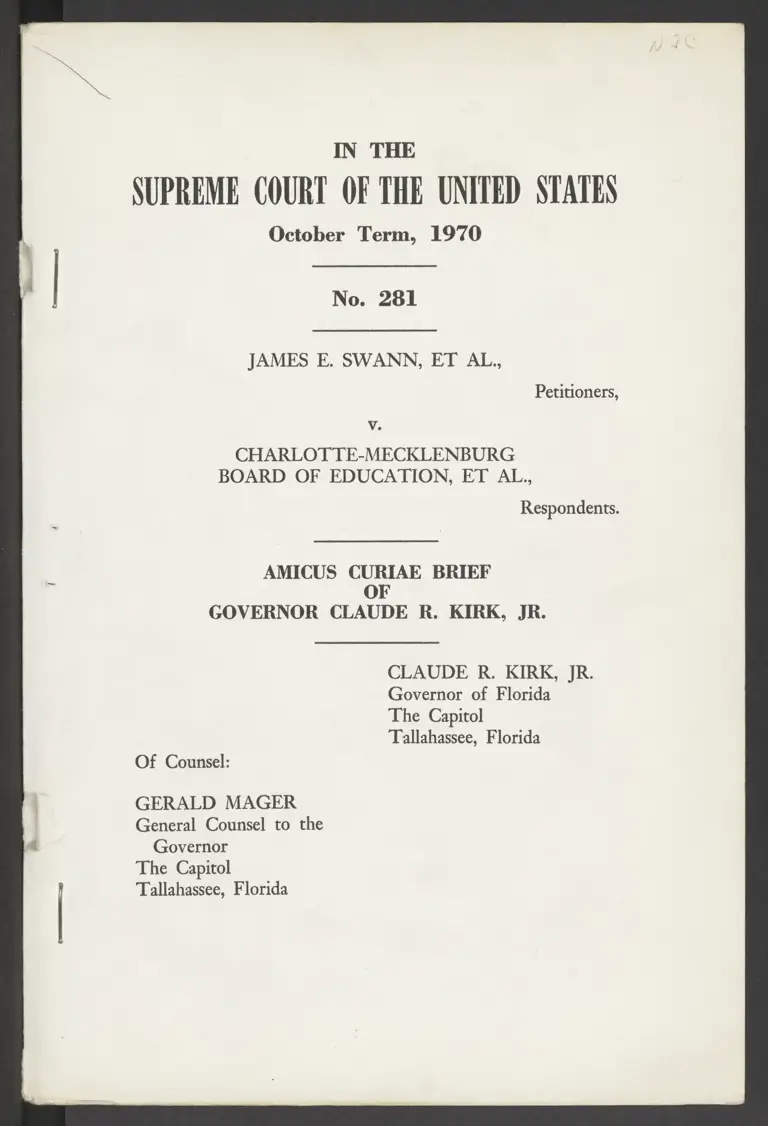
Amicus Curiae Brief of Governor Claude R. Kirk, Jr.

Public Court Documents
September 4, 1970

Amicus Curiae Brief of Governor Claude R. Kirk, Jr. preview

92 pages

Cite this item

  • Case Files, Swann v. Charlotte-Mecklenburg Hardbacks. Amicus Curiae Brief of Governor Claude R. Kirk, Jr., 1970. e3c57de2-2d34-f111-88b4-7c1e526962fd. LDF Archives, Thurgood Marshall Institute. https://ldfrecollection.org/archives/archives-search/archives-item/30d36aa5-f5e2-4c24-90b5-01eb9acfd63a/amicus-curiae-brief-of-governor-claude-r-kirk-jr. Accessed June 02, 2026.

    Copied!

     [||a75bb28a-ddc5-48ad-81b9-31fbf50e6864||] IN THE 

SUPREME COURT OF THE UNITED STATES 
October Term, 1970 


No. 281 
  

JAMES E. SWANN, ET AL, 

Petitioners, 

Ve. 

CHARLOTTE-MECKLENBURG 
BOARD OF EDUCATION, ET AL., 

Respondents. 


AMICUS CURIAE BRIEF 
OF 

GOVERNOR CLAUDE R. KIRK, JR. 


CLAUDE R. KIRK, JR. 
Governor of Florida 

The Capitol 

Tallahassee, Florida 

Of Counsel: 

GERALD MAGER 
General Counsel to the 

Governor 

The Capitol 
Tallahassee, Florida  


INDEX 

Introduction 

A. Consent for Filing 

B. Preliminary Statement 

C. Issues Involved 

Discussion 

A. Failure of Courts to Provide Guidelines 

B. Neighborhood School Concept 

C. Busing to Achieve Racial Balance, Maintaining a 

Racial Balance—Equal Educational Opportunities 

D. De Jure—De Facto Distinction 

t= Consideration of Race is Unconstitutional—Pro- 

portionate Representation Prohibited 

F. Distinction between Schools not Mathematically 

Integrated and Segregated Schools 

G. Meaning of Fourth Circuit Court’s Decision—Rule 

of Reason 

H. Issues Court Must Resolve 

Conclusion 

Appendix 

Certificate of Service 

Page 


1 

AUTHORITY TO FILE 

Cases 

Alexander v. Holmes County, (1969) 396 US 19, 

24 1.Ed.2d. 19 

Allen v. Board of Public Instruction of Broward 
County, Slip Opinion Number 30032, Aug. 18, 
1970 

Bell v. School City of Gary, Indiana, U.S.CA., 7 
Cir. (1963) 324 F.2d. 209, cert. denied, 377 U.S. 

024, 84 S.Ct. 1223; 12: L.Ed.2d. 216 

Bivins v Bibb County Board of Public Education, 
US.D.C., M.D. Ga (Jan. 21,.1970) No. 1926 

Briggs v. Elliott, ED.S.C. (1955) 132 F. Supp. 776 

Brown v. Board of Education, (1955) 349 U.S. 294, 

99 L.Ed. 1083, 1089 

Carter v. West Feliciana Parish School Board, et al. 

U.S.D.C., SD, Ala, Case No. 28,340 

Cassell v. Texas, (1950) 339 U.S. 282; 94 L.Ed. 840, 
847; 339 U.S. 291, 94 L.Ed. 849 

Deal v. Cincinnati Board of Education, U.S.CA., 6 

Cir. (1966) 369 F.2d. 55 (Deal 1) cert. denied, 

330 US 847, 88 S.Ct. 39,19 1L.Ed.2d. 114 

Deal v. Cincinnati Board of Public Instruction, 
US.C.A., 6 Cir. (1969) 419 F.2d, 13387, 1391-2 
(Deal 1I) 

Downs v. Board of Education of Kansas City, 
US.CA. 10 Cir, (1964) 336 F.2d. 988, cer. 

Page 

19, 23 

23 

19 

10 

16 

22 

11 

19 


111 

Cases 

denied, 380 US 914, 85 S.Ce. 898, 13 1.Ed. 2d. 

800 

Ellis v. Orange County Board of Public Instruc- 
tion, US.C.A.,)8 Cir. MD. Fla, (Feb. 17, 1970) 
No. 29,124 

Gilliam v. School Board of City of Hopewell, Va. 
US.CA.,4 Cir, 345 F.2d. 325 

Goins v. Allgood, U.S.C.A., 5 Cir. (1968) 391 F.2d. 

692 

Green v. County School Board of New Kent 
County, (1968) 391 U.S. 430, 439, 88 S.Ct. 1689, 

20 F.2d. 716 

Harvest, et al. v. Board of Public Instruction of 
Manatee County, et al., Slip Opinion No. 29425, 
5 Cir., June: 26; 1970 

Henry v. Clarksdale Municipal Separate School Dis- 
trict, USCA. $ Cir, (1969) 409 F.2d. 632 

Holland v. Board of Public Instruction of Palm 
Beach County, US.C.A., 5 Cir. (1958) 258 F.2d. 

730 

Kelley, et al. v. Metropolitan County Board of Edu- 
cation of Nashville and Davidson County, Ten- 
nessee, et al., US.D.C. Nashville Div., M.D. 
August 25, 1970 

Northcross vs. Board of Education, (1970) —— U.S. 
— 25 1 Ed 3d 346, 250 

Singleton v. Jackson Municipal Separate School Dis- 
trict, et al, USCA, 5 Cr, Case No. 26,235 

(January 21, 1970) 

Page 

29 

12 

11 

19 

31 

27 

4 5 11 
13, 31, 33 


1v 

Cases Page 

Singleton, et al. v. Jackson Municipal Separate 
School Districe, et al., USCA. § Cir., Case No. 
29.226 (May 5, 1970) 6 

Swain v. Alabama, (1965) 380 U.S. 202, 208; 13 

L.Ed.2d. 759, 766 20 

Taylor v. Board of Education of City School Dis- 
trict of New Rochelle, US.C.A., 2 Cir. (1961) 
294 F.2d. 36 10 

Thomie v. Houston County Board of Education, 
US.D.C, M.D. Ga. (January 21, 1970) No. 2077 10 

US. v. Jefferson County Board of Education, 
USCA. 3 Cir. (1966), 372 F.2d. 336 {Jefferson 

I) affirmed and adopted en banc 380 F.2d. 385, 

(Jefferson II) cert. denied sub. nom., Caddo 

Parish School Board v. United States (1967) 389 9, 12, 14, 

U.S. 840, 88 S.Ct. 67, 19 L.Ed.2d. 103 15,17 

U.S. v. Wiman, US.C.A,, 5 Cir. (1962) 304 F.2d. 53 20 

Other 

Civil Rights Act of 1964 

Section 401 (b) 8 

Section 407 (a) 8, 9 

Fourteenth Amendment, U.S. Constitution 21,22 

Statement by the President on Elementary and 

Secondary School Desegregation, March 4, 1970 26, 29, 32 


IN THE 

SUPREME COURT OF THE UNITED STATE 
October Term, 1970 


No. 281 
  

JAMES E. SWANN, ET AL, 

Petitioners, 

V. 

CHARLOTTE-MECKLENBURG 
BOARD OF EDUCATION, ET AL, 

Respondents. 


AMICUS CURIAE BRIEF 

OF 

GOVERNOR CLAUDE R. KIRK, JR. 


INTRODUCTION 

I. 

CONSENT FOR FILING 

In accordance with Rule 42 of the Supreme Court Rules, 

written consent to the filing of this Brief has been granted by 

the Petitioners and Respondents in this cause. (Appendix 

hereto Exhibit B 35—6) 


II. 

PRELIMINARY STATEMENT 

Claude R. Kirk, Jr., as Governor of the State of Florida, 

files this Brief as Amicus Curiae for the purpose of presenting 

to this Court, legal considerations which may be of assistance 

in the ultimate disposition of the issues. Amicus respectfully 

submits that he is not conversant with all the factual con- 

siderations; and, consequently, will endeavor to rely upon the 

factual representations contained in the Briefs filed by the 

parties in the presentation of any legal considerations to this 

Court. 

The Governor appeared as Amicus Curiae in the proceed- 

ings before the Fourth Circuit Court of Appeals. The Gover- 

nor also has appeared both as a party and as Amicus in numer- 

ous judicial proceedings before the district courts of the State 
of Florida, Fifth Circuit Court of Appeals, and this Honorable 

Court. In an original suit instituted in this Court in January, 
the Governor sought to have this Court declare and define the 

meaning of a “unitary system,” thereby fixing an ascertainable 

standard of conduct to be followed by the school boards in 

all states. The suit further sought to have this Court declare 

that no state of the United States, in establishing a unitary 

system, be compelled to transport pupils for the purpose of 

achieving a racial balance. Unfortunately, the Court dismissed 

the suit for lack of jurisdiction. 

The legal issues involved in this cause are also strikingly 

similar to those previously considered by the Fifth Circuit 

Court of Appeals and the District Courts in Florida. Recent 

decisions by the Fifth Circuit and the District Court clearly 

demonstrate the necessity for this Court to resolve clearly and 

unmistakably, once and for all, questions of busing and balance. 


III. 

ISSUES INVOLVED 

1. Does the Constitution require or permit the courts to 

order the busing of pupils for the purpose of achieving 

a racial balance? 

2. Does the Constitution require or permit the courts to 

direct school boards to adopt plans designed to bring about 

mathematical racial balances within school systems? 

IV. 

DISCUSSION OF ISSUES 

The Constitution neither requires nor permits the courts to 

direct the establishment of a mathematical racial balance 

whether by busing or otherwise. 

It was the position of Amicus before the Fourth Circuit 

Court of Appeals, and it remains the position of Amicus before 

this Court, that the concept of forced busing, that is to say 
involuntary transportation of pupils from one school to an- 

other for the purpose of achieving racial balance, and the con- 

cept of establishing a racial balance, whether by busing or 

otherwise, is neither required nor permitted under the Con- 

stitution of the United States and is inconsistent with the Civil 

Rights Act of 1964, the statements made by the President of 

the United States on Elementary and Secondary School De- 

segregation and applicable judicial declarations. 

Amicus respectfully submits that we are where we are today 

largely as a result of the failure of the Courts to provide the 

necessary guidance. This was so aptly pointed out by Judge 


Coleman in his dissent in Singleton wv. Jackson Municipal 
Separate School District, et al., US.C.A.,, 5 Cir.,, Case No. 
26,285 (January 21, 1970), when he observed: 

“What I dissent from is the continuing failure of this 

Court to provide a lighthouse in the new storm which is 

upon us. The school authorities and the District Judges 
need something to steer by. 

In United States v. Jefferson County Board of Educa- 
tion, 372 F.2d 836, 380 F.2d 385 (1966 and 1967), when 

freedom of choice was an acceptable method of seeking 

desegregation, this Court formulated a detailed decree for 

use by the District Courts and forbade any variation there- 

from. Now that freedom of choice is held to have gen- 

erally failed we lapse into silence and wash our hands in 

the water of taciturnity. I strongly protest this approach. 

In Jefferson 1, 372, F.2d 836, 849 (1966), the majority 

announced, ‘We grasp the nettle.’ I think the District 

Courts need help. They are being forced to act without 

our answer to many unanswered questions. I shall dis- 

cuss some of them and state my view of what answers 

ought to be. 

On September 30, 1969, at an en banc session in New 

Orleans, this Court ordered the cases now before us to be 

considered en banc. We were acutely aware of the critical 

nature of the problem—critical for the eradication of un- 

constitutional discrimination and critical for the future of 

public education, the great hope of nearly all children, 

black and white. It was my understanding then that upon 

the en banc hearing in Houston on November 17, 1969, 

we would attempt to supply some judicial compasses for 


use in a forest which had not been anticipated in 1966. 

Regrettably, we did not really do so. 

Certainly as the Supreme Court said in Brown II, and 

as we have often repeated, local school authorities have | 

the primary responsibility for elucidating, assessing, and | 

solving these problems, 349 U.S. 299. It does no good now | 

to say that these school districts have bad fifteen years in 

which to do something and have not dome it. As a matter 

of fact, most of the school districts now before us, if not 

all of them, have been under the supervision of the federal ] 

courts for as much as five years. I think it is quite clear 

awhat this proves. 

Regardless of who is, or has been at fault, the Supreme 

Court has told us in no uncertain terms that it will brook 

no further delays. Do we, then, stand by and see Innu- 

merable schools go crashing on the rocks and educational 

processes seriously impaired or shall we bestir ourselves 

and advance judicial solutions which will dismantle the 

dual school system without dismantling the schools as 

well? Samson slew his enemies, all right, but he likewise 

destroyed the hall and liquidated himself—all because of 

bad judgment, previously exercised.” (emphasis ours) 

Judge Clark joined with Judge Coleman in a separate dissent 

in Singleton, supra, and also expressed a deep concern about 

the failure of the higher courts to provide the necessary 
specifics to assist the lower courts in determining constitu- 
tionally acceptable plans. Judge Clark keenly observed: 

“Nobody knows what constitutes ‘a unitary school sys- 

tem within which no person is to be effectively excluded 

from any school because of race or color.” This is not to 


say ‘that this court hasn’t drawn some negative limits 

around the phrase ‘unitary school” We have frequently 

decreed that systems coming before us were not unitary 

for one reason or another. However, what is here urged 

is our duty to speak affirmatively, to tell the litigants, in 
advance of attacks made on them, precisely what such a 

‘unitary system’ is. We have said such a system must be 

racially integrated and that its faculty must approximate 

the racial balance of the whole system. These are the only 

affirmatives known.” 

It was not until the decision by the Fifth Circuit Court of 

Appeals in Ellis v. Orange County Board of Public Instruction, 
U.S.CA., 5 Cr, M.D. Fla. (February 17, 1970) No: 29,124, 

(see also Singleton, et al. v. Jackson Municipal Separate School 
District, et al., US.C.A. 5 Cir., Case No. 29,226, May 5, 1970) 
that we had some indication of an acceptable educationally 

sound approach to the establishment of a unitary school Sys- 

tem—namely the neighborhood school concept without the 

necessity of forced bussing. In Ellis, the Fifth Circuit Court 
observed in part: 

“As stated, based on the supplemental findings of fact, it 

appears that a true neighborhood assignment system, 

assigning students to the school nearest the student’s home 

up to the capacity of the given school, will result in the 

desegregation of eight of the remaining eleven all-Negro 

student body schools in the Orange County, system, 

leaving three elementary schools.” 

* * * * * * 

“There are a number of all-white student body schools in 

the Orange County system. This is due to the prepon- 

derant white student population (82 percent) and to 


schools which will remain, if the neighborhood assign- 

ment system is properly invoked, are also the result of | 

residential patterns. The majority to minority transfer | 

provision under the leadership of the bi-racial com- 

residential patterns. The three all-Negro student body | 

| 

mittee 1s a tool to alleviate these conditions now. Site 

location, also under the guidance of the bi-racial 

committee, will guarantee elimination in the future. 

In addition, open housing, Title VIII, Civil Rights Act 

of 1968, 42 USCA, SS 3601, Et Seq., Jones v. Mayer, 

1968, 392 U.S. 409, 88 S.Ct. 2186, 20 L.Ed.2d 1189, 
will serve to prevent neighborhood entrapment.” 

Ample precedent for the neighborhood school system is 

reflected in Deal v. Cincinnati Board of Public Instruction, 
USCA. 6 Cir., 1969, 419 F.2d. 1387, 1391-1 (Ded ID; | 

“‘The neighborhood system is in wide use through- 

out the nation and has been for many years the basis of 

school administration. This is so because it is acknowl- 

edged to have several valuable aspects which are an aid to 

education, such as minimization of safety hazards to chil- 

dren in reaching school, economy of cost in reducing 

transportation needs, ease of pupil placement and admin- 

istration through use of neutral, easily determined 

standards, and better home-school communications.’ ” 

* * * * * * 

“In Northcross v. Board of Education of the City of 
Memphis, Tenmessee., 302 F.2d. 818 (6th Cir. 1962), 

cert. denied, 370 U.S. 944, we outlined the minimal re- 

quirements for non-racial schools: 

‘Minimal requirements for non-racial schools are 

geographic zoning, according to the capacity and | 


facilities of the buildings and admission to a school 

according to residence as a matter of right” Id. at 

323.” 

The plan which was approved by the District Court in this 

case, as we understand it, involves extensive busing for the 

purpose of achieving racial balance and, apparently, rejects 

the reasonable efforts made by the Charlotte-Mecklenburg 

Board of Education to implement an assignment plan based 

on the neighborhood school concept and not on racial quotas. 

Although there is some indication that the order of the Dis- 

trict Court was not promulgated to achieve a “racial bal- 

ance,” the fact that the court directed the balancing of cer- 

tain schools demonstrates that the achieving of a racial 

balance was a controlling factor in the court’s determination. 

Although this may not have been the lower court’s intention, 

the fact remains from our understanding of the approved 

plan, that there is extensive involuntary busing for the pur- 

pose of achieving a racial balance. The clear wording and the 

intent of the Civil Rights Act of 1964 completely negates 

any intention to approved forced busing. 

Section 401(b) of the Civil Rights Act of 1964 provides 

as follows: 

“ ‘Desegregation’ means the assignment of students to 

public schools and within such schools without regard to 

their race, color, religion, or national origin, but ‘de- 

segregation’ shall not mean the assignment of students to 
public schools in order to overcome racial imbalance.” 
(emphasis ours) 

Section 407(a) of the Civil Rights Act of 1964 provides 

in part as follows: 


[43 

. . . provided that nothing herein shall empower any 

official or court of the United States to issue any order 

seeking to achieve a racial balance in any school by re- 

quiring the transportation of pupils or students from one 

school to another or one school district to another in order 

to achieve such racial balance, or otherwise enlarge the 

existing power of the court to insure compliance with 

constitutional standards. . .” (42 U.S.C. Sec. 2000c-6 (a) ) 

In U. S. v. Jefferson County Board of Education, U.S.C.A., 

5. Cir. (1966), 372 F.2d. 836 (Jefferson 1). affirmed and 

adopted en banc 380 F.2d. 385, (Jefferson II) cert. denied 

sub. nom. Caddo Parish School Board v. United States (1967) 

389 US 840, 88 S.Ct. 67, 19 L.Ed. 103, this Court, in Jeffer- 

son 1 observed at page 856: 

. When Congress declares national policy, the duty 

the two other coordinate branches owe to the Nation 

requires that, within the law, the judiciary and the execu- 

tive respect and carry out that policy. . .” 

In the enactment of Section 407 (a), supra, Congress de- 

clared a national policy with regard to the busing of pupils 

solely to achieve a racial balance. Unless Section 407 (a), 

supra, is declared to be unconstitutional and void, having no 

force and effect, it is respectfully suggested that the provi- 

sions of this Act are applicable and controlling. 

In Deal v. Cincinnati Board of Education, US.C.A., 6 Cir. 
(1966) 369 F.2d. 55, (Deal 1) cert. denied 389 US 847, 88 

S.Ct. 39, 19 L.Ed.2d. 114, the United States Court of Appeals 

for the Sixth Circuit held: 

“We hold that there is no constitutional duty on the part 

of the Board to bus Negro or white children out of their 


10 

neighborhoods or to transfer classes for the sole purpose 
of alleviating racial imbalance that it did not cause, nor 
is there a like duty to select new school sites solely in 
furtherance of such a purpose.” (emphasis ours) 

See also Deal v. Cincinnati Board of Education, supra, (Deal 

I); Bivins v. Bibb County Board of Public Education, 
U.SD.C., MD. Ga. (January 2V, 1970) No.°1926; and 

Thomie v. Houston County Board of Education, US.D.C, 
M.D. Ga. (Jamuary 21,1970) ‘No. 2077. 

In Taylor v. Board of Education of City School District 
of New Rochelle, USCA. 2 Civ. (1961) 29% F.2d. 36, 

Judge Moore, in his dissent observed at page 41: 

“The best account of the problems presented to the 
Board during the last ten years (1950-1960) is found in 
the testimony of Kenneth B. Low who from 1950 to 
1960 served on the Board and was its President from 
1958 to 1960. He had had a distinguished career in the 
field of interracial relations and for seven years had 
served as Chairman of the Westchester County Council 
appointed by the State Commission Against Discrimina- 
tion . . . ‘Solutions, he said, which sent ‘youngsters out 
of the district because of their race, as discussed before 
the Board brought about discrimination in reverse be- 
cause you ave creating special conditions for people on 
account of their race and that it could and perhaps 
should apply equally to other schools which bad either a 
racial imbalance or a religious imbalance of national 
backgrounds, and the result is that it would establish a 
precedent for sending children, because of any of these 
factors, to schools, which was believed to be a violation 
of basic principle’ (One school was over 90% Jewish 


11 

and one over 90% ltahan.) ‘But (said Mr. Low) I am 

not going to violate what I consider to be basic constitu- 

tional principles, and the mere fact that this (Lincoln) 

happens to be a badly imbalanced racial school is not due 

to any act of the Board of Education. It is a residential 

condition.” ” (emphasis ours) : 

If the courts are required to correct racial imbalances, then 

they would also be equally required to correct religious im- 

balances or imbalances of national backgrounds. It is respect- 

fully suggested that the courts cannot constitutionally make 

a selective distinction between religious or racial imbalance 

and that it would be inviting the opening of a Pandora’s box 

if correction of any type of mathematical imbalance becomes 

a constitutional imperative. 

The comments made by Judge Coleman in Carter v. West 
Feliciong Parish School Board, et d., USD.C., SD. Ah, 

Case No. 28,340, and Singleton wv. Jackson Municipal Sep- 

arate School District, supra, are indeed pertinent: 

“The High Court has never arbitrarily commanded that 

there must be racial balance in the student body of any 

school purely for the sake of racial balance. It has never 

commanded that little children be required to walk un- 

reasonable distances, or to be bussed to strange commu- 

nities just to obtain racial balance. It has ordered us to quit 
operating two systems within a system, one all black, and 

one all white, judges by five criteria, not one. Neither has 

it left the door open to tokenism.” (emphasis ours) 

Judge Cox, in his dissenting opinion, in Henry wv. Clarksdale 

Municipal Separate School District, US.C.A., 5 Cir. (1969) 
409 F.2d. 682 at page 692, refers to the holding in Gilliam wv. 


12 

School Board of City of Hopewell, Va., US.CA., 4 Cir., 345 
F.2d. 325, as follows: 

¢ ¢ . The constitution does not require the abandon- 

ment of neighborhood schools and the transportation of 

pupils from one area to another solely for the purpose of 

mixing the races in the schools. . .”” 

In Jefferson 1, supra, at page 847, footnote 5, the Fifth Cir- 

cuit, while indicating that in its opinion, racial balance was to be 

given a high priority, it is not constitutionally required: 

“... The law does not require a maximum of racial 

mixing or striking a racial balance accurately reflecting 

the racial composition of the community or the school 

population. It does not require that each and every child 

shall attend a racially balanced school. . .” 

In Harvest, et al. v. Board of Public Instruction of Mana- 
tee County, et al. slip Opinion No. 29425, 5 Cir., June 26, 
1970, Judge Clarke in an opinion concurring with the ma- 
jority commenting on the Fourth Circuit’s decision in the 
instance cause observed in part: 

“... The court there emphasized what the district 

court here has consistently recognized—that racial bal- 

ancing is not the sine qua non of a unitary system—that 

educational reasonableness and realities must prevail over 

any artificial racial ratios. . .” 

In a dissenting opinion written by Judge Bell (Judge Bell 
wrote the majority opinion in Ellis v. Board of Public In- 
struction of Orange County, Supra) in Jefferson II, supra, 
it is observed in part at page 417: 


13 

[4 ‘. . . The Supreme Court has not said that every school 
must have children from each race in its student body, 

or that every school room must contain children from each 

race, or that there must be a racial balance or a near racial 

balance, or that there be assignments of children based on 

race to accomplish a result of substantial integration. The 

Constitution does not require such. We would do well to 

‘stick to our last’ so as to carry out the Supreme Court’s 

present direction. It is no time for new notions of what a 

free society embraces. Integration is not an end in itself; 

a fair chance to attain personal dignity through equal edu- 
cational opportunity is the goal. . .” (emphasis ours) 

In Deal I, supra, Chief Judge Weick similarly observed 

at page 59: 

¢ 
‘. . . If factors outside the schools operate to deprive 

some children of some of the existing choices, the school 
board is certainly not responsible therefor. 

“Appellants, however, argue that the state must take 

affirmative steps to balance the schools to counteract the 

variety of private pressures that now operate to restrict 

the range of choices presented to each school child. Such 

a theory of constitutional duty would destroy the well- 

settled principle that the Fourteenth Amendment governs 

only state action. Under such a theory, all action would 

be state action, either because the state itself had moved 

directly, or because some private person had acted and 

thereby created the supposed duty of the state to coun- 

teract any CONSequences. 


14 

The standard to be applied is ‘equal educational op- 
portunity’. The Court in Brown cast its decision thus 
because it recognized that it was both unnecessary and 
impossible to require that each child come through the 

complex process of modern education with the same end 

result. ‘This approach grants due respect for the unavoid- 

able consequences of variations in individual ability, 

home environment, economic circumstances, and occu- 

pational aspirations. Equal opportunity requires that 

each child start the race without arbitrary official handi- 

caps; it does not require that each shall finish in the same 

time.” (emphasis ours) 

It appears that whether busing to achieve racial balance is 

permissible has been held to depend on a so-called distinc- 

tion between “de jure” or “de facto” segregation situations. 

In this regard, Judges Bell and Coleman in their dissent in 
Jefferson 11, supra, observe at pages 413 and 418: 

“The unfairness which inheres in the majority opinion 

stems from the new doctrine which the original panel 

fashioned under the concept of classifying segregation 

into two types: de jure segregation, called apartheid, for 

the seventeen southern and border states formerly having 

legal segregation; and de facto segregation for the other 

states of the nation. This distinction, which must be with- 

out a difference and somewhat hollow to a deprived 

child wherever located, 1s used as a beginning. The origi- 

nal opinion then goes on to require affirmative action on 

the part of the school authorities in the de jure systems 

to integrate the schools. The neighborhood school sys- 

tems of the nation with their de facto segregation are 

excused. The Constitution does not reach them. 


15 

“This reasoning is necessary to reach the end of com- 

pulsory integration in the so-called de jure states. It is 

the counterpart to overruling the settled construction of 
the Fourteenth Amendment, to be next discussed, that 
integration is not commanded. The restrictions in the 

Civil Rights Act of 1964 against requiring school racial 
balances by assignment and transportation are written 
out of the law with respect to the de jure states by using 
the de jure-de facto theory. Title IV, subsection 401(b), 
407 (a), 42 U.S.C.A. subsection 2000c(b), 2000c-6. The 

overruling of the constitutional limitation removes the 

other impediment to compulsory integration. The way 

is thus cleared for the new dimension. The only question 

left is when, and to what extent. The authority to HEW 

is carte blanche. We should disavow the de jure-de facto 

doctrine as being itself violative of the equal protection 

clause. It treats school systems differently. It treats chil- 

dren differently. It is reverse apartheid. It poses the 

question whether legally compelled integration is to be 

substituted for legally compelled segregation. It is un- 

thinkable that our Constitution does not contemplate a 

middle ground-no compulsion one way or the other.” 

(emphasis ours) 

“I further believe that whatever the Fourteenth Amend- 
ment requires of any State it requires of all States. If we 
are requiring something here in the enforcement of Four- 

teenth Amendment rights that should not be required of 

all fifty states then we have exceeded our authority and 

we have misapplied the Constitution. . .” (emphasis ours) 

Judge Gewin in Jefferson II, supra, observes at page 398:  


16 

¢ 
‘. . . One of the chief difficulties which I encounter with 

the opinion is that it concludes that the Constitution 
means one thing in 17 states of the nation and something 

else in the remaining states. This is done by a rather in- 

genious though illogical distinction between the terms 

de facto segregation and de jure segregation. While the 

opinion recognizes the evils common to both types, it 

relies heavily on background facts to justify the con- 
clusion that the evil will be corrected in one area of the 

nation and not in the other. In my view the Constitution 

cannot be bent and twisted in such a manner as to justify 

or support such an incongruous result.” 

The application which some courts have given to the anti- 

bussing philosophy expressed in Section 407(a), supra, ap- 

pears to have been occasioned by the apparent rejection of 

the decision in Briggs v. Elliott, ED.S.C. (1955) 132 F.Supp. 
776, where it was held at page 777: 

“.. . it 1s important that we point out exactly what the 

Supreme Court has decided and what it has not decided 

in this case. It has not decided that the federal courts 
are to take over or regulate the public schools of the 
states. It has not decided that the states must mix persons 

of different races in the schools or must require them to 

attend schools or wwmust deprive them of the right of 
choosing the schools they attend. What it has decided, 
and all that it has decided, is that a state may not deny to 

any person on account of race the right to attend any 

school that it maintains. This, under the decision of the 

Supreme Court, the state may not do directly or indi- 

rectly; but if the schools which it maintains are open to 

children of all races, no violation of the Constitution is 

involved even though the children of different races 


17 

voluntarily attend different schools, as they attend differ- 

ent churches. Nothing in the Constitution or in the de- 

cision of the Supreme Court takes away from the people 

freedom to choose the schools they attend. The Consti- 

tution, in other words, does not require integration. It 

merely forbids discrimination. It does not forbid such 

segregation as occurs as the result of voluntary action. 

It merely forbids the use of governmental power to en- 

force segregation. The Fourteenth Amendment is a limi- 

tation upon the exercise of power by the state or state 

agencies, not a limitation upon the freedom of indi- 

viduals.” (emphasis ours) 

Judge Gewin in Jefferson Il, supra, in commenting on the 

apparent rejection of the Briggs doctrine, supra, observed 
at page 409: 

“If the alleged Briggs dictum is so clearly erroneous 

and constitutionally unsound, it is difficult to believe that 

it would have been accepted for a period of almost 

twelve years and quoted so many times. Even the major- 
ity concedes that the court in Briggs was composed of 

distinguished jurists, Judges Parker, Dobie and Timmer- 
man. If the majority is correct, it is entirely likely that 

never before have so many judges been misled, including 

judges of this Court, for so long by such a clear, under- 

standable direct, and concise holding as the language 

in Briggs which the opinion now condemns. The lan- 

guage is straightforward and simple: “The Constitution, 

in other words, does not require integration. It merely 

forbids discrimination.’ 

It is interesting also to observe that the Supreme Court 

has never disturbed the Briggs language although it has  


18 

had numerous opportunities to do so. As a matter of fact, 

it has come very close to approving it; if it has not ac- 

tually done so. .. 

The majority rule requiring compulsory integration is 
new and novel, and it bas not been accepted by the Su- 
preme Court or by the other circuits. . .” (emphasis 
ours) 

In this regard, Judge Young, who was the trial judge in 
the Ellis case, supra, observed as follows: 

“. . . A student who because of his color is scooped up 

within a gerrymandered zone to be transported to a dis- 

“tant school in the same zone and deprived of the right 

of attending a school a few blocks from his home which 

is placed in another zone (where such zones are gerry- 

mandered for racial balance alone) is ‘effectively ex- 

cluded’ from a school because of race or color which is 

contra to Alexander v. Holmes County Board of Edu- 

cation, supra.” (emphasis ours) 

Judge Clark in his dissent in Singleton, supra, very simi- 
larly observed: 

“The assignment of specific racial quotas and the es- 

tablishment of minimum, acceptable, percentage, racial 

guidelines for students, most assuredly cannot be the 

terms of definition, for when a child of any race wishes 

to attend a school because of its location close to home, 

because of the deemed excellence of its faculty or facili- 

ties, because it is attended by brothers or sisters or close 

friends or because it is on Dad’s way to work or in 

Mother’s car pool, and his wishes accord with valid edu- 


19 

cational policy, yet that child winds up being excluded 
from that school solely because the color of his or ber 
skin doesm’t conform to a predetermined arbitrary racial 
quota or percentage guideline, that child's right to be 
free of racial distinctions is gone. By the very wording 
of the phrase to be defined, a school system can’t be 
‘unitary’ if a child is effectively excluded from any school 
because of bis or ber race or color. It’s easy to see what 

it isn’t, the challenge is to show what it is.” (emphasis 

ours) 

(See also Holland ©v. Board of Public Instruction of Palm 
Beach County, US.C.A., 35 Cr. (1958) 258. F.2d. 730, Bell 

w, School City of: Gary, ndings, US.C.A., 7.Cu. (1963) 
324 F.2d. 209; cert. denied, 377 US 924, 84 S.Ce. 1223, 12 

L.Ed.2d. 216; Downs v. Board of Education of Kansas City, 
US.CA. 10 Cir, (1964) 336 F.2d. 988, cert. denied, 380 
US 914.85 .5.Cr..898,.13 L.Ed. 2d. 800). 

  
Amicus respectfully suggests that busing as contemplated 

by the District Court’s order would be contrary to the prin- 

ciples set forth in Alexander v. Holmes County, (1969) 396 

US 19, 24 L.Ed.2d. 19. As we understand it, the order of the 

District Court requires that the school children administered 

by the plan which the court has approved are to be bused 

on the basis of race so as to achieve proportionate racial 

representation in the schools; and, because of their race, cer- 

tain children would be excluded from the school within the 

neighborhood of their choice and bused to another solely on 

the basis of race. This inherently violates the due process 

and equal protection clause of the Fourteenth Amendment 

to the United States Constitution. In Cassell v. Texas, (1950) 

339 U.S. 282, 287; 94 L.Ed. 840, 847, this Court said:


20 

¢ ‘. . . Proportional racial limitation is therefore for- 

bidden. An accused is entitled to have charges against 

him considered by a jury in the selection of which there 

has been neither inclusion nor exclusion because of 
» 

race. . . 

At 339 US. 291, 94 L.Ed. 849, a concurring opinion speak- 

ing through Mr. Justice Frankfurter stated: 

[44 
. . . But discrimination in this context means purpose- 

ful, systematic, non-inclusion because of color. . . It does 

not mean absence of proportional representation. Malis 

The principle of Cassell has been re-announced in recent 

times in Swain v. Alabama, (1965) 380 U.S. 202, 208; 13 

L.Ed.2d. 759, 766, wherein the following statement appears: 

“Similarly, since there can be no exclusion of Negroes 

as a race because of color, proportional limitation is not 

permissible. (Cassell v. Texas, 339. US. 292; 94 L.Ed 

230) ny 

This court has given the Cassell principle some recognition 

in the cases of U. S. v. Wiman, US.C.A., 5 Cir. (1962) 304 
F.2d. 33 and Goins v. Allgood, US.C.A.; 3: Cr... (1968) 1391 

F.2d. 692, wherein it is said that proportionate representation 

is not required. 

Each of the foregoing cases is concerned with jury selec- 

tion. However, there is no difference between the constitu- 

tional prohibitions against discrimination in the assignment 

of jurors and the assignment of students. Proportionate repre- 

sentation is prohibited because it requires that the state 

exclude on the basis of race those who exceed the portion 


21 

allotted to their race. The law must be color-blind. If the law 

requires that the race of the administered be known in order 

to enforce the law, then clearly race is made a controlling 

characteristic or issue. The plan approved by the lower court 
can only be effectuated if the race of the child is disclosed. 
It is a plan clearly racial in characteristic and as such is un- 

constitutional per se. The plan requires that a child, on the 

basis of race, graduate in a high school other than that which 

he has attended for perhaps three and a half years. It requires 

that he be bused out of his neighborhood. If the child falsi- 

fies his race and leaves all other factors the same he achieves 

the desirable circumstance of stability. Change can be legiti- 

mately imposed on him but not on the basis of race. A law 

which clearly discriminates on the basis of race cannot gain 

a constitutional exception because it is thought to promote 

a desirable social amelioration. 

The Court should also consider that the Fourteenth 

Amendment concludes with the provision: 

“Section 5. The Congress shall have power to enforce 

by appropriate legislation, the provisions of this article.” 

Congress has exercised the power specifically given by 

passing legislation which prohibits busing. It is respectfully 

suggested that such legislation prohibits the racial discrimina- 

tion characteristic of the plan in question. The Court should 

not give any construction of the Congressional enactment 

which would pervert any intent which may be clearly shown 

by the Congressional record or by the language of the act. 

Certainly the court should not say to its fountain head of 

jurisdictional power that it has not prohibited forced busing 

on the basis of race if only a distortion of the clear intent 

would permit such conclusion. To do so would require of  


[3
] 

[3
] 

Congress that it limit the Court's power to review certain 

Congressional enactments by a provision in the Act so stating, 

because such provision would be the only method whereby 

Congress could effectively exercise the power specifically 

given by Amendment XIV, Section 5, of the Federal Con- 

stitution. 

Congressional power to enforce the Fourteenth Amend- 

ment 1s not exclusive. However, in light of the specific pro- 

visions of Section 5, it must be controlling. 

If the Fourteenth Amendment of the Federal Constitution 

permitted, without requiring, proportionate representation on 

the basis of race, the decision of a United States District 

Court requiring proportionate representation would have to 

be reversed as imposing what was not required. A fortiori the 

order of a U. S. District Court must be reversed for imposing 

proportional racial representation when such is actually 

prohibited by the Fourteenth Amendment. As the Honor- 
able Thurgood Marshall stated in his Brief in Brown v. Board 

of Education, (1955) 349 US. 294, 99 L.Ed. 1083, 1089: 

“The Fourteenth Amendment requires that a decree be 

entered directing that appellants be admitted forthwith 

to public schools without distinction as to race or color.” 

Amicus asks but the same. 

Amicus would be remiss mn his responsibility to this Court 

if some comment were not made regarding the arguments 

of the parties: in .this proceeding. The: Brief filed by 

the Charlotte-Mecklenburg Board of Education (Cross- 

Petitioner) sets forth with great particularity and specificity 

their opposition to compulsory busing and racial balancing. 

At page 29 of their Brief, the Cross-Petitioner states, in part, 


that, “We do not think that the Constitution requires this 

racial balancing nor the busing necessary to implement it 

. ..7 The Brief filed by James Swann, et al, (Petitioners) 

urges acceptance of the concept of a racially balanced school 

system and busing to achieve such balance; such concept, it 

is argued, as being the constitutional imperative which the 

school boards have: been mandated by the courts to follow. 

Petitioner submits that these “techniques” are required to 

“eliminate segregation” and “integrate the school system.” 

Amicus respectfully submits that there is indeed a distinc- 

tion between school systems which are “segregated” and 

school systems which vary in the degree of mathematical 

“Integration.” Amicus suggests that there is a vast difference 

between the elimination of school segregation as commanded 

by the Court in the Brown cases, and directing a more 

racially balanced system as ordered by the District Court. 

Amicus respectfully submits that the inability of the Courts 

to make this distinction has contributed to the judicial con- 

fusion. It has been commonplace and perhaps an oversimplifi- 

cation to interchange these two concepts. In many instances, 

the courts were, in reality, dealing with school systems which 

were not “segregated,” but rather which did not have a suffi- 

cient degree of “integration” to “satisfy” the courts’ concept 

of a unitary system. 

The principle that this Court clearly enunciated in Alexan- 

der vs. Holmes County Board of Education, supra, was the 
necessity and requirement of school boards to establish a 

unitary system “within which no person is to be effectively 

excluded from any schools because of race or color.” 

In Allen vs. Board of Public Instruction of Broward County, 
slip Opinion Number 30032, August 18, 1970, the Fifth Cir- 

cuit observed, in part, as follows:  


24 

“The Supreme Court has commanded courts and school 
boards to eliminate school segregation ‘root and branch,’ 
Green, supra, 391 US. at 438, and to do it mow. See 
Green, supra; Alexander v. Holmes County Board of 
Education, 1969, 396 U.S. 19, 90 S.Ct. 29, 24 L.Ed. 2d 

19; Carter v. West Feliciana Parish School Board, 1970, 
396 U.S. 290, 90 S.Ct. 608, 24 L.Ed. 2d 477. We must 

be responsive to this constitutional mandate.” (emphasis 

ours) 

Indeed, the courts must be responsive to this mandate— 

but what is this mystical mandate? Is it to command the 

establishment of a racially balanced school system? Must the 

courts forever be saddled with a perennial abacus, reviewing 

plans every term and every time the population shifts adjust- 

ing them mathematically? This certainly could not be the 

intent of Alexander; providing equal educational opportumi- 
ties should be the goal. 

The Petitioner attempts to distort this, as well as the signifi- 

cance of the opinion of the Fourth Circuit, in suggesting a 

“new” legal principle has been established below, to-wit: 

“that in each case a court must decide whether the goal of 

complete desegregation of all schools is a reasonable goal 

. whether the Court thinks desegregation is worthwhile, 

giving the circumstances of the district . ..” (page 24, 

Petitioner’s Brief). This interpretation is completely incon- 

sistent with the meaning and significance of the opinion of 

the Fourth Circuit. The question is not whether desegrega- 

tion is worthwhile—this issue was resolved in 1954 by this 

Court and is no longer a matter to be resurrected. Nor is it 

fair to this Court to infer that the Fourth Circuit’s decision 

is one that is in opposition to desegregation. This suggestion 

is nothing more than a smoke screen designed to obscure the 

real issues and divert attention from the resolution of these 


23 

issues. Nowhere in the majority opinion of the Fourth Cir- 

cuit is there any intent to question the reasonableness of the 

goal of desegregation and this Court should pierce this 
illusory inference. The Fourth Circuit, in adopting what it 

referred to as “the test of reasonableness, instead of one that 

calls for absolutes” observed, in part: 

[43 . if a school board makes every reasonable effort 
to integrate the pupils under its control, an interactable 

remnant of segregation, we believe, should not void an 

otherwise exemplary plan for the creation of a unitary 

school system. Ellis ws. Board of Public Instruction of 
Orange County, Number 29124, February 17, 1970— 
F.2d.—Fifth Circuit.” (emphasis ours) 

With regard to the question of busing, the Fourth Circuit 

went on to observe: 

“Bussing is a permissible tool for achieving integration, 

but is not a panacea. In determining who should be 

bussed and where they should be bussed, a school board 

should take into consideration the age of the pupils, the 

distance and time required for transportation, the effect 

on traffic, and the cost in relation to the board’s resources. 

The board should view bussing for integration in the 

light that it views bussing for other legitimate 1mprove- 

ments, such as school consolidation and the location of new 

schools. In short, the board should draw on its experience 

with bussing in general—the benefits and the defects—so 

that it may intelligently plan the part that bussing will 

play in a unitary school system 

“, .. The board, we believe, should not be required to 

undertake such extensive additional busing to discharge 

its obligation to create a unitary school system.”  


26 

The Petitioner expresses great concern about applying a. 

“rule of reason,” seemingly suggesting that this rule has some 

sinister connotation. The Petitioner submits that applying the 

test of reasonableness “must leave every board or court which 

seeks to apply the formula, essentially at sea.” (page 39, Pe- 

titioner’s Brief) Yet, while suggesting the vagueness of using 

a standard of reasonableness in approving the efforts of the 

school board in the adoption of a school plan, Petitioner un- 
hesitatingly suggests that there is a “reasonable basis for the 

District Court’s decision;” that the Fourth Circuit Court’s order 

was not governed by traditional rules of appellate review be- 

cause in order to set aside the equity decree, the appellant 

“must demonstrate that there was no reasonable basis for the 

District Court’s decision.” How does one determine or demon- 

strate the existence or non-existence of a “reasonable basis” 

for a District Court’s decision, if the phrase or term “reason- 

able” is as vague as Petitioner suggests? Why is the test of 

reasonableness adopted by the Fourth Circuit, any the less 

vague than the test used by an appellate court or an appellant 

to sustain or set aside a lower court’s decision. 

The “rule of reason” which is the foundation for all juris- 

prudence is now alleged to be fraught with danger. Amicus 
would respectfully suggest that a determination of what is 

“reasonable” is perhaps far easier (and a much more equitable 

standard) than determining what is meant by a “unitary 

system,” which latter phrase the courts have spoken of with 

such forcefulness and understanding—yet what does that 

phrase really mean? 

In his Statement on Elementary and Secondary School 

Desegregation, made on March 24, 1970, President Nixon 

prophetically observed (even before the Fourth Circuit ruled): 


27 

¢ ‘.. . There 1s a Constitutional mandate that dual school 

systems and other forms of de jure segregation be elimi- 
nated totally. But within the framework of that require- 

ment an area of flexibility—a “rule of reason”—exists, in 
which school boards, acting in good faith, can formulate 

plans of desegregation which best suit the needs of their 

own localities.” (emphasis ours) (Appendix hereto Exhibit 

A 1—34, 12) 

The issue 1s not whether the Fourth Circuit Court is cor- 

rect in adopting a test based upon reasonableness; for no one 

can logically quarrel with any judicial determination founded 

upon a rule of reason. The issues are those which Mr. Chief 

Justice Burger correctly observed in Northcross vs. Board 
of Education this past March: 

[44 . . whether, as a Constitutional matter, any particular 

racial balance must be achieved in the schools; to what 

extent the school districts or zones may or must be altered 

as a Constitutional matter; to what extent transportation 

may or must be provided to achieve the ends sought by 

prior holdings of the Court. . .” (—U.S—, 25 L.Ed.2d 

246, 250) 

To these issues we must add: to what extent must school 

districts pair or cluster schools as a Constitutional matter, 

where such pairing is designed to achieve or maintain a racial 

balance. Pairing or clustering is a division of grade levels 

among several comparable schools located within a relatively 

short distance of each other. This is a device which many 

courts have utilized in improving the racial balance in school 

systems, in lieu of redrawing of zone lines. Although the 

question of whether to redraw zone lines (if done without  


28 

regard to race) or whether to utilize pairing and clustering, 

should be left to the sound discretion of the school boards, 

many courts have taken it upon themselves to direct pairing 

because the ratios of black to white within a given school 

system would be improved or more equally balanced. 

Pairing and clustering have been criticized as being incon- 

sistent with sound educational principles. Recently, the Super- 

intendent of Schools of Broward County, Florida, prepared 

a report discussing implementation of the Fifth Circuit Court of 

Appeals order, entered on August 18, 1970. In this report, 

Dr. Benjamin C. Willis states in part: 

“The essential condition of school pairing by grade levels 

will work in direct opposition to the reorganization of our 

school program, which 1s already under way. All of these 

plans have been formulated, seeking only to provide the 

best possible, and most appropriate education for each 

child, considering him only as an individual and not as a 

racial staustic. . .” 

* * * * * * 

“The conclusion can be only that clustering/pairing, using 

only statistics, is educationally, logistically, economically 

unsound.” (C 48, 52) 

This Court’s attention is also invited to this report, because 

it graphically demonstrates the frustrations in which educators 

and school systems have found themselves, as a result of edu- 

cationally unrealistic judicial directives. (Appendix hereto 

Exhibit C 37—52) 

Pairing and clustering have resulted in creating unneces- 

sary safety hazards. Small children are now forced to walk 


29 

past a neighborhood school over heavily traveled and con- 
gested thoroughfares such as U. S. highways in order to reach 
their “paired” school. Many children are not eligible for 
normal school bus transportation because they live within two 
miles of their school (Florida Statutes 234.01). Fifth Circuit 

Court decisions reversals directing pairing and clustering have 
occurred a few days before school opening leaving school 
officials little time to adequately correct these hazardous con- 
ditions. 

It is true, as the courts have announced, that this Court has 

stated that “there is no universal answer to complex problems 

of desegregation; there is obviously no one plan that will do 

the job in every case. The matter must be assessed in light of 

the circumstances present and the options available in each 

instance.” Green wvs. County School Board of New Kent 
County, 1968, 391 U.S. 430, 439, 88 S.Ct. 1689 20 F.2d 716. 

Yet it would seem that if a school system adopts a geographic 

zone plan and draws its zone lines in such a manner to insure 

that no person is effectively excluded from any school because 

of race or color, then a unitary system would be established 
and the mandate of this Court satisfied, notwithstanding that 

the particular method selected does not statistically provide 

as much of a racial balance as would pairing, clustering or 

other devices. No device or technique is a guaranteed panacea. 

There are numerous instances of hardship resulting from pre- 

occupation with balance—classical examples are the parent 

whose seven children will now be attending six different grade 

schools, and the parent whose children have been transferred 

several times during the school year. 

In attempting to summarize the prevailing trend of the 

judicial opinion, the President’s statement observes:  


30 

¢ 

“. . . Where school boards have demonstrated a good- 

~ faith effort to comply with court rulings, the courts have 

generally allowed substantial latitude as to method— 

often making the explicit point that administrative 

choices should, wherever possible, be made by the local 

school authorities themselves.” (A 11) 

The President’s statement also expresses his position on the 

neighborhood school concept and busing. 

“The neighborhood school would be deemed the most 

appropriate base for such a system. 

Transportation of pupils beyond normal geographic 

school zones for the purpose of achieving racial balance will 

not be required.” (A 23) 

* * * * * * 

“lI am dedicated to continued progress toward a truly 

desegregated public school system. But, considering the 

always heavy demands for more school operating funds, 

I believe it is preferable, when we have to make the 

choice, to use limited financial resources for the improve- 

ment of education—for better teaching facilities, better 

methods, and advanced educational materials—and for 

the upgrading of the disadvantaged areas in the com- 

munity rather than buying buses, tires and gasoline to 

transport young children miles away from their neigh- 

borhood schools.” (A 10) 

Of particular significance is the President’s observation that: 

“Demands that an arbitrary ‘racial balance’ be established 

as a matter of right misinterpret the law and misstate the 

priorities. 


As a matter of educational policy, some schools have 

chosen to arrange their school systems in such a way as 

to provide a greater measure of racial integration. The 
important point to remember is that where the existing 

racial separation has not been caused by official action, 
this increased integration 1s and should remain a matter 

for local determination.” (A 17) 

CONCLUSION 

The quandry in which many of the courts find themselves 

is a result of the absence of ascertainable standards. As Judge 
Clark in Singleton, supra, “The Court seeks to bring mighty 
things to pass, but just how 1s not explained . . .” “ . . The 

hard truth is that the courts have not fixed an adequate and 

a precise remedy. It is this court, not the school districts; that 

is to blame for any disparity between what the court now 

wants and what the districts actually are. . .” 

Only a few days ago, Judge Miller, a Circuit Judge sitting 
as a District Judge, by designation, in the Middle District of 
Tennessee, refused to implement a school plan, observing in 

part as follows: 

“. . . In the absence of further and more specific guide- 

lines from the Supreme Court, no lower federal court 1s 

in a position to make a definitive ruling on these impor- 

tant issues . . . therefore, the Court is of the opinion 

that the implementation of such a plan, by order of this 

Court, might result in harm to those whose interests must 

be deemed paramount, the students . . .” (Kelley, et al. 
v. Metropolitan County Board of Education of Nashville 
and Davidson County, Tenn., et al., U.S.D.C. Nashville 
Div., M.D., Aug. 23, 1970)  


32 

Therefore, the necessity for this Court to set forth specific 

guidelines cannot sufficiently be over-emphasized. Considera- 

tion of race, whether it be for the purposes of segregation or 

integration, is unconstitutional and as objectionable as would 
the consideration of religion or national origin. The Con- 

stitution must be color blind, not color conscious. The goal 

is not the level of integration to be achieved; instead, the 

goal is as Judge Bell pointed out in his dissent in Jefferson 
II, supra, “a fair chance to attain personal dignity through 

equal educational opportunity. . .” 

President Nixon, in his school statement, supra, makes 

several pertinent observations which merit quotation: 

“One of the mistakes of past policy has been to demand 

too much of our schools: They have been expected not 

only to educate but also to accomplish a social transfor- 

mation. Children in many instances have not been served, 

but used—in what all too often has proved a tragically 

futile effort to achieve in the schools the kind of a multi- 

racial society which the adult community has failed to 
achieve for itself. 

If we are to be realists, we must recognize that in a free 

society there are limits to the amount of government 

coercion that can reasonably be used; that in achieving 

desegregation we must proceed with the least possible 

disruption of the education of the nation’s children; and 

that our children are highly sensitive to conflict, and 

highly vulnerable to lasting psychic injury. 

Failing to recognize these factors, past policies have 

placed on the schools and the children too great a share 


33 

of the burden of eliminating racial disparities throughout 

our society. A major part of this task falls to the schools. 

But they cannot do it all or even most of it by themselves. 

Other institutions can share the burden of breaking 

down racial barriers, but only the schools can perform 
the task of education itself. If our schools fail to edu- 

cate, then whatever they may achieve in integrating 

the races will turn out to be only a pyrhhic victory.” 

(A 16—17) 

In his concluding comments in his dissent in Singleton, 
supra, Judge Clark summed up the position in which he 
felt the Court was now finding itself. Judge Clark observed: 

“With the glare of this publicity turned on us, this court 

is no less than on trial itself—on trial to see if it can make 

justice the handmaiden of liberty, or whether we make 
her serve tyranny. There is more at stake here than the 

tremendously valuable rights that lie on the surface of 

this controversy. Much of the vitality of the rule of law 

hangs in the balance, for we here deal not only with a 

vast number of people but also with perhaps the most 

sensitive area to any citizen—the welfare of his children. 

Respect for courts and for their decrees is a sine qua non 
to the acceptance of law as an ingrained way of life. We 

should do all we can as judges to promote that re- 
» 

spect . 

This Court has the opportunity to resolve the issues which 

have caused wide-spread concern and confusion. The time 

has long passed for the formulation of realistic guidelines 

which are consistent with sound constitutional and educa- 

tional imperatives. It is respectfully requested that this Court  


34 

reject the concept of balancing and busing and instead 

recognize the goal of equal educational opportunity through 

reasonable means. 

Respectfully submitted, 

s/ Claude R. Kirk 


Claude R. Kirk, Jr. 
Governor of Florida 

The Capitol 

Tallahassee, Florida 

Of Counsel: 

s/ Gerald Mager 


Gerald Mager 

General Counsel to the Governor 

Office of the Governor 

The Capitol 

Tallahassee, Florida 32304 


APPENDIX 


Statement by the President on Elementary and Second- 

ary School Desegregation 1A-34B 

Consent to File 35B-36B 

Statement by Superintendent of Education of Broward 

County 37C-52C 


1A 

EMBARGOED FOR ALL WIRE TRANSMISSION 
UNTIL 10:00 A.M., EST, MARCH 24, 1970 

EMBARGOED FOR RELEASE UNTIL 11:00 A.M., EST 

Office of the White House Press Secretary 

THE WHITE HOUSE 

STATEMENT BY THE PRESIDENT 
ON ELEMENTARY AND SECONDARY 

SCHOOL DESEGREGATION 

My purpose in this statement is to set forth in detail this 
Administrations policies on the subject of desegregation of 
America’s elementary and secondary schools. 

Few public issues are so emotionally charged as that of 

school desegregation, few so wrapped in confusion and 

clouded with misunderstanding. None is more important to 

our national unity and progress. 

This issue is not partisan. It is not sectional. It is an 

American issue, of direct and immediate concern to every 

citizen. 

I hope that this statement will reduce the prevailing confu- 

sion and will help place public discusion of the issue on a more 

rational and realistic level in all parts of the nation. It is time 

to strip away the hypocrisy, the prejudice and the ignorance 

that too long have characterized discussion of this issue. 

My specific objectives in this statement are: 


2A 

—To reaffirm my personal belief that the 1954 decision of 

the Supreme Court in Brown v. Board of Education was 
right in both Constitutional and human terms. 

—To assess our progress in the 16 years since Brown and to 

ont the way to continuing progress. P y g prog 

—To clarify the present state of the law, as developed by 

the courts and the Congress, and the Administration poli- 

cies guided by it. 

—To discuss some of the difficulties encountered by courts 

and communities as desegregation has accelerated in recent 

years, and to suggest approaches that can mitigate such 

problems as we complete the process of compliance with 

Brown. 

—To place the question of school desegregation in its 

larger context, as part of America’s historic commitment to 

the achievement of a free and open society. 

Anxiety over this issue has been fed by many sources. 

On the one hand, some have interpreted various Administra- 

tion statements and actions as a backing away from the principle 

of Brown—and have therefore feared that the painstaking work 

of a decade and a half might be undermined. We are not 

backing away. The Constitutional mandate will be enforced. 

On the other hand, several recent decisions by lower courts 

have raised widespread fears that the nation might face a mas- 

sive disruption of public education: that wholesale compulsory 

busing may be ordered and the neighborhood school virtually 

doomed. A comprehensive review of school desegregation cases 


3A 

indicates that these latter are untypical decisions, and that pre- 

vailing trend of judicial opinion is by no means so extreme. 

Certain changes are needed in the nation’s approach to school 

desegregation. It would be remarkable if sixteen years of hard, 

often tempestuous experience had not taught us something 

about how better to manage the task with a decent regard for 

the legitimate interests of all concerned—and especially the 
children. Drawing on this experience, I am confident the re- 

maining problems can be overcome. 

WHAT THE LAW REQUIRES 

In order to determine what ought to be done, it is important 

first to be as clear as possible about what 7zust be done. 

We are dealing fundamentally with inalienable human rights, 

some of them constitutionally protected. The final arbiter of 

Constitutional questions 1s the United States Supreme Court. 

The President's Responsibility 

There are a number of questions involved in the school con- 

troversy on which the Supreme Court has not yet spoken 

definitively. Where it has spoken, its decrees are the law. Where 

it has not spoken, where Congress has not acted, and where 

differing lower courts have left the issue in doubt, my responsi- 

bilities as Chief Executive make it necessary that I determine, 

on the basis of my best judgment, what must be done. 

In reaching that determination, I have sought to ascertain the 

prevailing judicial view as developed in decisions by the Su- 

preme Court and the various Circuit Courts of Appeals. In this 


4A 

statement I list a number of principles derived from the pre- 
vailing judicial view. I accept those principles and shall be 

guided by them. The Departments and agencies of the Gov- 

ernment will adhere to them. 

A few recent cases in the lower courts have gone beyond 

those generally accepted principles. Unless affirmed by the Su- 

preme Court, I will not consider them as precedents to guide 

Administration policy elsewhere. 

What the Supreme Court Has Said 

To determine the present state of the law, we must first re- 

mind ourselves of the recent history of Supreme Court rulings 

in this area. 

This begins with the Brown case in 1954, when the Court 

laid down the principle that deliberate segregation of students 

by race in the public schools was unconstitutional. In that 

historic ruling, the court gave legal sanction to two fundamental 

truths—that separation by law establishes schools that are in-. 

herently unequal, and that a promise of equality before the 

law cannot be squared with use of the law to establish two 

classes of people, one black and one white. 

The Court requested further argument, however, and pro- 

pounded the following questions, among others: 

“Assuming it is decided that segregation in public schools 

violates the Fourteenth Amendment 

“a. would a decree necessarily follow providing that, 

within the limits set by normal geographic school dis- 

tricting, Negro children should forthwith be admitted 

to schools of their choice, or 


5A 

“b. may this Court, in the exercise of its equity powers, 

permit an effective gradual adjustment to be brought 

about from existing segregated systems to a system not 

based on color distinctions?” 

In its second Brown decision the following year, the Court 

addressed itself to these questions of manner and timing of 

compliance. Its ruling included these principles: 

—Local school problems vary: school authorities have the 
primary responsibility for solving these problems; courts 

must consider whether these authorities are acting in good 

faith. 

—The courts should be guided by principles of equity, 

which traditionally are “characterized by a practical flexi- 

bility in shaping its remedies and by a facility for adjusting 
and reconciling public and private needs.” 

—Compliance must be achieved “with all deliberate speed,” 

including “a prompt and reasonable start” toward achieve- 

ing full compliance “at the earliest practicable date.” 

In 1964, the Supreme Court spoke again: “The time for mere 

‘deliberate speed’ has run out, and that phrase can no longer 

justify denying these . . . children their constitutional rights.” 

At the same time, Congress also added to the impetus of de- 

segregation by passing the Civil Rights Act of 1964, an Act 

that as a private citizen I endorsed and supported. 

Although the Supreme Court in the Brown cases concerned 

itself primarily, if not exclusively, with pupil assignments, its 

decree applied also to teacher assignments and school facilities 

as a whole. 


6A 

In 1968, the Supreme Court reiterated the principle enunciated 

in prior decisions, that teacher assignments are an important 

aspect of the basic task of achieving a public school system 

wholly freed from racial discrimination. During that same year, 

in another group of Supreme Court decisions, a significant and 

new set of principles also emerged. 

—That a school board must establish “that its proposed 

plan promises meaningful and immediate progress toward 

disestablishing State-imposed segregation,” and that the 

plan must “have real prospects for dismantling the State- 

imposed dual system ‘at the earliest practicable date.” ” 

—That one test of whether a school board has met its 

“affirmative duty to take whatever steps might be necessary 
to convert to a unitary system in which racial discrimina- 

tion would be eliminated root and branch” is the extent to 

which racial separation persists under its plan. 

—That the argument that effective desegregation might 

cause white families to flee the neighborhood cannot be 

used to sustain devices designed to perpetuate segregation. 

—That when geographic zoning is combined with “free 

transfers,” and the effect of the transfer privilege is to per- 

petuate segregation despite the zoning, the plan is unac- 
ceptable. 

The most recent decisions by the Supreme Court have now 

rejected any further delay, adding to the Court’s mandate: 

—*“The obligation of every school district is to terminate 

dual systems at once and to operate now and hereafter only 

unitary schools.” 


7A 

—That the obligation of such districts is an affirmative one 

and not a passive one. 

—That freedom of choice plans could no longer be con- 

sidered as an appropriate substitute for the affirmative 

obligation imposed by the Court unless they, in fact, dis- 

charge that obligation immediately. 

The Court has dealt only in very general terms with the 

question of what constitutes a “unitary” system, referring to it 

it as one “within which no person is to be effectively excluded 

from any school because of race or color.” It has not spoken 

definitely on whether or not, or the extent to which, “desegre- 

gation” may mean “integration.” 

In an opinion earlier this month, Chief Justice Burger pointed 

out a number of “basic practical problems” which the Court 

had not yet resolved, “including whether, as a Constitutional 

matter, any particular racial balance must be achieved in the 

schools; to what extent school districts and zones may or must 

be altered as a Constitutional matter; to what extent transporta- 

tion may or must be provided to achieve the ends sought by 

prior holdings of this Court.” 

One of these areas of legal uncertainty cited by Chief 
Justice Burger—school transportation—involves Congressional 
pronouncements. 

In the 1964 Civil Rights Act, the Congress stated, ©. . . noth- 

ing herein shall empower any official or court of the United 

States to issue any order seeking to achieve a racial balance mn 

any school by requiring the transportation of pupils or students 

from one school to another or one school district to another in 

order to achieve such racial balance, or otherwise enlarge the  


8A 

existing power of the court to insure compliance with constitu- 

tional standards.” 

In the 1966 amendments to the Elementary and Secondary 

Education Act, the Congress further stated, “. . . nothing con- 

tained in this Act shall . . . require the assignment or trans- 

portation of students or teachers in order to overcome racial 
imbalance.” 

I am advised that these provisions cannot constitutionally be 
applied to de jure segregation. However, not all segregation as 
it exists today is de jure. 

I have consistently expressed my opposition to any compul- 

sory busing of pupils beyond normal geographic school zones 

for the purpose of achieving racial balance. 

What the Lower Courts Have Said 

In the absence of definitive Supreme Court rulings, these and 

other “basic practical problems” have been left for case-by-case 

determination in the lower courts—and both real and apparent 

contradictions among some of these lower court rulings have 

generated considerable public confusion about what the law 

really requires. 

In an often-cited case in 1955 (Briggs v. Elliott), a District 
Court held that * the Constitution . . . does not require inte- 

gration. . . . It merely forbids the use of governmental power 

to enforce segregation.” 

But in 1966 another court took issue with this doctrine, 

pointing out that it had been used as justifying “techniques for 

perpetuating school segregation,” and declaring that: 


9A 

[19 

. . the only adequate redress for a previously overt 

system-wide policy of segregation directed against Negroes 
as a collective entity 1s a system-wide policy of integration.” 

In 1969, the 4th Circuit Court of Appeals declared: 

“The famous Briggs v. Elliott dictum—adhered to by this 
court for many years—that the Constitution forbids seore- yy aL : g 
gation but does not require integration . . . 1s now dead.” 

Cases m two circuit courts have held that the continued 

existence of some all-black schools in a formerly segregated 

district did not demonstrate unconstitutionality, with one not- 

ing that there 1s “no duty to balance the races in the school 

system in conformity with some mathematical formula.” 

Another circuit court decision declared that even though a 

district’s geographic zones were based on objective, non-racial 

criteria, the fact that they failed to produce any signficant 

degree of integration meant that they were unconstitutional. 

Two very recent Federal court decisions continue to illus- 

trate the range of opinion: a plan of a southern school district 

has been upheld even though three schools would remain all- 

black, but a northern school system has been ordered by another 

Federal court to integrate all of its schools completely “by the 

revising of boundary lines for attendance purposes as well as 

busing so as to achieve maximum racial integration.” 

This range of differences demonstrates that lawyers and 

judges have honest disagreements about what the law requires. 

There have been some rulings that would divert such huge 

sums of money to non-educational purposes, and would create 

such severe dislocations of public school systems, as to impair 


10A 

the primary function of providing a good education. In one, 

for example—probably the most extreme judicial decree so far— 

a California State court recently ordered the Los Angeles School 

Board to establish a virtually uniform racial balance throughout 

its 711 square mile district, with its 775,000 children in 561 

schools. Local leaders anticipate that this decree would impose 

an expenditure of $40,000,000 over the next school year to 

lease 1,600 buses, to acquire site locations to house them, to 

hire drivers, and to defray operating costs. Subsequent costs 

would approximate $20,000,000 annually. Some recent rulings 

by federal district courts applicable to other school districts 

appear to be no less severe. 

I am dedicated to continued progress toward a truly desegre- 

grated public school system. But, considering the always heavy 

demands for more school operating funds, I believe it is prefer- 

able, when we have to make the choice, to use limited financial 

resources for the improvement of education—for better teaching 

facilities, better methods, and advanced educational materials— 

and for the upgrading of the disadvantaged areas in the com- 

munity rather than buying buses, tires and gasoline to transport 

young children miles away from their neighborhood schools. 

What Most of the Courts Agree On 

Despite the obvious confusion, a careful survey of rulings 

both by the Supreme Court and by the Circuit Courts of Ap- 

peals suggests that the basic judicial approach may be more 

reasonable than some have feared. Whatever a few lower 

courts might have held to the contrary, the prevailing trend 

of judicial opinion appears to be summed up in these principles: 

— There 1s a fundamental distinction between so-called 

“de jure” and “de facto” segregation: de jure segregation 


IZA 

arises by law or by the deliberate act of school officials and 

is unconstitutional; de facto segregation results from resi- 
dential housing patterns and does not violate the Constitu- 

tion. (The clearest example of de jure segregation is the 
dual school system as it existed in the South prior to the 

decision in Brown—two schools, one Negro and one White, 

comprised of the same grades and serving the same geo- 

graphical area. This is the system with which most of the 

decisions, and the Supreme Court cases up until now, have 

been concerned.) 

—Where school boards have demonstrated a good-faith 

effort to comply with court rulings, the courts have gener- 

ally allowed substantial latitude as to method—often mak- 

ing the explicit point that administrative choices should, 

wherever possible, be made by the local school authorities 

themselves. 

—In devising particular plans, questions of cost, capacity, 

and convenience for pupils and parents are relevant con- 
siderations. 

—Wohatever the racial composition of student bodies, 

faculties and staff must be assigned in a way that does not 
contribute to identifying a given school as “Negro” or 

“White.” 

—In school districts that previously operated dual systems, 

affirmative steps toward integration are a key element in 

disestablishing the dual system. This positive integration, 

however, does not necessarily have to result in “racial bal- 

ance” throughout the system. When there is racial separa- 

tion in housing, the Constitutional requirement has been 

held satisfied even though some schools remained all-black. 


12A 

—W hile the dual school system is the most obvious example, 

de jure segregation is also found in more subtle forms. 
Where authorities have deliberately drawn attendance zones 

or chosen school locations for the express purpose of creat- 

ing and maintaining racially separate schools, de jure 
segregation is held to exist. In such a case the school board 

has a positive duty to remedy it. This is so even though the 

board ostensibly operates a unitary system. 

—In determining whether school authorities are responsible 

for existing racial separation—and thus whether they are 

Constitutionally required to remedy it—the intent of their 
action in locating schools, drawing zones, etc., is a crucial 

factor. 

—In the case of genuine de facto segregation (i.e., where 
housing patterns produce substantially all-Negro or all- 

White schools, and where this racial separation has not 

been caused by deliberate official action) school authori- 

ties are not Constitutionally required to take any positive 

steps to correct the imbalance. 

To summarize: There is a Constitutional mandate that dual 

school systems and other forms of de jure segregation be elimi- 
nated totally. But within the framework of that requirement an 

area of flexibility—a “rule of reasom”—exists, in which school 
boards, acting in good faith, can formulate plans of desegregation 

which best suit the needs of their own localities. (emphasis 

ours) 

De Facto segregation, which exists in many areas both North 

and South, is undesirable but is not generally held to violate 

the Constitution. Thus, residential housing patterns may result 

in the continued existence of some all-Negro schools even in 

a system which fully meets Constitutional standards. But in any 

event, local school officials may, if they so choose, take steps 


13A 

beyond the Constitutional minimums to diminish racial separa- 

tion. 

SCHOOL DESEGREGATION TODAY 

The Progress 

Though it began slowly, the momentum of school desegrega- 

tion has become dramatic. 

Thousands of school districts throughout the South have 

met the requirements of law. 

In the past year alone, the number of black children attend- 

ing southern schools held to be in compliance has doubled, 

from less than 600,000 to nearly 1,200,000—representing 40 per 

cent of the Negro student population. 

In most cases, this has been peacefully achieved. 

However, serious problems are being encountered both by 

communities and by courts—in part as a consequence of this 

accelerating pace. 

The Problems 

In some communities, racially mixed schools have brought 

the community greater interracial harmony; in others they have 

heightened racial tension and exacerbated racial frictions. Inte- 

gration is no longer seen automatically and necessarily as an 

unmixed blessing for the Negro, Puerto Rican or Mexican- 

American child. “Racial balance” has been discovered to be 

neither a static nor a finite condition; in many cases it has 

turned out to be only a way station on the road to resegrega- 

tion. Whites have deserted the public schools, often for grossly 

inadequate private schools. They have left the now re-segregated 

public schools foundering for lack of support. And when whites 

flee the central city in pursuit of all- or predominantly-white 


14A 

schools in the suburbs, it is not only the central city schools 

that become racially isolated, but the central city itself. 

These are not theoretical problems, but actual problems. 

They exist not just in the realm of law, but in the realm of 

human attitudes and human behavior. They are part of the real 

world, and we have to take account of them. 

The Complexities 

Courts are confronted with problems of equity, and adminis- 

trators with problems of policy. For example: To what extent 

does desegregation of dual systems require positive steps to 

achieve integration? How are the rights of individual children 

and their parents to be guarded in the process of enforcement? 

What are the educational impacts of the various means of de- 

segregation—and where they appear to conflict, how should 

the claims of education be balanced against those of integration? 

To what extent should desegregation plans attempt to anticipate 

the problem of resegregation? 

These questions suggest the complexity of the problems. These 

problems confront us in the North as well as the South, and in 

rural communities, suburbs and central cities. 

The troubles in our schools have many sources. They stem 

in part from deeply rooted racial attitudes; in part from dif- 

ferences in social, economic and behavioral patterns; in part 

from weaknesses and inequities in the educational system itself; 

in part from the fact that by making schools the primary focus 

of efforts to remedy longstanding social ills, in some cases 

greater pressure has been brought to bear on the schools than 

they could withstand. 

The Context 

Progress toward school desegregation 1S part of two larger 

processes, each equally essential: 


15A 

— The improvement of educational opportunities for all of 

America’s children. 

—The lowering of artificial racial barriers 1n all aspects of 

American life. 

Only if we keep each of these considerations clearly in 

mind—and only if we recognize their separate natures—can we 

approach the question of school desegregation realistically. 

It may be helpful to step back for a moment, and to consider 

the problem of school desegregation in its larger context. 

The school stands in a unique relationship to the community, 

to the family, and to the individual student. It is a focal point 

of community life. It has a powerful impact on the future of 

all who attend. It is a place not only of learning, but also of 

living—where a child’s friendships center, where he learns to 

measure himself against others, to share, to compete, to cooper- 

ate—and it is the one institution above all others with which the 

parent shares his child. 

Thus it is natural that whatever affects the schools stirs deep 

feelings among parents, and in the community at large. 

Whatever threatens the schools, parents perceive—rightly— 

as a threat to their children. 

Whatever makes the schools more distant from the family 

undermines one of the important supports of learning. 

Quite understandably, the prospect of any abrupt change in 

the schools is seen as a threat. 

As we look back over these sixteen years, we find that many 

changes that stirred fears when they first were ordered have 

turned out well. In many Southern communities, black and 


16A 

white children now learn together—and both the schools and 

the communities are better where the essential changes have 

been accomplished in a peaceful way. 
/ 

But we also have seen situations in which the changes have 

not worked well. These have tended to command the headlines, 

thus increasing the anxieties of those still facing change. 

Owverburdening the Schools 

One of the mistakes of past policy has been to demand too 

much of our schools: They have been expected not only to 

educate, but also to accomplish a social transformation. Children 

in many instances have not been served, but used—in what all 

too often has proved a tragically futile effort to achieve in the 

schools the kind of a multiracial society which the adult com- 

munity has failed to achieve for itself. 

If we are to be realists, we must recognize that in a free 

society there are limits to the amount of government coercion 

that can reasonably be used; that in achieving desegregation we 

must proceed with the least possible disruption of the education 

of the nation’s children; and that our children are highly 

sensitive to conflict, and highly vulnerable to lasting psychic 

injury. 

Failing to recognize these factors, past policies have placed 

on the schools and the children too great a share of the burden 

of eliminating racial disparities throughout our society. A major 

part of this task falls to the schools. But they cannot do it all 

or even most of it by themselves. Other institutions can share 

the burden of breaking down racial barriers, but only the 

schools can perform the task of education itself. If our schools 


17A 

fail to educate, then whatever they may achieve in integrating 

the races will turn out to be only a pyrrhic victory. 

With housing patterns what they are in many places in the 

nation, the sheer numbers of pupils and the distances between 

schools make full and prompt school integration in every such 

community impractical—even if there were a sufficient desire 

on the part of the community to achieve it. In Los Angeles, 78 

per cent of all Negro pupils attend schools that are 95 per cent 

or more black. In Chicago the figure is 85 per cent—the same 

as in Mobile, Alabama. Many smaller cities have the same pat- 

terns. Nationwide, 61 per cent of all Negro students attend 

schools which are 95 per cent or more black. 

Demands that an arbitrary “racial balance” be established as 

a matter of right misinterpret the law and misstate the priorities. 

As a matter of educational policy, some school boards have 

chosen to arrange their school systems in such a way as to pro- 

vide a greater measure of racial integration. The important point 

to bear in mind is that where the existing racial separation has 

not been caused by official action, this increased integration is 

and should remain a matter for local determination. 

Pupil assignments involve problems which do not arise in the 

case of the assignment of teachers. If school administrators were 

truly color blind and teacher assignments did not reflect the 

color of the teacher’s skin, the law of averages would eventually 

dictate an approximate racial balance of teachers in each school 

within a system. 

Not Just a Matter of Race 

Available data on the educational effects of tegration are 

neither definitive nor comprehensive, But such data as we have 


18A 

suggest strongly that, under the appropriate conditions, racial 

integration in the classroom can be a significant factor in im- 

proving the quality of education for the disadvantaged. At the 

same time, the data lead us into several more of the complexities 

that surround the desegregation issue. 

For one thing, they serve as a reminder that, from an educa- 

tional standpoint, to approach school questions solely in terms 

of race is to go astray. The data tell us that in educational terms, 

the significant factor is not race but rather the educational 

environment in the home—and indeed, that the single most 

important educational factor in a school is the kind of home 

environment its pupils come from. As a general rule, children 

from families whose home environment encourages learning— 

whatever their race—are higher achievers; those from homes 

offering little encouragement are lower achievers. 

Which effect the home environment has depends on such 

things as whether books and magazines are available, whether 

the family subscribes to a newspaper, the educational level of 

the parents, and their attitude toward the child’s education. 

The data strongly suggest, also, that in order for the positive 

benefits of integration to be achieved, the school must have a 

majority of children from environments that encourage learn- 

ing—recognizing, again, that the key factor is not race but the 

kind of home the child comes from. The greater concentration 

of pupils whose homes encourage learning—of whatever race— 

the higher the achievement levels not only of those pupils, 

but also of others in the same school. Students learn from stu- 

dents. The reverse is also true: the greater concentration of 

pupils from homes that discourage learning, the lower the 

achievement levels of all. 

We should bear very carefully in mind, therefore, the distinc- 

tion between educational difficulty as a result of race, and edu- 


19A 

cational difficulty as a result of social or economic levels, of 

family background, of cultural patterns, or simply of bad 

schools. Providing better education for the disadvantaged re- 

quires a more sophisticated approach than mere racial mathe- 

matics. 

In this same connection, we should recognize that a smug 

paternalism has characterized the attitudes of many white Ameri- 

cans toward school questions. There has been an implicit as- 

sumption that blacks or others of minority races would be 

improved by association with whites. The notion that an all- 

black or predominantly-black school 1s automatically inferior 

to one which is all or predominantly-white—even though not 

a product of a dual system—inescapably carries racist over- 

tones. And, of course, we know of hypocrisy; not a few of those 

in the North most stridently demanding racial integration of 

public schools in the South at the same time send their children 

to private schools to avoid the assumed inferiority of mixed 

public schools. 

It is unquestionably true that most black schools—though by 

no means all—are in fact inferior to most white schools. This 

is due in part to past neglect or shortchanging of the black 

schools; and in part to long-term patterns of racial discrimina- 

tion which caused a greater proportion of Negroes to be left 

behind educationally, left out culturally, and trapped in low 

paying jobs. It is not really because they serve black children 

that most of these schools are inferior, but rather because they 

serve poor children who often lack the home environment that 

encourages learning. 

Innovative Approaches 

Most public discussion of overcoming racial isolation centers 

on such concepts as compulsory “busing” —taking children out 


20A 

of the schools they would normally attend, and forcing them 

instead to attend others more distant, often in strange or even 

hostile neighborhoods. Massive “busing” is seen by some as the 

only alternative to massive racial isolation. 

However, a number of new educational ideas are being de- 

veloped, designed to provide the educational benefits of in- 

tegration without depriving the student of his own neighbor- 
hood school. 

For example, rather than attempting dislocation of whole 

schools, a portion of a child’s educational activities may be 

shared with children from other schools. Some of his educa- 

tion is in a “home-base” school, but some outside it. This 

“outside learning” is in settings that are defined neither as 

black nor white, and sometimes in settings that are not even in 
traditional school buildings. It may range all the way from 
intensive work in reading to training in technical skills, and to 
joint efforts such as drama and athletics. 

By bringing the children together on “neutral” territory 
friction may be dispelled; by limiting it to part-time activities 
no one would be deprived of his own neighborhood school; 
and the activities themselves provide the children with better 
education. 

This sort of innovative approach demonstrates that the al- 
ternatives are not limited to perpetuating racial isolation on the 
one hand, and massively disrupting existing school patterns on 
the other. Without uprooting students, devices of this kind 
can provide an additional educational experience within an in- 
tegrated setting. The child gains both ways. 


21A 

Good Faith and The Courts 

Where desegregation proceeds under the mandate of law, 
the best results require that the plans be carefully adapted to 

local circumstances. 

A sense of compassionate balance is indispensable. The con- 

cept of balance is no stranger to our Constitution. Even First 

Amendment freedoms are not absolute and unlimited; rather 

the scales of that “balance” have been adjusted with minute 

care, case by case, and the process continues. 

In my discussion of the status of school desegregation law, I 

indicated that the Supreme Court has left a substantial degree 

of latitude within which specific desegregation plans can be 

designed. Many lower courts have left a comparable degree of 

latitude. This does not mean that the courts will tolerate or 

the Administration condone evasions or subterfuges; it does 
mean that if the essential element of good faith is present, it 

should ordinarily be possible to achieve legal compliance with 

a minimum of educational disruption, and through a plan de- 

signed to be responsive to the community’s own local cir- 

cumstances. 

This matter of good faith is critical. 

Thus the far-sighted local leaders who have demonstrated 

good faith by smoothing the path of compliance in their com- 

munities have helped lay the basis for judicial attitudes taking 

more fully into account the practical problems of compliance. 

How the Supreme Court finally rules on the major issues it 

has not yet determined can have a crucial impact on the future 

of public education in the United States. 


22A 

Traditionally, the Court has refrained from deciding Con- 

stitutional questions until it became necessary. This period of 

legal uncertainty has occasioned vigorous controversy over 

what the thrust of the law should be. 

As a nation, we should create a climate in which these ques- 

tions, when they finally are decided by the Court, can be 
decided in a framework most conducive to reasonable and 

realistic interpretation. 

We should not provoke any court to push a Constitutional 

principle beyond its ultimate limit in order to compel com- 

pliance with the court’s essential, but more modest, mandate. 

The best way to avoid this is for the nation to demonstrate 

that it does intend to carry out the full spirit of the Constitu- 

tional mandate. 

POLICIES OF THIS ADMINISTRATION 

It will be the purpose of this Administration to carry out the 

law fully and fairly. And where problems exist that are beyond 

the mandate of legal requirements, it will be our purpose to 

seek solutions that are both realistic and appropriate. 

I have instructed the Attorney Gioia! the Secretary of 

Health, Education and Welfare, and other appropriate officials 

of the Government to be guided by these basic principles and 
policies: 

Principles of Enforcement 

—Deliberate racial segregation of pupils by official action 

1s unlawful, wherever it exists. In the words of the Supreme 


23A 

Court, it must be eliminated “root and branch”—and 1t 

must be eliminated at once. 

—Segregation of teachers must be eliminated. To this end, 

each school system in this nation, North and South, East 

and West, must move immediately, as the Supreme Court 

has ruled, toward a goal under which “in each school the 

ratio of White to Negro faculty members is substantially 

the same as it is throughout the system.” 

—With respect to school facilities, school administrators 

throughout the nation, North and South, East and West, 

must move immediately, also in conformance with the 

Court’s ruling, to assure that schools within individual 

school districts do not discriminate with respect to the 

quality of facilities or the quality of education delivered 

to the children within the district. 

—In devising local compliance plans, primary weight 

should be given to the considered judgment of local school 

boards—provided they act in good faith, and within Con- 

stitutional limits. 

—The neighborhood school will be deemed the most ap- 

propriate base for such a system. 

— Transportation of pupils beyond normal geographic 

school zones for the purpose of achieving racial balance 

will not be required. 

— Federal advice and assistance will be made available on 

request, but Federal officials should not go beyond the 

requirements of law in attempting to impose their own 

judgment on the local school district.  


24A 

—School boards will be encouraged to be flexible and 

creative in formulating plans that are educationally sound 

and that result in effective desegregation. 

—Racial imbalance in a school system may be partly de 
jure in origin, and partly de facto. In such a case, it is ap- 
propriate to insist on remedy for the de jure portion, 
which is unlawful, without insisting on a remedy for the 

lawful de facto portion. 

—De facto racial separation, resulting genuinely from 
housing patterns, exist in the South as well as the North; 

in neither area should this condition by itself be cause for 

Federal enforcement actions. De jure segregation brought 
about by deliberate schoolboard gerrymandering exists in 

the North as the South; in both areas this must be 

remedied. In all respects, the law should be applied equally, 

North and South, East and West. 

This is one nation. We are one people. I feel strongly that 

as Americans we must be done, now and for all future time, 

with the divisive notion that these problems are sectional. 

Policies for Progress 

—In those communities facing desegregation orders, the 

leaders of the communities will be encouraged to lead— 

not in defiance, but in smoothing the way of compliance. 

One clear lesson of experience is that local leadership is 

a fundamental factor in determining success or failure. 

Where leadership has been present, where it has been 

mobilized, where it has been effective, many districts have 

found that they could, after all, desegregate their schools 

successfully. Where local leadership has failed, the com- 


25A 

munity has failed—and the schools and the children have 

borne the brunt of that failure. 

—We shall launch a concerted, sustained and honest ef- 

fort to assemble and evaluate the lessons of experience: to 

determine what methods of school desegregation have 

worked, in what situations, and why—and also what has 

not worked. The Cabinet-level working group I recently 

appointed will have as one of its principal functions 

amassing just this sort of information and helping make it 

available to the communities in need of assistance. 

—We shall attempt to develop a far greater body of re- 

liable data than now exists on the effects of various inte- 

gration patterns on the learning process. Our effort must 

always be to preserve the educational benefit for the chil- 

dren. 

—We shall explore ways of sharing more broadly the 

burdens of social transition that have been laid dispro- 

portionately on the schools—ways, that is, of shifting to 

other public institutions a greater share of the task of un- 

doing the effects of racial isolation. 

—We shall seek to develop and test a varied set of ap- 

proaches to the problems associated with “de facto” seg- 

regation, North as well as South. 

—We shall intensify our efforts to ensure that the gifted 

child—the potential leader—is not stifled intellectually 

merely because he is black or brown or lives in a slum. 

— While raising the quality of education in all schools, we 

shall concentrate especially on racially-impacted schools, 


26A 

and particularly on equalizing those schools that are fur- 

thest behind. 

Words often ring empty without deeds. In government, 

words can ring even emptier without dollars. 

In order to give substance to these commitments, I shall ask 

Congress to divert $500 million from my previous budget re- 

quests for other domestic programs for Fiscal 1971, to be put 

instead into programs for improving education in racially- 

impacted areas, North and South, and for assisting school dis- 

tricts in meeting special problems incident to court-ordered 

desegregation. For Fiscal 1972, I have ordered that $1 billion 

be budgeted for the same purposes. 

I am not content simply to see this money spent, and then 

to count the spending as the measure of accomplishment. For 

much too long, national “commitments” have been measured 

by the number of Federal dollars spent rather than by more 
valid measures such as the quality of imagination displayed, 
the amount of private energy enlisted or, even more to the 
point, the results achieved. 

If this $1.5 billion accomplishes nothing, then the commit- 
ment will mean nothing. 

If it enables us to break significant new ground, then the 

commitment will mean everything. 

This I deeply believe: 

Communities desegregating their schools face special needs— 
for classrooms, facilities, teachers, teacher training—and the 

nation should help meet those needs. 


27A 

The nation also has a vital and special stake in upgrading 

education where de facto segregation persists—and where 

extra efforts are needed if the schools are to do their job. These 

schools, too, need extra money for teachers and facilities. 

Beyond this, we need to press forward with innovative new 

ways of overcoming the effects of racial isolation and of making 

up for environmental deficiencies among the poor. 

I have asked the Vice President’s Cabinet Committee on 

School Desegregation, together with the Secretary of Health, 

Education and Welfare, to consult with experts in and out of 

government and prepare a set of recommended criteria for the 

allocation of these funds. 

I have specified that these criteria should give special weight 

to four categories of need: 

—The special needs of desegregating (or recently deseg- 

regated) districts for additional facilities, personnel and 

training required to get the new, unitary system success- 

fully started. 

—The special needs of racially-impacted schools where de 

facto segregation persists—and where immediate infusions 
of money can make a real difference in terms of educa- 

tional effectiveness. 

—The special needs of those districts that have the fur- 

thest to go to catch up educationally with the rest of the 

nation. 

—The financing of innovative techniques for providing 

educationally sound inter-racial experiences for children 

in racially isolated schools. 


28A 

This money—the $500 million next year, and $1 billion in 

Fiscal 1972—must come from other programs. Inevitably, it 
represents a further reordering of priorities on the domestic 

scene. It represents a heightened priority for making school 

desegregation work, and for helping the victims of racial isola- 

tion learn. 

Nothing is more vital to the future of our nation than the 

education of its children; and at the heart of equal opportunity 

is equal educational opportunity. These funds will be an invest- 

ment in both the quality and the equality of that opportunity. 

This money is meant to provide help now, where help is 

needed now. 

As we look to the longer-term future, it is vital that we con- 

centrate more effort on understanding the process of learning— 

and improving the process of teaching. The educational needs 

we face cannot be met simply with more books, more class- 

rooms and more teachers—however urgently these are needed 

now in schools that face shortages. We need more effective 

methods of teaching, and especially of teaching those children 

who are hardest to reach and most lacking in a home environ- 

ment that encourages learning. 

In my message on education reform earlier this month, I 

proposed creation of a National Institute of Education to con- 

duct and to sponsor basic and applied educational research— 

with special emphasis on compensatory education for the dis- 

advantaged, on the Right to Read, on experimental schools and 

on the use of television for educational purposes. 

I repeat that proposal—and I ask that the Congress consider 

it a matter of high priority. 


29A 

A FREE AND OPEN SOCIETY 

The goal of this Administration is a free and open society. 

In saying this, I use the words “free” and “open” quite pre- 

cisely. 

Freedom has two essential elements: the right to choose, and 

the ability to choose. The right to move out of a mid-city 

slum, for example, means little without the means of doing so. 

The right to apply for a good job means little without access 

to the skills that make it attainable. By the same token, those 

skills are of little use if arbitrary policies exclude the person 

who has them because of race or other distinction. 

Similarly, an “open” society is one of open choices—and one 

in which the individual has the mobility to take advantage of 

those choices. 

In speaking of “desegregation” or “integration,” we often 

lose sight if what these mean within the context of a free, open, 

pluralistic society. We cannot be free, and at the same time be 

required to fit our lives into prescribed places on a racial grid— 

whether segregated or integrated, and whether by some mathe- 

matical formula or by automatic assignment. Neither can we be 

free, and at the same time be denied—because of race—the 

right to associate with our fellow-citizens on a basis of human 

equality. 

An open society does not have to be homogeneous, or even 

fully integrated. There is room within it for many communi- 

ties. Especially in a nation like America, it is natural that people 

with a common heritage retain special ties; it is natural and 

right that we have Italian or Irish or Negro or Norwegian 

neighborhoods; it is natural and right that members of those 


30A 

communities feel a sense of group identity and group pride. 

In terms of an open society, what matters is mobility: the right 

and the ability of each person to decide for himself where and 

how he wants to live, whether as part of the ethnic enclave 

or as part of the larger society—or, as many do, share the life 

of both. 

We are richer for our cultural diversity; mobility is what 

allows us to enjoy it. 

Economic, educational, social mobility—all these, too, are 

essential elements of the open society. When we speak of equal 

opportunity we mean just that: that each person should have 

an equal chance at the starting line, and an equal chance to go 

just as high and as far as his talents and energies will take him. 

This Administration’s programs for helping the poor, for 

equal opportunity, for expanded opportunity, all have taken a 

significantly changed direction from those of previous years— 

and those principles of a free and open society are the keys to 

the new direction. 

Instead of making a man’s decisions for him, we aim to give 

him both the right and ability to choose for himself—and the 
mobility to move upward. Instead of creating a permanent 

welfare class catered to by a permanent welfare bureaucracy, 

for example, my welfare reform proposal provides job train- 

ing and a job requirement for all those able to work—and also 

a regular Family Assistance payment instead of the demeaning 

welfare handout. 

By pressing hard for the “Philadelphia Plan,” we have sought 

to crack the color bar in the construction unions—and thus to 

give black and other minority Americans both the right and 


31A 

the ability to choose jobs in the construction trades, among the 

highest paid in the nation. 

We have inaugurated new Minority Business Enterprise pro- 

grams—not only to help minority members get started in busi- 

ness themselves, but also, by developing more black and brown 

entrepreneurs, to demonstrate to young blacks, Mexican- 

Americans and others that they, too, can aspire to this same 

sort of upward economic mobility. 

In our education programs, we have stressed the need for far 

greater diversity in offerings to match the diversity of in- 

dividual needs—including more and better vocational and 

technical training, and a greater development of 2-year com- 

munity colleges. 

Such approaches have been based essentially on faith in the 

individual—knowing that he sometimes needs help, but be- 

lieving that in the long run he usually knows what 1s best for 

himself. Through them also runs a belief that education 1s the 

key that opens the door to personal progress. 

As we strive to make our schools places of equal educational 

opportunity, we should keep our eye fixed on this goal: To 

achieve a set of conditions in which neither the laws nor the 

institutions supported by law any longer draw an invidious 

distinction based on race; and going one step further, we must 

seek to repair the human damage wrought by past segregation. 

We must give the minority child, that equal place at the start- 

ing line that his parents were denied—and the pride, the dignity, 

the self-respect, that are the birthright of a free American. 

We can do no less and still be true to our conscience and 

our Constitution. I believe that most Americans today, whether 

North or South, accept this as their duty. 


32A 

The issues involved in desegregating schools, reducing racial 

isolation and providing equal educational opportunity are not 

simple. Many of the questions are profound, the factors com- 

plex, the legitimate considerations in conflict, and the answers 

elusive. Our continuing search, therefore, must be not for the 

perfect set of answers, but for the most nearly perfect and the 

most constructive. 

I am aware that there are many sincere Americans who be- 

lieve deeply in instant solutions and who will say that my 

approach does not go far enough fast enough. They feel that 

the only way to bring about social justice is to integrate all 

schools now, everywhere, no matter what the cost in the 

disruption of education. 

I am aware, too, that there are many equally sincere citi- 

zens—North and South, black and white—who believe that 

racial separation 1s right, and wish the clock of progress would 

stop or be turned back to 1953. They will be disappointed, too. 

But the call for equal educational opportunity today is in 

the American tradition. From the outset of the nation, one of 

the great struggles in America has been to transform the sys- 

tem of education into one that truly provided equal opportu- 

nity for all. At first, the focus was on economic discrimination. 

The system of “fee schools” and “pauper schools” persisted 

well into the 19th century. 

Heated debates preceded the establishment of universal free 

public education—and even in such States as New York, New 

Jersey and Connecticut, the system is barely a century old. 

Even today, inequities persist. Children in poor areas often 

are served by poor schools—and unlike the children of the 


33A 

wealthy, they cannot escape to private schools. But we have 

been narrowing the gap—providing more and better education 

in more of the public schools, and making higher education 

more widely available through free tuition, scholarships and 

loans. 

In other areas, too, there were long struggles to eliminate 

discrimination that had nothing to do with race. Property and 

even religious qualifications for voting persisted well into the 

19th century—and not until 1920 were women finally guar- 

anteed the right to vote. 

Now the focus is on race—and on the dismantling of all 

racial bars to equality of opportunity in the schools. As with 

the lowering of economic barriers, the pull of conscience and 

the pull of national self-interest both are in the same direction. 

A system that leaves any segment of its people poorly educated 

serves the nation badly; a system that educates all of its people 

well serves the nation well. 

We have overcome many problems in our 190 years as a 

nation. We can overcome this problem. We have managed to 

extend opportunity in other areas. We can extend it mn this 

area. Just as other rights have been secured, so too can these 
rights be secured—and once again the nation will be better for 

having done so. 

I am confident that we can preserve and improve our schools, 

carry out the mandate of our Constitution, and be true to our 

national conscience. 
* * * * * * 


35B 

ERVIN, HORACK & MCCARTHA 
ATTORNEYS AT LAW 
ATTORNEYS BUILDING 

806 EAST TRADE STREET 
CHARLOTTE, NORTH CAROLINA AREA CODE 704 

28202 376-2491 

PAUL R. ERVIN 

BENJ. S. HORACK 

C. EUGENE McCARTHA 

JAMES M. TALLEY, JR. 

WILLIAM E. UNDERWOOD, JR. 

HENRY N. PHARR, II 

WILLIAM S. LOWNDES 

RAY S. FARRIS 

DAVID P. UNDERWOOD 

August 17, 1970 

The Honorable Clerk of Supreme Court 

of the United States 

Washington, D.C. 20543 

Re: Swann et al v. Charlotte-Mecklenburg Board of Educa- 

tion et al, No. 281, October Term 1970—Consent to Filing 

Brief Amicus Curiae. 

Dear Sir: 

Pursuant to Rule 42 to the Supreme Court Rules, the Charlotte- 

Mecklenburg Board of Education consents to the Honorable 

Claude R. Kirk, Jr., Governor of the State of Florida, filing a 

brief Amicus Curiae in the above action now pending in the 

Supreme Court. 

Very sincerely yours, 

Benj. S. Horack 

/k  


36B 

IN THE 

SUPREME COURT OF THE UNITED STATES 

October Term, 1970 

No. 281 

JAMES E. SWANN, et al, 
Petitioners 

V. 

CHARLOTTE-MECKLENBURG BOARD 
OF EDUCATION, et al, 

CONSENT   
  Respondents. | 

Pursuant to Rule 42 of the Rules of the Supreme Court, 

James E. Swann, et al, Petitioners, do hereby consent to the 

filing of brief amicus curiae by the Honorable Claude R. Kirk, 

Jr., Governor of the State of Florida. 

This 31st day of August, 1970. 

J LeVONNE CHAMBERS 
Chambers, Stein, Ferguson & Lanning 

216 West Tenth Street 

Charlotte, North Carolina 

Attorneys for Petitioners 


37C 

IMPLEMENTATION 

OF 

THE FIFTH CIRCUIT COURT OF APPEALS ORDER 

NO. 30032 

Benjamin C. Willis 

Superintendent of Schools 

August 24, 1970 

The School Board of Broward County, Florida 

1320 Southwest Fourth Street 

Fort Lauderdale, Florida 33312 

For dedicated service to education in Broward County 

and for performance above and beyond the call of defined 

duties, I gratefully acknowledge the assistance of the follow- 

ing people in the formulation and compilation of this docu- 

ment. 

William C. Drainer 

Associate Superintendent for Operational Services 

Harry F. McComb 
Associate Superintendent for Curriculum and Teaching 

Hal P. Jackson 
Associate Superintendent for Administration and Personnel 

William T. McFatter 

Associate Superintendent for Finance and Accounting 


38C 

James J. Gardener 
Director of Special Projects 

Albert H. Beckett 

Assistant Associate Superintendent for Operational Services 

Warren C. Cox 

Curriculum Assistant, Central Area 

James F. Wrinkle 
Coordinator, Pupil Assignment 

Daniel DeMauro 

Coordinator, Safety Department 

Arthur S. Healey 

Supervisor, Language Arts 

Daniel P. Lee 

Supervisor, Inservice Education 

For secretarial and production assistance, I am grateful to 

the following people: 

Rebecca Kunze, Alberta A. Hoeber, Jane Back, Carol A. 

Drouet 


39C 

TOPICAL OUTLINE 

Commendation 

Historical Background and Accomplishments 

Concerns of Implementation 

Discriminatory Aspects and Conclusions 

Imposed Mediocrity 

Summary 

The imposition of a social decree can be as 

delicate as the dew, as omnipotent as the sun, 

and as accepted as both—it is the timing that 

that makes it bitter or sweet. 


40C 

INTRODUCTION 

On April 30, 1970, the School Board of Broward County, 

Florida accepted from Judge Cabot the final order of District 
Court for achieving a “unitary school system” in Broward 

County. The Board appreciates the fact that Judge Cabot 
carefully considered its own plan for school integration which 

he measured against constitutional standards. 

In his comprehensive review of the matter, Judge Cabot 
supported the Board’s contention that the pairing of schools 

is educationally unsound by specifically rejecting the recom- 

mendations for pairing of schools submitted by the Desegre- 

gation Consulting Center with whom staff members of the 

Broward School System had worked on orders of the District 

Court itself. 

In this current review of the issue, the School Board of 

Broward County and its staff wishes to pay tribute to the 

careful procedures and judicious understanding of Judge 
Cabot in formulating a decision which, while it was a diffi- 

cult one to execute in a period of three and one-half months, 

has been accomplished without a serious disruption of the 

improving race relations in our community and without 

threatening a sound instructional program for the 120,000 

elementary and secondary school students in Broward County. 

The School Board of Broward County is dismayed at the 

untimely and seemingly arbitrary ruling of the Fifth Circuit 

Court of Appeals in New Orleans which so abruptly dismisses 

the “decidedly impressive” efforts of its staff members to effect, 

by the opening of school on August 31, 1970, the order of 

Judge Cabot, which was accepted, developed, and implemented 

in good faith. It is to Judge Cabot’s credit and it is a measure 


41C 

of his astute grasp of the issues involved that he provided an 

adequate, if not ample, time period within which multitudi- 

nous problems could be defined and solutions found. 

HISTORICAL BACKGROUND 
AND ACCOMPLISHMENTS 

Even prior to the decision handed down by Judge Cabot, 

the Broward School Board, its Superintendent and Staff had 

worked in good faith to meet the requirements for a unitary 

school system as it was then understood. The plans called 

for an educationally sound desegregation schedule that began 

in the early 1960s, and was given impetus by the passage of 

a 108.6 million dollar bond issue in 1968. This bond issue 

provided facilities for an orderly change from a parually 

segregated system to a unitary system. All grades 6-12 were 

to be desegregated by a plan commensurate with sound edu- 

cational research. Elementary schools were to remain as neigh- 

borhood schools. 

As judicial interpretations of the 1954 decision changed, 

the school system worked with various agencies as necessary, 

always in good faith, to make the changes necessary to imple- 

ment the ever new and changing guidelines that developed, 

seemingly on the whim of the hour. At various times they 

worked with representatives of the Department of Health, 

Education, and Welfare both at Washington and Atlanta as 

well as the Desegregation Consulting Center at the University 

of Miami. 

The plans called for a desegregation schedule beginning in 

1968 for completion by 1973. All secondary schools were to 

have been desegregated, with elementary schools remaining 

as neighborhood schools. 


42C 

The school system has always believed in the educational 

soundness of the neighborhood school concept especially at 

the elementary level, although agencies and courts seem con- 

tinually to attack the plans predicated on this concept. This 
order effectively destroys the neighborhood school for certain 
groups of students. 

On March, 16, 1970, Judge Cabot ordered the School Board 

of Broward County to establish a unitary school system by 

April 9, 1970. Since that date, school boundaries have been 

altered to comply with the order, parents have been notified 

and 24,000 students have been reassigned. 

A new organizational pattern was implemented to change 

elementary schools from grades one through six to Kinder- 

garten through five; junior high schools from grades seven 

through nine to middle schools with grades six through 

eight; and senior high schools from grades ten through 

twelve to nine through twelve. Additionally, two new high 

schools were organized for grades nine through twelve. 

A plan for teacher reassignment was devised by a group 

selected by the Superintendent and under this plan 1127 

teachers have been reassigned to new school centers. Princi- 

pals cooperated with the Personnel Division in the selection 

of those persons to be reassigned so they would best fit the 

educational needs of the schools. For example, combinations 

were established so that teachers would not leave a flexible 

school but were reassigned to another flexible school. Teachers 

in self-contained type school centers were reassigned, insofar 

as possible, to other self-contained type centers. 

Teachers with experience in individualized instructional 

programs were assigned to schools with similar programs 


43C 

wherever possible. As a part of this plan, an inservice training 
program was prepared and has been carried out. The program 

was begun with a county-wide television program conducted 

by the Superintendent and his staff. It was telecast into all 

schools. All members of the profession were given the oppor- 

tunity to phone in their questions so that each person would 

understand the impact of the integration order on his par- 

ticular situation. 

Additionally, inservice programs in the form of workshops 

were held for teachers who were transferred from familiar 

programs into others with which they had no familiarity, 

e.g., a teacher with self-contained classroom experience trans- 

ferred to an individualized program was given the oppor- 

tunity to learn some of the techniques to be expected of him 

mn 1970-71. 

Human relations specialists have addressed education groups 

to prepare personnel for some of the problems of integration 

which they might encounter. There have been a total of 515 

participants in a series of inservice programs. 

Other human relations workshops were conducted for 

principals, assistant administrators, and guidance personnel to 

prepare them for the special problems they will have to deal 

with in the desegregation process. For these workshops con- 

sultants were obtained from other school systems in Florida 

which have experienced this change. 

Special workshops were held during the week of August 

10 to August 17 for teachers newly assigned to flexible school 

programs as a result of plans for desegregation. The number 

of participants was 136. 


44C 

Also there has been a program of school intervisitation 

based on system of faculty exchange which has allowed 

teachers with little experience in integrated school settings 

to see first hand the operation of fully integrated schools. 

In the current plan the percentage of teachers to be relocated 

reflects directly the number of students of each race at the 

elementary, junior, and senior high school level. This is in 

compliance with Judge Cabot’s order for a unitary school 
system. 

Special efforts to obtain the textbooks appropriate for the 

changed student body in newly integrated schools were made 

by the Textbook Department and the supervisory staff work- 

ing with school building principals. 

The Supervisor of Instructional Materials has conducted an 

analysis of school libraries to make sure that adequate and ap- 

propriate materials were available for students in newly 

integrated schools. 

Budgets for the current year, which are prepared for schools 

on a per pupil cost basis, have already been computed on the 

basis of enrollments expected as a result of implementing Judge 
Cabot’s order. 

Principals have received these budgets, assigned the funds 

to supplies and materials categories appropriate to their instruc- 

tional program for the new year, and have returned those 

budgets to the county for processing. A tremendous amount 

of supplies and materials have already been bought to support 

the instructional program anticipated in each school for the 

1970-71 school year. 


45C 

Bus routes in Broward County which cover a total of 16,000 

miles per day have had to be substantially changed to accommo- 

date new school boundaries resulting from Judge Cabot’s order. 
Additional miles of travel required amount to an increase of 

5500 miles per day, one million miles per year, at a cost of 

approximately $370,000. An additional 4,000 students will have 

to be transported; special authorization for transporting 159 

students has been given because of hazardous conditions on new 

access routes. 

The driver’s day has been increased from 74 hours to 8; 

hours per day which places most of the drivers into the over- 

time pay category. Ten drivers have resigned because of this 

increase in length of working day and because of problems 

inherent in the integration process—real and imagined. At this 

point, the System needs 40 additional drivers. These drivers 

have to go through a minimum training program of 40 hours 

which requires a minimum of two weeks until that driver 1s 

hired and assigned to a permanent route. 

Buildings and programs originally designed to accommodate 

one age group of students have been to a great extent rede- 

signed to accommodate new groupings of students. Furniture, 
equipment, library books and textbooks, materials and supplies 

have been shifted from school to school in order to accommo- 

date these new grade groupings and ages of students. 

Broward County has a totally accredited school system in 

grades 1-12. This accreditation is based on adequate program 

and building design, adequate equipment and materials, and the 

training of teachers. Implementation of Judge Cabot’s order 

required that standards be kept in mind at all times in order 

not to jeopardize the accreditation of the Broward County 

School System. Large student enrollments in the senior high 


46C 

schools and the result of double sessioning of these schools has 

required the addition of 30 school administrators to absorb 

the administrative load with this size program. This cost 
$360,000. 

The tremendous number of students shifted and the track- 

ing problem involved in order to insure their records followed 

them, and followed them in a up-to-date condition, required 

that administrators, guidance personnel, and secretaries be 

employed for an additional 19 days; 53 people worked during 

the summer at an estimated cost of $37,000. 

A primary concern of school and community leaders alike, 

as they planned to implement District Court orders, was the 

health and safety of the thousands of children who would be 

required to travel greater distances or over new routes to get 

to school. Many special provisions have been made to guaran- 

tee their welfare: 

new streets and sidewalks have been built 

many walk ways have been extended 

new signal lights have been installed 

adults have been hired as crossing guards 

needed school zones and markings have been made 

traffic control devices have been obtained 

security officers have been assigned to some schools 

Civic leaders and school personnel have worked diligently 

for the past four months to build healthy attitudes within the 


47C 

school communities to be most severely affected by the new 

school attendance regulations. These efforts have been aimed 

at several specific goals: 

allaying the fears of parents whose children will have to 

move from a familiar school to a new one 

studying access routes to all schools to assure safety for 
children 

building positive relationships between parents and new 

school faculty members 

familiarizing students with the new schools they would be 

attending 

Because Judge Cabot had wisely permitted a period of ad- 
justment for implementing his decision, school and community 

leaders have been able successfully to overcome the initial, 

strong emotional reaction which followed the order in some 

communities. The importance of the factor of time cannot be 

over emphasized, for although buildings can be altered and 

furniture moved on schedule, the attitudes and feelings of 

people, especially on a matter so vital as the education of their 

children, need time to adjust. 

CONCERNS OF IMPLEMENTATION 

The Educational Problems 

It is especially alarming to the School Board of Broward 

County, Florida, to contemplate that a judicial decision made 

in New Orleans might have the effect of subverting recent 

massive efforts of the whole school system to reorganize its 


48C 

instructional program in a way to provide a continuous and 
effective learning experience for all students. Tremendous 

amounts of money, time, and effort have been invested in 

teacher training, materials development and experimentation 

with innovative uses of space and time within the school day. 

These massive efforts have resulted in a break-through in 

education organization which promises to effect great strides 

in educational achievement countywide. Careful planning has 

guaranteed that no disruption of this progress will occur in 

the implementation of Judge Cabot’s decision; however, if 
school pairing is to be forced on our school communities to 

meet the demands of one definition of a unitary school system 

time and effort have been wasted and the promises to our 

children will remain unfulfilled. 

The essential cindition of school pairing by grade levels will 

work in direct opposition to the reorganization of our school 

program which is already under way. All of these plans have 

been formulated seeking only to provide the best possible and 

most appropriate education for each child considering him only 

as an individual and not as a racial statistic. An essential part 

of a continuous individualized program is the gradual reduc- 

tion of grade level barriers which can hinder student progress. 

A court decision which requires segregation of students into 

fixed grade levels without concern for their individual needs 

is the result of an impaired vision which cannot discriminate the 

needs of an individual as an individual. 

Clustering or pairing under all the court-ordered plans pre- 

sented, causes a conflict in the educational continuum for the 

student, e.g., adjusting to a traditional program in one school, the 

student is then required to adjust to a flexible type program the 

next year. 


49C 

The possible loss of the kindergartens in the affected schools 

because of grade assignments would be another educational loss. 

Facility Problems 

Relocating portable building to effect the changes. 

Relocate the furniture to accomodate the size of the students. 

Renovation of facility to accomodate the new age group 

housed in the facility, i.e., chalk boards, washrooms, and drinking 

fountains. 

Relocate the instructional materials to correspond to the pro- P P 

gram. 

People Problems 

Reorientation program for the community, parents, teachers 

to gain reacceptance and renewed cooperation in implementing 

the plan. 

Family adjustment to children in as many as three elementary 

schools with a variation in opening and closing times for each. 

The family readjusts to the loss of the services of the older 

children in supervising the younger ones in going to and from 

school, only to find that they must now belong to threee 

PLAS 

Program variation between paired schools minimizes the ef- 

fectiveness of family involvement in assisting each other with 

school work. 

Many teachers will require additional inservice training in 

order to utilize effectively the new instructional environment 

into what they have been reassigned. This disruptive effect on 


50C 

the teachers will carry over to their interaction with students. 

Already successfully integrated situations are destroyed, and 

may never be rebuilt, and the new ones required take at last 

as long to build as the old ones did. 

Safety Problems 

The clustering has not considered the time, effort, and money 

expended by the various communities and agencies in providing 

sidewalks, traffic control, crossing guards, and the marking 

of safety lanes required for the safe movement of students to 

their presently assigned schools. In addition, nine student cross- 

ings will have to be constructed over Interstate 1-95, and two 

crossings over the Sunshine State Parkway. Construction work 

on 1-95 presents additional problems. 

Transportation Problems 

Lack of trained drivers and substitute drivers. 

Bus routing is circuitous, causing riding times to be un- 

necessarily long for the younger students. 

New transportation equipment cannot be obtained, thus ad- 

justments must be made in timing routes and school opening and 

closing. 

DISCRIMINATORY ASPECTS 
AND CONCLUSIONS 

Discrinnunation 

A careful study of the Court’s plans reveals it to be discrimina- 

tory in several ways. In the first place, the schools being di- 


51C 

rected to pair are located within the central and more densely 

populated areas of the county. Residential areas near the ocean 
and in the growing western section of the county where a pre- 

dominance of upper-middle class white families live remain 

relatively unaffected. It would be difficult not to interpret this 

most recent court order as discriminatory in favor of these 

more affluent areas of the county. 

In addition, any court order directing a specific reorganiza- 

tion of schools is discriminatory against a local community 

which has a unique history and characteristics of which a 

remote panel of judges can be only statistically aware. It 1S 

presumptuous to think that the judiciary can protect the 

rights of all communities before the law if it presumes to 

prescribe particular procedures for desegregation in the wide 

diversity of communities that constitute America. When judges 

assume the prerogatives of locally appointed school adminis- 

trators, they misconstrue their proper role as impartial inter- 

preters of the law. 

In the present instance, the decision of the judges of the 

Fifth District Court of Appeals not only confuses the role of 

the judiciary and is, in effect, discriminatory against a segment 

of the community of Broward County—but even more alarm- 

ingly it destroys the concept of the elementary school which 

is not a local institution, but a national one. Should the pairing 

problems which have been ordered in Broward County be 

equally required throughout the United States, it would have 

the effect of subjecting the public school system to the judiciary 

and thus destroying it as a free American institution. 

Review 

The administrative and educational problems have been 

enumerated in detail, but demand repetition here to provide 


52C 

concise reviewing of the problems. Referring to any one of the 

clusters, they contain people, young people, one-sixth of whom 

are going to school for the first time this fall. They contain the 

teaching staffs which have been assigned for almost four months. 

It is unthinkable; it is amazing, that anyone could interpret 

this as a situation that could be completely redirected as sud- 

denly as the court demands. The more information one gets 

from those who are familiar with the schools, streets, high- 

ways, and the people the more the impracticability of a head- 

long rush into implementation becomes apparent. The imple- 

mentation of decision on student and teacher reassignment is 

overwhelming. The preparation of the facility for different stu- 

dents and the accumulating of instructional materials for the 

grades assigned presents an ardous logistics problem. All of these 

compounded with problems of transportation, safety, and com- 

munity relation makes unreasonable the implementation of the 

order in the manner prescribed. 

The additional financial burden of accomplishing these 

changes would put a strain on the already strained financial 

condition of the system. Implementation as required would 

demand the expenditures of resources which could otherwise 

be directed towards the implementation of a desegregation which 

the community, parents, students, and educators had planned 

in good faith, worked for in good faith, and were going to im- 

plement in good faith. 

The conclusion can be only that cluster/pairing using only 

statistics is educationally, logistically, and economically unsound. 


CERTIFICATE OF SERVICE 

This is to certify that copies of Brief of Amicus Curiae 

were served upon each of the attorneys named below by 

depositing the same in the United States mail, postage pre- 

paid on this 4 day of September, 1970. 

William J. Waggoner 
1100 Barringer Office Tower 

426 North Tyron Street 

Charlotte, North Carolina 

Benjamin S. Horack 

806 East Trade Street 

Charlotte, North Carolina 

Julius Levonne Chambers 

216 West Tenth Street 

Charlotte, North Carolina 

Jack Greenberg 
10 Columbus Circle 

New York, New York 

Conrad O. Pearson 

2031; East Chapel Hill Street 

Durham, North Carolina 

Jerris Leonard 
Assistant Attorney General 

U. S. Department of Justice 
Washington, D. C. 

Honorable Erwin N. Griswold 

Solicitor General of 

United States 

Department of Justice 
Washington, D. C. 20530 

Honorable Robert Morgan 

Attorney General 

State of North Carolina 

Department of Justice 
Raleigh, North Carolina 

William C. Cramer, M.C. 

2165 Rayburn Building 

Washington, D.C. 20515 

Stephen J. Pollak 
Benjamin W. Boley 

Richard M. Sharp 

734 Fifteenth Street, N.W. 

Washington, D.C. 20036 

/s/ Gerald Mager 


Of Counsel [||a75bb28a-ddc5-48ad-81b9-31fbf50e6864||] 

Copyright notice

© NAACP Legal Defense and Educational Fund, Inc.

This collection and the tools to navigate it (the “Collection”) are available to the public for general educational and research purposes, as well as to preserve and contextualize the history of the content and materials it contains (the “Materials”). Like other archival collections, such as those found in libraries, LDF owns the physical source Materials that have been digitized for the Collection; however, LDF does not own the underlying copyright or other rights in all items and there are limits on how you can use the Materials. By accessing and using the Material, you acknowledge your agreement to the Terms. If you do not agree, please do not use the Materials.


Additional info

To the extent that LDF includes information about the Materials’ origins or ownership or provides summaries or transcripts of original source Materials, LDF does not warrant or guarantee the accuracy of such information, transcripts or summaries, and shall not be responsible for any inaccuracies.