Motion for Leave to File and Brief Amici Curae for the United Negro College Fund, Inc. et al.
Public Court Documents
June 23, 1970
28 pages
-
Case Files, Swann v. Charlotte-Mecklenburg Hardbacks. Motion for Leave to File and Brief Amici Curae for the United Negro College Fund, Inc. et al., 1970. c583eb82-2e34-f111-88b4-7c1e527f53b4. LDF Archives, Thurgood Marshall Institute. https://ldfrecollection.org/archives/archives-search/archives-item/3153a302-e373-4a5e-bfea-2d43dc648b20/motion-for-leave-to-file-and-brief-amici-curae-for-the-united-negro-college-fund-inc-et-al. Accessed October 15, 2026.
Copied!
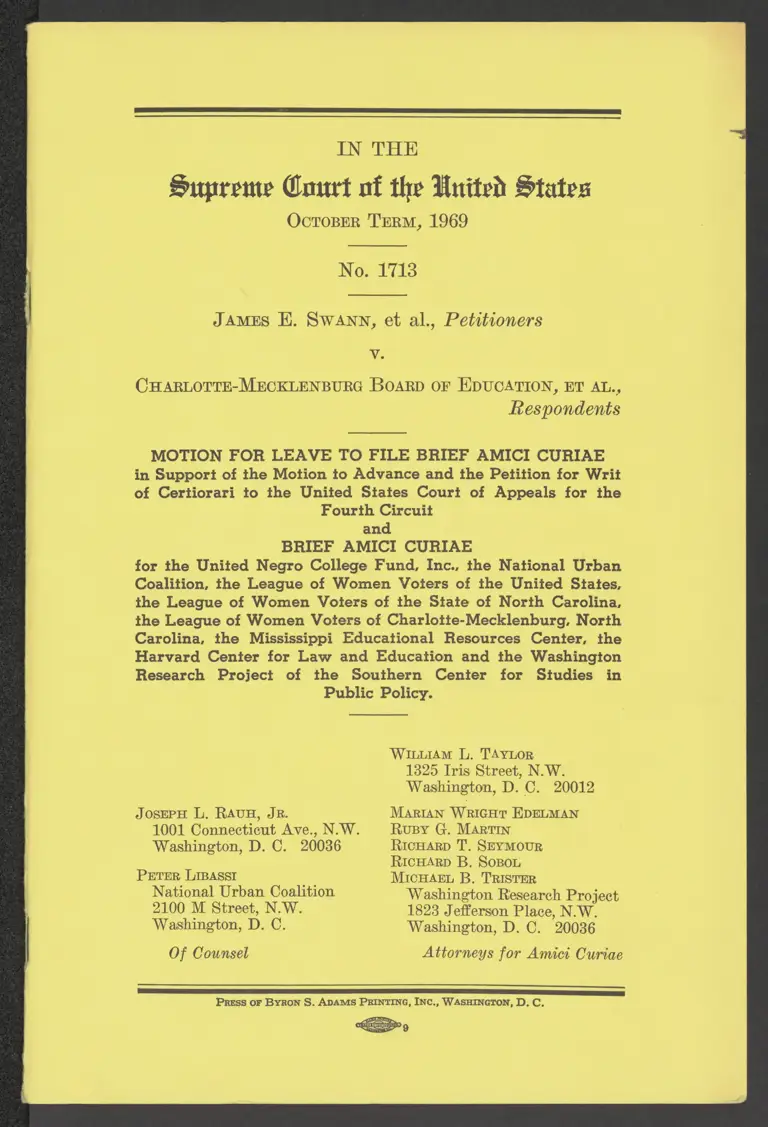
     [||31f0f371-1364-465e-b9be-8b3d307ac747||] IN THE

Supreme Court of the United States
OcToBER TERM, 1969

No. 1713

JAMES K. SWANN, et al., Petitioners

V.

CHARLOTTE-MECKLENBURG BOARD OF EDUCATION, ET ALL,

Respondents

MOTION FOR LEAVE TO FILE BRIEF AMICI CURIAE

in Support of the Motion to Advance and the Petition for Writ

of Certiorari to the United States Court of Appeals for the
Fourth Circuit

and
BRIEF AMICI CURIAE

for the United Negro College Fund, Inc.. the National Urban

Coalition, the League of Women Voters of the United States,

the League of Women Voters of the State of North Carolina,
the League of Women Voters of Charlotte-Mecklenburg, North
Carolina, the Mississippi Educational Resources Center, the
Harvard Center for Law and Education and the Washington

Research Project of the Southern Center for Studies in
Public Policy.

WiLLiAM L. TAYLOR
1325 Iris Street, N.W.
Washington, D. C. 20012

JosepH L. RAUH, JR. MARIAN WRIGHT EDELMAN
1001 Connecticut Ave., N.-W. RuBY G. MARTIN
Washington, D. C. 20036 RicaARD T. SEYMOUR

RicHARD B. SoBOL
PETER LIBASSI i MicHAEL B. TRISTER

National Urban Coalition Washington Research Project
2100 M Street, N.W. 1823 Jefferson Place, N.W.
Washington, D. C. Washington, D. C. 20036

Of Counsel Attorneys for Amici Curiae


PRESS OF BYRON S. ApAMS PRINTING, INC., WASHINGTON, D. C.


TABLE OF CONTENTS

Page

Motiox For Leave To Fire Brier Amici Curiae iN Sup-
PORT OF THE MoTioN To ADVANCE AND THE PETITION
FOR WRIT OF CERTIORARI TO THE UNITED STATES
Court or APPEALS FOR THE FourTH CIRCUIT

11. Summary of Argument

IIT. Argument

A. This case must be expedited to prevent ir-
reparable harm to petitioners and to thou-
sands of black children in other school dis-

. The refusal of the court below to sustain a
district court decision eliminating segregated
schools denied petitioners their constitutional

. The harm suffered by black children in segre-
gated schools cannot be vitiated by steps short
of integration

IV. Conclusion

TABLE OF AUTHORITIES

CasEs:

Aaron v. Cooper, 358 U.S. 27 (1958)
Alexander v. Holmes County Board of Education, 396

U.8, 19 (1969) 3,915, 20
Beckett v. School Board of Norfolk, 308 F. Supp. 1274

(IE.D. Va. 1969)
Brown v. Board of Education, 347 U.S. 483 (1954)

2,3,812,16


11 Contents Continued

Page

Brown v. Board of Education, 349 U.S. 294 (1955) .... 15
Carter v. West Feliciana Parish School Board, 396

LS. 200 (1070)... ...... cor csinnnsssnints 3, 414,15
Coopery. Aaron, 33.8. 1 (1958) ......0.00unvien ens 10
Green v. County School Board of New Kent County,

Va. 391 10.8. 430 (1968) ............ 9, 10,11 12, 14
Griffin v. County School Board of Prince Edward

County, 377 0.8, 218 (1964)... ...........:..... 11
Hannah v, Larche, 361 U.S. 910 (1959), 363 U.S.

490 (1960) ... i... cents anr nts n rns 4
Katzenbach v. McClung, 379 U.S. 294 (1964) ........ 4
Lurk v. United States, 365 U.S. 832 (1961), 366 U.S.

Z12 (1961) iru iris vais viiions vaio su NH 4 4
Northeross v. Board of Education of Memphis, Tenn.,

337. US 222 9 1. Bd. 24 246 (1970) .......... 15
Power Authority v. Tuscarora Indian Nation, 360 U.S.

915 (1959), 361 U.S. 892 (1959), 362 U.S. 99 (1960) 4
Shelley v, Kraemer, 334 US. 1, (1948) ....0.0u.iuuss 8
United States v. Montgomery County Board of Educa-

tion, 390 US. 925 (1969) ..........c...c00: 9, 14, 15
United Steel Workers v. United States, 361 U.S. 878

(1089) 0 ut ain dl si Te tare ss 4
Williamg v. Rhodes, 333 U.S. 23 ............ ........ 4

OTHER AUTHORITIES :

New York State Department of Education, Racial and
Social Class Isolation in the Schools, a Report to
the Board of Regents of the University of the
Siate of New York (1969) ................v... 18

Office of Education, United States Department of
Health, Education and Welfare, Equality of Kdu-
cational! Opportunity (1966) .......0ov0e.v..-- 19

United States Commission on (Civil Rights, Racial
Isolation in the Public Schools (1967) ....... 17,18,19

Austin, Texas School District, H.E.W. Docket No. CR
LTE BUR en ean es I GR ant JR 7

Newport News, Virginia School District, H.E..W. Docket
No. CR 080: 20: sii isnesterinss isd 6

Raleigh, North Carolina School District, H.F..W. Docket
de ae SO 6

Richland School District, Columbia, South Carolina,
HEW. Docket No. CR 589 .........c........... 5


IN THE

Supreme Court of the United States
OctoBER TERM, 1969

No. 1713

JAMES BE. SWANN, et al., Petitioners

V.

CHARLOTTE-MECKLENBURG BOARD OF EDUCATION, ET AL.,

Respondents

MOTION FOR LEAVE TO FILE BRIEF AMICI CURIAE IN
SUPPORT OF THE MOTION TO ADVANCE AND THE
PETITION FOR WRIT OF CERTIORARI TO THE
UNITED STATES COURT OF APPEALS FOR

THE FOURTH CIRCUIT

The following organizations—the United Negro Col-

lege Fund, Inc., the National Urban Coalition, the

League of Women Voters of the United States, the

League of Women Voters of the State of North


2

Carolina, and the League of Women Voters of Char-
lotte-Mecklenburg, North Carolina, the Mississippi Ed-

ucational Resources Center, the Harvard Center for

Law and Kduecation, and the Washington Research

Project of the Southern Center for Studies in Public

Policy—hereby move pursuant to Rule 42(3) of the

Rules of this Court, for leave to file the attached brief

amict curvae in the above-entitled cause. Petitioners

have consented to the filing.! Consent has not been
granted by the respondents.

The United Negro College Fund, Inec., is an organi-

zation consisting of 34 member colleges, all but one of

them in the South, which was established in 1943 to
raise funds and provide other assistance to member

colleges. The Fund and its members have an important

and direct interest in assuring that elementary and

secondary school students are well prepared for college

and thus have a continuing concern about the persist-

ence of segregated public schools.

The National Urban Coalition is an organization

whose purpose is to improve opportunities and con-

ditions of life for citizens living in urban areas of the

nation. Founded in 1967, it has 47 affiliated local coali-

tions and representation from corporations, unions,

religious, and civil rights organizations. The improve-

ment of educational opportunity is among its prime

purposes and to that end it has sponsored educational

research and participated as amicus curiae in a case

involving the equal distribution of educational re-

sources.


1 The written consent of the petitioners has been filed with the

Clerk.


3

The League of Women Voters of the United States,

the League of Women Voters of North Carolina, and

the League of Women Voters of Charlotte-Mecklen-

burg, North Carolina, are three organizations with com-

mon aims and principles but with independent de-

cision-making powers. Founded in 1920, the national

League now has 156,000 members in all 50 states, the

District of Columbia, Puerto Rico, and the Virgin Is-

lands. As part of its overall program of encouraging

informed and active participation of citizens in govern-

ment, the national League has placed major emphasis

upon the quality of public education and in 1970 re-

affirmed its pledge to support efforts to end racial dis-

crimination in education. The North Carolina and

Charlotte-Mecklenburg Leagues have conducted studies

of the quality of educational opportunity in their re-

spective areas. Like the national League, they are

committed to work for equality of opportunity in edu-

cation.

The Mississippi Educational Resources Center is a
private organization established in 1969 to represent
professional, parent, and community groups throughout

the State of Mississippi. Its membership is predomi-

nantly black. Its purpose is to assist communities and

school districts in overcoming problems incident to the

school desegregation process and to assure that desegre-

gation takes place and in an orderly and positive man-

ner.

The Harvard Center for Law and Education is an
educational institution established in 1969 by Harvard

University and the United States Office of Kconomie

Opportunity to ‘promote reform in American educa-

tion by working in the area of social policy and law.”

To carry out its aims, the Center has sponsored and


4

conducted research on various aspects of the educa-

tional process. It has also served as amicus curiae in

several cases involving issues within the area of its

expertise.

The Washington Research Project, established in

1968, is a research organization located in Washington,

D. C., and affiliated with the Southern Center for

Studies in Public Policy of Clark College in Atlanta,

Georgia. The principal aim of the project is to as-

sist in the establishment of equality of opportunity for
all citizens through negotiation and monitoring of ad-

ministrative agency programs and litigation. It is

deeply concerned with educational issues, particularly

with alleviating the continuing effects of racial dis-

crimination in public schools. It has conducted a study

of the impact of Federal aid to education programs on

minority children and maintains a continuing effort to
monitor such programs to ensure that they are con-

ducted without diserimination.

Each of the movant organizations consists of black

and white citizens. While their activities vary, all are

bound together by a common commitment to strengthen

public education in this country and to work for an

end to racial segregation in the schools. All of the

movant organizations, moreover, share a common com-

mitment to the maintenance of the Rule of Law in this

nation. They believe that the Rule of Law is threatened

by continuing violations of the rights of Negro school

children declared by this Court in 1954.

Movant organizations seek leave to enter this case
for the purpose of supporting fully the position of the

petitioners. Movants believe, however, that—by virtue

of their breadth, their special interest in education and


9)

the scope of their activities in conducting and sponsor-

ing research on issues of education and civil rights and

in evaluating the progress of school desegregation un-

der Federal civil rights laws—they are well equipped

to inform the Court with respect to issues which may

not otherwise be fully explored by the parties. Speci-

fically, movant organizations believe that they can pro-

vide information as to the impact that the decision

of the court below may have upon the process of school

desegregation throughout the nation and as to the edu-

cational impact upon children of the various forms of
relief that are in issue in this case.

Accordingly, movant organizations respectfully re-

quest that the Court grant leave to file the attached

brief amici curiae and that the Court consider their

brief together with the petition for writ of certiorari,
the petitioners’ motion to advance, and with other

papers in the case.

Respectfully submitted,

WiLriaM L. TAYLOR
1325 Iris Street, N.W.
Washington, D. C. 20012

JosepH L. RAuH, JR. MariIAN WRIGHT EDELMAN
1001 Connecticut Ave., N.W. RUBY G. MARTIN
Washington, D. C. 20036 RicEARD T. SEYMOUR

RiceEARD B. SoBOL
PETER LIBASSI : MicHAEL B. TRISTER

National Urban Coalition Washington Research Project
2100 M Street, N.W. 1823 Jefferson Place, N.W.
Washington, D. C. Washington, D. C. 20036

Of Counsel Attorneys for Amici Curiae

Dated: June 23, 1970


IN THE

Supreme Court of the United States
OcroBER TERM, 1969

No. 1713

JAMES HE. SWANN, et al., Petitioners

V.

CHARLOTTE-MECKLENBURG BOARD OF EDUCATION, ET AL.,
Respondents

BRIEF AMICI CURIAE

for the United Negro College Fund, Inc., the National Urban

Coalition, the League of Women Voters of the United States,
the League of Women Voters of the Siate of North Carolina,
the League of Women Voters of Charlotte-Mecklenburg, North

Carolina, the Mississippi Educational Resources Center, the
Harvard Center for Law and Education and the Washington

Research Project of the Southern Center for Studies in

Public Policy.

I.

INTEREST OF AMICI

Amici, as is more fully set forth in the Motion for

Leave to File a Brief Amici, are all organizations with

a deep interest in maintaining and improving the

quality of education available to children of all


2

races. As a part of this interest, they have all com-
mitted themselves to work for the elimination of racial

segregation and other forms of discrimination in educa-
tion.

Several amici have conducted or sponsored research

on problems of establishing equal educational oppor-

tunity. Others have supported and appeared in liti-

gation involving the public schools and discrimination.

Still others have undertaken to work for the full and
fair enforcement of civil rights laws by Executive de-

partments and agencies of the Federal Government.

All have a commitment to the maintenance of the

Rule of Law and a deep concern about the continuing
denial of constitutional rights of black school children.

IL.

SUMMARY OF ARGUMENT

This is a case of crucial importance. Only a prompt

hearing and disposition of the case can prevent harm

from being done to thousands of black students in many
areas of the nation. Unless such action is taken, when

schools open in the fall these students will be assigned

to segregated schools pursuant to the erroneous decision

of the court below.

The refusal of the court below to sustain a workable

plan for desegregating the schools of Charlotte-Meck-

lenburg denied the constitutional rights of petitioners.

The ruling conflicts with the decision of this Court in

Brown v. Board of Education and other cases. In hold-

ing that a school board must do only what is ‘‘reason-

able’’ rather than what is necessary to desegregate the

schools, the court below created a new loophole, one

which would allow the rights of many black children


3

to be indefinitely deferred or denied completely. Even
if a ‘‘reasonableness’ test were permissible, the dis-

trict court plan was by any standard ‘‘reasonable.”’

It promised to remedy the harm now being inflicted

on black children in segregated schools without causing

harm to any child in the Charlotte-Mecklenburg school

system. The alternatives to desegregation suggested by

the court below would allow harm to continue to be
inflicted on petitioners.

III.

ARGUMENT

A. This case must be expedited to prevent irreparable harm to
petitioners and to thousands of black children in other
school districts.

The holding of the court below violates the rights of

petitioners and requires the earliest reversal in order

to prevent the assignment of thousands of black chil-

dren this fall to segregated schools in violation of the
Fourteenth Amendment. Expedited action by this

Court is essential to avoid massive confusion and incon-

sistency among desegregating districts and among

various agencies enforcing school desegregation as to

standards permissible under the Fourteenth Amend-

ment.

Three times since Brown v. Board of Education, 347

U.S. 483, this Court advanced hearings or otherwise
accelerated disposition of school desegregation cases

to prevent circumvention or delay in vindicating the
constitutional rights of black school children. Aaron

v. Cooper, 358 U.S. 27; Alexander v. Holmes County
Board of Education, 396 U.S. 19; Carter v. W. Felici-


4

ana Parish Scnool Board, 396 U.S. 290." Amici sub-

mit that the instant case is of equal importance and

warrants the earliest possible decision to avoid still

further delay of a desegregated education to black
school children denied rights over sixteen years.

The ‘‘reasonable means’’ test promulgated by the

court below permits school boards to continue to assign

black children to all-black, or virtually all-black, schools

even where it is undisputed that such segregation re-

sulted from official public action. Such a test portends

grave consequences for school desegregation this fall

and hereafter. We agree with Judge Sobeloff that:

“Handed a new litigable issue—the so-called rea-
sonableness of a proposed plan—school boards can
be expected to exploit it to the hilt. The concept
is highly susceptible to delaying tactics in the
courts. Everyone can advance a different opinion
of what is reasonable. Thus, rarely would it be
possible to make expeditious disposition of a
board’s claim that its segregated system is not
‘reasonably’ eradicable.”’” (Plaintiffs’ App., at p.
2121)

That this new rule of reasonableness is nothing more
than a ‘‘new loophole” and ‘‘catapults us back’ to a

time when ‘good-faith’ rather than concrete desegre-

gation was considered the appropriate test of compli-


1 In Aaron v. Cooper, supra, it was necessary for the Court to
convene a Special Term during the summer recess to hear and de-

cide the case. Other cases in which hearings have been advanced
under Rule 43 (4) include United Steel Workers v. United States,
361 U.S. 878; Hannah v. Larche, 361 U.S. 910, 363 U.S. 420;
Power Authority v. Tuscarora Indian Nation, 360 U.S. 915, 361
U.S. 892, 362 U.S. 99; Lurk v. United States, 365 U.S. 832, 366
U.S. 712; Katzenbach v. McClung, 379 U.S. 294; Williams Vv.

Rhodes, 393 U.S. 23.


5)

ance seems clear (p. 213a). And to permit this de-
cision to stand will undercut the slow progress al-

ready made, will result in further litigation and con-
fusion, and will delay still more the endlessly delayed

rights of thousands of black children to a desegregated
education now. We can think of little that is ‘‘rea-

sonable’ in denying or delaying complete desegrega-

tion after sixteen years.

Hundreds of school desegregation cases are now

pending in various stages of negotiation and enforce-
ment proceedings at the Department of Health, Educa-

tion and Welfare (hereinafter HEW) and in the
courts”? The United States, which urged a position

similar to that adopted by the court below, can be ex-

pected to urge similar positions in its administrative
proceedings and has already begun to do so.

Several of these pending administrative cases illus-

trate the importance of early consideration and reversal

by this Court. In Richland School District, Columbia,
South Carolina,” HEW considered desegregation plans


2 As of May 28, 1970, 205 school districts were involved in HEW

compliance proceedings, 61 of which had undergone fund cutoffs
for noncompliance. [These were all cases exclusive of those pending
in the courts.] Forty-two involved districts which had received
a notice of intention to initiate formal enforcement procedures;
hearings had been conducted in 37 cases; in 12 a decision of non-
compliance had been rendered following a hearing or default pro-
ceeding; 32 districts had an appeal pending before a reviewing

authority; 19 districts had been found not to be in compliance by
the reviewing authority ; one had a report of the final decision filed

with Congressional committees (61 had completed Title VI appeal
procedures and had had their funds terminated in previous years).

In addition to these 205 cases, at least 80 others were in pre-enforce-

ment negotiations.

3 HEW Docket No. CR 589.


6

for a district of 40,122 pupils, 53.3 percent of them

white and 46.7 percent black. The Reviewing Authority

decision of February 25, 1970, reversed a determination

of the hearing examiner approving the plan filed by

the school board, pointing out that there were avail-
able alternatives that were more effective. On June

9, 1970, after the decision by the court below, the Di-

rector of HEW’s Office for Civil Rights reversed the

Reviewing Authority and reinstated the school board’s

plan, which permitted 15 of the 43 elementary schools

to remain more than 80 percent black and 11 schools

to remain more than 80 percent white. While these

segregated schools could have been eliminated by some
busing, the approved school board plan excluded busing

except in a few cases to relieve overcrowding.

There is grave danger of similar results being
reached in other cases. A Title IV plan was submitted
March 24, 1969, in Newport News, Virginia,* for a
district of 31,138 students, 64 percent white and 36

percent black. The plan, involving pairing of schools,

would have reduced the proportion of black students

at two virtually all-black high schools and two virtually
all-black junior high schools to 50 percent at each high

school and 48 percent and 55 percent at the two junior

high schools. The school board objected that the plan

required ‘involuntary’ busing and was therefore ‘‘un-

reasonable.”” The case is now pending before the
HEW Reviewing Authority where, as matters now

stand, it is likely to be decided under the broad ‘‘rea-

sonableness’’ standard in the instant case.

In Raleigh, North Carolina,’ a recent decision of the


+ HEW Docket No. CR 669.

5 HEW Docket No. CR 612.


7

Reviewing Authority refused to accept a plan which
provided no busing and under which only 22 percent of
the black students attended integrated schools. This
decision is now subject to challenge on grounds that
alternative plans involving busing would be ‘‘unrea-
sonable.” The Austin, Texas ® school district serves
52,724 students, 65 percent white, 19 percent Mexican-
American, and 16 percent black. Of the 70 schools in
operation, 9 are more than 94 percent black. HEW’s
Title IV plan permits four elementary schools to con-
tinue a combined black and Mexican-American popula-
tion of more than 94 percent. The government’s brief
in the HEW proceeding, at p. 8, stated that “the
[Title IV] team operated under guidelines which pre-
vented them from making any recommendations which
would require busing across town in order to desegre-
gate the Negro schools.”” This case is now pending be-
fore a hearing examiner and in present circumstances
may well be influenced by the decision in Charlotte-
Mecklenburg.

The decision of the court below is also likely to in-

fluence pending judicial proceedings. In Beckett v.
School Board of Norfolk, 308 F. Supp. 1274 (E.D. Va.
1969) an appeal has been taken from a decision per-
mitting the continuation of a substantial number of

all-black schools. In oral argument before the Fourth

Circuit sitting en banc on June 5, 1970, attorneys for

the United States stated that in light of the ‘“‘reason-

able means’ test in Charlotte-Mecklenburg, the govern-

ment would no longer insist on the plan for desegre-

gation it had previously urged.

While amici do not wish to prejudge the outcome
of these cases, we cannot ignore the already clear im-


¢ HEW Docket No. CR 902.


8

pact of Charlotte-Mecklenburg on these other pending
cases, and on the rights of black children in those dis-

tricts.

If, as we believe, the ‘‘reasonable means’ standard is

unconstitutional, this will mean that as long as the de-

cision stands unreversed, plans will be approved that

unconstitutionally assign many thousands of black chil-

dren to segregated schools. And if such plans are put

into effect in the fall it will undoubtedly require all

or the greater part of the school year 1970-1971 or

longer to undo the harm done.

B. The refusal of the court below to sustain a district court

decision eliminating segregated schools denied petitioners

their constitutional righis.

1. The decision of the court below that school boards

may lawfully continue to operate de jure segregated

schools indefinitely conflicts with previous decisions of

this Court.

This is not a case of de facto segregation. This 1s a

case of segregated public schools continuing sixteen

years after Brown, supra, directly as a result of dis-

criminatory governmental action.” This is a case where

it is possible to completely disestablish segregated


7 The district court found that segregation in the public schools

resulted from policies of the respondent school board and other

governmental officials who helped establish patterns of residential

segregation. The policies of school officials included the selection

of school sites in a manner which perpetuated racial segregation.

Actions of other government officials included judicial enforcement

of racially restrictive covenants until ruled unconstitutional in

Shelley v. Kraemer, 334 U.S. 1, discriminatory implementation of

zoning ordinances in white and black residential areas, and dis-

criminatory relocation of citizens through urban renewal programs.

(pp. 13a-14a, 86a-87a)


9

schools and provide every school child a desegregated

education.”

Despite these clear facts and the circuit court’s ex-

plicit adoption of the findings of the district court of

these facts, it nevertheless concludes ‘‘that not every

school in a unitary system need be integrated’ (p.

189a). This is in patent error and violates standards
for school desegregation established by this Court in

Green v. County School Board of New Kent County,
Va., 391 U.S. 430, 437-38 (1968), where this Court un-
animously declared that school boards were ‘‘clearly

charged with the affirmative duty to take whatever

steps may be necessary to convert to a unitary system

in which racial discrimination would be eliminated root

and branch’ (emphasis added). See also United
States v. Montgomery County Board of Education, 395

U.S. 225, 230 (1969). Both cases expressed a concern
that no schools be racially identifiable.’

The holding of the court below cannot be squared

with these decisions.


8 The opinion of the court below indicates that the plan prepared

by Dr. Finger, an expert appointed by the district court, and which

was adopted by the district court would eliminate all segregated

schools. Judge Sobeloff found that:

““The plan ordered by the district court works. It does the
job of desegregating the schools completely . . . The point has
been perceived by the counsel for the Board, who have can-
didly informed us that if the job must be done then the Finger
plan is the way to do it.”’ (p. 204a)

9 And in Alexander v. Holmes County Board of Education, 396

U.S. 19 (1969), this Court stated bluntly:

“Under explicit holdings of this Court the obligation of every
school district is to terminate dual school systems at once and
to operate now and hereafter only unitary schools’’ (emphasis
added).


|
I

|
I

|
|
|

|
I
|

|
|
|
|

10

2. The constitutional rights of petitioners cannot

be conditioned upon a ‘‘reasonable means test.”

We can conceive of little, if anything, that is ‘‘rea-

sonable,” which after sixteen years denies or further

delays the Fourteenth Amendment rights of black

school children. Nor can we square the rights of each
individual black child to a desegregated education with

a result that leaves some of them—be it 100 or 10,000—

in segregated black schools under a guise of reason-

ableness. As to them, is the Constitution not to apply?

This ‘rule of reason’ contravenes the mandate in

Green, supra, that imposes upon school boards the duty

to take whatever steps are necessary to establish a uni-

tary system eliminating racial discrimination “roof

and branch,” 391 U.S. 430, 438 (emphasis added).

There were no qualifications placed on this mandate.

It is no excuse that ‘vindication of these rights was
rendered difficult or impossible by actions of other
state officials,”’ Cooper v. Aaron, 358 U.S. 1, 16. And,
indeed, the discriminatory action of other government

officials does not prevent the school board from ful-

filling its duties under Green.

We have had ¢‘all deliberate speed’’ and ‘‘good faith”

for sixteen years. These doctrines have been used

by school boards to evade, delay and deny black child-

ren constitutional rights.’ To be faced in 1970 with a


10 Indeed, this Court formally disapproved the standard of ‘‘all

deliberate speed’’ in Alexander for precisely this reason. Cf. the
opinion of Mr. Justice Black on application to vacate the 5th Cir-

cuit’s order in Alexander, 90 S.Ct. 14 (1969) :

“<All deliberate speed’ has turned out to be only a soft eu-
phemism for delay.’’

Rarlier in his opinion, he stressed the danger of the vagueness in

such a standard:


1

new and undefined doctrine of ‘‘reasonableness’ can

only portend another decade of litigation, evasion, de-

lay and denial of vital rights protected by the Consti-

tution. This is impermissible where such important
rights are at stake.

The court below mistakes the duty of the school

board and offers the board such broad discretion as to

violate Fourteenth Amendment rights. In its only

effort to supply a standard for the doctrine of reason-

ableness, the court said:

“The board should view busing for integration in
the light that it views busing for other legitimate
improvements, such as school consolidation and the
location of new schools’ (p. 194a).

This is clearly erroneous. The demands of the Con-

stitution cannot be relegated to the same level as other

educational improvements which, while desirable, are

not constitutionally required.


‘“Federal courts have ever since [Brown II] struggled with
the phrase ‘all deliberate speed.” Unfortunately this struggle
has not eliminated dual school systems, and I am of the opin-
ion that so long as that phrase is a relevant factor they will
never be eliminated.’’

Id.

It is instructive that these opinions were written in 1969. As
early as 1964, this Court had disapproved the phrase:

“The time for mere ‘deliberate speed’ has run out, and that
phrase can no longer justify denying these Prince Edward
school children their constitutional rights to an education
equal to that afforded by the public schools in the other parts
of Virginia.’

Griffin v. County School Board of Prince Edward County, 377 U.S.
218, 234 (1964). In 1968, this Court stated again, in Green, 391
U. S. at 438, that ‘‘[t]he time for mere ‘deliberate speed’ has run
out.”


12

3. Even if the Constitution permits a ‘‘reasonable

means’’ test, the court below erred in rejecting as un-

reasonable a sound desegregation plan approved by the

district court and adopting a plan perpetuating seg-

regated schools.

This is not a case involving arbitrary and unreason-

able action by a district court. This is not a case in-

volving a hastily drafted or ineffective desegregation

plan but one developed by the district court after much
deliberation with the help of an expert in consultation

with the school board. This is not a case of a school

district unable to comply with the district court’s plan.

Nowhere is this contended. This is a case where the

school district has had every possible opportunity toe

comply with Brown, supra, and Green, supra. This is

a case where the school district took no action to deseg-

regate between 1954 and 1965, took in adequate action

in 1965 and then in 1969 and 1970 failed to submit an

acceptable plan after ten months and four opportuni-

ties to do so (fin. 9, p. 213a). This is a case of a

school board seeking to do the minimum to comply

when alternative and more effective means exist to

fully and constitutionally comply with this Court’s

mandates.

We believe that the constitutional duty of a school

board is not simply to use ‘reasonable means’ but to

do whatever is necessary to convert a dual school sys-

tem into a unitary one. But, assuming arguendo, that

it was not inappropriate for the court below to employ

such a standard, the judgment requires reversal be-

cause (a) the plan approved by the district court did

not exceed the bounds of ‘‘reasonableness” and (b)

respondents did not meet the burden of proof required


13

of a school board that seeks to overturn an effective

school desegregation plan.

a. Under the school board’s plan, more than half of
the black elementary school students in Charlotte-

Mecklenburg would be assigned to schools 86 per cent

to 100 per cent black and about half of the white

elementary school students would be assigned to schools

86 per cent to 100 per cent white. Under the district

court’s plan, the racial composition of all elementary

schools would range from 9 per cent to 38 per cent

black (p. 191a). The court-approved plan required

busing of 13,300 additional students, 8,000 more than

under the school board’s plan (p. 191a).

To conclude properly that the court-approved plan

was ‘‘unreasonable’’ the court below would have to

show more harm to black and white children as a

result of busing than that suffered by black children

who would otherwise remain in segregated schools. In

fact, the court was not able to find that children would

suffer any harm as a result of busing.

Instead, the court below attempted to judge the ap-

proved plan in light of factors which it did not relate to

impact upon school children, e.g., the amount of bus-

ing, its cost in relation to the board’s resources, the age
of the pupils involved and distance and time (p. 194a).

But here, ‘‘unreasonableness’ is not shown with re-

spect to any of these factors. Judge Sobeloff concluded
that ‘“‘distance and time will be comparatively short,

the effect on traffic is undemonstrated, the incremental

cost is marginal’’ (p. 210a)."


11 The 13,300 additional children to be bused when added to the

23,600 already bused would mean total busing of 47 per cent of the
school population, far less than the 55 per cent average proportion


14

In sum, the record makes no showing that the busing

under the district court’s plan is unreasonable in light

of national, state, or local practices of busing or will
harm pupils in any way. Nor does the record show

undue burden to the school board in implementing the

district court’s plan.

b. In Green, this Court held that the availability of

a plan that promises to be more effective than another

plan ‘“places a heavy burden upon the board to explain
its preference for an apparently less effective method.”
391 U.S. at 439. And in Montgomery County, 395 U.S.
225 (1969), and Carter v. W. Felictana Parish School
Board, 396 U.S. 290 (1970), this Court reversed deci-

sions by courts of appeals which had imposed desegre-

gation requirements which were less stringent than


of pupils now being bused to schools in North Carolina (p. 211a).

The court below accepted the findings of the district court as to
transportation costs which, as Judge Winter pointed out in his dis-

sent, would amount to less than 1.2 per cent of the respondent
board’s total budget when operating and capital costs are combined
(p. 221a). In fact, the district court’s estimate of 138 buses re-

quired under its plan was also adopted by the court below (pp.
191a, 194a) and exceeded the school board’s estimate of 104. The
average one-way trip for elementary students bused under the

court-approved plan would be less than seven miles and 35 minutes
(p. 207a), compared with an average one-way trip of 15 miles and
one hour and fourteen minutes for students now being bused in
Charlotte-Mecklenburg (p. 207a) and an average roundtrip of 24

miles for all students now bused in North Carolina (p. 194a).
The court below made no findings as to the age of children to be

bused or as to the impact upon traffic but it appears from the ree-
ord that substantial numbers of elementary school students are

already being bused in Charlotte-Mecklenburg (pp. 210a-211a) and
that the possibility that the court-approved plan would cause a
problem of traffic congestion is negligible (pp. 206a-207a).


15

those in plans available.” And in Carter, Mr. Justice
Harlan, in a concurring opinion joined by Mr. Justice

White, stated that school districts must demonstrate

“beyond question” the unworkability of an effect pro-

posal, 396 U.S. 290, 292. In addition, while the court

below properly limited its power of review to factual

questions it found ‘‘clearly erroneous’ (p. 194a), it

improperly rejected the district court’s determination

as to the burden of compliance. In Brown 11,349 U.S.

at 299, primary responsibility for implementing school

desegregation decrees is placed in the district courts.

And recently in Northeross v. Board of Education of

Memphis, Tennessee, 397 U.S. 232, the court of appeals

was held in error for substituting its findings for that

of the distriet court as to whether a dual school sys-

tem had been effectively dismantled when the district

court’s findings were ‘‘supported by substantial evi-

dence.’

Under the facts of this case and in light of the Dis-

trict Judge’s careful findings supported by the record,

and this Court’s previous decisions, the court below

must be reversed.

C. The harm suffered by black children in segregated schools
cannot be vitiated by steps short of integration.

The arguments preceding are sufficient to warrant

the granting of the relief sought by petitioners. It is

not necessary to argue the harm that will be suffered by

the black children in the Charlotte-Mecklenburg school

district who under the decision of the court below will


12In Montgomery County, the more effective plan had, as here,
been adopted by the district court. In Alexander and Carter, the
U.S. Department of Health, Education and Welfare had prepared
the plans.


16

continue to attend segregated schools. That issue was

settled in Brown Vv. Board of Education, 347 U.S. 483,
494 where this Court concluded:

“To separate them [Negro children in grade and
high school] from others of similar age and quali-
fications solely because of their race generates a
feeling of inferiority as to their status in the com-
munity that may affect their hearts and minds in
a way unlikely ever to be undone.’’

The court below did not dispute the applicability of

this conclusion in Brown to the instant case, and in-

deed in upholding the determination of the district

court that the segregation was of a de jure character

it implicitly acknowledged that the findings of Brown

applied here. Nevertheless, the court strongly implied

that the harm suffered by the black children in segre-
gated schools could be vitiated by remedies other than

total desegregation. Specifically, the court recom-

mended that the defendants (1) employ ‘‘special

classes, functions and programs on an integrated’

basis, and (2) ensure ‘‘that pupils who are assigned to

black schools for a portion of their school careers’ are

assigned to integrated schools as they progress to higher

grades."

There was, however, no evidence to support a con-

clusion that either of these steps, whether taken singly

or together, will prevent or undo the harm that black

children suffer in segregated schools. In fact, avail-


13 The only other alternative suggested by the court was a ma-

jority to minority transfer plan which allowed free voluntary

transfer of blacks ‘‘to any school in which their race is a minority

if space is available.”” An identical provision had not worked be-

fore in Charlotte-Mecklenburg, and there is no reason to believe it

can now have any meaningful impact.


17

able research on this issue leads to a contrary conclu-

sion—that black children will continue to suffer harm

so long as they are assigned to segregated schools, even

if they are permitted to participate in special inter-

racial programs and even if part of their educational
experience is in integrated schools.

The fashioning of special programs, functions and

classes conducted on an integrated basis for children

who attend segregated schools is not a new technique.
1t has been tried before, usually as an aspect of com-

pensatory programs designed to improve the quality

of education for disadvantaged children. Generally,

the effort is made to broaden the horizons of poor
children by giving them access to activities not

ordinarily within their reach—activities such as short-

term exchanges of teachers and students between

schools and visits and field trips to concerts and

museums. In its Report on Racial Isolation in the

Public Schools in 1967, the United States Commission

on Civil Rights examined the results of compensatory

programs and concluded that:

“Evaluations of programs of compensatory educa-
tion conducted in schools that are isolated by race
and social class suggest that these programs have
not had lasting effects in improving the achieve-
ment of the students. The evidence indicates that
Negro children attending desegregated schools that
do not have compensatory education programs per-
form better than Negro children in racially iso-
lated schools with such programs.’ *

A more recent comprehensive report summarizing

evaluations of compensatory programs, prepared by

the New York State Kducation Department, reached


14 Racial Isolation in the Public Schools (1967) at 205.


18

similar conclusions. It found that the programs

“failed to show any real promise in reducing the in-

tellectual and achievement deficits of disadvantaged

children’’ and that in contrast comparative studies

“showed integration to be superior.” ** Indeed, tem-

porary or ad hoc arrangements to provide some inter-
racial contact between students attending segregated

schools may even have a counterproductive effect. The

U.S. Civil Rights Commission Report noted:

“Indeed, in one community the Commission was
told that the contrasts afforded by inter-school
trips between white and Negro students under
compensatory programs heightened the sense of
inferiority felt by the Negro students.” *

The second alternative step put forward by the court

below is the assurance that children who are assigned

to segregated schools will attend integrated schools at

some point in their career. In practice this means that

the substantial number of black children who would

attend segregated elementary schools (more than half

of all black children under the respondents’ plan)
would then go on to integrated junior and senior high

schools. Black students who attend the segregated

junior high schools presumably would be assured an

integrated high school experience.

It is clear, however, that the harm inflicted upon

Negro children in segregated elementary schools is not

undone by providing integrated schooling later on. In

its Racial Isolation Report, the U.S. Commission on


15 Racial and Social Class Isolation in the Schools, A Report to

the Board of Regents of the University of the State of New York

(1969) at 374.

16 Racial Isolation in the Public Schools (1967) at 138.


19

Civil Rights examined the cumulative effects of segre-
gation and desegregation upon student attitudes and

achievement. Employing data compiled by a major

survey conducted by the United States Office of Educa-

tion, the report noted that the average grade-level per-

formance for 9th grade Negro students was consistently

higher when their earliest grade of attendance in de-

segregated schools was the 1st, 2nd or 3rd grade than

when it was later.” The Commission concluded:

‘“ Both the academic performance and attitudes of
Negro students, then, are affected by the duration
of their school contact with whites. Students
whose first contact with whites was late in elemen-
tary or early in secondary schools are at a distinct
disadvantage when compared with Negroes who
have had school contact with whites since the
early grades.”’ '®

The fact that all of the available research demon-

strates that the alternative steps proposed by the court

will not undo the harm caused by segregation under-

scores the Incorrectness of its decision and the danger

to black children in the adoption of loose standards of

‘reasonableness’ that permit something less than

prompt and complete compliance.


17 Racial Isolation in the Public Schools (1967) at 106-108. The

Office of Education survey itself made a similar finding—that pu-
pils who first entered integrated schools in the early grades re-

corded consistently higher scores than other groups. Office of
Education, U. S. Department of Health, Education and Welfare,
Equality of Educational Opportunity (1966) at 20, 32.

18 Racial Isolation in the Public Schools at 108.


20

IV.

CONCLUSION

Prompt action is needed in this case if irreparable
harm is not to be inflicted on petitioners and thousands

of other black children. The decision below cannot

stand because it allows school boards to continue to

segregate schools merely because an effective remedy

might cause some burden or inconvenience.

It would be tragic irony, if, after years of massive

resistance, evasion, and delay the rights of black child-

ren were now denied or further delayed on grounds

that ending segregation is ‘‘unreasonable.”’

Amici believe that under the authority of Alexander

v. Holmes County Board of Education, 396 U.S. 19, a
stay of the order of the Court below would be appro-
priate relief. But neither a stay nor the injunction
pendente lite sought by petitioners would be an ade-

quate substitute for an expedited hearing and disposi-
tion of the case. Only a prompt decision of this case
on the merits can avert harm to thousands of black

children in other districts.

Accordingly, amici urge that the Court grant the

petition for writ of certiorari, and petitioners’ motion

to advance during the current term or if need be dur-

ing such special or extended terms as may be con-

venient.
Respectfully submitted,

WiLLiaAM L. TAYLOR
1325 Iris Street, N.W.
Washington, D. C. 20012

JoserpH L. RAUH, JR. MARIAN WRIGHT EDELMAN

1001 Connecticut Ave., N.W. RuBY G. MARTIN
Washington, D. C. 20036 RicaArD T. SEYMOUR

RicaHARD B. S0BOL
PETER LIBASSI 2 MicHAEL B. TRISTER

National Urban Coalition Washington Research Project
2100 M Street, N.W. 1823 Jefferson Place, N.W.
Washington, D. C. Washington, D. C. 20036

Of Counsel Attorneys for Amici Curiae [||31f0f371-1364-465e-b9be-8b3d307ac747||]