Defendants' Proposed Findings of Fact and Conclusions
Public Court Documents
August 23, 1976
10 pages
-
Case Files, Garner Working Files. Defendants' Proposed Findings of Fact and Conclusions, 1976. 5cb872fa-33a8-f011-bbd3-000d3a53d084. LDF Archives, Thurgood Marshall Institute. https://ldfrecollection.org/archives/archives-search/archives-item/32502526-181e-47a4-b55c-9670be0865b8/defendants-proposed-findings-of-fact-and-conclusions. Accessed September 29, 2026.
Copied!
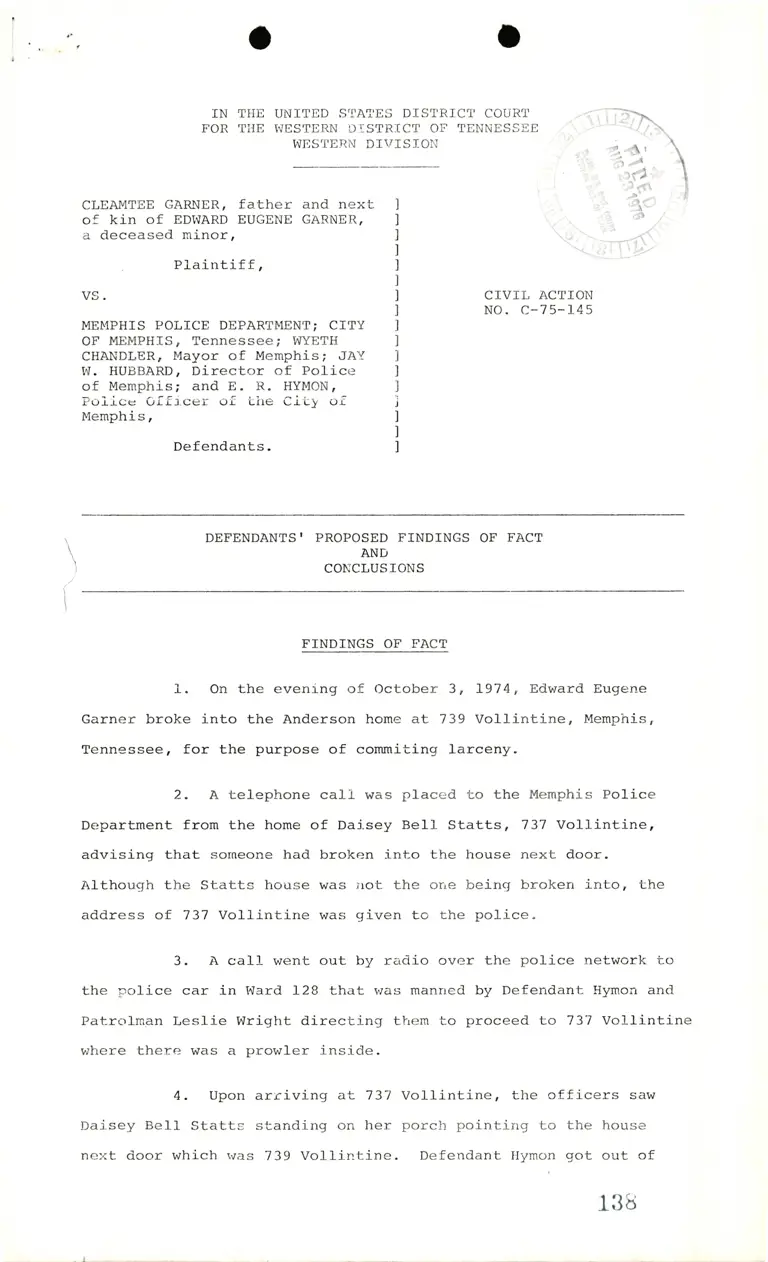
IN THE UNITED STATES DISTRICT COURT
FOR THE WESTERN DISTRICT OF TENNESSEE
WESTERN DIVISION
CLEAMTEE GARNER, father and next
of kin of EDWARD EUGENE GARNER,
a deceased minor.
Plaintiff,
CIVIL ACTION
NO. C-75-145
MEMPHIS POLICE DEPARTMENT; CITY
OF MEMPHIS, Tennessee; WYETH
CHANDLER, Mayor of Memphis; JAY
W. HUBBARD, Director of Police
of Memphis; and E. R, HYMON,
Police Offj.cer of the City oc
Memphis,
Defendants.
DEFENDANTS' PROPOSED FINDINGS OF FACT
AND
CONCLUSIONS
FINDINGS OF FACT
1. On the evenxng of October 3, 1974, Edward Eugene
Garner broke into the Anderson home at 739 Vollintine, Memphis,
Tennessee, for the purpose of commiting larceny.
2. A telephone call was placed to the Memphis Police
Department from the home of Dad.sey Bell Statts, 737 Vollintine,
advising that someone had broken into the house next door.
Although the Statts house was not the one being broken into, the
address of 737 Vollintine was given to the police.
3. A call went out by retdio over the police network to
the police car in Ward 128 that was manned by Defendant Hym.on and
Patrolman Leslie Wright directing them to proceed to 737 Vollintine
where there was a prowler inside.
4. Upon arriving at 737 Vollintine, the officers saw
Daisey Bell Statts standing on her porch pointing to the house
next door which v/as 7 39 Vollintine. Defendant Hymon got out of
138
the car to question Ms. Statts ^̂ bout the situation and she said,
"They are breaking in inside".
5. Defendant Hymon returned to the car, got his flash
light, advised his partner what was happening, and then proceeded
south along the west side of the house at 739 Vollintine.
6. Patrolman Wright then moved the squad car to the
curb, called the dispatcher to advise they were on the scene,
picked up his flashlight, and moved toward the east side of the
house.
7. Defendant Hymon was aware that tliere was a light on
in the house as he proceeded down the west side to the rear.
8. As Defendant Hymon approached the southwest corner
of the house he heard the back screen door slam and as he got to
a point just beyond the corner of the house he saw a figure running
from the back of the house to the back of the lot where a six (6)
foot cyclone fence stretched across the south boundary of the
property.
9. There was a three to four (3 to 4) foot chicken wire
fence which ran in a north to south direction along the west side
of the back yard and was situated between Defendant Hymon and the
cyclone fence.
10. As Defendant Ĥ mion was standing at a point near
the southwest corner of the house he observed that a garbage can
was placed under a window on the back side of the house and the
glass was broken out of the window.
11. Defendant Hymon then shined his flashlight along
the fence and spotted a person who later turned out to be Edward
Eugene Garner in a stooped position next to the cyclone fence near
the southv/est corner of an outbuilding located in the southeast
corner of the yard.
12. Defendant Hymon shouted "halt" and Garner paused
momentarily and then as Defendant Hymon took two steps in his
- 2 139
direction and toward the chicken wire fence Garner began to spring
over the cyclone fence and had gotten half of his body over the
fence when Hymon fired his service revolver hitting Garner in the
right side of the head.
13. Patrolman Wright who had proceeded along a pickett
fence in the front of the house on the east side heard Defendant
Hymon yell "halt" in a loud voice, following which there was a
pause and then as he approached the northeast corner of the house
he heard a shot.
14. When Patrolman Wright reached the southwest corner
of the house, Defendant Hymon said, "He's over there on the fence"
at which time Wright flashed his flashlight along the fence until
he picked up Garner whose body was draped on the fence, the top
half over the south side and the lower half on the north side.
15. An ambulance was called and the body was removed
from the fence at which time Garner was neither moving nor speaking,
16. Garner was transported to the hospital where he
expired shortly after his arrival.
17. It was determined that after breaking into the
house. Garner ransacked the bedrooms and removed a ring and wallet
containing $10.00 in cash.
18. The cyclone fence at the back boundary of the lot
where Garner was shot was six (6) feet tall.
19. The distance from Defendant Hymon to Garner at the
time of the shooting was approximately thirty-five to thirty-seven
(35 - 37) feet.
20. Although Defendant Hymon did not see a weapon of
any kind on Garner up to the time of the shooting he was not
positive that Garner was unarmed as he could not tell if he had a
weapon on his person.
14U
- 3
21. There was a concrete block and a board about a
foot from the fence which Garner used to climb on the fence.
22. Defendant Hymon could not have apprehended Garner
on foot before he climbed the fence nor did Hymon believe in his
own mind that he could have caught Garner once he climbed over
the fence.
23. Plaintiff's expert witness Eugene Barksdale
testified that in apprehending a fleeing felon, if in the officer's
own mind the person is about to escape and there is no other way
to catch him, then he is justified in using lethal force.
24. Captain John Coletta, who qualifies as an expert
in the use of firearms as v;ell as when lethal force should be
used, testified that in his opinion Hymon was justified in using
his weapon to apprehend Garner under the circumstances.
25. Less than two months prior to October 3, 1974,
Edward Eugene Garner was placed on probation by the Juvenile Court
in Memphis in connection with an adjudication of Juvenile Delinquency
stemming from a charge of Burglary in the Second Degree.
26. On August 26, 1974, when Edward Eugene Garner was
placed on probation on a charge of Burglary in the Second Degree,
his father indicated to the probation officer that it might be
better if his son was sent to a correctional institution.
27. Edward Eugene Garner was placed on probation by
Juvenile Court on November 1, 1971, in connection with a charge
of Burglary in the Third Degree.
28. Edward Eugene Garner was charged with violation
of curfew by the Juvenile Court which matter was adjusted non
judicially and Garner was released to his mother.
29. At the time of his death, the alcohol content in
the blood of Edward Eugene Garner was .09 which is just under
.10, the standard established by State Law which creates a presump
tion that one is acting under the influence of an intoxicant.
- 4 -
141
30. When Defendant Hymon yelled, "halt", Garner looked
in his direction and could see that he was being confronted by a
police officer, especially in view of the fact that there was a
porch light turned on next door at 737 Vollintine which illuminated
Defendant Hymon.
31. Defendant Hymon at the time he was attempting to
apprehend Garner could not be certain whether there was an accomplice
in the house.
32. The area by the cyclone fence in the back of the
house and the area south of the fence was very dark at the time
Defendant Hymon was trying to apprehend Garner.
33. The General Order published by the Memphis Police
Department on February 5, 1974, in connection with the "Use of
Firearms and Deadly Force" which was in effect on October 3, 1974,
is more restrictive than TCA 40-808, the Tennessee Statute which
deals with means by which a fleeing felon may be apprehended.
34. The training methods used and the subject matter
taught at the Memphis Police Department Training Academy and in
particular in the area of the use of firearms and deadly force,
are consistent with those used by other police departments
throughout the country and the FBI Academy.
33 Blood was found on both sides of the cyclone fence
following the shooting.
36. There is nothing in the record to indicate that
Defendant Hymon had any propensity toward the precipitous and
reckless use of firearms.
37. After a full investigation of the incident of
October 3, 1974, and a review of same by the Firearm's Review Board,
no disciplinary action was taken against Hymon.
38. The shooting of Garner by Hymon was presented to
the Shelby County Grand Jury and a No-True Bill was returned.
- 5 -
14
39. Defendant Hymon was a graduate of the 36th Session
of the Memphis Police Academy.
40. The Memphis Police Department decided to make a
study of various types of ammunition following complaints by
officers that the round nose ammunition they were issued was not
effective in stopping or neutralizing individuals with whom they
were confronted in dangerous situations.
41. Numerous tests were run by the firearms' section
of the Memphis Police Department under the auspicies of Captain
John Coletta and he recommended a change to a hollow point projec
tile for the reasons that it would be more effective in neutralizing
an individual and it was less likely to penetrate the individual
and continue in flight and do harm to innocent people and property.
42. During the term of Director Jay Hubbard, the Memphis
Police Department after careful study and consideration, switched
to hollow point ammunition, to-wit: .38 Special Caliber Remington
125 Grain semi-jacketed hollow point.
43. Hollow point ammunition is used by other police
departments throughout the United States as v/ell as the FBI.
44. The key factor in the injury producing effect of
bullets is not whether they are hollow point or round nose but
the part of the body they strike.
45. Medical authorities have concluded that hollow point
ammunition produces no more injuries than round nose ammunition.
CONCLUSIONS
1. Defendant Hymon was justified in using his weapon to
apprehend Edward Eugene Garner as this was the only reasonable
and practicable means of taking a felon or preventing his escape.
(a) TCA 40-808 provides that "if, after notice
of the intention to arrest the defendant,' he either
14di
- 6 -
flee or forcibly resist, the officer nuiy use all the
necessary means to effect the arrest".
(b) At the time in question. Officer Hymon
commanded Garner to "halt".
(c) Garner was guilty of commiting Burglary in
the First Degree, to-wit: breaking and entering a
dv/elling place in the nighttime with intent to commit
a felony, TCA 39-901.
(d) Garner was aware that he was being commanded
to halt by a police officer because he was within hear
ing range of the officer and the back porch light had
been turned on at 737 Vollintine which served to illu
minate the officer and the fact that he had a gun in
his hand.
(e) After having been told to halt and knowing
that he was confronted by a police officer. Garner
recklessly and heedlessly attempted to vault over
the fence, thereby assuming the risk of being fired
upon.
(f) In burglarizing a private home and attempting
to flee. Garner knowingly and wilfully placed himseJ.f
in a precarious oosition and should have known that
firearms might be used.
(g) Under the circiamstances Garner was directly
and proximately contributing to his own injury and
death, taking into account all factors present.
(h) At the time of the shooting incident. Garner
was on probation in connection with a previous burglary
charge, and had been drinking to the extent that he
bordered on being under the influence of an intoxicant.
(i) Defendant Hymon was satisfied in his own
mind and justified in thinking that once Garner scaled
Î IA
- 7 -
the fence, he would have been unable to apprehend him,
because (1) Garner was already half way over the fence
before Hymon couJ.d get over the chicken wire fence
separating him from the back yard; (2) Garner was some
35 to 37 feet away from Hymon when Garner started to scale
the fence; (3) Hymon was not fast enough on foot to
catch him under the circumstances; (4) It was very
dark by the fence and beyond to the south; (5) There
was tall grass and brush in the area behind the fence;
(6) Hymon would have to negotiate his way through a
cluttered back yard to get into position to try to
climb over the cyclone fence; (7) With all of his
equipment and paraphernalia it would have been hard
for him to climb the fence with any speed; and (8)
Due to the fact that Hymon was advised by Ms. Statts
upon arriving at the scene that "They are breaking
in inside", he could not be certain whether there
was an accomplice inside the house who might be armed
and come out of the house shooting.
(j) Neither Hymon nor his partner could reasonably
expect to catch Garner on foot before or after he scaled
the back fence.
(k) The officers were totally unfamiliar with the
area and in parcJcuiar that area behind and to the south
of the cyclone fence.
(l) Garner was familiar with the neighborhood
since he lived on Tully which was nearby.
(m) Although Hymon saw no weapon, he could not be
absolutely certain that Garner was unarmed since he
could have had a weapon on his person, nor could he be
certain whether there was a weapon available to Garner
on the other side of the fence.
(n) Because of the darkness and the fact that every
thing happened so fast Hymon could not ascertain the age
- 8 - 145
or size of Garner to the extent of determining that he
was in fact a juvenile.
(o) There was very little opportunity of identifi
cation of Garner for purposes of future arrest if he
escaped.
(p) Even if Hymon knew Garner was a juvenile, he
would have been justified in using deadly force where
no other reasonable and practicable means were available
to apprehend him,.
(q) While it was apparent to Hymon that the house
had been broken into, he could not be certain whether
the crime was being perpetrated against property or a
person.
2. The training program of the Memphis Police Department
which incorporates methods, practices and procedures used by other
police departments throughout the country and principles taught
at the FBI Academy was more than adequate.
3. The policies of the Memphis Police Department which
authorize the use of firearms to apprehend fleeing felons come
within the ambit of the Tennessee Statute (TCA 40-808). Further
more, the General Order dated February 5, 1974, and which was in
effect on October 3, 1974, dealing with the subject of the "Use
of Firearms and Deadly Force" is more restrictive than the State
Statute.
4. The use of hollow point bullets does not assure
that a person shot will be grievously wounded o.r killed instantly
anymore than one shot with round nose ammunition. The part of the
body hit is more determinative of the resulting injury than the
type of ammunition used.
(a) In the instant case, the type of ammunition
used would have little bearing on the subject, since
in all probability, a shot to the head would
result in death regardless of whether tlie
bullet was hollow point or round nose.
Henry L. Klein, Staff Attorney
City of Memphis
Attorney for Defendants
100 North Main Building - 3500
Memphis, Tennessee 38103
CERTIFICATE OF SERVICE
I, Henry L. Klein, Staff Attorney for the City of Memphis,
hereby certify that a copy of the foregoing Defendants' Proposed
Findings of Fact and Conclusions has been mailed to Mr. Walter Lee
Bailey, Jr., Attorney at Law, Suite 901, Tenoke Building, 161
Jefferson Avenue, Memphis, Tennessee 38103, and to Mr. Drev/ S. Days, III
Attorney at Law, 10 Columbus Circle, New York, New York 10019, via
United States Mail, postage prepaid, this 23rd day of August, 1976.
Henry L. Klein
\ M
- 10 -