Webb Jr. v. Maldonado Petition for a Writ of Certiorari
Public Court Documents
October 15, 1987
-
Brief Collection, LDF Court Filings. Webb Jr. v. Maldonado Petition for a Writ of Certiorari, 1987. 70fbf8c7-c89a-ee11-be36-6045bdeb8873. LDF Archives, Thurgood Marshall Institute. https://ldfrecollection.org/archives/archives-search/archives-item/326110d6-3707-4c4d-b5bf-fa850bc72727/webb-jr-v-maldonado-petition-for-a-writ-of-certiorari. Accessed October 05, 2026.
Copied!
ERICKSON, BEASLEY & HEWITT
ATTORNEYS AT LAW
Eighth Floor
12 Geary Street
John H. Erickson San Francisco, California 94108 Telephone:
Alice M. Beasley (415) 781-3040
Henry S. Hewitt
Leigh-Ann K. Miyasato
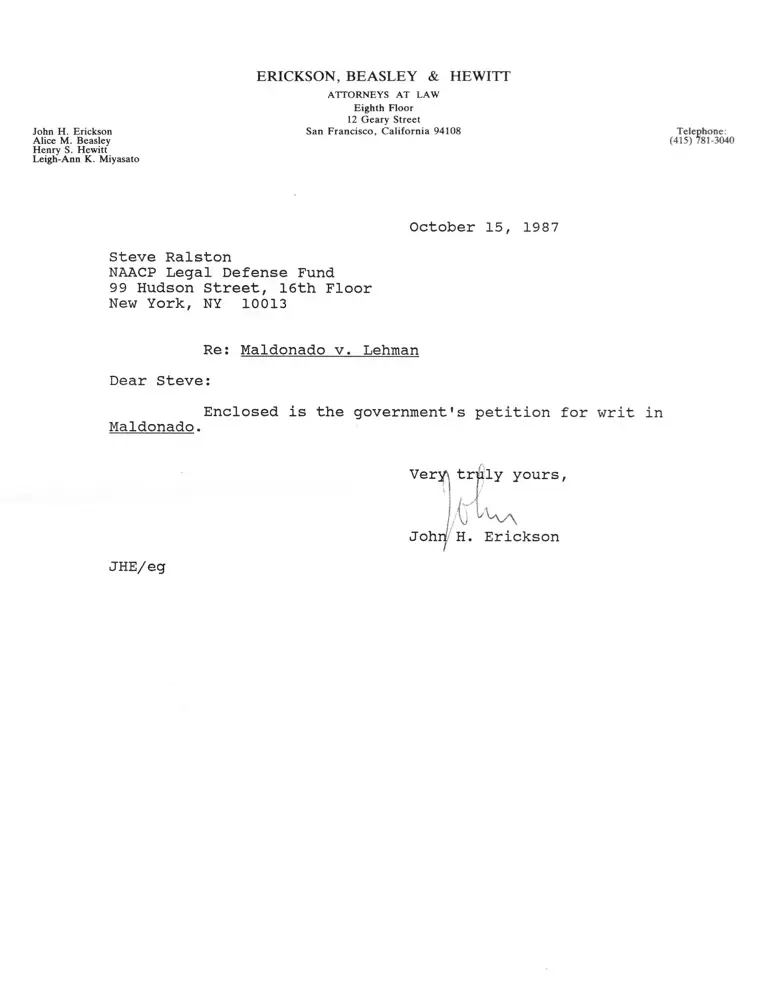
October 15, 1987
Steve Ralston
NAACP Legal Defense Fund
99 Hudson Street, 16th Floor
New York, NY 10013
Re: Maldonado v. Lehman
Dear Steve:
Enclosed is the government's petition for writ in
Maldonado.
Very\ truly yours,
ir V a
John H. Erickson
JHE/eg
No.
In tfy? ©aurt of tlj? Intteii States
O ctober T e r m , 1987
J a m e s H . W e b b , J r .,
Se c r e ta r y of t h e N a v y , p e t it io n e r
v.
Ca r m e l o M a ld o n a d o
PETITION FOR A WRIT OF CERTIORARI TO THE
UNITED STATES COURT OF APPEALS
FOR THE NINTH CIRCUIT
Charles Fried
Solicitor General
R ichard K. W illard
Assistant Attorney General
Donald B. Ayer
Deputy Solicitor General
Paul J. Larkin , Jr.
Assistant to the Solicitor General
W illiam Kanter
E. Roy Hawkens
Attorneys
Department o f Justice
Washington, D.C. 20530
(202) 633-2217
QUESTION PRESENTED
Whether an attorney’s customary hourly billing
rate provides the presumptively reasonable hourly
billing rate when calculating a “ reasonable attorney’s
fee” under Title VII of the Civil Rights Act of 1964,
42 U.S.C. 2000e-5(k).
(i)
II
PARTIES TO THE PROCEEDINGS
In addition to the parties named in the caption,*
E.J. Scheyder, Commander, Mare Island Naval Ship
yard, was sued in the district court in his official ca
pacity, but he was dismissed from the case by stipu
lation before the district court entered judgment.
* In accordance with Supreme Court Rule 40.3, James H.
Webb, Jr., has been substituted for John Lehman, who was
sued in his official capacity as Secretary of the Navy.
TABLE OF CONTENTS
Page
Opinions below_______________________________________ 1
Jurisdiction__________________________________________ 1
Statutory provision involved___________________________ 2
Statement_________________________ 2
Reasons for granting the petition______________________ 6
Conclusion____________________________________________ 15
Appendix A _________________________________________ la
Appendix B -------------------------------------------------------------- 5a
Appendix C _________________________________________ 8a
Appendix D ________________________________________ 9a
TABLE OF AUTHORITIES
Cases:
Albemarle Paper Co. v. Moody, 422 U.S. 405
(1975 )------------------------------------------------------------- 11
Blum v. Stenson, 465 U.S. 886 (1984)_________ 6, 9,11,12
Coulter V. Tennessee, 805 F.2d 146 (6th Cir. 1986),
cert, denied, No. 86-1660 (June 8, 1987)________ 9,14
Hanrahan v. Hampton, 446 U.S. 754 (1 9 80 )______ 9
Hensley v. Eckerhart, 461 U.S. 424 (1983 )_______ 9, 14
Johnson v. Georgia Highway Express, Inc., 488
F.2d 714 (5th Cir. 1974)______________________ 13
Laffey v. Northwest Airlines, Inc., 746 F.2d 4 (D.C.
Cir. 1984), cert, denied, 472 U.S. 1021 (1985)_4, 5, 6,
7, 8,10,11, 12, 13
Lenard v. Argento, 808 F.2d 1242 (7th Cir. 1987) _ 9
Marek v. Chesny, 473 U.S. 1 (1985)______________ 9,14
Mayson V. Pierce, 806 F.2d 1556 (11th Cir. 1987) _ 12,14
Pennsylvania v. Delaware Valley Citizens’ Council
for Clean Air, No. 85-5:
July 2,1986--------------------------------------------- 8, 9, 13,14
June 26,1987________________________________ 13
(ill)
Cases— Continued: Page
Save Our Cumberland Mountains, Inc. v. Model,
826 F.2d 43 (D.C. Cir. 1987)____________ 6, 7, 9,10,11
Sierra Club V. EPA, 769 F.2d 796 (D.C. Cir. 1985) _ 6
Statutes:
Civil Rights Act of 1964:
Tit. II, 42 U.S.C. 2000a et seq________________ 9,14
42 U.S.C. 2000a-3 (b ) ____________________ 9
Tit. VII, 42 U.S.C. 2000e et seq______________ 6, 9,14
42 U.S.C. 2000e-5 (k )_______________ 2, 3, 6, 9,12
42 U.S.C. 2000e-16(d)___________________ 3
Civil Rights Attorney’s Fees Awards Act of 1976,
42 U.S.C. 1988 _____________ ____________ 9,12
Clean Air Act § 304(d ), 42 U.S.C. 7604 ( d ) _______ 9
IV
Miscellaneous:
Berger, Court Awarded Attorney’s Fees: What is
“ Reasonable?” , 126 U. Pa. L. Rev. 281 (1977)__
H.R. Rep. 94-1558, 94th Cong., 2d Sess. (1976)___
S. Rep. 94-1011, 94th Cong., 2d Sess. (1976 )_____
10
9
9
Sn tty Supreme (Urntrt nf tty luttrii &tt\t?$
October T e r m , 1987
No.
Ja m e s H . W e b b , J r .,
Se c r e ta r y of t h e N a v y , pe t it io n e r
v.
Ca r m e l o M ald o n ad o
PETITION FOR A W RIT OF CERTIORARI TO THE
UNITED STATES COURT OF APPEALS
FOR THE NINTH CIRCUIT
The Solicitor General, on behalf of James H. Webb,
Jr., Secretary of the Navy, hereby respectfully peti
tions for a writ of certiorari to review the judgment
of the United States Court of Appeals for the Ninth
Circuit in this case.
OPINIONS BELOW
The opinion of the court of appeals (App., infra,
la-4a) is reported at 811 F.2d 1341. The order of
the district court (App., infra, 5a-7a) is unreported.
JURISDICTION
The judgment of the court of appeals was entered
on March 6, 1987. A petition for rehearing was de
nied on June 29, 1987 (App., infra, 9a). On Sep-
(1)
2
tember 17, 1987, Justice O’Connor entered an order
extending the time within which to file a petition for
a writ of certiorari to and including October 27,
1987. The jurisdiction of this Court is invoked under
28 U.S.C. 1254(1).
STATUTORY PROVISION INVOLVED
42 U.S.C. 2000e-5(k) provides as follows;
In any action or proceeding under this sub-
chapter the court, in its discretion, may allow
the prevailing party, other than the Commission
or the United States, a reasonable attorney’s fee
as part of the costs, and the Commission and the
United States shall be liable for costs the same
as a private person.
STATEMENT
1. In 1978, respondent Carmelo Maldonado, a
pipefitter at the Mare Island Naval Shipyard in
Vallejo, California, brought suit against the ship
yard, alleging that he had been denied a promotion
due to discrimination. The suit was settled, and re
spondent was promoted to foreman in 1980. In April
1982, respondent filed a complaint with the Equal
Employment Opportunity Commission alleging that
he had suffered various forms of reprisal for having
brought his earlier suit. Following a hearing, a hear
ing examiner issued a recommended decision in which
he found that respondent had been subjected to re
prisal. The Secretary of the Navy adopted the ex
aminer’s findings. The Secretary also informed re
spondent that his attorney, Robert Atkins,1 was en
1 Atkins received his law degree in 1979. In 1982, Atkins
was a third-year associate with the San Francisco law firm
of Erickson, Beasley & Hewitt. Excerpts of Record (E.R.) 62.
3
titled to present a claim for reasonable attorney’s
fees and costs to the Navy. App., infra, 2a.
Atkins thereafter presented an affidavit of fees
and costs. He declared he had performed 164.1 hours
of work and sought a fee based on a rate of $110
per hour and $398.20 in costs. The Navy agreed to
the number of hours spent by Atkins and the amount
of costs, but the Navy rejected Atkins’ sought-after
rate of $110 per hour on the ground that it was ex
cessive. Atkins’ customary billing rate was $80 per
hour, and the Navy offered to pay respondent a fee
consistent with that rate, amounting to approxi
mately $81 per hour. App., infra, 2a-3a.e
2. Dissatisfied with the Navy’s offer, Atkins filed
suit against petitioner in the United States District
Court for the Eastern District of California, seeking
attorney’s fees pursuant to 42 U.S.C. 2000e-5(k)
and 2000e-16(d). Atkins contended that he was en
titled to an award of fees based on a $110 hourly
rate. To support his claim, Atkins submitted affi
davits stating that other lawyers in the San Fran
cisco and Oakland areas commanded similar hourly
rates for their services in comparable cases (App.,
infra, 3a). Petitioner argued that Atkins was not
entitled to a $110 hourly rate because his customary
billing rate for similar cases in 1983 was $80 per 2
2 The Navy awarded Atkins $95 per hour for his work at
administrative hearings, and $75 per hour for his non-hearing
work. These rates were consistent with Atkins’ customary
hourly rate, and they corresponded to the maximum rates
awarded to attorneys by the Merit Systems Protection Board
for cases arising at the Mare Island Naval Shipyard. E.R.
195-198. We do not ask the Court to award fees in these
amounts, however, and they are irrelevant to the question
presented by this petition.
4
hour and the fee agreement between Atkins and re
spondent in this case was based on an $80 per hour
rate (E.R. 204, 207, 214, 218). In addition, peti
tioner pointed out that Atkins had conceded that his
customary billing rate for cases not compensated by
a contingent fee involving “ wills, contracts, real es
tate acquisition, partnership dissolution, and per
sonal injury defense” ranged from $60 to $80 per
hour (E.R. 219). Because the fee proposed by the
Navy was consistent with Atkins’ customary billing
rate, petitioner maintained that, under Laffey v.
Northwest Airlines, Inc., 746 F.2d 4 (D.C. Cir.
1984) (holding that an attorney’s customary billing
rate is the presumptively reasonable rate for calcu
lating an attorney’s fee award), cert, denied, 472
U.S. 1021 (1985), Atkins’ request for a $110 per
hour fee should be denied.
The district court rejected petitioner’s argument.
At a hearing on respondent’s motion, the district
court stated that respondent was entitled to his
sought-after community hourly rate because his own
customary rate “ is somewhat falling behind the
times” (10/21/85 Tr. 14).3 The court thereafter en
3 After concluding that San Francisco was the relevant legal
community, the district court stated that (10/21/85 Tr. 13-
14):
the next issue is the reasonable rate that can be charged
and which emanates from that relevant community of
San Francisco. Again, with all due respect, I have no
problems in finding the reasonable rate. I take into con
sideration counsel’s customary rate[,] which is somewhat
below the so-called reasonable rate in [the] community.
However, I also take into consideration the so-called cus
tomary rate in this case is somewhat falling behind the
times, it’s somewhat below—it’s not the reasonable rate
5
tered an order awarding fees (App., infra, 5a-7a).
The court acknowledged that Atkins’ customary bill
ing rate was $80 per hour (id. at 6a), but stated,
without elaboration or explanation, that a $110 per
hour rate was reasonable nevertheless (ibid.). The
court gave no explanation why Atkins should be
compensated at a rate more than one third in excess
of his customary hourly billing rate.* I * * 4
3. Petitioner appealed, and the court of appeals
affirmed (App., infra, la-4a). Petitioner argued that
the district court applied an erroneous legal standard
in selecting the hourly rate, and invited the court of
appeals to adopt the method approved in Laffey for
determining a lawyer’s reasonable hourly billing
rate. The court rejected petitioner’s argument on the
ground that it was foreclosed by prior Ninth Circuit
case law (id. at 3a-4a). The court stated that an
attorney’s customary hourly rate is relevant, but it
is not an abuse of discretion for a district court to
rely on “ The reasonable community standard that
was employed here’ ” to calculate a fee award (id. at
4a (citation omitted)).
that is normally paid to those who somewhat specialize in
the area.
In any event, the reasonable rate emanating from the
community is not so unreasonable as compared with the
customary rate as to make it impossible for this Court
to make such a finding there to. For all of those reasons,
I will find, having found that the Bay Area is, in fact,
the appropriate area, that the reasonable rate to be
charged in the community that will be charged in this
case is $110 per hour.
4 In fact, the court denied respondent’s request for a multi
plier on the ground that “ the results in the case were not
exceptional and the risk of nonpayment was not great” (App.,
infra, 6a) .
6
REASONS FOR GRANTING THE PETITION
This case presents an important, unsettled, and
frequently recurring question concerning the proper
method of calculating a reasonable attorney’s fee un
der Title VII of the Civil Rights Act of 1964, 42
U.S.C. 2000e-5(k), and scores of other fee-shifting
statutes. The Court has recognized that attorney’s
fees awards should be sufficient to attract competent
counsel without providing lawyers with windfalls.
To achieve that goal, the Court has required that a
fee award for a salaried attorney employed by a legal
aid organization should be calculated on the basis of
the prevailing community rate for similar services
by attorneys of reasonably comparable skill, experi
ence, and reputation. Blum v. Stenson, 465 U.S. 886,
895-896 n .ll (1984). The Court has not yet endorsed
a method for determining the reasonable hourly rate
for an attorney with an established billing history.
This case, which creates an express conflict among
the circuits regarding the proper method for deter
mining the reasonable hourly rate for such attorneys,
offers the Court an opportunity to provide needed
clarification of the law in this area.
1. The Ninth Circuit’s decision in this case
squarely conflicts with the District of Columbia Cir
cuit’s decision in Laffey v. Northwest Airlines, Inc.,
746 F.2d 4 (1984), cert, denied, 472 U.S. 1021
(1985). See also Save Our Cumberland Mountains,
Inc. v. Hodel, 826 F.2d 43 (D.C. Cir. 1987); Sierra
Club v. EPA, 769 F.2d 796, 811-812 (D.C. Cir.
1985). In Laffey, counsel for the prevailing parties
in a Title VII lawsuit sought attorneys’ fees under
42 U.S.C. 2000e-5(k) based upon an hourly rate
that was consistent with a composite prevailing mar
ket rate, but that exceeded counsel’s own customary
7
billing rate. The court of appeals expressly rejected
that claim, holding that an attorney’s customary bill
ing rate constitutes the presumptively reasonable rate
to be used in calculating a fee award as long as it is
not aberrationally high or low. An attorney’s fee
award should thus be calculated on the basis of coun
sel’s customary billing rate even if it differs, perhaps
greatly, from a composite average market hourly
rate. 748 F.2d at 16-25.® As the District of Colum
bia Circuit recently put it, “ [i]n this circuit, the
rule is * * * [that] if an attorney has a customary
billing rate, that rate constitutes the presumptively
reasonable rate to use in computing a fee award. In
general, only if the attorney himself has no custom
ary billing rate may the court base its fee award on
a composite average market hourly rate.” Save Our
Cumberland Mountains, Inc. v. Hodel, 826 F.2d at
47-48.
In this case, petitioners relied on the Laffey deci
sion in arguing that the district court applied an
erroneous legal standard in calculating respondent’s
6 The Laffey court explained that an attorney seeking com
pensation must provide evidence of the rate he customarily
charges in private representation. That rate presumptively
serves as the reasonable market rate for his services. Next,
counsel must provide evidence that enables the court to deter
mine whether that hourly rate falls within the reasonable
range of hourly rates billed by other lawyers for similar work
in the same community. In calculating the appropriate range
of reasonable hourly rates, a court would disregard abnor
mally high and low billing rates. As long as an attorney’s
customary rate fell within that range, it serves as the reason
able hourly rate at which an attorney’s fee would be calcu
lated. Laffey, 746 F.2d at 24-25.
8
fee. The Ninth Circuit expressly rejected the ap
proach endorsed in Laffey and upheld the district
court’s fee award even though it was based on an
hourly rate that substantially exceeded Atkins’ cus
tomary hourly fee (App., infra, 3a-4a, 6a). In so
doing, the court o f appeals offered no reason why
Atkins should be compensated by the Navy at an
hourly rate more than a third higher than what he
obtained in the market for private representation.
This conflict demands resolution by this Court.
2. The decision below is also incorrect. By ruling
that district courts have discretion to disregard an
attorney’s customary billing rate and to award fees
that are calculated on the basis of a composite mar
ket hourly rate, the court of appeals approved a fee
award more than one third in excess of the rate that
respondent’s counsel commands from fee-paying
clients. That outcome is utterly inconsistent with
the rationale underlying fee-shifting statutes and is
unsupported by this Court’s decisions.
Fee-shifting statutes exist to provide plaintiffs
with meritorious claims a fee sufficient to attract
competent attorneys, not to improve the financial con
dition o f lawyers. As this Court recently explained
in Pennsylvania v. Delaware Valley Citizens’ Council
for Clean Air, No. 85-5 (July 2, 1986) (Delaware
Valley I ) , slip op. 17-18, “ [fee-shifting] statutes
were not designed as a form of economic relief to
improve the financial lot o f attorneys, nor were they
intended to replicate exactly the fee an attorney could
earn through a private fee arrangement with his
client. Instead, the aim of such statutes was to en
able private parties to obtain legal help in seeking
redress for injuries resulting from the actual or
9
threatened violation of specific federal laws.” 6 A
reasonable attorney’s fee therefore is one that will
induce attorneys to handle meritorious cases without
paying plaintiffs a windfall.7
6 See also S. Rep. 94-1011, 94th Cong., 2d Sess. 6 (1976) ;
H.R. Rep. 94-1558, 94th Cong., 2d Sess. 8 (1976) ; Marek V.
Chesny, 473 U.S. 1, 10 (1985) ; Blum v. Stenson, 465 U.S. 886,
893-894 (1984) ; Hensley V. Eckerhart, 461 U.S. 424, 429
(1983).
Neither the text nor legislative history of 42 U.S.C. 2000e-
5(k) contains directions for calculating a reasonable attor
ney’s fee. Delaware Valley I involved Section 304(d) of the
Clean Air Act, 42 U.S.C. 7604(d), but the Court concluded
that it should be interpreted in accordance with the case law
addressing the Civil Rights Attorney’s Fees Awards Act of
1976, 42 U.S.C. 1988. That Act was patterned after the
attorney’s fee provisions of Titles II and VII of the Civil
Rights Act of 1964, 42 U.S.C. 2000a-3(b) and 2000e-5(k).
S. Rep. 94-1011, supra, at 4; Hensley v. Eckerhart, 461 U.S.
at 433 n.7; Hanrahan V. Hampton, 446 U.S. 754, 758 n.4
(1980). The Court has stated that the approach for determin
ing a reasonable attorney’s fee under 42 U.S.C. 1988 is ap
plicable to other fee statutes as well. Delaware Valley I, slip
op. 13-21; Hensley V. Eckerhart, 461 U.S. at 433 n.7. The
lodestar approach endorsed in cases such as Delaware Valley I
is therefore applicable to this case.
7 See Save Our Cumberland Mountains, Inc. v. Hodel, 826
F.2d at 49; Lenard V. Argento, 808 F.2d 1242, 1247 (7th Cir.
1987) ( “The statute allows only a reasonable fee. This means
a fee large enough to induce competent counsel to handle the
plaintiff’s case, but no larger.” ) ; see also Coulter V. Tennessee,
805 F.2d 146, 148-149 (6th Cir. 1986) ( “ Congress intended to
provide an economic incentive for the legal profession to try
meritorious cases defining and enforcing statutory policies and
constitutional rights in a variety of fields of legal practice.
Congress did not intend that lawyers, already a relatively
well off professional class, receive excess compensation or
incentives beyond the amount necessary to cause competent
legal work to be performed in these fields.” ), cert, denied,
No. 86-1660 (June 8, 1987).
10
The approach followed in Laffey fully serves that
goal. A lawyer’s customary billing rate provides a
precise measure of the value of his time and effort,
even if that rate is less than what is charged by
other attorneys in the legal community. It is unnec
essary to compensate a lawyer, such as Atkins, more
handsomely in order to attract him to this type of
case. In other words, if a lower hourly dollar award
is sufficient to attract competent attorneys in gen
eral, and Atkins in particular, to litigation of the
type at issue here, that hourly rate completely satis
fies the purpose of a fee-shifting statute by ensuring
that like attorneys will take on such cases. Any
greater amount is unnecessary to attract competent
lawyers and constitutes a windfall by definition.
Save Our Cumberland Mountains, Inc. v. Hodel, 826
F.2d at 49; see Berger, Court Awarded Attorney’s
Fees: What is “Reasonable?” , 126 U. Pa. L. Rev.
281, 321 (1977).8
This case illustrates that principle. An award
based on an $80 per hour rate would have exactly
8 As one commentator has observed (Berger, supra, 126
U. Pa. L. Rev. at 321 ( quoted in Laffey, 746 F.2d at 18)) :
The court must determine a value for the attorney’s time
that will place statutory fee cases on a competitive eco
nomic basis * * *. For lawyers engaged in customary
private practice, who at least in part charge their clients
on an hourly basis regardless of the outcome, the market
place has set that value. For these attorneys, the best
evidence of the value of their time is the hourly rate
which they most commonly charge their fee-paying clients
for similar legal services. This rate reflects the training,
background, experience, and previously demonstrated
skill of the individual attorney in relation to other lawyers
in that community.
11
offset the opportunity cost to Atkins from represent
ing respondent because, by his firm’s own estimation,
that fee accurately reflects his background, experi
ence, and skill relative to that of other attorneys in
the community. Moreover, the lower courts’ decision
to inflate Atkins’ customary rate by more than one
third resulted in an hourly rate that substantially
exceeded what Atkins historically had charged other
parties, including civil rights claimants, and even
exceeded the rate that Atkins had agreed to charge
respondent.9
The primary argument to the contrary is that this
Court’s decision in Blum v. Stenson, 465 U.S. 886
(1984), requires a composite market hourly rate to
be used to calculate all fee awards. Save Our Cum
berland Mountains, Inc. v. Hodel, 826 F.2d at 55-60
(Wald, C.J., dissenting); Laffey, 746 F.2d at 32-
33 (Wright, J., dissenting). That argument rests
largely on the statement in Blum that “ Congress did
not intend the calculation of fee awards to vary de
pending on whether plaintiff was represented by pri
vate counsel or by a nonprofit legal services organiza
tion.” 465 U.S. at 894. A composite market rate
must be used for all attorneys, the argument goes, to
ensure that fees are calculated in the same way for
both private, for-profit attorneys and lawyers em
9 The lower courts’ reliance on a community standard hourly
rate is clearly in error even under the abuse of discretion
approach followed by the court of appeals. Discretion must
be exercised in a principled fashion. See Albemarle Paper Co.
V. Moody, 422 U.S. 405, 416-417 (1975). The court of appeals,
however, gave no explanation why a district court has discre
tion to augment an attorney’s hourly billing rate simply be
cause the defendant must foot the bill.
12
ployed by a non-profit legal services corporation.
Properly read, however, the decision in Blum is not
contrary to the approach taken in Laffey.
Blum endorsed a market rate approach, rather than
a cost-based approach, because the legislative history
of 42 U.S.C. 1988 approved that result. Because there
is no market rate for a salaried attorney, Blum re
quired courts to calculate a fee based on the relevant
composite market rate. When counsel’s own rates are
available, however, Blum does not require a court to
blind itself to those rates. Nothing in Blum or the
legislative history of 42 U.S.C. 2000e-5(k) suggests
that a lawyer who receives fees from clients rather
than a salary from donors is not reasonably compen
sated under a fee-shifting statute by reference to his
own hourly billing rates. In sum, the statement in
Blum quoted above must be read in the context of
the issue that the Court addressed. That statement
does not foreclose the position we urge here, because
that question was not before the Court in Blum.
3. Basing a fee award on counsel’s customary bill
ing rate will also produce several other beneficial re
sults. See generally Laffey, 746 F.2d at 18-22; May-
son v. Pierce, 806 F.2d 1556, 1561 (11th Cir. 1987)
(Clark, J., dissenting). First, that approach will
often eliminate the difficult and sometimes impossible
task of calculating a particular, exact market rate
from the universe of rates billed by attorneys.10 Sec
10 Calculating a composite market hourly rate can be an
onerous task if done properly. See Blum V. Stenson, 465 U.S.
at 895-896 n .l l ( “ We recognize, of course, that determining
an appropriate ‘market rate’ for the services of a lawyer is
inherently difficult.” ).
13
ond, the approach followed in Laffey can lessen, if
not sometimes altogether avoid, a second round of
litigation over the fee question by providing a losing
party with an incentive to settle, since a lawyer’s
hourly billing rate can be determined objectively.11
Third, the Laffey approach will limit the trial judge’s
ability arbitrarily to punish or reward counsel for
either party by setting rates.12 Fourth, that approach
avoids the unprincipled, but otherwise inevitable, bat-
11 The Laffey court predicted that the approach that it
adopted would reduce fee litigation by establishing a predict
able and objective standard for setting hourly rates. 746 F.2d
at 21-22. That prediction was accurate. The United States
Attorney for the District of Columbia advises us that the
Laffey decision has resulted in less litigation over fees. Be
fore the Laffey decision, the United States Attorney’s office
devoted a substantial amount of time comparing the skills
and experiences of lawyers to calculate an appropriate mar
ket rate. Since Laffey, however, litigation over fees has
been greatly reduced because of the relative ease of determin
ing an attorney’s customary billing rate. The Laffey standard
has promoted settlements and has reduced second major liti
gations over fees.
12 See Pennsylvania V. Delaware Valley Citizens’ Council for
Clean Air, No. 85-5 (June 26, 1987) (Delaware Valley II),
slip op. 2 (O’Connor, J., concurring in part and concurring in
the judgment) ( “ To be ‘reasonable,’ the method for calculat
ing a fee award must be not merely justifiable in theory but
also objective and nonarbitrary in practice.” ) ; cf. Delaware
Valley I, slip op. 15 (noting that the 12-factor test adopted in
Johnson V. Georgia Highway Express, Inc., 488 F.2d 714,
717-719 (5th Cir. 1974), has been criticized on the ground
that “ it gave very little actual guidance to District Courts.
Setting attorney’s fees by reference to a series of sometimes
subjective factors placed unlimited discretion in trial judges
and produced disparate results.” ).
14
tie of the experts, as well as the disingenuousness
that such a procedure often produces.13
4. The question presented by this case has con
siderable practical importance. More than 100 stat
utes authorize an award of “ reasonable” attorney’s
fees to a prevailing party,14 and the Court has indi
cated that the fees awarded under these acts should
be calculated in the same manner. Delaware Valley
I, slip op. 13-21; Hensley v. Eckerhart, 461 U.S. 424,
483 n.7 (1983). The answer to the question pre
sented by this case not only will govern the award of
attorney’s fees under Titles II and VII of the Civil
Rights Act of 1964, but also will apply to every fee
statute in which Congress has authorized an award
of “ reasonable” fees without a defined hourly rate.
The decision below therefore clearly warrants review
by this Court.
13 Judge Clark criticized as “ deplorable” the “past practice
of fixing an attorney’s ‘reasonable hourly rate’ by approving
the use of affidavits at the extremities. It has been the custom
for many years for an attorney seeking court approved fees
to submit affidavits from friendly attorneys who state that a
reasonable rate is that which approximates the highest rate
charged in the community. These affidavits are opposed by
those from friends of defense counsel who swear to the rea
sonableness of the lowest rate which is charged by parts of the
legal community.” May son V. Pierce, 806 F. 2d at 1561 (Clark,
J., dissenting).
14 Delaware Valley I, slip op. 14 ( “ There are over 100 sepa
rate statutes providing for the award of attorney’s fees; and
although these provisions cover a wide variety of contexts and
causes of action, the benchmark for the awards under nearly
all of these statutes is that the attorney’s fee must be ‘reason
able.’ ” ) ; see also Marek V. Chesny, 473 U.S. at 44-51 (Bren
nan, J., dissenting) (listing statutes) ; Coulter V. Tennessee,
805 F.2d at 152-155 (same).
15
CONCLUSION
The petition for a writ of certiorari should be
granted.
Respectfully submitted.
October 1987
Charles Fried
Solicitor General
Richard K. W illard
Assistant Attorney General
Donald B. Ayer
Deputy Solicitor General
Paul J. Larkin , Jr.
Assistant to the Solicitor General
W illiam Kanter
E. Roy Hawkens
Attorneys
APPENDIX A
UNITED STATES COURT OF APPEALS
FOR THE NINTH CIRCUIT
Nos. 86-1545; 86-1578
D.C. No. CV-S-84-0334-RAR
Ca r m e lo M a ld o n a d o ,
PLAINTIFF-APPELLEE-CROSS-APPELLANT
V,
J o h n L e h m a n , in his capacity as Secretary of the
Navy; E. J. Sch eyder , in his capacity as Com
mander, Mare Island Naval Shipyard, d e f e n d a n t s -
APPELLANTS-CROSS-APPELLEES
Appeal from the United States District Court
for the Eastern District of California
Raul A. Ramirez, District Judge, Presiding
Argued and Submitted
December 12, 1986— San Francisco, California
Filed March 6, 1987
Opinion by Judge Hall
Before: Alfred T. Goodwin, Harry Pregerson and
Cynthia Holcomb Hall, Circuit Judges
(la)
2a
OPINION
HALL, Circuit Judge:
The United States Navy appeals from the dis
trict court’s award of attorney’s fees to Carmelo
Maldonado (Maldonado) as a prevailing party in his
Title VII, 42 U.S.C. §§ 2000e-16(c), action against
the Navy. Maldonado cross-appeals from the district
court’s refusal to apply a multiplier. This court has
jurisdiction over the appeals pursuant to 28 U.S.C.
§ 1291. We affirm.
I
In 1978, Maldonado, an employee at the Mare Is
land Shipyard, sued the Shipyard for employment
discrimination. The suit settled, and Maldonado was
promoted. In 1982, Maldonado filed a complaint with
the Equal Employment Opportunity Commission al
leging reprisal for his 1978 suit. After a five-day
hearing, the Examiner found that Maldonado had
experienced reprisal. The Secretary of the Navy
adopted the Examiner’s findings. Pursuant to 29
C.F.R. § 1613.271(c), the Secretary also found that
Maldonado was a prevailing party and, therefore,
that his attorney, Robert Atkins (Atkins), was en
titled to present a claim for reasonable attorney’s
fees and costs to the Navy.
Atkins then presented an affidavit to the Navy.
He claimed that he had spent 164.1 hours working
on Maldonado’s case and asked for a fee of $110 per
hour and a multiplier of two. He also requested
$398.20 in costs. The Navy accepted as reasonable
the amount of costs and the number of hours worked.
However, the Navy rejected Atkins’ requested hourly
rate, and, instead, awarded $95 per hour for Atkins’
work at administrative hearings and $75 per hour
3 a
for his non-hearing work. The Navy claimed that
these rates were consistent with Atkins’ customary
billing rate of $80 per hour. The Navy refused to
apply a multiplier because it felt that additional com
pensation was not warranted.
Maldonado, dissatisfied with the Navy’s award of
fees, filed a complaint for attorney’s fees in district
court pursuant to 42 U.S.C. § 2000e-16(c). In sup
port of his request for a fee of $110 per hour, Mal
donado submitted affidavits from attorneys in San
Francisco showing that other similarly situated at
torneys charged from $90 to $135 per hour. The
district court found that $110 was a reasonable
hourly rate for Atkins’ services and assessed the fee
award accordingly. The court refused to apply a
multiplier. The Navy now appeals the district
court’s award of fees, and Maldonado cross-appeals
the court’s refusal to apply a multiplier.
II
In a civil action filed under 42 U.S.C. § 2000e-
16 (c), the district court reviews the agency’s deci
sion de novo. Chandler v. Roudebush, 425 U.S. 840
(1976). We review the amount of fees awarded by
the district court for an abuse of discretion. Chal
mers v. City of Los Angeles, 796 F.2d 1205, 1210
(9th Cir. 1986).
III
The Navy argues that the district court should
have calculated the award of attorney’s fees using
Atkins’ customary billing rate rather than the pre
vailing market rate in San Francisco. See, e.g.,
Laffey v. Northwest Airlines, Inc., 746 F.2d 4 (D.C.
Cir. 1984), cert, denied, 469 U.S. 1181 (1985). This
Circuit does not follow the legal standard set forth
4a
in Laffey. “ While evidence of counsel’s customary
hourly rate may be considered by the District Court,
it is not a abuse of discretion in this type of case to
use the reasonable community standard that was
employed here.” White v. City of Richmond, 713
F.2d 458, 461 (9th Cir. 1983).
IV
Maldonado argues that the district court abused
its discretion by not applying a multiplier in calcu
lating the award of attorney’s fees. Maldonado has
the burden of proving that an upward adjustment is
necessary to award him a reasonable fee. Blum v.
Stenson, 465 U.S. 886, 898 (1984). While adjust
ments are possible, they are rare and must be sup
ported by specific evidence and detailed findings. Id.
at 898-900. Maldonado failed to establish that an
upward adjustment was warranted in this case.
AFFIRMED.
APPENDIX B
UNITED STATES DISTRICT COURT FOR THE
EASTERN DISTRICT OF CALIFORNIA
No. Civ S-84-0334 RAR
Ca r m e l o M a ld o n a d o , p l a in t if f
v.
J o h n L e h m a n , in his capacity as Secretary o f the
Navy; E. J. Sc h e y d e r , in his capacity as Com
mander, Mare Island Naval Shipyard, d e fe n d a n ts
[Filed Nov. 5, 1985]
ORDER GRANTING ATTORNEYS’ FEES
AND COSTS
Plaintiff’s motion for an award of attorneys’ fees
and costs came on for hearing on October 21, 1985
before the Honorable Raul A. Ramirez of the United
States District Court for the Eastern District of
California. Leigh-Ann K. Miyasato appeared on be
half of plaintiff. Defendant was represented by
Joseph E. Maloney, Assistant United States Attor
ney.
Plaintiff’s motion was made under Title VII of
the Civil Rights Act of 1964, 42 U.S.C. §§ 20Q0e-5,
2000e-16. It was undisputed that the 165.35 hours
of work performed by plaintiff’s counsel and the
$398.20 in costs expended were reasonable, but de
fendant challenged plaintiff’s request for an hourly
rate of $110.00 and for a multiplier of 2.0.
The Court finds that the relevant community for
purposes of determining the hourly rate for plain
tiff’s counsel is the San Francisco Bay Area. Al
though the administrative proceedings in the case
were held at Mare Island Naval Shipyard in Vallejo,
California, the Court finds that the rates for plain
tiff’s counsel, Robert Atkins, should be based on the
prevailing market rates in the San Francisco Bay
Area because it was reasonable for plaintiff to re
tain counsel from San Francisco. The case involved
the specialized fields of federal administrative law
and federal employment discrimination law. Only a
small number of attorneys are available in Vallejo
to handle such cases. Vallejo is only a short distance
from San Francisco. Finally, plaintiff had previ
ously been represented by an attorney from Mr.
Atkins’ firm in an employment discrimination matter
and had developed a relationship of trust and con
fidence with the firm.
Taking into account Mr. Atkins’ customary bill
ing rate of $80.00 per hour, but considering that the
declarations of San Francisco Bay Area counsel in
dicate a higher prevailing market rate for similar
services, the Court finds that a reasonable rate for
Mr. Atkins is $110.00 per hour.
The Court denies plaintiff’s request for a multi
plier on the grounds that the results in the case were
not exceptional and the risk of nonpayment was not
great.
Having found that it was reasonable for plaintiff
to request payment at the hourly rate of $110.00 for
all time expended, rather than to accept the hourly
rates paid by defendant ($75.00 for nonhearing
time and $95.00 for hearing time), the court further
finds that plaintiff’s motion for an award of attor
neys’ fees and costs was reasonable and that plaintiff
is entitled to payment for work performed on the
7a
motion. The hours and rates claimed for work per
formed on the motion were reasonable.
Accordingly, the court awards reasonable attor
neys’ fees and costs in the amount of $11,143.08, cal
culated as follows:
For the work of Robert Atkins, 165.35 hours at
$110.00 per hour, for a total of $18,188.50.
For costs expended in handling the merits of the
case, $398.20.
For the work of John H. Erickson on the motion
for attorneys’ fees and costs, 3.5 hours at $170.00
per hour, for a total of $595.00.
For the work of Leigh-Ann K. Miyasato on the
motion for attorneys’ fees and costs, 45.33 hours at
$110.00 per hour, for a total of $4,986.30.
For costs expended in handling the motion for
attorneys’ fees and costs, $474.51.
Credit for amounts previously paid by defendant,
$13,499.43.
IT IS ORDERED that plaintiff recover $11,143.08
as reasonable attorneys’ fees and costs.
D ATED :
/ s / Raul A. Ramirez
R a u l A . R a m ir e z
United States District Judge
APPROVED AS TO FORM:
Dated: October 23, 1985
/ s / Leigh-Ann K. Miyasato
L e ig h -A n n K . M iya sa to
Attorney for Plaintiff
Dated: Oct. 24, 1985
/ s / Joseph E. Maloney
J oseph E. M a l o n e y
Attorney for Defendant
8a
UNITED STATES DISTRICT COURT
EASTERN DISTRICT OF CALIFORNIA
APPENDIX C
Case Number: CIV-S-84-0334-RAR
M aldo nado
v.
L e h m a n
[Filed Nov. 12, 1985]
JUDGMENT IN A CIVIL CASE
□ Jury Verdict. This action came before the Court
for a trial by jury. The issues have been tried
and the jury has rendered its verdict.
[x] Decision by Court. This action came to trial or
hearing before the Court. The issues have been
tried or heard and a decision has been rendered.
IT IS ORDERED AND ADJUDGED
THAT JUDGMENT BE AND HEREBY IS EN
TERED IN FAVOR OF PLAINTIFF.
NOVEMBER 12, 1985
Date
J a m e s R. Gr in d sta ff
Clerk
/ s / Sharon Sinander
S. S in a n d e r
(By) Deputy Clerk
9a
UNITED STATES COURT OF APPEALS
FOR THE NINTH CIRCUIT
Nos. 86-1545 & 86-1578
DC No. CV-S-84-0334-RAR
Ca r m e l o M a ld o n a d o ,
p l a in t if f / a p p e l l e e / cross-a p p e l l a n t
APPENDIX D
V.
J o h n L e h m a n , in his capacity as Secretary of the
Navy; E. J. Sc h e y d e r , in his capacity as Com
mander, Mare Island Naval Shipyard, d e f e n d a n t s /
APPELLANTS/CROSS-APPELLEES
[Filed Jun. 29, 1987]
ORDER
Before: GOODWIN, PREGERSON, and HALL,
Circuit Judges.
The panel has voted to deny the petition for re
hearing and to reject the suggestion for rehearing
en banc.
The full court has been advised of the suggestion
for rehearing en banc and no active judge has re
quested a vote on whether to rehear the matter en
banc. (Fed. R. App. P. 35.)
The petition for rehearing is denied and the sug
gestion for rehearing en banc is rejected.
& U . S . GOVERNMENT PRINTING OFFICE; 1 9 8 7 1 8 1 4 8 3 6 0 0 4 5