Wall v. Stanley County, North Carolina Board of Education Brief for Appellants
Public Court Documents
January 1, 1966
-
Brief Collection, LDF Court Filings. Wall v. Stanley County, North Carolina Board of Education Brief for Appellants, 1966. d1a5e259-c89a-ee11-be36-6045bdeb8873. LDF Archives, Thurgood Marshall Institute. https://ldfrecollection.org/archives/archives-search/archives-item/32af8765-4548-4fab-8521-08b5f50e6c29/wall-v-stanley-county-north-carolina-board-of-education-brief-for-appellants. Accessed October 06, 2026.
Copied!
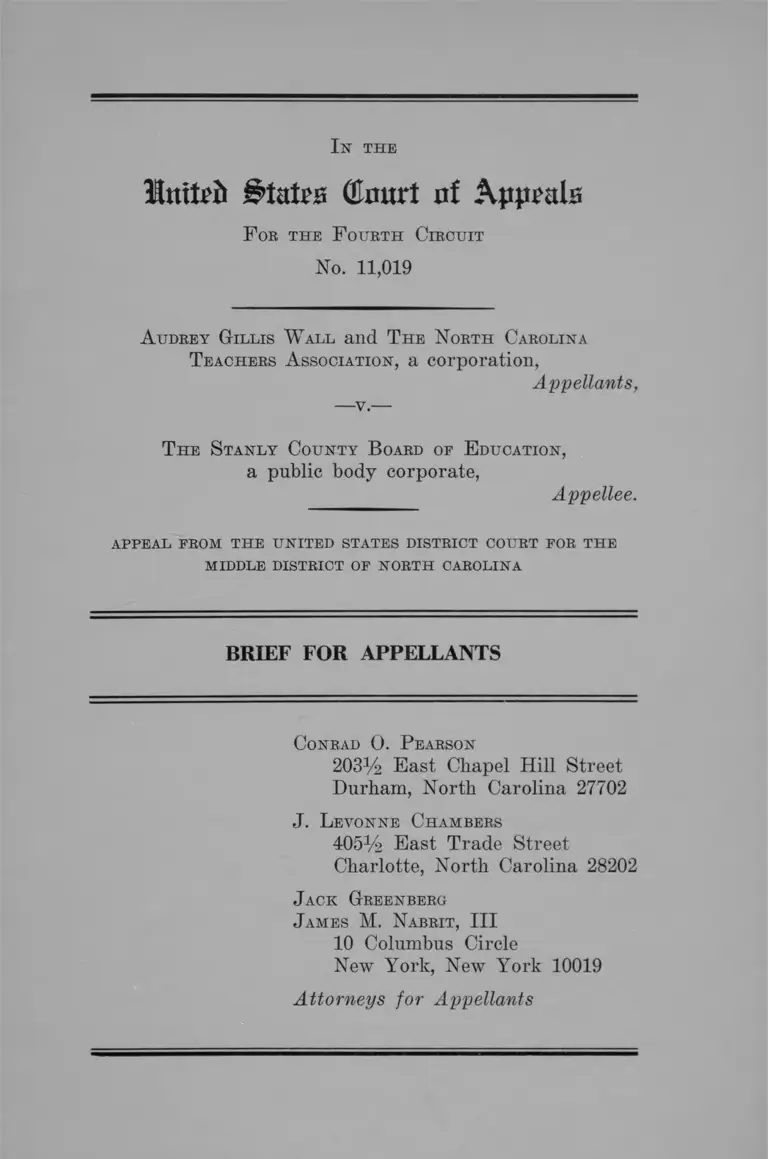
Httitei States (Enurt of Appeals
F oe the F ourth Circuit
No. 11,019
I n THE
A udrey G illis W all and T he N orth Carolina
T eachers A ssociation, a corp ora tion ,
Appellants,
— v .—
T he S tan ly C ounty B oard of E ducation ,
a public b o d y corp orate ,
Appellee.
APPEAL FROM TH E U NITED STATES DISTRICT COURT FOR TH E
MIDDLE DISTRICT OF N O RTH CAROLINA
BRIEF FOR APPELLANTS
C onrad 0 . P earson
2033/2 East Chapel Hill Street
Durham, North Carolina 27702
J. L evonne Chambers
4053/2 East Trade Street
Charlotte, North Carolina 28202
J ack Greenberg
J ames M. N abrit, III
10 Columbus Circle
New York, New York 10019
Attorneys for Appellants
I N D E X
PAGE
Statement of the Case ..................................................... 1
Statement of Facts ........................................................... 5
Questions Involved............................................................. 8
A rgum ent
Preliminary Statement ..................................................... 9
I. The School Board’s Dismissal of Plaintiff Wall
and Others of Her Class, in Attempting to De
segregate Its System, With No Consideration
or Comparison of Their Qualifications With
Other Teachers in the System, While Hiring-
New White Teachers to Fill Positions in White
Schools Constituted a Clear Denial of Due Proc
ess and Equal Protection of Law, Entitling
Them to Reinstatement and Damages ............... 12
II. Plaintiffs Are Entitled to An Order Enjoining
Further Racial Employment, Assignment and
Dismissal of Teachers and School Personnel .... 17
C onclusion ..................................................................................... 19
T able of Cases
Bradley v. School Board of City of Richmond, 382 U.S.
103, reversing 345 F.2d 310 (4th Cir. 1965) .............. 12
Bradley v. School Board of City of Richmond, 345 F.2d
310 (4th Cir. 1965) ......................................................... 18
Bradley v. School Board of City of Richmond, 317 F.2d
429 (4th Cir. 1963) .....................................................14,18
Brooks v. County School Board of Arlington County,
324 F.2d 303 (4th Cir. 1963) ...................
Brown v. Board of Education, 347 U.S. 483
18
5
11
Chambers v. Hendersonville City Board of Education,
364 F.2d 189 (4th Cir. 1966) .......................... 9,11,12,13,
14,16,17,18
Christmas v. Board of Education of Harford County,
231 F. Supp. 331 (D. Md. 1964) ................................11,16
Cramp v. Board of Public Instruction, 368 U.S. 278 .... 13
Franklin v. County School Board of Giles County, 360
F.2d 325 (4th Cir. 1966), reversing 242 F. Supp. 371
(W.D. Va. 1965) .................................................... 9,11,12,
13,14,15,16
Green v. School Board of City of Roanoke, 304 F.2d
118 (4th Cir. 1962) ......................................................... 14
Greene v. McElroy, 360 U.S. 474 .................................... 16
Johnson v. Branch, 364 F.2d 177 (4th Cir. 1966) .......13,14,
15,16
PAGE
Kier v. County School Board of Augusta County, 249
F. Supp. 239 (W.D. Va. 1966) .................................. 12,17
Olson v. Board of Education of Union Free School
District No. 12, 250 F. Supp. 1000 (E.D. N.Y. 1966).. 18
Rackley v. School District Number 5, Orangeburg
County, ------ F. ------ (Civil No. 8458, D. S.C.
1966) .............................................................................. 13,16
Schware v. Board of Bar Examiners, 353 U.S. 232 .....13,14
Service v. Dulles, 354 U.S. 365 ........................................ 16
Singleton v. Jackson Municipal Separate School Dis
trict, 355 F.2d 865 (5th Cir. 1966) ............................ 12,17
Slochower v. Board of Education, 350 U.S. 51 ............. 13
Ill
Smith v. Board of Education of Morrilton School Dis
PAGE
trict No. 32, 365 F.2d 770 (8th Cir. 1966) ...........11,12,14
Smith v. Hampton Training School for Nurses, 360
F.2d 577 (4th Cir. 1966) ............................................. 16
Torcaso v. Watkins, 367 U.S. 488 .................................... 13
Vitarelli v. Seaton, 359 U.S. 353 ...................................... 16
Wanner v. County School Board of Arlington County,
357 F.2d 452 (4th Cir. 1966) ....................................... 18
Wheeler v. Durham City Board of Education, 363 F.2d
738 (4th Cir. 1966) ................................................ 12,17,18
Wickersham v. United States, 201 U.S. 392 .................. 16
Wieman v. Updegraff, 344 U.S. 183 .............................. 13
Statute :
N.C. Gen. Stat. §§ 115-58, 115-72 ...................................... 17
Other Authorities:
N.E.A. Convention, Speech by the President, July 2,
1965, New Y ork ............................................................... 9
National Education Association, Washington, D. C.,
“Report of Task Force Appointed to Study the
Problem of Displaced School Personnel Related to
School Desegregation and the Employment Studies
of Recently Prepared Negro College Graduates Cer
tified to Teach in 17 States,” December 1965 .........10,11
Ozman, “ The Plight of the Negro Teacher,” The Amer
ican School Board Journal, September 1965 ........... 10
U. S. Department of Health, Education, and Welfare,
Revised Statement of Policies for School Desegrega
tion Plans under Title VI of Civil Rights Act of
1964 ...................................................................... 9,12,14,17
I n the
luttrii States (Court of Apprala
F or the F ourth C ircuit
No. 11,019
A udrey G illis W all and T he N orth Carolina
T eachers A ssociation, a corp oration ,
Appellants,
—v.—
T he S tan ly C ounty B oard of E ducation ,
a public body corporate,
Appellee.
APPEAL FROM TH E U NITED STATES DISTRICT COURT FOR TH E
MIDDLE DISTRICT OF N O RTH CAROLINA
BRIEF FOR APPELLANTS
Statement of the Case
This appeal is from a final judgment (94a) (------ F.
Supp. ------ ) of the United States District Court for the
Middle District of North Carolina, Salisbury Division, dis
missing plaintiffs’ complaint and denying injunctive relief
to plaintiffs and members of their class who were dismissed
or denied reemployment as teachers for the 1965-66 and
subsequent school years following the transfer of Negro
pupils from all-Negro schools to formerly all-white schools
in the Stanly County School System.
This action, seeking a preliminary and permanent injunc
tion against the racially discriminatory policies and prac
tices of the Stanly County Board of Education in hiring,
2
assigning and dismissing teachers and professional school
personnel, was filed on August 11, 1965, by a Negro school
teacher and the North Carolina Teachers Association, a
professional organization, consisting principally of Negro
teachers and professional school personnel. The plaintiffs
alleged (la-6a) that the School Board had in the past and
was presently hiring, assigning and dismissing teachers and
school personnel solely on the basis of race and color, with
Negro teachers assigned solely to Negro schools, and white
teachers assigned to white schools; that pursuant to the
Civil Rights Act of 1964, the defendant adopted a plan,
effective with the beginning of the 1965-66 school year, for
the assignment of pupils which permitted students to indi
cate the school they desired to attend; that pursuant to this
plan, approximately 100 Negro pupils requested reassign
ment from all-Negro to previously all-white schools; that
pursuant to the School Board’s policy of making racial
assignments of teachers and school personnel, the School
Board dismissed the individual plaintiff and others of her
class, solely on the basis of their race and color, in an
ticipation of the decrease in enrollment at the Negro
schools; that the School Board hired new white teachers
and school personnel to fill positions in the formerly all-
white schools and refused to consider the individual plain
tiff and others of her class solely because of their race
and color. The plaintiffs prayed that the Court enjoin the
School Board and those acting in concert with it from
employing, assigning and dismissing teachers and other
professional personnel on the basis of race and color (6a)
and for reinstatement of the individual plaintiff in the
same or comparable position (40a-41a).
The School Board filed an answer on or about Septem
ber 3, 1965, denying the material allegations of the com
plaint and moving the Court to dismiss and for summary
B
judgment (8a-30a). Plaintiffs’ response to the motion to
dismiss and for summary judgment was filed on October
15, 1965 (31a-34a). The motions of plaintiffs for pre
liminary injunction and of defendant to dismiss and for
summary judgment were heard on October 20, 1965 and
denied without prejudice on November 9, 1965 (39a).
Initial and final pretrial conferences were held on October
20, 1965 (35a) and February 2, 1966 (42a-50a), respec
tively.
The cause came on for hearing on April 27, 1966 at which
time plaintiffs intrduced several exhibits, consisting of
answers to interrogatories, depositions of Luther Adams,
Robert McLendon, G. L. Hines, Reece B. McSwain, and
Audrey Gillis Wall; teacher allotments, directory, minutes
of Board meetings, proposed policy changes of the defen
dant Board; letters of Luther Adams and Robert Mc
Lendon; form contract for instructional services; and the
oral testimony of Luther Adams and plaintiff Wall. The
case was continued until the following day at which time
plaintiffs introduced the oral testimony of E. Edmund
Reutter. The defendant offered no evidence.
On September 15, 1966, the District Court filed its Find
ings of Fact, Conclusions of Law and Opinion, finding that
Negro teachers and principals through the 1964-65 school
year had been assigned to Negro schools and white teachers
and principals to white schools (56a); that there was no
change in the racial composition of teachers and staff for
the 1965-66 school year with the exception of one Negro
teacher hired at a predominantly white school in January
1966 (62a); that pursuant to the freedom of choice plan
instituted by the defendant for the 1965-66 school year ap
proximately 300 Negro pupils transferred to formerly all-
white schools resulting in a reduction in allotment of
teachers at Negro schools and an increased allotment of
4
teachers at white schools (58a, 60a); that the Board
adopted no specific provisions to govern assignment of
teachers for the 1965-66 school year who might he affected
by the shifting of pupil enrollment and did not advise the
principals that teachers of a different race might be em
ployed at their respective schools (60a); that although
plaintiff Wall had initially been recommended and ap
proved for employment for the 1965-66 school year she
was denied employment following the reduction in allot
ment of teachers at her school because of her temperament
and attitude (64a-65a); that no objective comparison was
made of her qualifications or the severity of her alleged
faults with those of other teachers in the system; that the
practice and procedure followed by the defendant fell short
of the generally accepted practice (61a-62a, 66a).
On the basis of these findings the Court concluded that
neither the individual plaintiff nor members of the class
were denied due process of law although deefndant’s prac
tice varied from the generally accepted norm (76a, 78a);
that plaintiff Wall was not denied equal protection of the
laws although there was no objective comparison between
the plaintiff and other teachers in the school system (84a)
and although it was clear that the plaintiff would have
been employed had there been no reduction in teacher allot
ment at the Negro school (82a); and that plaintiffs were
not entitled to general injunctive relief reasoning that the
plan adopted by the defendant on April 15,1966 (216a-232a)
was not constitutionally objectionable. The Court thus
denied all relief and dismissed the complaint (94a).
From this judgment, the plaintiffs, on September 26,
1966, filed this appeal (517a).
5
Statement of Facts
Despite the ruling of the Supreme Court in Brown v.
Board of Education, 347 U.S. in 1954, the seventeen schools
in the Stanly County School System (101a) were op
erated on a completely segregated basis until two Negro
pupils requested reassignment for the 1964-65 school year
to the all-white North Stanly High School (293a, 351a, 55a-
56a). Negro students and teachers were assigned to three
all-Negro Schools—South Oakboro, Lakeview and West
Badin (101a, 294a, 351a). White students and teachers
were assigned to the remaining fourteen all-white schools.
Negro students completing elementary school at South Oak
boro and Lakeview were, and still are except upon request
for reassignment to another school (301a-302a), trans
ferred to the all-Negro Kingville High School in another
school district, a practice long condemned by the Supreme
Court and by this Court.
For the 1965-66 school year, the defendant, pursuant to
the requirements of the Civil Rights Act of 1964, adopted
a plan for the assignment of pupils which permitted them
to indicate the school they desired to attend (299a, 352a,
19a-30a). Pursuant to this plan approximately 300 Negro
pupils requested reassignment to formerly all-white schools
(99a, 180a). Because of the shift in the assignment of
pupils there was a corresponding reduction in the allot
ment of teachers at the Negro schools and an increased
allotment of teachers in the white schools (60a, 101a, 161a-
177a, 415a-421a). Plaintiff Wall, although initially favor
ably recommended by her Principal and the Superintendent
and approved for employment for the 1965-66 school year
by the School Board (206a, 267a, 323a), was subsequently
advised by her Principal that due to the reduction in the
6
allotment of teachers at her school she had “been selected
as one of the three teachers, who will not receive a con
tract at this time” (214a), with admittedly no comparison
of her qualifications with other teachers in the system
(314a, 458a, 66a, 82a).
Applicants for teaching positions in defendant’s School
System have generally submitted applications to the var
ious principals or to the Superintendent (365a, 381a, 403a-
405a, 57a). Applications submitted to the Superintendent
have been filed separately according to race, “ for the con
venience of the principals,” since normally Negro princi
pals “were not interested in white applicants,” and white
principals were not interested in Negro applicants (299a,
302a, 57a). When positions became available, applicants
were interviewed by the various principals or by the
Superintendent and recommended to the School Board for
employment (404a, 407a-408a). Teachers in the school sys
tem were routinely re-employed, without the necessity of
competing with new applicants, upon their indication of
their desire to remain in the system (345a). The defen
dant maintained no written standards or criteria for the
employment, assignment and retention of teachers (409a).
At the close of the 1964-65 school year plaintiff Wall,
who had taught in the Stanly County School System for
thirteen years, expressed her desire to remain in the sys
tem. She was accordingly recommended and approved for
employment for the 1965-66 school year. Due to the trans
fer of Negro students from her school to the formerly all-
white Norwood School, the teacher allotment at her school
was reduced by three (415a) and increased by two at the
Norwood School (416a). No instruction was given to the
principals as to the procedure to follow in case of loss of
teachers, the Superintendent assuming that they would
7
take “ several things into consideration;” nor were the
white principals advised that they could or should employ
Negro teachers who might be affected by the reduction in
the allotment of teachers at Negro Schools (314a, 60a).
Plaintiff Wall was selected as one of several teachers to
be displaced because of her alleged “negative attitude”
which was explained as questioning the programs of her
principal, failing to attend meetings, not following the
rules of her school and being absent from school (242a-
246a, 274a-278a). No comparison, however, was made of
the plaintiff’s qualification or alleged faults with other
teachers in the system (314a, 66a, 82a), and despite these
alleged faults, she was nevertheless recommended for em
ployment. Her Principal testified that this was because he
“didn’t have any other applicants for the position” (284a),
although he admitted having several such applications
(283a, 286a, 455a). The Superintendent sought to explain
his recommendation of the plaintiff on the ground that
they feared hiring new teachers (452a), although approxi
mately fifty new white teachers were hired for the 1965-66
school year, many in positions the plaintiff was qualified
to fill and could have filled were it not for defendant’s'
racial policies (104a-131a, 181a-199a, 178a). The record
is clear, as conceded by the District Court (82a), that had
not the Negro students transferred to formerly all-white
schools and had there been no reduction in the allotment
of Negro teachers, the plaintiff would have been employed,
her alleged faults notwithstanding.
On April 15, 1966, the School Board adopted a plan to
govern employment and assignment of teachers and school
personnel which generally adopts the pattern followed by
the defendant in the past and further provides that staff
and professional personnel will be employed and assigned
without regard to race (216a-232a, 436a-437a, 504a).
8
The District Court, in dismissing the complaint, found
the new plan constitutionally acceptable, and that the de
fendant, in dismissing the plaintiff, did not act arbitrarily
or capriciously and was not required to accord the plaintiff
the same objective comparison and consideration which
this Court and others have held that Negro teachers simi
larly affected were entitled.
Questions Involved
1
Where a School Board, in attempting to desegregate its
school system, reduces the number of teachers at its Negro
schools and increases the number of teachers at its white
schools because of the transfer of Negro students to the
formerly all-white schools, may Negro teachers thereby af
fected be denied objective comparison of their qualifications
and equal consideration for employment with other teachers
in the school system, Negro and white, in the School Board’s
selection of the teachers to be displaced when new white
teachers are hired to fill the positions in the formerly
all-white schools?
2
Where, upon a showing of a long-established policy of
racial employment, assignment and dismissal of teachers,
a School Board, following the filing of suit and a few days
before the case is heard, adopts a plan which provides
generally that race will not be considered in the future
but which nevertheless allows for such consideration, and
no actual or material steps have been taken by the Board
to implement its plan, are Negro teachers affected by the
Board’s policies and practices entitled to injunctive relief?
9
ARGUMENT
Preliminary Statement
This Court, on two previous occasions, Chambers v.
Hendersonville City Board of Education, 364 F.2d 189
(4th Cir. 1966) and Franklin v. County School Board of
Giles County, 360 F.2d 325 (4th Cir. 1966), reversing 242
F. Supp. 371 (W. D. Va. 1965), has considered the startling-
decimation of Negro teachers resulting from attempted
desegregation of school systems. As Negro students ob
tain transfers to formerly all-white schools and formerly
all-Negro schools are closed or integrated, Negro teachers
in increasingly large numbers have been summarily dis
missed rather than transferred along with the Negro stu
dents or employed and assigned without regard to race,
thus prompting concern from the President of the United
States,1 revised rules of the Department of Health, Edu
cation and Welfare2 and the subject of intensive studies
1 Speech, N. E. A . Convention, July 2, 1965, New York. The President
stated:
“For you and I are both concerned about the problem of the dis
missal of Negro teachers as we move forward— as we move forward
with the desegregation of the schools of America. I applaud the
action that you have already taken.”
“For my part, I have directed the Commissioner of Education to
pay very special attention in reviewing the desegregation plans, to
guard against any pattern of teacher dismissal based on race or
national origin.”
2 U. S. Department of Health, Education, and Welfare, Revised State
ment of Policies for School Desegregation Plans Under Title Y I of the
Civil Rights Act of 1964 [hereinafter referred to as Revised Rules] :
Section 181.13(a) Desegregation of Staff. The racial composition
of the professional staff of a school system, and of the schools in
the system, must be considered in determining whether students are
subjected to discrimination in educational programs. Each school
system is responsible for correcting the effects of all past discrim
10
by national groups.3
Here, the School Board, following the transfer of ap
proximately 300 Negro students from formerly all-Negro
to formerly all-white schools, reduced the teacher allot
ment at the Negro schools with no advice to the Negro or
white principals of the procedure to follow in selecting the
teachers to be displaced. No comparison was made of the
teachers in the system. No consideration was given the
Negro teachers affected for positions in the formerly all-
white schools. Their jobs had simply gone out of existence
and new white teachers were hired to fill the positions in
the white schools (104a-131a, 181a-199a, 178a).
inatory practices in the assignment of teachers and other professional
staff.
Section 181.13(h) New Assignments. Race, color, or national origin
may not be a factor in the hiring or assignment to schools or within
schools of teachers and other professional staff, including student
teachers and staff serving two or more schools, except to correct the
effects of past discriminatory assignments.
Section 181.13(c) Dismissals. Teachers and other professional
staff may not be dismissed, demoted, or passed over for retention,
promotion, or rehiring, on the ground of race, color, or national
origin. In any instance where one or more teachers or other pro
fessional staff members are to be displaced as a result of desegre
gation, no staff vacancy in the school system may be filled through
recruitment from outside the system unless the school officials can
show that no such displaced staff member is qualified to fill the
vacancy. I f as a result of desegregation, there is to be a reduction
in the total professional staff of the school system, the qualifications
of all staff members in the system must be evaluated in selecting the
staff members to be released.
3 See National Education Association, Washington, D. C., “Report of
Task Force Appointed to Study the Problem of Displaced School Per
sonnel Related to School Desegregation and the Employment Studies of
Recently Prepared Negro College Graduates Certified to Teach in 17
States, December 1965 [hereinafter referred to as N. E. A . R eport];
Ozman, “ The Plight of the Negro Teacher,” The American School Board
Journal, pp. 13-14, September, 1965.
11
This pattern follows that found by NEA Study to be
taking place all over the South:4
“ Concern with faculty integration is becoming acute
because of current practices. Typically, whenever
twenty or twenty-five Negro pupils are transferred
from a segregated school, the Negro teacher left with
out a class is in many cases dismissed rather than
being transferred to another school with a vacancy.
• • •
“As has been demonstrated, ‘white schools’ are
viewed as having no place for Negro teachers. As a
result when Negro pupils in any number transfer out
of Negro schools, Negro teachers become surplus and
lose their jobs. It matters not whether they are as
well qualified as, or even better qualified than, other
teachers in the school system who are retained. Nor
does it matter whether they have more seniority. They
were never employed as teachers for the school sys
tem—as the law would maintain—but rather as teach
ers for Negro schools.”
The deprivation of constitutional rights threatened by
such dismissals have been carefully reviewed by this Court
and in each instance the burden has been placed upon
school authorities to show by clear and convincing evi
dence that their conduct was consistent with due process
and equal protection of the law. Franklin v. County School
Board of Giles County, supra; Chambers v. Hendersonville
City Board of Education, supra; see also Smith v. Board
of Education of Morrilton School District No. 32, 365 F.2d
770 (8th Cir. 1966); Christmas v. Board of Education of
Harford County, 231 F. Supp. 331 (D. Md. 1964). Viewed
in light of the principles established in the above cases,
4 N. E. A . Report, p. 13.
12
the instant case clearly establishes that the School Board’s
practices and conduct were inconsistent with plaintiffs’
rights under the Constitution and that the District Court
erred in refusing’ to grant plaintiffs injunctive relief as
prayed.
I
The School Board’s Dismissal of Plaintiff Wall and
Others of Her Class, in Attempting to Desegregate Its
System, With No Consideration or Comparison of Their
Qualifications With Other Teachers in the System,
While Hiring New White Teachers to Fill Positions in
White Schools Constituted a Clear Denial of Due Proc
ess and Equal Protection of Law, Entitling Them to
Reinstatement and Damages.
It is clear that the Fourteenth Amendment forbids dis
crimination on the basis of race by a public school system
with respect to the employment, assignment and retention
of teachers and other school personnel. Chambers v. Hen
dersonville City Board of Education, supra; Franklin v.
County School Board of Giles County, supra; Wheeler v.
Durham City Board of Education, 363 F.2d 738 (4th Cir.
1966); Smith v. Board of Education of Morrilton School
District No. 32, supra; Bradley v. School Board of the
City of Richmond, 382 U.S. 103, reversing 345 F.2d 310
(4th Cir. 1965); Singleton v. Jackson Municipal Separate
School District, 355 F.2d 865 (5th Cir. 1966) ; Kier v.
County School Board of Augusta County, 249 F. Supp. 239
(W. D. Va. 1966); Revised Rules, Section 181.13(c). It is
equally clear that the Fourteenth Amendment forbids de
nial by a school board or other public agency of employ
ment to teachers and other public servants on some frivo
lous, arbitrary or other ground which fails to accord due
13
process. Cramp v. Board of Public Instruction, 368 U.S.
278; Torcaso v. Watkins, 367 U.S. 488, 495-96; Schware v.
Board of Bar Examiners, 353 U.S. 232; Slochoiver v. Board
of Education, 350 U.S. 51; Wieman v. Updegraff, 344 U.S.
183; Johnson v. Branch, 364 F.2d 177 (4th Cir. 1966);
Rackley v. School District Number 5, Orangeburg County,
------ F. Supp. ------ (Civil No. 8458, D. S. C., 1966). De
fendant’s practices here in dismissing plaintiff Wall and
Negro teachers of her class were violative of their rights
to due process and equal protection of the law.
A. In an homogeneous school system, where teachers
are and may be assigned among the various schools de
pending on needs of the system, as the Superintendent
testified his school system to be (430a-431a, 435a, 459a),
it is patently violative of the rights of Negro teachers to
limit their consideration for employment to the Negro
schools. Chambers v. Hendersonville City Board of Edu
cation, supra; Franklin v. County School Board of Giles
County, supra. Following the reduction in the allotment
of teachers at the Negro schools, Negro teachers were
displaced with no comparison whatever of their qualifica
tions with other teachers in the school system. Moreover,
there was here not even the semblance of evaluating “their
right to continue employment in terms of the vacancies
then existing in the other schools in the system.” Franklin
v. County School Board of Giles County, 242 F. Supp. 371,
374 (W. D. Va. 1965), reversed, 360 F.2d 325 (4th Cir.
1965). Approximately 50 new white teachers were hired
to fill the positions in the white schools which the Negro
teachers were qualified to fill. In view of the practice fol
lowed by the defendant, with Negro and white teachers
being assigned to separate schools on the basis of race,
the defendant’s failure to fairly and objective appraise
the Negro teachers for all positions for which they were
qualified permits no conclusion other than they were “dis
14
charged because of their race.” Franklin v. County School
Board of Giles County, supra; Chambers v. Hendersonville
City Board of Education, supra; Smith v. Board of Edu
cation of Morrilton School District No. 32, supra. See
also Revised Rules, Section 181.13(c). In addition, such
appraisals were to be fairly, objectively and equally ap
plied throughout the system to Negro and white staff
members. Schware v. Board of Bar Examiners, supra;
Johnson v. Branch, supra; Bradley v. School Board of the
City of Richmond, 317 F.2d 429 (4th Cir. 1963); Green v.
School Board of City of Roanoke, 304 F.2d 118 (4th Cir.
1962). Had that been done here, the evidence clearly
shows that plaintiff Wall and others of her class possessed
far superior qualifications to many of the white teachers
retained or newly hired in positions the plaintiff and mem
bers of her class were qualified to fill.5
As a basis for the dismissal of plaintiff Wall, defen
dant has asserted her alleged “negative attitude.” The
District Court found this sufficient to deny to her the con
stitutional rights to fair and objective consideration and
comparison with other teachers in the school system (84a).
These alleged faults, however, were considered material
by the defendant only after it became necessary to reduce
the Negro teachers at the plaintiff’s school and after her
principal and the Superintendent had favorably recom
mended her and the defendant had approved her employ
ment for the 1965-66 school year. Moreover, with no com
parison of the plaintiff’ s qualifications and of her alleged
faults, no fair and objective determination could be made
by the defendant as is clearly required by the teachings
of this Court. Chambers v. Hendersonville City Board of
5 See 118a-131a, where many teachers held Emergency B, Primary B
or no Certificates at all. Plaintiff W all had a Grammar Graduate Cer
tificate, with 13 years experience in the Stanly County School System.
15
Education, supra; Johnson v. Branch, supra; Franklin v.
County School Board of Giles County, supra, and see par
ticularly Note 3, requiring that the Board objectively dem
onstrate that it would not have retained the teacher in
volved “under any circumstances.” As the District Court
here found, had there been no transfer of Negro students
to the white schools, and had there been no reduction in
the allotment of teachers at her school, plaintiff Wall
“would have been re-employed for the school year 1965-66”
(82a). Clearly, therefore, the asserted basis here for not
retaining plaintiff is to be given no weight. It could not
properly be a sufficient basis where, as here, the defendant
has failed to consider her for other positions in the sys
tem and to fairly, objectively and without discrimination
appraise her qualifications with “ all staff members in the
s y s t e m Otherwise, the constitutional principles clearly
established in the above cited cases would become sterile
pronouncements without meaning or force. Johnson v.
Branch, supra.
The evidence here further shows that Frederick Wel-
borne was denied objective and fair comparison with other
teachers in the system prior to the determination to deny
him employment (235a-237a, 241a-242a, 246a-247a). He
too had been recommended for employment and his em
ployment approved for the 1965-66 school year (211a).
He too was to be dismissed following the reduction in the
allotment of teachers at his school. It is true that he
obtained other employment fearing the loss of Negro
teachers in the system (280a). The District Court did not
consider it material that no objective appraisal was made
since Welborne had obtained employment elsewhere (85a),
but the failure initially to fairly and objectively consider
him for any position in the system without regard to race
further corroborates defendant’s racially discriminatory
16
practices with respect to plaintiff and others of her class.
Franklin v. County School Board of Giles County, supra;
Chambers v. Hendersonville City Board of Education,
supra; Christmas v. Board of Education of Harford
County, supra.
B. Plaintiff Wall is entitled to an order requiring her
reinstatement and a determination of her damages. Cham
bers v. Hendersonville City Board of Education, supra;
Johnson v. Branch, supra; Franklin v. County School Board
of Giles County, supra; Smith v. Hampton Training School
for Nurses, 360 F.2d 577 (4th Cir. 1966); Rackley v. School
District Number 5, Orangeburg County, supra. The evi
dence here clearly establishes that the plaintiff was dis
missed in a manner inconsistent with her rights to due
process and equal protection of the law. She is thus en
titled to an effective remedy as established by this Court
in the above cases. See also Service v. Dulles, 354 U.S.
365; Vitarelli v. Seaton, 359 U.S. 353; Greene v. McElroy,
360 U.S. 474, 491-92; Wickersham v. United States, 201
U.S. 392.
17
II
Plaintiffs Are Entitled to An Order Enjoining Fur
ther Racial Employment, Assignment and Dismissal of
Teachers and School Personnel.
The responsibility for eliminating past racial assign
ments of teachers and school personnel and instituting an
effective plan and practice of non-racial employment is
that of the defendant Board. Chambers v. Hendersonville
City Board of Education, supra; Wheeler v. Durham City
Board of Education, supra; Singleton v. Jackson Municipal
Separate School District, 355 F.2d 865 (5th Cir. 1966);
Kier v. County School Board of Augusta County, supra;
Revised Rules, Section 181.13.6 Defendant’s long-estab
lished practice of racial employment and assignment of
teachers is clear (433a, 56a, 62a). All Negro teachers and
school personnel have been assigned to Negro schools and
all white teachers and school personnel assigned to white
schools. In January 1966, defendant employed one Negro
teacher at North Stanly, a formerly all-white school. In
April 1966, the defendant adopted a plan which contained
a provision that staff and professional personnel shall be
employed and assigned to and within schools without re
gard to race, color or national origin (219a). The plan
further provided that teachers were to indicate whether
they would teach in an all-white, all-Negro or integrated
school (255a) and the Superintendent testified that he
would honor such indications (437a-441a). No other steps
had been taken by the Board or planned (444a) to correct
or eliminate the Board’s racial policies. The District Court
denied injunctive relief reasoning that the plan was a
6 See also N. C. Gen. Stat. §$115-58, 115-59, 115-72, expressly placing
the responsibility for the employment and assignment of teachers upon
school boards.
18
sufficient corrective.7 The District Court, however, clearly
erred. In view of the long history of racially discrimina
tory practices by the Board, still in the process of attempt
ing to desegregate, and with no more showing by the
Board that one Negro teacher had been assigned to a
formerly all-white school, injunctive relief as prayed by
the plaintiffs should have been granted. Brooks v. County
School Board of Arlington County, 324 F.2d 303 (4th Cir.
1963); Bradley v. School Board of the City of Richmond,
317 F.2d 429 (1963). See particularly Chambers v. Hen
dersonville City Board of Education, supra, where the
School Board had advanced much further in integrating
its staff and this Court nevertheless held that the plaintiffs
as a class were entitled to injunctive relief and that the
Court should retain jurisdiction “until the transition to a
desegregated faculty is completed.” Id. at 193.
7 The District Court further held that such considerations were not
per se impermissible, citing Wanner v. County School Board of Arlington
County, 357 F.2d 452 (4th Cir. 1966) and Olson v. Board of Education
of Union Free School District No. 12, 250 F . Supp. 1000 (E . D. N. Y .
1966), and reasoning further that the constitution does not forbid volun
tary associations, citing Bradley v. School Board of the City of Richmond,
345 F.2d at 316. This, reasoning, however, ignores the necessity for in
junctive relief. In both Wanner and Olson the School Board had adopted
affirmative policies to promote integration. The Court simply held that
race in such instances were permissible consideration. Certainly, here the
School Board advances no contention that its purpose is to promote inte
gration but rather the opposite as is clearly established by the record.
Moreover, the District Court’s reliance on Bradley not only permits but
encourages the very practice reproved by this Court in Wheeler V.
Durham City Board of Education, supra, the perpetuation of racial em
ployment and assignment practices by school boards. Certainly, where
teachers are involved as plaintiffs who are adversely affected are entitled
to injunctive relief. Chambers v. Hendersonville City Board of Education,
supra.
19
CONCLUSION
Plaintiffs respectfully pray that this Court reverse the
holding of the District Court and remand the case with
instructions requiring both the reinstatement of plaintiff
Wall and the determination of her damages resulting from
her wrongful discharge and the issuance of an injunction
restraining the defendant from further consideration of
race or color in the employment, assignment and dismissal
of teachers and professional personnel. The plaintiffs fur
ther pray that if a reduction in teacher force in defendant’s
system is required, that defendant be ordered to apply the
same standards or criteria to all teachers and applicants,
and after such appraisal, should the plaintiff or any mem
ber of her class be refused employment, the defendant be
required to establish by clear and convincing evidence that
those denied employment were accorded due process and
equal protection of the law.
Respectfully submitted,
Conrad 0 . P earson
203% East Chapel Hill Street
Durham, North Carolina 27702
J. L evonne C hambers
405% East Trade Street
Charlotte, North Carolina 28202
J ack Greenberg
J ames M. N abrit, III
10 Columbus Circle
New York, New York 10019
Attorneys for Appellants
MEILEN PRESS INC. — N. Y. 219