Davis v. Cook Petition for a Writ of Certiorari to the US Court of Appeals for the Fifth Circuit and Brief and Appendix in Support Thereof
Public Court Documents
May 5, 1950
Cite this item
-
Brief Collection, LDF Court Filings. Davis v. Cook Petition for a Writ of Certiorari to the US Court of Appeals for the Fifth Circuit and Brief and Appendix in Support Thereof, 1950. b3fddc5e-af9a-ee11-be37-00224827e97b. LDF Archives, Thurgood Marshall Institute. https://ldfrecollection.org/archives/archives-search/archives-item/33d7a828-fbee-41b4-8d89-24f644dcea69/davis-v-cook-petition-for-a-writ-of-certiorari-to-the-us-court-of-appeals-for-the-fifth-circuit-and-brief-and-appendix-in-support-thereof. Accessed July 30, 2026.
Copied!
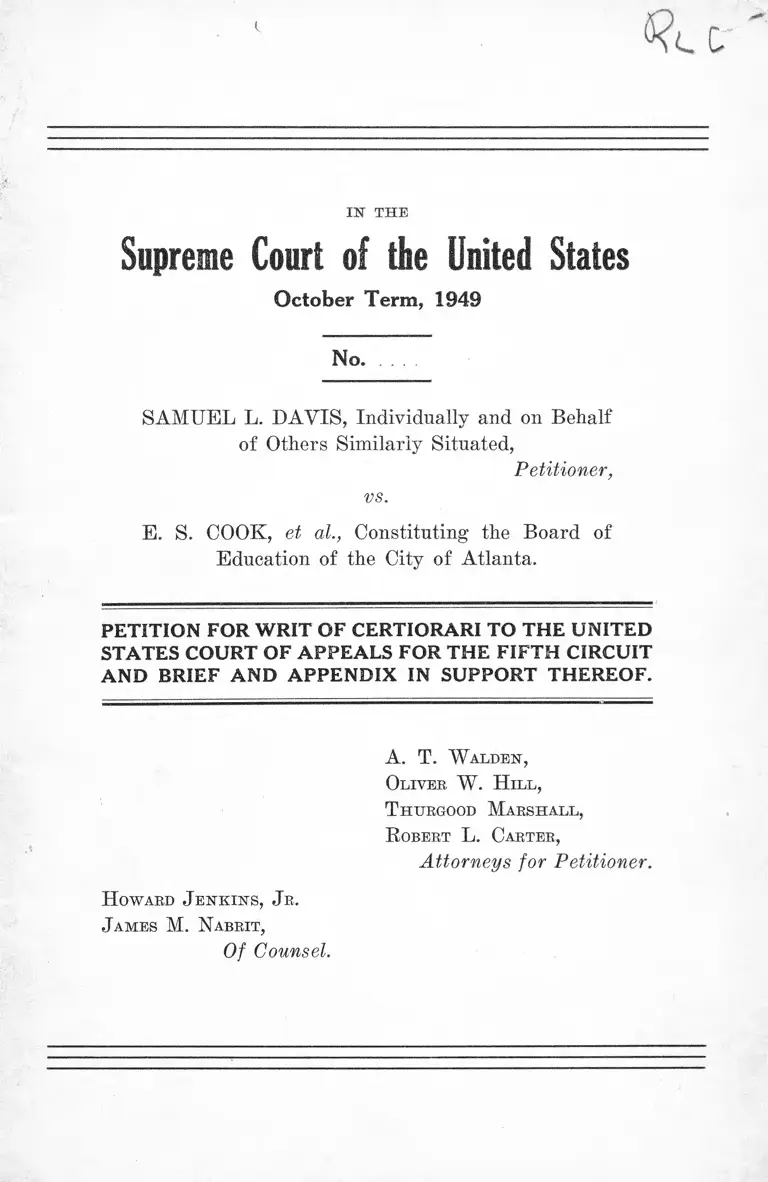
IK THE
Supreme Court of the United States
October Term, 1949
No. .
SAMUEL L. DAVIS, Individually and on Behalf
of Others Similarly Situated,
Petitioner,
vs.
E. S. COOK, et at., Constituting the Board of
Education of the City of Atlanta.
PETITION FOR W RIT OF CERTIORARI TO THE UNITED
STATES COURT OF APPEALS FOR THE FIFTH CIRCUIT
AND BRIEF AND APPENDIX IN SUPPORT THEREOF.
A. T. W alden,
Oliver W . H ill,
T hurgood Marshall,
R obert L. Carter,
Attorneys for Petitioner.
H oward J enkins, J r .
J ames M. Nabrit,
Of Counsel.
I N D E X
PAGE
P etition for W rit of Certiorari:
Summary Statement of the Matter Involved ---------- 2
Statement of Facts _____________________________ 4
The Opinion of the Court of Appeals -------------------- 12
Jurisdiction ______________________ 13
Question Presented ______________________________ 14
Reasons Relied Upon for Allowance of the W rit__ 14
Conclusion_______________________________________ 19
Brief in Support T hereof:
Opinions of the Courts Below____________________ 21
Jurisdiction______________________________________ 21
Statement of the Case ___________________________ 22
Errors Relied U pon_____________________________ 22
A rgument :
I. Administrative remedies need not be pursued
prior to resort to federal courts unless manda
tory in nature_______________________________ 23
11
PAGE
II. The nature of petitioner’s cause is such as to
require dispensing with the pursuit of admin
istrative remedies and immediate judicial de
termination —
III. The State Board of Education is without statu
tory jurisdiction or authority to grant petitioner
the relief he seeks------ --------------------------------
IV. The procedure provided for appeal to the Atlanta
Board of Education is in the nature of a peti
tion for rehearing or reconsideration by the
Board and, hence, need not be exhausted prior
to resort to the federal courts-------------------------
V. The procedure provided for appeal to the
Atlanta Board of Education fails to satisfy
the minimum requirements of due process of
law--------------- --------- ------------------------------------ 32
VI. The opinion of the Court of Appeals in this case
is in apparent conflict with the Court of Appeals
of the Ninth Circuit-------------------------------------
40
Conclusion
Appendix —
I l l
Table of Cases
PAGE
Aircraft & Diesel Equipment Corp. y. Hirseh, 331 U. S.
752 ___________ ..___________ __- _ — — 17, 26
Alston v. School Board, 112 P. 2d 992 (C. C. A. 4th
1940); cert. den. 311 IT. S. 693 __________ _______ 25
Boney v. County Board of Education, 45 S. E. 2d 442
(1947) _____________________ ___________________ 30
Bryant v. Board of Education, 156 Ga. 688, 119 S. E.
601 (1923) ________________________ —_______..-16, 23
Carter v. Johnson, 186 Ga. 167, 197 S. E. 258
(1938) _____________________________________15,28,37
Colyer v. Skeffington, 265 Fed. 17 (D. Mass. 1920) ___ 18, 36
County Board of Education v. Young, 187 Ga. 664, 1
S. E. 2d 739 (1939) ____________ _________16,23,24,25
Downer v. Stevens, 22 S. E. 2d 139 (1942) ....—.15,25,29
Fordham v. Harrell, 197 Ga. 135, 28 S. E. 2d 463
(1943) ___________________________ _—15,25,28,30,37
Kansas City So. By. Co. v. Ogden Levee Dist., 15 F. 2d
637 (C. C. A. 8th 1926) ____ ____________ ________ 18,36
Levers v. Anderson, 326 IT. S. 219 ______ ________ 15, 31
Londoner v. Denver, 210 IT. S. 373 __________________ 35
Moore v. Illinois Central Railway Co., 312 IT. S. 630__ 16, 24
Morgan v. United States, 304 U. S. 1 ______________ 18, 35
Munn v. Des Moines National Bank, 18 F. 2d 269
(C. C. A. 8th 1927) _________________________ 17,18,34
Ohio Bell Telephone Co. v. Public Utilities Commission,
301 U. S. 292 __________________________________18, 36
Oklahoma Natural Gas Co. v. Bussell, 261 U. S. 290__ 17, 25
IV
Pacific Telephone & Telegraph Co. v. Kuykendall, 265
PAGE
U. S. 196 ______________________________________17, 36
Porter v. Investors Syndicate, 286 U. S. 461------------17, 36
Shelley v. Kraemer, 334 U. S. 1 ------------------------------- 38
Steele v. Louisville & N. B. Co., 323 U. S. 192---------- 15, 36
Trans-Pacific Airlines v. Hawaiian Airlines, 174 F. 2d
63 (C. C. A. 9th 1949)------------ ---------------------------- 16, 38
Tunstall v. Brotherhood of Locomotive Firemen &
Enginemen, 323 IT. S. 210----------------------------------15, 36
United States v. Carolene Products Co., 304 U. S.
444 ____________________________________________ 38
United States v. Morgan, 298 U. S. 468 --------------------18, 35
Yick Wo v. Hopkins, 118 U. S. 356 -------------------------- 25
V
Constitutional and Statutory Authorities
Constitution of the State op Georgia o f 1945
PAGE
A rticle VIII
Section II, Chap. 2-65, § 2-6501 _________________ 40
Section III, Chap. 2-66, § 2-6601 ________________ 41
Section VII, Chap. 2-70, § 2-7001 _______________ 5,42
Section VIII, Chap. 2-71, § 2-7101 ______________ 42
Section XI, Chap. 2-74, § 7401, § 7402 __________42,43
Georgia Code A nnotated
Section 32-401 (Acts 1937, p. 864; Acts 1943, pp.
636, 638) ______________________ ____________ 43
Section 32-402 (Acts 1937, pp. 864, 865; Acts 1943,
pp. 636, 637, 638) ___________________________ _ 43
Section 32-403 (Acts 1937, pp. 864, 865; Acts 1943
pp. 636, 638) ________________________________ _ 44
Section 32-404 (Acts 1937, pp. 864, 865) _________ 44
Section 32-405 (Acts 1937, pp. 864, 865) ________44, 45
Section 32-406 (Acts 1937, pp. 864, 865) ________ 45
Section 32-407 (Acts 1937, pp. 864, 866) ________ 45
Section 32-408 (Acts 1937, pp. 864, 866) ________45, 46
Section 32-409 (Acts 1937, pp. 864, 866) _____...___ 4q
Section 32-410 (Acts 1937, pp. 864, 866) ________ 46
Section 32-411 (Acts 1937, pp. 864, 866) ________ 46
Section 32-411.1 (Acts 1947, pp. 668, 669) ______46,47
Section 32-412 (Acts 1937, pp. 864, 867) ________ 47
Section 32-414 (Acts 1937, pp. 864, 867) _______ 30,47
Section 32-504 (Acts 1937, pp. 864, 867) ________ 47
V I
Section 32-601 (Acts 1937, pp. 882, 883) ---------5, 27, 48
Section 32-602 (Acts 1937, pp. 882, 883) ---------5,14,48
Section 32-603 (Acts 1937, pp. 882, 883) -------------- 48
Section 32-604 (Acts 1937, pp. 882, 883) ---------- -27, 48
Section 32-605 (Acts 1937, pp. 882, 883) --------------5,15,
30, 37, 48
Section 32-606 (Acts 1937, pp. 882, 883) -------------- 49
Section 32-608 (Acts 1937, pp. 882, 884) ------------ 27,49
Section 32-609 (Acts 1937, pp. 882, 884; Acts 1947, ̂
pp. 668, 669) ---------------------------------------5,14, 2/,o0
Section 32-610 (Acts 1937, pp. 882, 885) ---------5,27,51
Section 32-611 (Acts 1937, pp. 882, 886) ------------ 27,51
Section 32-612 (Acts 1937, pp. 882, 886) ------------51, 52
Section 32-613 (Acts 1937, pp. 882, 886) — 6,14, 27, 52
Section 32-614 (Acts 1937, pp. 882, 886) — 6, 28, 52, 53
Section 32-615 (Acts 1937, pp. 882, 887; Acts 1946,
pp. 201, 216; Acts 1947, pp. 668, 670) — 6,14, 28, 53
Section 32-616 (Acts 1937, pp. 882, 883) — 6,14, 28, 54
Section 32-622 (Acts 1937, pp. 882, 890) -------------- 54
Section 32-910 (Acts 1919, p. 324; Acts 1947, pp.
1189, 1190) __________________________ 14,23,30,54
Section 32-1010 (Acts 1919, p. 352; Acts 1947, pp.
1189, 1191) ______________________________15,30,55
Section 32-1111 (Acts 1919, p. 340; Acts 1946, pp.
206, 211) ___________________________________29>55
PAGE
11ST T H E
Supreme Court of the United States
PETITION FOR W RIT OF CERTIORARI TO THE
UNITED STATES COURT OF APPEALS
FOR THE FIFTH CIRCUIT.
To the Honorable, the Chief Justice of the United States
and the Associate Justices of the Supreme of the
United States:
Petitioner respectfully prays that a writ of certiorari
issue to review the judgment of the United States Court of
Appeals for the Fifth Circuit, reversing the judgment of
the District Court of the United States for the Northern
District of Georgia which had entered judgment, enjoining
and restraining the respondents from paying petitioner and
other Negro teachers and principals in the public schools of
Atlanta less salary than is paid white teachers and prin
cipals of equal qualifications and experience, and perform
ing substantially the same duties, solely on account of race
and color, in violation of the equal protection clause of the
Fourteenth Amendment.
October Term, 1949
No. ____
Samuel L. D avis, Individually and on
Behalf of Others Similarly Situated,
Petitioner,
E. S. Cook, et al., Constituting the Board
of Education of the City of Atlanta.
vs.
2
Summary Statement of the Matter Involved.
This ease has a long history. Until some time in 1942,
teachers and principals in the Atlanta public schools were
paid pursuant to a dual salary schedule—one for Negro
teachers and principals and one for white teachers and prin
cipals. These schedules admittedly discriminated against
Negro teachers and principals (R. 36, 42).
On January 30, 1941, a petition, on behalf of a teachers’
association representing all Negro teachers employed in the
Atlanta public school system, was filed with the Atlanta
Board of Education alleging discrimination in the payment
of salaries, and requesting that Negro teachers and prin
cipals be paid the same salary as other teachers of equal
qualifications and experience and performing substantially
the same duties, without regard to race and color (R. 10).
On November 26, 1941, a second petition of the same nature
was filed, but respondents took no action (R. 10).
On February 17, 1942, William Reeves, a Negro teacher
employed in the school system, brought suit in the United
States District Court against the respondents seeking to
enjoin the practice, custom and usage of paying Negro
teachers and principals less salary than is paid white teach
ers and principals. After the filing of the Reeves ’ suit, re
spondents announced that they were abolishing the dual
schedule of salaries and ordered the institution of a new
single salary schedule which would be free of discrimina
tion on account of race and color (R. 42, 43). (The Board’s
resolution authorizing this action is set out on page 43 of the
Record.)
On July 2,1943, the instant complaint of the present peti
tioner was filed in the United States District Court (R. 2-
14). On July 20, 1943, a motion to dismiss was filed (R. 14-
17). No allegation was there made that petitioner had
3
failed to exhaust any state administrative remedies. On
June 29, 1944, the motion was overruled (R. 17-30). On
July 8, 1944, the answer was filed (R. 30-38). Here, again,
respondents did not allege as a defense to this action failure
on petitioner’s part to exhaust administrative remedies.
The trial on the merits did not take place until November,
1947, three years later. Additional argument was heard in
July, 1948 (R. 53), and on September 28, 1948, the trial
court issued findings of fact and conclusions of law (R. JO-
64). It found that the wide differential between the salaries
of Negro and white teachers could only be the result of the
discrimination based upon race and color in violation of the
Fourteenth Amendment (R. 61). It further found that the
State Board of Education fixed the state’s contribution to
the educational fund of Atlanta (R. 42). That on the salary
schedule which the State Board prescribes the minimum
rate of pay for Negro teachers is less than the minimum
rate of pay prescribed for white teachers (R. 42). That
the funds contributed by the State Board do not fix the rate
of pay of the teachers, since the Atlanta Board provides
additional funds secured through local taxation which deter
mine the salary of teachers in the system (R. 42). The
trial court’s findings of fact and conclusions of law are re
ported in 80 F. Supp. 443.
On December 16, 1948, the final judgment and decree of
the court was issued in which the court enjoined and re
strained the respondents from discriminating in the pay
ment of salaries against petitioner and other Negro teachers
in the public school system and gave the Atlanta Board of
Education until September 1, 1949, to readjust their salary
schedules in accordance with the decree (R. 64, 65).
Notice of appeal was filed on December 30,1948 (R. 66).
The appeal was argued before the United States Court of
4
Appeals for the Fifth Circuit on October 17, 1949 (R. 69),
and that court reversed and remanded the judgment of the
lower court on December 28,1949 (R. 86). The main ground
of reversal was that the petitioner had failed to exhaust
administrative remedies (R. 80-85). It was, therefore,
ordered that the cause be remanded to the District Court
to remain there pending for a reasonable time to permit-
petitioner to avail himself of the administrative remedies
which the court felt must be pursued before the cause was
ripe for the intervention of the federal courts (R. 86). A
motion to extend the time for filing the petition for rehear
ing was granted on January 11, 1950 (R. 88). Petition for
rehearing was filed on January 27, 1950 (R. 89-94), and was
denied on February 6, 1950 (R. 95). Whereupon, petitioner
brings the cause here by this petition for writ of certiorari.
Statement of Facts.
This suit was begun by petitioner in the United States
District Court on July 2, 1943, almost seven years ago. It
is to be remembered, however, that the efforts of petitioner
and the class he represents—Negro teachers and principals
in the Atlanta public school system—to have the discrimi
nation in the payment of salaries on the basis of race and
color removed, date back to the filing of the petition with the
Atlanta Board on January 30,1941, over nine years ago (R.
10, par. 15). A second petition was filed on November 26,
1941, and a suit by a William Reeves was commenced in
1942 because of the failure of the respondents to remove
the discrimination in the payment of salaries (R. 43, 72).
The findings of fact of the District Court, beginning at
page 40 of the record and reported in 80 F. Supp. 443, are
adopted and accepted by the petitioner as a correct state
ment of the facts of the case, and these findings were not
disputed by the Court of Appeals.
5
Petitioner is a Negro teacher employed by the Atlanta
Board of Education. He brings this action as a class suit,
pursuant to Rule 23 of the Federal Rules of Civil Procedure,
as the representative of all the Negro teachers and prin
cipals employed by the Atlanta Board of Education. He
alleges that the Atlanta Board is paying to him, and to all
other Negro teachers employed in the school system, a
salary less than is being paid to white teachers and prin
cipals with equal qualifications and experience solely on the
basis of race and color (R. 9, 40, 41).
The City of Atlanta, pursuant to Article VIII, Chapter
2-70, Section 2-7001 of the Constitution of the State of
Georgia of 19451 is permitted to maintain and support an
independent school system. All teachers and principals are
employed by the Atlanta Board of Education on the recom
mendation of its Superintendent of Schools, all respondents
in this action (§32-605, Ga. Code Ann., Acts 1937, pp. 882,
883).
Pursuant to the public policy of the state to provide equal
educational advantages to all children of public school age
(§ 32-601, Ga. Code Ann., Act 1937, pp. 882,883), the state has
established certain uniform minimum standards with regard
to the employment and payment of teachers in public schools
throughout the state. All teachers must hold state certifi
cates (§32-610, Ga. Code Ann., Acts 1937, pp. 882, 885). All
public schools must be operated at least seven months per
year (§32-602, Ga. Code Ann., Act 1937, pp. 882, 883). The
State Board is authorized to determine the minimum num
ber of teachers the various school systems may employ for
the minimum seven-month school year (§ 32-609, Ga. Code
Ann., Acts 1937, pp. 882, 884; Acts 1947, pp. 668, 669). The
1 All constitutional and statutory provisions referred to here and
in the supporting brief may be found in the Appendix.
6
State Board is required to fix a schedule of minimum salaries
to be paid to various classes of teachers prescribed by them
out of the public school funds of the state (§32-613, Ga.
Code Ann., Acts 1937, pp. 882, 886). The public school fund
is to be used to pay all teachers “ for not less than seven
months each year in accordance with the salary schedule
prescribed by the Board” (§32-614, Ga. Code Ann., Acts
1937, pp. 882, 886). Prior to the beginning of each school
term, the State Board is required to fix the minimum sched
ule of teachers’ salaries, and the minimum number of teach
ers which each school system must employ for the ensuing
year (§32-616, Ga. Code. Ann., Acts 1937, pp. 882,883). Each
school system is permitted to operate its schools more than
a minimum of seven months, supplement the state’s sched
ule of salaries and employ teachers in addition to those re
quired in Section 32-616, Ga. Code Ann. All teachers em
ployed during the school term must receive at least the
minimum rate of pay prescribed in the state’s schedule
(§32-615, Ga. Code Ann., Acts 1937, pp. 882, 887; Acts 1946,
pp. 206-216; Acts 1947, pp. 668, 670).
The State Board of Education each year establishes a
minimum schedule of salaries payable in the Atlanta school
system (Exhibits 12 and 30). These schedules prescribe
lower minimum rates of pay for Negro teachers than those
prescribed for white teachers (Exhibits 12 and 30). The
state contributes to the Atlanta Board funds sufficient to
pay the minimum number of teachers which the state re
quires it to employ at the minimum rate prescribed in the
schedule of the State Board of Education (Exhibits 12 and
30). All Atlanta teachers receive considerably more than
the minimum prescribed by the state’s salary schedule (Ex
hibits 13, 12 and 30). The Atlanta Board fixes the actual
salaries payable to its teachers pursuant to its own rules
and regulations (Exhibits 13, 14 and B. 42). The funds
7
raised locally and the funds contributed by the state are
commingled into one general fund, out of which the Atlanta
School Board pays the salaries of teachers and principals
in its public schools.
The present salary schedule and scheme, under which
the Atlanta Board is now operating, was not put into effect
until September, 1944, over a year after the institution of
this suit (R. 47). Adoption of the present scheme resulted
in an average increase for the Negro teachers over the old
scale of approximately $8 per month and of slightly under
$2 per month for white teachers (R. 47), and, therefore, as
the Court of Appeals stated in its opinion, the differential
in the minimum rate of pay of Negro and white teachers
which the salary schedule of the State Board of Education
prescribed was eliminated (R. 79).
The new salary scheme of the Atlanta Board of Educa
tion established four separate categories—high school prin
cipals, elementary school principals, junior and senior high
school teachers and elementary school teachers (R. 45, 46).
In each category there are three to four Tracks, and on
each Track there are sixteen to nineteen steps (R. 45, 46).
As the trial court found, initial placement on the Track is
of vital importance because this determines the number of
years required to attain the “ maximum placement where
his salary is frozen unless in exercise of official discretion
based upon subjective qualifications, he is placed on another
track” (R. 48). Thus, the ultimate salary of a high school
principal placed upon Track I is $250 per month, while his
ultimate salary if placed on Track IV is $375 per month
(R. 45). Similarly, an elementary school principal who is
placed on Track I, Step 12 receives a salary of $215 per
month, and it will take him eight years to obtain his ulti
mate maximum salary of $230 (R. 45). On the other hand,
a principal placed on Track IV, Step 2 receives a salary
8
of $207 per month. After three years he will receive more
than the maximum obtainable on Track I, and his ultimate
salary is $305 per month, which he can obtain in 18 years
(R. 45). Therefore, if discrimination is to be avoided, it
is essential that it be eliminated in the initial placement on
the schedule (R. 48).
Placement on the new schedule was recommended to the
Superintendent by separate committees—one for white
teachers and one for Negro teachers. Each committee
operated independently with a Dr. Hunter serving on both
committees (R. 47). The present placement on the schedule
was approved, after some changes, by the Superintendent
of Schools (R. 47). Initial placement on the schedule is
determined by the Atlanta Board of Education in accord
ance with certain objectives and certain subjective criteria
which are set out in paragraph I of Exhibit 14—Procedures
for Applying the New Salary Schedules for Elementary and
High School Teachers. Advancement on the schedule is
also determined by the Atlanta Board of Education based
upon certain objective and subjective criteria which are set
out in paragraph 2, subsection 4 of Exhibit 14. The regu
lations provide that any teacher dissatisfied with her place
ment on the schedule may appeal to the Superintendent for
reconsideration (see par. 4, Exhibit 14). A Committee on
Appeals, advisory to the Superintendent, is given original
jurisdiction in any appeal, but its services are not avail
able to the aggrieved teacher (par. 4, Exhibit 14 and R.
82).
Appeal to the Atlanta Board to review the action of the
Superintendent is provided in paragraph 5, Exhibit 14.
Such appeal must be made in writing to the Atlanta Board
of Education within ten days of the action of the Superin
tendent (par. 5, Exhibit 14). There is no provision for a
hearing before the Atlanta Board of Education, for repre
9
sentation by counsel, for the presentation of evidence or
witnesses (par. 5, Exhibit 14).
Petitioner was placed on the new salary scale at the
same salary he had received under the old dual and admit
tedly discriminatory salary schedule (R. 47).
Although the findings of the trial court on the merits
were not disputed by the Court of Appeals, and the cause
is here solely on the question of whether petitioner’s suit
was premature in that he failed to exhaust certain state
administrative remedies, a brief review of the findings of
the trial court will be helpful to the Court, we submit, in
determining whether the writ herein sought should be
granted.
At the trial voluminous testimony was taken. The trial
court found that while the operation of the schedule
adopted by the Atlanta Board was “ complicated and their
provisions overlapping, and, as shown by the evidence, little
understood by defendants or teachers, they * * * are not
on their face discriminatory and only become so, if ad
ministered in a discriminatory manner” (R. 48). Both
petitioner and respondents employed the services of quali
fied statisticians. Petitioner’s statistician, in reaching his
conclusions, took a percentage of the Negro teacher popu
lation and compared it with a percentage of the white. This
is called the sampling method. Respondents objected to
the bases from which the statistician for the petitioner
worked. The court concluded, however, that if the methods
used by the latter had materially and erroneously affected
the conclusions reached, the discrepancies could easily have
been pointed out Avith tables asserted to be correct by the
respondents on an analysis of the whole population (R.
52). No such tables were presented and, therefore, the
court found that the statistics of the petitioner were “ rea
sonably correct” and presented “ conclusions which, after
10
allowing for a considerable margin of error and for reason
able scope in the exercise of a fair discretion based upon
subjective qualifications * # * , may be properly used in
the consideration and determination of the issue as to
whether or not discrimination because of race or color has
been shown” (E. 52).
The white teacher is 4.6 percent years older than the
colored teacher. Eighty-three percent of the white teachers,
as compared to 76 percent of the Negro teachers, have been
elected to tenure. The white teacher has 17.83 years of edu
cation, while the Negro teacher has 17.67 years. The median
total teaching experience in the Atlanta School System of
the white teachers was 18.5 years, and the Negro teachers
15.4 years. Total average teaching experience was 20.2
years for the whites and 16.8 years for Negroes (E. 59-60).
The trial court found that 78.1 percent of the white high
school teachers received more than $189 per month basic
salary, and 21.9 percent received $189 or less; whereas 1.5
percent of the Negroes received more, and 98.5 percent re
ceived less than $189 per month 2 (E. 57). That 54.2 percent
of the Negro high school teachers are on Track I, 16.6 per
cent on Track II, 25 percent on Track III and 4.2 percent on
Track IV ; whereas, 4.4 percent of the white teachers are on
Track 1 ,12.4 percent are on Track II, 14.3 percent on Track
III and 68.9 percent are on Track IV. Thus, the majority of
the Negro teachers are in Track I (E. 57) with an ultimate
maximum salary of $165 per month (E. 46), and the ma
jority of the white teachers are on Track IV (E. 57) with an
ultimate maximum salary of $231 per month (E. 46). In
terms of comparative qualifications, the record shows that
58 percent of the white teachers have Masters degrees and
2 The findings were 99.5 percent, but this, apparently is in error
and would amount to more than 100 percent.
11
36 percent have A.B. degrees; whereas 41 percent of the
Negroes have Masters degree and 50 percent have A.B.
degrees (R. 57).
The court also found that all the colored principals in
the elementary schools received less than $214 per month,
whereas only 17.1 percent of the white teachers received as
little as $214 per month. The rest received more, up to a
maximum of $314 per month. All the Negro principals are
on Tracks I and I I ; whereas only 16.7 percent of the white
elementary principals are on Track II, 25 percent on Track
III, 58.3 percent on Track IV and none on Track I (R. 58).
As to their comparative qualifications, the court found that
66.7 percent of the white elementary principals have Mas
ters degrees, while 80 percent of the Negro teachers hold
such degrees; 33.3 percent of the white principals have
A.B. degrees, while 20 percent of the Negroes hold such
degrees (R. 58).
With regard to elementary school teachers, 71.5 percent
of the white teachers receive over $139 per month, but not
over $214, while 28.5 percent receive less than $140 per
month. 95.2 percent of the Negro teachers receive less than
$140, while 4.8 percent receive between $140 and $164. 96.5
percent of the Negro elementary school teachers are on
Tracks I and II, 3.5 percent on Tracks III and I V ; while
25.6 percent of the white teachers are on Track II, 18.1 per
cent on Track III and 56.4 percent on Track IV and none on
Track I (R. 58). With respect to their academic qualifica
tions, 26 percent of the white teachers have Masters degrees.
42 percent A.B. degrees and 29 percent two years normal
training. As to Negroes, 5 percent have Master degrees, 73
percent have A.B. degrees and 21 percent have two years
normal training (R. 58). With respect to experience, 23
percent of the white high school teachers have had five years
12
experience or less, while 41 percent of the Negro high
school teachers have five years or less experience. As to
the white elementary teachers, 35 percent have five years
or less, while 53 percent of the Negro teachers have five
years or less experience (E. 59).
With regard to study increments: 87.8 percent of the
white elementary principals and 75 percent of Negroes have
earned increments; 36.6 percent of the white principals and
50 percent of the Negro principals have earned five incre
ments; 42.4 percent of the white elementary teachers have
increments, 20 percent of them having as many as five; while
29.3 percent of the colored elementary teachers have earned
increments, 16.9 percent as many as five. Each increment
entitles the teacher to a $5 per month permanent increase
(R. 59).
The court concluded that making allowances for error
and for the operation of subjective qualifications which de
termine the fitness of the teacher that discrimination had
been proved, and, therefore, ordered the writ to issue.
The Opinion of the Court of Appeals.
The United States Court of Appeals for the Fifth Cir
cuit in reversing the judgment of the trial court based
its decision on the existence of a state administrative
remedy which had not been pursued (R. 70, 80, et seq.).
The court was of the opinion that petitioner should have ap
pealed both to the Atlanta Board and to the State Board of
Education (R. 83). The court further found that the appeal
to the State Board existed at the time the suit was filed, and
that appeal to the Atlanta Board was first created in June,
13
1944 (R. 83),3 after institution of the present suit. Since
relief sought related to discrimination at the time of the de
cree, the court concluded petitioner should have been re
quired to have pursued the administrative remedy available
at that time (R. 84). The Court, however, did not feel that
petitioner’s failure to exhaust administrative remedies
ousted the trial court of jurisdiction warranting dismissal,
of this action (R, 84), because the failure to appeal to the
State Board was not raised in the respondent’s motion to
dismiss, and appeal to Atlanta Board of Education, pur
suant to regulations now in effect, was not made available
until after institution of this suit (R. 84). The cause was
remanded to the district court to there remain pending for
a reasonable time to permit the exhaustion of administra
tive remedies (R. 85). The opinion of the Court of Appeals
has not as yet been officially reported.
Petition for rehearing was filed on January 27, 1950
(R. 94), and overruled on February 6, 1950 (R. 95).
Jurisdiction.
The jurisdiction of this Court is invoked under Title 28,
United States Code, Section 1254, this being a case involv
ing rights secured under the Fourteenth Amendment to the
Constitution of the United States. In his complaint and
throughout the entire proceedings petitioner has asserted
that the action of respondents in paying him and other
Negro teachers and principals a lower salary than is paid
to white teachers and principals of equal qualifications and
experience is a denial of the equal protection of the laws
guaranteed by the federal constitution.
3 Actually the new schedule did not go into effect until September,
1944 as found by the trial court when the classification had been
completed (R. 47, 37).
14
Question Presented.
I.
Does the state provide an administrative remedy
which is required to be exhausted prior to restort to the
federal courts for relief and which necessitates the
setting aside of the judgment of the trial court pending
petitioner’s appeal to the Atlanta and State Boards of
Education?
Reasons Relied Upon for Allowance of the Writ.
I.
The principle of exhaustion of administrative remedies
does not require petitioner to pursue the suggested remedy
of appeal to the State Board of Education for the reason
that the State Board is without statutory jurisdiction or
authority to grant petitioner the relief sought in this action.
The relief which petitioner seeks is from the discriminatory
practices of the Atlanta Board of Education which cannot
be corrected by the State Board of Education in view of
the autonomous structure of the Atlanta School System and
the limited authority of the State Board with respect to the
payment of salaries of school teachers in the Atlanta public
school system. Final authority to fix the salary of petitioner
and the class he represents rests not within the State Board
of Education but solely with the Atlanta Board of Edu
cation (§32-609, Ga. Code Ann., Acts 1947, pp. 882, 884;
Acts 1947, pp. 668, 669; §32-602, Ga. Code Ann., Acts 1937,
pp. 882, 883; §32-613, Ga. Code Ann., Acts 1937, pp. 882,
886; § 36-615, Ga. Code Ann., Acts 1937, pp. 882, 887; Acts
1947, pp. 206, 216; Acts 1947, pp. 668, 670; §32-616, Acts
1937, pp. 882, 888; §32-910, Acts 1919, p. 324; Acts 1947,
15
pp. 1189, 1190; § 32-1010, Acts 1919, p. 352, Acts 1947, pp.
1189, 1191. See also Fordham v. Harrell, 197 Ga. 135, 28
S. E. 2d 463 (1943); Downer v. Stevens, 22 S. E. 2d 139
(1942); Carter v. Johnson, 186 Ga. 167, 197 S. E. 258
(1938).)
II.
The procedure provided for appeal to the Atlanta Board
of Education, as set out in paragraph 5 of Exhibit 14 (Pro
cedure for Applying the New Salary Schedules for Elemen
tary and High School Teachers), at best provides a pro
cedure for rehearing or reconsideration since the Board
determines, in the first instance, the teacher’s salary and
his placement on the schedule. (See Exhibit 14, pars. 1, 2;
§32-605, Ga. Code Ann., Acts 1937, pp. 882, 883.) There
fore, to require petitioner to follow the remedy provided in
paragraph 5 of Exhibit 14 prior to seeking judicial relief
is in direct conflict with the decision of this Court in Levers
v. Anderson, 326 U. S. 219.
III.
The procedure provided for appeal to the Atlanta Board,
as the trial court pointed out (R. 61), does not provide for
an appeal to a disinterested party, but to the very agency
guilty of effectuating the wrong complained of. Petitioner,
and all the Negro teachers and principals in the school sys
tem of Atlanta, complained to the Atlanta Board and it has
failed to discontinue these discriminatory practices. The
principle that administrative remedies must be pursued
prior to resort to the courts does not require an appeal to
be taken to the very body which perpetuates the wrong on
which the cause of action is based. Steele v. Louisville &
Nashville R. Co., 323 U. S. 192; Tunstall v. Brotherhood of
Locomotive Firemen and Enginemen, 323 U. S. 210.
16
IV.
Under Georgia law, as defined by the highest court of
the state, the statutory provisions for appeal to county and
state boards of education have been construed as not bar
ring direct resort to courts to compel the proper discharge
of official duty. County Board of Education v. Young, 187
Ga. 666, 1 S. E. 2d 739 (1939); Bryant v. Board of Educa
tion, 156 Ga. 688, 119 S. E. 601 (1923). Hence, the adminis
trative remedy provided is, under Georgia law, at best a
permissive and not a mandatory remedy. Therefore, the
decision of the Court of Appeals requiring the exhaustion
of this remedy is in direct conflict with the opinion of this
court in Moore v. Illinois Central Railroad Co., 312 U. S.
630, where the pursuit of administrative remedy was
deemed to be required only where the statute made such
pursuit mandatory. Where the remedy provided was a
permissive one, this Court there held that it need not be
pursued prior to the institution of action in the federal
courts.
V.
The opinion of the Court of Appeals is in apparent con
flict with the principles enunciated by the Court of Ap
peals for the Ninth Circuit in Trans-Pacific Airlines v. Ha
waiian Airlines, 174 F. 2d 63 (C. C. A. 9th 1949). In that case
the Ninth Circuit held that the exhaustion of administrative
remedies was required only where the question to be deter
mined required expert knowledge and administrative dis
cretion. In this case the sole question presented is whether
the Atlanta Board of Education discriminated against Negro
teachers in the payment of salaries solely on the basis of
race and color in violation of the Fourteenth Amendment.
The federal courts are better equipped to determine that
question than any administrative agency of the state.
17
VI.
The opinion of the Court of Appeals conflicts with the
principles of this Court announced in Oklahoma Natural
Gas Co. v. Russell, 261 U. S. 290; Pacific Telephone and
Telegraph Co. v. Kuykendall, 265 U. S. 196; Porter v. In
vestors Syndicate, 286 U. S. 461; Aircraft & Diesel Equip
ment Corporation v. Hirsch, 331 U. S, 752, to the effect
that the presence of constitutional questions coupled with
a sufficient showing of the inadequacies of the prescribed
administrative remedy and threat of irreparable injury
flowing from the delay incident to following the prescribed
procedure were sufficient to dispense with exhausting the
administrative process before instituting judicial action.
VII.
The procedure provided in paragraph 5, Exhibit 14 for
appeal to the Atlanta Board of Education for review of
the teacher’s placement on the salary schedule is not con
sistent with requirements of due process of law. The time
limit for effecting such review is unreasonably short and
is, apparently, designed to prevent rather than to permit
adequate opportunity for a full and fair hearing. The pro
cedure provides a period of only ten days for taking an
appeal to the Atlanta Board of Education. Since the very
nature of petitioner’s grievance is based upon a practice
of racial discrimination, it would be necessary for him to
have access to the voluminous files and records of the At
lanta Board; to study and analyze these files and records;
and to make other investigation in order to be in a position
to submit adequate proof of his claim of discriminatory
treatment. This was amply demonstrated by the vol
uminous evidence which was presented at the trial on the
merits to prove discrimination in the administration of
the new salary schedule. Obviously ten days is too short a
time within which to make such preparation. Munn v. Des
Moines National Bank, 18 F. 2d 269 (C. C. A. 8th 1927).
18
The remedy provided is inadequate for the reason that
the so-called right of appeal from an unjust classification
of the Superintendent falls short of the requirements of
due process under the Fourteenth Amendment. There is
no clear right to a hearing. No provision is made in the
Board’s appeal procedure for the presentation of evidence
by the aggrieved teacher, nor for disclosure by the Super
intendent of the basis for the action taken. There is a
complete absence of the other procedural safeguards re
quired by due process. No provision is made for the re
butting of evidence or representation by counsel. In short,
the prescribed administrative remedy which petitioner is
told to exhaust does not afford him an opportunity to pro
tect his constitutional right here asserted, but constitutes
an opportunity for the Board to make a decision without
evidence and without a ‘ ‘ hearing ’ ’ in the due process sense.
United States v. Morgan, 298 U. S. 468; Morgan v. United
States, 304 U. S. 1 (1938); Ohio Bell Telephone Co. v. Public
Utilities Comm., 301 U. S. 292; Kansas City So. Ry. Co. v.
Ogden Levee Dist., 15 F. 2d 637 (C. C. A. 8th 1926); Munn
v. Des Moines National Bank, supra; Colyer v. Skeffington,
265 Fed. 17 (D. Mass. 1920).
IX.
The new scheme and schedule, now employed by the At
lanta Board of Education, is an attempt to continue the
policy, custom and usage, practiced under the old dual
salary schedule, of paying to Negro teachers and principals
of equal qualifications and experience less salary than is
paid to white teachers and principals solely on account of
race and color, under a device so ingenious and complicated
as to avoid the reach of the Fourteenth Amendment.
VIII.
19
Conclusion.
W herefore, it is respectfully submitted that this peti
tion for writ of certiorari to review the judgment of the
Court of Appeals for the Fifth Circuit should be granted.
A. T. W alden,
Oliver W. H ill,
T hurgood Marshall,
R obert L. Carter,
Attorneys for Petitioner.
H oward J enkins, J r .,
J ames M. Nabrit,
Of Counsel.
Dated: May 5,1950.
IN T H E
Supreme Court of the United States
October Term, 1949
N o............
Samuel L. Davis, Individually and on
Behalf of Others Similarly Situated,
Petitioner,
vs.
E. S. Cook, et al., Constituting the Board
of Education of the City of Atlanta.
BRIEF IN SUPPORT OF PETITION FOR W R IT OF
CERTIORARI TO THE UNITED STATES COURT
OF APPEALS FOR THE FIFTH CIRCUIT.
Opinions of the Courts Below.
The opinion of the United States Court of Appeals for
the Fifth Circuit may be found at page 70 of this record
and is not yet officially reported. The findings of fact and
conclusions of law and judgment of the United States Dis
trict Court for the Northern District of Georgia begin at
page 40 of the record and is officially reported in 80 F.
Supp. 443.
Jurisdiction.
Jurisdiction of this Court rests upon Title 28, United
States Code, Section 1254. The United States District
Court for the Northern District of Georgia entered judg-
21
22
ment for petitioner on December 16, 1948. Judgment was
reversed by the United States Court of Appeals for the
Fifth Circuit on December 28, 1949. Petition for rehearing
was filed on February 27, 1950 (E. 89) and was overruled
February 6, 1950 (E. 95).
Statement of the Case.
The pertinent facts involved in this case have been set
out in the petition itself and, therefore, will not be restated
at this time.
Errors Relied Upon.
The United States Coart of Appeals for the Fifth
Circuit erred in reversing the judgment of the United
States District Court for the Northern District of
Georgia, which had entered a decree enjoining and
restraining respondents from discriminating in the pay
ment of salaries against petitioner and other Negro
teachers and principals in the public schools in Atlanta,
Georgia, and from paying petitioner and other Negro
teachers and principals in said schools less salary than
is paid to white teachers and principals of equal quali
fications and experience solely on account of race and
color.
The Court erred in reversing the judgment of the
trial court on the grounds that petitioner should have
appealed to the Atlanta Board of Education prior to
seeking relief in the federal courts.
The Court erred in reversing the judgment of the
trial court on the grounds that petitioner should have
appealed to the State Board of Education prior to seek
ing relief in the federal courts.
23
A R G U M E N T .
I.
Administrative remedies need not be pursued prior
to resort to federal courts unless mandatory in nature.
In County Board of Education v. Young, 187 Ga. 664, 1
S. E. 2d 739 (1939) the Supreme Court of Georgia had be
fore it the question whether a direct proceeding against the
County Board of Education could be maintained by a
teacher for restoration of her former status as principal and
for her back salary. Under Section 32-910 Georgia Code
Annotated, county boards of education are made tribunals
for hearing and determining local controversies with respect
to the construction and administration of school laws, with
a right of appeal to the State Board of Education. The
Court held that even if the statute were to be construed as
reaching the instant controversy, such construction would
not preclude a direct judicial proceeding against the Board
to compel a proper discharge of official duty. (To the same
effect see Bryant v. Board of Education, 156 Ga. 688, 119
S. E. 601 (1923).) Counsel for petitioner has discovered
no subsequent decision of the state court limiting, restrict
ing or repudiating the views expressed in this case.
Thus, prior to seeking judicial intervention to compel a
proper discharge of official duty, one is not required under
Georgia law to follow statutory procedures providing for
appeal to county and state boards of education. This case
raises a more fundamental question concerning proper
official conduct than was presented in the Young case, supra.
Petitioner, therefore, is not required to pursue any appeals
to the Atlanta or State Board of Education, which may be
provided, before his cause becomes ripe for judicial deter
mination.
24
In Moore v. Illinois Central Railway C o 312 U. S. 630,
this Court held that use of the administrative machinery
provided under the Railway Labor Act for the settlement
of disputes was not a necessary prerequisite to court action.
In County Board of Education v. Young, supra, statutory
appeals to county and state boards of education are simi
larly construed. Even if the Court of Appeals is correct in
concluding that an administrative machinery is available to
redress the wrongs of which petitioner complains, since
utilization of this machinery is not a necessary prerequisite
to court action, petitioner was entitled to federal relief
without being required to first avail himself of the admin
istrative process. We submit, therefore, that the judgment
of the trial court was correct and should be affirmed.
II.
The nature of petitioner’s cause is such as to require
dispensing with the pursuit of administrative remedies
and immediate judicial determination.
Petitioner is here complaining of irreparable injury.
He instituted this suit in equity seeking a declaration of
his rights and a decree enjoining and restraining respon
dents from discriminating against him and other Negro
teachers and principals solely because of race and color
in the payment of salaries. The discriminatory treatment
on which his cause of action rests has continued since be
fore 1941 when a petition requesting the Atlanta Board of
Education to cease its discriminatory practices was filed
on behalf of the Negro teachers and principals in the At
lanta school system.
The Atlanta Board of Education cannot pay to Negro
teachers and principals less salary than is paid to white
teachers and principals of equal qualifications and ex
25
perience without violating the guarantees of the Fourteenth
Amendment. Alston v. School Board, 112 F. 2d 992 (C. C. A.
4th 1940); cert, denied, 311 TJ. S. 693; Yick Wo v. Hopkins,
118 U. S. 356.
The relief, which the trial court granted, does not reach
the past conduct of the Atlanta Board of Education, but
relates only to future action. Further delay in the settle
ment of this dispute will prolong the harm which petitioner
and other Negro teachers have suffered over a long period
of years. Petitioner has conclusively proved that he and
other Negro teachers and principals are being discrimi
nated against in the administration of the salary scheme
and schedule under which the Atlanta Board of Education
is now operating. He is entitled, therefore, to judgment
declaring the Board’s action to be a denial of the equal
protection of the laws', Yick Wo v. Hopkins, supra, and to
a decree enjoining further discrimination. Alston v. State
Board, supra.
Under Georgia law, as we have pointed out above, statu
tory provisions providing for appeal to county and state
boards of education do not bar direct court action. County
Board of Education v. Young, supra. In view of the auton
omy given independent school systems and the limited
statutory authority which the State Board of Education
may exercise with respect to teachers’ salaries, its au
thority to grant relief is extremely dubious at best. See
Downer v. Stevens, 22 S. E. 2d 139 (1942); Fordham v.
Harrell, 197 Ga. 135, 28 S. E. 2d 463 (1943). In fact, we
believe that the statutes and cases necessitate the conclu
sion that the State Board of Education is without jurisdic
tion and authority to grant petitioner relief herein sought.
Under these circumstances, we submit, the rule which
this Court applied in Oklahoma Natural Gas Co. v. Bussell,
261 U. S. 290; Pacific Telephone £ Telegraph Co. v. Kuy
2 6
kendall, 265 U. S. 196; Porter v. Investors Syndicate, 286
U. S. 461, and restated with approval in Aircraft & Diesel
Equipment Corp. v. Hirsch, 331 IT. S. 752 governs this action.
In those cases, this Court established the principle that the
requirement that administrative remedies be exhausted
prior to resort to federal courts would be dispensed with
where there was present a constitutional question, a show
ing of the inadequacy of the prescribed administrative re
lief and a threat of irreparable injury flowing from the
delay incident to a pursuit of the administrative procedure.
In Aircraft & Diesel Equipment Corp v. Hirsch, supra, note
38, at page 773, it was pointed out that this rule had been
most frequently applied with respect to state administra
tive action. We submit that this case presents all factors
requiring application of that rule and that the judgment
of Court of Appeals in requiring petitioner to utilize the
administrative process before seeking the intervention of
the federal court was in error and should be reversed.
III.
The State Board of Education is without statutory
jurisdiction or authority to grant petitioner the relief
he seeks.
The opinion of the Court of Appeals, that petitioner
should have invoked the aid of the State Board of Educa
tion before being permitted to seek relief in the federal
court, we submit, wTas based upon an erroneous view of the
law of the State of Georgia. The State Board of Educa
tion has no jurisdiction or authority to order the Atlanta
Board of Education to discontinue its policy, custom and
usage of paying Negro teachers less salaries than it pays
white teachers of equal qualifications and experience and
performing substantially the same functions.
27
Section 32-601, Ga. Code Ann. (Acts 1937, pp. 882, 883)
empowers the State Board of Education to equalize the
educational opportunities of all children of school age
throughout the State of Georgia.
Section 32-604, Ga. Code Ann. (Acts 1937, pp. 882, 883)
establishes several county and independent school systems
as local units of administration through which the State
Board is to operate in equalizing educational advantages.
Section 32-608, Ga. Code Ann. (Acts 1937, pp. 882, 884)
directs the State Board of Education to divide the various
local units of administration into five groups on the basis
of population.
Section 32-609, Ga. Code Ann. (Acts 1937, pp. 882, 884;
Acts 1947, pp. 668, 669) empowers the State Board of Edu
cation to determine for each group the minimum number
of teachers to be employed for the minimum school term
of seven months per year required under Section 32-602,
Ga. Code Ann. (Acts 1937, pp. 882, 883).
Section 32-610, Ga. Code Ann. (Acts 1937, pp. 882, 885)
provides that all teachers employed in the public school
system of the state shall hold a state’s certificate issued
by the State Board.
Section 32-611, Ga. Code Ann. (Acts 1937, pp. 882, 886)
expressly states that local school units are not prohibited
from providing educational advantages in addition to those
prescribed or that may be prescribed by the State Board of
Education or from making rules for the government of such
local systems not in conflict with the rules prescribed by
the State Board.
Section 32-613, Ga. Code Ann. (Acts 1937, pp. 882-886)
directs the State Board of Education to annually fix a sched
ule of the minimum salaries to be paid to the teachers of
2 8
the various classes prescribed by them out of the public
school funds of the state; and further provides that the
salary schedule shall be uniform for each of the classes of
teachers fixed by the State Board.
Section 32-614, Ga. Code Ann. (Acts 1937, pp. 882, 886)
provides that the common school funds of the state shall be
used by the State Board to pay to teachers in the public
schools of the state for not less than seven months in each
school year in accordance with the salary schedule pre
scribed by the State Board of Education.
Section 36-615, Ga. Code Ann. (Acts 1937, pp. 882, 887;
Acts 1942, pp. 206-216; Acts 1947, pp. 668-670) empowers
each local unit to operate its school for a period longer than
the seven month school year established by statute and to
supplement the state schedule of salaries and employ teach
ers in addition to the minimum number prescribed by the
State Board of Education. It further expressly states that
the rate of pay of all teachers must not be less than the
minimum salaries set by the State Board of Education.
Section 32-616, Ga. Code Ann. (Acts 1937, pp. 882-888)
empowers the State Board to fix at the beginning of each
year the minimum schedule of teachers’ salaries for the en
suing year and to determine the minimum number of teach
ers which may be employed for each local unit.
Pursuant to this statutory authority, the State Board
of Education classifies teachers in the Atlanta School Sys
tem on the basis of their types of certificates and years of
training (see Exhibits 12 and 30). It determines the mini
mum number of teachers which the Atlanta Board of Edu
cation may employ and prescribes a minimum rate of pay
and allocates state funds to the Atlanta Board on this basis.
The Atlanta Board of Education has exclusive authority to
employ teachers (see Fordham. v. Harrell, supra; Carter
29
v. Johnson, supra), and the salaries it pays are considerably
higher than the minimum rate prescribed by the State
Board of Education (compare Exhibits 12 and 30, State
Salary Schedule for Teachers, and Exhibit 13 and B. 45, 46,
Salary Schedule in Atlanta Public Schools). Funds to pro
vide these additional advantages are raised locally pursuant
to authority granted in Section 32-1111, Ga. Code Ann.
(Acts 1919, p. 340; Acts 1946, pp. 206, 211). The Atlanta
Board and it alone is in sole and exclusive control of these
funds. Downer v. Stevens, supra. In addition the Atlanta
Board of Education provides for a teacher classification
considerably different from that which the State Board
prescribes. The Atlanta Board of Education determines
actually and finally the salaries which each teacher is to
receive.
Under the statute all that the State Board can require
is that the teachers employed in the Atlanta School System
do not receive a rate of pay less than the minimum which
has been prescribed in the state salary schedules. Statutory
authority is expressly given to the Atlanta Board of Edu
cation to pay to the teachers higher salaries, and as long
as its rate of pay meets the minimum standard which the
State Board of Education prescribes, that Board is without
jurisdiction or statutory authority to tell the Atlanta Board
of Education what salary it must pay the teachers in its
employ.
Thus, it is difficult to perceive how petitioner could ob
tain relief from the State Board of Education since he
and the other Negro teachers and principals employed in
the Atlanta School System are paid more than the minimum
which the state requires. It is, therefore, submitted that
the State Board of Education cannot grant petitioner the re
lief which he seeks and, therefore, an appeal to the State
Board of Education would be futile.
30
Further, Section 32-910 (Acts 1919, p. 324; Acts 1947,
pp. 1189,1190) and Section 32-1010 (Acts 1919, p. 352; Acts
1947, pp. 1189, 1191) which provide for appeal to the State
Board of Education in general controversies determined by
county boards of education and specific controversies in
volving the suspension of teachers would appear to negate
an intent on the part of the state legislature to give the
State Board of Education under Section 32-414 such overall
authority over local school systems which the Court of Ap
peals believed it to have. The State Board’s role is merely
to supervise generally the public school systems of the state
and to require them to meet certain uniform minimum
standards. Except for this limited authority, power and
responsiblity for the conduct of the schools rest with the
local school systems. See Boney v. County Board of Edu
cation, 45 S. E. 2d 442 (1947); Fordham v. Harrell, supra.
Thus, it is clear that the State Board cannot grant petitioner
relief herein sought, and to require him to appeal to that
agency is to require him to do a useless and futile act.
IV.
The procedure provided for appeal to the Atlanta
Board of Education is in the nature of a petition for
rehearing or reconsideration by the Board and, hence,
need not be exhausted prior to resort to the federal
courts.
Section 32-605, Ga. Code Ann. (Acts 1937, pp. 882-883)
provides that teachers are to be elected by the Atlanta
Board of Education on the recommendation of the Super
intendent of Schools. The procedure outlined in Exhibit
14 for the application of the salary schedule now in effect
in the Atlanta Public School System further provides that
the Board of Education shall determine the salaries to be
paid and the group in which the teacher shall advance in
31
the schedule on the recommendation of the Superintendent.
(See par. 1, subsection 2, par. 2, subsection 1 of Exhibit
14—Procedure for Applying the New Salary Schedule for
Elementary and High School Teachers.) Thus, the Atlanta
Board of Education is required by statute and by its own
regulations to hire the teacher, determine his salary and
his placement on the salary schedule in the first instance.
It is incorrect, therefore, to conclude as apparently the
Court of Appeals concluded, that the determination of the
teachers’ salaries and his placement on the salary schedule
is made by the Superintendent of Schools independent of
the Atlanta Board of Education. The Superintendent of
Schools merely recommends. The determination and place
ment is and must be made by the Atlanta Board of Educa
tion. Thus, to require petitioner to pursue the remedy pro
vided in paragraph 5 of Exhibit 14 prior to seeking judicial
relief is to require him to go to the Atlanta Board of Edu
cation and ask them to reconsider their initial action in
fixing his salary and his placement on the schedule. At
best this would be a procedure in the nature of a petition
for rehearing. This Court in Levers v. Anderson, 326 U. S.
219 at p. 222 said the rule that “ no one is entitled to judicial
relief for a supposed or threatened injury * * * does not
automatically require that judicial review must always be
denied where rehearing is authorized but not sought.”
There is no statutory or constitutional requirement of the
State of Georgia which makes it mandatory for petitioner
to seek a rehearing before the Atlanta Board of Education
prior to seeking judicial intervention. There is no con
stitutional or statutory authority to indicate that this was
the intent of the legislature. It would therefore follow that
the principle of Levers v. Anderson, supra, should apply to
this case, and that petitioner would not be required to fol
low the procedure outlined in Exhibit 14 for seeking a re
view by the Atlanta Board of Education prior to seeking
relief in the federal courts.
32
V.
The procedure provided for appeal to the Atlanta
Board of Education fails to satisfy the minimum re
quirements of due process of law.
1.
The remedy provided under paragraph 5, Exhibit 14 for
appeal to the Atlanta Board of Education is inadequate for
the reason that the time limit for perfecting such an appeal
is unreasonably short and is designed to prevent rather
than permit adequate opportunity for a full and fair
hearing.
The Atlanta Board of Education is not subject to the
control of the State Board of Education with respect to fix
ing the total compensation payable to teachers in the At
lanta school system, except that it cannot pay less than the
minimum which the State Board prescribes. Thus, the pro
cedure outlined in paragraph 5, Exhibit 14 provides the
only administrative remedy under which petitioner may
conceivably obtain the relief which he now seeks. It is to
be remembered that this procedure was not available to
petitioner at the time this suit was filed in July, 1943, but
became available one year after institution of this action.
Under the procedure described in Exhibit 14, which may
be utilized when a teacher is dissatisfied with his classifi
cation and placement on the salary schedule, a Committee
on Appeals, advisory to the Superintendent, is given au
thority to consider appeals referred to it by the Superin
tendent (see par. 4 of Exhibit 14). However, as the Court
of Appeals correctly indicated (B. 82), since the dissatisfied
teacher cannot invoke the services of this committee, it is
not a part of the machinery to be considered in the appli
cation of the doctrine of exhaustion of administrative
remedies.
33
Paragraph 5, Exhibit 14 provides that a teacher “ who is
dissatisfied with the action of the Superintendent on appeal
may request the Board of Education to review the same.
Such request shall be made in writing within ten days from
the action of the Superintendent” . This procedure allow
ing only ten days for taking an appeal to the Atlanta Board
of Education is totally inadequate.
In this case, for example, petitioner alleges discrimina
tory conduct on the part of the Atlanta Board in paying to
him and other Negro teachers and principals less salary
than is paid to white teachers and principals of equal quali
fications and experience. It would be necessary for him to
have access to the files and records of the Atlanta Board
for the purpose of study and analysis in order to compare
his position and the position of other Negro teachers and
principals on the scale with that of white teachers and prin
cipals of equal qualifications and experience. To sustain Ms
claim of discriminatory treatment on appeal to the Atlanta
Board of Education, it would be necessary for petitioner to
follow the same method which was used to prove discrimina
tion in the trial court, that is, the employment of a qualified
statistician with access to the records of the Board for study
and analysis. Only then will he be able to submit adequate
proof of his claim of discriminatory treatment.
As the trial court found, the operation of the salary
schedule is complicated and little understood by either the
respondents or the teachers (R. 48). To obtain factual proof
within the short time limit of ten days prescribed, sufficient
to prove the discriminatory treatment herein alleged, would
be virtually impossible. To require petitioner to pursue such
a remedy is, in fact, to deprive him of a right to a full and
fair hearing within the meaning of the due process clause
of the Fourteenth Amendment.
34
The principle here enunciated is illustrated by Munn v.
Des Moines National Bank, 18 F. 2d 269 (C. C. A. 8th 1927).
In that case the court had before it the problem of deciding
whether a suit could be entertained in equity against the
application of a discriminatory state tax statute prior to
the exhaustion of administrative remedies. The gravamen
of the complaint asserted by the taxpayers was that the
records from which they would be able to obtain proof of
discrimination was not made available until a few days
prior to the scheduled hearing before the administrative
agency. The court entertained the suit because it concluded
that the shortness of time available to the taxpayers to
properly prepare for the administrative hearing made the
administrative remedy totally inadequate. There the court
said, at page 271, that an adequate “ remedy which will pre
vent the maintenance in this court of equity of these suits
must be ‘ as practical and efficient to the ends of justice and
its prompt administration as the remedy in equity’ ” .
In view of the fact that the ten days prescribed for ap
peal to the Atlanta Board of Education does not afford suf
ficient time for petitioner to assemble evidence essential to
prove the claimed discrimination, in effect, no administra
tive remedy is available to him. The rule requiring exhaus
tion of administrative remedies, therefore, does not apply
to the procedures set out in Exhibit 14 prescribing the
method of appeal to the Atlanta Board of Education.
2.
The many procedural shortcomings relating to peti
tioner’s opportunity to obtain a full and fair hearing under
the procedure presented in Exhibit 14, make it clear that
the machinery which respondents have established fails to
satisfy the minimum requirements of due process of law.
The regulations promulgated by the Board of Education
fail to indicate what rights a dissatisfied teacher has with
35
respect to the fundamental question of notice and oppor
tunity for a hearing. All that the regulations contemplate,
and all that the regulations provide is that in some manner
there may be a review by the Board of Education of the
action taken by the Superintendent at the request of a dis
satisfied teacher. No clear right to a hearing is set forth
or spelled out. Under the regulations no hearing, in fact,
is required.
There is a complete absence of other procedural safe
guards which this Court has said are essential to an ade
quate hearing before an administrative agency. No pro
vision is made for the presentation of evidence by the ag
grieved teacher, for the rebutting of evidence, nor for repre
sentation by counsel. There is no procedure prescribed
whereby the teacher can be advised of the bases of the
action taken by the Superintendent in placing him in one
position on the scale as compared with placing another
teacher of equal qualifications and experience and perform
ing the same duty on another position on the scale. The
regulations do not require that the Superintendent make a
record of the bases for her findings in the first instance.
In short, the regulations permit an ex parte determination
of the salary to be made without evidence, without disclosure
of the bases for making such a determination, without con
sultation with the teacher and without affording the teacher
an opportunity to be heard. Moreover, the Board is not
required to grant the aggrieved teacher a hearing, and
though it is charged with the responsibility of reviewing
the action of the Superintendent on an appeal by the
teacher, no procedural steps governing such review are set
forth in the regulations. It is clear, therefore, that this
procedure fails to meet the minimum requirements of due
process as understood and interpreted by this court. See
Londoner v. Denver, 210 U. S. 373; United States v. Morgan,
298 U. S. 468; Morgan v. United States, 304 U. S. 1; Ohio
36
Bell Telephone Co. v. Public Utilities Commission, 301 U. S.
292. See also Kansas City So. Ry. Co. v. Ogden Levee Dist.,
15 F. 2d 637 (C. C. A. 8th 1926); Colyer v. Skeffington, 265
Fed. 17 (D. Mass. 1920).
There is no necessity for the administrative hearing to
be governed by strict rules of courts of law, but reasonable
standards of justice and fair play must be assured. In the
light of the procedural shortcomings pointed out above, no
such safeguards are provided under the regulations which
respondents have promulgated.
In short, the administrative remedy which the Court of
Appeals states that petitioner is required to exhaust does
not afford him an opportunity to protect the constitutional
rights here asserted, but on the contrary constitutes an
opportunity for the Board to make its decision without evi
dence and without affording petitioner a hearing within the
meaning of due process of the law. The remedy being in
adequate petitioner was entitled to seek direct judicial inter
vention.
3.
As pointed out by the trial court, to require petitioner
to appeal to the Atlanta Board of Education would be to
require him to appeal not to a disinterested agency but to
the very body whose actions he is now seeking to have cor
rected (R. 61). This Court in Steele v. Louisville & N. R.
Co., 323 U. S. 192, and Tunstall v. Brotherhood of Locomo
tive Firemen & Enginemen, 323 U. S. 210 concluded that it
was not an essential prerequisite to federal action that a
complainant seek redress from the administrative agency
guilty of the wrong upon which his cause of action is based.
Therefore even if appeal to the Atlanta Board can be con
sidered adequate, since petitioner would be required to ap
peal to the very party guilty of the wrong upon which peti
tioner bases his complaint, petitioner is not barred from
proceeding directly in the federal courts.
37
Under Section 32-605, Ga. Code Ann. (Acts 1937) the
Atlanta Board has full authority and responsibility for the
hiring* of teachers in the Atlanta School System. The At
lanta Board is responsible for determining the teacher’s
salary and his placement on the salary schedule. The regu
lations themselves set out in Exhibit 14 expressly and speci
fically recognize and provide for the exercise of this au
thority in the Atlanta Board of Education (see pars. 1 and
2, Exhibit 14). All the Superintendent may do is to
recommend. Responsibility rests solely with the Atlanta
Board.
As the Court of Appeals has construed, these regula
tions, initial placement on the schedule and determination
of the teachers’ salary is made by the Superintendent of
Schools independent of the Atlanta Board of Education.
This the Superintendent of Schools is not empowered to do
under the statute. Section 32-605, Ga. Code Ann. (Acts
1937); Fordham v. Harrell, supra; Carter v. Johnson,
supra; and if the regulations provide for such independent
action on the part of the Superintendent of Schools then
such regulations are invalid.
For these reasons, we submit, the Court of Appeals was
in error in holding that petitioner was required to appeal to
the Atlanta Board under the procedure prescribed.
VI.
The opinion of the Court of Appeals in this case is
in apparent conflict with the Court of Appeals of the
Ninth Circuit.
In this case the Court of Appeals for the Fifth Circuit
held that the granting of federal relief was premature in
view of the fact that petitioner had failed to avail himself
of the state administrative remedies. Petitioner is here
seeking a declaration of his right to be free of discrimination
in the payment of salaries by the Atlanta Board solely be
cause of his race and color. He further seeks to enjoin and
restrain respondents from continuing their policy, custom
and usage of discriminating against him and other Negro
teachers and principals. The question presented does not
involve the application of administrative discretion. Nor
does it require for its determination any special or expert
knowledge with which the administrative agency may be
peculiarly equipped. Where racial discrimination exists it
is violative of the Federal Constitution. Hence, questions
of administrative discretion cannot be determinative of a
problem of that nature.
Racial discrimination in the payment of teachers’ sal
aries has been proved by petitioner in the trial court. It is
within the special province of the federal courts to deter
mine whether discriminatory treatment is practiced by state
officials and to grant appropriate relief from such wrongful
conduct. See United States v. Carotene Products Co., 304
U. S. 144; Shelley v. Kraemer, 334 U. S. 1. Yet the Court
of Appeals construed the rule requiring the exhaustion of
administrative remedies prior to resort to federal courts as
being automatically applicable in this case without regard
to these factors.
In Trans-Pacific Airlines v. Hawaiian Airlines, 174 F. 2d
63 (C. C. A. 9th 1949), the Court of Appeals for the Ninth
Circuit held that the rule requiring exhaustion of adminis
trative remedies is applicable only in those cases where solu
tion of the problem requires familiarity with complicated
factual situations peculiar to the field in which the adminis
trative agency operates, or where decision rests on exercise
of administrative discretion. In all other instances, it was
39
stated, failure to pursue administrative remedy was not a
barrier to the intervention of federal courts. Had the Court
below applied this rule on appeal in this case, the judgment
of the trial court would have been affirmed.
It is therefore apparent that the two courts are ap
proaching the problem from two different and conflicting
points of view, and the petition for writ of certiorari herein
sought should be granted to resolve this conflict.
Conclusion.
W e submit that for the reasons hereinabove
stated, the judgment of the trial court was correct
and should have been affirmed by the Court of
Appeals. There are no available administrative
remedies which petitioner can utilize to obtain the
relief herein sought. Respondents are still practic
ing the discrimination herein complained of under
a complicated machinery designed to protect their
illegal actions from the reach of the Fourteenth
Amendment. Wherefore, it is respectfully submitted
that this petition for writ of certiorari should be
granted, and the judgment of the Court of Appeals
should be reversed.
A. T. W alden,
Oliver W. H ill,
T htjrgood Marshall,
R obert L. Carter,
Attorneys for Petitioner.
H oward J enkins, J r.
James M. Nabrit,
Of Counsel.
Dated: May 5,1950.
40
A P P E N D I X .
Constitution of the State of Georgia of 1945.
Article VIII.
* * * * * * * * * *
Section II.
Chapter 2-65. State Board of Education.
* * * * * * * * * *
2-6501. Paragraph I. Appointment; personal; terms of
office; vacancies; eligibility; powers and duties.—There
shall be a State Board of Education, composed of one
member from each Congressional District in the State,
who shall be appointed by the Governor, by and with the
advice and consent of the Senate. The Governor shall not
be a member of the State Board of Education. The first
State Board of Education under this Constitution shall
consist of those in office at the time this Constitution is
adopted, with the terms provided by law. Thereafter, all
succeeding appointments shall be for seven year terms from
the expiration of the previous term. Vacancies upon said
Board caused by expiration of term of office shall be simi
larly filled by appointment and confirmation. In case of a
vacancy on said Board by death, resignation, or from any
other cause other than the expiration of such member’s
term of office, the Board shall by secret ballot elect his suc
cessor, who shall hold office until the end of the next session
of the General Assembly, or if the General Assembly be
then in session to the end of that session. During such
session of the General Assembly the Governor shall ap
point the successor member of the Board for the unexpired
term and shall submit his name to the Senate for confirma
tion. All members of the Board shall hold office until their
successors are appointed and qualified. The members of
41
the State Board of Education shall be citizens of this State
who shall have resided in Georgia continuously for at least
five years preceding their appointment. No person em
ployed in a professional capacity by a private or public
education institution, or by the State Department of Edu
cation, shall be eligible for appointment or to serve on said
Board. No person who is or has been connected with or
employed by a school book publishing concern shall he
eligible to membership on the Board, and if any person
shall be so connected or employed after becoming a mem
ber of the Board, his place shall immediately become va
cant. The said State Board of Education shall have such
powers and duties as provided by law and existing at the
time of the adoption of this Constitution, together with
such further powers and duties as may be hereafter pro
vided by law.
# * # * * # # # # *
Section III.
Chapter 2-66. State School Superintendent.
* # * # * # * # # #
2-6601. (6577) Paragraph I. Election; term of office;
qualifications; compensation.—There shall be a State School
Superintendent, who shall be the executive officer of the
State Board of Education, elected at the same time and in
the same manner and for the same term as that of the Gov
ernor. The State School Superintendent shall have such
qualifications and shall be paid such compensation as may
be fixed by law. No member of said Board shall be eligible
for election as State School Superintendent during the
time for which he shall have been appointed.
* # # * # # # # # #
Appendix
42
Appendix
Section VII.
Chapter 2-70. Independent School Systems.
# * * * * * * * * *
2-7001. Paragraph I. Maintenance of existing systems;
new systems prohibited.—Authority is hereby granted to
municipal corporations to maintain existing independent
school systems, and support the same as authorized by
special or general law, and such existing systems may add
thereto colleges. No independent school system shall here
after be established.
* * * * * * * * * *
Section VIII.
Chapter 2-71. Meetings of Boards of Education.
* * * * * * * * * *
2-7101. Paragraph I. Meetings open to the public.—
All official meetings of County Boards of Education shall
be open to the public.
# # # # * # # * = * *
Section XI.
Chapter 2-74. Grants, Bequests, and Donations.
# * # * * * * # # *
2-7401. (6581) Paragraph I. State Board of Education
and Regents of University System.—The State Board of
Education and the Regents of the University System of
Georgia may accept bequests, donations and grants of land,
or other property, for the use of their respective systems
of education.
43
2-7402. Paragraph II. County boards of education and
independent school systems.—County Boards of Education
and independent school systems may accept bequests, dona
tions and grants of land, or other property, for the use of
their respective systems of education.
# # # # # # # # # #
Georgia Code Annotated.
* * * * * * * * * *
32-401. Board created; members; appointment.—-The
State Board of Education, hereby created, shall be com
posed of one member from each congressional district in
this State, who shall be appointed by the Governor, by and
with the advice and consent of the Senate. The Governor
shall not be a member of the State Board of Education.
The said State Board of Education provided for by this
Chapter shall have the powers and duties now provided by
law for the State Board of Education, and such as may be
hereafter provided; and shall be subject to all provisions
of law with respect to the State Board of Education, not in
consistent with this Chapter. (Acts 1937, p. 864; 1943, pp.
636, 638.)
32-402. Terms of office.—The first State Board of Edu
cation appointed hereunder shall hold office as follows: two
for three years; four for five years; and four for seven
years. All of said terms shall date from January 1, 1943.
The Governor in making said appointments shall designate
the holders of the respective terms. Successors to persons
so appointed shall hold terms of office of seven years from
the expiration of the previous term. All members of the
Board appointed for a first or succeeding full term shall
hold office until their successors are appointed and qualify.
Any appointment of a member of the Board for a full term,
Appendix
44
made when the Senate is not in session, shall be effective
until the same is acted on by the Senate. (Acts 1937, pp.
864, 865; 1943, pp. 636, 637, 638.)
32-403. Vacancies.—In case of a vacancy on said Board,
by a death or resignation, or from any other cause other
than such member’s term of office, the Board shall by secret
ballot elect his successor, who shall hold office until the end
of the next session of the General Assembly, or if the Gen
eral Assembly be then in session, to the end of that session,
and such election shall be effective for such interim. During
such session of the General Assembly, the Governor shall
appoint the successor member of the Board for the unex
pired term and submit his name to the Senate for confir
mation. (Acts 1937, pp. 864, 865; 1943, pp. 636, 638.)
* * * * * # # # # #
32-404. Eligibility for membership.—The members of
the State Board of Education shall be citizens of this State
who have resided in Georgia continuously for at least five
years preceding their appointment. No person employed
in a professional capacity by a private or public educational
institution, or by the State Department of Education, shall
be eligible for appointment or to serve on said Board. No
person who is or has been connected with or employed by a
schoolbook publishing concern shall be eligible to member
ship on the Board, and if any person shall be so connected
or employed after becoming a member of the Board, his
place shall immediately become vacant. (Acts 1937, pp. 864,
865. )
* * * * # * * ? ■ # #
32-405. Oath; meeting for organization; officers.—The
members of the Board of Education shall take an oath of
office for the faithful performance of their duties and the
Appendix
45
oath of allegiance to the Federal and State Constitutions
and enter upon the discharge of same on the effective date
of this Chapter. They shall meet at the State capitol in the
Department of Education, or at such place in the capitol as
may be designated by the Governor for that purpose. They
shall elect one of their members as chairman, and shall fix
the term of office of the chairman. (Acts 1937, pp. 864, 865.)
32-406. Meetings.—The Board shall meet quarterly in
regular session, at such time as they may by regulation pro
vide, and may hold additional meetings at the call of the
chairman: Provided, that upon the written request of a
majority of the members of the Board the State Superin
tendent of Schools shall call a meeting at any time. (Acts
1937, pp. 864, 865.)
32-407. Per diem and mileage of members.—The mem
bers of the Board shall receive the sum of seven dollars for
each day of actual attendance at the meetings of the Board,
and as actual cost of transportation to and from the place
of meeting and their respective homes by the nearest prac
ticable route the mileage allowed by law to State officers and
employees. Such per diem and mileage shall be paid by the
State Department of Education. (Acts 1937, pp. 864, 866.)
32-408. Rules and regulations for supervision of schools;
courses of study; curriculum revision; administration of
school funds.—The State Board of Education shall provide
rules and regulations for the supervision of all public
schools of this State; they shall provide a course of study
for all common and high schools receiving State aid and
may, in their discretion, approve additional courses of study
set up by the local units of administration; provide for
curriculum revisions and for the classification and certifi
Appendix
46
cation of teachers. They shall make such rules and regula
tions as may be necessary for the operation of the common
schools and for the administration of the common school
fund. (Acts 1937, pp. 864, 866.)
32-409. Estimate of funds needed—The Board shall
prepare and submit to the Governor and General Assembly
of the State of Georgia an estimate of the funds necessary
for the operation of the State public school system. (Acts
1937, pp. 864, 866.)
32-410. Control of employees.—The Board shall have
general supervision of the State Department of Education
and shall employ and dismiss, upon the recommendation of
the State Superintendent of Schools, such clerical em
ployees, supervisors, administrators, and other employees
as may be necessary for the efficient operation of the com
mon school system. (Acts 1937, pp. 864, 866.)
* * * * * * * * * *
32-411. Set aside funds for maintenance of Depart
ment.— The Board shall set aside the necessary funds for
the maintenance of the office of the State Department of
Education and the State Superintendent of Schools, the
amount and sufficiency of said funds to be in the discretion
of the State Board of Education, said funds to be disbursed
by the State Superintendent of Schools in the payment of
salaries and travel expense of employees; for printing, com
munication, equipment, repairs and other expenses inci
dental to the operation of the State Department of Educa
tion. (Acts 1937, pp. 864, 866.)
32-411.1. Elementary and high school grades.—For the
purpose of operation of the common schools of this State,
and the participation therein by the State, the elementary
grades of the common schools shall embrace grades one
Appendix
47
through seven, inclusive, and no other; and the high school
grades shall embrace eight through 12, inclusive, and no
other. (Acts 1947, pp. 668, 669.)
* # * * # * # # * *
32-412. Powers of old Board.—Except as provided by
this Chapter, the State Board of Education shall also have
all the powers conferred by law upon the State Board of
Education created by section 32-401 of the Code, and abol
ished by section 32-419, and shall perform all the duties now
required by law of said State Board of Education as now
constituted. (Acts 1937, pp. 864, 867.)
# # # # * * * # # *
32-414. Appeals to State Board.—The State Board of
Education shall have appellate jurisdiction in all school mat
ters which may be appealed from any county or city board
of education, and its decisions in all such matters shall be
final and conclusive. Appeals to the Board must be made
in writing through the county superintendents of schools,
or the secretary of the Official Board of Independent Sys
tems, and must distinctly set forth the question of law, as
well as the facts in the case. The Board shall provide by
regulation for notice to the opposite party and for hearing
on the appeal. (Acts 1937, pp. 864, 867.)
# * # * # # # # * *
32-504. Secretary and agent of State Board of Educa
tion.—The State Superintendent of Schools shall be the
executive secretary of the State Board of Education, and
the administrative officer of the State Department of Edu
cation. He shall enforce and administer the regulations
adopted by the State Board of Education. (Acts 1937, pp.
864, 867.)
# # # # # # # * # #
Appendix
48
32-601. State’s policy to equalize opportunities.—It is
hereby declared to be the public policy of the State of
Georgia that educational opportunities for all of the chil
dren of school age in this State shall be equalized through
out the State by the State Board of Education, so far as
possible. (Acts 1937, pp. 882, 883.)
32-602. Seven months’ operation. Twenty days a month.
—From and after July 1, 1937, the public schools of this
State, including the public high schools, shall be operated,
upon the basis hereinafter provided, for a period of not less
than seven school months during each school year. Twenty
school days shall constitute a school month. (Acts 1937,
pp. 882, 883.)
32-603. School year.—The school year shall begin on
the first day of July and end on the thirtieth day of June of
each year. (Acts 1937, pp. 882, 883.)
32-604. Units of administration.—For the purpose of
this Chapter, the several counties of the State, and the
various independent school systems established by law, shall
he the local units of administration. (Acts 1937, pp. 882,
883.)
32-605. Election of principals and teachers.—In the local
units of administration, the several teachers and principals
shall be elected by the boards of education on the recom
mendation of the respective superintendents: Provided, that
principals and teachers in local tax districts, not operated
as independent systems, shall be recommended by the board
of trustees of such school district and by the county super
intendent. (Acts 1937, pp. 882, 883.)
Appendix
49
32-606. Superintendents and boards to execute Chapter.
—The superintendents and the boards of education of the
respective local units referred to shall execute the provi
sions of this Chapter under such rules and regulations as
may be adopted by the State Board of Education. (Acts
1937, pp. 882, 883.)
* # # # # # # # # #
32-608. Local units to be divided into five groups.—The
State Board of Education shall divide the various local
units of administration provided for by section 32-604 into
five groups, on the basis of the most recent United States
census, and shall regroup said locals units as early as prac
ticable after each United States census.
(a) Group 1 shall embrace independent school systems in
cities of more than 10,000 population, counties having one
or more cities of more than 10,000 population, exclusive of
independent systems, and counties having a population
density of more than 200 per square mile.
(b) Group 2 shall embrace all independent school sys
tems not included in Group 1 and all counties having a popu
lation density of not less than 875 and not more than 200
per square mile.
(c) Group 3 shall embrace counties having a population
density of 45 or more and less than 75 per square mile.
(d) Group 4 shall embrace counties having a population
density of 19 or more and less than 45 per square mile.
(e) Group 5 shall embrace counties having a population
density of less than 19 per square mile. (Acts 1937, pp.
882, 884.)
Appendix
50
32-609. Annual determination of teachers to be em
ployed in each group—The State Board of Education shall
annually determine, subject to such variations as in its
discretion may be necessary, the number of teachers to be
employed for the minimum term prescribed by section 32-
601, upon the basis of average daily attendance for the pre
ceding school year, as follows:
(a) For school systems in Group 1 there shall he allowed
one teacher for each 40 pupils and major fraction thereof
in the elementary grades, and one teacher for each 35 pupils
and major fraction thereof in the high school grades.
(b) For school systems in Group 2, there shall be al
lowed one teacher for each 35 pupils and major fraction
thereof in the elementary grades, and one teacher for each
30 pupils and major fraction thereof in the high school
grades.
(c) For school systems in Group 3, there shall be al
lowed one teacher for each 30 pupils and major fraction
thereof in the elementary grades, and one teacher for each
25 pupils and major fraction thereof in the high school
grades.
(d) For school systems in Group 4, there shall be al
lowed one teacher for each 25 pupils and major fraction
thereof in the elementary grades, and one teacher for each
20 pupils and major fraction thereof for the high school
grades.
(e) For school systems in Group 5, there shall be al
lowed one teacher for each 20 pupils and major fraction
thereof in the elementary grades, and one teacher for each
15 pupils and major fraction thereof in the high school
grades.
Appendix
51
For the purpose o f this section, grades one through
seven, inclusive, and no others shall be considered elemen
tary grades, and grades eight through 12, and no others, in
clusive, shall he considered high school grades. (Acts 1937,
pp. 882, 884; 1947, pp. 668, 669.)
# # # # # # # # * *
32-610. Certifying and classifying of teachers.—The
State Board of Education shall provide, by regulation, for
certifying and classifying the teachers in the public schools
of this State. No teacher, principal, supervisor, or super
intendent, other than county school superintendents, shall
be employed in the public schools unless such person shall
hold a certificate from the State Board of Education, cer
tifying to his or her qualifications as such teacher, principal,
supervisor, or superintendent, or a county license issued by
a county board of education pursuant to the rule and regu
lations of the State Board of Education. (Acts 1937, pp.
882, 885.)
32-611. Local units may provide additional advantages.
—Nothing in this Chapter shall operate to prevent any local
school unit from providing for local fund educational ad
vantages in addition to those herein prescribed or that may
be prescribed by the State Board of Education or from mak
ing rules for the government of such local systems not in
conflict with those prescribed by the State Board. (Acts
1937, pp. 882, 886.)
32-612. Basis of classification of teachers.—The State
Board of Education shall provide, by regulation, for the
classification of all of the teachers in the public schools of
this State, except county school superintendents, upon the
Appendix
52
basis of academic and professional training and experience,
and the certificate or license issued to each such teacher by
the State Board of Education, or pursuant to its authority,
shall indicate the classification of such teacher. (Acts 1937,
pp. 882, 886.)
32-613. Schedules of minimum salaries.—The State
Board of Education shall annually fix a schedule of the
minimum salaries which shall be paid to the teachers of
the various classes prescribed by them out of the public
school funds of the State, which salary schedule shall be
uniform for each of the classes of teachers fixed by the
State Board of Education: Provided, however, that the
State Board of Education, in its discretion, may authorize
or provide for variations from such schedules whenever,
in its discretion, such variations may be necessary. (Acts
1937, pp. 882, 886.)
# # # * * * # * # *
32-614. Common school fund and appropriations, how
used.—The common school fund and such appropriations
as may have been, or may hereafter be made by the Gen
eral Assembly for common school purposes, shall be used
by the State Board of Education to carry out the provisions
of this Chapter and for the following purposes:
(1) To pay all teachers in the public schools of the State
except county superintendents, salaries for not less than
seven months in each school year, in accordance with the
salary schedules prescribed by the State Board of Educa
tion : Provided, that no teacher shall receive less than the
minimum salary prescribed by the State Board of Educa
tion for the class to which such teacher belongs, unless the
State Board of Education, in the exercise of its discretion,
shall otherwise direct.
Appendix
53
(2) To pay the salaries of county school superintendents
as now provided by law.
(3) To pay to each local unit of administration, as here
inbefore defined, for the purpose of meeting local adminis
trative expenses, the cost of operating and maintaining
school plants, meeting fixed charges, the expense of auxil
iary agencies, the expenses of transportation, and other
administrative expenses, a sum sufficient, when added to
the total amount which may be raised by such local unit
of administration, by a local tax levy of five mills, to equal
one-third of the amount allotted to such local unit of ad
ministration for salaries.
(4) To pay the administrative expenses of the State
Department of Education, the compensation and expenses
of the State Board of Education, and the State Superin
tendent of Schools, and such other salaries and adminis
trative expense of the Department of Education as may be
authorized by the State Board of Education and approved
by the State Superintendent of Schools. (Acts 1937, pp.
882, 886.)
* * * * * * * * * *
32-615. Operation beyond seven months; supplementing
salaries; additional teachers.—The board of education of
any local unit of administration, as defined by this Chapter,
may operate the schools of such county, or city, or school
district, for a longer period than seven months during any
school year, or may, in its discretion, supplement the State
schedule of salaries, and employ additional teachers not
provided for in this Chapter: Provided, however, that
teachers in such schools shall receive not less than the mini
mum salary prescribed by the State Board of Education on
the State schedule for any period during which the school
Appendix
54
term may be extended, unless the State Board of Educa
tion, in its discretion, shall otherwise direct: Provided,
further, that any such local unit as herein defined may op
erate kindergartens or grades above the twelfth solely from
local funds. (Acts 1937, pp. 882, 887; 1946, pp. 206, 216;
1947, pp. 668, 670.)
* * * * * * * * * *
32-616. Board to fix minimum salaries and number of
teachers each year.—The State Board of Education shall,
on or before the beginning of each school year, or as soon
thereafter as may be practicable, fix the minimum schedule
of teachers’ salaries for the ensuing school year, and deter
mine the minimum number of teachers which may be em
ployed by each local unit of administration under the classi
fication of local units prescribed by this Chapter. This in
formation shall be furnished to the board of education of
each local unit as soon as the same is available. (Acts 1937,
pp. 882, 888.)
* * * * * * * * * *
32-622. State Board to administer; Superintendent as
secretary.—The State Board of Education shall administer
this Chapter, and enforce its provisions. The State Super
intendent of Schools shall be the executive and adminis
tration secretary of the State Board of Education for that
purpose. (Acts 1937, pp. 882, 890.)
# # * # # * # * * *
32-910. Powers of county boards as school court.—The
county board of education shall constitute a tribunal for
hearing and determining any matter of local controversy in
reference to the construction or administration of the school
law, with power to summon witnesses and take testimony
if necessary; and when they have made a decision, such
Appendix
55
decision shall be binding upon the parties. Either of the
parties shall have the right of appeal to the State Board of
Education, and such appeal shall be made through the
county superintendent of schools in writing and shall dis
tinctly set forth the question in dispute, the decision of the
county board and testimony as agreed upon by the parties
to the controversy, or if they fail to agree upon the testi
mony as reported by the county superintendent of schools:
Provided, that this section shall not apply to any public
school system established prior to the adoption of the Con
stitution of 1877. (Acts 1919, p. 324; 1947, pp. 1189, 1190.)
* * # * # # * * # *
32-1010. Examination and suspension of teachers.—The
county superintendent of schools shall superintend exami
nations of all teachers of his county as provided by law. He
shall suspend any teacher under his supervision for non
performance of duty, incompetency, immorality or ineffi
ciency, and for other good and sufficient causes. From Ms
decision the teacher may appeal to the county board of edu
cation, and either the superintendent or the teacher, being
dissatified with the decision of the board, may appeal to the
State Board of Education, the decision of which shall be
final: Provided, that this section shall not apply to any
public school system established prior to the adoption of
the Constitution of 1877. (Acts 1919, p. 352; 1947, pp. 1189,
1191.)
* * * * # * # * # #
32-1111. Local school systems.—Authority is given by
the Constitution to municipalities now authorized by law to
operate independent school systems to maintain public or
common schools in their respective units by local taxation.
(Acts 1919, p. 340; 1946, pp. 206, 211.)
Appendix
L aw yers P ress. I nc., 165 William St., N. Y . C. 7 ; ’Phone: BEekman 3-2300