State Defendants' Post-Trial Reply Brief
Public Court Documents
October 5, 1989
23 pages
-
Case Files, LULAC and Houston Lawyers Association v. Attorney General of Texas Hardbacks, Briefs, and Trial Transcript. State Defendants' Post-Trial Reply Brief, 1989. 4e5c1604-247c-f011-b4cc-7c1e52467ee8. LDF Archives, Thurgood Marshall Institute. https://ldfrecollection.org/archives/archives-search/archives-item/3437eaa7-4ac3-40f3-b0c7-760c4d0019a8/state-defendants-post-trial-reply-brief. Accessed September 25, 2026.
Copied!
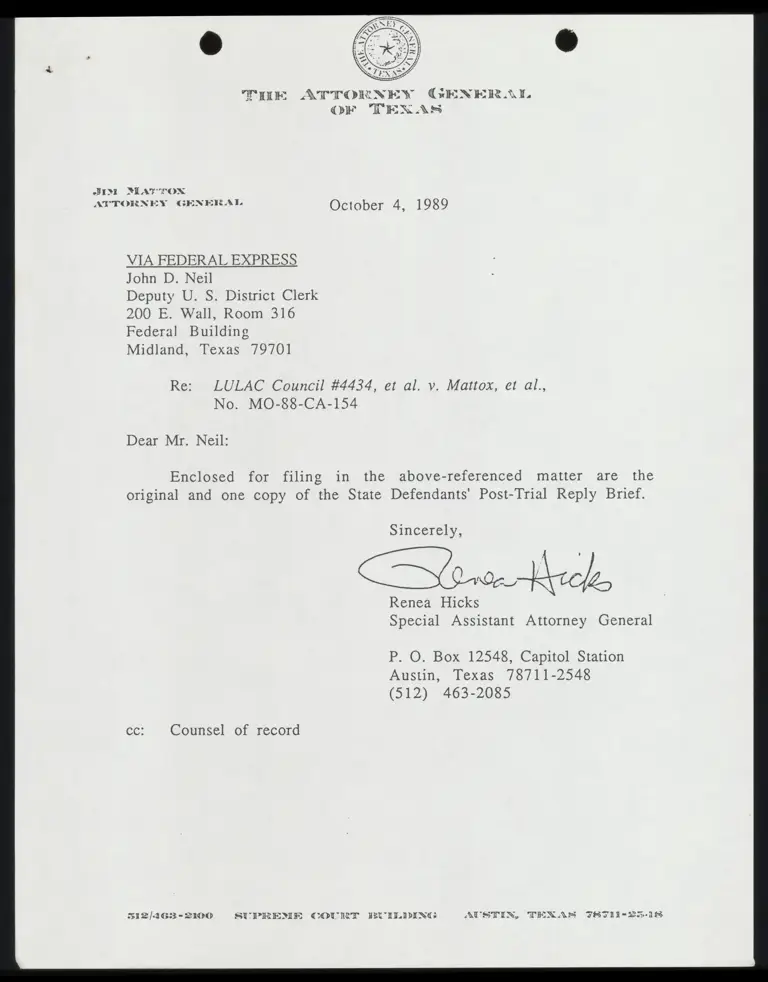
    THEE: ATTORNEY (CN EIR.WL.

Or TEXAS

JIM NIATTOX

ATTORNEY GENERAL October 4 1989
2

VIA FEDERAL EXPRESS

John D. Neil

Deputy U. S. District Clerk
200 E. Wall, Room 316

Federal Building
Midland, Texas 79701


Re: LULAC Council #4434, et al. v. Mattox, et al.,

No. MO-88-CA-154

Dear Mr. Neil:

Enclosed for filing in the above-referenced matter are the

original and one copy of the State Defendants’ Post-Trial Reply Brief.

Sincerely,

Cin rcs
Renea Hicks
Special Assistant Attorney General

P. O. Box 12548, Capitol Station

Austin, Texas 78711-2548

(512) 463-2085

CC: Counsel of record

512/463-2100 SUPREME COURT BUILDING AUSTIN, TEXAS 78711-2548


UNITED STATES DISTRICT COURT
WESTERN DISTRICT OF TEXAS
MIDLAND-ODESSA DIVISION

LULAC COUNCIL #4434, et al.,

Plaintiffs,

Civil Action No.

MO-88-CA-154

VS.

JIM MATTOX, et al.,

Defendants. LO
N

LO
R

LO
R

LO
R

CO
N

LO
R

O
P


STATE DEFENDANTS' POST-TRIAL REPLY BRIEF

The State Defendants! reply as follows to the post-trial briefs

of the plaintiffs, the Harris County plaintiff-intervenors, and the

Dallas County plaintiff-intervenors:

1.

PARTISAN BLOC VOTING


The three plaintiff briefs offer at best weak rejoinders to the

salience of partisan bloc voting in analyzing vote dilution cases under

Section 2 of the Voting Rights Act. The LULAC plaintiffs dismiss

Whitcomb v. Chavis in a footnote.2 The Dallas County plaintiff-

intervenors suggest that the point begs the question. The Harris


1 Paragraphs 12-14 on pp. 4-5 of the LULAC plaintiffs’ post-trial bricf
accurately lists the State Defendants except for John F. Onion, who has been
replaced by Michael J. McCormick as Presiding Judge of the Texas Court of
Criminal Appeals and a member of the Judicial Districts Board.

4 In footnote 26 on page 32 of their post-trial brief, the LULAC plaintiffs
mischaracterize Whitcomb's status under the law. As pointed out in the
extensive discussion in the State Defendants’ opening post-trial brief, Congress
clearly intended to revivify Whitcomb when it amended Section 2 in 1982. At
least five of the justices in Gingles still viewed it as good law, and Justice
Brennan's plurality opinion did not reject it.


County intervenors say that it would "immunize" partisan elections

from Section 2 attack. All are wrong.

Recognition of partisan bloc voting as the best description of

the voting patterns would not immunize partisan elections from

Section 2's reach. The State Defendants’ opening post-trial brief

carefully explained this point and delineated how inquiries into

partisan bloc voting and racial bloc voting can be meshed together to

lead to precisely the kind of inquiry Gingles requires -- that is, a

practical, realistic inquiry which takes a functional view of the local

political processes under challenge. On the other hand, not taking

partisanship into account (as the plaintiffs would have it) would

create an immunity of sorts. Given the realities of present-day

partisan voting patterns, ignoring it essentially immunizes plaintiffs

from defeat in vote dilution challenges to at-large partisan elections.

In 1982, Congress obviously did not intend to surreptitiously slip the

per se invalidation of such elections into Section 2 and guarantee

victory to plaintiffs.3 Gingles, in fact, holds that at-large elections are

presumptively valid. 106 S.Ct. at 2764.

That the applicable legal concepts in vote dilution cases are less

simplistic and more realistic than the plaintiffs would have it is

becoming increasingly clear as the courts grapple with Gingles’

meaning in a variety of electoral contexts. The Dallas County

plaintiff-intervenors reluctantly acknowledge the force of this

observation at page 17 of their brief when they refer to the more


3 The State Defendants’ opening post-trial brief inadvertently
characterized the President who signed the 1982 Voting Rights Act
amendments as a Democrat. Of course, he was a Republican.


refined inquiries conducted in recent Section 2 decisions out of the

Fifth Circuit. One such decision especially points toward the

importance of taking partisanship into account in these cases. In

Monroe v. City of Woodville, 881 F.2d 1327 (5th Cir. 1989), the Fifth

Circuit holds: "That a group's voting behavior is racially polarized

indicates that the group prefers candidates of a particular race." 881

F.2d at 1331. Here, the facts are that voters’ behavior is indifferent

to the candidates’ race; instead, their voting behavior demonstrates

that they prefer candidates of a particular party. Thus, in the

counties involved in this suit, the evidence shows that there is not

racially polarized voting, but partisan polarized voting. That this

pattern does not violate Section 2 is the new lesson of the Fifth

Circuit's Monroe decision and the old lesson of the Supreme Court's

Whitcomb v. Chavis decision.4

1.

NON-DISCRIMINATORY POLICY SUPPORTING COUNTYWIDE

ELECTIONS FOR DISTRICT JUDGESHIPS


Chief Justice Phillips testified about the policy underlying

countywide elections for district judges in Texas. Contrary to the

representation on page 16 of the Harris County plaintiff-intervenors’

post-trial brief, he did not testify that his only concern was the

system which might be substituted for it. Instead, he (along with Dr.

Champagne) explained that historically in Texas counties are the


4 That the lesson is the same, old or new, shows that Gingles rcally
changed nothing in terms of defining of racially polarized voting. Accord
Romero v. City of Pomona, ___ F.2d __, ___ (5th Cir. Aug. 24, 1989) ("[Gingles],

moreover, did not alter the statistical methods used to prove racially polarized
voting." :


basic unit of government. He also testified generally about what

might best be described as the inherent tension between the role of a

trial judge and their being subject to popular election. Nothing

prevents the state from doing what it can to relieve that tension

without eliminating either of the elements that might create it.

Countywide election of all the district judges sitting in a particular

county embodies a policy which performs that function. It can

hardly be deemed tenuous if the state's choice in the first place to

elect its trial judges is to be respected.

The LULAC plaintiffs’ response to such a policy appears to be

that the county unit is irrelevant to any state concern because

elected judges always are subject to the potential of undue influence.

Abstractly, such an argument cannot be refuted, but it also has no

meaning because it has no logical bounds. In fact, its logical

conclusion is that there is no threat to judicial integrity -- and

"integrity" is used in a broad sense -- no matter how small the unit is

that elects a judge. Only empirical, comparative research can resolve

the matter, and such research has not yet occurred in Texas because,

other than for a very brief period many years ago in two Texas

counties, smaller than countywide elections for district judges have

not occurred. The state is not required, however, to conduct such

empirical, comparative experiments before adopting a policy. The

basis offered suffices, if deference to legislative policy choices means

anything.

Facts adduced by the plaintiffs in this case further buttress the

policy of countywide elections. While Anglos as a group are

proportionately better off from a socioeconomic perspective than

oA


blacks or Hispanics as a group, the raw numbers tell a different

story. That story is that there is significant common ground in Texas

between blacks, Hispanics, and large numbers of Anglos. In Tarrant

County, for example, approximately 2,600 more white families than

black families were below the poverty level in 1979. See Exhibit Ta-

09, 4th page. In Ector and Midland Counties during the same period,

there were more white families in poverty than black or Hispanic

families. See Exhibits E-11 & M-13, 4th page. The further

fragmentation of these three groups through the creation of smaller

than countywide judicial elections would be likely to further reduce

the common ground they share.>_ There is certainly nothing tenuous

about a state policy that tends to increase the common bonds among

different groups of its citizens.

Chief Justice Phillips’ testimony also explained the non-

discriminatory policy basis for the 1985 ensconcement in the state

constitution of a preference -- and, as he carefully explained, it is

nothing more than a preference, because the local voters can change

it -- for countywide elections for state district judgeships. The 1985

state constitutional amendments to the judiciary article of the Texas

Constitution created an important new state institution with

significant power to affect the configuration of the trial bench across

Texas. Section 7a(i) of Article 5 was a limitation on the powers of


3 This observation about the common ground among blacks, Hispanics,
and whites of low socioeconomic status also is pertinent to Dr. Taebel's analysis.
It buttresses his point that there is no such thing as a white bloc. Instead,
there at least two white blocs in every county, one a Democratic bloc and onc a
Republican bloc. Common political science wisdom is that whites who arc
lower on the socioeconomic rung tend to vote Democratic.


that new state institution -- the Judicial Districts Board -- to change

longstanding local judicial arrangements. Senator Washington's later

expressions of vague disquietude hardly suffice to convert this

readily ascertainable policy into one of intentional, invidious

discrimination against racial minorities in Texas. Federal courts

should be "reluctant to attribute unconstitutional motives to the

state, particularly where a plausible [constitutional] purpose may be

discovered from the face of the statute." Mueller v. Allen, 463 U.S.

388, 394-95 (1983).

111.

MISCELLANEOUS MISDIRECTIONS


Before turning to replies appropriate to specific counties, other

aspects of the post-trial briefs require some response:

A. Hypothetical districts/hypothetical elections -- The plaintiffs


repeatedly employ the device of comparing the actual outcomes of

the analyzed elections with hypothesized outcomes of contests

between the same candidates in hypothesized minority-voter

dominated single-member districts. The problem with this approach

is its attenuated relation to political reality. Even people with only a

passing interest in American politics understand that changing the

rules for elections brings a wholly different set of dynamics to bear

on their outcome. The plaintiffs’ use of this concept of hypothetical

elections suggests that proportional representation is the standard

against which they ask the Court to measure the current Texas

system. That standard is an invalid one, as the Dole proviso to the

amended Section 2 establishes.


Dr. Engstrom's testimony regarding Harris County presents

another problem with the concept's use. According to page 3 of the

post-trial brief of the Harris County plaintiff-intervenors, Dr.

Engstrom testified that if the same election were held in the white

community and in the black community, the winner of the election

would be different. This is very similar to the hypothetical district

device. The problem is that, even assuming that the political

dynamics were otherwise the same, the question of whether the

election outcome would be different in the white and black

communities cannot be answered without specifying the particular

white community to which reference is being made. If the same

election were conducted in the white Democratic community, the

electoral outcome would be precisely the same in it as in the black

community in Harris County.

The types of comparisons criticized here are invalid either

because they are fundamentally misguided flights of fancy or

because they are too simple to take into account the political reality

that whites do not vote as a monolithic bloc.

B. Broad-brushed pictures of racial discrimination -- The LULAC


plaintiffs repeatedly invoke three sets of historical references to try

to buttress their case against the State Defendants. None of them

adds anything to their case, and all should be ignored. One device to

which they regularly retreat is the recitation of what the Department

of Justice has said in letters of objection under Section 5 of the

Voting Rights Act. The first problem with the use of these letters is

that they really are not the product of any adjudicatory factfinding

process at all. Second, most of them are so dated that, even if the

5


facts were true and relevant in the past, they mean nothing about

current practices. Third, and most critically, a careful reading of the

overwhelming bulk of those so-called § 5 letters reveal that they

prevented possible discriminatory action from occurring, instead of

describing discriminatory action that had occurred. Thus, the letters

rebuffed the very actions which the plaintiffs seek to invoke to help

their case. They typically show that incriminatory things did not

occur in a particular county, not that they did occur.

Another device repeatedly used by the plaintiffs is the citation

to federal court decisions finding violations of other federal

constitutional provisions or statutes protecting individuals from

racial discrimination in various aspects of governmental conduct.

Again, most of these decisions are too dated to mean anything in this

case. Many involve isolated conduct by individuals working for some

political subdivision somewhere in the county in question. The are

by and large wholly irrelevant to this case. Their principal use is as

a makeweight for the plaintiffs’ arguments.

Finally, the plaintiffs repeatedly cite the Graves v. Barnes

findings with regard to the counties at issue. These citations add

nothing other than an historical footnote to the analysis of this case.

Fifteen years have passed since those findings were announced. The

state has become a two-party state. The Democratic party, which

really was the principal focus of Graves v. Barnes, bears no

resemblance to the party depicted then. In fact, the LULAC plaintiffs

themselves make this point when they write in § 76 on page 33 of

their post-trial brief that "voters generally know that if they vote

Democratic, rather than Republican, they will be voting for a

2.


minority candidate or for a candidate who is sympathetic to concerns

of the minority community." This acknowledgment alone means that

the Graves v. Barnes findings are irrelevant here and should be

disregarded, except insofar as they contain certain historical

references.

The plaintiffs’ approach on these matters is exactly the one the

Fifth Circuit has warned against:

[T]he fluidity of the Section 2 analysis, as
glossed by Thornburg, may encourage
litigants to aggregate statistics or facts rather
indiscriminately in the hope that a district
court will simply count facts rather than
analyze them carefully.

Overton v. City of Austin, 871 F.2d 529, 533 (5th Cir. 1989).

C Majority vote requirement in primaries -- The depth with


which Dr. Brischetto studied the challenged election practices at issue

here was revealed when he testified incorrectly that a majority vote

requirement for electing state district judges in Texas enhanced the

system's discriminatory effect on minority voters. Of course, there is

no such requirement in the general elections, which require only a

plurality for victory. In their brief, the LULAC plaintiffs adopt a

fallback position which criticizes the discriminatory enhancement

that follows from a majority vote requirement for party nomination.

The problem with the plaintiffs’ discussion on this point is that it has

virtually nothing to do with what they are challenging in this case.

Their challenges, except for those in Travis and Jefferson Counties,

are in reality to the system of general elections, not of primaries.

The rather indiscriminate mixing of complaints about the primaries


and general elections runs afoul of yet another warning from the

Fifth Circuit which recently noted the criticism of "mixing data from

primary and general elections.” Monroe, supra, 881 F.2d at 1331.

D. Fixation with R%_ Coefficients -- Plaintiffs employ a three step


process in determining whether racially polarized voting exists in a

county. First, Dr. Brischetto runs regression analyses on selected

races. Second, Dr. Brischetto looks at the correlation between the

percentage of minorities in voting precincts and voting behavior.

Third, if the correlation coefficient (the R2) exceeds a certain value,

Dr. Brischetto concludes that racially polarized voting exists. While

writing for another circuit, Judge John Minor Wisdom, a long-time

member of the Fifth Circuit, has cautioned against such a simplistic

methodology for determining whether racially polarized voting exists

and encouraged the examination of factors "other than race that may

also correlate highly with election outcomes . . . [such as] party

identification." Lee County Branch of NAACP v. City of Opelika, 748

F.2d 1473, 1482 (11th Cir. 1984) ("Opelika"). Citing Judge

Higginbotham, Judge Wisdom explains why such a methodology

cannot fully explain the critical factual inquiry of racially polarized

voting.

The point is that there will almost always be a raw

correlation with race in any failing candidacy of a

minority whose racial or ethnic group is [a] small

percentage of the total voting population.

Opelika, 748 F.2d at 1482 n.15 (brackets added by the court). Thus,

a thorough analysis must include a determination whether the

seemingly racially polarized voting pattern is best explained by race


or whether it is best explained by party identification, for example.

Opelika, 748 F.2d at 1482. We have examined this matter; the

plaintiffs ignored it.


IV.

SPECIFIC COUNTY RESPONSES

A. Harris County -- The post-trial brief of the Harris County


plaintiff-intervenors incorrectly says at page 5 that Dr. Taebel, an

expert of the State Defendants, analyzed some "white-on-white"

clections in connection with Harris County. He conducted no such

analysis, as a review of Exhibit D-5 will show. At page 8 of the same

brief, the plaintiff-intervenors employ a transition which seems to

ascribe opinions to Dr. Taebel that are the opposite of those to which

he testified. Among other things, after noting that Dr. Taebel had

described swing voters in the closely partisan-balanced county as

largely white, the plaintiff-intervenors assert that the Republican

vote, the swing vote, and the white Democratic vote clearly do not

support black candidates running in district judge elections. In case

it is not clear, Dr. Taebel did not so testify. On the contrary, Dr.

Taebel testified that his analysis showed that the white Democratic

voters supported Democratic candidates, irrespective of race, and

that the swing voters showed no consistent pattern in the kind of

candidate that they supported. It was that testimony that led Dr.

Taebel to his conclusion that, after taking partisan bloc voting into

account, whites in the county -- including the swing voters and the

white Democratic voting bloc -- did not vote consistently as a bloc so

as usually to defeat the preferred candidate of minority voters in

district judge elections.

i, 55


B. Dallas County -- Although not strictly a reply point, the State

Defendants do note for the Court that the Eighth Circuit recently held

that unsuccessful minority candidates do not have standing to raise

Section 2 claims. Roberts v. Wamser, 883 F.2d 617 (8th Cir. 1989).

To the extent they bring their claim as defeated candidates, the

Dallas County plaintiff-intervenors lack standing in this action.

C Tarrant County -- The plaintiffs’ brief on this county really


requires no response.

D. Bexar County -- The plaintiffs’ characterization of Bexar County


as an area where Hispanic candidates do not get elected because

Anglo voters do not vote for Hispanic candidates is simply not

reflective of the actual outcomes of elections in the county.

Moreover, the plaintiffs’ assessment of politics in Bexar County does

not recognize the political reality that the Hispanic community wields

extensive political clout.

Anglo voters frequently vote for and elect Hispanic candidates.

Judge Anthony Ferro testified that the qualified Hispanic can win,

and frequently does win, in Bexar County.

We have five Hispanic district court judges here:

Machado, Chavarria, Mireles, Gonzales, and Chapa. Chapa

is now a court of appeals judge. We have five Hispanic
county court-at-law judges: Tony Jimenez, myself,

Anthony Ferro, Paul Canales, Miguel Rodriguez, and

Robert Lozano. We had Henry Cisneros who, of course,

won by 70 to 75 maybe 80 percent of the vote. We had

Raymundo Villarreal who ran and won county wide for

16 years as county surveyor. We have Rudy Garza, tax

assessor collector. We have David Garcia who wins

county wide as the district clerk; David Garcia defeated

an Anglo opponent in the general election. We had

Sheriff Joe Neaves. We had another man named Rudy

12.
der


Garza as Sheriff who defeated an Anglo. We had Albert
Bustamante as county judge who defeated two Anglo

opponents. We have Chapa and Cadena on the Fourth

Court of Appeals. Judge Cantu who was on the Fourth
Court of Appeals defeated himself when right before the
election he stated to the general public that he never

wanted to be a lawyer or a judge. Fred Rodriguez who is
the district attorney defeated the incumbent Sam
Millsap in 1986. We have a lot of Hispanics who get
elected in the community college district races, which
are almost county wide.

Hispanic candidates that campaign county-wide and do not

limit themselves to targeting the Hispanic community win in Bexar

County. They win both as Democrats and as Republicans. Judge Paul

Canales beat Michael Patterson (an Anglo Republican) in the General

Election. Judge Canales not only won in the Hispanic West and South

Sides, he also won many of the Anglo boxes in the near north side

(inside Loop 410). Judge Canales also ran well (as well as Anglo

Democrats) in the Republican Anglo boxes outside of Loop 410. Roy

Barrera Jr. running as a Republican Hispanic defeated, by a large

margin, Mr. Stolhandski (an Anglo Democrat) in the 1982 general

election. Mr. Barrera had a broad base campaign. He did not target

any area of town. He campaigned over the whole county. In fact,

Judge Anthony Ferro testified that he did not think that Barrera lost

a single Anglo North side box.

In general the Hispanic candidates that lose (like Adam

Serrata) in Bexar County, lose because they target the Hispanic

community to the exclusion of the Anglo Community. Judge Anthony

Ferro calls this failed campaign strategy a 1960's campaign; Judge

Ferro concludes that the Hispanics that lose:

13.


[h]ave been giving up the north side and northeast side,

and campaigning strongly in the south side and the west
side figuring that they can win with that vote alone.
They figure that since there are more Mexicans than
Anglos they can win the election simply by campaigning

in that area. They do not take into consideration that not
all of them come out and vote. And if they do come out

and vote that they do not get down to the bottom of the
ballot where the judges are. If 1,000 people vote for the
governor in a west side precinct, 400 will vote for the

county officials, especially the judges.

The current political reality of the eighties (not the sixties) in

Bexar County that the Plaintiffs ignore, and the Judge Ferro

acknowledges, is that "it is coming to the point to where I do not

know whether an Anglo is going to be able to win a county wide race

because of the demographics.”

Plaintiffs focus on the 1988 Republican Primary race where

Robert Arellano lost to Stephen White to show that Hispanics lose

because of their race. Judge Paul Canales testified that he had

spoken with Arellano and that Arellano believes he lost because he

did not work hard enough, he took things for granted, and because of

the name identification problem with former DA Bill White and

former Governor Mark White. Judge Ferro believes that Mr. Arellano

lost because he campaigned almost exclusively in the Hispanic

community: "That is a very bad tactic in this county to campaign in

just a certain area of town, because that is all you are going to get."

The political reality in Bexar County is that Hispanics who

campaign county-wide and who seek the votes of all voters win.

They win at all levels of government. Henry Cisneros, San Antonio's

former Mayor, frequently received 70 to 80 percent of the vote.

Rudy Garza, county tax assessor and collector, beat an Anglo

14.


opponent by campaigning throughout the county -- indeed, he was

the highest vote getter in the county for that election.

Another political reality in Bexar County is that elected

Hispanics who are perceived to do well in office do not draw

opposition. Judge Ferro has won reelection for county court at law

twice, both times unopposed. According to Judge Ferro, in Bexar

County "if the lawyers perceive you to be a good judge, and fair, you

are not going to get opposition." Judge Canales testified that the

Mexican American judges in Bexar county run unopposed because

people perceive them as strong and people do not want to risk losing

to them. Lack of opposition is not a weakness, as the plaintiffs

suggest, but a sign of the political strength of the Hispanic

community -- a community that now dominates politics in Bexar

County.

E Travis County -- The third sentence of {| 236 on page 89 of the


LULAC plaintiffs’ post-trial brief is inaccurate. On cross-examination,

Mr. Coronado acknowledged an awareness that, in addition to the

1988 Democratic primary race between Gallardo and McCown, there

had been other contested races for the Democratic party nomination

to run for district judge in this decade in the county. He recalled the

race between Brock Jones and Joe Hart (who now is an incumbent)

and found no reason to quarrel with the assertion that there also had

been a Democratic party contest between Jon Wisser and Joe Dibrell

(both of whom now are district judges in Travis County). As several

other State Defendants’ exhibits show, there have been numerous

contested Democratic primary races in Travis County over the years,

with Hispanic candidates showing a consistent ability to garner large

x5.


Anglo support and, even more importantly, achieve victory in

electoral jurisdictions dominated by Anglo voters.

The plaintiffs analysis falls far short of the kind of searching

local inquiry required by Gingles. In fact, it falls even further short

than one might gather from a first glance at what they did. In § 42

on page 18 of their brief, the plaintiffs explain that they only

reviewed elections where a minority candidate opposed an Anglo,

but in Travis County they violated their own injunction by analyzing

the three-way county-court-at-law race among an Hispanic (Castro),

a black (Kennedy), and an Anglo (Hughes).® Throwing out that

election, as the plaintiffs argue is really the only appropriate way to

do, leaves them with having analyzed only two judicial races, both in

1988. By their own terms, this level of analysis is insufficient to

permit conclusions to be drawn about whether vote dilution occurs in

the Democratic primary in Travis County. Mr. Richards’ testimony,

exactly the kind of intensely local inquiry called for by Gingles, on

the other hand show a consistent pattern of Anglo support for

Hispanic candidates and a consistent pattern of victory for the

preferred candidates of Hispanic voters.

There are other obvious flaws in the plaintiffs’ analysis. Their

Exhibit Tr-O1 shows a total voting age population for the county of

312,392, yet State Defendants’ Exhibit D-15 shows that in 1988

registered voters alone in the county equalled 319,059, more than


6 Kennedy, the black candidate in this countywide judicial race in the
1988 Democratic primary, received 52% of the Anglo vote. See Exhibit D-8, p.
44a. Castro, the Hispanic candidate, received approximately equal levels of
black and Anglo support. See Exhibit D-§, p. 41. Together, the two minority
candidates received 70% of the Anglo vote.


than the plaintiffs’ total for people even old enough to vote. The

reliance in their brief on relatively ancient Graves v. Barnes

statements about concentrations of Hispanic residents has been

superseded by the passage of time. For example, Judge Nowlin noted

the dispersal of Hispanic residents in Austin on page 36 of his 1985

opinion in Overton v. City of Austin. See Exhibit D-40 ("Majority

Hispanic census tracts account for only 30 percent of Austin's

Hispanic population; thus, 70 percent of Hispanics live elsewhere in

Austin.")7

The plaintiffs’ post-trial brief makes it clear, if it was not

before, that their case comes down to one race, the Gallardo/McCown

race. The Overton decisions at the trial and appellate levels, David

Richards’ testimony, and the very way in which Gallardo conducted

his campaign (stressing to all segments of the Travis County voting

population that he was the only minority candidate) conclusively

demonstrate that the outcome of that race was, in some sense, an

aberration in Travis County politics. To permit it to be the sword

that strikes down a well-functioning system that is solicitous of

minority voters’ concerns would be to let the exceptional electoral

contest be treated as a typical Travis County electoral contest.

Section 2 neither requires nor permits such an approach to the facts.

F. Jefferson County -- The plaintiffs rely heavily on the testimony

of Mr. Davis to support their argument that black candidates cannot

run at large for judgeships and win in the county. Mr. Davis's


7 This circumstance explains why the plaintiffs were unable to draw a
district mecting the first Gingles factor of geographical compactness.

17


testimony offers nothing other than conclusory, self-serving

statements on this point. Other details of his testimony, however,

refute his conclusory allegations. First, he twice ran for a judgeship

himself, obviously operating under some hope that a black judicial

candidate could run and win countywide. In fact, in one of his two

races, a black judicial candidate did run and win countywide. It just

happened not to be Mr. Davis. That same candidate, Judge Floyd,

since has run again, this time unopposed, and still sits as a county

court at law judge in the county. Second, Mr. Davis testified that

three black lawyers had sought gubernatorial appointments to

district judgeships when they came open in the county. Such

appointments are only interim, and the appointees would of

necessity have had to run countywide to hold their judgeships.

Obviously, those black office-seekers were of the view that a black

judicial candidate could run and win countywide in Jefferson County.

Otherwise, obtaining the sought-after appointments would have been

a fairly hollow success for them.

The plaintiffs analyzed only two judicial races in the county in

this decade, both for justice of the peace. In the more recent of the

two races, the plaintiffs’ own expert found no racially polarized

voting. And in that race, the candidate supported by Mr. Davis was

the white opponent of the black candidate.

Only by surmise can a vote dilution case be discerned in

Jefferson County. The plaintiffs have offered no evidence sufficient

to find that whites votes sufficiently as a bloc in the Democratic

primary in the county to usually deny victory to the preferred

candidate of minority voters. The evidence, in fact, points the other

18.


direction -- that is, that the preferred candidate of black voters (e.g.,

Representative Price) can and does win. There is no support in the

law for the plaintiffs’ effort to avoid this result by painting

Representative Price as a candidate of special circumstance merely

because of his employment record. There is no evidence that this

circumstance had any special effect on Jefferson County voters.

G Lubbock County -- In their post-trial brief, the State


Defendants explained how the plaintiffs have failed to prove political

cohesion between black and Hispanic voters in the county. In § 294

on page 109 of their brief, the plaintiffs show the limited perspective

from which they view the issue of political cohesiveness. They rely

nearly exclusively on the regression analysis that, as Monroe, supra,

now makes clear, is addressed to racially polarized voting patterns,

not political cohesiveness. See also Romero v. City of Pomona, ___

F.2d ___ (9th Cir. Aug. 24, 1989). The testimony of Mr. Shelton and

Ms. Mercado provide the sources for a more localized inquiry which

shows that blacks and Hispanics in Lubbock County cannot be

considered politically cohesive to an extent which will permit them

to be aggregated for purposes of meeting the first Gingles factor.

The plaintiffs’ post-trial brief in § 310 on page 114 relies on

Ms. Mercado's deposition testimony to support an argument that

minorities have not run countywide for judicial positions in Lubbock

County because they are convinced they could not win. As with Mr.

Davis's testimony concerning Jefferson County, the details of Ms.

Mercado's testimony refutes her broad, conclusory generalizations.

She names at least three Hispanic lawyers in the county who have

sought the position through the appointive process. One may only

-19-


ask rhetorically why they would undertake such an effort if they

truly were convinced that they could not run and win in the

countywide race which would follow close on the heels of their

sought-after appointment.

H Ector and Midland Counties -- In Exhibits E-12 and M-14, the


plaintiffs purport to show the exceedingly low rate of registration of

Hispanic voters in Ector and Midland Counties. When combined with

other items of evidence, this low registration level shows that the

plaintiffs have failed to meet the first Gingles factor in these two

counties -- even if, as the State Defendants dispute in their opening

post-trial brief, blacks and Hispanics are politically cohesive enough

to be formed into a single district. The other items of evidence are

Exhibits E-13 and M-15. These are the plaintiffs’ efforts to factor out

of their "Gingles I" calculations those Hispanics who are not eligible

voters because they are not United States citizens. Those exhibits

lower the margin of safety in terms of creating a "safe" minority

district to a level closer to fifty percent of the voting age population.

When considered with this factor, the low registration rates of

Hispanic voters effectively turn the posited Gingles [ district into

something less than a "safe" minority district. The plaintiffs

therefore failed to meet their burden on one of the three threshold

Gingles issues.


8 Cases such as the Ninth Circuit's City of Pomona decision, when
combined with Brewer v. Ham, 876 F.2d 449 (5th Cir. 1989), require the Court to
begin its inquiry into the first Gingles factor by looking at the number of

eligible minority voters, which excludes non-citizens.

20 -


CONCLUSION


Incantation of the phrase "racially polarized voting" is

insufficient for the plaintiffs in this case. It ignores too many of the

political realities in the counties involved in this lawsuit, chief among

them being the overwhelming domination of the outcome of state

district judge races by partisan bloc voting patterns. The plaintiffs’

claims should be rejected, and judgment entered for the State

Defendants.

Respectfully submitted,

JIM MATTOX
Attorney General of Texas

MARY F. KELLER
First Assistant Attorney General

=) “Heal
2 WE Vn Tot


RENEA HICKS
Special Assistant Attorney General

JAMES C. TODD

Division Chief, General Litigation

JAVIER P. GUAJARDO
Assistant Attorney General

P. O. Box 12548, Capitol Station

Austin, Texas 78711-2548

(512) 463-2085

ATTORNEYS FOR STATE DEFENDANTS

CERTIFICATE OF SERVICE

I certify that on this 5th day of October, 1989, I sent a copy of

the foregoing document by first class United States mail, postage

oie § I


prepaid, to each of the following: William L. Garrett, Garrett,
Thompson & Chang, 8300 Douglas, Suite 800, Dallas, Texas 75225;
Rolando Rios, Southwest Voter Registration & Education Project, 201
N. St. Mary's, Suite 521, San Antonio, Texas 78205; Sherrilyn A. Ifill,

NAACP Legal Defense and Educational Fund, Inc., 99 Hudson Street,

16th Floor, New York, New York 10013; Gabrielle K. McDonald, 301

Congress Avenue, Suite 2050, Austin, Texas 78701; Edward B.
Cloutman, III, Mullinax, Wells, Baab & Cloutman, P.C., 3301 Elm

Street, Dallas, Texas 75226-1637; J. Eugene Clements, Porter &

Clements, 700 Louisiana, Suite 3500, Houston, Texas 77002-2730;

and Robert H. Mow, Jr., Hughes & Luce, 2800 Momentum Place, 1717

Main Street, Dallas, Texas 75201.

Cre Het.

Renea Hicks