Supplemental Brief of Defendants-Appellants
Public Court Documents
November 24, 1976
24 pages
-
Case Files, Norwood v. Harrison - Hardbacks. Supplemental Brief of Defendants-Appellants, 1976. 46fc3570-722e-f111-88b4-000d3a199651. LDF Archives, Thurgood Marshall Institute. https://ldfrecollection.org/archives/archives-search/archives-item/34c030bf-e356-4298-8ebd-5252dd7367af/supplemental-brief-of-defendants-appellants. Accessed October 16, 2026.
Copied!
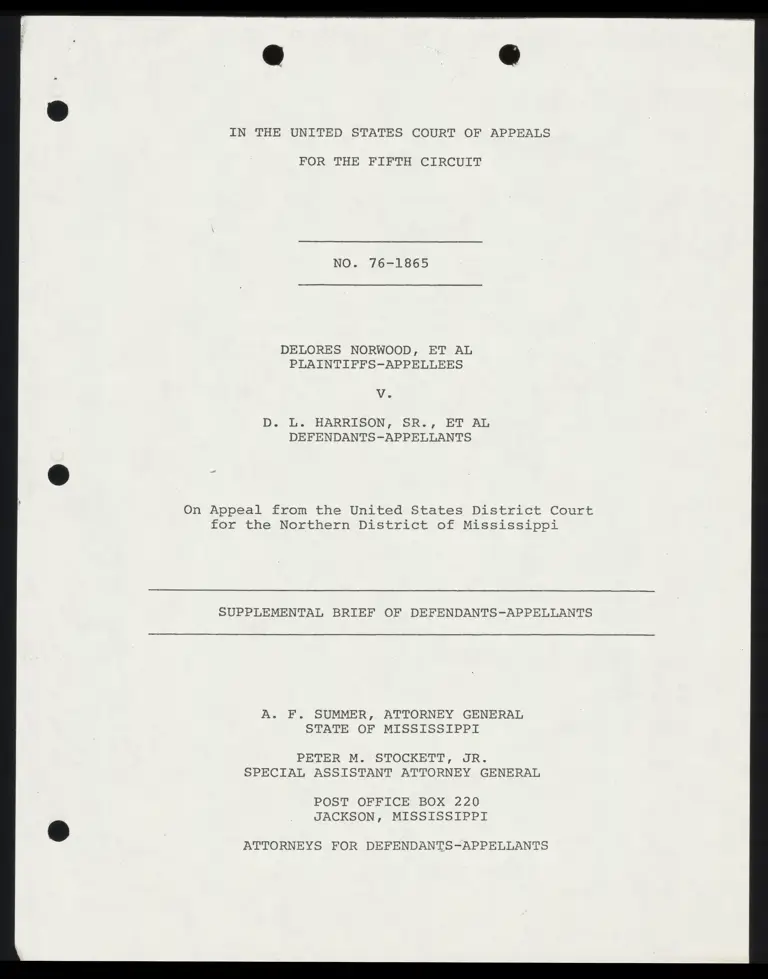
     [||105a19e6-d466-41e4-8e58-5bddf0ebd351||] IN THE UNITED STATES COURT OF APPEALS

FOR THE PFPIPTH CIRCUIT


NO. 76-1865


DELORES NORWOOD, ET AL
PLAINTIFFS-APPELLEES

Vv.

D. L. HARRISON, SR., ET AL

DEFENDANTS-APPELLANTS

On Appeal from the United States District Court
for the Northern District of Mississippi


SUPPLEMENTAL BRIEF OF DEFENDANTS-APPELLANTS


A. FF. SUMMER, ATTORNEY GENERAL

STATE OF MISSISSIPPI

PETER M. STOCKETT, JR.
SPECIAL ASSISTANT ATTORNEY GENERAL

POST OFFICE BOX 220
JACKSON, MISSISSIPPI

ATTORNEYS FOR DEFENDANTS~APPELLANTS


I NDE X


SUMMARY OF ARGUMENT ©, 0. . i. Jat Cap dag. 3 - 4

ARGUMENT TY vom Deli el 5 ="

ARGUMENT IX: 5 i ie ar anal Eh LE 8.7185

ARGUMENT TIT ©, waa LT 16 -

CONCLUSION «fe al wiry iniiy saw nv Ja io difiel in” win rem

CERPIRPICATE. tv viv vs nile i¥ eGo wis ihe lie ini es nie

od

Loe


- Arkansas v.

38is.Ct.

Belknap v.
40 L.Ed.

Tennessee,

301,

Schild,
599.

Bry-Man's Ine. v.

Christian v.

62 L.Ed.

Stute

TABLE OF CASES


246 U.S.
638».

161. U.S. 11,
° LJ ° » Ld

(1963),

Atlantic and North
Railroad Company,

158, 175,

16 S.Ct.

312 F.24 585

Carolina

133 U.8...233, 10 S.Ct. 260,

° Ld

1951)
*

33 L.74. 589 .. . . . iis

City of Kenosha v. Bruno, 412 U.8. 507,
93 S.Ct... 2222, 37 1,.E4 24 109 Te

Clark v. Washington, 366 F.24 678
{9th Cir. 1966) vbw mie ae bie

Durfee v. Duke, 375 U.S. 106, 115,
84 S.Ct... 242, 11 L.Ed. 247186 .. .

FPitapatyick v. Bitsmer, U.S.
96 S.Ct. 2666, 49 1L..Fd.: 24 1976

Bale vv ie ve ne Be we es .

Bevitt vw, City of Jacksonville, (5th Cir.
188 F.24.423 . Cala ele ie

Jagnandan v. Giles, No. 74-3467 «7s

King v. Finch, (1970) 428 F.2d 709 . .

Monroe v. Pape, 365 U.S5.:167, 81 '8.Ct. 473,

5 L.B0.20, 292 oi. teat Me an LT,

Olson v. California Adult Authority,
(+h Cir. 1970), 423 F.28 1326 y

Ld

PAGE


11

10


- PAGE


Provident Bank and Trust Company v. Patterson
390 U.8+.+102, 83 S.Cte 733,19 L.Ed. 284° 936 . .... 8

Schutten v. Shell 011 Company,
421 P.24. 869 (5th Cir. 1970) wv oii vin wien 9, 13

Shields v. Barrow, l1l7 How. 130,
OE Td FRY TREE Bs WYER i Se Se PE RA A aE LN Ri i TENET SH 8

United States v. Nixon, 418 U.S. 683,
94 S.Ct. 3000, 41 L.EQ. 24 1039 "iui oa ode ite ia 33

United ‘States v. Romana): :382 U.S. 136,
86 S.Ct. 279, 15 L.BA.: 24 210 0 . ota Gan 14

Western Union Telegraph Company v.
» Pennsylvania, 368 U.S. 71, 75, 82:8.Ct. 199,

J: L.Ed. 24 139 40 oii ein . luted ’ “oie 8

OTHER AUTHORITIES

Civili Right Act of 1964, 42 U.S.C.
2000la) 0... oi ee eae eee eee le ae el he 6

Civil Rights Attorneys' Fees Award Act of
2976 «ie see ee wie «eatin «Liam a ee 1::3;°5,

8,:9,:13

Rule 19 of the Federal Rules of Civil

PrOCOOUYE vio viihiie: vin vile Sie Sh WEL SRE 9

ii.


IN THE UNITED STATES COURT OF APPEALS

FOR THE FIFTH CIRCUIT


NO. 76-1865


DELORES NORWOOD, ET AL
PLAINTIFFS-APPELLEES

VY.

D. L. HARRISON, SR., ET AL

DEFENDANTS-APPELLANTS

On Appeal from the United States District Court
for the Northern District of Mississippi


SUPPLEMENTAL BRIEF OF DEFENDANTS~-APPELLANTS


This supplemental brief will be addressed to two issues

which have supervened since the filing of our main Brief and

our Brief in Opposition to Motion for Summary Affirmance.

One of these issues is legal; the enactment of the Civil

Rights Attorneys' Fees Award Act of 1976. The other issue


to be discussed in this brief is factual in nature; the

admission into the record on this appeal of the deposition

of M. A. Snowden, with its attached exhibit.

E
R

A
T
E


T
A


A
A


a
E
y


e
C


T
O


”
TA

TE


TA
LTE

 4


MAR


po
re


ep
ne


a
iA

E4
i
I

H

f

i
ES

i

k

i

SUMMARY OF ARGUMENT


As to the effect on this case of the enactment

of the Civil Rights Attorneys' Fees Awards Act of 1976,

sometimes hereinafter referred to as "the Act", appellants

contend that: (1) The Act did not amend the definition

of "person" under 42 U.S5.C. 1983 to include States or

State agencies; nor did said Act itself make such entities

suable. Therefore, under the holding of the Supreme

Court in Fitzpatrick. v, Bitzer, uw ~~ U.85. 98 8.CL.

2666, 49 L.Ed.2d (1976), as interpreted by this

Court in Jagnandarn v. Giles, No. 74-3467, decided September

20, 1976, the attorneys' fees and costs involved in the

case sub juduce can not be recovered from funds of the

State of Mississippi; and (2) appellants maintain their

position as expressed in their brief (Pages 34-37) that

the State of Mississippi is an absent indispensable party

to this litigation. Appellants would further state that

if the Civil Rights Attorneys' Fees Award Act of 1976 is to

be construed to legislatively determine that the State of

Mississippi is not an indispensable party to this litiga-

tion, then said Act is unconstitutional on the grounds

of being an invasion of the judicial power of Courts of


the United States.

As to the deposition of M. A. Snowden, appellants

submit that a reading of that deposition to which an

exhibit is attached which appellees say demonstrates that

appellants were "active participants in the transfer of

textbooks to private academies" (Motion for Summary

Affirmance and Brief for Plaintiffs-Appellees, page 6),

defendants submit that a reading of that deposition

clearly reveals that all that was done by Mr. Snowden,

then Executive-Secretary of the Textbook Board, was to

implement the long standing practice under then valid

State law-of allowing the "textbooks to follow the

student”.

CT EW IR SAT PINT


g
e
s


m
r


A


T
A
P


33

0


G
T
P


A
A


RR
 R
R

R
A
T
E
R


¢
%
#
i

:
: :


ARGUMENT


I.

THE CIVIL RIGHTS ATTORNEYS
FEES AWARD ACT OF 1976 DID

NOT AMEND THE DEFINITION OF

"PERSON"

In their brief in Opposition to Motion for Summary

Affirmance previously filed in this cause, appellants

expounded at length (Pages 3-9) as to the conditions and

circumstances under which Congress might permit a monetary

award from the funds of an unconsenting State, as expli-

cated by the decisions of the Supreme Court of the United

States in Fitzpatrick v. Sehier, U.S, 06 BCE,

2666, __ L.Ed.2d___ , and of this Court in the case of

Jagnandan v. Giles, decided September 20, 1976. In order

to avoid repetitious argument, reference is hereby made

to that portion of our brief, and appellants request the

Court to take the arguments there made ino: consideration

in deciding this issue.

The question arises, does the enactment of the

Civil Rights Attorneys' Fees Award Act of 1976 make the

State of Mississippi liable to a monetary judgment in the

case sub juduce? We believe that the answer is clearly


in the negative. The Act, provides in pertinent part:

"In any action or proceeding to enforce
a provision of sections 1977, 1978, 1979,
1980, and 1981 of the Revised Statutes,
or Title VI of the Civil Rights Act of
1964, the Court, in its discretion, may
allow the prevailing party, other than
the United States, a reasonable attorneys’
fee as part of the costs".

The Act does not specifically include States

pursuant to Fitzpatrick v. Bitzer, supra, and therefore,

does not act to permit fees in this case. In Bitzer

the award of fees was made pursuant to an express statu-

tory provision, 42 U.S.C. 2000e-5(k), part of the statute

| that originally permitted the lawsuit. That section pro-

vides as follows:

"In any action or proceeding under this
subchapter the court, in its discretion,
may allow the prevailing party, other
than the Commission or the United States,
a reasonable attorneys' fee as part of the.
costs, and the Commission and United States
shall be liable for costs the same as a
private person".

That statute however, must be read in conjunction with

another section of Title VII of the Civil Rights Act of

1964, 42 U.S.C. 2000e(a) which provides that the definition

of "person" includes "governments, governmental agencies

[and] political subdivision."

Of critical importance here is the fact that the

Act does not amend the definition of "person" found in


42 U.S.C. 1983 to cover States. It is well settled that

States or State agencies are not "persons" under §1983,

Monroe v.. Pape, 355 U.S. 167, 81 8.Ct, 473, 5 1L.E4.28 492,

City of Sneath v. Bruno, 412 U.S. 507, 93 S.Ct. 2222,

37 L.Ed.2d 109; Clark v. Washington, 366 F.2d 678, (9th

Civ.y 1966); Olson v. California Adult Authority, (9th

Cir., 1970), 423 F.2d 1326, and therefore, are not subject

to suit and an award of attorney fees pursuant to that

statute. Thus, an attempt to pass a general amendatory

statute to cover states in contravention of a Constitutional

righty. must fail,

2 zt 73 N13 #f


It.

THE STATE OF MISSISSIPPI 1S
AN ABSENT INDISPENSABLE PARTY
TO THIS LITIGATION NOTWITH-
STANDING THE ENACTMENT OF THE
CIVIL RIGHTS ATTORNEYS' FEES

AWARD ACT OF 1976

Appellants have previously taken the position

that the State of Mississippi is an absent indispensable

party to this litigation. See Brief for Defendants-

Appellants, pages 34-37 and Brief of Defendants—-Appel-

lants in Opposition to Motion for Summary Affirmance,

pages 13-14. We maintain this position in light of the

enactment _of the Act.

made in our previous briefs.

We will not reiterate the arguments

previously cited by appellants in this connection are:

Durfee v. Duke, 375 U.S. 106, 115;
84 8.Ct. 242, 11L.EAd.24 186

Arkansas v. Tennessee, 246 U.S. 158,
76, 38 8.Ct 301, 62 L.P4A. 638

Western Union Telegraph Company v.
Pennsylvania, 368 B.S. 71, 75,
82. 83.Ct. 199, 7 L.B8.24 139.

Provident Bank and Trust Company v.
Patterson, 390 U.S5.:102, 88 S.
Ct. 733,

Shields v.

L.EA. 153

19 ..E4.28 936

Barrow, 17 Bow.130, 15


The cases and other authorities


T
Y
R


EB EB ET Te TY

Schutten v. Shell 011 Company,
421 ¥.28 869 (5th Cir. 1970)

Olson v. California Adult Authority
{9 Cir, 1970) 423 P.24 1326

Hewitt v. City of Jacksonville
{5 Cir. 1951) 188 7,24 423

Rule 19 of the Federal Rules of
Civil Procedure

The answer of appellees to this argument appears

to be two-fold: (1) None of the above cases cited by

“appellants involved cases in which the relevant State

or any of its agencies were parties defendant; thus,

1 to the case sub Jjuduce; and (2) they are inapplicable

The legislative history of the Act, as shown by language

in the report from the Senate Judiciary Committee indicates

congressional intent to vest Federal Court jurisdiction

to award judgments for attorneys' fees against a State or

local government, whether or not the agency or government

is a named party. Appellees take the position that Congress

has legislatively decided that the State of Mississippi is

not an indispensable party in this case. In the alternative

appellees contend that the District Court has definitely

1/ Motion for Summary Affirmance and Brief for Plaintiffs-
Appellees, page 8.


disposed of this issue in the concluding paragraph of

its Gates opinion, which was incorporated into its

decision in the instant case.?

Appellants would respond to the two-fold

argument of appellees as follows:

Further research relating to the decisions of

the Courts as to the indispensability of an unconsenting

State as a party to a suit seeking to recover State

monies demonstrates that states are, indeed, indispensable

parties to such suits even when State officers or agencies

are named defendants to the action. For example, see

the decision of the Supreme Court of the United States in
re

Christian v. Atlantic and North Carolina Railroad Company, /6

133 v.98. 233, 10 8.Ce. 260, 33 1.24. 539, in which the

Treasurer of the State of North Carolina was named as a

defendant. The ' relevant Yancanse of the Supreme Court

: \
stades: \

S . QA "How the dividends due to the State
v/s can be seized and appropriated to the
py? payment of the bonds, or how the stock

held and owned by the State can be
sold and transferred through the medium

2/ Letter from Melvyn R. Leventhal, Esquire, Counsel for
appellees to Honorable Edward W. Wadsworth, Clerk
Of this Court, dated October 6, 1976, pags 2.


of a suit in equity, without making
the State a party to the suit, it is
difficult to comprehend. The general
rule certainly is, that all persons
whose interests are directly to be
affected by a suit in chancery must
be made parties.

* %*%

The State has a direct interest to be
affected by such a proceeding. The
proposal is to take the property of the
State and apply it to the payment of
its debts due to the plaintiffs, and
to do it through the instrumentality
Of a court of equity.

* x %

There is a class of cases, undoubtedly,
in which the interests of the State
may be indirectly affected by a judicial
proceeding without making it a party.

*k*k

Such cases do not affect the present,
in which the object is to take and
appropriate the State's property for
the purpose of satisfying its obliga-
tions." |

(33 L.Ed 592-593)

40 L.Ed. 599, the Supreme Court stated the rule; thusly:

"In a suit to which the state is neither
formally nor really a party, its officers
although acting by its order and for its
benefit, may be restrained by injunction,
when the remedy at law is inadequate, from
doing positive acts for which they are

And, in Belknap v. Schild, 161 U.S. 11, 16 S.Ct. 44s,

18906


personally and individually liable, b
taking or injuring the plaintiff's
Property, contrary to a plain official
duty requiring no exercise of dis-


cretion and in violation of the |
Constitution or laws of the United |
States.

¥ | | | * % % 3

But no injunction can be issued a-
i ainst officers of a state, to re- i

strain or control the use of property |
already in the. possession of.the

| state, or money in its treasury-when
the suit—is_ commenced; or to compel
the state to perform its obligations; |
or where the state has otherwise such |
an interest in the object of the suit

i as to be a necessary party."

J (40 L.Ed. 602)

® The State of Mississippi is an indispensable party : ] |

| to this suit which seeks to obtain a money judgment !

; against State funds. 4

: As the holdings of the Supreme Court and this Court 2

i make clear, the determination of whether a party to a sult

i is indispensable is strictly a function of the Courts, and

: any effort by the Legislative or Executive branches of ;
i | :

the government to intrude in the making of this determination ;

i must be rejected as a violation of the principle of separation

; of powers. This Court has exercised its' judicial power on

i numerous occasions to determine whether a person or an i

i entity is a necessary or indispensable party to the main-
i

/

i
f


EERE % J TRIN I RRS FO OT
a De 5 CS OE RECT TS ENT Rv et i i i a EE i a Sa ait oe ot CBRE ERE


tenance of a suit. See Schutten v. Shell 0il Company,

supra; Bry-Man's Inc. v. Stute, (1963), 312 F.2d 585;

and King v. Finch, (1970) 428 F.2d 709. In King v.

Finch, supra, this Court made the following statement:

"We must reject the argument that
a law that does not affect the com-
position, nature, jurisdiction or
even procedure of the courts, but
only affects the substantive rights
of a litigant, violates the separa-
tion of powers under the facts of
this case."

{428 F.24 713)

The correlative to this principle is that any law

that does affect the "composition, nature, jurisdiction,

or even procedure of the Courts" would violate the prin-

ciple of separation of powers. If the language contained

in the Report of the Senate Judiciary Committee is to be

engrafted upon provisions of the Act so as to mandate a

Congressional determination that the State of Mississippi

is not an indispensable party to the case sub Jjuduce,

then the Act would run afoul of the strictures of the

Supreme Court of the United States and of this Court above

cited.

The Supreme Court of the United States, in its'

decision in United States v. Nixon, 418 U.s. 683, 94.8.0.

3090, 41 L.Ed.2d 1039, has recently reminded us that:


"Notwithstanding the. deference each
branch must accord the others, the
'judicial power of the United States’
vested in the federal courts by Art
III, §1, of the Constitution can no

"more be shared with the Executive
Branch than the Chief Executive, for
example, can share with the Judiciary
the veto power, or the Congress share
with the Judiciary the power to over-
ride a Presidential veto. Any other
conclusion would be contrary to the
basic concept of separation of powers
and the checks and balances that flow
from the scheme of a tripartite govern-
ment." :

(41 L.Ed.2d 1062)

By the same token, the judicial power of the United

States cannot be shared with the Legislative branch, as

su the Suprefie Court has held in United States v. Romana,

382 U.S, 135, 86 .8.Ct. 279, 15 L.Bd.24 210, and numerous

other cases. |

As to the alternative position of appellees that the

District Court in the case sub juduce has definitively

disposed of the issue of the Lndlspansatiiliey of the State

of Mississippi in the concluding paragraph of its' Gates

opinion, which was incorporated into its decision in the

instant case, (A., pages 105-106), a reading of the language

used by the District Court shows that it made no mention

as to whether or not the State of Mississippi was an in-

dispensable party to the suit, but dealt chiefly with


stating equitable considerations and other reasons why,

as between assessing the award of attorneys' fees and costs

against the defendants in their individual, personal

capacities or against monies of the State, the State

should have to bear the financial burden. If the decision

of the District Court can be read so as to hold that the

State of Mississippi is not an indispensable party to

this action, then appellants submit that said decision

is clearly erroneous.

F
e


A
T


A

r
e

F
e


w
r


F
E
S


F
o


N
S


ah


\

z
[3

i
[>

i z
|:


ARGUMENT III

THE DEPOSITION OF M. A. SNOWDEN

AND ITS' ATTACHED EXHIBIT DOES

NOT SUPPORT THE CONCLUSION THAT

APPELLANTS WERE ACTIVE PARTICI-

PANTS IN THE TRANSFER OF TEXT-

BOOKS TO PRIVATE ACADEMIES

Appellees interpret the memorandum attached as

Exhibit I to the deposition of M. A. Snowden, formally

Executive-Secretary of the Textbook Board, which was

recently admitted into the record on this appeal,

to mean that appellants, or their predecessors in office

were "active participants in the transfer of textbooks

to private academies" .3

Appellants submit that a reading of that deposition

clearly reveals that all that was done by Mr. Snowden

was to implement the long standing practice under then

valid State law of allowing the "textbooks to follow

the student".

In the first place, the memorandum itself, states

that:

"It will be necessary for the super-
intendents to transfer books with the
student as he transfers to the private
school.”

3/ Motion for Summary Affirmance and Brief for Plaintiffs-
Appellees, page 6

- 16 -


This was in furtherance of long standing State

policy embodied in the free textbook program since 1940

and certainly did not direct the transfer of textbooks

to private schools, but merely stated that the textbooks

should follow the student, Mr. Snowden, in giving his

testimony, gave his interpretation of Mississippi law

as meaning that the Textbook Board could loan a student

a textbook without distinction as to whether he attended

a public or private school.

Under questioning from counsel for appellees as

to the meaning and implementation of the memorandum which

was attached as Exhibit I to his deposition, Mr. Snowden

stated:

Q. Mr. Snowden, did any children take

textbooks directly from a public

school to a private school?

A. Not that I know of; they may have.

We have had some that entered school

school and took them home with them

and never showed up again.

0. Did you authorize superintendents to

permit children to take textbooks with

4/ Deposition of M. A. Snowden, page 8


them from public to private schools.

A. Yes, but on a transfer basis; check

them in to him and check them out to

the others.

Q. If any child took a textbook with him

directly from public to private school,

how would that have occurred?

A. It would have been Xind of poor administra-

tion on the part of the school.

Q. You don't read this memorandum as authori-

zing that; this plaintiff's Exhibit One?

" A No, sir."

A fair reading of Mr. Snowden's deposition supports

‘our position and he was not quilty of the requisite wilful,

purposeful act of discrimination in issuing this memorandum.

pe, 5/ Deposition, page 29

6/ Brief for defendants-appellants, pages 26-29 for

a discussion of the proposition that proof of a
wilful, purposeful act of discrimination is a
requisite condition to the invocation of §718 of
the Emergency School Aid Act.


= T18


B
T


J
EE


E
h


EE


a
FT

Ae


TR SW A es

v

’


CLES FES PS NE RIT POS BEF SPR J i

CONCLUSION


For the reasons cited, ante, appellants contend

that the Civil Rights Attorneys' Fees Award Act of 1976

is not applicable to this action, which seeks a judg-

ment Suaingt funds of the State of Mississippi to pay an

award of Attorneys' fees and costs of the Court. Like-

wise, we believe that the deposition of M. A. Snowden

and the memorandum attached thereto as Exhibit I are

not persuasive evidence to condemn appellants or their

predecessors as being guilty of wilful, purposeful

acts of discrimination.

For the reasons herein stated, and as stated in

the previous briefs of appellants filed in this cause,

this Court should reverse the judgment of the District

Court.

Respectfully submitted,

A. F. SUMMER, ATTORNEY GENERAL
STATE OF MISSISSIPPI

PETER M. STOCRETT, JR.

SPECIAL ASSISTANT ATTORNEY GEN ERAL

By { 2 Lm Shad otf ,

PETER M. STOCKETT, R) .


i
i

!

CERTIFICATE


This is to certify that the undersigned has on

this day caused to be mailed through the United States

Mail postage prepaid, one copy of .gny Supplemental Briel...

of Defendants-Appellants to the following:

Melvyn R. Leventhal
10 Columbus Circle
Suite 2030
New York, New York 10019

Fred L. Banks, Jr.

538 1/2 North Farish Street
Jackson, Mississippi 39202

This the 2449 day of November, 1976.

PETER M. STOCKETT')
ML Een Elle [||105a19e6-d466-41e4-8e58-5bddf0ebd351||]