Response to Plaintiffs' Request for Production, Inspection and Copying of Documents
Public Court Documents
August 11, 1977
54 pages
-
Case Files, Hatcher v. Methodist Hospital - Hardbacks. Response to Plaintiffs' Request for Production, Inspection and Copying of Documents, 1977. 11107538-5584-f111-ab0f-7c1e527d5379. LDF Archives, Thurgood Marshall Institute. https://ldfrecollection.org/archives/archives-search/archives-item/34e890c6-83f7-4690-b978-2eb0534e5943/response-to-plaintiffs-request-for-production-inspection-and-copying-of-documents. Accessed October 11, 2026.
Copied!
     [||8691f36c-4337-4c85-bfa5-eb570379f93d||] " *
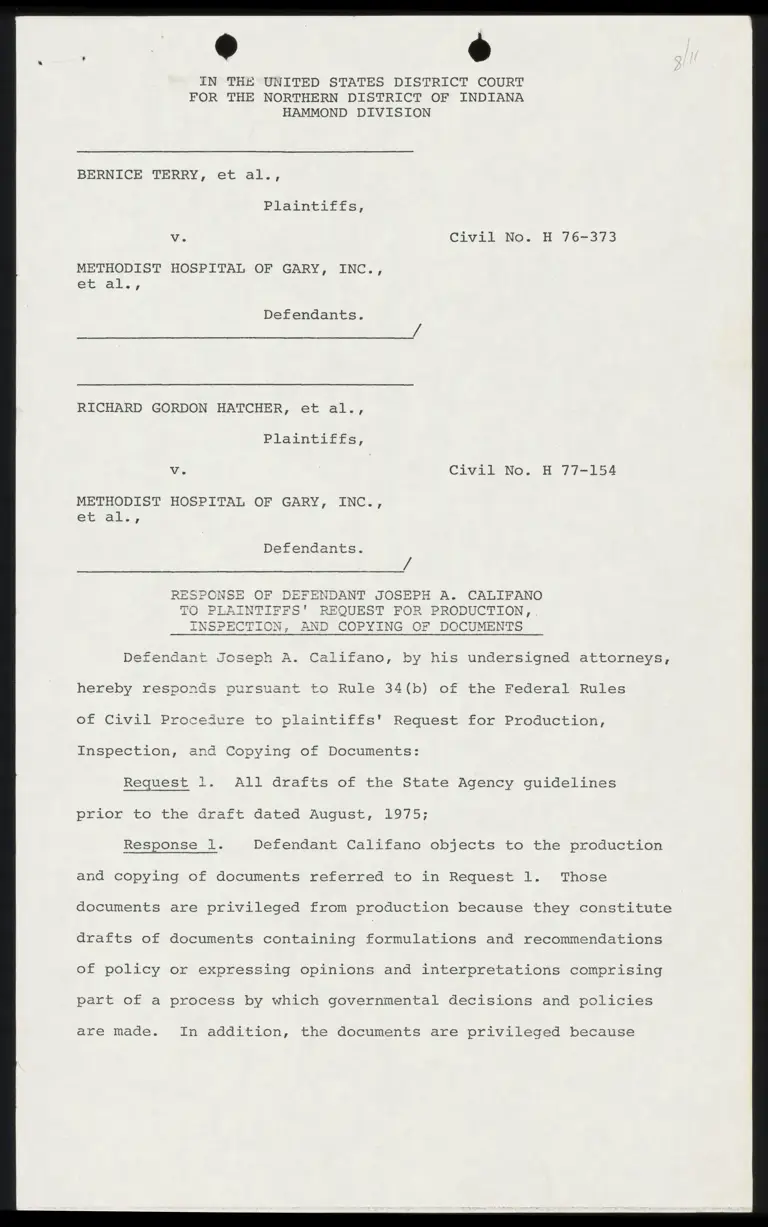
IN THE UNITED STATES DISTRICT COURT

FOR THE NORTHERN DISTRICT OF INDIANA

HAMMOND DIVISION


BERNICE TERRY, et al.,

PlaintifEs,

Vv. Civil No. H 76-373

METHODIST HOSPITAL OF GARY, INC.,

et al.,

Defendants.


/

RICHARD GORDON HATCHER, et al.,

Plaintiffs,

v. Civil No. H 77-154

METHODIST HOSPITAL OF GARY, INC.,

et al.,

Defendants.

/

RESPONSE OF DEFENDANT JOSEPH A. CALIFANO

TO PLAINTIFFS' REQUEST FOR PRODUCTION,
INSPECTICN, AND COPYING OF DCCUMENTS


-
i Defendant Joseph A. Califano, by his undersigned attorneys,

hereby responds pursuant to Rule 34(b) of the Federal Rules

of Civil Procedure to plaintiffs' Request for Production,

Inspection, and Copying of Documents:

Request 1. All drafts of the State Agency guidelines

prior to the draft dated August, 1975;

Response 1. Defendant Califano objects to the production


and copying of documents referred to in Request 1. Those

documents are privileged from production because they constitute

drafts of documents containing formulations and recommendations

of policy or expressing opinions and interpretations comprising

part of a process by which governmental decisions and policies

are made. In addition, the documents are privileged because


* ®

they reflect the mental processes of the individuals in

making governmental decisions.

Request 2. Transcripts, tapes, summaries, comments,


criticisms, on the State Agency guidelines of August, 1975 by

Peter Holmes (former director of the Office for Civil Rights),

Martin Gerry (present Director of the Office for Civil Rights) ,

and by the regional and national chiefs of the Health and

Social Service Branch, Office for Civil Rights;

Response 2. Defendant Califano objects to the production


and copying of documents referred to in Request 2. Those

documents are privileged from production because they consti-

tute inter and intra-agency documents and drafts of documents

containing formulations and recommendations of policy or

expressing opinions and interpretations comprising part of a

process by which governmental decisions and policies are

made. In addition, the documents are privileged because

they reflect the mental processes of the individuals in

Request 3. Corrected copy of enforcement activity


chart of 1975, and copies of similar charts for all years

Response 3. The corrected copy of the enforcement activity


chart for 1975 will be made available for inspection and

copying at the Department of Health, Education, and Welfare,

North Building, 300 Independence Ave., S.W., Washington, D. C.

at a mutually convenient time. Similiar charts for all

years from 1972 to the present do not exist.

Request 4. Complete civil rights file for the Methodist


Hospital, Gary, Indiana:

Response 4: The complete civil rights file for the


Methodist Hospital will be made available for inspection and

copying at the Region V HEW Offices in Chicago, Illinois at

a mutually convenient time.


» *

Request 5. All civil rights files for all health


facility relocation and/or displacement projects for the

past five years, and if the project was a Hill-Burton facility,

Part I of the Hill-Burton application and the narrative

description of the project;

Response 5: Defendant Califano will make available for


inspection and copying at the Department of Health, Education

and Welfare, North Building, 300 Independence Ave., SW,

Washington, D. C., 20201, at a mutually convenient time the

documents referred to in this request.

Request 6. Policy paper from Region V on this problem


of relocation of health facilities, and comments, memoranda,

letters, and criticism, from the Regional Health Directors

and from all persons within the Office for Civil Rights and

the Health Resources Administration, both from Region V and

Washington:

Response 6: Defendant Califano objects to the production


and copving of the document referred to in Request 6. This

document is privileged from production because it is an

intra-agency document containing formulations and recommendations

of policy or expressing opinions and interpretations comprising

part of a proccess by which governmental decisions and policies

are made.

Request 7. Any document from the Office for Civil

Rights to the Office of Surplus Property, DHEW, concerning

possible civil rights consequences and/or advisability of a

civil rights review in the circumstances of the Chicago

Veteran's Hospital;

Response 7: Defendant Califano will make available for


® ®

inspection and copying at the Department of Health, Education


and Welfare, North Building, 300 Independence Ave., S.W.,

Washington, D. C. 20201, at a mutually convenient time the

documents referred to in this request.

Request 8. Copy of Notice of Hearing, Letter of Non-

compliance, and any other public documents involving the

Park City Hospital, Bridgeport, Connecticut;

Response 8: Defendant Califano will make available for


inspection and copying at the Department of Health, Education

and Welfare, North Building, 300 Independence Ave., S.W.,

Washington, D. C. 20201 at a mutually convenient time the

documents referred to in this request.

Request 9. Civil Rights file on West Virginia relocation

project;

Response 9: HEW cannot locate any documents relevant to


Request No. 8.


Request 10. Current enforcement activity report for

Region V showing each health and social service civil rights

matter in the office;

Response 10: Attached are the Annual Operating Plans

for the Region V Cffice for Civil Rights for the last three

quarters. (Attachments 1, 2, and 3)

-
i Request 11. All civil rights files for all Hill-Burton


projects showing civil rights issues considered by Office

for Civil Rights and State Hill~Burton agencies for past five

years;

Response 1ll: The Civil rights files for Region V will


be made available for inspection and copying at the Region V

HEW Offices in Chicago, Illinois at a mutually convenient

time. Defendant Califano objects to production of these files

for Regions other than Region V because it is unduly burdensome

and oppressive and for the additional reason that it is neither

relevant nor likely to lead to relevant information.


® »
Request 12. Copies of all reports received from the


Delaware Department of Health and Social Services since

July 10, 1975;

Response 12: Defendant Califano will make available


for inspection and copying at the Department of Health,

Education and Welfare, North Building, 300 Independence

Ave., SW, Washington, D. C. 20201 at a mutually convenient

‘time the documents referred to in this request.

Request 13. All complaints under section 504, date


received, whether resolved (and if so, how resolved), whether

on-site reviews conducted, and program area (health, education,

social services, etc.)

Response 13: Defendant Califano will make available


for inspection and copying at the Department of Health,

Education and Welfare, North Building, 300 Independence Ave.,

S.W., Washington, D. C. 20201 at a mutually convenient

time the deccuments referred to in this request. The names

of the complainants have been deleted because they are not

relevant to this suit and because toc release the names would

be an unwarranted invasion of the complainant's Privacy:

Request 14. All complaints raising site location issues


under either Title VI or section 504;

Response 14: HEW can locate no documents responsive to


this request.

Request 15. Letters finding violations and notices of


opportunity for hearing under section 504;

Response 15: HEW can locate no documents responsive to


this request.

Request 16. Worksheets, charts, inventories, and


other documents showing number of person days needed to

perform each of the component parts of the civil rights

program for each Region developed during survey by Office

for Civil Rights team in summer of 1975;


* *
Response 16: Defendant Califano will make available


for inspection and copying at the Department of Health,

Education and Welfare, North Building, 300 Independence

Ave., S.W., Washington, D. C. 20201, at a mutually convenient

time the documents referred to in this request.

Request 17. Staff allocation and actual positions


filled in Health and Social Services Branch of the Office

for Civil Rights for the past five years, nationwide and in

Region III.

Response 17: Defendant Califano will make available


for inspection and copying at the Department of Health,

Education and Welfare, North Building, 300 Independence

Ave., S.W., Washington, D. C. 20201 at a mutually convenient

time the documents referred to in this request. The Annual

Operating Plan for Region V is attached. (Attachment 4)

=

Request 18. Copies of all section 504 guidelines and


regulations;

onsa 18: The attached section 504 regulations are


can locate responsive to this request.

(Attachment 5)

Request 19. Copies of the Indiana State Methods

required under Title VI regulations;

Response 19: HEW can locate no documents responsive to


this request. However, the Methods of Administration

for the State of Indiana Board of Health are attached.

(Attachment 6).

Request 20. Copies of all standards and guidelines

for Title VI and section 504 compliance promulgated by

each region and the Office for Civil Rights.

Response 20: Defendant Califano objects to this request


except insofar as it relates to Region V and the Central

Office standards and guidelines for site selection on Title VIX

and §504. The reason for this objection is that to produce

such materials for all regions would be unduly burdensome and

would not lead to relevant evidence. Region V standards

and guidelines for Title VI are encompassed in the response


® al
to Interrogatory 8. The letter to Wilmington Medical


Center of July 5, 1977 represents the written policy of the

Office of Civil Rights in the Title VI and §504 area.

(Attachment 7)

Request 21. Report of HEW issued February 23, 1977


which designated Gary, Indiana is an area of critical

health manpower shortage;

Response 21: The report, dated February 25, 1977, which


to the best of the defendant's knowledge, is the one referred

to in this request is attached. (Attachment 8)

Request 22. Any report, communication, memoranda or


document relating to or concerning report or investigation

of Alfred Sanchez, HSSB, OCR, HEW, Region V on or about

May 14, 1973 concerning the identification by HEW of urban

hospitals within Chicago where intended, actual or

proposed relocations would result in decreased accessibility

3 s — > * [3 .

+0 health care bv minorities:


3. Copies of State Agency guidelines, standards


and methods of administration of the Indiana State Board

of Health relating to state agency functions under Title VI,

Section 504, Section 1122 of the Social Security Act, and

the Hill-Burton Program.

Response 23: Attached is a copy of the Methods of


Administration of the Indiana State Board of Health to

assure compliance with Title VI of the Civil Rights Act

of 1964. (Attachment 6) We are not aware that the Indiana

State Board of Health has any Methods of Administration to

assure compliance with Section 504, nor are there Methods of

Administration specifically designed to assure compliance

with Civil Rights statutes in the administration of Section

1122 of the Social Security Act and the Hill-Burton Program.


OF COUNSEL:

JEFFREY CHAMPAGNE
U.S. Department of Health,

Education and Welfare

MARVIN G. GARVIN

Regional Attorney

EDWARD IL. KQVEN

Assistant Regional Attorney
Department ¢f Health,

Education and Welfare
300 South Wacker Drive
18th Floor
Chicago,

re

B, mde tn —

*
oul QAd a0, TO Salencts [+L 2x
BARBARA ALLEN BABCOCK Jo

Assistant Attorney General


  nt?


RICHARD L. KIESER

United States Attorney


FRED W. GRADY

Assistant United States Attorney

Noma G2 Joe de Ll,


DENNIS G. LINDER ’

Nr {LO 2% Ave,


REBECCA L. ROSS

Attorneys for Defendants
Attorneys, Department of Justice
Washington, D. C. 20530
Telephone: 739-2230


® *
CERTIFICATE OF SERVICE


I certify that copies of Response of Defendant Joseph

A. Califano to Plaintiffs' Request For Production, Inspection

and Copying of Documents and Response to Plaintiffs' First Set

of Interrogatories have been served this


|]4h day of


August, 1977 by mailing postage prepaid to:

Ms. Beth Lief
Mr. Jack Greenberg

Mr. Melvyn Leventhal
10 Columbus Circle
New York, New York 10019

Mr. Julian Allen
2009 Broadway
Gary, Indiana 46407

Ms. Marilyn G. Rose
Ms. Christine B. Hickman
1757 N Street, N.W.
Washington, D.C. 20036

Mr. Bruce E., Sayers
Hodges, Davis, Greenberg, Compton

& Sayers
5525 Broadway
Gary, Indiana 46401

Kipton Kaplan
Executive Director, Northern Indiana

Comprehensive Health Services
Agency, Inc.

900 East Colfax Avenue
South Bend, Indiana 46617

Michael Schaefer
Assistant Attorney General

of Indiana
219 State House
Indianapolis, Indiana 46204

Chl R (\V) :
SN AE a 25


REBECCA L. ROSS


K
\

PLAN
(4
> ARTERL i

~4
{

ry 77 R=
oy S055 207 1ST QUARTE

™ rr TT /mor
a s

mv

ioe)
NO

n
[iy 4

>
BSL

i
(7

i

~ m™ ~*7T OTTATTION
0 TR I, TRIE CA (

TTY TY
LY a3

rgd
INVEST] L TION INVESTIGAT

/
EVIEY/ nT

Ne TCTION TIDTIN
IRISDYT J Y Lol) 1

rrr Tr
-E A Nr hd

arnoaya ld Bil...
~
J

3 >
LR © APR Gn
BE Ea)

REET at. GFF _T

14

x
B
3
6


E
L


™ ~
N42

~
v1

!
3

I
T
N

E
N
T


| |

ent)
-

~ym™M
~~ [9 LO

4
§ ToYWE

FEL lows

JAA Cor. on) ACNE NOAA

oDp
i


ATTA [ENT

OUARTERLY PLAN - PRE-GRANT

The pre-grant reviews, conducted by H&SS do not lend themselves to the

format proposed for the Quarterly Plan. "irst, the identit vy of the

recipient is ante aati the application is received. Secondly, all

reviews are generally concluded within 30 Calendar days. Thirdly, ali

are reviewed for compliance with Title VI. Fourthly, since we do not

have the applications yet, thev have no log number. Thercfore, I

submit the following as a moxe meaningful Quarterly Plan for

reviews.

PROJECTIONS FOR PRE-GRANTS

TYPE OCTOBER NOVEMBER DIZCEMBER

Hill-Burton

Medicare fd


I
O
N


Federal Property
RDRS

TOTAL

U8
)

un
 |

wu


NO


PROJECTED ALLOCATION OF TIME IN HOURS


OCTOBER NOVEMBER DECEMBER TOTAL

146 227%. 132 504


4
a


-

S
o
n


i
Y
2
0


|

o 7


HR2'ST Jo Se. hl


Ih AT
S440 a) OF RECIPIENT


Illinois Dept of

ildren & Family

brvices

ishard Memorial

yspital

ginaw County

sntal Health Ctr,

innesota Dept of

ublic Welfare

George Hospital

brporation

bcial Development

linois Dept of

sblic Aid

HEALTH AND SOCIAL Gin
REGION

AOP QUARTERLY
OCR,

3RD QUARTER -

COMPLAINT IDENTIFICATION

DATA/LOG NUMBER AND DATE

OF RECEIPT

WWICES BRANCH .

Vv

PLAN

FY 77

AREA OF

JURISDICTION

DATE

or

OF INITIATION

REVIEW/ INVESTIGATION

PROJECTED

DATE ‘CF

COMPLETION

INVESTIGATION NEGOT

PROJECT.

DATE C ~~
Ta Tr
aE


Complaint

Complaint

Review

Review

Complaint

Complaint

Complaint

Complaint

p


Burgos (05761007)

June 14, 1976

Ekanem (05762008)

05769698

05769699

COMPRAND

August 25,

(05761008)

1976

Concerned Citizens

(05766001)

August 3, 1976

Gary Human Relations

Commission (05762009)

September 29, 1976

(05761038)

1975

Perdomo

December 12,

Title VI

National

Title VI

Title VI

National

Pile VI

Title VI

Race

Title VT

National

Title VI

Race

Title VI ~-

National Origin

November 1,

November 16,

January 3,

September 8,

December 12,

January 15,
August 21, 19

1976

August 16, 1976

1976

76

1977

1976

1976

1976

April 29,1977

April 29,

April-15,

3277 April-l,

May 30, 1977

April 15, 1977

June 30, 1977


e project that we will receive approximately 230 Pre-Grants will he which require 644 hours to process.


a

Fri PLA

REGICH 7

COMPLIANCE REVIEWS AND


I. Elementary & Second

Sorvices

A. Completint RB

on 10/1/76


FY 1977 AUNUAL OFZRA .

COMPLATINIT INVE >

Tis ff Pursuant to Title VI, Title IX, Public Health Service Act and E.O. 11246 JL
3

¥

Inventory


Actions


Elesientary and

Secondary Education

Higher Education

jer Complaints

mentary and g
econdary Education

4
3
4

5
'4

h

Es
A
1
3

  FY 1677 Complaints

Higher Educaticn


FY 1977 ANNUAL OFZRATING PLAY

COMPLIANCE REVIEWS AND OTH=R

Actions


mpleting Reviews in Progress
on 10/1/76

l. State Agency Reviews

Liew Actions

l. Pre-grant Clearnaces
(Title VI)

Other Institutions .ani Azencies

Employment


Total - All Compliance Review

Reeapitulation for Compliance

Total - All Compliance Reviews


g .


{ WEDNESDAY, MAY 4, 1977

| PART IV

e


hy
 |


i li


a i


€= DEPARTMENT OF
HEALTH,

EDUCATION, AND
WELFARE

Office of the Secretary

I
jy


Di


f
Ji


m
b

J
i


NONDISCRIMINATION
ON BASIS OF
HANDICAP

{
il
,

2

me


ll


Programs and Activities Receiving or

Ji 1 |

Benefiting from Federal Financial

Assistance


22694

tion as unnecessary. They are clearly com-
prehended by the more general sections ban-

ning discrimination.
Section 84.62(c) is a new section requiring

recipient hospitals to establish a procedure
for effective communication with persons
with impaired hearing for the purpose of
providing emergency health care. Although it
would be appropriate for a hospital to fulfill
its responsibilities under this section by hav-
ing a full-time interpreter for the deaf on
staff, there may be other means of accom-
plishing the desired result of assuring that
.some means of communication is immedi-
ately available for deaf persons needing

emergency treatment.

Section 84.52(d), also a new provision, re=
quires recipients with fifteen or more em-
ployees to provide appropriate auxiliary aids

for persons with impaired sensory, manual,

or speaking skills. Further, the Director may

require a small provider to furnish auxiliary

alds where the provision of aids would not

adversely affect the ability of the recipient to

provide its health benefits or services. Thus,

although a small nonprofit neighborhood

clinic might not be obligated to have avail

able an- interpreter for deaf persons, the

RULES AND REGULATIONS

Director may require provision of such aids
as may be resonably available to ensure that
qualified handicapped persons are not denied
appropriate benefits or services because of

their handicaps.
37. Treatmeni of Drug Addicts and Alco-

holics. Section 84.63 is a new section that
prohibits discrimination in the treatment
and admission of drug and alcohol addicts
to hospitals and outpatient facilities. This
section is included pursuant to section 407,
Public Law 92-255, the Drug Abuse Office
and Treatment Act of 1972 (21 U.S.C. 1174),
as amended, and section 321, Public Law
91-616, the Comprehensive Alcohol Abuse
and Alcoholism Prevention, Treatment, and
Rehabilitation Act of 1970 (42 U.S.C. 4581),
as amended, and section 321, Public Law
03-282. Section 504 itself also prohibits such
discriminatory treatment and, in addition,
prohibits similar discriminatory treatment
by other types of health providers. Section
84.53 prohibits discrimination against drug
abusers by operators of outpatient facilities,
despite the fact that section 407 pertains
only to hospitals, because of the broader ap-
plication of section 504. This provision does
not mean that all hospitals and outpatient

facilities must treat drug addiction and
alcoholism. It simply means, for example,
that a cancer clinic may not refuse to treat
cancer patients simply because they are also

alcoholics.

38. Education of institutionalized persons.
The regulation retains § 84.54 of the pro-

posed regulation that requires that an ap-
propriate education be provided to qualified
handicapped persons who are confined to
residential institutions or day care centers.

SUBPART G—PROCEDURES

In § 84.61, the Secretary has adopted the
title VI complaint and enforcement proce-
dures for use in implementing section 504
until such time as they are superseded by
the issuance of a consolidated procedural
regulation applicable to all of the civil rights
statutes and executive orders administered

by the Department.

APPENDIX B—ENFORCEMENT PROCEDURES

Sections 80.6-80.10 and Part 81 of Title 45

of the Code of Federal Regulations are re-

printed here without change for the conven-

ience of the reader:

FEDERAL REGISTER, VOL. 42, NO. 86—WEDNESDAY, MAY 4, 1977


§ 80.6 Compliance information.

(a) Cooperation and assistance. The
responsible Department official shall to
the fullest extent practicable seek the
cooperation of recipients in obtaining
compliance with this part and shall pro-
vide assistance and guidance to reciplents
to help them comply voluntarily with
this part.
_(b) Compliance reporis. Each recipi-

ént shall keep such records and sunmit fo
the responsibie Department official or his
designee timely, complete and accurate
compliance reports at such times, and in
such form and containing such informa-
tion, as the responsible Department offi-
cial or his designee may determine to be
necessary to enable him to ascertain
whether the recipient has complied or is
complying with this part. For example,
recipients should have available for the
Department racial and ethnic data
showing the extent to which members of
minority groups are beneficiaries of and
participants in federally-assisted pro-
grams. In the case of any program under
which a primary recipient extends Fed=
eral financial assistance to any other re-
cipient, such other recipient shall also
submit such compliance reports to the
primary recipient as may be necessary to

enable the primary recipient to carry

out {ts obligations under this part.

{c) Access fo sources of information.
Each recipient shall permit access by

the responsible Department official or

his designee during normal business
hours to such of its books, records, ac-

counts, and other sources of informa-

tion, and its facilities as may be per-

tinent to ascertain compliance with this

part. Where any information required
of a recipient is in the exclusive pos-
session of any other agency, institution
or person and this agency, institution
or person shall fail or refuse to furnish
this information the recipient shall so
certify in its report and shall set forth
what efforts it has made to obtain the
information. Asserted considerations of
privacy or confidentiality may not op-
erate to bar the Department from
evaluating or secking to enforce com-
pliance with this Part. Information of a -
confidential nature obtained in connec-
tion with compliance evaluation or en-
forcement shail not be disclosed except
where necessary in formal enforcement
proceedings or where otherwise required
by law.

RULES AND REGULATIONS

(d) Information to beneficiaries and
participants, Each recipient shall make
available to participants, benecficiaries,
and other interested persons such in-
formation regarding the provisions of
this regulation and its applicability to
the program for which the reciplent re=
ceives Federal financial assistance, and
make such information available to
them in such manner, as the responsi-
ble Department official finds necessary
to apprise such persons of the protec-
tions against discrimination assured
them by the Act and this regulation.
(Sec. 801, 6802, Clvil Rights Act of 1964: 78
‘Stat. 252; 43 U.S.C. 2000d, 2000d-1) [29 FR
168208, Dec. 4, 1964, as amended at 32 FR
14555, Oct. 19, 1967; 38 FR 17681, 17082,
July 8, 1873} Y

§ 80.7 Conduct of investigations.

(a) Periodic compliance reviews. The
responsible Department official or his
designee shall from time to time review
the practices of recipients to determine
whether they are complying with this
part.

(b) Complaints. Any person who be-
eves himself or any specific class of
individuals to be subjected to discrimi-
nation prohibited by this part may by
himself or by a representative file with
the responsible Department official or
bis designee & written complaint. A

complaint must be filed not later than

180 days from the date of the alleged dis-

crimination, unless the time for filing is

extended by the responsible Department

official or his designee.

= {¢) Investigations. The responsible

Department official or his designee will

make a prompt Investigation whenever

& compliance review, report, complaint,

«vr any other information indicates a
possible failure to comply with this part.
The investigation should include, whers
appropriate, a review of the pertinent
practices and policies of the recipient.
the circumstances under which the pos-
sible noncompliance with this part oc¢-
‘curred, and other factors relevant to a
determination as to whether the recipl-
ent has falled to comply with this part.

(d) Resolution of matters. (1) If an
investigation pursuant to paragraph (¢)
of this section indicates a failure to com-
ply with this part, the responsible De-
partment official or his designee will so
inform the reciplent and the matter will
be resolved by informal means whenever
possible, If it has been determined that
the matter cannot be resolved by infor
mal means, action will be taken as pro-
vided for In § 80.8.

(2) If an investigation does not war-
rant actlon pursuant to subparagraph
(1) of this paragraph the responsible
Department official or his designee will
50 inform the recipient and the com-
plainant, if any, in writing.

{e) Intimidatory or retaliatory acts
prohibited. No recipient or other person
sball intimidate, threaten, coerce, or .
discriminate against any individual for
the purpose of interfering with any right
or privilege secured by section 601 of the
Act or this part, or because he has mads
a complaint, testified, assisted, or par-
ticipated in eny manner In an investi °
gation, proceeding or hearing under
this part. The Identity of complainants

22695

shall be kept confidential except to the
extent necessary to carry out the pur-
poses of this part, including the conduct
of any investigation, hearing, or judicial
proceeding arising thereunder.
(Sec. 803, 602, Civil Rights Act of 1964; 78
Stat. 262; 43 U.S.C. 2000d, 2000d-1) [20 FR
16208, Dec. 4, 1984, as amended at 38 FR
17981, 17982, July 5, 1973}

.§ 80.8 Procedure for effecting compli.
ance.

(a) General. If there appears to be a
{allure or threatened failure to comply
with this regulation, and if the noncom=-
pliance or threatened noncompliance
cannot be corrected by informal means,
compliance with this part may be effected
by the suspension or termination of or
refusal to grant or to continue Federal
financial assistance or by any other

means authorized by law. Such other

means may inciude, but are not limited
to, (1) a reference to the Department of
Justice with a recommendation that ap-
propriate proceedings be brought to en-
force any rights of the United States
under any law of the United States (in=-
cluding other titles of the Act), or any
assurance or other contractual under-
taking, and (2) any applicable proceed=
ing under State or local law.

(b) Noncompliance with § 80.4. If an
applicant fails or refuses to furnish an.
assurance required under § 80.4 or other=
wise falls or refuses to comply with a
requirement imposed by or pursuant to
that section Federal financial assistance
may be refused in accordance with the
procedures of paragraph (¢) of this sec-
tion. ‘The Department shall not be re-
quired to provide assistance in such a
case during the pendency of the admin-
{stretive proceedings under such para-
graph except that the Department shall
continue assistance during the pendency
of such proceedings where such assiste
ance is due and payable pursuant to an
application therefor approved prior to
the effective daie of this part.

{c) Termination of or refusal io grant
or to continue Federal financial assist-
ance. No order suspending, terminating
or refusing to grant or confinue Federal
financial assistance shall become effec
tive until (1) the responsible Depart-
ment official has advised the applicant or
recipient of his failure to comply and has
determined that compliance cannot be
secured by voluntary means, (2) there
has been an express finding on the rec-
ord, after opportunity for hearing, of
a failure by the applicant or recipient
to comply with a requiremens imposed
by or pursuant to this part, (3) the ex-
piration of 30 days after the Secretary
has filed with the commitiee of the House
and the committee of the Senate having
legislative jurisdiction over the program
involved, 8 full written report of the
circumstances and the grounds for such
action. Any action to suspend or ter-
minate or to refuse to grant or to con-
tinue Federal financisgl assistance shall
be limited to the particular political en~
tity, or part thereof, or other applicant

or recipient 83 to whom such a finding has

heen made and shall be limited in its

effect to the particular program, or part

thereof, in which such noncompliance
hes been so found.

(d) Other means authorized by law,

No action to effect compliance by any

other means authorized by law shall

be taken until (1) the responsible De-

FEDERAL REGISTER, VOL. 42, NO. 86—WEDNESDAY, MAY 4, 1977


122696

partment official has determined that
compliance cannot be secured by vol-
untary means, (2) the recipient or other

- person has been notified of its failure to
comply end of the action to be taken to
effect compliance, and (3) the expirae
tion of at least 10 days from the mailing
of such notice to the recipient or other
person. During this period of at least
10 days additional efforts ghall be made
to persuade the recipient or other person
to comply with the regulation and to
take such corrective action as may be
appropriate. ?

(Sec. 601, 602, Civil Rights Act of 1964: 78
Stat. 252; 42 U.S.C. 2000d, 2000d-1. Sec. 182,
80 Stat. 1209; 42 U.S.C. 20004-5) [29 FR
16208, Dec. 4, 1964, as amended at $2 FR

145566, Oct. 19, 1067; S8 FR 17982, July b,
1678]

§ 80.9 Hearings.
(a) Opportunity for hearing. When-

ever an opportunity for a hearing is re-
quired by § 80.8(c), reasonable notice
shall be given by registered or certified
mail, return receipt requested, to the
affected applicant or recipient. This no-
tice shall advise the applicant or recip-
{ent of the action proposed to be taken,
the specific provision under which the
proposed action against it is to be taken,
and the matters of fact or law asserted
as the basis for this action, and either
(1) Aix a date not less than 20 days after
the date of such notice within which the
applicant or recipient may request of the
responsible Department official that the
matter be scheduled for hearing or (2)
advise the applicant or recipient that the
matter in question has been set down for
hearing at a stated place and time, The
time and place so fixed shall be reason
ghls and shall be subject to change for
cause. The complainant, if any, shall be
advised of the time and place of the
hearing. An applicant or recipient may
waive 8 hearing and submit written in-
formation and argument for the record.
The fajlure of an applicant or recipient
to request a hearing for which a date
has been set shall be deemed to be a
waiver of the right to a hearing under

section 602 of the Act and § 80.8(¢c) of
this regulation and consent to the mak-

ing of a decision on the basis of such
information as may be filed as the record.

(b) Time and place of hearing. Heare
ings shall be held at the offices df the
Department in Washington, D.C, at a

time fixed by the responsible Department
official unless he determines that the

convenience of the applicant or recipient
or of the Department requires that an-
other place be selected. Hearings shall
be held before a hearing examiner des=
fgnated in accordance with § U.S.C. 3105
and 3344 (section 11 of the Administra-
tive Procedure Act).

(¢) Right to counsel. In all proceed-
ings under this section, the applicant or
recipient and the Department shall have
the right to be represented by counsel.

(d) Procedures, evidence, and record.
(1) The hearing; decision, and any ad-
ministrative review thereof shall be con-
ducted in conformity with sections 5-8
of the Administrative Procedure Act, and
in accordance with such rules of proce-
dure as are proper (and not inconsistent
with this section) relating to the con-
duct of the hearing, giving of notices

RULES AND REGULATIONS

subsequent to those provided for in para-
graph (a) of this section, taking of testi
mony, exhibits, arguments and briefs, re-
quests for findings, and other related
matters. Both the Department and the
applicant or recipient shall be éntitled
to introduce all relevant evidence on the
issues as stated in the notice for hearing
or as determined by the officer conduct-
ing the hearing at the outset of or during
the hearing. Any person (other than a
Government employee considered to be
on official business) who, having’ been
invited or requested to appear and testify
28 a witness on the Government's behalf,
attends at a time and place scheduled
for a hearing provided for by this part,
may be reimbursed for his travel and’
actual expenses of attendance in an
amount not to exceed the amount pay-
able under the standardized travel regu-
lations to 8 Government employee
traveling on official business.

(2) Technleal rules of evidence shall
not apply to hearings conducted pursu-
ant to this part, but rules or principles
designed to assure production of the most
credible evidence available and to sub-
ject testimony to test by cross-examina-

tion shall be applied where reasonably
necessary by the officer conducting the
hearing. The hearing officer may ex=-

clude irrelevant, Immaterial, or unduly
repetitious evidence, All documents and
other evidence offered or taken for the
record shall be open to examination by
the parties and opportunity shall be
given to refute facts and arguments ad--
vanced on either side of the issues. A

transcript shall be made of the oral evi-
dence except to the extent the substance
thereof is stipulated “for the record.
All decislons shall be based upon the
hearing record and written findings shall
be made.

(e) Consolidated or Joint Hearings.
In cases in which the same or related
facts are asserted to constitute non-
compliance with this regulation with re
spect to two or more programs to which
this part applies, or noncompliance with
this part and the regulations of one or
more other Federal departments or agen-
cles issued under Title VI of the Act, the
responsible Department official may, by
agreement with such other departments
or agencies where applicable, provide for
the conduct of consolidated or joint
hearings, and for the application to such
hearings of rules of procedures not in-
consistent with this part. Final decisions
in such cases, insofar as this regulation
is concerned, shall be made in accordance
with § 80.10.
(Sec. 603, Civil Rights Act of 1964: 78 Stat.
263; 42 U.S.C. 2000d-1) [29 FR 16298, Dec. 4,
1984, as amended at S32 FR 14555, Oct. 19,

1867; $8 FR 17981, 17982, July 8, 1973]

§ 80.10 Decisions and notices.

(a) Decisions by hearing examiners.
After a hearing is held by a hearing ex-
eminer such hearing examiner shall
either make an initial decision, if so ay-
thorized, or certify the entire record in-
cluding his recommended findings and
proposed decision to the reviewing au-
thority for a final decision, and a copy
of such Initial decision or certification
shall be mailed to the applicant or re-
ciplent and to the complainant, if any.

Where the initial decision referred to in
this paragraph or in paragraph (¢) of
this section is made by the hearing ex-
aminer, the applicant or reciplent or the
counsel for the Department may, within
the period provided for in the rules of
procedure issued by the responsible De-
partment official, file with the reviewing
authority exceptions to the initial deci-
sion, with his reasons therefor. Upon
the filing of such exceptions the review-
ing authority shall review the initial de-
cision and issue its own decision thereof
including the reasons therefor. In the
absence of exceptions the initial decision
shall constitute the final decision, sub-

ject to the provisions of paragraph (e)
of this section.

(b) Decisions on record or review by
the reviewing authority, Whenever a rec-

ord is certified to the reviewing authority

for decision or it reviews the decision of
a hearing examiner pursuant to para-
graph (a) or (¢) of this section, the ap-
plicant or recipient shall be given rea-
sonable opportunity to file with it briefs
or other wriiten statements of its con-
fentions, and a copy of the final decision
of the reviewing authority shall be given
in writing fo the applicant or recipient
ard to the complainant, if any,
_(e) Decisions on record where @ hearing

{s waived. Whenever a hearing is walved
pursuant fo § 80.9(a) fhe reviewing au-
thority shall make its final decision on
the record or refer the matter to a hear-
ing examiner for an initial decision to be
made on the record. A copy of such de-
cision shall be given in writing to the
applicant or recipient, and to the com-
plainant, if any. ;

(d) Rulings required. Each decision of
a hearing examiner or reviewing author-
ity shall set forth a ruling on each find-
ing, conclusion, or exception presented,
and shall identify the requirement or re-
quirements imposed by or pursuant to
this part with which {t is found that
the applicant or recipient has failed to

comply.
(e) Review in certain cases by the

Secretary. If the Secretary has not per-
sonally made the final decision referred
to in paragraphs (a), (b), or (c) of this
section, a recipient or applicant or the
counsel for the Department may request
the Secretary to review a decision of the
Reviewing Authority in accordance with

rules of procedure {issued by the re-
sponsible Department official. Such: re-

view is not a matter of right and shall be

granted only where the Secretary deter-

mines there are special and important

reasons therefor. The Secretary may

grant or deny such request, in whole or

fn part. He may also review such 2 deci-

sion upon his own motion in accordance

with rules of procedure issued by the re-

sponsible Department official. In the ab-

sence of a review under this paragraph, a

final decision referred to in paragraphs

(a), (b), (c) of this section shall become

the final decision of the Department

when the Sccretary transmits it as such

to Congressional committees with the re-

port required under section 602 of the

Act. Failure of an applicant or recipient
to file an exception with the Reviewing

Authority or to request review under this

paragraph shall not be deemed a failure

to exhaust administrative remedies for

the purpose of obtaining judicial review.

FEDERAL REGISTER, VOL. 42, NO. 86—WEDNESDAY, MAY 4, 1977


|


E
E


(f) Content of orders. The final deci-

sion may provide for suspension or termi-

nation of, or refusal to grant or continue

Federal financial assistance, in whole or

in part, to which this regulation applies,

and may contain such terms, conditions,

and other provisions as are consistent

with and will effectuate the purposes of

the Act and this regulation, including

provisions designed to assure that no

Federal financial assistance to which this

regulation applies will thereafter be ex-

tended under such law or laws to the

applicant or recipient determined by

such decision to be in default in its per-

formance of en assurance given by it pur-

suant to this regulation, or to have other-

wise failed to comply with this regulation

unless and until it corrects its noncom-

pliance and satisfles the responsible De=-

partment official that it will fully comply

with this regulation.

(g) Post-termination proceedings. (1)

An applicant or recipient adversely af-

fected by an order issued under para-

graph (f) of this section shall be restored

to full eligibility to receive Federal fi-

nancial assistance if it satisfies the terms

and conditions of that order for such

eligibility or if it brings itself into com-

pliance with this part snd provides

reasonable assurance that it will fully

comply with this part. An elemen-

tary or secondary school or school sys-

tem which is unable to file an assurance

of compliance with § 80.3 shall be re-

stored to full eligibility to receive Federal

financial assistance, if it filles a court

order or a plan for desegregation which

meets the requirements of § 80.4(¢), and

provides reasonable assurance that it

will comply with the court order or plan.

(2) Any applicant or recipient ad-

versely affected by an order entered pur-

suant to paragraph (f) of this section

may at any time request the responsible

Department official to restore fully its

eligibility to receive Federal financial as-

glstance. Any such request shall be sup-

ported by information showing that the

applicant or recipient has met the re-

quirements of subparagraph (1) of this

paragraph. If the responsible Depart

ment official determines that those re-

quirements have been satisfied, he shall

restore such eligibility.

(3) If the responsible Department of-

ficial denies ny such request, the ap-

plicant or recipient may submit a request

for & hearing in writing, specifying why

it believes such official to have been in

error. It shall thereupon be given 80

expeditious hearing, with a decision on

the record, In accordance with rules ot

procedure issued by. the responsible De-

pariment official, The applicant or recip-

{ent will be restored to such eligibility if

it proves at such hearing that it satisfied

the requirements of subparagraph (1)

of this paragraph. While procecdings

under this paragraph are pending, the

sanctions imposed by the order issued

under paragraph (f) of this section shall

remain in effect. :

(Sec. 603, Civil Rights Act of 1064; 78 Stat.

252; 42 U.8.C. 2000d-1) [29 FR 16298, Dec. 4,

1064, as amended at 32 FR 14558, Oct. 19,

1067; 38 FR 17981, 17982, July 5, 1973]

RULES AND REGULATIONS

PART 81—PRACTICE AND PROCEDURE
FOR HEARINGS UNDER PART 80 OF
THIS TITLE

Subpart A—General Information
Sec.
81.1 Scope of rules.

81.2 Records to be public.
81.8 Use of gender and number.
81.4 Suspension of rules,

Subpart B—Appearance and Practice

81.11 Appearance,
81.12 Authority for representation.
81.13 Exclusion from hearing for miscone

duct,

Subpart C—Partles

81.21 Parties; General Counsel deemed @&
party.

81.22 Amici curiae,
81.28 Complainants not parties,

Subpart D—Form, Execution, Service and Filing
of Documents

81.21 Form of documents to be filed,
81.3% Signature of documents,

81.83 Filing and service.
81.34 Service—how msde,
81.85 Date of service.
81.38 Certificate of service.

Subpart E—Time

81.41 Computation.
81.43 Extension of time or postponement,

81.43 Reduction of time to file documents.

Subpart F—Proceedings Prior to Hearing

81.51 Notice of hearing or opportunity for

hearing.
81.52 Answer to notice.

81.58 Amendment of notice Or answer,

81.54 Request for hearing,
81.55 Consolidation.
81.56 Motions.
81.57 Responses to motions and petitions,

81.58 Disposition of motions and petitions.

Subpart G—Responsibilities and Duties of
Presiding Officer

81.61 Who presides.
81.62 Designation of hearing examiner.
81.63 Authority of presiding officer,

Subport H—Hearing Procedures

81.71 Btatement of position and trial

briefs.
81.72 REvidentiary purpose. 4

81.73 Testimony,
81.74 Exhibits,
81.76 = Affidavits,
81.768 Depositions,
81.77 Admissions as to facts and docu-

ments. :
81.78 Evidences.
81.79 Cross-examination.

81.80 Unsponsored written material,

81.81 Objections,

81.83 ‘Exceptions to rulings of presiding

officer unnecessary,

81.83 Official notice,
81.84 Public document items,
81.85 Offer of proof.
81.86 Appeals from ruling of presiding

officer.

Subpart |—The Record

81.01 Official transcript.
8192 Record for decision.

Subpart J—Posthearing Procedures, D

81.101 Posthearing briefs: proposed findings
apd conclusions. :

81.102 Decisions following hearing.
91.183 Exceptions to initial or recommended

decisions

81.104 Final decisions.
81.105 Oral argument to ths reviewing

: authority.
81.108 Review by the Secretary.
81.107 Service on amici curiss,


22697

Subpart X—Judicial Standards of Practice

81.111 Conduct.
81.112 Improper conduct.
81.113 Ex parte communications,
81.114 Expeditious treatment.

81.115 Matters Dot prohibited.
81.118 Filing of ex parte communications.

Subpart L—Posttermination Proceedings

81.121 Posttermination progeedings,

Subpart M—Definitions

81.131 Definitions,

AvTHORITY: The provisions of this Part 81
are issued under 6 US.C. 80 ia 1 and 456 CFR

Sourcz: The provisions of this Part 81
eppear at 32 F.R, 15158, Nov. 3, A

otherwise noted. gn Hales

Subpart A—General Information
§ 81.1 Scope of rules,

The ‘rules of procedure in
supplement §§ 80.9 and 80.10 2 his Pans
title and govern the practice for hear-
ings, decisions, and administrative ré-
view conducted by the Department of
Hezlth, Education, and Welfare, pursu-
ip Tns VI 3 the Civil Rights Act of
He Ari 8 Stat. 252) and Part 80

§ 81.2 Records to he public.

All pleadings, correspondence -
its, transcripts of testimony, ath
briefs, decisions, and other documents
filed in the docket in any proceeding may
be inspected and copied in the office of
the Civil Rights hearing clerk. Inquiries
may be made at the Central Information
Center, Department of Health, Educa-
tion, and Welfare, 330 Independence
Avenue SW., Washington, D.C. 20201.

§ 81.3 ' Use of gender and number,

As used in this part, words importing
the singular number may extend and be
applied to several persons or things, and
vice versa. Words importing the mascu-
line gender may be applied to females or
organizations,

§ 81.4 Suspension of rules.

Upon notice to all parties, the review-
ing authority or the presiding officer,
with respect to matters pending before
them, may modify or waive any rule in
this part upon determination that no
party will be unduly prejudiced and the
ends of justice will thereby be served.

Subpart B—Appazarance and Practice

§ 81.11 Appearance,

A party may appear in person or by
counsel and participate fully in any pro-
ceeding. A State agency or a corporation
may appear by any of its officers or by
any employee it authorizes to appear on
fts behalf. Counsel must be members in
good standing of the bar of a State,
Territory, or possession of the United
States or of the District of Columbia or
the Commonwealth of Puerto Rico.

§ 81.12 Authority for representation.

Any individual acting in a representa-
tive capacity in any proceeding may be
required to show his authority to act in
guch capacity.

FEDERAL REGISTER, VOL. 42, NO. 86—WEDNESDAY, MAY 4, 1977


22698

§ 81.13 Exclusion from hearing for mis.
conduct.

Disrespectful, disorderly, or contumae-
clous language or contemptuous conduct,
refusal to comply with directions, or
continued use of dilatory‘tactics by any

person at any hearing before a presiding

officer shall constitute grounds for im.

mediate exclusion of such person from

the hearing by the presiding officer.

Subpart C—Parlies

§ 81.21 Parties; General Counsel decmed
a party.

(a) The term party shall include an

applicant or recipient or other person

to whom a notice of hearing or oppor-

tunity for hearing has been mailed name

ing him as respondent.
(b) The General Counsel of the De-

partment of Health, Education, and Wel-
fare shall be deemed a party to all
proceedings.

§ 81.22 Amici curiae.

(a) Any interested person or organi-
zation may file a petition to participate in
a proceeding as an amicus curiae. Such
petition shall be filed prior to the pre-
hearing conference, or if none is held,
‘before the commencement of the hearing,
unless the petitioner shows good cause for
filing the petition later. The presiding
officer may grant the petition if he finds
that the petitioner has a legitimate in-
terest in the proceedings, that such par-
ticipation will not unduly delay the out-
come, and may contribute materially to
the proper disposition thereof. An amicus
curiae’is not a party and may not intro-
‘duce evidence at a hearing.

(b) An amicus curiae may submit a
statement of position to the ‘presiding
officer prior to the beginning of a hear-
ing, and shall serve a copy on each party.
The amicus curiae may submit a brief on
each occasion a decision is to be made or
a prior decision is subject to review. His
brief shall be filed and served on each
party within the time lmits applicable
to the party whose position he deems
himself to support; or if he does not
deem himself to support the position of
any party, within the longest time limit
applicable to any party at that particular
stage of the proceedings.

(¢) When all parties have completed
their initial examination of a witness,
any amicus curiae may request the pre-
siding officer to propound specific ques-
tions to the witness. The presiding officer,
in his discretion, may grant any such
request if he believes the proposed addi-
tional testimony may assist materially
in elucidating factual matters at issue be-
tween the parties and will not expand
the issues,

§ 81.23 Complainanis not parties.

A person submitting a complaint pur-

suant to § 80.7(b) of this title is not a

party to the proceedings governed by

this part, but may petition, after pro-

ceedings are initiated, to become an

amicus curiae,

RULES AND REGULATIONS

Subpart D--Form, Execution, Service
and Filing of Documents

§ 81.31 Form of documents to be filed.

Documents to be filed under the rules

in this part shall be dated, the original
signed in ink, shall show the docket de-
scription and title of the proceeding, and

ghall show the title, if any, and address

of the signatory. Copies need not be
signed but the name of the person sign-
ing the original shall be reproduced.
Documents shall be legible and shall not
be more than 8% inches wide and 12

inches long.

§ 81.32 Signature of documents.

The signature of a party, authorized :
officer, employee or attorney constitutes
a certificate that he has read the docu-
ment, that to the best of his knowledge,
information, and belief there is good
ground to support it, and that it is not
interposed for delay. If a document is
not signed or is signed with intent to
defeat the purpose of this section, it may
be stricken as sham and false and the
proceeding may proceed as though the
document had not been filed. Similar ac=
tion may be taken if scandalous or ine

decent matter is inserted.

§ 81.33 Filing and service.

All notices by a Department official,
and all written motions, requests, peti-
tions, memoranda, pleadings, exceptions,
briefs, decisions, and correspondence to
@ Department official from a party, or
vice verse, relating to a proceeding after
its commencement shall be filed and
served on all parties. Parties shall supply
the original and two copies of documents
submitted for filing. Filings shall be
made with the Civil Rights hearing clerk
at the address stated in the notice of
hearing or notice of opportunity for
hearing, during regular business hours.
Regular business hours are every Mon-
day through Friday (legal holidays in
the District of Columbia excepted) from
® am. to 5:30 p.m., eastern standard or
daylight saving time, whichever is efiec-
tive in the District of Columbia at the
time. Originals only of exhibits and
transcripts of testimony need be filed.”
For requirements of service on amici

curiae, see § 81.107.

§ 81.34 Service—how made.

Service shall be made by personal de-
livery of one copy to each person to be
served or by mailing by first-class mail,
properly addressed with postage prepaid.
When a party or amicus has appeared
by sttorney or other representative,
service upon such attorney or represent-
ative will be deemed service upon the

party or amicus. Documents served by

mall preferably should be mafled in suf-
ficient time to reach the addressee by

the date on which the originel is due to

be filed, and should be air mailed if the

addressee is more than 300 miles distant.

§ 81.35 Date of service.

The date of service shall be the day
when the matter is deposited in the US.
mail or is delivered in person, except
that the date of service of the initial
notice of hearing or opportunity for

hearing shall be the date of its delivery,

or of its attempted delivery if refused.

§ 81.36 Certificate of service.

The original of every document filed
and required to be served upon parties
to a proceeding shall be endorsed with a
certificate of service signed by the party
making service or by his attorney or rep=

resentative, stating that such service has
been made, the date of service, and the
manner of service, whether by mall or

personal delivery.

Subpart E—Time

§ 81.41 Computation,

In computing any period of time un-
der the rules in this part or in an order
issued hereunder, the time begins with
the day following the act, event, or de=-
fault, and includes the last day of the
period, unless it is a Saturday, Sunday,
or legal holiday observed in the District
of Columbia, in which event it includes
the next following business day. When
the period of time prescribed or allowed
is less than 7 days, intermediate Satur-
days, Eundays, and legal holidays shall
be excluded from the computation.

§ 81.42 Exiension of time or postpone-
ment,

Requests for extension of time should
be served on all parties and should set
forth the reasons for the application.
Applications may be granted upon a
showing of good cause by the applicant,
From the designation of a presiding of-

ficer until the issuance of his decision
such requests should be addressed to him,

Answers to such requests are permitted,

if made promptly.

§ 81.43 Reduction of time to file docu-
ments.

For good cause, the reviewing author-
ity or the presiding officer, with respect
‘to matters pending before them, may re-
duce any time limit prescribed by the

rules in this part, except as provided by

law or in Part 80 of this title.

Subpart F—Proceedings Prior to
Hearing

§ 81.51 Notice of hearing or opportunity
for hearing.

Proceedings are commenced by mailing
8 notice of hearing or opportunity for
bearing to an affected applicant or re-
ciplent, pursuant to § 80.9 of this title,

§ 81.52 Answer 10 notice.

The respondent, applicant or recipient
may file an answer to the notice within
20 days after service thereof. Answers
shall admit or deny specifically and in
detail each allegation of the notice, une
less the respondent party is without
knowledge, in which case his answer
should so state, and the statement will
be deemed a denial, Allegations of fact
in the notice not denied or controverted
by answer shall be deemed admitted.

‘FEDERAL REGISTER, VOL. 42, NO. 86—WEDNESDAY, MAY 4, 1977


Matters alleged as afirmative defenses

shall be separately stated and numbered.

Failure of the respondent to file an

- answer within the 20-day period follow-

ing service of the notice may be deemed

an admission of all matters of fact recited

in the notice, ?

§ 81.53 Amendment of notice or answer,

The Ceneral Counsel may amend the

notice of hearing or opportunity for

hearing once as a matter of course before

an answer thereto is served, and each

respondent may amend his answer once

as 8 matter of course not lafer than 10

days before the date fixed for hearing

but in no event later than 20 days-from

the date of service of his original answer,

Otherwise a notice. .or answer may be

amended only by leave of the presiding

officer. A respondent shall file his answer

to an emended notice within the time

remaining for filing the answer to the

original notice or within 10 days after

service of the amended notice, whichever

period may be the longer, unless the

presiding officer otherwise orders.

§ 81.54 Request for hearing.

within 20 days after service of a no-

tice of opportunity for hearing which

does not fix a date for hearing the re-

spondent, either in his answer or in 8

separate document, may request a hesr-

ing. Failure of the respondent to request

a hearing shall be deemed a waiver of

the right to a hearing and to constitute

his consent to the making of a decision on

the basis of such information as is avail
able.

£81.55 Consolidation,

The responsible Department official
"may provide for proceedings.in the De-
partment to be joined or consolidated for
hearing with proceedings in other Fed-
eral departments or agencies, by agree-

ment with such other departments or
agencies. All parties to any proceeding
consolidated subsequently to service of
the notice of hearing or opportunity for
hearing shall be promptly served with
notice of such consolidation.

§ 81.56 Motions.

Motions and petitions shall state the
relief sought, the authority relied upon,
and the facts alleged. If made before or
after the hearing, these matters shall be
in writing. If made at the hearing, they
may be stated orally; but the presiding
officer may require that they be reduced
to writing and filed and served on all par-
ties in the same manner as 8 formal mo-
tion. Motions, answers, and replies shall
be addressed to the presiding officer, if
the case is pending before him, A repeti-
tious motion will not be entertained.

§ 81.57 . Responses to motions and petl-
- tions.

Within 8 days after a written motion
or petition is served, or such other period
as the reviewing suthorkty or the pre-
gliding officer may fix, any party may file
a response thereto. An immediate oral
response may be made to an oral motion,

RULES AND REGULATIONS

§ 81.58 Disposition of motions and pe-

titions,

The reviewing authority or the presid=

ing officer may not sustain er grant &

written motion or petition prior to ex-

piration of the time for filing responses

thereto, but may overrule or deny such

motion or petition without awaiting

response: Provided, however, That pre=-

hearing conferences, hearings and de-

cisions need not be delayed pending

disposition of motions or petitions. Oral

motions and petitions may be ruled on

{mmediately. Motions and petitions sub-

mitted to the reviewing authority or the

presiding officer, respectively, and not

‘disposed of in separate rulings or In

thelr respective decisions will be deemed

denied. Oral arguments shall not be held

on written motions or petitions unless

the presiding officer in his discretion ex-

pa OC Responsibilities and
Duties of Presiding Officer

§ 81.61 Who presides.

A hearing examiner assigned under §
U.S.C. 3105 or 3344 (formerly sec, 11 of
the Administrative Procedure Act) shall
preside over the taking of evidence in
any hearing to which these rules of pro-

cedure apply.

§ 81.62 Designation of hearing exam-
iner,

The designation of the hearing exami=
ner as presiding officer shall be in writing,
and shall specify whether the examiner
is to make an initial decision or to certi-
fy the entire record including his recom=-
mended findings and proposed decision
‘to the reviewing authority, and may also
fix the time and place of hearing. A copy
of such order shall be served on all par-
ties. After service of an order designat-
ing a hearing examiner to preside, and
until such examiner makes his decision,
motions and petitions shall be submitted
to him. In the case of the death, illness,
disqualification or unavailability of the
designated hearing examiner, another
hearing examiner may be designated to
take his place.

§ 81.63 Authority of presiding officer.

The presiding officer shall have the
duty to conduct a fair hearing, to take
all necessary action to avold delay, and
to maintain order. He shall have all pow=-
ers necessary to these ends, including
(but not limited to) the power to:

(a) Arrange and issue notice of the
date, time, and place of hearings, or, up-

on due notice to the parties, to change
the date, time, and place of hearings
previously set. :

(b) Hold conferences to settle, simpli
fy, or fix the issues in a proceeding, or
to consider other matters that may ald
in the expeditious disposition of the
proceeding.

(¢) Require parties and amicl curiae
to state thelr position with respect to the
various Issues in the proceeding.

(d) Administer oaths and affirmae-
tions,

(e) Rule on motions, and other pro-
cedural items on matters pending befors
him,

(!) Regulate the course of the hearing
and conduct of counsel therein,

(g) Examine witnesses and direct
witnesses to testify,

22699

(h) Receive, rule on, exclude or limit
evidence. .

(1) Fix the time for filing motions, pe-
titions, briefs, or other items {n matters
pending before him,

(J) Issue initial or recommended de-
cisions. >

(k) Take any action authorized by the
rules in this part or in conformance with
the provisions of 5 U.S.C, 551-559 (the
Administrative Procedure Act).

Subpart H—Hearing Procedures

§ 81.71 Siatement of position and trial
briefs. :

The presiding officer may require par-
tiles and amici curiae to fille written
statements of position prior to the-be-
ginning of 8 hearing. The presiding of-
ficer may also requre the parties to sub-
mit trial briefs. :

§ 81.72 Evidentiary purpose.

(a) The hearing is directed to receiv-
ing factual evidence and expert opinion
testimony related to the issues in the pro-
ceeding. Argument will not be received
in evidence: rather it should be presented
in statements, memoranda, or briefs, as
determined by the presiding officer. Brief
opening statements, which shall be lim-
ited to statement of the party’s position
and what he intends to prove, may be
made at hearings.

(b) Hearings for the reception of evi-
dence will be held only in cases where is-
sues of fact must be resolved in order to
determine whether the respondent has
failed to comply with one or more appli-
cable requirements of Part 80 of this
title. In any case where it appears from
the respondent’s answer to the notice of
hearing or opportunity for hearing, from
his failure {timely to answer, or from his
admissions .or stipulations in the record,
that there are no matters of material
fact in dispute, the reviewing authority
or presiding officer may enter an order
so finding, vacating the hearing date if

one has been set, and fixing the time for
filing briefs under § 81.101. Thereafter
the proceedings shall go to conclusion in
accordance with Subpart J of this part.
The presiding officer may allow an appeal
from such order in accordance with

.§ 81.86.

§ 81.73 Testimony.

Testimony shall be given orally under
oath or affirmation by witnesses at the
hearing; but the presiding officer, in his
discretion, may require or permit that

the direct testimony of any witness pe
prepared in writing and served on all
parties in advance of the hearing. Such,
testimony may be adopted by the witness
at the hearing, and filled as part of the
record thereof. Unless authorized by the
presiding officer, witnesses will not be
permitted to read prepared testimony
into the record. Except as provided in
§8 81.75 and 81.76, witnesses shall be
available at the hearing for cross-
examination,

Pn FEDERAL REGISTER, VOL. 42, NO. 86—WEDNESDAY, MAY 4, 1977


§ 81.74 Exhibits,

Proposed exhibits shall be exchanged
at the prehearing conference, or othire
wise prior to the hearing if the presiding
officer so requires. Proposed exhibits not
80 exchanged may be denied admission as
evidence. The authenticity of all pro-
posed exhibits exchanged prior to hearing
will be deemed admitted unless written
objection thereto is filed prior to the
hearing or unless good cause is shown at
the hearing for failure to file such written
objection.

§ 81.75 Affidavits,

An affidavit is not inadmissible as such,
Unless the presiding officer fixes other
time periods afidavits shall be filed-and
served on the parties not later than 15
days prior to the hearing; and not less
than 7 days prior to hearing & party may
file and serve written objection to any
affidavit on the ground that he believes
it necessary to test the truth of assertions

_ therein at hearing, In such event the
assertions objected to will not be re-
celved in evidence unless the affiant is
made available for cross-examination, or
the presiding officer determines that
cross-examination is not necessary for
the full and true disclosure of facts re-
ferred to in such assertions. Notwith-
standing any objection, however, affl-
davits may be considered in the case of
any respondent who walves a hearing.

§ 81.76 Depositions.

Upon such terms as may be just, for
the convenience of the parties or of the

Department, the presiding officer may
authorize or direct the testimony of any
witness to be taken by deposition.

§ 81.77 Admissions as to facts and docu.
ments,

Not later than 15 days prior to the
scheduled date of the hearing except for
good cause shown, or prior to such earlier
date as the presiding officer may order,
any party may serve upon an opposing
party a written request for the admission
of the genuineness and authenticity of
any relevant documents described in and
exhibited with the request, or for the
admission of the truth of any relevant
matters of fact stated in the request.
Each of the matters of which an admis-
sion is requested shall be deemed ad-
mitted, unless within a period designated
In the request (not less than 10 days
after. service thereof, or within such
further time as the presiding officer or
the reviewing authority if no presiding
officer has yet been designated may allow
upon motion and notice) the party to
whom the request is directed serves upon
the requesting party a sworn statement
either denying specifically the matters
of which an admission is requested or
setting forth in detail the reasons why
he cannet truthfully elther admit or deny
such matters. Coples of requests for ad-
mission and answers thereto shall be
served on all parties. Any admission made
by a party to such request is only for the
purposes of the pending proceeding, or
any proceeding or action instituted for
the enforcement of any order entered
therein, and shall not constitute an ad-
mission by him for any other purpose or
be used against him in any other pro-
ceeding or action.

RULES AND REGULATIONS

§ 81.78 Evidence,

Irrelevant, immaterial, unreliable,
and unduly repetitious evidence will be
excluded.

§ 81.79 Cross-examination.

A witness may be cross-examined on

any matter material to the proceeding
without regard to the scope of his direct
examination.

§ 81.80 Unsponsorcd written material.

Yetters expressing views or urging ac-

tion and other unsponsored written ma-

terial regarding matters in issue in a
hearing will be placed in the correspond-

ence section of the docket of the proceed-

ing. These data are not deemed part of
the evidence or record in the hearing.

§ 81.81 Objections.

Objections to evidence shall be timely
and briefly state the ground relied upon.

381.82 Exceptions to rulings of presid-
ing officer unnecessary.

Exceptions to rulings of the presiding

officer are unnecessary. It is sufficient

that a party, at the time the ruling of

the presiding officer Is sought, makes
known the action which he desires the
presiding officer to take, or his objection
to an action taken, and his grounds
therefor.

§ 81.83 Official notice.

Where official notice is taken or is to
be taken of a material fact not appearing
in the evidence of record, any ‘party, on
timely request, shall be afforded an op-
portunity to show the contrary.

§ 81.84 Public document items.

Whenever there is offered. (In whole
or in part) a public document, such as
an official report, decision, opinion, or
published scientific or economic statis-
tical data issued by any of the executive’
departments (or their subdivisions),
legislative agencies or committees, or ad-
ministrative agencies of the Federal Gov-
ernment (including Government-owned
corporations), or a similar document is-
sued by a State or its agencies, and such
document (or part thereof) has been
shown by the offeror to be reasonably
available to the public, such document
need not be produced or marked for
identification, but may be offered for of-
ficial notice, as a public document item
by specifying the document or relevant
part thereof.

§ 81.85 Offer of proof.

An offer of proof made in connection
with an objection taken to any ruling of
the presiding officer rejecting or exclud-
ing proffered oral testimony shall consist
of a statement of the substance of the
evidence which counsel contends would
be adduced by such testimony: and, if
the excluded evidence consists of evi-
dence in documentary or written form
or of reference to documents or records,
8 copy of such evidence shall be marked
for identification and shall accompany
the record as the offer of proof.

§ 81.86 Appeals from ruling of presid-
ing officer.

Rulings of the presiding officer may

not be appealed to the reviewing suthori-

ty prior to his consideration of the en-

tire proceeding except with the consent

of the presiding officer and where he cer-

tifles on the record or in writing that

the allowance of an interlocutory appeal

is clearly necessary to prevent excep-

tional delay, expense, or prejudice to any
party, or substantial detriment to the

public interest. If an appeal is allowed,

any party may file a brief with the re-
viewing authority within such period as
the presiding officer directs. No -oral
argument will be heard unless the re=
viewing authority directs otherwise. At
any time prior to submission of the pro-
ceeding to it for decision, the reviewing
authority may direct the presiding officer
to certify any question or the entire rec-
ord to it for decision. Where the entire
record Is so certified, the presiding officer
shall recommend a decision.

Subpart i—The Record
§ 81.91 Official transcript.

The Department will designate the of-
ficial reporter for all hearings. The of-
ficial transcripts of testimony taken, to-
gether with any exhibits, briefs, or
memoranda of law filed therewith shall
be flled with the Department. Transcripts
of testimony in hearings may be obtained
from the official reporter by the parties
and the public at rates not to exceed
the maximum rates fixed by the contract
between the Department and tte re-
porter. Upon notice to sll parties, the
presiding officer may authorize correc-
tions to the transcript which involve mat-
ters of substance,

§ 81.92 Record for decision.

The transcript of testimony, exhibits,
and all papers and requests filed in the
proceedings, except the correspondence
section of the docket, including rulings
and any recommended or initial decision
shall constitute the exclusive record for
decision.

Subpart J—Posthearing Procedures,
Decisions

“g 81.101 Posthearing briefs: proposed
findings and conclusions,

(a) The presiding officer shall fix the
time for filing posthearing briefs, which
may contain proposed findings of fact
and conclusions of law, and, if permitted,
reply briefs.

(b) Briefs should include a summary
of the evidence relied upon together with
references to exhibit numbers and pages
of the transcript, with citations of the
authorities relied upon.

§ 81.102 Decisions following hearing,

When the time for submission of post-

hearing briefs has expired, the presiding

officer shall certify the entire record, in-

cluding his recommended findings and

proposed decision, to the responsible De-

FEDERAL REGISTER, VOL. 42, NO. 86—WEDNESDAY, MAY 4, 1677


partment official; or if so authorized he
shall make an initial decision. A copy of
the recommended findings and proposed
decision, or of the initial decision, shall
be served upon all parties, and amici if
any.

§ 81.103 Exceptions to initial or recom.
mended decisions.

Within 20 days. after the mailing of
an initial or recommended decision, any
party may file exceptions to the decision,
stating reasons therefor, with the review-

ing authority. Any other party may file
& response thereto within 30 days after
the mailing of the decision. Upon the
filing of such exceptions, the reviewing
authority shall review the decision 3nd
issue its own decision thereon.

§ 81.104 Final decisions,

(a) Where the hearing is conducted
by a hearing examiner who makes an
initial decision, if no exceptions thereto
are filed within the 20-day period speci.
fled in § 81.103, such decision shall be-
come the final decision of the Depart
ment, and shall constitute “final agency
action” within the meaning of § US.C.
704 (formerly section 10(c) of the Ad-
ministrative Procedure Act), subject to
the provisions of § 81.108,

(b) Where the hearing is conducted
by a hearing examiner who makes a rec-
ommended decision, or upon the filing
of exceptions fo a hearing examiner's
initial decision, the reviewing authority
shall review the recommended or initial
decision and shall issue its own decision
thereon, which shall become the final de-
cision of the Department, and shall con-
stitute “final agency action” within the
meaning of 5 U.S.C. 704 (formerly section
10(c) of the Administrative Procedure
Act) , subject to the provisions of § 81.106,

(c) All final decisions shall be
Dromply served on all parties, and amici,

any.

§ 81.105 Oral argument to the review
"ing authority. :

(a) If any party desires to argue a
case orally on exceptions or replies to
exceptions to an initial or recommended

decision, he shall make such request in

writing. The reviewing authority may

grant or deny such requests in its dis-
cretion. If granted, it will serve notice
of oral argument on all parties, Ths
notice will set forth the order of pres-

entation, the amount of time allotted,

end the time and place for argument.
The names of persons wno will argue
should be filled with the Department
hearing clerk not later than 7 days be-
fore the date set for oral argument.

(b) The purpose of oral argument is
to emphasize and clarify the written ar-
gument in the briefs. Reading at length
fromm the brief or other texts is not
favored. Participants should confine
their arguments to points of controlling
importance and to points upon which
exceptions have been flled. Consolida-
tions of appearances at oral argument
by parties taking the same side will per-
mit the parties’ interests to be presented
more effectively in the time allotted,

RULES AND REGULATIONS

(c) Pamphlets, charts, and other
written material may be presented at
oral argument only if such material i8
limited to facts already in the record
and is served on all parties and filed with
the Department hearing clerk at least

7 days before the argument.

§ 81.106 Review by the Secretary,

Within 20 days after an initial decision

becomes a final decision pursuant to
§ 81.104(a) br within 20 days of the mail-~
ing of a final decision referred to in

§ 81.104(b), as the case may be, a party
may request the Secretary to review the

final decision. The Secretary may grant

or deny such request, in whole or in part,

or serve notice of his intent to review

the decision in whole or in part upon his

-

_own motion. If the Secretary grants the
requested review, or if he serves notice

of intent to review upon his own motion,

each party to the decision shall have

- 20 days following notice of the Secre=-

tary's proposed action within which to

file exceptions to the decision and sup-

porting briefs and memoranda, or briefs

and memoranda in support of the decl-

sion. Failure of a party to request review

under this paragraph shall not be

deemed a failure to exhaust admin-

istrative remedies for the purpose of
obtaining Judicial review.

§ 81.107 Service on amici curiae.

All briefs, exceptions, memoranda, re-
quests, and decisions referred to in this

subpart J shall be served upon amici
curiae at the same times and in the same

manner required for service on parties,
Any written statements of position and
trial briefs required of parties under
§ 81.71 shall be served on amici.

Subpart K—Judicial Standards of
Practice

§8L111 Conduct

Parties and thelr representatives are
expected to conduct themselves with
honor and dignity and observe Judicial
standards of practice and ethics in all
proceedings. They should not indulge in
offensive personalities, unscemly wrane-
gling, or intemperate accusations or
characterizations. A representative of
any party whether or not a lawyer shall
observe the traditional responsibilities of
lawyers as officers of the court and use
his best efforts to restrain his client from
fmproprieties in connection with a
proceeding. :
§ 81.112 Improper conduct.

With respect to any proceeding it is
finproper for any interested person to at-
tempt to sway the judgment of the re-
viewing authority by undertaking to
bring pressure or Influence to bear upon
any officer having a responsibility for a
decision in the proceeding, or his decl-
sional staff. It is improper that such in=
terested persons or any members of the
Department's staff or the presiding offi-
cer glve statements to coramunicalions
media, by pald advertisement or other
wise, designed to influence the judgment
of any officer having a responsibility for
8 decision in the proceeding, or his de-

=

cisional staff, It is improper for any per-

son to solicit communications to any

such officer, or his decisional staff, other

than proper communications by parties
or amicl curiae. :

§ 81.113 Ex parte communications.

Only persons employed by or assigned

to work with the reviewing authority who
perform no investigative or prosecuting

function in connection with a proceeding

shall communicate ex parte with the re-
viewing authority, or the presiding offi-

cer, or any employee or person involved

in the decisional process in such proceed-

ings with respect to the merits of that or

a factually related proceeding. The re-

viewing authority, the presiding officer,
or any employee or person involved in the

decisional process of & proceeding shall

communicate ex parte with respect to

the merits of that or a factually related
proceeding only with persons employed
by or assigned to work with them and
who perform no investigative or pros-

ecuting function in connection with the
proceeding. .

§ 81.114  Expeditious treatment.

Requests for expeditious treatment of
matters pending before the responsible
Department official or the presiding offi-
cer are deemed communications on the
merits, and are improper except when
forwarded from parties to a proceeding
and served upon all other parties thereto.
Such communications should be in the
form of a motion.

§ 81.115 Datters not prohibited.

A request for information which mere-
ly inquires about the status of a pro-
ceeding without discussing issues or ex-
pressing points of view is not deemed an
ex parte communication. Such requests
should be directed to the Civil Rights
hearing clerk. Communications with re-
spect to minor procedural matters or in-
quiries or emergency requests for ex-
tensions -of time are not deemed ex parte
communications prohibited by § 81.113.
Where feasible, however, such communi-
cations should be by letter with copies to
all parties. Ex parte communications be-
tween a respondent and the responsible
Department official or the Secretary with
respect to securing such. respondent's
voluntary compliance with any require-
ment of Part 80 of this title are not pro-
hibited.

§ 81.116 Filing of ex parte communica.
tions,

A prohibited communication in writ-
ing received by the Secretary, the re-
viewing authority, or by the presiding
officer, shall be made public by placing
it in the correspondence file of the docket
fn the case and will not be considered
as part of the record for decision. If the
prohibited cominunication is received
orally, a memorandum setting forth its
substance shall be made and filed in the

correspondence section of the docket in

the case. A person referred to in such

memorandum may fille a comment for

inclusion in the docket if he considers the

memorandui to be Incorrect.

FEDERAL REGISTER, VOL. 42, NO. 86—WEDNESDAY, MAY 4, 1977


22702

Subpart L—Posttermination
Proceedings

§ 81.121 Posttermination proceedings.

(a) An applicant or recipient ad-

versely affected by the order terminating,

discontinuing, or refusing Federal finan-
cial assistance In consequence of proceed-
ings pursuant to this title may request
the responsible Department official for an
order authorizing payment, or permitting
resumption, of Federal financial assist-
ance. Such request shall be in writing
and shall affirmatively show that since
entry of the order, it has brought its
program or activity into compliance with
the requirements of the Act, and with the
Regulation thereunder, and shall set
forth specifically, and in detail, the steps
which it has taken to achieve such com-
plance. If the responsible Department
official denies such request the applicant
or recipient shall be given an expeditious
hearing if it so requests in writing and
specifies why it believes the responsible
Department official to have been in error,
The request for such a hearing shall be
addressed to the responsible Department

- official and shall be made within 30 days
after the applicant or recipient is in-
formed that the responsiole Department
official has refused to authorize payment
or permit resumption of Federal financial

assistance.

(b) In the event that a hearing shall
be requested pursuant to subparagraph

(a) of this section, the hearing proce-
dures established by this part shall be

applicable to the proceedings, except as

otherwise provided in this section.

Subpart M—Definitions

§ 81.131 Definitions.

The definitions contained in § 80.13 of
this subtitle apply to this part, unless the
context otherwise requires, and the term
“reviewing authority” as used herein in-
cludes the Secretary of Health, Educa-
tion, and Welfare, with respect to action
by that official under § 81.106.

Transition provisions: (a) The amend-

ments herein shall become effective upon

publication in the FEDERAL REGISTER.

(b) These rules shall apply to any

proceeding or part thereof to which Part

80 of this title as amended effective Oc-

tober 19, 1967 (published in the FepERAL

" REecisTER for Oct. 19, 1967), and as the

same may be hereafter amended, applies.

In the case of any proceeding or part
thereof governed by the provisions of

Part 80 as that part existed prior to such

amendment, the rules in this Part 81

shall apply as if these amendments were
not in effect.

FEDERAL REGISTER, VOL. 42, NO. 86—WEDNESDAY, MAY 4, 1977

RULES AND REGULATIONS

[FR Doc.77-12620 Filed 4-28-77;4:35 pm]


29676

Title 45—Public Welfare

SUBTITLE A—DEPARTMENT OF HEALTH,
EDUCATION, AND WELFARE, GENERAL
ADMINISTRATION

PART 84—NONDISCRIMINATION ON THE
BASIS OF HANDICAP IN PROGRAMS
AND ACTIVITIES RECEIVING CR BENE-
FITING FROM FEDERAL FINANCIAL
ASSISTANCE

AGENCY: Department of Health, Edu-
cation, and Welfare.

ACTION: Final rule. :

SUMMARY: This regulation implements
section 504 of the Rehabilitation Act of
1973, 29 U.S.C. 706, with regard to fed-
eral financial assistance administered by
the Department of Health, Education,
and Welfare. Section 504 provides that
‘no otherwise qualified handicapped in-
dividual * * * shall, solely by reason of
his handicap, be excluded from the.par-
ticipation in, be denied the benefits of,
or be subjected to discrimination under
anhy program or activity receiving federal
financial assistance.” The regulation,
which applies to all recipients of fed-
eral assistance from HEW, is intended
to ensure that their federally assisted
programs and activities are operated
without discrimination on the basis of
handicap. The regulation defines and
forbids acts of discrimination against
qualified handicapped persons in em-
ployment and in the operation of pro-
grams and activities receiving assistance
irom the Department. As employers, re-
cipients must make reasonable accom-
modation to the handicaps of applicants
and employees unless the accommodation
would cause the employer undue hard-
ship. As providers of services, recipients
are required to make programs operated
in existing facilities accessible to handi-
capped persons, to ensure that new fa-
cilities are constructed so as to be read-
ily accessible to handicapped persons,
and to operate their programs in a non-
discriminatory manner.

EFFECTIVE DATE: June 3, 1977.

FOR FURTHER INFORMATION, CON-
TACT:

John Wodatch, Director, Office of New
Programs, Office for Civil Rights, De-
partment of Health, Education, and
Welfare, Washington, D.C. 20201, 202-
245-1821.

SUPPLEMENTARY INFORMATION:

BACKGROUND

_ As part of the Rehabilitation Act of
1973 (Public Law 93-112) Congress en-
acted section 504, which provides that
“no otherwise qualified handicapped in-
dividual in the United States, as defined
in section 7(6), shall, solely by reason
of his handicap, be excluded from the
participation in, be denied the benefits
of, or be subjected to discrimination un-
der any program or activity receiving
Federal financal assistance.” In the same
statute, Congress defined the term

“handicapped individual” solely with

relationship to employment; section 7(6)

of the 1973 Act defined the term “handi-

FEDERAL REGISTER,

RULES AND REGULATIONS

capped individual” as “any individual
who (a) has a physical or mental disa-
bility which for such individual consti-
tutes or results in substantial handicap
to employment and (b) can reasonably
be expected to benefit in terms of em-
ployability from vocational rehabilita-
tion services * * *.” However, the fol-
lowing year, in section 111(a) of the Re-
habilitation Act Amendments of 1974
(Public Law 93-516), Congress amended
the definition of ‘handicapped individ-
ual” for purposes of section 504 and the

- other provisions of titles IV and V of the
Rehabilitation Act so that the definition
is no longer limited to the dimension of
employability. For purposes of section 504
of the Act, a “handicapped individual”
is defined as “any person who (A) has a
physical or mental impairment which
substantially limits one or more of such
person’s major life activities, (B) has a
record of such an impairment, or (C) is
regarded as having such an impair-
ment.” With this amended definition, it
became clear that section 504 was in-
tended to forbid discrimination against
all handicapped individuals, regardless
of their need for or ability to benefit from
vocational rehabilitation services.

Section 504 thus represents the first
Federal civil rights law protecting: the
rights of handicapped persons and re-
flects a national commitment to end dis-
crimination on the basis of handicap.
The language of section 504 is almost
identical to the comparable nondiscrim-
ination provisions of title VI of the Civil
Rights Act of 1964 and title IX of the
Education Amendments of 1972 (apply-
ing to racial discrimination and to dis-
crimination in education on the basis
of sex). It establishes a mandate to end
discrimination and to bring handicapped
persons into the mainstream of American
life. The Secretary intends vigorously to
implement and enforce that mandate.

THE PROBLEM OF DISCRIMINATION

From the outset, the Department has
recognized that the problem of ending
discrimination on the basis of handicap
presents considerations that are ex-
tremely complex. The diversity of types
of handicaps, as well as the wide variety
of settings in which programs financed
by the Department are offered, make the
task of prescribing general rules of non-
discriminatory treatment a difficult one.

There is overwhelming evidence that
in the past many handicapped persons
have been excluded from programs en-
tirely or denied equal treatment, simply
because they are handicapped. But elim-
indting such gross exclusions and denials
of equal treatment is not sufficient to as-
sure genuine equal opportunity. In draft-
ing a regulation to prohibit exclusion and
discrimination, it became clear that dif-
ferent or special treatment of handicap-
ped persons, because of their handicaps,
may be necessary in a number of con-
texts in order to ensure equal oppor-
tunity. Thus, for example, it is meaning-
less to “admit” a handicapped person in
a wheelchair to a program if the program
is offered only on the third floor of a
walk-up building, Nor is one providing

equal educational opportunity to a deaf
child by admitting him or her to a class=
room but providing no means for the
child to understand the teacher or receive
instruction.

These problems have been compounded
by the fact that ending discriminatory
practices and providing equal access to
programs may involve major burdens on
some recipients. Those burdens and costs,
to be sure, provide no basis for exemption
from section 504 or this regulation: Con-
gress’ mandate to end discrimination is
clear. But it is also clear that factors of
burden and cost had to be taken into
account in the regulation in prescribing

-the actions necessary to end discrimina-
tion and to bring handicapped persons
into full participation in federally fi-
nanced programs and activities.

The very general language of section
504 itself and the scant legislative history
surrounding its enactment provide little
guidance as to how these complex issues
should be resolved. The rulemaking proc-
ess in which the Department has en-
gaged has, however, provided a basis for
an initial resolution of those issues. The
Secretary believes the resulting regu-
lation offers genuine promise of provid-
ing an éffective and workable program
for ending discrimination against handi-
capped persons.

RULEMAKING HISTORY

On May 17, 1976, the Department pub-
lished a Notice of Intent to Issue Pro-
posed Rules, seeking public comment on
fifteen identified critical issues. 41 FR
20296. A draft proposed rule was attached
to the Notice of Intent, as was a state-
ment of the estimated economic and in-
flationary impact of the draft proposal,
prepared in accordance with the require-
ments of Executive Order 11821.

Over three hundred written comments
were received in response to the Notice of
Intent. The written comments were sup-
plemented by a series of ten meetings
conducted by the Office for Civil Rights
at various locations across the country.

On July 16, 1976, the Department pub-
lished a Notice of Proposed Rulemaking
analyzing comments received on the
critical issues identified in the Notice of
Intent and setting forth a revised pro-
posed regulation for public comment. 41
FR 29548. The initial 60-day comment
period was extended in response to nu- -
merous requests until October 14, 1976.
Additional comments received since that
date have also been considered to the
extent feasible. A total of more than
700 comments were received in response
to the July 168 Notice of Proposed Rule-
making; they have been analyzed along
with approximately 150 comments sent
in response to May 17 Notice that were
received too late to be analyzed during
the first comment period. Finally, an
additional twenty-two public meetings
were held after publication of the
July 16 Notice, again designed to inform

. interested persons and organizations of
the proposed regulation and to solicit
their comments and recommendations.
Transcripts of all these meetings were
made and analyzed along with the writ-

VOL. 42, NO. B6—WEDNESDAY, MAY 4, 1977


ten comments. Copies of these tran-
scripts, as well as the written comments,
are avallable for public inspection in
Room 5400, 330 Independence Avenue,
S.W., Washington, D.C. 20201.

The Secretary believes that both the
written comments and the views ex-
pressed at the public meetings have illu-
minated the camplex issues involved in
implementing section 504 in an efiective
and workable fashion. The Secretary’s
response to the comments of interested
parties, and the explanation for changes
in the proposed regulation, are set forth
in the section-by-section analysis of
each subpart of the regulation, which
appears as Appendix. A to the regula-
tion. As that analysis explains, a num-
ber of provisions in the proposed regu-
lation have been eliminated as duplica-
tive or unnecessary; others have been
shortened or clarified. The goal through-
out has been to design a regulation that
preserves the essential elements of a
strong and effective program for ending
discrimination, while avoiding the im-
position of unnecessary or counterpre-
ductive administrative obligations on
recipients.

OVERVIEW OF REGULATION

The regulation is divided into seven
subparts. Subpart A (General Provi-
sions) defines the important terms that
are used throughout the regulation and
states .in general terms the discrimina-
tory acts that are prohibited. It also sets
forth what the Secretary believes is a
simple, workable system of administra-
tion: assurances of compliance, self-
evaluation by recipients, establishment
of grievance procedures, and notification
of employes and beneficiaries of the reci-
pient’s policy of mnondiscrimination on
the basis of handicap. The regulation
covers all types of physical and mental
impairments, including drug addition
and alcoholism.

Subpart B, dealing with employment
practices, bars discrimination by reci-
pients of HEW assistance in recruit-
ment, hiring, compensation, job assign-
ment and classification, and fringe
benefits. It also requires employers to
make reasonable accommodation to
qualified handicapped applicants or em-
ployees unless it can be demonstrated
that the accommodation would impose
an undue hardship on the employer.

Subpart C sets forth the central re-
quirement of the regulation—program
accessibility. All new facilities are re-
quired to be constructed so as to be
readily accessible to and usable by
handicapped persons. Every existing fa-
cility need not be made physically acces-
sible, but all recipients must ensure that
programs conducted in those facilities
are made accessible. While flexibility is
allowed in choosing methods that in fact
make programs in existing facilities ac-
cessible, structural changes in such faci-
lities must be undertaken if no other
means of assuring program accessibility
is available.

Subparts A, B, and C of the regula-
tion, as well as subpart G—which incor-
porates by reference the Department’s

RULES AND REGULATIONS

procedures under title VI of the Civil
Rights Act of 1964—apply to all reci-
pients of financial assistance from the
Department. The remaining subparts of
the regulation contain more specific re-
quirements applicable to three major
classes of recipients.

Subpart D is concerned with preschool,
elementary, and secondary education.
Its provisions have been closely coordi-
nated with those of the Education for
All Handicapped Children Act of 19875
(Pub. L. 94-142). They require, basically,
that recipients operating public educa-
tion programs provide a free appropriate
education to each qualified handicapped
child in the most normal setting appro-
priate. The regulation also sets forth
evaluation requirements designed to en-
sure the proper classification and place-
ment of handicapped children, and due
process procedures for resolving dispute
over placement of students. While the
Department does not intend to review
individual placement decisions, it does
intend to ensure that testing and evalu-
ation procedures required by the regula-
tion are carried out, and that school sys-
tems provide an adequate opportunity
for parents to challenge and seek review
of these critical decisions. And the De-
partment will place a high priority on
pursuing cases in which a pattern or
practice of discriminatory placements
may be involved.

Subpart E deals with postsecondary
education: It proscribes discrimination
against handicapped persons in recruit-
ment, admission and treatment after ad-
mission. Colleges and universities are re-
quired to make reasonable adjustments
to permit handicapped persons to fulfill -
academic requirements, and to ensure
that they are not effectively excluded
from programs because of the absence of
auxiliary aids: Groups of colleges may
‘not establish consortia exclusively for
handicapped students.

Finally, Subpart F deals with health,
welfare and other social service pro-
grams. It forbids discrimination in pro-
viding such services and requires larger
recipients to provide auxiliary aids to
handicapped individuals where neces-
sary. Specific provisions require hospi-
tals not to discriminate against addicts
or alcoholics who need medical services
and to establish emergency room proce-
dures for communication with persons
with impaired hearing. Under Subpart
C, health and social service providers
may satisfy their program accessibility
obligations with respect to existing fa-
cilities by arranging to meet benefici-
aries in accessible locations. In addition,
small providers may refer patients or
other beneficiaries to accessible provid-
ers as a “last resort” alternative to mak-
ing significant structural changes.

ExeEcuTIVE ORDER 11914

Under Executive Order 11914 (41 FR
17871, April 28, 1978), the Department is
required to issue general standards for
other departments and agencies of the
Federal government to follow in promul-
gating regulations implementing Section
504. This responsibility will be fulfilled

22677

promptly and independently from this
regulation. The Department does, how-
ever, expect to incorporate the definition
of handicapped person adopted in § 84.3
(j) of this regulation in the standards
for determining what persons are cov-
ered by the Act. The Secretary also an-
ticipates that the relevant provisions of
Subparts A, B and- C of the regulation

- will be the basis for guidelines, pursuant
to the Executive Order, as to what are
discriminatory practices.

Economic IMPACT

The Department has previously certi-
fied, in issuing the Notice of Intent and
the Notice of Proposed Rulemaking, that
the economic and inflationary impact of
the proposed regulation had been care-
fully evaluated in accordance with OMB
Circular A-107. That analysis, which was
printed at 41 FR 20312 (May 1%, 1976),
has been revised and updated, and is
available on request.

SECTION-BY~-SECTION ANALYSIS OF.
REGULATION

Appended to the final regulation is a
section-by-section analysis of the regu-
lation, which describes the basis and pur-
pose of each section, discusses significant
comments, and explains the basis for
any changes made from the proposed
regulation published in July 1976.

In consideration of the foregoing, Part
84, to read as set forth below, is hereby
ordered to be added to Title 45 of the

Code of Federal Regulations.

Dated: April 28, 1977.

JosegrH A. CALIFANO, JT.,
Secretary, Department of

Health, Education, and Welfare.

Subpart A—General Provisions

Sec.
84.1 Purpose.

84.2 Application.
84.3 Definitions.
84.4 Discrimination prohibited.
84.5 Assurances required.
84.6 Remedial action, voluntary action,

and self-evaluation.

84.7 Designation of responsible employee
and adoption of grievance proced-
ures.

84.8 Notice.

84.9 Administrative requirements for small
recipients.

84.10 Effect of state or local law or other re-

quirements and effect of employ-
ment opportunities.

Subpart B—Employment Practices

84.11 Discrimination prohibited.
84.12 Reasonable accommodation.
84.13 Employment criteria.
84.14 Preemployment inquiries.
84.15-84.20 [Reserved]

Subpart C—Program Accessibility

84.21 Discrimination prohibited.
84.22 Existing facilities.
84.23 New construction.
84.24-84.30 [Reserved]

Subpart D—FPreschool, Elementary, and
Secondary Education

84.31 Application of this subpart.
84.32 Location and notification.
84.33 Free appropriate public education.
84.34 Educational setting.
84.35 Evaluation and placement.

FEDERAL REGISTER, VOL. 42, NO. 86-—WEDNESDAY, MAY 4, 1977


22678

Sec.
84.36 Procedural safeguards.
84.37 Nonaocademic services.
84.38 Preschool and sdult education pro-

grams.
84.39 Private education programs.

84.40 [Reserved]

Subpart E—Postsecondary Education

84.41 Application’of this subpart,
84.42 Admissions and recruitment,
84.43 Treatment of students; general.

84.44 Academic adjustments,
84.45 Housing.
84.46 Financial and employment assistance

to students.
84.47 Nonacademic services.

84.48-84.50 [Reserved]

Subpart F—Health, Welfare, and Social Services

84.51 Application of this subpart.
84.52 Health, welfare, and other social serv-

ices. :
84.53 Drug and alcohol addicts. :
84.54 Education of Iinstitutionallzed per-

sons.
84.55-84.60 [Reserved]

Subpart G—Procedures

84.61 Procedures.

84.62-99 [Reserved]

APPENDIX A—ANALYSIS OF FINAL REGULATION

AUTHORITY: Sec. 504, Rehabilitation Act of

1973, Pub. L. 93-112, 87 Stat. 394 (29 U.S.C.
794); sec. 111 (a), Rehabilitation Act Amend-
ments of 1974, Pub. L. 93-516, 88 Stat. 1619

(29 U.S.C. 706); sec. 606, Education of the
Handicapped Act (20 U.S.C. 1405), as
amended by Pub. L. 94-142, 89 Stat 795; sec,
321, Comprehensive Alcohol Abuse and Alco-
holism Prevention, Treatment, and Rehabili-
tation Act of 1970, 84 Stat. 182 (42 U.S.C.
4581), as amended; sec. 407, Drug Abuse
Office and Treatment Act of 1972, 88 Stat. 78
(21 U.S.C. 1174), as amended.

Subpart A—=General Provisions

§ 84.1 Purpose.

The purpose of this part is to effectu-
ate section 504 of the Rehabilitation Act
of 1973, which is designed to eliminate
discrimination on the basis of handi-
cap in any program or activity receiving
Federal financial assistance,

§ 84.2 Application.

This part applies to each recipient of
Federal financial assistance from the De-
partment of Health, Education, and Wel-
fare and to each program or activity that
receives or benefits from such assistance.

§ 84.3 Definitions.

As used in this part, the term:
(a) “The Act” means the Rehabilita-

tion Act of 1973, Pub. L. 93-112, as
amended by the Rehabilitation Act
Amendments of 1974, Public Law 93-5186,
29 U.S.C. 794.

(b) “Section 504” means section 504 of
the Act.

(¢) “Education of the Handicapped
Act” means that statute as amended by
the Education for all Handicapped
Children Act of 1975, Pub. L. 94-142, 20
U.S.C. 1401 et seq.

(d) “Department” means the Depart-
ment of Health, Education, and Welfare.

(e) “Director” means the Director of
the Office for Civil Rights of the Depart-
ment.

(f) “Recipient” means any state or its
political subdivision, any instrumentality
of a state or its political subdivision,

RULES AND REGULATIONS

any public or private agency, institution,
organization, or other entity, or any per=-
son to which Federal financial assistance
is extended directly or through another
recipient, ‘including any successor, as-
signee, or transferee of a recipient, but
excluding the ultimate beneficiary of the
assistance:

(g) “Applicant for assistance” means
one who submits an application, request,
or plan required to be approved by a De~-
partment official or by a recipient as a
condition to becoming a recipient.

(h) “Federal financial assistance”
means any .grant, loan, contract other
than a procurement contract or a con-
tract of insurance or guaranty), or any
other arrangement by which the Depart-
ment provides or otherwise makes avail-
able assistance in the form of:

(1) Funds;
(2) Services of Federal personnel; or
(3) Real and personal property or any

interest in or use of such property, in-

cluding:
(i) Transfers or leases of such prop-

erty for less than fair market value or
for reduced consideration; and

(ii) Proceeds from a subsequent trans-
fer or lease of such property if the Fed-
eral share of its fair market value is not
returned to the Federal Government.

(1) “Facility” means all or any por-
tion of buildings, structures, equipment,
roads, walks, parking lots, or other real
or personal property or interest in such

property.
(J) “Handicapped person.” (1) “Hand-

icapped persons” means any person who
(1) has a physical or mental impairment
which substantially limits one or more
major life activities, (il) has a record of
such an impairment, or (iil) is re-
garded as having such an impairment.

(2) As used in paragraph (j) (1) of

this section, the phrase:

(i) “Physical or mental impairment”

means (A) any physiological disorder or

condition, cosmetic disfigurement, or

anatomical loss affecting one or more of

the following body systems: neuro-

logical; musculoskeletal; special sense

organs; respiratory, including speech or-

gans; cardiovascular; reproductive, di-

gestive; genito-urinary; hemic and

lymphatic; skin; and endocrine; or (B)

any mental or psychological disorder,

such as mental retardation, organic brain

syndrome, emotional or mental illness,
and specific learning disabilities.

(i) “Major life activities” means
functions such as caring for one’s self,
performing manual tasks, walking, see-
ing, hearing, speaking, breathing, learn-
ing, and working.

(iii) “Has a record of such an impair-
ment’ means has a history of, or has
been misclassified as having, a mental
or physical impairment that substan-
tially limits one or more major life activi-

ties.

(iv) “Is regarded as having an im-
pairment” means (A) has a physical or
mental impairment that does not sub-
stantially limit major life activities but
that is treated by a recipient as consti-
tuting such a limitation; (B) has a phy-

FEDERAL REGISTER, VOL. 42, NO. 86—WEDNESDAY, MAY

sical or mental impairment that sub-
stantially limits major life acitivities
only as a result of the attitudes of others
toward such impairment; or (C) has
none of the impairments defined in
paragraph (j) (2) (i) of this section but
is treated by a recipient as having such
an impairment.

(k) “Qualified handicapped person”
means:

(1) With respect to employment, a
handicapped person who, with reason-
able accommodation, can perform the
essential functions of the job in ques-
tion;

(2) With respect to public preschool.
elementary, secondary, or adult educa-
tional services, a handicapped person
(i) of an age during which nonhandi-
capped persons are provided such serv-
ices, (ii) of any age during which it is
mandatory under state law to provide
such services to handicapped persons, or
(iii) to whom a state is required to pro-
vide a free appropriate public education
under § 612 of the Education of the Han-
dicapped Act; and

(3) With respect to postsecondary and
vocational education services, a handi-
capped person who meets the academic
and technical standards requisite to ad-
mission or participation in the recipi-
ent’s education program or activity;

(4) With respect to other services, a
handicapped person who meets the es-
sential eligibility requirements for the
receipt of such services.

(1) “Handicap” means any condition
or characteristic that renders a person
a handicapped person as defined in para-
graph (j) of this section.

§ 84.4 Discrimination prohibited.

(a) General. No qualified handicapped
person shall, on the basis of handicap,
be excluded from participation in, be
denied the benefits of, or otherwise be
subjected to discrimination under any
program or activity which receives or
benefits from Federal financial assist-
ance,

(b) Discriminatory actions prohibited.
(1) A recipient, in providing any aid,
benefit, or service, may not, directly or
through contractual, licensing, or other
arrangements, on the basis of handicap:

(1) Deny a qualified handicapped per-
"son the opportunity to participate in or
benefit from the aid, benefit, or service;

(ii) Afford a qualified handicapped
person an opportunity to participate in
or benefit from th2 aid, benefit, or serv-
ice that is not equal to that afforded
others;

(iii) Provide a qualified handicapped
person with an aid, benefit, or service
that is not as effective as that provided
to others;

(iv) Provide different or separate aid,
benefits, or services to handicapped per-
sons or to any class of handicapped per-
sons unless such action is necessary to
provide qualified handicapped persons
with aid, benefits, or services that are as
effective as those provided to others;

(v) Aid or perpetuate discrimination
against a qualified handicapped person

4, 1977


A
A
A
A


4
e
r
o


A
m


by providing significant assistance to an
agency, organization, or person that dis-
criminates on the basis of handicap in
providing any aid, benefit, or service to
beneficiaries of the recipients program;

(vi) Deny a qualified handicapped
person the opportunity to participate as
a member of planning or advisory boards;
or

(vii) Otherwise limit a qualified handi-
capped person in the enjoyment of any
right, privilege, advantage, or opportu-
nity enjoyed by others receiving an aid,

benefit, or service. ;
(2) For purposes of this part, aids,

benefits, and services, to be equally ef-
fective, are not required to produce the
identical result or level of achievement
for handicapped and nonhandicapped
persons, but must afford handicapped
persons equal opportunity to obtain the
same result, to gain the same benefit, or
to reach the same level of achievement,
in the most integrated setting appropri-
ate to the person’s needs.

(3) Despite the existence of separate
or different programs or activities pro-
vided in accordance with this part, a re-
cipient may not deny a qualified handi-
capped person the opportunity to partici-
pate in such programs or activities that
are not separate or different.

(4) A recipient may not, directly or
through contractual or other arrange-
ments, utilize criteria or methods of ad-
ministration (i) that have the effect of
subjecting qualified handicapped persons
to discrimination on the basis of handi-
cap, (11) that have the purpose or effect
of defeating or substantially impairing
accomplishment of the objectives of the
recipient’s program with respect to han-
dicapped persons, or (iii) that perpetuate
the discrimination of another recipient if
both recipients are subject to common
administrative control or are agencies of
the same State.

(5) In determining the site or loca-
tion of a facility, an applicant for assist-
ance or a recipient may not make selec-
tions (i) that have the effect of exclud-
ing handicapped persons from, denying
them the benefits of, or otherwise sub-
jecting them to discrimination under
any program or activity that receives or
benefits from Federal financial assist-
ance or (ii) that have the purpose or ef-
fect of defeating or substantially impair-
ing the accomplishment of the objectives
of the program or activity with respect
to handicapped persons.

(8) As used in this section, the aid,
benefit, or service provided under a pro-
gram or activity receiving or benefiting
from Federal financial assistance in-
cludes any aid, benefit, or service pro-
vided in or through a facility that has
been constructed, expanded, altered,
leased or rented, or otherwise acquired,
in whole or in part, with Federal finan- _
cial assistance.

(¢) . Programs limited by Federal law.
The exclusion of nonhandicapped per-
sons from the benefits of a program lim-
ited by Federal statute or executive order
to handicapped persons or the exclusion
of a specific class of handicapped persons

FEDERAL

RULES AND REGULATIONS

from a program limited by Federal stat-
ute or executive order to a different class
of handicapped persons is not prohibited
by this part.

§ 84.5 Assurances required.

(a) Assurances. An applicant for Fed-
eral financial assistance for a program
or activity to which this part applies
shall submit an assufance, on a form
specified by the Director, that the pro-
gram will be operated in compliance with
this part. An applicant may incorporate
these assurances by reference in subse-
quent applications to the Department.

(b) Duration of obligation. (1) In the
case of Federal financial assistance ex-
tended in the form of real property or
to provide real property or structures on
the property, the assurance will obligate
the recipient or, in the case of a subse-
quent transfer, the transferee, for the
period during which the real property or
structures are used for the purpose for
which Federal financial assistance is ex-
tended or for another purpose involving
the provision of similar services or

benefits.
. (2) In the case of Federal financial
assistance extended to provide personal
property, the assurance will obligate the
recipient for the period during which it
retains ownership or possession of the
property.

(3) In all other cases the assurance
will obligate the recipient for the period
during which Federal financial assistance
is extended.

(¢c) Covenants. (1) Where Federal fi-
nancial assistance is provided in the form
of real property or interest in the prop-
erty from the Department, the instru-
ment effecting or recording this trans-
fer shall contain a covenant running
with the land to assure nondiscrimina-
tion for the period during which the real
property is used for a purpose for which
the Federal financial assistance is ex-
tended or for another purpose involving
the provision of similar services or
benefits.

(2) Where no transfer of property is
involved but property is purchased or
improved with Federal financial assist-
ance, the recipient shall agree to include
the covenant described in paragraph (b)
(2) of this section in the instrument ef-
fecting or recording any subsequent
transfer of the property.

(3) Where Federal financial assistance
is provided in the form of real property
or interest in the property from the De-
partment, the covenant shall also in-
clude a condition coupled with a right to
be reserved by the Department to revert
title to the property in the event of a
breach of the covenant. If a transferee
of real property proposes to mortgage or
otherwise encumber the real property as
security for financing construction of
new, or improvement of existing, facili-
ties on the property for the purposes for
which the property was transferred, the
Director may, upon request of the trans-
feree and if necessary to accomplish
such financing and upon such conditions
as he or she deems appropriate, agree to

REGISTER, VOL. 42, NO. 86—WEDNESDAY, MAY

22679

forbear the exercise of such right to re-
vert title for so long as the lien of such
mortgage or other encumbrance re-
mains effective.

§ 84.6 Remedial action, voluntary ae-
tion, and self-evaluation.

(a) Remedial action. (1) If the Direc-
tor finds that a recipient has discrimi-
nated against persons on ‘the basis of
handicap in violation of section 504 or
this part, the recipient shall take such
remedial action as the Director deems
necessary to overcome the effects of the
discrimination. :

(2) Where a recipient is found to have
discriminated against persons on the
basis of handicap in violation of section
504 or this part and where another re-
cipient exercises control over the recip-
ient that has discriminated, the Direc-
tor, where appropriate, may require
either or both recipients to take reme-
dial action.

(3) The Director may, where neces-
sary to overcome the effects of discrimi-
nation in violation of section 504 or this
part, require a recipient to take remedial
action (i) with respect to handicapped
persons who are no longer participants
in the recipient’s program but who were
participants in the program when such
discrimination occurred or (ii) with re-
spect to handicapped persons who would
have been participants in the program
had the discrimination not occurred.

(b) Voluntary action. A recipient may
take steps, in addition to any action that
is required by this part, to overcome the
effects of conditions that resulted in
limited participation in the recipient’s
program or activity by qualified handi-
capped persons.

(¢) Self-evalution. (1) A recipient
shall, within one year of the effective
date of this part:

(i) Evaluate, with the assistance of in-
terested persons, including handicapped
persons or organizations representing
handicapped persons, its current policies
and practices and the effects thereof that
do not or may not meet the requirements
of this part;

(ii) Modify, after consultation with
interested persons, including handi-
capped persons or organizations repre-
senting handicapped persons, any poli-
cies and practices that do not meet the
requirements of this part; and

(iii) Take, after consultation with in-
terested persons, including handicapped
persons or organizations representing
handicapped persons, appropriate reme-
dial steps to eliminate the effects of any
discrimination that resulted from adher-
ence to these policies and practices.

(2) A recipient that employs fifteen or
more persons shall, for at least three
years followed completion of the evalua-
tion required under paragraph (¢) (1) of
this section, maintain on file, make avail-
able for public inspection, and provide to
the Director upon request: (i) a list of

“the interested persons consulted, (ii) a
description of areas examined and any
problems identified, and (iii) a descrip-
tion of any modifications made and of
any remedial steps taken.

4, 1977


22680

'§ 84.7 Designation of responsible em-
ployee and adoption of grievance
procedures.

(a) Designation of responsible em-=
ployee. A recipient that employs fifteen
or more persons shall desigriate at least
one person to coordinate its efforts to
comply with this part.

(b) Adoption of grievance procedures.
A recipient that employs fifteen or more
persons shall adopt grievance procedures
that incorporate appropriate due process
standards and that provide for the
prompt and equitable resolution of com-
plaints alleging any action prohibited by
this part. Such procedures need not be
established with respect to complaints
from applicants for employment or from
applicants for admission to postsecond-
ary educational institutions.

~~ §84.8 Notice.

(a) A recipient that employs fifteen
or more persons shall take appropriate
initial and continuing steps to notify
participants, beneficiaries, applicants,

~ and employees, including those with im-
paired vision or hearing, and unions
or professional organizations holding col-
lective bargaining or professional agree-
ments with the recipient that it does not
discriminate on the basis of handicap in
violation of section 504 and this part. The
notification shall state, where appropri-
ate, that the recipient does not discrim-
inate in admission or access to, or treat-
ment or employment in, its programs
and activities. The notification shall also
include an identification of the respon-
sible employee designated pursuant to
§ 84.7(a). A recipient shall make the ini-
tial notification required by this para-
graph within 90 days of the effective date
of this part. Methods of initial and con-
tinuing notification may include the
posting of notices, publication in news-
papers and magazines, placement of no-
tices in recipients’ publication, and dis-
tribution of memoranda or other written
communications.

(b) If a recipient publishes or uses re-
cruitment materials or publications con-
taining general information that it
makes available to participants, bene-
ficiaries, applicants, or employees, it shall
include in those materials or publications
a statement of the policy described in
paragraph (a) of this section. A recipi-
ent may meet the requirement of this
paragraph either by including appro-
priate inserts in existing materials and
publications or by revising and reprint-
ing the materials and publications.

§ 84.9 Administrative requirements for
small recipients.

The Director may require any recipi-
ent with fewer than fifteen employees,

- or any class of such recipients, to comply
with §8 84.7 and 84.8, in whole or in part,
when the Director finds a violation of

this part or finds that such compliance

will not significantly impair the ability
of the recipient or class of recipients to
provide benefits or services.

FEDERAL

RULES AND REGULATIONS

§ 84.10 Effect of state or local law or
other requirements and effect of em-
ployment opportunities.

(a) The obligation to comply with this
part is not obviated or alleviated by the
existence of any state or local law or
other requirement that, on the basis of
handicap, imposes prohibitions or limits
upon the eligibility of qualified handi-
capped persons to receive services or to
practice any occupation or profession.

(b) The obligation to comply with this
part is not obviated or alleviated be-
cause employment opportunities in any
occupation or profession are or may be
more limited for handicapped persons
than for nonhandicapped persons..

Subpart B—Employment Practices

§ 84.11

(a) General. (1) No qualified handi-
capped person shall, on the basis of
handicap, be subjected to discrimination
in employment under any program Or
activity to which this part applies.

(2) A recipient that receives assistance
under the Education of the Handicapped
Act shall take positive steps to employ
and dadvance in employment qualified
handicapped persons in programs as-

sisted under that Act.
(3) A recipient shall make all decisions

concerning employment under any pro-
gram or activity to which this part ap-
plies in a manner which ensures that
discrimination on the basis of handicap
oes not occur and may not limit, segre-

gate, or classify applicants or employees
in any way that adversely affects their
opportunities or status because of
handicap.

(4) A recipient may not participate in
‘a contractual or other relationship that
has the effect of subjecting qualified
handicapped applicants or employees to
discrimiination prohibited by this sub-
part. The relationships referred to in this
subparagraph include relationships with
employment and referral agencies, with
labor unions, with organizations provid-
ing or administering fringe benefits to
employees of the recipient, and with
organizations providing training and ap-
prenticeship programs.

(b) Specific activities, The provisions
of this subpart apply to:

(1) Recruitment, advertising, and the
processing of applications for employ-
ment;

(2) Hiring, upgrading, promotion,
award of tenure, demotion, transfer, lay-
off, termination, right of return from lay-
off, and rehiring;

(3) Rates of pay or any other form of
compensation and changes in compensa-
tion; :

(4) Job assignments, job classifica-
tions, organizational structures, position
descriptions, lines of progression, and
seniority lists;

(5) Leaves of absense, sick leave, or any
other leave;

(6) Fringe benefits available by virtue
of employment, whether or not adminis-
tered by the recipient;

/

Discrimination prohibited.


('D Selection and financial support for
training, including apprenticeship, pro-
fessional meetings, conferences, and
other related activities, and selection for
leaves of absence to pursue training;

(8) Employer sponsored activities, in-
cluding social or recreational programs;
and :

(9) Any other term, condition, or priv-
ilege of employment.

(c) A recipient’s obligation to comply
with this subpart is not affected by any
inconsistent term of any collective bar-
gaining agreement to which it is a party.

§ 84.12 Reasonable accommodation,

(a) A recipient shall make reasonable
accommodation to the known physical or
mental limitations of an otherwise qual-
ified handicapped applicant or employee
unless the recipient can demonstrate
that the accommodation would impose
an undue hardship on the operation of
its program.

(b) Reasonable accommodation may
include: (1) making facilities used by
employees readily accessible to and us-
able by handicapped persons, and (2) job
restructuring, part-time or modified
work schedules, acquisition or modifica-
tion of equipment or devices, the provi-
sion of readers or interpreters, and other
similar actions.

(¢) In determining pursuant to para-
-graph (a) of this section whether an ac-
commodation would impose an undue
hardship on the operation of a recipi-
ent’s program, factors to be considered
include:

(1) The overall size of the recipient’s
program with respect to number of em-
ployees, number and type of facilities,
and size of budget;

(2) The type of the recipient’s opera-
tion, including the composition and
structure of the recipient’s workforce;
and

(3) The nature and cost of the accom-
modation needed.

(d) A recipient may not deny any em-
ployment opportunity to a qualified han-
dicapped employee or applicant if the
basis for the denial is the need to make
reasonable accommodation to the physi
cal or mental limitations of the employee
or applicant.

§ 84.13 Employment ¢riteria.

(a) A recipient may not make use of
any employment test or other selection
criterion that screens out or tends to
screen out handicapped persons or any
class of handicapped persons unless:
(1) the test score or other selection cri-
terion, as used by the recipient, is shown
to be job-related for the positien in ques-
tion, and (2) alternative job-related tests
or criteria that do not screen out or tend
to screen out as many handicapped per-
sons are not shown by the Director to
be available. :

(b) A recipient shall select and admin-
ister tests concerning employment so as
best to ensure that, when administered
to an applicant or employee who has a
handicap that impairs sensory, manual,
or speaking skills, the test results accu-

REGISTER, VOL. 42, NO. 86—WEDNESDAY, MAY 4, 1977

:


rately reflect the applicant’s or em-
ployee’s job skills, aptitude, or whatever
other factor the test purports to meas-
ure, rather than reflecting the appli-
cant’s or employee’s impaired sensory,
manual, or speaking skills (except where
those skills are the factors that the test
purports to measure).

§ 84.14 Preemployment inquiries.

(a) Except as provided in paragraphs
(b) and (ec) of this section, a recipient
may not conduct a preemployment med-
ical examination or may not make pre-
employment inquiry of an applicant as
to whether the applicant is a handi-
capped person or as to the nature or
severity of a handicap. A recipient
may, however, make preemployment in-
quiry into an applicant’s ability to per-
form job-related functions.

(b) When a recipient is taking
remedial action to correct the effects
of past discrimination pursuant to § 84.6
(a), when a recipient is taking voluntary
action to overcome the effects of con-
ditions that resulted in limited par-
ticipation in its federally assisted pro-
gram or activity pursuant to § 84.6(b),
or when a recipient is taking affirmative
action pursuant to section 503 of the
Act, the recipient may invite applicants
for employment to indicate whether and
to what extent they are handicapped,
Provided, That:

(1) The recipient states clearly on
any written questionnaire used for this
purpose or makes clear orally if no writ-
ten questionnaire is used that the in-
formation requested is intended for use
solely in connection with its remedial
action obligations or its voluntary or
affirmative action efforts; and

(2) The recipient states clearly that
the information is being requested on a
voluntary basis, that it will be kept con-
fidential as provided in paragraph (4d)
of this section, that refusal to provide

-it will not subject the applicant or em-
ployee to any adverse treatment, and
that it will be used only in accordance
with this part.

(¢) Nothing in this section shall
prohibit a recipient from conditioning
an offer of employment on the results
of a medical examination conducted
prior to the employee’s entrance on
duty, Provided, That: (1) All entering
employees are subjected to such an
examination regardless of handicap, and
(2) the results of such an examination
are used only in accordance with the re-
quirements of this part.

(d) Information obtained in accord-
ance with this section as to the medi-
cal condition or history of the applicant
shall be collected and maintained on
separate forms that shall be accorded
confidentiality as medical records, ex-

cept that:

(1) Supervisors and managers may be
informed regarding restrictions on the
work or duties of handicapped persons
and regarding necessary accommoda-
tions;

(2) Pirst aid and safety personnel
may be informed, where appropriate, if
the condition might require emergency

treatment; and

FEDERAL

RULES AND REGULATIONS

(3) Government officials investigating
compliance with the Act shall be pro-
vided relevant information upon re-
quest.

§§ 84.15——84.20 [Reserved]

Subpart C—Program Accessibility

§ 84.21 Discrimination prohibited.

No qualified handicapped ° person
shall, because a recipient’s facilities are
inaccessible to or unusable by handi-
capped persons, be denied the benefits of,
be excluded from participation in, or
otherwise be subjected to discrimination
under any program or activity to which
this part applies. °

§ 84.22 Existing facilities.

(a) Program accessibility. A recipient
shall operate each program or activity
to which this part applies so that the
program or activity, when viewed in its
entirety, is readily accessible to handi-
capped persons. This paragraph does not
require a recipient to make each of its
existing facilities or every part of a fa-
cility accessible to and usable by handi-
capped persons. -

(by) Methods. A recipient may comply
with the requirement of paragraph (a)
of this section through such means as
redesign of equipment, reassignment of
classes or other services to accessible
buildings, assignment of aides to bene-
ficlaries, home visits, delivery of health,
welfare, or other social services at alter-
nate accessible sites, alteration of exist-
ing facilities and construction of new fa<
cilities in conformance with the require-
ments of § 84.23, or any other methods
that result in making its program or ac-
tivity accessible to handicapped persons.
A recipient is not required to make
structural changes in existing facilities
where other methods are effective in
achieving compliance with paragraph
(a) of this section. In choosing among
available methods for meeting the re-
quirement of paragraph (a) of this sec-
tion, a recipient shall give priority to
those methods that offer programs and
activities to handicapped persons in the
most integrated setting appropriate.

(c) Small health, welfare, or other so-
cial service providers. If a recipient with
fewer than fifteen employees that pro-
vides health, welfare, or other social
services finds, after consultation with a
handicapped person seeking its services,
that there is no method of complying
with paragraph’ (a) of this section other
than making a significant alteration in
its existing facilities, the recipient may,
as an alternative, refer the handicapped
person to other providers of those serv-
ices that are accessible.

(d) Time period. A recipient shall
comply with the requirement of para-
graph (a) of this section within sixty
days of the effective date of this part
except that where structural changes in
facilities are necessary, such changes
shall be made within three years of the
effective date of this part, but in any
event as expeditiously as possible.

(e) Transition plan. In the event that
structural changes to facilities are nec-
essary to meet the requirement of para-
graph (a) of this section, a recipient

REGISTER, VOL. 42, NO.  86—WEDNESDAY, MAY

226K1

shall develop, within six months of the
effective date of this part, a transition
plan setting forth the steps necessary to
complete such changes. The plan shall
be developed with the assistance of in-
terested persons, including handicapped
persons or organizations representing
handicapped persons. A copy of the
transition plan shall be made available
for public inspection. The plan shall, at
a minimum:

(1) Identify physical obstacles in the
recipient’s facilities that limit the acces-
sibility of its program or activity to
handicapped persons;

(2) Describe in detail the methods that
will be used to make the facilities ac-
cessible;

(3) Specify the schedule for taking the
steps necessary to achieve full program
accessibility and, if the time period of
the transition plan is longer than one
vear, identify steps that will be taken
during each year of the transition pe-
riod; and :

(4) Indicate the person responsible
for implementation of the plan.

(f) Notice. The recipient shall adopt
and implement procedures to ensure
‘that interested persons, including per-
sons with impaired vision or hearing, can
cbtain information as to the existence
and location of services, activities, and -
facilities that are accessible to and usa-
ble by handicapped persons.

§ 84.23 New construction.

(a) Design and construction. Each fa-
cility or part of a facility constructed
by, on behalf of, or for the use of a re-
cipient shall be designed and constructed
in such manner that the facility or part
of the facility is readily accessible to and
usable by handicapped persons, if the
construction was’ commenced after the
effective date of this part. °

(b) Alteration. Each facility or part
of a facility which is altered by, on
behalf of, or for the use of a recipient
after the effective date of this part in a
manner that affects or could affect the
usability of the facility or part of the fa-
cility shall, to the maximum extent fea-
sible, be altered in such manner that the
altered portion of the facility is readily
accessible to and usable by handicapped
persons.

(¢c) American National Standards In-
stitute accessibility standards. Design.
construction, or alteration of facilities in
conformance with the “American Na-
tional Standard Specifications for Mak-
ing Buildings and Facilities Accessible
to, and Usable by, the Physically Handi-
capped,” published by the American Na-
tional Standards Institute, Inc. (ANSI
Al117.1-1961 (R1971))," which is incorpo-
rated by reference in this part, shall
constitute compliance with paragraphs
(a) and (b) of this section. Departures
from peorticular requirements of those
standards by the use of other methods
shall be permitted when it is clearly
evident that equivalent access to the
facility or part of the facility is thereby
provided.

1 Copies obtainable from American Na-
tional Standards Institute, Inc., 1430 Broad-
way, New York, N.Y. 10018.

4, 1977


22682

§§ 84.24-84.30. [Reserved]

Subpart D—Preschool, Elementary, and
Secondary Education

§ 84.31 : Application of this subpart.

Subpart D applies to preschool, ele-
mentary, secondary, and adulf education
programs and activities that receive or
benefit from federal financial assistance
and to recipients that operate, or that
receive or benefit from federal financial
assistance for the operation of, such pro-
grams or activities.

§ 84.32 Location and notification. -

A recipient that operates a public ele-
mentary or secondary education pro-
gram shall annually:

(a) Undertake to identify and locate
every qualified handicapped person re-
siding in the recipient’s jurisdiction who
is not receiving a public education; and

(b) Take appropriate steps to notify
handicapped persons and their parents
or guardians of the recipient’s duty un-
der this subpart. :

§ 84.33 Free appropriate public cduca-
tion.

(a) General. A recipient that operates
a public elementary or secondary educa-
tion program shall provide a free appro-
priate public education to each qualified
handicapped person who is in the recip-
ient’s jurisdiction, regardless of the na-
ture or severity of the person’s handicap.

(b) Appropriate education. (1) For
the purpose of this subpart, the provi-
sion of an appropriate education is the .
provision of regular or special education
and related aids and services that (i) are
designed to meet individual educational
needs of handicapped persons as ade-
quately as the needs of nonhandicapped
persons are met and (ii) are based upon
adherence to procedures that satisfy the
requirements of §§ 84.34, 84.35, and 84.36.

{2) Implementation of an individual-
ized education program developed in ac-
cordance with the Education of the
the Handicapped Act is one means of
meeting the standard established in
paragraph (b) (1) (i) of this section.

> (3) A recipient may place a handi-
capped person in or refer such person to
a program” other than the one that it
operates as its means of carrying out

~ the requirements of this subpart. If so,
the recipient remains responsible for en-
suring that the requirements of this sub-
part are met with respect to any handi-
capped person so placed or referred.

(¢) Free education—(1) General. For
the purpose of this section, the provi-
sion of a free education is the provision
of educational and related services with-
out cost to the handicapped person or to
his or her parents or guardian, except
for those fees that are imposed on non-
handicapped persons or their parents or
guardian. It may consist either of the
provision of free services or, if a recipi-
ent places a handicapped person in or
refers such person to a program not op-
erated by the recipient as its means of
carrying out the requirements of this
subpart, of payment for the costs of the
program. Funds available from any pub-

FEDERAL REGISTER, VOL. 42, NO. 86—WEDNESDAY, MAY

RULES AND REGULATIONS

lic or private agency may be used to
meet the requirements of this subpart.
Nothing in this section shall be con-
strued to relieve an insurer or similar
third party from an otherwise valid ob=-
ligation to provide or pay for services
provided to a handicapped person.

(2) Transportation. If a recipient
places a handicapped person in or refers
such person to a program not operated
by the recipient as its means of carry-
ing out the requirements of this subpart,
the recipient shall ensure that adequate
transportation to and from the program
is provided at no greater cost than would
be incurred by the person or his or her
parents or guardian if the person were
placed in the program operated by the
recipient. :

(3) Residential placement. If place-
ment in a public or private residential
program is necessary to provide a free
appropriate public education to a handi-
capped person because of his or her
handicap, the program, including non-
medical care and room and board, shall
be provided at no cost to the person or
his or her parents or guardian.

(4) Placement of handicapped persons
by parents. If a recipient has made
available, in conformance with the re-
quirements of this section and § 84.34,
a free appropriate public education to a
handicapped person and the person’s
parents or guardian choose to place the
person in a private school, the recipient
is not required to pay for the person’s
education in the private school. Dis-
agreements between a parent or guard-
ian and a recipient regarding whether
the recipient has made such a program
available or otherwise regarding the.
question of financial responsibility are
subject to the due process procedures of
§ 84.36.

(d) Compliance. A recipient may not
exclude any qualified handicapped per-
son from a public elementary or sec-
ondary education after the effective date
of this part. A recipient that is not, on
the effective date of this regulation, in
full compliance with the other require-
ments of the preceding paragraphs of
this section shall meet such require-
ments at the earliest practicable time
and in no event later than September 1,
1978.

§ 84.34 Educational setting.

(a) Academic seiling. A recipient to
which this subpart applies shall educate,
or shall provide for the education of,
each qualified handicapped person in its
jurisdiction with persons who are not
handicapped to the maximum extent ap-
propriate to the needs of the handi-
capped person. A recipient shall place a
handicapped person in the regular edu-
cational environment operated by the
recipient’ unless it is demonstrated by
the recipient that the education of the
person in the regular environment with
the use of supplementary aids and serv-
ices cannot be achieved satisfactorily.
Whenever a recipient places a person in
a setting other than the regular educa-
tional environment pursuant to this par-
agraph, it shall take into account the


proximity of the alternate setting to the
person’s home.

(b) Nonacademic settings. In provid-
ing or arranging for the provision of
nonacademic and extracurricular serv-
ices and activities, including meals, re-
cess periods, and the services and activ-
ities set forth in § 84.37(a) (2), a recipient
shall ensure that handicapped persons
participate with nonhandicapped persons
in such activities and services to the:
maximum extent appropriate to the
needs of the handicapped person in
question.

(¢c) Comparable facilities. If a recip-
ient, in compliance with paragraph (a)
of this section, operates a facility that is
identifiable as being for handicapped
persons, the recipient shall ensure that
the facility and the services and activ-
ities provided therein are comparable to
the other facilities, services, and activ-
ities of the recipient.

§ 84.35
(a) Preplacement evaluation. A recip-

ient that operates a public elementary or
secondary education program shall con-
duct an evaluation in accordance with
the requirements of paragraph (b) of
this section of any person who, because
of handicap, needs or is believed to need
special education or related services be-
fore taking any action with respect to the
initial placement of the person in a reg-
ular or special education program and
any subsequent significant change in
placement.

(b) Evaluation procedures. A recipient
to which this subpart applies shall estab-
lish standards and procedures for the
evaluation and placement of persons
who, because of handicap, need or are
believed to need special education or re-
lated services which ensure that:

(1) Tests and other evaluation mate-
rials have been validated for the specific

Evaluation and placement.

purpose for which they are used and are _
administered by trained personnel in
conformance with the instructions pro-
vided by their producer;

(2) Tests and other evaluation mate-
+ rials include those tailored to assess spe-
cific areas of educational need and not
merely those which are designed to pro-
vide a single general intelligence quo-
tient; and :

(3) Tests are selected and adminis-
tered so as best to ensure that, when a
test is administered to a student with
impaired sensory, manual, or speaking
skills, the test results accurately reflect
the student’s aptitude or achievement
level or whatever other factor the test
purports to measure, rather than reflect-
ing the student’s impaired sensory, man-
ual, or speaking skills (except where
those skills are the factors that the test
purports to measure).

(¢c) Placement procedures. In inter-
preting evaluation data and in making
placement decisions, a recipient shall (1)
draw upon information from a variety
of sources, including aptitude and
achievement tests, teacher recommenda-
tions, physical condition, social or cul-
tural background, and adaptive behavior,
(2) establish procedures to ensure that
information obtained from all such

4, 1977


sources is documented and carefully con-
sidered, (3) ensure that the placement
decision is made by a group of persons,
including persons knowledgeable about
the child, the meaning of the evaluation
data, and the placement options, and (4)
ensure that the placement decision is
made in conformity with § 84.34.

(d) Reevaluation. A recipient to which
this section applies shall establish pro-
cedures, in accordance with paragraph
(b) of this section, for periodic reevalua=-
tion of students who have been provided
special education and related services. A
reevaluation procedure consistent with
the Education for the Handicapped Act

is one means of meeting this requirement.

§ 84.36 Procedural safeguards.

A recipient that operates a public ele-
mentary or secondary education program
shall establish and implement, with re-
spect to actions regarding the identifica-
tion, evaluation, or educational place-
ment of persons who, because of handi-
cap, need or are believed to need special
instruction or related services, a system
of procedural safeguards that includes
notice, an opportunity for the parents or
guaradian of the person to examine rele-
vant records, an impartial hearing with
opportunity for participation by the per-
son’s parents or guardian and represent-
ation by counsel, and a review procedure.
Compliance with the procedural safe-
guards of section 615 of the Education of
the Handicapped Act is one means of
meeting this requirement.

§ 84.37 Nonacademic services.

(a) General. (1) A recipient to which
this subpart applies shall provide non-
academic and extracurricular services
and activities in such manner as is neces-
sary to afford handicapped students an
equal opportunity for participation in
such services and activities. 3

(2) Nonacademic and extracurricular
services and activities may include coun-
seling services, physical recreational
athletics, transportation, health services,
recreational activities, special interest
groups or clubs sponsored by the recipi-
ent, referrals to agencies which provide
assistance to handicapped persons, and
employment of students, including both
employment by the recipient and assist-
ance in making available outside employ-

ment.

(b) Counseling services. A recipient to
which this subpart applies that provides
personal, academic, or vocational coun-
seling, guidance, or placement services to
its students shall provide these services
without discrimination on the basis of
handicap. The recipient shall ensure that
qualified handicapped students are not
counseled toward more restrictive career
objectives than are nonhandicapped stu-
dents with similar interests and abilities.

(¢) Physical education and athletics.
(1) In providing physical education
courses and athletics and similar pro-
grams and activities to any of its stu-
dents, a recipient to which this subpart
applies may not discriminate on the basis
of handicap. A recipient that offers phys-
ical education courses or that operates

FEDERAL

RULES AND REGULATIONS

or sponsors interscholastic, club, or in-
tramural athletics shall provide to quali-
fied handicapped students an equal op-
portunity for participation in these
activities.

(2) A recipient may offer to handi-
capped students physical education and
athletic activities that are separate or
different from those offered to nonhandi-
capped students only if separation or
differentiation is consistent with the
requirements of § 84.34 and only if no
qualified handicapped student is denied
the opportunity to compete for teams or
to participate in courses that are not
separate or different.

§ 84.38 Preschool and adult education
programs.

A recipient to which this subpart ap-
plies that operates a preschool educa-
tion or day care program or activity or
an adult education program or activity
may not, on the basis of handicap, ex-
clude qualified handicapped persons from
the program or activity and shall take
into account the needs of such persons
in determining the aid, benefits, or serv-
ices to be provided under the program
or activity.

§ 84.39 Private education programs.

(a) A recipient that operates a pri-
vate elementary or secondary education
program may not, on the basis of handi-
cap, exclude a qualified handicapped
person from such program if the person
can, with minor adjustments, be provided
an appropriate education, as defined in
§ 84.33(b) (1), within the recipient’s
program.

" (b) A recipient to which this section
applies may not charge more for the pro-
vision of an appropriate education to
handicapped persons than to nonhandi-
capped persons except to the extent that
any additional charge is justified by a
substantial increase in cost to the
recipient.

(¢) A recipient to which this section
applies that operates special education
programs shall operate such programs in
accordance with the provisions of
§§ 84.35 and 84.36. Each recipient to
which this section applies is subject to
the provisions of §§ 84.34, 84.37. and

84.38.

§ 84.40 [Reserved]

Subpart E—Postsecondary Education

§ 84.41 Application of this subpart.

Subpart E applies to postsecondary
education programs and activities, in-
cluding postsecondary vocational educa-
tion programs and activities, that receive
or benefit from federal financial assist=
ance and to recipients that operate, or
that receive or benefit from federal fi-
nancial assistance for the operation of,
such programs or activities.

§ 84.42 Admissions and recruitment.

(a) General. Qualified handicapped
persons may not, on the basis of handi-
cap, be denied admission or be subjected
to discrimination in admission or re-
cruitment by a recipient to which this
subpart applies.

REGISTER, VOL. 42, NO. 86—WEDNESDAY, MAY

-obligations

22683

(b) Admissions. In administering its
admission policies, a recipient to which
this subpart applies:

(1) May not apply limitations upon
the number or proportion of handi-
capped persons who may be admitted;

(2) May not make use of any test or
criterion for admission that has a dis-
proportionate, adverse effect on handi-
capped persons or any class of handi-
capped persons unless (i) the test or cri-
terion, as used by the recipient, has been
validated as a predictor of success in the
education program or activity in ques-
tion and (ii) alternate tests or criteria
that have a less disproportionate, ad-
verse effect are not shown by the Direc-
tor to be available; >

(3) Shall assure itself that (i) admis-
sions tests are selected and administered
so as best to ensure that, when a test is
administered to an applicant who has a
handicap that impairs sensory, manual,
or speaking skills, the test results accu-
rately reflect the applicant’s aptitude or
achievement level or whatever other fac-
tor the test purports to measure, rather
than reflecting the applicant’s impaired
sensory, manual, or speaking skills (ex-
cept where those skills are the factors
that the test purports to measure); (ii)
admissions tests that are designed for
persons with impaired sensory, manual,
or speaking skills are offered as often and
in as timely a manner as are other admis-
sions tests; and (iii) admissions tests are
administered in facilities that, on the
whole, are accessible to handicapped
persons; and

(4) Except as provided in paragraph
(¢c) of this section, may not make pread-
mission inquiry as to whether an appli-
cant for admission is a handicapped per-
son but, after admission, may make in-
quiries on a confidential basis as to
handicaps that may require accommo-
dation.

(¢c) Preadmission inquiry exception.
When a recipient is taking remedial ac-
tion to correct the effects of past dis-
crimination pursuant to § 84.6(a) or
when a recipient is taking voluntary ac-
tion to overcome the effects of conditions
that resulted in limited participation in
its federally assisted program or activity
pursuant to § 84.6(b), the recipient may
invite applicants for admission to indi-
cate whether and to what extent they
are handicapped, Provided, That:

(1) The recipient states clearly on any
written questionnaire used for this pur-
pose or makes clear orally if no written
questionnaire is used that the informa-
tion requested is intended for use solely
in connection with its remedial action

or its voluntary action
efforts; and

(2) The recipient states clearly that
the information is being requested on a
voluntary basis, that it will be kept con-
fidential, that refusal to provide it will
not subject the applicant to any adverse
treatment, and that it will be used only
in accordance with this part.

(d). Validity studies. For the purpose
of paragraph (b) (2) of this section, a re-
cipient may base prediction equations on
first year grades, but shall conduct peri-

4, 1977


22684

odic validity studies against the criterion
of overall success in the education pro-
gram or activity in question in order to
monitor the general validity of the test

scores.

§84.43 Treatment of students; general.

(a) No qualified handicapped student
shall, on the basis of handicap, be ex-
cluded from .participation in, be denied
the benefits of, or otherwise be subjected
to discrimination under any academic,
research, occupational training, hous~-
ing, health, insurance, counseling, finan-
cial aid, physical education, athletics,
recreation, transportation, other extra-
curricular, or other postsecondary edu-
cation program or activity to which this

subpart applies.
(b) A recipient to which this subpart

applies that considers participation by
students in education programs or activi-
ties not operated wholly by the recipient
as part of, or equivalent to, an education
program or activity operated by the re-

 cipient shall assure itself that the other
education program or activity, as a
whole, provides an equal opportunity for
the participation. of qualified handi-
capped persons.

(c) A recipient to which this subpart
applies may not, on the basis of handi-
cap, exclude any qualified handicapped
student from any course, course of study,
or other part of its education program or

activity.
(d) A recipient to which this subpart

applies shall operate its programs and
activities in the most integrated setting
appropriate.

§ 84.44 Academic adjustments.

(a) Academic requirements. A recipi-
ent to which this subpart applies shall
make such modifications to its academic
requirements as are necessary to ensure
that such requirements do not discrimi-
nate or have the effect of discriminating,
on the basis of handicap, against a quali-
fied handicapped applicant or student.
Academic requirements that the recipi-
ent can demonstrate are essential to the
program of instruction being pursued by
such student or to any directly related
licensing requirement will not be re-
garded as discriminatory within the
meaning of this section. Modifications
may include changes in the length of
time permitted for the completion of de-
gree requirements, substitution of spe-
cific courses required for the completion
of degree requirements, and adaptation
of the manner in which specific courses
are conducted.

(b) Other rules. A recipient to which
this subpart applies may not impose
upon handicapped students other rules,.
such ‘as the prohibition of tape recorders
in classrooms or of dog guides in campus
buildings, that have the effect of limit-
ing the participation of handicapped
students in the recipient's education
program or activity.

(c) Course examinations. In its course
examinations or other procedures for
evaluating students’ academic achieve-
ment in its program, a recipient to which
this subpart applies shall provide such
methods for evaluating the achievement
of students who have a handicap that

RULES AND REGULATIONS

impairs sensory, manual, or speaking
skills as will best ensure that the results
of the evaluation represents the stu-
dent’s achievement in the course, rather
than reflecting the student’s impaired
sensory, manual, or speaking skills
(except where such skills are the factors
that the test purports to measure).

(d) Auxiliary aids. (1) A recipient to
which this subpart applies shall take
such steps as are necessary to ensure that
no handicapped student is denied the
benefits of, excluded from participation
in, or otherwise subjected to discrimina-
tion under the education program or
activity operated by the recipient be-
cause of the absence of educational
auxiliary aids for students with impaired
sensory, manual, or speaking skills.

(2) Auxiliary aids may include taped
texts, interpreters or other effective
methods of making .orally delivered
materials available to students with
hearing impairments, readers in libraries
for students with visual impairments,
classroom equipment adapted for use by
students with manual impairments, and
other similar services and actions.
Recipients need not provide attendarits,
individually prescribed devices, readers
for personal use or study, or other
devices or services of a personal nature.

§ 84.45 Housing.

(a) Housing provided by the recipient.
A recipient that provides housing to its
nonhandicapped students shall provide
comparable, convenient, and accessible
housing to handicapped students at the
same cost as to others. At the end of the
transition period provided for in Sub=
part C, such housing shall be available
in sufficient quantity and variety so that
the scope of handicapped students’
choice of living accommodations is, as a
whole, comparable to that of nonhandi-
capped students.

(b) Other housing. A recipient that
assists any agency, organization, or per-
son in making housing available to any
of its students shall take such action as
may be necessary to assure itself that
such housing is, as a whole, made avail-
able in a manner that does not result in
discrimination on the basis of handicap.

§ 84.46 Financial and employment as-
sistance to students.

(a) Provision of financial assistance.
(1) In providing financial assistance to
qualified handicapped persons, a recipi-
ent to which this subpart applies may
not (i), on the basis of handicap, provide
less assistance than is provided to non-
handicapped persons, limit eligibility for
assistance, or otherwise discriminate or
(ii) assist any entity or person that pro-
vides assistance to any of the recipient’s
students in a manner that discriminates
against qualified handicapped persons on
the basis of handicap.

(2) A recipient may administer or as-
sist in the administration of scholar-
ships, fellowships, or other forms of fi-
nancial assistance established under
wills, trusts, bequests, or similar legal in-
struments that require awards to be made
on the basis of factors that discriminate
or have the effect of discriminating on
the basis of handicap only if the overall


effect of the award of scholarships, fel-
lowships, and other forms of financial
assistance is not discriminatory on the
basis of handicap.

(b) Assistance in making available
outside employment. A recipient that as-
sists any agency, organization, or per-
son in providing employment opportuni-
ties to any of its students shall assure it-
self that such employment opportunities,
as a whole, are made available in a man-
ner that would not violate Subpart B if
they were provided by the recipient.

(c) Employment of students by recip-
ients. A recipient that employs any of
its students may not do so in a manner
that violates Subpart B.

§ 84.47 Neonacademic services.

(a) Physical education and athletics,
(1) In providing physical education
courses and athletics and similar pro-
grams and activities to any of its stu-
dents, a recipient to which this subpart
applies may not discriminate on the basis
of handicap. A recipient that offers
physical education courses or that oper-
ates or sponsors intercollegiate, club, or
intramural athletics shall provide to
qualified handicapped students an equal
opportunity for participation in these
activities.

(2) A recipient may offer to handicap-
ped students physical education and
athletic activities that are separate or
different only if separation or differentia~
tion is consistent with the requirements
of §84.43(d) and only if no qualified
handicapped student is denied the op-
portunity to compete for teams or to
participate in courses that are not sepa-
rate or different.

(b) Counseling and placement services.
A recipient to which this subpart applies
that provides personal, academic, or
vocational counseling, guidance, or place-
ment services to its students shall pro-
vide these services without discrimina-
tion on the basis of handicap. The recip-
ient shall ensure that qualified handi-
capped students are not counseled toward
more restrictive career objectives than
are nonhandicapped students with
similar interests and abilities. This re-
quirement does not preclude a recipient
from providing factual information about
licensing and certification requirements
that may present obstacles to handicap-
ped persons in their pursuit of particular
careers.

(¢c) Social organizations. A recipient
that provides significant assistance to
fraternities, sororities, or similar organi-
zations shall assure itself that the mem-
bership practices of such organizations
do not permit discrimination otherwise
prohibited by this subpart.

§§ 84.483—84.50 [Reserved]

Subpart F—Heaith, "Welfare, and Social
Seivices

§ 84.51

Subpart F applies to health, welfare,
and other social service programs and
activities that receive or benefit from
federal financial assistance and to recip-
ients that operate, or that receive or
benefit from federal financial assistance
for the operation of, such programs or
activities.

Application of this subpart.

FEDERAL REGISTER, VOL. 42, NO. 86—WEDNESDAY, MAY 4, 1977

~

{ 3 3 :


§ 84.52 Health, welfare, and other social
services.

(a) General. In providing health, wel-
fare, or other social services or benefits,
a recipient may not, on the basis of
handicap:

(1) Deny a qualified handicapped per-
son these benefits or services;

(2) Afford a qualified handicapped
person an opportunity to receive bene-
fits or services that is not equal to that
offered nonhandicapped persons;

(3) Provide a qualified handicapped
person with benefits or services that are
not as effective (as defined in § 84.4(b))
as the benefits or services provided to
others;

(4) Provide benefits or services in a
manner that limits or has the effect of
limiting the participation of qualified
handicapped persons; or

(5) Provide different or separate bene-
fits or services to handicapped persons
except where necessary to provide quali-
fied handicapped persons with benefits
and services that are as effective as those
provided to others.

(b) Notice. A recipient that provides
notice concerning benefits or services or
written material concerning waivers of
rights or consent to treatment shall take
such steps as are necessary to ensure
that qualified handicapped persons, in-
cluding those with impaired sensory or
speaking skills, are not denied effective
notice because of their handicap.

(¢c) Emergency treatment for the hear-
ing impaired. A recipient hospital that
provides health services or benefits shall
establish a procedure for effective com-
munication with persons with impaired
hearing for the purpose of providing
emergency health care.

(d) Auxiliary aids. (1) A recipient to
which this subpart applies that employs
fifteen or more persons shall provide ap-
propriate -auxiliary aids to persons with
impaired sensory, manual, or speaking
skills, where necessary to afford such
persons an equal opportunity to bene-
fit from the service in question.

(2) The Director may require recip-
ients with fewer than fifteen employees
to provide auxiliary aids where the pro-
vision of aids would not significantly im-
pair the ability of the recipient to pro-
vide its benefits or services.

(3) For the purpose of this paragraph,
auxiliary aids may include brailled and
taped material, interpreters, and other
aids for persons with impaired hearing
or vision.

§ 84.53 Drug and alcohol addicts.

A recipient to which this subpart ap-
plies that operates a general hospital or
outpatient facility may not discriminate
in admission or treatment against a drug
or alcohol abuser or alcoholic who is suf-
fering from a medical condition, because
of the person’s drug or alcohol abuse or
alcoholism.

§ 84.54 Education of
persons.

A recipient to which this subpart ap-
plies and that operates or supervises a
program or activity for persons who are

institutionalized

FEDERAL REGISTER, VOL. 42, NO. 86—WEDNESDAY, MAY

§§ 84.62-84.99

RULES AND REGULATIONS

institutionalized because of handicap
shall ensure that each qualified handi-
capped person, as defined in § 84.3(k) (2),
in its program or activity is provided an
appropriate education, as defined in
§ 84.33(b). Nothing in this section shall
be interpreted as altering in any way the
obligations of recipients under Subpart
D.

§§ 84.55-84.60 [Reserved]
Subpart G—Procedures

§ 84.61 Procedures.

The procedural provisions applicable
to title VI of the Civil Rights Act of
1964 apply to this part. These procedures
are found in §§ 80.6-80.10 and Part 81
of this Title.

[Reserved]
NoTE: Incorporation by reference provisions
approved by the Director of the Federal
Register, May 27, 1975. Incorporated docu-
ments are on file at the Office of the Federal
Register.

APPENDIX A—ANALYSIS OF FINAL REGULATION

SUBPART A—GENERAL PROVISIONS

Definitions—1. “Recipient”. Section 84.23
contains definitions used throughout the
regulation. Most of the comments concerning
§ 84.3(f), which contains the definition of
“recipient,” commended the inclusion of re-
cipients whose sole source of federal financial
assistance is Medicaid. The Secretary believes
that such Medicaid providers should be re-
garded as recipients under the statute and
the regulation and should be held individ-
ually responsible for administering services

in a nondiscriminatory fashion. Accordingly,
§ 84.3(f) has not been changed. Small Medic-
aid providers, however, are exempt from
some of the regulation’s administrative pro-
visions (those that apply to recipients with
fifteen or more employees). And such recip-
ients will be permitted to refer patients to
accessible facilities in certain limited cir-
cumstances under revised § 84.22(b). The
Secretary recognizes the difficulties involved
in federal enforcement of this regulation
with respect to thousands of individual
Medicaid providers. As in the case of title VI
of the Civil Rights Act of 1964, the Office for
Civil Rights will concentrate its compliance
efforts on the state Medicaid agencies and
will look primarily to them to ensure com-
pliance by individual providers.

One other comment requested that the
regulation specify that nonpublic elemen-
tary and secondary schools that are not
otherwise recipients do not become recip-
ients by virtue of the fact their students
participate in certain federally funded pro-
grams. The Secretary believes it unnecessary
to amend the regulation in this regard, be-

cause almost identical language in the De-
partment’s regulations implementing title VI
and title IX of the Education Amendments
of 1972 has consistently been interpreted so
as not to render such schools recipients.
These schools, however, are indirectly sub-
ject to the substantive requirements of this
regulation through the application of § 84.4

(b) (iv), which prohibits recipients from as-
sisting agencies that discriminate on the
basis of handicap in providing services to
beneficiaries of the recipients’ programs.

2. “Federal financial assistance”. In § 84.3
(h), defining federal financial assistance, a
clarifying change has been made: procure-

ment contracts are specifically excluded.
They are covered, however, by the Depart-
ment of Labor’s regulation under section 503.
The Department has never considered such
contracts to be contracts of assistance; the

22685

explicit exemption has been added only to
avoid possible confusion. :

The proposed regulation’s exemption of
contracts of insurance or guaranty has been
retained. A number of comments argued for
its deletion on the ground that section 504,

unlike title VI and title IX, contains no
statutory exemption for such contracts.

There is no indication, however, in the legis-
lative history of the Rehabilitation Act of

1973 or of the amendments to that Act in
1974, that Congress intended section 504 to
have a broader application, in terms of fed-
eral financial assistance, than other civil
rights statutes. Indeed, Congress directed

that section 504 be implemented in the same
manner as titles VI and IX, In view of the
long established exemption of contracts of

insurance or guaranty under title VI, we
think it unlikely that Congress intended sec-
tion 504 to apply to such contracts.

In its May 1976 Notice of Intent, the De-
partment suggested that the arrangement
under which individual practitioners, hos-
pitals, and other facilities receive reimburse-
ment for providing services to beneficiaries
under Part B of title XVIII of the Social Se-
curity Act (Medicare) constitutes a contract
of insurance or guaranty and thus falls
within the exemption from the regulation.
This explanation oversimplified the Depart-
ment’s view of whether Medicare Part B con-
stitutes Federal financial assistance. The De-
partment’s position has eonsistently been
that, whether or not Medicare Part B arrange-
ments involve a contract of insurance or
guaranty, no Federal financial assistance
flows from the Department to the doctor or
other practitioner under the program, since
Medicare Part B—like other social security
programs—is basically a program' of pay-
ments to direct beneficiaries.

3. “Handicapped person”. Section 84.3(j).
which defines the class of persons protected
under the regulation, has not been substan-
tially changed. The definition of handi-
capped person in paragraph’ (j) (1) conforms
to the statutory definition of handicapped
-person that is applicable to section 504, as
set forth in section 111(a) of the Rehabilita-
tion Act Amendments of 1974, Pub. L. 93-
516.

The first of the three parts of the statutory
and regulatory definition includes any per-
son who has a physical or mental impair-
ment that substantially limits one or more
major life activities. Paragraph (Jj) (2) (1)
further defines physical or mental impair--
ments. The definition does not set forth a
list of specific diseases and conditions that
constitute physical or mental impairments
because of the difficulty of ensuring the com-
prehensiveness of any such list. The term in-
cludes, however, such diseases and condi-
tions as orthopedic, visual, speech, and hear-
ing impairments, cerebral palsy, epilepsy,
muscular dystrophy, multiple sclerosis, can«
cer, heart disease, diabetes, mental retarda-
tion, emotional illness, and, as discussed
below, drug addiction and alcoholism.

It should be emphasized that a physical or
mental impairment does not constitute a
handicap for purposes of section 504 unless
its severity is such that it results in a sub-
stantial limitation of one or mére major life
activities. Several comments observed the
lack of any definition in the proposed regula-
tion of the phrase “substantially limits.” The
Department does not believe that a defini-
ticn of this term is possible at this time.

A related issue raised by several comments
is whether the definition of handicapped per-
son is unreasonably broad. Comments sug-
gested narrowing the definition in various
ways. The most common recommendation
was that only “traditional” handicaps be
covered. The Department continues to be-
lieve, however, that it has no flexibility within
the statutory definition to limit the term to
persons who have those severe, permanent,

4, 1977


22686

or progressive conditions that are most com~
monly regarded as handicaps. The Depart-
ment intends, however, to give particular st-
tention in its enforcement of section 504 to
eliminating discrimination against persons
with the severe handicaps that were the fo-
cus of concern in the Rehabilitation Act of
1973.
The definition of handicapped person also

includes specific limitations on what persons
are classified as handicapped under the regu-
lation. The first of the three parts of the

definition specifies that only physical and
mental handicaps are included. Thus, envi-
ronmental, cultural, and economic disadvan-
tage are not in themselves covered; nor are
prison records, age, or homosexuality. Of
course, if a person who has any of these char-
acteristics also has & physical or mental
handicap, the person is included within the
definition of handicapped person.

In paragraph (J) (2) (1), physical or
mental impairment is defined to include,
among other impairments, specific learning
disabilities. The Department will interpret
the term as it is used in section 602 of
the Education of the Handicapped Act, as
amended. Paragraph (15) of section 602 uses
the term “specific learning disabilities” to
describe such conditions as perceptual
handicaps, brain injury, minimal brain
dysfunction, dyslexia, and developmental
aphasia. \

Paragraph (J) (2) (1) has been shortened,
but not substantively changed, by the dele-
tion of clause (C), which made explicit the
.inclusion of any condition which is mental
or physical but whose precise nature is not
at present known. Clauses (A) and (B)
clearly comprehend such conditions.

The second part of the statutory and
regulatory definition of handicapped person
includes any person who has a record of

a physical or mental impairment that sub-
stantially limits a major life activity. Under
the definition of “record” in paragraph (J)
(2) (iii), persons who have a history of a'

handicapping condition but no longer have
the condition, as well as persons who have
been incorrectly classified as having such a
condition, are protected from discrimination
under section b504. Frequently occurring
examples of the first group are persons with
histories of mental or emotional ‘lilness,
heart disease, or cancer; of the second group,
persons who have been misclassified as

mentally retarded.
The third part of the statutory and reg-

ulatory definition of handicapped person in-
cludes any person who is regarded as having
a physical or mental impairment that sub-

stantially limits one or more major life

activities. It includes many persons who
are ordinarily considered tc be handicapped
but who do not technically fall within the
first two parts of the statutory definition,
such as persons with a limp. This part of
the definition also includes some persons
who might not: ordinarily be considered
handicapped, such as persons with disfigur-
ing scars, as well as persons who have no
physical or mental impairment but are

treated by a recipient as if they were

handicapped.
4, Drug addicts and alcoholics. As ‘was the

case during the first comment period, the
issue of whether to include drug addicts
and alcoholics within the definition of

handicapped person was of major concern

to many commenters. The arguments
presented on each side of the issue were
similar during the two comment periods,
as was the preference of commenters for

exclusion of this group of persons. While
some comments reflected misconceptions
about the implications of including al-
coholics and drug addicts within the scope
of the regulation, the Secretary understands
the concerns that underlie the comments on

FEDERAL

RULES AND REGULATIONS
-

this question and recognizes that applica-
tion of section 504 to active alcoholics and
drug addicts presents sensitive and difficult
questions that must be taken into account

in interpretation and enforcement.
The Secretary has carefully examined the

issue and has obtained a legal opinion from
‘the Attorney General, That opinion con-
cludes that drug addiction and alcoholism

are “physical or mental impairments” within
the meaning of section 7(6) of the Rehabili-
tation Act of 1973, as amended, and that drug
addicts and alcoholics are therefore handi-
capped for purposes of section 504 if their
impairment substantially limits one of their

“major life activities. The Secretary therefore
believes that he is without authority to ex-
clude these conditions from the definition.
There 1s a medical and legal consensus that
alcoholism and drug addiction are diseases,
although there is disagreement as to whether
they are primarily mental or physical, In ad-
dition, while Congress did not focus specifi-
cally on the problems of drug addiction and
alcoholism in enacting section 504, the com=-
mittees that considered the Rehabilitation
Act of 1973 were made aware of the Depart
ment’s long-standing practice of ‘treating
addicts and alcoholics as handicapped imdi-
viduals eligible for rehabilitation services
under the Vocational Rehabilitation Act.

The Secretary wishes to reassure recipients
that inclusion of addicts and alcoholics with-
in the scope of the regulation will not lead to
the consequences feared by many com=
menters. It cannot be emphasized too
strongly that the statute and the regulation
apply only to discrimination against qualified

handicapped persons solely by reason of their
handicap. The fact that drug addiction and
alcoholism may be handicaps does not mean

that these conditions must be ignored in
determining whether an individual is quali-
fied for services or employment opportunities.

On the contrary, & recipient may hold a drug
addict or alcoholic to the same standard of
performance and behavior to which it holds
others, even if any unsatisfactory perform-
ance or behavior is related to the person’s
drug addiction or alcoholism. In other words,

while an alcoholic or drug addict may not be
denied services or disqualified from employ-
ment solely because of his or her condition,

the behavioral manifestations of the condi-
tion may be taken into account in determin-

ing whether he or she is qualified.

With respect to the employment of a drug
addict or alcoholic, if it can be shown that
the addiction or alcoholism prevents success-
ful performance of the job, the person need
not be provided the employment opportunity
in question. For example, in making em-

ployment decisions, a recipient may judge
addicts and alcoholics on the same basis it
judges all other applicants’ and employees.
Thus, a recipient may consider—for all ap-

plicants including drug addicts and alco-
holics—past personnel records, absenteeism,
disruptive, abusive. or dangerous behavior,
violations of rules and unsatisfactory work
performance. Moreover, employers ‘may en-
force rules prohibiting the possession or use
of alcohol or drugs in the weork-place, pro-
vided that such rules are enforced against all

employees.

With respect to services, there is evidence
that drug addicts and alcoholics are often
denied treatment at hospitals for conditions
unrelated to their addiction or alcoholism.
In addition, some addicts and alcoholics
have been denied emergency treatment.
These practices have been specifically pro-

hibited by section 407 of the Drug Abuse
Office and Treatment Act of 1872 (21, U.S.C.
1174) and section 321 of the Comprehensive
Alcohol Abuse and Alcoholism Prevention,
Treatment and Rehabilitation Act of 1970
(42 U.S.C. 4581), as amended. These statu-

REGISTER, VOL. 42, NO. B6—WEDNESDAY, MAY


tory provisions are also administered by the
Department’s Office for Civil Rights and are
implemented in § 84.563 of this regulation.

With respect to other services, the impli-
cations of coverage of alcoholics and drug
addicts are two-fold: first, no person may be
excluded from services solely by reason of
the presence or history of these conditions;
second, to the extent that the manifesta-
tions of the condition prevent the person .
from meeting the basic eligibility require-
ments of the program or cause substantial
interference with the operation of the pro-~
gram, the condition may be taken into con-
sideration, Thus, a college may not exclude
an addict or alcoholic as a student, on the
basis of addiction or alcoholism, if the per-
son can successfully participate in the edu-
cation program and complies with the rules

of the college and if his or her behavior does
not impede the performance of other

students.
Of great concern to many commenters was

the question of what effect the inclusion of
drug addicts and alcoholics as handicapped
persons would have on school disciplinary
rules prohibiting the use or possession of
drugs or alcohol by students. Neither such
rules nor their application to drug addicts or
alcoholics is prohibited by this regulation,
provided that the rules are enforced evenly
with respect to all students.

5. “Qualified handicapped person.” Para-
graph (k) of § 84.3 defines the term “quali-
fied handicapped person.” Throughout the
regulation, this term is used instead of the
statutory term “otherwise qualified handi-
capped person.” The Department believes
that the omission of the word ‘“‘otherwise” is
necessary in order to comport with the in-
tent of the statute because, read literally,
“otherwise” qualified handicapped persons
include persons who are qualified except for
thelr handicap, rather than in spite of their
handicap. Under such a literal reading, a
blind person possessing all the qualifications

for driving a bus except sight could be said
to be “otherwise qualified” for the job of
driving. Clearly, such a result was not in-
tended by Congress. In all other respects, the
terms “qualified” and “otherwise qualified”
are intended to be interchangeable.

Section 84.3(k)(1) defines a qualified
handicapped person with respect to employ-
ment as a handicapped person who can, with
reasonable accommodation, perform the es-
sential functions of the job in question. The
term “essential functions” does not appear
in the corresponding provision of the De-
partment of Labor’s section 503 regulation,

and a few commenters objected to its inclu-
sion on the ground that a handicapped per-
son should be able to perform all job tasks.
However, the Department believes that in-
clusion of the phrase is useful in emphasiz-
ing that handicapped persons should not be
disqualified simply because they may have
difficulty in performing tasks that bear only
a marginal relationship to a particular job.
Further, we are convinced that inclusion of
the phrase is not inconsistent with the De-
partment of Labor’s application of its

definition.
Certain commenters urged that the defi-

nition of qualified handicapped person be
amended so as explicitly to place upon the
employer the burden of showing that a par-
ticular mental or physical characteristic is
essential. Because the same result is achieved
by the requirement contained in paragraph

(a) of § 84.13, which requires an employer

to establish that any selection criterion that
tends to screen out handicapped persons is
job-related, that recommendation has not

been followed.
Section 84.3 (k) (2) (formerly § 84.3(k) (3))

defines qualified handicapped person, with
respect to preschool, elementary, and sec-
ondary programs, in terms of age. Several

4, 1977


commenters recommended that eligibility
for the services be based upon the standard
of substantial benefit, rather than age, be-
cause of the need of many handicapped
children for early or extended services if
they are to have an equal opportunity to
benefit from education programs. No change
has been made in this provision, again be-
cause of the extreme difficulties in admin-
istration that would result from the choice
of the former standard. Under the remedial
action provisions of §84.6(a) (3), however,
persons beyond the age limits prescribed in
§ 84.3(k) (2) may in appropriate cases be
required to be provided services that they
were formerly denied because of a recipi-
ent’s violation of section 504.

Section 84.3(k) (2) states that a handi-
capped person is qualified for preschool, ele-
mentary, or secondary services if the person
is of an age at which nonhandicapped per-
sons are eligible for such services or at. which
state law mandates the provision of educa-
tional services to handicapped persons. In
addition, the extended age ranges for which
recipients must provide full educational op-
portunity to all handicapped persons in order
to be eligible for assistance under the Edu-
cation of the Handicapped Act—generally,
3-18 as of September 1978, and 3-21 as of

September 1980 are incorporated by reference
in this paragraph.

Section 84.3(k) (3) (formerly § 84.3(k) (2))
defines qualified handicapped person with re-
spect to postsecondary educational programs.

As revised, the paragraph means that both
academic and technical standards must be
met by applicants to these programs. The
term “technical standards” refers to all
nonacademic admissions criteria that are es-
sential to participation in the program in

question.
6. General prohibitions against discrimi-

nation. Section 84.4 contains general prohi-

bitions against discrimination applicable to
all recipients of assistance from this

Department.
Paragraph (b) (1) (i) prohibits the exclu-

sion of qualified handicapped persons from
aids, benefits, or services, and paragraph
(ii) requires that equal dpportunity to par-
ticipate or benefit be provided. Paragraph
(iii) requires that services provided to hand-
icapped persons be as effective as those

provided to the nonhandicapped. In para-
graph (iv), different or separate services are
prohibited except when necessary to pro-

vide equally effective benefits.

In this context, the term ‘equally effec-
tive,” defined in paragraph (b) (2), is in-
tended to encompass the concept of equiva-

lent, as opposed to identical, services and to
acknowledge the fact that, in order to meet
the individual needs of handicapped persons
to the same extent that the corresponding
needs of nonhandicapped persons are met,

adjustments to regular programs or the pro-
vision of different programs may sometimes
be necessary. For example, a welfare office
that uses the telephone for communicating
with its clients must provide alternative
modes of communicating with its deaf cli=-
ents. This standard parallels the one estab-

lished under title VI of Civil Rights Act of
1964 with respect to the provision of educa-
tional services to students whose primary
language is not English. See Lau Vv. Nichols,
414 U.S. 563 (1974). To be equally effective,
however, an aid, benefit, or service need not

produce equal results; it merely must afford
an equal opportunity to achieve equal re-

sults.

It must be emphasized that, although sep-

arate services must be required in some in-
stances, the provision of unnecessarily sepa-
rate or different services is discriminatory.
The addition to paragraph (b)(2) of the
phrase “in the most integrated setting ap-

FEDERAL

RULES AND REGULATIONS

propriate to the person’s needs” is intended
to reinforce this general concept. A new
paragraph (b) (8) has also been added to

§ 84.4, requiring recipients to give qualified
handicapped persons the option of partici-
pating in regular programs despite the exist-
ence of permissibly separate or different pro-
grams. The requirement has been reiterated
in §§ 84.38 and 84.47 in connection with
physical education and -athletics programs.

Section 84.4(b) (1) (v) prohibits a recipient
from supporting another entity or person

that subjects participants or employees in
the recipient’s program to discrimination on
the basis of handicap. This section would, for
example, prohibit financial support by a re-
cipient to. a community recreational group
or to a professional or social organization
that discriminates against handicapped per-
sons. Among the criteria to be considered in
each case are the substantiality of the re-

lationship between the recipient and the
other entity, including financial support by
the recipient, and whether the other entity's
activities relate so closely to the recipient’s

program or activity that they fairly should
be considered activities of the recipient it-
self. Paragraph (b) (1) (vi) was added in re-
sponse to comment in order to make ex-
plicit the prohibition against denying quali-
fied handicapped persons the opportunity to
serve on planning and advisory boards re-
sponsible for guiding federally assisted pro-
grams or activities.

Several comments appeared to interpret
§ 84.4(b) (5), which proscribes discriminatory
site selection, to prohibit a recipient that is

located on hilly terrain from erecting any
new bunldings at its present site. That, of

course, is not the case. This paragraph is
not intended to apply to construction of ad-
ditional buildings at an existing site. Of
course, any such facilities must be made ac-
cessible in accordance with the requirements
of § 84.23.

7. Assurances of ‘compliance. Section 84.5

(a) requires a recipient to submit to the Di-
rector an assurance that each of its programs
and activities receiving or benefiting from
federal financial assistance from this Depart-
ment will be conducted in compliance with

this regulation. To facilitate the submission
of assurances by thousands of Medicaid pro-
viders, the Department will follow the title

VI procedures of accepting, in lieu of assur-
ances, certification on Medicaid vouchers
Many commenters also sought relief from the
paperwork requirements imposed by the De-

partment’s enforcement of its various civil
rights responsibilities by requesting the De-
partment to issue one form incorporating
title VI, title IX, and section 504 assurances.
The Secretary is sympathetic to this request.
‘While it is not feasible to adopt a single civil
rights assurance form at this time, the Office

for Civil Rights will work toward that goal.

8. Private rights of action. Several com-
ments urged that the regulation incorporate
provision granting beneficiaries a private
right of action against recipients under sec-

tion 504. To confer such a right is beyond
the authority of the executive branch of gov-
ernment. There is, however, case law holding

that such a right exists. Lloyd v. Regional
Transportation Authority, 548 F. 2d 1277 (7th

Cir. 1977); see Hairston v. Drosick, Civil No.
75-0691 (S.D. W. Va., Jan. 14, 1976); Gur-
mankin v. Castanzo, 411 F. Supp. 982 (E.D.

Pa. 1976); cf. Lau v. Nichols, supra.

9. Remedial action. Where there has been

a finding of discrimination, § 84.6 requires &
recipient to take remedial action to overcome
‘the effects of the discrimination. Actions
that might be required under paragraph (a)
(1) include provision of services to persons
previously discriminated against, reinstate-
ment of employees, and development of a

remedial action plan. Should a recipient fail

REGISTER, VOL. 42, NO. 86—WEDNESDAY, MAY

22687

to take required remedial action, the ulti-
mate sanctions of court action or termination
of federal financial assistance may be im-
posed.

Paragraph (a) (2) extends the responsibil-
ity for taking remedial action to a recipient
that exercises control over a noncomplying
recipient. Paragraph (2) (3) also makes clear
that handicapped persons who are not in the
program at the time that remedial action is
required to be taken may also be the sub-

Ject of such remedial action. This paragraph
has been revised in response to comments in
order to include persons who would have
been in the program if discriminatory prac-
tices had not -existed. Paragraphs (a) (1),

(2), and (3) have also been amended in re-
sponse to ‘comments to make plain that, in
appropriate cases, remedial action might be
required to redress clear violations of the
statute itself that occurred before the effec-
tive. date of this regulation.

10. Voluntary action. In § 84.6(b), the term
“voluntary action” has been substituted for

the term “affirmative action” because the use
of the latter term led to some confusion. We
believe the term ‘voluntary action” more
accurately reflects the purpose of the para-
graph. This provision allows action, beyond
that required by the regulation, to overcome

conditions that led to limited participation
by handicapped persons, whether or not the

limited participation was caused by any dis-
criminatory actions on the part of the re-
cipient. Several commenters urged that para-

graphs (a) and (b) be revised to require
remedial action to overcome effects of prior
discriminatory practices regardless of
whether there has been an express finding of
discrimination. The self-evaluation require-
ment in paragraph (c) accomplishes much

the same purpose.
11. Self-evaluation. Paragraph (c) requires

recipients to conduct a self-evaluation in
order to determine whether their policies or

practices may discriminate against handi-
capped persons and to take steps to modify

any discriminatory policies and practices and
their effects. The Department received many
comments approving of the addition to para-
graph (c) of a requirement that recipients
seek the assistance of handicapped persons in

the self-evaluation process. This paragraph
has been further amended to require consul-
tation with handicapped persons or organiza-
tions representing them before recipients

undertake the policy modifications and re-
medial steps prescribed in paragraphs (c)

(ii) and (iii).
Paragraph (c¢) (2), which sets forth the

recordkeeping requirements concerning self-
evaluation, now applies only to recipients
with fifteen or more employees. This change

was made as part of an effort to reduce un-
necessary or counterproductive administra-

tive obligations on small recipients. For those
recipients required to keep records, the re-
quirements have been made more specific;
records must include a list of persons con-
sulted apd a description of areas examined,

problems identified, and corrective steps
taken. Moreover, the records must be made
available for public inspection.

12. Grievance procedure. Section 84.7 (for=
merly § 84.8) requires recipients with fifteen
or more employees to designate an individ-
ual responsible for coordinating its compli-
ance efforts and to adopt a grievance pro-
cedure. Two changes were made in the sec-
tion in response to comment. A general re=

quirement that appropriate due process

procedures be followed has been added. It
was decided that the details of such proced-
ures could not at this time be specified be-

cause of the varied nature of the persons and
entities who must establish the procedures

and of the programs to which they apply. A
sentence was also added to make clear that

4, 1977


   |

i

|


22688

grievance procedures are not required to be
made available to unsuccessful applicants for
employment or to applicants for admission to
colleges and universities.

The regulation does not require that griev-

ance procedures be exhausted before recourse
is sought from the Department. However, the
Secretary believes that it is desirable and
efficient in many cases for complainants to
seek resolution of their complaints and dis-
putes at the local level and therefore en=
courages them to use available grievance

procedures.
A number of comments asked whether com-

pliance with this section or the notice re-
quirements of § 84.8 could be coordinated
with comparable action required by the title
IX regulation. The Department encourages
such efforts,

13. Notice. Section 84.8 (formerly § 84.9)
sets forth requirements for dissemination of
statements of nondiscrimination policy by
recipients.

It is important that both handicapped per-
sons and the public at large be aware of the
obligations of recipients under section 504.
Both the Department and recipients have
responsibilities in this regard. Indeed the
Department intends to undertake a major
public information effort to inform persons
of their rights under section 504 and this
regulation. In § 84.8 the Department has
sought to impose a clear obligation on major
recipients to notify beneficiaries and em-
ployees of the requirements of section 504,
without dictating the precise way in which
this notice must be given. At the same time,
we have avoided imposing requirements on
small recipients (those with fewer than fif-
teen employees) that would create unneces~
sary ‘and counterproductive paperwork bur-
dens on them and unduly stretch the en-
forcement resources of the Department.

Section 84.8(a), as simplified, requires re-
cipients with fifteen or more employees to
take appropriate steps to notify beneficiaries
and employees of the recipient’s obligations
under section 504. The last sentence of § 84.8
(a) has been revised to list possible, rather
than required, means of notification. Section
84.8(b) requires recipients to include a noti-
fication of their policy of nondiscrimination
in recruitment and other general informa-
tion materials.

In response to a number of comments,

§ 84.8 has been revised to delete the require-
ments of publication in local newspapers,

which has proved to be both troublesome and
ineffective. Several commenters suggested
that notification on separate forms be al-
lowed until present stocks of publications
and forms are depleted. The final regulation
explicitly allows this method of compliance.
The separate form should, however, be in-

cluded with each significant publication or
form that is distributed.

Former § 84.9(b) (2), which prohibited the
use of materials that might give the impres-
sion that a recipient excludes qualified hand=-
icapped persons from its program, has been
deleted. The Department is convinced by the
comments that this provision is unnecessary
and difficult to apply. The Department en-
courages recipients, however, to include in
their recruitment and other general infor-
mation materials photographs of handi-
capped persons and ramps and other features

of accessible buildings,

Under new § 84.9 the Director may, under
certain circumstances, require recipients with

fewer than fifteen employees to comply with
one or more of these requirements, Thus, if

experience shows a need for imposing notice
or other requirements on particular recipi-

ents or classes of small recipients, the De-
partment is prepared to expand the coverage

of these sections.

FEDERAL REGISTER, VOL. 42, NO. 86—WEDNESDAY, MAY

RULES AND. REGULATIONS

14. Inconsisient Stale laws. Section 84.10
(a) states that compliance with the regula~
tion is not excused by state or local laws
limiting the eligibility of qualified handi-
capped persons to receive services or to prac-
tice an occupation. The provision thus ap-
plies only with respect to state or local laws

that unjustifiably differentiate on the basis
of handicap.

Paragraph (b) further points out that the
presence of limited employment opportuni-
ties in a particular profession does not ex-
cuse a recipient from complying with the
regulation. Thus, a law school could not deny
admission to a blind applicant because blind
lawyers may find it more difficult to find jobs

than do nonhandicapped lawyers.

SUBPART B—EMPLOYMENT PRACTICES

Subpart B prescribes requirements for
nondiscrimination in the employment prac-
tices of recipients of federal financial assist-

ance administered by the Department. This
subpart is consistent with the employment
provisions of the Department’s regulation
implementing title IX of the Education
Amendments of 1972 (45 CFR Part 86) and
the regulation of the Department of Labor
under section 503 of the Rehabilitation Act,
which requires certain Federal contractors
to take affirmative action in the employment

and advancement of qualified handicapped
persons. All recipients subject to title IX are
also subject to this regulation. In addition,
many recipients subject to this regulation
receive federal procurement contracts in
excess of $2500 and are therefore also subject
to section 503. : :

15. Discriminatory practices. Section 84.11
sets forth general provisions with respect to

discrimination in employment. A new para-
graph (a) (2) has been added to clarify the
employment obligations of recipients that

receive federal funds under Part B of the
Education of the Handicapped Act, as
amended  (EHA). Section 606 of the EHA
obligates elementary or secondary school
systems that receive EHA funds to take posi-
tive steps to employ and advance in employ-

ment qualified handicapped persons. This
obligation is similar to the nondiscrimina-
tion requirement of section 504 but requires
recipients to take additional steps to hire
and promote handicapped persons. In enact-
ing section 606 Congress chose the words
“positive steps” instead of “affirmative ac-
tion” advisedly and did not intend section

606 to incorporate the types of activities re-
quired under Executive Order 11246 (affirma-
tive action on the basis of race, color, sex, or
national origin) or under sections 501 and
503 of the Rehabilitation Act of 1973. :

Paragraph (b) of §84.11 sets forth the
specific aspects of employment covered by

the regulation. Paragraph (c) provides that
inconsistent provisions of collective bargain-
ing agreements do not excuse noncompliance.

18. Reasonable accommodation. The rea-
sonable accommodation requirement of

§ 84.12 generated a substantial number of
comments. The Department remains con-

vinced that its approach is both fair and
effective. Moreover, the Department of Labor

reports that it has experienced little difficulty
in administering the requirement of reason-
able accommodation. The provision therefore
remains basically unchanged from the pro-
posed regulation.

Section 84.12 requires a recipient to make
reasonable accommodation to the known

physical or mental limitations of a handi-

capped applicant or employee unless the
recipient can demonstrate that the accom-

modation would impose an undue hardship
on the operation of its program. Where a
handicapped person is not qualified to per-
form a particular job, where reasonable

accommodation does not overcome the
effects of a person’s handicap, or where
reasonable accommodation causes undue

hardship to the employer, failure to hire or
promote the handicapped person will not be
considered discrimination,

Section 84.12(b) lists some of the actions
that constitute reasonable accommodation,

The list is neither all-inclusive nor meant
to suggest that employers must follow all of

the actions listed. :
Reasonable accommodation includes modi=-

fication of work schedules, including part-
time employment, and job restructuring. Job
restructuring may entail shifting nonessen-
tial duties to other employees. In other cases,
reasonable accommodation may include phy-
sical modifications or relocation of particular
offices or jobs so that they are in facilities

or parts of facilities that are accessible to and
usable by handicapped persons. If such ac-
commodations would eause undue hardship

to the employer, they need not be made.
Paragraph (c) of this section sets forth the

factors that the Office for Civil Rights will
consider in determining whether an accom-
modation necessary to enable an applicant or
employee to perform the duties of a job
would impose an undue hardship. The weight
given to each of these factors in making the
determination as to whether an accommoda-
tion constitutes undue hardship will vary
depending on the facts of a particular situ-
ation. Thus, a small day-care center might
not be required to expend more than a nom-
inal sum, such as that necessary to equip a
telephone for use by a secretary with im-
paired hearing, but a large school district
might be required to make available a teach-
er’s aide to a blind applicant for a teaching
job. Further, it might be considered reason-
able to require a state welfare agency to ac-
commodate a deaf employee by providing an
interpreter, while it would constitute an

undue hardship to impose that requirement
on a provider of foster home care services.

The reasonable accommodation standard in
§ 84.12 is similar to the obligation imposed
upon federal contractors in the regulation
implementing section 503 of the Rehabilita~
tion Act of 1973, administered by the De-
partment of Labor. Although the wording of
the reasonable accommodation provisions of
the two regulations is not identical, the ob-
ligation that the two regulations impose is

the same, and the federal government's
policy in implementing the two sections will
be uniform. The Department adopted the
factors listed in paragraph (c) instead of the

“business necessity” standard of the Labor
regulation because that term seemed inap-
propriate to the nature of the programs op-
erated by the majority of institutions subject
to this regulation, e.g., public school systems,
hospitals, colleges and universities, nursing
homes, day-care centers, and welfare offices.
The factors listed in paragraph (c) are in-
tended to make the rationale underlying the

business necessity standard applicable to and
understandable by recipients of HEW funds.

17. Tests and selection criteria. Revised
§ 84.13(a) prohibits employers from using
test or other selection criteria that screen out
or tend to screen out handicapped persons
unless the test or criterion is shown to be
job-related and alternative tests or criteria
that do not screen out or tend to screen out
as many handicapped persons are not shown

by the Director to be available. This para-
graph is an application of the principle es-

tablished under title VII of the Civil Rights
Act of 1964 in Griggs v. Duke Power Com-
pany, 401 U.S. 424 (1971).

Under. the preposed section, a statistical
showing of adverse impact on handicapped
persons was required to trigger an employer's
obligation to show that employment criteria

4, 1977


and qualifications relating to handicap were
necessary. This requirement was changed be-
cause the small number of handicapped per-
sons taking tests would make statistical
showings of “disproportionate, adverse ef-
fect” difficult and burdensome. Under the
altered, more workable provision, once it is
shown that an employment test substan-
tially limits the opportunities of handi-
capped persons, the employer must show the
test to be job-related. A recipient is no
longer limited to using predictive validity
studies as the method for demonstrating

that a test or other selection criterion is in
fact job-related. Nor, in all cases, are predic-
tive validity studies sufficient to demonstrate
that a test or criterion is job-related. In ad-

dition, § 84.13(a) has been revised to place
the burden on the Director, rather than the

recipient, to identify alternate tests.

Section 84.13(b) requires that a recipient
take into account that some tests and cri-
teria depend upon sensory, manual, or speak-
ing skills that may not themselves be neces-
sary to the job in question but that may

make the handicapped person unable to
pass the test. The recipient must select and
administer tests so as best to ensure that
the test will measure the handicapped per-

son’s ability to perform on the job rather
than the person’s ability to see, hear, speak,
or perform manual tasks, except, of course,

where such skills are the factors that the
test purports to measure. For example, &
person with a speech impediment may be

perfectly qualified for jobs that do mot or
need not, with reasonable accommodation,
require ability to speak clearly. Yet, if given
an oral test, the person will be unable to
perform in a satisfactory manner. The test

results will not, therefore, predict job per-
formance but instead will reflect impaired

speech.
18. Preemployment inquiries. Section 84.14,

concerning preemployment inquiries, gen-
erated a large number of comments. Com=
menters representing handicapped persons
strongly favored a ban on preemployment
inquiries on the ground that such inquiries
are often used to discriminate against
handicapped persons and are not necessary
to serve any legitimate interests of em-
ployers! Some recipients, on the other hand,
argued that preemployment inquiries are
necessary to determine qualifications of the
applicant, safety hazards caused by a partic-
ular handicapping condition, and accommo-

dations that might be required.

The Secretary has concluded that a gen-
eral prohibition of preemployment inquiries

is appropriate. However, a sentence has been

added to paragraph (a) to make clear that

an employer may inquire into an applicant’s
ability to perform job-related tasks but may
not ask if the person has a handicap. For

example, an employer may not ask on an

employment form if an applicant is visually

impaired but may ask if the person has a

current driver’s license (if that is a neces-

sary qualification for the position in ques-

tion). Similarly, employers may make in-

quiries about an applicant's ability to per-

\ form a job safely. Thus, an employer may

not ask if an applicant is an epileptic but

mey ask whether the person can perform

a particular job without endangering other

employees. :

Section 84.14(b) allows preemployment in-

quiries only if they are made in conjunction

with required remedial action to correct past

discrimination, with voluntary action to

overcome past conditions that have limited

the participation of handicapped persons, or

with obligations under section 503 of _the

rehabilitation Act of 1973. In these instances,

paragraph (b) specifies certain safeguards

that must be followed by the employer.

FEDERAL

RULES AND REGULATIONS

Finally, the revised provision allows an em-

ployer to condition offers of employment to
handicapped persons on the results of medi-

cal examinations, so long as the examina-
tions are administered to all employees in a
nondiscriminatory manner and the results

are treated on 5 confidential basis.
© 19. Specific acts of Discrimination. Sections
84.15 (recruitment), 84.16 (compensation),
84.17 (job classification ahd structure) and
84.18 (fringe benefits) have been deleted
from the regulation as unnecessarily duplica-
tive of § 84.11 (discrimination prohibited).
The deletion of these sections in no way
changes the substantive obligations of em-
ployers subject to this regulation from those
set forth in the July 16 proposed regulation.
These deletions bring the regulation closer
in form to the Department of Labor's section
503 regulation.

Proposed § 84.18, concerning fringe bene-.
fits, had allowed for differences in .benefits
or contributions between handicapped -and

nonhandicapped persons in situations only

where such differences could be justified on
an actuarial basis. Section 84.11 simply bars
discrimination in providing fringe benefits
and does not address the issue of actuarial

differences. The Department believes that
currently available data and experience do
not demonstrate a basis for promulgating a
regulation specifically allowing for differences
in benefits or contributions.

SuBPART C—PROGRAM ACCESSIBILITY

In general, Subpart C prohibits the exclu-
sion of qualified handicapped persons from
federally assisted programs or activities be-
cause a recipient’s facilities are inaccessible

or unusable.
20. Existing facilities. Section £84.22 main-

tains the same standard for nondiscrimina-
tion in regard to existing facilities as was
included in the proposed regulation. The
section states that a recipient's program or
activity, when viewed in its entirety, must
be readily accessible to and usable by handi-

capped persons. Paragraphs (a) and (b) make
clear that a recipient is not required to make
each of its existing facilities accessible to
handicapped persons if its program as a whole
is accessible. Accessibility to the recipient’s
program or activity may be achieved by a
number of means, including redesign of

equipment, reassignment of classes or other
services to accessible buildings, and making
aides available to beneficiaries. In choosing
among methods of compliance, recipients are
required to give priority consideration to
methods that will be consistent with pro-
vision of services in the most appropriate
integrated setting. Structural changes in

existing facilities are required only where
there is no other feasible way to make the

recipient’s program accessible.
Under § 84.22, a university does not have

to make all of its existing classroom build-
ings accessible to handicapped students if

some of its buildings are already accessible
and if it is possible to reschedule or relocate
enough classes so as to offer all required
courses and a reasonable selection of elective
courses in accessible facilities: If sufficient
relocation of classes is not possible using

existing facilities, enough alterations to en-

sure. program accessibility are required.’ A
university may not exclude a handicapped

student from a specifically requested course

offering because it is not offered in an acces-

sible location, but it need not make every

section of that course accessible.

Commenters representing several institu-

tions of higher education have suggested

that it would be appropriate for one post-

&econdary institution in a geographical area

to be made accessible to handicapped persons

and for other colleges and universities In

REGISTER, VOL. 42, NO. 86-—WEDNESDAY, MAY

22689

that area to participate in that school’s pro-
gram, thereby developing an educational con-
sortium for the postsecondary education of
handicapped students. The Department be-
lieves that such a consortium, when devel-
oped and applied only to handicapped per-
sons, would not constitute compliance with

§ 84.22, but would discriminate against quali-
fied handicapped persons by restricting their
choice in selecting. institutions of higher
education and would, therefore, be inconsist-
ent with the basic objectives of the statute.

Nothing in this regulation, however, should
be read as prohibiting institutions from
forming consortia for the benefit of all stu-

dents. Thus, if three colleges decide that it
would be cost-efficient for one college to
offer biology, the second physics, and the
third chemistry to all students at the three
colleges, the arrangement would not violate
section 504. On the other hand, it would
violate the regulation if the same institutions
set up a consortium under which one college
undertook to make its biology lab accessible,
another its physics lab, and a third its chem-
istry lab, and under which mobility-impaired
handicapped students (but not other stu-

dents) were required to attend the particular
college that is accessible for the desired
courses.

Similarly, while a public school district

need nct make each of its buildings com-
pletely accessible, it may not make only one
facility or part of a facility accessible if the
result is to segregate handicapped students
in a single setting. :

All recipients that provide health, wel-
fare, or other social services may also com-
ply with § 84.22 by delivering services at al-
ternate accessible sites or making home
visits. Thus, for example, a pharmacist might
arrange to make home deliveries of drugs.
Under revised § 84.22(c), small providers of
health, welfare, and social services (those
with fewer than fifteen employees) may refer

a beneficiary to an accessible provider of the
desired service, but only if no means of meet-

ing the program accessibility requirement
other than a significant alteration in exist-
ing facilities is available. The referring re-

cipient has the responsibility of determining
that the other provider is in fact accessible
and willing to provide the service. The Sec-
retary believes this “last resort” referral pro-
vision is appropriate tp avoid imposition of
additional costs in the health care area, to
encourage providers to remain in the Med-
icaid program, and to avoid imposing sig-
nificant costs on small, low-budget providers

such as day-care centers or foster homes.
A recent change in the tax law may assist

some recipients in meeting their obliga-
tions under this section. Under section 2122
of the Tax Reform Act of 1976, recipients
that pay federal income tax are eligible to
claim a tax deduction of up to $25,000 for
architectural and transportation modifica-
tions made to improve accessibility for
handicapped persons. Many physicians and
dentists, among others, may be eligible for
this tax deduction. See 42 FR 17870 (April 4,
1977), adopting 26 CFR 7.190.

Several commenters expressed concern
about the feasibility of compliance with the
program accessibility standard. The Secre-
tary believes that the standard is flexible
enough to permit recipients to devise ways
to make their programs accessible short of
extremely expensive or impractical physical
changes in facilities. Accordingly, the sec-

tion does not allow for waivers. The Depart-

ment is ready at all times to provide techni-

cal assistance to recipients in meeting their

program accessibility responsibilities. For

this purpose, the Department is establishing

a special technical assistance unit. Recipi~

ents are encouraged to call upon the unit

4, 1977


22690

staff for advice and guidance both on struc-
tural modifications and on other ways of
meeting the program accessibility require-
ment. : :

- Paragraph (d) has been amended to re-


quire recipients to make all nonstructural
adjustments necessary for meeting the pro-
gram accessibility standard within sixty
days. Only where structural changes in fa-

cilities are necessary will a recipient be per-
mitted up to three years to accomplish
program accessibility. It should be empha-

sized that the three-year time period is mot
a waiting period and that all changes must
be accomplished as expeditiously as possible.
Further, it is the Department’s belief, after

consultation with experts in the field, that
outside ramps to buildings can be con-
structed quickly and at relatively low cost.
Therefore, it will be expected that such
structural additions will be made promptly

to comply with § 84.22(d).
The regulation continues to provide, as

did the proposed version, that a recipient
planning to achieve program accessibility

by making structyral changes must develop
a transition plan for such changes within six
months of the effective date of the regulation.
A number of commenters suggested extend-
ing that period to one year. The Secretary
believes that such ah extension is unneces-
sary and unwise. Planning for any necessary
structural changes should be undertaken
promptly to ensure that they can be com-
pleted within the three-year period. The ele-

ments of the transition plan as required by
the regulation remain virtually unchanged
from the proposal but § 84.22(d) now in-
cludes a requirement that the recipient make

the plan available for public inspection.
Several commenters expressed expressed

concern that the program accessibility

standard would result in the segregation of
handicapped persons in educational institu-

tions. The regulation will not be applied to

permit such a result. See §84.4(c) (2) (iv),

prohibiting unnecessarily separate treat-

ment; § 84.35, requiring that students in ele-

mentary and secondary schools be educated
in the most integrated setting appropriate

to their needs; and new § 84.43(d), applying

the same standard to postsecondary educa-

tion. ;

We have received some comments from or-

ganizations of handicapped persons on the

subject of requiring, over an extended period.

time, a barrier-free environment—that is,

a the removal of all architectural

barriers in existing facilities. The Depart-

ment has considered these comments but

has decided to take no further action ‘at

this time concerning these suggestions, be-

lieving that such action should only be con-

sidered in light of experience in implement-

ing the program accessibility standard.

21. New construction. Section 84.23 re-

quires that all new facilities, as well as altera-

tions that could affect access to and use of

existing facilities, be designed and con-

structed in a manner so as to make the facil-

ity accessible to and usable by handicapped

persons. Section 84.23(a) has been amended

go that it applies to: each newly con-

structed facility if the construction was

commenced after the effective date of the

regulation. The words “if construction has
commenced” will be considered to mean “if

groundbreaking has taken place.” Thus, a re-

cipient will not be required to alter the
design of a facility that has progressed be-

yond groundbreaking prior to the effective
date of the regulation.

Paragraph (b) requires certain alterations

to conform to the requirement of physical

accessibility in paragraph (a). If an altera-
tion is undertaken to a portion of a building
the accessibility of which could be improved
by the manner in which the alteration is car-

A

RULES AND REGULATIONS

ried out, the alteration must be made in that
manner. Thus, if a doorway or wall is being
altered, the door or other wall opening must
be made wide enough to accommodate wheel-

chairs. On the other hand, if the alteration
consists of altering cellings, the provisions of
this section are not applicable because this
alteration cannot be done in a way that af-
fects the accessibility of that portion of the
building. The phrase “to the maximum ex-
tent feasible” has been added to allow for
the occasional case in which the nature of
an existing facility is such as to make it im-
practical or prohibitively expensive to reno-
vate the building in a manner that results
in its being entirely barrier-free. In all such
cases, however, the alteration should provide
the maximum amount of physical accessibil-
ity feasible.

As proposed, § 84.23 (c) required compli-
ance with the American National Standards
Institute (ANSI) standard on building ac-_
cessibility as the minimum necessary for
compliance with the accessibility require-
ment of §§ 84.23 (a) and (b). The reference
to the ANSI standard created some ambigu-
ity, since the standard itself provides for
waivers where other methods are equally ef-
fective in providing accessibility to the facil-
ity. Moreover, the Secretary does not wish to
discourage innovation in barrier-free. coh-
struction by requiring absolute adherence to
& rigid design standard. Accordingly, § 84.23
(c) has been revised to permit departures
from particular requirements of the ANSI
standard where the recipient can demon-
strate that equivalent access to the facility
is provided.

Section 84.23(d) of the proposed regula-
tion, providing for a limited deferral of ac-
tion concerning facilities that are subject to
section 6502 as well as section 504 of the Act,
has been deleted. The Secretary believes that
the provision is unnecessary and inappropri-
ate to this regulation. The Department will,
however, seek to coordinate enforcement ac-
tivities under this regulation with those of
the Architectural and Transportation Bar-
riers Compliance Board.

SUBPART D—PRESCHOOL, ELEMENTARY, AND
SECONDARY EDUCATION

Subpart D sets forth requirements for non-

discrimination in preschool, elementary, sec~
ondary, and adult education programs and
activities, including secondary vocational
education programs. In this context, the term -
“adult education” refers only to those edu-
cational programs and activities for adults
that are operated by elementary and second-
ary schools.

The provisions of Subpart D apply to state
and local educational agencies. Although the
subpart applies, in general, to both public
and private education programs and active
ities that are federally assisted, §§ 84.32 and
84.33 apply only to public programs and
§ 84.39 applies only to private programs;
§§ 84.35 and 84.36 apply both to public pro-
grams and to those private programs that
include special services for handicapped
students. : :

Subpart B generally conforms fo the stand-
ards established for the education of handi-
capped persons in Mills v. Board of Education
of the Disirici of Columbia, 348 F. Supp. 866
(D.DL. 1972), Pennsylvania Association for
Retarded Children v. Commonwealth of
Pennsylvania, 334 F. Supp. 1257 (E.D. 1971),
343 F. Supp. 279 (ED.Pa. 1972), and Lebanks
v. Spears, 60, F.R.D. 135 (ED. La. 1973), as

well as In the Education of the Handicapped
Act, as amended by Public Law 94-142 (the
EHA). #

The basic requirements common to those
cases, to the EHA, and to this regulation are
(1) that handicapped persons, regardless of
the nature or severity of their handicap, be
provided a free appropriate public education,

(2) that handicapped students be educated
with nonhandicapped students to the maxi-
mum extent appropriate to their needs, (3)
that educational agencies undertake to iden-
tify and locate all unserved handicapped
children, (4) that evaluation procedures be
improved in order to avoid the inapproriate
education that results from the misclassifica~
tion of students, and (5) that procedural
safeguard be established to enable parents
and guardians to influence decisions regard-
ing the evaluation and placement of their
children. These requirements are designed to
ensure that no handicapped child is excluded
from school on the basis of handicap and,
if a recipient demonstrates that placement in
& regular educational setting cannot be:
achieved satisfactorily, that the student is
provided with adequate alternative services
suited to the student’s needs without addi-
ticnal cost to the student’s parents or

guardian. Thus, a recipient that operates a
public school system must either educate
handicapped children in its regular program
or provide such children with an appropirate
alternative education at public expense.

It is not the intention of the Department,
except in extraordinary circumstances, to re-
view the result of individual placement and
other educational decisions, so long as the
school district complies with the “process” re-
quirements of this subpart (concerning iden-

tification and location, evaluation, and due
process precedures). However, the Depart-
ment will place a high priority on investigat-
ing cases which may involve exclusion of a

child from the education system or a pat-
tern or practice of discriminatory placements
or education. - ; 2

22. Location and notification. Section 84.32
requires public schools to take steps annually
to identify and locate handicapped children
who are not receiving an education and to
publicize to handicapped children and their

parents the rights and duties established by
section 504 and this regulation. This section
has been shortened without substantive
change. r .

23." Free appropriate public education.
Former §§ 84.34 (“Free education”) and 84.-
36(a) (“Suitable education”) have been con-
solidated and revised in new § 84.33. Under

§ 84.34(a), a recipient is responsible for pro-
viding a free appropriate public education to
each qualified handicapped person who is in
the recipient’s jurisdiction. The word “in”
encompasses the concepts of both domicile

and actual residence. If a recipient places a
child in a program other than its own, it re--
mains financially responsible-for the child,
whether or not the other program is operated
by another recipient or educational agency.
Moreover, -a recipient may not place a child
in a program that is inappropriate or that
otherwise violates the requirements of Sub-
part D. And in no case may a recipient refuse
to provide services to a'handicapped child
in its jurisdiction because of another person’s
or entity’s failure to assume financial re-
sponsibility. E ;

Section 84.33(b) concerns the provision of
appropriate educational services to handi-
capped children. To be appropriate, such
services must be designed to meet handi-
capped children’s individual educational
needs to the same extent that-those of non-
handicapped children are met. An appropri-

ate education could consist of education in
regular .classes, education in regular classes
with the use of supplementary services, or
special education and related services. Spe-~
cial education may include specially designed
instruction in classrooms, at home, or in
private or public institutions and may be
accompanied by such related services as de-
velopmental, corrective, and other supportive
services (including psychological, counsel-
ing, and medical diagnostic services). The
placement of the child must however, be con-

FEDERAL REGISTER, VOL. 42, NO. 86—WEDNESDAY, MAY 4, 1977 _


sistent with the requirements of § 84.34 and
be suited to his or her educational needs.

The quality of the educational services
provided to handicapped students must
equal that of the services provided to non-
handicapped students; thus, handicapped
student’s teachers must be trained in the in-
struction of persons with the handicap in
question and appropriate materials and
equipment must be available. The Depart-
ment is aware that the supply of adequately
trained teachers may, at least at the outset
of: the imposition of this requirement, be
insufficient to meet the demand of all re-
cipients. This factor will be considered in
determining the appropriateness of the rem-
edy. for noncompliance with this section. A
new § 84.33(b) (2) has been added, which
allows this requirements to be met through
the full implementation of an individualized
education program developed in accordance

with the standards of the EHA.
Paragraph (c) of §84.33 sets forth the

specific financial obligations of a recipient.
If a recipient does not itself provide handi-
capped persons with the requisite services,
it must assume the cost of any alternate
placement! If, however, a recipient offers
adequate services and if alternate placement
is chosen by a student’s parent or guardian,
the recipient need not assume the cost of
the outside services. (If the parent or guard- .
ian believes that his or her child cannot be
suitably educated in the recipient’s program,
he or she may make use of the procedures
established in § 84.36.) Under this paragraph,
a recipient’s obligation extends beyond the
provision of tuition payments in the case of
‘placement outside the regular program. Ade-
quate transportation must also be provided.
Recipients must also pay for psychological
services and those medical services necessary
for diagnostic and evaluative purposes.

If the recipient places a student, because
of his or her handicap, in a program that
necessitates his or her being away from
home, the payments must also cover room
and board and nonmedical care (including

custodial and supervisory care). When resi-
dential care is necessitated not by the stu-
dent’s handicap but by factors such as the
student’s home conditions, the recipient is
not required to pay the cost of room and

board.
Two new sentences have been added to

paragraph (c¢)(1) to make clear that a re-
cipient’s financial obligations need not be
met solely through its own funds. Recipients
may rely on funds from any public or private
source including insurers and similar third
parties, :

The EHA requires a free appropriate edu-
cation to be provided to handicapped chil-
dren “no later than September 1, 1978,” but
section 504 contains no authority for delay-
ing enforcement. To resolve this problem, a
new paragraph (d) has been added to § 84.33.
Section 84.33(d)° requires recipients to
achieve full compliance with the free appro-
priate public education. requirements of

§ 84.33 as expeditiously as possible, but in
no event later than'’September 1, 1978. The
provision also makes clear that, as of the
effective date of this regulation, no recipi-
ent may exclude a qualified handicapped

child from its educational program. This
provision against exclusion is consistent with

. the order of providing services set forth in
section 612(3) of the EHA, which places the
highest priority on providing services to
handicapped children who are not receiving

an education.

24, Educational seiting. Section 84.34 pre-
scribes standards for educating handicapped

persons with nonhandicapped persons to the
maximum extent appropriate to the needs
of the handicapped person in question. A
handicapped student may be removed from
the regular educational setting only where

FEDERAL

RULES AND REGULATIONS

the recipient can show that the needs of the
student would, on balance, be served by
placement in another setting.

Although under § 84.34, the needs of the
handicapped person are determinative as to
proper placement, it should be stressed that,
where 8 handicapped student is so disruptive
in a regular classroom that the education

of other students is significantly impaired,
the needs of the handicapped child cannot
be met in that environment. Therefore, regu-
lar placement would not be appropriate to
his or her needs and would not be required

by § 84.34. ;
Among the factors to be considered in plac-

ing a child is the need to place the child as
close to home as possible. A new sentence has
been added to paragraph (a) requiring recip-
ients to take this factor into account. As
pointed out im several comments, the par-
ents’ right under §84.36 to challenge the
placement of their child extends not only
to placement in special classes or separate

schools but also to placerhent in a distant
school and, in particular, to residential place-
ment. An equally appropriate educational
program may exist closer to home; this is-
sue may be raised by the parent or guardian

under §§ 84.34 and 84.36.
New paragraph (b) specifies that handi-

capped children must also be provided non-
academic services in ‘as integrated a setting
as possible. This requirement is especially
important for children whose educational
needs necessitate their being solely with
other handicapped children during most of
each day. To the maximum extent appro-

priate, children in residential settings are
also to be provided opportunities for par-
ticipation with other children.

Section 84.34(c) (formerly § 84.38) re-

quires that any facilities that are identifi-
able as being for handicapped students be
comparable in quality to other .facilities of
the recipient. A number of comments ob-
jected to this section on the basis that it
encourages the creation and maintenance
of such facilities. This is not the intent of
the provision. A separate facility violates sec-
tion 504 unless it is indeed necessary to the

provision of an appropriate education to cer-
tain handicapped students. In those in-
stances in which such facilities are neces-
sary (as might be the case, for example, for

severely retarded persons), this provision re«
quires that the educational services pro-
vided be comparable to those provided in
the facilities of the recipient that are not
identifiable as being for handicapped per-

sons.
25. Evaluation and placement. Because the

failure to provide handicapped persons with
" an appropriate education is so frequently the
result of misclassification or misplacement,
section 84.33(b) (1) makes compliance with

its provisions contingent upon adherence to
certain procedures designed to ensure ap-
propriate classification and placement. These
procedures, delineated in §§ 84.35 and 84.36,

“are concerned with testing and other evalua-
. tion methods and with procedural due proc-

ess rights.

Section 84.35(a) requires that an individ-

ual evaluation be conducted before any ac-
tion is taken with respect either to the initial
placement of a handicapped child in a regu-
lar or special education program or to any
subsequent significant change in that place-
ment. Thus, a full reevaluation is not re-
quired every time an adjustment in place-
ment is made. “Any action” includes denials

of placement.

Paragraphs {(b) and (c) of § 84.35 estab-
lishes procedures designed to ensure that
children are not misclassified, unnecessarily
labeled as being handicapped, or incorrectly
placed because of inappropriate selection,
administration, or interpretation of evalua-

REGISTER, VOL. 42, NO. 86—WEDNESDAY, MAY

. 22691

tion materials. This problem has been exten-
sively documented in “Issues in the Classi-

/

fication of Children,” a report by the Proj-

ect on Classification of Exceptional Children,
in which the HEW Interagency Task Force
participated. The provisions of these para=
graphs are aimed primarily at abuses in the
placement process that result from misuse
of, or undue or misplaced reliance on, stand-
ardized scholastic aptitude tests.

Paragraph (b) has been shortened but not
substantively changed. The requirement in
former subparagraph (1) that recipients pro-
vide and administer evaluation materials in

the native language of the student has been
deleted as unnecessary, since the same re-
quirement already exists under title VI and
is more appropriately covered under that
statute. Subparagraphs (1) and (2) are, in
general, intended to prevent misinterpreta-
tion and similar misuse of test scores and, in
particular, to avoid undue reliance on gen-

eral intelligence tests. Subparagraph (3) re-
quires a recipient to administer tests to a
student with impaired sensory, manual, or
speaking skills in whatever manner is neces-
sary to avoid distortion of the test results
by the impairment. Former subparagraph (4)

has been deleted as unnecessarily repeti-
tive of the other provisions of this para-
graph. :

Paragraph (c) requires a recipient to draw
upon 8 variety of sources in the evaluation
process so that the possibility of error in
classification is minimized. In particular, it
requires that all significant factors relating
to the learning process, including adaptive
behavior, be considered. (Adaptive behavior
is the effectiveness with which the individual
meets the standards of personal independ-

ence and social responsibility expected of his
or her age and cultural group.) Information
from all sources must be documented and

considered by a group of persons, and the
procedure must ensure that the child is
placed in the most integrated setting ap-
propriate. : .

The proposed regulation would have re-
quired a complete individual reevaluation
of the student each year. The Department
has concluded that it is inappropriate in
the section 504 regulation to require full re-
evaluations on such a rigid schedule. Accord-
ingly, § 84.35(c) requires periodic reevalua-
tions and specifies that reevaluations in ac-
cordance with the EHA will constitute com-
pliance. The proposed regulation implement-
ing the EHA allows reevaluation at three-
year intervals except under certain specified

circumstances. Ln

Under § 84.36, a recipient must establish a
system of due process procedures to be af-
forded to parents or guardians before the

recipient takes any action regarding the iden-
tification, evaluation, or educational place-

ment of*a person who, because of handicap,
needs or is believed to need special educa-
tion or related services. This section has been
revised. Because the dug process procedures

of the EHA, incorporated by reference in the
proposed section 504 regulation, ate inap-
propriate for some recipients not subject to
that Act, the section now specifies minimum
necessary procedures: notice, a right to in-
spect records, an impartial hearing with a
right to representation by counsel, and a
review procedure. The EHA procedures re-
main one means of meeting the regulation’s
due process requirements, however, and are
recommended to recipients as a model. :

26. Nonacademic services. Section 84.3% re-
quires a recipient to provide nonacademic

and extracurricular services and activities in
such manner as is necessary to afford handi-
capped students an equal opportunity for
participation. Because these services and ac-
tivities are part of a recipient’s education
program, they must, in accordance with the

a, 1977


22692
provisions of § 84.34, be provided in the most
integrated setting appropriate.

Revised paragraph (c)(2) does permit

separation or differentiation with respect to
the provision of physical education and ath-
letics activities, but only if qualified handi-

capped students are also allowed the oppor-
tunity to compete for regular teams or
participate in regular activities. Most handi-
capped students are able to participate in

one or more regular physical education and
athletics activities. For example, a student. in
a wheelchair can participate in regular arch-
ery course, as can a deaf student in a
wrestling - course. .

Finally, the one-year transition period pro-
vided in former § 84.37(a) (3) was deleted in

response to the almost unanimous objection
of commenters to that provision.

27. Preschool and adult education. Section
84.38 prohibits discrimination on the basis of
handicap in preschool and adult education
programs. Former paragraph (b), which em-

phasized that compensatory programs for
disadvantaged children are subject to section
504, has been deleted as unnecessary, since it
is comprehended by paragraph (a).

28. Private education. Section 84.39 sets
forth the requirements applicable to recip-
fents that operate private education pro-
grams and activities. The obligations of these

recipients have been changed in two signifi-
cant respects: first, private schools are sub-
ject to the evaluation and due process pro-
visions of the subpart only if they operate
special education programs; second, under
§ 84.39(b), they may charge more for pro-
viding services to handicapped students than
to nonhandicapped students to the extent
that additional charges can be justified by

increased costs.
Paragraph (a) of § 84.39 is intended to

make clear that recipients that operate pri-
vate education programs and activities are
not required to provide an appropriate educa-
tion to handicapped students with special
educational needs if the recipient does not
offer programs designed to meet those needs.
Thus, a private school that has no program
for mentally retarded persons is neither re-
quired ‘to admit such a person into its pro-
gram nor to arrange or pay for the provision
of the person’s education in another program.

A private recipient without a special program
for blind students, however, would not be
permitted to exclude, on the basis of blind-
ness, a blind. applicant who is able to par-

ticipate in the regular program with minor
adjustments in the manner in which the
program is normally offered.

SUBPART E—POSTSECONDARY EDUCATION

Subpart E prescribes requirements.for non-
discrimination in recruitment, admission,
and treatment of students in postsecondary
education programs and-activities, including

vocational education.

29. Admission and recruitment. In addi-
tion to a general prohibition of discrimina-
tion on the basis of handicap in § 84.42(a),
the regulation delineates, in § 84.42(b), spe-
cific prohibitions concerning the establish-

ment of limitations on admission of handi-
capped students, the use of tests or selection

criteria, and preadmission inquiry. Several
changes have been made in this provision.

Section 84.42(b) provides that postsecond-

ary educational institutions may not use any

test or criterion for admission that has a
disproportionate, adverse effect on handi-

capped persons unless it has been validated
as a predictor of academic success and alter-
nate tests or criteria with a less dispropor-
tionate, adverse effect are shown by the De-
partment to be available. There are two sig-
nificant changes in this approach from the
July 16 proposed regulation.

RULES AND REGULATIONS

First, many commenters expressed concern

that § 84.42(b) (2) (ii) could be interpreted
to require a “global search” for alternate
tests thgt do not have a disproportionate,
adverse impact on handicapped persons. This
was not the intent of the provision. and,

therefore, it has been amended to place the
burden on the Director of the Office for Civil
Rights, rather than on the recipient, to iden-

tify alternate tests. :
Second, a new paragraph (d), concerning

validity studies, has been added. Under the
proposed regulation, overall success in an
education program, not just first-year grades,
was the criterion against which admissions
tests were to be validated. This approach has
been changed to reflect the comment of pro-
fessional testing services that .use of first-
year grades would be less disruptive of pres-

ent practice and that periodic validity
studies against overall success in the educa-
tion program would be sufficient check on the
reliability of first-year grades.

Section 84.42(b) (3) also requires a recip-
ient to assure itself that admissions tests are
selected and administered to applicants with
impaired sensory, manual, or speaking skills
in such manner as is necessary to avoid un-
fair distortion of test results. Methods have

been developed for testing the aptitude and
achievement of persons who are not able to
take written tests or even to make the marks
required for mechanically scored objective
tests; in addition, methods for testing per-
sons with visual or hearing impairments are
available. A recipient, under this paragraph,
must assure itself that such methods are
used with respect to the selection and ad-
ministration of any admissions tests that it
uses. :

Section 84.42 (kb) (3) (iii) has been amended
to require that admissions tests be admin-
istered in facilities that, on the whole, are
accessible. In this context, “on the whole”
means that not all of the facilities need be
accessible so long as a sufficient number of
facilities are available to handicapped per-

sons.
Revised § 84.42(b) (4) generally prohibits

preadmission inquiries as to whether an ap-
plicant has a handicap. The considerations
that led to this revision are similar to those
underlying the comparable revision of § 84.14
on preemployment inquiries. The regulatien

does, however, allow inquiries to be made,
after admission but before enrollment, as to
handicaps that may require accommodation.

New paragraph (c) parallels the section on
praesmployment inquiries and allows post-

secondary institutions to inquire about ap-
plicants’ handicaps before admission, sub-
Ject to certain safeguards, if the purpose of
the inquiry is to take remedial action to cor-
rect past discrimination or to take voluntary
action to overcome the limited participation
of handicapped persons in postsecondary
educational institutions.

Proposed § 84.42(c), which would have al-
lowed different admissions criteria in e¢er-
tain cases for handicapped persons, was
widely misinterpreted in comments from
both handicapped persons and recipients.
We have concluded that the section is un-
necessary, and it has been deleted.

30. Treaiment of students. Section 84.43

contains general provisions prohibiting the
discriminatory treatment of qualified handi-

capped applicants. Paragraph (b) requires
recipients to ensure that equal opportuni-
ties are provided to its handicapped stu-
dents in education programs and activities
that are not operated by the recipient. The
recipient must be satisfied that the outside
education program or activity as a whole is
nondiscriminatory. For example, a college
must ensure that discrimination on the basis
of handicap does not occur in connection
with teaching assignments of student teach-

FEDERAL REGISTER, VOL. 42, NO. 86—WEDNESDAY, MAY

\

ers in elementary or secondary schools not
operated by the college. Under the “as a
whole” wording, the college could continue
to use elementary or secondary school sys-
tems that discriminate if, and only if, the
college’s student teaching program, when
viewed in its entirety, offered handicapped
student teachers the same range and quality
of choice in student teaching assignments

afforded nonhandicapped students.
Paragraph (c)* of this section prohibits a

recipient from excluding qualified handi-

capped students from any course, course of
study, or other part of its education pro-
gram or activity. This paragraph is designed
to eliminate the practice of excluding hand-
icapped persons from specific courses and
from areas of concentration because of fac-
tors such as ambulatory difficulties of the
student or assumptions by the recipient that
no job would be available in the area in
question for a person with that handicap.

New paragraph (d) requires postsecondary
institutions to operate their programs and
activities so that handicapped students are
provided services in the most integrated set-
ting appropriate. Thus, if a college had sev~-
eral elementary physics classes and had
moved one such class to the first floor of

the science building to accommodate stu-
dents in wheelchairs, it would be a viola-
tion of this paragraph for the college to con-
centrate handicapped students with no mo-
bility impairments in the same class.

31. Academic adjustments. Paragraph (a)
of § 84.44 requires that a recipient make cer-
tain adjustments to academic requirements
and practices that discriminate or have the
effect of discriminating on the basis of handi-
¢ap. This requirement, like its predecessor in
the proposed regulation, does not obligate an
institution to waive course or other academic
requirements. But such institutions must
accommodate those requiréments to the

needs of individual handicapped students.
For example, an institution might permit an
otherwise qualified handicapped student who
is deaf to substitute an art appreciation or
music history course for a required course in
music appreeiation or could modify the man-
ner in which the music appreciation course

is conducted for the deaf student. It should
be stressed that academic requirements that
can be demonstrated by the recipient to be

essential to its program of instruction or to
particular degrees need not be changed.

Paragraph (b) provides that postsecondary
institutions may not impose rules that have
the effect of limiting the participation of
handicapped students in the education pro-
gram. Such rules include prohibition of tape
recorders or braillers In classrooms and dog
guides in campus buildings. Several recipi-
ents expressed concern about allowing stu-

dents to tape record lectures because the
professor may later want to copyright the lec-
tures. This problem may be solved by requir-
ing students to sign agreements that they:

will not release the tape recording or tran-
scription or otherwise hinder the professor's
ability to obtain a copyright. -

Paragraph (c¢) of this section, concerning
the administration of course examinations to
students with impaired sensory, manual, or
speaking skills, parallels the regulation’s pro-

visions on admissions testing (§84.42(b))
and will be similarly interpreted.

Under § 84.44(d), a recipient must ensure
that no handicapped student is subject to
discrimination in the recipient’s program be-
cause of the absence of necessary auxiliary

educational aids. Colleges and universities
expressed concern about the costs of com-
pliance with this provision. . : :

The Department emphasizes that recipi-
ents can usually meet this obligation by as-
sisting students in using existing resources
for auxiliary aids such as state vocational re-

4, 1977


T
E


—


habilitation agencies and private charitable
organizations. Indeed, the Department an-
ticipates that the bulk of auxiliary aids will
be paid for by state and private agencies,
not by colleges or universities. In those cir-
cumstances where the recipient institution
must provide the educational auxiliary aid,
the institution has flexibility in choosing
the methods by which the aids will be sup-
plied. For example, some universities have
used students to work with the institution’s
handicapped students. Other institutions
have used existing private agencies that tape
texts for handicapped students free of charge

in order to reduce the number of readers
needed for visually impaired students.

As long as no handicapped person is ex-
cluded from a program because of the lack

of an appropriate aid, the recipient need not
have all such aids on hand at all times. Thus,
readers need not be available in the recipi-
ent’s library at all times so long as the sched-
ule of times when a reader is available is es-
tablished, is adhered to, and is sufficient. Of
course, recipients are not required to main-

tain a complete braille library.
32. Housing. Section B84.45(a) requires

postsecondary institutions to provide hous-
ing to handicapped students at the same cost
as they provide it to other students and in
a conveniént, accessible, and comparable
manner. Commenters, particularly blind per-
sons, pointed out that some handicapped per-
sons can live in any college housing and need
not wait to the end of the transition period

in Subpart C to be offered the same variety
and scope of housing accommodations given
to nonhandicapped persons. The Department
concurs with this position and will interpret

this section accordingly. .
A number of colleges and universities. re-

acted negatively to paragraph (b) of this
section. It provides that, if a recipient as-
sists in making off-campus housing available
to its students, it should develop and imple-
ment procedures to assure itself that off-
campus housing, as a whole, is available to
handicapped students. Since postsecondary
institutions are presenfly required to assure
themselves that off-campus housing is pro-
vided in a manner that does not discrimi-
nate on the basis of sex (§ 86.32 of the title
IX regulation), they may use the procedures
developed under title IX in order to comply

with § 84.45(b). It should be emphasized that
not. every off-campus living accommodation
need be made accessible to handicapped

persons.
33. Health and insurance. Section 84.46 of

the proposed regulation, providing that re-
cipients may not discriminate on the basis
of handicap in the provision of health and
related services, has been deleted as dupli-
cative of the general provisions of section
84.43. This deletion represents no change in
the obligation of recipients to provide non-
discriminatory health and insurance plans.
The Department will continue to require that
nondiscriminatory health services be pro-
vided to handicapped students. Recipients are
not required, however, to provide specialized
services and aids to handicapped persons in

health programs. If, for example, a college

infirmary treats only simple disorders such

as cuts, bruises, and colds, its obligation to

handicapped persons is to treat such disor-

ders for them.
384. Financial assistance. Section 84.46(a)

(formerly § 84.47), prohibiting discrimination

in providing financial assistance, remains

substantively the same. It provides that

recipients may not provide less assistance to

or limit the eligibility of qualified handi-

capped persons for such assistance, whether

the assistance is provided directly by the

recipient or by another entity through the

recipient’s sponsorship. Awards that are made

under wills, trusts, or similar legal instru-


RULES AND REGULATIONS

ments in a discriminatory manner are per-
missible, but only if the overall effect of the
recipient’s provision of financial assistance
is not discriminatory on the basis of han-
dicap.

It will not be considered discriminatory to
deny, on the basis of handicap, an athletic
scholarship to a handicapped person if the
handicap renders the person unable to qual-
ify for the award. For example, a student who
has a neurological disorder might be denied
a varsity football scholarship on the basis of
his inability to play football, but a deaf per=
son could not, on the basis of handicap, be
denied a scholarship for the school’s diving
team. The deaf person could, however, be
denied a scholarship on the basis of compar-

ative diving ability.
Commenters on § 84.46 (b), which applies

to assistance in obtaining outside employ-
ment for students, expressed similar con-
cerns to those raised under § 84.43(b), con-
cerning cooperative programs. This para-
graph has been changed in the same man-
ner as §84.43(b) to include the “as a
whole” concept. and will be interpreted in
the same manner as § 84.43(b).

35. Nonacadeniic services. Section 84.47
(formerly § 84.48) establishes nondiscrimi-
nation standards for physical education and
athletics counseling and placement services,
and social organizations. This section sets
the same standards as does § 84.38 of Sub-
part D, discussed above, and will be inter-
preted in a similar fashion.

SUBPART F-—HEALTH, WELFARE, AND SOCIAL

SERVICES

Subpart F applies to recipients that
operate health, welfare, and social service
programs. The Department received fewer
comments on this subpart than on others.
Although many commented that Subpart

F lacked specificity, these commenters pro-
vided neither concrete suggestions nor addi-
tions. Nevertheless, some changes have been
made, pursuant to comment, to clarify the
obligations of recipients in specific areas.

In addition, in an effort to reduce duplica=
‘tion in the regulation, the section govern-
ing recipients providing health services
(proposed § 84.52) has been . consolidated
with the section regulating providers of wel-
fare and social services (proposed §84.53).
Since the separate provisions that appeared
in the proposed regulation were almost
identical, no substantive change should be
‘nferred from their consolidation.

Several commenters asked whether Sub-
part 'F applies to vocational rehabilitation
agencies whose purpose is to assist in the
rehabilitation of handicapped persons. To
the extent that such agenciés receive
financial assistance from the Department,
they are covered by Subpart F and all other
relevant subparts of the regulation. Nothing
in this regulation, however, precludes such
agencies from servicing only handicapped
persons. Indeed, § 84.4(c) permits recipients
to offer services or benefits that are limited
by federal law to handicapped persons or

classes of handicapped persons.
Many comments suggested requiring state

health, welfare, and social service agencies
to take an active role in the enforcement
of section 504 with regard to local health
and social service providers. The Department
believes that the possibility for federal-state
cooperation in the administration and en-
forcement of section 504 warrants further
consideration. Moreover, the Department will
rely largely on state Medicaid agencies, as it

has under title VI, for monitoring compli-
ance by individual Medicaid providers.

A number of comments also discussed
whether section 504 should be read to re-
quire payment of compensation to institu-
tionalized handicapped patients who per-

FEDERAL REGISTER, VOL. 42, NO. 86—WEDNESDAY, MAY
~~

22693

form services for the institution In which
they reside. The Department of Labor has
recently issued a proposed regulation under
the Fair Labor Standards Act (FLSA) that
covers the question of compensation for in-
stitutionalized persons. 42 FR 15224
(March 18, 1977). This Department will seek
information and comment from the Depart-
ment of Labor concerning that agency's ex=-
perience administering the FLSA regulation.

86. Health, welfare, and other social serv-
ice providers. As already noted, § 84.53 has
been combined with proposed § 84.53 into
a single section covering health, welfare,
and other social services. Section 84.52(a)

“has been expanded in several respects. The
addition of new paragraph (a)(2) is in-
tended to make clear the basic requirement
of equal opportunity to receive benefits or
services in the health, welfare, and social
service areas. The paragraph parallels §§ 84.4
(b) (ii) and 84.43(b). New paragraph (a) (3)
requires the provision of effective benefits
or services, as defined in §84.4(b) (2) (ie,
benefits or services which *afford handi-
capped persons equal opportunity to obtain
the same result (or) to gain the same

benefit » * +7),
Section 84.52(a) also includes provisions

concerning the limitation of benefits or serv-
ices to handicapped persons and the sub-
jection of handicapped persons to different
eligibility standards. (These provisions were
previously included in the welfare recipient
section (§ 84.53(a)).) One common miscon=

ception about the regulation is that it would
require specialized hospitals and other health
care providers to treat all handicapped per-
sons. The regulation makes no such require-
ment. Thus, a burn treatment center need
not provide other types of medical treatment
to handicapped persons unless it provides
such medical services to nonhandicapped
persons. It could not, however, refuse to
treat the burns of a deaf person because of
his or her deafness,
Commenters had raised the question of

whether the prohibition against different
ystandards of eligibility might preclude recip-
ients from providing special services to
handicapped persons or classes of handi-
capped persons. The regulation will not be so
interpreted, and the specific section in gques-
tion has been eliminated. Section 84.4(c)
makes clear that special programs for handi-
capped persons are permitted.
. A new paragraph (a) (5) concerning the

provision of different or separate services or
benefits has been added. This provision pro-
hibits such treatment unless necessary to
provide qualified handicapped persons with
benefits and services that are as effective as
those provided to others.

Section 84.52(a) (2) of the proposed regu-
lation has been omitted as duplicative of re-
vised §84.22 (b) and (c) in Subpart C. As
discussed above, these sections permit health
care providers to arrange to meet patients in
accessible facilities and to make referrals in
carefully limited circumstances.

Section 84.52(a) (3) of the proposed regu-
lation has been redesignated § 84.52(b) and
has been amended Yo cover written material
concerning waivers of rights or consent to
treatment as well as general notices con-
cerning health benefits or services. The sec-
tion requires the recipient to ensure that
qualified handicapped persons are not denied
effective hotice because of their handicap.
For Example, recipients could use several dif-
ferent types of notice in order to reach per-
sons with impaired vision or hearing, such
as brailled messages, radio spots, and tactile
devices on cards or envelopes to inform blind
persons of the need to call the recipient for

“further information.
Sections 84.52(a) (4), 84.52(a) (5), and

84.52(b) have been omitted from the regula-

a, 1977


TTY PRA rt. . : a
BI lL A SR . RRR OE 3 T DERE STRPIIR tft PLM Ek Sa Lo i oS


$4 i 2
ar as RT RY LY aa “pm Fd 1 Ls 7/38 { ~

AF ALAA Ve ty Ben

Ta

hs
In fulfilling obligations under Title VI of the Civil Rights Act of 1964, “nd

he State Board of iloalth will inform its own departmental staff Ly distributing ine |?

the chove Act and FE Ind regulations to all menbers of the stuff;

gs to explain the duties and obligaticns under the Act; and by

nducting staff neetings to discuss the role of the state end local agencles in regard

!

ii (5 PEG Ser 1 ig: SURE BRE Ti ALalhl. Lib Llealt

HOTITLEVICGF Tul CIVIL RIGHTS ACT OF YU64


Persons outside the immediate state agency will be Informed of Title VI of

he Civil Rights Act of 1964 through letters of cxplunatlon when such infoyuation is

oupht by thes; oral explanation when consultants are in the field; the nrontiily

ublication of the. lndiena State board of estahe vhich has widesprozd circulation; and

hrouph explanations to various groups who tour the State Board of ticalth,


ue


Potential participants of programs under Title VI will be reached by lotters

f inforzation zbout the Act hen they seek information concerning funds and/or by

nciuding a copy of the Act as an enclosure, vith specific reference, when responding

ro thelr request for inforcation,

e rethods of reaching all other persons who may be interested will be much

the above, This will be done by infornation disseminated through the

jcatien, oral cxplenntions by staff vhea appropriate, and explanations

uring the State Courd of Hoeplth facility.

"


ocal azencies and cther potential recipients wlll be instructed or inferred

of their obligations under Title VI by staff of the Stute board of liealth, These

s7oups will be roackod through contscts with the Hesplita) Assccistion, health officer

eetings held during the year, staff in-service treining prograns of local hoonlth

epartacnts, and the menthly magazine puvlisied and distriloted by the State Board of

icaith,

Purchasing for the Indiana State board of licalth is accorplished by a

Central Parcaasing Agency under the State Deparinent of Adzinistration, Tho reverse

side of the ourchase ‘order form under item 16, Law Compliance, is the statement that

"In performanco of this Crdur, the Seller agrees to corply at all tives with all

applicable Fedaral, State and local avs und regulations,”

The State Agency, in the development of their plens for Corprechensive Yoel

Jisnlth Services will insure that the rood of all citizens of the State are included :!

in such plans, Special efforts will be rade to jrovide adequate health services =

especially for those living in hard pressed are vas of the State and other disadvantoeged °F

groups, Membership of the State health planning council will be sclected on a non-

discriminatory basis.

As a part of the administration of Title VI, a person or persons who make

ouplaints to the Indiana State Heard of lealth, alleging discriminatory practices,

Fes forth in Title VI or in the regulations relating to the Title, by the Indiana 4

State soazd of lealth, or by an agency, institution or vendor with which the Indiunalfv:

State Board of ilealth has financial transactions involving {federal grant funds will |

be required to submit a signed complaint in writing. The complainant will be asked

"to indicate the type of discrimination alleged, time and pla ce of alleged discrinina-

tion and other pertinent facts and circumstances of alleged discrinination,

[.

of

§


Complaints shall be sent to the state henlth commissiener or, in the case
R of cenmplaints coulng to staff members, the health commissioner will be advised of

such compluints, The stete health commissioner will direct the eppropriate division
{within the State Board of llealth to take necossury stops to investignte the complaint,

In cases of nu complaint involving o local agency, the agency head will be informed of
the complaint, requested to Investigate the complaint, and render 2 rejort to the

state health cenmissioney cn his fT a including SorTeitlc ve local action ps indices

3

1

Upon receipt of reports of en investigation of a complaint and upon receipt
07 Fines, a2 deterninratica shell be nade as to the validity of the

ction 1s nocessary,

The conplainont shall be advised of the disposition of his complaint,

ance of the Indian:
fies? i n bringing about a

Pecords of coaplaints, investipations rade ond disposi cn of complaints shu
all be evailable for review by an officinl representative of the Departr

of ee Education and VWelfaré,

foderrl zrency will be informed of conpluints received, and

aints, by the State Beard of jealth,

Compliance procedures and compliance a Par se will be yoevieued at losst
snmnlly, More frequent reviews will be nade as the situation indicotes. The yesrly
ropor: of the State soard of Health will dndide Inforwation reletlive té activities

MN unde extaken, including the handling of complaints, in carrying out Title VI,

Keview of policies and practices of locel agencies will bo eccopplished in
of contact with such agencies in execoeting State Board of Henith proprams,
with 3it)e Vv] will be doterpined pt ‘the tire of renewal of contracts with
ies, vendors ox contyactors,

the couyrsc

Compliance

local ageic

In instances whore local or other ascneies which are recipients of federal
funds aduinistered throuph the Indiana State Board of ilenlth are not conilying, or
cannot coaply, the federal agencies will be so adviscd,

Instances in which recipient onan or federal funds ed»inistered by the
State Board of ilzalth do not coiaply, funds shall bo discentinued after thorough
Investigation and efforss to bring shout rs lehe, Arezncies or institutions to whic
funds are discontinued will be so informed by ths Otete vealth Cenmissicner ~~

hs

H

\
H

i

b


-
3

h
d


ot
We

a
oat

a
wv

a
e


art
=

1
d


X
»

A
R


f
a
l


N
“3

v
x

ng’
»

a


"
X

R
R
A


S
S
L


Mod
ami

BS
I
I


R
a
l


St
lle

R
S
X


0


2


NR
n
N


dirt
2

H
a
v
a


3k,
pat

Achy
FETPS

RRIF
U
R
E

(
I
P
E
,


TER
1G,

NE
S
E
R
A

E
E
R
I
E


A


ad 4

Bye

%

Ss   C oy
BUREAU OF HEALTH MANPOWER

ation

LFARE

hPL Ie

=

pe

4

Amite pan y
73

2,

Vem pe
Frond PS

ane

. ~~ ie
RE Reo

~~

va 0 {= 5
<

Ww
y

=


2
§

x
q
a


n
z
:


o
Y


AT n
&

T
W
 3

ul E
d


v
38

J
Y


a


&
XI

pn
| a


J od

| z

P50N nor

> QO
z <<

z Q b
=


< 0 ~


a uw

xr b
=


of
<<
wl

x IL
Oo
b
e


2 w pS
P
-


id
< a.
V3}

0

-
i 2cnard

os


»bruary 2, 1977

hief, Manpower Analysis Branch
ureau of Health Manpower
palth Resources Administration
000 Rockville Pike
ethesda, MD 20014

TTENTION: SHORTAGE AREA DESIGNATION STAFF
NIH, BUILDING 31, 3806

Ld

he Northern Indiana Health Systems Age ncy is requesting that the City of Gary,

ndiana (Census Tracts 101 thru 128) be designated as a critical Health Manpower

hortage Area under Section 329(b) of the Public Health Services Act, The following

ata supports this designation:

(1) Area Definition:


[4

The target area defined above represents a community or set

of neighborhoods delineated by social, economic, political,

natural and man-made boundaries,

On the east the City borders on the Leke-Porter County Line,

The southern boundary of this target area is the Little

Calumet River Flood Plain reinvorced by the Borman Expressway.

This has been a traditional barrier which divided the City
racially and economically,

On the west the City 1s separa’ -ed from its sister cities,

Hammond and East Chicago, by political boundaries and com-

pletely lacks public transportation between the cities.

Main Cffice

. Subarea Office/Central Subarea Office/East

Suborea Office/West 900 East Colfax Avenue Roberts Building

8149 Kennedy Avenue, Suite B South Bend, Indiana 46G17 4646 U. S. Highway 24 West
then ANA Za AN Enrt Wauna Indiana ARRNA


hief, Manpower Analysis Branch
ebruary 2, 1977
age 2

(2) Location of Existing Resources:


!

+r cud : LAY
The enclosed map indicates the existing primary care resources? *..:
within a ten mile radius.

Ratios of Population to Primary Care M.D.'s:


Exhibit I lists the primary care doctors located within the target
area who actively practice. The number of physician equivalents

equals 26.5 for a population to Primary Care M.D., a ratio of 5357:1
well above the required 4000:1 ratio needed to qualify under
Section 329(b).

Contigious Area Considerations:


Exhibit 2 lists all the cities within a ten mile radius of the
center of Gary, their number of primary care physicians, and their
population to primary care physician ratios,

The City of Gary is broken into three parts: -Gary I, Gary II,
Gary 1 is inside the target area, Gary Il is outside

the target arsz, but accessible to the target area by public transpor-
tation and Gary III is outside the target area and unaccesSible by
public transportation, No bus lines cross the political borders

(A comp
closed).

Other Considerations:


Recently published Northern Inciana Health Systems Agency data shows
that the entire twenty-four county region has a population to primary
care physician ratio of 2157:1, compared to Indiana 2147:1, and the
U.S. 1308:1. The data also incicates that the Primary Care Physician
ratio for lake county is 2183:1. Thus, while there is a resource of

Primary care physicians in the County, this resource is not great
enough to meet the State or the National Average. Further, most of

these physicians are inaccessible to the population of the target
area who to a much larger extent than the normal population must rely
on public transportation.

An indication of the extent of the need for easily accessible primary
care in the target area is that 12 census tracts containing 40 per


hief, Manpower Analysis Branch

ebruary 2, 1977

age 3

cenl of the population of the target area have been designated

medically underserved by the Secretary of H.E.W.

The Infant Death Rate for Gary in 1975 was 25.0 while the State

and National rates were 14.8 and 16.1 respectively. The entire

county had a rate of 19.4. Subtracting out Gary's contribution,

th> county rate is 16.75. Thus, Gary has an Infant Death Rate

that is 149% of that of the rest of the County, 169% of the State,
anc 155% of the Hation.

incerely,

Vpn / Woghont

Sine Kaplan
xecutive Director

nclosure

Dr.
ledical Bla


  3 EXHIPRIT IX p

LISTING OF PRIMARY CARE PHYSICIANS

YN THF TARGET AREA - 1916


PHYSICIAN

AGE
PRACTICE GROUPING (1)

SERVICE

WEIGHT (2)


Barthelemy, D.

Barton, R.

Bergal, M.

Boone, C.

Carey, A.

Chube, D.

Davidson. C.

Debois, X.

Espy, T.

Grant,  P.

Hedrick, G.

Johnson, A.

Kopcha, G.

Lewis, ‘Ll.

Lewis,

Lovell,

viz, CG.

iichel , GCG.

iolengraft, C.

Montouri, G.

Moore, E.

Nazon, Y.

Nelson, W.

 Paryatt, ZL.

Hoss, O.

Rosario, M.

Williams, A.

¥illiams, E. D,

Pediatrics IX

General Practice IIT

General Practice II

Obstetrics : di 5

General Practice Yi

General Practice Ix

Obstetrics 5 i

General Practice III

General Practice »Iv

General Practice Iv

General Practice A

Obstetrics “Iv

Obstetrics Iv

Pediatrics

General Practice

General Practice Xv

Gynecologist “IV

General Practice 0 bp

Obstetrics sd XV
fe

General 1 i IV

Obstetrics TIVv

General 1 Iv

General Iv

General 1x3

General I1X

General X17

General TTY

0
Bs
»)


Jd


IR
= T

E
S
S


A
Wy


wt


J

1.0

LJ


.
LJ


di


®

LJ


¥
LJ


.

LJ


LJ


LJ
*

A
.

.
LJ
]

.
®

4
*

.
.

LJ

MH

O
R

O
H
O


M
M
E


M
R
R

R
E
E


.

C
O
M
O


O
O

N
O
O
O

N
O
O
O


O
O
C
O
D
O
0


LAKE COUNTY MEDICAL SOCIETY BULLETIN, FEBRUARY, 1976;

ILLINOIS BE TELPHONE DIRECTORY - AUGUST, 1976;

MEDICAL CEN R OF GARY DATA.

SOURCE:

UNDER 40 YEARS OF AGE I
40 ~ 50 YEARS OF MAGE IX
50 - 60 YEARS OF AGL III
60 YEARS OF AGE AND OLDER IV

GROUPING:

LUTZ HAS ONLY PARTIAL HOURS EXCESS OF ADVANCED AGE

NAZON IS IN CHICAGO HALY TIME

ROSARYO I5 IN THE E.R. HALF TIME


®

EXHIBIT II


CITIES WITHIN A TEN MILE RADIUS

OF THE CENTER OF GARY


PRIMARY CARE

M.D.'s {1976) POPULATION (1970) RATIO?


GARY T 26% 139,276

36,139

GARY IX

GARY 1171

E. CHICAGO* 46,981

®. GARY 9,858

GRIFFITH 18,168

HAMMOND * 107,738

24,956

’21, 488

MERRILLVILLE 15,918

WHITING GH po Ty

MUNSTER 16,514


City Health Departments

This data does not take into account population shifts which
would tend to increase the ratio for Merrillville, Munster,
and Griffith, decrease it for llammond and East Chicago and
leave the target area essentiaitly unchanged. [||8691f36c-4337-4c85-bfa5-eb570379f93d||]