Opinion Remanding Order
Public Court Documents
October 5, 1978
3 pages
-
Case Files, Norwood v. Harrison - Hardbacks. Opinion Remanding Order, 1978. 4f79aac1-722e-f111-88b4-7c1e527f53b4. LDF Archives, Thurgood Marshall Institute. https://ldfrecollection.org/archives/archives-search/archives-item/35d1ad51-98ca-41eb-89eb-83d815953708/opinion-remanding-order. Accessed October 16, 2026.
Copied!
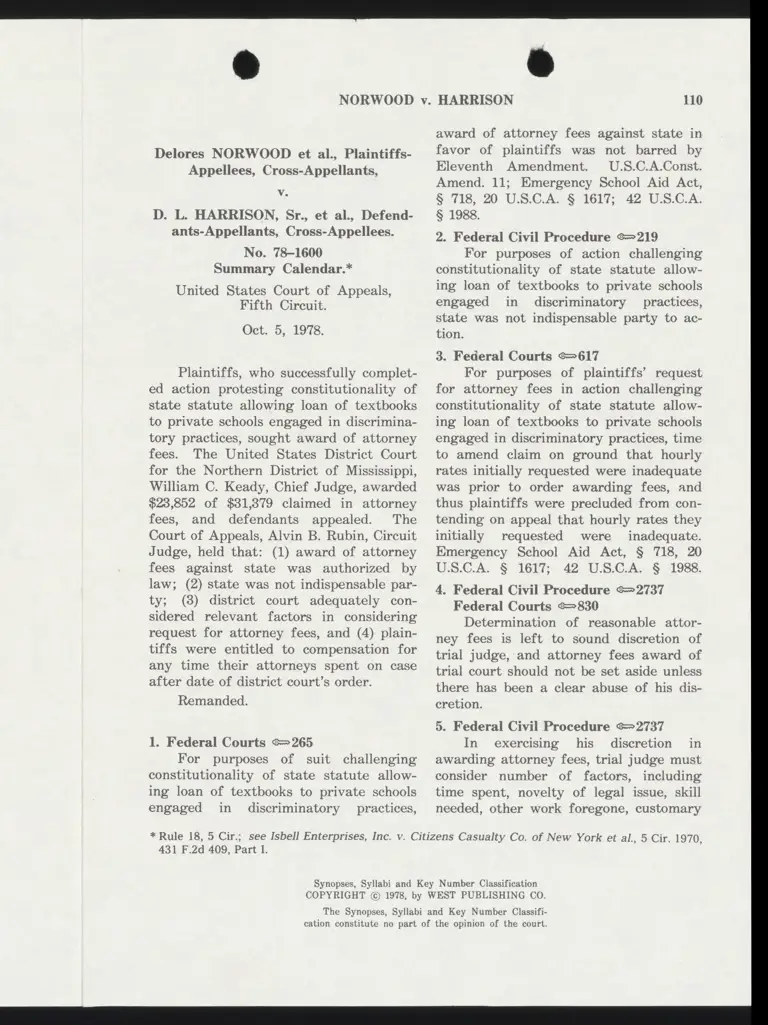
     [||f57d2fcc-52d2-4e5a-86c8-5541fbef58e7||] NORWOOD v. HARRISON

Delores NORWOOD et al., Plaintiffs-

Appellees, Cross-Appellants,

Vv.

D. L. HARRISON, Sr., et al., Defend-

ants-Appellants, Cross-Appellees.

No. 78-1600
Summary Calendar.*

United States Court of Appeals,
Fifth Circuit.

Oct. 5, 1978.

Plaintiffs, who successfully complet-
ed action protesting constitutionality of
state statute allowing loan of textbooks
to private schools engaged in discrimina-
tory practices, sought award of attorney
fees. The United States District Court
for the Northern District of Mississippi,
William C. Keady, Chief Judge, awarded
$23,852 of $31,379 claimed in attorney

fees, and defendants appealed. The
Court of Appeals, Alvin B. Rubin, Circuit
Judge, held that: (1) award of attorney
fees against state was authorized by
law; (2) state was not indispensable par-
ty; (3) district court adequately con-
sidered relevant factors in considering
request for attorney fees, and (4) plain-
tiffs were entitled to compensation for
any time their attorneys spent on case
after date of district court’s order.

Remanded.

1. Federal Courts ¢=265
For purposes of suit challenging

constitutionality of state statute allow-
ing loan of textbooks to private schools
engaged in discriminatory practices,

110

award of attorney fees against state in

favor of plaintiffs was not barred by
Eleventh Amendment. U.S.C.A.Const.
Amend. 11; Emergency School Aid Act,
§ 718, 20 U.S.C.A. § 1617; 42 US.C.A.
§ 1988.

2. Federal Civil Procedure ¢=219
For purposes of action challenging

constitutionality of state statute allow-
ing loan of textbooks to private schools
engaged in discriminatory practices,

state was not indispensable party to ac-

tion.

3. Federal Courts &=617
For purposes of plaintiffs’ request

for attorney fees in action challenging
constitutionality of state statute allow-
ing loan of textbooks to private schools
engaged in discriminatory practices, time
to amend claim on ground that hourly
rates initially requested were inadequate
was prior to order awarding fees, and
thus plaintiffs were precluded from con-
tending on appeal that hourly rates they
initially requested were inadequate.
Emergency School Aid Act, § 718, 20

US.CA. § 1617; 42 US.C.A. § 1988

4. Federal Civil Procedure ¢=2737

Federal Courts =830

Determination of reasonable attor-

ney fees is left to sound discretion of
trial judge, and attorney fees award of
trial court should not be set aside unless

there has been a clear abuse of his dis-

cretion.

5. Federal Civil Procedure ¢=2737
In exercising his discretion in

awarding attorney fees, trial judge must
consider number of factors, including
time spent, novelty of legal issue, skill
needed, other work foregone, customary

* Rule 18, 5 Cir.; see Isbell Enterprises, Inc. v. Citizens Casualty Co. of New York et al., 5 Cir. 1970,
431 F.2d 409, Part 1.

Synopses, Syllabi and Key Number Classification

COPYRIGHT © 1978, by WEST PUBLISHING CO.

The Synopses, Syllabi and Key Number Classifi-

cation constitute no part of the opinion of the court.


    111

fee for similar work in the community,
time limitations, experience of attorney,
awards in similar cases, and whether fee
is fixed or contingent; it is always not
only appropriate but mandatory for
court, in fixing fees, to consider all of
these factors.

6. Federal Courts ¢=2737.5
In action in which plaintiffs success-

fully challenged constitutionality of state
statute allowing loan of textbooks to pri-
vate schools engaged in discriminatory
practices, trial court gave adequate at-
tention to contingency factor in consider-
ing plaintiffs’ request for attorney fees.
Emergency School Aid Act, § 718, 20

US.C.A. § 1617; 42 US.C.A. § 1988.

7. Federal Courts ¢=2735
Plaintiffs, who successfully chal-

lenged constitutionality of state statute
allowing loan of textbooks to private
schools engaged in discriminatory prac-
tices, were entitled to be compensated
for any time their attorneys spent on
matter after date on which district court
entered its order awarding plaintiffs at-
torney fees. Emergency School Aid Act,
§ 718, 20 U.S.C.A. § 1617; 42 U.S.C.A.
§ 1988.

8. Federal Courts ¢=922
Although Court of Appeals had pow-

er to award attorney fees or to adjust
any award found to be inequitable,
where record did not disclose amount of
time counsel devoted to case following
district court’s order awarding attorney
fees, case would be remanded so that

parties could be heard in district court
on issue concerning additional award of
attorney fees for time spent by plain-
tiffs’ counsel following district court’s
order.

Appeals from the United States Dis-
trict Court for the Northern District of
Mississippi.

Before THORNBERRY, GODBOLD
and RUBIN, Circuit Judges.

NORWOOD v. HARRISON

ALVIN B. RUBIN, Circuit Judge:

Plaintiffs successfully completed an
action protesting the constitutionality of
a state statute allowing the loan of text-
books to private schools engaged in dis-
criminatory practices. The district court,
in a thorough and careful opinion,
awarded $23,852 of the $31,379 claimed

in attorneys’ fees, based on services ren-
dered for the period ending March 2,
1976, pursuant to Section 718 of the
Emergency School Aid Act, P.L. 92-318,

20 U.S.C. § 1617, and, alternatively, the

Civil Rights Attorneys Fees Awards Act,
P.L. 94-559, 42 U.S.C. § 1988.

Defendants appeal from the award,
claiming that it was barred by the Elev-
enth Amendment, that the statutory pro-

visions did not abrogate the state’s im-
munity to monetary judgment, and that
the state was an indispensable party to
the action. Plaintiffs cross-appeal for an
increase in the amount of fees awarded
and for additional fees to cover later

services.

For the reasons stated, we affirm the

judgment in the plaintiffs’ favor, and re-
mand for further allowance on the plain-

tiffs’ cross-appeal.

[1,2] During the pendency of the ap-
peal, the Supreme Court decided the case
of Hutto v. Finney, 1978, — U.S. ——,

98 S.Ct. 2565, 57 L.Ed.2d 522. That deci-
sion makes it clear that the award of
attorneys’ fees against the state is au-
thorized by law and that the state is not
indispensable. The sole remaining issue
is whether the district court improperly

failed to allow the additional amount for
services rendered.

The district court made an award for

the period ending March 2, 1976 with


.D


®
NORWOOD v. HARRISON 112

careful calculation. See Norwood v.
Harrison, N.D.Miss.1976, 410 F.Supp.
133. Plaintiffs had claimed a total of
$31,379; they were awarded $23,852.
For proceedings in the district court pri-
or to the first appeal, the plaintiffs had
claimed 406.85 hours at $35 per hour.
The court accepted the claim as to time
spent, but decided to vary the hourly fee
based on the type of service performed.
It awarded $20 per hour for writing let-
ters, attending conferences, routine mo-

tions, and preparing exhibits; $30 per
hour for depositions; $35 per hour for
drafting the complaint, legal research,
brief-writing, and courtroom appear-
ances. For work performed on remand
designing a certification program for
Mississippi private schools, the court
awarded the full claim of 141.5 hours at
$40 per hour. For time spent on appeal

to the Supreme Court, the court accept-
ed the hourly fee of $50, but decided
that the estimated time spent was exces-
sive and decreased the hours from 231 to
150. The award averaged $36.06 per
hour.

[3] Plaintiffs appear now to have
reached the conclusion that the hourly
rates they initially requested were inade-
quate. Whether or not this is the case,

the time to amend their claim was prior
to the order awarding fees.

[4,5] It is settled in this circuit that

“[t]he determination of a reasonable at-

torney’s fee is left to the sound discre-
tion of the trial judge.  .. :. . An
attorney’s fee award of a trial court
should not be set aside unless there has
been a clear abuse of his discretion.”
Weeks v. Southern Bell Telephone and
Telegraph Co., 5 Cir. 1972, 467 F.2d 95,

97 (citations omitted). In exercising his
discretion, the trial judge is directed by
Johnson v. Georgia Highway Express,
Inc., 5 Cir. 1974, 488 F.2d 714, to con-

sider a number of factors, including the

time spent, the novelty of the legal issue,
the skill needed, other work foregone,

the customary fee in the community,
time limitations, the experience of the
attorney, and awards in similar cases.
In this case adequate consideration was
given to all of these factors.

[6] It is always not only appropriate
but mandatory for a court, in fixing
fees, to consider all of the Johnson fac-

tors, including the customary fee for
similar work in the community, and
whether the fee is fixed or contingent.
We do not in this opinion endorse an
average fee of so much per hour in all
contingent fee cases, nor hold that the

lawyer who undertakes to handle a diffi-

cult case for a plaintiff on a contingent
basis should be held to the hourly fee
that is expected by attorneys whose re-
tainers are sure. In the award appealed
from, however, we think the trial court,

in considering the request for attorneys’
fees, framed as it was, gave adequate

attention to the contingency factor.

[7,8] The plaintiffs should, however,

be compensated for any time their attor-
neys spent on the matter after March 2,
1976. Although we have the power to
award attorneys’ fees, or to adjust any
award we find inequitable, see Brown v.
Culpepper, 5 Cir. 1977, 559 F.2d 274; Da-
vis v. Board of School Commissioners of
Mobile County, 5 Cir. 1976, 526 F.2d 865,

the record does not disclose the amount
of time counsel have devoted to this
case; we, therefore, think that the par-
ties should be heard on that issue in the
trial court. Fain v. Caddo Parish Police
Jury, 5 Cir. 1977, 564 F.2d 707, 709, n.4.

For these reasons, the awarded attor-
neys’ fees to March 2, 1976, is affirmed;
the case is remanded to the district
judge for a determination of appropriate
compensation for work performed since
its March 2 order.

REMANDED.

Adm. Office, U.S. Courts—West Publishing Company, Saint Paul, Minn. [||f57d2fcc-52d2-4e5a-86c8-5541fbef58e7||]