Agreement; General Order
Public Court Documents
April 22, 1980
13 pages
-
Case Files, Garner Hardbacks. Agreement; General Order, 1980. ec0778fb-26a8-f011-bbd3-000d3a53d084. LDF Archives, Thurgood Marshall Institute. https://ldfrecollection.org/archives/archives-search/archives-item/3623cb6e-5456-4b49-aeba-7d855551242b/agreement-general-order. Accessed September 29, 2026.
Copied!
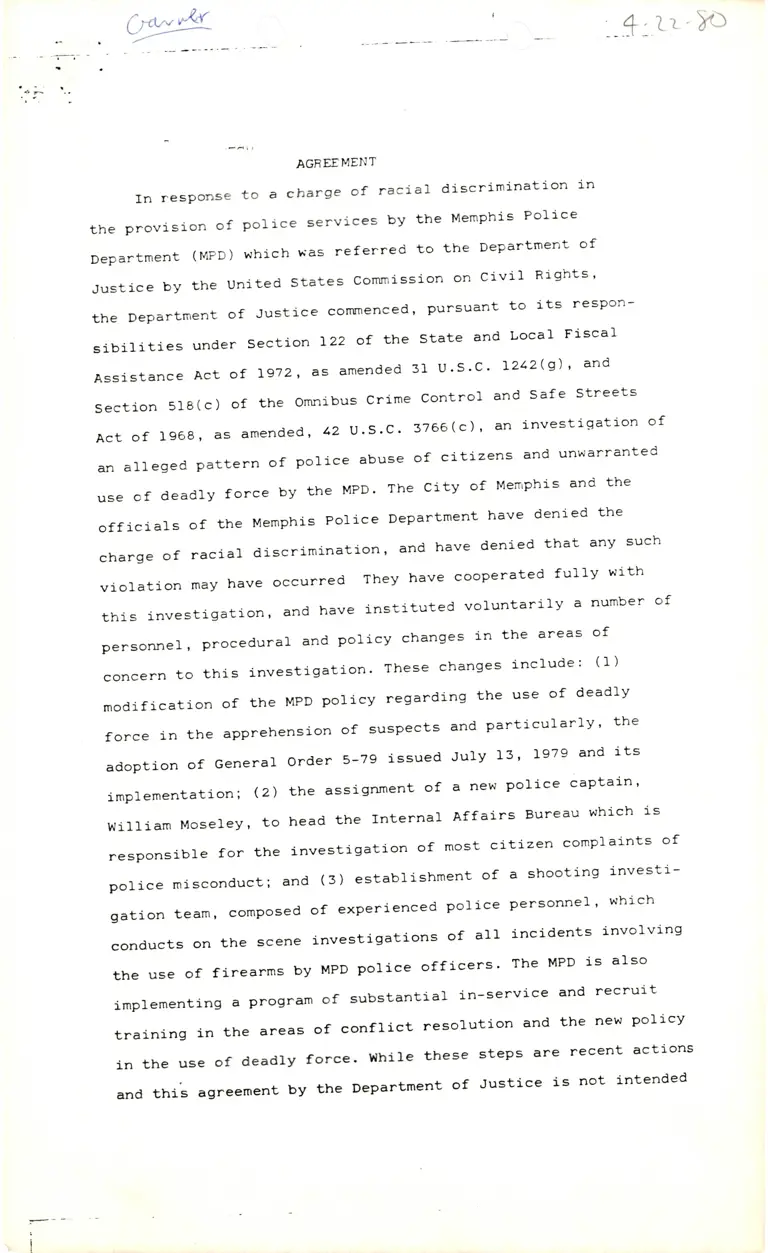
AGREEMENT
in response to a charge of racial discrimination in
the provision of police services by the Memphis Police
Department (MPD) which was referred to the Department of
justice by the United States Comrr.ission on Civil Bights,
the Department of Justice commenced, pursuant to its respon
sibilities under Section 122 of the State and Local Fiscal
Assistance Act of 1972, as amended 31 U.S.C. 1222(g), and
section 518(c) of the Omnibus Crime Control and Safe Streets
Act of 1968, as amended, 22 U.S.C. 3766(c), an investigation of
an alleged pattern of police abuse of citizens and unwarranted
use of deadly force by the MPD. The City of Memphis and the
officials of the Memphis Police Department have denied the
charge of racial discrimination, and have denied that any such
violation may have occurred They have cooperated fully with
this investigation, and have instituted voluntarily a number of
personnel, procedural and policy changes in the areas of
concern to this investigation. These changes include: (1)
modification of the MPD policy regarding the use of deadly
force in the apprehension of suspects and particularly,
adoption of General Order 5-79 issued July 13, 1979 and its
implementation; (2) the assignment of a new police captain,
William Moseley, to head the Internal Affairs Bureau which is
responsible for the investigation of most citizen complaints of
police misconduct; and (3) establishment of a shooting investi
gation team, composed of experienced police personnel, which
conducts on the scene investigations of all incidents involving
the use of firearms by MPD police officers. The MPD is also
implementing a program of substantial in-service and recrui
training in the areas of conflict resolution and the new policy
in the use of deadly force, while these steps are recent actions
and this agreement by the Department of Justice is not intended
as an endorsement oi the deadly force policy set forth in
General Order 5-79 in particular with respect to its provision
regarding third-degree burglaries, the Department of Justice
recognizes that the City and the MPD have taken significant
steps to ensure rore effective and fair provision of police
services not only to the Memphis black community but throughout
the City of Memphis, and they have thereby exhibited a commit
ment to the same goals of fair and effective law enforcement as
are sought by the Department of Justice. Accordingly the
Department has agreed to defer further investigation, and the
City has agreed to the following.
1, The City of Memphis agrees that it will not engage
in any act or practice which will have the purpose or effect
of causing discrimination on the basis of race in the provision
of police services in violation of Section 122 of the State
and Local Fiscal Assistance Act of 1972 or of Section 518(c) of
the omnibus Crime Control Act of 1968. The City avers that it
is and will remain the policy of the City and the MPD that all
persons will be treated by Memphis police officers fairly and
equally without regard to race; that complaints of police
misconduct will be fairly and thoroughly investigated, and,
where it is determined that such charges are well founded,
appropriate discipline will be administered; and that strict
adherence with the policy set out in General Order 5-79 issued
July 13, 1979 will be required in police use of deadly force. A
copy of General Order 5-79 is attached.
2. The City and the MPD will continue the development
and implementation of the in-service and recruit training
programs regarding conflict resolution and use of deadly
force to ensure that all officers are aware of the MPD policy
on deadly force and of the circumstances under which such
use is or is not justified and appropriate.
- 2 -
The City and the MPD shall maintain all records
relating to complaints of police misconduct, and to police use
of deadly force for a period of five (5) years from date of
preparation and all such records shall be made available for
inspection and copying by the Department of Justice upon
written request. Such records shall include the forms and
reports presently used, as well as the following logs:
(a) A log of complaints of police misconduct shall
be maintained at the Internal Affairs Bureau (lAB), showing
the name, address, and race of the complaining party (or, where
the complaint is filed by an organization, the name of the
alleged victim), the date of the alleged misconduct, the
name(s) and race of the officer(s) involved, the nature of the
alleged misconduct, and the disposition of the lAB investiga
tion, including, if the complaint was sustained, the discipli
nary action taken. It is understood that all complaints of
police misconduct will be received at the lAB, and that
precinct supervisors will be instructed to refer all complaints
received at the precinct offices to the lAB.
(b) A log shall be maintained by the MPD of all arrests
where a suspect subsequently receives medical treatment because
of injury related to the arrest. The log shall indicate the
name, address, and race of the suspect, the name and race of
the arresting officers, and the date and time of arrest and the
offense. The log shall also indicate the nature and extent of
the injuries received by the suspect, to the extent that such
information is known or is available from the treatment
facility, and the place where treatment was administered.
4. The City and the MPD shall submit a quarterly
report to the Department of Justice containing the follow
ing information:
(a) A summary of the efforts by the City and the
MPD during the reporting period in developing and
- 3 -
implementing the in-service and recruit training
programs in the areas of conflict resolution and use
of deadly force.
(b) A summary of firearms use incidents occurring
or resolved during the reporting period, showing the
name, address, age and race of the suspect(s), the
criminal activity Involved, the name and race of the
officer(s) involved, a brief description of the
incident and the action taken by the MPD regarding
the incident. Where the action taken by the MPD is
reviewed by the Civil Service Commission of the City,
the action taken by the Civil Service Commission
shall be reported.
(c) A summary, by nature of complaint and race
of the complainant, of the number of complaints
filed during the reporting period, and a summary
of the disposition of the complaints, by nature of
complaint and race of complainant.
(d) The number of suspects, by race, receiving
.edical treatment for injuries related to the arrest
during the reporting period.
5. The parties hereto agree that this Agreement and the
aforesaid quarterly reports shall continue for a period of two
and one-half (2^) years from the signing of this Agreement.
Should the Department of Justice believe that the City has
failed to comply with this Agreement, it shall notify the City,
and the parties will meet promptly to attempt to resolve the
matter without litigation. At the conclusion of two years, the
parties shall meet to review the performance of the City and
the MPD in terms of the equitable provision of police services
to the Memphis community and the overall objectives of this
Agreement.
- A -
Agreemen
April, 1980.
t aqreed to and entered into t h i s ^ ’V d a y of
DREW 5. DAYS III ^ _
Assistant A t t orney General
MICHAEL CODY
S tates— ^ttornfey
DAVID L. ROSE GERALD F . GEORGE
Attorneys
U.S. Department of Justice
Washington, D-C. 20530
2-
M I j ^ P H I S P O L I C E D E F ^ ^ M E N T
na« A O A M B A V » N U « 'M « M P H 1B ,T «N N E 8 8 B « 38*ie>3
rsiUfVlBER:
SUBueCT:
izzt D A T E : 16 J u l y 1 9 7 9
DEADLY FORCE POLICY
1. PURPOSE.
To establish uniform policies regarding the use of deadly force by members of this
department and to establish procedures for the investigation and review of police
shooting incidents. This order rescinds General Orders 18-76, 13-76, 13-77, 4-74, and
72-6 and Command Bulletin 9-77.
2. ACTION,
a. USE OF DEADLY ■<̂ 0RCE
Definitions:
(1) DANGEROUS FELONY - A dangerous felony is any felony wherein the
suspect has used, threatened to use, or attempted to use deadly
force in the commission of a crime. Dangerous felonies include
the following crimes:
(a) Kidnapping
(b) Murder in the 1st or 2nd degree
(c) Manslaughter
(d) Arson
(e) Criminal Sexual Assault, 1st, 2nd, or 3rd degree (Rape and Attempt Rape
(f) Aggravated Assault
(g) Robbery
(h) Burglary, 1st, 2nd, or 3rd degree
(i) Any attempt to commit the above crimes.
(2) DEADLY FORCE - That amount of force that is sufficient to, intended
to, or may be reasonably expected to inflict serious bodily injury and/or
death. This includes the discharge of any firearm at, near, or in the
direction of any individual.
(3) JUVENILE - Any person under the age of eighteen-(18) years.
- 2 -
REASONABLE BELIEF - Such belief as would appear reasonable to the
o S y ^nd prudent police officer of ^ I ^ ^ . ^ X c ^ r
rircumstances Such belief is not reasonable if the ofticer is
reckless or negligent 1n having T f ' " / " “'"uw°which
usinq all alternate methods other than deadly force, ho e ,
concludes that any other means will be ’rter to
tn the officer or some innocent third party, in oroer
s s t r s t ^ i : “iiihi:ihrt^Jirisford;t5ry"?s:u™war^
necessary The officer must also have communicated
r S ? r a u r f n h n r b ’irie^sire
his part could eliminate the immediate need for deadly rorce.
SOn01^ uni 00 \ • , twa /̂ Anĉ jiKlp W35 COnVTCt0u o<
r s t a ^ b t ^ ^ A ^ S n ^ e l u M - f o p h ^ ^ ^ ^ ^ ^ ^
down this rule for the State of Tennessee.
An officer having a prisoner in custody who attempts
escfprwill be excused for killing him if he cannot be
otha^ise retaken, but if he can
in any case without resort to such harsh measures, t
will be at least manslaughter to kill him. The o .,
doubtless acted under the belief that =
as to the rights of a public officer, that is, tnat ne
SIL lawfully kill a prisoner if he fails to obey his
corinand to halt. This is a very erroneous
doctrine and must be corrected. Officers should under
stand that it is their duty to use such means to secure
nriLner^as will enable them to hold them in cus-
Sd7-?thrur;is“ tTirt the use of firea^s or danger-us
weapons and that they will not be excused for ,aMng li^-
in any case, where, with diligence and cau.ion, -he o .
soner could otherwise be taken.
- J -
This earlier Tennessee law has since been applied in many other
cases involving the use of deadly force by police officers and
is equally applicable to situations where an attempt is being
made to apprehend a fleeing felon. The Tennessee Supreme Court
in Scarbrough v. State > 76 S. W. 2d 106, (1934) , specifically
applied the above rule of law to cases involving fleeing felons.
The court said:
The law does not clothe an officer with authority
to arbitrarily judge the necessity of killing, and
such a course must be a last resort; and whether or
not there was a necessity for killing, and the
reasonableness of the grounds upon which the officer
acted are questions of fact for a jury. Killing in
flight is excusable only when it is shown that the
felon cannot be ultimately taken by less drastic means.
Deadly force may be used in the following circumstances after all other
reasonable means of apprehension or prevention have been exhausted:
(1) In self-defense where the officer has been attacked with
deadly force or is being threatened with the use of deadly
force.
(2) In defense of others where a third party has been attacked with
deadly force or is being threatened with the use of deadly force
or is in danger of serous bodily injury or death during the
actual comrission of a crime against his person.
(3) To prevent the coimiission of a dangerous felony in progress.
(4) To apprehend a suspect fleeing from the commission of a dangerous
felony when an officer has witnessed the offense or has sufficient
information to know as a virtual certainty that the suspect committed
the offense.
(5) To kill an animal which poses a direct threat to the safety of the
officer or other persons. However, the Ordnance Section should be
called to handle such a matter unless the danger is immediate,
USE OF DEADLY FORCE PROHIBITED
The use of deadly force is prohibited in the following circumstances:
(1) To apprehend or arrest a person for a misdemeanor offense.
(2) To effect the arrest of any person- for escape from the commission
of any misdemeanor offense.
(3) As warning shots.
■' /I ̂ Tc aoDrehend or arrest a oerson known t o b e o r beT^eved to be a
■'uvenile unless the use of deadly force is imnediately necessary
in the de-^ense of the office'-'s life or of another oerson s li e ̂
when all other reasonable means have been exhausted, "he of icer s
knowledge or belief of a person's age may be based uoor, fac-ors
such as the officer's previous knowledge of the person, his obser
vations of the person's aopearance, or upon reliable information
given to him by other persons.
(5) To apprehend or arrest a person fleeing from a felony is not
a dangerous felony. This includes felonies such as auto Theft,
larceny, embezzlement, fraud, burglary of an auto, or any other
felony which does not involve the use use of deadly force, attempted
use of deadly force, or threatened use of deadly force.
(6) From or at any moving vehicle except in a case where
felony has been committed in the officer s presence and the off cer
has determined that there is a much greater threat to innocent lives
by not using deadly force. In making this detemination, The officer
must consider the consequences of stray shots e;;<^aogenng ^"oo^en.
parties and must consider the consequences of the vehicle out
of control at a high rate of speed. Officers should be
cautious in using deadly force in self-defense
used by the other person is an automobile, and the other person s
trying^to get away. The suspect's intentions are ‘usually ambiguous,
and th-i officer can usually esc:?e harm ct least as ^
the vehicle as he can by standing his ground and ®T
coming vehicle. An officer almost never has a safe, effective shot
a ^ a moiling vehicle. This is particularly true when an officer s
involved in a high speed chase and is shooting from a moving vehicle.
(7) In any other case where the officer does not have a olear f^ld of
fire and cannot be virtually certain that only the susoect will e
hit and that the potential for harm to innocent persons is minimum.
d. NOTIFICATION PROCEDURES WHEN WEAPONS ARE FIRED
When any officer of the Memphis Police Department discharges any ^iream.
whether^on duty or off duty, the officer will immediately report the
incident to the dispatcher who will have the ^^jnizant Watch or Squad
Comnander notified. This Commander will proceed to The scene
shootinq and will begin an immediate investigation and notify the precinct
or b U L comnbnder^f the Incident The V ^ s o T a J e tht
Visor's Shooting Incident Report (Attachment 1). and ^ ®
officer prepare a Firearms Use Report (Form-2100.149,
Connande? will also request a Crime Scene Squad unit to
if necessary. The Cormiander on the scene may also ®
assistance from the Investigative Services Division if said Conmander
feels that it is necessary.
In all shooting incidents where a suspect, other officer,
15 wounded or killed, the Watch or Squad Comander will request that both
Crime Scene end the Investigative Se|-ices ^’vision conduct an on-the^
investigation. The Commander in such cases is to imnedia.e.y relieve tne
the involved officer of duty oending the completion of the preliminary
investigation. The Cormander will notify the on duty or on call Staff
Commander, and a decision will be made as to the necessity for notifying
the Police Legal Advisor and the Shelby County Attorney General's Office
for additional investigation.
e. REVIEW PROCEDURES
All reports, including the Firearms Use Report, Supervisor's Shooting
Incident report. Crime Scene report, and General Investigation Squad
report, copies of arrest tickets, offense reports, and memos will be
immediately forwarded directly to the Deputy Director of Operations,
prior to the end of the reporting officer's tour of duty.
Upon reviewing all initial reports, the Deputy Director of Operations
will take the following action:
(1) Determine that no additional administrative investigation is required
and either notify the officer by letter that no action is to be taken
or issue a statement of charges using established disciplinary pro
cedures..
(2) Determine that additional administrative investigation is required
and assign this investigation to the Internal Affairs Bureau.
After the completion of the Internal Affairs inveTtigation, all file material
will be returned to the Deputy Director of Operations. The Deputy Director
of Operations shall take one of the following actions;
(1) Notify the officer by letter that no action is to be taken; or
(2) Submit the investigative file to the Police Legal Advisor for review
by the Attorney General's Office and/or the Shelby County Grand Jury.
(3) Issue a statement of charges using the established disciplinary pro
cedures and/or schedule the case to be presented to the Trial Board
for a hearing.
3. This bulletin will remain in effect until revoked or superceded by competent
authority.
Distribution
A . & .
L / J. D. Holt
Deputy Director of Operations
I ' J' i
.^o»‘.xun verity tne report or the orricer as to;
1. Nuaber shots fired by officer;
If not „plaln:
es No 2. Nuaber of shots fired by suspect;
If not explain;
OC.SfcXlt,e»^AN-.E:^ 'N ■NVOI.VEO- &UCH A& ftAQlO A>alUNV.US T . O
GIVE w o r d i n g o f m e s s a g e TRANSMITTER.
ON V iE .v - e iC . If n * G « - ■’,s iNME^r-
ISTANCE FROM SUSPECT wttEN F lR jT SHOT WAS FIRCO
DISTANCE FROM SUSPECT WHEN LAST SHOT WAS F1* E P
FEET
FEET
n u m b e r OF SHOTS FIRED BY YOU:
OFFICER’S POSmOS:
n HIP □ s t a n d i n g _ sitting PRONE □ KNEELING Z o t h e r ■ SPECIFY
_ YCS Z NO ”
O to YOU HAVE ■••.EAPCN ORAV.ri A-.O REAO^ fC R USE'b EFORE YOU NEEDED IT?
a r e YOU
O RIGHT handed □ left —aNOEO
Oto YOU HAVE TO RELO AD ’
□ YCS O - NO
“T
* REMARKS OR R E C O W E N D A T IO N S , FOR WEAPONS OR TRAIN .NG
I
I_1_
I f YES, h Qv; m a n y w e r e YOU A 3 l £ TO RELOAD?
• HO".*/ LONG OlO IT T A K * SECONDS?
d i d YOU COUNT YOUR Sh CTS A j ' 'C U FIREG?
Q YCS n NO
H|0 YOUR WEAPON WORK PROPERLY*
I □ YCS □ NO IF NOT. EYPL/^'N C*' p EVEO«E SIDE
DIO YOU HAVE TIME TO SIGHT AVD A IM ’
□ YCS □ NO
' n u m b e r OF SHOTS FIRED;
' □ SINGLE ACTION Z DOUBLE A ':~ 'ON
INJURIES: SUSPECT WAS
□ NOTW OUNOCO □ s u p e r f i c i a l l y WOUNOCO
OFFICER INVOLVED WAS
O NOTW OUNOCO C S .—C R F IC IA LLY PfOONOCD________________________ ■
iiw-> YOU uSCO • SUCH ^ U G h T p o l e s , d o o r w a y s , c a r . r u i <-.. . w R i., e •
□ C R IT IC A L L Y WOUNOCO
Z c r i t i c a l l y WOUNOCO
killTD
KI'.L*- .1
OESCRI8E PROTECTIVE COVER .VHi
WHY OlO >'OU USE YOUR WEAPON’
□ p r o t e c t s e l f Z p r o t e c t Ci t i z e n □ p r e v e n t f e l o n y
Z SuSPCCT WANTED FOR: ^ OTHER ■ SPECI'N '
Z prevent ESC A- R - 0 A 'E..ON
AC KG SC '.N O • V.'HA' 3 - .— t. • ,f VCU missed I
NOTE. '*'1 R T V C R ' " ' C t. 01'. £ a ~ '
wHtc - ■ u i - A ■ -
F O L u C w Ch R C N C L O G i C A l • A C t ' R ^
.. _ - - n a p RA T ;\ e ACC ■ - ‘ I '
- - - ' / t 3 £ r * i AVC'. c - c
£ , £*%r > Aŝ rhly ol.»lhaCLRAE^'^'.^hC~T|., ̂ -