Brief of Orleans Parish School Board, Defendant-Appellee-Appellant
Public Court Documents
June 20, 1962
27 pages
-
Case Files, Bush v. Orleans Parish School Board. Brief of Orleans Parish School Board, Defendant-Appellee-Appellant, 1962. 81ee9b6a-d2fd-f011-8406-0022482cdbbc. LDF Archives, Thurgood Marshall Institute. https://ldfrecollection.org/archives/archives-search/archives-item/373cca2e-b7fd-4a95-ba49-27c1132dc250/brief-of-orleans-parish-school-board-defendant-appellee-appellant. Accessed October 06, 2026.
Copied!
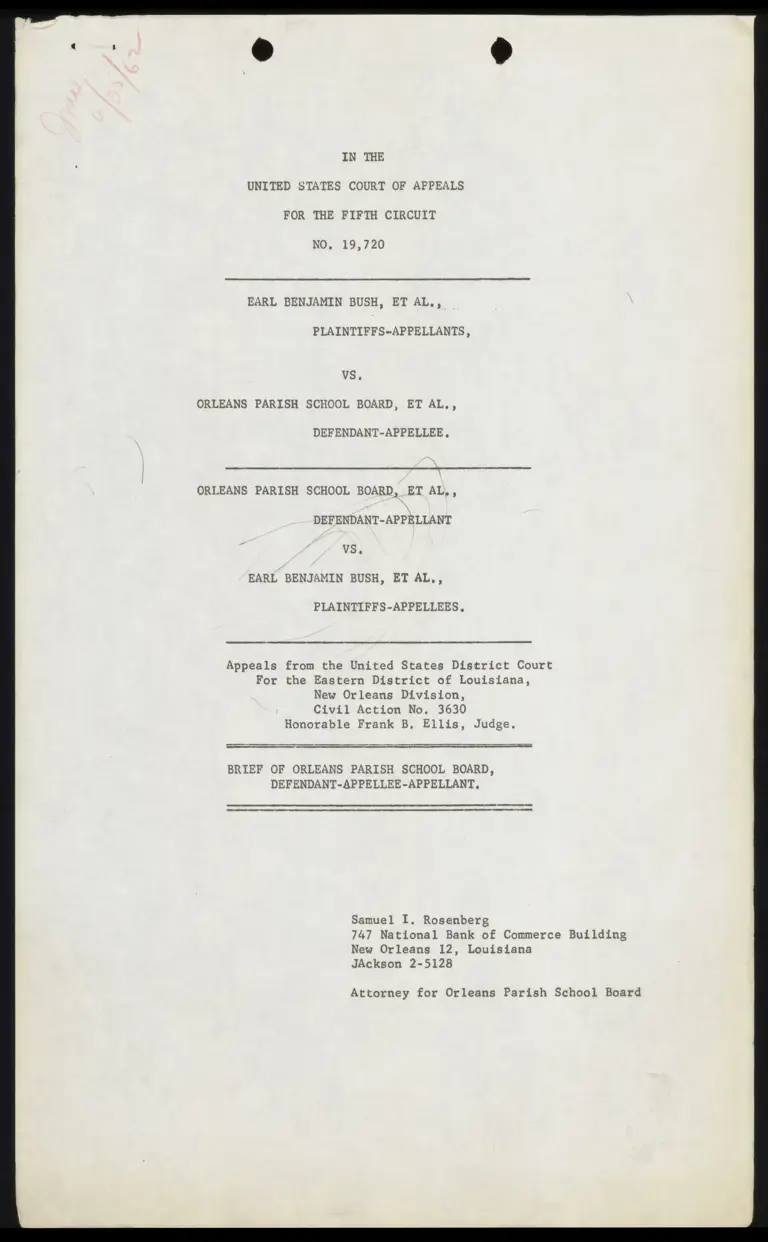
    IN THE

UNITED STATES COURT OF APPEALS

FOR THE FIFTH CIRCUIT

NO. 19,720

EARL BENJAMIN BUSH, ET AL.,

PLAINTIFFS~APPELLANTS,

VS.

ORLEANS PARISH SCHOOL BOARD, ET AL.,

DEFENDANT-APPELLEE,

ORLEANS PARISH SCHOOL BOARD, ET AL,,

DEFENDANT-APPELLANT

Vs.

EARL BENJAMIN BUSH, ET AL,,

PLAINTIFFS-APPELLEES,

Appeals from the United States District Court
For the Eastern District of Louisiana,

New Orleans Division,

Civil Action No, 3630

Honorable Frank B, Ellis, Judge.

FE Cr iv ——

BRIEF OF ORLEANS PARISH SCHOOL BOARD,

DEFENDANT-APPELLEE-APPELLANT,

Samuel I. Rosenberg
747 National Bank of Commerce Building
New Orleans 12, Louisiana

JAckson 2-5128

Attorney for Orleans Parish School Board


LIDEX

PAGE

STATEMENT OF CASE 1

SPECIFICATION OF ERROR 2

LAW AND ARGUMENT

PART I ly

PART II 10

PART III 16

CONCLUSION 19

FOOTNOTES Following Page 20

TABLE OF CASES

BROWN VS. BOARD OF EDUCATION L,5,6,18
eT UsBe O53, [1 3. OC,,056,
98 L. Ed. 873 (1954) and
39 U.S, 20k, 75'8. Ct, 753,

99 L, Ed, 1083 (1955),

CARSON VS. BOARD OF EDUCATION OF
MCDOWELL CO., ([ Cir. 1955) 227 F, 17

(2d) 789.

CARSON VS. WARLICK,(L Cir. 1956) 238 17
F,(2d) 72l,, certiorari denied 1957,
353 Ue 8. 910, 77 8. Ct,, 665, 1:1,
Ed, (2d)66L

CoorrR ya, AARON, 358 U.8, 1,78 3, y,6,13
Ct. 1101, (1958),

COVINGTON VS. EDWARDS, (DeCeM.D N.C, 17
1958 165 ¥, SPP. 057, Affirmed
L cir. 1959, 26 F.(2nd)780,
certiorari denied 1959, 361 U,S,
840, 80 8, ct, 78, L 1.23.{24)79.

FARLEY VS. TURNER, 281 F, (24) 131 (4th 16
Cir, 1900},

GIBSON VS. BOARD OF PUBLIC INSTRUCTION
OF “DADE CO, ,Flhey 212 Fa (2d) (03,
(5th Cir,1959); and 2,46 F, (2d) 913
(5th Cir, 1957). 12

HOLT VS. RALEIGH CITY BOARD OF EDUCATION, 17
( D.C.E,D,N.C, 19504 16, F, Supp. 853,
Affirmed lL cir, 1959, 265 F, (2d)95,
certiorari denied 19,9, 361 U,s., 818,
80 S.Ct, 59, IL L. Ed. (2463,


INDEX (CONT, )

SCHOOL BOARD OF
JONES VS./ CITY OF ALGXANDRIA, VA.,

278 F. (2d) 72 (LTh Cir. 1960).

MANNINGS VS. BOARD OF PUBLIC EDUCATION,
277 F. (2d) 370,” ~ (5th Cir, 1960).

MCKISSICK VS. DURHAM CITY BOARD OF
EDUCATION, D.C,M,D.N.C, 1959,) 176

NORTHCROSS VS. BOARD OF EDUCATION,
(6th Cir, March 23, 1962) No.
11162 (Not yet reported).

PARHAM VS, DOVE, 271 F, (24) 132 (8th
Cir. 1059), and 282 F, (2d) 256
(8th cir, 1960).

RIPPY VS. BORDERS, 250 F., (24) 690,
(5th Cir, 1957), See also 275 F,
(2d) 850 and 285 F, (2d) 13 and
2h? FP. (2d) 268,

SCHOOL BOARD OF CITY OF CHAR LOTTESVILIE,
VA,, VS, ALLEN, 2H0 ¥, (2d) 59
(ith Cir, 1956).

SHUTTIESWORTH VS, ALABAMA, (ND AILA-1958)
162"¥., Supp. 3/2, Air'd, 356 0.8,101,

STATUTES

LA, ACT 192 OF 196.0 (R,S.17:101, et seq.)

PAGE

13

12, 13

17

11,1k,15

13

1h,17, 19

Ts 10

2,3,15,16


INDEX

PAGE

STATEMENT OF CASE 1

SPECIFICATION OF ERROR 2

LAW AND ARGUMENT

PART I ly

PART II 10

PART ITI 16

CONCLUSION 19

FOOTNOTES Following Page 20

TABLE OF CASES

BROWN VS. BOARD OF EDUCATION h,5,6,18
S07 Ue, GB3, II =, OL, ,580,
98 L, Ed. 873 (195) and
349 9.8. 20h, 753. Cu. 753,

99 L. Ed. 1083 (1955).

CARSON VS. BOARD OF EDUCATION OF
ICDOWEILL_CO., (I Cir, 1955) 227 F, 17

(2d) 789.

CARSON VS. WARLICK,(L Cir. 1956) 238 17
F.(2d) 72, certiorari denied 1957,
353 YU. 8, G10, TTS. Cb., 565, 1 1,
Ed, (2d)66l ,

COOPER VS. AARON, 358 U.S. 1,78 S. l,6,13
Ct, 1401, (1958),

COVINGTON VS. EDWARDS, (DeC.M.D.N.C. 17
1958) 165 F, Supp. 957, Affirmed
Ly Cir, 1959, ai F, (2nd) 780,
certiorari denied 1959, 361 U,S,
810, BO 8. Ct, 78, hh L.Ra.(24)79,

FARLEY V3. TURNER, 281 F, (24) 131 (4th 16
Cir, 1900),

GIBSON VS. BOARD OF PUBLIC INSTRUCTION
OF DADE CO.,FLA., 272 F. (2d) 703,
(5th Cir,1959); and 2,6 F, (2d) 913
(5th Cir. 1957). 12

HOLT VS. RALEIGH CITY BOARD OF EDUCATION, 17

Affirmed lL cir, 1959, 265 F, (24)95,
certiorari denied 19/9, 361 U.S. 818,
80 s.Ct. 59, Ii L. Ed. (2463.


INDEX (CONT. )

PAGE

SCHOOL BOARD OF
JONES VS,/ CITY OF ALEXANDRIA, VA,., 13

20 ¥, 12d) (2 LTH Cire 1900),

MANNINGS VS. BOARD OF PUBLIC EDUCATION, 12, 13
217 Fe 124) 370, “(oth Civ, 1950).

MCKISSICK VS. DURHAM CITY BOARD OF
EDUCATION ,( D.C, M,D.N.C, 1959,) 176 17
Fo. Supp. 3

NORTHCROSS VS. BOARD OF EDUCATION, 11,1),15
(6th Cir. March 23, 1962) No.
111612 (Not yet reported),

PARHAM VS. DOVE, 271 F., (2d) 132 (8th 13
Gir. 19507, and 282 7», (24) 256
(8th cir, 1960).

RIPPY VS. BORDERS, 250 F, (24) 690, 1,17, 19
(5th Cir, 1957), See also 275 F,
(2d) 850 and 285 F, (24) L3 and
2h? ». (24) 268,

SCHOOL BOARD OF CITY OF CHAR LOTTESVILIE ,
Vas ‘o. ALIN, fT. Cg 1
(Ith Cir. 1956).

SHUTTIESWORTH VS. ALABAMA, (ND ALA-1958) Ts 10
160 :, Supp. 312s ALT 14.358 0.8.10],

STATUTES

LA. ACT L92 OF 196.0 (R.S.17:101, et seq.) 2,3,15,16


IN THE

UNITED STATES CCURT OF APPEALS

FOR THE FIFTH CIRCUIT

NO. 19,720

EARL BENJAMIN BUSH, ET AL,,

PLAINTIFFS-APPELLANTS,

vs.

ORLEANS PARISH SCHOOL BOARD, ET AL,,

DEFENDANT-APPELLEE,

ORLEANS PARISH SCHOOL BOARD, ET AL.,

DEFENDANT-APPELLANT

VS.

EARL BENJAMIN BUSH, ET AL.,

PLAINTIFFS-APPELLEES,

Appeals from the United States District Court
For the Eastern District of Louisiana,

New Orleans Division,

Civil Action No. 3630

Honorable Frank B, Ellis, Judge.

BRIEF OF ORLEANS PARISH SCHOOL BOARD,

DEFENDANT-APPELLEE-APPELLANT,

STATEMENT OF THE CASE

This is an appeal from an order entered May 29, 1962 in the court

below. Plaintiffs and plaintiff-intervenors filed a notice of appeal

herein, but only plaintiffs have filed a brief. The Orleans Parish

School Board, defendant below, has appealed from Paragraph 6 of the

order entered below. For purposes of brevity, Earl Benjamin Bush, et

al., will be referred to herein as appellant, and the Orleans Parish

School Board will be referred to herein as appellee.

Most of the details contained in the first thirteen pages of

appellant's brief, are substantially correct, and no useful purpose

would be accomplished in reiterating said detail herein. However, the

court's attention is deferentially directed to the following:


- Page 2 -

On Page 7, Paragraph 2, first sentence of appellant's

brief, the figures therein quoted include 11 institu-

tional classes, and actually there are only 117 schools

in the Orleans Parish School System, of which 64 are

white, and 53 are Negro. (Exhibit P-9, Page 2).

On Page 8, Line 2, of appellant's brief, the numerals

"40" should be "30" (Exhibit P-9, Page 31); or, if

appellant intended to show the percentage of Negro

classes having more than 40 pupils, the numerals

"46.2%" should be "4.7%".

On Page 6, Paragraph 2, of appellant's brief, reference

is made to the motion to dismiss filed by appellees.

The court below indicated that the motion would be

taken "...with the balance of the matter." (Tr. P.5)

But no disposition was ever made of this motion.

The inferences, conclusions, and implications drawn from the facts

recited in appellant's brief, will be rebutted in that portion of this

brief which will be devoted to "LAW AND ARGUMENT."

SPECIFICATION OF ERROR

The District Court erred in ordering that:

The Louisiana Pupil Placement Law may be applied
to any child only where dual school systems based
on race have been eliminated and assignments are
made without regard to race."

The allegation of error is predicated upon the following proposi-

tions:

(a)

(b)

(c)

(d)

The Orleans Parish School Board has made a prompt
and reasonable start toward full compliance with the
May 17, 1954 ruling of the United States Supreme Court.

Time is needed to carry out the ruling of the Supreme

Court in an effective manner.

During a period of transition to a racially non-
discriminatory school system, a Pupil Placement Law
may be applied to dual school systems.

Appellants have not exhausted all administrative
remedies provided for in Louisiana Act 492 of 1960
(R.S. 17:101, et seq.).


(e)

(f)

(g)

- Page 3 -

Appellants have not exercised the option given to them

in early orders of this Court to attend " ..either

the formerly all white public school nearest their

home, or the formerly all negro public school nearest

their home..."

No pupil, whose application for transfer was denied,

is before the Court; nor has any such pupil ever

filed an objection with appellee to his assignment

to a particular school or requested assignment

to another school to be designated by the Board, all

as is provided for in R. S. 17:106.

The constitutionality of Louisiana Act 492 of 1960

is not here attacked. Injunctive relief can be

granted only to those who allege, and prove that

they have exhausted the administrative remedies set

forth in the statute, and the rights which they

claim must be asserted as individuals, and not as a

class or group.


- Page 4 -

LAW AND ARGUMENT

1.

MAY COURTS PERMIT AN EFFECTIVE GRADUAL ADJUSTMENT TO BE

BROUGHT ABOUT FROM EXISTING SEGREGATED SCHOOL SYSTEMS TO A

SYSTEM NOT BASED ON COLOR DISTINCTION?

1/
In the first Brown™ decision, the United States Supreme Court was con-

fronted with the identical question here being considered. Although the

Court had previously requested briefs on this question, it realized its

tremendous importance, and instead of answering the question in its first

opinion, asked for further argument at a later date, on its questions 4

2/
and 5. After additional briefs and further arguments, the Court, in the

3/
second Brown opinion,” said:

"...The Courts will require that the defendants make
a prompt and reasonable start toward full compliance with

our May 17, 1954 ruling. Once such a start has been made,
the Courts may find that additional time is necessary to

carry out the ruling in an effective manner...'' (Underscor-

ing mine)

4
In Cooper vs, Aaron! the Court again indicated that the construc-

tive use of time was an acceptable and oftentimes desirable conclusion

for a District Court to reach, and at Page 1404, the Court said:

"On the other hand, a District Court, after analysis of the
relevant factors (which, of course, excludes hostility to

racial desegregation) might conclude that justification

existed for not requiring the present non-segregated ad-
mission of all qualified Negro children. In such circum-

stances, however, the Court should scrutinize the program

of the school authorities to make sure that they had de-
veloped arrangements pointed toward the earliest practi-

cable completion of desegregation, and had taken appro-
priate steps to put their program into effective opera-

tion..." (Underscoring mine)

In the opinion below, the Court calls attention to a resolution of

appellee adopted on May 14, 1962, which said resolution is set forth in

full in footnote 22 of said opinion, and on Page 12 thereof the Court

said:

"By this the Board supplements good faith with affirmative
performance. The Board's formal decision to comply with
the orders of this Court coupled with the order handed
down this day represents, to the Court's satisfaction, an
active plan of desegregation under Brown that will ade-
quately protect plaintiffs’ rights as well as the aspira-
tions for order sought by all reasonable men."

Thus, the District Court has found that the Board has made a prompt

and reasonable start toward full compliance, and under the authority of

Brown and Cooper vs. Aaron, may find that additional time is necessary to

carry out the ruling in an effective manner.


- Page 5 =

Appellants argued below, and in brief, that appellee has never made

the start required in Brown. They seemingly lay great emphasis upon the

fact that appellee did not file a formal plan with the District Court,

The record in this matter clearly indicates that in May of 1960, the

statutes of Louisiana, prevented the Board from filing a plan. It was not

until the decision of the three-judge District Court on August 27, 1960

that the aforesaid statutes were declared to be null and the effectiveness

of an injunction issued by the State Court was restrained. Immediately

thereafter, on August 29, 1960, appellee called upon the District Court,

and informed it of the fact that since state laws and State Court judgments

no longer prevented its compliance, it was prepared to move forward toward

full compliance with the Court's orders. The District Court recognized the

sincerity and good faith of appellee, and entered an order on August 29,

1960, which extended to November 14, 1960, the date for beginning the plan

of desegregation contained in the Court's order of May 16, 1960, stating:

"...and the Court being impressed with the sincerity
and good faith of the board, each member of which person-
ally appeared, with the exception of member, Emile A.
Wagner, Jr., who was absent from the city at the time..."

Subsequently, the Board, in public session, adopted the plan under

which it initiated the beginning of desegregation in this Entity =

This was not a secret subjective plan, but rather was one that was given

full publicity in the local, state, national and international press.

This was a public announcement by the Board of its intention to comply

with the orders of the Court. The filing of a formal plan with the Court

was neither in order nor called for. The Court had furnished the Board

with a plan and the Legislature had furnished the Board with Louisiana

Act 492 of 1960. As an administrative body, charged with neither judi-

cial nor legislative functions, the Board, as an agency of the State of

Louisiana, was, and is, bound by enactments of the Legislature of the

State of Louisiana, until and unless such statutes are stricken with

nullity by the Courts. Despite an unprecedented five consecutive extra-

ordinary sessions of the Louisiana Legislature, the first of which con-

vened on November 4, 1960, just ten days before the effective date of the

court's order, the Board never wavered from its statement to the Court

that it would in good faith, comply with the orders of the District Court.

As will be seen from Exhibits P-1, P-2, P-3 and P-4, the appellee kept

faith with the Court, and upon the recommendation of its Superintendent,


- Page 6 ~-

made a prompt and reasonable start toward full compliance with the May }7,

1954 ruling of the United States Supreme Court, and the February 15, 1956

and May 16, 1960 orders of the District Court. On November 14, 1960, four

Negro children were admitted into two formerly all-white public schools in

the Parish of Orleans. This was the first time since the founding of the

public school system in the Parish of Orleans in 1877 that colored children

attended classes with white children.

Appellants seek to belittle this accomplishment, but as modest as it

was, it constituted such a radical departure from local customs, hardened

by time, that it stirred deep emotions among many citizens of this commun-

ity, and led a vocal minority to open demonstration. Appellants have ap-

parently forgotten that the action of the appellee in making this start

toward full compliance was not so modest as to dissuade the legislature

from passing a resolution, addressing out of office four of the five mem-

bers of the Orleans Parish School Board, nor was it so modest as to dis-

suade the legislature in five successive extra-ordinary sessions from repeal-

ing the Act creating the board; from passing two other statutes creating

new Boards; from addressing the Superintendent out of office, and even from

dismissing the writer of this brief as the Attorney for the Board.

It is true that in Cooper vs. Aaron hostility to racial desegregation

was held not to be a justification for not requiring the present non-segre-

gated admission of all qualified Negro children, but the appellee at the

case at bar, is not seeking to suspend the Court's plan for desegregation

for two and one-half years, as did the Little Rock Board in Cooper vs.

Aaron. The Board in the instant case is simply urging, and the District

Court has found, that additional time is necessary to carry out the ruling

of the Court in an effective manner. The Supreme Court, in Brown, has

authorized the courts to consider, inter alia, problems related to revi-

sions of local laws and regulations, which may be necessary in solving the

problems of desegregation. Appellants complain of the Board's failure to

carry the burden imposed upon them in Brown. It is respectfully submitted

that never before in the history of mankind has there been more local laws

and regulations, which Is had to be revised, than is revealed in the record

of this case. Literally dozens of statutes, Legislative resolutions and even

provisions of the Constitution of the State of Louisiana have had to be re-

vised. But despite these facts, the appellee has continually moved forward

toward full compliance with the orders of the Court.


- Page 7 =

On April 24, 1961, even before the Supreme Court of the United States

had affirmed all of the actions of the District Court, the appellee ac-

cepted the recommendation of its Superintendent, setting forth the proced-

ure for the assignment, transfer and continuance of all pupils in the

Orleans Parish Public Schools for the school year 1961-1962. %/ The plan

adopted by the Board again combined the District Court's order of May 16,

1960, with the provisions of Louisiana Act 492 of 1960, Act 492 is identi-

cal to the Alabama Pupil Placement Law, which was held to be not unconsti-

tutional on its face in the Shuttlesworth case

The plan was applied to both white and colored children, at the first

grade level, who wished to attend a school, other than the school of his

attendance district. As the testimony adduced at the hearing indicated,

by using 90 as the minimum acceptable I.Q. and the 50th percentile of the

readiness at the school to which transfer was requested, none of the sixty-

8ix colored children who applied for transfer to a previously all-white

school qualified. Nevertheless, the Board still cognizant of its legal

obligation to comply with the order of this Court to desegregate the public

schools of this Parish with all deliberate speed, lowered the 1.Q. require-

ment to 80 and the readiness score to 56. The national readiness average

is 70, the average for all white children at the first grade level in the

City of New Orleans is 72; and the average readiness of first grade chil-

dren at some of the schools to which transfers were requested has been in

the high 80's, for the past three years. The defendants felt, and still

feel, that a colored child with at least an average I1.Q., and at least an

average readiness has a better chance of succeeding in a previously all-

white school, than does a colored child whose 1.Q. and readiness is below

average. But, in order to proceed with the desegregation process, some

pupils had to be selected, so the Board approved the transfer of eight

colored children to previously all-white schools at the commencement of

the school term in September, 1961. (Exhibit P-10)

In contrast, with the chaotic conditions encountered in November, 1960,

the school term in September, 1961 commenced with comparative quiet, The

work of the members of the School Board and the District Court in educating

the public and municipal authorities, to the responsibility of all citizens

to obey constituted authority and to maintain law and order, had begun to

bear fruit.


- Page 8 -

The fact that the Board is making significant progress in moving to-

ward full compliance with the orders of the Court seems to be recognized

by everyone except appellants. Even the President of the United States

has paid public tribute to the accomplishments of appellee.

In the clippings annexed to appellee's first supplemental memorandum

filed below, President Kennedy on February 25, 1961 said:

"Let me here pay tribute to these educators, princi-
pals, officers of school boards, and public school teachers.

The constitutional requirement of desegregation has pre-
sented them with many new responsibilities and hard chal-

lenges.

"In New Orleans today...these loyal citizens and edu-
cators are meeting these responsibilities and challenges
with quiet intelligence and true courage. The whole coun-
try is in their debt, for our public school system must be
preserved and improved. Our very survival as a free na-

tion depends upon it."

Again on October 6, 1961, President Kennedy stated that for the third

time this fall he had the good fortune to call the nation's attention to

the progress being made in the peaceful and voluntary desegregation of our

schools in compliance with the mandate of the Constitution. He went on

to say:

"In New Orleans last month...there was a new demon-
stration by the people of that city of their respect for
law and of their acceptance of the necessity and wisdom of
orderly compliance with the command of the law.

"The way in which our citizens are meeting their re-
sponsibilities under the law in Memphis, New Orleans and

elsewhere, reflects credit on the United States through-
out the world."

As was hereinabove pointed out, appellee adopted another resolution, on

8/
May 14, 1962, setting forth the plan to be followed for the school year

1962-1963. Although the following facts do not appear in the record of this

proceeding, they have appeared in the public press and it is submitted that

Your Honors may take judicial notice thereof. On June 4, 5, and 6, 1962,

registration of children desiring to enroll in the first grade of the public

schools of the Parish of Orleans was conducted. All children planning to

enter the first grade in the fall of 1962 were allowed to register to attend

either the school assigned for the white elementary district of his or her

residence, or to register to attend the school assigned for the Negro ele-

mentary district of his or her residence, at their option. On Monday,

June 18, 1962, pursuant to Paragraph 4 of the aforesaid resolution of the

Orleans Parish School Board, the Superintendent of Schools presented to the


- Page 9 -

Board the results of the aforesaid registration. These results indicated

that 8,125 children registered to attend the first grade for the 1962-1963

school session. It appears that 233 Negro children have registered for

the first grade in 24 white or formerly all-white elementary schools.

It is submitted that the above and foregoing clearly indicates that

the Orleans Parish School Board has made a prompt and reasonable start to-

ward compliance with the orders of the District Court and the mandate of

the United States Supreme Court. Once such a start has been made, it was

within the discretion of the District Court to find that additional time

was necessary to carry out the ruling in an effective manner.


- Page 10 -

11,

DURING PERIOD OF TRANSITION LOUISIANA ACT 492

OF 1960 MAY BE USED BY APPELLEE

At the outset, it should be made perfectly clear to the Court that

appellee does not take the position that it may permanently maintain a

dual school system, and apply the procedures set forth in Louisiana Act 492

of 1960 to the applications of those pupils who wish to transfer from one

district to another. Too many Circuit Courts of Appeal have already held

that this violates the Fourteenth Amendment, for such a position to be

seriously argued to this Court. Appellee does contend, however, that dur-

ing the period of transition to a racially non-discriminatory system, it

may use the Louisiana Pupil Placement Law.

As pointed out, supra, an identical statute was held to be not uncon-

stitutional on its face, in Shuttlesworth vs. Alabama. Even in the instant

case, the constitutionality vel non of the statute is not attacked. Appel-

lants do contend, however, and the District Court held, that the application

of the statute was unconstitutional,

One apparent misunderstanding as to how the appellee applied the stat-

ute must be clarified. On Page 10 of the opinion below, the statement is

made (on line 4) that the statute was applied solely to Negroes. Actually,

however, the statute was applied to all children entering the first grade,

both white and Negro, who wished to attend a school, other than the school

of their attendance district.

In 1960, a total of 199 applications were timely received. These were

divided, as follows:

Negro children desiring to attend white schools 137

White children desiring to attend Negro schools 1

Negro children desiring to attend Negro schools 15

White children desiring to attend white schools 46

(Exhibit P-4, Page 1 of the Superintendent's letter to Board, dated

November 7, 1960).

After applying the procedures set forth in detail in the Exhibit, the

Superintendent recommended, and the Board approved, the acceptance of a

total of 18 applications. The applications which were accepted, fell into

the following categories:


- Page 11 -

White children to white schools 12

Negro children to Negro schools }

Negro children to white schools 5

(See Exhibit P-4, Page 3, of Superintendant's letter to Board, dated

November 7, 1960).

Similarly, the record shows that for the school year 1961-1962, 229

requests for transfer were timely received. These requests were divided

as follows:

White children desiring to attend white schools 142

Negro children desiring to attend Negro schools 21

Negro children desiring to attend white schools 66

(Exhibit P-10, Page 1 of Superintendent's letter to Board, dated

September 6, 1961).

The identical procedures were applied to all 229 children, on a

racially non-discriminatory basis, and the Board subsequently approved 101

applications broken down into the following categories:

White children to white schools 91

Negro children to Negro schools 2

Negro children to white schools 8

(See Exhibit P-10, Page 3 of Superintendent's letter to Board, dated

September 6, 1961).

Furthermore, appellants admitted, upon the hearing of their Motion for

Further Relief, that they did not question the integrity of the tests ap-

plied. (Tr. pp.105-106). Additionally, there is uncontroverted testimony

in the record, showing that identical tests were given to colored children

and to white children, without any discrimination whatsoever. (Tr. 104, et seq.)

An examination of pertinent decisions, against the background of the

racially non-discriminatory application of the Louisiana Placement Law, as

hereinabove set forth, will reveal that this Court as well as the Courts

of other Circuits have allowed School Boards to use similar procedures dur-

ing a period of transition to a racially non-discriminatory system.

9
The Northcross case 2f very recently decided, has been relied upon

as being authority for the proposition that a Pupil Placement Plan can not

be used in a racially segregated system. An analysis of the opinion in the

Northcross case, however, indicates that the authorities upon which the

Court relies, in reaching its conclusion, do not so hold.


- Page 12 ~-

10
The Gibson casess arising out of the Fifth Circuit, and dealing with

the public schools of Dade County, Florida, was cited and relied upon by the

Sixth Circuit in the Northcross case. It should be noted, however, that at

the time of trial in the Gibson cases, the public schools of Dade County

were completely segregated, both as to teachers and as to pupils. In the

instant case, six elementary schools have already been desegregated. This

Court, in the Gibson case, throughout its opinion, stressed the fact that

a pupil assignment law does not meet the requirements of a plan of desegre-

gation only where the school system to which it is applied is completely

segregated, This is a far cry from stating that such a law may only be

validly applied in an integrated school system. Therein, this Court

stated, at Page 767:

"On the first appeal in this case, we said that so
long as the requirement of racial segregation continues
throughout the school system it is premature to consider
the effect of the law providing for the assignment of
pupils to particular schools. See 246 F. 2d at Pages 914,
915. Obviously, unless some legally non-segregated schools
are provided, there can be no constitutional assignment of

a pupil to a particular school. We do not understand that
the Fourth Circuit has ruled to the contrary. (Cases cited.)
The net effect of its rulings, as we understand them, is

that the desegregation of the public schools may occur simul-
taneously with and be accomplished by the good faith appli-

cation of the law providing for the assignment of pupils
to particular schools, If that understanding is correct,

then we readily agree. (Underscoring mine.)

It should further be noted that this Court in the Gibson case, did not

order the board therein to completely, immediately desegregate all elemen-

tary schools in Dade County, but rather stated, at Page 767, that:

"In that connection, the Board may, if it chooses,
submit for the consideration of the district court a plan

whereby the plaintiffs and the members of the class repre-
sented by them are hereafter afforded a reasonable and
conscious opportunity to apply for admission to any schools
for which they are eligible without regard to their race or
color, and to have that choice fairly considered by the en-
rolling authorities. In the event of the submission and
approval of such a plan, the district court might properly
wait a reasonable time for the necessary administrative
action before finding whether further proceedings are
necessary,"

11/
The Northcross case also cited Mannings vs. Board of Public Education.

This case.differs from the case at bar in that therein no decree had been

rendered making certain that the factor of race would not be a consideration

in the application of the Florida Pupil Placement Law. The Court was im-

pressed with the fact that the School District had shown no disposition to

abandon its segregation policy and emphasized the duty of state authorities


- Page 13 -

to devote every effort toward initiating desegregation, as provided for in

Cooper vs. Aspon 32 and to take other steps publicly to disestablish

13
segregation in the school system, as set forth in Parham vs. Dove ,~=/ The

court concluded that the above factors:

". ..constrains us to hold that the plaintiffs are
entitled to have such massive testing as is contemplated,
assuming that the Florida Statute is carried out object-
ively and in good faith against a background of the decree
of the trial court, prohibiting the consideration of the
race of the pupil as a relevant factor..." 15

The Sixth Circuit also cited, quoted from, and relied upon the case

15
of Parham vs. Yove ~~’ This case dealt with the school problem in the

Dollarway School District No. 2, in Jefferson County, Arkansas, and after

the two opinions of the Eighth Circuit referred to in the Northcross

case, the matter was remanded to the District Court for the Eastern

District of Arkansas, Western Division. At a hearing, in which the school

board sought and received approval of a supplemental report, the Court

recognized the proposition herein contended for, namely, that during a

period of transition, a school district is permitted some freedom of

selection in designating the Negro students who are to attend formerly

segregated schools. Therein, the Court said:

"Giving due weight to the arguments against the plan
advanced by plaintiffs, the court is persuaded that the
plan is sufficient on its face to meet initial require-

ments, and that if actually carried out objectively and
with a good faith intent to end ultimately the system of
segregation, which has existed traditionally in the

Dollarway District, it will constitute an adequate start
toward the elimination of such segregation and will ini-
tiate a permissible transition period."

"An affected school district is permitted during a
transition period some freedom of selection in designat-
ing the negro students who are to attend formerly segre-

gated schools, and in that connection they may employ
legitimate assignment criteria and may even give limited
consideration to race. See Dove vs. Parham, supra,

282 F 2d at Page 262. And the Court feels that the basic
intelligence or mental readiness and maturity of negro
students about to enter school at the first grade level
is a legitimate and objective basis of selection during
the transition period and may permissably be used by the
board during such time in accomplishing the program which
it has initiated." 16/

The Sixth Circuit also cited Jones vs. School Board of City of

17/
Alexandria, Virginia.” It is important to note that in the Jones case,

the Court was reviewing the School Board's rejection of the application of

14 children to be transferred from colored to white schools. The District

Court ordered the admission of 9 children and denied further relief to the


- Page 14 -

other 5 because of residence or academic deficiencies. The Circuit Court

affirmed the action of the District Court. In so doing, the Court made it

quite clear that every plan and every change in plans must have an initial

application, and even though the Court specifically condemned the mainte-

nance of a dual system of attendance areas based upon race, the Court said,

at Page 76:

"However, it does not follow that ther must be an
immediate and complete reassignment of all the pupils in

the public schools of Alexandria."

While discussing this phase of the instant problem, the Court's atten-

18
tion is deferentially directed to Rippy vs. Borders. —’ which dealt with

the instant problem in Dallas, Texas. Therein this Court reversed the ac-

tion of the District Court in enjoining the School Board from requiring or

permitting segregation of the races in any school under their supervision.

The Court, speaking through Judge Rives, pointed out that it is only racially

discriminatory segregation in the public schools, which is forbidden by the

Constitution. The Court quoted approvingly from School Board of City of

19
Charlottesville, Virginia vs. Allen: ™

"It must be remembered that the decisions of the Supreme
Court of the United States in Brown vs. Board of Education,

1954 and 1955, 347 U.S. 483 (74 S. Ct. 686, 98 L. Ed. 873)
and 349 U,S. 294, (75 S.Ct. 753, 99 L, Ed. 1083) do not compel
the mixing of the different races in the public schools. No

general reshuffling of the pupils in any school system has
been commanded. The order of the Court is simply that no child
shall be denied admission to a school on the basis of race or
color. Indeed, just so a child is not through any form of
compulsion or pressure required to stay in a certain school,

or denied transfer to another school, because of his race or

color, the school heads may allow the pupil, whether white or
negro, to go to the same school as he would have attended in
the absence of the ruling of the Supreme Court. Consequently,
compliance with that ruling may well not necessitate such
extensive changes in the school system as some anticipate." 20/

In striking down the District Court's order, this Court said, at Page 694:

"...The school authorities should be accorded a reason-
able further opportunity promptly to meet their primary re-
sponsibility in the premises..."

Finally, it should be noted that even in the Northcross case, which goes

further than any other appellate case on this subject, the Court still did

not order the complete desegregation of the public schools of Memphis, but

simply concluded by saying, at Page 10 of the slip opinion:


- Page 15 -

"The judgment of the District Court is reversed with

instructions to restrain the defendants from operating a

biracial school system in Memphis, or in the alternative

to attempt a plan looking toward the reorganization of

the schools, in accordance with the Constitution of the

United States. The District Court should retain juris-
diction of the case during the period of transition.
Brown vs. Board of Education, 349 U.S. 294, 301."

(Underscoring mine)

It is submitted that, during the period of transition to a racially

non-discriminatory school system, there is no reason why La. Act 492 of

1960 can not be used by appellees. To paraphrase this Court's statement

in the Gibson case, supra, the desegregation of the public schools of the

Parish of Orleans, can occur simultaneously with, and be accomplished by,

the good faith application of La. Act 492 of 1960.


~ Page 16 =

IXY.

APPELLANTS CAN NOT ATTACK
IA. ACT L92 OF 1960,

In the instant case, no plaintiff or plaintiff.

intervenor, has attempted to exercise the option given

to him in the order of this Court dated May 16, 1960

to attend either the formerly all-white public school

nearest his home, or the formerly all-negro public school

nearest his home. Furthermore, no pupil whose application

for transfer was denied, has filed, in writing, with the

Orleans Parish School Board, objections to the fallure

of the Board to approve the application for transfer, or

has filed objections to his assignment to a particular

school, Furthermore, none of the said pupils has re-

quested by petition, in writing, assignment or transfer

to a designated school, or to another school to be

designated by the Board, all as 1s provided for in R.S.

17:106, It is also significant to note that no such

pupil appears as either plaintiff or plaintiff-intervenor

in these proceedings, (Tr. pp 109, et seq.; Exhibit

OPSB-1)

Tt is submitted that the procedure adopted by the

Orleans Parish School Board2l / and the Louisiana Pupil

Placement Act (R.S., 17:101, et seq.) set forth a full

and complete administrative procedure to be followed by

any pupil who claims that he has been discriminated

against,

In Farley vs. Turner ,22/the Fourth Circuilt said,

at Page 132:

"This court has consistently required
negro pupils desirous of being reassigned
to schools without regard to race to pur-

sue established administrative procedures
before seeking the intervention of a
federal court, This insistence is predi=-
cated upon the availability of a reasonably
expeditious and adequate administrative
remedy, here, however, the administrative
procedures fall to meet this standard, courts
may not deny their constitutional rights to
persons otherwise entitled to relief..."


- Page 17 =

It has been repeatedly held that injunctive

relief in suits of this type will be granted only after

the exhaustion of administrative remedies, and that

rights must be asserted as individuals, not as a class

or a group 23

Appellants! argument, that all of te elementary

schools in Orleans Parish, should be immediately de=

segregated rather than requiring oo pellants to pursue

their rights as individuals, is completely and effec=

tively answered in Covington vs. Rdwnrdy, 20 as follows:

"We are advertent to the circumstances
upon which the plaintiffs rest their case,
namely, that the County Board has taken no
steps to put an end to the planned segregat ion
of the pupils in the public schools of the
county, but, on the contrary, in 1955 and
subsequent years, resolved that the practice
of enrollment and assignment of pupils for
the ensuing year should be similar to those
in use in the current year, If there were no
remedy for such inaction the federal court

might well make use of its injunctive power
to enjoin the violation of the constitutional:
rights of the plaintiffs but, as we have seen,
the State statutes give to the parents of any
child dissatisfied with the school to which
he is assigned the right to make application
for a transfer and the right to be heard on
the question by the Board. If after the hearing
and final decision he is not satisfied, and
can show that he has been discriminated against
because of his race, he may then apply to the
federal court for relief, In the pending case,
however, that course was not taken, although
it was clearly outlined in our two prior de-
cisions, and the decision of the District Court
in dismissing the case was therefore correct,"

This Court has previously held that the Constitution

does not require desegregation, it merely forbids dis~

crimination,

"The equal proteetion and due process
clauses of the fourteenth amendment do not
affirmatively command integration, but they
do forbid any state action requiring segre=-
gation on account of their race or color of
children in the public schools, Avery v,
Wichita Falls Independent School District,
5 Cir. 1957, 2ii PF, 2d, 230, 233. Pupils
may, of course, be separated according to
their degree of advancement or retardation,
their ability to learn, on account of their
health, or for any other legitimate reason,
but each child 1s entitled to be treated as
an individual without regard to his race or
color," 25/


- Page 18 =

Appellee herein took affirmative action to initiate

the desegregation of the public schools within its juris-

diction, Not a single child whose application was re jec=-

ted by the Board availed himself of the administrative

remedies available to him under Act [,92, Not a single

child whose gpplication was re jected by the Board, has

ever filed suit alleging that it has been discriminated

against, or tha he has been deprived of his constitu=~

tional rights,

At the same time, many of the appellants were

eligible to spply for transfer in 1960, or in 1961, but

did not do so, Can these children ignore the admini-

strative procedures established by the Board, and then

come into Court in an equity proceeding and allege that

they have been discriminated against? Can they seek to

en join appellee from following a state statute, admitted=-

ly constitutional on its face, by alleging that it was

administered in an unconstitutional manner, when they

did not even file an application with the Board, seeking

admission to a school other than that to which they were

assigned? To so hold would be tantamount to removing

appellee's power to administer the public schools of this

Parish,

The United States Supreme Court has recognized

that school boards have the primary responsibility for

elucidating, assessing and solving varied local school

problems,

Full Suplenenbat ton of these con-

stitutional principles may require solution

of varied local school problems, School

authorities have the primary responsibility

for elucidating, assessing and solving these

problems ;.. "28 /

This same proposition was recognized by this Court

when it said:


- Page 19 =

"The authority to administer the public
schools is invested in the appellants, the
board and the superintendent, and, of course,
they are the ones required to make the necessary
arrangements referred to in the judgment to be
entered by the District Court, as directed by
our mandate," 27/

In the case at bar, appellee is making good faith

efforts to solve the varied local school problems en-

countered in fully implementing the basic constitutional

principles enunciated by the Court, If the children of

this Parish may ignore the published procedures of the

Board, and ignore a state statute, which is consti-

tutional on its face, appellee, which has the primary

responsibility in the premises, will never be able to

effectively achieve, in an orderly manner, the goal

set for it by the Court; l.e. to desegregate the public

schools of this Parish with all deliberate speed,

CONCLUSION

It is submitted that Paragraph 6 of the order

rendered by the Court below should be deleted there-

from, and that said order should be otherwise affirmed,

It is further submitted that the case should be remanded

to the District Court, which retains continuing juris-

diction,

Respectfully Submitted,

Samuel I. Rosenberg
Attorney for Orleans Parish School
Board,
7,7 National Bank of Commerce Bldg.,
New Orleans 12, Louisiana
JA-2-5128,


- Page 20 =

CERTIFICATE

I certify that a copy of the above and fore-

going Brief on behalf of the Orleans Parish School Board

has been duly served on counsel for plaintiffs and coun-

sel for intervenors by depositing a copy of same in the

United States Mail in a duly stamped envelope addressed

to each, A, P, Tureaud, Esquire, Ernest N, Morial, Esquire,

A. M, Trudeau, Lsquire, at their address, 1821 Orleans

Avenue, New Orleans 16, Louisiana; James M, Nabrit, III,

Esquire, Jack Greenberg, Esquire, and Constance Baker

Motley, Esquiress, at their address, 10 Columbus Circle,

New York 19, New York; Alvin J. Liska, Esquire, City

Attorney, City Hall, New Orleans 12, Louisiana; and

Edward E, Pinner, Esquire, 511 Audubon Building, New

Orleans 16, Louisiana, Attorneys for Amicus Curiae.

Samuel IT, Rosenberg

New Orleans, Loulsiana
June 20, 1962,


1 / Brown v. Board of Education, 347 U.S. 483, 7L S.
0CY G0By BD Le 4.73 (1951)

2_/ Question li is particularly pertinent and was
phrased as follows:

",, Assuming it is decided that segregation
in public schools violates the 1th Amendment:

(a) Would a decree necessarily follow
providing that, within the limits set by
normal geographic school districting, Negro
children should forthwith be admitted to
schools of their choice, or

(b) May this Court, in the exercise of
its equity powers, permit an effective
gradual adjustment to be brought about from
existing segregated systems to a system not
based on color distinctions,"

3_/ Brown vs, Board of Education, 349 U.S. 294, 75 S.
Ct, 753, 150, 99 L. Bd. 1083 (1955),

L / Cooper vs. Aaron, 358 U,S. 1, 78 Ss. Ct, 1401, (1958)

5 _/ Exhibit p-3,

6_/ Exhibit P-5,

7_/ Shuttlesworth vs. Alabama, (ND ALA-1958), 162 F, Supp.
372s ATT10e 350 Uses. 101,

8 / See Page 9, Footnote 22 of opinion below,

9 / Northeross vs. Board of Education, (bth Cir, March 23,
1962) No, 1U6L.2 (Not yet reported),

10/ Gibson vs. Board of Public Instruction of Dade Co,
Fla,, 272 F., (2d) 763, (5th Cir. 1959); and 2,6 F,
(2d) 913 (5th Cir, 1957).

11/ 277 Fed. (2d) 370 (5th cir, 1960)

12/ Supra, Footnote li,

13/ 2711 r. (24) 132, 135 (8th Cir, 1959),

1l/ Mannings vs, Board of Public Education, 277 F. (2d)
370,375 (5th Cir, 1960),

15/ Parham vs, Dove, 271 F, (2d) 132 (8th Cir. 1959), and
282 F, (2d) 256 (8th Cir. 1960),

16/ 19, F. Supp. 112, 11; See also, same case 196 F, Supp.
oLl (1961),

17/ Jones vs. School Board of City of Alexandria, Va., 278
Fe(2a) 72 (Ith Cir. 10607.

18/ Rippy vs. Borders, 250 F, (2d) 690 (5th Cir, 1957),
Ses oI 215 F, (2d) 850 and 285 F, (2d) 3 and 247
FP, (24) 268,

19/ School Board of City of Charlottesville, Va., Vs.
XiTen. BIO FF (33) 59 (ih Cirr TOE6).

20/ Rippy vs. Borders, 250 F, (2d) 690,693 (5th Cir,1957).

21/ Exhibit P-5,

22/ 281 F, (2d) 131 (Lth cir, 1960)


23/

2/

26/

21/

FOOTNOTES (CONT, )

Carson v. Board of Education of McDowell County,
Ww Cir, 1955, 227 FF. 2d 709; Carson Ve Warlick,
LL Cir, 1956, 238 F, 2d, 72l, certiorari denied
3257, 353 U., S. 920, 77.8, Cha, 665, 1 L. BEd, 24
oly 3 Govington vs, Edwards, D.C,M,D,N,C,1958,

165 F, Supp. 957, affirmed lL Cir. 1959, 26 F,
2nd 780, certiorari denied 1959, 361 U,s. 8.0,
80 3. Ct. 78, li L.Ed, 2d 79, and McKissick v.
Durham City Board of Education, D.CeMsDeNs Co
1959, 176 F. Suppd; Holt v. Raleigh Citv Board
of Education, D.C.E.D.N.C, 3 16] F, Supp.
053, affirmed L Cir, 1959, 265 F, 2d 95, certiorari
denied 19490, 361 U.s, B18, 80 8.06. 59, LL L. Ed,
24 03,

Covington vs. Edwards, 26l F, (2a) 780,783
(Lith Cir, 1959) certiorari denied 1959, 361 U.S,
B40, 30's, Cu, 78, 4 L, ma, (2a) 79.

Borders v, Rippy, supra, footnote 18, 2.47 F.
(20) 268, 271.

Brown vs. Board of Education, supra, at 756,

Rippy vs. Borders, 250 F, (2d) 690, 693 (5th Cir,
1957 py

 —