Motion for Leave to File Brief Amici Curiae, Out of Time and Brief Amici Curiae
Public Court Documents
1970
48 pages
-
Case Files, Swann v. Charlotte-Mecklenburg Hardbacks. Motion for Leave to File Brief Amici Curiae, Out of Time and Brief Amici Curiae, 1970. 82518406-2e34-f111-88b4-7c1e526962fd. LDF Archives, Thurgood Marshall Institute. https://ldfrecollection.org/archives/archives-search/archives-item/38bb111e-2db0-41f9-b598-5a6a6574df7b/motion-for-leave-to-file-brief-amici-curiae-out-of-time-and-brief-amici-curiae. Accessed October 16, 2026.
Copied!
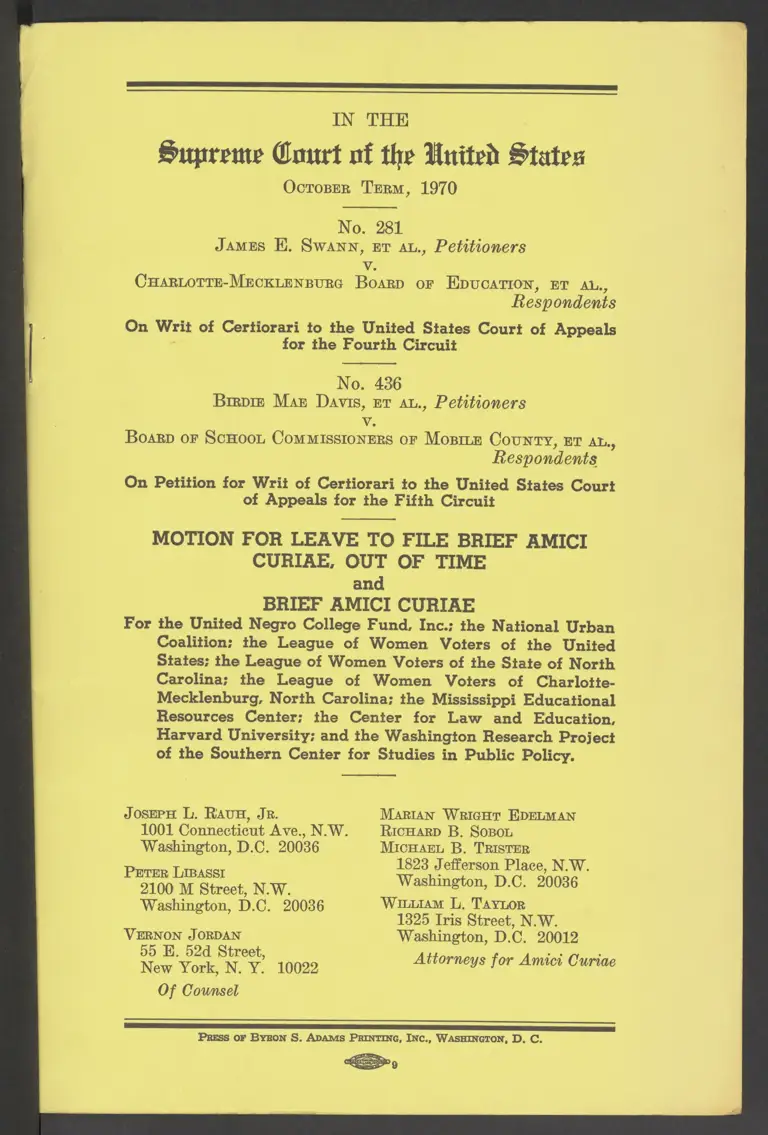
     [||040996b6-f3bc-414c-8497-348091e7b01c||] IN THE

Supreme Court of the United States
Ocroser Term, 1970

No. 281
James E. SWANN, ET AL, Petitioners

V.

CHARLOTTE-MECKLENBURG BoarD oF EDUCATION, ET AL,
Respondents

On Writ of Certiorari to the United States Court of Appeals
for the Fourth Circuit

No. 436
Birpie Mar Davis, Br AL., Petitioners

Vv.
Boarp or ScHOOL CoMMISSIONERS oF Mose CoUNTY, ET AL.,

Respondents

On Petition for Writ of Certiorari to the United States Court
of Appeals for the Fifth Circuit

MOTION FOR LEAVE TO FILE BRIEF AMICI
CURIAE, OUT OF TIME

and

BRIEF AMICI CURIAE
For the United Negro College Fund, Inc.; the National Urban

Coalition; the League of Women Voters of the United
States; the League of Women Voters of the State of North
Carolina: the League of Women Voters of Charlotte-
Mecklenburg, North Carolina; the Mississippi Educational
Resources Center; the Cenier for Law and Education,
Harvard University: and the Washington Research Project
of the Southern Center for Studies in Public Policy.

JosepH L. Raum, JR. MARIAN WRIGHT EDELMAN
1001 Connecticut Ave., NW. RicaARD B. SoBOL
Washington, D.C. 20036 MicHAEL B. TRISTER

Dorin [ApsG 1823 Jefferson Place, N.W.
2100 M Street, N.W. Washington, D.C. 20036

‘Washington, D.C. 20036 WiLLiam L. TAYLOR
1325 Iris Street, N.W.

VERNON JORDAN Washington, D.C. 20012
55 BE. 52d Street, oe
New York, N. Y. 10022 Attorneys for Amici Curiae

Of Counsel


Press oF BYRON S. ApaMs PRINTING, INc., WASHINGTON, D. C.


TABLE OF CONTENTS

Page

Moriox ror Leave To Fie Brier Amict Curiar, Our
oF TIME

Summary of Argument

Argument

I. Disestablishment of a dual school system requires
that, unless demonstrably unfeasible, pupils be
assigned so that mo school has a student body
which is all-black or so disproportionately black
as to make the school identifiable as a ‘‘black
school ’’

A.

B. The principles declared in Green

C. Schools with black student bodies which could
feasibly be desegregated are remnants of the
system of discrimination condemned in
Brown 1

II. Elimination of ‘‘black schools’’, where feasible, is
required as a remedy for the wrong of official seg-
regation which produced those schools


|
|

|
|
|


ii Table of Contents Continued

Page

ITI. The courts of appeals in these two cases imper-
missibly approved the continued existence of black
school on grounds falling short of the unfeasibility
of degegregatino them ...........c.covaveens.s 26

A. The Mobile case and the ‘neighborhood school
COROCDLT ens vir nnn anna sntswasnsion slides 27

B. The Charlotte case and the ‘‘rule of reasonable-
co rae rl EEE Ba EE i 31

C, The question of busing .................... 34

Conclusion... ir i cinerea tras 37

TABLE OF AUTHORITIES

CasEs:

Adams v. Mathews, 403 F. 2d 181 (C.A. 5,1968) ...... 27

Alexander v. Holmes County Board of Education, 396
1.8. 19 (1969), ...0scenss vos dusiisborentde Sh ii 22, 30

Allen v. Board of Public Instruction of Broward
County, C.A. 5, No. 30032, August 18, 1970 ...... 17

Andrews v. City of Monroe, C.A. 5, No. 29358, April
nha v0 Re pe a ed EE pa ea pe 17

Blocker v. Board of Education, 226 F. Supp. 208 (E.D.
NY. T0084) iti ocises soins snior tn siavss olin isis sluci vice 22

Brewer v. School Board of the City of Norfolk, 397
F.2d 37 (0C:A. 24,1908) ..,...c00c0:0105s" satin 34

Brown v. Board of Education of Topeka, 347 U.S. 483
(1954) (Brown 1) ......... ..... 910,12 13,18, 20, 23

Brown v. Board of Education of Topeka, 349 U.S. 294
(1955) (Brownadl) . coo. 00th sibs svsmssnss os 14, 34

Carter v. West Feliciana Parish School Board, 396
15S. 290 A170) . .ciciiurilnvinisssiss + Sins: nuisisimesivs » 2. 27

Cooper v. Aaron, 3583 U.S, 1 (1958) ......% .50oeil... 30
Ellis v. Board of Public Instruction of Orange County,

423 72d 203.0C. A: 5, 1970) ....l i Jou vaiionsin ii 30
Felder v. Hornett County Board of Education, 409

FP. 24 203 (C.A.4,,1909) ...c.uv.s dma dha unis 17

hh a ia riagsecno.e. es ,., Lv ur él. lls» s lio, Le rei Me kh ka a at sa"


Table of Contents Continued 11d

Page

Green v. Board of School Commissioners of New Kent
County, 391 U.S: 430 (1968) ...... 9,10, 12, 14, 15, 19,

20, 21, 23, 30, 31

Griffin v. County School Board of Prince Edward
County, S77: U.S. 28 (1964) i... vc. vin snins J vis 33

Haney v. County Board of Education of Sevier County,
C.A. 8, No..19,899, June 129, 1970; sv... satan cv 17

Henry v. Clarksdale Municipal Separate School Dis-
trict, 409 P, 24 632 (C.A. 5, 1969) .............. 27

Henry v. Clarksdale Municipal Separate School Dis-
{riet, C.A. 5, No. 29165, August 12, 1970.......... 28

Hobson v. Hansen, 269 F. Supp. 401 (D.D.C. 1967) ..18, 22
Louisiana v. United States, 380 U.S. 145 (1965) ...... 24

Monroe v. Board of Commissioners of The City of
Jaclkwon 8391 U.S. 450 (1968) ..... deus. du nh, 20

Nesbit v. Statesville City Board of Education, 418 F. 2d
J040 (CLA. 4, 1900) ...0oo00ts sc isvsiesnnsivnss, 25

Singleton v. Jackson Municipal Separate School Dis-
trict, 419 BF, 24 1211 (C.A.5,1969) ............., 25

United States v. School District 151 of Cook County,
404 F.2d 1125 (C.A. 7, 1968) ....... c.c....... 23

United States v. Indianola Municipal Separate School
District, 410 F. 24 626: (1969) .................. 28

United States v. Montgomery County, 395 U.S. 225
(O08) 10s 50 vid 9h Thunb amis vin von visivitinnd fetes 23, 24, 25

Wright v. Board of Public Instruction of Alachua
County, C.A. 5, No. 29999, August 4,1970 ........ 17

OTHER AUTHORITIES :

Black, The Lawfulness of the Segregation Decisions,
69 Yale LT 421 (1960) ........ i... .c0oeieiversss 13

Center for Urban Education, ‘On the Matter of Bus-
ing’’ (Staff Memorandum, February 1970) ...... 35

Coles, Northern Children Under Desegregation, 31
Paychinlry 1 (1008)... cos visi rirenirrarnes 36

Levine and Griffin, The Busing Myth, South Today,
Vol. 1, Ne. 10, at 7 (May 1970) ............ %.. 36

President’s Statement on School Desegregation,
March 24, 1970 ..... ihc evar di canned 25


1v Table of Contents Continued

Page

Brief for the United States, United States v. Montgom-
ery County, No. 798 October Term 1968 ........ 23, 24

United States Commission on Civil Rights, Racial Iso-
lation in the Public Schools (1967) ............ 18, 22

United States Commission on Civil Rights, Transeript
of Hearing held in Montgomery, Alabama (1968) 19

United States Office of Education, Equality of Educa-
tional Opportunity (1966)... 0. vii via. Ju vnuns 19


IN THE

Supreme Court of the United States
OctoBer Term, 1970


No. 281

James E. SwANN, BT AL., Petitioners

V.

CHARLOTTE-MECKLENBURG BoARD oF EDUCATION, ET AL,
Respondents

On Writ of Certiorari to the United States Court of Appeals
for the Fourth Circuit


No. 436

Birpie MAE Davis, ET AL., Petitioners

V.

Boarp or ScrooL ComMIssioNERS OF MoBILE COUNTY, ET ALL,
Respondents

On Petition for Writ of Certiorari to the United States Court
of Appeals for the Fifth Circuit

MOTION FOR LEAVE TO FILE BRIEF AMICI
CURIAE, OUT OF TIME

The following organizations—the United Negro College
Fund, Inc.; the National Urban Coalition; the League of

Women Voters of the United States; the League of Women
Voters of the State of North Carolina; the League of
Women Voters of Charlotte-Mecklenburg, North Carolina;
the Mississippi Educational Recources Center; the Center


i
|
|
} !


2

for Law and Education, Harvard University ; and the Wash-

ington Research Project of the Southern Center for Studies
in Public Policy—hereby move pursuant to Rule 42(3)

of the Rules of this Court, for leave to file the attached

brief amici curiae in the above-entitled cases. Petitioners
in both cases, the United States as a party to No. 436, and
the Charlotte-Mecklenburg Board of Education as a re-
spondent in No. 281, have consented to the filing.? The other

respondents have not yet replied to our request for consent

to file.

Under the briefing schedule established by this Court
briefs amici curiae supporting the position of petitioners

were due by September 16, 1970. Rule 42(2), Rules of Su-

preme Court. Movant organizations respectfully request

that leave be granted to file the attached brief out of time.

As set out below, movant organizations represent a broad

and diverse spectrum of citizens, united by a common

concern for quality integrated education. They desire to

present to the Court a unified treatment of these two

critical cases. The accelerated briefing schedule established
by this Court, under which amici briefs supporting peti-
tioners were due seventeen days after the Court’s order,
made it impossible for counsel to consult with all of them

and agree on a common treatment of both cases, and to

prepare a brief giving full and comparative attention to
the Mobile as well as the Charlotte case, by September 16.

The United Negro College Fund, Inc., is an organization

consisting of 36 member colleges, all but one of them in
the South, which was established in 1943 to raise funds

and provide other assistance to member colleges. The
Fund and its members have an important and direct interest

in assuring that elementary and secondary school students


! Movant organizations earlier filed a brief amici curiae urging

the grant of certiorari in No. 281, by leave of this Court granted
pursuant to motion.

2 The written consent of these parties has been filed with the

Clerk.


3

are well prepared for college and thus have a continuing
concern about the persistence of segregated public schools.

The National Urban Coalition is an organization whose

purpose is to improve opportunities and conditions of

life for citizens living in urban areas of the nation.

Founded in 1967, it has 47 affiliated local coalitions and

representation from corporations, unions, religious, and

civil rights organizations. The improvement of educa-

tional opportunity is among its prime purposes and to

that end it has sponsored educational research and par-

ticipated as amicus curiae in a case involving the equal
distribution of educational resources.

The League of Women Voters of the United States, the
League of Women Voters of North Carolina, and the

League of Women Voters of Charlotte-Mecklenburg, North

Carolina, are three organizations with common aims and
principles but with independent decision-making powers.
Founded in 1920, the national League now has 156,000

members in all 50 states, the District of Columbia, Puerto

Rico, and the Virgin Islands. As part of its overall
program of encouraging informed and active participa-

tion of citizens in government, the national League has

placed major emphasis upon the quality of public edu-

cation and in 1970 reaffirmed its pledge to support efforts

to end racial discrimination in education. The North

Carolina and Charlotte-Mecklenburg Leagues have con-

ducted studies of the quality of educational opportunity

in their respective areas. Like the national League, they

are committed to work for equality of opportunity in

education.

The Mississippi Educational Resources Center is a
private organization established in 1969 to represent pro-

fessional, parent, and community groups throughout the

State of Mississippi. Its membership is predominantly

black. Its purpose is to assist communities and school

districts in overcoming problems incident to the school

desegregation process and to assure that desegregation
takes place and in an orderly and positive manner.


4

The Center for Law and Education, Harvard University,
is an educational institution established in 1969 by Harvard

University and the United States Office of Economic Op-
portunity to ‘‘promote reform in American education by

working in the area of social policy and law.”” To carry
out its aims, the Center has sponsored and conducted

research on various aspects of the educational process.

It has also served as amicus curiae in several cases in-
volving issues within the area of its expertise.

The Washington Research Project, established in 1968,

is a research organization located in Washington, D. C.,

and affiliated with the Southern Center for Studies in
Public Policy of Clark College in Atlanta, Georgia. The

principal aim of the project is to assist in the establish-
ment of equality of opportunity for all citizens through

negotiation and monitoring of administrative agency
programs and litigation. It is deeply concerned with edu-

cational issues, particularly with alleviating the continu-

ing effects of racial discrimination in public schools. It
has conducted a study of the impact of Federal aid to

education programs on minority children and maintains

a continuing effort to monitor such programs to ensure

that they are conducted without discrimination.

Fach of the movant organizations consists of black and

white citizens. While their activities vary, all are bound

together by a common commitment to strengthen public
education in this country and to work for an end to

racial segregation in the schools. All of the movant
organizations, moreover, share a common commitment to

the maintenance of the rule of law in this nation. They
believe that the rule of law is threatened by continuing
violations of the rights of Negro school children declared
by this Court in 1954.

Movant organizations seek leave to enter these cases

for the purpose of supporting fully the position of the

petitioners. Movants believe, however, that—by virtue of


9)

their breadth, their special interest in education and the

scope of their activities in conducting and sponsoring re-

search on issues of education and civil rights—they are

well equipped to inform the Court with respect to the

impact that the decisions of the courts below may have

upon the process of school desegregation throughout the

nation. Further, movants believe that a unified and com-

parative treatment of these two cases might helpfully
supplement the separate treatment provided in the briefs
for the petitioners.

Accordingly, movant organizations respectfully request
that the Court grant leave to file the attached brief amici
curiae.

Respectfully submitted,

Mariax WricHT EDELMAN

RicaARD B. SosoL

MicuArL B. TRISTER

1823 Jefferson Place, N.W.

Washington, D. C. 20036

WirLiam L. Tavror

1325 Iris Street, N.W.

Washington, D. C. 20012

Attorneys for Amici Curiae
JosepH L. Raum, Jr.

1001 Connecticut Ave., NW.

‘Washington, D. C. 20036

Peter LiBasst

2100 M Street, N.W.

Washington, D.C. 20036

VERNON JORDAN

55 KE. 52d Street

New York, N.Y. 10022

Of Counsel


0

IN THE

Supreme mut of the United States
OcroBer TERM, 1970


No. 281

JAMES KE. SWANN, ET AL., Petitioners

V.

CHARLOTTE-MECKLENBURG BOARD OF EDUCATION, ET AL.,
Respondents

On Writ of Certiorari to the United States Court of Appeals
for the Fourth Circuit


No. 436

Birnie MAE DAVIS, ET AL., Petitioners

Vv.
BoARD oF ScHOOL COMMISSIONERS OF MOBILE COUNTY,

ET AL., Respondents

On Petition for Writ of Certiorari to the United States Court
of Appeals for the Fifth Circuit


BRIEF AMICI CURIAE

For the United Negro College Fund, Inc.;: the National Urban

Coalition: the League of Women Voters of the United
States; the League of Women Voters of the State of North
Carolina: the League of Women Voters of Charlotte-
Mecklenburg, North Carolina; the Mississippi Educational

Resources Center; the Center for Law and Education,
Harvard University: and the Washington Research Project
of the Southern Center for Studies in Public Policy.


INTEREST OF AMICI

Amici, as is more fully set forth in the Motion for
Leave to File a Brief Amici Curiae, are all organiza-

tions with a deep interest in maintaining and improv-


2

ing the quality of education available to children of all
races. As a part of this interest, they have all com-

mitted themselves to work for the elimination of racial

segregation and other forms of discrimination in educa-
tion.

Several amici have conducted or sponsored research

on problems of establishing equal educational oppor-
tunity. Others have supported and appeared in liti-

gation involving the public schools and discrimination.
Still others have undertaken to work for the full and

fair enforcement of civil rights laws by Executive de-

partments and agencies of the Federal Government.

All have a commitment to the maintenance of the

rule of law and a deep concern about the continuing
denial of constitutional rights of black school children.

STATEMENT

A. No. 281, Swann v. Charlotte-Mecklenburg Board
of Education

During the 1968-69 school year, the Charlotte-Meck-
lenburg school system served more than 84,000 pupils

in 107 schools (293a-294a).! Approximately 71 per

cent of the pupils were white and 29 per cent were black.
During that year, nearly 17,000 of the more than 24,000

black pupils in the district attended predominantly
black schools, under a geographic zoning plan allowing

for free transfer (459a).

To remedy this situation, which all parties now agree

fell short of achieving a unitary school system, the dis-

trict court held numerous hearings and received vo-

luminous evidence. As a result of this extensive liti-


1 Record references in this form are to the printed Appendix

filed in No. 281.

i \


iA

3

gation, the details of which are set out in the Brief for
Petitioners in No. 281, the district court was presented
in February of 1970 with two alternative pupil assign-
ment plans.

The school board proposed a plan which was based
exclusively upon the technique of ‘‘neighborhood’’ or
contiguous attendance zoning (727a-728a). The board
plan substantially integrated all the high schools, pro-
ducing a white majority of at least 64 per cent in each
school (829a). The plan desegregated most of the
Junior high schools, but left one of them 90 per cent
black and several virtually all white (830a). With re-
spect to the elementary schools, the board plan left
more than half the black elementary school pupils in
nine schools which were between 83 per cent and 100
per cent black and about half the white elementary
pupils in schools 86 per cent to 100 per cent white
(832a-834a).

An educational expert appointed by the court, Dr.

John Finger, presented an alternative plan which de-

segregated every school in the Charlotte-Mecklenburg

system. With one minor modification, not now in issue,

his plan adopted the board’s proposed zoning of high

school attendance areas. With respect to the junior
high schools and the elementary schools, the plan

started with the contiguous attendance zones proposed

by the board, but where those zones left schools racially

identifiable by the makeup of their student bodies, it

paired all-black or predominantly black schools with
non-contiguous all-white or predominantly white

schools so that all the students in the zones feeding both

schools would attend the formerly white school for

grades 1-4 and the formerly black school for grades
5-6 (1209a-1214a).


4

Before February 1970, the Charlotte-Mecklenburg

school system had provided substantial bus service to

its pupils. During the 1969-70 school year, the board

operated 280 school buses transporting nearly 25,000

of its 84,000 students (619a), at a cost of about

$475,000, or about $20 per child (1259a). The plan

devised by the court-appointed expert required the

additional transportation of 13,300 pupils—1,500 high

school, 2,500 junior high school, and 9,300 elementary

school. The additional operating cost of transporting

these pupils was to be about $266,000 (1269a). It was

originally thought that the new busing requirements

would entail a capital outlay of about $745,000, but it

now appears from the hearing held after this Court

granted certiorari that the outlay will be much lower

because of surplus buses the school board has on hand

(Br. A18-A23).> The school budget for the Charlotte-

Mecklenburg system for 1970-71 is about $66 million

(Br. A21).

Under the court expert’s plan, approximately 47

per cent of the pupils in the Charlotte-Mecklenburg

system would be bused to school. In North Carolina

as a whole, about 55 per cent of all pupils ride buses to

school (1289a). The average one-way bus trip for

pupils newly bused under the plan would be about 7

miles, taking about 35 minutes (1215a). In North

Carolina as a whole, the average one-way bus trip is

about 12 miles (1199a), and in Charlotte-Mecklenburg

the average trip during the 1969-70 school year was

about 15 miles, taking about an hour and a quarter

(1204a).


2 Record references in this form are to the Appendix to the

Brief for Petitioners in No. 281, wherein the distriet court pro-
ceedings following this Court’s grant of certiorari are set out.


bh}

The district court ruled that the school board’s plan

fell short of constitutional requirements, while the plan

proposed by the court-appointed expert did achieve a

unitary system and was feasible; accordingly, he

ordered the expert’s plan into effect (819a). On ap-
peal, the court of appeals agreed that the school board’s

plan failed to achieve a sufficient degree of pupil inte-
gration to qualify as a unitary plan, and accepted the

district court assignment plans for junior and senior

high schools, plans which involved some noncontiguous

zoning and additional busing. However the court held

that the assignment plan for elementary schools re-

quired an excessive amount of additional transporta-

tion, and set aside that part of the order. The court

adopted what it called ‘‘the test of reasonableness’; it
held ‘‘first, that not every school in a unitary system

need be integrated ; second, nevertheless, school boards

must use all reasonable means to integrate the schools in

their jurisdiction. ...”” (1267a). Judges Sobeloff and
Winter, dissenting, would have affirmed the district

court order in its entirety (1279a; 1295a); Judge
Bryan, concurring specially, indicated his belief that

the plan proposed by the school board met constitu-
tional standards (1295a).

On remand, after this Court granted certiorari, the
district court reaffirmed its original order. The school

board failed to come forward with a new plan, and the
district court found that no educationally sound plan
falling short of the degree of desegregation achieved in
its original order had been proposed (Br. A2, A27).


6

B. No. 436, Davis v. Board of School Commissioners of
Mobile County?

The Mobile County school system served about 73,500

pupils during 1969-70 in 91 schools; about 58 per cent

of the pupils were white and 42 per cent black. As in
Charlotte, an extended course of litigation, summarized

in the Brief for Petitioners in No. 436, led to a situa-

tion in January of 1970 in which the district court was

required to select from alternative plans the one which
would best comport with constitutional requirements.

The school board proposed a plan under which nearly
19,000 black children, about 60 per cent of the black

students in the system, would be assigned to 21 all-

black or virtually all-black schools. Educational ex-

perts from the Department of Health, Education and
Welfare proposed two plans. The first was based en-

tirely upon the technique of contiguous zoning, and re-
quired no additional transportation of students, but
left nine all-black schools serving nearly 8,000 pupils.

The second HEW plan used the additional technique of

satellite or noncontiguous zoning, and paired the re-

maining all-black schools with predominantly white
schools in the same way as did the plan ordered by the

district court in Charlotte. It left no schools all-black.

Like the Charlotte-Mecklenburg system, the Mobile

County system has in the past provided substantial bus

service for its pupils. During the 1967-68 school year,

207 buses transported 22,094 pupils daily. Busing was
not confined to the rural areas of the county ; during the

1966-67 school year, 7,116 pupils were bused within

metropolitan Mobile. Nor was busing confined to trans-


3 Because the printed Appendix in No. 436 was not available
when this brief was prepared, our statement of the case necessarily

lacks record references.


7

porting pupils to the nearest school ; during the 1966-

67 school year, 2,350 pupils were bused because of non-

contiguous zone assignments. Much of the busing was
provided in order to maintain segregation.

Because the district court did not hold evidentiary

hearings on the proposed plan, the record in this case

does not reflect the extent or cost of the additional

transportation which would be required to implement
the HEW alternative plan which eliminated the all-

black schools in the Mobile system.

In the January 1970 district court proceedings, the

petitioners urged the court to adopt the HEW plan

which would eliminate the all-black schools; the United

States, which is a party to the case, urged the adoption

of the other HEW plan, which proposed no additional

transportation but left several all-black schools; and
the school board urged adoption of its own plan. The

district court ordered the school board plan into effect.

On appeal, the three parties maintained their respeec-

tive positions. The court of appeals held that the

school board plan did not provide a unitary system, but

at the same time it rejected petitioner’s HEW plan

which would have eliminated the all-black schools. It

accepted a modification of the HEW contiguous zoning

proposal, which, after further modification, left six all-

black elementary schools serving about 5,300 children—

about 17 per cent of the black pupils in the whole
Mobile County system, and about 50 per cent of the
black elementary school pupils in metropolitan Mobile.

There have been further subsequent minor modifica-

tions of the plan, but the record does not make clear

how these modifications have affected the racial makeup
of the schools.


8

The court of appeals proceeded under a legal stand-

ard which it stated as follows:

“We have examined each of the plans presented
to the district court in an effort to determine which
would go further toward eliminating all Negro or
virtually all Negro student body schools while at
the same time maintaining the neighborhood
school concept of the school system.”

C. A Comparison of the Two Cases

Both the Mobile and the Charlotte school systems op-

erated full dual school systems based on race well into

the 1960’s. In both, little pupil desegregation had

been achieved by the end of the 1968-69 school year.

Both are large systems, serving a majority of urban

and a minority of rural school children. Both systems

have in the past transported substantial numbers of

children to school by bus and in both busing has been

used to perpetuate the system of segregation.

In both systems, substantial residential segregation

makes it impossible fully to desegregate each elemen-

tary school if assignment is based solely on ‘‘neighbor-

hood?’ or contiguous attendance zones. In both cases,

plans have been proposed which would use only con-

tiguous zones, and in both cases these plans would leave

approximately half of the black elementary school chil-

dren in all-black or virtually all-black schools. In both

cases, alternative plans have been proposed which

would desegregate every school’s student body by pair-

ing schools in black areas with schools in noncontiguous

white areas; in both of the cases, these plans would re-

quire the school system to provide additional trans-

portation to get children to school.

In the Charlotte case, district court findings sup-

ported by substantial evidence indicate that the addi-


9

tional transportation required by the complete desegre-
gation plan would cost the school less than one percent

of its operating budget. The percentage of children
bused under the plan, and the average length of the
bus trip, would be well within the statewide average

for North Carolina. Similar evidence and findings are

not available in the Mobile case, in which the district
court has not held evidentiary hearings on the proposed

plans. However the record in the case indicates that
both noncontiguous zoning and busing of students are

familiar assignment techniques in the Mobile school
system.

In both cases, the respective courts of appeals have

rejected the proposed plan which would completely

desegregate the school system. The rationales for the

rejection differ somewhat: in the Mobile case the Fifth

Circuit has refused to go beyond ‘‘neighborhood’’ or

contiguous zoning to achieve desegregation; while in

the Charlotte case, the Fourth Circuit has approved
some noncontiguous zoning with accompanying addi-

tional transportation, but has disapproved more exten-

sive use of the same technique as ‘““unreasonable.”’

SUMMARY OF ARGUMENT

I. In Brown v. Board of Education of Topeka, 347

U.S. 483 (1954), this Court found that the system of
official segregation of the schools, based as it was upon

the assumption that black people were morally and in-

tellectually inferior to whites, amounted to a massive

government-sponsored racial insult to the black people
subjected to it, and hence violated the equal protection

clause. In Green v. Board of School Commissioners of
New Kent County, 391 U.S. 430 (1968), the Court de-
clared three basic principles to govern final implemen-


10

tation of Brown: 1) the system of segregation must be

dismantled and its effects undone; 2) the goal of this

process is the abolition of racially identifiable schools;

and 3) officials must take all feasible steps to achieve

this goal and bear a heavy burden of justification for

any failure to do so.

In the context of the present cases, Brown and Green

mean that in school districts which have officially segre-

gated the races, schools with all-black or very dispro-

portionately black student bodies cannot be tolerated

where feasible alternative plans of pupil assignment

exist. Such schools are racially identifiable ‘‘black

schools.” To both whites and blacks in the community

they represent the perpetuation of the system of official

segregation and the official assumption of black inferi-

ority upon which that system rests. They inflict the
same psychological harm on black children as was con-

demned in Brown, and they perpetuate tangibly second-

rate education for the pupils assigned to them. These

schools must be abolished wherever this is possible

through known techniques of pupil assignment; no ex-

cuse short of complete technical unfeasibility can be
allowed.

II. The issue in these cases is not whether as an ab-

stract matter the Constitution commands a particular

racial balance in public schools, or even whether the

Constitution condemns all-black schools as such. It is

rather what remedy is required to undo the particular

historical system of school segregation existing in this

country, founded as it has been on assumptions of
racial inferiority. The instructive analogy is to fac-

ulty desegregation, where this Court has approved a re-

quirement of full racial balance, not as a substantive
constitutional requirement, but as a remedy to dis-

-——f


4

11

mantle a well-entrenched system and to undo, as far as
possible, the effects of that system.

III. In the two present cases, the courts of appeals

have tolerated the perpetuation of black schools on
grounds short of the unfeasibility of abolishing them.

In Charlotte, the district court ordered a plan of com-

plete desegregation which the record makes clear is

technically feasible. In Mobile, the district court’s

failure to hold hearings has prevented development of
a similar record, but a plan of complete desegregation,

never found unfeasible by any court, has been sub-

mitted by government educational experts.

The excuses put forward to justify continued segre-
gated schools are constitutionally insufficient. The
Fifth Circuit’s ‘‘neighborhood school concept’ repre-

sents only one among several competing systems of

pupil assignment used in this country, one without con-

stitutional status, and one which has not been used in

the South generally or in Mobile in particular. The

Fourth Circuit’s vague ‘‘rule of reasonableness’ ap-
pears to excuse continued segregation where integra-
tion would require ‘‘too much’’ incidental transporta-

tion with its accompanying cost. ‘Cost as such, particu-
larly the very limited costs of achieving full desegrega-
tion in these cases, is not a sufficient excuse for main-

taining segregated schools. Busing is a familiar tech-

nique of getting children to school, often used for pur-

poses other than desegregation. It, like all other stand-

ard educational techniques, must be used where needed
to complete the process of disestablishing the dual
school system.


12

ARGUMENT

I. DISESTABLISHMENT OF A DUAL SCHOOL SYSTEM
REQUIRES THAT, UNLESS DEMONSTRABLY UN-
FEASIBLE, PUPILS BE ASSIGNED SO THAT NO
SCHOOL. HAS A STUDENT BODY WHICH IS ALL-

BLACK OR SO DISPROPORTIONATELY BLACK AS TO

MAKE THE SCHOOL IDENTIFIABLE AS A “BLACK

SCHOOL".

These cases raise the question whether school officials

who have been operating separate systems of schools

based upon race can be said to have disestablished those

systems when they continue to assign pupils so as to

maintain schools with all-black or disproportionately

black student bodies. We submit that the answer is

“No’’—at least where there exist feasible alternative

methods of assignment which would desegregate those

schools.

The issue is not whether as an abstract matter the

Constitution requires any particular racial balance in

public schools generally, or even whether the Constitu-

tion generally forbids all-black or predominantly black

schools whatever their historical background. Rather

the issue is the narrower one of what remedy is re-

quired to eliminate the last vestiges of a particular

historical practice, long since judged to be unconstitu-

tional, namely the official and mandatory assignment

of black children to separate schools set aside for their

race.

The underlying rationale of Brown v. Board of Edu-

cation of Topeka, 347 U.S. 483 (1954) (Brown I) and

the specific principles pronounced in Green v. Board

of School Commissioners of New Kent County, 391

U.S. 430 (1968), require the abolition of schools iden-

tifiable as black by the makeup of their student bodies,

wherever this can be accomplished by feasible tech-

niques of student assignment. The grounds stated by


13

the Fourth and Fifth Circuit Courts of Appeals for ap-

proving plans which fall short of this requirement in
the present cases are insufficient as a matter of estab-
lished law.

A. The Rationale of Brown i

In the first Brown decision, this Court held that

racial segregation of the public schools violated the
equal protection rights of black children. In the Amer-

ican historical context, the system of segregation was no

less than a massive government-sponsored racial insult
to the black people subjected to it, based on assumptions

of their intellectual and moral inferiority to white

people. The system of segregation, and the official

insult it carried with it, was most damaging as applied

in the schools, for there it was directed at children of

unformed minds and developing personalities, in the
public institutions most crucial to their growth. The

system was unconstitutional because the history of the

Fourteenth Amendment made clear that the framers

meant to forbid all official action which injured or de-

graded black people because they were black.

Thus Brown I rested firmly on the finding of the
Kansas district court: ‘“Segregation of white and

colored children has a detrimental effect upon colored

children. The impact is greater when it has the sanction

of the law; for the policy of separating the races is

usually interpreted as denoting the inferiority of the

Negro groups.” 347 U.S. at 494. That was sufficient

to establish the constitutional violation; official segrega-

tion meant official imputation of racial inferiority, and

hence official injury to black people because of their

race.


4 See generally Black, The Lawfulness of the Desegregation De-
cistons, 69 Yale L.J. 421 (1960).


14

B. The Principles Declarea In Green.

In Brown I the Court declared the basic principle;

in Brown Vv. Board of Education of Topeka, 349 U.S.

294 (1955) (Brown II), the job of implementing the
principle was returned to the district courts. In Green,
supra, the Court addressed itself in detail to the stand-

ards governing that implementation, and laid down

three essential guidelines which govern these cases.

First, the Court stated that the constitutional goal

was ‘‘the abolition of the system of segregation and its

effects.” 391 U.S. at 440. The Court, in referring to
the system of segregation and its effects, recognized

that the dual school system constituted and supported
a set of social practices, practices which by their exist-

ence and maintenance conveyed and continued the

racial insult condemned in Brown I. The job of the

courts in remedying the wrong of segregation was not

merely to undo the formal legal arrangements of the

dual system, but also more broadly to dismantle the in-
stitutions in which those arrangements found fruition.’

Second, the Court specified what a unitary system
was : it was one ‘without a ‘white’ school and a ‘Negro’

school, but just schools.” 391 U.S. at 442. Here the
Court dispelled any notion that a system might some-
how be desegregated while its schools retained their

former racial identification.

Third, the Court placed upon officials who had op-
erated dual school systems ‘‘the affirmative duty to


5 The Court in Green traced the obligation to abolish and dis-

mantle the entire system of segregation back to Brown II and its
command, 349 U.S. at 301, ‘‘to effectuate a transition to a racially

nondiseriminatory school system.’’ 391 U.S. at 435.

6 See Green, 391 U.S. at 437: “Brown II was a call for the dis-

mantling of well-entrenched dual systems ....”’

J


15

take whatever steps might be necessary to convert to a
unitary system in which racial discrimination would be
eliminated root and branch.” 391 U.S. at 437-438 (em-
phasis added). When school officials claimed to be op-
erating unitary systems, the district courts were to
‘““weigh that claim in light of the facts at hand and in
light of any alternatives which may be shown as fea-
sible and more promising in their effectiveness. . . .”’
391 U.S. 439 (emphasis added). Thus no excuse would
be heard that the means required might be too onerous;
the school officials were to take ‘‘whatever steps might
be necessary,” to adopt ‘‘any alternatives which may
be shown to be feasible.” Along with the ‘affirmative
duty’’ to achieve complete desegregation went “a heavy
burden upon the board to explain its preference’’ for
anything less than the most effective feasible plan of
desegregation. Ibid. (emphasis added).

Thus Green held : 1) that the system of segregation
must be dismantled and its effects undone; 2) that the
goal of this process was the abolition of racially iden-
tifiable schools; and 3) that boards must take all fea-
sible steps to achieve this goal and bear a heavy burden
of justification for any failure to do so.

C. Schools With Black Student Bodies Which Could by Fea-
sible Assignment Techniques Be Desegregated Are Rem-
nanis of the System of Discrimination Condemned in
Brown I.

Where a school in a dual system is attended exclu-
sively or very largely by black children, and where
school officials maintain this attendance pattern in the
face of feasible alternatives which would produce an
integrated student body, that school is as a practical
matter the equivalent to the ‘“colored school’ of the
pre-Brown system of segregation. The very difficulty


16

of persuading southern school officials, southern judges,

and even federal bureaucrats to do the job of integrat-

ing these schools is the best evidence for this fact.

White school officials and parents feel a peculiar horror

at the idea of assigning white children to these schools,

as the records in these cases attest.

In Charlotte, when the school board was finally

forced to the point of achieving some substantial de-

segregation in the summer of 1969, it proposed to move

substantial numbers of black children to white schools,

and to use school buses to get them there (481a-482a).

Several black schools were closed, and the children

whom they had served were bussed into white neigh-

borhoods. There were no accompanying transfers of

white students into the black central city schools

(5902). Judge McMillan pointed out that this one-

way integration plan was ‘‘an affront to the dignity

and pride of the black citizens’’ in his August 15, 1969,
order, but felt compelled to accept the plan for the

1969-70 school year by the exigencies of time (586a,

589%a-590a).

In Mobile, when educational experts from the De-

partment of Health, Education and Welfare were asked

to prepare a plan for desegregation in the summer of

1969, their response also was to close black schools and

bus the children who had attended them into white

areas of town. But, where closing of a black school

could not be justified, the student body of that school

was left all-black ; no white-to-black transfers were pro-

posed. When the experts were asked about this obvious

discrepancy, their response—that ‘‘cross-busing” did

not have ‘financial’ or ‘‘community’’ support—

amounted to a concession that the notion of actually

desegregating ‘‘black schools’ by assigning white stu-


17

dents to them was too radical to contemplate even in

the year 1969. They purported to rely on alleged
legal difficulties with ordering busing of students to

achieve desegregation, but as the plan they submitted

clearly shows their chief concern was with cross-bus-

mg—the busing of white as well as black children.

In general, school desegregation to date has been a

one-way process. Black children have been allowed

into the white schools, but there have been few corre-

sponding transfers of white children to black schools.

Instead, large numbers of those black schools have been

closed or reassigned to subsidiary uses such as voca-

tional or special education classes even where they were

newer and better equipped than the white schools which

remained open, and even at the cost of running the

newly integrated white schools on double shifts. Where

black schools could not be closed, they have largely
remained all black.”

Thus the black schools of today, identified by their

all-black or predominantly black student bodies and by

their location in black neighborhoods, retain for the

white community which seeks so hard to avoid them

the stigma originally conferred by the underlying seg-

regationist assumption that they are for inferior chil-


"On one-way integration and black school closings, see Judge
MecMillan’s order in the Charlotte case, text, supra; see also Felder
Vv. Harnett County Board of Education, 409 F.2d 1070, 1074 (C.A.

4, 1969) ; Haney v. County Board of Education of Sevier County,
C.A. 8, No. 19,899, June 29, 1970 (slip opinion at 11-13) ; Andrews
v. City of Monroe, C.A. 5, No. 29358, April 23, 1970 (slip opinion
at 8) ; Wright v. Board of Public Instruction of Alachua County,

C.A. 5, No. 29999, August 4, 1970 (slip opinion at 5); Allen v.
Board of Public Instruction of Broward County, C.A. 5, No.
30032, August 18, 1970 (slip opinion at 7).


18

dren.’ But if they still bear that stigma for the white

community, so do they for the black community and

for the black children who attend them. This being so,

assignment to these schools must have for these black

children the same ineradicable effects upon their hearts

and minds which this Court condemned as the central

vice of state-imposed segregation in Brown 1.°

Black schools are inferior not only because of the

racist assumptions upon which they are founded and

the consequent psychological harm they do, but also in

a more tangible sense. These schools receive less of

the resources available for education than do schools at-

tended by the children of the dominant white com-

munity, and provide correspondingly inferior facilities

and services. For example, the Civil Rights Commis-
sion found that, in a sixteen-county area of Alabama,


8 One of the findings of the Civil Rights Commission, based
upon its analysis of the extensive Coleman data on race and

education was that:

‘“‘Predominantly Negro schools generally are regarded by
the community as inferior institutions. Negro students in

such schools are sensitive to such views and often come to
share them. Teachers and administrative staff frequently
recognize or share the community’s view and communicate
it to the students. This stigma affects the achievement and

attitudes of Negro students.”” U.S. Commission on Civil

Rights, Racial Isolation in the Public Schools 204 (1967).

9 A district judge with long experience in the struggle to dis-

establish the official dual school system put the point well:

“‘The entire community, white and black, whose own atti-
tude toward Negro schools is what stigmatizes those schools

as inferior, must be disabused of any assumption that the

schools are still officially segregated, an assumption it might
cling to if after supposed ‘desegregation’ the schools re-

mained segregated in fact.”” Hobson v. Hansen, 269 F. Supp.

401, 495 (D.D.C. 1967).


19

white-attended school buildings and their contents were
worth an average of $981 per pupil, compared with an
average of $283 per pupil at black-attended schools.
Test scores reveal the stark results of this kind of dis-
parity—black twelfth grade pupils in the urban South
score 3.5 grade levels behind their white counterparts
on standard reading comprehension tests.

It is a fact of political life in the South that the
power and influence needed to improve the quality of
schools resides in the white community. That com-
munity would not long tolerate for its children the kind
of education which has typically been supplied to black
children in their separate schools. Only when there
are no more black schools as such, when the children of
the white community attend every school, will every
school receive its fair share of available educational
resources.

In G'reen, this Court, recognizing both the continuing
psychological harm and the continuing inferior educa-
tion inherent in the black schools surviving from the
pre-Brown system of segregation, named the racial
identifiability of schools as the essential evil to be abol-
ished by the desegregation process. 391 U.S. at 449.
When school officials maintain schools with student
bodies all-black or black in gross disproportion to the
racial makeup of their districts as a whole, even in the
face of feasible alternatives, they are maintaining


19 Transeript of Hearing held before the U.S. Commission on
Civil Rights, Montgomery, Alabama (1968), Exhibit No. 26 at
863.

1 United States Office of Education, Equality of Educational
Opportunity (1966), at 274.


20

racially identifiable black schools.” Green thus re-
quires these officials to take ‘whatever steps might be

necessary’’ to abolish their black schools.”

In the context of these cases, this means that school

officials must adopt any feasible plan of pupil assign-

ment which promises to leave no school’s student body
identifiably black. As Judge Sobeloff has said, ‘‘school

boards are not obligated to do the impossible. Federal

courts do not joust at windmills. Thus it is proper to

ask whether a plan is feasible, whether it can be ac-

complished.” (1284a). For example, there are all-

black or virtually all-black school districts, which ob-

viously cannot within their own boundaries abolish

black schools. Though we would not discount the pos-


12Tn one of the companion cases to Green, Monroe v. Board

of Commissioners of the City of Jackson, 391 U.S. 450 (1968),

the Court held that a geographic zoning plan with a provision for
free transfers was proved ineffective, and hence insufficient to
meet constitutional requirements, by the survival of a junior high
school and three elementary school attended only by black
students. This rendered them ‘‘Negro’’ schools within the mean-

ing of Green. 391 U.S. at 457.

18 Of course in Green the Court condemned the maintenance

of ‘‘white’’ as well as ‘“black’’ schools. We have focused in these
cases on the requirement of eliminating the black schools, because

it is through them that the insult of official discrimination econ-

demned in Brown I is most concretely imposed upon black people.

This is not to slight the importance of the goal of eliminating

white schools as well. Where all-white schools are allowed to con-

tinue, they provide a safe haven for whites attempting to avoid

desegregation, and thus constitute a threat to the stability of a

desegregated school system. As Judge MeMillan stated in the

Charlotte case, elimination of all-white schools:

‘would tend to eliminate shopping around for schools; all

the schools, in the New Kent County language, would be

‘just schools’; it would make all schools equally ‘desirable’

or ‘undesirable’ depending on the point of view; it would

equalize the benefits and burdens of desegregation over the

whole county . ...”” (310a-31la).


21

sibility of restructuring school district lines to achieve
some degree of practical desegregation in such cases,

it may be that in some instances geographic factors

make this a practical impossibility. In these few cases,

the law obviously does not require abolition of the black
schools,

The limitation of feasibility is meant only to deal
with these few isolated situations where existing tech-
niques do not make full desegregation a practical possi-

bility. It is meant to exclude all other excuses for the

continued maintenance of black schools in dual systems.

These other excuses are often put forward under the

rubric that complete desegregation would be ‘“‘impraec-

tical,” but they do not mean that it cannot be achieved

by known techniques. Rather as in these cases, they

mean that it is not a sufficiently important goal to

justify the use of techniques already familiar to edu-

cators—such as placing children on buses for a half-

hour or an hour in order to get them to school. In this

sense, the ‘“‘impracticality’’ of desegregation means

added inconvenience for administrators, or resistance

to the reallocation of resources from other programs,
or other political opposition to desegregation from the

white community.

If excuses of this sort could justify failure to abolish

all remnants of the dual system, this Court’s command

in Green that school officials take ‘‘whatever steps

might be necessary’’ would be rendered a nullity. Only

last Term, this Court made it clear that no such nullify-

ing interpretation was intended ; against all objections

of cost, inconvenience, impracticality, even ‘‘chaos’—

objections made not only by school officials but by the

national administration—it unanimously ordered that

plans promising an end to the dual system be put into

effect now, in mid-school-year if that was necessary.


22

Alexander v. Holmes County Board of Education, 396
U.S. 19 (1969).

II. ELIMINATION OF “BLACK SCHOOLS,” WHERE FEA-
SIBLE. IS REQUIRED AS A REMEDY FOR THE WRONG

OF OFFICIAL SEGREGATION WHICH PRODUCED

THOSE SCHOOLS.

We have not argued that every school with an all-

black or predominantly black student body represents

a violation of the equal protection clause. Such an
argument could be made; there is substantial evidence

that isolation of black children in schools wherever

and for whatever reason it occurs, correlates highly

with inferior education. United States Commission on

Civil Rights, Racial Isolation in the Public Schools

202-204 (1967). However, no such substantive constitu-

tional doctrine need be advanced in order to decide

these cases according to the rule we have argued for.”

We deal, in Charlotte and Mobile, not just with any

concentrations of black children in separate schools,

but with concentrations surviving from a system

which segregated these children as part of an official
policy based on their assumed inferiority. We ask the

Court to declare, not that the Constitution condemns


14 Compare Carter v. West Feliciana Parish School Board, 396
U.S. 290, 296 (1970) (Harlan, J., concurring): ‘‘If Department
recommendations are already available the school districts are to

bear the burden of demonstrating beyond question, after a hear-

ing, the unworkability of the proposals ....”’

15 “De facto’ racial segregation of the schools has been held

unconstitutional in several federal cases, among them Hobson Vv.

Hansen. supra Note 9, and Blocker v. Board of Education, 226 F.

Supp. 208 (E.D.N.Y. 1964).

We do not disclaim the arguments put forward in these cases

and elsewhere that the Constitution condemns adventitious racial

segregation; we merely point out that no such argument need be

accepted in order to require the abolition of black schools as part

of the process of dismantling official segregation.


23

black schools as such, but that federal courts of equity

in abolishing the discriminatory dual school system
must abolish the black schools which continue as a

remnant of that system.

Thus it is not necessary in these cases for the Court

to confront the question of the legal status of black

schools in states which did not maintain formal stat-

utory systems of school segregation. It may be that

some school districts which have not maintained full

dual systems have nonetheless brought about the exist-

ence of black schools through official action. In those

cases, both the principle of Brown I and the remedial
standards of Green would logically apply. Cf. United
States v. School District 151 of Cook County, 404 F2d
1125 (C.A.7, 1968) What we stress here is that the

abolition of black schools is required as a remedy to

undo the effects of past unconstitutional diserimina-
tion.

The concept of a remedial standard is well illustrated
by the way in which this Court and the lower federal

courts have handled the dismantling of another aspect

of the dual school system, the institution of faculty

segregation. In United States v. Montgomery County,
395 U.S. 225 (1969), this Court granted certiorari to

review a district court decree ordering a school board

to assign faculty so that the ratio of black to white

teachers in each school was substantially equal to the

ratio in the system as a whole. In arguing for rein-

statement of the district court decree, which had been

set aside by the court of appeals, the United States

relied on the same notion of a remedial standard, im-

posed to measure the achievement of a constitutional
goal, as we urge here.

The government pointed out that general directions

by the courts to ‘‘desegregate’ or ‘‘abolish the dual


24

system’’ had not proved effective ; more precise instrue-

tions were needed to accomplish the constitutional end.

““The standard approved . . . by the district court in

this case is an appropriate and workable means of

measuring faculty desegregation under judicial super-

vision.” Brief for U.S., No. 798 October Term 1968,

at 12. Similarly here, the requirement of no all-black

student bodies where a workable alternative exists is a

relatively precise standard by which to measure the

elimination of the racial identifiability of the schools in

a dual system, a standard which would be more effec-

tive and less productive of delay and confusion than the

vague tests now employed by the Fourth and Fifth

Circuits.

In the Montgomery County case, the government also

argued that the numerical ratio required by the dis-

trict court was ‘designed as a remedy for past racial

assignment which, as a result of respondent’s deliberate

actions, has produced racially identifiable faculties.”

The government added: ‘There is no suggestion in the

district court’s opinion, nor is there intended to be any

in our submission here, that proportional allocation of

faculty on the basis of race is a constitutional require-

ment.’ Brief for United States, No. 798 October Term

1968, at 13. Similarly here, we urge conscious racial

assignment of students to eliminate the all-black schools

which were produced by and survive from the system

of conscious assignment on the basis of race formerly
employed by the respondents here; we do not rely on

any constitutional prohibition against all-black schools
as such.’


16 Compare Louisiana v. United States, 380 U.S. 145, 154 (1965) :

““We bear in mind that the court has not only the power
but the duty to render a decree which will so far as possible

eliminate the discriminatory effects of the past as well as

bar like discrimination in the future.’’


25

This Court unanimously sustained the government’s
argument in Montgomery County. The aftermath of

that decision is instructive. Within months after this
Court had approved the proportional racial allocation

rule as ordered by the district court, both the Fourth

and Fifth Circuit had adopted the same strict rule to
govern faculty assignment in all desegregating school

districts under their jurisdictions. Nesbit v. States-

ville City Board of Education, 418 F.2d 1040 (C.A. 4,
1969) ; Singleton v. Jackson Municipal Separate School
District, 419 F.2d 1211, (C.A. 5, 1969). The President
in his March 24, 1970 statement, giving the Administra-

tion’s view of existing school law, adopted the same

rule for nationwide enforcement by the executive

branch.” In short, as soon as this Court approved a

simple and easily applied rule, even a very strict one,

to measure the achievement of a unitary system in the

area of faculty desegregation, the courts and the execu-

tive branch united to apply it generally. The result

has been that the issue of faculty desegregation, once

as divisive in the schools and time-consuming in the
courts as the issue of student desegregation is today,

has virtually disappeared as a source of delay and con-

fusion in the process of converting to unitary school

systems throughout the South.

In our view, adoption of the rule we propose here

for student desegregation would have much the same

result in the area of pupil assignment. Southern school

officials would turn from struggling to maintain the

greatest degree of pupil segregation which could be

wrested from the courts to quick and final abolition of

the dual system and then to their basic job of education.


17 Statement of the President on School Desegregation, March
24, 1970, at 13.


26

With the establishment of a relatively simple and easily

administrable rule, the protests of unhappy white con-

stituents, now spurred by hopes of success for such

slogans as ‘‘neighborhood schools” and ‘‘no busing’’

could be turned aside by the unanswerable response

that the courts have finally spoken, the law is now clear,

the job now finally must be done.

III. THE COURTS OF APPEALS IN THESE TWO CASES
IMPERMISSIBLY APPROVED THE CONTINUED EX-
ISTENCE OF BLACK SCHOOLS ON GROUNDS FALL-
ING SHORT OF THE UNFEASIBILITY OF DESEGRE-
GATING THEM.

In each of these cases, a plan, drawn up by educa-

tional experts, which would have achieved the desegre-

gation of the student body of each and every school,

was submitted to the district court. In each case a

plan which fell short of achieving this goal was ap-

proved by the court of appeals. In neither case was
the plan which would have achieved complete desegre-

gation shown to be unfeasible. Indeed in the Charlotte

case, the record made in the district court and the

court’s findings supported by that record incontra-

vertibly establish that the complete desegregation plan

was feasible within any definition of that term. In the

Mobile case, the complete desegregation plan closely re-

sembled the plan accepted by the district court in Char-

lotte, based as it was upon the same technique of limited
noncontiguous pairing of white and black schools. Only
the failure of the district court in Mobile to hold a hear-

ing on the proposed plans prevented the development

of a record which could have conclusively established

the feasibility of this plan. There is nothing in the

record, however, to suggest that the plan is less than

fully feasible; and in any event, the school board has

in no way met its burden of proving it impossible to


27

implement. Cf. Carter v. West Feliciana Parish School
Board, supra, 396 U.S. at 296 (Harlan, J., concurring).

The courts of appeals did not purport to find either
of the complete desegregation plans unfeasible. Rather
the courts rejected them on other grounds: the Fifth
Circuit in the Mobile case because the plan went beyond
““neighborhood”” zoning, the Fourth Circuit in the
Charlotte case because the plan required an ““unreason-
able” amount of busing. Neither of these grounds pro-
vides a constitutionally sufficient excuse for maintain-
ing all-black schools as remnants of the system of seg-
regation.

A. The Mobile Case and the “Neighborhood School Concept”.

In the Mobile case below, this Fifth Circuit panel
announced its intention to accept that plan “which
would go further toward eliminating all Negro or virtu-
ally all Negro student body schools while at the same


18 The ‘‘neighborhood school’’ rule followed in this case is by
no means a uniform standard for defining achievement of a
unitary school system within the Fifth Circuit. In Adams v.
Mathews, 403 F.2d 181, 188 (1968), that court held:

“If in a school district there are still all-Negro schools,
or only a small fraction of Negroes enrolled in white schools,
or no substantial integration of faculties and school activities
then, as a matter of law, the existing plan fails to meet
constitutional standards as established in Green.’’

In Henry v. Clarksdale Municipal Separate School District, 409
F.2d 682 (1969), the Fifth Circuit rejected a geographic zoning
or ‘‘neighborhood’’ attendance plan for Clarksdale, Miss., because
it failed to achieve sufficient pupil integration. The court said:

“A school board’s zoning policy may appear to be neutral
but in fact tend to retard desegregation because it binds
pupils to custom-segregated neighborhoods. In this situa-
tion, the board’s failure to take corrective action amounts
to the State’s giving official sanction to continue school


28

time maintaining the neighborhood school concept of

the school system.’” In other words, it erected the

maintenance of ‘neighborhood schools’ into an abso-

lute which overrides the constitutional obligation to

disestablish the dual school system.

We submit that the ‘neighborhood school concept’

has no such constitutional status. It is rather one

among several concepts used in this country as a basis

for assigning students to schools. Whether or not it

should be adopted by a particular school district is a

matter of educational policy, to be decided by school

officials within the constraint of the constitutional re-

quirement of complete disestablishment of the dual

school system. That is the proper order of priorities—

not, as the court below would have it, that courts are

to meet constitutional requirements within the con-

straint of a particular educational theory of pupil

assignment.

One need look no further than Mobile, Alabama, to

see that the ‘neighborhood’ system of pupil assign-

ment is not uniformly in use throughout this country.

Mobile has never had a neighborhood school system.

Until very recently, it has had a racial system of assign-

ment, under which black and white children both rode

on buses past nearby schools designated for the other

race on the way to their own ‘black’ or ‘‘white”’

school. More recently, under pressure from the courts


segregation . . . .”” 409 F.2d at 689. And see United States

v. Indianola Municipal Separate School District, 410 F.2d
626 (1969).

Only recently, the Fifth Circuit’s second decision in the Clarks-

dale case reiterated the holding that geographic zoning which

left all-black schools did not meet constitutional standards. Henry

v. Clarksdale Municipal Separate School District, No. 29165,

August 12, 1970 (slip opinion at 3).


29

to desegregate, Mobile school officials have adopted a
crazy-quilt of assignment policies, detailed in the Ap-
pendix to the Brief for Petitioner in No. 436, all de-
signed to achieve maximum segregation rather than
contiguity of child’s home to child’s school.

Alternatives to neighborhood school assignment have

been adopted for many reasons other than to avoid de-

segregation. The largest part of the history of rural
schools in America during this century has been the
movement from the one-room ‘‘neighborhood’’ school
to which each child could walk, to the larger consoli-
dated school which requires a system of bus transpor-
tation—a movement promoted by the search for better
education through the economies of scale possible in
larger schools. Similarly in many of our larger cities,
the “‘neighborhood concept’ is violated every day as
thousands of children with special abilities or special
problems attend far-away schools with specialized pro-
grams designed to meet their needs.

This is not to say there are no values in having
schools close to home. There are of course the values
of convenience and of minimizing time and money
spent in transportation. There are the values of link-
ing the school to a community, and of giving parents
ready geographical access to their children’s school,
though these are often exaggerated in present day con-
ditions.” (In urban areas today, few ‘neighborhood’


19 To the extent that there are values in having children attend
school close to home, one of the issues in both the Charlotte and
the Mobile cases is whether black children have a right to share
in these values equally with white children. Acceptance of a
half-way approach to pupil integration has usually meant that
black children are ‘‘integrated’’ into white schools in white
neighborhoods, while there is no corresponding transportation of
white children to black schools in black neighborhoods. See Note
7, supra, and accompanying text.


30

schools really serve anything remotely like a real com-

munity ; and once the school is removed beyond walking

distance from the home, as it often is even in our cities,

the distance a parent must drive or take public trans-

portation to reach his child’s school becomes only a

matter of degree.)

The rule which the Fifth Circuit has built upon the

concept of the neighborhood school does not even have

the exactness and precision which appears at first

glance to be its chief virtue. Once this Fifth Circuit

panel departs from the strict mathematical model of

the “neighborhood school’”” which it constructed in

Ellis v. Board of Public Instruction of Orange County,

423 F.2d 203 (1970)—and as far as we know, that model

has been applied only in that single case—it becomes

most unclear exactly what the ‘‘neighborhood school

concept’’ is. It does not bar the pairing of schools, for

instance ; the court of appeals ordered schools paired in

this very case, observing only that the pairings were

‘well within any reasonable definition of a neighbor-

hood school system.”

Ultimately, the ‘neighborhood school’’ rule must be

rejected because it excuses the continuation of black

schools in districts with dual systems for reasons short

of the complete unfeasibility of total desegregation,

reasons which are too easily and too often used to mask

opposition to desegregation itself. This Court has in

the past dealt unequivocally with apparently neutral

slogans which effectively produce continued segrega-

tion—with “political impossibility,” Cooper v. Aaron,

358 U.S. 1 (1968), with “freedom of choice,”’ Green,

supra, with “administrative chaos,” Alexander, supra.

«Neighborhood schools” is, in the context of this case,

merely another of these slogans behind which continued


31

segregation can take shelter, and should be dealt with
the same way.*

B. The Charlotte Case and the “Rule of Reasonableness”.

The rule laid down by the Fourth Circuit in the
Charlotte case—that school boards operating dual Sys-
tems must make ‘‘all reasonable efforts to integrate
every school” (1277a)—has the single advantage over
the Fifth Circuit’s “neighborhood school’ rule that
it does not bar the use of the legitimate and accepted
technique of noncontiguous or satellite zoning as a tool
for eliminating the effects of official segregation. In
every other respect, however, the Fourth Circuit’s ‘“rea-
sonableness’’ doctrine as applied in this case is a wholly
unacceptable standard by which to measure compliance
with the constitutional mandate.


20 In this case, the court of appeals held that the wrong inherent
in the maintenance of black schools ‘“‘can be further alleviated
through a majority to minority transfer policy and through the
functioning of a bi-racial committee.’’ Similarly in the Charlotte
case, the Fourth Circuit noted factors which would ameliorate the
existence of black schools: majority to minority transfers, inte-
grated special classes and out of school activities, and the require-
ment that each student must at some point in his career attend
an integrated school.

These devices, taken by themselves, are all half-way measures,
so long as black children continue to attend black schools in the
face of feasible alternatives. In particular, the majority to
minority transfer device puts upon black children the burden of
desegregating the schools, whereas the Green case firmly declares
accomplishment of that task to be the affirmative duty of the
school board. And the notion that an integrated education for
part of a child’s career excuses assigning him to an all-black
school for the remainder is reminiscent of the ‘‘grade a year’
and other gradualist approaches to desegregation common during
the era of ‘‘all deliberate speed.’’


32

First, the “reasonableness” test is scarcely a stand-

ard at all, in the sense of a meaningful guide for the

school officials and distriet courts who must administer

the process of desegregation. The test allows as an

excuse for failing to achieve the goal of complete inte-

gration the ‘‘unreasonableness’’ of the steps needed to

accomplish the task. ‘Unreasonableness’, as the

Fourth Circuit sees it, is a conclusory term through

which judges can express a subjective judgment that

the difficulties of achieving complete desegregation are

simply too much for school officials to have to put up

with. Promulgation of a ‘standard’ like this is a

guarantee of years of continued litigation and strife,

with inconsistency even in the end as the promised re-

sult.”

Second, the ‘reasonableness’ test impermissibly

tolerates the perpetuation of remnants of the system of

segregation which could feasibly be eradicated. This

case makes clear that for the Fourth Circuit, ‘‘unrea-

sonable” does not mean unfeasible or unworkable in

practice. It has never been seriously argued that the

plan ordered by Judge McMillan could not be put into

effect consistently with the continued effective opera-

tion of the Charlotte-Mecklenburg school system—in-

deed, that system is today operating under that plan.


21 Ag Judge Sobeloff has said, dissenting below :

“Handed a new litigable issue—the so-called reasonable-

ness of a proposed plan—school boards can be expected to

exploit it to the hilt. The concept is highly susceptible to

delaying tactics in the courts. Everyone can advance a

different opinion of what is reasonable. Thus, rarely would

it be possible to make expeditious disposition of a school

board’s claim that its segregated system is not ‘reasonably’

eradicable.”” (1290a).


33

There is no plausible argument that harm or injury
to the children invalidates the district court plan, for

the record contains no evidence of such harm. Under

the district court’s plan a lower proportion of children
will be bused to school in Charlotte than are bused in

the state as a whole. The average length of the bus
trip for those newly bused under the district court

plan is less than the average length both for the state

as a whole, and for the children previously bused within

the Charlotte-Mecklenburg system.

The court of appeals’ objections to the district court

plan seem to be based on its monetary cost alone. That

objection is insufficient on its face. The operating cost

of the elementary school busing ordered by the district
court was found by the court to be about $186,000, this
in a school system with a projected operating budget

of about $66 million. The capital cost of the new buses

1s not precisely known, but all of the evidence indicates

that it will surely be far below the original estimate of

$745,000 for the district court’s entire busing plan. As

the district court found in its hearings after this Court
granted certiorari, surplus buses owned by the Char-
lotte-Mecklenburg system, and extra buses available

through loan from the state, have brought about a situa-

tion where ‘‘[n]o capital outlay will be needed to sup-

ply buses for the 1970-71 school year.” Appendix to
Brief for Petitioner, Br. A23.

As a general matter, the fact that it costs money to

desegregate the schools is no excuse for failure to do
the job. Griffin v. County School Board of Prince Ed-
ward County, 377 U.S. 218 (1964). Whatever may be
the outer limits of that principle—whether, in some

hypothetical case, the monetary cost of desegregating


34

each school in a system might be so great as to disable

the operation of that system and hence render achieve-

ment of the goal ‘‘unfeasible’’—those outer limits are

not even approached in this case.

In this case, Judge McMillan has shown that the

process of desegregation can be completed, and a wholly

unitary system can be achieved in an urban southern

school district with substantial residential segregation.
He has in fact done the job which this Court entrusted

to the federal district judges of the South in Brown 11,
and he has done it with patience, sensitivity and skill.

That good work should not be undone by the court of

appeals’ vague and constitutionally insufficient ‘‘rule

of reasonableness.” #

C. The Question of Busing.

In the popular press and in the political arena, these

cases are generally thought to be primarily concerned

with the question whether the busing of children to
school is required as part of the process of desegrega-

tion. As we see the cases, this 1s at most a peripheral

issue. The process of disestablishing dual school sys-
tems requires a result—the abolition of the black


22 Judge McMillan made extensive findings to the effect that
residential segregation in Charlotte was in large part the result

of state action (297a-298a, 455a-456a, 1229a). These findings

were summarized and affirmed by the court of appeals (1264a).
While these findings compound the constitutional wrong of using
geographic zoning to impose segregated housing patterns on the

schools, we do not rely upon them here. Our view is rather that
school officials are required to take all feasible steps, including

transportation of pupils, to eliminate racially identifiable schools,

whatever the cause of residential segregation may be. Cf. Brewer

v. School Board of the City of Norfolk, 397 F.2d 37, 41-42 (C.A.

41968).


39

schools which were part of that system. The means to
be used to accomplish this end are limited solely by
technical feasibility. Busing of children to schools is
merely one among many tools which can be used to
bring about the required result.

As the Fourth Circuit itself noted in the Charlotte
case, ‘‘[b]ussing is neither new nor unusual. It has
been used for years to transport pupils to consolidated
schools in both racially dual and unitary school sys-
tems. Figures compiled by the National Education
Association show that nationally the number of pupils
bussed increased from 12 million in the 1958-59 school
year to 17 million a decade later.”” Today about 40 per-
cent of the nation’s school children ride a bus to school.
As the Center for Urban Education has put it, “Riding
the yellow school bus is as much a symbol of American
education in 1970 as the little red schoolhouse was in
1900.”” Center for Urban Education, ‘On the Matter
of Busing” at 1 (Staff Memorandum, February 1970).

Busing has in the past been used for numerous pur-

poses, some worthy, though none perhaps so important

as helping to overcome decades of unconstitutional dis-
crimination. It has been used to get rural children to
the larger and more efficient consolidated schools which
replaced their one-room schoolhouse. In the suburbs, it
has been used to transport children over large areas to
the excellent schools which those communities often
provide. In cities, it has been used to overcome the
safety and health hazards of children walking to school
through city streets or taking public transportation.
In each of these instances busing has cost money and
has coincided with children attending school far from
their homes, but not until it was used to achieve de-
segregation did it become an issue of public controversy.


36

The school officials and parents who so vigorously

object to busing for purposes of desegregation raised

no similar outery in past years against the extensive

busing required to maintain the system of racially seg-

regated schools. Today, white parents who remove

their children from public schools to avoid integration

typically put the same children on buses for long rides

to segregated private schools, and pay heavily for the

privilege. A recent survey conducted by the Southern

Regional Council indicated that a random sample of

recently established white private schools bused an

average of 62 percent of their pupils (as opposed to 49

percent of public school pupils in eight southern states)

an average distance of 17.7 miles (as opposed to 10.1

miles for public school pupils in these states) each day

to school. Levine and Griffith, The Busing Myth,

South Today, Vol. 1, No. 10, at 7 (May 1970).

There is no evidence that busing is in any way harm-

ful to children. As the district court found in the

Charlotte case, ““[s]chool bus transportation is safer

than any other form of transportation for school chil-

dren.” Appendix to Brief for Petitioners, No. 281, at

Br. A16. The only study we have found of the psycho-

logical effects of busing for purposes of desegregation,

made by a distinguished child psychiatrist, found that

children being bused in the Boston public school sys-

tem experienced ‘no significant medical or psychiatric

‘harm’ or ‘injury’ as a result of the travel or change.’

Coles, Northern Children Under Desegregation, 31

Psychiatry 1, 14 (1968).

In short, busing of children to school is simply a

technique which ean be used for good or for ill in the

administration of a school system. The facts about


37

busing, its extent and its past acceptance, suggest that

the recent outery against it is merely the 1970 version

of the sixteen year old campaign to undermine the
Brown decision.

CONCLUSION

The importance of these cases to the vindication of

the constitutional rights of black children—rights which

have been long denied—cannot be overestimated. If

the decisions of the courts of appeals below are allowed
to stand, the answer to the question ‘ What has Brown

accomplished ?”’ will be forever an equivocal one. Much

of the formal structure and some of the concrete mani-

festations of the system of segregation will be gone.

But thousands of black children will spend years of

their educational careers—most often the earliest, for-

mative, years—in schools indistinguishable as a prae-

tical matter from the black schools established by the

system of segregation. After all the years of turmoil

and tragedy around the lives of these black children,
it simply cannot be that they will be forced to settle
for formal or half-way equality. The system of segre-

gation and its effects must be abolished—all of it.

Accordingly, we ask that the judgments of the courts

of appeals be reversed, and the cases remanded for


38

further proceedings consistent with principles urged

in this brief.

Respectfully submitted,

MARIAN WRIGHT EDELMAN

RicEARD B. S0BOL

MicHAEL B. TRISTER

1823 Jefferson Place, N.W.

Washington, D.C. 20036

WirriaMm L. TAYLOR
1325 Iris Street, N.W.

Washington, D.C. 20012

Attorneys for Amici Curiae

JoserH L. RAUH, JR.
1001 Connecticut Ave., N.W.

Washington, D.C. 20036

PETER LiIBASSI

2100 M Street, N.W.

Washington, D.C. 20036

VERNON JORDAN

55 KE. 52nd Street

New York, N.Y. 10022

Of Counsel [||040996b6-f3bc-414c-8497-348091e7b01c||]