Memorandum for the United States as Amicus Curiae
Public Court Documents
June, 1970
9 pages
-
Case Files, Swann v. Charlotte-Mecklenburg Hardbacks. Memorandum for the United States as Amicus Curiae, 1970. 149c11af-2e34-f111-88b4-0022482cdbbc. LDF Archives, Thurgood Marshall Institute. https://ldfrecollection.org/archives/archives-search/archives-item/3a1aabf6-9215-450c-9628-7ddc8343c451/memorandum-for-the-united-states-as-amicus-curiae. Accessed October 16, 2026.
Copied!
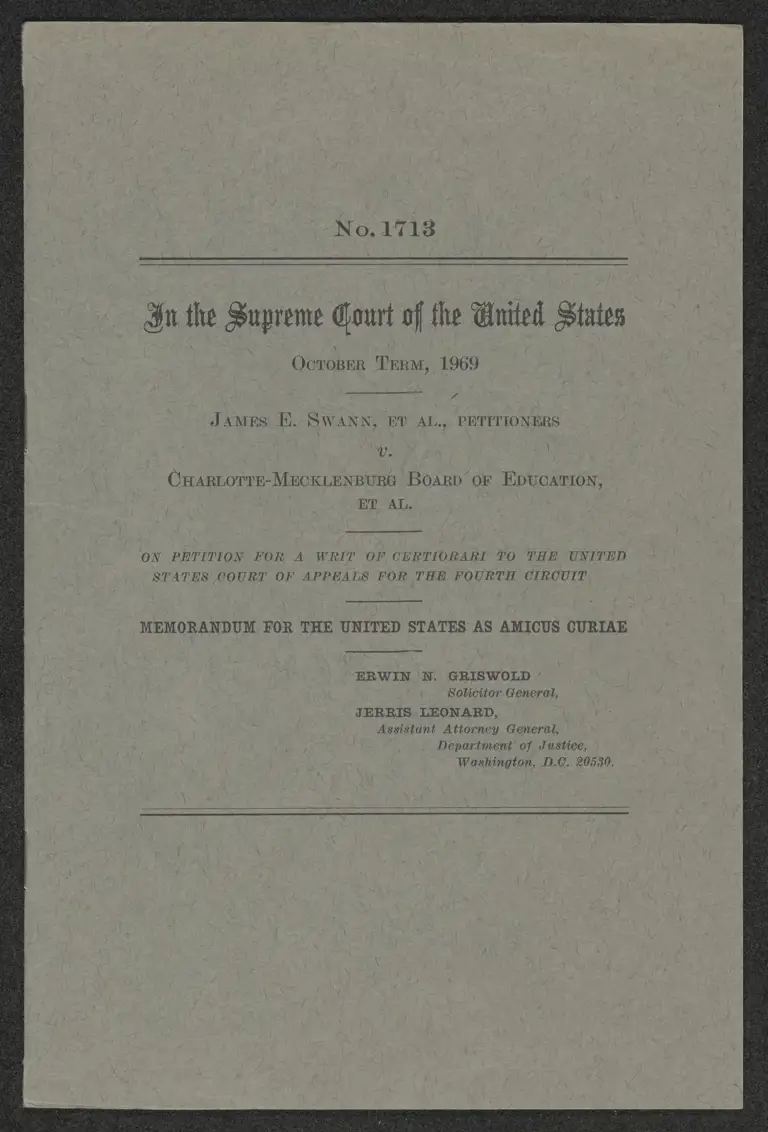
     [||9eff5894-9568-4ab2-9a4d-3ad9f1d0fedb||] No.1713


In fhe Supreme Gourt of the Tnited States

Odiohe rR TERM, 1969

Ey »

JAMES HF. SWANN, ET AL., PETITIONERS
\ v.

CHARLOTTE-MECKLENBURG BOARD OF EDUCATION,

ET AL.

ON PETITION FOR A WRIT OF. CERTIORARI 70 THE UNITED

STATES COURT OF APPEALS FOR THE FOURTH CIRCUIT

MEMORANDUM FOR THE UNITED STATES AS AMICUS CURIAE

ERWIN N. GRISWOLD

Solicitor General,

JERRIS LEONARD,

Assistant Attorney General,

Department of Justice,

Washington, D.C. 20530.


Ju the Supreme Gow of the Tnited States

OcroBeEr TERM, 1969

No. 1713

JAMES E. SWANN, ET AL., PETITIONERS

v.

CHARLOTTE-MECKLENBURG BOARD OF EDUCATION, ET AL.

ON PETITION FOR A WRIT OF CERTIORARI TO THE UNITED

STATES COURT OF APPEALS FOR THE FOURTH CIRCUIT

MEMORANDUM FOR THE UNITED STATES AS AMICUS CURIAE

INTEREST OF THE UNITED STATES

The United States has substantial responsibility

under 42 U.S.C. 2000¢-6, 2000d in the area of school

desegregation. The outcome of this case will affect

that enforcement responsibility. The government par-

ticipated below as amicus curiae at the invitation of

the court of appeals, and the United States Depart-

ment of Health, Education and Welfare 1s now pre-

paring desegregation plans for Charlotte-Mecklenburg

as recommended by the court of appeals.

(1)

389-264—T70


2

STATEMENT

The school system here involved comprises the

urban area of Charlotte, North Carolina, as well as

the more rural Mecklenburg County. The system

serves approximately 82,500 students, of whom about

23,200 are black and 59,300 are white (123a-128a), at-

tending 106 schools. This school district has been in de-

segregation litigation since 1965.

The issue raised by the plaintiffs’ petition relates

primarily to nine elementary schools attended by

about one-half of the black elementary students, who

reside in the urban area in the northwest quadrant of

Charlotte. The plan proposed in the district court by

the school board, while fully desegregating some other

all-Negro schools, would have resulted in virtually

all-Negro student bodies in these nine schools. That

plan, relying solely on geographic zoning and based

on the premise that no Negro school should be deseg-

regated unless it could be at least 60 percent white,

was rejected by the district court—a decision approved

by the Fourth Circuit. The district court approved

a plan, drawn by an educational expert recommended

by the plaintiffs, based on the premise that there

should be no Negro-majority schools in the entire

system. The plan used the technique of noncontiguous

pairing or “satellite” zoning so that black schools

in northwest Charlotte would be paired with predom-

inately white schools in suburban areas.


3

The court of appeals affirmed as to the high schools

and junior high schools and disapproved the elemen-

tary school plan. It held:

first, that not every school in a unitary school

system need be integrated ; second, nevertheless,

school boards must use all reasonable means to

integrate the schools in their jurisdiction; and

third, if black residential areas are so large that

not all schools can be integrated by using

reasonable means, school boards must take fur-

ther steps to assure that pupils are not ex-

cluded from integrated schools on the basis of

race. * * % 11805]

The court approved such techniques for achieving

desegregation as rezoning, “pairing, grouping, clus-

tering, and satellite zoning” (198a) but held that

the elementary school plan required by the district court

was beyond constitution requirements and inappropri-

ate in the circumstances of this case.

Accordingly, inasmuch as implementation of all

parts of the district court-approved plan had been

stayed (135a, 177a) and the 1969-1970 school year was

at an end, the court of appeals remanded the case with

instructions to require, on an expedited schedule, the

formulation of additional alternative plans for ele-

mentary schools. On remand, the Fourth Circuit sug-

gested, “the district court should direct the school

board to consult experts from the Office of Education

of the Department of Health, Education, and Welfare


4

and to explore every method of desegregation, including

rezoning with or without satellites, pairing, group-

ing, and school consolidation” (199a). The board is to

submit a new plan by June 30, 1970 (200a).

DISCUSSION

While we believe that the court of appeals was

correct in its formulation of the school board’s obli-

gation, we agree with the petitioners that this case pre-

sents issues of national importance requiring resolu-

tion by this Court. But we think that, in the posture

of this case, determination of the merits by this Court

is not appropriate at this time.

As the court of appeals noted, ‘‘Similar segrega-

tion occurs in many other cities throughout the na-

tion, and constitutional principles dealing with it

should be applied nationally’ (188a). The question

of the appropriate remedial standard for school dis-

tricts covering large urban areas is now being pre-

sented to a number of appellate courts. Cases have

recently been decided or are now pending involving

Orlando and Tampa, Florida; Mobile, Alabama;

Houston, Texas; Jackson, Mississippi; Little Rock,

Arkansas; Oklahoma City and Tulsa, Oklahoma ; Nor-

folk, Virginia; Alexandria, Louisiana; Memphis,

Tennessee; and Cincinnati, Ohio, among others. Ap-

pellate ‘decisions to date have not uniformly adopted

a single remedial standard; and the issues as framed

by the petitioners would ask this Court to address

some of the questions posed by Mr. Chief Justice Burger


5

concurring in Northcross Vv. Board of Education, 397

U.S. 232, 227.

The issue here focuses on the appropriate remedies

for school segregation in the context of an urban

school district characterized by racial residential seg-

regation. In view of the large number of students

who would continue to attend virtually all-Negro

schools under the school board’s plan and the board’s

quite artificial limitations on that plan, namely, that

no technique but rezoning would be used and that no

integrated school should be less than 60 percent

white, both of the courts below held that the school

board’s plan was not an adequate remedy. We fully

agree with that conclusion.

The court of appeals declined, however, to endorse

as to elementary schools the alternative plan adopted

by the district court. To be sure, district courts have

wide discretion in formulating appropriate remedies

in school-desegregation cases. See, e.g., Brown V.

Board of Education, 349 U.S. 294, 299-300; Umted

States v. Montgomery County Board of Education, 395

U.S. 225; Green Vv. County School Board, 391 U.S.

430, 438 n. 4, 439, 442 n. 6; Griffin v. School Board,

377 U.S. 218, 232-234; cf. Carier v. Jury Commission,

396 U.S. 320, 336-337; Turner Vv. Fouche, 396

U.S. 346, 355. Indeed, this Court has authorized

requiring implementation of educator-devised de-

segregation plans although recognizing that the par-

ticular plans were not the exclusive means of satis-


6

fying constitutional mandates. Alexander v. Holmes

County Board of Education, 396 U.S.19; Carterv. West

Feliciana Parish School Board, 396 U.S. 290. But

holding that, “if a school board makes every reasonable

effort to integrate the pupils under its control,

an intractable remnant of segregation * * * should

not void an otherwise exemplary plan for the creation

of a unitary school system” (190a), the Fourth Circuit,

in effect, remanded the case to determine whether, in

view of IEW alternatives,’ remaining segregation

could be eliminated by a more limited use of the available

techniques. In its remand, the court of appeals did not

direct, as had the district court (116a), that all schools

must be majority white. For that reason, the plaintiffs

seek review by this Court.

Yet, because of the importance of the question, we

think the record in this case should be supplemented

before this Court decides the issue. New plans will be

filed in the district court by June 30, 1970. It can be

anticipated that those submissions will be the subject

of an evidentiary hearing held on an expedited basis

and will be accorded full consideration by the district

court and perhaps also the court of appeals. Those

plans, in conjunction with the plans already in the

record, will no doubt reflect the full range of possibili-

ties available to desegregate this school district. Ae-

1 Ct. e.g., Alexander v. Holmes County Board of Education,
supra; Carter v. West Feliciana Parish School Board, supra,
at 291-293 (Harlan, J., concurring). Singleton v. Jackson Munic-
ipal Separate School District, 419 F. 2d 1211 (C.A. 5) (en banc)
(per curiam) ; Clark v. Board of Education of the Little Rock
School District, No. 19,795 (C.A. 8, May 13,1970) (en banc).


7

cordingly, the plans may provide the indispensable

context in which to review the Fourth Circuit’s rule

that “school boards must use all reasonable means to

integrate the schools in their jurisdiction” (189a). It

would seem inadvisable to resolve the issues of this sig-

nificant case only in the abstract and without the benefit

of a complete record (cf. Northeross v. Board of Educa-

tion, supra), and we, therefore, suggest that plenary

consideration of the merits of the case by this Court

would be premature at this time.

Although we believe, as previously explained, that

the court of appeals’ order remanding the case for fur-

ther proceedings in conformity with its opinion was

proper, we recognize that the district court’s decree

constituted one means of accomplishing a unitary

school system in the respondent district. Conse-

quently, in accordance with this Court’s opinion in

Alexander v. Holmes County Board of Education,

supra, that decree might well remain in effect until

replaced by a modified decree also establishing a uni-

tary system, even though there appears to be ample

time for the formulation of such a modified decree

prior to the re-opening of school.

We suggest, therefore, that the petition for a writ

of certiorari should be granted, and that the judgment

of the court of appeals should be left undisturbed

insofar as it remands the case to the district court

for further proceedings but that the district court’s

prior judgment should remain in effect pending those

proceedings. In the alternative, if this Court should de-

cide to grant plenary review at this time, we suggest


8

that it direct the filing with the Clerk of this Court of

all plans, pleadings, proceedings, findings of fact, and

conclusions of law from the district court.

Respectfully submitted.
HRwIN N. GRISWOLD,

Solicitor General.
JERRIS LLEONARD,

Assistant Attorney General.
June 1970.

U.S. GOVERNMENT PRINTING OFFICE: 1970 [||9eff5894-9568-4ab2-9a4d-3ad9f1d0fedb||]