Shelby County v. Holder Brief Amicus Curiae
Public Court Documents
August 1, 2012
36 pages
-
Brief Collection, LDF Court Filings. Shelby County v. Holder Brief Amicus Curiae, 2012. 023cf2fe-c39a-ee11-be37-00224827e97b. LDF Archives, Thurgood Marshall Institute. https://ldfrecollection.org/archives/archives-search/archives-item/3a286447-eabd-4a92-a07f-f33eb9421b34/shelby-county-v-holder-brief-amicus-curiae. Accessed October 05, 2026.
Copied!
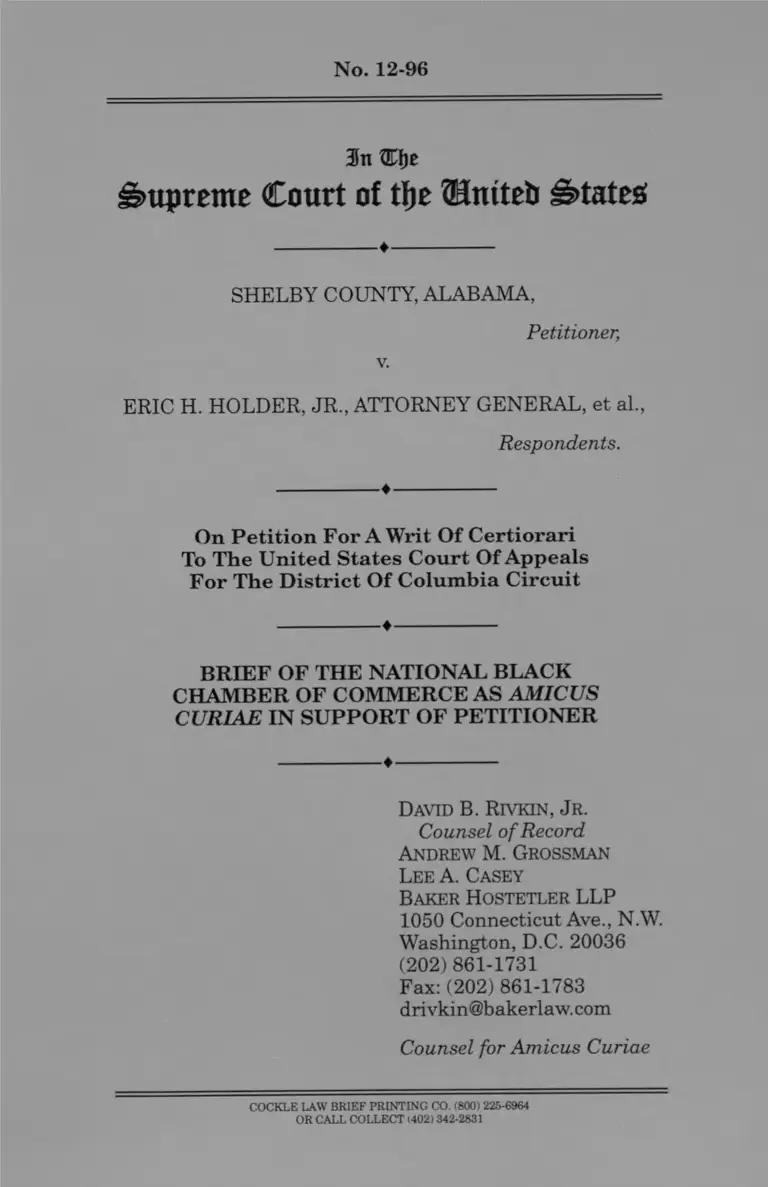
No. 12-96
3n me
Supreme Court of tfje fHmteb States!
--------------- « ----------------
SHELBY COUNTY, ALABAMA,
Petitioner,
v.
ERIC H. HOLDER, JR., ATTORNEY GENERAL, et al.,
Respondents.
On Petition For A Writ Of Certiorari
To The United States Court Of Appeals
For The District Of Columbia Circuit
--------------- ♦----------------
BRIEF OF THE NATIONAL BLACK
CHAMBER OF COMMERCE AS AMICUS
CURIAE IN SUPPORT OF PETITIONER
--------------- ♦----------------
David B. Rivkin, Jr.
Counsel of Record
Andrew M. Grossman
Lee A. Casey
Baker Hostetler LLP
1050 Connecticut Ave., N.W.
Washington, D.C. 20036
(202) 861-1731
Fax: (202)861-1783
drivkin@bakerlaw.com
Counsel for Amicus Curiae
COCKLE LAW BRIEF PRINTING CO. (800) 225-6964
OR CALL COLLECT (402) 342-2831
mailto:drivkin@bakerlaw.com
1
QUESTION PRESENTED
Whether Congress’s decision in 2006 to reautho
rize Section 5 of the Voting Rights Act under the pre
existing coverage formula of Section 4(b) exceeded its
authority under the Fifteenth Amendment and thus
violated the Tenth Amendment and Article IV of the
United States Constitution.
Page
QUESTION PRESENTED..................................... i
TABLE OF CONTENTS......................................... ii
TABLE OF AUTHORITIES................................... iv
INTEREST OF THE AMICUS CURIAE.............. 1
INTRODUCTION AND SUMMARY OF THE AR
GUMENT ............................................................ 2
ARGUMENT........................................................... 6
I. THE VRA’S PRECLEARANCE REGIME EX
CEEDS CONGRESS’S AUTHORITY UN
DER THE FIFTEENTH AMENDMENT.... 6
A. Section 5 Is No Longer an Appropriate
Means of Enforcing the Fifteenth Amend
ment ....................................................... 7
1. Only “Widespread Resistance to the
Fifteenth Amendment,” and Its Lin
gering Aftereffects, May Justify this
“Uncommon Exercise of Power”...... 7
2. The “Exceptional Conditions” Pre
sent in Katzenbach and Lingering
Aftereffects Present in City of Rome
No Longer Prevail........................... 12
B. The Section 4(b) Coverage Formula Is
No Longer “Rational in ... Practice and
Theory”................................................... 17
ii
TABLE OF CONTENTS
I l l
TABLE OF CONTENTS - Continued
Page
II. THE COURT NEED NOT RESOLVE THE
STANDARD OF REVIEW APPLICABLE
TO SECTION 2 OF THE FIFTEENTH
AMENDMENT............................................. 23
CONCLUSION....................................................... 28
TABLE OF AUTHORITIES
Page
Cases
Beer v. United States, 425 U.S. 130 (1976)................. 8
Bd. of Trustees of the Univ. of Alabama v.
Garrett, 531 U.S. 356 (2001).................................. 26
City ofBoeme v. Flores, 521 U.S. 507 (1997) . . . 6, 23, 26, 27
City of Rome v. United States, 446 U.S. 156
(1980)...............................................................passim
Georgia v. Ashcroft, 539 U.S. 461 (2003).................... 6
Gonzales v. Raich, 545 U.S. 1 (2005).........................23
McCulloch v. Maryland, 17 U.S. (4 Wheat.) 316
(1819)...................................................... 5,23,26, 27
Miller v. Johnson, 515 U.S. 900 (1995)................. 8, 24
Nat’l Fed. Indep. Bus. v. Sebelius, 132 S.Ct.
2566 (2012).............................................................. 23
Nw. Austin Mun. Util. Dist. No. One v.
Mukasey, 573 F.Supp.2d 221 (D.D.C. 2008)...........12
Nw. Austin Mun. Util. Dist. No. One v. Holder,
557 U.S. 193 (2009).........................................passim
Perry v. Perez, 132 S.Ct. 934 (2012)...........................17
Reno v. Bossier Parish School Bd., 528 U.S. 320
(2000).......................................................... 16, 25,26
Shaw v. Reno, 509 U.S. 630 (1993)..................... 25, 26
South Carolina v. Katzenbach, 383 U.S. 301
(1966)...............................................................passim
V
Page
Tennessee v. Lane, 541 U.S. 509 (2004)....4, 5, 16, 18, 22
United States v. Bd. of Comm’rs of Sheffield,
435 U.S. 110 (1978)................................................... 3
Constitutional Provisions and Statutes
U.S. Const, amend. XV.......................................passim
Pub. L. No. 89-110, 79 Stat. 437 (1965)...................... 7
Pub. L. No. 109-246, 120 Stat. 577 (2006)................ 16
42 U.S.C. § 1973 (“Section 2”) ................... 2, 16, 17, 23
42 U.S.C. § 1973 (“Section 3”) ..............................17, 24
42 U.S.C. § 1973b (“Section 4”) ......................... passim
42 U.S.C. § 1973c (“Section 5”).......................... passim
Other Authorities
H.R. Rep. No. 109-478 (2006).................... 4, 12, 14, 16
S. Rep. No. 109-295 (2006).............................13, 14, 15
Evan Caminker, “Appropriate” Means-Ends Con
straints on Section 5 Powers, 53 Stan. L. Rev.
1127 (2001).............................................................. 27
Ellen Katz, Documenting Discrimination in Vot
ing, Judicial Findings under Section 2 of the
VRA Since 1982, 36 U. Mich. J. L. Reform
643 (2006).......................................................... 16, 22
Nathaniel Persily, The Promise and Pitfalls of
the New Voting Rights Act, 117 Yale L.J. 174
(2007)................................................................. 5, 19
TABLE OF AUTHORITIES - Continued
VI
TABLE OF AUTHORITIES - Continued
Page
U.S. Census Bureau, Reported Voting and Reg
istration of the Voting-Age Population, by Sex,
Race and Hispanic Origin, for States: No
vember 2008............................................................14
1
The National Black Chamber of Commerce is a
nonprofit, nonpartisan organization dedicated to the
economic empowerment of African American com
munities through entrepreneurship. Incorporated in
1993, it represents nearly 100,000 African American-
owned businesses, and advocates on behalf of the 2.1
million black-owned businesses in the United States.
The Chamber has 190 affiliated chapters located
throughout the nation, as well as international affili
ates in, among others, the Bahamas, Brazil, Colom
bia, Ghana, and Jamaica.
The Chamber rejects the assumption underlying
Congress’s reauthorization of Section 5 of the Voting
Rights Act that the exceptional circumstances which
justified close federal oversight of the electoral prac
tices of many states and localities in 1965 and 1975
persist today. They do not. The Chamber and its
members and affiliates work hand-in-hand with gov
ernment at all levels to foster an environment in
which black-owned businesses can take root and
thrive. The government officials who are partners in
this effort are people of good faith, and do not deserve
INTEREST OF THE AMICUS CURIAE1
1 Pursuant to Rule 37.2(a), all parties have received at least
10 days’ notice o f amicus’s intent to file and have consented to
the filing o f this brief. In accordance with Rule 37.6, counsel to
amicus affirm that no counsel for any party authored this brief
in whole or in part and that no person or entity other than
amicus, its members, or its counsel made a monetary contribu
tion to its preparation or submission.
2
to be labeled and treated as presumptive discrim
inators. Federal control of elections, through the
“preclearance” process, undermines these officials’
authority and flexibility, to the ultimate detriment of
their constituents - many of them minorities. Worse,
Section 5 has been abused in some instances to rein
force stereotypes regarding minority voters’ prefer
ences and affiliations, preventing voters who do not
embody these stereotypes from electing their candi
dates of choice.
The Chamber supports vigorous enforcement of
those federal laws that prohibit actual voting discrim
ination, including the Fifteenth Amendment and
Section 2 of the Voting Rights Act. By contrast, Sec
tion 5 is no longer necessary to combat widespread
and persistent discrimination in voting and now, per
versely, serves as an impediment to racial neutrality
in voting and to the empowerment of state and local
officials who represent minority constituencies.
INTRODUCTION AND
SUMMARY OF THE ARGUMENT
Katzenbach upheld Section 5 of the Voting Rights
Act of 1965 (“VRA”) on the basis that “exceptional
conditions can justify legislative measures not other
wise appropriate.” South Carolina v. Katzenbach, 383
U.S. 301, 334 (1966). Though the Fifteenth Amend
ment had barred voting discrimination over 90 years
before, “registration of voting-age whites ran roughly
3
50 percentage points or more ahead of Negro registra
tion” in a group of states that flouted federal law
through discriminatory administration of voting re
quirements. Id. at 313. As quickly as Congress acted
to prohibit particular means of discrimination by
facilitating case-by-case litigation, these jurisdictions
contrived new ones, exhibiting an “unremitting and
ingenious defiance of the Constitution.” Id. at 309. In
the face of this massive resistance, Congress exer
cised its Fifteenth Amendment power in an “inventive
manner” by “shifting] the advantage of time and
inertia from the perpetrators of the evil to its victims”
through Section 5’s temporary preclearance regime,
which it confined to those specific regions where
“immediate action seemed necessary.” Id. at 327-28.
The exceptional conditions that prevailed in 1965
and justified “one of the most extraordinary remedial
provisions in an Act noted for its broad remedies,”
United States v. Bd. o f Comm’rs of Sheffield, 435 U.S.
110, 141 (1978) (Stevens, J., dissenting), no longer
exist. In today’s South, “[vjoter turnout and registra
tion rates now approach parity. Blatantly discrim
inatory evasions of federal decrees are rare. And
minority candidates hold office at unprecedented
levels.” Nw. Austin Mun. Util. Dist. No. One u. Holder,
557 U.S. 193, 202 (2009) (.“Nw. Austin”). Indeed, “the
racial gap in voter registration and turnout is lower
in the States originally covered by § 5 than it is na
tionwide.” Id. at 203. The VBA’s success over 45 years
has been robust and durable; no longer does Section 5
remain “necessary to preserve the limited and fragile’
4
achievements of the Act.” City of Rome v. United
States, 446 U.S. 156, 182 (1980).
The logic of Katzenbach and City of Rome does
not support Congress’s latest 25-year reauthorization
of the VRA’s preclearance regime. Those cases upheld
Section 5 as a temporary remedy for contemporan
eous, widespread discrimination and its lingering
aftereffects. Katzenbach, 383 U.S. at 334-35; City of
Rome, 446 U.S. at 176. But as the record most re
cently compiled by Congress concludes, “many of the
first generation barriers to minority voter registra
tion and voter turnout that were in place prior to the
VRA have been eliminated.” H.R. Rep. No. 109-478,
at 12 (2006). The Court need not “check Congress’s
homework to make sure that it has identified suffi
cient constitutional violations,” Tennessee v. Lane, 541
U.S. 509, 558 (2004) (Scalia, J., dissenting), but may
instead rely on Congress’s findings showing that
“systematic resistance to the Fifteenth Amendment,”
Katzenbach, 383 U.S. at 328, is long past. For that
reason, Section 5 is ultra vires and unconstitutional.
Section 4(b)’s coverage formula, based on 40-year-
old data that fails to account for decades of progress,
is also unconstitutional under Katzenbach. In 1965,
Congress used “evidence of actual voting discrimina
tion” to craft a coverage formula that the Court
upheld as “rational in both practice and theory.” Id. at
330. But in 2006, Congress rubberstamped continued
application of an outdated formula in the face of “con
siderable evidence that it fails to account for current
political conditions.” Nw. Austin, 557 U.S. at 203. As
5
to theory, the most one can say in that formula’s
defense is that leaving it in place did not “disrupt
settled expectations.” Nathaniel Persily, The Promise
and Pitfalls of the New Voting Rights Act, 117 Yale
L.J. 174, 208 (2007). And as to practice, the “correla
tion between inclusion in § 4(b)’s coverage formula
and low black registration or turnout ... appears to be
negative,” as is the correlation between coverage and
blacks’ holding public office. Pet. App. 83a, 85a (Wil
liams, J., dissenting). In other relevant respects, “the
covered jurisdictions appear indistinguishable from
their covered peers.” Id. at 93a. That they are none
theless singled out for opprobrium and federal super
vision is simply irrational and, given the absence of
“relevant constitutional violations,” cannot be sup
ported by the Fifteenth Amendment. See Lane, 541
U.S. at 564 (Scalia, J., dissenting).
To reach these conclusions, the Court need not
definitively resolve the extent of Congress’s Fifteenth
Amendment enforcement power, see Nw. Austin, 557
U.S. at 204, but only apply Katzenbach and City of
Rome according to their terms. Their application of
the “necessary and proper” standard of McCulloch v.
Maryland, 17 U.S. (4 Wheat.) 316, 421 (1819), though
flexible, requires at least that Congress’s ends be
legitimate, its means be “plainly adapted” to those
ends, and its actions comport with the letter and the
spirit of the Constitution. Congress’s decision to “en
force” Section 1 of the Fifteenth Amendment by in
vading states’ power to regulate elections, in the face
of evidence that any need for such a prophylactic
6
remedy has long passed, falls far short, particularly
when the means it has chosen violate the Consti
tution’s letter by rendering race “the predominant
factor in redistricting.” Georgia v. Ashcroft, 539 U.S.
461, 491 (2003). Of course, the result is no different
under the more rigorous “congruence and proportion
ality” standard of City of Boerne v. Flores, 521 U.S.
507, 520 (1997).
This case presents a question of great and recur
ring importance. Delaying review of the issues it
raises will only exacerbate the iniquities of the pre
clearance regime. The Court should grant the petition
for a writ of certiorari and overturn the decision of
the court below.
ARGUMENT
I. THE VRA’S PRECLEARANCE REGIME EX
CEEDS CONGRESS’S AUTHORITY UNDER
THE FIFTEENTH AMENDMENT
The Fifteenth Amendment does not grant Con
gress plenary power to regulate states’ electoral prac
tices. As Congress itself recognized in the 1965 Act,
suspending facially nondiscriminatory voting regula
tions and subjecting them to review for discrimina
tory purpose or effect was so novel and aggressive an
exercise of its enforcement power that it applied the
VRA’s preclearance requirement only to those ju
risdictions employing tests or devices to violate the
Fifteenth Amendment’s affirmative prohibition and
did so only on an emergency basis, limited to five
7
years. Pub. L. No. 89-110, § 4, 79 Stat. 437, 438
(1965). This Court upheld that enactment as justified
by “widespread resistance” to the constitutional pro
hibition against racial discrimination in voting: “Un
der the compulsion of these unique circumstances,
Congress responded in a permissibly decisive man
ner.” Katzenbach, 383 U.S. at 337, 335. Because those
unique circumstances are long in the past, and be
cause voting discrimination is no longer concentrated
in the areas singled out by its obsolete coverage
formula, Section 5 no longer serves to enforce the
right of citizens to vote free of race, color, or previous
condition of servitude.
A. Section 5 Is No Longer an Appropriate
Means of Enforcing the Fifteenth Amend
ment
1. Only “Widespread Resistance to the
Fifteenth Amendment,” and Its Lin
gering Aftereffects, May Justify this
“Uncommon Exercise of Power”
The Court has always held that prophylactic
exercises of Congress’s Fifteenth Amendment en
forcement power, and Section 5 in particular, “must
be justified by current needs.” Nw. Austin, 557 U.S. at
203. In particular, this means “widespread and per
sistent discrimination in voting,” Katzenbach, 383
U.S. at 331, and its lingering effects, City of Rome,
446 U.S. at 176, 181-82.
8
“Section 5 was directed at preventing a particular
set of invidious practices that had the effect of un
doing or defeating the rights recently won by non
white voters.” Miller v. Johnson, 515 U.S. 900, 925
(1995) (internal quotation marks and citation omit
ted). Through discriminatory administration of voting
qualifications, and an endless procession of tests and
devices, jurisdictions predominantly within the South
managed to deprive black citizens of their right to
vote for nearly a century following the Fifteenth
Amendment’s enactment.
Beginning in the 1950s, Congress “repeatedly
tried to cope with the problem by facilitating case-
by-case litigation against voting discrimination.”
Katzenbach, 383 U.S. at 313. But that approach
proved unequal to the Southern states’ “unremitting
and ingenious defiance of the Constitution.” Id. at 309.
Jurisdictions could “stay[ ] one step ahead of the fed
eral courts by passing new discriminatory voting laws
as soon as the old ones had been struck down.” Beer v.
United States, 425 U.S. 130, 140 (1976). Each new
law “remained in effect until the Justice Department
or private plaintiffs were able to sustain the burden
of proving that [it], too, was discriminatory.” Id.
Section 5 was directed precisely at this evil:
Congress had found that case-by-case litiga
tion was inadequate to combat widespread
and persistent discrimination in voting, be
cause of the inordinate amount of time and
energy required to overcome the obstruction
ist tactics invariably encountered in these
9
lawsuits. After enduring nearly a century
of systematic resistance to the Fifteenth
Amendment, Congress might well decide to
shift the advantage of time and inertia from
the perpetrators of the evil to its victims.
Katzenbach, 383 U.S. at 328.
And the Katzenbach Court upheld Section 5 on
precisely that basis, reasoning that “exceptional con
ditions can justify legislative measures not otherwise
appropriate.” Id. at 334. The provision, it recognized,
was an “inventive,” and potentially problematic, as
sertion of Congress’s Fifteenth Amendment enforce
ment power, in three respects. First, it automatically
suspends state and local procedures, prior to any
judicial review. But this was, the Court recognized, “a
legitimate response to the problem” of “systematic
resistance to the Fifteenth Amendment” that was un
checked by case-by-case litigation. Id. at 328. Second,
Section 5’s remedies were not uniform throughout the
nation, in keeping with the principle of equal sover
eignty, but confined “to a small number of States
and political subdivisions” identified by formula. Id.
This, too, was permissible in principle: Congress
could appropriately “cho[o]se to limit its attention to
the geographic areas where immediate action seemed
necessary.” Id.
Finally, the Court considered, and approved, Sec
tion 5’s substantive effect, of suspending the opera
tion of voting regulations pending federal review for
discriminatory purpose or effect. This “uncommon
10
exercise of power,” it explained, was justified only by
the “exceptional circumstances” of the day:
Congress knew that some of the States cov
ered by § 4(b) of the Act had resorted to the
extraordinary stratagem of contriving new
rules of various kinds for the sole purpose of
perpetuating voting discrimination in the
face of adverse federal court decrees. Con
gress had reason to suppose that these
States might try similar maneuvers in the
future in order to evade the remedies for vot
ing discrimination contained in the Act itself.
Under the compulsion of these unique cir
cumstances, Congress responded in a per
missibly decisive manner.
Id. at 334-35.
City of Rome affirmed Katzenbach and upheld
the 1975 reauthorization of Section 5. The Court re
jected the argument that a ban on electoral changes
that are discriminatory in effect necessarily exceeds
Congress’s Fifteenth Amendment enforcement power.
Under that power, Congress may “attack! ] the per
petuation of earlier, purposeful racial discrimination,
regardless of whether the practices they prohibited
were discriminatory only in effect.” Id. at 177. In this
instance, Congress “could rationally have concluded
that, because electoral changes by jurisdictions with a
demonstrable history of intentional racial discrimina
tion in voting create the risk of purposeful discrimi
nation, it was proper to prohibit changes that have a
discriminatory impact.” 446 U.S. at 177. Section 5
11
was therefore an appropriate means of enforcing the
Fifteenth Amendment by “preventing States from un
doing or defeating the rights recently won by Ne
groes.” Id. at 178 (internal quotation marks omitted).
The Court also upheld Congress’s seven-year re
authorization of Section 5, on the basis that it re
mained “necessary to preserve” what were then “the
limited and fragile achievements of the Act.” Id. at
182 (internal quotation marks omitted). Although rec
ognizing that progress had been made, the Court
deferred to Congress’s finding, supported by electoral
data, that the effects of a century of widespread dis
crimination persisted even a decade after the VRA’s
enactment:
Significant disparity persisted between the
percentages of whites and Negroes registered
in at least several of the covered juris
dictions. In addition, though the number of
Negro elected officials had increased since
1965, most held only relatively minor posi
tions, none held statewide office, and their
number in the state legislatures fell far short
of being representative of the number of
Negroes residing in the covered jurisdictions.
Congress concluded that, because minority
political progress under the Act, though “un
deniable,” had been “modest and spotty,” ex
tension of the Act was warranted.
Id. at 180-81. On that basis, “Congress’ considered de
termination that at least another 7 years of statutory
remedies were necessary to counter the perpetuation
12
of 95 years of pervasive voting discrimination [was]
both unsurprising and unassailable.” Id. at 182.
2. The “Exceptional Conditions” Present
in Katzenbach and Lingering After
effects Present in City of Rome No
Longer Prevail
The same cannot be said of Congress’s 2006
reauthorization of Section 5 in the face of evidence
demonstrating that “[t]he extensive pattern of dis
crimination that led the Court to previously uphold
§ 5 as enforcing the Fifteenth Amendment no longer
exists.” Nw. Austin, 557 U.S. at 226 (Thomas, J., con
curring).
Indeed, Congress was forced to concede that
“many of the first generation barriers to minority
voter registration and voter turnout that were in
place prior to the VRA” - i.e., the very types of tests,
devices, and “ingenious defiance” that Section 5 was
enacted to block - “have been eliminated.” H.R. Rep.
No. 109-478, at 12. “Blatantly discriminatory eva
sions of federal decrees are rare,” Nw. Austin, 557
U.S. at 202, and the instances of allegedly discrimi
natory conduct identified by Congress are few in
number and widely scattered. See Nw. Austin Mun.
Util. Dist. No. One v. Mukasey, 573 F.Supp.2d 221,
252-54, 256-62 (D.D.C. 2008) (summarizing legislative
record); Pet. App. 29a-30a (providing five examples,
four involving towns or counties, over 11 years);
13
S. Rep. No. 109-295, at 13 (2006) (identifying a total
of six published cases since 1982 where a court has
found unconstitutional voting discrimination against
minorities). They do not amount to anything near
the kind of “widespread and persistent discrimination
in voting” that Katzenbach held to justify Section 5.
383 U.S. at 328 (citing “a century of systematic re
sistance to the Fifteenth Amendment”).
Reflecting this lasting progress, “the rate of DOJ
objections to preclearance requests has decreased
from over 4% in the first five years after the Voting
Rights Act, to between 0.05% and 0.23% from 1983
to 2002,” Persily, supra, at 199, to .05% from 1998
to 2002, Pet. App. 34a. These data on actual en
forcement actions rebut any possible argument “that
public officials stand ready, if given the chance, to
again engage in concerted acts of violence, terror,
and subterfuge in order to keep minorities from vot
ing.” Nw. Austin, 557 U.S. at 226 (Thomas, J., concur
ring).
The record is also clear that the kind of lingering
aftereffects of a century of voting discrimination that
the City of Rome Court held to support reauthoriza
tion of Section 5 are too in the past. “[T]he number of
African-Americans who are registered and who turn
out to cast ballots has increased significantly over the
last 40 years, particularly since 1982,” and “[i]n some
circumstances, minorities register to vote and cast
14
ballots at levels that surpass those of white voters.”
H.R. Rep. No. 109-478, at 12. In particular:
[I]n seven of the covered States, African-
Americans are registered at a rate higher
than the national average. Moreover, in Cali
fornia, Georgia, Mississippi, North Carolina,
and Texas, black registration and turnout in
the 2004 election ... was higher than that
for whites. In Louisiana and South Carolina,
African-American registration was 4 per
centage points lower than that for whites - a
rate identical to the national average.
S. Rep. No. 109-295, at 11. Even in the farthest
outlier, Virginia, black voter registration in 2004 was
only 7 percentage points lower than the national
average, id., and had nowhere near the “significant
disparity” between black and white voting rates that
persisted through the decade following enactment of
the VRA." Id.; see City of Rome, 446 U.S. at 180; cf.
Katzenbach, 383 U.S. at 313 (in several Southern
states, black registration was 50 percentage points
behind white registration).
Moreover, by 2008, black registration and voting rates in
Virginia exceeded than those for whites. U.S. Census Bureau,
Reported Voting and Registration o f the Voting-Age Population,
by Sex, Race and Hispanic Origin, for States: Novem ber 2008, at
tbl. 4b, http^/www.census.gov/hliesVvAv/socdemo/voting/'publications''
p20/2008/tables.html.
http://www.census.gov/hliesVvAv/socdemo/voting/'publications''
15
Similar gains are evident in the number of black
elected officials:
As of 2000, more than 9,000 African-
Americans have been elected to office, an
increase from the 1,469 officials who held
office in 1970. As of 2004, 43 African-
Americans currently serve in the United
States Congress, with 42 individuals serving
in the United States House of Representa
tives, and one serving in the United States
Senate. At the State level, more than 482
African-Americans serve in State legislatures,
with thousands more African-Americans serv
ing in county, township, and other locally
elected positions.
S. Rep. No. 109-296, p. 18. No longer do the number
of black elected officials in covered jurisdictions “f[a]ll
far short of being representative” of the black popula
tions of covered jurisdictions. City of Rome, 446 U.S.
at 181.
In sum, Congress’s own findings, supported by
Census data, demonstrate that, far from “limited and
fragile,” City of Rome, 446 U.S. at 182, the achieve
ments of the VRA have been robust and durable, par
ticularly over the past three decades. There is no
possibility that the jurisdictions subject to Section 5,
unbridled from the preclearance requirement, could
act to “perpetuate[ ] the effects of past discrimina
tion,” id. at 176, when those effects have long since
dissipated.
Recognizing that the exceptional circumstances
previously found to support Section 5 no longer
16
prevail, Congress based its reauthorization on evi
dence of so-called “second-generation barriers” quite
unlike the type of purposeful discrimination that
motivated Section 5’s enactment. See Pub. L. No. 109-
246, § 2(b)(4), 120 Stat. 577, 577-78 (2006). Much of
this evidence concerns “racially polarized voting” (i.e.,
“block voting”), not any kind of state action to deny
the right to vote. See H.R. Rep. No. 109-478, pp. 34-
35. It is irrelevant. Lane, 541 U.S. at 564 (Scalia, J.,
dissenting) (requiring “an identified history of rele
vant constitutional violations”). The remainder con
sists of Section 2 vote dilution litigation. Pet. App.
26a-29a, 36a-38a. This evidence, or course, does not
even suggest the kind of purposeful discrimination
that the Court held to support Section 5; it does not
indicate any violation of the Fifteenth Amendment,
see Reno v. Bossier Parish School Bd., 528 U.S. 320,
334 n.3 (2000) (“Bossier IF’); and, as described further
below, it does not support Congress’s application of
Section 5 to particular jurisdictions. See Ellen Katz,
Documenting Discrimination in Voting, Judicial Find
ings under Section 2 of the VRA Since 1982, 36 U.
Mich. J. L. Reform 643, 677-78 (2006) (identifying all
of 12 lawsuits finding intentional discrimination in
covered jurisdictions, and 21 in non-covered jurisdic
tions, between 1982 and 2006).
Finally, absent the sort of widespread discrimina
tion and “obstructionist tactics” that prevailed in
1965, traditional litigation, such as under Section 2,
is certainly not “inadequate” to protect the right to
vote. See Katzenbach, 383 U.S. at 328. In addition to
17
the Section 3 “bail-in” mechanism, which authorizes
judicial preclearance of voting regulations in juris
dictions found to have engaged in discrimination,
“courts may always use the standard remedy of a
preliminary injunction to prevent irreparable harm
caused by delay” in Section 2 litigation. Pet. App. 77a-
78a (Williams, J., dissenting) (citing Perry v. Perez,
132 S.Ct. 934, 942 (2012)). No evidence even sug
gests that jurisdictions (subject to Section 5 or not)
have acted to evade Section 2 judgments or other
wise stymie judicial enforcement of the right to vote.
See generally Katz, supra (comprehensively surveying
Section 2 litigation between 1982 and 2006).
Without question, “exceptional conditions can
justify legislative measures not otherwise appropriate”
under Congress’s remedial authority. Katzenbach, 383
U.S. at 334. But for Congress to persist long past the
date those conditions are remedied, as it has with its
reauthorization of Section 5, is to seize for itself a
new and improper power that the Constitution re
serves to the states.
B. The Section 4(b) Coverage Formula Is
No Longer “Rational in ... Practice and
Theory”
Section 4(b)’s coverage formula comes nowhere
near satisfying Katzenbach’s bare-minimum require
ment that preclearance coverage be “rational in both
practice and theory.” Based on 40-year-old data that
“fails to account for current political conditions,” Nw.
18
Austin, 557 U.S. at 203, it blatantly violates “the
requirement that Congress may impose prophylactic
§ [2] legislation only upon those particular States in
which there has been an identified history of relevant
constitutional violations.” Lane, 541 U.S. at 564
(citing cases).
Katzenbach recognized that Section 4(b) was un
usual, and potentially problematic, because it con
fines its remedies (and those of Section 5) to a
discrete set of states and political subdivisions. 383
U.S. at 328. It therefore required that Congress
distinguish between covered and non-covered juris
dictions in a rational manner, so as “to justify the
application to [covered] areas of Congress’ express
powers under the Fifteenth Amendment.” Id. at 329.
The Section 4(b) formula was rational in practice,
because it applied two characteristics routinely
shared by jurisdictions that had engaged in actual
voting discrimination - “the use of tests and devices
for voter registration, and a voting rate in the 1964
presidential election at least 12 points below the na
tional average.” Id. at 330. And it was rational in
theory, because those characteristics are logically
probative of discrimination: “Tests and devices are
relevant to voting discrimination because of their
long history as a tool for perpetrating the evil; a low
voting rate is pertinent for the obvious reason that
widespread disenfranchisement must inevitably af
fect the number of actual voters.” Id. Overall, the
coverage formula’s rationality was “confirm[ed]” by
the fact that it exempted no state or jurisdiction that
19
had engaged in recent discrimination involving tests
or devices - in other words, coverage could be jus
tified on both an absolute and relative basis. Id. at
331.
By contrast, attempting to identify present-day
vote discrimination by reference to 40-year-old data is
not rational in either respect. It is certainly not
rational in theory. “[T]he misuse of tests and devices
... was the evil for which the new remedies were
specifically designed,” id., but voting practices in
place at the time President Richard Nixon was
reelected are not probative of any current discrimina
tion. Ending “widespread and persistent discrimina
tion in voting” was Congress’s broader objective, id.,
but obstinate refusal to consider more recent experi
ence guarantees that, even if met, that objective will
have no legal consequence whatsoever. “In identifying
past evils, Congress obviously may avail itself of in
formation from any probative source,” id. at 330, but
it may not bury its head in the sand. And the Court
has never suggested that political expedience is suf
ficient to sustain an otherwise irrational exercise of
enforcement power. See Persily, supra, at 208-09 (al
tering the coverage formula “would likely have led to
the complete unraveling of the bill”); id. at 210 (ex
panding coverage to “large and politically powerful
states ... would have sunk the bill”); id. at 211
(“Whatever its drawbacks, the current coverage
formula had the virtue of already having been upheld
by the Supreme Court,” decades prior.).
20
Even more stunning is Section 4(b)’s complete
failure in practice to identify current vote discrimina
tion. Voter registration and turnout data, which were
central to Katzenbach, actually undermine any argu
ment for the formula’s current rationality:
There appears to be no positive correlation
between inclusion in § 4(b)’s coverage for
mula and low black registration or turnout.
Quite the opposite. To the extent that any
correlation exists, it appears to be negative -
condemnation under § 4(b) is a marker of
higher black registration and turnout. Most
of the worst offenders - states where in 2004
whites turned out or were registered in sig
nificantly higher proportion than African-
Americans — are not covered. These include,
for example, the three worst - Massa
chusetts, Washington, and Colorado. And
in Alabama and Mississippi, often thought
of as two of the worst offenders, African-
Americans turned out in greater proportion
than whites.
Pet. App. 83a (Williams, J., dissenting) (citing Census
Bureau voting data).
Data on black elected officials also demonstrates
the formula’s completely arbitrary pattern of cover
age:
Covered jurisdictions have far more black of
ficeholders as a proportion of the black popu
lation than do uncovered ones. Of the ten
states with the highest proportion of black
elected officials relative to population, eight
21
are covered states, with the top five all being
fully covered states (Virginia, Louisiana,
South Carolina, Mississippi, and Alabama).
Nor can the poor scores achieved by some un
covered states be chalked up to small black
populations. Illinois, Missouri, Delaware and
Michigan, where African-Americans comprise
at least 10% of the [citizen voting-age popu
lation], all [score worse than] every one of
the states fully covered by § 4(b).
Pet. App. 85a (Williams, J., dissenting) (citing Census
Bureau and election data). Based on data from recent
decades, “no one could credibly argue that the [black
officeholder] numbers are proof of the coverage
scheme’s continued rationality.” Id.
Taken as a whole, the same types of data on
which the Court relied in Katzenbach and City of
Rome do not show that vote discrimination is “con
centrated in the jurisdictions singled out for preclear
ance.” Nw. Austin, 557 U.S. at 203. In fact, they show
the opposite. Congress’s choice, notwithstanding that
fact, to continue to subject those jurisdictions to the
preclearance requirement is therefore arbitrary, ir
rational, and in excess of its Fifteenth Amendment
enforcement power.
Again, recognizing that Section 4(b) could not be
upheld under the reasoning of Katzenbach and City of
Rome, Congress attempted to bolster the record by
pointing to “second-generation barriers” to voting,
principally Section 2 litigation, which are not neces
sarily probative of Fifteenth Amendment violations.
22
But Section 2 cases since the last reauthorization of
the VRAin 1982 do not support Section 4(b)’s contin
ued application:
The five worst uncovered jurisdictions, in
cluding at least two quite populous states
(Illinois and Arkansas), have worse records
than eight of the covered jurisdictions.... Of
the ten jurisdictions with the greatest num
ber of successful § 2 lawsuits, only four are
covered.
Pet. App. 93a (Williams, J., dissenting). Moreover, of
those very few cases that resulted in a finding of
intentional discrimination — the only result conceiv
ably relevant to the Katzenbach analysis - far more
arose in non-covered jurisdictions (21 cases) than in
covered jurisdictions (12 cases). Katz, supra, at 677.
* * *
Lacking evidence of any meaningful correlation
between Section 4(b)’s coverage formula and actual
Fifteenth Amendment violations, and unable or un
willing to devise a formula suited to current condi
tions, Congress attempted to backfill the legislative
record with largely irrelevant evidence of Section 2
cases, and even those data undermine the case for the
formula’s rationality. But reliable evidence, accepted
by Congress and long held relevant by this Court,
confirms that the coverage formula “fails to account
for current political conditions,” Nw. Austin, 557 U.S.
at 203, and fails to confine Section 5’s remedy to
those particular states” that have engaged in vote
discrimination, Lane, 541 U.S. at 564 (Scalia, J., dis
senting). It therefore exceeds Congress’s authority.
23
II. THE COURT NEED NOT RESOLVE THE
STANDARD OF REVIEW APPLICABLE TO
SECTION 2 OF THE FIFTEENTH AMEND
MENT
The foregoing analysis demonstrates that the
Court need not resolve the difficult question of the
proper standard of review for exercises of Congress’s
Fifteenth Amendment enforcement power. See Nw.
Austin, 557 U.S. at 204 (“That question has been
extensively briefed in this case, but we need not re
solve it.”). Whether under the more permissive
McCulloch standard, which the Court claimed to ap
ply in Katzenbach and City of Rome, or the poten
tially more rigorous “congruence and proportionality”
standard of Boerne, the result is the same: the Fif
teenth Amendment cannot support the VRA’s arbi
trary and unnecessary preclearance regime.
Though permissive, the McCulloch standard does
not accord Congress plenary power. Instead, it re
quires that Congress, at the least, legislate with
rationality and within the limitations of the Consti
tution. McCulloch, 17 U.S. (4 Wheat.) at 421; accord
Gonzales v. Raich, 545 U.S. 1, 39 (2005) (Scalia, J.,
concurring); Nat’l Fed. Indep. Bus. v. Sebelius, 132
S.Ct. 2566, 2647 (2012) (Scalia, Kennedy, Thomas,
Alito, JJ., dissenting) (concluding that insurance-
coverage mandate was not plainly adapted, and there
fore not “necessary,” to effectuate insurance-market
24
reforms). As should be apparent, the preclearance
regime fails on both counts.
First, it is anything but “plainly adapted” to the
unarguably legitimate end of eradicating both wide
spread intentional discrimination in voting and the
perpetuation of the effects of such discrimination. See
City of Rome, 446 U.S. at 178. As described above,
such discrimination is now rare and scattered, calling
into serious question the appropriateness of any pre
clearance process other than one limited to particular
jurisdictions’ violations of the Reconstruction Amend
ments - in other words, the VRA’s Section 3(b). And
the effects of previous discrimination have long since
dissipated, as demonstrated by blacks’ robust voting
participation rates and substantial gains in elected
offices. But even more damning is the preclearance
regime’s perfectly arbitrary coverage, which bears no
relation to any meaningful indicia of vote discrimina
tion, much less actual acts of discrimination. Based
on decades-old data, the coverage formula is plainly
adapted only to Congress’s political expedience, and
not to any facts on the ground that might justify
Section 5’s extraordinary burden.
Second, the preclearance regime stands in viola
tion of both the letter and the spirit of the Constitu
tion. Section 5, even prior to its 2006 amendment,
was recognized to be in “tension with the Fourteenth
Amendment” to the extent that it was used as a “com
mand that States engage in presumptively unconsti
tutional race-based districting.” Miller, 515 U.S. at
25
927. Congress’s 2006 amendments, even while leav
ing untouched the Section 4(b) coverage formula, ig
nored this Court’s warnings and amended Section 5
to mandate race-conscious districting. Under the new
Section 5, covered jurisdictions must prove that any
change will not “diminish!] the ability” of minorities
“to elect their preferred candidates of choice,” 42
U.S.C. §§ 1973c(b),(d), and is not premised on a “dis
criminatory purpose” of declining to adopt other chang
es that would have strengthened minority voting
power, § 1973c(c).
As a result of these amendments, “[pjreclearance
now has an exclusive focus - whether the plan dimin
ishes the ability of minorities (always assumed to be
a monolith) to ‘elect their preferred candidates of
choice,’ irrespective of whether policymakers (includ
ing minority ones) decide that a group’s long-term
interests might be better served by less concentration
- and thus less of the political isolation that concen
tration spawns.” Pet. App. 75a (Williams, J., dissent
ing). Moreover, “[b]y inserting discriminatory purpose
into § 5, and requiring covered jurisdictions affirma
tively to prove its absence, Congress appears to have
... restored ‘the Justice Department’s implicit com
mand that States engage in presumptively unconsti
tutional race-based districting.’ ” Id. at 76a (quoting
Bossier II, 528 U.S. at 336). Section 5 now requires, in
effect, that minority voters be lumped together with
other persons with whom they “may have little in
common ... but the color of their skin.” Shaw v. Reno,
509 U.S. 630, 647 (1993). This in itself perpetuates
26
and enforces “impermissible stereotypes” and “bears
an uncomfortable resemblance to political apartheid.”
Id. And mandating that covered jurisdictions dis
criminate among their own citizens on the basis of
race surely “exacerbate[s] the substantial federalism
costs that the preclearance procedure already exacts.”
Bossier II, 528 U.S. at 336.3
Finally, even the most cursory analysis shows
that the preclearance regime, which cannot with
stand McCulloch’s standard, surely fails “congruence
and proportionality” review. Under Boerne, a court
must “identify with some precision the scope of the
constitutional right at issue,” Bd. of Trustees of the
Univ. of Alabama v. Garrett, 531 U.S. 356, 365 (2001);
examine whether Congress identified a history and
pattern” of constitutional violations, id. at 368; and
then find “congruence and proportionality between
the injury to be prevented or remedied and the means
adopted to that end.” Boerne, 521 U.S. at 520. Here, a
“history and pattern” of constitutional violations is
lacking, and the Court has rejected looking decades
Although these issues were not argued below as independ
ent grounds for invalidation o f Sections 4(b) and 5, they are un
questionably implicated by the question presented, both under
the McCulloch standard (actions m ust “consist with the letter
and spirit o f the constitution” ) and the Boerne standard (actions
must be congruent and proportional), and are therefore properly
raised by the petition for a writ o f certiorari. See Pet. App. at 77a
(Williams, J., dissenting) (To evaluate Section 4 (b)’ s constitu
tionality, one must necessarily first assess the severity o f the
consequences o f coverage under § 4(b) (i.e., subject to § 5 as it
exists today.)”).
27
into the past to take notice of conditions that fortu
nately no longer prevail, in support of current and
substantial burdens on federalism. Nw. Austin, 557
U.S. at 203. Measured against current evidence of
intentional discrimination in voting, the preclearance
regime is “so out of proportion to a supposed remedial
or preventive object that it cannot be understood
as responsive to, or designed to prevent, unconsti
tutional behavior.” Boerne, 521 U.S. at 509.4 Nor is
its haphazard coverage congruent to any recent
pattern of actual voting discrimination.
Of course, it is only logical that an enactment
which is not “plainly adapted” to enforcement of a
constitutional right, or outside the “letter and spirit
of the constitution,” also lacks “congruence and pro
portionality” with respect to violations of that right.
See generally Evan Caminker, “Appropriate” Means-
Ends Constraints on Section 5 Powers, 53 Stan. L. Rev.
1127, 1153-58 (2001). A statute that fails McCulloch
therefore fails Boerne. To decide this case, the Court
need not choose between the two.
4 A nd this infirm ity is only exacerbated by the most recent
amendments to Section 5.
28
CONCLUSION
For the foregoing reasons, this Court should
grant the petition for a writ of certiorari.
Respectfully submitted,
David B. Rivkin, Jr.
Counsel o f Record
Andrew M. Grossman
Lee A. Casey
Baker Hostetler LLP
1050 Connecticut Ave., N.W.
Washington, D.C. 20036
(202)861-1731
Fax: (202) 861-1783
drivkin@bakerlaw. com
Counsel for Amicus Curiae
August 2012