Yarbrough v. The Hubert-West Memphis School District No. 4 Appellees' Brief
Public Court Documents
January 1, 1967
-
Brief Collection, LDF Court Filings. Yarbrough v. The Hubert-West Memphis School District No. 4 Appellees' Brief, 1967. 19f95caf-c99a-ee11-be36-6045bdeb8873. LDF Archives, Thurgood Marshall Institute. https://ldfrecollection.org/archives/archives-search/archives-item/3abf6977-867a-45aa-8399-9854fe1d033d/yarbrough-v-the-hubert-west-memphis-school-district-no-4-appellees-brief. Accessed October 08, 2026.
Copied!
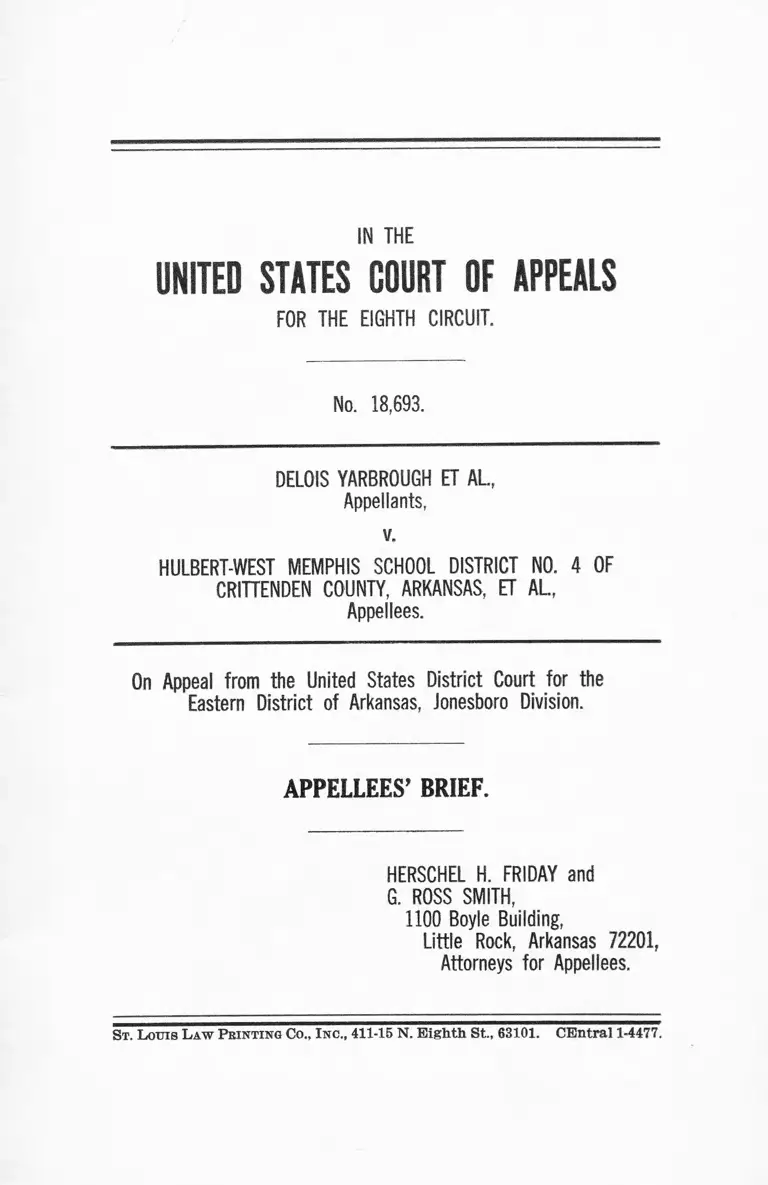
UNITED STATES COURT OF APPEALS
FOR THE EIGHTH CIRCUIT.
IN THE
No. 18,693.
DELOIS YARBROUGH ET A L ,
Appellants,
v.
HULBERT-WEST MEMPHIS SCHOOL DISTRICT NO. 4 OF
CRITTENDEN COUNTY, ARKANSAS, ET A L ,
Appellees.
On Appeal from the United States District Court for the
Eastern District of Arkansas, Jonesboro Division.
APPELLEES' BRIEF.
HERSCHEL H. FRIDAY and
G. ROSS SMITH,
1100 Boyle Building,
Little Rock, Arkansas 72201,
Attorneys for Appellees.
St. L ouis L a w Printing Co., I nc., 411-15 N. E ighth St., 63101. CEntral 1-4477.
INDEX.
Page
Statement of Case ............................................................. 1
Statement of Points to Be A rgu ed ................................. 4
Argument:
I. The District Court Was Correct in Approving
Appellees’ Plan for Desegregation of Faculty and
Staff ............................................................................ 5
II. The District Court Properly Dismissed the Case
Since All Issues Had Been A djudicated................ 15
Conclusion............................... .......................... ................. 17
Table of Cases.
Aaron v. Cooper, 169 F. Supp. 325 (E. D. Ark. 1959). .4,16
Bradley v. School Board of the City of Richmond,
382 U. S. 103 (1965) ..................................... ............... 4, 5
Briggs v. Elliott, 132 F. Supp. 776 (E. D. S. Car.
1955) .................................................................................. 4,16
Brown v. Board of Education of Topeka, 347 U. S. 483
(1954 )............................................................................ 4,5,15
Clark v. Board of Education of Little Rock, 369 F. 2d
661 (8th Cir. 1966) ................................. 4, 6, 7, 8,10,12,15
Dowell v. Oklahoma Board of Education, . . . F. 2d
. . . (10 Cir. No. 8523 January 23, 1967), Affirming
244 F. Supp. 971 (W. D. Okla. 1967) ......................... 4,14
Kier v. County School Board of Augusta County, 249
F. Supp. 239 (E. D. Va. 1966) ............................. 4,13,14
Kemp v. Beasley, 352 F. 2d 14 (8th Cir. 1965)... .2,4, 6,15
Smith v. Board of Education of Morrilton School Dis
trict No. 32, 365 F. 2d 770 (8th Cir. 1966)..............4, 7,11
United States v. Jefferson County School Board . . .
F. 2d . . . (5th Cir. No. 23345, Dec. 29,
1966) 4, 5,12,15,16
UNITED STATES COURT OF APPEALS
FOR THE EIGHTH CIRCUIT.
IN THE
No. 18,693.
DELOIS YARBROUGH ET A L ,
Appellants,
v.
HULBERT-WEST MEMPHIS SCHOOL DISTRICT NO. 4 OF
CRITTENDEN COUNTY, ARKANSAS, ET AL.,
Appellees.
On Appeal from the United States District Court for the
Eastern District of Arkansas, Jonesboro Division.
APPELLEES’ BRIEF.
STATEMENT.
Appellants’ statement contains errors of omission and
misplaced emphasis, and Appellees, in this Statement,
will set forth factors necessary for a proper orientation
to the issues presented in this appeal.
In response to the Appellees’ original Desegregation
Plan, Appellants noted nine features of the plan to which
they objected. One of these objections was that as pro
posed, the provisions relating to faculty and staff de
segregation were inadequate. The primary objection
2
was that the desegregation plan was defective in that it
made no provision for “ establishing a set of school zone
lines on a non-racial basis.” See 243 F. Supp. at 69.
After a hearing, the Plan was approved and the pro
visions for staff desegregation were foxmd constitutionally
adequate “ at this time,” with the understanding that the
Appellees would continue these efforts in accordance with
added knowledge to be derived from their experiences
with the problem. 243 F. Supp. 65.
After the Appellants filed Notice of Appeal, the parties
agreed to amend the Plan to conform to the decision of
this Court in Kemp v. Beasley, 352 F. 2d 14 (8th Cir.
1965). No changes were made in the provisions of the
Plan pertaining to faculty and staff desegregation or in
any commitments of Appellees with reference thereto but
Appellees did agree to submit a progress report on faculty
and staff desegregation. Such a report was filed and its
contents are set forth in Section II of this brief. Appel
lants objected to the report. Thereafter a Supplemental
Report on faculty and staff desegregation was filed, the
contents of which are also set forth in Section II of this
brief. Both of the reports filed by Appellees were treated
as amendments to the Plan.
As noted in the Memorandum Letter Opinion of No
vember 21, 1966, Appellants then requested a ruling on
the question of the adequacy of the Plan as it related to
faculty and staff desegregation. By Memorandum Letter
Opinion of September 29, 1966, the Plan as amended was
approved, but Appellees were requested to adopt a “ con
crete” expression of policy suggested by the District
Court. Appellees did so. The Court found that Appellees
had made a “ meaningful start” toward achieving faculty
and staff desegregation. The District Court having
deemed the matter to have been fully submitted, an Order
was entered on October 28, 1966 approving the Plan as
amended and dismissing the cause.
Appellants then filed a “ Motion for New Trial and/or
to Amend the Judgment,” in which the Court was in
formed that Appellants then desired “ to investigate
faculty and staff desegregation in the district” and to
retain their educational expert to “ survey the school sys
tem” and report to the Court. See Appellants’ Motion
filed November 4, 1966. This action of Appellants was
clearly untimely, and the Court denied the Motion and
dismissed the cause, again finding that all issues had been
fully adjudicated and that the orderly administration of
its docket required the dismissal of the cause. There
after, Appellants prosecuted this appeal.
— 3 —
— 4 —
STATEMENT OF POINTS TO BE ARGUED.
I.
The District Court Was Correct in Approving Appellees’
Plan for Desegregation of Faculty and Staff.
Bradley v. School Board of the City of Richmond,
382 U. S. 103 (1965);
Brown v. Board of Education of Topeka, 347 U. S.
483 (1954);
Clark v. Board of Education of Little Rock, 369 F. 2d
661 (8th Cir. 1966);
Dowell v. Oklahoma Board of Education, . . . F. 2d
. . . (10th Cir. No. 8523, January 23, 1967), A f
firming 244 F. Supp. 971 (W. D. Okla. 1967);
Kemp v. Beasley, 352 F. 2d 14 (8th Cir. 1965);
Kier v. County School Board of Augusta County, 249
F. Supp. 239 (E. D. Va. 1966);
Smith v. Board of Education of Morrilton School Dis
trict No. 32, 365 F. 2d 770 (8th Cir. 1966);
United States v. Jefferson County School Board, . . .
F. 2d . . . (5th Cir. No. 23345, Dec. 29, 1966).
II.
The District Court Properly Dismissed the Case Since
All Issues Had Been Adjudicated.
Aaron v. Cooper, 169 F. Supp. 325 (E. D. Ark. 1959);
Briggs v. Elliott, 132 F. Supp. 776 (E. D. S. Car.
1955);
Brown v. Board of Education of Topeka, 347 U. S. 483
(1954);
United States v. Jefferson County School Board,
F. 2d . . . (5th Cir. No. 23345, Dec. 29, 1966).
— 5 —
ARGUMENT.
I .
The District Court Was Correct in Approving Appellees’
Plan for Desegregation of Faculty and Staff.
Since the United States Supreme Court’s decision in
Bradley v. School Board of the City of Richmond, 382
U. S. 103 (1965), increased attention has been directed to
the problems involved in the desegregation of faculties
and staffs of school board attempting to comply with the
Civil Rights Act, the Health, Education and Welfare guide
lines and decisional law on the subject. While recogniz
ing the possible effect of faculty segregation upon the
operation of desegregation plans and the need for con
scientious activity to secure the expeditious desegregation
of faculty and staff composition, all courts faced with this
problem have shown an awareness of the delicate balance
between the desirability of faculty desegregation and the
preservation of some semblance of educationally sound re
lationships between teachers and their students. Even the
most drastic decision to date, United States v. Jefferson
County School Board, . . . F. 2d . . . (5th Cir. No. 23345,
December 29, 1966), concedes this point:
“ The most difficult problem in the desegregation
process is the integration of faculties.
# # # # # # #
“ Everyone agrees, on principle, that the selection
and assignment of teachers on merit should not be
sacrificed just for the sake of integrating faculties;
teaching is an art.” p. 106.
In Kemp v. Beasley, 352 F. 2d 14 (8th Cir. 1965), this
Court held that the dictates of Brown v. Board of Edu
cation of Topeka, 347 U. 8. 483 (1954), and the Civil
Rights Act of 1964, require the desegregation of teaching
staffs as well as the elimination of discrimination in ad
mission of students. The desegregation plan presented
by the board in Kemp and approved by the District Judge
contained no provisions for achieving faculty desegrega
tion. Plaintiffs objected to this feature of the plan and
urged this Court on appeal to order the adoption and
implementation of a faculty desegregation plan which
would embody specific and detailed rules to be adhered to.
In rejecting this approach, the Court agreed that at the
inception of the desegregation plan, there was no justifi
cation for the imposition of stringent procedures regard
ing faculty desegregation. Rather,
“ [T]he Court feels, . . . as did the District Judge,
that this is a situation which will be corrected by
the Board during the transitional period.” Kemp v.
Beasley, supra, at p. 22.
Thus while urging the necessity for action to bring the
Board into compliance with the law, this Court saw no
need to “ hamstring” the board in its dealings with
teachers and staff members.
The problem of faculty desegregation was again pre
sented to this Court in Clark v. Board of Education of
Little Rock, 369 F. 2d 661 (8th Cir. 1966). The plaintiffs
urged that the desegregation plan was fatally defective
in that it contained no specific outlines for faculty and
staff desegregation. This Court held that the desegrega
tion plan was deficient in so far as it dealt with faculty
and staff desegregation, noting that the real purport of
this feature of the plan was nothing more than a declara
tion of intention. To achieve satisfactory faculty and
staff desegregation, it was deemed necessary to incorpo
rate into the plan, first, a positive pledge that future
employment, assignment, transfer and discharge of teach
ers would be free from racial considerations. Second,
“ should the desegregation process cause the closing of
schools employing individuals predominantly of one race,
the displaced personnel should, at the very minimum,
be absorbed into vacancies appearing in the system.”
Third, “ whenever possible, requests of individual staff
members to transfer into minority situations should be
honored by the Board.” Finally, this Court urged the
adoption of all additional positive commitments necessary
to secure “ some measure of racial balance” in school
staffs.
It should be noted that the plan attacked in this appeal
compares favorably with the suggestions set forth in
Clark. The Hulbert-West Memphis Board has adopted
a pledge as suggested in Clark which states:
“Vacancies on the teaching and professional staff
shall be filled by employment of the best qualified
available applicant without regard to race, and it is
hereby declared to be the policy of this district to
accept and consider all applications for employment
without regard to race.
* # # # # # #
“Race or color will henceforth not be a factor in
the hiring, assignment, reassignment, promotion, de
motion, or dismissal of teachers and other profes
sional staff, with the exception that assignments may
be made to further the progress of desegregation.” 1
As to school personnel displaced by the closing of schools
employing individuals predominantly of one race, Smith
v. Board of Education of Morrilton School District No.
32, 365 F. 2d 770 (8th Cir. 1966), held that such displaced
personnel should, at the very minimum, be absorbed into
vacancies appearing in the system. Of course, Appellees
accept this ruling as binding whether it is inserted in the
Desegregation Plan or not. Thirdly, there has been no
intimation throughout these proceedings that any in-
l Letter to District Court dated October 6, 1966.
dividual staff members have ever requested a transfer
into a minority situation, or that such a request had ever
been denied. Furthermore, according to the Hulbert-West
Memphis Plan as it now stands, any transfer, assignment
or reassignment of a faculty or staff member must be made
without regard to race, except “ that assignments may be
made to further the progress of desegregation.” Thus it
would appear that this transfer procedure recommended in
Clark is substantially the same as that presently existing
in the Hulbert-West Memphis Plan.
As to other “positive commitments” necessary to achieve
faculty and staff desegregation, the Hulbert-West Mem
phis Board has included the following provision in its
Plan:
“ . . . All applicants for positions of employment
in this district shall be informed that Hulbert-West
Memphis operates a racially desegregated school sys
tem, that the teachers and other professional person
nel in this district are subject to assignment in the
best interest of the school system without regard to
race or color, and that teachers shall be subject to
being employed in integrated teaching situations.
— 8 —
By this proviso Appellees hope to eliminate a serious ob
stacle to faculty desegregation. It has been correctly rec
ognized, judicially and otherwise, that some teachers
simply will not teach in a minority situation or in a de
segregated school. By directing attention to the possibil
ity of such an assignment, the Board may be able to main
tain its force of teachers without resignations resulting
from a teacher’s refusal to be assigned to an integrated
situation.
All faculty meetings, teachers’ meetings, principals’
meetings and in-service workshops are being conducted 2
2 Ibid.
on an integrated and non-racial basis. Classroom teach
ers’ salaries have been equalized, with the consequent
elimination of any difference in rate of pay based on
race. See Appellees’ Report tiled May 27, 1966.
In addition, as detailed in Appellees’ Report on Faculty
and Staff Desegregation, filed with the District Court
September 27, 1966, the Hulbert-West Memphis Board has
instituted the following personnel innovations for the 1966
school year concerning faculty and staff desegregation:
1. A Federal Coordinator (white) who supervises
all schools and works mainly with Negro children.
2. A white cafeteria supervisor for schools attended
by both white and Negro children.
3. A white social worker working in schools at
tended by both white and Negro children, devoting
the major portion of time to working with Negro
children.
4. A team of nurses, one white and one Negro, who
will work in schools attended by both white and
Negro children.
5. A white supervisor for elementary schools now
being attended by Negro children. A supervisor
whose function will be to seek methods of eliminating
the disparity in educational achievement levels of
white and Negro students will oversee instructional
methods and work with teachers and principals to
raise the academic level of Negro students. This su
pervisor also provides instruction to teachers conduct
ing remedial classes. She also is responsible for the
testing program in elementary schools of the district
and will adapt testing methods to aid in elimination
of educational attainment differentials between stu
dents of different races.
6. The complete integration of students of a special
education program in an elementary school attended
— 9 —
10 —
predominantly by white children. The program will
be conducted by one white and one Negro teacher.
7. A Negro music teacher teaching in the elementary
schools attended predominantly by white children.
8. The scheduling of positions for a Negro librarian
in a predominantly white Junior High School and a
white librarian in a Junior High School now attended
by Negro students.
In spite of the positive commitments relating to faculty
and staff desegregation contained in the Appellees’ Plan
and the specific activities enumerated above, Appellants
characterize these efforts of the Hulbert-West Memphis
District as vague and indefinite. The Appellants would
have this Court impose a plan of faculty staff desegrega
tion on the Appellee, whereby an arbitrary mathematical
ratio would be used to “ balance” the racial composition
of the district’s faculties and staffs. Under this plan
(which was also urged and rejected by this Court in
Clark), Appellees would be required to re-allocate teach
ers in the district on a purely racial criterion so that the
proportion of Negro and white teachers in each school in
the district would equal the proportion of Negro and white
teachers in the entire school system. Pursuant to such
a plan, in the 1966-1967 school year, each school in the
Hulbert-West Memphis District would have been required
to have a faculty composed of 45.8% Negro teachers and
54.2% white teachers.3
It is submitted that the selection and assignment of
faculty members is no place for the employment of an
arbitrary criterion having no educational significance
whatever. The operation of such a plan would involve a
complete sacrifice of quality considerations in favor of
3 At the inception of the 1966-67 school year the Hulbert-West Mem
phis District employed 240 teachers, 110 of whom are Negro and 130
of whom are white. See Answer to Interrogatory No. 2, filed July 8,
11
racial composition of faculties. The whole purpose of
faculty and staff desegregation is to eliminate such arbi
trary criteria from the employment and assignment of
teachers. To argue that faculty composition should be
based on the very factor sought to be eliminated is com
pletely unsound, even in the context of purporting to
correct the effects of past assignments.
This Court and others have recognized that the area of
faculty desegregation is no place for the application of
arbitrary plans such as proposed by Appellants. In Smith
v. Board of Education of Morrilton School District No. 32,
365 F. 2d 770 (8th Cir. 1966), the Court stated:
“ We recognize that teaching is an art and that ex
cellence does not depend upon knowledge, experience,
formal training and classroom conduct alone. Fit
ness for teaching rests upon a broad range of factors
and encompasses numerous personality and character
traits. See Shelton v. Tucker, supra, p. 485 of 364
IT. S.; Beilan v. Board of Pub. Educ., 357 IT. S. 399,
405 (1958); Adler v. Board of Educ., 342 IT. S. 485,
493 (1952); Morris v. Williams, 149 F. 2d 703, 708
(8 Cir. 1945); Brooks v. School Disk, supra, pp. 736-
37 of 267 F. 2d; Safferstone v. Tucker, 235 Ark. 70,
357 S. W. 2d 3, 4 (1962). In addition, the particular
needs of a school district may at times genuinely re
quire that weight indeed be given to an applicant’s
ability to teach more than one subject, or, in addition
to teaching, to supervise extracurricular activity.
Nothing contained in this opinion is intended to be
restrictive of a school board’s freedom to make full
inquiry and to give due consideration to an appli
cant’s qualifications and the district’s need in filling
vacancies so long as the board does not act unreason
ably, arbitrarily, capriciously, or unlawfully. Brooks
v. School Dist., supra, p. 739 of 267 F. 2d. However,
in this day race per se is an impermissible criterion
— 12
for judging either an applicant’s qualifications or the
district’s needs.” (365 F. 2d at 781, 782.) (Emphasis
added.)
Even the majority opinion in United States v. Jefferson
County Board of Education, supra (characterized by the
dissenting judge as a harsh and unwarranted extension of
the Brown cases beyond their intended import), acknowl
edged that the lack of experience of District Courts and
the Fifth Circuit Court itself, in the area of faculty in
tegration, was a factor that must be considered in framing
orders for faculty desegregation. After noting that some
few district courts had ordered the institution of plans
similar to the “ ratio” plan asserted here, the Fifth Circuit
Court omitted any such plan from its order, commenting:
“ The goal should be an equitable distribution of
the better teachers. We anticipate that when district
courts and this Court have gained more experience
with faculty integration, the Court will be able to set
forth standards more specifically than they are set
forth in the decrees in the instant cases.” p. 111.
Similarly, in Clark, this Court rejected the very plait
urged in the instant case, commenting:
“ We do not want to intrude into the specifics of or
to unduly hinder the Board in its lawful operation of
the local school system, but we cannot remain ob
livious to plaintiffs’ valid constitutional objections.
Therefore, we have attempted to protect the rights
of plaintiffs without setting forth a detailed and rigid
plan for accomplishing the necessary goals of proper
notice and staff desegregation. We recognize that it
is the responsibility of the Board to set policy and
operate the schools, but it is also the positive duty of
the Board to operate its schools according to the dic
tates of the law. We prefer to rely at this time on the
flexibility afforded by setting forth the duties of the
— 13 —
Board and allowing the Board to handle its duties
according to the reasonable dictates of its expertise.”
369 F. 2d at 670.
The Appellants attempt to distinguish the Court’s re
jection of the mathematical ratio plan in Clark and the
situation presented in this case by noting the comment
in Clark as to “ significant progress” having been made
in the Little Rock District, and urging that there is no
such element in the instant case. The distinction is not
sound because the “ ratio” approach is not proper under
any circumstances, but, in any event, the commitments
and performance (past and future) of the Hulbert-West
Memphis District compare favorably with those of the
Little Rock School District, even though Hulbert-West
Memphis has been operating under a desegregation plan
for a much shorter period of time.
It should also be noted that those situations where dis
trict courts have seen fit to impose the “ ratio plan”
(none in this circuit) are clearly distinguishable from the
facts herein. For example, in Kier v. County School
Board of Augusta County, 249 F. Supp. 239 (E. D. Ya.
1966), although the total number of students in the sys
tem was far in excess of the number of students in the
Hulbert-West Memphis District,4 the total number of
Negro teachers in the district was 25. 249 F. Supp. at
247, Note 7. In the instant case, of 240 teachers in the
district, 110 are Negro. Certainly this factor is an im
portant one, as noted by Kier:
“ The number of Negro teachers in the school sys
tem is small. It should be feasible to desegregate
faculties and administrative staffs in the various
schools completely for the 1966-67 school term . . . ”
249 F. Supp. at 247.
4 Of a total of 10,000 school children in the county, slightly above 500
were Negro (about 5% ). 249 P. Supp. at p. 240. In the Hulbert-West
Memphis District, of 6,433 students, 3,029 are Negro and 3,404 are white.
See Answer to Interrogatory No. 2, filed July 8, 1966,
14 —
Furthermore, in Kier, the plan did not contain a pledge
to assign teachers to each school regardless of race and
there had been no placements of teachers in integrated
situations.
Likewise, in Dowell v. Oklahoma Board of Education,
. . . F. 2d . . . (10th Cir. No. 8523, January 23, 1967),
affirming 244 F. Supp. 971 (W. D. Okla. 1967), there were
significant factors not present herein. There the District
Court found that after eight years of operation under a
desegregation plan, there was no tangible evidence of a
good faith effort by the board and that the school board
had in fact not acted in good faith “ in its efforts to
integrate . . . as to pupils and personnel.” 219 F. Supp.
at 444, 445. During a six year period of operation under
a desegregation plan,
“ Total segregation still existed as to faculty mem
bers, administrative employees and all other support
ing personnel within the system.” Dowell, supra.
Perhaps the most significant distinction in Dowell and this
case lies in the fact that proof had established that in the
Oklahoma district “ Negro teachers are equal in quality
to the white teachers,” 219 F. Supp. at 444, 445 and:
“ The record reflects that a higher percentage of
non-white teaching personnel have masters’ degrees
than do white personnel. The superintendent of
schools admitted there was no difference in the qual
ity of performance between the white and non-white
personnel.” Dowell, supra.
It is thus seen that in the cases from other circuits
where mathematical ratio plans have been suggested, there
were factors present which are not present in the Hulbert-
West Memphis District, and that such a plan applied to
the Defendants herein would involve the most serious con
sequences, perhaps interfering with the disestablishment
of segregation as to students (in which the Defendants are
already ahead of their original schedule pursuant to a vol-
— 15
nntary amendment of their plan to conform to the decision
in Kemp v. Beasley, supra.) We emphasize that even
though the cases cited are distinguishable, appellees posi
tion is that a plan is unsound legally and educationally,
even in the factual situations in which it has been in
voked. The factors recognized in Clark, and United States
v. Jefferson County Board of Education, supra, reflect that
it is contrary to the best interests of all concerned.
II.
The District Court Properly Dismissed the Case Since
All Issues Had Been Adjudicated.
Appellants allege that the action of the District Court
in dismissing the case from its docket reflects a mis
understanding of its duty under the Brown decision. Cer
tainly courts cannot and should not abdicate their duty
to test the conduct of school authorities against the stand
ards of the Fourteenth Amendment to the Constitution.
Appellees submit that the District Court fulfilled its obli
gation in this regard. As stated in Brown:
“ School authorities have the primary responsibility
for calculating, assessing, and solving these problems;
courts will have to consider whether the action of
school authorities constitute good faith implementa
tion of the governing constitutional principles.” 99
L. Ed. at 1105.
That this is exactly what the District Judge did is re
flected in the opinion at 243 F. Supp., p. 71:
“ The question is not what the Court would do if it
were operating the schools, but whether the defendants
are proceeding in a permissible manner from a consti
tutional standpoint.”
Appellants not only object to the District Court’s failure
to retain jurisdiction, but would have this Court impose
rigorous reporting requirements on this district and ap
16
parently every other district in the Eighth Circuit, so
that voluminous documents would constantly be flowing
into the District Courts of this Circuit. Aside from the
propriety of such an order from the standpoint of the
scope of judicial action, the effect would be a virtual
transformation of District Courts into an administrative
agency, probably requiring substantial additions to physi
cal and personnel resources. It should also be noted
that the decision pronouncing such an order received
a scathing attack from the third and dissenting member
of the three judge panel hearing the appeal. See Judge
Cox’s dissent in United States v. Jefferson County School
Board, . . . F. 2d . . . (5th Cir., No. 23345, December 29,
1966) (petition for rehearing en banc granted):
“ The colored children are not befriended and their
lot is not improved by this unprecedented majority
opinion and the entire school system will suffer under
the impact of this improvident administrative direc
tive as thus adopted by this Court.” p. 153.
It has also been recognized many times that:
“ It is not the duty or function of the Federal
Courts to regulate or take over and operate the pub
lic schools. That is still the duty of the duly State-
created school authorities * # #.” 3 Aaron v. Cooper,
169 F. Supp. 325 (E. D. Ark. 1959); See also, for ex
ample, Briggs v. Elliott, 132 F. Supp. 776 (E. D. S.
Car. 1955).
The Supreme Court has frequently urged that matters
relating to the desegregation process be worked out
through the exercise of a flexible equity jurisdiction of
the District Courts. To this end, the District Judge found
compelling reasons to dismiss the case since all issues
had been adjudicated. As noted in the Memorandum Let
ter Opinion of November 21, 1966:
“ The Court’s experience has been that the reten
tion of these cases indefinitely keeps a backlog of
17
old cases oil its docket, with no really useful purpose
served.
* * * * # # #
The Court believes that the orderly administration
of its docket requires the dismissal of a cause when
all issues have been adjudicated.”
Appellants’ argument that if further litigation becomes
necessary the institution of a new suit would be more
burdensome than filing a complaint for further relief in
a pending action is a mere exercise in semantics and
untenable. It is also contrary to the experience and find
ings of the District Judge:
“ This Court has always given priority to these
desegregation cases, and as far as time is concerned
there would be little or no difference between a hear
ing on a motion in an old case and a hearing on a
case newly filed. The clerk’s cost of filing a new ac
tion would be $15.00, and the cost of service is not
large.”
The District Court stands ready to receive requests for
additional relief. On the other hand, genuine interests in
the proper administration of justice are best served by
keeping District Court dockets free of old cases which
may never again come before the Court for consideration.
CONCLUSION.
Appellees respectfully submit that the Judgment of the
District Court is correct and should be affirmed.
Respectfully submitted,
HERSCHEL H. FRIDAY and
G. ROSS SMITH,
1100 Boyle Building,
Little Rock, Arkansas 72201,
Attorneys for Appellees.
98