Brunson v Board of Trustees of School District No 1 of Clarendon County South Carolina Appendix for Appellants
Public Court Documents
June 1, 1962
37 pages
-
Brief Collection, LDF Court Filings. Brunson v Board of Trustees of School District No 1 of Clarendon County South Carolina Appendix for Appellants, 1962. d2ac4afa-b69a-ee11-be36-6045bdeb8873. LDF Archives, Thurgood Marshall Institute. https://ldfrecollection.org/archives/archives-search/archives-item/3ae540d0-cdd3-4b7c-aa08-aa2c61eeb336/brunson-v-board-of-trustees-of-school-district-no-1-of-clarendon-county-south-carolina-appendix-for-appellants. Accessed October 09, 2026.
Copied!
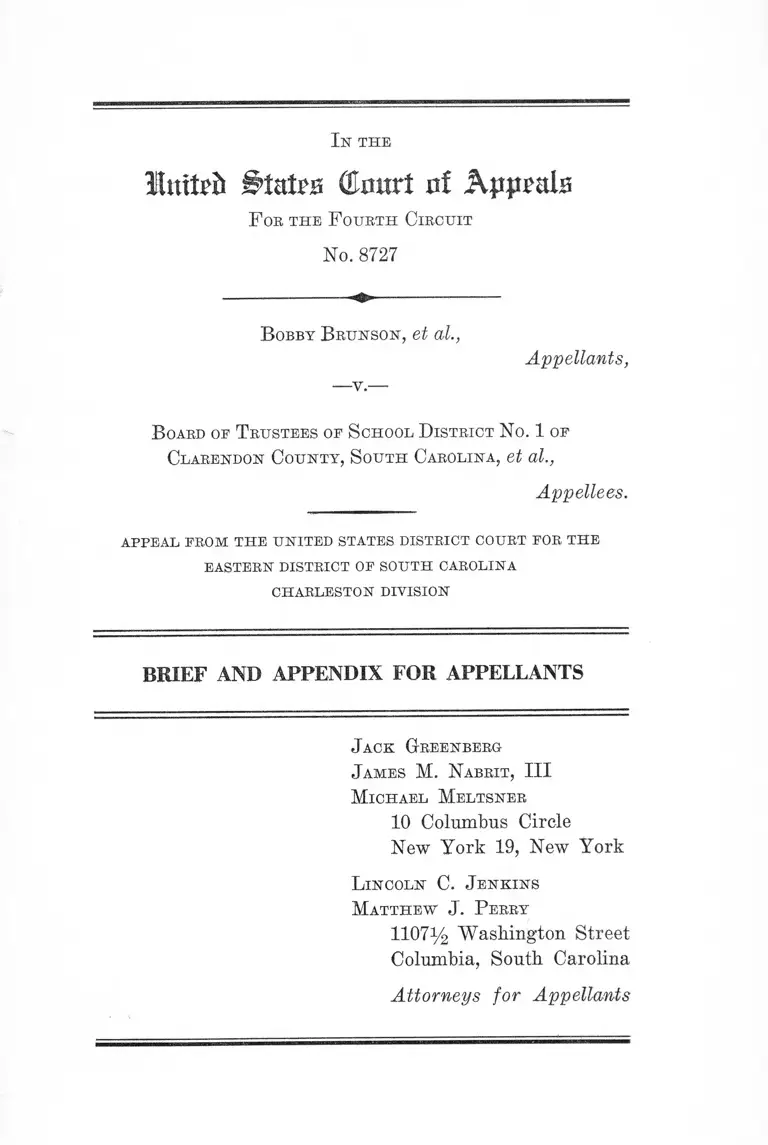
Ittifpfi (Emtrt of A*ijn>als
F ob the F ourth Circuit
No. 8727
I n th e
B obby B runson, et al.,
—v.—•
Appellants,
B oard of T rustees of S chool D istrict No. 1 of
Clarendon County, S outh Carolina, et al.,
Appellees.
APPEAL FROM T H E U N ITED STATES D ISTRICT COURT FOR T H E
EASTERN DISTRICT OF SOU TH CAROLINA
CH ARLESTON DIVISION
BRIEF AND APPENDIX FOR APPELLANTS
J ack Greenberg
J ames M. Nabrit, III
M ichael Meltsner
10 Columbus Circle
New York 19, New York
L incoln C. J enkins
Matthew J. P erry
1107% Washington Street
Columbia, South Carolina
Attorneys for Appellants
INDEX TO BRIEF
PAGE
Statement of the Case ............................................ 1
Statement of Facts ........................................................ 5
Questions Involved ........................................................ 7
A bgument :
Negro School Children and Their Parents Are
Entitled to Join Together, on Behalf of Them
selves and Others Similarly Situated, in Order
to Seek Injunctive Relief Against the Mainte
nance of Discriminatory Pupil Assignment Pro
cedures ..................................................................... 8
Conclusion ......................................................................... 12
T able op Cases
Briggs v. Elliott, 132 F. Supp. 776 (E. D. S. C. 1955) .. 11,12
Covington v. Edwards, 264 F. 2d 780 (4th Cir. 1959) 11
Farley v. Turner, 281 F. 2d 131 (4th Cir. 1960) ......... 10
Gibson v. Board of Public Instruction, 272 F. 2d 763
(5th Cir. 1959) ............................................................. 10
Green v. School Board of the City of Roanoke,------
F. 2 d ------ (4th Cir. May 22, 1962) .......................9,10,12
Jones v. School Board of City of Alexandria, 278
F. 2d 72 (4th Cir. 1960) ..... '...................................... 10
11
PAGE
Mannings v. Board of Public Instruction, 277 P. 2d
370 (5th Cir. 1960) .... 10
Marsh v. County School Board of Roanoke County,
— F. 2 d ------ (4th. Cir. June 12, 1962) ...............9,11,12
Northeross v. Board of Education of the City of
Memphis, 302 F. 2d 818 (6th Cir. 1962) ................ 10
INDEX TO APPENDIX
Relevant Docket Entries .............................................. la
Complaint ....................................................................... 2a
Motion to Strike .............................................................. 12a
Motion to Dismiss ......................................................... 13a
Opinion and O rder............. 14a
Notice of Appeal ........................................................... 20a
I n th e
Hutted (ta r t nf Appeals
F ob the F ourth Circuit
No. 8727
B obby B runson, et al.,
Appellants,
B oard oe T rustees of S chool D istrict No. 1 of
Clarendon County, South Carolina, et al.,
Appellees.
appeal from the united states district court for the
EASTERN DISTRICT OF SOUTH CAROLINA
CHARLESTON DIVISION
APPELLANTS’ BRIEF
Statement of the Case
This is an appeal from an order (lla -lT a)1 entered May
31, 1962 striking the names of all the plaintiffs from the
complaint save one minor plaintiff and striking all the
allegations of the complaint inappropriate to a personal
action by said one minor plaintiff (19a).
This is an action for injunctive relief brought by the
plaintiff-appellants, Negro school children and parents in
Clarendon County, South Carolina, against the Board of
Trustees of School District No. 1 of Clarendon County,
South Carolina, the County Superintendent of Education
1 Citations are to the appendix to this brief.
2
and the District Superintendent of Education. This appeal
is brought under 28 U. S. C. §1291.
The complaint was filed on April 13, 1960 by 42 Negro
school children eligible to attend the public schools of
School District No. 1 of Clarendon County, South Carolina,
and their parents (2a-lla) as a class action on behalf
of themselves and on behalf of other adults and minors
similarly situated, pursuant to the provisions of Rule
23(a)(3) of the Federal Rules of Civil Procedure (4a).
Jurisdiction was invoked pursuant to 28 U. S. C. §1343(3),
the action being authorized by 42 IT. S. C. §1983 to redress
the deprivation of rights secured by the Fourteenth Amend
ment to the Constitution of the United States and by 42
U. S. C. §1981 providing for the equal rights of citizens
(4a).
The complaint identified appellees, the Board of Trustees
of School District No. 1, the County Superintendent of
Education and the District Superintendent of Education,
as generally maintaining and supervising the public schools
of School District No. 1 pursuant to the direction of the
Constitution and laws of the State of South Carolina (6a).
The complaint alleged that the defendants had main
tained and continued to maintain a biracial school system
in which school attendance and assignment of school per
sonnel was determined by race and color and that certain
schools were restricted to white school children and per
sonnel and others to Negro school children and personnel
(7a). Appellants alleged that the maintenance of a biracial
school system resulted in injury to appellants and the class
which they represented in violation of rights guaranteed
by the Constitution and laws of the United States (7a-10a).
Appellants sought a permanent injunction enjoining ap
pellees from operating a biracial school system, maintain
ing dual school zones, assigning students and subjecting
3
students to assignment transfer or admission standards
on the basis of race (10a). In the alternative, appellants
prayed that appellees be directed to submit a plan for the
reorganization of the school system of Clarendon County
on a nonracial basis (11a).
On May 3, 1960, appellees filed a Motion to Strike (12a)
“ (1) from the caption of the complaint the names of all
of the plaintiffs except ‘Bobby Brunson’ and (2) from the
body of the complaint all of the allegations unrelated to
the cause of action in behalf of ‘Bobby Brunson’ as sole
plaintiff” on the ground that “ no class action within the
meaning of Rule 23(a)(3) is alleged and therefore if any
cause of action is stated in behalf of any plaintiff it is one
for individual relief, which may be entertained only if all
immaterial allegations and all nonessential parties are
eliminated from the action” .
Also on May 3, 1960, appellees filed a Motion to Dismiss
on the ground that the Court lacks jurisdiction and the
complaint fails to state a claim upon which relief can be
granted in that the complaint does not allege a class action
within the meaning of Rule 23(a)(3) of the Federal Rules
of Civil Procedure (13a).
On May 14, 1962, two years after the filing of the motion
to strike and motion to dismiss, the Court held a hearing
on both motions. On May 31, 1962, the Court, Judge C. C.
Wyche (sitting by Designation), filed its opinion and
ordered that the names of all of the appellants other
than Bobby Brunson be stricken from the complaint as well
as all of the allegations of the complaint inappropriate
to a personal action by Bobby Brunson (19a). In con
cluding that this action was not properly brought as a
class action under Rule 23(a)(3), the Court determined
that there was no common question of fact or unresolved
4
common question of law and, therefore, a class action was
inappropriate (18a).
As to a common question of law, the Court had this to
say:
. [DJecisions make it clear that any common
question of law has been settled. The defendant may
not deny to any plaintiff on account of race the right
to attend any school which it maintains. That law has
been established not only in controlling decisions of
the Fourth Circuit but also in an action involving
this very school district to which several of the plain
tiffs here were parties and in which the School Board
was a defendant. Briggs v. Elliot, 132 F. Supp. 776,
777” (17a).
In passing to the issue of a common question of fact the
Court stated:
• In determining the school to which a pupil is
entitled to go, a School Board must consider a great
many factors unrelated to race, such as geography,
availability of bus transportation, availability of class
room space, and scholastic attainment in order to
perform the Board’s duty to promote the best interests
of education within the district and insofar as possible
place the child in the school where he has the best
chance to improve his education. ‘School authorities
have the primary responsibility for elucidating, as
sessing and solving these problems.’ Briggs v. Elliott,
349 U. S. 294. There is no allegation in the complaint
showing that the factual situation with reference to
each of the plaintiffs is the same. Undoubtedly the
plaintiffs reside in different places, they are of dif
ferent ages, they are of different scholastic attainment.
South Carolina has provided a pupil placement statute
5
which permits any child desiring to attend a school
other than the one to which he has been assigned to
proceed through administrative channels to obtain
placement in a different school of his choice. This
statute provides that the case of each child shall be
considered individually. 1952 Code, Sections 21-230,
21-247; Hood v. Board, 232 F. 2d 626, 286 F. 2d 236.
This statute is similar to the North Carolina statute,
the validity of which was sustained in Carson v. Board
of Education of McDowell County, 227 F. 2d 789
(1955), and in Carsonv. Warlick, 238 F. 2d 724 (1956)”
(18a).
On June 21, 1962, plaintiffs filed Notice of Appeal from
the order of May 31, 1962 (20a).
Statement of the Facts
The forty-two Negro school children and their parents
and guardians who brought this action on behalf of them
selves and other adults and minors similarly situated are
all Negro citizens of the United States and residents of
the State of South Carolina, residing in School District
No. 1, Clarendon County (5a).
After the decision of the United States Supreme Court
in the School Segregation Cases, the United States District
Court for the Eastern District of South Carolina, on
July 15, 1955, issued its decree in the case of Briggs v.
Elliott, 132 F. Supp. 776 (E. D. S. C. 1955) providing
that the officials of what is now School District No. 1,
Clarendon County, comply with the decision and mandate
of the United States Supreme Court in the School Segre
gation Cases, namely, that they operate them on a non-
discriminatory basis, with race no longer as a standard of
6
school assignment. Plaintiff-appellants here allege in their
complaint that appellees have failed and refused to take
any steps to eliminate racial segregation in the school
system in accordance with the decree in Briggs v. Elliott,
supra and have steadfastly failed and refused to employ
a plan for the reorganization of the school system into
a unitary, nonracial school system as required by decisions
of the United States Supreme Court (7a).
It is alleged that appellants have each made written
application to defendants requesting reassignment to a
public school limited to attendance by white students only
to no avail (8a). Adult plaintiffs, some of whom were
plaintiffs in the aforementioned case of Briggs v. Elliott,
supra and all of whom by reason of their residing in
School District No. 1, would have benefited by the proper
implementation of the decree entered in that case on July
15, 1955, requiring that schools be operated on a non-
discriminatory basis, waited for over four years for the
defendants to begin complaince with the order of this
Court. On August 27, 1959, the appellants, through their
attorney, Lincoln C. Jenkins, Jr., wrote to appellee W. C.
Sprott, Chairman, Board of Trustees, School District No.
1, requesting assignment of their children to a school to
which a white child similarly situated to them would at
tend (8a). They received no reply to this request (8a).
Subsequently, on October 8, 1959, the adult plaintiffs called
upon appellee W. C. Sprott in writing to institute a plan
for the complete desegregation of the schools within his
jurisdiction. A reply from defendants dated October 13,
1959, indicated that appellants’ request came too late for
consideration by the Board, although the deadline referred
to in the Board’s reply had never been previously publicly
announced (8a).
7
It is alleged that the appellants have not exhausted the
administrative remedy provided by the South Carolina
School laws for the placement of pupils by trustees for the
reason that the remedy there provided is inadequate to
provide the relief sought by appellants in this case (9a).
Appellants alleged they have not exhausted the remedy
provided by the aforesaid pupil placement laws for the
further reason that the criteria set forth in these laws
for assigning children to school have been and are applied
by appellees only to Negro children seeking admission, as
signment or transfer (7a-10a). Furthermore, by the use
of a previously unannounced cutoff date, appellees have
prevented plaintiffs from employing the purported reme
dies under said law (8a-10a). Appellants alleged that act
ing under color of the authority conferred upon them by
the South Carolina laws for the placement of pupils by
trustees, defendants have continued to maintain and oper
ate a biracial school system in School District No. 1 of
Clarendon County; have used the provisions of these laws
to deny admission of Negro children to certain schools
solely because of race and color; and have used these laws
to defeat rather than attain full compliance with the deci
sions of the United States Supreme Court in the School
Segregation Cases (9a-10a). Plaintiffs alleged that defen
dants have not employed the pupil placement laws as a
means of abolishing state imposed race distinctions, nor
have they offered to plaintiffs, by means of the pupil as
signment, a genuine means of securing attendance at non-
segregated public schools (7a-10a).
Question Involved
Whether the Court below erred in determining that
forty-two Negro school children and their parents seeking
injunctive relief against the racially discriminatory policies
8
of a school board and its administrators on behalf of them
selves and others similarly situated could not join in a single
suit and maintain a class action under Rule 23(a)(3) of
the Federal Rules of Civil Procedure when plaintiffs al
leged discriminatory application and administration of
pupil assignment laws in a biracial school system.
ARGUMENT
Negro School Children and Their Parents Are En
titled to Join Together, on Behalf of Themselves and
Others Similarly Situated, in Order to Seek Injunctive
Relief Against the Maintenance of Discriminatory Pupil
Assignment Procedures.
Appellants alleged in the complaint that they had not
exhausted the administrative remedies provided by the
South Carolina pupil placement laws for the reason that
the criteria set forth in these laws for assigning children
to school have been and are applied by defendants only
to Negro children seeking admission, assignment or trans
fer ’ (9a). Appellants alleged that the appellees maintained
a biracial school system under color of the authority con
ferred by the South Carolina pupil placement laws; em
ployed unannounced cutoff dates in order to prevent plain
tiffs from exhausting the remedies under the placement
laws; and employed said laws as a means to defeat rather
than to comply with the decisions of the United States
Supreme Court in the School Segregation Cases (10a).
Appellants prayed the court grant the following relief:
1. Enter a decree enjoining defendants, their agents,
employees and successors from operating a biracial
school system in School District No. 1 of Clarendon
County;
9
2. Enter a decree enjoining defendants, their agents,
employees and successors from maintaining a dual
scheme or pattern of school zone lines based upon race
and color;
3. Enter a decree enjoining defendants, their agents,
employees and successors from assigning students to
schools in Clarendon County on the basis of the race
and color of the students;
4. Enter a decree enjoining defendants, their agents,
employees and successors from subjecting Negro chil
dren seeking assignment, transfer or admission to the
schools of Clarendon County, to criteria, requirements
and prerequisites not required of white children seek
ing assignment, transfer or admission to the schools
of Clarendon County.
In the alternative, plaintiffs pray that this Court
enter a decree directing defendants to present a com
plete plan, within a period of time to be determined
by this Court, for the reorganization of the school
system of Clarendon County, South Carolina, on a
unitary, nonracial basis which shall include the as
signment of children on a nonracial basis, the drawing
of school zone lines on a nonracial basis, and the
elimination of any other discriminations in the opera
tion of the school system based solely upon race and
color. Plaintiffs pray that if this Court directs defen
dants to produce a desegregation plan that this Court
will retain jurisdiction of this case pending approval
and full implementation of defendants’ plan (lOa-lla).
This case is, therefore, like Green v. School Board of the
City of Roanoke,------F. 2 d ------- (No. 8534, May 22, 1962),
and Marsh v. County School Board of Roanoke County,
____. F. 2 d ____ (No. 8535, June 12, 1962), in which this
10
Court condemned the operation of pupil assignment laws
in school systems with dual racial zones. The complaint
raises the very issues the Court decided in Green when it
said: “Because the initial school assignments are made on
a racial basis, full compliance by the plaintiffs with the
transfer procedures cannot repair the discrimination to
which they have been and are subjected.”
Appellants, therefore, are under no obligation to pursue
administrative remedies. “ To insist, as a prerequisite to
granting relief against discriminatory practices that the
plaintiffs first pass through the very procedures that are
discriminatory would be to require an exercise in futility,”
Green, supra. See Jones v. School Board of City of Alexan
dria, 278 F. 2d 72, 77 (4th Cir. 1960); Farley v. Turner,
281 F. 2d 131 (4th Cir. 1960) ; Norther oss v. Board of
Education of the City of Memphis, 302 F. 2d 818 (6th Cir.
1962); Mannings v. Board of Public Instruction, 277 F. 2d
370, 372-75 (5th Cir. 1960); Gibson v. Board of Public
Instruction, 272 F. 2d 763, 766-67 (5th Cir. 1959).2
This Court has already decided that appellants, faced
with a pupil assignment law administered in a manner
offensive to their constitutional rights, may join together
in one proceeding to obtain relief on behalf of themselves
and others similarly situated pursuant to the provisions of
Buie 20(a) and Buie 23(a)(3) of the Federal Buies of
Civil Procedure.
In Green, supra, the Court stated:
. . . the individual appellants are entitled to relief
and also they have the right to an injunction on behalf
of the others similarly situated.
2 Sood v. Board of Trustees of Sumter County School District, 286 F. 2d
236 (4th Cir. 1961); Carson v. Board of Education of McDowell County, 277
F. 2d 789 (4th Cir. 1955) and similar eases are, therefore, inapplicable.
11
In Marsh, supra, the Court held that:
. . . the plaintiffs are entitled to a declaratory judg
ment that the defendants are administrating the Pupil
Assignment Act in an unconstitutional manner and to
an injunction against the further use of racially dis
criminatory criteria in the assignment of pupils to
school.
The most explicit approval of this procedure appears
in Covington v. Edwards, 264 F. 2d 780, 783 (4th Cir. 1959).
In Covington, this Court affirmed a motion to dismiss on
the ground that plaintiffs had failed to exhaust their
administrative remedies and had not shown that the Pupil
Assignment Law had been utilised so as to perpetuate
segregated schools. In discussing the rights of Negro
school children when subjected to discriminatory assign
ment criteria, the Court said:
If after the hearing and final decision he is not
satisfied and can show he has been discriminated
against because of his race, he may then apply to the
federal court for relief. In the pending case, however,
that course was not taken . . . and the decision of the
District Court in dismissing the case was therefore
correct. This conclusion does not mean that there
must be a separate suit for each child on whose behalf
it is claimed that an application for reassignment has
been improperly denied. There cam, be no objection to
the joining of a number of applicants in the same suit
as has been done in other cases. (Emphasis added.)
The decree in Briggs v. Elliott, 132 F. Supp. 776 (E. D.
S. C. 1955), in which some of the adult appellants in the
instant suit were plaintiffs, did not adjudicate the ques
tion of the constitutionality of appellees’ administration
of the South Carolina pupil placement laws. Nor did it
12
grant the specific relief which appellants seek here. The
decree in Briggs v. Elliott, supra, was but a general injunc
tion prohibiting racial discrimination in the administration
of the schools and not a final determination of the legality
of the assignment and transfer practices appellants chal
lenge.
Appellants have alleged that the appellees have ad
ministered pupil placement laws unconstitutionally. They
have been denied the opportunity to make the required
showing of discriminatory application delineated by Marsh
v. County School Board of Roanoke County, supra, and
Green v. Roanoke City School Board, supra. Appellants,
on behalf of themselves and the class they represent, have
a common legal interest in proving they are subject to
unconstitutional racial zoning and racial assignment and
transfer criteria by reason of appellees’ administration
of the South Carolina pupil placement laws.
CONCLUSION
W herefore, for the foregoing reasons, appellants pray
the judgment below be reversed.
Respectfully submitted,
Jack Greenberg
James M. Nabrit, III
Michael Meltsner
10 Columbus Circle
New York 19, New York
L incoln C. Jenkins
Matthew J. Perry
1107% Washington Street
Columbia, South Carolina
Attorneys for Appellants
APPENDIX
Relevant Docket Entries
Civil Action No. 7210
---------------------------------------
B obby B runson, et al.,
Appellants,
B oard of T rustees of S chool D istrict No. 1 of
Clarendon County, S outh Carolina, et al.,
Appellees.
Bate Proceedings
1960
4-13 Summons and Complaint.
4-13 7 copies to Marshal for Service.
4-14 Marshal’s Returns (6) of Service on L. Richard
son, J. W. Sconyers, W. A. Brunson, C. N. Plow-
den, W. C. Sprott, and L. B. McCord on 4-14-60.
4- 19 Marshal’s Return of Service on C. E. Buttes on
4-15-60.
5- 3 Defendants’ Motion to Strike.
5-3 Defendants’ Motion to Dismiss.
5-14-62 Hearing on motion to dismiss and to strike. Coun
sel to file briefs and case taken under advisement.
5-31-62 Opinion and Order that names of all of the plain
tiffs other than Bobby Brunson be stricken from
caption and that plaintiff Bobby Brunson shall
have 20 days from date from order to file an
amended complaint.
5- 31-62 Copies to counsel.
6- 21-62 Notice of Appeal.
6-21-62 Appeal Bond.
6- 21-62 Designation of Record on Appeal.
7- 24-62 Appeal Record to USCA.
2a
I n the
UNITED STATES DISTRICT COURT
F or the E astern D istrict oe S outh Carolina
Charleston D ivision
(Filed: April 13,1960)
Complaint
B obby Brunson, E lizabeth Brunson and E llis Brunson,
by McQueen Brunson, their father and next friend,
— and—
T isbia E. Delaine, a Minor by Leo Delaine, her father
and next friend,
— and—
Eloise F elder, a Minor, by Nora Felder, her mother
and next friend,
— and—
Blease C. Gibson, Jr., T homas Gibson, Evelyn M. Gibson
and F rancis E. Gibson, by Frances Gibson, their mother
and next friend,
— and—
J oseph Gipson, F rancina Gipson, and Calvin Gipson, by
Johnnie Gipson, their father and next friend,
—and—
Susan J. H ilton, Bessie I. H ilton, Edward P. H ilton and
Charles M. H ilton, by W illiam H ilton, their father
and next friend,
—and—
H arry G. McDonald and R itta McDonald,
their father and next friend,
— and—
J eremiah Oliver, Jr. and Mary Oliver, their mother
and next friend,
— and—
3a
V idel P earson, Deleware P earson, Harold Pearson and
Carrie A. Pearson, by Levi P earson, their father and
next friend,
— and—
Cleola R agin, R obert L. R agin, Moses Ragin, H enry J.
R agin, L ucretia R agin and W illie J. R agin, by Minnie
R agin, their mother and next friend,
—and—
Glenn R agin, a Minor by W illiam Ragin, his father
and next friend,
—and—
Jackson D. R ichardson and J ohnnie F. Richardson,
by L ee R ichardson, their father and next friend,
—and—
T helma Stukes, E thel Stukes, L ionel Stukes, Marion
Stukes, A bel Stukes, R ochelle Stukes and Marcia
Stukes, by L adson Stukes, their father and next friend,
—and—
Della T indal, a Minor, by L awrence T indal,
her father and next friend,
—and-—
E manuel R ichardson, a Minor by Luchresher R ichardson,
his father and next friend,
Plaintiffs,
B oard of Trustees of School District No. 1 of Clarendon
County, South Carolina.; L. B. McCord, County Super
intendent of Education; C. E. Buttes, District Super
intendent of Education; W. C. Sprott, Chairman, Board
of Trustees; C. N. Plowden, W. A. Brunson, J. W.
Sconyers and L. R. R ichardson, Members of the Board
of Trustees,
Defendants.
Complaint
4a
1. The jurisdiction of this Court is invoked pursuant to
Title 28, United States Code, §1343(3), this being an action
which is authorized by law, Title 42, United States Code,
§1983, to be commenced by any citizen of the United States
to redress the deprivation under color of state law, statute,
ordinance, regulation, custom or usage of rights, privileges
and immunities secured by the Constitution and laws of the
United States. The rights here sought to be redressed are
rights guaranteed by the due process and equal protection
clauses of the Fourteenth Amendment to the Constitution
of the United States and by Title 42, United States Code,
§1981.
2. This is a proceeding for a permanent injunction en
joining defendants from continuing to pursue the policy,
practice, custom and usage of operating a biracial school
system in School District No. 1, Clarendon County, South
Carolina, in violation of rights secured to plaintiffs by the
Constitution and laws of the United States referred to
above.
3. This is a class action brought by the adult plaintiffs
for the minor plaintiffs on behalf of themselves and on be
half of other adults and minors similarly situated, pursu
ant to the provisions of Rule 23(a)(3) of the Federal Rules
of Civil Procedure. The members of this class are all adult
Negro citizens and their minor children of the State of
South Carolina who reside in School District No. 1, Claren
don County. The minors are all eligible to attend the public
schools in School District No. 1 of Clarendon County, South
Carolina, and the members of the class are all similarly
affected by the action of the defendants in maintaining and
operating the public school system of School District No. 1,
Clarendon County, on a racially segregated basis. There
Complaint
5a
are involved common questions of law and fact affecting
tlie rights of all other Negro children eligible to attend the
public schools of School District No. 1, Clarendon County,
and their respective parents and guardians, who are so
numerous as to make it impracticable to bring all before
the Court, but whose interests are adequately represented
by plaintiffs.
4. The adult plaintiffs in this ease are all citizens of the
United States and of the State of South Carolina, residing
in School District No. 1, Clarendon County. Each adult
plaintiff is the parent of one or more minor children who
are eligible to attend the public schools in District 1 of
Clarendon County. Each minor plaintiff is likewise a citi
zen of the United States and of the State of South Caro
lina, residing in District No. 1, Clarendon County.
5. The plaintiffs in this case are Bobby Brunson, Eliza
beth Brunson and Ellis Brunson, minors, by their father
and next friend, McQueen Brunson; Tisbia E. Delaine, a
minor, by her father and next friend, Leo Delaine; Eloise
Felder, a minor, by her mother and next friend, Nora
Felder; Blease C. Gibson, Jr., Thomas Gibson, Evelyn M.
Gibson and Francis E. Gibson, minors, by their mother and
next friend, Frances Gibson; Joseph Gipson, Francina
Gipson and Calvin Gipson, minors, by their father and next
friend Johnnie Gipson; Susan J. Hilton, Bessie I. Hilton,
Edward P. Hilton and Charles M. Hilton, minors, by their
father and next friend, Charles M. Hilton; Harry G. Mc
Donald and Ritta McDonald, minors, by their father and
next friend, John McDonald; Jeremiah Oliver, Jr. and Mary
Oliver, minors, by their mother and next friend, Mary J.
Oliver; Videl Pearson, Deleware Pearson, Harold Pearson
and Carrie A. Pearson, minors by their father and next
Complaint
6a
Complaint
friend, Levi Pearson; Cleola Ragin, Robert L. Ragin, Moses
Ragin, Henry J. Ragin, Lueretia Ragin and Willie J. Ragin,
minors, by their mother and next friend, Minnie Ragin;
Glenn Ragin, a minor, by his father and next friend,
William Ragin; Jackson D. Richardson and Johnnie F.
Richardson, minors, by their father and next friend, Lee
Richardson; Thelma Stakes, Ethel Stukes, Lionel Stukes,
Marion Stakes, Abel Stakes, Rochelle Stakes and Marcia
Stakes, minors, by their father and next friend, Ladson
Stakes; Della Tindal, a minor, by her father and next friend,
Lawrence Tindal, and Emanael Richardson, a minor, by
his father and next friend, Lnchresher Richardson.
6. Defendant L. B. McCord is County Snperintendent of
Edacation of Clarendon Coanty, Soath Carolina, inclading
School District No. 1, and holding office parsaant to the
laws of the State of Soath Carolina.
7. Defendant C. E. Battes is District Superintendent of
Edacation in School District No. 1 of Clarendon Coanty.
Defendant W. C. Sprott is Chairman of the Board of
Trastees of School District No. 1. Defendants C. N. Plow-
den, W. A. Branson, W. W. Sconyers and L. Richardson
are members of the Board of Trastees of School District
No. 1.
8. The defendants maintain and generally sapervise, as
indicated by their titles, the pablic schools in School Dis
trict No. 1 of Clarendon Coanty, Soath Carolina, acting
parsaant to the direction and anthority contained in state
constitational provisions and statates, and as snch are
officers of the State of Soath Carolina enforcing and exer
cising state laws and policies. This sait is broaght against
the defendants in their official and individnal capacities.
7a
9. Acting under color of the laws of the State of South
Carolina, the defendants have pursued and are presently
pursuing a policy, practice, custom and usage of operating
a biracial school system in District No. 1 of Clarendon
County. The biracial school system operated by defendants
consists of a system of elementary and high schools limited
to attendance by white children only. Said schools are
staffed by white teachers, white principals, and while lo
cated in various parts of the district, may be attended by
white children only. The defendants also maintain a sys
tem of schools limited to attendance by Negro children
only. These schools, likewise located in various parts of
the district, are staffed entirely by Negro personnel: the
teachers are all Negroes and the principals are all Negroes.
Attendance at the various schools is determined by race
and color and the assignment of personnel is determined
by race and color of the children and the race and color of
the personnel.
10. After the decision of the United States Supreme
Court in the School Segregation Cases, the United States
District Court for the Eastern District of South Carolina,
on July 15, 1955, issued its decree in the case of Briggs v.
Elliott providing that the officials of School District No. 1,
Clarendon County, comply with the decision and mandate
of the United States District Court in the School Segrega
tion Cases, namely, that they operate them on a nondis-
criminatory basis, with race no longer as a standard of
school assignment. Defendants have failed and refused
to take any steps to eliminate racial segregation in the
school system and have steadfastly failed and refused to
employ a plan for the reorganization of the school system
into a unitary, nonracial school system as required by said
decisions.
Complaint
8a
11. Plaintiffs residing in School District No. 1 have each
made written application to the appropriate defendant re
questing reassignment to a public school limited to at
tendance by white students only, to no avail. Adult plain
tiffs, some of whom were plaintiffs in the aforementioned
case of Briggs v. Elliott, and all of whom by reason of their
residing in School District No. 1, would have benefited by
the proper implementation of the decree entered in that
case on July 15,1955, requiring that schools be operated on
a nondiscriminatory basis, waited for over four years for
the defendant to begin compliance with the order of this
court. On August 27, 1959, the plaintiffs, through their
attorney, Lincoln C. Jenkins, Jr., wrote to defendant W. C.
Sprott, Chairman, Board of Trustees, School District No.
1, requesting assignment of their children to a school to
which a white child similarly situated to them would attend.
They received no reply to this request. Subsequently, on
October 8, 1959, the adult plaintiffs in writing called upon
defendant W. C. Sprott to institute a plan for the complete
desegregation of the schools within his jurisdiction. A
reply from defendants dated October 13,1959, indicated that
plaintiffs’ request came too late for consideration by the
Board, although the deadline referred to in the Board’s
reply had never been previously publicly announced.
12. Plaintiffs, and the members of the class which they
represent, are injured by the operation of a biracial school
system for the Negro and white children in School District
No. 1, Clarendon County. The biracial school system is
predicated upon the theory that Negroes are inherently
inferior to white persons and, consequently, may not at
tend the same public schools attended by white children
who are superior. The plaintiffs, and members of their
class, are injured by the policy of assigning teachers, prin
Complaint
9a
cipals and other school personnel on the basis of the race
and color of the children attending a particular school and
the race and the color of the person to be assigned. Assign
ment of school personnel on the basis of race and color is
also predicated on the theory that Negro teachers, Negro
principals and other Negro school personnel are inferior
to white teachers, white principals and other white school
personnel and, therefore, may not teach white children.
13. The injury which plaintiffs and members of their
class suffer as a result of the operation of the biracial
school system in School District No. 1 of Clarendon County,
and as a result of the policy of assigning school personnel
on the basis of race is irreparable and will continue until
enjoined by this court. Any other relief to which the plain
tiffs and those similarly situated could be remitted would
be attended by such uncertainties and delays as to deny sub
stantial relief, would involve a multiplicity of suits, cause
further irreparable injury and occasion damage, vexation
and inconvenience, not only to plaintiffs and those similarly
situated, but to defendants as public officials.
14. The plaintiffs have not exhausted the administrative
remedy provided by the South Carolina School laws for the
placement of pupils by trustees for the reason that the
remedy there provided is inadequate to provide the relief
sought by plaintiffs in this case. Plaintiffs have not ex
hausted the remedy provided by the aforesaid pupil place
ment laws for the further reason that the criteria set forth
in these laws for assigning children to school have been
and are applied by defendants only to Negro children
seeking admission, assignment or transfer. Furthermore,
by the use of a previously unannounced cutoff date, de
fendants have prevented plaintiffs from employing the
Complaint
10a
purported remedies under said law. Plaintiffs allege that
acting under color of the authority conferred upon them by
the South Carolina laws for the placement of pupils by
trustees, defendants have continued to maintain and oper
ate a biracial school system in School District No. 1 of
Clarendon County, have used the provisions of this law
to deny admission of Negro children to certain schools
solely because of race and color, and have used this law to
defeat rather than attain full compliance with the decisions
of the United States Supreme Court in the School Segre
gation Cases. Defendants have not employed the pupil
assignment law as a means of abolishing state imposed race
distinctions, nor have they offered to plaintiffs by means
of the pupil assignment law a genuine means of securing
attendance at nonsegregated public schools.
Wherefore, plaintiffs respectfully pray that this Court
advance this cause on the docket and order a speedy hear
ing of this action according to law and after such hearing:
1. Enter a decree enjoining defendants, their agents,
employees and successors from operating a biracial school
system in School District No. 1 of Clarendon County;
2. Enter a decree enjoining defendants, their agents,
employees and successors from maintaining a dual scheme
or pattern of school zone lines based upon race and color;
3. Enter a decree enjoining defendants, their agents,
employees and successors from assigning students to schools
in Clarendon County on the basis of the race and color of
the students;
4. Enter a decree enjoining defendants, their agents,
employees and successors from subjecting Negro children
seeking assignment, transfer or admission to the schools of
Complaint
11a
Clarendon County, to criteria, requirements and prerequi
sites not required of white children seeking assignment,
transfer or admission to the schools of Clarendon County.
In the alternative, plaintiffs pray that this Court enter
a decree directing defendants to present a complete plan,
within a period of time to be determined by this Court, for
the reorganization of the school system of Clarendon
County, South Carolina, on a unitary, nonracial basis which
shall include the assignment of children on a nonracial
basis, the drawing of school zone lines on a nonracial basis,
and the elimination of any other discriminations in the
operation of the school system based solely upon race and
color. Plaintiffs pray that if this Court directs defen
dants to produce a desegregation plan that this Court will
retain jurisdiction of this case pending approval and full
implementation of defendants’ plan.
Plaintiffs pray that this Court will allow them their
costs herein and grant such further, other, additional or
alternative relief as may appear to the Court to be equitable
and just.
L incoln C. Jenkins
1107% Washington Street
Columbia, South Carolina
Matthew J. P erry
371% South Liberty Street
Spartanburg, South Carolina
T hurgood Marshall
Jack Greenberg
10 Columbus Circle
New York 19, New York
Attorneys for Plaintiffs
Complaint
12a
UNITED STATES DISTRICT COURT
Foe the E astern D isteict oe South Carolina
Ch arleston D ivision
C /A 7210
Motion to Strike
(Filed: May 3,1960)
[ same title]
Reserving their rights under a Motion to Dismiss, here
tofore filed, the defendants move the Court to strike (1)
from the caption of the complaint the names of all of the
plaintiffs except “ Bobby Brunson” and (2) from the body
of the complaint all of the allegations unrelated to the cause
of action in behalf of “ Bobby Brunson” as sole plaintiff,
including but not limited to the allegations of paragraphs
3, 4, and 5 and to portions of paragraphs 11, 12, 13 and 14,
and (3) those portions of the prayer not applicable to the
cause of action in favor of Bobby Brunson upon the ground
that no class action within the meaning of Rule 23(a)(3)
is alleged and therefore if any cause of action is stated in
behalf of any plaintiff, it is one for individual relief, which
may be entertained only if all immaterial allegations and
all non-essential parties are eliminated from the action.
David W. R obinson
R obinson, MoF adden & Moose
Attorneys for the Defendants
13a
UNITED STATES DISTKICT COURT
F ob the E astern D istrict of South Carolina
Charleston Division
C /A 7210
Motion to Dismiss
(Filed: May 3,1960)
{ same title}
----------------- -- --------------—— --- ------
The Defendants move the Court:
1. To dismiss the action on the ground that the Court
lacks jurisdiction in that the complaint fails to allege a
class action within the meaning of Rule 23(a)(3).
2. To dismiss the action because the complaint fails to
state a claim against the defendants upon which relief can
be granted in that a class action within the meaning of
Rule 23(a)(3) is not alleged.
David W. R obinson
R obinson, McF adden & Moore
Attorneys for the Defendants
14a
I n the
UNITED STATES DISTRICT COURT
F or the E astern District of South Carolina
Charleston D ivision
C /A 7210
Opinion and Order
(Filed: May 14,1962)
[ same title]
This cause is before me on the defendants’ motion to
dismiss upon the ground that the complaint fails to allege
a class action and on their alternate motion to strike from
the complaint all of the parties-plaintiff other than the
first named plaintiff and all of the allegations which are
unrelated to the first plaintiff’s cause of action upon the
ground that no class action is alleged.
These motions require an analysis of the complaint to
ascertain whether these allegations in the light of ap
plicable law allege a proper class action under Rule
23(a)(3).
The complaint is brought in behalf of a large number
of negro school children by their respective parents against
the Trustees of School District No. 1 of Clarendon County,
the Clarendon County Superintendent of Education, and
the District Superintendent of Education. The complaint
alleges that it is a class action under Rule 23(a) (3) brought
to protect rights under the 14th Amendment to the Con
stitution of the United States and under the Civil Rights
Statute, 42 U. S. C. A. 1981. They allege that the defen
dants are operating a bi-racial school system in School
District No. 1 of Clarendon County; that the plaintiffs are
15a
being denied admission to certain schools solely on account
of race; and that the plaintiffs have not exhausted the
administrative remedy provided by the South Carolina
school laws because that remedy is inadequate. The com
plaint also alleges that some of the plaintiffs are the same
parties who were parties in Briggs v. Elliott (98 F. Supp.
529, 103 F. Supp. 920, 347 U. S. 483, 349 IT. S. 294, 132
F. Supp. 776), which action is still pending in this Court
before a Three-Judge Court. In effect, the complaint is
brought for the purpose of securing the admission of each
of the plaintiffs to one of the several white schools being
operated by the defendants in School District No. 1.
Rule 23 of the Rules of Civil Procedure of this Court
provides in pertinent part: “ Class Actions (a) Representa
tion. I f persons constituting a class are so numerous as
to make it impracticable to bring them all before the court,
such of them, one or more, as will fairly insure the ade
quate representation of all may, on behalf of all, sue or
be sued, when the character of the right sought to be
enforced for or against the class is * * * (3) several, and
there is a common question of law or fact affecting the
several rights and a common relief is sought.”
Moore, in his Federal Practice (2nd Edition), Vol. 3,
page 3442, designates the class of action referred to in
Rule 23(a)(3) as “ spurious class suits” . Spurious as here
used does not mean that such a suit may not be maintained
as a class action but it does mean that this group does not
fall within the traditional class action. Each plaintiff has
a “ several” cause of action. Joinder is permitted merely
because there is a “ common question of law or fact” . There
is a similarity between this type of class and the practice
of consolidating for trial two independent suits where there
is a similar legal or factual situation. For instance, tort
Opinion and Order
16a
actions on behalf of two occupants of an automobile in
jured in a single collision with a truck are frequently tried
together though neither plaintiff has any legal interest on
the damage to the other.
The inquiry here is to determine whether there is a
“ common question of law or fact” justifying the use of the
class procedure of Rule 23(a)(3). Turning first to the
question of whether there is present in this case any
unresolved common question of law, I should look to the
controlling decisions to ascertain whether there is now any
unresolved question of law.
In Briggs v. Elliott, 132 F. Supp. 776, 777 (1955), the
Three-Judge District Court in interpreting the Supreme
Court decision in 347 U. S. 483, 349 U. S. 294, had this to
say about the legal issue: “Having said this, it is im
portant that we point out exactly what the Supreme Court
has decided and what it has not decided in this case. It
has not decided that the federal courts are to take over
or regulate the public schools of the states. It has not
decided that the states must mix persons of different races
in the schools or must require them to attend schools or
must deprive them of the right of choosing the schools
they attend. What it has decided, and all that it has de
cided, is that a state may not deny to any person on ac
count of race the right to attend any school that it main
tains. This, under the decision of the Supreme Court,
the state may not do directly or indirectly; but if the
schools which it maintains are open to children of all
races, no violation of the Constitution is involved even
though the children of different races voluntarily attend
different schools, as they attend different churches. Nothing
in the Constitution or in the decision of the Supreme Court
takes away from the people freedom to choose the schools
Opinion and Order
17a
they attend. The Constitution, in other words, does not
require integration. It merely forbids discrimination. It
does not forbid such segregation as occurs as the result
of voluntary action. It merely forbids the use of govern
mental power to enforce segregation. The Fourteenth
Amendment is a limitation upon the exercise of power by
the state or state agencies, not a limitation upon the free
dom of individuals.” (Emphasis added.)
This interpretation of the Supreme Court decision has
been followed consistently in the Fourth Circuit. School
Board of City of Charlottesville, Va. v. Allen (C. A. 4),
240 F. 2d 59, 62 (1956); School Board of City of Newport
News, Va. v. Atkins (C. A. 4), 246 F. 2d 325, 327 (1957).
These decisions make it clear that any common question
of law has been settled. The defendants may not deny
to any plaintiff on account of race the right to attend any
school which it maintains. That law has been established
not only in the controlling decisions of the Fourth Circuit
but also in an action involving this very school district
to which several of the plaintiffs here were parties and in
which the School Board was a defendant. Briggs v. Elliott,
132 F. Supp. 776, 777.
There being no unresolved common question of law, I
shall next consider whether there is a common question
of fact. In determining the school to which a pupil is en
titled to go, a School Board must consider a great many
factors unrelated to race, such as geography, availability
of bus transportation, availability of classroom space, and
scholastic attainment in order to perform the Board’s duty
to promote the best interests of education within the dis
trict and insofar as possible place the child in the school
where he has the best chance to improve his education.
“ School authorities have the primary responsibility for
Opinion and Order
18a
elucidating, assessing and solving these problems.” Briggs
v. Elliott, 349 U. S. 294. There is no allegation in the
complaint showing that the factual situation with reference
to each of the plaintiffs is the same. Undoubtedly the
plaintiffs reside in different places, they are of different
ages, they are of different scholastic attainment. South
Carolina has provided a pupil placement statute which
permits any child desiring to attend a school other than
the one to which he has been assigned to proceed through
administrative channels to obtain placement in a different
school of his choice. This statute provides that the case of
each child shall be considered individually. 1952 Code,
Sections 21-230, 21-247; Hood v. Board, 232 P. 2d 626,
286 F. 2d 236. This statute is similar to the North Carolina
statute, the validity of which was sustained in Carson v.
Board of Education of McDowell County, 227 P. 2d 789
(1955), and in Carson v. Warlich, 238 F. 2d 724 (1956).
It is the individual who is entitled to the equal protection
of the law and if he is denied a facility which under the
same circumstances is furnished to another citizen, he
alone may complain that his constitutional privilege has
been invaded. He has the right to enforce his constitu
tional privilege or he has the right to waive it. No one
else can make that decision for him. McCabe v. A., T. £
S. F. By. Co., 235 U. S. 151; Williams v. Kansas City, Mo.,
194 F. Supp. 848, 205 F. 2d 47, c.d. 346 U. S. 826. Cf.
Machinists v. Street, 367 U. S. 740, 774 (1961).
Therefore, it is my conclusion that this action is not
properly brought as a class action under Rule 23(a)(3).
I have not found and the parties have not called to my
attention any precedent dealing with the disposition of a
complaint brought as a class action but where a cause of
action may exist in favor of an individual plaintiff. The
Opinion and Order
19a
defendants have moved to dismiss or, in the alternative, to
strike all of the parties-plaintiff except the first plaintiff
allowing the case to continue as an individual action in
behalf of that plaintiff. In my view the latter is the ap
propriate relief.
It is, therefore, Ordered and A djudged, (1) That the
names of all of the plaintiffs other than Bobby Brunson
are hereby striken from the caption of the complaint and
all of the allegations inappropriate to a personal action
by Bobby Brunson are striken from the complaint; (2)
That the plaintiff Bobby Brunson shall have twenty days
from the filing of this order in which to file an amended
complaint consistent with the provisions of this order. The
defendants shall have twenty days in which to plead to
such an amended complaint.
Opinion and Order
C. C. W ychb
United States District Judge
(Sitting by Designation)
Dated:
Spartanburg, South Carolina,
May 30,1962.
20a
Notice of Appeal
(Filed: June 21,1962)
UNITED STATES DISTRICT COURT
F oe the E astern D istrict of South Carolina
Charleston D ivision
C /A No. 7210
[ same title]
Notice of A ppeal to the United States Court of A ppeals
F or the F ourth Circuit
Notice is hereby given that the plaintiffs in this action
hereby appeal to the United States Court of Appeals for
the Fourth Circuit from the Order (1) striking the names
of all the plaintiffs other than Bobby Brunson from the
caption of the complaint and striking from the complaint
all of the allegations inappropriate to a personal action
by Bobby Brunson, and (2) giving the plaintiff Bobby
Brunson twenty (20) days from the filing of said Order in
which to file an amended complaint consistent with the
provisions of said order, signed by the Court on May 30,
1962 and filed herein on May 31, 1962.
Dated: ...... ........ June, 1962.
L incoln C. J enkins, Jr.
Matthew J. Perry
1107% Washington Street
Columbia, South Carolina
Jack Greenberg
James M. Nabrit, III
10 Columbus Circle
New York 19, New York
Attorneys for Appellants