Maxwell v. Bishop Motion for Leave to File and Brief of Amici Curiae
Public Court Documents
September 10, 1969
-
Brief Collection, LDF Court Filings. Maxwell v. Bishop Motion for Leave to File and Brief of Amici Curiae, 1969. dbdcfc5c-bd9a-ee11-be36-6045bdeb8873. LDF Archives, Thurgood Marshall Institute. https://ldfrecollection.org/archives/archives-search/archives-item/3b203ea9-e07f-471b-a350-e6133f2ac217/maxwell-v-bishop-motion-for-leave-to-file-and-brief-of-amici-curiae. Accessed October 09, 2026.
Copied!
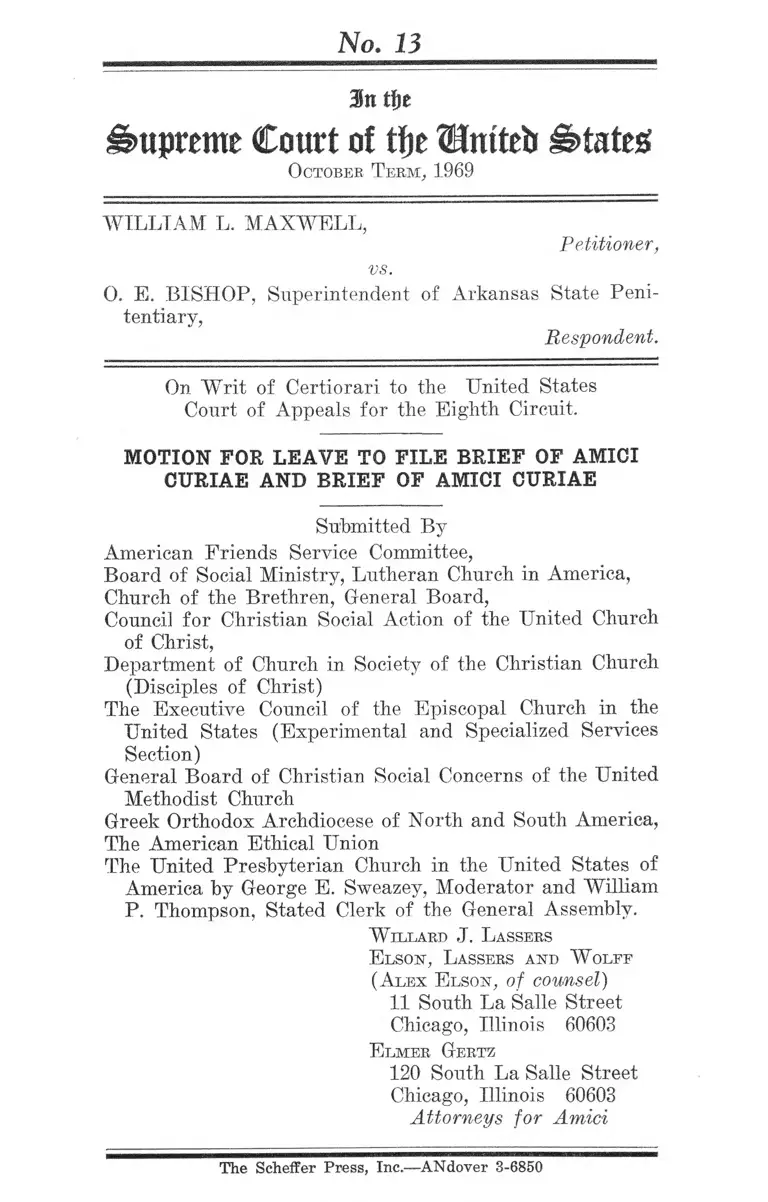
No. 13
in tije
Supreme Court of tfjc States
October T erm, 1969
WILLIAM L. MAXWELL,
Petitioner,
vs.
O. E. BISHOP, Superintendent of Arkansas State Peni
tentiary,
Respondent.
On Writ of Certiorari to the United States
Court of Appeals for the Eighth Circuit,
MOTION FOR LEAVE TO FILE BRIEF OF AMICI
CURIAE AND BRIEF OF AMICI CURIAE
Submitted By
American Friends Service Committee,
Board of Social Ministry, Lutheran Church in America,
Church of the Brethren, General Board,
Council for Christian Social Action of the United Church
of Christ,
Department of Church in Society of the Christian Church
(Disciples of Christ)
The Executive Council of the Episcopal Church in the
United States (Experimental and Specialized Services
Section)
General Board of Christian Social Concerns of the United
Methodist Church
Greek Orthodox Archdiocese of North and South America,
The American Ethical Union
The United Presbyterian Church in the United States of
America by George E. Sweazey, Moderator and William
P. Thompson, Stated Clerk of the General Assembly.
W illard J. L assers
E lsox, L assers and W olff
(A lex E lsox, of coimsel)
11 South La Salle Street
Chicago, Illinois 60603
E lmer Gertz
120 South La Salle Street
Chicago, Illinois 60603
Attorneys for Amici
The Scheffer Press, Inc.— ANdover 3-6850
I N D E X
PAGE
Motion for Leave To File Brief of Amici Curiae ........ 1
Brief of Amici Curiae ..................................................... 9
1. Imposition of the Death Penalty In a Unitary
Trial Is a Deprivation of Life and Liberty With
out Due Process .......... ...... .......................... . 9
Conclusion ................................... —........— ..................... 13
T able of Cases
Witherspoon v. Illinois, 391 US 510 (1968) .......... ...... 12
In T he
SUPREME COURT OF THE UNITED STATES
October T erm., 1969
No. 13
WILLIAM L. MAXWELL,
vs.
Petitioner,
0. E. BISHOP, Superintendent of Arkansas State Peni
tentiary,
Respondent.
On Writ of Certiorari to the United States
Court of Appeals for the Eighth Circuit.
MOTION FOR LEAVE TO FILE BRIEF OF AMICI
CURIAE AND BRIEF OF AMICI CURIAE
Submitted By
American Friends Service Committee,
Board of Social Ministry, Lutheran Church in America,
Church of the Brethren, General Board,
Council for Christian Social Action of the United Church
of Christ,
Department of Church in Society of the Christian Church
(Disciples of Christ)
The Executive Council of the Episcopal Church in the
United States (Experimental and Specialized Services
Section)
General Board of Christian Social Concerns of the United
Methodist Church
Greek Orthodox Archdiocese of North and South America,
The American Ethical Union
The United Presbyterian Church in the United States of
America by George E. Sweazey, Moderator and William
P. Thompson, Stated Clerk of the General Assembly.
The above religious organizations by their attorneys,
Willard Lassers and Elson, Lassers and Wolff, (Alex
Elson, of counsel) and Elmer Gertz, move for leave to file
a brief amici curiae in support of petitioner, William L.
Maxwell. In support of this motion the religious organiza
tions represent as follows:
The legal arguments on behalf of petitioner have been
ably presented by his counsel. There are, however, a
number of ethical considerations of deep concern to the
religious organizations. Most of these organizations for
mally have taken stands in opposition to capital punish
ment.1 They are aware that the issue of the death penalty
as such is not at bar.
They desire to present a point of view somewhat differ
ent from that of petitioner, which they think will con
tribute to a more complete understanding of the case.
Hence ask leave to file this brief.
These organizations have a total membership exceeding
34,500,000. They are:
1. AMERICAN FRIENDS SERVICE COMMITTEE.
The Americans Friends Service Committee has, since
1917, engaged in religious, charitable, social, philanthropic
and relief work on behalf of the several branches and
divisions of the Religious Society of Friends in America.
There are approximately 123,000 Friends in the United
States. The American Friends Service Committee, al
1 The statements appear in the appendix to the amicus
brief filed on behalf of the American Friends Service
Committee, et al, in Witherspoon v. Illinois, O.T. 1967,
No. 1015. Substantially every major denomination has
expressed its opposition to the death penalty. The state
ments appear in the Witherspoon brief.
— 3 —
though it cannot speak for all Friends, has a vital interest
in this litigation because of Friends’ historic and con
tinued opposition to the taking- of human life by the
State. Such opposition to capital punishment goes back
more than 300 years, to the beginning of the Quaker
movement and stems from Quaker belief that there is an
element of the divine in every man.
2. BOARD OF SOCIAL MINISTRY, LUTHERAN
CHURCH IN AMERICA
The Board of Social Ministry is an instrumentality of
the Lutheran Church in America. Its object is “ to inquire
into the nature and proper obedience of the church’s
ministry within the structures of social life . . . devoting
itself in particular to those aspects of the church’s min
istry in which individual and social needs are met as an
expression of Christian responsibility for love and jus
tice.”
The 1966 biennial convention of the Lutheran Church in
America adopted a social statement on capital punish
ment encouraging abolition of capital punishment. The
Lutheran Church in America has 3,300,000 members in
6,225 congregations in the United States and Canada.
3. CHURCH OF THE BRETHREN GENERAL
BOARD
The Church of the Brethren General Board is the ad
ministrative arm of the Church of the Brethren. It carries
out policies adopted by the church’s legislative arm—
Annual Conference—in the areas of world ministries,
parish ministries and general services. Among its world
ministries are efforts to correct social injustices at home
and abroad. The Church of the Brethren has adopted
policy statements opposing capital punishment on several
occasions, the last one being in 1959 at the Annual Con
ference. The Church of the Brethren has 200,000 members
in approximately 1,000 churches.
4. COUNCIL FOR CHRISTIAN SOCIAL ACTION
OF THE UNITED CHURCH OF CHRIST
The Council for Christan Social Action is an instru
mentality of the United Church of Christ devoted to
promoting education and action in international, political
and economic affairs. The Council stated its position in
opposition to capital punishment in a policy statement of
January 30, 1962. The United Church of Christ has over
10,000,000 adherents.
5. DEPARTMENT OF CHURCH IN SOCIETY OF
THE CHRISTIAN CHURCH (DISCIPLES OF
CHRIST)
The Department of Church in Society of the Division
of Church Life and Work is a part of The United
Christian Missionary Society, a national unit of the
Christian Church (Disciples of Christ). The Christian
Church has approved two resolutions on capital punish
ment in its International Convention. The first resolution,
approved in October 1957 at Cleevland, Ohio, stressed
the need for rehabilitation of criminals and indicated that
“ the practice of capital punishment stands in the way of
more creative, redemptive and responsible treatment of
crime and criminals. The second, “ Concerning Abolition
of Capital Punishment,” was approved in the October
1962 Assembly of the International Convention at Los
Angeles, California. This resolution specifically placed
the Christian Church (Disciples of Christ) on record as
— 5 —
“ favoring a program of rehabilitation for criminal of
fenders rather than capital punishment.”
The Christian Church (Disciples of Christ) in the
United States and Canada has a membership of 1,600,648.
6. THE EXECUTIVE COUNCIL OF THE EPISCOPAL
CHURCH IN THE UNITED STATES (EXPERI
MENTAL AND SPECIALIZED SERVICE SEC
TION)
The Executive Council is the principal administrative
body of The Domestic and Foreign Missionary Society
of The Protestant Episcopal Church in the United States
of America which has 7,546 parishes and missions, 11,362
ordained clergy and 3,588,435 baptized members.
7. GENERAL BOARD OF CHRISTIAN SOCIAL
CONCERNS OF THE UNITED METHODIST
CHURCH
The General Board of Christian Social Concerns is an
instrumentality of the United Methodist Church. Its pur
pose is to further the works of the church in the sphere
of social affairs. The United Methodist Church at its
1960 General Conference adopted a statement opposing
the death penalty. The statement was revised in 1964 and
is now part of United Methodist Social Policy. The United
Methodists number 11,000,000 members among their
38,000 churches which are situated in every state.
8. GREEK ORTHODOX ARCHDIOCESE OF
NORTH AND SOUTH AMERICA.
The Greek Orthodox Church expresses the belief that
every person should be afforded every opportunity to
establish his innocence. If he is found guilty, he should be
— 6 —
afforded every opportunity to present what evidence he can
to mitigate his guilt. The Greek Orthodox Church consists
of 500 parishes, largely in the United States and Canada,
and some in Central and South America. The membership
of the Church is 1,500,000.
9. THE AMERICAN ETHICAL UNION
The American Ethical Union is a federation of the
Ethical Culture Societies and Fellowships in the United
States, which, collectively constitute a liberal religious
humanist fellowship known as the “Ethical Movement”
or the “Ethical Culture Movement.”
The first Ethical Culture Society was founded in New
York City in 1876 by Dr. Felix Adler. There are today
24 Societies and Fellowships of the American Ethical
Union in ten states and the District of Columbia. The
American Ethical Union is a member of the International
Humanist and Ethical Union, a world-wide organization,
with headquarters in Utrecht, The Netherlands. Religious
humanists oppose the death penalty. The American Ethi
cal Union has adopted policy statements calling for its
abolition, and Members and Leaders (Ministers) of Ethi
cal Culture Societies have been active and, in many in
stances, in the forefront of organized efforts to have the
death penalty abolished throughout the United States.
10. THE UNITED PRESBYTERIAN CHURCH IN
THE UNITED STATES OF AMERICA BY
GEORGE E. SWEAZY, MODERATOR AND
WILLIAM P. THOMPSON, STATED CLERK
OF THE GENERAL ASSEMBLY
The United Presbyterian Church adopted a statement
condemning the death penalty at its 171st general as
— 7 —
sembly in 1959 and adopted a revised statement at the
177th General Assembly in 1965.
The United Presbyterian Church in the United States
of America has a membership of 3,250,000. It has 8,750
churches throughout the nation.
Petitioner has consented to the filing of this brief.
Consent has been requested of respondent, but we have
not yet received a reply.
Respectfully submitted,
W ILLABD J. LASSESS
E lson, L assebs & W olff
( Alex E lson, of counsel)
11 South La Salle Street
Chicago, Illinois 60603
and
E lmee Geetz
120 South La Salle Street
Chicago, Illinois 60603
Attorneys for Amici.
BRIEF OF AMICI CURIAE
— 9 —
Amici ask this court to hold for petitioner both on the
unitary trial issue and on the lack of standards issue. It
is the unitary trial issue that appears to raise particularly
grave ethical problems, and for that reason these amici
confine their brief to that issue.
I .
Imposition of the Death Penalty In a
Unitary Trial Is a Deprivation of Life
and Liberty Without Due Process
The death penalty is the most awful penalty the law
can impose. Of all murderers, only a few are selected
for the supreme sentence. One would suppose that those
so selected are chosen only after the most searching probe
into every phase of their lives, their character, their
motivation and their personalities. For those who plead
guilty and for those who elect a bench trial, the oppor
tunity for such probe is open. But in most states, for
the defendant who pleads not-guilty, and elects a jury
trial, the door to such probe, realistically, is closed. Be
cause he asserts his innocence, he must yield his oppor
tunity to an effective plea for mercy.
To be sure, the right to present evidence in support of
a plea for mercy and a plea itself is preserved—nominally.
The accused may both argue his innocence and at one and
the same time assert that if his defense is disbelieved, the
jury should spare his life. But such a defense surely is
self-destructive. The jury of laymen scarcely will appre-
10 —
ciate the dilemma of the accused. Hence, the plea for
mercy almost surely will he interpreted as a confession
of guilt. The evidence of innocence disbelieved may influ
ence the jury to impose the ultimate penalty upon an
accused who, they deem, sought to trick them into accept
ing a false tale. The alternative is during the trial to
present nothing, or, at any rate a minimum in support of
a plea for mercy. This course means risking all on the
plea of innocence. Thus the accused is presented with a
cruel dilemma of trial tactics.
But far more is involved than a hard choice of trial
strategy. Moral issues are at stake as well. A defendant
who asserts his innocence may well decline to plead for
mercy, apart from the effect of such plea on his chance
of acquittal. The moral man might well find it wrong to
plead for mercy for a crime he asserts he did not commit,
at least until a judgment of guilt has been passed upon
him. Only at such point, having been judged by a fallible
human judgment, might a man feel free to ask for the
sparing of his life.
For the community, the moral issues are more complex,
more profound. Many defendants, perhaps most, will
elect to make no plea for mercy, preferring to rely on
the plea of innocence. In such case the jury makes its
choice, knowing nothing of the defendant as a. human
being. Yet it is asked to consider the extreme penalty
for him.
This, we think, imposes an immoral task upon the jury,
wholly apart from the issue of the morality of capital
punishment itself.
Since most death sentences are imposed for murder,
let us consider this crime.
11
The Sixth Commandment is “ Thou shalt not kill.” Every
step in the enforcement of this commandment by society is
fraught with the greatest difficulties.
A human being is slain by another. To identify the
killer often is a subtle, baffling task. Often guilt or
innocence as found by a court turns on the question
whether the jury believes one man or another; whether
the rules of evidence permit or exclude one or another
bit of evidence, and similar issues. Having made a
decision that the defendant is responsible for the death,
then the jury has an even more elusive task. Despite the
infinite complexity of human motivation, the crime must
be categorized into one of two or three legislatively de
fined classes, such as “murder”, “voluntary manslaughter” ,
etc.
If the jury chooses the label “murder” , then it must
fix the punishment. Life and death are in its hands. Here,
we think, the religious and ethical teachings of our
Judaic-Christian heritage have special relevance. Only
divine judgments are perfect. God alone can assess
truly the measure of a man’s culpability. The truth of
this ancient teaching has been reaffirmed and reinterpreted
for us by modern learning concerning human motivation.
Yet, by an accident in the development of the law, a man
may be sentenced to death, deprived of an effective oppor
tunity to present evidence in mitigation. The voice of the
accused himself is effectively stilled to plead for his own
life. Even his counsel cannot make a plea for him, or if
he does so, must mute his speech. The jury which dooms
a man may know nothing of him as a man, or as a human
being. His childhood, his youth, his education, his work,
the circumstances leading to the criminal act—-the jury
knows nothing of, except insofar as they are presented
during the guilt-innocence trial. Counsel for petitioner
12
point ont (Pet. Br. 73) that petitioner did not testify.
Hence, “ The jury who sentenced him to die therefore had
heard neither his case for mercy, nor even the sound of
his voice.” Like Joseph K, in Kafka’s The Trial, he is
sentenced without even reasonable opportunity to submit
an initial plea for mercy. Like Joseph K, on the last page
of the novel, petitioner might ask, “Were there arguments
in his favor that had been overlooked?” The procedure at
bar would permit petitioner to perish “ like a dog” . The
“ shame of it” is upon us all.
Such procedure is surely prejudicial to the defendant.
In addition, and this we stress, it compels the jurors to
face an impossible moral dilemma. As jurors they are
sworn to decide between life and death. Yet they are
deprived, where the defendant pleads innocence, from
hearing an effective plea for mercy on his behalf. The
life of a man is in their hands; yet they may know
almost nothing about that man as a human being. How
then can their decision be a moral one? Under the cir
cumstances, it is nearly inevitable that the jury will focus
npon the crime, and pass judgment upon it, when it should
judge the man and pass judgment upon him. This, we
submit, is profoundly wrong.
In Witherspoon v. Illinois, 391 US 510 (1968), this
Court held it in error to exclude automatically from the
jury, those who had scruples against the death penalty.
By the inclusion of such persons on the jury, their
moral values, too, come to be reflected in the ultimate
decision. The end sought in Witherpsoon is to bring to
the jury the widest range of public sentiment. But this
more perfectly constituted jury, however, can scarcely
perform its function satisfactorily, indeed morally, if it
is deprived of the fullest knowledge of the man before it.
13
Once the sentence of death is imposed by a jury, the
defendant suffers a prejudice nearly impossible to over
come, even in states such as Illinois where the judge may
overrule the jury. Even if evidence in mitigation is pre
sented to a judge, he often rejects the jury recommenda
tion. Reviewing courts, even where empowered to do so,
are reluctant to overrule a jury or a judge and jury.
The remedy for the evils of the unitary trial is not com
plex. The jury need only decide first the guilt or innocence
of the accused. If it determines guilt, it may then hear evi
dence in aggravation and mitigation and fix or recom
mend the punishment. This procedure is used successfully
in a number of states. An alternative is to empanel a
separate jury solely for the fixing of the penalty. By
either of these methods, the jury, within the limits of
human understanding, can make a rational decision on life
or death. These methods leave to the jury the sentencing
power, but permits its intelligent exercise. Another pos
sibility is to restrict the jury to the guilt-innocence issue,
and to vest sentencing in the judge.
Conclusion
The unitary trial in capital cases unfairly prejudices a
man on trial for his life and thus constitutes a deprivation
of due process of law. It confronts the defendant with a
needless moral question—shall he ask for mercy before
being judged guilty and while asserting his innocence?
It requires the jury to decide the awful question of life
or death when frequently deprived of full knowledge of
the human being before it.
— 14 —
The unitary trial is a bar to an effective plea by a human
being for understanding and for mercy. We plead for
the right to make such a plea. As we show compassion, so
may we receive compassion. In the words of Amos (5:15)
let us “ establish judgment in the gate; it may be that the
Lord God of hosts will be gracious unto” us. In the words
of Mi cab (6:8), let us strive “ to do justly and to love
mercy” . These words of Scripture encompass our plea.
We ask that the judgment be reversed and that this
court find that due process requires the invalidation of
the unitary trial in capital cases.
Respectfully submitted,
W lLLARD J. LASSEBS
E lson, L assebs & W olff
(A lex E lson, of counsel)
11 South La Salle Street
Chicago, Illinois 60603
and
E lmer Gertz
120 South La Salle Street
Chicago, Illinois 60603
Attorneys for Amici.
September 10, 1969