Memorandum in Support of Motion to Dismiss or in the Alternative for Summary Judgment by Defendant
Public Court Documents
April 1, 1977
110 pages
-
Case Files, Hatcher v. Methodist Hospital - Hardbacks. Memorandum in Support of Motion to Dismiss or in the Alternative for Summary Judgment by Defendant, 1977. 67125eb3-5484-f111-ab0f-7ced8d2181dd. LDF Archives, Thurgood Marshall Institute. https://ldfrecollection.org/archives/archives-search/archives-item/3b4b5f7d-3e01-4821-a3da-c5ac3f447944/memorandum-in-support-of-motion-to-dismiss-or-in-the-alternative-for-summary-judgment-by-defendant. Accessed October 10, 2026.
Copied!
     [||a4df741f-b80a-4691-baa6-a7f23b936996||] ® »

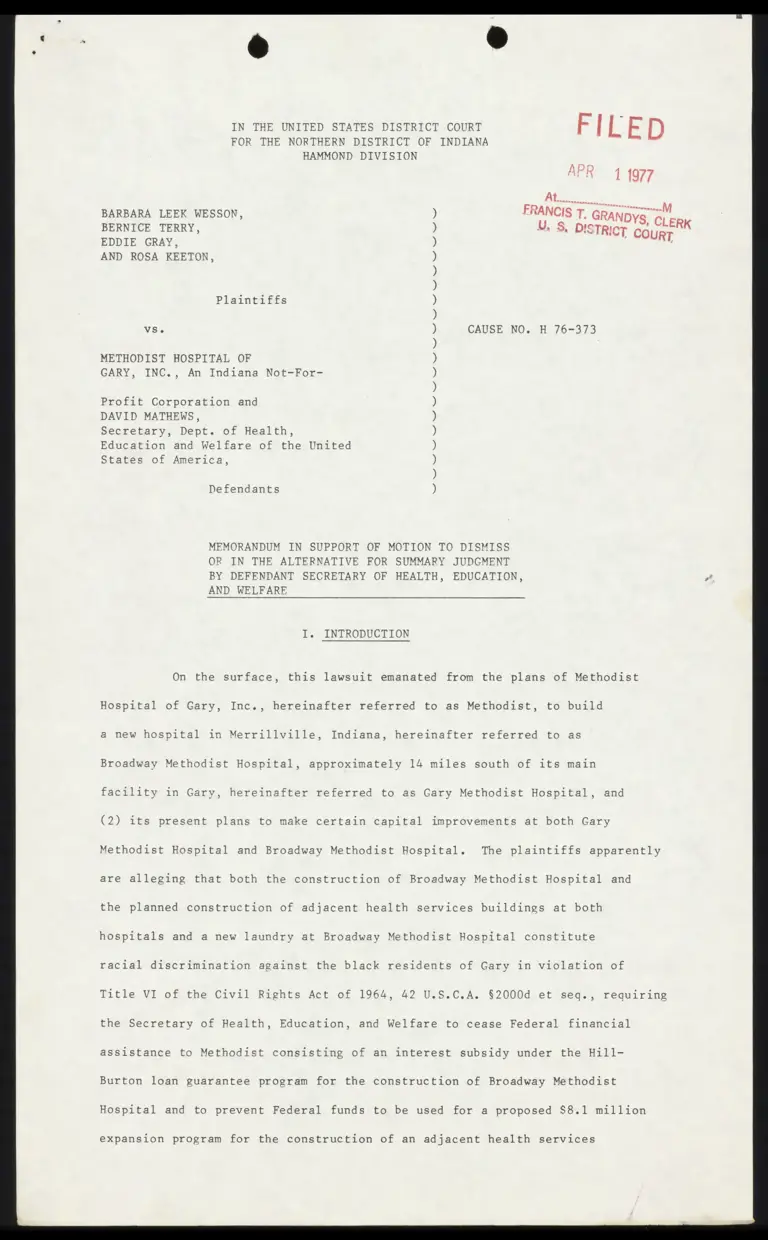
IN THE UNITED STATES DISTRICT COURT Fl L: F D

FOR THE NORTHERN DISTRICT OF INDIANA

HAMMOND DIVISION

FRANCIS T. GRANDYS, 01 Eri U. S, DISTRICT COURT

BARBARA LEEK WESSON,
BERNICE TERRY,
EDDIE GRAY,
AND ROSA KEETON,

Plaintiffs

VS. CAUSE NO. H 76-373

METHODIST HOSPITAL OF

GARY, INC., An Indiana Not-For-

Profit Corporation and

DAVID MATHEWS,

Secretary, Dept. of Health,

Education and Welfare of the United

States of America,

N
e
’


N
o
’


N
o
’


N
o

N
N


N
N

N
N

N
N
N

N
N
N

N
N
N


Defendants

MEMORANDUM IN SUPPORT OF MOTION TO DISMISS

OR IN THE ALTERNATIVE FOR SUMMARY JUDGMENT

BY DEFENDANT SECRETARY OF HEALTH, EDUCATION,

AND WELFARE


I. INTRODUCTION

On the surface, this lawsuit emanated from the plans of Methodist

Hospital of Gary, Inc., hereinafter referred to as Methodist, to build

a new hospital in Merrillville, Indiana, hereinafter referred to as

Broadway Methodist Hospital, approximately 14 miles south of its main

facility in Gary, hereinafter referred to as Gary Methodist Hospital, and

(2) its present plans to make certain capital improvements at both Gary

Methodist Hospital and Broadway Methodist Hospital. The plaintiffs apparently

are alleging that both the construction of Broadway Methodist Hospital and

the planned construction of adjacent health services buildings at both

hospitals and a new laundry at Broadway Methodist Hospital constitute

racial discrimination against the black residents of Gary in violation of

Title VI of the Civil Rights Act of 1964, 42 U.S.C.A. §2000d et seq., requiring

the Secretary of Health, Education, and Welfare to cease Federal financial

assistance to Methodist consisting of an interest subsidy under the Hill-

Burton loan guarantee program for the construction of Broadway Methodist

Hospital and to prevent Federal funds to be used for a proposed $8.1 million

expansion program for the construction of an adjacent health services


Sh =a


building at each facility and a laundry at Broadway Methodist Hospital.

Moreover, the plaintiffs are alleging that Methodist failed to live

up to Civil Rights assurances executed in July 1973 as a condition for

its obtaining Federal financial assistance in connection with the con-

struction of Broadway Methodist Hospital. The plaintiffs are asking

that the Court order the Secretary to (1) withhold from Methodist an

interest subsidy provided on a Hill-Burton fen susrantes for the financing

of Proudway Methodist Hospital endorsed in September 1973 under the

provisions of 42 U.S.C.A. §291j-4 and (2) to withhold the disbursement

of "8,143,370 of the Hill-Burton Grant and Loan Guarantee to defendant

Methodist for expansion of its Gary and Broadway sites."

However, there bens £0 be two primary underlying reasons

for the filing of the suit. The first reason appears to be directly the

result of a dispute between two groups - the hospital, the Board of

Directors, and the medical staff of the hospital including most of the black

physicians against the Medical Center of Gary of which Dr. Alfonso D. Holliday II

is Executive Director and Barbara Leek Wesson is President - as to the location

of the proposed health services building in Gary and the role of the

two groups in Methodist's future planning. The second reason appears

to be a concern that the present Federal health legislation does not provide

an adequate positive impact on inner city black residents.

II. BACKGROUND

A. Legislative

l. "Hill-Burton" Grant
and Loan Guarantee

Program

The federal government has long supported and encouraged health

planning initiatives by the various States. Probably the oldest and

best-known program in this area is the "Hill-Burton" program which channels

federal funds to the States to support the construction and modernization

of hospitals and other medical facilities. Public Health Service Act,

§601 et seq., 42 0.5.C.A. §§291-291z. Before becoming entitled to its

allotment of Hill-Burton funds, each State submits to the Secretary a

State Plan (to be reviewed annually) which names a State agency to administer

the program and establishes a "survey of need" for general hospital beds,


skilled nursing beds, public health centers, etc., throughout the State.

The surveys describe existing medical facilities and project needs.

Public Health Service Act, $604, 42 U.S.C.A. §291d.

Changes in program emphasis during recent years have been re-

lecthd in a decreasing availability of direct avant aid and increasing

reliance on the use of borrowed funds and in constructing and equipping

needed hospitals and other health care facilities. The Medical Facilities

and Construction and Modernization Amendments of 1970, P.L. 91-296, amended

Title VI of the Hill-Burton Act to authorize loan guarantees with interest

subsidies and direct loans. Title VI of the Public Health Service Act

authorized the Secretary of Health, Education, and Welfare to siataates loans

made to private nonprofit medical facilities by non-Federal lenders and

to make direct loans to public medical facilities to assist in the construction

of needed hospitals, outpatient care facilities, and rehabilitation facilities.

The loan guarantee part of the program is essentially a "mortgage" type

operation in which loan arrangements are made by the applicant with commercial

banks, savings banks, or other lending institutions, with repayment of the

loan guaranteed by the Secretary. The loan guarantee authority provides

for interest subsidies to be paid by the Federal Government at a rate sufficient

to reduce by three percent per annR the net effective interest paid by the

borrower. 42 U.S.C.A. §§4601-4655. The regulations implementing the Hill-

Burton grant and loan-guarantee program are set forth at 45 C.F.R. Part 53.

2. Title VI of the Civil Rights Act of 1964,
42 U.S.C. §2000d et seq.

Section 601 of Title VI of the Civil Rights Act of 1964, 42 U.S.C.A.

§2000d, states the general principle that no person in the United States

shall be excluded from participation or otherwise discriminated against

on the ground of race, color, or national origin under any program receiving

Federal financial assistance.

Section 602, 42 U.S.C.A. §2000d-1, directs each Federal agency

administering a program of Federal financial assistance by way of grant,

loan, or contract "other than a contract of insurance or guarantee" to

take action pursuant to rule, regulation, or order of general applicability


to effectuate the principle of section 601 in a manner consistent with

the achievement of the objectives of the statute authorizing the assistance.

The regulations promulgated by the Secretary to effectuate the purposes

of Title VI are found at 45 C.F.R. Part 80. In seeking to effdotuate

compliance with its requirements imposed pursuant to section 602, an agency

is authorized to terminate or to refuse to grant or to continue assistance

under a program to any recipient or applicant as to whom there has been

an express finding, after opportunity for a hearing, of a failure to comply

with the requirements under that program. However, each agency is directed

under section 602 to first seek compliance with its requirements by

voluntary means. A contemplated action that could result in terminating

or refusing to grant or continue assistance because of noncompliance with section

601, cannot become effective until 30 days after the head of a Federal

Department or agency files with the House and Senate Committees having

legislative jurisdiction over the program or activity involved a full written

report of the circumstances and the grounds for such action.

Section 603 of Title VI, 20 U.S.C.A. §2000d-2, provides that any

agency action taken pursuant to section 602 shall be subject to judicial review

2s would be available for similar actions by that agency on other grounds.

Where the agency action consists of terminating or refusing to grant or

to continue financial assistance because of a finding of a failure of the

recipient to comply with the agency's requirements imposed under section

602, and the agency action would not otherwise be subject to judicial review

under existing law, judicial review shall nevertheless be available to any

person aggrieved as provided in section 10 of the Administrative Procedure Act,

5 U.S.C.A. §§8701-706.

Section 605 of Title VI, 20 U.S.C.A. §2000d-4, provides:

"Nothing in this subchapter shall add to or detract
from any existing authority with respect to any
program or activity under which Federal financial
assistance 1s extended by way of a contract of
insurance or guaranty."

The implementing regulations specify the Department's complaint

and investigatory process. Section 80.7(b) of Title 45 of the Code of

Federal Regulations, reads in pertinent part:

"(b) Complaints. Any person who believes himself


or any specific class of individuals to be subjected
to discrimination prohibited by this part may by himself
or by a representative file with the responsible De-
partment official or his designee a written complaint.
* % % MW


¢ *
Section 80.7(c) of the Regulations provides for investigations of possible

instances of noncompliance, as follows:

"The responsible Department official or his designee

will make a prompt investigation whenever a compliance
review, report, complaint, or any other information
indicates a possible failure to comply with this part."

Finally, 45 C.F.R. §80.7(d) pertains to the resolution of complaints as

follows:

"(d) Resolution of matters.

(1) If an investigation pursuant to paragraph (c)
of this section indicates a-failure to comply with
this part, the responsible Department official or
his designee will so inform the recipient and the
matter will be resolved by informal means whenever

possible. If it has been determined that the matter
cannot be resolved by informal means, action will
be taken as provided for in §80.8.


(2) If an investigation does not warrant action.
pursuant to subparagraph (1) of this paragraph the
responsible Department official or his designee
will so inform the recipient and the complainant,
if any, in writing."

The July 1973 assurances obtained in connection with Methodist's

application for a loan guarantee to assist financing the construction of

Broadway Methodist Hospital are in addition to those assurances required by

45 C.F.R. 80.4(a)(1).

Title VI of the Civil Rights Act of 1964, supra, is applicable to

both the Hill-Burton direct grant program and the loan guarantee program

as indicated by 42 C.F.R. §53.112(c) which states:

"Attention is called to the requirement of title
VI of the Civil Rights Act of 1964 (42 U.S.C. 2000d;
78 Stat. 252) which provides that no person in the
United States shall, on the ground of race, color, or

national origin be excluded from participation in, be
denied the benefits of, or be subjected to discrimination
under any program or activity receiving Federal financial
assistance. A regulation implementing such title VI,
applicable to assistance under this part for construction
and modernization of hospitals and medical facilities, has
been issued by the Secretary of Health, Education, and
Welfare with the approval of the President (45 CFR Part 80)."

Section 80.2 of Title 45 of the Code of Federal Regulations

provides, in part:

"This regulation applies to any program for which Federal
financial assistance 1/ is authorized to be extended to a
recipient under a law administered by the Department,
including the Federally-assisted programs and activities
listed in Appendix A of this regulation . . . . This
regulation does not apply to (a) any Federal financial

assistance by way of insurance or guarantee contracts, . . . .
The fact that a type of Federal assistance is not listed
in Appendix A shall not mean, if Title VI is otherwise
applicable, that such program is not covered."

  1/ "Federal Financial assistance" is defined at 45 C.F.R. §80.13(f) to include
'any Federal agreement, arrangement, or other contract which has as one of its
purposes the provision of assistance." The 3% interest subsidy constitutes
Federal financial assistance.


Methodist for many years operated one hospital of approximately

400 beds in downtown Gary. In 1972, Methodist applied for a Hill-Burton

grant pursuant to 42 U.S.C.A. §§291-291z for $333,300 for fiscal year 1972

and for $819 227 for fiscal year 1973 in connection with the proposed
3H 2 5 : :

SER Pd ’ x : : ’
construction of a new facility in Merrillville, Indiana, located about

14 miles south of downtown cary. In addition, Methodist applied for a

Hill-Burton loan gurantee of $16,336,193 pursuant to 42 U.S.C.A. §§4601-4655.

Under the loan guarantee program, the Federal Government pays a 37% interest

subsidy and the borrower must pay the remaining percentage of the loan.

The Regional Office oF tho Dpeartment of Health, Education, and

Welfare was concerned with the possiblity that the construction of the new

focility in Merrillville might result in a loss of hospital services to the inner-

city residents of Gary, over 60% being minority. Specifically, the Regional

HEW officials were concerned that the construction of the new facility might

result in a loss of services to the inner-city minorities of Gary constituting

discrimination on the basis of race by a recipient of Federal financial

assistance in violation of Title VI and the implementing regulations set forth

in 45 C.F.R. Part 80. The Regional Office of the Department of Health,

Education, and Welfare in Chicago insisted upon Methodist making specific

assurances designed to assure that Gary Methodist Hospital would continue to

operate as a viable acute care hospital in Gary as a condition of approval

of the Hill-Burton loan gurantee covering the construction of Broadway Methodist

Hospital. These assurances were executed by Methodist and approved by the

Department of Health, Education, and Welfare in July 1973. 2/ They specifically

require prior HEW approval of any addition to or expansion of Broadway Methodist

Hospital, any reduction of services at Gary Methodist hospital, and any plans

to duplicate at Broadway Methodist Hospital services at Gary Methodist Hospital.

Moreover, paragraph 2 of the assurances specifically provides that if Gary

Methodist Hospital should experience any financial difficulties that would

preclude the operation of Gary Methodist as a general acute care hospital,

financial resources generated by Broadway Methodist Hospital will be immediately

and directly used to provide the necessary assistance to Gary Methodist Hospital.


2/ The assurances are included Exhibit A to Methodist's Motion to Dismiss,


¢. lie. 09


After execution of the Civil Rights assurances in July 1973,

the loan guarantee agreement relating to the financing of the construction of

Broadway Methodist Hospital was consummated on September 5, 1973 (Exhibit 1).

The agreement provides for HEW to pay a 3% interest subsidy on a real

estate mortgage in the sum of $14,315,207. The language contained in

section 4 of the agreement reflects the statutory provision, 42 U.S.C.A.

§2913-3(f), which provides:

"(f) Any guarantee of a loan to a nonprofit private
agency made by the Secretary to this part shall be

incontestible in the hands of an applicant on whose
behalf such guarantee is made, and as to any person

who makes or contracts to make a loan to such applicant

in reliance thereon, except for fraud or misrepresentation
on the part of such applicant or such other person.

(Emphasis added).


Broadway Methodist Hospital opened in January 1976.

Pursuant to the requirements contained in the July 1973 Civil

Rights assurances, Methodist wrote the Office for Civil Rights on July 17,

1974 (Exhibit 2) enclosing a copy of its proposals for the construction of

a health services building in Gary, a health services building in Merrillville,

and a new laundry in Merrillville. Methodist convened a meeting on July 19,

1974 of representatives of the Region V Office for Civil Rights and Regional

Health Administrator's Office, the Indiana State Board of Health, the

Northwest Indiana Comprehensive Health Planning Agency, and hospital officials. 3/

The purpose of the meeting was to discuss Methodist's proposal to construct

the aforementioned health services buildings and laundry with Federal financial

assistance and to obtain a preliminary reaction with regard to potential

problems of the reviewing State and Federal officials. As indicated in his

attached affidavit (Exhibit 4), Alfred Sanchez, the present Chief of the HEW

Region V Health and Social Services Branch of the Office for Civil Rights,

raised certain questions regarding the duplication and reduction of services

at Gary Methodist Hospital at the July 19, 1974 meeting. Hospital officials

stated that there would be no reduction or duplication of services. The

Northwest Indiana Comprehensive Health Planning Agency officials expressed

a similar view. Mr. Sanchez stated that based on his reading of the proposals

and the statements made at the meeting by hospital and health planning officials,

he anticipated no problems when the proposals would be submitted to the Regional


3/ A record of the minutes of the July 19, 1974 meeting is attached as Exhibit 3.


#% - 8 - »

Office for Civil Rights for review pursuant to the July 27, 1973 Civil

Rights assurances and the routine review under Title VI of the Civil

Rights Act of 1964 of the Hill-Burton applications.

During the period July 1974 until April 1976, Methodist put

together applications for Federal sihanb ial assistance for the two health

service buildings and laundry and processed its applications through the

appropriate local and State health agency reviewing authorities.

The applications were received by the Region V Regional Health

Administrator on April 19, 1976. The sources of funding proposed by Methodist

for the two health services buildings and laundry were as follows: 4/

Source Health Services Health Services TOTAL


Building - Gary Building & Laundry -
Broadway

Hill-Burton Grant $ 215,396 $ 276,177 $ 491,573

Loan¥* 2,511,604 3,522,895 6,034,499
Internal Operations/ 554,370 1,062,928 1,617,298

cash/securities

*Guaranteed by HEW and includes 3% interest subsidy

Thus, the total Federal assistance requested related to $6,526,072 of

the total estimated $8,143,370 cost of the projects.

The Regional Office for Civil Rights received the Hill-Burton

applications for Title VI review on April 23, 1976. In reviewing the applications,

the Office for Civil Rights had a number of questions relative to the

accuracy of the applications and significance of the alleged changes or

modifications of the proposals not only since July 1974, but also since review

by the appropriate State and local agencies. Specifically, the Regional

Office for Civil Rights requested addi ional information or clarification

regarding the following:

(1) Elimination of coronary care - intensive care units

in the proposed Gary Methodist Hospital Building,

(2) Reduction of clinic space at the Gary Health Services
Building,

(3) Increase of space in the Broadway Health Services
Building, and

(4) The elimination of offices for hospital-based
physicians in the Gary Health Services Building.


4/ The proposed sources of funding are set forth in the staff analysis of the
Northern Indiana Health Systems Agency, Inc., which was attached to the agency's
August 23, 1976 letter to the Region V Office for Civil Rights. Both documents
are attached as Exhibit 5.


- 9 - »

The Northern Indiana Health Systems Agency's staff analysis

transmitted to the Office for Civil Rights on August 23, 1976 stated that

the proposed square footage and programs in both the proposed health

services building in Gary and in Merrillville were adequate to meet the

needs of the population in the service areas (Exhibit 5). In a June 4, 1976

letter, R. B. Glesne, Administrator of Methodist, advised a hospital

administrative consultant with the Indiana State Board of Health that

Gary Methodist Hospital had recently remodeled a 10-bed intensive care

coronary unit to replace the outdated units. For that reason, the hospital

no longer saw a need for coronary care-intensive care units in the proposed

health services building (Exhibit 6). An investigation by the Office for

Civil Rights revealed that Aiuto the Gary nor the Broadway health services

building were to have physician offices. Accordingly, all concerns of the

Office for Civil Rights relative to unequal treatment to the minority community

of Gary in connection with the application for Federal financial assistance

for the health service buildings and laundry projects were satisfactorily

answered.

As indicated in the affidavit of Alfred Sanchez (Exhibit 4), the

Office for Civil Rights determined on September 20, 1976 that the applications

for the construction of the health services buildings and laundry presented

no potential or actual Title VI problems and recommended proceeding with

funding. On September 28, 1976, the Department of Health, Education, and Welfare

entered into two loan guarantee agreements with Methodist whereby HEW offered to

guarantee payment of loans and a 3% interest subsidy to Methodist for a

portion of the cost of construction of the hospital services buildings and

‘laundry.

The Department of Health, Education, and Welfare has information that

during the period July 1974 through September 1976 there was a strong

difference of opinion between Methodist and the Medical Center of Gary as

to where the hospital soritas building should be located in Gary. In the

summer of 1976, it became apparent that the dispute also involved the role the

Medical Center of Gary was to have in the control and operation of the health

services building in Gary. These differences clearly appear in the following

documents:


Oi. ®

(1) Medical Center of Gary's July 22, 1976
"statement of position on Gary Methodist

Proposed Building'" which perceives the health
services building at Gary as the cornerstone
of a primary care group practice controlled

by the Medical Center of Gary (Exhibit 7).

(2) August 6, 1976 letter signed by the majority
of Methodist's black physicians to R. B. Glesne,
Hospital Administrator, expressing concern
that the Medical Center of Gary would share
the health services facility and have jurisdiction
over its long term goals and opposing the

recommendation of the Medical Center of Gary

to relocate the building at a site not adjacent
to Gary Methodist Hospital (Exhibit 8).

(3) Draft Memorandum of Agreement drawn up by the
Medical Center of Gary dated August 11, 1976

(Exhibit 9).

(4) August 23, 1976 letter from R. B. Glesne to
Alfonso D. Holliday II, M.D., Executive Director
of the Medical Center of Gary, advising that on
August 23, 1976 the Methodist Board of Directors
voted to reject the draft agreement proposed by

Medical Center of Gary (Exhibit 10).

(5) September 15, 1976 letter from Barbara Wesson,
President of the Medical Center of Gary, Inc.,
to Alfred Sanchez, HEW Regional Office for Civil
Rights, advising that the Medical Center of Gary
opposed Methodist's proposals for the construction
of the two health services buildings and laundry

(Exhibit 11).

The Office for Civil Rights received letters and mailgrams on

or about October 1, 1976 from several interested persons in the Gary area

objecting to the approval of Federal financial assistance to Methodist to build

the hospital services buildings and laundry. Based on the information obtained

during the Office for Civil Rights Title VI review which resulted in clearances

of the applications on September 20, 1976, letters were sent to the interested

parties on October 21, 1976 along with an ll-page position paper setting forth

in detail why it was concluded that there were no Title VI problems with the

applications and some discussion of the problems endangering the delivery of

health care to residents of Gary which are common to many inner city areas

(Exhibit 12). 5/


5/ The October 21, 1976 letter and position paper were a summary of Office for
Civil Rights findings concerning the applications for both the original project
- construction of Broadway Methodist Hospital - and the most recent applications
for the hospital service buildings and laundry.


#® re ®

A September 29, 1976 letter of complaint from the Gary Human Relations

Commission was hand-delivered to Mr. Sanchez at the Region V Office for Civil

Rights by Steve Tallackson, Executive Director of the Commission (Exhibit 13).

The complaint alleged that Methodist had operated in such a manner that the level

of services at Gary Methodist Hospital had been reduced. The September 29, 1976

complaint specifically alleged the following:

(1) Gary Methodist Hospital had failed to replace
the "inadequate power plant, X-ray, and emergency

room,"

(2) Methodist deleted three of the original five improve-
ments from Gary Methodist Hospital that were in the
original Hill-Burton application, and

(3) There was a prediction that at some undisclosed future °
time the number of beds at Broadway Methodist Hospital
would be increased and the number of beds at Gary
Methodist Hospital would be reduced.

Mr. Tallackson called the Office for Civil Rights on November 10, 1976

and November 24, 1976 adding additional allegations on each occasion to the

September 29, 1976 complaint letter. The additional oral allegations are reflected

in Mr. Sanchez's December 7, 1976 memorandum to file (Exhibit 14). Mr. Tallackson

never submitted these oral allegations in writing. These additional allegations

centered around the types of equipment used at the two hospitals and the quali-

fications of medical personnel at the two hospitals. Mr. Sanchez of the Office

for Civil Rights discussed the existence of the complaint and the general nature

of the allegations with R. B. Glesne, Administrator of Methodist.

The Office for Civil Rights sent a letter to Methodist on December 22,

1976 requesting information relating to the September 29, 1976 complaint by the

Gary Human Relations Commission, as orally amended by Mr. Tallackson in calls he

placed to Mr. Sanchez on November 10 and 24, 1976 (Exhibit 15). Wensdiat:

furnished the information requested in a letter dated Yahuary 19, 1977 to the Regional

Office for Civil Rights (Exhibit 16). Mr. Sanchez pursued his investigation of

the Gary Human Relations Commission complaint, which included an on-site visit

on February 15, 1976, and concluded in his detailed March 29, 1977 preliminary

letter of findings to the Gary Human Relations Commission that there was no

Title VI violation (Exhibit 17). The Gary Human Relations Commission was given

the opportunity to explain or rebut any finding in the preliminary letter of

findings within 10 days.


During a March 16, 1977 deposition of Dr. Alfonso D. Holliday

II in connection with this lawsuit, the Department of Health, Education,

and Welfare became aware for the first time of a new specific allegation

which was never previously brought to the attention of the pepactheni

regarding an alleged reduction in the availability of radio-therapy services

at Gary Methodist Hospital since the opening of Broadway Methodist Hospital.

The Department has initiated an investigation of this new specific allegation.

See affidavit of Alfred Sanchez (Exhibit 4).

ARGUMENT

I. Plaintiffs Have Failed to Exhaust Administrative
Remedies with Respect to Claims Against Secretary of H.E.W.


The plaintiffs have failed to follow the administrative procedure

for filing a complaint for an alleged violation of Title VI of the Civil

Rights Act of 1964 as implemented at 45 C.F.R. §80.7(b). Title VI directs

Federal agencies to effectuate compliance with its provisions through the

issuance of rules, regulations, or orders of general applicability and by

voluntary means. As previously noted, only after a recipient has been put

on notice of the Department's finding of a Title VI violation and given an

opportunity to comply by voluntary means may an action directed at the

termination of Federal funding or refusal to grant Federal financial assistance

be initiated. 42 U.S8.C.A. $2000 d-1, 45 C.7.R. Parts 80.7(c) and (4d). The

plaintiffs in this case - Barbara Leek Wesson, Bernice Terry, Eddie Gray,

and Rosa Keeton - have neither individually nor collectively ever filed a

complaint alleging a Title VI violation with the Office for Civil Rights of

the Department of Health, Education, and Welfare. 6/ Since none of the

plaintiffs have attempted to exhaust their administrative remedies, the Court

does not have subject matter jurisdiction under Title VI as to any claim

against the Secretary in this situation.


6/ A Title VI complaint filed by the Gary Human Relations Commission on September
29, 1976, as amended by telephone conversations on November 10 and 24, 1976, con-

taining some similar allegations was investigated by the Office for Civil
Rights, Department of Health, Education, and Welfare, Region V. The Office
for Civil Rights concluded in a March 29, 1977 report that none of the allegations
constituted a violation of Title VI. None of the plaintiffs in this case
have alleged that they were members of the Commission or that they were parties

to the complaint.


@ Be ®


As indicated in Mr. Sanchez's affidavit (Exhibit 4), the Office

for Civil Rights has thoroughly reviewed the applications for the health

services buildings and laundry for any Title VI problems and has investigated

all allegations raised by the Septenber 29, 1976 complaint filed by the

Gary Human Relations Commission as orally amended on November 10 and 24, 1976,

and found no allegations constituting a violation of Title VI of the Civil

Rights Act of 1964. The general allegations tn te complaint

filed in the United States District Court on December 29, 1976, appeared

similar to those set forth in the complaint of the Gary Human Relations

Commission. However, it appeared during the March 16, 1977 deposition of

Dr. Alfonso D. Holliday II, that a new specific allegation was being made

regarding an alleged reduction in the availability of radio-therapy services

at Gary Methodist Hospital since the opening of Broadway Methodist Hospital.

Based on the new information first brought to the Department's attention during

discovery proceedings in this lawsuit, the Office for Civil Rights has initiated

an investigation into this new allegation pursuant to the procedures provided

for in Title VI of the Civil Rights Act of 1964 as implemented by 45 C.F.R.

Part 80.

It is a long settled rule of judicial administration that 'mo one is

entitled to judicial relief for a supposed or threatened injury until the

prescribed administrative remedy has been exhausted." Myers v. Bethlehem

Shipbuilding Corp., 303 U.S. 41, 50-51, 58 S. Ct. 459, 463 (1938). See also

Borden Inc., Vv. ¥.7.C., 495 F.2d 785, 786-787 (7th Cir. 1974).

The Supreme Court in McKart v. U.S5., 395 U.S. 185, 193-194, 89 S, Ct.

1657, 1662-1663 (1969), has articulated the policies supporting the exhaustion

‘requirement as follows:

"A primary purpose is, of course, the avoidance of

premature interruption of the administrative process.
The agency, like a trial court, is created for the
purpose of applying a statute in the first instance.
Accordingly, it is normally desirable to let the agency
develop the necessary factual background upon which de-

cisions should be based. And since agency decisions
are frequently of a discretionary nature or frequently §
require expertise, the agency should be given the first
chance to exercise that discretion or to apply that
expertise. And of course it is generally more efficient
for the administrative process to go forward without
interruption than it is to permit the parties to seek
aid from the court at various intermediate stages."

See also McGee v. U.S., 402 U.S. 479, 91 S. Ct. 1565 (1971).


® - 14 = %


Congress has provided for administrative proceedings to review

the role of the Secretary and administer Federal financial assistance to

institutions which may have violated Title VI. 42 U.S.C. 2000 d-1. The

plaintiffs have failed to follow such procedures and instead have chosen

to ignore the administrative process and go directly to Court. The issue

of the Secretary's role in implementing Title VI is properly an administrative

matter at this point and is not properly before the Court. The Seventh

Circuit in Green Street Association v. Daley, 373 F.2d 1, 8 (7th Cir. 1967),


cert. denied 387 U.S. 932, 87 S. Ct. 2054 (1967), strongly opposed efforts

to bypass the administrative procedure contemplated by Congress as the

plaintiffs have attempted in this case by stating:

"The plaintiffs' remaining contention . . . is that
the Plan's 'recognition' of the segregated nature of
residential facilities in Chicago subjects them to
'discrimination under a program . . . receiving Federal financial
assistance' within the meaning of section 601 of the Civil Rights
Act of 1964 and that this section implicitly confers stand-
ing upon them to sue to enjoin violations of it. As to
federal defendants, the plaintiffs' argument is erroneous
in that it ignores the remaining sections of Title VI of
the Act. Sections 602 and 603 of the Act, 42 U.S.C.
§§2000d-1, 2000 d-2, establish the procedure to be followed
by federal officials in enforcing the nondiscrimination
requirements of section 601. Only after the appropriate
Federal agency has followed this procedure is judicial
review permitted by section 603. If an individual suit for
an injunction against the Federal officials were permitted,
the administrative procedure would be bypassed. We do not
think that section 601 was intended to permit the termination
of Federal participation in a given program by this means.

(Emphasis added)


Allegations relating to the Secretary's implementation of Title VI,

including the July 27, 1973 assurances, are properly within the Department's

primary jurisdiction because of the Department's expertise and ongoing

obligation to implement consistent policies in the area of race discrimination.

Through its complaint investigation and review procedures, the Department

has developed a familiarity and a technical background appropriate to resolve

issues involved in this suit. In addition, Congress has given jurisdiction

to the Secretary by enacting Title VI. As these civil rights protections

have been created by Congress, so have their methods of implementation.

The Department's" jurisdiction should not be preempted so long as there is

no evidence of governmental collusion in the recipient's alleged discrimination

or any unwillingness to pursue the compldint administratively. Adams v.

Richardson, 480 F.2d 1159, 1162 (D.C. Cir. 1973); Gautreaux v. Romney,


448 F.24 731, 737-9 (7th Cir. 1971).


pe - 15 -


The Office for Civil Rights in Chicago has diligently followed

the letter and spirit of Title VI of the Civil Rights Act of 1964 as

implemented in 45 C.F.R. Part 80 and the July 27, 1973

assurances in connection with every specific allegation raised in

connection with Methodist Hospital of. dary, Inc., and is continuing to do

so. The plaintiffs have attempted to bypass the administrative process

by filing this action in Federal Court. The plaintiff's failure to exhaust

their administrative remedies under Title VI requires the Secretary of

Health, Education, and Welfare to be dismissed from this -suit. 7/

Green Street Association v. Daley, supra; Johnson v. County of Chester, 413


F. Supp. 1299, 1310-11 (E.D. Pa., 1976); Green v. Cauthen, 379 F. Supp.

361, 378-79 (D. S.C., 1974); Feliciano v. Romney, 363 F. Supp. 656, 672-

873 {S.D. M.Y., 1973); Dupree v. City of Chattanooga, 362.7. Supp. 1136, 1141~


42 {E.D. Temmn., 1973).

II. Plaintiff Have Not alleged Facts which
Constitute a Claim Upon Which Relief Can be Granted


A. Plaintiffs Have Not Stated A Claim or
Cause of Action Against the Secretary


Although Title VI of the Civil Rights Act of 1964 may create a

cause of action by individuals against a recipient of Federal financial

assistance, the statute provides that plaintiffs with no cause of action

or claim for relief against the Secretary in this situation. 8/ In order

to state a cognizable claim against the Secretary under Title VI, the

plaintiffs must be able to and, in fact, allege one of two fact patterns:

(1) that the Secretary knew or had constructive knowledge that the recipient

was out of compliance and that the Secretary failed to act because of a

consciously adopted general policy to abdicate his statutory duties, e.g.

Adams v. Richardson, supra, or (2) that the Secretary was in conscious

collaboration with the recipient in its allegedly discriminatory conduct,

e.g. Gautreaux v. Romney, supra.


7/ However, we do not mean to suggest that plaintiffs must exhaust their
administrative remedies against Methodist. It is only the claims against

the Secretary which must be pursued administratively.

8/ See Lloyd v. Regional Transit Authority, (No. 76-1524, 7th Cir. Slip Opinion,


decided January 18, 1977), attached hereto.


*® igo ®

The plaintiffs purported causes of action against the Secretary

neither allege nor imply either of these two fact patterns. The plaintiffs"

appear to be alleging that Methodist is in violation of Title VI and that it

is the Secretary's duty to insure that Methodist does not discriminate as

a recipient of Federal financial assistance. However, there is neither

a statement nor implication that the Secretary knew of possible Title VI

violations, that he had a policy of not enforcing Title VI and the implementing

regulations and assurances as to Methodist, or that any Departmental action

was taken in collaboration with the allegedly discriminatory actions of

Methodist. Thus, the plaintiffs have stated no claim in this case.

B. Plaintiff Has Not Alleged Facts which
Constitute a Failure of the Secretary to
Meet his Duty


The plaintiffs' complaint alleges no facts which support a

legal conclusion that the Secretary has failed to meet his duty.

In fact, the Secretary has fulfilled his duties under Title VI

by implementing a rational and effective enforcement mechanism. The primary

substantive section of Title VI declares that:

"No person in the United States shall on the ground
of race, color, or national origin, be excluded from
participation in, be denied the benefits of, or be
subjected to discrimination under any program or
activity receiving Federal financial assistance."

42 U.S8.C. §20004d.

Title VI authorizes and directs the Department cf Health, Education, and Welfare

to effectuate the Act by rules and regulations. 42 U.S.C. §2000d-1. The

Secretary's task is to see to it that all recipients of Federal financial

assistance are in compliance with the appropriate statutes and regulations.

The actions which are necessary and appropriate to this task are spelled

out in the regulations at 45 C.F.R. Part 80. Section 80.7 of the regulations

requires the responsible Departmental official to review the compliance

status of recipients "from time to time" (80.7(a)), and to make a prompt

investigation whenever a compliance review, report, complaint, or any other

information indicates a possible failure to comply with the regulations

(§80.7(e)).


8 i. ¢


In addition, as a result of the sensitivity and genuine concern

by the Department to preclude the possibility of the closing of Gary

Methodist Hospital at some future point, the Department insisted upon the

July 27, 1973 Civil Rights assurances as a prerequisite to the approval

of the construction of Broadway Methodist Hospital. These assurances,

the first of its kind in the country, were the result of the initiative

of the Chicago Office for Civil Rights and reflect a concern regarding the

future health care services available to all residents of Gary. In accordance

with the assurances, Methodist has twice come to the Office for Civil

Rights —- upon the closure of the obstetrics department at St. Mary Mercy

Center in Gary and by submitting its a for the health services

buildings and laundry as early as July 1974. 9/

The Office for Civil Rights thoroughly investigated the Title VI

implications of the proposed health services buildings and laundry upon

its receipt of the Hill-Burton applications in April 1976 prior to clearing

the projects on September 20, 1976. The Office for Civil Rights has

thoroughly investigated every allegation in the September 29, 1976 complaint

filed by the Gary Human Relations Commission, as orally amended on November

10 and 24, 1976, and on March 29, 1977 found no Title VI violation.

See Exhibit 17. The Office for Civil Rights is presently investigating an apparent

new specific allegation which came to its attention as the ‘result of an

allegation relating to the availability of radio-therapy services at Gary

Methodist Hospital during a March 16, 1977 deposition in connection with this

litigation.

The Secretary has fulfilled and is presently fulfilling his duty

by implementing a rational, effective, and responsive enforcement mechanism.

Thus, the plaintiffs conclusions of law are without merit. Because the plaintiff

has neither stated a cognizable claim against the Secretary nor alleged facts

which constitute a failure of the Secretary to fulfill his duty, plaintiff

has stated no claim against the Secretary upon which relief can be granted.


9/ See Exhibit 12, page 5 of the ll-page position paper, prepared by the
Office for Civil Rights in response to a number of requests to withhold
funding of the health services buildings and laundry projects.


- 18 =


CONCLUSION

WHEREFORE, for the above reasons, defendant respectfully request

that its Motion to Dismiss or in the alternative for summary judgment

be granted.

Respectfully submitted,


RICHARD L. KIESER

United, States Attorney

Ffled W. Grady /

Assistant United State Attorney


Of Counsel:

Marvin E. Gavin
Regional Attorney
Department of Health, Education,

and Welfare

300 South Wacker Drive, 18th Floor

Chicago, Illinois 60606

Edward L. Koven

General Attorney


. WD
Form No. USA-20 UNITED STATES DISTRICT4SCYRT :
(Rev. 10-9-58) ‘®. \ FOR THE 4 F | | = D

0 Suv NORTHERN DISTRICT OF INDTRNA
FAN HAMMOND DIVISION
4s APR 1 1977

Alin
FRANCIS T. GRANDYS « CERTIFICATE OF SERVICE BY MAIL u. s. DISTRICT. Coie ™K

BARBARA LEEK WESSON, et al., )
VS.

METHODIST HOSPITAL OF GARY, ) Hammond Civil No. H76-373
INC., an Indiana Not-For- )
Profit Corporation, et al.

The undersigned hereby certifies that he is an employee in the

Office of the United States Attorney for the Northern District

of indians and 1s a person of such age and discretion


as to be competent to serve papers.

frat on Abril 1,.1977

Motion to Dismiss or in the Alternative for Summary Judgment with Memorandum
in Support of Motion to Dismiss or in the Alternative for Summary Judgment by
Defendant Secretary of Health, Education and Welfare with attachments thereto

he served a copy of the attached


by placing said copy in a postpaid envelope addressed to the person(s)

hereinafter named, at the place(s) and address(es) stated below, which

Ab/are the last known address(es), and by depositing said envelope and

contents in the United States Mail at Hammond, Indiana.

Addressee(s):

Hodges, Davis, Gruenberg, Compton & Sayers, 5525 Broadway, Merrillville, Indiana
a B. Allen, and Charles B. Miller, 2009 Broadway, Gary, Indiana 46407

ilton R. Leventhal, Jack Greenberg, Beth Lief, 10 Columbus Circle, New York,
New York 10019
Douglas M. Grimes and Thomas V. Barnes, 562 Washington Street, Gary, Indiana 46402
Robert Deloney 2208 Broadway, East Chicago, Indiana 46312
Marilyn G. Rose and Christine B. Hickman, 1751 N Street, N.W.., Washington, D.C.

20030


DOJ- es uw SA
chb Fred W. Grady


(Rev. 3/27/73)

PROJECT NO. Ind. 189 H.B.

STATE Indiana

FACILITY Broadway Methodist Hospital ay

LOAN GUARANTEE AGREEMENT

WHEREAS, THE METHODIST HOSPITAL OF GARY, INC. (hereinafter

referred to as the "Applicant") is a private nonprofit agency

which has filed with the Secretary of Health, Education and Welfare

(hereinafter referred to as the "Secretary") application forms,

Project No. Ind. 189 H.B. (05C18014), dated April 27, 1972 (here-

inafter referred to as the "Application"), for a loan guarantee

with interest subsidy under Title VI of the Public Health Service

Act {42 U.S.C. 29) et Sseq., hereinafter referred to as the "Act"),

which application Jos ben approved by the Secretary:

The Secretary, in accordance with the provisions of this

Agreement, hereby offers to guarantee payment of a loan to be made

to the Applicant to meet part of the eligible cost of construction

of the project described in the Application, and to pay an interest

subsidy thereon.

1. Upon written acceptance by the Applicant in the space

provided below, and subject to the terms and conditions set forth

in paragraph 2 hereof, the Secretary agrees as follows:

8/31/73 .: FUTHIT >


. \
Methodist Bospital


Burp, Indiana

~~ 5 i14

- ~~ VT J
T° ( July 17, 1974 Of bio. Ei

wo L191 ty

grit FO pit

Mr. Kenneth A. Mines

Regional Civil Rights Director
Office for Civil Rights
Department of Health, Education and Welfare
Region V

309 West Jackson - Room 1000
Chicago, Illinois 60606

Dear Mr. Mines:

On July 27, 1973, the Methodist Hospital of Gary
entered into an agreement with Region V, Department
of Health,Education and Welfare, PUTSUTAL to Title VI
of the Civil Rights Act of 1964.

In accordance with that agreement | am forwarding
to you a project proposal for the development of the
Gary and Merrillville hospitals by the Methodist Hospi -
tal of Gary. Included is a letter from the '"B" agency
reporting their approvals, a staff report indicating
their endorsement, and a detailed report of the pro-
ject.

Cord4ally yours,

oui & A. Johy pr
Administrator J

EAJ/bas

Enclosures


C


Loan Guarantee Agreement vs

a. To guarantee payment by the Applicant (in accordance with

. the repayment schedule described in paragraph 2e hereof) of interest

and principal on a loan, to be made to the Applicant by a non-Federal

lender, in an amount equal to the lesser of (i) $14,336,193.12 or

(ii) an amount which, when added to any other financial assistance

(excluding interest subsidy payments) provided under the Act for the

construction project described in the Application, equals 90 per centum

of the eligible cost of construction of such project as determined by

the Secuetary in accordance with the Act and the implementing program

regulations (42 CFR Part 53, hereinafter referred to as the "Regulations").

bh. To pay on behalf of the Applicant to the holder of the

loan guaranteed by the Guarantee Endorsement appended to this Adree-

ment (hereinafter referred to as the "Guaranteed Loan") interest

payments in amounts sufficient to reduce by 3 per centum per atin

the net effective interest rate approved by the Secretary. Upon

execution by the Secretary of such Guarantee Endorsement, the holder

of such loan shall have a contractual right to receive from the

Secretary the interest subsidy payments required by the preceding

sentence. Payments of interest subsidy pursuant to this subparagraph

will be made by the Secretary in accordance with the terms of the

loan, directly to the holder of such loan or to a trustee or agent

designated in writing to the Secretary by such holder until such

time as the Secretary is notified in writing by the holder that

such loan has been transferred and has acknowledged receipt of

8/31/73


"
a)


Loan Guarantee Agreement 3

such notice in writing. Pursuant to such written notification of

transfer, the Secretary will make such interest subsidy payments

directly to the new holder (transferee) of the loan: Provided, how-


ever, that it shall be the responsibility of the holder to remit any

payments of interest subsidy to the new holder which the Secretary

may have made to the holder after such transfer and prior to receipt

of such written notice, and the Secretary shall not be liable to any

party for amounts remitted to the holder prior to receipt of such

written notice and acknowledgement in writing by the Secretary of

receipt of such notice.

2. The commitments of the Secretary described in paragraph 1

above shall be subject to the following terms and conditions:

a. The Guaranteed Loan shall constitute the initial

permanent financing of the project.

I. The project with respect to which the loan guarantee

is made shall be placed under contract within 12 months from the date

of execution of this Agreement by the Secretary, unless a longer time

is approved by the Secretary, but in no case to exceed 18 months.

Cs Where the "Guarantee Endorsement Prior to Completion

of Construction" appended to this Agreement is executed by the

Secretary, the proceeds of the loan to be guaranteed shall be dis-

bursed to the Applicant by the lender in accordance with the terms

of a Building Loan Agreement to be entered into by the Applicant,

8/31/73


% A.


Loan Guarantee Agreement 4

the lender, and the Secretary ailop to or at the time of such

Endorsement, and which shall be in force and substance approved by

the Secretary. Upon any disbursement of such proceeds to the Appli-

cant by the lender in conalidnne with the terms of such Building Loan

Agreement, repayment of the principal amount of such disbursement,

together with interest thereon, shall be deemed unconditionally

guaranteed by the Secretary in accordance with this Agreement.

(This paragraph shall not apply where the "Guarantee Endorsement

Following Construction” appended hereto is executed by the Secretary.)

d. Where the "Guarantee Endorsement Following Construction™

appenfed to this Agreement is executed by the Secretary, the project

shall be constructed to completion in or RR with the applicable

provisions of the Act and the Regulations and with the plans and

specifications and the terms, conditions, 2nd assurances set forth

in the Application, which Application is attached hereto as Appendix A

and is hereby incorporated by reference and made a part of this

Agreement as though fully set forth herein. (This paragraph shall

not apply if the "Guarantee Endorsement Prior to Completion of

Construction" appended hereto is executed by the Secretary.)

e. The principal amount of the Guaranteed Loan, together

with interest thereon at a rate which shall not exceed the FNMA aver-

age auction yield rate for 4-month commitments at time of endorsement,

shall be repayable in accordance with a repayment schedule which will

8/31/73


-
‘ .

Ld .
.

“wo.
KE. »


Loan Guarantee Agreement 5

be prepared and approved by the Applicant, the Lender and the Secretary

upon completion of construction of the project: Provided, that


the Applicant shall be permitted to prepay up to 15 per centum of the

original principal amount of the loan in any calendar year without

additional charge. The Applicant and the Lender may further agree

that the Applicant will be permitted to prepay in excess of 15 per

centum of the original principal amount of the loan in any calendar

year without saaleional ohare, but no Such payment in excess of 15

per centum shall be made without the prior written approval of the

Secretary.

fe. The Guaranteed Loan shall be evidenced by a credit

instrument and secured by a security instrument in a form found

acceptable by the Secretary for use in the locality in:which the

project is to be constructed, covering such security as the

Secretary finds reasonably sufficient to insure repayment. There

shall be presented to the Secretary, at the time of closing, in

accordance with the Regulations, a final approving opinion of the

Applicant's legal counsel stating that the credit and security

trebrunente anderen by the Applicant are duly authorized and

delivered, and that the indebtedness of the Applicant is valid

and binding and payable in accordance with the terms of this

Agreement.

8/31/73


B, e
Loan Guarantee Agreement 6


g. Closing of the Guaranteed Loan shall be accomplished

at such time and place as may be agreed upon by the parties to such

loan and the Secretary.

3¢ B. If the Applicant shall fail to make any payment of the

Guaranteed Loan when due in accordance with the repayment schedule

+ described in paragraph 2e hereof, or if the applicant shall otherwise

default. under the terms of the credit instrument, the security

instrument, or the Building Loan Agreement, and such default is not

cured within 90 days after the Secretary receives notification from

the holder of the loan of such default, the holder of the loan shall

have the right to make demand upon the Secretary for payment pursuant

to this Agreement. Upon such demand by the holder of the loan the

- Secretary shall, at his option, either (A) purchase the loan through

the payment to the holder of the loan the full unpaid principal amount

of such loan together with accrued interest on such unpaid principal

amount at the date of such purchase and any reasonable expenses

incurred by the holder of the loan in attempting to secure payment

from the Applicant; or (B) pay to the holder of the loan, on behalf

of the Applicant, the full amount of all overdue payments of principal

and accrued interest, together with such reasonable charges for late

payment as are made in accordance with the terms of the credit instru-

ment or security instrument evidencing or securing such loan, and to

8/31/73


ve

» : .e

Ls LN

Loan Guarantee Agreement 7


continue to make payments on the loan when due (in accordance with the

repayment schedule described in paragraph 2e hereof) until such time

as the applicant resumes the making of such payments or the Secretary

elects to purchase the loan as provided in clause (A) hereof:

Provided that where such default is for any reason other than


the failure of payment of principal or interest on the guaranteed

loan in accordance with the repayment schedule, the Secretary shall

purchase the loan in accordance with clause (A) hereof.

bh. The United States shall be entitled to recover from the

Applicant the amount of any payment made pursuant to the guarantee

evidenced by the Guarantee Endorsement appended to this Agreement,

unless the Secretary for good cause waives his right of recovery; and,

upon making any such SAREE the Secretary shall be subrogated to all

of the rights of the recipient of the payments with respect to which

the guarantee was made.

4. Upon written acceptance by the Applicant in the space

provided below, the commitment ev idenuel ity this Agreement shall,

subject to the provisions of paragraph 2 hereof, be incontestable

(i) as to the Applicant except for fraud or misrepresentation on

the part of the Applicant, and (ii) as to any person who contracts

to make a loan to the Applicant in reliance upon such commitment,

except for fraud or misrepresentation on the part of such other

person.

8/31/73


o

.
»

. - .
.

.


Loan Guarantee Agreement 8

5. Upon execution of the Guarantee Endorsement appended

hereto, the Secretary's guarantee as set forth in this Agreement

shall be incontestable as to any holder of the Guaranteed Loan,

except for fraud or misrepresentation on the part of such holder.

6. Note: By mutual agreement of the parties, and in con-

sideration of the mutual promises, covenants and conditions

hereinabove set forth, this LOAN GUARANTEE AGREEMENT is intended

to replace, in its entirety, a prior LOAN GUARANTEE AGREEMENT

executed by the parties hereto on April 27, 1972, and the

Secretary warrants that all rights and benefits inured under

the prior Agreement are restored and contained in this Agreement.

The Secretary of Health, Education,

and Welfare:

; 2 2, re)

By: Eh % / ANT cobs hcl lid, Hope RH. Snider, M.D,
Title: L-puill 22h /

Date: sa


Acceptance by Applicant:


L
~ T+ OF GARY, INC.


tl Jpnnscn ceil A.
CREA, [of


8/31/73


® ®


Loan Guarantee Agreement 8a

STATE OF ILLINOIS, COUNTY OF COOK, SS:

-

Before me, the undersigned, a Notary Public in and/for said

i =] oY a
County and State, personally appeared ~/lFi7n4c bolo hoy of pd lk


A

Representative of The Secretary of Health ,/Education and Welfare,

and known to me to be such Representative of The Secretary of

Health, Education and Welfare and acknowledged the execution of

the foregoing Loan Guarantee Agreement for and on behalf of and by

authority of the Secretary of Health, Education and Welfare. {4

Witness my hand and notarial seal this 5th day of September,’

1973.

7 Elie 27
My Commission Expires: Ths STH. Le ra tA

ip, Notary Public

Car Hof C.. Trofinc,


STATE OF ILLINOIS, COUNTY. OF COOX, 8S:

Before me, the undersigned, a Notary Public in and for said

County and State, personally appeared Everett A. Johnson, Adminis-

trator of Methodist Hospital of Gary, Inc., known to me to be such

Officer of Methodist Hospital of Gary, Inc. and acknowledged

acceptance of the foregoing Loan Guarantee Agreement, for and on

behalf of said Corporation and further acknowledged his authority

to do the same.

Witness my hand and notarial seal this 5th day of September,

1973.


My Comiineion Expires: ZL 2 A rg
/Notary Public
arta C. TvoHer

This instrument prepared by Bruce E. Sayers, Attorney at Law,

5525 Broadway, Merrillville, Indiana 46410


*

»
~

oY

.

t


Loan Guarantee Agreement | 9bl

GUARANTEE ENDORSEMENT PRIOR TO COMPLETION OF CONSTRUCTION


Subject to the terms and conditions set forth in the above Loan

Guarantee Agreement between the Secretary of Health, Education, and

Welfare (hereinafter "Secretary®) and THE METHODIST HOSPITAL OF GARY,

INC. (hereinafter "Applicant") and subject further to the provisions

+ of the Act and the Regulations including future regulations imple-

menting the Act not inconsistent with the express provisions of the

above Loan Guarantee Agreement and this Guarantee Endorsement, the

Secretary hereby guarantees payment of a loan made by FIRST FEDERAL

SAVINGS AND LOAN ASSOCIATION OF GARY to the Applicant in the principal

amount equal to the lesser of (i) §$14,336,193.12 or (il) an amount

which, when added to any other financial assistance (excluding interest

subsidy payments) provided under the Act for the construction of the

project described in the Application, equals 90 per centum of the

eligible cost of construction of such project as determined by the

Secretary in accordance with the Act and the Regulations, together

with interest thereon at the rate of 7.597 per centum per annum,

which Yann is evidenced by a certain Promissory Note or other debt

instrument executed by the Applicant dated September 5,

1973, and which is secured by a certain Mortgage, Deed of Trust

or other security instrument executed by Applicant, dated September 5,

1973. The Secretary further agrees, subject to the terms and

conditions of such Loan Guarantee Agreement, to pay throughout

8/31/33


s *


Loan Guarantee Agreement 9b2

the term of the loan on behalf of the Applicant to the holder of

the loan guaranteed hereby interest payments in amounts sufficient

to reduce the net effective interest rate payable by the Applicant

on such loan by 3 per centum per annum. The Applicant has submitted

to the Secretary an estimated Schedule of Advances specifying by

month the amounts of advances which the Applicant expects to draw

during the construction period. Such Schedule of Advances may be re-

vised from time to time by the Applicant, with the approval of the

Secretary. Payments of interest subsidy prior to the commencement

of amortization of the loan shall be made by the Secretary as follows:

On an actual basis of interest due on advances made upon receipt by

the Secretary from Applicant's lender of drawdown vouchers repre-

senting advances made, certified by Borrower's Representative.

Beginning with the commencement of amortization of the loan,

payments of the interest subsidy shall be made by the Secretary

in accordance with the permanent Interest Subsidy Payment Schedule,

which will be prepared and approved by the Applicant, the Lender,

and the Secretary upon completion of the construction on the

project.

The Applicant agrees that construction on the project

8/31/73


%
~


Loan Guarantee Agreement

heretofore commenced shall proceed

specifications heretofore provided.

8/31/73

9b3

pursuant to the plans and

The Secretary of Health, Education,
and Welfare

By: A. er Ya illo #2:


Hipe H- Snider, md 2s
Pitle: Cierny A et Ly a kit i : ocd

:

74 f pit
Date: S [23

/


o *

Loan Guarantee Agreement : 10


I hereby acknowledge receipt of executed duplicate originals

of the above Loan Guarantee Agreement and Guarantee Endorsement,

and understand the terms and effect of such instruments.

Applicant: | Lender:


THE METHODIST HOSPITAL FIRST FEDERAL SAVINGS AND LOAN


Address where interest subsidy
payments are to be sent:

First Federal Savings and Loan
Association of Gary, Iuse.

545 Broadway
Gary, Indiana 46402

8/31/73


* +


Loan Guarantee Agreement : 9bh4

STATE OF ILLINOIS, COUNTY OF COOK, SS:

Before me, the undersigned, a Notary Publ ¢c in aL of said

WT Les 29.87

Representative of The Secretary of Health, eT and Welfare,

County and State, personally appeared


and known to me to be such Representative of The Secretary of

’ ‘ TRG art
Health, Education and Welfare and acknowledged the execution of ATS

the foregoing Guarantee Endorsement Prior to Completion of

» . . : . . Le j aes :

Construction for and on behalf of and by authority of the Secretary yg
: a5

of Health, Education and Welfare.

- Witness my hand and notarial seal this 5th day of September,

1973.

My Commission Expires: Hs) 2 le LT Zr


Notary Public

Carita ©. TeoHer

This instrument prepared by Bruce E. Sayers, Attorney at Law,

5525 Broadway, Merrillville, Indiana 46410

8/31/73


NS

.
Methodist Bospital

Gary, Indiana

OFFICE OF THE ADMINISTRATOR

July 25, 1974

Mr. Al Sanchez
Office for Civil Rights
Department of Health, Education &

Welfare - Region V
Room 1000
309 W. Jackson
Chicago, Illinois 60606

Dear Mr. Sanchez:

Enclosed is a copy of the notes taken at our recent
meeting in Indianapolis regarding our proposed projects for Gary Methodist and Broadway Methodist. You
expressed a desire to review the notes before
distribution to others present.

We will await your response before mailing to other
members present.

Yours very truly,

Everett A. Jdhn an, Ph.D.
Administrator

EAJ/bk

encls.

RXHIBIT 3


» ®

Indrana Stete Board of Health
July 19, 1974
10:00 A, MM,

Room 421

METHODIST HOSPITAL PROJECT


Present -

Kip Kaplan, Northwest Indiana Comprehensive Health Planning Al Sanches, Office for Civil Rights
Barbara Hullock, Health Care Facilities - HEw Region V Jim White, Hospital § Institutional Services - Board of Health Frank Sherer, Hopital & Institutional Services - Board of Health Steve Mann. Comprehensive Hea l th Planning, Board of Health Jack Cohen, Comprehensive Health Planning, Board of Health Gerald Crave, banitary Engineering, Board of Health J. Hippenteei, “anitary Engineering, Board of Health Robert Leech, Lonsultant to Methodist Hospital
Everett "Johnson, Methodist Hospital
R. B. Glesne, Methodist Hospital
Beth Kaminski, Methodist Hospital

Kip Kaplan, chairman of the meeting, presented a brief description of the proposed project. ‘He indicated there were threc purposes for the project to be reviewed - $122, Hi¥1 Burton-Loan Guarantee and Office for Civil Rights asked Comprehenyive Health to review inter-city projects ‘which includes Methodist and Mercy hospitals. Mr. Kaplan indicated his office had completed review and recommended project for app-oval. The Lake County Executive Committee and the Regiounal Executive Committee have approved the project. He then opened the meeting for questions and discussion.

Mr. Sanchez expressed his concern of impact on residents of Gary. He is concerned with transfer of services and duplication of services. He questioned if provisions of out patient services at both locations would dilute the service downtown.

Dr. Johnson pointed out the objectives in building a Health Facilities building downtown: (1) ICU-CCU cannot be properly designed in present facilties, (2) shortage of primary care physicians in Gary and difficulty in getting Family Practice Residency, (3) during the last fou years several c inics have been developed and present space 1s inadequate and there will be a need to service south county residents at Broadway.

Mr. Kaplan noted Lake County is divided into three service areas therefore there would be no duplication of service. He said the ''B" Agency intends to monitor services. No one can predict what wil] happen to clinics in five years.


®

” \

Mr. Sanches questioned the availability of manpower to operate the two facilities. Dr. Johnson said the hospital dees not feel this will be a problem. The hospital surveyed the area by sending out letters to nurses listed in the Registry and the reply wos favorable. Management people will be shared between the two hospitals.

Mr. Sanchez questioned the availability of lang 1, expand the present laundry. D-. Johnson noted the present laundry i: blocked in from expansion and present boilers would not support larger system.

Mr. Kaplan said no one could come up with alternate solutions on a practical basis. Not everyone was pleased with all par! of the proposal but no ome could ~uggest alternates. CHP forced appli ant to go through alternative. but none were acceptable. The applicant being criticized from both «ides. Some feel the applicant should not invest $2,500,000 in Gary's intercity. The laundry is really an economi: issue and does not affect medical care delivery.

Dr. Johnson stated the medical staff wanted to vote on the proposed project but Administration did not raise the issue with the Modical Staff because they believed the medical staff would defeat any development of the Gary Health Services building.

Mr. Hann said his office is in the process of checking wut the recommend- ations of tne 'B" Agency. They rely on the recommendations of the Mg Agency for much of the ground work. Mr. Sanchez asked Mr. Mann how his office would check out the manpower situation. Mr. Mannmplied that if the project is financially feasible and there is a need for service, he could not really turn down a project on availability of manpower as it invclves mostly ancillary parsonnel. Mr. Kaplan noted the critical manpower issue could come from downtown project not Broadway. There are suburban people that would work at a suburban facility.

Mr. Sanchez asked Dr. Johnson what hao been done on Family Practice. Or. Johnson explained that Space was the reason we were turned down for the program two years agoand 3 full time medical education director not employed Program cannot be further pursued until space is available. If Family Practice should fail other options for the space could be to expand the clinics, HMO, private practice, etc.

Mr. Kaplan said some of the intercity health needs are being realized or this project would not have been approved. . Mr. Sanchez said the. future of medical care in the intercity could be clinics. Mr. Kaplan pointed out unless someone con control where physicians practice, medical delivery will change. Some control can be instituted by putting speciality services in certain areas. Clinic care iw batiar than none at all. Mr. Sanchez felt a dim picture is be ing painted for medical care in the future. Mr. Kaplan said you cannot predict what will happen in the future. There are two too many hospitals in Lake County and they were built without planning approval, . There are no controls, only if youhave Federal reimbursement. Then it is possible to use certain areas for non-medicare and non-medicaid patients therefore allowing expansion without approval.


’

July 19, 1974

Page 3

Mr. Glesne asked if those involved would now voice their opinion or any objections rather than wait till we get to the end of the road and then be denied.

Barbara Bullock indicated an environmental assessment would have to be completed on the Gary phase of the project. She said that Health Facilities would have ne objections if the State approves. Also would need a financial feasibility.

Mr. Glesne noted the two buildings at Broadway would be done under a change order on the hospital project. Application would have to be Filed for the Gary building. Moncey for the Gary projec would have to be allocatad at the meeting in November or Decembor b, theState Mr white indicated, Mr. Crevey questioned thé legality uF the change oroers. Mr. Glesne indicated the maximum contingency allowed would provide for this. Mortgege wouid have to be increased and Mr. Per mins, HEW Washington office hed indicated some time ago that a second mor tgage is allowed under the Loan Guarantee program.

.

Mr. Sanchez indicated his office would have no objections on the laundry 33 it does not affect medical service. Health Facilities - Gary - Mr, Sanchez agrees with Family Practice, offices for physicians and ICU-CCU. He is concerned about clinical services and that it may lead to a trend to replace private practice medicine. Or. Johnson pointed out the poss - ibility of ending up with no physicians. At the present We are gelting only specialists not general practitioners. Mr. Kaplan noted that is ‘you do not build clinics you may be denying medical care to the intercity patients. Mr. Kaplan said he can forsee wings being closed in the downtown hospitals with the suburban hospitals expansion, it would not be economically feasible to keep them open. The suburban hospital will enable Methodist to attract physicians to the Gary hospital.

Mr. Sanchez approves of the Admitting Center at Broadway but is concerned with the ambulatory care. He feels it will dilute the manpower in Gary. He would recommend approval contingent upon Methodist being monitored in how well the hospital is doing to keep physicians in Gary. Mr. Kaplan suggested that Northwest Indiana Comprehensive Health Planning office quarterly monitor the progress and construction activity on this project, Mr. Sanches said he would take this infurmation back 10 his office and we could expect a response in about ten days.

Beth Kaminski, Recording


DEPARTMENT OF HEALTH. EDUCATION, AND WELFARE

REGION V

XXX XN X XA ION K NX
XIAN HPI XXRK ; OPPICE. OF

309 West Jackson - Room 1000 THE REGIONAL DIRECTOR
Chicago, Illinois 60606

August 9, 1974

Everett A. Johnson, Ph.D.

Administrator
Methodist Hospital of Gary
600 Grant Street
Gary, Indiana 46402

Dear Doctor Johnson:

This letter will serve to provide my comments on the minutes of the
July 19 meeting and to convey the response of the Office for Civil Rights
to your Hospital's proposals.

First, | would request one modification of the minutes. The last para-
graph does not, | feel, reflect the agreement made about the monitoring.
What | proposed, and what both you and Mr. Kaplan accepted, | believe,
was that: :

The CGffice for C ivil Rights would approve the three proposals or

presented at the July 19 meeting provided that the Hospital
would furnish the CHP with information on (J) the progress
of the Family Practice Residence Program, (2) the number of
staff physicians whom the Hospital has persu
tTicing In Gary, and (3) ’
at the clinics of both Health Services Buildings. This infor-
mation will be evaluated by the CHP with a report to be made to

the Office. for Civili Rights,

e number of patients, by race, seen

Secondly, you may proceed with your proposals with the knowledge that +

Office for Civil Rights finds no conflict with Title VI or the Assuram~
and on that basis approves the proposals. However

changes are made, we would expect to be notified.

1 ff ar . NL RE We , {f any substantial

Sincerely yours,

J.. Sanchez

jual Opportunity Specialist
Civil Rights

AUCs rat or Y


STATE OF ILLINOIS )

)
COUNTY OF COOK )

AFFIDAVIT

Alfred Sanchez, being first duly sworn, deposes and says:

1. I am the Chief of the Health and Social Services Branch of the

Office for Civil Rights, Sesion V, Department of Health, Education, and

Welfare and have held this position since June 1975. I was Acting Chief

of the Health and Social Services Branch from May 1974 to June 1975.

2. 1 was employed as an equal opportunity specialist in the

Health and Social Services Branch of the Office for Civil Rights from

June 1971 through May 1974.

3. I first became aware of the proposal of Methodist Hospital of

Gary to construct a health services building in Gary, a health services

building in Merrillville, and a new laundry in Merrillville upon receipt

of a July 17, 1974 letter from Methodist Hospital of Gary.

4, At the invitation of Methodist Hospital of Gary, I attended a

meeting on July 19, 1974 with other Federal, State, local, and hospital

officials to discuss the proposal. During that meeting I raised certain

questions regarding the possible duplication of services at the proposed

Merrillville facility and possible reduction of services at Gary Methodist

Hospital. Based upon the responses by hospital and health planning of-

ficials, I did not anticipate any problems relating to compliance with

Title VI of the Civil Rights Act of 1964 and the July 27, 1973 Civil

Rights Assurances executed by officials of Methodist Hospital of Gary

and the Federal Government.

EXHIBIT


5. The Office for Civil Rights received the Hill Burton applica-

tions for the two health services buildings and laundry on or about

April 23, 1976. I requested additional information and clarification

regarding a number of matters relevant to our civil rights review which

were satisfactorily answered by September 1976.

6. Upon my recommendation, the Office for Civil Rights determined

on September 20, 1976 that the applications for the construction of the

health services buildings and laundry presented no potential or actual

Title VI problems and recommended further funding.

7. In late September and early October 1976, the Office for Civil

Rights received letters and mailgrams expressing opposition to the health

services buildings and laundry projects. Based upon the information ob-

tained during the Office for Civil Rights Title VI review which resulted

in clearances of the applications, letters were sent to the interested

Aartics on October 21, 1976 along with an ll-page position paper setting

forth in detail why it was concluded that there were no Title VI problems.

8. On September 29, 1976 a letter of complaint from the Gary Human

Relations Commission was hand-delivered to me by Steve Tallackson, the

Executive Director of the Commission.

9. The complaint was orally amended on November 10, 1976 and Novem-

ber 24, 1976 during belealions conversations made by Mr. Tailackson to me.

The amendments are reflected in my December 7, 1976 memorandum to file.

10. On December 22, 1976, the Office for Civil Rights under my

signature sent a letter to Methodist Hospital of Gary requesting infor-

mation relating to the September 29, 1976 complaint by the Gary Human

Relations Commission, as orally amended.


® | *

11. On January 19, 1977, Methodist Hospital of Gary, Inc., responded

to our December 22, 1976 letter. |

12, After additional investigation, tneluding an on-site visit, the

Office for Civil Rights has concluded in a March 29, 1977 preliminary

letter of findings that none of the allegations in the September 29,

1976 complaint, as orally amended, constituted a violation of Title VI

of the Civil Rights Act of 1964.

13. The Office for Civil Rights in Chicago devoted approximately two

person months to the investigation of the complaint filed by the Gary

Human Relations Commission, as orally amended, plus additional time of

approximately one person month during the Title VI review of the appli-

cations for the health services buildings and laundry.

14, On March 17, 1977, 1 was advised by a representative of the

Department of Health, Education, and Welfare who attended the March 16,

1977 deposition of Dr. Alfonso D. Holliday II in Merrillville, that it

appeared that a new allegation was being made regarding an alleged re-

duction in the availability of radio-therapy servidenat Gary Methodist

Hospital since the opening of Broadway Methodist Hospital.

15. I have immediately initiated an investigation into this new

allegation.

Further affiant says not.

Ces. 8 onal,
Alfred Sanchez


Subscribed and sworn to before me this

Sy eg
3/1" day of March 5 1977,

FL Ns

Notary Public
/

rd


NOTARY PUBLIC STATE OF ILLINOIS
'Y COMMISSION EXPIRES OCT, 23, 1977


ian her

A 0k
rd

 — {

Health Systems Avapiy,

SUBAREA OFFICE WEST MAIN OF Fe SUBART CY OREM FE FAST
1115 Kenpred Aven MUBARFA OI FICE fF CENT rr tal an N ! 0 LR EF CRA teed

thohlyp? I A A TE BBY Fast Colts Yeenne Tiiefany JANOS

{219 818-1930 Sauvthy Bemd in hang Jon =

(219) 233-5140

August 23, 1976

Mr. Michael Kruley

Health and Social Services Branch

Office for Civil Rights, Region V

Department of Health, Education, and Welfare

300 South Wacker Drive

Chicago, Illinois 60606
Dear Mr. Kruley:

The Northwest Sub-Area Advisory Council of Northern Indiana Health Systems
Agency, Inc. has acted on the proposal of the Methodist Hospital of Gary
to construct health service buildings at Broadway Methodist Hospital and
at Methodist in downtown Gary and a laundry at Broadway. The Council
has recommended approval of the project to the Executive Committee of
NIHSA who shall make the final decision on the project on August 25,
1976.

I am enclosing for your information a copy of this agency's staff analysis
on the project and a copy of a summary of the application itself. Please
let me know if I can provide you with any further assistance or informa-
tion.


Sincerely,

Anthony ™B

Assistant


NORTHERN INDIANA HEALTH SYSTILIAS AGENCY

900 Last Collar, Snuth Bend, Indiana

STAFF AM

COVER SHEE

ALYS SI

Lo Ti

MDJECT |

76-41-02

MAS LR}
Eh tig


-


tcAatio


. Health Services Buildings Gary/Broadway Laundry - Broadway


+ OF Applicant: Methodist Hospital


600 Grant Street


City: IN zip: 46402 TT


jal cost oof Proscar:
+ 38,143, 370 Amount. Re que sited:

Subarca: 1404 X
— ren et on ts mae LAY TWAT SLL FBT


Lake NE ob sem Zs County:


Type of Application:
See, 1122

Instituticnal Health Servic e (Cert 2

Us

of


se of Feder -al Funds

Reed).


Other (Spuciiy r)


iype of Review:

hew sek SRE

Continuation =

Prepared By:


Peter W. Teitelman

NPS. BIS

X

Non Substantive,
Substancive

Ce een KETZ RD ieee mem

8/2/76

Rah JS

Date:


Approved Dy: Kipton Kaplan 8/2/76 Batre:

Staff Recownwendation:

Approve

{ Nn pprove

irra RE


          ): uzpested Conditions (if any


8

As prescribed by 42 Crit 127

utilized reviewing projects

NIM = REVIEW

a)-309

by Healt

[snl
08

in

LRITIRIA & ix DINGS

following
h Systems Apoenciecs:

the minimum criteria must be


Criterion Sur Lt wary of Staff Fi

Relationship to HSP and Meets three National Health Priceitios, which
are part of Interim HSP,


Relationship to long-range plan of

applicaent

3. heed for proposed services

  — — tn en ct er, en. a ete. mr On. --

Consistant with Tong range plans re Gary Heal
Services Bldg. & Laundry. Long range A doej
not address Broadway Health Service Building
Documented for all components - See narrative


Availla more

cffeed

Lhility of Jesus coutly o

tive altoernpt ives

Ya itd

feanibilily

{ Yet Foun hip Lo exivting

Syaliem


3. tate and Jong-term financial

health cave

Proposal is most effective alternative for He:
Services Buildings. Alternatives to laundry pi

are still under considera ition.


Financially feasible without unreasonable inc
in pastony Shange structure.

Does not unnece ssarily duplicate service with
possible exception of laundry, Showed laundry

11d he fuvthoy t   :
~pyrvices shan 3


EE
vi.

ACL THO

Co

ISTE Sort Sere —— ——— —— ——— ————

Criterion

Ze AvaiYauli1iq
FYI" 1) "ve
HARD En

y of resources (vonpower,
personnel, capital and

,
t pronel en)
LY RAE

A
Ehret

ris ean h LAT x ] "i a FE Fa

&. Nelatdoruhip to auc]
Services

ad tii hit fie iene ms ve ————— A oe a

lery or support

RI A — 21. ——————. Ws Soh set se viens

pecial needs of inst
a mt erm mes

itutions or pro-
Serving persons who do not

Cites

STAYF ANALYSIS
SHEET

  HSA
ee meta m. .

Jn the Hiusa acyacent
HE vp op —— TE TU mex mere mame ii i or a

I

—————— . —— v— ——

30. -
od

Specizal needs

ds of research Projects

 ———————— Construction projects
Conviriuct on CoOSES

FEB AE

and methods
3: uf construction the si

COSTS on rao
Yoel uroe

Yor Inpatient facilities:
Wil Jab llityiof less Costly,

Or
tore effecient fppropriste alternatives

Utilivat ton of Similar facilities Con<jderation of alternatives to new con- tl ructi ion
: Prolong to patients

wniertaken

Ore
Avpropriaste

1
in obtaining care if 10!

TE errs. s————— i —. TL.

»

——— — te. ct otta———

Fi

————

£>» af
0 APG ndings

Manpower resources are adequate in gen
No recruitment plan for family practic
~-residency Medical Director &_ resident

Not applicable, as entire application with ancillary §& support services. See ~Lriterion 43 eT ru Wr Nort seis pr a esl A ———. ———————

Not applicable
EE

Not applicable

Not applicable
Ll tht teem iear  mbammd ba ge =o A

a) Cost Per square foot of $95 is reaso b) See # riterion #5 per state Board
Health

a) See Criterion #4

b) Not applicable
c) See Criterion #4

d) Certain outpatient and health educatig services will not be accessible,


~
INTRODUCTION


Methodist Hospital proposes to construct the following facilities:

Square Cost/
Building Site Components Feet Cost Square foot


Health Services Gary Meth- Ambulatory Care 31,720 $3,281,370 $103
Building odist hos- Family Practice

pital Residency

Health Services Broadway Ambulatory Care 39,900 $3,599,800
Building Methodist Admitting Center

Hospital Health Education
Hospital-Base
Physicians Offices °

Laundry Broadway Laundry Building 15,444 $1,262,200
Methodist & Equipment
Hospital


86,164 $8,143,370 $95

The proposal was initially reviewed and approved under Section 1122 by Northwest
Indiana Comprehensive Health Planning Council, Inc. and the State Board of Health
in 1974. Because the applicant did not incur a binding obligation within one
year after approval by the State Board of Health, approval was withdrawn and the
applicant was asked to update the application. The attached proposal is a summary
of the updated and revised application.

Relationship to HSP and AIP


The proposal address itself to three of the national health priorities which are
incorporated into the Interim Health Systems Plan;

The provision of primary care services for medically underserved populations,
The promotion of activities for the prevention of disease, and
The development of effective methods of educating the general public
concerning proper health care and methods for effective use of available
health services

The proposal addresses these national health priorities through its planned expansion
of outpatient clinics in Gary and health education component of the Broadway Methodist
Health Service Building.


Si Relationship to Long Range Plan of Applicant


Construction of a Health Services Building at Gary Methodist Hospital and a new
laundry are consistent with the longe range plan of the applicants and are
included in the "Long Range Program Recommendations to the Board of Directors -
The Methodist Hospital of Gary, Inc.", dated April, 1972. Plans for construction
of a health services building at Broadway Methodist Hospital are not included in
this document.

Need For Proposed Services


(a) Health Services Building - Gary


(1) Ambulatory Care


Methodist Hospital of Gary is the only hospital in the Northwest Subarea
which provides organized outpatient clinics. These include orthopedic,
crippled children's, pediatric specialty (metabolism, endocrimology,
cardiology neucology), and obstetrics. An epilepsy clinic is planned.
Clinics are presently scattered throughout the existing hospital with
little or no room for expansion of additional clinics. Creation of the
new facility will enable the hospital to provide ambulatory services
more efficiently as well as provide for establishment of additional clinics.

Family Practice Residency


There are currently no family practive residencies established in the
Northwest Subarea. Establishment of a family practice residency program
in Gary will help attract physicians to Gary. Adequate facilities are
necessary in order to obtain American Medical Association approval for
such a residency. The proposed facilities meet all AMA requirements.

(b) Health Services Building - Broadway


(1) Ambulatory Care


The ambulatory care component of the Broadway Methodist Health Services
Building was not included in the original plans for the hospital.
Availability of outpatient diagnostic procedures and outpatient surgery
will allow for less costly alternatives to inpatient hospitalization.

Admitting Center


The Admitting Center was also not included in the original plans for
Broadway Methodist Hospital but has been established and successful at
Gary Methodist. The Admitting Center has been shown to reduce length
of stay and case cost up to 25%, based on a study by the Commission
on Professional and Hospital Activities. This is accomplished by
consolidating and centralizing all tests and admitting procedures as
well as the nursing interview and record preparation.

1
Commission on Professional and Hospital Activities, Memorandum Report:
The Effects of an Admitting Center on Various Components of » Health Care


(c)

Health Education


Educational facilities were also not included in the original plans for
Broadway Methodist Hospital. Such facilities will be used for educational
programs for hospital employees medical staff, patients, and community
groups. The need for health education as established in the National
Health priorities of P.L. 93-641 has been discussed previously.

Hospital-Based Physicians Offices


The final component of the Broadway Methodist Health S2rvices Building
is offices for hospital based physicians in Neurology, Physical Medicine
and Rehabilitation, Oncology, and Nuclear Medicine. Office space was
not provided for these physicians in original hospital plans. Provision
of space at Broadway Methodist Hospital will enable them to have adequate
office-locations at both Gary and Broadway Methodist.

Laundry

The existing laundry at Gary Methodist Hospital has been determined to be
substandard by the State Board of Health. It is not capable of meeting
the long-term needs of both hospitals without substantial moderization
including increasing boiler capacity. Construction of the laundry at Broadway
Methodist, where there is adequate space and boiler capacity, will enable the
hospital to meet its needs for laundry service.


~ Availability of Less Costly or More Effective Alternatives

(a) Health Services Building - Gary


An alternative to the Health Services Building - Gary would be to utilize
existing hospital space. However, hospital officials have evaluated this
alternative and have determined that existing space is inadequate for this
purpose. A second alternative, recommended by the Medical Center of Gary,
would be to relocate the building across Grant Street so that it would be
physically detached from the hospital and within the proposal Medical Center
of Gaw boundaries. This alternative is presently being explored by the hospital's
Board of Directors and Administrative Staff.

Health Services Building - Broadway


An alternative to providing the components of the Broadway Methodist Health
Services Building which has been considered is to not construct the facility
and utilize the Gary Admitting Center, health education facilities, ambulatory
care facilities, and hospital-based physicians' offices within the Gary Methodist
Hospital for all patients in both hospitals' service areas. The hospital has
ruled out this alternative, however, because of substantial inconvenience to
patients, physicians, and residents of the Broadway Methodist service area.

Laundry

Consideration has been given to remodeling the laundry at Gary Methodist Hospital
converting to disposables, utilizing commercial services, and various combination

of these alternatives. After evaluation, the most cost-effective alternative

has been determined to be construction of the laundry at the Broadway site,


» - ®

It should be noted however, that, in the initial review process in 1974, shared
laundry service with other hospitals being pursued. Both St. Mary Medical Center
and St. Margaret Hospital has expressed interest in utilizing Methodist's Taundry.
The applicant, however, did not pursue thisalternative and subsequently reduced
the size of the laundry so that it can only accommodate its own laundry needs.
The staff feels the applicant should reconsider this alternative. In addition, the
applicant has agreed to consider constructing the laundry at Gary Methodist Hospital
in relation to load factors between the two hospitals, sources of labor, boiler
capacities, cost factors, and the impact of shared laundry service.

Immediate and Long Term Financial Feasibility


The project is to be financed primarily through a loan guaranteed under the Hill-Burto
program of the Department of Health, Education and Welfare. Interest subsidies of 3%
and grant monies have also been allocated to this project under the same program,
Sources of funds are summarized below:

Health Services
Health Services Building - Broadway % of

Source Building - Gary and Laundry Total Total


Hill-Burton Grant $ 215,396 $ 276,177 $ 491,573 6.0
Loan* : 2,511,604 3,522,895 6,034,499 78.1
Internal Opera- 554 370 1,062,928 1,617,298 19.9
tions/cash/securities

TOTAL $3,281,370 $ 4,862,000 $8,143,370 100.0


*Guaranteed by DHEW and includes 3% interest subsidy.

The total charges per patient day attributable to this project are $3.47. However,
this is based on the assumption of no revenue. Revenue generated by the ambulatory
care component of the project may enable the hospital to reduce or eliminate this
debt service expense from the patient charge structure.

Hill-Burton funds, originally to have expired on June 30, 1976, have been extended
through September 30, 1976. The Indiana State Board of Health has recommended these
funds be approved. :

Based on the above, the project appears to be financially feasible and will not
unreasonably affect the hospital's rate structure.

Relationship to Existing Health Care System


As discussed previously, several the components of the project are (or will be) within
the Northwest Subarea - specifically, the organized outpatient clinics and family
practice residency and complement the existing health care system. Other components,
such as ambulatory care at Broadway, health education, and hospital based physicians’
offices are duplicative of other hospitals in the area but are not unnecessarily
duplicateve, as they are essential components of hospital operation. The building of
a laundry, however, without further attempts to provide laundry service for other
interested institutions, could result in an unnecessary duplication of service.


Availability of Resources


Staff requirements for this project are minimal and it is anticipated that there will be no major difficulties in recruiting additional personnel for ambulatory
care, health education, and the laundry. However, there is not adequate
documentation to determine whether recruitment of a medical director and residents
for the Family Residency program will be effective.

Management personnel are currently employed. Capital and operating funds have been discussed previously.


Hlethodist Tospitl RECEIVED
Gury, Indiuns

JUNT7 13/6

ViDIAKA STATE BUARD OF RLALIN Ci¥iS
| ARD CF BiAL SIGH

OF HOSPITAL & INSTITUTIONAL SERIES

OFFICE OF THK ADMINISTRATOR

June 4, 1976

Mr. James White .

Hospital Administrative Consultant

Division of Hospital and Institutional Services

Indiana State Board of Health

. 1330 West Michigan Street

Indianapolis, Indiana 46206

Dear Mr. White:

This letter is written in response to a May 12, 1976

communication from Anthony DeBonis, Jr., Assistant

Director Northwest Subarea, Northern Indiana Health

Systems Agency, lnc. For your convenience, a copy

of that letter has been attached.

It is the intention of this letter to discuss each

point offered in Mr. DeBonis' letter. The Hospital

is most interested in accurately and properly des-

cribing the project as it currently exists and ex-

plaining the changes that have evolved since ]97h.

Point 1: Elimination of the intensive and coronary

care unit from the Gary Health Services

Building, which in the original applica-

tion was the "key to the Health Services

Building."

Response: At the time of the 1974 1122 applica-

tion, the Hospital's ICU-CCU was seriously sub-

standard. Since then, a newly remodelled 10

bed I1CU-CCU has replaced the outdated facility.

While the remodelling was intended as an

interim step, the new unit was equipped with

the very latest in technology. Experience

has shown that the present ICU-CCU can ade-

quately meet the demand for intensive care-

coronary care beds.


‘ *
Mr. James White
Page 2.

Given this fact together with the high construction costs for ICU-CCU beds, it was prudent to delete the ICU-CCU component from the program suggested in 1974,

Point 2: Elimination of hospital-based physicians offices from the Gary Health Services
Building.

Response: The increased cost of construction, coupled with the non-revenue character of offices for hospital based Physicians justified the elim- ination of this program component.

Point 3: Due to elimination of these components,
the Gary Health Services Building square
footage has been reduced by 37% from
50,000 square feet to 31,720 square feet.
However, the total cost of the building
has increased by 32% from $2,500,000 to
$3,281.000. “This reflects an increase in
Cost per square foot of 106% from $50 to $103. This level of ireroass appears
difficult to Justify In light of the fact
that the services which generally have a higher cost per square foot (intensive
and coronary care units, physician of fices)
have been deleted. -

Response: The original cost estimate of $2,500,000 for 50,000 square feet has now been refined to 31,720 square feet at a cost of $3,281,000. This change is explained as follows:


A. The original cost did not include equipment
which normally approximates 15% of construction
cost. After adjusting for equipment the
original cost would have been 52,872 .000.
Based on this figure, the current cost rep-
resents a 14% increase over two years.

The original cost and square footage were
proposed without the benefit of detailed
architectural analysis. Accordingly, it
Is inaccurate to evaluate the original pre-
liminary estimates against the current pro-
fessional project space and cost data.


Mr. James White

Page 3.

Point 4: Although the Broadway Health Services Build-
ing has expanded in size by 30%, from 30,000
(net of private practitioners offices) to
39,000 square feet, the costs of that build-
ing have increased disproportionately, by
177%, from $1,300,000 to $3,599,800... The
cost per square foot of this building has
Increased by 114%, from $43 to $92.

Response: The cost per square foot has increased
from $43 to $92. This increase is explained in
two ways:

A. The $43 estimate did not include equipment.
When adjusted for equipment at 15% of the
construction cost, the cost would be $50/
square foot. :

The original preliminary estimate was prepared
without the benefit of architectural analysis.
After professional analysis, the original pro-
gram was corrected to the present $92/sq. foot.

Point 5: The total square footage of the laundry
has been reduced by 23% from 20,000 to
15,444, but the total costs have increased
by 26% from $1,000,000 to $1,262,200 and
the cost per square foot has increased
64% from $50 to $82.

Response: Again, professional analysis has
shown that original staff estimates were in error,
however, the margin here was less than for the
health services buildings.

Point 6: The total cost of the project has increased
by 70% from $4,800,000 to $8,143,370 and

the cost per square foot for the total pro-
Ject has increased by 88% from $48 to $90.

. Response: Hospital staff estimates were used in
the original 1974 project proposal. The Hospital,
at that time, had not acquired professional arch-

Itectural analysis of the program. After profes-
slonal plans and analysis were completed the more
accurate figures of $90 per square were presented.
These figures incorporate the effects of detailed
plans, inflation and equipment, all of which were
not present in the original estimates.

-.


*
Mr. James White

Page 4.

.

Point 7: The estimated debt service per patient day
has increased by 55%, from $2.20 to $3.40.

Response: The current estimated debt figure is
Sra. This figure has been developed following
the costs as presented by the architect and
secondly, after a detailed amortization schedule
was prepared. Finally, the current $3.47 provides for repayment in 23 years whereas the original $2.20 per patient day was based upon 25 years
payback period.

The local Health Service Agency has properly identified what appears to be excessive and unjustifiable increases in costs per square foot. However, the comparison of 1974 figures, which excluded equipment and which were
based on hospital staff estimates, cannot and should not be compared with costs which include equipment and
inflation and which have the significant advantage of professional architectural study.

The hospital believes its program adjustments to be
prudent and sound, its current cost projections to be considerably more accurate than those of 197. it is
our hope that these responses will assist in clarify- ing the issues raised by Mr. DeBonis.

“The Hospital is prepared to provide additional inform-
ation as you deem necessary. We wish to thank you for
permitting us the opportunity to comment on Mr. DeBonis'
letter.

Sincerely,

fe /3 Z
R. B. Glesne dT

Administrator
bw

Enclosure

cc: Mr. DeBonis

~~ N

\


GARY, INDIANA

JULY 22, 1876

M.C.G.'S STATEMENT OF POSITION ON GARY METHODIST PROPOSED BUILDING

The M.C.G.'s Board of Directors has gone on record in support

of Methodist Hospital's plan to develop specialty out-patient clinics

and a Family Practice Residency. The Board further has stated that the

building should be located to the east of Grant Street within the area pro-

posed for such a facility in the MCG Development Plan. In the long term,

this is the most economical use of tha moncy to be spent on this project.

The following points justify this position.

The proposed structure has been stripped of all in-patient functions

such as I.C.U., C.C.U., and E.R., which would require a connection to

transport patient and service to and from this facility.

On November 17, 1966 in the Gary Joint Hospital Fund Drive Publication,

Methodist Hospital stated that one of its major priorities was the

replacement of its existing power plant for its present facility and

added capacity for future expansion. This was not done with the

monies from the fund drive.

In the Methodist Hospital document entitled "Proposed Projects" dated

May 24, 1974 on pages 14 and 22, reference is made to questionable

boiler capacity and a need for a new boiler. There has been no change

in the boiler since this date except for additional age.

Failure to provide for proper future expansion in 1966 raises questions

EXHIBIT 7


about the present proposed addition of another attached facility. What

is the future of the new facility when the mother facility at the

other end of their geriatric umbilical cord dies?

Logic and economics would indicate that the new facility should be

placed east of Grant Street with its own power plant with capacity to

expand into the MCG Development Site. The initial cost would be greater

but cost savings would be realized with planned expansion. This same

principle was used in Broadway Methodist's "nuclear powered" facility,

which can possibly support 600-800 beds in the future. Without a free

standing Health Services Building, logical decisions cannot be made

about the ultimate replacement or phasing out of the present mother hos-

pital during the next ten years. This is a difficult choice to make

but the old hospital will not be able to compete with the services or

economics of newer hospital facilites.

There may be some initial inconveniences to the out-patients at a

facility on the east side of Grant Street. However, no progressive

changes can be made without some pain. Some patients will have to walk

across the street for some specialized tests, but even now, Gary patients

who have keloids removed as out-patients at Gary Methodist must travel

15 miles to Broadway Methodist for their preventive x-ray therapy the

same day. Even if the proposed building was attached, the majority of

the out-patients would still have to travel from clinics or private

physician's offices throughout the city and surrounding areas to the

hospital for specialized tests.


The MCG Board of Directors lauds much of the effort and leadership which

Methodist Hospital has given in various areas of health care as enumerated

by their hospital administrator into his communication ot the City

Wide Health Task Force on August 23, 1973. However, leadership and

credibility in the facility constructed was lost by Methodist Hospital

in 1969 when it elected to adopt a policy of appeasement to its

medical staff and built the extended care south pavilion instead of

the Phase One addition as recommended in November, 1966 (see attachments).

The MCG Board is fully aware that Methodist Hospital may well elect not

to construct a facility in Gary if it has to be located east of Grant Street.

It is also aware that our present stand could jeopardize our relationship

with Methodist Hospital in other arcas of health care delivery where

mutual cooperation is crucial to the citizens of our community.

The MCG feels most strongly, however, that relationships must be based

on facts and not appeasements. Health facility construction dollars are

so limited (there are none in the 1977 federal budget), that each penny

spent must fit into a well-developed plan for the future. Failure to adopt

a well thought out plan is an extravagance which we cannot afford.

The MCG, Methodist Hospital of Gary, and St. Mary Medical Center of

Gary have written a joint proposal to the Robert Wood Johnson Foundation

to establish a Primary Care Group Practice in Gary. The decision on this

funding has not been made. However, the MCG is proceeding to implement

the program on its own.


® ta »

Gary's greatest health care need at this time is to improve the primary

care delivery system and thereby provide entry into the health care system.

We have produced reams of data and studies to support this position.

Properly done, the Methodist Health Services Building could be the

cornerstone of this primary care group practice. The Family Practice Residency

Program would have a synergistic relationship with the group practice if

they were both located in the same building. The Family Practice Residency

Program would benefit from economies of scale by being part of a volume

ambulatory center. In addition, the residents would be involved in a delivery

system that was true to life rather than one set up purely for educational

purposes. The primary care group practice would benefit with increased

quality of care through its relationship with an education program.

The Gary hospitals would, of course, both benefit because the only way

to make sure Gary residents are not hospitalized in other cities is to

provide a viable primary care system in Gary.

The MCG stands ready to work with Methodist, Indiana University, and

St. Mary Medical Center to structure a quality cost effective health care

system. This cannot be done with words alone. Each institution must

give of its resources and its pride to work together.


Che Mediral Stak
0

JHethadist Hospital

Gury, Indians

August 6, 1976

R. B., Glesne
Administrator
Methodist Hospital
600 Grant Sireet
Gary, Indiana L6402

Dear Mr. Glesne:

Please be advised that we the undersigned are concerned
about the location and composition of the proposed health
service building.

It is our understanding that the building was planned to
provide ambulatory care services and a family practice re-
sidency. Moreover, it would be contiguous with the existing
South Pavilion of Mesihodist Hospital of Gary. This would
seem to be the most efficacious way of expanding and utiliz-
ing our present facilities. However, we understand that there :
is a proposal to relocate the new health facility approximately
three (3) blocks from the site adjacent to the South Pavilion.

It would then be impractical to the utilization of available
ancillary services, It also would necessitate the creation
of new facilities at additional expense. Furthermore, this
wouid inconvenience the physicians who would be servicing the
proposed facility. :

We understand that the Masdical Center of Gary would share the
facility and have jurisdiction over ots long term goals. This
would seem to be totally incongruent with the initial purpose
of the building.

t if the plans are not approved
0, the monies would not be forth-
e Family Practice application is
¥» 1977. The delay in the com-
Id seriously jeopardize approval

It is our understanding tha
by HEW prior to Se epten nba
coming vor the project. T
requesting approval for Ju
pletion of the building wo

of that application.

E
T
;


® lo
R. B. Glesne :
Page 2.

If it is true that HSA would not approve the present lccation
because of the objections raised by MCG or other interested
parties, perhaps a presentation by the Medical Staff to HSA
would help to indicate the obvious wisdom of the present

plans.

We are obviously opposed to the recommendations presented by

MCG to relocate the health service building and, will actively

attempt to circumvent these actions.

It also is suggested that the entire Medical Staff be apprised
of the present situation, posthaste. And, that the Hospital
Board of Directors be encouraged to support our stand.

Srusiely yours: :
ad ey val

2 : ol / So” / {ia

2 3 py yA LE a1 or
ier 1 3 rl in er A

a
» > ye
Arnold Johnson, M.D,


y
J

[lL . ty ;

fares. La 02. wo Sgt T:
FLEE Lewis, M. PD.

~~


rd

. rt
DELL Ll : SEN A ALE wf

Atucien Lewis,-.D.

gg) = :
’ pA golf 2718 ? :

iy) Clg,

Martin Lovell, M.D.

- ~

2A Rare i vi F


Diy Chube, “Ma 3.

ray :
hs Ls. ty Liss Jl


Charles ey 2r He Oonald, M.D.

hii Cl ly 7 7 SLAY Ay eo f : Life A
Ey ET M.0. : Georgia Mitchell, i


Wiliam Mitchell, M.D.

2 Say Cafe ¥) {be Ji TEE
18

N i, : 7 Vi ——— ;

~~ \ : & ” {/ a

Mion bbe A tn) Colic iL Aer (

Pierre Gilles, M.D. Edwin Moo H.O.
Pio ~~

4
i

ir eH
i i LF 7 A
Toa Hazon, M.D. / Cs

!

»

’ fr : id
¥

pind EALAn Rn
EE

Fz ames Cth 4 0 CALLE Co Ti 4.0, {—


| R. B. Gleshe

Page 3.


George Smalls, M.D.
4 2,

Zz : 1%
7 HEY -, dS ;

Hj oo i CE Rul SO i Te

David Ross, M.D.


Iii Disa 4 i. WD


Alexander Williams, M.D.

£9, kk mids I Lm
Daniel Ere M. B.


7) sd hy fd Bae : ] a Sr apt et py


Arthur Potiin, M.D.


Wiliiam Mott, H.D.

cc: Board of Directors
Medical Staff f


DRAWN iy MEDICAL CENTER OF GARY AUGUST 1375

DRAFT
MEMORANDUM OF AGREEMENT

. WHEREAS, the Medical Center of Gary, Inc. (hereinafter referred to as the

"Center") and the Methodist Hospital of Gary, Inc. (hereinafter referred to
~as the "Hospital") are active members of the health care system serving
the residents of Gary, Indiana; and

WHEREAS, the Center and the Hospital are concerned with the efficient and

orderly development of health care services, facilities, and programs

that will result in the highest level of health while containing the costs

of health care to the people of Gary; and

WHEREAS, the Center and the Hospital recognize that quality, accessibility,

and the containment of costs of health care services in Gary require the

development and adherence to future plans that are carefully drawn to maxi-

mize the resources and facilities available to health care institutions and

providers in the city; and recognizing further that present proposals for

future expansion, construction, and development of facilties and services

by both the Hospital and Center require serious scrutiny in view of the long

term needs of the people of Gary;

BE 1T THEREFORE RESOLVED that the Center and the Hospital enter into this

agreement for the purpose of insuring that current proposals to alter the

health care system in Gary, Indiana are undertaken by each party only after

they have been found to promote the efficiency, accessibility, and quality

of health care to the people of Gary, and to insure, further, that long term

plans are developed and established to govern the future development of

facilities and services by the parties.

I. AGREEMENTS:

a.) The Hospital herewith agrees and promises, in consideration of the

agreements and promises of the Center as specified in subparagraph

(b) herein, to do the following:

Change or amend proposals by the Hospital currently pending

before agencies of the United States Government, other units

of government, or planning agencies with powers of review

over such proposals .to provide that the "Health Services
Building" currently proposed for construction on a site
immediately adjacent to and south of the Methodist Hospital

of Gary be constructed instead on a site bounded on the west

by the Grant-Johnson alley; on the east by the Lincoln-Johnson

alley, and on the north by the alley immediately to the south

of Fifth Avenue, and on the south by Sixth Avenue.” Further, -
such building will be planned in a manner so as to cost not

less than’ oe . _. to construct.


Restudy proposals by the Hospital currently pending before
agencies of the United States Government, other units of

government or planning agencies with powers of review over

such proposals to construct a laundry at a site located at

Broadway Methodist Hospital in Merrillville, Indiana. This

reassessment by the Hospital of the laundry construction pro-

posal shall be done in coordination with the Center and other

hospitals or interested health care institutions in the City

of Gary and will include a reconsideration of the location and

capacity of the laundry.

Install a power plant and foundations adequate to permit addi-

tions to the "Health Services Building" at Methodist Hospital
of Gary and absorb the architectural and other costs of these

improvements.

Submit to the Center for its approval, and approval by Northern

Indiana Health Systems Agency, Inc. (NIHSA) (the health systems
agency designated for northern Indiana by the Department of

Health, Education and Welfare pursuant to Public Law 93-641
of the United States Congress) all proposed architectural

improvements to buildings and real property under the control

of the Hospital whether located in Gary, or elsewhere. The

Hospital agrees to proceed only with those improvements approved

by the Center and NIHSA after review of the size, type of con-

struction, services to be included and location of the proposed

improvements.

Undertake a physical plant assessment and study of the current

and future needs of the hospitals serving the residents of

Gary, Indiana. Such assessment shall include a study of power

and laundry requirements of the Hospital and St. Mary Medical

Center, Gary, and shall determine what portions of such hos-

pitals are closed, and may be adapted to other appropriate

uses including the establishment of shared or cooperative

services. The Hospital shall make every diligent effort to

involve St. Mary Medical Center, Cary in such a physical

plant reassement. In the event St. Mary Medical Center de-

clines to enter into such a joint study, the Hospital shall,

to the extent practicable, complete the study without the

cooperation of St. Mary Medical Center.

Develop a long-range iInsitutional plan with the cooperation of

the Center, NIHSA, and other appropriate hospitals or health

care institutions serving Gary. Such plan shall be drawn so

as to be consistent with plans of the Center and NIHSA.

The Center herewith agrees and promises in consideration of the

agreements and promises of the Hospital as specified in sub-

paragraph (a) herein, to do the following:


Assist the Hospital in securing approval of, and cease to oppose
in any fashion its proposal to construct a "Health Services
Building" at Broadway Methodist Hospital, Merrillville.

Provide the Hospital with assistance in the acquiring of real
property at the Hospital site by instituting cooperation between Hf
City of Gary and the Hospital in relocation assistance.

Assist the Hospital with the provision of additional parking

facilities at the Hospital by instituting cooperation between the
City of Gary and Hospital in relocation assistance.

Assist the Hospital with the provision of adequate security

for parking areas adjacent to the Methodist Hospital of Garyby in
cooperation between the Hospital and the City of Gary's Planning

Assist the Hospital in securing approval of the construction

or expansion of a laundry provided that plans for such construc-

tion or expansion are approved as provided for in I (a) (4.)
and are consistent with studies and plans completed pursuant

£0 1 (a)(5.) and (6.) herein.

Assist the Hospital in developing the long-range institutional

plan as specified in I (a)(6.) herein, and any other plans for
the development of Hospital facilities or services.

Make every diligent effort to enlist the support of the Com-

munity at large, NIHSA, and other appropriate governmental and

non-governmental groups and organizations for actions:by the

Hospital taken in conformance to this agreement, and any plans

adopted and approved pursuant thereto. The Center further

agrees to provide the Hospital with such technical assistance

as it may, from time to time, require in order to execute the

provisions of this agreement and its duly adopted and approved

long-term plan.

Assist the Hospital in gaining such extensions of time for
the consideration and/or development of proposals from re-

viewing agencies of government, provided that such proposals

are consistent with plans adopted pursuant to this agreement

or otherwise execute other provisions thereof.

BREACH

Upon the breach by a party to this agreement of a promise or promises

contained herein, the non-breaching party may cease to execute its pro-

mises under this agreement provided that such non-breaching party give

written notice to the breaching party of termination of the agreement

at least thirty (30) days before the effective date of same.

-3-


TERMINABILITY AND AMENDMENT; RENEWAL

This agreement shall continue in full force and effect for five (5)
years from the date of its execution by the final party concurring

therein, and may be renewed or amended only by a writing, duly

executed by the Parties for any further period as required.

OTHER PROVISIONS

a.) Portions of this agreement may "be extended to include other
parties in writing provided that the Hospital and Center

. concur to such extensions in writing. This agreement may be

"expanded to embrace other activities, enterprises, or projects

contemplated by the Parties provided such expansion is adopted
in writing pursuant to paragraph III. :

The terms of this agreement are subject to the laws and regu-

lations of the United States, its agencies and assigns

and the laws of the State of Indiana and other applicable

units of government. Any term of this agreement in conflict

therewith is void, but the balance of the agreement shall
remain in force to the extent that the portion so voided
shall permit. : 4

Executed this

Medical Center of Gary, Inc.


Hethodist Bospital
Gury, Indiuna

OFFICE OF THT ADMINISTRATOR

-<

August 23, 1976

Alfonson D. Holliday 11, M.D.
Executive Director

Medical Center of Gary, Inc.
650 Grant Street

Gary, Indiana 46402

Dear Dr. Holliday:

Several months ago the Board of Directors of

Methodist Hospital approved the Health Services

bullding at Gary to be located adJacent to the
South Pavilion, At a meeting of the Board of

Directors held August 23, 1976 this position was

reaffirmed. The Board of Directors also approved

the recommendation from the Medical Council of the
Medical Staff which reads as follows:

"Mot lon was made and seconded to
approve the original location of
health services building at Gary,
whlch would be adjacent to the South
Pavilion, east entrance. Motion was

carried."

The Board of Directors also voted to reject the draft

of the Memo of Agreement from the Medical Center of
Gary, Inc., with the understanding that Methodist Hos-

pital is open to further discussion as the occasion
demands.

Ve hope you will realize that a great decal of tim= and
effort has been given In deliberation of these im-

portant Issues.

Sincerely yours,

RBG :es R. B. Glesne : EXHIBIT 10

Adminlstrator


ASH 2,

DRAFT

MEMORANDUM OF AGREEMENT


SwHEREAS, the Medical Center of Gary, Inc. (hereinafter referred to as the

'Center™) and the Methodist Hospital of Gary, Inc. (hereinafter referred to
, 88 the "Hospital”) are active members of the health care system serving

the residents of Gary, Indiana; and

WHEREAS, the Center and the Hospital are concerned with the efficient and

orderly development of health care services, facilities, and programs

that will result in the highest level of health while containing the costs

of health care to the people of Cary; and

WHEREAS, the Center and the Hospital recognize that quality, accessibility,

and the containment of costs of health care services in Gary require the

development and adherence to future plans that are carefully drawn to maxi-

mize the resources and facilities available to health care institutions and

providers in the city; and ‘recognizing further that present proposals for

future expansion, construction, and development of facilties and services

by both the Hospital and Center require serious scrutiny in view of the long

.term needs of the people of Gary; male, f
hr Aue

BE IT THEREFORE RESOLVED that the Center and the Hospital enter into this

agreement for the purpose of insuring that current proposals to alter the

health care system in Gary, Indiana are undertaken by each party only .after

they have been found to promote the efficiency, accessibility, and quality

of health care to the people of Gary, and to insure, further, that long term

plans are developed and established to govern the Zutive development of = ~-

peg

{ facilities and services by the parties.

I. AGREEMENTS: : bY.

a.) The Hospital herewith agrees and promises, in consideration of the

: agreements and promises of the Center as specified in subparagraph

(b) herein, to do the following:

1.) Change or amend proposnly by the Hospital currently pending

before agencies of the United States Governmest, other units

of government, or planning agencies with powers of review

over such proposals to provide that the, "Health Services

Building' currently proposed for construction en a site

immediately adjacent to and south of the Methodist Hospital

of Gary be constructed instead on a site bounded on the west

by the Grant-Johnson alley; on the east by the Lincoln- Johnson

alley, and on the north by the alley immediately to the south

of Fifth Avenue, and on the south by Sixth Avenue.” Further,

such building will be planned in a manner so & to cost not

less than . to construct.


2.) Restudy proposals by the Hospital currently pending before
agencies of the United States Government, other units of
government or planning agencies with powers of review over
such proposals to_construct_a_ laundry at a site Jocated at
Broadway Methodist Hospital in Merrillville, Indiana. This
Teassessment by the Hospital of the laundry construction pro-
posal shall be done in coordination with the Center and other
hospitals or interested health care institutions in the City
of Gary and will include a reconsideration of the location and
capacity of the laundry.

3.) Install a Posy plant and foundations zdequate to permit addi-
tions to the "Health Services Building" at Methodist Hospital
of Gary and absorb the architectural and other costs of these

“improvements.

4.) Submit to the Center for its approval, and approval by Worthern
Indiana Health Systems Agency, Inc. . (NIHSA) (the health systems
agency designated for northern Indiana by the Department of
Health, Education and Welfare pursuant to Public Law 93-641
of the United States Congress) all proposed. architectural

jmprovements to buildings and real property under the ‘control
. of the Hospital whether located in Gary, or elsewhere. The
Hospital agrees to “proceed only ‘with those improvements approved
by the Center and NIHSA after review of the size, type of con-
struction, services to be included and location of the proposed

improvements. j

5.) Undertake a physical plant assessment and study of the current
and future needs of..the. ‘hospitals serving the residents of ~
Cary,” ‘Indiana. Such assessment shall include a study of power

and laundry requirements of the Hospital and St. Mary Medical
Center, Gary, and shall determine what portions of such hos-

pitals are closed, and may be adapted to other appropriate

uses including the establishment of shared or cooperative

services. The Hospital shall make every diligent effort to
involve St. Mary Medical Center, Gary in such a physical
plant reassement. In the event St. Mary Medical Center de-

clines to enter into such a joint study, the Rospital shall,
to the extent practicable, complete the study without the

cooperation of St. Mary Medical Center,
-

6.) ‘Develop a long-range Insitutional plan with the cooperation of
the Center, NIHSA, and other appropriate hospitals or health

care tnstirotions serving Gary. Such plan shall be drawn so

as to be consistent with plans of the Center and NIHSA.

The Center herewith agrees and promises in consideration of the

agreements and promises of the Hospital as specified in sub-

paragraph (a) herein, to do the following:
.e


Assist the Hospital in securing approval of, and cease to oppose
in any fashion its proposal to construct a "Health Services
Building" at_Broadway..Methodist Hospital, Merrillville.
SERA

ance in the acquiring of real
property at the Hospital site by instituting ‘cooperation between th
City of Gary and the Hospital in relocation assistance.

Provide the Hospital with assist

Assist the Hospital with the provision of additional parking
facilities at the Hos spital by instituting cooperation between the
City of Gary and Hospital in relocation assistance.

Assist the Hospital with the provision of adequate security
for parking areas adjacent to the Methodist Hospital of .Garyby ini
cooperation between the Hospital and the City of Gary's Planning Dd

Assist the, Hospital in securing approval of the construction
or expansion of a laundry provided that plans for such construc-
tion or expansion are approved as provided for in I (a){4.)
and are consistent with studies and plans completed pursuent
to I {(a){(5.) and (6.) herein. Te

Assist the Hospital in developing the long-range. institutional
plan as specified in I (a)(6.) herein, and any other plans for
the development of Hospital facilities or services.

Make every diligent effort to enlist the support of the Com-
munity at large, NIHSA, and other appropriate governmental and
non-governmental groups and organizations for actions:by the
Hospital taken in conformance to this agreement, and any plans

adopted and approved pursuant thereto. The Center further

agrees to provide the Hospital with such technical assistance

as it may, from time to time, require in order to execute the
provisions of this agreement and its duly adopted and approved

"long-term plan. : ; : : roid BAF

Assist the Hospital in gaining such extensions of time for
the consideration and/or development of proposals from re-
viewing agencies of government, provided that such proposals

are consistent with plans adopted pursuant to this agreement

or otherwise execute other provisions thereof.

BREACH

Upon the breach by a party to this agreement of a promise or promises
contained herein, the non-breaching party may cease to execute its pro-

mises under this agreement provided that such non-breaching party give

written notice to the breaching party of termination of the agreement

at least thirty (30) days before the effective date of same.

oy


TERMINABILITY AND AMENDMENT; RENEWAL : : “Re .
. . oh

: This agreement shall continue in full force and effect for five (5)
years from the date of its execution by the final party concurring
therein, and may be renewed or amended only by a writing, duly
executed by the Parties for any further period as required.

OTHER PROVISIONS thie ,

a.) Portions of this agreement may ‘be extended to include other
partics in writing provided that the Hospital and Center

. concur to such extensions in writing. This agreement may be
"expanded to embrace other activities y enterprises, or projects
contemplated by the Parties provided such expansion is doped
in writing pursuant to pavegraph 311. .

The terms of this agreement are subject to the laws and regu-
lations of the United States, its agencies and ‘assigns
and the laws of the State of Indiana and other applicable
units of government. Any term of this agreement in conflict
therewith is void, but the balance of the agreement shall
remain in force te the extent that the portion so voided
shall permit. g : :

Executed this


»
~

;
.

by . an or 3 Pr Po

We oh LE ALI AAI nL An . A
y LZ fom eT Phar at A ETT

oo { odd GO, TE hl 4 Fame tal « > 7 .

ENS CU Cs 0 i Ted | i CHEE 550 GRANT STREET, GARY, INDIANA 46402
Ci] t YY. Irie, . : TELEPHONE: 219-883-3656


WF
ALFONSO D. HOLLIDAY, II, M.D. BARBARA L. WESSON

EXECUTIVE DIRECTOR PRESIDENT, BOARD OF DIRECTORS

SEP22 19 1975


yin TTR YN Yet

0 ~ YT Fe he 3 “$
Lad ar ro | Wo, * £1 2]

DHEW-PHS-REG. V-OD-DRD #4 12% py
HSE Day

—~ is PS hg

: Lp > A rn
de Rid fe)

Qu < 197, ;
* in, /6

September 15, 1976 “130

Mr. Alfred J. Sanchez

Chief of Health and Social

Services Branch RECLwveED

Department of Health, Education, =

and Welfare SEP 2G ia7n
.

Soi

300 South Wacker Drive

Chicago, Illinois 60606 4 A LR Ah TT
i sR os iA

Dear Mr. Sanchez:

This is to inform you that on September 8, 1976, the Board of Directors

of the Medical Center of Gary, Inc. adopted the following motion regard-

ing the application of Gary Methodist Hospital for 8.1 million dollars

in Hill-Burton Grant and Loan Guarantee Funds.

BE IT RESOLVED, that:

“The MCG -Board of Directors agree to oppose the total

$8.1 million Methodist Hospital expansion proposal in that

it lacks the necessary provision to ensure the promotion

of efficiency, accessibility and quality of health care to

the people of the City of Gary."

Sincerely,

ol oa 74
Bs fon nad cL /

Barbara L. Wesson, President

J Medical Center of Gary, Inc.

BLW: rmc

“CONCERNED ABOUT THE HEALTH NEEDS OF PEOPLE" FXHIBIT 11


Y

The letter addressed to Vernon Smith, President, Gary Common Council,

$Medical Center of Gary, 550 Grant Street, Gary,

was also addressed to the following people:

The Honorable

Richard Gordon Hatcher

Mayor of Gary

Mr. Clarence Wood, Regional Director

Central Regional Office

National Urban League, Inc.

Chicago, Illinois

Ms. Daisy A. Stone, President

Gary Branch, NAACP

%$Medical Center of Gary

Mr. Stephen R. Tallackson, Executive Director

Gary Human Relations Commission

Ms. Barbara L. Wesson, President

Medical Center of Gary

Indiana, dated October 21, 1976


October 21, 1976

Mr. Vernon Smith

President

Gary Common Council

Medical Centex of Gary

550 Grant Street

Gary, Indlana 46402

Dear !1xr. Smith:

The Office for Civil Rights has received your telegram, dated

Septernber 23, 1976. Ve share your concerns regarding the future

f health care for the City of Gary. In order to respond ncaning-

fully to your telegram, we have taken tire to draft a position

vaper regarding the Hill~Purton applications of the Methodist

Hoapital of Gary (enclosure). In that light, we hope that you

vill understand the reason for the length of time it took for

ws to respond.

For your information, the 0ffice for Civil Rights found that the

Methodist lospital of Gary was in compliance with Title VI and

yecormerded to the NMublic Health Services Administration that

the application be cleared. Ve have received information from

the Tublic Iealth Services Administration that the application

was approved and that the funds were granted. Thena actions

do not terminate involvement of the Office for Civil nights in

this situation nor do they constitute a dismissal of your

concerns. The Office for Civil Rights intends te monitor the

actions of the Methodist T'ospital of Gary and 2ll othor recipi-

ents of ITV funds which provide health care in Lake County.

The position paper setsforth the reasons for our finding of

compliance and delineates those areas of concerns which this

Office intends to track.


Page 2 - Mr. Vernon Snith

  Thank you for your cormunication regarding this situation. If you have any information which we have overlooked,
questions regarding our findings,
I can be reached at 312-353-1301.

Sincerely,

Alfred J. Sanchez
Chief
Health and focial Cervices Rranch
Office for Civil Rights, Region Vv

Enclosure


Copies were furnished Eo:
Mr.-RB. 'B. Glesne, Administrator ee The Methodist Hospital of Gary Ae : i


Mr. David Matthews, Secretary


Richard E. Friedman Regional Director v

Frank E. Ellis, M.D. Regional Health Administration Public Health Services
Kenneth A. Mines, Director OCR Vv Davis A. Sanders, Deputy Director OCR V


EE to— at a aa

RAY a ,
$ < r= eo oh 2 Cee


a I PV Dies A A J N SRA a

2s Tia SEM, res aig “o
oS or or

Fm SVR Ch ’

0 SO * 4 i 3 1a PY
SAI vot

    5 Ld n x » . 1 0 . AN 3 geben tag FH, gw a &
” a Dy ig A a al LS SR. N, om pli LY ep oe x Bon abana CARE LT

SF ey = Ny 2 NRE ay Me . A ai PO £7 ie CY ani vai hs AR

:

™~ Aner


oh


7
a
a
a


INTRODUCTION

mr ve

The Department of Health, Education, and Welfare, particularly the

Office for Civil Rights, has received objections from several sources

to the approval of Hill-Burton funds for the Methodist Hospital of

The applications are Methodist Hospital of Gary, Inc.

(Project No. - Indiana 212) and Broadway Methodist Hospital (Project No. =~

Gary, I

Indiana 213).

nc.


Where

Sent Received

9/28/76 10/1/76 Richard Gordon Hatcher

9/24/76 9/27/76

9/24/76 10/1/76 Daisy R. Stone

9/29 10/1/76

9/29/76 10/1/76 Vernon Smith

9/28/76 10/7/76 Clarence N. Wood

9/7/76 9/15/76 Barbara L. Wesson

S/29/76 9/29/76 Stephen R. Tallackson

I Nature of Objections

The specific objections are listed.

of the author has been quoted.

Objections have been received from the following persons:

- Mayor, Gary, Indiana

- President, Gary Branch

of the NAACP

- President, Gary Common

Council

- Regional Director,

Central Regional Office,

National Urban League, Inc.

—- President, Medical Center

cf Gary, Inc.

Executive Director,

Gary Human Relations

Commission

possible, the actual language


B
i
a
n

i


T
O

T
V

A
L
R
.


1
T
y


a
T


a

i
h


i


HSA

gf

"Methodist Hospital will not share with the citizens of

Gary their long range plans for the community. They also

cal Center of = i
 will not join with the community (t

Gary, Inc., St. Mary's Medical Cent

Northwest Indiana Health Syst

health facility and program pl

eliminate. duplications, in ord

utilization of health care dolla

full service health facilities of t

Gary". (Ms. Stone, Letter to Secretary Matthews,

September 24, 1976.)

i

er of Gary, and the

S e Inc.) in joint

anning to combine, share, or

er to achieve the maximum

lars and, thereby, maintain

f the highest quality in

"We encourage you to demand Methodist Hospital to develop a

long range plan, which will meet the needs of the citizens

of Gary and the needs of the citizens of the County".

(Mayor Hatcher, Letter of September 28, 1976.)

Lack of Responsibility

is our opinion that the Northern Indiana Health Systems Agency

s abdicating its role and responsibility in the case of their
a
fos |

hYit (Mr.

i
position in regard to the application by Methodist Hospital . . .

"

Wood, Letter to Mr. Floyd Russaw, September 28, 1976.)

Negative Impact on Gary

1.

No


Reduction of Quality of Care in Gary

would be unable to offer medical care on par with the

institution to the South". (Mr. Wood)

a). . relegated to the institution within the city which

b) See Mayor Hatcher statement above (B-3).

c) "This proposal is another step in abandoning health services
"The poor and minorities to the citizens of Gary, Indiana".

will receive the leftover care when the health resources are

shifted to South County".

Acceleration of "White Flight"

~ 3

a) "The serious question as to whether or not the original
+ He t i construction of B.M.H. has greatly accelerated the existin

flight of white patients and physicians to the suburbs and

suburban hospitals should be dealt with prior to . . . any

further development/expansion at the Broadway site’.

(Mr. Tallackson, Letter of September 29, 1976.)

~
<-


e
e

a
a
 a


0
a


e
e


a


Duplication of Services

1. "Methodist Hospital has already made a huge investment in

South County, contrary to present and projected health

needs of Lake County, Indiana. . . . This unneeded and

unwarranted expansion has duplicated services which are

already available in Gary, Indiana and which will only

help to increase the cost of health care throughout Lake

County. It is odd and conspicuous that no study had ever

shown the need for more primary care facilities in South

County." (Ms. Wesson statement to HSA Executive

Committee, August 25, 1976.)

2. ". . . Methodist Hospital has already invested heavily in

the South County area and the current proposal if closely

examined, will indicate that the 'reasons' for expansion

are not justified and will only serve to increase the

already high cost of medical care in Lake County, Indiana."

(Mr. Wood, Letter to Mr. Floyd Russaw, September 28, 1976.)

3. See Ms. Stone statement below (C-2).

Increase in Cost of Health Care

1. See Ms. Wesson statement above (A-1).

2. See Mr. Wood statement above (A-2).

3. "To allow Methodist Hospital to continue its expansion in

the suburbs. . . will only serve to further reduce the

quality of health care to the citizens of Gary, Indiana

and to increase the cost of health care for everyone in

Lake County." (Mayor Hatcher, Letter of September 28, 1976.)

Lack of Commitment to Gary

1. "Methodist Hospital's reluctance to totally modernize 1ts

Gary facility (evidenced by (i) its failure to replace it

inadequate power plant, x-ray and emergency room. . . and

(ii) Methodist deleting three of the original five improve~

rs for G.M.H. that were in the present pending grant and

i i 111 probably be furthered by thi

+ a

Y% S

a+ 310 foc. Mm. Ss +he blac hospital
Lion of G.M.H. 85 tne lack hosplital’.

6.)


:

|
H
£

|

R
E


nae
:

E
y


i


A
EE a


b) "More doctors will leav Wi e Gary and the health care in the

hospital will dete te" e ) I)
 HN


= O In }}


c) See Mr. Wood statement below (E-5-Db).

Racial Segregation

a) "The racial segregation of patient populations at the two

hospitals that already exist would be greatly accelerated".

(Mr. Tallackson)

b) "It is evident that the drive for this shift in resources

is based on the economic gain of a few and is fueled by

racial fear and hatred". (Ms. Wesson)

Decline in Bed Occupancy at Gary Methodist

"It has been brought tc the attention of the Gary Human

Relations Commission that G.M.H. normally has 120 to 160

empty beds. . . If that expansion occurs, then another

sharp drop in the number of occupied beds at G.M.H. may occur.

(Mr. Tallackson)

Broadway Methodist Threatens Existence of Gary Methodist

a) "We are opposing this application because of the negative

impact this action will have on Gary, Indiana". (Mayor

Hatcher)

b) ". . . the ultimate results of such an action. Namely, the

weaving away from the City of Gary, the good physicians and

the 'apying' patients”. (Mr. Wood)

gc) Miu. Methodist Hospital's application . a will... . .

adversely affect its Gary facility". (Mr. Tallackson)

d) "HEW should also consider withdrawing the $

dollar Hill-Burton Loan Subsidy which was given to

Methodist Hospital in 1973 to build their Broadway

Suburban Hospital, which is a direct cause for the present

deteriorating hospital situation in Gary". (Ms. Stone)


o ara Fhe ro 1.1 CT 1A
S.ang the Thvreal THl1s wWoil ld

een by the Office for Civil
a += Mad a jo = 1 ££ ed the Methodist Hospital of


S
H


~


E
R
R
A
T
A


a

E
e


I

I
~
.

—


s
B
e
.


Any and all plans to duplicate at Broadway Methodist Hospita:

P dist Hospital or the

cordance with Public Law

sent at Gar

92-603, at either hospital nus

by the Regional Civil Rights D t the Department of

Health, Education, and Welfare in a manner consistent with

Title VI of the Civil Rights Act of 1964 and the regulations

pursuant thereto.

’

t be submitted to and approved

irect f

The Hospital has lived up to this assurance on two occasions:

(2) upon the closure of the OB department at St. Mary Mercy

Medical Center in Gary and (b) by submitting its proposals for

the current Hill-Burton funds to the 0ffice for Civil Rights as

early as July 19, 1974.

The Northern Indiana Health Systems Agency has the responsibility

for assessing the merits of certain applications for federal funds.

This Office has relied on the HSA and its predecessor (the CHP) for

information regarding duplication of services. In a letter to our

Office, dated August 23, 1976, the HSA informed us that each

component of the Hospital's plan met real needs and did not result

in "unneeded or unwarranted" expansion with the possible exception

of the laundry, which the HSA felt should be a joint venture with

other hospitals.

There does exist a duplication of services in Lake County, Indiana,

namely a surplus of beds. This is not, however, solely the result

of the building of the Broadway Methodist Hospital. It should be
remembered that four new hospitals were built at the same time:

Broadway, Hobart Mercy, St. Anthony in Crown Point, and the

Munster Hospital. The latter two were built without CHP or State

approval. What is needed to stop the proliferation of hospital

beds is legislation requiring certificate of need. This is a

State responsibility. Neither HEW nor this Office can require the

State to enact such legislation. A study of health care in Lake

County by the Northwest Indiana Comprehensive Planning Council and

Arthur D. Little, Inc. warned against the very situation which now

exists (Hospital Study, June 1971). That study and an earlier one

d see a need for health

le warning against actions

3


ies in South Lake County, wh


i
4


Increase in Cost of Health Care


This was predicted by the Northwest Indiana CHP in its 1971 Hospital
a Study. The CHP recommended uniform planning by all parties involved,

not just the Methodist Hospital of Gary, Inc. Without such planning,

the following conseguences were likely:

-underutilized facilities, bed facilities which are kept filled

because of the financial need of the institution rather than

the health needs of the patient. Estimated annual operational

costs for hospitals were set at $30,000 per bed.

-pressure to hospitalize patients rather than use alternative

means of treatment

—-competition for scarce manpower resources

-expensive and unnecessary duplication of facilities and equipment

-potential maldistribution of resources among geographic areas

and population groups (PP 25 and 29-30).

Gary Methodist Hospital is not the sole player in the game. Thus,

it is not solely to blame. On the other hand, a case could be made

that the blame worthy institutions are St. Anthony Hospital and the

Munster Medical Center, which were not approved by the CHP. Ideally,

there should be a consolidated medical program for the eastern half

of the county. This issue, however, is not within the domain of the

Office for Civil Rights. Title VI of the Civil Rights Act of 1964

does not guarantee cost effective health programs. It guarantees

that citizens will not be denied health care or treated differently

on the basis of thelr race, color, or national origin whatever the

quality of the health care offered by the recipient of federal

funds.

With respect to the specific actions to be taken by the Hospital, a

CHP Analysis in July 1974 took the position that the steps would

effectively result in cost savings.

Lack of Commitment to Gary


the Board of Directors of the Methodist Hospital

irming its commitment to Gary are a matter of

resolution was passed on April 13, 1972. The

en HEW and the tute] were reported in the

v as July 19, 1976, the Administrator reaffirmed

1 liday of the Medical Center

+ A)


ct


(D
 = (M
D 8 6]


Hh


O

ja i

0)


2

F
E
Y


TH


hy


Th


=~


{D
<

of


= ® : S

press. As recent

ter

y, Inc. So, apparently, the concern is not what the stated

t is. Rather, the concern is thet certain

£ Specifically

ure to share long-

TTY

j
=


r

intent of the Hosp

actions or lack of action t re

d are the failure to modernize, the fai

Fh


—


( 0 ct


=


oO)


(
)

0

-5=-


Fi
   ba

:
:
i

:
i
r
3

¢
§
!
§ f
$
Ed

{

g
H

H
£

:
;
3
:
8

4


The Office for Civil Rights came across no reports that Gary
Methodist's power plan, x-ray, and emergency room facilities
were "inadequate". This charge is apparently based on the
projected use to which funds from the 1966 Gary Joint Hospital
Fund would be used. The Fund Drive letter of November 17, 1966 i ex
does not speak in terms of inadequacy as much as it does of
"expansion".

ted that a partial remodelling of the E.R. is mentioned in the

wer plan is mentioned only in terms of expansion to meet the
needs of the Health Services Building. X-Ray facilities are not
mentioned at all.

The Office for Civil Rights also has a deep concern about the
Hospital's commitment to Gary. It believes that actions not words
are proof of this commitment. In that light, considerable weight
must be given to the following facts:

1) The Emergency Room at Gary was remodelled in 1973.

2) The ICU-CCU at Gary were remodelled.

3) The Hospital proposes to expend $3,281,370 for a Health

Services Building in Gary.

4) $1,262,200 of $4,862,000 earmarked for construction at
Merrillville is for a laundry which will also benefit
the Gary facility.

5) Methodist Hospital assumed the responsibility for providing
stetrical care after St. Mary Mercy closed its obstetrical

Whether these steps go far enough can be debated. However, it is
the judgment of this Office that they do manifest commitment.

Secondly, there is question of the Hospital's reluctance to share
long-range plans with the people of Gary. The Hospital does have
long-range plans, developed in 1972. The Office for Civil Rights
has no authority to compel the Hospital to disclose these plans.
It is surprising that a community hospital, such as Gary Methodist,
has not done so.


Finally, there is the question of the Hospital's reluctance to

plan jointly. This phenomenon - of which all hospitals in Lake

County are guilty - has been noted in the aforementioned s tudies.

If the health planners are correct, joint planning is a must. This

Office cannot compel recipients of federal funds to plan jointly or

even individually. What it can do is insure that whatever plans

are developed do not discriminate on the basis of race, color, or

national origin.

HSA Responsibility


The effectiveness of the HSA in carrying out its responsibilities

can only be evaluated by the Public Health Services Administration

of HEW.

Negative Impact on Gary


1. Reduction of Quality Care in Gary

This quality of health care is a complex issue which this Office

is not qualified to assess. We relied very much on HSA evalua-

tions. Each single component of the two Hill-Burton applications

was found by the HSA to be necessary, cost effective, and

beneficial. The HSA, however, made no attempt to compare the

quality of care at both institutions. It is the experience of

this Office that there is no agency with an adequate instrument

to compare the quality of care at different institutions. The

best that can be done is to assess that quality of care within

an institution. The Office for Civil Rights intends to continue

exploring this issue with the resources available to it.

Quality of care is complex because it involves such diverse

factors as the number and skill of medical personnel, the quality

of facilities and equipment, and the timeliness and appropriate-

ness of treatment. The question of medical personnel will be

treated later. Regarding facilities and equipment, the Office

for Civil Rights has no evidence, to date, that the Hospital has

taken steps to reduce the level of quality in violation of

Title VI. Likewise, we have no evidence that the level of treat-

ment has been reduced in violation of Title VI. However, as

mentioned previously, this is a difficult area to measure.

-
. Acceleration of "White" No


a


E
E


E
T


um

—
—


rst, Census data show that "White flight" began as far

ck as 1950. Since 1950, the White population of Gary has

decreased by 24%. Since 1960, the total population of Gary

decreased by 2,905, while the Black population increased by

24,221.

1950 1960 1970

Total Population 133,911 178,320 175,415

Black Population 39,326 69,340 93,561

Others 94,585 108,980 81,854

The CHP in its 1971 Hospital Study noted that physicians were

part of this trend and were relocating to the South.

Dr. Pierre de Vise noted a similar trend in Chicago. Thus,

while it may be argued that the Hospital is guilty of racism bv

trying to join the exodus, it cannot be argued that it initiated

"White flight".


Data furnished to OCR by the Hospital show that between 1970 -

1972, thirty-four physicians on staff moved to Merrillville

from Gary. This was prior to construction of the Broadway

satellite.

Does the Hospital's actions aid and abet "White flight"?

This is one of those "Which came first? The chicken or the

egg?" type questions. We have data that shows a declince in

the number of white physicians on staff from 1973 to 1976.

Total White Black Hispanic Oriental


1972 144 113 27 1 3

1976 137 81 28 l 27

Thirty-six white physicians who were on the active staff in

1972-1973 are no longer on the active staff. Eight are on the

Courtesy staff and five are on the Honorary staff. We do not

know what became of the remainder. If Broadway Methodist was

intended as a "haven" or if the Hospital's actions accelerated

White flight, the Hospital has still lost over 30% of the White

staff it had in 1972-73. It should be remembered that there are

three other hospitals in South Lake County competing with

Broadway Methodist and the two Gary hospitals for medical staff.

A final comment concerns the limits of HEW's authority over

physicians. At the time the Assurances were originally drafted,

provision was included whic] red the Hospital to compel
a

a i

physicians to practice at Ga

J Pe


e
r


a


~ FE nym rq 1 ~ ITE! ~ ra v 3 N - ~~ NTT ~ ~ } staff privileges. HEW's Regional Attorney ruled that there
EI = Tw] ~ 211-1 x = | > my wa Tey + ~ a at 3 ~txr es Ian
was no QRLNOY ITY IOY Chie gover: Hient To gictate TO ay s1Clans

x 1 Few 3 - - J) "ENE 3 - ~ wy ry 3 here they should practice. The 1971 CHP study recommended
oS -F +21 1 3 y 3 - wa may i STE gg N=
that JAOSPpLTals 1 eastern L.axe County Herge siaills T 1nsure
Tm Ie ives NRT FARE 2 .
adeguate distribution of physicians. Obviously, this recommen

J f= a Tx by) 3 3 ~ ~~ 1 +3 dation was ignored by all parties and no agency has the

autnority to require it.

1 analysis, the availability of physicians is the

key to health care in Gary. In that vein, the Hospital's

attempts to establish a Family Practice Residency must be

viewed as an effort to attract physicians to Gary. However,

the Hospital has been attempting this since 1972 without

success. The Hospital's position is that the space which

will be available after construction of the Health Services

Building will be a major step towards realization of the

program. The issue of physician availability and the

Hospital's role in it is one that must be closely tracked.

Racial Segregation

This too is a reality. It can be attributed directly to the

physicians. Thus, this Office cannot charge the Hospital with

the creation of a dual system in violation of Title VI. This

Office polled one-third of the Black physicians on the Hospital's

staff. Their comments support Mr. Tallackson's statement. All

stated that they are perfectly free to practice at Broadway

Methodist and that some of their Black colleagues do. However,

in general, they prefer to practice at Gary Methodist and White

physicians prefer Broadway Methodist. Again, we ccme back to

the free choice of physicians.

Mr. Wesson's statement also bears truth. Developments in the

health field in Lake County do seem to have been dictated more

by economics than health needs. The shift of resources is

undoubtedly prompted to some degree by racial fear and hatred.

The question is whether the administration of the Hospital is

the primary and/or sole cause or whether the greed, fear, and

hatred of other hospitals, the physicians, and the people have

created these forces. Our evaluation of the situation, at this

tal has acted in the best interests of
A 11

time, is that the Hospi

£ Ls seontrol. Gary in the face of forces beyond

In our judgment, the occupancy rate at Gary Methodist would have

declined whether or not Broadway Methcodist opened given the

construction of St. Anthony, Hobart Mercy, and the Munster

Hospitals. It was the pcsition of the CHP, the State Board of

h 1


~ a
-—3{)-


c 2 5 pos JERI 3 m1] - Ty. vicra " £ = And J
5. Broadway Methodist Threatens Existence of Gary Methodist

v have been treated specifically

expressed is the negative

will have on Gary.


.

Based on a review of th ication and t

for Civil Rights found the applicant to be in com a

recommended clearance to the Public Health Services. We have been informed

that the applications were approved and that funds were granted. The

granting of the funds does not preclude later action by the Office for Civil

Richts to seek termination of the grant in the event that a Title VI

e issues, the Office > ~
ft e Hospital's appl

3

»

g
-

Oo lation is proven.

The Office for Civil Rights presently has no evidence that the Hospital's

actions constitute a violation of Title VI. In an issue as complex as this,

there is always the possibility that previously unknown past developments ox

new developments will come to light which will negate our findings or require

ew ones. The granting of the funds does not preclude later action by the

Office for Civil Rights to seek termination of the grant in the event that a

Title VI violation is proven.


c
s


B
E

R
t
.

S
m

A
A


Ar


E
R


I


® ®
City of Gary

Human Lelations Commission
401 BROADWAY

GARY,INDIANA 46402

CAROLYN J. MOSBY

CHAIRMAN
RICHARD GORDON HATCHER

MAYOR . STEPHEN R. TALLACKSON L. A
September 29, 1876 EXECUTIVE DIRECTOR

ANDREW DELAROSA
VICE-CHAIRMAN

DIANNA C. DURHAM

SECRETARY

fir. Alfred J. Sanchez
Branch Chief of Health

& Social Services
Office Of Civil Rights
Department of H.E.U.
300 South VYacker Drive
Chicago, Illinois 60606

Dear. Nr. Sanchez:

The Gary Human Relations Commission, at its September 22,
1976 meeting, unanimously voted to file this complaint vith
your office registering our opposition to the apnroval of
llethodist Hospital of Gary's 3.1 million dollar grant and
loan request to the United States Department of Health,
Education and Welfare. The Commission's concern is that this
8.1 million dollar request may be another example of Methodist
Hospital not being candid with HEU or the Gary community.

The Gary Human Relations Commission understands Methodist
Hospital's application to imply that the proposed expansion
of its Merrillville facility will not adversely affect its
Gary facility. A review of developments at both Methodist
Hospital sites from 1966 to 1976 points to the unlikeliness of
this "prediction" being accurate. When the building of Broadway
Methodist Hospital (B.Il.H.) was proposed in the late 1960's,

/ ;)the residents of Gary were promised that the new, suburban
& hospital would only be a satellite hospital that would serve
~— merely those suburban Lake County residents who could not be

promptly accomodated by a then overcrowded Gary Hlethodist Hospital
alles} Thus, G.M.H. would be helped (by relieving the over-

crowding), not hurt by the construction of B.M.H. Such "help"
may be the death of G.M.H. G.M.H. went from more than 400 fully
occupied beds in the early 1970's to a barely halffull 345 bed

(\ facility in 1976. It has been brought to the attention of the
he “\Gary Human Relations Commission that G.M.H. normally has 120 to

AM. 1160 empty beds. B.4.H. presently has 155 beds. The serious
Ww 1A “question as to whether or not the original construction of B.M.H.

has greatly accellerated the existing flight of white patients
and physicians to the suburbs and suburban hospital should be
dealt with prior to proceeding with the proposed Ambulatory Care
Facility or any further development/expansion at the Broadway cite.

EXHIBIT 13


» “ih "»
Medical studies have shown that a certain percentage of

patients who come to an ambulatory care facility require
hospitalization. If the facts cited above are any indicator,
the result may well be even Tess patients being admitted to
G.M.H. and more seeking to be admitted to B.M.H. This added
admission's pressure at B.M.H. may in turn be used as further
justification for the addition of another 100 $10 125 beds at
the Merrillville facility. If that expansion occurs, then
another sharp drop in the numbeyY of occupied beds at G.M.H.
may occur.

Developments at both Methodist Hospi#tal sites and the
resultant declining status of health care in Gary point to
probable civil rights violations which form the basis of our
complaint. The racial segregation of patient populations at
the two hospitals that already exist would be greatly accelle-
rated {i.e., B.M.H.'s patient population is overwhelmingly
white and G.M.H.'s is largely black). Methodist Hospital's
reluctance to totally modernize its Gary facility /evidenced
by: = 1). =dts. Fajiure to replace its inadequate - power plant,
X-ray and emergency room (as was promised to Citizefs—of
Gary by Methodist Hospital in the November 16, 1966 appeal of
the Gary Joint Hospital Fund, Inc.) and 2). Methodist deleting
three (3) of the original five (5) improvements for G.M.H. that
were in the present pending grant and loan application/ will
probably be furthered by this increasing identification of G.M.H.
as the "black hospital". Worst than this reluctance to do
extensive modernization, is the definite possibility that a 100
to 125 bed expansion at B.M.H. would result in a drop in the
number of occupied beds at G.M.H. from approximately 180-220
to around 100-140. Such a low level of occupancy could very
well endanger the continued existence of G.M.H. The closing
of G.M.H. would imperil the health care of all Gary residents.
It would have a disproportionately severe impact on Black and
Latino residents of Gary who tend to live in those Gary Neigh-
borhoods closest to G.M.H. Emergencies that could not be
handled by St. Mry Mercy Medical Center of Gary would have to
go as much as 15 miles further than now (to Broadway rather than
Gary Methodist).


The Gary Human Relations Commission urges you not to approve
this grant unless there is a better balance in the disposition of
the money (instead of the 5 million dollars for B.M.H. and the 3
million dollars for G.M.H.) and until the serious questions raised
above about the future of G.M.H. are satisfactorily answered. If
the application is approved, no money should be released until] a
hearing is held on these issues.

Sincerely,

Hp hn ich,

Stephen R. Tallackson
Executive Director
Gary Human Relations Commission

ri

SRT:pwf


¢ HIC ACH)

RY 0 MORAN D@M | DEPARTM! NT OF a EDUCATION, AND WELFARE

~~

: Complaint File of Gary Human Relations DATE: December 7, 1976
Commission vs. Gary Methodist Hospital

Chief, Health and Social Services Branch
FROM  : office for Civil Rights

supjecT: Summary of Telephone Conference with Steve Tallackson

On November 24, 1976, I had a telephone conference with Steve
Tallackson, Executive Director of the Gary Human Relations Commission.
The Commission's complaint a-ainst Gary Methodist Hospital was filed
in his name. Most of his remarks concerned specific allegations of
the unequal health care for residents of Gary provided bv Methodist
Hospital. Prior to that, he informed me of three items that were
raised at a meeting between the Commission and Hospital officials.

1. Mr. Ribordy, Chairman of the Board, informed him that the
1972 Long-Range Plans drafted by Everett.Johnson were never
submitted to or approved by the Board of Directors.

The Commission requested information from the Hospital on
three points:

a. What services are available at Broadway Methodist but

not at Gary Methodist

b. What plans have not been carried out

c. What efforts has the Hospital made to stem white flight.

The Hospital officials stated that the Board passed a recent
resolution to provide $200,000 per year to the Family Practice
Residency program, starting in 1977.

Allegations

1. Xerography Machine

This is sophisticated equipment used for X-rays in breast cancer
cases. Allegedly, it is available at Broadway but not at Gary.

SENERGYWISE {ZA J&B] Econmnze:


@

Page 2 - Complaint File of Gary Human Relations Commission
Vs. Gary Methodist Hospital

Cystology Room in Operating Room

This equipment is used to provide cystoscopies to patients.

Broadway allegedly has a separate room to provide this service.

Gary Methodist only has a table which must be set up in an

Operating Room. Consequently, patients at Gary must wait up

to a week or until the 0.R. is available for cystoscopies.

Ceiling X-Ray Equipment in Operating Room

This equipment is available in two of the five 0.R.'s at

Broadway, but only in one of the five 0.R.'s at Gary.

Image Intensifier Components in O.R. Tables

This equipment permits the taking of X-rays with the lights on

in the 0.R. The hospitals have portable units only, according

to the administrator. The problem is that the tables at Gary

are wider, making it more difficult to use the portable equipment.

Portable Monitors in Recovery Room

The Recovery room at Broadway has portable monitors. There

are none at Gary, thus monitoring of patients is dependent

on personal observations.

Automatic Patient Cart Washer

There is an automatic patient cart washer at Broadway. At

Gary the costs are washed manually. As a result, the equipment

at Gary is not washed in a timely fashion to sterilize it.

Moreover, there is a question of the existence of a written

policy regarding the sterilization of eguipment to transport

patients.

Combination Gas-Steam Autoclave Sterilizer with an Aeration

Chamber

This equipment cleans and sterilizes eguipment in two hours,

as opposed to the 48 hours needed for older methods. It is

available at Broadway but not at Gary.

Ultra-Sonic Instrument Washer

Allegedly, this equipment is available at Broadway but not

Gary.


»
Page 3 - Complaint File of Gary Human Relations Commission

vs. Gary Methodist Hospital

Private Rooms

All rooms at Broadway are private but not so at Gary. Is
this a mechanism to control admissions of Medicare and Medicaid -
and minority - patients at Broadway.

Nurses
XN

Gary Methodist has a greater number of graduate nurses and A
foreign nurses compared to Broadway which has more registered
nurses and American-born nurses.

Physicians

The percentage of externs, interns and residents at Gary
is higher than at Broadway.

Rooms for Physicians on Call

Five to six rooms are available at Broadway for physicians
on call. Only one is available at Gary.

Linear Accelerator

This is available at Broadway but not at Gary.

Mr. Tallackson's position was that these issues should be investigated
in addition to the charges in his September 29, letter, inasmuch as
they may demonstrate an unequal level of health care at the two hospitals.

Alfred J. Sanchez


er
=

o ’ 4 ;

MOTE.—DO NOT USE THIS ROUTE SLIP TO | DATE 5_7g-77
SHOW FORMAL CLEARANCES OR APPROVALS


TO . AGENCY BLDG. ROOM

Ed Koven


Attorney


Office of the Regional Attorney


18


[] APPROVAL [J REVIEW [] PER CONVERSATION

[J SIGNATURE [7] NOTE AND SEE ME [{] AS REQUESTED

[J] COMMENT [J NOTE AND RETURN [J] NECESSARY ACTION

£1 FOR YOUR INFORMATION

[J PREPARE REPLY FOR SIGNATURE OF


REMARKS:

(Fold here for return)

A. Sanchez, Chief, H&SS -


BUILDING


Form HEW-30 Rev. 115% ROUTE SLIP cro: 75 0-330


December 22, 1976

312-353-1301

Mr. R. B. Glesne, Administrator

Methodist liospital of Gary

600 Grant Street

Gary, Indiana 46402

Dear Mr. Glesne:

This is to inform you that this 0ffice has received a
Mr. Steve Tallackson of the Gary human Relations Cormissi
the provision of unequal health care at the Gary MMothodist
compared to the Broadway Methodist iospital facility.
a violation of the Civil Rights Assurances

Pli.D., Administrator of the Me

July 27, 1973.

Provision 4 of that agreement provides:

Prior to any reduction of ser

such proposed reduction must nnd ar.

the Regional Uivil Rights D £f tha Denartrant
Ilealth, Education, and Velfa & manner consiston 13 +h
Title VI of the Civil Right y€ 1964 and the resulations
issued pursuant thereto.

Provision 3 provides that prior to approval of

expansion of Broadway Methodist, the l'ospital
that adequate capital expenditures have heen mnin

Hospital.

Provision 5 provides

gervices existing at

either hospital must be approved

Rights, Region V.

As ps In our investigation, un

in assessing her the fcllowing specific

if I ing an eXplanation as oo vlan


Glosnoe

‘Xerography itachine

A xerography nachine for X-ray diagnosis

is avallable at readvay but not at

Cystology Roon

A cvntology room is ave : ab Iran

only a table which must b pin an

provide cystoscopies. Consequently, nat i

wait up to a week or until an cperatinc room 'is aw

Ceiling X-ray Fauipment in Operating oom

This 1s available in two of the five opnx

Proadway, but only in one of the five onaerat

Gary.

Inage Intensifier Components

This cauipmont

on in the opera

only; however,

difficult to

Portable Monitors Recovayy Room

The Recovery room at Broadway has portable ronitern. Where

ara none at Gary, thus monitoring of natients is dependent

on personal observations.

Autonatic Patient C

There is an automatic patient cart washer at

Gary the carts are washed manually.

rent at Gary is not washed in a tirely &

it. Mereover, there is a questi

written policy regarding the

transport patients.

Combination Gas-Stean Autoclave

Chamber

This ermipment cleans and sterild

as opposed to the 48 hours

available at Broadway but


Page 3 - Mr.

Ultra-Sonic Instrument Washer

Allecedly, this ec Te is available at
&t Gary.

Private Rooms

All rooms at Gary are private

Hurses

Gary Methodist has a greater numkter of oraduate nurses and
foreign nurses compared to Broadway ich has more registered
nurses and dmerican-born nurses.

Physicians

The percentage of externs, interns and residents at Gary
is higher than at Broadway.

Rooms for Physicians on Call

Five to six rooms are available at

on call. Only ono is available at

Linear Accelerator

This is availabe at Broadway but not at Garv. i

Modernization of Gary Methodist

Hethodist Hospital's reluctance to totally

inadequate power-plant, X-ra

Please include in your response a breakdown for roth )
Gary Methodist lospitals of the number of Medicare and edicaid patients
and/or patient days for the past year; a copy of your admissions policy
at both sites regarding Medicare and Medlcaid patients; and a descrintion
of what improvements or reductions in scrvice have
facility since the opening of Broadway Methodist.


vou provide our Office with a rosponen to the
: £

akove with: k days of your receipt of thi: or. Fleaso

if vou have any questions rogarding thin

ratter.

Carvery one
SANCHO

Cavey penser Tivsarent
s VICE > ~ at Ail -d

Roagion V


THE ® Hopist OITA YL GARY, INC.
BROADWAY METHODIST HOSPITAL

Reply to: []

BROADWAY METHODIST HOSPITAL
8701 BROADWAY
MERRILLVILLE, INDIANA 46410
219 738.5500

METHODIST HOSPITAL OF GARY
600 GRANT STREET
GARY, INDIANA 46402
219 836-4000

January 19, 1977

R EG

Alfred J. Sanchez JAN
Chief, Health and Social Services Branch
Office for Civil Rights, Region V
Department of Health Education and Welfare OFFICE FOR CIVIL RIGHTS - 300 So. Wacker Drive
Chicago, Illinois 60606

[E I hr
[ 1} [5

0 201577

Dear Mr. Sanchez:

In response to your letter of 12/22/76, “The Methodist Hospital of Gary,
Inc., wishes to provide the following information specifically relating
to each of the allegations made against the hospital. In addition, you
should be aware of the following facts, in reference to the Civil
Rights Assurances signed by The Methodist Hospital of Gary, Inc. , In
1373:

1. There has been no reduction of services at the Gary hospital
since the assurances were signed.

A continuous capital equipment and renovation program has
been in effect at the Gary hospital for at least twenty
years.

The programs and equipment found in the Gary hospital are
among the most modern to be found in any urban hospital of
comparable size and age.

Every effort has been made by the Board and Administration
of the two hospitals to operate the hospitals in a fiscally
prudent and efficient manner. Basic services have been
duplicated in the Gary and Broadway facilities, solely in the
interest of effective care and service to the patient, whose
interests must be given priority.

The hospital has consciously kept your office advised of all it's plans
for expansion and development of services at both hospital sites, and
will continue to do so in the future should additional programs be
contemplated at either site.

EXHIBIT 16


®
Alfred J. Sanchez January 19, 1977
Office for Civil Rights
Department of Health Education and Welfare
Chicago, Illinois

Page 2

The commitment of The Methodist Hospital of Gary, Inc., to its entire
service area of eastern Lake County has been a deep and abiding one for
54 years. Within the limits of its resources, the hospital organization
will continue to provide the best possible facilities and programs of
care to the patients throughout the area it serves regardless of their
race, creed, or national origin.

We have answered the allegations within the time frame you proposed.
We have been forthright and direct in responding to these allegations,
despite the fact that many of the allegations assumed facts which were
not true. We have tried to provide you with the best information we
could within the time allotted.

Sinesrel

R. B. Glesne

Administrator

RBG/bas

Attachments


o ®
The Methodist Hospital of Gary, Inc.


Xerography Machine


In regard to Xerography being available at Broadway Methodist
Hospital but not at the Gary Hospital, it should be noted that
xeromammography (available at Broadway) and xeroradiography
(available at Gary) are both of equal value, accuracy and
benefit. A recent article in the American Colicge of Radiology
by Dr. Lester who was Chief of Radiology at Duke University,
stated that ''the two modalities are of equal value and benefit,
but the determining factor is the expertise of the examiner".

The Xeromammography machine was not purchased at Broadway, but
was rented in May 1976 on a temporary basis for testing and
evaluation to evaluate if this service would be as reliable as
the Xeroradiography machine at the Gary Hospital and also meet

the needs of the medical staff.

In the last several months the number of mammograms have de-
clined markedly because of recent publicity in regard to adverse
effects from radiation exposure. In 1975, there were nearly 600
mammograms performed at the Gary Hospital whereas in 1976 there
were less than 300 examinations. On reviewing our statistics

it was noted that in August, September, October, and November

of 1976 there was an average of less than 12 mammograms a month
in contrast to 45 mammograms a month in 1975. It was for this
reason that it was not advisable to duplicate both mammogram
services at either hospital.

Urology Room


One small cystology room is available at the Broadway Hospital

adjacent to the surgical area. This room can function only as
a diagnostic room; thus patients in need of surgery need to be
transferred to the surgical area or scheduled for future surgery
at a later date since this room is not suitable for surgery.

A cystoscopy table at Gary is available in one of the larger

surgical suites. The cystoscopy ‘table at Gary can also function

as a surgical table; thus immediate surgery can be performed
following a diagnostic procedure. The ability to perform

surgery following a diagnostic procedure is sometimes advanta-
geous to the patient and attending physician.

The administrative office has not been made aware that patients
have to wait up to a week to have surgery scheduled at the Gary
Hospital. There is usually open time available every day of
the week and with proper scheduling there should be no waiting

period. Since most of the medical staff urologists are also


® 9
staff members of at least 3-4 area hospitals, any scheduling wait
is most likely created due to the weekly schedule of the operating
physician. The hospital also has a very active medical staff,
Utilization Review Committee, and daily surveillance is made on
all hospitalized patients; thus authorization to have the patient
wait in the hospital for a week for surgery would not be permitted.

X-Ray Equipment in Surgery


One control stand and one generator is available in surgery at
the Broadway Methodist Hospital. This equipment can serve two
rooms. A similar machine is available at Gary Methodist Hospi tal
in one room. However, other surgical suite rooms have 240 volt
shockproof outlets; therefore, a 200 KV portable machine can be
used in any surgical room at Gary Methodist Hospital.

Gary Methodist Hospital has one operating room equipped with a
well wired rapid changer machine able to perform angiography---
this service is not available at Broadway Methodist Hospital.

In the summer of 1976 bids were obtained to completely renovate
one of the fluorscopic and diagnostic X-ray units at the Gary
Methodist Hospital. Work was begun in the fall of 1976 and
completed the first week of January, 1977. There was a complete
renovation of an entire room with the most modern expensive
equipment available. This room is essentially the same as the
facility at the new hospital in Merrillville. It should also be
noted that bids are now also being obtained to renovate a second
room at the Gary Methodist Hospital and this work should be
completed in 1977.

Currently, there is discussion involving plans for enlarging the
special procedures room in the Radiology Department at Gary
Methodist Hospital. Hopefully, this expanded service will be-
came operational by early 1978.

lt should be noted without anyone really having to point it out
that when one builds a new hospital the most modern technological
equipment that budgetary allowances permit would be purchased.

The Gary Hospital has been in existence since 1923 and consequently
the equipment is older and cannot: be equated to that going into a
new hospital. However, major pieces of equipment have been pur-
chased annually at the Gary Hospital in order to insure that
quality services are available. These additions have always been
undertaken at the hospital's initiative: witness our completely
renovating and replacing one entire diagnostic unit, including
image intensification and television control at the Gary Hospital.

It should also be noted that at the Gary Methodist Hospital we
have six rooms of diagnostic radiology equipment whereas at the
Merrillville Hospital there are only four rooms of diagnostic


4 .
equipment.

Gary Methodist Hospital has 7 stationery x-ray machines with
separate controls and generators.

Broadway Methodist Hospital has 5 stationery machines with
separate controls and generators.

The same diagnostic procedures are performed at Gary Methodist
Hospital as at Broadway Methodist Hospital namely: myelography,
hysterosalpingography, arteriography, arthrography, lymphangio-
graphy, tomography, mammography; in other words, all of these
diagnostic procedures are performed at both hospitals.

Film storage is a constant problem and it should be noted that
Gary Methodist Hospital has 4 times the storage than is available
at Broadway Methodist.

Image Intensifiers


There are 5 Image Intensifiers at Gary Methodist Hospital. Two of
these are portable and can be used in any of the operating rooms,
Intensive Care Units, or a patient room at the Gary Hospital.

Broadway Methodist Hospital has a total of 2 Image Intensifiers
which are permanently located and can only be used in the main
Radiology Department.

It should also be noted that Gary Methodist Hospital has 6

portable x-ray machines, one of which is a panoramic machine.
Broadway Methodist has only 2 portable machines.

Portable Monitors in Recovery Room


The recovery room at Broadway has portable monitors. There is one
portable monitor and defribrillator available for use in the re-

covery room at the Gary Hospital.

There are current plans to add portable monitors for individual
E.K.G. scope monitoring of patients at the Gary Hospital recovery
room and these should be available in 1977.

lt should be noted that the essential modality of treatment is

physical observation by the personnel.

Automatic Patient Cart Washer


There is an automatic cart washer at Broadway as this piece of modern

technology was not available until the time the Broadway Hospital was
built.


. ®
(

Carts at the Gary Hospital are hand washed with '""Beaucoup' and
within 3-4 minutes are germicidally clean and available for use
when needed. All carts returned to Central Service are washed
properly at both hospitals prior to returning to any of the
hospital nursing stations.

Combination Gas-Steam Autoclave Sterilizer with an Aeration Chamber


Broadway Methodist Hospital has a gas sterilizer with a separate
aeration chamber located in the central processing area. This
equipment is used to sterilize catheters, trays, rubber and
plastic supplies as well as surgical instruments.

Methodist Hospital in Gary also has a smaller gas sterilizer located
in the operating area but is seldom used because it is more convenient
to send supplies to the Broadway Hospital for processing; thus avoid-
ing duplication of effort and expensive equipment.

A well scheduled transportation system operates between the two

hospitals and provides for this type of service. For example,
"cut down'' needles are processed at the Broadway Hospital, using
the Gas Sterilizer, and returned to Gary on a routine scheduled
basis.

It should be pointed out that other methods of sterilization can
be used effectively and safely beside gas sterilization. Both
institutions have steam autoclave sterilization, cold sterilization

methods, as well as the gas sterilization technique. All methods
are monitored by quality control methods; thus assuring the hospital
that safe and effective sterile technique is being maintained.

Ultra-Sonic Instrument Washer


This is correct---there is an ultra-sonic instrument washer at the

Broadway Hospital and none at the Gary Hospital. Instruments are
hand-washed at Gary, rinsed, wrapped, and autoclaved for sterile
purposes.

Ultra-sonic instrument washing is a modern cleaning technique and

was installed in the Broadway Hospital at the time it was built.
Instruments coming out of the ultra-sonic machine must also be
checked for cleanliness by an employee before wrapping and sterili-

zing. Both techniques are safe and acceptable standards of operation.

Private Rooms


All rooms at the Broadway Hospital are private. Again, this was
the latest concept in patient care units at the time the hospital
was designed and built. It was also pointed out in the literature

ih


6; i.
to be the most reasonable in cost, because patient transfers would
not be necessary and rooms could be utilized more effectively.

Gary Methodist Hospital was built in 1923 when this concept was not recommended. In fact "8 bed wards" were considered to be the most
modern concept in the delivery of patient care. Continuous re-
modeling over the last 50 years has taken place at the Gary Hospital
and at the present time there are no 8 bed wards or 4 bed wards.
Our beds are all state conforming. It is our understanding that
there are approximately 185 beds in the community that are not con-
forming.

[3

Nurses

Gary Methodist Hospital employees 156 nurses.

*22 of whom are Filipino nurses

Patient Average Census - 260

Broadway Methodist Hospital employees 109 nurses.

*None are Filipino

Patient Average Census - 160

*The Filipino nurses were employed at the Gary Hospital prior to the
existence of Broadway Methodist Hospital. Like many inter-city
hospitals it is difficult to recruit an adequate number of nurses;
thus the Nursing Service Administration actively recruited these
nurses. The Gary Methodist Hospital had living quarters available
on the 3rd floor of the Administration Center and since these nurses
do not have transportation, they choose to stay and work at the Gary
Hospital. They are welcome to work at both institutions.

Physicians


It is both prestigious and advantageous to the Gary Methodist Hospital
to have a higher percentage of externs, medical students, and physi-
cian residents at the Gary Hospital. These young men and women are
from teaching institutions, which are the most respected medical
schools and hospitals in the country. It is also a stimulus to the
medical staff and the entire hospital personnel to have these medical
professional workers in the. Gary Hospital.

It should also be noted that the Gary Methodist Hospital has recently
completed a very extensive Family Practice Residency Program curriculum

- 5 =


® ®
application and has been site surveyed by the American Medical Asso-

ciation Academy of Family Practice. The residency is to be a three-

year program and will be located at the Gary Hospital and serve the
Gary community. The focus of this three-year program is on the
delivery of quality medical care to families in need of health care
on a 24 hour basis. The residents in this program are licensed

physicians and will spend a total of 3 years associated with family
medicine under supervision and direction of a full time Medical
Director and medical staff physicians willing to donate their time
teaching in this residency program at Gary Methodist Hospital.

The Board of Directors of Methodist Hospital has also allocated
$250,000 annually for operational support of this program. The

3 million dollar building project at the Gary Hospital will include
a floor devoted to this residency program. A total of 12 licensed
physicians will compliment the residency program and serve the

community and their medical needs.

Rooms for Physicians on Call


At the Broadway Hospital the only on call rooms are centrally

available in one area of the hospital. Any physician needing to
stay at the hospital must go to the 2nd floor of the hospital for
sleeping accommodations. These physicians are then called to

various areas of the hospital when their services are needed.

At the Gary Hospital there are several on call rooms available for
physicians located in numerous patient care areas. For example,

the emergency room at Gary has an on call room for the physician
in the immediate area, thus the physician is always immediately
available. Likewise, in the 0.B. department at Gary, there are on

call rooms available for physicians and anesthetist---this is not
true at Broadway Hospital. The administrative building at Gary
also has several rooms on the second floor that are available for
physicians, technicians, or any hospital employee needing to stay
on the hospital premises overnight. There is no administrative
building at the Broadway Hospital that can offer these types of
accommodations.

Linear Accelerator


The use of the linear accelerator is the latest modality of radiation
treatment of cancer patients and this equipment has only been made
available in the last few years.

It should also be noted that the linear accelerator was placed at the

hospital in Merrillville for several reasons: 1) It was recognized

that St. Catherine's and St. Margaret's hospitals both had high
energy sources of radiation and it was considered in the best interest

Rr


® ®
geographically, to install the new linear accelerator in the

southern part of the County where high energy radiation sources

were lacking or unavailable. In all probability planning would
not allow a linear accelerator in Gary due to population needs,
and close proxsimity to St. Catherine's and St. Margaret's,
2) The room requires extensive architectural planning and
would have been impossible to build in The Gary Methodist
Hospital because of space considerations and architectural re-

quirements.

Cesium is available at both hospitals for implantation.
[3

Modernization of Gary Methodist Hospital


a. Inadequate power plant---in 1972 a new boiler was added to

the Gary plant at the cost of $160,000. The present power
plant is adequate to carry the present hospital power needs.
One of the building projects approved by H.E.W. is a new
laundry facility.


With a new modern laundry facility that will serve both insti-
tutions this will relieve the present power plant at the Gary
Hospital and will allow for future expansion and remodeling
projects. The hospital Board of Directors approved this project
several years ago and we expect to start the building on this
project along with the two other building projects when the
present issues are resolved.

Radiology (X-Ray) Department---please refer to question #3 and #h.


Emergency Room---the present emergency department at Gary Methodist

was totally renovated and replaced the former emergency room in

August, 1973.


The remodeled area consists of 6 treatment bays, 2 treatment carts

in a self-contained "trauma room'', a "triage" room which can
double as a minor treatment room, a pediatric treatment room,
and a orthopedic cast room which is located off the emergency

department/out-patient lobby. The Gary facility can routinely

care for 9 patients on carts, simultaneously, with a total capa-

city for 12 occupied carts.

The Broadway Emergency Department has Lb treatment bays with carts

and a combination Cast/Trauma Room which has 2 carts for a total
capacity of 6 patients on carts. The fourth treatment bay doubles

as an examining area for the Pre-admission Center, while Gary

Methodist has a separate and much larger Pre-admission Center.

Both hospital emergency room facilities are equally equipped, in-
cluding one crash cart and one portatile EKG Monitor-defibrillator
which is used during patient transport situations.

-7 =


4
(

Staffing Patterns:


The Gary Emergency Department:


1 - Head Nurse (R.N.)
6 - R.N.'s (full-time)

1 - L.P.N. (full-time)
7 EMT-11 Paramedics

2 - full-time

5 = part-time

EMT-I
2 - full-time

3 ~- part-time

Physician Assistant

full-time, evening shift

Broadway Emergency Department:


1 - Head Nurse (R.N.)
L - R.N.'s (full-time)
1 - EMT-1 (full-time nights)

plus Crown Rescue EMT |/EMT || Paramedics who function
as E.R. personnel while waiting for emergency runs.

The EMT's are frequently called away from the department on emergency
runs at the Broadway Hospital. This does not occur at the Gary
Hospital since the EMT's are not scheduled on emergency runs while
working at the hospital. Both Emergency Departments share a common
medical department director and a common E.M.S. physician group.
Both departments have one physician on duty at all times.


®
Health Education


Health education offers a wide variety of programs as well as individual
counseling at the Gary Hospital, including diabetic classes which meet
every day during the week for both inpatients and outpatients. There are
pre-natal classes twice weekly as well as groups of evening classes four
times per year for the community.

Health education has post-partum classes three times a week and infant
care programs twice weekly. In addition to those, there are classes
on tubal ligation and other preoperative preparation classes.

Hypertension counseling and coronary classes are provided. There is
much individual counseling for families with incidencies of ulcers,
asthma, etc. Also, there is individual counseling for families regarding
tube feedings, colostomy care, sel f-catheterization, mastectomy, etc.

There are scoliosis classes held two times per month in correlation with
the scoliosis clinic.

At the Broadway facility there are classes in coronary and hypertension
along with individual counseling. There are no pre-natal classes there,
however, there are post-partum and infant care programs. There are
classes on radiation therapy at Broadway that include a variety of in-
formation relevant to those who are receiving treatments. There are
diabetic classes held at Broadway, also.

In the community, the health education department is involved with the
radio program WLTH, relating to a wide variety of health programs. The
staff of the department also direct special presentations to area P.T.A.
groups. They additionally give classes on C.P.R., diabetes, hypertension,
and coronary problems relevant to the families' needs.


Patient Days


Gary Hospital Broadway Hospital


Medicare Patient Days 20,000 13,900

Medicaid Patient Days 17,500 1,350

Total Patient Days 97,526 i he 39

Admissions Policy


There is no separate admissions policy at either hospital regarding Medicare
and Medicaid patients.

Improvements and Additions of Service
at Gary Hospital

1976


No reduction of services at Gary Hethodist Hospital.

1. Epilepsy Clinic added to existing Clinic Services

Combined Employee and Medical Staff Library

Regional Coordinating Center for EMT/Paramedic
Training for 7 Counties:

Lake

LaPorte
Jasper

Pulaski

Newton

Porter

Stark

Expanded and Extended Patient and Community Education Services/Programs

Presently Enlarging Electro-Diagnostic Department and Services

Presently Enlarging Nuclear Medicine - ''Wet Lab Services for Assay Testing"

Presently Enlarging Cast Clinic and Waiting area for Emergency Room and
and Orthopedic Patients.

- 10 =


. .
Presently Expanding Laboratory Department---for Mini-Stat Lab Services

Remodeled Radiology Room 2 - Furnished with most modern up-to-date
radiology equipment.

Up~-dated Library Texts and Reference Materials.

Pilot Project with St. Vincent Hospital, Indianapolis - Family Practice
Residents (physicians) working with 0.B. clinic under supervision and
direction of Medical Director. *

Affiliating with Purdue University (Added to numerous other Educational

Hospital Affiliations) A.D. Nursing students to Gary/Broadway - 12 stu-
dents at Gary and 12 students at Broadway

Security Department---added additional workforce

Total Number Manhours for Employee Staff Development and Continuing
Education at Gary - 42,912

Total number Manhours for Employee Staff Development and Continuing
Education at Broadway - 40,882.

Auxiliary Contributions:

Scholarship Assistance


Auxiliary-A.D. Nursing-Ind. University $1,500.00
Medical Staff H fa is 1,500.00
Auxiliary (1/2 Tuition for Hospital ,,029.00

personnel - 1976)
Auxiliary (Youth Volunteer Scholarship) 1,000.00
Cytology Lab. Scholarship (Special Award) 500.00


Broadway Methodist Hospital

Radiology

ecember

SERVICE

In Patient

Cut Patient

Employees

TOTAL

EXAMINATIONS

Chests

Gastro-Intestinal

Gastro-Urinary

Skull, Facial

Spine

Bone & Joints

Abdomen

TOTAL

SPECIAL EXAMINATIONS

MYELOGRAMS

Bronchograms

Salpingograms

Cholangiograms -1IVC

Pregnancy &

Pelvimetry

Cystograms

Laminograms

Misc. Spec. Proc,

Mammographies

TOTAL

OPERATING ROOM EXAMS

Arterliograms

Pneumoencephalograms
Retrograde Pyelograms

Hip Pinning

Operative
Cholangiograms

TOTAL

IN PATIENT X-RAY EXAMS

OUT PATIENT X-RAY EXAMS

TOTAL X-RAY EXAMS [||a4df741f-b80a-4691-baa6-a7f23b936996||]