Brief for Appellants
Public Court Documents
April 22, 1966
53 pages
-
Case Files, Henry v. Clarksdale Hardbacks. Brief for Appellants, 1966. aca9e68b-8418-f111-8342-7c1e526962fd. LDF Archives, Thurgood Marshall Institute. https://ldfrecollection.org/archives/archives-search/archives-item/3bc42dce-fe7c-4b5e-8682-fbd9c362c09a/brief-for-appellants. Accessed September 28, 2026.
Copied!
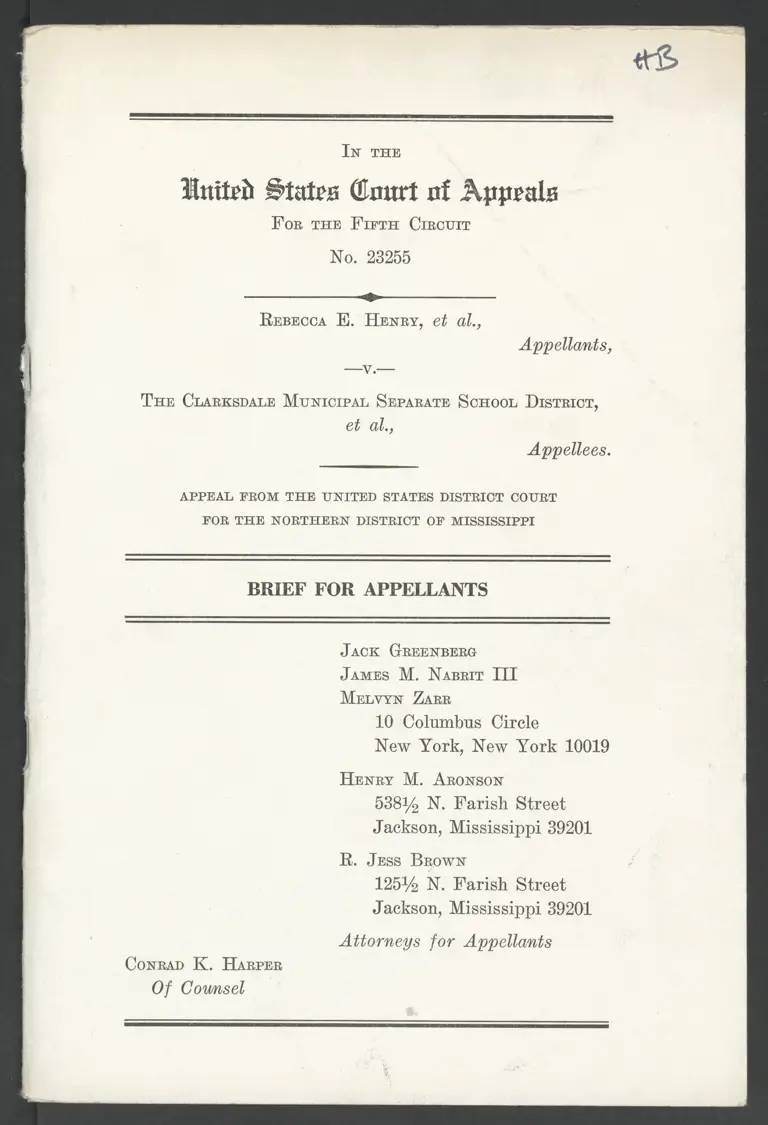
     [||288e573e-06fe-4bbe-87bc-77f87a258e6b||] IN THE

united States Court of Appeals
For tHE Frrra Circuit

No. 23255

Gr

ReBecca K. Henry, ef al.

Appellants,
Vee

THE CLARKSDALE MUNICIPAL SEPARATE SCHOOL DISTRICT,

et al.,

Appellees.

APPEAL FROM THE UNITED STATES DISTRICT COURT

FOR THE NORTHERN DISTRICT OF MISSISSIPPI

BRIEF FOR APPELLANTS

JACK (GREENBERG

James M. Nasrit III

MELVYN ZARR

10 Columbus Circle

New York, New York 10019

Hexry M. Aronson

53814, N. Farish Street

Jackson, Mississippi 39201

R. Jess Brown

125% N. Farish Street

Jackson, Mississippi 39201

Attorneys for Appellants

Coxrap K. HARPER

Of Coumsel


Statement of the Case is... ..ltuiiii id ciinilientl.. wilieniiio

A; Summary of the Litigation ...cu.simesmesersstiemsese

B Stade of Bacls

1,

5)

6.

Summary of Desegregation under the Board’s

Plat v...... cies iin iiitiniivemnesensds ibis Gio satin tome apieies

The Board’s Zoning Seheme .............. oo

Testimony of Educational Experts ....................

Effect of State Action on Board’s Zone Lines

(a) Testimony of School Board Attorney

Lucket€i oo bn DS Llama odd, Bu

(b) Testimony of City Commissioner Bell ....

(c) Testimony of City Planning Commission

Chairman... leaden. Slinloaisul. sualale

(d) Testimony of Dr. Aaron Henry ..............

Opinion of the Court Below ..co..otiieenn ii.

The Board’s Revised Zone Lines ......................_.

Specificationsiof Brrer Lo. 00 Busan sali,

ARGUMENT

I. Effectuation of the Brown Decision Bars the

Board’s Use of a Neighborhood School Assign-

ment Policy to Justify Its Failure to Eliminate

Segregated Schools, Particularly Where State

Action and Custom Combine to Maintain Neigh-

borhoods on a Racial Basis

10

16

37

18

20

20

21

26

27


11

PAGE

II. Actions pny City and County Officials to Kffec-

tively Remove Virtually All Negroes From

White School Zones Do Not Relieve the Board

of Its Constitutional Obligation to Desegregate

the Behools .......c... neve a prise id 395

III. The Board’s Plan Falls Short of This Court’s

Standards of Acceptable Pupil and Teacher

Desesregation ..........cemsioniiseisenianenssiioncn 39

CONCLUSION... oe i rbdicitins hs es Asal sith 45

TABLE or CASES

Balaban v. Rubin, 40 Misc. 2d 249, 242 N. Y. S. 2d 974

(Sup. Ct. 1963), revd, 20 App. Div. 2d 438, 248

N.Y.8.2d4574 (2d Dept.), aff'd 14 N. ¥. 8S. 24.193,

199 N. E. 2d 375 (1964), cert. denied 379 U. S. 881

(1964) #00.) AEA LL) 10 Laas | AD)... 33

Barksdale v. Springfield School Comm., 237 F. Supp.

943 (D. Mass. 1965), vacated without prejudice, 348

P.2 201 (1st Cir. 1961) noone creer sarge sien 33

Beckett v. School Board of Norfolk, Civ. No. 2214

(EB. D. Va.) ......citaued.bonivadl Zhanall adT J 43, 44

Bell v. School City of Gary, Indiana, 213 F. Supp. 819

(N. D. Ind. 1963), aff’d 324 F. 2d 209 (7th Cir. 1963),

cort. denied 377 U.S. 924 (1964)... 33
Blocker v. Board of Education of Manhasset, 226 F.

Suppii 208. (ED. :N. [Yel 964) oii. moiioncdonBl 33

Board of Public Instruction of Duval County v. Brax-

ton, 326 X..'24.616, (5th Cir. 1964) ....c.ileSl. din... 40

Booker v. Board of Education of Plainfield, 45 N. J.

161, 212: A. 24. 1.161965): sesesioisnaibiniiln bong sisidin ds... 33


PAGE

Boson v.: Rippy,: 285 F. 2d 43 (5th Cir. 1960) nil...L..% 33

Bradley v. School Board of City of Richmond, 382

U. SE1035(1965) oor sia sn ab 33, 39, 40

Bradley v. School Board of City of Richmond, Civ. No.

Lr A YE Se i SE LL 44

Briggs'v. ‘Elliott, 132 B.'“Supp." 776 (B.VD. ‘8.’

1958) shila oad he A D0 OR 23,25

Brooks v. County School Board of Arlington, Virginia,

F240) 20303 (4th CIT. 10D). ....onsernsrenersprocrersgrreeroraionss 30

Brown *v." Board of ¥dueation, 347 U. 'S. ‘433

BE GRR Cl EE 25,29, 31,32,:39

Cooper vo Aaron; 358° UST (1958) vine coreeenenes 31

Dowell v. School Board of the Oklahoma Public

Schools, 219 F. Supp. 427 (W. D. Okla. 1963) ....36, 39, 44

Dowell v. School Board of the Oklahoma Public

Schools, 244 F. Supp. 971 (W. D. Okla. 1965) ........ 37,41,

42, 44

Downs v. Board of Education of Kansas City, Kansas,

336 F. 2d 988 (10th Cir. 1964), cert. denied 380 U. S.

23 7 SE CR en LL CN LE ee 33

Gilliam v. School Board of City of Hopewell, Virginia,

345 F. 2d 325 (4th Cir. 1965), reversed on other

grounds, sub nom. Bradley v. School Board of City

of Riechmond,:332 U.S. 103(1965)....ao0ulanl... i mul 33

Gomillion v. Lightfoot, 364 U. S.:339 (1960) '............... 36

Goss v. Board of Education, 373 U. S. 683 (1963) ........ 33

Griffin v. County School Board of Prince Edward

County, 377 0. 8. 21S (1984) ...cci tiie, 33


PAGE

Holland v. Board of Public Instruction of Palm Beach,

a.,:2581.,2d 730 (5th Cir. 1958) ui. onli... hu 36

Houston Independent School District v. Ross, 282 F. 2d

95 (5th Civ: 1960) ail du dl lous Luladrian 33

Jackson v. Pasadena School Board, 31 Cal. Rptr. 606,

382 P. 2d 878, 8 Race Rel. L. Rep. 924 (1963) ............ 33

Kier v. County School Board of Augusta County, 249

I. Supp. 239 (W..D. Va. 1966) uyic.osuremersosensess 39, 41,42, 44

Lockett v. Board of Education of Muscogee County,

Ga, 342 BF. 2d 225 (5th Cir, 1965) co.cc cvnictieorssrnss 40

Morean v. Board of Education of Montclair, 42 N. J.

237, 200 A. 2d 97, 9 Race Rel. L. Rep. 688 (1964) ........ ..33

Northeross v. Board of Education of the City of Mem-

his, 333 W234 661 (Bth Cir, 1964) ........... cece eee... 30

Price v. Denison Independent School District, 348 F.

24 1000°(5fh CirN065)" ob ll ea Se He 22,39

Rogers. v. Paul; 382 U. 8.1198 (1965) .........o alia). 39

Ross'v. Dyer, 312 1, 2d 191. (5th Cir, 1963) .......L...... 30

Singleton v. Jackson Municipal Separate School Dis-

triet;i348'W. 124.729 |(Bth Cir. 1965)... ial. Ll al 25,29

Singleton v. Jackson Municipal School District, 355

F.2d 865 (5th Cir. 1966) <....0. ic. bain... 0.00 39, 41


Sweatt v. Painter, 339 U. 8. 629 (1950) ........................ 32

Taylor v. Board of Education of New Rochelle, 191

Y.Supp. 181 (8, D. N. Y. 1961)... 36

OTHER AUTHORITIES

Wright, Public School Desegregation: Legal Remedies

for De Facto Segregation, 40 N. Y. U. Law Rev. 285

BAL) eee Hh RR De 38


IN THE

Nuited States Court nf Appeals
For aE Firra Circulr

No. 23255

tf

ReBecca E. Henry, ef al.,

Appellants,
——V.—

THE CLARKSDALE MUNICIPAL SEPARATE ScHOOL DISTRICT,

et .al.,

Appellees.

APPEAL FROM THE UNITED STATES DISTRICT COURT

FOR THE NORTHERN DISTRICT OF MISSISSIPPI

pr

BRIEF FOR APPELLANTS

Statement of the Case

A.

Summary of the Litigation

Negro parents and pupils residing in Clarksdale, Mis-

sissippi appeal the December 13, 1965 order of the United

States District Court for the Northern District of Missis-

sippl approving a desegregation plan submitted by Clarks-

dale school authorities pursuant to its orders of June 26,

1964 and August 10, 1965.


2

Suit was filed in April, 1964 seeking injunctive relief

against the Board’s policy of maintaining the public schools

of Clarksdale on a segregated basis (R. 1-12).! The Board’s

answer admitted the schools were segregated (R. 13-19),

and the district court on June 26, 1964 granted plaintiffs’

motion for a temporary injunction, ordering the Board to

prepare a desegregation plan which would provide a mini-

mum of one desegregated grade for the school term be-

ginning September, 1964 (R. 20-24). In response, the

Board submitted a plan consisting of four alternative modi-

fied stair-step time schedules for desegregation, each of

which was to be accomplished by the assignment of pupils

in accordance with newly designed school boundaries or

zone lines (R. 25-49). Plaintiffs filed objections to the

method and speed of the desegregation proposals (R. 46-

49), but the district court, following an August 19, 1964

hearing of these objections, ordered into effect portions of

two of the Board’s plans “as a tentative and interim pro-

cedure” (R. 63) for the purpose of requiring the desegre-

gation of grade 1 in September, 1964 and of grade 2 in

January, 1965 (R. 63-64).

On January 5, 1965, appellants filed a motion for further

injunctive relief alleging that no actual desegregation had

resulted from the Board’s implementation of its plan and

! Negroes in Clarksdale had sought school desegregation since
August, 1954 when a petition, signed by 454 heads of families, was
submitted to the school board (R. 425). The Board never replied,
but the petition and the names of its signers were published in a
local newspaper, with the result that various pressures and intimi-
dations caused some of them to withdraw their names (R. 425-26).
Following this, there was less activity for school desegregation, but
another petition, signed by the parents of 25 children, was filed in
1963 (R. 427-28). Again, there was no response from the Board
and again the petition and the names of its signers were published
in a local newspaper (R. 428). Thus followed this action (R. 8-9).


3

that, because of the nature of the plan, no desegregation

could be expected to result (R. 65-67). A full hearing was

held on April 8 and 9, following which the district court,

on August 10, 1965, issued an order (R. 111-17) approving

some of the school zones submitted by the Board and

directing the Board to reconsider their proposals as to

certain other school zones, which nevertheless were “tem-

porarily approved” for the Fall semester (R. 115). The

order required inter alia desegregation of five grades for

the 1965-66 school year and the desegregation of the re-

maining seven grades during the following two years

(R. 112).

Appellants filed a motion to amend the findings and

Judgment (R. 120-125), asserting that court approval of

zone lines conforming to racial neighborhoods and violat-

ing educational standards effectively foreclosed any de-

segregation for a second year; the motion also challenged

the basis for findings concerning the validity of the zone

lines (R. 122) and asserted that the district court’s con-

clusion that the Board had no affirmative constitutional

duty to integrate its schools was incompatible with de-

cisions of this Court (R. 123-24). It was denied on August
30, 1965 (R. 126).

In October, 1965, after the start of the new school year,
the Board, in compliance with the district court’s August
10th order, filed a revised plan for those attendance zones
which had not received final court approval (R. 127-35).
Appellants filed objections to the revised plan, pointing out
that only two of the five zones had been altered and that
the Board’s recommendation that two zones be combined

~ would not, under the circumstances, desegregate those


4

zones. Appellants also opposed the Board’s request that

all zones be retained in their present form until the Fall

of 1966 (R. 136-40). Following a hearing on November 15,

1965, the district court, on December 13, 1965, approved

all the Board’s zone boundaries (R. 148-49). Appellants

filed a notice of appeal on December 14, 1965 (R. 150).

B.

Statement of Facts

1. Summary of Desegregation Under the Board’s Plan

Public school desegregation was initiated in Mississippi

in the Fall of 1964, after four school districts, including

Clarksdale, were enjoined by federal courts to desegregate

at least 1 grade. Three systems, Jackson, Biloxi and Leake

County, offered first graders their choice of Negro or white

schools, and 61 Negro children enrolled in formerly all-

white schools.” Clarksdale devised an assignment plan

under which all first graders were assigned in accordance

with redrawn school zones lines (R. 25-45, 50-62). As a

result not a single child was enrolled in a desegregated

school (R. 160-62). For the second semester of the 1964-65

school year the Board was required to assign all second

grade pupils in accordance with its school zone lines and

again not a swmgle child was enrolled in a desegregated

school® (R. 163-64).

When this case was heard in April, 1965, there were

almost 5,000 students attending the Clarksdale public

2 Vol. II, Southern School News, p. 1 (Sept. 1964).

8 The Board reported that approximately 64 first and second
grade white pupils were residing in Negro school zones but that
some entered private schools and others moved or left the system.
None attended desegregated schools (R. 160-64).


5

schools (R. 157-59), but the 2,800 Negro pupils continued

to attend the five Negro schools and the 2,100 white chil-

dren continued to attend the six white schools.*

When the Clarksdale schools opened in September, 1965,

they were under the court’s August 10, 1965 order to de-

segregate five grades (3, 4 and 12 in addition to grades 1

and 2) (R. 112). But again, no pupils were enrolled in

schools formerly serving the opposite race (R. 195), until,

however, two Negroes were permitted to transfer to a

white school.’

2. The Board’s Zoning Scheme

The City of Clarksdale is bisected from the northeast

to the southwest by a main line of the Illinois Central

Railroad track. Traditionally, most Negroes in the City

have lived south of these tracks, while the great majority

of the City’s white residents live north of the tracks (R.

381, 775, Population Distribution Map). The Higgins High

School, containing all the Negro pupils in grades 7-12 (ex-

cept two), is located south of these tracks, while the high

* The Clarksdale Board and the Coahoma County Board, under
a written agreement, shared jurisdiction over combined high school
facilities operated for all white high school children in the City
and County. Based on this fact, the Coahoma County Board had
been named a defendant in the complaint (R. 4); however, this
agreement was permitted to expire at the end of the 1964-65 school
year (R. 73, 156).

> Following the opening of school, two Negro girls in the 11th
grade requested Latin, a course not offered at the Negro Higgins
High School. Under provisions of the court’s August 10, 1965
order requiring the granting of transfers to obtain courses not
offered at schools where they were initially enrolled (R. 114),
they obtained transfers to the white Clarksdale High School (R.
195).


6

schools containing all the white public high school pupils

are located north of the tracks (R. 219, 381).

In similar fashion, four elementary schools, Oliver, Hall,

Washington and Riverton, containing all the Negro ele-

mentary pupils, are located south of the Illinois Central’s

tracks. Three of the four elementary schools serving white

pupils are located north of the tracks. The fourth elemen-

tary school, Eliza Clark, is located in a white residential

section south of the tracks (R. 273).

The Board maintains that the race of residents was not

considered in drawing zone lines (R. 212, 248), except as

an “incidental factor” (R. 212, 248, 710), with school utiliza-

tion, proximity, natural boundaries and safety and health

the major considerations (R. 263). The Board has admitted

following historical boundary lines utilized under the seg-

regated system (R. 281-82). Thus, boundary lines such as

the Illinois Central tracks which bisect the City (R. 270)

and the Wilson Avenue line dividing white Eliza Clark and

Negro Myrtle Hall zones (R. 246-47) have traditionally

served as boundaries between Negro and white neighbor-

hoods (R. 164-67). The result of continuing to use these tra-

ditional zones has been to continue Negro pupils in Negro

schools and white pupils in white schools. Based on Board

statistics provided in March, 1965, 865 Negro high school

pupils, all but two of the total eligible to attend high school,

live south of the Illinois tracks, attend Higgins, and if the

Board has its way, will continue at Higgins (R. 183).°

¢ The Board reported 198 of the 1,023 white high school pupils
reside south of the Illinois Central tracks (R. 183), but half of
these live in the Eliza Clark zone, and it is unlikely that any would
attend the Negro Higgins High School if assigned there.


7

As to elementary schools, the Board has zoned the one

white and four Negro elementary schools located south of

the Illinois Central tracks so that all Negroes will be

assigned to schools traditionally serving Negro pupils and

the great majority of white pupils will be assigned to the

white Eliza Clark School. The three remaining white ele-

mentary schools located north of the Illinois Central tracks

have been zoned so as to serve only pupils living north of

the tracks (R. 186, 610). Few if any of these students are

Negroes. In fact, the Board estimated that in December

1964, only one Negro elementary school child was eligible

by reason of residence to attend an elementary school now

serving only white pupils (R. 168)."

The Board has followed traditional racial boundary lines

even when they appeared to clash with standards of efficient

school utilization, proximity and other generally accepted

school zoning criteria. For example, the Eliza Clark zone

completely encompassed all white pupils living in the largest

white neighborhood located south of the Illinois Central

tracks, but did not include even one Negro (R. 168), though

Negro neighborhoods surround the Eliza Clark zone on

three sides. While railroad tracks mark the northern and

western boundaries and a highway makes up its southern

boundary, these geographical features do not interfere with

travel, as indicated by the number of pupils required to

"As with the high school students, a percentage of white ele-
mentary pupils (145 of 1025) reside in attendance zones serving
Negro schools. But the experience thus far is that none will choose
to accept assignment to such schools.


8

cross both the tracks or the highway under both the Board’s

old (R. 164-67) and new zones (R. 270-71).

The eastern boundary of the Clark school zone followed

a Clarksdale street, Wilson Avenue, which is only 200 feet

from the school (R. 277). Wilson Avenue is not a major

thoroughfare, is only partially paved, and in some parts

is only a rut through a grassy area (R. 281-82). Its sole

distinguishing characteristic is that whites reside in great

numbers along the western half and Negroes reside in great

numbers along its eastern half (R. 280). Finally, it ap-

pears that Negroes live south of Highway 61, which was

the southern boundary of the Kliza Clark zone (R. 282-

83).

The Board Superintendent explained that capacity of the

Clark School and its physical condition dictated the draw-

ing of the school’s zone boundaries (R. 280-81). But the

three adjoining Negro elementary schools are all more

crowded than Eliza Clark (R. 183). Indeed, Negro schools

are generally more crowded than schools serving white

pupils. Teacher-pupil ratios are generally higher in the

Negro schools, even though Negro teachers until 1965 were

paid less than white teachers with similar qualifications (R.

610), and the Board traditionally has spent more money

per pupil in white than Negro schools (R. 173, 185).

The Board Superintendent, Gycelle Tynes, testified that

the system was committed to the neighborhood school plan

which was “time-honored” and “time-tested” (R. 206, 263),

8 During the 1963-64 school year, before this suit was filed, the
Board assigned 710 pupils to schools which required travel across
the Illinois Central Railroad tracks bisecting the City from east
to west. A total of 594 pupils were so assigned during the 1964-65
school year (R. 184-85).


9

that the Board’s adherence to this philosophy was striet,

and that all pupils were required to attend the schools in

their zones (R. 211). In practice, however, the Board has

assigned pupils to schools outside the zones of their resi-

dence:

1. All white elementary pupils residing in Zone E-3A,

pending construction of a school in that zone are assigned

to either the Eliza Clark (Zone E-1C) or the Oakhurst

(Zone KE-4A) schools (R. 27, 194, 698). When the zone

lines were drawn to include a zone with no school, the

Board estimated that the new building would be ready for

occupancy by September, 1966 (R. 43). In October, 1965,

they reported no school would be constructed until there

were sufficient children in the district to justify a school

building (R. 195-96), and conceded at the November, 1965

hearing that they do not now own sufficient land in the

zone to construct an adequate school (R. 696).

2. Approximately thirty percent of the pupils at the
Eliza Clark School (42 of 147) do not reside within the
Eliza Clark Zone (R. 702-03).

3. During the first semester of the 1964-65 school year,
all pupils who were to be assigned to the new Riverton
School (elementary zone E-2B) when it opened in January,
1965, were assigned together with teachers to two Negro
schools in the system (R. 27).

4. During the current school year, the Board, in order
“to better utilize available class rooms,” enrolled two classes
of pupils in Myrtle Hall who actually reside in the George
Oliver area (R. 707) and a class of sixth grade pupils in
the Riverton School (Zone E-2B) who reside in Zone E-2A,
the Washington School Zone (R. 193-94, 701, 704).


10

3. Testimony of Educational Experts

To support the contention that the Board’s zone lines

were gerrymandered to frustrate school desegregation, ap-

pellants obtained the assistance of Reginald Neuwein® and

Myron Lieberman,” two authorities in the field of edueca-

tional administration. The two experts spent several days

studying statistics on the school system and surveying the

schools and the community (R. 455, 533). At the April, 1965

hearing, both men testified that, as drawn, the Board’s zone

lines violated generally accepted criteria for school zones

and could be regarded only as an effort to maintain seg-

regated schools. They noted that Negro schools were over-

crowded and understaffed and that Negro teachers were

underpaid, with the result that these schools were not

® Reginald Neuwein has 36 years of educational experience and
at present is director of a study of 13,000 elementary and 2,400
secondary Catholic schools in the United States conducted from the
University of Notre Dame. He was Superintendent of Schools in
Stamford, Connecticut and was Director of Administrative Re-
search at the Educational Research Council of Greater Cleveland
in Cleveland, Ohio, in which position he advised school superin-
tendents and completed 15 school system surveys similar to the
study requested by appellants of Clarksdale’s school system (R.
452-54).

10 Myron Lieberman is Chairman of the Professional Studies Di-
vision at Rhode Island College and has charge of the Departments
of Elementary Education, Secondary Education, Industrial Arts
Education, Psychology, Philosophy, the Laboratory School of over
700 pupils and student teaching and faculty research programs.
He has taught at the University of Illinois, Hofstra University,
Emory University, the University of Oklahoma, and served as
Chairman of the Department of Education at Yeshiva University.
Dr. Lieberman, who earned a Ph.D. Degree in Education at the
University of Illinois has over 10 years of experience in work deal-
ing with the interrelationship between race and education. He has
published articles and books, given lectures and chaired conferences
dealing with race relations and race in education and served as a
desegregation consultant to the New Rochelle, New York school
system and other systems working on school integration problems
(R. 531-32).


11

capable of offering the quality of education offered at the

white schools. They stated emphatically that both elemen-

tary and high school zone lines could be redrafted so as

both to improve school utilization and to provide for a sub-

stantial amount of desegregation—despite the increasingly

rigid neighborhood racial patterns.

Reginald Neuwein (R. 452) was critical of the placement

of the schools (R. 457) and stated that the school zone

lines did not meet generally accepted criteria (R. 459).

He noted that on both counts the white Kirkpatrick (Zone

E 4-B) and Heidelberg (Zone E 4-C) schools located north

of the Illinois Central tracks in an all white area appeared

well placed and well balanced (R. 459-60), but compared

the Negro Myrtle Hall (Zone E 1-B) and white Eliza

Clark (Zone E 1-C) school zones (R. 461-62), which are

divided by a street (Wilson Avenue) on which Negroes live

on one side and whites on the other (R. 463), and concluded

that no desirable educational benefit occurred from draw-

ing the line in this fashion (R. 463-64).

Mr. Neuwein recommended that the zone lines for Eliza
Clark (Zone KE 1-C), Riverton (Zone E 2-B) and Washing-
ton (Zone HK 2-A) be redrawn (R. 465). He also found fault
with the location of the high schools (R. 466-67), suggested
that since the Illinois Central Railroad tracks provided no
serious barrier or hazard, it should not be an automatic

zone line (R. 468-69) and that a more appropriate zone line
between the high school facilities could be drawn in a gen-
erally north-south fashion (R. 469-70). Such a zone line
would have educational benefits (R. 470) and would not
serve to perpetuate segregation, as does the present line
(R. 470-71).


12

Mr. Neuwein compared average class size statistics for

the Negro and white schools and found the average enroll-

ment in the white schools 25.1 pupils per class as compared

with a figure of 35.3 pupils per class in the Negro schools

(R. 473). He stated that the differential has a substantial

effect on the quality of education offered in the Negro and

white schools (R. 473-74), because teachers in the larger

classes in Negro schools are less able to administer to the

needs of individual children (R. 477-78).

Another important factor was the average per pupil ex-

penditure, which in 1964 was $202.62 for each Negro ele-

mentary pupil and $295.00 for each white pupil (R. 475).

Of this amount, there is a difference of $76.00 per pupil

on salary expenditures and $17.00 per pupil for other

operational costs (R. 474-75). At the high school level,

the Board expends $292.00 for each Negro pupil and $424.00

for each white pupil with a differential of $79.00 per pupil

for teacher salaries and $52.00 differential for other opera-

tional expenses (R. 476).

Mr. Neuwein concluded that the present zone lines should

be completely re-examined and redrawn to better balance

school population. Such redrawn lines would also accom-

plish desegregation (R. 479). Thus, while agreeing that the

white Kirkpatrick and Heidelberg schools appeared prop-

erly zoned (R. 510), he stated that these schools were part

of a system that could not truly be desegregated until all

schools were properly zoned (R. 520). Desegregation would

also be furthered, according to Mr. Neuwein, by selection

of faculty according to qualifications and without regard

to race (R. 480-81).

Dr. Myron Lieberman (R. 531) testified that, based on

his study of the Clarksdale school system, he had concluded


13

the zone lines were not drawn in accordance with sound

administrative procedures (R. 533). Citing as examples

the Oakhurst, Clark, Hall and Washington school zones,

he indicated that while boundaries should minimize travel

distances and maximize utilization of schools, the white

Clark School was operating at 24 capacity, while the adjoin-

ing Negro Hall and Washington schools were both above

capacity (R. 533-34). He recommended altering the zone

lines so as to assign pupils from Hall and Washington

schools to the Clark school and made similar suggestions

concerning the new Riverton School which was already op-

erating close to capacity (R. 534-35).

Based on the number of pupils presently crossing the

Illinois Central Railroad tracks, Dr. Lieberman agreed

with Mr. Neuwein that there was no reason to utilize the

tracks as a boundary in the Clarksdale community and

that some pupils assigned to the Riverton School should

be assigned to the Oakhurst School (R. 537-38).

Dr. Lieberman stated that it would be a miracle if the

Board’s school utilization policies had not adversely af-

fected the education of both white and Negro pupils (R.

539). He cited the larger class sizes in Negro schools and

the fact that Negro pupils must travel longer distances

to their assigned schools. He also pointed to the greater

salary of white teachers, the narrower curriculum in the

Negro schools and the fact that even the rated capacity of

Negro schoolrooms is set higher than the figure for white

schoolrooms of similar size (R. 539-41).

As to teacher assignment, Dr. Lieberman noted that there

are 700 more elementary school Negro than white elemen-

tary school pupils but only four more Negro teachers


14

assigned to Negro elementary schools than to white ele-

mentary schools. He described this as a “staggering dif-

ference”, adding that the situation is probably even worse

because there are five teachers in white schools who are

not assigned to classes, but are available for supervisory

or remedial work with pupils. He described the situation

as impossible to defend on any sound administrative basis

(R. 542).

Dr. Lieberman described as an “obvious conclusion” that

the effect of the board’s school zone lines, school construe-

tion policy and the school addition policy had the effect

of retaining segregation (R. 543). He stated that if each

pupil in the system were merely assigned to the school

located nearest his home, the lines would have been drawn

much differently, particularly with regard to the Clark,

Hall and Washington school zone lines (R. 543). In addi-

tion, some pupils now assigned to Riverton would go to

Oakhurst where there is substantial space available (R.

543-44). He made a similar suggestion as to the high school

zones, indicating that a north-south line, perhaps using the

Sunflower River as a dividing line between the high school

facilities, would probably be the best solution to maximize

utilization of facilities and distance factors (R. 545). He

also suggested that differences in curriculum at the high

school level made necessary some flexibility in the Board’s

transfer policy to enable transfers for genuine educational

reasons (R. 545-46).

He stated that the neighborhood school policy has many

interpretations, but added:

In this community the only criterion for ‘neighbor-

hood’ that I can honestly see is in using the criterion of


15

race, that ‘neighborhood’ seems to be defined by ‘white’

or ‘Negro.’ It certainly isn’t defined in terms of distance

from school, because if it were there would be many

Negro pupils going to schools that now enroll only

whites and there would be some white students that

would be going to schools that now are enrolling only

Negroes.

So, I don’t know, but my concept of neighborhood

school would be that you would go to the school near-

est your home, provided that due account were given

to the utilization of facilities and safety factors. That,

I believe, is a legitimate conception of a neighborhood

school, and if that were followed in this community I

think the lines could be, as I said before, much dif-

ferent from what they are. (R. 547-48).

He added that school zone lines following legitimate

criteria would automatically place large numbers of Negro

pupils in white schools and substantial numbers of white

pupils in Negro schools (R. 548).

He agreed with Mr. Neuwein that the continued assign-

ment of teachers on the basis of race is an educational

handicap to all students, both because the racial standard

makes it more difficult to get the best person in each job

and because it tends to fix goals on race instead of the

educational job that must be done, thereby weakening the

educational process (R. 548-49). He indicated that research

shows desegregated faculties improve the educational

standards and general school morale and alter the tradi-

tional racial image of the school (R. 549-50).

Dr. Lieberman blamed the Board’s plan for the fact

that those white pupils assigned to Negro schools chose


16

to leave the school system or to change their residences

(R. 562). He said that when very few white pupils are as-

signed to a Negro school, they can be expected to move

(R. 562). Moreover, he stated that school board policies

are crucial to the racial composition of the schools. Thus,

the plans should be drawn so as not to maximize segrega-

tion, which he asserted occurs where a few white pupils are

assigned to a Negro school (R. 562-63).

4. Effect of State Action on Board’s Zone Lines

While the Board’s zone lines as drawn served to direct

most white pupils to white schools and virtually all Negro

pupils to Negro schools, a census taken by the Board

showed there were from 72 to 80 Negro children of school

age, including 32 eligible to enter the first grade in the Fall

of 1964, residing in white school zones (R. 160, 180-81,

608). But a series of official actions, all taken during the

Summer of 1964 by Coahoma County and the City of

Clarksdale, effectively removed almost every Negro fam-

ily living north of the Illinois Central tracks (R. 381).

These actions were as follows:

(1) The City incorporated a sizeable area of land lo-

cated north of elementary zone E-3A (see maps, R.

773, 795), excluding a cluster of Negro homes in

an area along Friar Point Road which is known as

“Tuxedo Park”. The city then purchased these

homes, allegedly for park purposes, had them torn

down and relocated the Negro residents south of the

Illinois Central railroad tracks (R. 323).

(2) The City by a 1964 ordinance (R. 68-70) de-annexed

two strips of land on East Second Street located


17

north of the Illinois Central Railroad tracks and in

the southern portion of elementary zone E-3A (R.

328). As a result, Negro pupils residing in these

areas were rendered ineligible to attend City schools

(RB. 333).

(3) The City and the County, ostensibly to aid in solv-

ing parking problems, purchased areas near the

County jail in the central business district (elemen-

tary Zone E-3A) for public parking lots (R. 335-36).

Houses occupied by Negroes in this area were torn

down (R. 181).

(a) Testimony of School Board Attorney Luckett

Appellants called Board attorney Semmes Luckett to

testify as to his knowledge, and possible participation in,

the enactment of the July, 1964 zoning ordinance and the

property purchases which had the effect of purging virtu-

ally all Negroes residing north of the Illinois Central Rail-

road tract (R. 312). Attorney Luckett was familiar with

the content and effect of the ordinance, although indicating

that he had read it for the first time only the day before

(R. 314). He said he could not recall whether or not he

had been present at any official or unofficial meetings of

the Mayor and City Commissioners regarding the ordi-

nance (R. 315-19). He admitted that he had discussed the

matters treated in the ordinance with the Mayor and Com-

missioners, but in his capacity as a member of the City

Planning Commission and not as school board attorney

(R. 320-21). He denied that the actions taken by the city

were on his recommendation, but admitted that he favored

the actions taken for various reasons which he maintained

had nothing to do with the school system.


18

For example, he had favored for many years city ac-

tion to tear down the Negro housing in Tuxedo Park for

reasons of health (R. 327-28). He also was in agreement

with the de-annexation of the Negro residential sections on

East Second Street, just north of the Illinois Central Rail-

road tracks (R. 328-29). He also recommended that the

city purchase property around the county jail where Negro

residences were located (R. 337-38), but is not certain

that it was his recommendation that led to the action. He

stated that much of the action had been planned under an

urban renewal project abandoned in 1961 (R. 340). At-

torney Luckett said that he had assisted the Board in pre-

paring the school zone lines contained in the plan (R. 343)

and knew that the recommendations which were adopted

in the city ordinance would reduce the number of Negroes

who were assigned to white schools (R. 345). He stated he

had not told the school board that his recommendations

would affect the amount of desegregation under the plan

(R. 347), but thought it “entirely possible” that the Board

knew (R. 347-48)."

(b) Testimony of City Commissioner Bell

One of the City Commissioners, Hudson KF. Bell, Jr.,

testified (R. 352) that the July, 1964 ordinance, which an-

nexed some areas and de-annexed others, was passed as

11 Attorney Luckett, who is acknowledged as the author of the
State’s Tuition Plan Law (R. 350) (under which some white pupils
assigned to Negro schools were able to withdraw from the public
schools, obtain tuition from the State and enroll in private segre-
gated schools) believes that school desegregation is unavoidable,
but also believes that some “escape valve” is necessary for areas
with high percentages of Negroes such as Clarksdale (R. 348-49).


19

part of a city improvement project and conformed to an

urban renewal plan which had to be abandoned in 1961

because of the passage of a state statute (R. 368). The

project was later renewed with local funds obtained from

a sales tax ordinance. He conceded that nothing had been

done about the de-annexed areas for several years, as other

projects were deemed more important (R. 370). He said

the zoning ordinance was the result not of recommenda-

tions by Attorney Luckett, but of the Planning Commis-

sion, of which Luckett was a member at the time the

recommendations were adopted (R. 371).

Commissioner Bell denied any knowledge of the effect

the zoning ordinance would have on the Board’s desegre-

gation plan (R. 372-73), but conceded that the action was

taken after the school suit was filed and after the slum

clearance project had lain dormant for the four years since

the urban renewal program had died. While stating that

revenue from the sales tax ordinance, passed in 1962, en-

abled capital improvements to be made, Commissioner Bell

was not able to explain why the need for money had held

up the de-annexation program, since no funds were neces-

sary for this purpose (R. 375-76, 378). He maintained that

the de-annexation resulted from the City’s inability to pro-

vide the de-annexation areas with sewage facilities and that

the houses in the Tuxedo Park area were subsequently

purchased by the City and torn down because of their bad

condition (R. 388-89). The City and County need for the

property was given as the basis for the purchase of Negro

residential areas located near the County jail (R. 390-94).

Nevertheless, Commissioner Bell conceded that the ordi-

nance had the effect of removing all Negroes living north

of the railroad tracks (R. 381) and that this was the only


20

action taken on slum housing, which is located throughout

the city (R. 396-98).

(¢) Testimony of City Planning Commission Chairman

The Board obtained testimony from the Chairman of

the City Planning Commission (R. 400), who sought to sup-

port the position of the Board attorney and City Commis-

sioner that the City action which removed the Negro resi-

dents living north of the railroad tracks was not intended

to achieve this purpose and was done without knowledge of,

or regard to, the Board’s desegregation plan.

On cross examination, however, it appeared that, not-

withstanding attempted justification of the zoning ordi-

nance based on a desire to rid the area of substandard

housing, only the substandard housing located north of the

Illinois Central Railroad tracks was affected. Virtually all

housing either torn down or de-annexed had been occupied

by Negroes, while some substandard housing occupied by

whites in that area was permitted to stand (R. 414-15, 418-

20, Defs. Exh. 25). Moreover, it appeared that notwith-

standing the Chairman of the Planning Commission con-

tended that the housing affected by the ordinance had the

highest priority for action under the abandoned urban re-

newal plan (R. 405-06), the ordinance also affected (by

de-annexation) the area along Kast Second Street, which

had been given the lower priority number of XI (Defs.

Exh. 26, pp. 52-593).

(d) Testimony of Dr. Aaron Henry

Appellant and state NAACP leader Dr. Aaron Henry

(R. 425) said that the Board’s school zones and the City’s


21

zoning ordinance would prevent school desegregation. He

explained that the great majority of Negroes in Clarksdale

are day laborers or are employed in the farm system (R.

434), that the work is frequently sporadic and that the

pay 1s very low (R. 438). Negroes live in clearly recog-

nizable areas of the city and generally reside in the school

zone areas serving Negro schools (R. 438-39). Housing for

Negroes ranges from very poor to fairly good (R. 440).

Dr. Henry stated that there are areas south of the railroad

tracks (particularly in zone E 2-A) which are just as

dilapidated as the demolished Tuxedo Park or the de-

annexed area along East Second Street (R. 440).

Dr. Henry, who is also the president of the local NAACP

and the only Negro pharmacist (R. 425), knows most of the

Negro residents of Clarksdale. He believes few, if any,

Negroes now live north of the Illinois Central Railroad
tracks (R. 441, 449). He said that he doubts that Negroes
have ever tried to move into the areas served by the
Kirkpatrick, Heidelburg and Oakhurst Schools because
of the mores and the customs of segregation in housing (R.

441). Dr. Henry, whose daughter seeks admission to a

public school on a desegregated basis (R. 441-42), believes
that present conditions in Clarksdale would prevent even
a freedom-of-choice-type desegregation plan from having

any effect in Clarksdale, because of the general opposition
to school desegregation of the white community (R. 442-43).

5. Opinion of the Court Below

The district Judge reviewed all the evidence then before

him in a lengthy Memorandum Opinion dated August 10,
1965 (R. 74-110). His conclusions may be summarized as
follows:


22

a. In conformity with this Court’s adoption of the De-

partment of Health, Education and Welfare’s school de-

segregation guidelines in Price v. Denison Independent

School District Board of Education, 348 F. 2d 1010 (5th

Cir. 1965), the desegregation rate was set so as to en-

compass all grades by the 1967-68 school year (R. 74-75).

b. The court referred to several school desegregation

decisions which it interpreted as having held neighborhood

school zones a constitutionally permissible method of de-

segregation if all pupils within the zone were required to

attend their assigned school and the boundaries of each

zone were drawn on a nonracial basis (R. 76-77). Utilizing

these principles in reviewing the validity of the zone lines

contained in the Board’s plan, the court determined that

the junior and senior high school zones and the elementary

zones located north of the Illinois Central railroad tracks

should be approved, despite the fact that there were few

Negroes residing in the area north of the tracks and few

whites living in the zones located south of the tracks. The

court found that the residential patterns “arise from racial

housing patterns which have developed over the years”

(R. 80). The court found that the railroad tracks were a

proper and reasonable natural boundary and that selection

of this boundary as a school zone line did not create the

racial housing patterns and therefore did not in any way

detract from the appropriateness of such a boundary (R.

80). As to the one white and four Negro elementary zones

located south of the Illinois Central tracks, the court indi-

cated that it was not convinced that more efficient zone

lines could not be constructed (R. 91). The board was or-

dered to reconsider its recommendations as to these

school zones, which were nevertheless to be placed into

operation on a temporary basis for the first semester of


23

the 1965-66 school year (R. 91-92). As to these zones, the
court stated that it lacked the educational expertise to make
a final determination, but it rejected the suggestions made
by appellants’ educational experts, although conceding both
men were “educationally and theoretically well qualified”
(R. 96). The court felt they lacked practical experience in
the operation of the Clarksdale schools (R. 96-97) and that
their philosophy showed a commitment to mixing Negro
and white pupils in a classroom (R. 99-100). The court
regarded as the basic issue in this case not whether actual
integration occurred, but whether pupils were dealt with
as individuals without regard to race (R. 97). In support of
this interpretation of the Supreme Court’s school desegre-
gation decisions, the district court quoted Briggs v. Elliott,
132 F. Supp. 776 (E. D. S. C. 1955) and a number of appel-
late court decisions based on the Briggs v. Elliott opinion.

c. The district court recognized and took measures to
correct several of the deficiencies in the administration of
Negro schools complained of by appellants, including
teacher salary scales, curricula, teacher-pupil ratios and
per pupil expenditure of public funds (R. 92-93). The
court ordered that all these deficiencies be corrected and
that greater expenditures in the Negro school be authorized
if necessary to bring these schools up to white school
standards.

d. The court found merit in appellants’ complaint that
teachers were assigned on a segregated basis, but deter-
mined that, because teacher contracts had already been
issued for the 1965-66 school year, immediate relief would
create “unnecessary and serious problems”, justifying tem-
porary deferral of the problem of faculty desegregation
(R. 95-96).


24

e. Reviewing the evidence submitted by appellants that

numerous official actions taken by city and county officials

had greatly decreased the number of Negroes eligible to

attend white schools, the court found no connection between

the board’s obligation to desegregate the public schools

and the official actions ; these he found had been planned for

several years. Nor did the court see any problem in the

fact that the school board attorney was a member of the

Planning Commission which recommended all these mu-

nicipal actions (R. 107). It viewed appellants’ evidence as

an effort to demonstrate a conspiracy between the defen-

dants and the city and county agencies to frustrate deseg-

regation efforts (R. 107), but rejected the argument as

unsupportable (R. 108-09).

Following its Memorandum Opinion, the distriet court

entered what it designated a final order, approving the high

school zones and the elementary zones located north of the

Illinois Central tracks as well as the pace of the desegrega-

tion plan, adding requirements that all school facilities be

equalized and that students seeking courses not offered in

their assigned schools be given the right to transfer to

schools where such courses are offered (R. 114). The order

temporarily approved the school zones located south of the

Tllinois Central tracks, but required reconsideration of these

zones by the board and a resubmission of zones “predicated

on efficient utilization of available school facilities on a

racially nondiscriminatory basis in accordance with sound

education principles” (R. 115-16).

The order further provided that, notwithstanding the ele-

mentary subdistricts located north of the Illinois Central

tracks had been approved, the Board was free to revise


25

these boundaries if this was necessary to accommodate

changes in the elementary attendance zones located south of

the Illinois Central tracks. The order awarded costs to

appellants and retained jurisdiction of the case for addi-

tional orders which might become necessary or appropriate

(R.: 116-17).

On August 18, 1965, appellants filed a motion to amend the
findings and judgment (R. 120-25), in which they pointed
out that the court’s August 10th order effectively denied
them relief. They supported this contention by pointing

out that the school zones as approved by the court effec-

tively excluded Negroes from white schools, that under

such zones no desegregation had been effected in grades

one and two and that the evidence indicated that no de-

segregation could be expected in the future. The motion
also sought reconsideration of the court’s view that the
Brown decision could be carried out by eliminating dis-
crimination even though no integration resulted. Appel-
lants cited this Court’s decision in Singleton v. Jackson
Municipal Separate School District, 348 F. 2d 729 (5th

Cir. 1965), which rejected the teaching of Briggs v. Elliott
and, upon reexamination of the second Brown opinion,
concluded that it “clearly imposes on public school au-
thorities the duty to provide an integrated school system.”

Appellants also maintained that the proof offered by their
expert witnesses clearly showed that the Board’s zone lines
violated generally accepted criteria for drafting school
boundaries and could be justified only as a means for main-
taining segregation. On August 30, 1965, the district court

denied and overruled plaintiff’s motion (R. 126).


26

6. The Board’s Revised Zone Lines

In October, 1965, the Board submitted its revised plan for

the elementary attendance zones located south of the Illinois

Central tracks. The sole change recommended was that the

zone line dividing the white Eliza Clark school from the

Negro Myrtle Hall school be eradicated and that, effective

in September, 1966, all first and second grade pupils in the

combined zone be assigned to the Eliza Clark school and

all pupils in grades three through six be assigned to the

Myrtle Hall school (R. 129-31). Appellants promptly filed

objections to the revised plan (R. 136-40), contending that

there was no greater justification for retaining the zone

lines of the other elementary schools (R. 137) and that,

while the eradication of the line between the Myrtle Hall

and Eliza Clark zones appeared to have advantages from

an educational and desegregational standpoint, the praecti-

cal effect of assigning the 115 white children from Kliza

Clark with the approximate 415 Negro pupils from Myrtle

Hall would be that white parents would refuse to send their

children to the school and would move their residences to

areas north of the Illinois Central tracks where, as the

evidence shows, Negroes could not obtain housing (R. 137).

Appellants also objected to the Board’s request that the

revised zone plan not go into effect until September, 1966,

in view of the court’s approval of the zones for one semester

only (R. 138-39). Appellants further complained that the

Board had failed to report what action, if any, had been

taken to comply with that portion of the court’s August

10, 1965 order requiring utilization of all school facilities

(R. 139-40). Following a hearing on November 15, 1965,

the court on December 13, 1965 gave full approval to the


27

board’s revised plan and ordered it into effect for the 1966-
67 school year (R. 141-49).

Specifications of Error

The District Court erred in:

1. Refusing to hold that the Board, having established
and maintained a racially segregated school system, is con-

stitutionally obligated to submit a desegregation plan which
actually disestablishes segregation patterns and eradicates
Negro and white schools.

2. Approving the attendance school zones contained in
the Board’s desegregation plan over objections that such
zones are both conformed to racial neighborhoods and de-
signed to perpetuate segregated schools, and despite in-
disputable evidence that:

a. Approval of such zones retains almost intact Negro
and white schools;

b. The approved zones do not satisfy generally accepted
criteria for school zones;

c¢. The zone lines are drawn to capitalize on pendente lite
rezoning and relocation action by City and County
officials effectively removing large numbers of Negro
families from zones serving white schools;

d. The Board’s policy of school construction and school
additions fosters perpetuation of segregation;

e. The Clarksdale school system is readily adaptable to
zoning which effectively integrates the schools while
conforming to classical school zoning criteria;


28

f. Community conditions and pressures render inad-

visable further delay in requiring an assignment pol-

icy which actually disestablishes segregated schools.

3. Approving a gradual stair-step desegregation plan

in the absence of valid administrative factors justifying

further delay, notwithstanding Negro educational facilities

remain dramatically inferior.

4. Refusing to require the immediate submission of a

specific plan providing for the nonracial hiring and assign-

ment of teachers and other faculty personnel.


29

ARGUMENT

IL

Effectuation of the Brown Decision Bars the Board’s

Use of a Neighborhood School Assignment Policy to

Justify Its Failure to Eliminate Segregated Schools, Par-

ticularly Where State Action and Community Custom

Combine to Maintain Neighborhoods on a Racial Basis.

This Court has now clearly held that school boards op-

erating a dual system are required by the Constitution

not merely to eliminate the formal application of racial

criteria to school administration, but must by affirmative

action seek the complete disestablishment of segregation

in the public schools. Singleton v. Jackson Municipal Sep-
arate School District, 348 F. 2d 729, 355 F. 2d 865. As

succinctly stated in the first Singleton case, “ . . . the second

Brown opinion clearly imposes on public school authorities

the duty to provide an integrated school system.” 348

F. 2d 729 at 730, n. 5.

The record clearly shows that pupil assignment via the
zone lines submitted by the Clarksdale Board will not suffice
to effect any change in the traditionally segregated assign-
ment patterns which the Brown decision, and this Court,
have held invalid and which the district court specifically
enjoined.

Even if the Board’s zone lines reflected traditional ad-
herence to assigning each child to the neighborhood school
closest to his home, the Brown decision would necessitate
additional measures to bring about a desegregated school
system. This Court and other courts have frequently held


30

that if the application of educational principles and theories

results in the preservation of an existing system of imposed

segregation, the necessity of vindicating constitutional

rights will prevent their use. Dove v. Parham, 282 F. 2d

256 (Sth Cir. 1960) ; Ross v. Dyer, 312 F. 2d 191, 196 (5th

Cir. 1963) ; Brooks v. County School Board of Arlington,

Virginia, 324 F. 2d 303, 308 (4th Cir. 1963).

The Sixth Circuit, reviewing evidence that school zone

lines had been drawn so as to preserve a maximum amount

of segregation, in Northcross v. Board of Education of City

of Memphis, 333 F. 2d 661 (6th Cir. 1964), held not only

that the burden of proof rested with the school board to

demonstrate that challenged zone lines were not drawn to

preserve a maximum amount of segregation, but added:

Where the Board is under compulsion to desegregate

the schools (1st Brown case, 347 U. S. 483) we do not

think that drawing zone lines in such a manner as to

disturb the people as little as possible is a proper

factor in rezoning the schools. 333 F. 2d at 664. See

also Clemons v. Board of Education of Hillsborough,

Ohio, 228 F. 2d 853 (6th Cir. 1956).

In this case, the Board’s commitment to the neighborhood

school policy appears less than convincing when it is con-

sidered that, prior to this suit, pupils were assigned to

schools much further than those located closest to their

homes in order to comply with the segregated system. Ex-

cept for those grades now covered by the Board’s plan,

pupils are still assigned on the basis of race, with the re-

sult that many pupils are required to travel past schools

to which, but for their color, they would have been routinely

assigned. Thus, for a full decade after the Brown decision,


31

Board assignment policy required violation of the neigh-
borhood school principle to effect segregation. Now the

Board opposes any departure from assignment on a strict
neighborhood basis which would possibly alter segregated
patterns.

In addition, the Board’s zones are obviously drawn
with regard to the racial boundaries in the community.
Appellants’ experts testified that the lines did not comport
with generally accepted zoning criteria (R. 459, 533) and
suggested alternate lines which would have both complied
with educational criteria and effected integration of the
Clarksdale schools (R. 479, 543). Some of the Board lines
requiring many Negro pupils to travel substantial dis-
tances to overcrowded Negro schools, while white schools
located closer to their homes are underutilized, are in-
genious: e.g., the use of the Illinois Central Railroad track
(the major racial dividing line in Clarksdale) as the sole
zone boundary for high schools and the key elementary
school zone boundary, even though the railroad tracks are
amply dotted with safe underpasses, and the board, prior to
the desegregation order, directed during the 1963-64 school
year 1,100 pupils to schools requiring the crossing of the
Illinois Central tracks and 639 during the 1964-65 school
year (R. 538). Others are ingenuous, particularly the east-
ern zone line of the Hliza Clark School, which faithfully
follows Wilson Avenue (a traditional racial boundary with
Negroes living on the east side and whites on the west side
of the street), even when that street narrows to a grassy
field (R. 463). All may accurately be categorized as part
of a scheme which deprives Negro pupils of both their
constitutional right to attend schools administered on a
nonracial basis, Cooper v. Aaron, 358 U. 8. 1, 17 (1958),


32

and their right, clear even prior to Brown v. Board of

Education, 347 U. S. 483 (1954), to equal educational facili-

ties. Sweatt v. Painter, 339 U. S. 629 (1950).

While the Board altered the most flagrantly gerry-

mandered elementary zone line, the line between Zone E1C,

the Eliza Clark white elementary school, and Zone K1B,

the Myrtle Hall Negro elementary school (R. 666-67), even

this action was taken with knowledge based on experience

that, at least during this transitional period, Clarksdale’s

white pupils will not attend a predominantly Negro school.

The Board’s use of Wilson Avenue, an unpaved road

little used for travel but generally acknowledged as a

long established racial dividing line, typifies the motiva-

tions behind the Board’s construction of all its zone lines.

The elimination of that line after the district court refused

to approve it and the consolidation of the Clark and Hall

zones with a resulting Negro-white ratio so uneven as to

almost invite parents to withdraw their children from the

public schools reflects the Board’s intention to substitute

form for substance in the school desegregation process.”

12 Tn interrogatories served on the Board after its revised plan
was announced, appellants, noting that the combined zones would
consolidate schools with 415 Negro pupils and only 115 white
pupils, inquired: “Under such circumstances and based on the
Board’s experience with the reluctance of white parents to permit
their children to attend schools with Negroes, particularly where
the Negro student body constitutes a majority, what plans or other
action has the Board undertaken to maintain the stability of the
community in Zone E1-C [the combined zone] and prevent white
parents from moving or enrolling their children in private schools”
(R. 191). The Board responded :

These defendants have neither the power nor authority to
prevent anyone from moving from where he or she lives. Nor
do they have the power or authority to prevent any parent
from enrolling his or her child in a private school (R. 196).


33

The district court’s acceptance of the Board’s revised

plan reflects that court’s failure to grasp the settled prin-

ciple that schemes which technically approve desegregation

but retain the school system in its dual form must be struck

down. Goss v. Board of Education, 373 U. S. 683 (1963) ;

Griffin v. County School Board of Prince Edward County,

377 U. S. 218 (1964) ; Boson v. Rippy, 285 F. 2d 43 (5th Cir.

1960) ; Houston Independent School District v. Ross, 282

F.2d 95 (5th Cir. 1960).

Appellants do not here seek the type of relief sought in

cases involving school segregation not shown to have re-

sulted from officially sponsored and supported state action.'®

Nor does this case, as indicated above, raise merely the

issue apparently presented in Gilliam v. School Board of

City of Hopewell, Virginia, 345 F. 2d 325 (4th Cir. 1965),

reversed on other grounds, sub mom. Bradley v. School

Board of City of Richmond, 382 U. S. 103 (1965), of the
validity of school zone lines drawn in accordance with gen-

erally accepted criteria but resulting in only token de-

segregation. In this case the issue is clear and settled.

13 The right to such relief has been sustained in Booker v. Board
of Education of Plainfield, 45 N. J. 161, 212 A. 2d 1 (1965);
Balaban v. Rubin, 40 Mise. 2d 249, 242 N. Y. S. 2d 974 (Sup. Ct.
1963), rev'd, 20 A. D. 2d 438, 248 N. Y. S. 2d 574 (2d Dept.),
aff’d, 14 N. Y. 8. 2d 193, 199 N. E. 2d 375 (1964), cert. denied,
379 U. S. 881 (1964), 9 Race Rel. L. Rep. 690; Morean v. Board
of Education of Montclair, 42 N. J. 237, 200 A. 2d 97, 9 Race Rel.
L. Rep. 688 (1964); Jackson v. Pasadena School Board, 31 Cal.
Rptr. 606, 382 P. 2d 878, 8 Race Rel. L. Rep. 924 (1963) ; Blocker
Vv. Board of Education of Manhasset, 226 F. Supp. 208 (E. D. N. Y.
1964) ; Barksdale v. Springfield School Comm., 237 F. Supp. 543
(D. Mass. 1965), vacated without prejudice, 348 F. 2d 261 (1st
Cir. 1961) ; and denied in Bell v. School City of Gary, Indiana, 213
F, Supp. 819 (N. D. Ind. 1963), aff’d, 324 F. 2d 209 (7th Cir.
1963), cert. denied, 377 U. S. 924 (1964), and Downs v. Board of
Education of Kansas City, Kansas, 336 F. 2d 988 (10th Cir. 1964),
cert. denied, 380 U. S. 914 (1965).


34

A school board under injunction to desegregate does not

comply by assigning pupils according to zone lines which

reinforce rather than disestablish traditionally segregated

schools. If the contrary were true, then, as the Fourth

Circuit said in invalidating Prince Kdward County’s tui-

tion grant plan as a scheme to evade school integration,

appellees would “have indeed accomplished a remarkable

feat, stultifying a decade of judicial effort to bring about

compliance with Brown v. Board of Education. But the

label applied to these . . .. schools cannot blind courts, or

anyone else, to the realities.” Griffin v. Board of Super-

visors, 339 F. 2d 486 (4th Cir. 1964).


35

II.

Actions by City and County Officials to Effectively

Remove Virtually All Negroes From White School Zones

Do Not Relieve the Board of Its Constitutional Obliga-

tin to Desegregate the Schools.

Despite the Board’s efforts to construet its zones to

contain pupils of one race, a substantial number of Negro

families lived in four areas located north of the Illinois

Central Railroad tracks as of March, 1964, when this suit

was filed. Two groups lived just north of the tracks on

Fast Second Street; a third group lived near the County

Jail and a fourth resided in a section just north of the

City boundary in an area named Tuxedo Park. Due to

intervening action by city officials of Clarksdale and Coa-

homa County, none of the children of these families are

now eligible to attend white schools. A zoning ordinance,

enacted in July, 1964 by the City of Clarksdale, de-annexed

the property on Hast Second Street where the Negroes

lived; the City and County purchased and demolished the

homes located near the County Jail; and the City pur-

chased and demolished the homes in Tuxedo Park, after

annexing adjoining territories containing white residences.

While the Board denies any knowledge of the City and

County action, and city officials maintain that the ordi-

nance was not intended to affect school desegregation, the

testimony shows that of all the reasons given (desire to

clear dilapidated housing, to acquire needed property and

exclude areas where no sewage lines can be provided), the

real reason for pushing through in a few months measures

which had lain dormant for years was the removal of Negro

residents from areas served by white schools. See Taylor


36

v. Board of Education of New Rochelle, 191 F. Supp. 181,

192 (S. D. N. Y. 1961) ; ef. Gomallion v. Lightfoot, 364 U. S.

339 (1960).

Appellants introduced evidence that the Board attorney

was a member of the City Planning Commission and not

only had knowledge of the changes but had recommended

some of them. Other school officials also conceded that they

were aware of the zoning changes and governmental pur-

chases which effectively removed virtually all Negroes

living in school zones serviced by white schools. Appellants

did not, as the District Judge suggests (R. 107), introduce

this evidence to prove a conspiracy between the school

board and the City and County officials or to show that

school officials had offered perjured testimony. Rather,

they sought to show that the Board was aware of the gov-

ernmental actions, all of which directly affect their general

obligation under the Constitution and their specific obliga-

tion under two Federal court orders to desegregate the

schools, and passively accepted it. Appellants reject the

Board’s contention that the matter was beyond their control.

For example, pupils uprooted by the City and County could

have been offered the right to attend the school in the

zone of their former residence, thereby permitting pupils

to cross its zone lines to obtain a desegregated education;

as it is now, crossing of zone lines is presently required

in order to better utilize segregated schools (R. 701, 704,

707).

The Board’s obligation is clear. This Court has already

indicated it would condemn school zone lines drawn to re-

flect patterns of segregation caused by housing ordinances.

Holland v. Board of Public Instruction of Palm Beach, Fla.,

258 F. 2d 730 (5th Cir. 1958). More recently, in Dowell v.

School Board of the Oklahoma Public Schools, 219 F. Supp.


37

427 (W. D. Okla. 1963), a district court noted the strong

connection between housing and school segregation and de-

termined that the results of past patterns of housing segre-

gation must be dealt with by the school board. The court

stated:

The patrons of the School District had lived under a

dual system and the children’s residential areas were

fixed by custom, tradition, restrictive covenants and

laws. The Negro people had been segregated so com-

pletely in their residential pattern that it was difficult

to determine what way, method and plan and what pro-

gressive plans should be adopted and carried out in

the future.

Two years later, in Dowell v. School Board of Oklahoma
Public Schools, 244 F. Supp. 971, 980 (W. D. Okla. 1965),

the court ordered the school board to take affirmative action

to integrate the system, holding:

The validity of defendant Board’s action in rezoning
its public schools must be judged not only in the light
of the result (more than 90% of the system’s schools

remained virtually all Negro or all white), but also with

regard to the residential patterns in Oklahoma City,
established by statute, and by restrictive covenant, and
maintained at present by various discriminatory cus-
toms and practices which effectively limit the area
where Negroes live to easily definable areas. To draw

school zone lines without regard to these residential

patterns is to continue the very segregation which
necessitated the rezoning action, and requires judicial
condemnation of the procedure. Yick Wo v. Hopkins,
118 U. S. 356.


38

While speaking in a different context, Judge J. Skelly

Wright has taken a clear position that school boards must

consider residential segregation in order to prepare zone

lines which are constitutionally valid.

Where state policy expressed by its several agen-

cies lends itself to, and leads toward, segregated

schools, the responsibility of the state is plain. For

example, where state policy with reference to hous-

ing or state encouragement of private racial cove-

nants in housing leads to residential segregation, and

the school board uses the neighborhood plan in mak-

ing pupil assignments, the school segregation that re-

sults is clearly the responsibility of the state. Certainly

the state will not be allowed to do in two steps what

it may not do in one.

It is therefore irrelevant whether appellee school officials

were parties to creating the identifiable racial patterns

that have existed for a long time in Clarksdale or to carry-

ing out the official actions in the Summer of 1964 that

completed this segregation. Housing segregation exists,

and the Board may not close its eyes to this reality and

may not simply duplicate the segregation housing patterns

in the schools. This in effect is what results when a Board

faced with this problem adopts the policy as proclaimed

by the Superintendent at the November, 1965 hearing on

the revised plan:

The School Board is disregarding totally the racial

characteristics of the people and is simply proposing

these zones as being the best for the children and

14 Wright, Public School Desegregation: Legal Remedies for
De Facto Segregation, 40 N. Y. U. Law Rev. 285, 295 (1965).


39

patrons of this school district, and racial considera-

tions are just simply out the window (R. 672).

The Board’s duty is not at this late date to become color-

blind, but to draw school zone lines that will create inte-

grated schools in so far as is practicable and consistent with

sound educational practice. Dowell v. School Board of Okla-

homa City Public Schools, supra; Kier v. County School

Board of Augusta County, 249 F. Supp. 239, 244 (W. D.

Va. 1966).

III.

The Board’s Plan Falls Short of This Court’s Stand-

ards of Acceptable Pupil and Teacher Desegregation.

In Price v. Denison Independent School District, 348

F. 2d 1010 (5th Cir. 1965), this Court adopted the U. S.

Office of Kducation’s “Statement of Policies for School De-

segregation under Title VI of the Civil Rights Aect of

1964 (April, 1965)” as its minimum desegregation stand-

ard. In March 1966, its “Revised Statement of Policies for

School Desegregation” was issued, which is no less relevant

to judicial appraisal of school plans. See Bradley v. School

Board of Richmond, 382 U. S. 103 (1965) ; Singleton v. Jack-

son Municipal Separate School District, 355 F. 2d 865 (5th

Cir. 1966).

A.

Even if the Board's desegregation plan were capable of
effecting meaningful compliance with Brown, the plan fails
to meet current minimum standards for speed. Rogers v.
Paul, 382 U. 8. 198 (1965) ; Singleton v. Jackson Mumicipal


40

Separate School District, 355 F. 2d 865 (5th Cir. 1966).

These decisions bar denial of a desegregated education to

any child seeking it, even though the grade such child is

eligible to enter has not been reached in an approved de-

segregation plan. But the Board’s plan as approved by the

court below permits only students seeking courses not of-

fered in the segregated grades to which they are assigned

to obtain transfers to desegregated schools.

B.

The Board concedes that until the current 1965-66 school

year, Negro teachers were paid less than white teachers with

similar qualifications, and were hired and assigned on a

strictly segregated basis. In addition, appellants’ educa-

tional experts testified that racial assignment of teachers

seriously lowers educational standards and goals (R. 548-

50). The district court however refused to require deseg-

regation of teacher assignments because of feared con-

fusion and unrest in the school system.

This Court, for a period of time, left the scheduling of

teacher desegregation to district judges. Compare Board

of Public Instruction of Duval County v. Braxton, 326 ¥. 2d

616 (5th Cir. 1964) with Lockett v. Board of Education of

Musogee County, Ga., 342 F. 2d 225 (5th Cir. 1965). Now,

the Supreme Court has indicated that delay in this matter

may no longer be countenanced, Bradley v. School Board

of Richmond, supra. Accordingly, this Court now requires

school boards to “ . .. provide an adequate start toward

elimination of race as a basis for the employment and allo-

cation of teachers, administrators, and other personnel.”


41

Singleton v. Jackson Municipal Separate School District,

355 F. 2d 865 (5th Cir. 1966).

Prompt faculty desegregation is also required by the re-

vised school desegregation guidelines, which make each

school system responsible for correcting the effects of all

past discriminatory teacher assignment practices and call

for “significant progress” toward teacher desegregation in

the 1966-67 school year. Thus, new assignments must be

made on a nonracial basis, “ . . . except to correct the effects

of past discriminatory assignments.” 181.13(b). The pat-

tern of past assignments must be altered so that schools are

not identifiable as intended for students of a particular race

and so that faculty of a particular race are not concen-

trated in schocls where students are all or preponderantly

of that race. 181.13(d).

In view of the already discussed difficulties likely to be

encountered in attempting to desegregate the Clarksdale

school system by either freedom of choice or geographic

assignment procedures, it is imperative that the Board be

required to promptly adopt an effective faculty desegre-

gation plan. See Dowell v. School Board of Oklahoma City

Public Schools, 244 F. Supp. 971 (W. D. Okla. 1965), on

appeal to 10th Circuit, No. 8523; and Kier v. County School
Board of Augusta County, 249 F. Supp. 239 (W. D. Va.
1966).

In the Oklahoma City case, the court, adopting the recom-
mendations of educational experts retained by plaintiffs
with the court’s approval to study the system, set a goal of
1970 for “. . . the same approximate percentage of non-
white teachers in each school as there now is in the sys-
tem. ...” The 1970 date was keyed to personnel turnover


42

figures indicating that approximately 15% of the total

faculty is replaced each year, permitting the accomplish-

ment of faculty integration by replacements to the faculty

as well as by transfers. 244 F. 2d at 977-78.

In the Augusta County case, the district court, noting the

small number of Negro teachers in the system, ordered

faculty desegregation to be completed by the 1966-67 school

term. Referring to the Oklahoma City case, supra, the court

said:

Insofar as possible, the percentage of Negro teachers

in each school in the system should approximate the per-

centage of the Negro teachers in the entire system for

the 1965-66 school session. Such a guideline can not be

rigorously adhered to, of course, but the existence of

some standard is necessary in order for the Court to

evaluate the sufficiency of the steps taken by the school

authorities pursuant to the Court’s order. 249 F.

Supp. at 247.

The court acknowledged that the standard for teacher as-

signments is race-conscious, but justified such relief as neec-

essary to correct discrimination practiced in the past.

Quoting from a 1963 opinion on the subject by the Attorney

(General of California, 8 Race Rel. L. Rep. 1303 (1963), the

court held that:

Clearly, defendants may consider race in disestab-

lishing their segregated schools without violating the

Fourteenth Amendment’s equal protection clause. The

admonition of the first Mr. Justice Harlan in his dis-

senting opinion in Plessy v. Ferguson, 163 U. S. 537,

559, 16 S. Ct. 1138, 41 L. Ed. 256 (1896) that “Our


43

Constitution is color-blind” was directed against the

“separate but equal” doctrine, and its rejection in

Brown v. Board of Education, 347 U. S. 483, 74 S. Ct.

686, 98 L. Ed. 873, was an explicit recognition that

separate educational facilities are inherently unequal,

and did not convert Justice Harlan’s metaphor into

constitutional dogma barring affirmative action to ac-

complish the purposes of the Fourteenth Amendment.

Thus, racial classifications which effect invidious dis-

crimination are forbidden but may be upheld if deemed

necessary to accomplish an overriding governmental

purpose.

Recently, in Beckett v. School Board of Norfolk, Civ. No.

2214 (E. D. Va.) where the faculty is 40% Negro, a district

court entered a consent order on March 17, 1966, approving

a plan submitted by the Board containing provisions for

teacher desegregation which, in addition to recognizing its

obligation to take all reasonable steps to eliminate existing

racial segregation of faculty that resulted from the past

operation of a dual school system, committed the Board

ter alia to the following :

The Superintendent of Schools and his staff will take
affirmative steps to solicit and encourage teachers
presently employed in the System to accept transfers
to schools in which the majority of the faculty members
are of a race different from that of the teacher to be
transferred. Such transfers will be made by the Super-
intendent and his staff in all cases in which the teachers
are qualified and suitable, apart from race or color, for
the positions to which they are to be transferred.


44

In filling faculty vacancies which occur prior to the

opening of each school year, presently employed teach-

ers of the race opposite the race that is in the majority

in the faculty at the school where the vacancy exists

at the time of the vacancy will be preferred in filling

such vacancy. Any such vacancy will be filled by a

teacher whose race is the same as the race of the ma-

jority on the faculty only if no qualified and suitable

teacher of the opposite race is available for transfer

from within the System.

Newly employed teachers will be assigned to schools

without regard to their race or color, provided, that if

there is more than one newly employed teacher who is

qualified and suitable for a particular position and the

race of one of these teachers is different from the race

of the majority of the teachers on the faculty where the

vacancy exists, such teacher will be assigned to the

vacancy in preference to one whose race is the same."

An effective faculty desegregation plan must establish

specific goals to be achieved by affirmative policies ad-

ministered with regard to a definite time schedule. The

plans in the Oklahoma City, Augusta County and Norfolk

cases, supra, meet these criteria. The Clarksdale Board, for

valid constitutional and educational reasons, should be re-

quired to submit a faculty desegregation plan patterned

after those reviewed above.

15 A similar plan was approved on March 30, 1966, by the district
court in Bradley v. School Board of City of Richmond, Civ. No.
3353 (E. D. Va.) for a system in which about 50% of the teachers
are Negro.


45

CONCLUSION

For the foregoing reasons, appellants respectfully submit

that the appealed portions of the district court’s judgment

should be reversed and the case remanded with specific in-

structions to require the Board to prepare a desegregation

plan capable of meeting its constitutional duty to operate

a unitary, integrated school system.

Respectfully submitted,

JACK GREENBERG

James M. Nasrir IIT

MELVYN ZARR

10 Columbus Cirele

New York, New York 10019

Henry M. ARONSON

03814 N. Farish Street

Jackson, Mississippi 39201

R. Jess Brown

125% N. Farish Street

Jackson, Mississippi 39201

Attorneys for Appellants

Conrap K. HArPER

Of Counsel


46

CERTIFICATE OF SERVICE

I hereby certify that on April 22, 1966, I served a copy

of the foregoing Brief for Appellants upon Semmes

Luckett, Esq., 121 Yazoo Avenue, Clarksdale, Mississippi

38614, attorney for appellees, by United States air mail,

postage prepaid.

Attorney for Appellants [||288e573e-06fe-4bbe-87bc-77f87a258e6b||]