Greenberg Calls for Renewed Efforts and Funds in Press Conference for 1970 Annual Report
Press Release
May 6, 1971
-
Press Releases, Volume 6. Greenberg Calls for Renewed Efforts and Funds in Press Conference for 1970 Annual Report, 1971. cfc29c7c-ba92-ee11-be37-00224827e97b. LDF Archives, Thurgood Marshall Institute. https://ldfrecollection.org/archives/archives-search/archives-item/3c053dae-1c04-4634-a3b1-1764552663f5/greenberg-calls-for-renewed-efforts-and-funds-in-press-conference-for-1970-annual-report. Accessed October 07, 2026.
Copied!
    PressRelease fp ae Ia

May 6, 1971
For Immediate Release

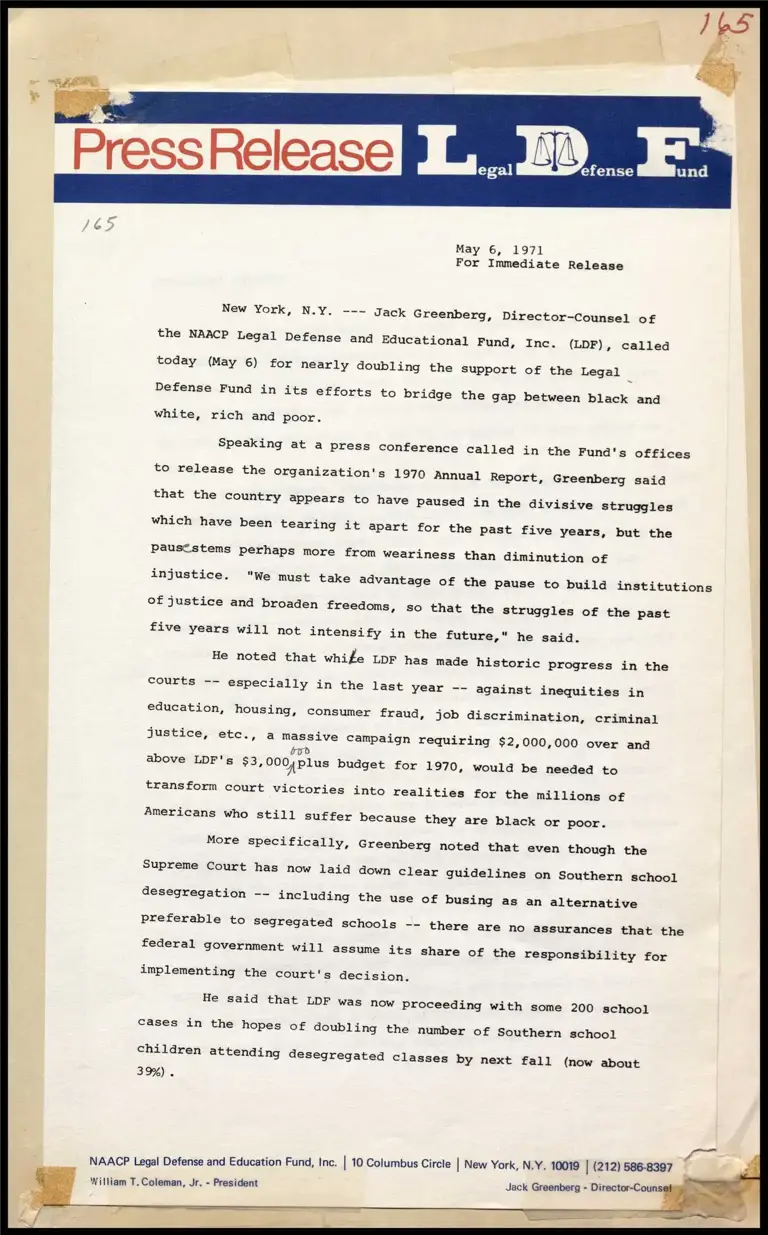
New York, N.Y. --- Jack Greenberg, Director-Counsel of
the NAACP Legal Defense and Educational Fund, Inc. (LDF), called
today (May 6) for nearly doubling the support of the Legal —

Defense Fund in its efforts to bridge the gap between black and
white, rich and poor.

Speaking at a press conference called in the Fund's offices
to release the organization's 1970 Annual Report, Greenberg said
that the country appears to have paused in the divisive struggles
which have been tearing it apart for the past five years, but the
Paus¢stems perhaps more from weariness than diminution of

injustice. "We must take advantage of the pause to build institutions
of justice and broaden freedoms, so that the struggles of the past
five years will not intensify in the future," he said.

He noted that whife LDF has made historic progress in the
courts -- especially in the last year -- against inequities in
education, housing, consumer fraud, job discrimination, criminal
justice, etc., a ot campaign requiring $2,000,000 over and
above LDF's $3, ,000jpius budget for 1970, would be needed to
transform court victories into realities for the millions of
Americans who still suffer because they are black or poor.

More specifically, Greenberg noted that even though the
Supreme Court has now laid down clear guidelines on Southern school
desegregation -- including the use of busing as an alternative
preferable to segregated schools -- there are no assurances that the
federal government will assume its share of the responsibility for
implementing the court's decision.

He said that LDF was now proceeding with some 200 school
Cases in the hopes of doubling the number of Southern school
children attending desegregated classes by next fall (now about
39%) .

NAACP Legal Defense and Education Fund, Inc. | 10 Columbus Circle | New York, N.Y. 10019 | (212) 586-8397
William T, Coleman, Jr. - President Jack Greenberg - Director-Couns:


GREENBERG REMARKS
PAGE TWO

Greenberg also noted the irony of the massive lay-offs

and demotions being suffered by black principals and teachers

throughout the South as school districts realize economies from

school desegregation and pledged his organization's full support

in urging that reductions in staff, or hiring be done solely on

merit.

On employment, Greenberg praised the Supreme Court decisions

in two LDF cases: Griggs v. Duke Power Company, which has outlawed

the use of employment tests which bear no relation to ability to

do the job, and Phillips v. Martin Marietta -- the first sex

discrimination case related to employment ever decided by the

Supreme Court -- which said that women could not be refused jobs

because they have pre-school youngsters unless the same standard

was applied to men in a similar situation.

He claimed that both victories would require enforcement

and that LDF was prepared to supply it and that LDF would attack

other discriminatory employment practices as well.

Speaking on the LDF's prison reform campaign, Greenberg

noted that the organization has brought more than a dozen suits

against prisons across the country in an effort to assure humane

treatment for convicts and untried suspects too poor to produce

bail. He mentioned two recent victories, one in Toledo, Ohio,

where a District Court judge likened the treatment received by

inmates of the Lucas County Jail to "a refined sort (of punishment)

much more comparable to the Chinese water torture than to such

crudities as breaking on the wheel;" and the other in Little

Rock, Arkansas, where a judge ordered the closing of the Pulaski

County Jail unless conditions were imporved.