Correspondence from Calvert to Tegeler with "Measuring Connecticut's Progress Toward Meeting the National Education Goals" Report
Reports
October 9, 1991
48 pages
-
Case Files, Sheff v. O'Neill Hardbacks. Correspondence from Calvert to Tegeler with "Measuring Connecticut's Progress Toward Meeting the National Education Goals" Report, 1991. 7970f639-a446-f011-877a-002248226c06. LDF Archives, Thurgood Marshall Institute. https://ldfrecollection.org/archives/archives-search/archives-item/3c6de01e-fc3d-422b-89c1-85056f23891b/correspondence-from-calvert-to-tegeler-with-measuring-connecticuts-progress-toward-meeting-the-national-education-goals-report. Accessed September 24, 2026.
Copied!
    i


MacKenzie Hall

110 Sherman Strect

Hartford, CT 061053

RICHARD BLUMENTHAL
ATTORNEY GENERA,


FAX (203) 523-5536

Office of The Attorney General

State of Connecticut
October 3, 1931

Tel: 566-7173

Philip Tegeler, Esq.
Connecticut Civil Liberties Union

32 Grand Street

Hartford, CT 0610s

Dear Phil:

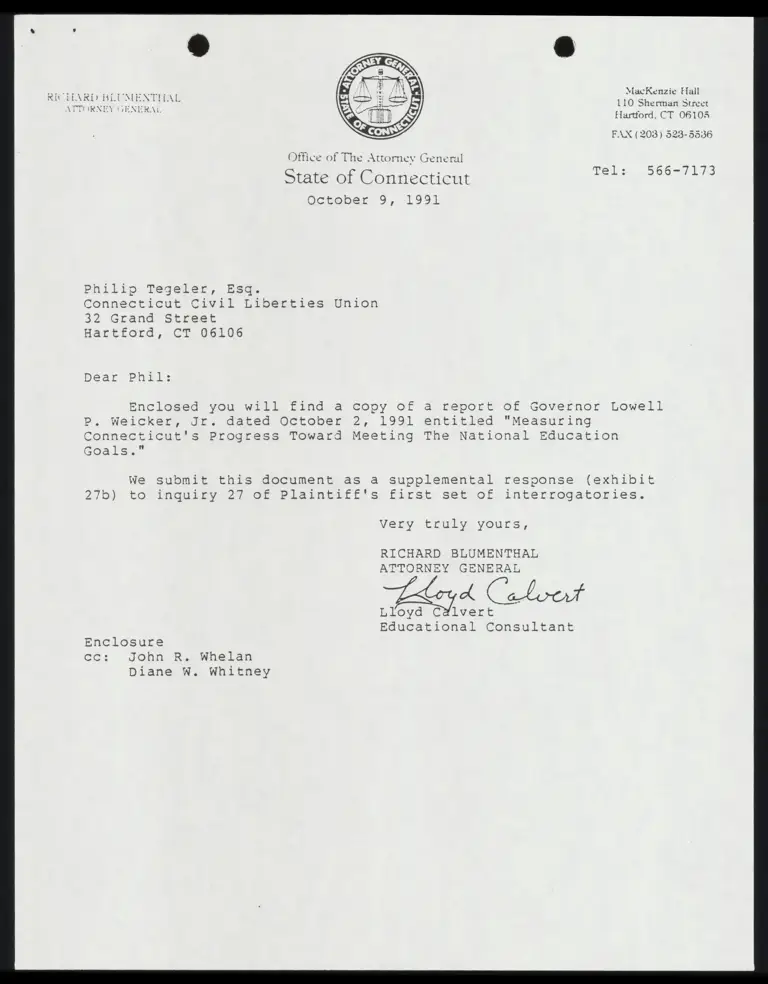
Enclosed you will find a copy of a report of Governor Lowell
P. Weicker, Jr. dated October 2, 1991 entitled "Measuring
Connecticut's Progress Toward Meeting The National Education
Goals."

We submit this document as a supplemental response (exhibit
27h) to inquiry 27 of Plaintiff's first set of interrogatories.

Very truly yours,

RICHARD BLUMENTHAL

ATTORNEY GENERAL

L Colorent
Lloyd Cdlvert
Educational Consultant

Enclosure

df John R. Whelan

Diane W. Whitney


Report of the Governor

Measuring Connecticut's Progress

Toward Meeting

The National Education Goals

Governor Lowell P. Weicker, Jr.

October 2, 1991


LOWELL P. WEICKER JR.

GOVERNOR

STATE OF CONNECTICUT

EXECLTIVE CHAMBERS

HARTFORD. CONNECTICUT

06106

October 2, 1991

Dear Friends:

At the 1989 Education Summit in Charlottesville, President Bush and the country's
governors comrmutted themselves to six national education goals to be realized by the
year 2000.

The first report of the National Educatdon Goals Panel was released on September 30
with a first look at the problems found and the progress made.

Connecticut's first report looks at some of the same problems and deals with educa-
tional, demographic and social conditions affecting its students, young and old.

[ urge you to read this report carefully and to be ready to cooperate with other con-
cerned citizens to build upon our successes and tackle the challenges that lie ahead. I
recommend to you Measuring Connecticut's Progrexs Toward Meering the National
Education Goals.


Governor


Contents

Acknowledgments

National Education Goals and Objectives

Introduction

Critical Links in Accountability

The Before School Years

The School Years

The After School Years

Summary

Appendix — Comparison of the State Board

of Education's 1991-1995

Comprehensive Plan Goals and
The National Education Goals

33

36


Acknowledgments

Many individuals have contributed ty the development of this report. Thanks are due to the Connecticut Departments of Educa- tion, Higher Education, Health Services, Human Resources, Children and Youth Services, Labor, Mental Retardation, and Income Maintenance, as well as to the Connecticut State Library, the Commission on Children, the Connecticut Employment and Training Commission and the Connecticut Alcohol and Drug Abuse Commission.

In addition, statewide businesses, labor organizations, profes- sional organizations and legislators also have provided valuable contributions.

Specialthanks go out to Wanda Dupuy (Office of Policy and Man- agement), Kathy Frega (Department of Education), Valerie Lewis (Department of Higher Education), Emily Melendez (Governor's Office) and Betty Schmitt (Department of Education), whose guid- ance and perseverance were invaluable in compiling this report. Thanks to Marsha Howland and Betty Speno (Department of Edu- cation) for their time and expertise in publishing this report.


Meeting The National Education Goals

—@  heportofthe Governor —@—o-—__


Readiness

Goal 1

By the y=2r 2000, sl! children in Amer-
ica will start school ready to learn.

Objectives

All disadvantaged and disabled children
wilt have access to high-quality and devel-
opmentally appropriate preschool pro-
gramsthat help prepare children for school.

Ev2y parent in America will be a child's
first teacher and devote time each day
helping his cr her preschool child learn;

parents will have access to the training
and support they need.

Children will receive the nutrition and heath
care needed to arrive at school with healthy
minds and bodies, and the number of low-
birth-weight babies will be significantly
reducedthrough enhanced prenatal health
systems.

High School Completion

Goal 2

By the year 2000, the high school gradu-
ation rate will increase to at least 90
percent.

Objectives

The nation must dramatically reduce its |
dropout rate, and 75 percent of those stu-
dents who do drop out will successfully
complete a high school degree or fits
equivalent.

The gap in high school graduation rates |
between American students from minority
backgrounds and their nonminority
counterparts will be eliminated.

Student Achievement

and Citizenship

Goal 3

By the year 2000, American students
will leave grades four, eight and twelve
having demonstrated competency over
challenging subject matter including
English, mathematics, science, history
and geography; and every school in
America will ensure that all students
learn to use their minds well, so they
may be prepared for responsible citi-
Zzenship, further learning, and produc-
tive employment In our modern econ- |
omy.

1v


| {

|

Objectives

The academic performance of slemen-
tary and secondary students will increase
significantly in every quartile, and the
distribution of minority students in each
level will more closely reflect the student
population as a whole.

The percentage of students who demon-
strate the ability to reason, solve prob-
lems, apply knowledge, and write and
communicate effectively will increase
substantially.

All students will be involved in activities
that promote and demonstrate good citi-
zenship, community service and personal
responsibility.

The percentage of students who are
competent in more than one language will
substantially increass.

All students will be knowledgeable about
the diverse cultural heritage of this nation
and about the world community.

Mathematics and Science

Goal 4

By the year 2000, U.S. students will be
first in the world in mathematics and |
sclence achievement.

Objectives

Math and science education will be
strengthened throughout the system,
especially in the early grades.

The number of teachers with a substan-
tive background in mathematics and sci-
ence will increase by 50 percent.

The number of U.S. undergraduate and
graduate students, especially women and
minorities, who complete degrees in
mathematics, science and engineering will |
increase significantly.

Adult Literacy and
Lifelong Learning

Goal 5

By the year 2000, every adult American
will be literate and will possess the
knowledge and skills necessary to |
compete in a global economy and
exercise the rights and responsiblii-
ties of citizenship.

Nat@nal Education Goals and Objectifs

Objectives

Every major American business will be
involved in strengthening the connection
between education and work,

All workers will have the opportunity to
acquire the knowledge and skills, from
basic to highly technical, needed to adapt
to emerging new technologies, work maeth-
ods, and markets through public and pri-
vate educational, vocational, technical,
workplace or other programs.

The number of quality programs, includ-
ing those at libraries, that are designed to
serve more effectively the needs of the
growing number of part-time and mid-
career students will increase substan-
tially.

The proportion of those qualified students,
especially minorities, who enter college,
who complete at least two years, and who
complete their degree programs will in-
crease substantially.

The proportion of college graduates who
demonstrate an advanced ability to think
critically, communicate effectively and
solve problems will increase substan-
tially.

Safe, Disciplined and
Drug-Free Schools

Goal 6

By the year 2000, every school In
America will be free of drugs and vio-
lence and will offer a disciplined envi-
ronment conducive to learning.

Objectives

Every school will implement a firm and fair
policy on use, possession and distribution
of drugs and alcohol.

Parents, businesses and community or-
ganizations will work together to ensure
that schools are a safe haven for all chil-
dren.

Every school district will develop a com-
prehensive K-12 drug and alcoho! pre-
vention education program. Drug and
alcohol curriculum should be taught as an
integral part of heatth education. In addi-
tion, community-based teams should be
organized to provide students and teach-
ers with needed support.


—@— Report of the Governor —@—o—


Introduction

The National Governors Association, in a policy adopted in July
1990, called upon each governorto issue a report to mark his or her
state's progress toward reaching the six National Education Goals.
The state report complements the national report released by the National Education Goals Panel.

Connecticut's report is organized into three sections and corre-
sponds to the six National Education Goals as follows: The Before
School Years (Goal 1), The School Years (Goals 2, 3, 4 and 6) and
The After School Years (Goal S). An appendix provides supplemen-
tary information about how Connecticut's education goals for 1991-
1995, adopted by the State Board of Education in 1990, compare to
the National Education Goals. In this report, indicators that have
been taken directly from the State Board's Comprehensive Plan for
1991-1995 are identified by the symbol of a small pencil (&).

Every effort has been made to provide objective indicators that measure Connecticut's progress in achieving the National Educa-
tion Goals. Where data are unavailable or unreliable, information on
selected programs that address the needs of children and adults is
presented.


Meeting The Nctional Education Goals


—@—— Report of the Governor —_-


Critical Links in Accountability

National Education Goals and Objectives for The Year 2000

Connecticut's Education Goals and Objectives 1991-1995

Our state has long recognized the importance of setting rigorous performance goals and establishing re- §able indicators to measure progress in meeting these goals. Since 1980, the Cor 1ecticut State Board of Education has been mandated to set long-term educational goals every five years.

While the National Education Goals for the year 2000 were being developed, Connecticut citizens were for- mulating the Connecticut State Board of Education's Challenge for Excellence: Connecticut's Comprehen- sive Plan for Elementary, Secondary, Vocational, Career and Adult Education — A Policy Plan 1991-1995. A comparison of the National Education Goals and Connecticut's education goals for 1991-1995 appears in thé appendix (see page 36).

Connecticut's Comprehensive Plan has two sets of goal statements. The five 1991-1995 Statewide Edu- cational Goals for Students (see page 37) articulate expectations for student performance and outcomes as the culmination of the public school experience. Eight policy goals focus efforts within the state/local partnership to implement essential operational changes to the state's public educational system which will enable the attainment of the student performance goals.

Local Board of Education Goals for Students

Change is dynamic. Anditis a dynamic process that must characterize our educational improvement ef- forts. Inthis school year, each of the state's 166 school districts will engage in the challenging process of adopting student educational goals consistent with the 1991-1995 Statewide Educational Goals for Students. While establishing goals, objectives and accountability are part of the broad national agenda, they are the essence of Connecticut's continuing agenda for educational improvement.

National Indicators of Progress

The national goals report contains mostly nationwide measures of progress and only some state-by-state measures. The National Education Goals Panel is developing proposals for more consistent indicators to use in both national and state reports in future years.

Connecticut's Indicators of Success

Since 1985, the Connecticut State Board of Education has reported annually on many of the state indica- tors presented in this first report. These indicators — noted with the symool of a small pencil (7 ) on the pages that follow — also are an integral part of the comprehensive education plan for 1991-1995.


Meeting The National Educatior Goals

Vil


Vili


overnor


Local Schooi and District Indicators of Progress/Strategic Profiles

The statewide indicators provide the basis for the most far-reaching accountability program ever under- takenin Connecticut: the Strategic School Profiles initiative for individual schools and school districts. The profiles will provide rich data on numerous indicators such as student performance on Connecticut Mastery Tests, attendance, high school dropout rates and graduation rates. The Strategic School Profiles are scheduled to be prepared by superintendents and presented to the public at meetings of local and regional boards of education annually beginning in 1992. The availability of the Strategic School Profiles with their key indicators — in some cases for the first time ever on an individual school basis — will assist public education in targeting efforts toward meaningful improvement toward meeting local, state and national education goals.

Higher Education Goals and College and University Profiles

Connecticut's goals for higher education also are aimed toward realizing the national goals. The 1989 Midpoint Review of the Higher Education Strategic Plan documents progress towards the three higher education goals of access, quality and responsiveness. The Department of Higher Education is mandated beginning this year to develop an annual Higher Education Profile for each college and university.

Annual Reports of Progress

Future annual reports toward meeting the National Education Goals — at the national, state and school/ campus level — will enhance accountability efforts already underway in Connecticut.


Measuring Connecticut's Progress Toward


Goal 1 :

School Readiness

Readiness requires that
children receive appro-
priate care during all
stages of their develop-
ment

Comprehensive health
andeducation programs

. consistently have

made a difference in the

lives of disadvantaged
children


| v
d


|
4

The Before School Years

Achieving the goal of school readiness means that every child in Connecticut will
begin school eager and able to lean. While the majority of Connecticut children
do arrive on their first day of school ready to learn, an alarming number do not.
Children with physical and emotional disabilities, and children from low-income,
immigrant, non-English-speaking, and single-parent households are less likely to
be prepared for the challenge of formal education. These children are at risk of
educational failure.

The 1990 census data reveal tt. atin Connecticut, the overall population of children
and youth under 18 years old decreased by 8.9 percent since 1980: however, the
population under age 5 grew by 23.3 percent. Early indications are that blacks,
Hispanics and Asians comprise a greater proportion oi the under-5 population
than in 1980. Given the strong correlation between poverty and minority group
status, there is cause for concern about the school readiness of increasing
numbers of Connecticut children.

Readiness requires that children receive appropriate care during all stages of their
development. Early and adequate prenatal care is associated with improved
deliveries, while the lack of such care increases the risks of low-birth-weight
deliveries and infant mortality. Studies have shown that children born with low
birth weights are at greater risk of educational failure than those born within the
range of normal birth weights. For the majority of women, private insurance or
Medicaid pays the costs associated with their prenatal care. Yet, a substantial
number of women have no heatth insurance and have little or no access 10
prenatal care. Local hospitals, community health centers and private physicians
provide some of these women with reduced- or no-cost care, but the demand is
still greater than the supply.

In the formative years after birth, children require proper nourishment and
preventative health care in order to have the best possible chance of reaching the
levels of physical and mental maturity necessary for formal education. Immuni-
zation, lead poisoning screening, and nutrition programs have resulted in dra-
matic declines in the incidence of many childhood illnesses and have contributed
to a general improvement in the health of children.

Research has demonstrated that high-quality early childhood programs have a
positive effect on the lives of children. While all children can benefit from such
programs, children who are disadvantaged and children with disabilities reap the
greatest benefits from participating in them. Comprehensive health and educa-
tion programs such as Head Start consistently have made a difference in the lives
of disadvantaged children. When compared to children from low-income families
who did not attend high-quality early intervention programs, participants from

quality early childhood education programs have greater school success (e.g.
better grades, less need for special education services), increased future employ-

ability, decreased need for public welfare assistance, and decreased criminal
activity later in ite. Children with disabilities who attend early intervention
programs make significant gains in developmental functioning, particulary when
the intervention occurs during the earliest years of life.


Meeting The National Ed ization Goa. s


2

"The role of parents is
paramount

Young chiidren are the
most likely age group in
Connecticut to be poor


Heport of the Governor


While earty childhood programs play an ever-increasing role in preparing children for school, the role of parents is paramount. Parents (including single parents, guardians, foster parents and stepparents) have the principal responsibility to make sure that their children are ready and eager for school when the time comes. They need to spend time reading and talking with their children. Yet, with more and more children residing in households where the only parent or both parents work outside the home, it becomes more difficult for parents to adequately provide for their children's developmental needs. Nonetheless, the effectiveness of parents in their role as first teacher” can be enhanced if they have access to the training and support they need. Furthermore, research has shown that the quality of a child's life and his or her level of educational accomplishment improve when the parent's educational level rises. Illiteracy and educational failure are intergen- erational. Promoting lifelong leaming for adults — especially parents of young children — has multiple benefits.

Demographic Trends

Recently released 1990 census data indicate that the 5-and-under population in Connecticut was 272,294 children and has increased by 23.3 percent or 43,168 children since 1980. While specific data as to the breakdown by race/ethnic backgroundis not yet available, early indications are that significantincreases are evident in the Asian, black and Hispanic population groups.

Young children are the most likely age group in Connecticut to be poor. According lo census data, in 1970 nearly 9.3 percent of children under age 6 in Connecticut lived in poverty. By 1980, the percentage of children under age 6 living in poverty grew to 14.9 percent. In 1985, according to survey data collected by the U.S. Census Bureau, the percentage of children under the age of 5 living in poverty was 15.8 percent. Poverty rates for black and Hispanic children were significantly higher than those for white children. In 1988S, of all children under the age of 18 living in poverty, 6 percent were white, 32 percent were black and 62 percent were Hispanic.

In 1980, 34,554 or 18.9 percent of children under age 5 were from non-English-
speaking families. Of this group, 44.7 percent or 15,458 children under age 5 ‘Spoke Spanish at home. (New.data from the 1990 census are not yet available)


Measuring Connecticut's Progress Toward


—@— Report of the Governor —@


Health and Nutrition

Preventative Health Care

A mother's ability to take advantage of health care during her pregnancy has a
dramatic effect on the circumstances surrounding the birth of her child and the
extent to which the child may experience developmental delays. Inthe 1990s,
access to health care generally has come to mean ability to pay. Typically, a
mother has medical insurance either through her employer or through a program
such as Medicaid. Yet there are many who have neither. In its January 1991
interim progress report, the Connecticut General Assembly's Health Care Ac-
cess Commission estimated that 25.4 percent of Connecticut children under the
age of 18 are uninsured. |


f Percentage of Low Birth Weight Deliveries )

BY SITY Rass Wich ign ie Dri ® While the overall percentage of low-birth-
2 weight deliveries remained between 6.6

and 6.9 percent during the three-year pe-
; 7 Bm TOTAL riod from 1988 through 1990, the percent-

BS Zz Zz 3, ware ages for black and Hispanic children were
d of Z: 2 Bt consistently and significantly higher. Provi-

i Z: OQ OT-ER-ASIAN sional data for 1990 point to a slight de-
I I = Prove onal crease in the incidence of low birth weight

gu BZ BE 87: : for black children.
i Source C7 Depanmen of ea!’ Se~ ces


Percentage of Births with Late or No Prenatai Care

1ReE-90

(Late « Care starting aher 1st tnmester Mothers Hepa orgin @ me ported)


® Many pregnant women in Connecticut. re-
gardless of race, receive late or no prenatal
care. Yet, the mothers of black and His-

z panic children are much more likely than
$ their counterparts to have late or no prena-
E tal care.

1988 1988 1990°

ii Source CT Department of Health Services 3


Meeting The National Education Goals


necticut's Healthy Start
program is to reduce the
Incidence of infant mor-
tality and low birth
weight

Despite Immunizing
more than 95 percent of

children by school en-
try...only 69 percent of
all urban 2-year-olds

have received a com-

plete basic series of im-

munizations

According to estimates,
approximately 80,000
Connecticut children
sufferfrom lead poison-
Ing

Solid data Is lacking as
to the total number of
Connecticut preschool
and school-age children
who suffer from or are
at risk of hunger

The obinctve ot ec. Sein Breton

       e aovernor


Report 0


women and infants: The program is a joint effort of the Department of Health
Services and the Department of Income Maintenance. The objective of the pro-
gramis to reduce the incidence of infant mortality and low birth weight. Strategies
for achieving this objective include reducing the financial barriers to early, ongoing
and comprehensive maternal and child health care for income-eligible women,
infants and children upto age 7. Healthy Start provides funding for outpatient serv-
ices for eligible pregnant women and infants up to 18 months of age who are in-
eligible for Medicaid. Data from the Department of Health Services indicate that
curing fiscal year 1990, 4,977 women and 4,466infants — a total of 9,443 — were
served through the Healthy Start program. Data for fiscal year 1531 show a sig-
nificant increase inthe numbers served: 7,284 women and 9,587 infants — a total
of 16,881.

The objective of Connecticut's Immunization Program, administered by the De-
partment of Health Services, is to eliminate diseases that can be prevented by
vaccinations. The program strives to protect children from potentially fatal dis-
eases such as meningitis, polio, measles, rubella, mumps, dipthena, tetanus and
pertussis. During 1991, the Department distributed more than 537,000 doses of
publicly supplied vaccine to health-care providers in Connecticut to eliminate the
cost factor for those who cannot pay. Despite immunizing more than 95 percent
of children by school entry and providing education and outreach services, recent
Department surveys indicate that only 69 percent of all urban 2-year-oids have
received a complete basic series of immunizations.

The important role that immunization plays in preventing childhood illness and
lengthy periods of recovery has not gone unnoticed by Connecticut's legislature.
During its 1991 Session, the Connecticut General Assembly enacted the Univer-
sal Childhood Immunization Act, which promotes the full and timely immunization
of young children through parent education. expanded local outreach and coor-
dination between state agencies.

A preventable environmental hazard that threatens the heatth of children is lead
poisoning. The Lead Poisoning Prevention Program seeks to reduce and elimi-
nate exposure to lead through increased screening, education, medical care and
environmental follow-up. Itis estimated that approximately 80,000 children age
0-18 in Connecticut suffer from lead poisoning, which in many instances results
inleaming disabilities and other central nervous system problems. Urban and low-
income children and families experience the highest risk of exposure. Only 48
percent of the 80,000 children estimated to be lead poisoned were screened
during fiscal year 1991.

Solid data is lacking as to the total number of Connecticut preschool and school-
age childrenwho sufferfromor are at risk of hunger. However, a survey conducted
by the Hispanic Health Council in Hartford (1990) under the auspices of the
Community Childhood Identification Project indicates that significant numbers of
low-income families experience hunger. In addition, it was found thatfamilies who
are experiencing hunger employ strategies to cope. These strategies include
purchasing less expensive food, getting food from friends and relatives, sending
their children to eat with friends and relatives, eating at soup kitchens, and getting
groceries from food pantries.


Measuring Connecticut's Progress Toward

eatth-caregprogramioriowirgome pragnar


Federal funds available
throughthe U.S. Depart-
ment of Agriculture are
distributed through the
State Department of
Education to heip pro-
vide nutritious meals

and snacks to pre-


The Special Supplemental Food Program for Women, Infants and Children (WIC),
a federal program administered in Connecticut by the Department of Health
Services, is designed to provide supplemental foods, nutrition education and
health-care referrals to low-income pregnant, postpartum and breastfeeding
women and to infants and children up to 5 years of age who are at nutritional/
medical risk. During 1990, 52,909 Connecticut families benefited from the
program; during 1991, 59,203 families participated.

Federal funds available through the U.S. Department of Agriculture are distributed
through the State Department of Education to help provide nutritious meals and
snacks to preschool children in day-care centers, schools, Head Start programs,
family resource centers and family day-care homes. According to the State
Department of Education, approximately $8 million is distributed annually. While
children in before- and after-school programs can also receive breakfast and
snacks and all meais during school vacation periods, nearly 90 percent of the
children served by this federal program are infants and children through age 5.


school children

fe Duily Number of Preschoolers Served a)

Department Of Education's Child Nutrition Program

® There has been a gradual in-
crease in the number of preschool

3 children served nutritious meals
2 EH Tou through the state's Child Nutrition
& E Pnvate Non-Pro Program.

x B Pubic Schools
E

Loca! Gov ; . 2 ® Nearly 18,000 infants and children
through age 5 were served daily in
1990.

Nv Source CT Department of Educaton )


Access to Quality Programs

Connecticut's Department of Human Resources is the lead agency in the state
charged with coordinating and administering our child-care delivery system,
which is an integral pant of early childhood programming. In July 1991 the
Department submitted to the federal Agency on Children and Families a three-
year plan for the administration of childcare services. Through the Child Care
and Development Block Grant Act of 1990, Connecticut is eligible to receive atotal
of $16 million over the plan period. Federal approval of the plan and application
is still pending. Key features of the plan address the issue of access 10 quality
programs for disadvantaged and disabled children by targeting child-care service
dollars as follows: to children whose parents are teenagers completing high
school; children who require protective services through the Department of

Children and Youth Services; and children who have siblings in care. The plan
also calls for providing additional payment to child-care providers who serve
children with special needs upon verified additional expense information. To
enhance the quality of the delivery system, the plan includes a commitment to
improve compliance with current state child-care regulations, to develop a com-

  5

Meeting The National Education Goals


Report of the Governor


Teleint, i
prehensive training program for child-care providers, and to implement an
Incentive payment program for providers who meet certain standards of quality as
recognized by national child-care associations.


There are a number of places where children may participate in preschool
programs: day-care centers (private, local and state-funded); family day-care
homes; and earty childhood centers located in local schools. One of the more

The Family Resource comprehensive models in Connecticut can be found in the Family Resource
Centers offer compre- Centers. These centers, which served three communities in 1988 and eight by
hensive, community- 1991, offer comprehensive, community-based child-care and family support
based child-care and services located in public school buildings. Services include full-time preschool
family support services child care, and support and training for family day-care providers as well as op-

portunities for parents to gain and enhance parenting skills.

Disadvantaged children are served through a number of arrangements. Many
low-income families are eligible to participate in programs that provide no- or low-
costchild-care. One such comprehensive program, Head Start, provides children
under 5 with health, education, and social supports to help them achieve. In1990,
22 cities and towns in Connecticut operated Head Start programs, serving ap-
proximately 4,726 children. itis estimated that only 20 to 25 percent of all children
eligible for Head Start are currently served.


# Children with Disabiiees Age 0 - §
Estmated Need ve Number Served

1980 - 1990

ME ® An estimated 12,000 children
frm - age 0-5 in Connecticut may
2 1 LS emer have disabilities, and in 1990
< ) BCI Ws fri just over half of these children
; $522 Nav Seve were reported to be receiving
2 early intervention services

£115 gue? supported by state or federal
x funds.
BR I OU 1652

Source CT Otice of Poicy and Management
N —

J

Children with disabilities are those who are experiencing delays in their mental,
physical or emotional development. The definition also includes those children
who have a physical or medical condition (such as Down Syndrome) that has a
high probability of resulting in developmental delay. A significant percentage of
these children will require special education due to their disabling conditions.

There are no conclusive data on the total number of Connecticut children under
the age of 5 who have disabling conditions. There is only estimated data, based
on national research and federal projections. According to estimates from the
Connecticut Office of Policy and Management (OPM) based on 1980 and 1990
census data, at least 3 percent of Connecticut children ages 0-2 (a total of 4,143)
have a disabling condition. OPM also estimates that at least 6 percent of
Connecticut children ages 3-5 (a total of 8,049) have disabilities.


Measuring Connecticut's Progress Toward


Connecticut is below the
national average In the
proportion of its 3-year-
oid children with disabill-
ties to whom It provides
services

The challenge for the
public schools Is to be
ready for all children

Parental involvement is

essentialtoachlid’s de-
velopment and key to
ensuring educational
success

€. Report of the Governor 9

State and federal law mandate that each state provide children ages 3 to 5 with
special education programs. Data from the Connecticut Department of Education
indicate that in 1991 approximately 5,400 children ages 3-5 were enrolled in
preschool special education programs across the state. (Comprehensive data on
the actual number served are available only for those children who receive
services from public providers, such as the Department of Education and the De-
partment of Mental Retardation.) Based on the available data, Connecticut is
below the national average in the proportion of its 3-yesar-old children with
disabilities to whom it provides services. However, the proportion of 4- and 5-year-
olds served in Connecticut is similar to the national average.

in Connecticut, children with disabilities under the age of 3 may receive services
from a variety of public and private providers. The six regional educational service
centers (RESCs) act as coordination centers and provide access to assessment
servces, planning services to meet identified needs, and referrals to appropriate
services for the birth-through-age-two population and their families.

Children with diverse backgrounds and developmental seveis and different
lengths of preschool experiences enter kindergarten and primary grades each
year. The challenge for the public schools is to be ready for all children. A program
of developmentally appropriate and positive instruction that nurtures the child-
hood desire to learn is critical. Practices that sort young children, based on
assesed school entry level abilities, into fixed groups with long-term identifying
labels must be scrutinized. Practices that convey the expectation for childhood
competence and high levels of skill development facilitate maximum growth in all
children. State and local support for developmentally appropriate preschool,
kindergarten and primary grade programs encourages child-centered cumiculum
and recognizes the active involvement of the child and tamily in learning.

Supporting Parents as the Child's First Teacher

Parenting is not an easy task. The demands on one's time and energy are
phenomenal. Yet parentalinvolvement is essential to a child's development and
key to ensuring educational success. To support parents and families in develop-
ing skills and resources to address the needs of their preschool children,
Connecticut has undertaken some key initiatives.

The eight Connecticut Family Resource Centers provide a contiuum of commu-
nity-based child- and family-support services. Through the Families in Training
(FIT) program, the centers employ an integrated approach of home visitation,
group meetings and monitoring of child development for new and expectant
parents. The centers also provide parent training and adult education programs
and serve as resource and referral centers for services related to parenting.

The Department of Children and Youth Services offers parental support and

training programs through community-based organizations. The Parent Educa-
tion and Support Centers (PESCs) provide education and support to parents of
children from birth through age 18, with special emphasis on parents of young
children, those with low income, those with limited English proficiency, first-time
parents, and minority parents. Atotalof 15 PESCs are in operation statewide, with

two located in low-income housing projects. The Department's Therapeutic Child
Care Initiative provides preschool programs for young children along with parent
support and education. These programs serve abused and neglected children

and encourage positive parent-child interaction.


Meeting The National Education Goals


Report of the Governor
LB


In addition, the Department of Education's Young Parents Program and the
Department of Health Services-sponsored Peer Education Program and Young
Parents Program also attempt to address the need for parental training and
education for teenage parents.

Kids Count

The Connecticut Commission on Children has initiated a five-year public policy
and education campaign on the importance of the first five years of life:

1-2-3-4-5 KIDS COUNT.

Working with state and local lawmakers, parents and business leaders, the
initiative is designed to encourage the development of new programs and the
retooling of existing ones. The KIDS COUNT goals include a coordinated and
integrated system of child care that is efficient and of high quality; prenatal care:
access to postnatal health care and nutritional guidance; expanded success-
oniented environments for both young teenage parents and their children; and
support systems to strenghten community and family life.


Measuring Connecticut's Progress Toward


  ® Report of the Governor =i


The School Years
High Expectations for Students and Schools

The goal is to rank . On almost every measure of student achievement, Connecticut students rank
among the best In the among the best in the nation. The goal, however, is to rank among the best in the
world world. It has been said that we must raise our standard of performance or lower

our standard of living. In essence, this means that we have no choice. We must
have a high-performing educational system that gives students an opportunity to
leamin safe, high-quality integrated school environments. Students must develop
all the skills, knowledge and attitudes necessary to become productive members

+ of Connecticut's work force and our global society.

The high school graduating class of the year 2000 entered first grade in the fall of
1988. Each school day approximately 472,000 students attend more than 970
public schools in the state staffed by approximately 43,000 certified professionals.

All students can contrib- We must motivate and inspire all students to want to successfully complete high
ute to meeting the Na- school and engage in lifelong leaming. All students can contribute to meeting the
tional Education Goals National Education Goals if they see them as their personal goals. We needto offer
If they see them as thelr students a safe and supportive leaming environment, rigorous and challenging
personal goals curriculum objectives, and high expectations for performance.

High-quality teachers are the essence of a high-performing system. Connecticut's
reform efforts have recognized this with rigorous standards for the teaching
profession; the state's new teacher certification continuum reflects those stan-
dards. The continuum addresses every stage of an educator's career:

* teacher preparation standards, including a new requirement

for a subject-matter major;
* teacher induction procedures and assessments:
* professional development for the experienced teacher; and
* an alternate route to certification.

High-quality teachers and school leaders are committed to helping students
achieve the highest possible goals. In order to identify where improvement is
needed and how to achieve that improvement, educators and parents need accu-
rate, reliable and comprehensive information about what students know and are
able to do. This section of the 1991 progress report presents available statewide
measures of progress; it includes the most comprehensive set of indicators in this
report — reflecting Connecticut's major investment in accountability systems for
the public schools. It features Connecticut-specific data to supplement the report
of the National Education Goals Panel on Goals 2, 3, 4 and 6, which cover “The
School Years.”

Goal 2 There is no greater impediment to future success than failure to complete high
School Completion school. Reported in this section are Connecticut-specific indicators related to

graduation rates (the proportion of ninth graders who graduate from high school)
for the public school population and for students by racial/ethnic groups (e.g.,
white, black and Hispanic students). Information is also provided on students who

9

Meeting The National Education Goals


  e Governor

compiete high school irom nonpublic schools and adults who recsive credit-based
local high schoo! diplomas or the Genera! Educational Development dipioma (GED).


Students at risk of academic failure and dropping out of school have been the
focus of a multiyear dropout prevention program in the state's Priority School
Districts. Many towns have spearheaded local initiatives to coordinate child and
family support services with school efforts on behalf of youth and families at risk.
In addition, the state's equivalent of the federal Upward Bound program has op-
erated in urban areas over the past five years and has posted a 92 percent high
school graduation rate; 95 percent of these graduates enroll in college.

Significant numbers of public school students, however, continue to leave school
before obtaining a diploma. Statewide information on public school dropouts will
be available in 1993, to supplement the high school graduation rate information.

& An increase in the proportion of ninth graders who complete high school


® The local public school graduation rate rose from
77.2 percent in 1986 to 78.8 percent in 1989, and
then tellin 1990 to 77.7. G

R
A
D
U
A
T
I
O
N
 )

RA
TE


G
R
A
D
U
A
T
I
O
N


)

————————————
: : White ® The gap between the graduation rates of white stu-

dents and black and Hispanic students remains
Black large. The graduation rate in 1990 was 82.5 percent

“0 for whites, 62.2 percent for blacks and 51.1 percent
Hispanic for Hispanics. XE cp —— i+

06 87 83 89 90
YEAR

® The number of diplomas awarded in 1990 was the
smallest in more than a decade, due to the declining

~ number of births in the 1970s. This downward trend
is expected to continue through 1994.

R
A
T
E


CREDIT ar : oe ¢ i ® School completion is attained through the traditional
NONPUBLIG K through 12 method and also through other means.
V1 In 19890, 12.0 percent of all high school diplomas

granted were General Educational Development
(GED) diplomas and 4.5 percent were adult credit-
based diplomas. In 1990, local education agencies
(LEAs) granted 66.2 percent of all high school diplo-
mas, vocational-technical schools granted 5.1 per-

i, cent, and nonpublic schools granted Connecticut
students the remaining 12.2 percent.

Bi
id

io
mm

md
h

T
o
m


A

LEA

NU
MB
ER


OF

D
I
P
L
O
M
A
S
 \


.


Measuring Connecticut's Progress Toward


I Report of the Governor —@

Goal 3 The Connecticut Mastery Test (CMT) is the centerpiece of the state's K-12 testing
efforts. Information on student CMT performance in reading, writing and mathe-

Student Achievement rics in Grades 4, 6 and 8 is presented in this part of the report. The National
and Citizenship Education Goal on Student Achievement and Citizenship addresses the issue of

subgroup performance in student outcomes. On page 12, therefore, several
measures are used 10 assess the reduction inthe disparity in outcomes among the
state's subgroups of students on the Connecticut Mastery Test. Data on student
achievement is displayed by gender, racial/ethnic group and relative family in-
come. These are key indicators of the state's commitment to report on equality
of educational outcomes.


Formats for CMT results that are similar to the formats used in this report will be
employed in the Strategic Schoo! Profiles to be reported annually by each school
and school district in the state beginning in 1992.

&& An increase In student reading performance & An increase In student writing performance

& An increase in student mathematical skills


4 Connecticut Mastery Test Results Measured Against The State Goals a
: (Combined Results for Grades 4, 6 and 8)

Reading Writing Mathematics

Percentage Percentage . Percentage Fall 1990 pi a) Ros Or 3ova at or above
State Goal State Goal State Goal

56 18 43

80 an
|

E ° 70 5 707 3 70
T
© [1]

§ 60 g 5%

te —

3 40 $ 401 $ fio —
+

eg ; 39] : 0
8 20 Fa 207 — a 20
a 4

10 T T fais. i TY YT 10 T ~~  & ™ 4 10% T P——_— YT T

86 87 88 89 90 86 87 88 89 90 86 87 88 89 90
Ne School Year School Year School! Year


* The percentage of students scoring at or above the reading goals in Grades 4, 6 and 8 has risen from 48 percent in
1986 to 56 percent in 1990. The largest gain occurred between 1986 and 1987.

* Thepercentage of students scoring at or above the writing goals in Grades 4, 6 and 8 has shown no significant growth;
the figure was 18 percent in both 1986 and 13890.

* The percentage of students scoring at or above the mathematics goals in Grades 4, 6 and 8 has risen steadily from

34 percent in 1986 to 43 percent in 1990.


11

Meeting The National Education Goals


P Report of the Governor ms:


understanding, computational skills, problem soving/applications and measurement/geometry. The reeding test
measures students’ ability to understand nonfiction English prose at different levels of reading difficulty. In
writing, each student writes a composition which is judged on the student's ability to convey information in a
coherent and organized fashion. Listening skills measures students’ ability to understand information presented
on an audiotape. Reasoning/probiem solving measures students’ abilities in selected higher-order skills in lan-
guage arts and mathematics. Locating Information measures students’ ability to extract information from
schedules, maps and reference materials. Students who score at or above the state goal have demonstrated
superior performance on the skills, processes and knowledge associated with the particular content area
assessed. The remedial standards identify a level of performance that suggests the need for remedial
assistance.

g A decrease In the disparity in educational outcomes among the state's subgroups of students (by
race/ethnicity, gender, school district, parental Income and similar subgroups)


z CMT Results by income * &
(Combined Results for Grades 4, 6 and 8)

Percentage at or above state goal ® When compared by income level, the CMT
Reading Writing ~~ Math results show significant performance differ-

‘8 '90 88 ©0 ‘88 BO ences. Students in poverty conditions (i.e.,
Very Poor and Poor Students) are experi-

Very Poor Students 20 26 5 6 14 20 encing severe academic deficiencies as com-
Poor Students 33 39 8 8 2.28 pared to all Other Students.
Other Students 81. 66 18 21 42 =p

All three income levels show growth over
* Income categories are derived from participation in the time in all three tests.

federal School Lunch Program. "Very Poor Students” are
eligible for a free lunch; "Poor Students” are eligible for a
reduced-price lunch; "Other Students” are not eligible. 3)


4 SoM Results by Rages mnichy : 0) ® The CMT results by race/ethnicity continue
Combinae Resulis for Orades ¢, aac 8) to show large differences between white and

Percentage at or above state goal minority students. The largest differences
Reading Writing Math are inthe percentage of white students scor-

ing at or above the goal and the percentages '88 90 '88 90 ‘88 ‘90 of black and Hispanic students scoring at or


White 62. 85 18 21 AL SD above the goal. A higher percentage of white

yo BR 7: 6 13 "ys students scored at or above the goal in read-
Black ! 14 ing than Asian American students, butin both
Hispanic 8 X 5 BL. writing and math the percentages scoring at

\ AsianAmer. 56 56 19 19 46 3 or above the state goals are similar.


Measuring Connecticut's Progress Toward


Report of the Governo!


& Adecrease in the disparity In educational outcomes among the state's subgroups of students (by
race/ethnicity, gender, school district, parental income and similar subgroups) [continued]


# CMT Results by Sex eo)
(Combined Results for 4,6 and 8) .

A higher percentage of females scored at or
POIGAnice 210 E50%8 said ou above the goals in both reading and writing,
Reading Writing al while in math a higher percentage of males

88 90 B V0 8 BO scored at or above the goal.

Females S55 58 19 22 36 41
\_ _/

P74 A decrease in the percentage of students below state standards in the basic skills

Connecticut Mastery Test Results Measured Against the Remedial Standard
(Combined Results for Grades 4, 6 and 8)

Reading Writing Mathematics

Percentage Percentage Percentage

at or below at or below at or belcw

Fall 1890 Remed:al Remedial Remedial

Standard Standard Standarc

25 15 14

| 801 801 80

| & 7] Rik 5 70]
T 60] E 601 E so = & = 80
ac) 9 5 4 [75) 4

P=] hi P 50]
Lo 40 4 3 40 9 ? 401

$ k = 4 = 1

301 304 T 30
= ; ——— 5 ) 8 )

8 204 s 20 1 Hi ati TA ® 201
$ i

a - ] :
10 T ™ T : 4 r 10 T Tr 2 4 4 10 Tr ™ T 5 T |

86 87 88 B89 90 86 87 88 89 90 86 B87 88 89 9°
— School Year School Year School Year


® The percentage of students at or below the remedial standard in reading has decreased from 30 percent in 1986 to
25 percent in 1990. The largest decrease occurred between 1986 and 1987.

® The percentage of students below the remedial standard in writing has decreased from 23 percent in 1986 to 15
percentin 1990 This decrease has not been steady. The percentage below the remedial standard increasedin 1988,
but decreased in 1989 and remained the same in 1990.

® The percentage of students below the remedial standard in mathematics has decreased steadily from 17 percent
in 1986 to 14 percent in 1990.

  13

Meeting The National Education Goals


  @ Report of the Governor =—@——


CMT Results by Grade

f GRADE 4 0) ® Fourth grade students have shown improved
: performance in math and reading over the six
LANG ARTS administrations of the Connecticut Mastery

Test. However, in language arts there has
been limited improvement. Writing scores
have fluctuated.


O
B
J
E
C
T
I
V
E
S

W
A
R
I
E
N
E
D


0
0
/
E
C
T
I
V
E
D

W
A
B
Y
E
R
E
D


ss 20
YEAR ® In 1990, the average number of math objec-

READIN tives mastered by students in Grade 4 was
21.2 (out of 25); language arts was 6.3 (out of

¥: 9). The average reading score was 48 De-
grees of Reading Power Units (out of 39), and

i a i : the average holistic score on the writing
85 ygap 90 J sample was 5.1 (on a scale of 210 B).


GRADE 6 TY ® Sixth grade students have shown consistent
improvement in math, with the average num-

ber of objectives mastered increasing from
23.1 to 24.5 (out of 36) from 1986 to 19390.

Writing and language arts scores have fluctu-
ated, but are above the 1986 levels. Reading
performance is essentially unchanged.


O
B
J
E
C
T
I
V
E
S

H
A
R
T
E
N
E
D

o
N


O
B
J
E
C
T
I
V
E
S

W
A
B
T
E
R
E
D


In 1990, the average number of math objec-
G | tives mastered by sixth graders was 24.6 (out
m of 36); the number in language arts was 8.1


++ READIN


    A
V
E
R
A
G
E


R
E
A
D
I
N
G


S
C
O
N
E


$ 'e sh S (out of 11). The average reading score was
: 11 3 57 Degrees of Reading Power Units (out of
: i T T 99), and the average holistic score on the

N. YEAR 4 writing sample was 4.6 (on a scale of 2 10 8).

rr GRADE 8 |
ri ® Eighth grade students have shown, with mi-


nor fluctuations, strong annual improvement ANG ARTS
§ in all subject areas from 1986 to 1990. nN

oR
SN oN

WN:

WN:


  ® In 1990, the average number of math objec-

tives mastered by eighth grade students was
25.7 (out of 36); the number in language arts
was 8.4 (out of 11). The average reading
score was 63 Degrees of Reading Power

Units (out of 99), and the average holistic
score on the writing sample was 55 (on a
scale of 2 to 8).

O
B
J
E
C
T
I
V
E
S

M
A
S
T
E
R
E
D


O
B
J
E
C
T
I
V
E
S

m
A
S
Y
E
R
E


-


  R
a
e
l


W
R
I
T
I
N
G


S
C
O
N
E


A
V
E
R
A
G
E


R
E
A
D
I
N
G


B
C
O
N
E


—


a


i
 EA


-
 m »-


n


Measuring Connecticut's Progress Toward


——==== Report cf the Governor =————

Connecticut participated in the 1990 state-by-state National Assessment of
Connecticut students Educational Progress (NAEP) math assessment for eighth graders, and the
perform among the best results also are included in this section. Two other national indicators of student
in the nation on the achievement are reported annually and are included in this progress report:
Scholastic Aptitude student performance on the Scholastic Aptitude Test (SAT) and the Advanced
Test and Advanced Placement Examinations. Connecticut students on average perform among the
Placement Examina- best in the nation on these measures. Additionally, the proportion of Connecticut
tions students taking these tests is significantly higher than the national average.

National Assessment of Educational Progress (NAEP)


£5 : 1990 Eighth Grade Mathematics Assessment 2)
Percent of Students by Performance Level

Perigrmance (evel Connecticut Nation

Level 200: Simple additive reasoning
and problem solving with whole numbers 98 % 97%

Level 250: Simple multiplicative
reasening and 2-step problem solving 72% 64%

Level! 300: Reasoning and problem solving

with fraction, decimal, percents and

elementary geometry 39% 12%

Leyel 350: Higher-level reasoning and
Re problem solving 0 0 7


A random sample of nearly 2,700 Connecticut public school eighth grade students participated in the first state-by-
state trial assessment undertaken by the 1990 National Assessment of Educational Progress (NAEP) in mathemat-
ics.

Connecticut's average student score was 270, compared with the national average of 261. The scores show that
virtually all eighth graders in Connecticut have acquired skills involving simple additive reasoning and problem solv-
ing with numbers. However, dramatically fewer students (19%) appear to have acquired reasoning and complex
problem-solving skills involving fractions, decimals, percents, elementary geometric properties and simple algebraic
manipulations.

There appears to be no ditferenceinthe average mathematics proficiency of eighth grade males and females attend-
ing public schools in Connecticut. Compared to the national results, females in Connecticut scored higher than
females across the country; males in Connecticut scored higher than males across the country.

Connecticut students from disadvantaged urban areas had average scores (237) significantly lower than their
national counterparts (249). This seems to reflect the concentration of poverty in Connecticut's cities, which include
two of the poorest communities in the nation.


15

Meeting The National Education Goals


@— Report of the Governor ——@=


® Many more white students reached relatively high levels of performance compared with black and Hispanic students.
For example, while 23 percent of white students in Connecticut were proficient in the understandings expected of
eighth graders, 3 percent of black stu
ings.

dents and 2 percent of Hispanic students were proficient in these understand-

National Assessment of Educational Progress (NAEP)


( 1990 Eighth Grade Mathematics Assessment 2)
Performance by Level and Race/Ethnicity

(Percent of students at or above given levels)

CONNECTICUT NATION

Level All White Black Hispanic All White Black Hispanic

200 98 100 93 90 97 99 89 23

2590 72 8 2 3 8 30 6 4 74 30 4 1

JOO 19 23 3 2 ¥2 3-5 2 3 7


¢& An increase In the Connecticut SAT scores at a rate greater than or equal to the national rate

SAT Results


® The Connecticut average verbal and mathemat-
ics scores onthe SAT declined in 1991, as did the
scores forthe nation. The combined average SAT
score was 897 for Connecticut and 896 for the
nation.

® In 1991, the College Board estimates that 81
percent of all Connecticut high school graduates
took the SAT; nationally, 42 percent of all gradu-
ates took the test. Generally, the more test-takers
in a state, the lower the average score.

® Overall, the average mathematics score has ex-
ceeded the average verbal score.

® The average Connecticut mathematics score has
fallen below the average score for the nation,
while the average Connecticut verbal score has
exceeded that of the nation.


TE >
joo

QO
(&)

07 cernacticut

ow 4 ..

< JUniiee States \
0 900 1 ;
J

«< go 4
{= of
WJ

>

< a0 ye -
[ §] 8] [1] | [ }) 91

o YEAR A

4 480 )

= US Math fo TO

O 4701 Y CY HAN
(&) ar

Vv 44809
=
<
wv 4504

ev WET CT Yerdal

<

= 4307 Lr  —
(68 og ~ > ‘re » US Verdal oN

< BY 03. 85 87 89 ®

Wh YEAR if

16

Measuring Connecticut's Progress Toward


Report of the Governor


Scholastic Aptitude Test (SAT)
Percentage

of Students Verbal Math
Tested ** Average Average

Gender

Male 49 431 489
Female “ic 48 427 A418

Race

Asian 3% 413 517

Black 7% 341] 365
Hispanic 4% 354 391
Wine 83% 443 481

Family Income

Under $20,000 10% 360 397

$20,000 - $70,000 63% 418 454

over $70,000 27% 476 528

% May not total 100% due to rounding a


Advanced Placement Test Results


™


P
E
R
C
E
N
T


P
A
S
S
I
N
G


  -


® Males outperformed females both in Con-
necticut and nationally, atthough in Connecti-
cut the gap betweenthe scores has narrowed
in both mathematics and verbal tests.

White students accounted for 83 percent of
the Connecticut SAT test-takers and
outscored all other racial/ethnic groups on
the verbal test. Asian Americans outscored
all other groups on the mathematics test.

Family income and parents’ education are
strongly correlated with SAT test scores. The
average total score for students from families
eaming more than $70,000 was 1,004 versus
an average score of 757 for students from
families eaming less than $20,000. Also, the
average total score for students with parents
holding graduate degrees was 1,010, versus
726 for students whose parents did not have
a high school diploma.

In May 1990, 72.1 percent of the Advanced
Placement (AP) examinations taken by Con-
necticut public school students received scores
of 3 or better (ona 1to 5 scale inwhich 3is the
minimum score required to receive college
credit). Nationally, 65.4 percent received
scores of 3 or better.

Between 1984-85 and 1989-90, the percent-
age of Connecticut public school seniors par-
ticipating in the AP program increased from
45106.7.

Eighty-five percent of Connecticut public high
schools offered at least one Advanced Place-

ment course in 1983-30.

Five percent of all 11th and 12th graders took
at least one Advanced Placement examina-
tion, but only three percent of minority stu-
dents did.


Meeting The National Education Goals

17


——@: Report of the Governor x Ss


Critical factors that affect student performance include the time schools allocate
10 instruction, the amount of time students spend on homework and on watching
television, and the school attendance rate. This section of the report includes
Measures of these fundamental components of leaming.

&& An increase in school attendance of students


  ® In 1990, average daily school attendance state-
wide was 95.1 percent. While currently above
the 1984 level, this rate has changed littie over
the last five years.


100

| [ET EAcines

LN


® Average daily attendance in the state's five larg-
vgs fe Je Bz ost cities has fluctuated each year and was 92.6

4 90 rcent in 1990.
YEAR Wf pe 29

A
T
T
E
N
D
A
N
C
E


(
A
V
E
R
A
G
E


DA
IL

Y


& An increase In time allocated to Instruction ® The time allocated to instruction has increased
atallgrade levels since the 1984-85 school year.
Districts scheduled an average of 964.8 hours of
elementary instruction in 1990-91 versus 951 in
1984-85. This represents an additional 4.6 min-
utes daily. Hours increased from 949 to 961.5 at
the intermediate level (an average of 4.2 addi-
tional minutes daily), from 947 to 965.6 at the
muddle schooljunior high level (6.2 minutes daily)
and from 943 to 956.7 at the high school level
(4.6 minutes daily). =

Student-Reported Time Spent
On Mathematics Homework

Dally — 19390


  ® In Connecticut, relatively few of the students
(5%) reported that they spend no time each day

on mathematics homework, compared to 9 per-
cent for the nation. Moreover, B percent of stu-
dents in Connecticut and 12 percent of students
in the nation spent an hour or more each day on
mathematics homework. Students were surveyed
as part of the 1990 National Assessment of Edu-

: gc cational Progress (NAEP) in eighth grade mathe-
30 45 60 or matics.


None 1

P
E
R
C
E
N
T


OF

S
T
U
D
E
N
T
S


    a MINUTES PER DAY ,

18


Measuring Connecticut's Progress Toward


Report of the Governor


Student-Reported Time Spent
Watching Television

Daily — 1990

é& 9» 0) ® In Connecticut, average eighth grade mathe-
x (BCTHUS| B matics proficiency was lowest for students
oo iz who spent six hours or more watching televi-
Fe 7 sion each day.

S LZ : Z ® In Connecticut, 16 percent of eighth graders
- rz 'Z reported watching one hour or less of televi-
a wr sion daily, while 12 percent of the nation's stu-
o 7 : i dents reported watching one hour or less.
x A BY BY BY BY Twelve percent of Connecticut's students and
Yor 2 3 4-5 § of 16 percent of the nation's students reported

less more watching six hours or more of teievision daily.
Ni HOURS PER DAY if


Connecticut-specific information is not currently available to measure student
competency in the following areas identified in the National Education Goals:
good dtizenship; community service; personal responsibility; percentage of
students proficient in two or more languages; and knowledge of the diverse
cultural heritage of the nation and the world. Given Connecticut's rich cultural di-
versity, many students speak more than one language. The state's support of
voluntary interdistrict cooperative programs recently has expanded multicultural
leaming opportunities to students in 100 of the state's166 school districts.

Plans are underway to report on student ability to reason and solve problems
through analysis of the 1991 Grade 4, 6 and 8 CMT results.

Statewide information on student performance in science and social studies
(history, geography and citizenship) is not available at this time. However, the
state plans to incorporate assessments of these areas in the new Grade 10
Connecticut Mastery Test scheduled to begin in 1993. The Grade 10 CMT also
will provide the first statewide comprehensive measures of high school students’
achievement in reading, writing and mathematics.

Goal 4 Achieving the national goals and Connecticut's goals will require major improve-
Mathematics ments in math and science education. In 1991, Connecticut was awarded afive-

year $7.8 million grant to improve science and mathematics education by the
and Science National Science Foundation. This initiative, which includes the Connecticut

Academy for Education in Mathematics, Science and Technology, will bring
together resources from education, higher education and the private sector to
focus on strengthening K-12 cumiculum and assessment methods and cross-
teaching opportunities for college and high school teachers. Priority School
Districts with the lowest student performance and greatest need for improvement
will be the focus for improvement efforts.

  19


  @- Report of the Governor ——&@
The national goals and objectives also address the preparation of teachers, and
the need to increase the number of college degrees eamed — especially by
women and minorities — in mathematics, science and engineering.

An Alternate Route to Teacher Certification, recognized as a national model, is
placing talented people with backgrounds in mathematics, science and other
fields into high school classrooms. Under the leadership of the Board of
Govemors for Higher Education, the state supports college/school collaboratives
(including the Connecticut Pre-Engineering Program) modeled after Upward
Bound to reduce high school dropouts. Through another college/school program,
teacher aides in urban schools are being prepared for teaching careers in order
to help diversity the teacher force.

Measures of college math and science enrollment, by racial/ethnic groups and
gender, are reported. The numbers of college degrees awarded in math, science
and engineering also are included.


Enrollments in Mathematics and Scientific Disciplines
By Race, Ethnicity and Gender

Connecticut Colleges and Universities — Fall 1990

Mathematics and Science Nonmathematics or Sclence

Total %* Total
Blacks 4398 25 9,025
American Indians 31 0.2 390
Asian Americans 1,313 6.5 2,850
Hispanics 437 23 5,028
Whites 14,810 735 122.677
Nonresident Aliens 2,083 10.4 2.727


Women 6,549 325 88,719

Total for group as a percantage of all mathematics and science students. Percentages do not add to 100.0 because of a small
number of students for whom there are no racial or ethnic classifications.

Total for group as a percentage of all students in disaplines other than mathematcs and scence Percentages do not add to
100 0 because of a small number of students for whom there are no racial or ethnic classifications   Source: CT Department of Higher Education 5


® Blacks, Hispanics, whites, and women were underrepresented among college and university students enrolled in
mathematics and scientific disciplines in 1830.


Measuring Connecticut's Progress Toward


== Report of the Governor


Degrees Conferred in Mathematics and Scientific Disciplines
By Race, Ethnicity and Gender

Connecticut Colleges and Universities — 1989-1990

Mathematics and Science Nonmathematics or Science

Total %* Total %°

Blacks 109 3.2 1,052 43
Amencan Indic ns 11 0.3 66 0.3
Asian Americans 153 45 469 1.8
Hispanics 59 1.7 513 2.1
Whites 2.724 79.3 20,160 82.8
Nonresident Aliens 265 7.7 920 3.8

Women 913 26.6 14,433 59.3

a Total for group as a percentage of all mathematics and science students Percentages do not add to 100.0 because
of a small number of students for whom there are no racial or ethnic classifications

b Total for group as a percentage of all students in disciplines other than mathematcs and science Percentages do
not add to 100 O because of a small number of students for whom there are no racal or ethnic classifications

\" Source: CT Department of Higher Education gr


® The same patterns of under- and overrepresentation among racial, ethnic and gender groups in 1990 enrollments
also appear with regard to degrees conferred by Connecticut colleges and universities during the 1989-1930 aca-
demic year.

® Trend data over the past five years indicate that the absolute number of degrees conferred in mathematics and
scientific disciplines has decreased from 4,070 to 3,434 and the relative proportion of mathematics and scientific
degrees has decreased from 14.7 percent to 12.4 percent of all degrees awarded.


Meeting The National Education Goals


{ B Report of the Governor =i)
AT Tan -

Goal © Recognizing the need for Connecticut-specific information, the 1988 Connecti-
Safe Disciplined Cut legislature authorized the first statewide survey of 6th through 12th grade

’ students conceming the extent of alcohol, tobacco and other drug use. The 1989
and Drug-Free survey of a five percent representative sample of public and private school
Schools students provides the statistical benchmarks in this repont. Indicators include stu-

dent substance use in the last 30 days; regular use (i.e., six or more times in the
last 30 days); and substance use by high school seniors in Connecticut, the
Northeast and the nation. Baseline information on students’ reports of problems
related to substance use also is included. The State Department-of Edueation
plans to survey students in 1992-83 and incorporate the results in the 1993
Strategic School Profiles.

&& A decrease in the prevalence of student use of alcohol, tobacco and drugs

Substance Use In Last 30 Days ® Connecticut students, regardless of grade level, re-
ported that the most frequently used (at least once
within the past month) substances are alcohol, ciga-

# 60 v \ rettes and marijuana, followed by prescription pain
’ medications used outside of medical supervision,

B GR&3 "uppers,” cocaine, "downers," inhalants and tranquil-
B GR&12 izers. Only 0.6 percent of high school students re-

ported using crack-cocaine in the past 30 days
These measures of current or monthly use describe
substance use that is ongoing versus students who
reported “experimentation” with a particular sub-

stance only on a single occasion.


White students exceed both minority groups in alco-
hol consumption, cigarette and marijuana use and

prescription drug abuse. Among nonwhite students,
Hispanic students reported more use than black
students of all substances except marijuana.

  ‘P
ER

CE
NT


OF

ST

UD
EN

TS


-


High school students residing in large cities reported
lower levels of substance use than students in

nonurban areas.


Measuring Connecticut's Progress Toward


== Report of the Governor ch


Substance Use In Last 30 Days ® Compared with the most recent and directly
High School Seniors * comparable national data available atthe time

of the Connecticut survey, Connecticut high
school seniors reported a similar pattern, but
a higher rate of use of alcohol, cigarettes and
marijuana. Although relatively small propor-
tions of students reported using cocaine, Con-
necticut seniors show a higher use rate than
students nationally.


® Relatively large numbers of Connecticut stu-

dents are estimated to be using illicit sub-
stances regularly (six or more times per
month). Of the 270,595 students enrolled in
Grades 6 to 12:     38,100 smoked cigarettes regularly;

24,400 drank alcohol regularty:

* US and Northeast data are for 1988; 14,800 smoked marijuana regularly; and
CT data are for 19889. 1,900 used cocaine regularly.

(
P
E
R
C
E
N
T


OF

ST
UD
EN
TS


® More than half of Connecticut's high schoo!

seniors reported that they had seen drugs
Alcohol and Other Drugs being sold in school at least once dunng the

In School past year. Significant proportions of students
reported going to class under the influence of
alcohol or other substances, or missing schoo!

0 ™ altogether as a consequence of substance
; use.


    ® Significant proportions of high school stu-
dents reported problems with their parents,
friends or the police associated with sub-
stance use. Testimony to the fact that sub-
stance use constitutes a significant public
health problem for Connecticut students are
the following estimates conceming students
enrolled in Grades 6 to 12:


P
E
R
C
E
N
T


OF

S
T
U
D
E
N
T
S


Po


hu
nt
.

th
i0
00


fh

At least once in the past year —
Sew drugs High, drunk, Absert because

being soid or stoned in of alcohol or   19,700 missed schoolbecause of substance

abuse;
32,300 attended class high or intoxicated:
29,000 high school students have driven a

vehicle while using a substance; and
86,000 traveled in a car with an impaired

driver.


r
r
 E : %

Ne


  23

Meeting The National Education Goals


9


5


Each schooldistrict in

Connecticut is re-
quired by state and

feceral law to provide
substance abuse pre-
vention education


Since October 1990, every school district in Connecticut has been required to
implement student policies on the use, sale or possession of alcohol or controlled
drugs and to implement a drug and aicohol prevention policy for school employ-
ees. Each school districtin Connecticut is further required by state and federal law
to provide substance abuse prevention education every year to all students in
kindergarten through Grade 12 as a component of a comprehensive health
education program. The state monitors local school district compliance with these
requirements. Recent results show the following:

* Of the 38 Connecticut school districts monitored by the state during the
1990-91 school year, 36 districts have developed, adopted and imple-

mented student polices and procedures dealing with the use, sale or
possession of alcohol or controlled drugs.

* Thirty-five of the 38 districts have developed and implemented student
standards of conduct that clearly prohibit the unlawful possession, use or
distribution of illicit drugs or alcohol. Three school district policies did not
satisfy the requirement to include a description of sanctions that ensure that
similarly situated student violations were to be treated in a similar manner.

* The development and implementation of standards of conduct for school
district employees, a statement of sanctions and a description of sanctions
also are required. Compliance with these requirements will be monitored

by the state beginning this year.

* All 38 districts reviewed in 1990-91 had developed comprehensive K-12
drug and alcohol prevention education curricula as required by federal
statute. Due to the specificity of the state mandates, however, 10 district
curricula and programs were determined to need improvement. Of these,
the majority were to have corrected the insutficiencies by the beginning of
the 1991-92 school year.

Every public college and university in the state has adopted drug and alcohol
policies for its students and employees. Increased substance abuse prevention

education for college students affects the statewide effort beyond the collegiate
community, since today's college students are often simultaneously workers and/
or parents as well.

All teacher preparation programs are mandated to provide prospective teachers
with effective education on drug and alcoholissues, with an emphasis on preven-

tion education and counseling.


Measuring Connecticut's Progress Toward


J


  Ms Report of the Governor


Connecticut businesses have a clear stake in improving student achievement. In
order to sustain a high-quality He for the citizens of Connecticut—their current
employees—and to ensure a competitive position in the global marketplace, they
need to be able to recruit a high-quality work force.

Business Initiatives

and School Business

Partnerships

The CBIA Education
Foundation coordi-
nates partnerships that
focus on academic en-
richment for students
and professional devel-
opment for teachers

In 1990, the General

Assembly formed the
Task Force on School

Business Partnerships

Business Is taking a
more unified, compre-

hensive approach to-
ward education reforms

A popular approach to business contributions to K-12 education has been through
partnerships. The Connecticut Business and Industry Assocation (CBIA), with
over 6,500 member companies, founded the CBIA Education Foundationin 1983.
The Foundation was established to coordinate partnership efforts that focus on
academic enrichment for students and professional development for teachers.
The Foundation has invested more than $3 million in public education over the
past eight years.

DRUGS DONT WORK! (DDW!), established in 1989, is a statewide private/public
sectc r partnership of business and government dedicated to working together to
prevent alcohol and other drug abuse among Connecticut's current and future
work force through innovative programs developed for corporations, colleges and
schools. The nonprofit organization was founded, at the invitation of the public
sector, as a partnership to utilize the unique managerial skills and resources of the
private sector and augment those of the public sector in order to fill gaps in existing
prevention programming. DRUGS DONT WORK! consists of three partnerships:
Schools, Campus and Workplace. Each of these partnerships works with its
membership to solve substance abuse problems by training individuals to intro-
duce comprehensive prevention programs where none exist or to complement
ongoing prevention, education and intervention programs already in place.

Efforts to promote ties between business and education were intensified in the

1990 session of the General Assembly. The result was the formation of a Task

Force on School Business Partnerships, which has developed the Forum on
School Business Partnerships and the Clearinghouse on School Business Part-
nerships. Comprised of business leaders, educators, parents and policymakers,

the Forum is a vehicle to ensure ongoing dialogue, advocacy and action for
educational excellence and school reform in Connecticut. The Clearinghouse
serves as a statewide information source and network for state and national

partnership initiatives, resources and materials. Both the Forum and Clearing-
house are housed at CBIA.

Building on the success of these partnership efforts, business is taking a more
unified, comprehensive approach toward education reforms. At the urging of
President Bush, business leaders have joined forces in a nationwide campaign to

improve schools. In Connecticut, approximately 25 business leaders have formed
the Connecticut Business for Education Coalition (CBEC). The group's goal is to
work closely with educators, parents, public officials and others to raise student
achievement to a level that will guarantee the state's position in the world market-
place. CBEC has endorsed Connecticut's Common Core of Learning, which is the
State Board of Education's standard of an educated citizen. CBEC also has
adopted a vision to guide its 10-year effort. This includes nine essential elements
of a successful school system, ranging from quality prekindergarten programs to
an emphasis on performance-based assessment strategies. The essential ele-
ments — or bedrock components — provide a foundation for achieving the
National Education Goals.


to


Wh


Meeting The National Education Goals


  ——¢@— Report of the Governor =——@—o—

The After School Years
Adult Literacy and Lifelong Learning


Goal 5 Asthe 21st century approaches, itis clearthat the state's future prosperity will rest
Adult Litera cy on its ability to compete successfully in the global economy. Success will depend

: largely upon Connecticut having a well-educated and highly productive work
and Lifelong force. A merely literate work force is no Jonger sufficient. The jobs of today and
Learnin g tomorow cannot be filled by employees who are acquiring the skills, knowledge

and abilities of the past. During the 1990s, the high-technology, information-
centered workplace will call for the continuous training, retraining and upgrading
of job-related skills of all employable and employed adults. New methods of
production and work organization will demand the application of not only basic
skills, but higher-level thinking and communication skills as well.

While the nature of work and jobs will change significantly in the coming decade,
the size of the labor force will not. Ninety percent of the labor force inthe year 2000
is working now. The "baby boomers” have already entered the labor force, and
thereis no sizable group of appropriately educated, trained and skilled youngsters
“waiting inthe wings” to revitalize the labor pool and meet emerging needs. What
is more, new entrants to the work force will increasingly include economically
disadvantaged individuals and persons with disabilities. There will be fewer
younger workers (under age 25) and more minorities and older workers. It is
predicted that by the year 2000, 6 of every 10 additions to the work force will be
women, and 4 of 10 will be minority group members.

During this decade, changes in Connecticut's economy are expected to result in
a growing “mismatch” between job requirements and work force competency. it
is predicted that during the 1990s, many Connecticut workers will experience
some type of disruption in the workplace. Some willtemporarily jointhe unempioy-
ment line as they see their jobs disappear. Displaced workers will be forced to
seek other jobs in a significantly changed job market where they may not have
the skills and competencies the new jobs will require. Others will stay in their
current jobs, but will be faced with rapid changes that will require retraining and
the upgrading of skills in order to keep them.

Continuing educa- Continuing education, training and retraining provide the solution to the problem.
tion, training and re- However, studies suggest that employers’ training resources are typically in-
training provide the vested in employees who already have the most education and the best-paying
solution . . . jobs. Publicly supported training programs, by contrast, serve primarily the hard-

core unemployed, the disadvantaged and persons with disabilities. Those work-
ers ‘in the middle” whose jobs are most threatened by technological and
economic changes get the least support for retraining and further education.

At a time when the need for a highly skilled and educated work force is becoming
critical, the gap that exists between the competencies of Connecticut adults and
the demands of the workplace is of concern. The prevailing wisdom, supported
by research findings, is that those who do not have a high school diploma find it
harder to secure employment than those who do. According to the 1980 census,


Measuring Connecticut's Progress Toward


An sstimated 340,000
Connecticut adults are
functionally literate

Promoting the educa-
tional achievement of
aduits also improves
the quality of their chil
dren's lives

...highereducation will
assume even greater
Importance Inpreparing
entrants to the work
force


  Report of the Governor

approximately 600,000 Connecticut adults age 25 and older (28% of the popula-
tion) do not have a high school diploma. Of the state's 2 million adults, it is
estimated that 340,000 (17%), are functionally illiterate — unable to read a
newspaper, bus schedule or menu. These skill deficits are highest among the
state's urban and rural poor, and recent immigrants.

Adult literacy and learning reap many benefits for the individual adults, but there
are social benefits as well. Undereducated adults who go onto improve their edu-
cation, training and skills are more likely to obtain better-paying jobs, increase
their productivity and become more involved and responsible citizens. Promoting
the educational achievement of adults also improves the quality of their children’s
ves. Studies of academic achievement have consistently found a strong relation-
ship between parents’ level of education (especially that of the mother) and the
achievement of their children. Illiteracy and educational failure are intergenera-
tional, with the children of today’s undereducated adults likely to become the
dropouts and illiterate citizens of tomorrow.

The Connecticut State Library has long played a leading role in efforts to eliminate
iiiteracy in our state. Since 1984, the State Library has provided grants to public
ibraries throughout Connecticut for adult literacy activities. Eight public libraries

actually house literacy units. In addition to working with the public libraries, the
State Library and Literacy Volunteers of America — Connecticut have collabo-
rated to provide training of volunteer tutors. Since 1986, the Connecticut Coalition
for Literacy has worked to raise awareness of illiteracy in the state.

Colleges and universities traditionally have played a role in meeting Connecticut's
human capital and work force needs by preparing young students for all manner
of professions, such as medicine, law, teaching and the like. Today, a college
degree is required for a growing list of jobs. More and more occupations are open
only to individuals with specialized training. Given this occupational trend, higher
education will assume even greater importance in preparing entrants to the work

force. In addition, due to anticipated changes in the economy, it is expected that
institutions of higher education will increasingly provide services to more older,
part-time, employed students (adults) seeking retraining.

Adult Education

State law requires every school district to offer adult education programs in U.S.
citizenship, English as a Second Language, and elementary and secondary
school completion. Connecticut's 166 school districts have formed 85 local and
regional programs that provided in 1989-30 services to 60,000 adults seeking to
improve their literacy skills. This represents approximately 10 percent of the
state's adults who do not have a high school diploma. In addition to local and
regional school districts, other agencies (including community-based organiza-
tions, community and technical colleges, vocational-technical schools and re-
gional educational service centers) offer adults a variety of programs below the

associate degree level. Anecdotal information suggests that many interested
students have had to be turned away because all available class space wastaken.


(O21 (J (LLL) BNC


  ® Report of the Governor s—_
Between 85 and 90 Historically, between 85 and 90 percent of all high school diplomas awarded
percent of all high annually in Connecticut have been eamed by secondary students directly
school diplomas graduating from high schools (local, regional, vocational-technical and private).
awarded annually Approximately 10to 15 percent of all Connecticut high school diplomas are earned
in Connecticut are in other ways. A State High School Diploma may be eamed by adults successfully
earned by secon- passing the Connecticut General Educational Development (GED) test or by
dary students di- documenting eamed credit and credentials. Other adult diploma options include
rectly graduating the Credit-Based Adult High School Diploma, which may be awarded by a local
from high schools or regional board of education or the Vocational- Technical School System, or the

External Diploma Program — a national assessment network of that has evalu-
ation centers in Connecticut.

Passing the GED testis the primary way Connecticut adults demonstrate that they
have acquired a level of leaming comparable to that of high school graduates.
Twelve percent of all high school degrees awarded in 1990 in Connecticut were
to adults who successfully passed the GED. The rate nationwide is 15 percent.
Connecticut's lower rate may reflect the state's relatively higher proportion of “tra-
ditional” high school completers (77.7% in 1990) or a lack of class space available
in programs necessary to prepare for the GED.

To be eligible for the Connecticut GED test, a person must be a Connecticut
resident who is at least 17 years of age and officially withdrawn from school for at
least six months or whose ninth grade class has graduated. While formal prepa-
ration for the exam is not required, it is strongly encouraged. In 1990 there was
anincrease inthe number of Connecticut residents who took the GED test (7,411,
up from 5,884 in 1989) and in the proportion of those individuals who passed the

GED (68.95%, up from 66.5% in 1989) and were awarded a State High School
Diploma. The increase in the pass rate is attributed to the increased number of
applicants choosing GED preparation priortotakingthe GED andtotheincreased
use of the official GED practice test.

Information collected about those who took the 1990 GED exam indicate that a
significant number have completed at least two years of high school and are under
the age of 25.

® In1990, 90 percent of examinees
who took the GED had completed


( Average GED Pass Rats in Connecticut 1990 at least one year of high school,
By Racial/Ethnic Group with 66 percent having completed

$03 two years.

® A majority of examinees take the
test shortly after leaving high
school. The 1990 data show that
62 percent of all test-takers were
under 25 years of age.

Av
er

ag
e

Pa
ss


Ra
le


® Amajority (51.4%) of allindividu-
als passing the GED in Connecti-
cut in 1990 prepared for the test
through public adult education

programs.


TOTAL ASIAN AMER BLACK HISPANIC NATIVE AMER WHITE

- /  ® Thereis considerable vanationin
the average GED pass rate by
racial/ethnic group.


Measuring Connecticut's Progress Toward


To obtain a State High School Diploma through the GED examin Connecticut, an
individual must eam a total score of at least 225 with no one score in any of the
five subtest areas lower than 35. The GED is similar to the Connecticut Mastery
Test for school-age students in that it measures student performance in reading,
writing and mathematics. The GED also measures student performance in
science and social studies.

The GED total average test score declined from 242 in 1989 to 236 in 1990. This
decrease is consistent with the increase in the number of test-takers. The
increased number of test-takers in Connecticut and nationwide is due in part to
a weak economy, which encourages job-seekers to upgrade their academic
credentials. :


A
v
e
r
a
g
e


So
or

e


Average GED Score by Subtest Area 1988-1900


50 + : x

| |


wring Suis Socal Studies Sciences

Source CT Departrmert of Education


~

® Adults passing the GED in 1930
averaged 45 points in writing skills

HW ess and 44.5 in math. Scoresinread-
0 196s ing literature, social studies and
3 sow science showed higher perform-

ance.


For adults not yet ready to pursue a high-school-level program, but who need
to attain minimal basic and kfe skills proficiency, the Connecticut Adult
Performance Program (CAPP) provides an avenue.

CAPP's assessment method measures an individual's level of proficiency
across a broad range of functional literacy areas, including reading, writing,
math, consumer economics, health, and occupational knowledge. Providers of

Adult Basic Education and English as a Second Language programs then
match the student with an appropriate level and course of instruction. CAPP
is now in use by all 85 local and regional adult education programs, as well as
many of the social service and employment and training programs offered by
the Departments of Labor, Income Maintenance, and Human Resources.
Regardless of where an adult lives in the state, CAPP offers consistent

standards for measuring mastery of essential proficiencies that can be applied

in family, work and community environments.

  29

Meeting The National Education Goals


  f th Psy Report of the Governor =


Employment and Training

The Connecticut Em-
ployment and Training
Commission was cre-
ated In part to coordi-
nate all publicly funded
employment and train-
ing programs in the

Employment and training opportunities occur in many settings and are supported
through a number of different funding sources. The Connecticut Employment and
Training Commissionwas createdin part to coordinate all publicly funded employ-
ment and training programs in Connecticut. The Commission (in collaboration
with the Departments of Education, Higher Education, Labor, income Mainte-
nance, and Human Resources; plus community-based organizations and busi-
ness and labor leaders) has developed a Connecticut Human Resources Devel-

state

More than 332,000 In-

dividuals were pro-
vided some type of
employment and

training service by
state agencies during
1988-89

Apprenticeship pro-
grams are a viable
means to train and in-
tegrate Individuals
into traditional and
emerging vocations

opment Plan. This plan identifies actions that will fully utiize Connecticut's work
force in a competitive global economy.

Based on input from the private sector, the Connecticut Employment Training
Commission has identified the improvement of the basic literacy skills of Connecti-
cut's work force as an economic priority forthe state. Further, it has recommended
that the State Department of Education and the Department of Higher Education
work collaboratively to develop a statewide plan for enhancing and coordinating
adult basic skills education in Connecticut.

More than 332,000 individuals were provided some type of employment and train-
ing service by state agencies during 1988-83. The statewide employment and
training system serves the needs of a wide variety of populations, including the
economically disadvantaged, persons with disabilities, out-of-school youth, of-
fenders and displaced homemakers. Of the 332,000 adults and youth served in
1988-89 (80 percent of whom were adults), more than 120,700 completed some
type of employment and training activity. Program completion may include gradu-
ation from a high school or college degree-granting program, as well as placement
in employment.

Initiated in 1983, the Coordinated Education and Training Opportunities (CETO)
initiative has proven to be a model for collaborative regional planning and program
implementation. CETO is a client-centered, competency-based, employment-
driven education and training system serving disadvantaged populations. The
Department of Education is working collaboratively with the Departments of In-
come Maintenance, Labor, and Higher Education to build a continuum of services
that extends from basic skills to a high school diploma, to occupational training and

job placement with support services such as child care and transportation it

needed. CETO, which merges seven state and federal funding sources, is de-
signed to encourage and enhance regional planning and minimize duplication.
Approximately 5,000 individuals were served in 1990-91.

The Department of Labor addresses the education and training needs of many
individuals through a vanety of programs, including those that serve displaced

homemakers and dislocated workers. Many of the programs are offered with the
assistance of higher education institutions. Apprenticeship programs are a viable
means to train and integrate individuals into traditional and emerging vocations.
As of June 1991, the Department had approved approximately 4,000 employer-
sponsored apprenticeship training programs with 8,506 participants. During fiscal
year 1991, three new apprenticeship programs were introduced: Mechanical
Manufacturing, Jet Engine Technician and Licensed Practical Nurse. In collabo-
ration with the Departments of Education and Higher Education, the Department
of Labor is developing a partnership between business and state government to
create a clear structure through which young people can make a smooth transition
from school to work.


Measuring Connecticut's Progress Toward


Connecticut's Voca- In addition to its regular daytime secondary school program, the state's Voca-
tional- Technical School tional-Technical School System (VTSS) offers a variety of programs for adults —
Sys=tem c#ers a variety including post-high-school training in specific occupational trades, short-term
of programs for adults bilingual vocational training programs that provide English as a Second Lan-

guage, programs in kicensed practical nurse training, aviation and avionics,
customized training for employers under conract and courses for registered
apprentices. More than 7,000 adults were served in 1990-91.

Higher Education

The Department of Higher Education reports that in Connecticut, enrollments in
two and four-year institutions have steadily increased despite the decline in the
total numbers of high school graduates. This is due in part to the increased per-
centages of high school graduates who choose to directly pursue a college
education (73.6 percent in 1990) and in part to the increased numbers of adults
who are seeking education beyond the high school level.

Not all students who enter our colleges and universities possess the skills to
succeed. Many are in need of assistance in the form of remedial coursework. In
1989-90, the community and technical colleges served 22,114 adult students in

basic education, developmental courses, tutoring, counseling, English as a sec-
ond language, study skills and job-related basic skills programs. The community
and technical colleges have instituted a basic skills testing program for the

Fall 1989 data suggest purposes of placement and determination of remediation needs. Fall 1989 data
that more than 50 per- suggest that more than 50 percent of students entering the two-year colleges may
cent of students en- need developmental instruction.
tering the two-year
colleges may need de- Ithas beenwidely reported that, by the year 2000, the pool of potential employees
velopmental Instruc- will be composed of significant numbers of minority group members. If Connecti-
tion cutisto succeedinthe global community, efforts to encourage and support the en-

roliment and graduation of minority students is essential. In 1985, the Board of
Govemors for Higher Education adopted the Strategic Plan to Ensure Racial and
Ethnic Diversity. The Minority Advancement Program, developed to achieve the
goals ofthe Strategic Plan, is a systemwide approach to increasing student access
and retention, professional staff development, and early awareness about the im-
portance of higher education among at-risk middle and high school students.
Through 1990, this systemwide effort has resulted in significant progress.


7 Enroliments in Connecticut Colleges and Universities 2

By Race and Ethnicity

® While enroliments overthe last three
years have fluctuated to a small
degree, there has been an encour-
agingthree-yearincrease, supported
by state higher education incentive
programs, in minority participation.

Fall 1988 Fall 1989 Fall 1990

Blacks 8,820 9.310 9.523

Hispanics 4,830 5.154 5.465

Amencan Indians 398 417 421

Asian Amencans 3,563 3,763 4,163

Nonresident Aliens 4073 4470 4.820

Total — All Students 165,803 169,132 168,758     A.) Source’ CT Department of Higher Education


Meeting The National Education Goals


  ® Report of the Governor KE |

  ~~

A Degrees Conterred by Connecticut Colleges and Universities

By Race and Ethnicity

1887-1988 1933-1989 1985-1990 ® The number of total degrees con-
ferred has been fairly consistentover

Blacks 950 1,014 1,071 the past three years. The numbers
Hispanics of minority graduates have shown
American Indans small increases.

- Asian Amencans

Nonresident Aliens 3135 1.3

Total — All Students 26,877 26,747     Source: CT Department of Higher Education


Workplace Initiatives

Connecticut is fortunate to have a business community that is committed to
assisting its employees gain the necessary skills to perform their jobs and to
enhance their ives. While there are many individual companies that provide

opportunities for learning and the upgrading of skills, there are two initiatives that
deserve special mention.

« The Connecticut Business and Industry Association (CBIA), through its
Education Foundation, has established the Workplace Literacy Initiative.
Operating under grants from the Connecticut State Department of Labor
and the U.S. Department of Education, the initiative works to help compa-
nies that have employees in need of basic skills training or English as a
second language. This partnership connects businesses with the resources

of adult education programs, regional education service centers and
community colleges. Key features of the program include on-site custom-
ized training with an assessment of company and employee needs, an
analysis of the jobs employees are expected to perform, and basic skills
training sessions in groups of up to 12 employees.

The Business and Industry Services Network, a collaborative venture of the
state's 15 community and technical colleges, is designed to provide both
large and small businesses with training and education for continued growth
into the next century. Services and assistance include customized training

and retraining programs, proposal writing assistance, workplace literacy

programs, computer skills training and computer-based instruction and
brokering services for individuals and businesses.


Measuring Connecticut's Progress Toward


    Report of the Governor


Summary

The Before School Years

In 1980, more than 272,000 children under the age of 5 were living in Connecticut.

Goal 1: Readiness

Connecticut's children with disabilities and chikdren who are economically disadvantaged
(from birth to age 5) currently are underserved.

The mothers of black and Hispanic children are more likely than the.r counterparts to receive
late or no prenatal care.

Statewide data are not available on the estimated number of preschool or school-age
children who suffer from or are at risk of hunger. Government-supported child nutrition
programs have shown a steady increase in the number of preschoolers who are served
breakfasts, snacks and other meals.

Only 69 percent of all urban 2-year-olds have received a complete basic series of immuni-
zations.

An estimated 25.4 percent of all children under the age of 18 in Connecticut are uninsured
for medical and preventative health care.

The School Years

In 1991, more than 470,000 children are enrolled in the state's public schools.

Goal 2: School Completion

At 77.7 percent, Connecticut's high school graduation rate (the proportion of ninth graders
who graduate from high school) continues to be among the highest in the nation. However,
in 1990 the statewide rate fell one full percentage point, due primarily to a decrease in the
number of white students completing high school.

The graduation rates for black students (62.2%) and Hispanic students (51.1%) continue to

be unacceptably low.

Goal 3: Student Achievement and Citizenship

The demonstrated academic performance of Connecticut's elementary students, assessed
in relation to the Connecticut mastery level in reading, writing and mathematics in Grades 4,
6 and 8, generally has shown a trend of steady and incremental increases. However, there
are clear indications that a substantial effort will be needed for all students to meet these
goals. Many children do not achieve the state's goal in reading and most do not in mathe-
matics. Less than one in five meets the goal in writing of “what all students should know and
be able to do” at grade level.


Meeting The National Education Goals

33


  Report of the Governor

. Dramatic progress is seen when student academic performance is measured against the Con-
necticut Mastery Test's remedial standards. Each year since 1986, a smaller proportion of
students has been identified as being at or below the state's remedial standards in reading,
mathematics and writing in Grades 4, 6 and 8.


. The Connecticut Mastery Test results by race/ethnicity continue to show large differences

between white and minority students. Significantly higher proportions of white students score
at or above the state goals in reading, writing and mathematics than black and Hispanic
students.

, At this time, there are no measures of secondary school students’ academic performance that
are unique to Connecticut, beyond the traditional norm-referenced Scholastic Aptitude Test
.(SAT) and Advanced Placement (AP) examinations. Connecticut students continue to rank
among the best in the nation on these measures, and—most significantly—the proportion of
students in Connecticut choosing to take these examinations is higher than these proportions
in nearly allother states. Furthermore, 73.6 percent of the high school graduating class of 1950
reported that they intended to go to college.

. Specific measures for many aspects of student achievement and citizenship stated in the
National Education Goals and Connecticut's Statewide Educational Goals for Students 1991-
1985 are not available at this time. New statewide measures of progress are planned to be
phased in over the next few years.

Goal 4: Mathematics and Science

. Connecticut eighth grade students rated among the highest in the country on the 1990
mathematics assessment conducted on a state-by-state trial basis by the National Assess-
ment of Educational Progress. However, the majority of students in the state and nation have
not acquired reasoning and complex problem-solving skills involving fractions, decimals,
percentages, elementary geometric properties and simple algebraic manipulations.

. In mathematics, fourth and sixth grade students have shown steady and substantial improve-
ment in objectives mastered since the state began mastery testing in 1986.

. Statewide achievement in science and technology is not currently measured for elementary
or secondary school students.

. At the college and university levels, the absolute numbers of graduates eaming degrees in
mathematics and saentific disciplines have decreased since 1986.

Goal 6: Safe, Disciplined and Drug-Free Schools

. Connecticut high school seniors reported a higher rate of use of alcohol, cigarettes and
marijuana than their national counterparts in 19839. Connecticut students in Grades 6 through
12 reported this same pattern of substances used most frequently in the last 30 days—
testimony to the fact that such substance use constitutes a significant public health problem
in the state.

. Since October 1990, every school district in Connecticut has been required to implement a
firm, fair policy on the use, possession and distribution of alcohol and other controlled drugs.
School board policies for both students and school employees are required. The state began

34 "

Measuring Connecticut's Progress Toward


a four-year cycle of monitoring compliance with specific state and federal requirements in
1990-91; 35 of the 38 districts reviewed for compliance had met the standards.

Every college and university in the state has adopted drug and aicohol policies for students
and employees.

The After School Years

In 1990, more than 2,537,500 adults over age 18 were living in Connecticut.

Goal 5: Adult Literacy and Lifelong Learning

Although 90 p=rcent of the work force forthe year 2000 are currently employed, 6 out of every
10 new entry i. vel workers will be women and 4 out of 10 will be minority group members
by the year 2000. During the 1990s, the high-technology, information-centered workplace
will call for the continuous training, retraining and lifelong leaming of skills of all prospective
and employed adults.

It is estimated that 17 percent of Connecticut adult residents (340,000) are functionally
illiterate—unable to read a newspaper, bus schedule or menu—and that 600,000 adults 25
and older (28% of our adult population) do not have a high school diploma. (Estimates are
based on the 1980 census; the 1990 census estimates are not yet available.)

One indicator of adult literacy is success in passing the General Educational Development
(GED) test. In 1990, there was a majorincrease inthe number of Connecticut residents who
took the GED test (7,411, up from 5,884 in 1989). There also was an increase in the
proportion of those individuals who passed the GED (68.9%, up from 66.5%).

Adults passing the GED in 1990 scored lower in writing and mathematics than in reading’
literature. Elementary school students demonstrated a similar pattern onthe 1990 Connecti-
cut Mastery Test. Taken together, these findings indicate that there is an intergenerational
need for skill improvement in writing and mathematics competencies.

Statewide demand for adult education currently exceeds the supply of spaces available.
This results in waiting lists, particularly in Connecticut cities.

The enroliment of black and Hispanic students in Connecticut colleges and universities
shows incremental yet steady growth. However, the total enroliment of minority students
continues to be very low.

The total number of college and university degrees awarded has been fairy consistent over
the past three years. The number of minority graduates has increased annually.

Connecticut has numerous valid statewide statistical indicators to assess progress. However, in some
areas systematic reliable information does not currently exist. Plans to fill some of these gaps are underway.
Our collective efforts to be more accountable require a review of our investments in data collection—so that
more useful, current and comprehensive information is reported. It is important not only to measure
performance, but also to use such data to make more informed decisions targeting strategies for improve-
ment. Compared to the National Education Goals, indicators show that a major effort will be necessary to
achieve success by the year 2000.


Meeting The National Education Goals


  @— Report of the Governor ——8=


Appendix

Comparison of the State Board of Education's
1991-1995 Comprehensive Plan Goals and
~The National Education Goals

National Education Goals Compared to Connecticut Education Goals:

. The six National Education Goals are referred to as “performance goals” by the
National Governors’ Association. Connecticut's five Statewide Educational Goals for

Students (see next page) also are stated in terms of expectations for demonstrated
student performance and outcomes. Both the National Education Goals andthe Con-
necticut State Board of Education's eight policy goals articulate specific long-range
objectives necessary to attain the goals.

. Connecticut's goals are a statement of high expectations of what students need to

know and be able to do as a culmination of the public school experience. The 1991-
1995 student goals have incorporated the expected attributes and attitudes, skills and

competencies, understandings and applications of knowledge embodied in Connecti-
cut’s Common Core of Leaming, a policy adopted by the Connecticut State Board of
Education in 1987 “as its standard of an educated citizen.”

. Each of the National Education Goals has an analogous goal/objective in Connecti-
cut’s 1991-1995 Comprehensive Plan, which was adopted by the Connecticut State
Board of Education in 1990. Connecticut's goals, however, are more comprehensive
for both student performance and the public school system. (See pages 38 and 39.)


Measuring Connecticut's Progress Toward


Note:

tio s Educational Goals for Students "7 995

The five goals incorporate the expected attitudes and attributes, skills and compe-
tencies, understandings and applications of knowledge embodied in Connecticut's
Common Core of Learning.

Goal One

Motivation to Learn

Students must be motivated to learn and to respond to the high
expectations of their parents, teachers and school administrators
and to their own inherent need to grow and develop. Connecticut
public school students will:

+ develop self-understanding and a positive self-concept;
+ understand and strive to fulfill their own personal aspira-

tions;

+ develop positive feelings of self-worth which contribute to
self-reliance,

responsible behavior, personal growth, heaith and safety;
« demonstrate strong motivation and persistence to learn;

and

« exhibit an inquisitive attitude, open-mindedness and cu-
rosity.

Goal Two
Mastery of the Basic Skills

Proficiency in the basic skills is essential for acquiring knowledge

and for success in our society. Connecticut public schoo! stu-
dents will:

+ learn to communicate effectively in speech and writing;
- listen, view and read with understanding;
+ acquire knowledge of and ability in mathematics;
+ demonstrate skills necessary to locate and effectively use

a variety of sources of information, including print mate-
rials, media, computers and other technology;

+ demonstrate decision-making, reasoning and problem-
solving skills alone and in groups; and

+ demonstrate good study skills and skills necessary for
lifelong learning.

Goal Three

Acquisition of Knowledge

Acquiring knowledge leads to fuller realization of individual
potential and contributes to responsible citizenship. Connecticut
public school students will:

 acquirethe knowledge of science and technology, mathe-

matics, history, social sciences, the creative and perform-
ing arts, literature and languages;

* acquire the knowledge necessary to use computers and

other technoiogies for learning and problem solving;

* acquire an understanding and appreciation of the values
and the intellectual and artistic achievements of their
culture and other cultures; and

+ take full advantage of opportunities to explore, develop

and express their own uniqueness and creativity.


|

Goal Four

Competence in Life Skills

As adults, students will be challenged to function successfully in
multiple roles — as a citizen, family member, parent, worker and
consumer. Connecticut public school students will:

» demonstrate an ability to make informed career choices;
« understand the responsibilities of family membership and

parenthood;

«+ demonstrate the ability to undertake the responsibilities
of citizenship in their communities, in the state, in the
nation and the world;

« understand human growth and development, the func-
tions of the body, human sexuality and the lifelong value
of physical fitness;

+ understand and apply the basic elements of proper nutri-
tion, avoidance of substance abuse, prevention and treat-
ment of ilinass and management of stress;

+ understand and develop personal goals and aspirations:
and

+ upon completion of a secondary-level program, demon-
strate the skills, knowledge and competence required for

success in meaningful employment, and be qualified to
enter postsecondary education.

Goal Five

Understanding Society's Values

As responsible citizens, students will enrich their family, commu-
nity and culture and create equal opportunity for all persons to
participate in and derive the benefits of their society. Connecti
cut public school students will:

* respect and appreciate diversity;
+ understand the inherent strengths in a pluralistic society;
« recognize the necessity for moral and ethical conduct in

society;
* understand and respond to the vital need for order under

law;

* acquire the knowledge to live in harmony with the envi-

ronment, and actively practice conservation of natura! re-
sources;

* respect the humanity they share with other people and
live and work in harmony with others;

+ acquire and apply an understanding and appreciation of

the values and achievements of their own culture and
other cultures; and

» show understanding of international issues which affect
life on our planet and demonstrate skills needed to par-
ticipate in a global society.

From Challenge for Excellence Connecticut's Comprehensive Plan for
1991-1995, adopted by the Connecticut State Board of Education in
April 1990.

37


parison of the State Board of Education’)
1991-1995 Comprehensive Plan Goals and

The National Education Goals


Connecticut's Challenge for Excellence:
1991-1995 Comprehensive Plan Goals (4/90)

“National Education Goals — (2/90)


Statewide Educational Goals for Students
and Indicators of Success

Gost) Motivation to Learn

Goalll Mastery of the Basic Skills

Goal lll Acquisition of Knowledge

Goal IV Competence in Life Skills

Goal V Understanding Society's Values

Student Achievement and Citizenship

3. By the year 2000, American students will
leave grades four, eight, and twelve
having demonstrated competency over
challenging subject matter including
English, mathematics, science, history,
and geography, and every school in
America will ensure that all students
learn to use their minds well, so they may
be prepared for responsible citizenship,
further learning, and productive employ-
ment in our modern economy.

Mathematics and Science

4. By the year 2000, U.S. students will be
first in the world in mathematics and sci-
ence achievement.


Connecticut State Board of Education Policy
Goals | through VIil and Selected 1991-1995
Objectives

Goal | To Ensure Equity for All Children

Objective 8. Priority School Districts

Objective 9. Coordinate Children
and Family Services

Objective 10. Support and Evaluate
Programs for Youth at Risk

High School Completion

2. By the year 2000, the high school
graduation rate will increase to at least
90 percent.

    Goalll To Improve the Effectiveness of
Teachers and Teaching


38


-


Comparison of the State Board of Education's
1991-1995 Comprehensive Plan Goals and

The National Education Goals


Connecticut's Challenge for Excellence: National Education Goals — (2/90)
1991-1995 Comprehensive Plan Goals (4/90)


State Board of Education Policy Goals (continued)

Geoa' lll To Ensure Access to Developmentally Readiness
Appropriate Early Childhood Programs
and Services for All Young Children 1. By the year 2000, all children in America
and Their Families will start school ready to learn.


Goal IV To Improve Skills for Future
Employment


GoalV ~~ To Improve and Expand Adult Adult Literacy and Lifelong Learning
Education Programs

S. By the year 2000, every adult American
will be literate and will possess the
knowledge and skills necessary to com-
pete in a global economy and exercise
the rights and responsibilities of citizen-


ship.

Goal VI To Improve the Quality of Safe, Disciplined and
Instruction and Curriculum Drug-Free Schools

Objective 4. Substance Abuse 6. By the year 2000, every school in Amer
Prevention Education ica will be free of drugs and violence

and will offer a disciplined environment
conducive to learning.


Goal VII To Improve the Delivery of Quality Goals 2, 3, 4, 5, and 6 above.
Education and Occupation-Specific
Training Below the Associate Degree
Level in Connecticut's Regional
Vocational-Technical School System


Goal Vill To Report on the Condition of
Education in Connecticut