Decision and Filing of Garner v. Memphis Police
Public Court Documents
June 18, 1979
-
Case Files, Garner Hardbacks. Decision and Filing of Garner v. Memphis Police, 1979. 865794ca-26a8-f011-bbd3-000d3a53d084. LDF Archives, Thurgood Marshall Institute. https://ldfrecollection.org/archives/archives-search/archives-item/3c8d5438-413e-4626-a021-8deb2d28356c/decision-and-filing-of-garner-v-memphis-police. Accessed September 27, 2026.
Copied!
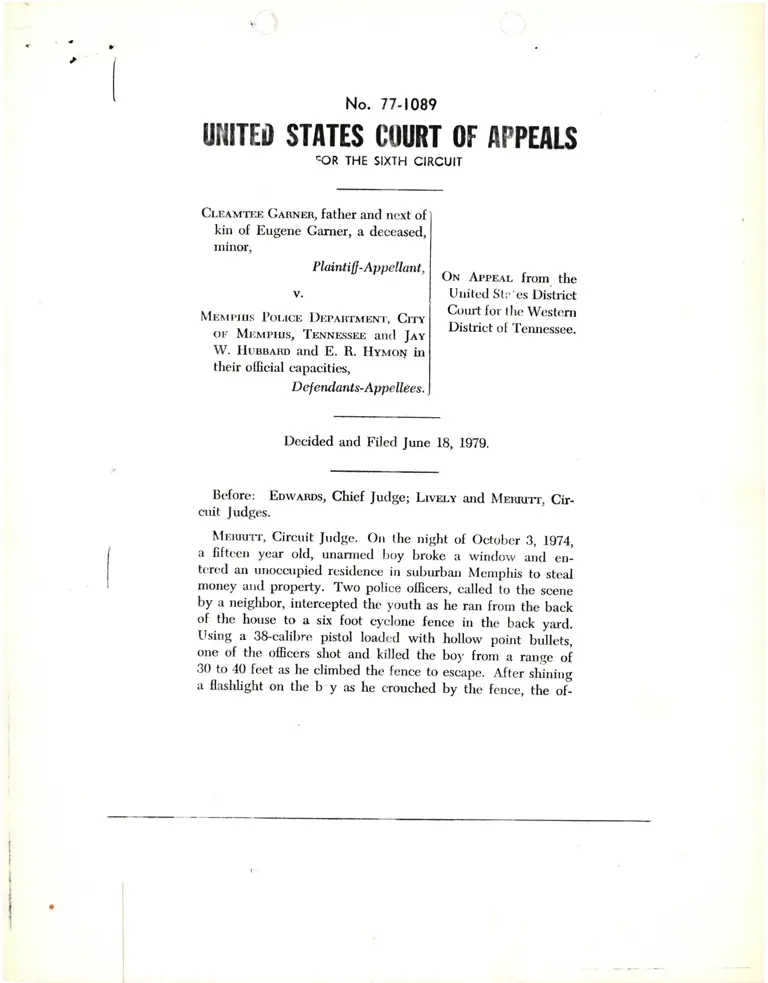
No. 77-1089
UNITEO STATES COURT OF APPEALS
"■-OR THE SIXTH CIRCUIT
Clei\m ti:e (Earner, father and next of
kin of Eugene Gamer, a deceased,
minor,
Pluintiff-Appellant,
V.
M em I'JUS 1’o u c e 13epa rtm en t , C ity
OE MiOMi’ins, T ennessee and Jay
W. IluRBARD and E. R. Hymoi ̂ in
their official capacities.
Defendants-Appellees.
O n Appeal from the
United Slc'es District
Court for the Western
District of Teimessee.
Decided and Filed June 18, 1979.
Before: Edwaiujs, Chief Judge; L ively aiid M erritt, Cir
cuit Judges.
M erritt, Circuit Judge. On the night of October 3, 1974,
a fifteen year old, unanned boy broke a window and en
tered an unoccupied residence in suburban Memphis to steal
money and property. Two police officers, called to the scene
by a neighbor, intercepted the youth as he ran from the back
of the house to a six foot cyclone fence in the back ytud.
Using a 38-calibre pistol loaded with hollow point bullets,
one of the officers shot and killed the boy from a range of
30 to 40 feet as he climbed the fence to escape. After shining
a flashhght on the b y as he crouched by tlie fence, the of-
ficer identified himself as a policeman and yelled “Halt.” He
could see that the fleeing felon was a youth and was apparent
ly unarmed. As the boy jumped to get over the fence, the
officer fired at the upper part of the body, as he was trained
to do by his superiors at the Memphis Police Department.
He shot because he believed the boy would elude capture in
the dark ouc-e he was over the fence. The officer was taught
that it was proper to kill a fleeing felon rather than run
the risk of allowing him to escape.
The Dis-inct Court dismissed the suit of decedent’s father
brought against the City under 42 U.S.C. § 1983 (1976) to
rec-over damages for vTongful death caused by claimed con
stitutional violations of the fourth, eighth and fourteenth
amendments. In accordance with then existing law, the Dis
trict Court held that a city is not a “person” subject to suit
under § 1983; but Monroe v. Pape, 3C1 U.S. 167 (1961), in
which the Supreme Court so ruled, was overruled on this
point last term by the case of Monell v. Department of Social
Services, 436 U.S. 658 (1978). Following a bench trial, the
District Court also dismissed the case against the officer and
his superiors holding, in accordance with our decisions in
B eechv. Melancon, 465 F.2d 425 ( 6th Cir. 1972), cert, denied,
409 U.S. 1114 (1973); Qualls v. Parrish, 534 F.2d 690 ( 6th Cir.
1976); am’ W iley v. Memphis Police Department, 548 F.2d
1247 (6th Cir.), cert, denied, 434 U.S. 822 (1977), that the
officers acted in good faith reliance on Tennessee law which
allows an officer to kill a fleeing felon rather than nin the
risk of allowing him to escape apprehension.
W e conclude that the District Court did not err in finding
that the individual defendants acted in good faith reliance
on Tenn . C ode A n .v . § 40-808 which provides that an officer
“may use all the necessary means to effect the arrest” of a
fleeing felon. As our previous cases, cited above, point out,
Tennessee cornls have interpreted this statute as a codification
oi the common law rule allowing officers to kill fleeing felons
rather than run the risk of permitting them to escape ap
2 Garner v. Memphis Police Department, et al. No. 77-1GJ9
prehension. This rule applies to fleeing felons suspected of
property crimes not endangering human fife, as well as life-
endangering crimes, and to fp’ ons who pose no threat of
bodily harm to others, if not apprehended immediately, as
well as felons who may be dangerovL to others if left at large.
Applying the qualified “good faith” privilege or immunit)-
from liabilih- for constitutional claims, as announced in our
previous decisions cited abo\e, we affirm that portion of the
District Court's judgment dismissing the case against the in
dividual defendants.
W e reverse and remand the case against the Cit)’, how
ever, far reconsideration by the District Court in light of
Monell V. Department of Social Services, supra. Monell holds
that a city may be held liable in damages under § 1983 for
constitutional deprivatio"s that result from a “policy or cus
tom” followed by the city. 436 U.S. at 694 and n.66.
Our pre\'ious decisions do not establish the constitutionality’
of T en x . C ode A x x . § 40-808, permitting a city to authorize
its officers to use deadh- force against a fleeing felon, nor
have they e‘‘*^ablished the constitutionality of the ciU’’s use of
hollow point bullets. Although there is discussion of the
constitutionality c : the Tennessee statute in the Beech, Qualls
and Wiley cases, supra, all tlnee of those cases dealt with ac
tions against individ’ ial officers under § 1983, and not liabili
ty based on tĥ ' “policy or custom” of a governmental entity.
Those cases held that it “would be unfair” to impose liability’
on an officer "who relied, in good faith, upon the settled law
of his state that relie\’ed him from liability for the particular
acts perfonned in his official capacity.” Qualls v. Parrish, supra
at 694, quoted in Wiley v. Memphis Police Department, supra
at 12.53. The essential bolding of those cases was that an in-
di\idual officer has a qualified pri\'ilege or immimity from
liability for constitutional claims based on good faith per
formance oi Iris duties in accordance with statutorv or admin
istrative authority, a holding subsequentlv approved by’ the
Supreme Court in Butz v. Economou, 438 U.S. 478, 496-508
No. 77-1089 Garner v. Memphis Police Department, et al. 3
(1978). Although the qualified immunity developed in those
cases insulates the oflBcers and officials from personal liability
in this case, as the District Court held, the following ques
tions in the case against the city are still open under Monell:
1. Does a municipahty have a similar qualified immuni-
t)' or privilege based on good faith under Monell?’
2. If not, is a municipality’s use of deadly force under
Tennessee law to capture allegedly nondangerous
felons fleeing from nonviolent crimes constitutionally
permissible under the fomth, sixth, eighth and four
teenth amendments?®
3. Is the municipahty’s use of hollow point buUets con
stitutionally permissible under these provisions of the
Constitution?® . v
4. If til' municipal conduct in any of these respects vi
olates the Constitution, did the conduct flow from a
“policy or custom” for which <-he City is liable in
damages under Monell?^
4 Garner v. Memphis Police Department, et al. No. 77-1089
J
’ See discussion of this question in Leite v. City of Providence, 463
F. Supp. 585, 588 (D. R.I. 1978).
2 See generally Coker v. Georgia, 433 U.S. 584 (1977); Ingraham
V. Wright, U.S. 651 (1977); Gregg v. Georgia, 428 U.S. 153
(1976): Furman v. Georgia. 408 U.S. 238 (1972): Landrum v. Moats,
576 F.2h 1320 (8th Cir.), cert, denied, 99 S.Ct. 282 (1978); Mattis v.
Schnarr, 547 F.2d 1007 (8th Cir. 1976), vacated as advisory opinion
sub nom. Ashcroft v. Mattis, 431 U.S. 171 (1977); Jones v. Marshall,
528 F.2d 132 (2d Cir. 1975); Day, Shooting the Fleeing Felon: State
of the Law. 14 Crim . L. Bull. 285 (1978); Comment, Deadly Force to
Arrest: Triggering Constitutional Review, 11 Harv. C. R. — C. L. L.
Rev. 361 (1976).
3 See generally Paust, Does Your Police Force Use Illegal Weapons?
A Configurative Approach to Decision Integrating International and
Domestic Law, 18 Harv. Int’l L.J. 19 (1977).
4 On the question of “policy or custom,” police records are said
to show, according to reports we do not find in this record, that
during the preceding eight years Memphis police officers killed
seventeen fleeing burglary suspects; thirteen were black and five
were youths. According to the same rep>orts, Memphis police of
ficers killed twenty-four individuals during this period in connec
tion with crimes of violence or in self-defense; they attempted to
use deadly force on 177 occasions, 114 of which were in connection
W e remand the case against the City to the District Court
for reconsideration in light of Monell, including consideration
of these questions.
No. 77-1089 Gamer v. Memphis Police Department, et al. c
with property crimes. See the original certified appellate record,
document 45, in Wiley V. Memphis Police Dep’t, 548 F.2d 1247 (6th
Cir.), cert, denied, 434 U.S. 822 (1977), as summarized in Comment,
Deadly Force to Arrest: Triggering Constitutional Review, 11 Harv.
C. R. — C. L. L. Rev. 361. 362 n.4 (1976); Report, Term. Adv. Com
mittee to U.S. Civ. Rights Comm’n, Civic Crisis — Civil Challenge:
Police-Community Relations in Memphis 81 (1978).