Correspondence from Steven L. Winter to Walker L. Bailey
Correspondence
October 5, 1979
-
Case Files, Garner Hardbacks. Correspondence from Steven L. Winter to Walker L. Bailey, 1979. 7e7f93d6-26a8-f011-bbd3-000d3a53d084. LDF Archives, Thurgood Marshall Institute. https://ldfrecollection.org/archives/archives-search/archives-item/3ca8266d-944d-4d5e-9639-7572d9e58adb/correspondence-from-steven-l-winter-to-walker-l-bailey. Accessed September 13, 2026.
Copied!
egal efenseF
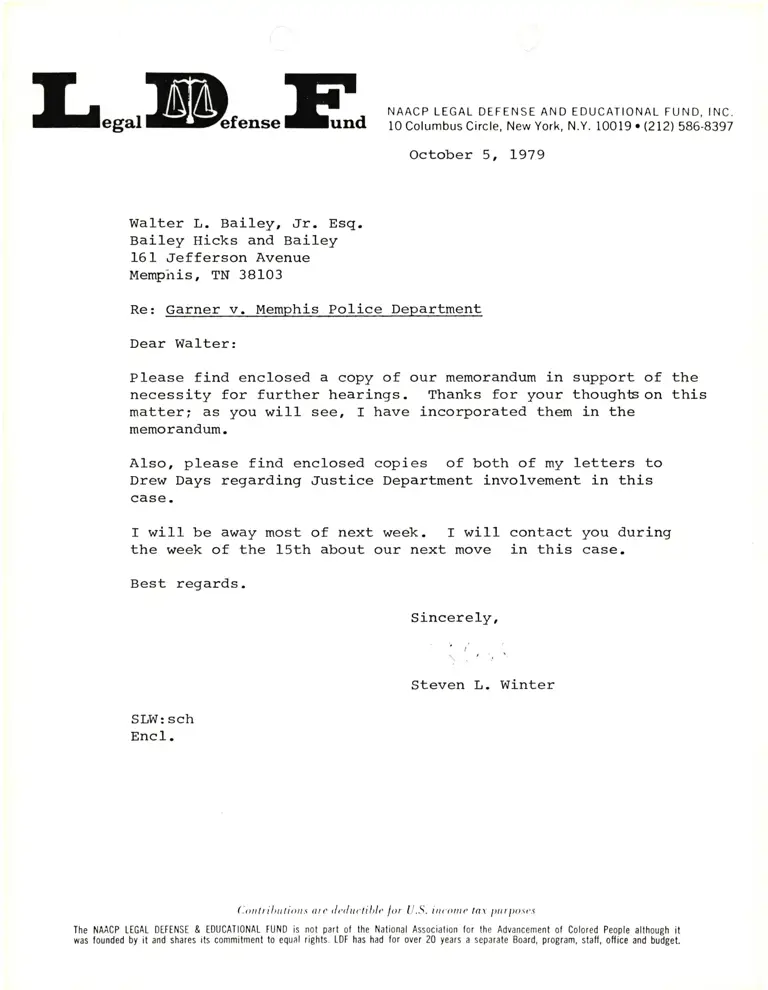
October 5, 1979
N A A C P L E G A L D E F E N S E A N D E D U C A T I O N A L F U N D , I NC.
10 C o l u m b u s Circle, N e w York, N.Y. 10019 • (212) 586-8397
Walter L. Bailey, Jr. Esq.
Bailey Hicks and Bailey
161 Jefferson Avenue
Memphis, TN 38103
Re: Garner v. Memphis Police Department
Dear Walter:
Please find enclosed a copy of our memorandum in support of the
necessity for further hearings. Thanks for your though Is on this
matter; as you will see, I have incorporated them in the
memorandum.
Also, please find enclosed copies of both of my letters to
Drew Days regarding Justice Department involvement in this
case.
I will be away most of next week. I will contact you during
the week of the 15th about our next move in this case.
Best regards.
Sincerely,
I
\ . ' •
Steven L. Winter
SLW:sch
Enel.
(lonlt ihiitiiws (U r ilrili ic lihir for (/..S', iiiroinr ln\ pinposcs
The NAACP LEGAL DEFENSE & EDUCATIONAL FUND is not part of the National Association for the Advancement of Colored People although it
was founded by it and shares its commitment to equal rights. LDF has had for over 20 years a separate Board, program, staff, office and budget.
egal efenseF
October 5, 1979
NAACP LEGAL DEFENSE AND EDUC ATIONAL FUND, INC.
10 C o l u m b u s Circle, N e w York, N.Y. 10019 • (212) 586-8397
Hon. J. Franklin Reid
Clerk, U. S. District Court
for the Western District of Tennessee
Western Division
950 Federal Building
Memphis, TN 38103
Re: Garner v. Memphis Police Department et al Civ.No. C-75-145
Dear Sir:
Please find enclosed the original and one copy of Plaintiff s
Memorandum in Support of the Necessity for Further Hearings
in the above-noted case. Also enclosed are two copies of a
letter to the Hon. Harry W. Wellford. Please file them in
accordance with the local rules.
Thank you prompt attention in this matter.
Sincerely, r
I r
Steven L. Winter
SLW:sch
Enclosures
cc: Walter L. Bailey, Jr. Esq.
(. iw li i hiil io iis it ir i lc i li ii l i l i l r jor V.S. i i i rom r lax jaitixxsrs
The NAACP LEGAL DEFENSE & EDUCATIONAL FUND is not part of the National Association for the Advancement of Colored People allhough it
was founded by it and shares its commitment to equal rights. LDF has had for over 20 years a separate Board, program, staff, office and budget.
egal efenseF■ ■ l u n d N A A C P L E G A L D E F E N S E A N D E D U C A T I O N A L F U N D , I NC.
10 C o l u m b u s Circle, N e w York, N.Y. 10019 • (212) 586-8397
October 5, 1979
The Hon. Harry W. Wellford
United States District Judge
for the Western District of Tennessee
957 Federal Building
Memphis, TN 38103
Re: Garner v. Memphis Police Department Civ. No. C-75-145
Dear Judge Wellford;
Please find enclosed two copies of Plaintiff's Memorandum
in Support of the Necessity for Further Hearings in the
above-noted case.
Sincerely,
I
// I. ̂̂ - V,.
Steven L. Winter
SLW:sch
cc: Walter L. Bailey, Jr., Esq.
Henry L. Klein, Esq.
Enel.
( .null ilnilioiis a ir ilrilurlihir jo r ILS. nuotm' lax jaiiposes
The NAACP LEGAL DEFENSE & EDUCATIONAL FUND is not part of the National Association for the Advancement of Colored People although it
was founded by it and shares its commitment to equal rights. LDF has had for over 20 years a separate Board, program, staff, office and budget.
IN THE UNITED STATES DISTRICT COURT
FOR THE WESTERN DISTRICT OF TENNESSEE
WESTERN DIVISION
CLEAMTEE GARNER, father and
next of kin of EDWARD
EUGENE GARNER, a deceased
minor.
X
Plaintiff,
V.
MEMPHIS POLICE DEPARTMENT; CITY
OF MEMPHIS, TENNESSEE; WYETH
CHANDLER, Mayor of Memphis,
and JAY W. HUBBARD, Director
of Memphis Police,
Defendants.
Civil Action No. C-75-145
X
PLAINTIFF'S MEMORANDUM IN SUPPORT OF THE
NECESSITY FOR FURTHER HEARINGS
On August 10, 1979, this Court invited the parties to
submit memoranda regarding whether further hearings are nec
essary for the determination of the issues presented on remand.
Plaintiff respectfully submits that further hearings are nec
essary. It appears that they were contemplated by the Sixth
Circuit in ordering a remand.
It is necessary to distinguish between the nature of
the case on remand and the posture of the case as it was before
this Court previously and on appeal. Previously, the case fo- |icused on the question of the constitutionality of the acts of j
the individual defendant. Officer Hymon. There was some |
evidence adduced relating to the policies and practices of the ,I
municipal defendants and the effects of those policies on the j
j
conduct of Officer Hymon. However, this aspect of the case was
secondary to the case against the individual officer.
In contrast, in its current posture, the case is
purely one involving questions of systemic practices relating
to the use of deadly force by Memphis police officers. If the
Court is to decide the systemic case, it must have systemic
evidence. Plaintiff should be afforded the opportunity to
supplement the record so that this Court can be provided with
the necessary factual background to decide the difficult consti
tutional issues of this case.
A. The Scope of The Issues Presented on Remand
The four general questions noted by the Sixth Circuit ido not exhaustively define the issues that remain to be liti
gated. Rather, the panel opinion itself recognized the complex ̂
nature of these questions. In remanding the case to the district
court, it did not limit the remand to the four listed questions.
Rather, it merely indicated that those four questions remain
open after Monell. It remanded the case "for reconsideration in
light of Monell, including consideration of these questions."
Garner v. Memphis Police Dept., 60Q F.2d 52, 55 (6th Cir, 1979)
(emphasis added).
Analysis of the issues suggested by the four general
questions in turn suggests areas in need of further factual
development. For example, in its second question, the Sixth
Circuit indicated that the constitutionality of the use of
deadly force under the Fourteenth Amendm.ent is still an open
question. Plaintiff needs to be able to develop further
evidence regarding the race of the victims and potential victims
and the relevant circumstances in all incidents involving the
use of deadly force by Memphis police officers in order to
ascertain whether there is a Fourteenth Amendment violation.
There was evidence in the prior hearing that officers were,
essentially, instructed to use their own judgment in determining
when to use deadly force. If the leaving of this discretion to
the individual officer in fact results in proportionately more
blacks being shot than whites, controlling for similar cir-
- 2 -
cumstances, than it can be said that the municipal policy
caused a constitutional violation. Avery v. State of
Georgia, 345 U.S. 559, 562 (1953)(discrimination in jury
selection); Rowe v. General Motors Corp., 457 F.2d 348, 359
(5th Cir. 1972)(Title VII: subjective determinations "are a
ready mechanism for discrimination").
Indeed, the Sixth Circuit was plainly concerned by
this aspect of the case and contemplated the supplementation
of the record. This was evidenced by the questions asked from
the bench at oral argument and the discussion of the racial
breakdown of the victims of Memphis police shootings in the
panel's opinion. 600 F.2d at 55 n. 4. The court indicated
that "[o]n the question of 'policy or custom,'" the record in
this case was deficient in that it failed to provide the facts
regarding the incidence of the use of deadly force by Memphis
police officers, the numbers of resulting fatalities, and the
circ\amstances of those deaths, including the race and alleged
crimes of the victims. Id.
B. The Relevance of Supplemental Evidence on The
Practices And Policies of Other Police
Departments
The Sixth Circuit's second question also suggests
another area in which the record needs to be supplemented. In
determining whether the use of deadly force to stop an unarmed
fleeing felon is unconstitutionally excessive, cf, Coker v,
Georgia, 433 U.S. 584 (1977), or "shocks the conscience,"cf.
Rochin v. California, 343 U.S. 165 (1952), the Court must first
develop some standard against which this policy can be measured.
Plaintiff must have the opportunity to develop evidence to
enable the Court to formulate these standards. The testimony of
experts and other evidence relating to the practices and
policies of other police departments will be helpful to
establish the enlightened professional judgment of police pro
I
- 3 -
fessionals necessary to aid the Court in establishing these
stardards. !
Evidence of practices of other police departments will |
also be relevant to the other questions posed by the circuit
court. Data on the use of hollow point bullets by other
(3,0partments will be relevant to establish both the effects of
the use of hollow points— whether they result in increased
fatality rates— and the standards by which their acceptibility
may be judged.
The practice of other departments in terms of policies
and training will also be relevant to the applicability,as I
opposed to the availability/ of a good faith defense. That is,
if a good faith immunity defense is available as a matter of
legal principle— a question now sub judice in the Supreme Court,
Owen V. City of Independence, M o c e r t . granted 48 U.S.L.W. 3189
(1979),— the question still remains whether it is available in
this case. This will turn on the factual findings regarding
defendants' conduct. For example, if it can be shown that
defendants' conduct in inadequately training Memphis police
Qfficeirs in the use of deadly force caused the constitutional
violation, the question will still remain whether the municipal
conduct or "policy" was so inadequate as to preclude application
of the good faith defense. This could be shown, for example, by
proof that the training given Memphis police officers was so
far below the standards accepted in police departments around
the country that it gives rise to the inference that the
defendant was deliberately indifferent to the effects of those
failings on the victims. Of course, this could only be proven
if plaintiff is allowed to develop further evidence on the
training afforded in Memphis and the extent of training else
where .
C. Other Factual Issues
Other factual questions remain, For example, there
- 4 -
is the question whether the training provided to Memphis
officers in alternatives to deadly force is inadequate and
whether it results in the use of deadly force in situations,
such as the instant case, where it was not necessary. The
Sixth Circuit merely held that the individual officer had a
good faith defense based on the fact that he used deadly force
to "apprehend" a fleeing felon as he was taught. It did not
indicate that the use of such force was justified in the
instant case. The question of adequate training in this regard,
as compared to the standards evidenced by the practices of
other departments, is, thus, still open.
Still further factual issues are suggested by the
Sixth Circuit's fourth question, which defendants concede is a
factual one. First, there is the question of causation. Do the
policies noted above result in the shooting deaths of unarmed
fleeing felons? Second, there is the question of the interplay
between the use of hollow points and the training afforded
Memphis police officers in the use of deadly force. The Court
did not previously address the question whether the interplay
between the use of hollow points and the fact that officers
are trained to shoot at the torso causes an unreasonable and
unjustifiable risk of death. Finally, there is the question
whether there is an unspoken policy, deduced by the officers
from the type and content of their training, that officers who
use their guns should shoot to kill. In Wiley v. Memphis Police;
Department, 548 F .2d 1247 (6th Cir. 1977), the court quoted :
I
the district court's opinion which indicated that the |
defendants— |
I
testified that they shot without
attempting to wound or incapacitate the
fleeing two, and that they were
trained whenever they use their
firearms to "shoot to kill. "
Id. at 1250.Plaintiff should be afforded the opportunity to show
- 5 -
the existence of such a policy and that it causes the un
warranted deaths of unarmed fleeing felons.
Plaintiff does not dispute the defendants' assertion
that this Court will ultimately have to decide issues of law.
But the issues in this case are better characterized as mixed
issues of fact and law. Plaintiff contends that he must be
afforded the opportunity to put on all the evidence relevant
to the determination and application of those complex issues.
Accordingly, plaintiff respectfully submits that further
discovery and hearing are necessary to resolve the questions
posed by the Sixth Circuit on remand.
Respectfully submitted,
STEVEN L. WINTER
10 Columbus Circle
Suite 2030
New York, N.Y. 10019
WALTER LEE BAILEY, JR.
161 Jefferson Avenue
Suite 901, Tenoke Bldg.
Memphis, Tennessee 38103
Attorneys for Plaintiff
CERTIETCATE OF SURVLCE
1 hereby certify that a copy of the foregoing PLAIN
TIFF'S MEMORANDUM IN SUPPORT OF THE NECESSITY FOR FURTHER
HEARINGS has been served by United States mail, postage pre- j
paid, to Henry L. Klein, Esq., 100 No. Main Building, Suite 3500,
1Memphis, Tennessee 38103, this 5th day of October, 1979. |
Steven L. Winter